Loading related

Loading event involving an Airbus A330, VH-QPJ, at Bangkok, Thailand, on 23 July 2015

Final report

What happened

On 23 July 2015, an Airbus A330 aircraft, registered VH-QPJ and operated by Qantas Airways, was being loaded at Bangkok Airport, Thailand, prior to flying to Sydney, Australia. The ground-handling agent (and loading supervisor) was in Bangkok, and the load controller was in Warsaw, Poland.

The load instruction report (LIR) displayed a pictorial representation of the planned uplift. To maximise uplift within the aircraft’s operational limitations, the report contained a set of loading instructions. These instructions identify positions within the aircraft hold for loading containers, baggage and freight.

The load controller in Warsaw issued a load instruction report (LIR) to the loading supervisor in Bangkok (Figure 1). The loading supervisor was required to load the aircraft in accordance with the LIR. The LIR also contained ‘Special instructions’ and ‘Special load details’. The Special instructions for QF24 stated that the freight pallet shown on the LIR in position 23P was on standby. The loading supervisor then called the load controller by telephone to provide a ‘partial read back’. The supervisor read back to the controller how the aircraft had been loaded, based on the LIR.

The loading supervisor commenced by reading out the description and weight of the pallet loaded into position 23P. The load controller responded that the pallet in 23P was on standby as per the Special instructions, and directed the loading supervisor to offload that freight. The supervisor responded ‘yes’, and stated that the loading was in accordance with the LIR. The loading supervisor then continued to read the loading to the controller, again commencing with the pallet in 23P, followed by the rest of the loaded freight. The pallet in 23P remained loaded on the aircraft.

Figure 1: Load instruction report showing freight positions and special instructions
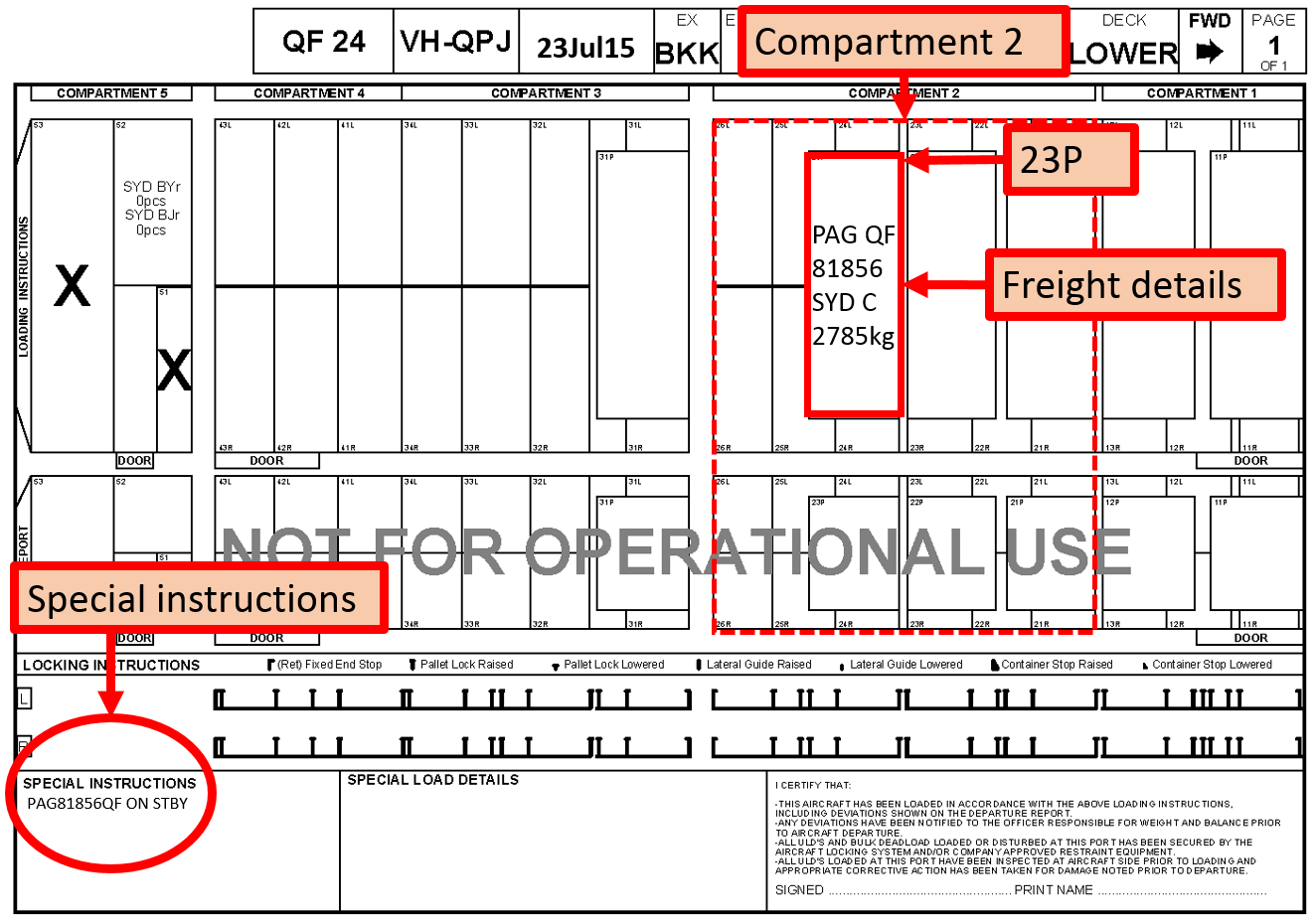
Figure 1: Load instruction report showing freight positions and special instructions

Source: Aircraft operator

After completion of the loading, the loading supervisor again phoned the load controller to provide the final read back of the loading. The loading supervisor stated ‘forward compartment no change’, to which the load controller responded clarifying position 23P was ‘no fit’[1]. The loading supervisor replied, ‘yeah, no change’ and the load controller responded ‘ok’.

The load controller then prepared the final load sheet for the flight, based on the information provided over the phone by the loading supervisor. The load controller transmitted the final load sheet to the flight crew via the Aircraft Communications Addressing and Reporting System (ACARS). The load sheet included the calculated aircraft total and component weights including fuel, passenger, baggage and freight weights. It also provided the aircraft balance details including the aircraft take-off trim setting position.

The flight crew then used this data to calculate reference speeds for take-off, fuel consumption rates, and initial climb altitude. At about midday local time, the aircraft departed Bangkok for Sydney and the flight crew did not detect any abnormal flight characteristics, nor did they receive any warnings related to the aircraft’s weight or balance.

After the flight had closed, the load control system automatically generated a Container Pallet Message (CPM) report. The report was based on the input from the load controller, and therefore did not include the pallet in 23P. The loading supervisor identified that the pallet in 23P was not on this report and contacted the load controller. The load controller confirmed that the pallet should have been offloaded, and was therefore not included in the uplift weight calculations. The load controller then contacted the Qantas Integrated Operations Control (IOC) in Sydney and advised them that a pallet had been loaded onto the aircraft, which was not included in the load sheet, and that some operational limitations had been exceeded.

About 75 minutes after the aircraft departed from Bangkok, the IOC advised the aircraft flight crew of the error. The flight crew entered the amended aircraft weight into the flight management computer.

Load discrepancy

The weight of the standby pallet for 23P indicated on the LIR was 2,785 kg. The final load sheet indicated 1,225 kg of freight in compartment 2. Compartment 2, depicted in Figure 1, included a number of freight positions including 23P. The calculation for total freight weight in Compartment 2 was based on freight loaded in positions 26L (615 kg), 26R (610 kg) and zero in 23P.

Based on the final load sheet, the taxi weight was calculated to be 235,485 kg (maximum 233,900 kg) and the take-off weight was 232,300 kg (maximum 233,000 kg).

As a result of the discrepancies, Qantas advised that the maximum taxi weight had been exceeded by 1,585 kg, and the maximum take-off weight by 2,085 kg. The initial cruise altitude of 35,000 ft did not exceed the maximum altitude when the actual weight was subsequently entered into the aircraft flight management computer.

Qantas investigation

Qantas conducted an investigation into the incident, which included a review of the transfer of load control operations to Warsaw (from its previous location in Hong Kong), the systems supporting the load controller and loading supervisor, and their individual actions.

The investigation identified a number of safety factors that contributed to the incident. These included the following.

Depiction of standby freight

The load controller represented the standby freight as listed on the LIR, with the freight depicted in the loaded position, and a standby notation included in the Special Instructions box. The Qantas investigation found that was not a documented procedure for handling standby freight, but it was an accepted practice. The training of loading supervisors did not include how standby freight was to be documented on the LIR.

Communication

The communications between the loading supervisor and load controller were open to misinterpretation, had ambiguous phraseology, untimely transmissions, and did not involve a read-back hear-back process.

During the partial read back, the offload instruction caused confusion as to whether the pallet in 23P was to be loaded or not, and that confusion was not resolved.

During the final read back, a misunderstanding resulted from the load controller’s use of the phrase ‘no fit’, meaning not loaded, and the loading supervisor’s use of the phrase ‘no change’ meaning no change to the loading depicted on the LIR.

Training

Irregularities were identified with the training regarding LIR presentation and interpretation. Specifically, the training on procedures for handling standby items provided to load controllers did not cross-reference the training provided to loading supervisors and vice versa.

Safety actions

Whether or not the ATSB identifies safety issues in the course of an investigation, relevant organisations may proactively initiate safety action in order to reduce their safety risk. The ATSB has been advised of the following proactive safety action in response to this occurrence.

Aircraft operator

As a result of this occurrence, Qantas advised the ATSB that they are taking the following safety actions:

Immediate action taken

For all flights out of Bangkok, the loading supervisor must receive a scanned copy of the final LIR before transmitting the final load sheet to the flight crew (by ACARS).

Standard phraseology is to be used for all read back communications.

Standby freight procedure

Load Control will document the following:

  • procedures for listing standby freight in the LIR Special Instructions
  • use of LIR Special Instructions
  • sample communications for instructions to offload and the required response from loading supervisors.
Training

The training provided to load controllers and loading supervisors was to be coordinated. The training procedures will include a standardised process for handling standby freight.

A process for updating load control training material will also be implemented.

Firstload

An automated read back system, ‘Firstload’, is scheduled to be introduced to Bangkok and other international ports in November 2015. Firstload is an iPad-generated LIR and read back system. Implementation of the system will remove the requirement for verbal read backs.

Safety message

This incident highlights the importance, particularly when dealing with safety-critical data, for:

  • standard phraseology in verbal communications
  • ensuring a verbal instruction has been understood and complied with
  • validating verbal communication with written documentation.

The ATSB SafetyWatch highlights the broad safety concerns that come out of our investigation findings and from the occurrence data reported to us by industry. One of the safety concerns is data input errors.

Data input errors, such as the wrong figure being used, happen for many reasons. The consequences of these errors can range from aborted take-offs, to collisions with the ground. More information is available in the ATSB safety research report, Take-off performance calculation and entry errors: A global perspective.

Aviation Short Investigations Bulletin - Issue 45

Purpose of safety investigations

The objective of a safety investigation is to enhance transport safety. This is done through:

  • identifying safety issues and facilitating safety action to address those issues
  • providing information about occurrences and their associated safety factors to facilitate learning within the transport industry.

It is not a function of the ATSB to apportion blame or provide a means for determining liability. At the same time, an investigation report must include factual material of sufficient weight to support the analysis and findings. At all times the ATSB endeavours to balance the use of material that could imply adverse comment with the need to properly explain what happened, and why, in a fair and unbiased manner. The ATSB does not investigate for the purpose of taking administrative, regulatory or criminal action.

Terminology

An explanation of terminology used in ATSB investigation reports is available here. This includes terms such as occurrence, contributing factor, other factor that increased risk, and safety issue.

Publishing information 

Released in accordance with section 25 of the Transport Safety Investigation Act 2003

Published by: Australian Transport Safety Bureau

© Commonwealth of Australia 2015

image_5.png

Ownership of intellectual property rights in this publication

Unless otherwise noted, copyright (and any other intellectual property rights, if any) in this report publication is owned by the Commonwealth of Australia.

Creative Commons licence

With the exception of the Coat of Arms, ATSB logo, and photos and graphics in which a third party holds copyright, this publication is licensed under a Creative Commons Attribution 3.0 Australia licence.

Creative Commons Attribution 3.0 Australia Licence is a standard form licence agreement that allows you to copy, distribute, transmit and adapt this publication provided that you attribute the work.

The ATSB’s preference is that you attribute this publication (and any material sourced from it) using the following wording: Source: Australian Transport Safety Bureau

Copyright in material obtained from other agencies, private individuals or organisations, belongs to those agencies, individuals or organisations. Where you wish to use their material, you will need to contact them directly.

__________

  1. No fit means that the position is empty.


Occurrence summary

Investigation number AO-2015-088
Occurrence date 23/07/2015
Location Suvarnabhumi Airport (Bangkok)
State International
Report release date 22/12/2015
Report status Final
Investigation level Short
Investigation type Occurrence Investigation
Investigation status Completed
Mode of transport Aviation
Aviation occurrence category Loading related
Occurrence class Incident
Highest injury level None

Aircraft details

Manufacturer Airbus
Model A330-303
Registration VH-QPJ
Serial number 0712
Aircraft operator Qantas Airways
Sector Jet
Operation type Air Transport High Capacity
Departure point Bangkok, Thailand
Destination Sydney, NSW
Damage Nil

Loading related involving a Boeing 727-277, VH-RMX, Enroute Melbourne to Perth, Victoria, on 22 December 1993

Summary

The captain reported that at flight planned optimum cruise altitude the aircraft failed to meet expected cruise performance. When the aircraft arrived at Perth a re-weigh of the payload was requested. The re-weigh showed that the payload was approximately 3500 kg more than was indicated on the loading documentation. This meant that the aircraft had been operated at weights in excess of its maximum zero fuel weight and maximum brakes release weight.

The investigation revealed that four unrelated factors had contributed to the overloading of the aircraft.

  • The first involved accepting freight from another air freight company on the basis of the weights provided by that company and not re-weighing the freight to check the weights.
  • The second involved weighing freight on scales with which the airfreight personnel were not familiar and not properly positioning the freight trolleys on the scales.
  • The third involved a communication breakdown between loading personnel which resulted in freight being loaded on the aircraft that was not included in the loading documentation.
  • The final factor was minor in nature and involved last minute removal and addition of freight from/into containers without accurate adjustments being made to the loading documentation. The company has addressed these problems and taken corrective action to prevent a recurrence.

Occurrence summary

Investigation number 199304273
Occurrence date 22/12/1993
Location Enroute Melbourne to Perth
State Victoria
Report release date 14/06/1994
Report status Final
Investigation type Occurrence Investigation
Investigation status Completed
Mode of transport Aviation
Aviation occurrence category Loading related
Occurrence class Incident

Aircraft details

Manufacturer The Boeing Company
Model 727-277
Registration VH-RMX
Sector Jet
Operation type Air Transport High Capacity
Departure point Melbourne VIC
Destination Perth WA
Damage Nil

Loading related involving a McDonnell Douglas DC9-33F, VH-IPC, Melbourne, Victoria, on 13 May 1998

Summary

The aircraft was being prepared for a freight flight with newspapers included as part of a standard load for this service. Normally the newspaper publisher informed the operator of the weight of the consignment and the newspapers would arrive at the airport in sufficient time to ensure an on time departure. However, on this occasion, the consignment was delayed. The duty manager decided to delay the flight's departure to await the arrival of the newspapers.

The aircraft's upper deck and Compartment 1 of the lower deck had been loaded, and the manager intended to load the newspapers in the rear compartment of the lower deck in which 670 kg of weight allowance was available. The duty manager had the newspapers weighed and found them to be heavier than normal at a weight of 1,070 kg. He reported that he had informed the captain that the consignment was 400 kg overweight but the captain later stated that he had not been told of the discrepancy. The newspapers were loaded and the aircraft departed 20 minutes later than its scheduled departure time. The loading crew at the destination opened Compartment 1 and noted the Universal Loading Device (ULD) tag as showing the weight of an item of cargo as 87 kg.

The crew did not believe this figure and checked the weight at 277 kg. The loading crew then opened the rear compartment and noted a ULD tag showing a cargo weight of 607 kg. They again checked the weight and found 1,172 kg of newspapers and 78 kg of other freight. The net effect of these discrepancies was that the aircraft was heavier than its maximum zero fuel weight limit and that the centre of gravity was aft of its computed position, although within limits. The flight crew reported that the flight was normal and free from any noticeable abnormalities in aircraft performance or handling.

Since the occurrence, the operator has replaced the ULD tags with new "user friendly" tags designed to reduce the probability of error. The reason the crew were unaware of the excess load could not be determined.

Occurrence summary

Investigation number 199801956
Occurrence date 13/05/1998
Location Melbourne
State Victoria
Report release date 11/07/1998
Report status Final
Investigation type Occurrence Investigation
Investigation status Completed
Mode of transport Aviation
Aviation occurrence category Loading related
Occurrence class Incident

Aircraft details

Manufacturer McDonnell Douglas Corp.
Model DC9-33F
Registration VH-IPC
Sector Jet
Operation type Air Transport High Capacity
Departure point Melbourne Vic.
Destination Launceston Tas.
Damage Nil

Loading related involving a Boeing 767-238, VH-EAJ, Sydney Aerodrome, New South Wales, on 13 February 1998

Summary

The Boeing B767 aircraft was operating an RPT passenger service from Sydney direct to Perth. As the aircraft was rotated for lift-off the co-pilot, who was the handling pilot for the flight, found that the aircraft was very nose heavy. The crew contacted load control and requested a loading check. The check disclosed that 400 kg of cargo had been loaded into position 11, the most forward bay, and this load had not been entered into the loading data. The crew received revised stabiliser trim settings which were confirmed during the arrival into Perth.

The investigation found that the load controller had established what load had to be loaded onto the aircraft and had made the relevant weight and balance computations. However, the load controller had not locked out the computer field related to freight as is required by the relevant procedures. This allowed the aircraft loaders to load the additional cargo and make an entry into the computer.

This entry did not become obvious to the load controller and, because the load controller thought there was no changes to the original computations, the crew were not advised to reconfigure the aircraft. The operator has instituted training procedures designed to improve discipline in the loading system.

Occurrence summary

Investigation number 199800517
Occurrence date 13/02/1998
Location Sydney Aerodrome
State New South Wales
Report release date 18/08/1998
Report status Final
Investigation type Occurrence Investigation
Investigation status Completed
Mode of transport Aviation
Aviation occurrence category Loading related
Occurrence class Incident

Aircraft details

Manufacturer The Boeing Company
Model 767-238
Registration VH-EAJ
Sector Jet
Operation type Air Transport High Capacity
Departure point Sydney NSW
Destination Perth WA
Damage Nil

Loading related involving a Boeing 737-376, VH-TAF, Melbourne Aerodrome, Victoria, on 11 January 1998

Summary

After the aircraft had commenced taxiing for take-off the crew were advised that the aircraft had been loaded out of trim. The aircraft was returned to the gate while adjustments to the load were made. To enable the aircraft to be loaded within the weight and balance limits the load control officer planned for a nil uplift in hold 4. A load instruction report was prepared indicating a nil uplift for hold 4 and was handed to the ramp leading hand. After loading was completed the ramp leading hand presented a ramp clearance report to the load control officer.

It was noted that twenty bags had been loaded into hold 4. Accordingly, the load control officer recalculated the weight and balance, found that the aircraft was out of trim, and recalled the aircraft. The operators procedures require the ramp leading hand to advise the load control officer of any changes before the changes are made. These procedures were not followed and the company has initiated measures to improve discipline in the loading area. The aircraft was operating under a new centralised load control system that allows the aircraft to be released from the gate prior to obtaining a final load clearance.

The final loadsheet data is transmitted by radio to the aircraft and a hard copy is printed on the flight deck by the crew. System safety is assured as final loadsheet data cannot be transmitted by the load control officer until after the passenger and ramp clearances have been received and any loading adjustments made in the system. Also, the system will not produce a loadsheet if the weight or trim is outside limits, and the crew will not be able to configure the aircraft for takeoff without first having received the loadsheet data.

Occurrence summary

Investigation number 199800089
Occurrence date 11/01/1998
Location Melbourne Aerodrome
State Victoria
Report release date 18/08/1998
Report status Final
Investigation type Occurrence Investigation
Investigation status Completed
Mode of transport Aviation
Aviation occurrence category Loading related
Occurrence class Incident

Aircraft details

Manufacturer The Boeing Company
Model 737-376
Registration VH-TAF
Sector Jet
Operation type Air Transport High Capacity
Departure point Melbourne Vic.
Destination Adelaide SA
Damage Nil

Loading event involving a Bombardier DHC-8, VH-LQK, at Brisbane Airport, Queensland, on 25 August 2014

Final report

On 25 August 2014, a QantasLink Bombardier DHC-8 aircraft, registered VH-LQK was being prepared for a scheduled passenger flight to Blackall and then Longreach, from Brisbane Airport, Queensland. Ground handlers loaded bags into the aircraft in accordance with the load instruction report: 12 bags with destination Blackall and 47 bags for Longreach in hold 41; 20 bags for Longreach in hold 42; and nil bags or cargo in locker 11.

A ground handling agent transcribed the baggage information onto a call back card, but indicated there were 12 bags in hold 41 instead of 59 bags. The call back card was then provided to the flight crew, who entered the baggage information into the iPad loading application to complete the final load sheet. 

The aircraft arrived in Blackall at 0915 Eastern Standard Time. A ground handler at Blackall completed the offload reconciliation procedure and identified a discrepancy of 47 bags or 676 kg in hold 41. The aircraft remained within centre of gravity limits and no structural limits were exceeded.

Data input errors, such as the incorrect loading figures being used, occur for many different reasons. The consequences of these errors can include a range of aircraft handling and performance issues.

Accurate weight and balance information is essential for the safety of every flight. Following standard procedures and checklists minimise the potential for error.

Aviaiton Short Investigations Bulletin - Issue 37

Occurrence summary

Investigation number AO-2014-145
Occurrence date 25/08/2014
Location Brisbane Airport
State Queensland
Report release date 23/12/2014
Report status Final
Investigation level Short
Investigation type Occurrence Investigation
Investigation status Completed
Mode of transport Aviation
Aviation occurrence category Loading related
Occurrence class Incident
Highest injury level None

Aircraft details

Manufacturer Bombardier Inc
Model DHC-8-402
Registration VH-LQK
Serial number 4415
Aircraft operator Sunstate Airlines
Sector Turboprop
Operation type Air Transport High Capacity
Departure point Brisbane, Qld
Destination Blackall, Qld
Damage Nil

Loading related events involving a Boeing 737, VH-YIR, Bali, Indonesia, on 26 May 2014 and an Airbus A330, VH-XFE, at Perth, Western Australia, on 16 June 2014

Final report

On 26 May 2014, a Virgin Australia Boeing 737 aircraft, registered VH-YIR, was being loaded at Bali International Airport for a flight to Melbourne, Victoria. The flight had been delayed due to a series of disruptions following the cancellation of the previous day’s flight to Melbourne. A breakdown of the baggage belt at Bali airport exacerbated the difficulty in loading and reconciling passenger baggage. A scheduled airport curfew created time pressure for the ground staff who had to manually re-tag bags on the airport apron. 

The load controller assessed that a total of 93 bags had been loaded onto the aircraft and the flight documents were produced using that figure. About 30 minutes after the aircraft departed Bali, the ground handler advised network operations and load control that the final baggage numbers were incorrect. The total number of bags loaded onto the aircraft was 189 instead of 93, with an estimated additional weight of about 1,600 kg. The load control team leader elected not to advise the flight crew of the discrepancy.

It was later determined that, based on estimates, the aircraft remained within the weight and balance limitations throughout the flight and the additional weight would have had a negligible effect on the aircraft’s take-off performance.

On 15 June 2014, a Virgin Australia Airbus A330 aircraft, registered VH-XFE, was being loaded for a flight from Perth, Western Australia, to Brisbane, Queensland.  The load coordinator printed and distributed the outbound load instructions, on which no outbound items were allocated to the forward hold, but omitted to print the inbound load instructions. The forward hold was not opened or inspected at any time while the aircraft was on the apron at Perth Airport. 

The flight departed at about 2245 Western Standard Time and landed in Brisbane without incident. The flight crew were not aware of any loading or weight and balance issues during the flight. During offloading, ground staff at Brisbane Airport found a crate of freight weighing 1,467 kg in the forward hold that had not been manifested and was supposed to have been offloaded in Perth prior to departure.

Accurate weight and balance information is essential for the safety of every flight. These incidents demonstrate the impact distractions such as time pressure and equipment malfunction can have on the accuracy of that information. Following standard procedures and checklists may minimise the potential for error.

Aviation Short Investigations Bulletin - Issue 36

Occurrence summary

Investigation number AO-2014-110
Occurrence date 26/05/2014
Location Bali International Airport, Indonesia
State International
Report release date 03/12/2014
Report status Final
Investigation level Short
Investigation type Occurrence Investigation
Investigation status Completed
Mode of transport Aviation
Aviation occurrence category Loading related
Occurrence class Incident
Highest injury level None

Aircraft details

Manufacturer The Boeing Company
Model 737-8FE
Registration VH-YIR
Serial number 39925
Aircraft operator Virgin Australia
Sector Jet
Operation type Air Transport High Capacity
Departure point Denpasar, Indonesia
Destination Melbourne, Vic.
Damage Nil

Aircraft details

Manufacturer Airbus
Model A330
Registration VH-XFE
Serial number 1319
Aircraft operator Virgin Australia
Sector Jet
Operation type Air Transport High Capacity
Departure point Perth Airport, WA
Destination Brisbane, Qld
Damage Nil

Loading issue involving a Boeing 737, VH-VZO, at Canberra Airport, Australian Capital Territory, on 9 May 2014

Summary

On 9 May 2014, a Qantas Boeing 737 aircraft, registered VH-VZO and, operating a flight from Canberra, Australian Capital Territory, to Perth, Western Australia, was prepared for departure. On board the aircraft were the crew and 150 passengers, including a group of 87 primary school children. The group of children was seated together at the rear of the cabin and all had been assigned the standard adult weight of 87 kg during check-in.

The captain and first officer conducted the pre-flight checks and waited some time for the final load sheet to be delivered. The load sheet stated the take-off weight as 76,800 kg and the stabiliser trim figure as 5.5 units.

During take-off, the aircraft appeared nose-heavy. To rotate the aircraft and lift off from the runway, the captain found that significant back pressure was required. Conscious of the potential threat of striking the aircraft tail on the runway if too much back pressure was applied to the controls, the captain maintained steady back pressure to ease the aircraft into the air. The aircraft exceeded the calculated take-off safety speed (V2) by about 25 kt. The aircraft climbed at a higher initial climb speed than normal, which resulted in a slightly reduced climb gradient, but the crew did not receive any terrain or other warnings.

The crew did not experience any further issues during the flight. It was subsequently determined that the final load sheet overstated the aircraft take-off weight by about 3.5 to 5 tonnes and the stabiliser trim was out about 1 unit.

Determining accurate weight and balance is required for all aircraft prior to flight. Use of a trim setting that is inappropriate for the aircraft’s actual weight and balance may adversely affect the aircraft’s controllability at any stage of flight.

Aviation Short Investigations Bulletin - Issue 34

Occurrence summary

Investigation number AO-2014-088
Occurrence date 09/05/2014
Location Canberra Airport
State Australian Capital Territory
Report release date 03/09/2014
Report status Final
Investigation level Short
Investigation type Occurrence Investigation
Investigation status Completed
Mode of transport Aviation
Aviation occurrence category Loading related
Occurrence class Incident
Highest injury level None

Aircraft details

Manufacturer The Boeing Company
Model 737-838
Registration VH-VZO
Serial number 34191
Aircraft operator Qantas
Sector Jet
Operation type Air Transport High Capacity
Departure point Canberra, ACT
Destination Perth, WA
Damage Nil

Weight and balance event involving Fairchild SA-227AC, VH-UUO, Melbourne Airport, Victoria, on 30 January 2013

Summary

On 30 January 2013, a Fairchild SA 227AC, registered VH-UUO (UUO), departed Melbourne Airport, Victoria for Launceston Airport, Tasmania on a scheduled freight flight. The pilot was the only person on-board.

The pilot prepared a trim sheet to confirm the weight and balance information for the aircraft, then provided an uplift figure to the freight organisation that prepared a loading plan that they used to load the aircraft.

When the pilot approached the aircraft, the freight had been loaded with all cargo access doors closed and the cargo support strut (tail stand) removed. The pilot completed the pre-flight checks in the cockpit then, removed the wheel chocks and wing tip safety markers and placed them in the main cabin area.

During the take-off, the pilot reported that he needed more forward elevator trim than usual to climb out at a 10 degrees nose-up attitude. The pilot noticed that in straight and level flight, the aircraft had full nose-down trim and the aircraft was flying at a 50 nose-up attitude. When the autopilot was engaged, the pilot reported that the autopilot struggled to maintain straight and level flight and the aircraft ‘porpoised’.

The pilot conducted a normal landing at Launceston and checked the freight located in the nose locker. The pilot estimated that the nose locker contained 35 kg of freight when it should have contained about 100 kg. After off-loading the freight at Launceston, the aircraft was re-loaded for the next flight, to ensure that the aircraft was within the centre of gravity limits.

As a result of this occurrence, the operator has advised the ATSB that they are taking safety action including: develop a plan to provide training for all employees, establish an audit oversight program, establish standard operating procedures for all facets of operation and identify all managers and supervisors that require training or retraining including agents.

Aviation Short Investigation Bulletin Issue 20

Occurrence summary

Investigation number AO-2013-044
Occurrence date 30/01/2013
Location Melbourne Airport
State Victoria
Report release date 28/06/2013
Report status Final
Investigation level Short
Investigation type Occurrence Investigation
Investigation status Completed
Mode of transport Aviation
Aviation occurrence category Loading related
Occurrence class Incident
Highest injury level None

Aircraft details

Manufacturer Fairchild Industries Inc
Model SA227
Registration VH-UUO
Serial number AC 530
Operation type Air Transport Low Capacity
Departure point Melbourne, Vic.
Destination Launceston, Tas.
Damage Nil

Loading issue - Boeing 747-438, VH-OJM, Melbourne Airport, 22 December 2011

Notice

Discontinued

Section 21 (2) of the Transport Safety Investigation Act 2003 (TSI Act) empowers the Australian Transport Safety Bureau (ATSB) to discontinue an investigation into a transport safety matter at any time. Section 21 (3) of the TSI Act requires the ATSB to publish a statement setting out the reasons for discontinuing an investigation.

On 3 January 2012, the ATSB commenced an investigation into a loading issue involving a Boeing Company 747-438 aircraft registered VH-OJM, at Melbourne Airport, Vic, on 22 December 2011. Examination of the information collected during the investigation identified that the circumstances of the occurrence were limited to incorrect load data being entered onto the provisional loadsheet. The discrepancy was identified by the flight crew and amended prior to the final loadsheet being produced.
 
The operator advised the ATSB that they had identified the nature of the error and had put in place measures to prevent its reoccurrence.
 
Accordingly, the ATSB decided that there was limited potential to enhance transport safety by continuing this investigation and has elected to discontinue it. However, the data already collected may be used by the ATSB for future statistical analysis and safety research purposes.

Occurrence summary

Investigation number AO-2012-004
Occurrence date 22/12/2011
Location Melbourne Airport
State Victoria
Report status Discontinued
Investigation level Short
Investigation type Occurrence Investigation
Investigation status Discontinued
Mode of transport Aviation
Aviation occurrence category Loading related
Occurrence class Incident
Highest injury level None

Aircraft details

Manufacturer The Boeing Company
Model 747
Registration VH-OJM
Serial number 25245
Operation type Air Transport High Capacity
Departure point Melbourne, VIC
Destination Sydney, NSW
Damage Nil