Fuel starvation

Fuel starvation, Cessna 172, Gold Coast Airport, Queensland, on 16 March 2022

Brief

Occurrence Briefs are concise reports that detail the facts surrounding a transport safety occurrence, as received in the initial notification and any follow-up enquiries. They provide an opportunity to share safety messages in the absence of an investigation.

What happened

On 16 March 2022, at about 1025 local time, a Cessna 172 RG was on approach to Gold Coast Airport, Queensland. The pilot was conducting a solo navigation training exercise.

As the aircraft approached the circuit area, the pilot actioned the before-landing checks, moving the fuel selector from the RIGHT to BOTH indent. Shortly after, the engine stopped. The pilot assessed that the aircraft was not in a position to glide to the runway and prepared the aircraft to conduct a forced landing onto a beach. They made a MAYDAY call on the Gold Coast Tower frequency. 

An instructor from the same flying school, flying at the time, advised the pilot to ‘check the fuel selector’. The pilot adjusted the position of the selector and felt it click into the BOTH indent and the engine subsequently restarted. The pilot subsequently conducted a normal circuit and landed at Gold Coast Airport.

Maintenance actions

The aircraft’s fuel system was inspected by a licenced aircraft maintenance engineer and no faults were found.

Fuel system

The Cessna 172 RG has an integral fuel tank in both the left and right wing. Fuel is gravity fed to a four-way selector valve, then through a strainer to the engine-driven fuel pump and on to the carburettor. The fuel selector allows fuel to be fed from the left tank, right tank, both fuel tanks, or to be selected to OFF.

The pilot’s operating handbook (POH) stated:

The fuel selector valve should be in the BOTH position for take-off, climb, descent, landing, and maneuvers that involve prolonged slips or skids. Operation from either LEFT or RIGHT tank is reserved for level cruising flight only.

Operator’s investigation

Cessna 172 RG POH top-of-descent and before-landing checklists required the fuel selector valve be selected to BOTH. However, the operator’s internal investigation into the incident identified that neither its top-of-descent nor before-landing checklist accurately reflected this requirement.

The operator conducted a survey of its staff and students and identified that, while the majority were aware of the requirement to ensure the fuel selector was selected to BOTH at the top of descent, a small minority changed tanks as part of the before-landing checklist.

Safety action

As a result of this incident the operator has:

  • held a staff discussion to discuss the incident and standardise procedures based on the POH
  • raised a safety bulletin to highlight the issue and the dangers of changing fuel tanks at low altitudes
  • reviewed and updated the quick reference handbook and abbreviated checklist to follow the manufacturer’s POH
  • briefed all students as part of their pre-flight briefings to ensure awareness of following correct procedures.

Safety message

The ATSB continues to receive reports of engine failures due to fuel starvation. Effective fuel management during flight along with knowledge of the aircraft’s fuel system and proficiency in its use will ensure fuel is continuously supplied to the engine. The ATSB publication, Avoidable Accidents No. 5 - Starved and exhausted: Fuel management aviation accidents (AR-2011-112), is available from the ATSB website.

Operators are advised to ensure their operating procedures and checklist closely align with the aircraft manufacturer’s published materials. This will ensure flight crews consistently operate the aircraft in a method appropriate for the aircraft type. 

About this report

Decisions regarding whether to conduct an investigation, and the scope of an investigation, are based on many factors, including the level of safety benefit likely to be obtained from an investigation. For this occurrence, no investigation has been conducted and the ATSB did not verify the accuracy of the information. A brief description has been written using information supplied in the notification and any follow-up information in order to produce a short summary report, and allow for greater industry awareness of potential safety issues and possible safety actions.

Occurrence summary

Mode of transport Aviation
Occurrence ID AB-2022-001
Occurrence date 16/03/2022
Location Gold Coast Airport
State Queensland
Occurrence class Incident
Aviation occurrence category Fuel starvation
Highest injury level None
Brief release date 01/07/2022

Aircraft details

Manufacturer Cessna Aircraft Company
Model 172 RG
Sector Piston
Operation type Part 141 Recreational, private and commercial pilot flight training
Departure point Gold Coast Airport, Queensland
Destination Gold Coast Airport, Queensland
Damage Nil

Fuel starvation, Piper PA 31 350 near Devonport Airport, Tasmania, on 21 March 2021

Brief

Report release date: 27/04/2021

Occurrence Briefs are concise reports that detail the facts surrounding a transport safety occurrence, as received in the initial notification and any follow-up enquiries. They provide an opportunity to share safety messages in the absence of an investigation.

What happened

On 21 March 2021, at about 2200 Eastern Daylight-saving Time,[1] a Piper PA-31-350 aircraft was operating a scheduled freight flight from Moorabbin, Victoria to Devonport, Tasmania. On board was a pilot in command supervising a second company pilot.

During approach, when about 5 NM from Devonport Airport, the low boost pump and low fuel flow warning lights illuminated. The right engine stopped shortly after. The pilot in command confirmed the fuel selector was in the correct position and observed that the fuel gauges indicated three-quarters full, which was as expected. The pilot then attempted to cross-feed fuel from the left engine, which was unsuccessful. By this time, the aircraft was on mid-final and, once assured of making the runway, the pilot stopped troubleshooting and concentrated on landing the aircraft.

After landing, the pilot inspected the fuel cap, which appeared to be secured correctly. However, blue stains were evident on top of the wing consistent with fuel venting out of the fuel cap. The fuel system was subsequently inspected by maintenance personnel with nil defects found with the fuel cap and no blockages in the fuel tank vents.

The pilot later advised that the rubber bladder containing the fuel within the tank was sucked up against the top of the wing as the tank emptied, providing a false indication of the fuel remaining in the tank.

Safety action

As a result of this occurrence, the aircraft operator has advised the ATSB that brighter torches would be carried in the aircraft to ensure flight crew could see the fuel tank caps during night operations. The aircraft operator already had a policy for pilots to check fuel caps for venting after take-off.

Safety message

Fuel starvation happens when the fuel supply to the engine(s) is interrupted although there is adequate fuel on board.

This incident reinforces the need to:

  • conduct a thorough pre-flight inspection ensuring all fuel tank caps are secured correctly
  • determine the expected rate of fuel consumption prior to flight
  • monitor fuel consumption during flight
  • be fully familiar with the fuel system’s operation.

More information on fuel management can be found in the ATSB research report, Starved and Exhausted: Fuel management aviation accidents (AR-2011-112).

About this report

Decisions regarding whether to conduct an investigation, and the scope of an investigation, are based on many factors, including the level of safety benefit likely to be obtained from an investigation. For this occurrence, no investigation has been conducted and the ATSB did not verify the accuracy of the information. A brief description has been written using information supplied in the notification and any follow-up information in order to produce a short summary report, and allow for greater industry awareness of potential safety issues and possible safety actions.

__________

  1. A Eastern Daylight-saving Time (EDT): Coordinated Universal Time (UTC) + 11 hours.

Occurrence summary

Mode of transport Aviation
Occurrence ID AB-2021-009
Occurrence date 21/03/2021
Location Near Devonport Airport
State Tasmania
Occurrence class Serious Incident
Aviation occurrence category Fuel starvation
Brief release date 27/04/2021

Aircraft details

Manufacturer Piper Aircraft Corp
Sector Piston
Departure point Moorabbin, Victoria
Destination Devonport, Tasmania
Damage Nil

Fuel starvation involving a Cessna 210M, near Maningrida, Northern Territory, on 4 June 2020

Brief

Occurrence Briefs are concise reports that detail the facts surrounding a transport safety occurrence, as received in the initial notification and any follow-up enquiries. They provide an opportunity to share safety messages in the absence of an investigation.

What happened

On 4 June 2020, a Cessna 210M departed Darwin for a charter flight to Maningrida, Northern Territory. There was a pilot and three passengers on board.

After take-off, the aircraft was cleared to climb to 7,500 ft and track direct to Maningrida. During cruise, the pilot switched from the left to the right fuel tank. Approximately 26 minutes after the tank switch, the pilot observed the exhaust gas temperature rising and the fuel flow gauge fluctuating. The pilot then turned on the fuel pump and observed that the fuel flow gauge ceased to fluctuate. Once the fuel pump was turned off again, the fuel flow fluctuations increased in severity, the engine’s performance was diminished and the RPM dropped. The engine subsequently stopped.

The pilot immediately turned on the fuel pump, reduced the mixture lever to halfway, switched the fuel tank from right back to left and successfully restarted the engine. With no suitable landing areas identified, the pilot closely monitored the engine’s performance and maintained 6,000 ft until overhead Maningrida. The aircraft joined the circuit and landed without further incident.

Post-flight, the pilot checked that the fuel caps were secured correctly and conducted a fuel drain to check for contamination, of which there was none.

Engineers conducted a thorough inspection of the fuel system and discovered mud wasp nests in both fuel vent lines.

Safety action

As a result of this incident, the operator and maintenance organisation advised the ATSB that they have taken the following safety action:

  • A full fleet inspection was conducted where all fuel vent lines were examined for blockages.
  • Fuel cap venting will be checked during 100 hourly aircraft inspections.

Safety message

The ATSB has investigated a number of incidents involving insect activity disrupting aircraft systems and causing blockages that have been particularly difficult to identify.  Mud wasps in particular, can build nests in aircraft that are stationary for very short periods of time. This incident serves as a reminder to operators that extra caution should always be taken in locations where known environmental hazards exist.

About this report

Decisions regarding whether to conduct an investigation, and the scope of an investigation, are based on many factors, including the level of safety benefit likely to be obtained from an investigation. For this occurrence, no investigation has been conducted and the ATSB did not verify the accuracy of the information. A brief description has been written using information supplied in the notification and any follow-up information in order to produce a short summary report, and allow for greater industry awareness of potential safety issues and possible safety actions.

Occurrence summary

Mode of transport Aviation
Occurrence ID AB-2020-026
Occurrence date 04/06/2020
Location near Maningrida
State Northern Territory
Occurrence class Incident
Aviation occurrence category Fuel starvation
Highest injury level None
Brief release date 30/07/2020

Aircraft details

Manufacturer Cessna Aircraft Company
Model 210M
Sector Piston
Operation type Charter
Departure point Darwin, Northern Territory
Destination Maningrida, Northern Territory
Damage Nil

Fuel starvation and forced landing involving a Miles M3A Falcon, near Hamilton Airport, Victoria, on 17 April 2020

Brief

Occurrence Briefs are concise reports that detail the facts surrounding a transport safety occurrence, as received in the initial notification and any follow-up enquiries. They provide an opportunity to share safety messages in the absence of an investigation.

What happened

On 17 April 2020, a Miles M3A Falcon single-engine piston aircraft was operating a ferry flight from Lilydale to Nelson, Victoria. There was one pilot and one passenger on board.

During cruise, after flying for about 2 hours and 20 minutes, the pilot decided to conduct a diversion to Hamilton for the day due to approaching weather and lighting conditions. Approximately 9 km south-east of Hamilton at 2,000 ft AGL, the engine failed. The pilot attempted to restart the engine by changing the fuel selector from the ‘both’ selection to the left tank but was unsuccessful. The pilot then changed the fuel selector to the right tank and the engine restarted momentarily, before cutting out again.

The pilot identified a large paddock nearby to conduct a forced landing. The aircraft was unable to reach the desired paddock and the pilot subsequently conducted the forced landing in a smaller paddock.

After touchdown, the right wing struck a fence post and the aircraft swung sideways. The aircraft then struck a second wire fence, and the wire pulled the aircraft to a stop. The right landing gear collapsed, the propeller struck the ground and the wing’s leading edge sustained damage. The pilot and passenger were uninjured.

Engineering inspection

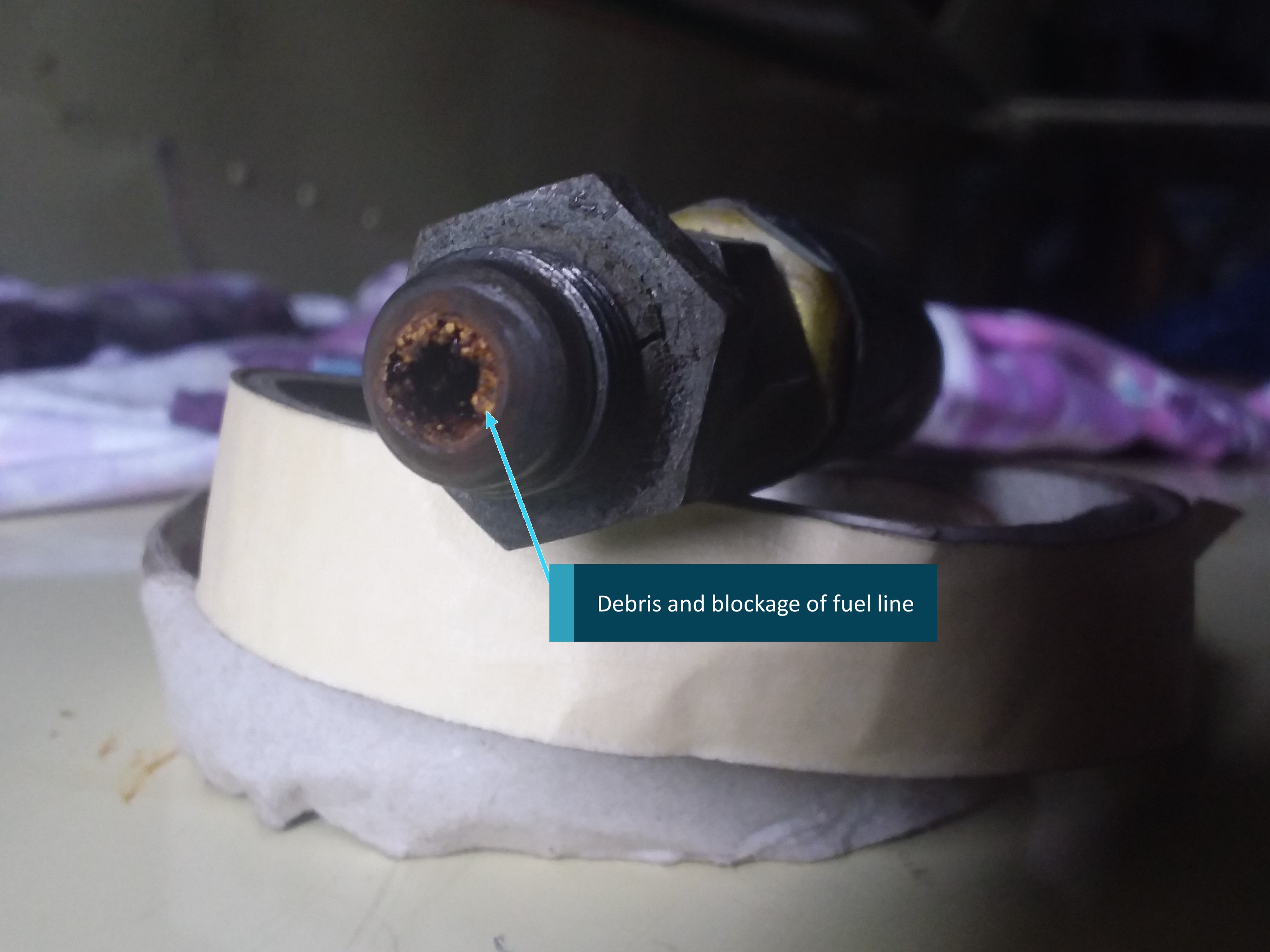
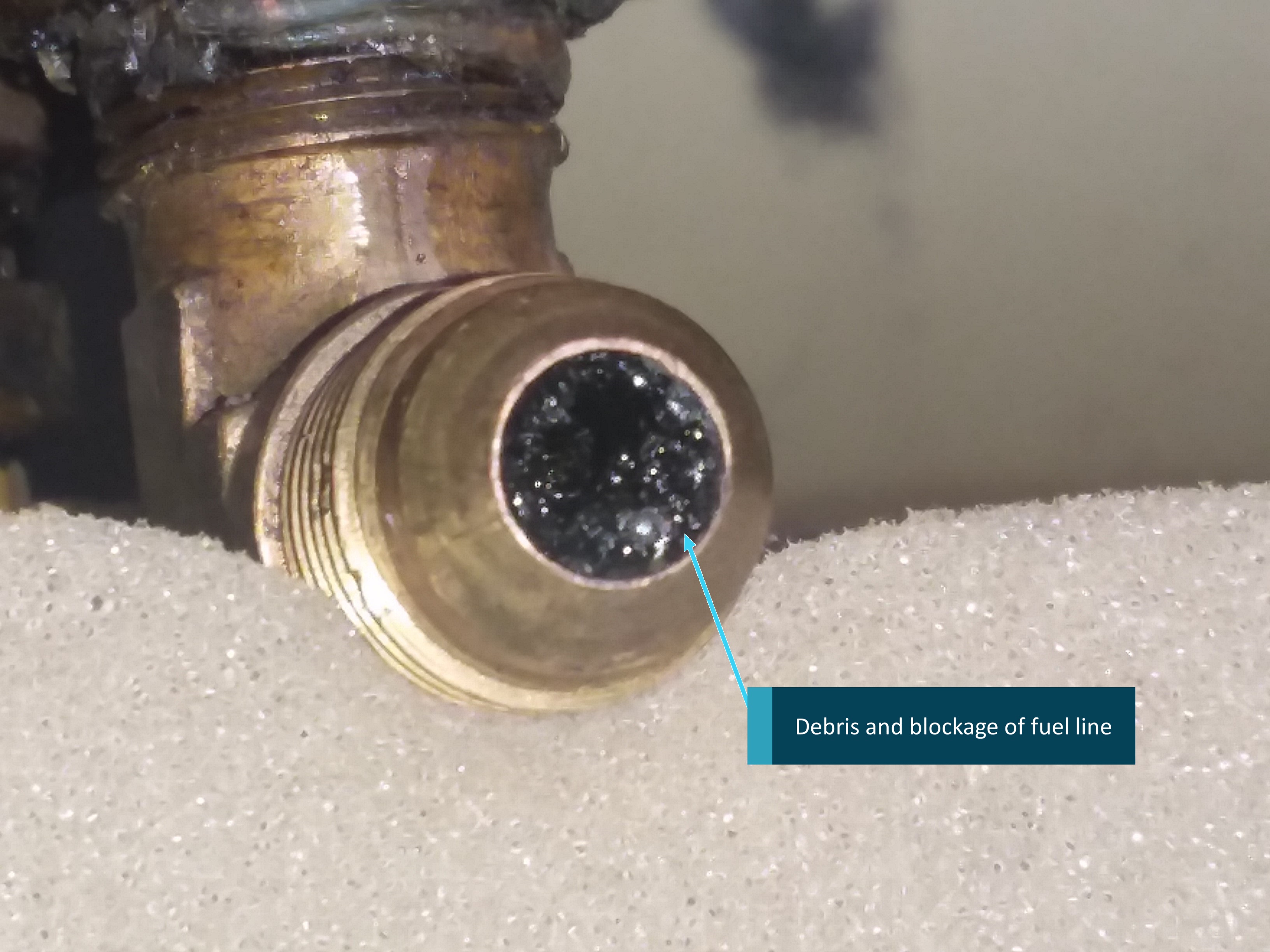
The engineering inspection revealed that as the aircraft had not been operated for several years, debris accumulated in the fuel lines resulting in a blockage during flight and the engine failure. The inspection further revealed that there was 60 litres of fuel remaining in the left tank, and no fuel remained in the right tank.

Figure 1: Fuel line blockage and debris

Figure 1: Fuel line blockage and debris.
Source: Pilot

Source: Pilot

Figure 2: Fuel line blockage and debris

Figure 2: Fuel line blockage and debris.
Source: Pilot

Source: Pilot

Pilot comments

The pilot advised that normally, a low-wing aircraft would only have left and right fuel selector positions. This aircraft, which he had recently purchased, is fitted with a fuel selector that has a ‘both’ position and he assumed that fuel was drawing equally from both wing tanks. He therefore believed having the fuel selector set to this position was the best option for the flight. The pilot further commented that it would have been beneficial to have conducted a check of the fuel supply from the left-wing tank 1.5 hours into the flight to ensure there was enough fuel flow for the cruise consumption of 32 litres per hour and to check that fuel was drawing from both wing tanks.

Safety message

This accident highlights the importance of ensuring all aircraft systems and components are operating as per the aircraft manual.

It also serves as a reminder that keeping fuel supplied to the engine during flight relies on the pilot’s knowledge of the aircraft’s fuel supply system and being familiar and proficient in its use.

More information on fuel management can be found in the ATSB research report, Starved and Exhausted: Fuel management aviation accidents (AR-2011-112).

About this report

Decisions regarding whether to conduct an investigation, and the scope of an investigation, are based on many factors, including the level of safety benefit likely to be obtained from an investigation. For this occurrence, no investigation has been conducted and the ATSB did not verify the accuracy of the information. A brief description has been written using information supplied in the notification and any follow-up information in order to produce a short summary report, and allow for greater industry awareness of potential safety issues and possible safety actions.

Occurrence summary

Mode of transport Aviation
Occurrence ID AB-2020-014
Occurrence date 17/04/2020
Location 9 km south-east of Hamilton Airport
State Victoria
Occurrence class Accident
Aviation occurrence category Fuel starvation
Highest injury level None
Brief release date 22/05/2020

Aircraft details

Model Miles M3A Falcon
Sector Piston
Operation type Private
Departure point Lilydale, Victoria
Destination Nelson, Victoria
Damage Substantial

Fuel starvation involving a Pilatus Britten-Norman BN2A21, near Warraber Island, Queensland, on 20 September 2019

Brief

Occurrence Briefs are concise reports that detail the facts surrounding a transport safety occurrence, as received in the initial notification and any follow-up enquiries. They provide an opportunity to share safety messages in the absence of an investigation.

What happened

On 20 September 2019, a Pilatus Britten-Norman BN2A-21 Islander operated a return charter flight from Horn Island to York Island, Queensland. There was one pilot and four passengers on board.

During taxi after landing at York Island in the morning, the pilot turned the fuel pumps on and switched the tank selector from main tanks to tip tanks. After the passengers disembarked and the aircraft was parked on the apron, the pilot completed his flight log and dipped the fuel tanks, confirming his estimate of remaining fuel on board.

The passengers returned late afternoon and the aircraft departed for its return flight to Horn Island at about 1600 Eastern Standard Time.

During cruise, the pilot observed the no. 1 engine surging. He immediately turned on both fuel pumps and monitored all instruments. He noticed that the fuel gauges were indicating that the tip tanks were almost empty and the main tanks had gained a significant amount of fuel. The pilot switched from tip tanks to main tanks and the surging stopped. As a precaution, he conducted a diversion to Warraber Island.

After landing, the pilot checked the fuel in the tip tanks and discovered that the tanks were empty and the fuel had transferred into the main tanks.

Engineering inspection

Following the incident, engineers determined that after switching the fuel selector from the main tanks to the tip tanks, the aircraft was shut down without allowing adequate time for the fuel transfer lines to close. This resulted in the fuel from the tip tanks to drain into the main tanks.

Safety action

As a result of this occurrence, the aircraft operator has advised the ATSB that they are taking the following safety actions:

  • An internal company document was raised to review procedures by dipping the fuel tanks before take-off when on the ground for 30 minutes or more.
  • A safety meeting was held to raise awareness and discuss the importance of fuel procedures, including allowing 5 to 10 minutes before shut down when switching to tip tanks on the ground.
  • A note has been included in the aircraft close to where the switches are, advising the importance of allowing time for the fuel selection change.

Safety message

Keeping fuel supplied to the engines during flight relies on the pilot’s knowledge of the aircraft’s fuel supply system and being familiar and proficient in its use. Accidents and incidents involving fuel mismanagement are an ongoing aviation safety concern, particularly those involving complex fuel delivery systems. The ATSB publication, Avoidable Accidents No. 5 - Starved and exhausted: Fuel management aviation accidents (AR-2011-112), is available from the ATSB website.

About this report

Decisions regarding whether to conduct an investigation, and the scope of an investigation, are based on many factors, including the level of safety benefit likely to be obtained from an investigation. For this occurrence, no investigation has been conducted and the ATSB did not verify the accuracy of the information. A brief description has been written using information supplied in the notification and any follow-up information in order to produce a short summary report, and allow for greater industry awareness of potential safety issues and possible safety actions.

Occurrence summary

Mode of transport Aviation
Occurrence ID AB-2019-038
Occurrence date 20/09/2019
Location near Warraber Island
State Queensland
Occurrence class Incident
Aviation occurrence category Fuel starvation
Highest injury level None
Brief release date 21/11/2019

Aircraft details

Manufacturer Pilatus Britten-Norman Ltd
Model BN2A-21
Sector Piston
Operation type Charter
Departure point York Island, Queensland
Destination Horn Island, Queensland
Damage Nil

Fuel starvation involving a Piper PA-28, north of Paynes Find, Western Australia, on 18 July 2019

Brief

Occurrence Briefs are concise reports that detail the facts surrounding a transport safety occurrence, as received in the initial notification and any follow-up enquiries. They provide an opportunity to share safety messages in the absence of an investigation.

What happened

On 18 July 2019, the pilot of a Piper PA-28 was conducting a private flight from Jandakot to Meekatharra, Western Australia.

During the flight, the pilot identified that the fuel in the left-hand tank was lower than, and being consumed at, a greater rate than expected. Shortly after, the engine failed and due to the remote location of the aircraft, the pilot advised that he declared a MAYDAY[1] to air traffic control. The pilot commenced troubleshooting as per the aircraft’s flight manual to attempt to resolve the engine issue. After changing the fuel selector and activating the fuel pump, power was restored to the engine.

Rather than proceed with the planned flight, the pilot diverted and landed the aircraft to Paynes Find Airport for further assessment. There were no reported injuries or damage to the aircraft.

A post-flight inspection revealed that the left-hand fuel drain was not in the fully closed position leading to fuel leaking from the left tank.

Safety message

If an engine fails or runs rough due to fuel starvation, changing the selected tanks should restore power but may take some time to take effect. In this incident, after engine power was restored, the pilot assessed the situation and elected to land the aircraft as soon as possible for inspection, to ensure the safety of the aircraft and its occupants.

Fuel starvation continues to be a common cause of engine failures. More information can be found in the ATSB report, Starved and exhausted: Fuel management aviation accidents, which highlights key messages about accurate fuel management and keeping fuel supplied to the engines.

This incident also highlights the importance of thorough pre-flight inspections to ensure the aircraft is safe for flight. This includes confirming that fuel drains are correctly closed after fuel sampling.

About this report

Decisions regarding whether to conduct an investigation, and the scope of an investigation, are based on many factors, including the level of safety benefit likely to be obtained from an investigation. For this occurrence, no investigation has been conducted and the ATSB did not verify the accuracy of the information. A brief description has been written using information supplied in the notification and any follow-up information in order to produce a short summary report, and allow for greater industry awareness of potential safety issues and possible safety actions.

__________

  1. MAYDAY: an internationally recognised radio call announcing a distress condition where an aircraft or its occupants are being threatened by serious and/or imminent danger and the flight crew require immediate assistance.

Occurrence summary

Mode of transport Aviation
Occurrence ID AB-2019-025
Occurrence date 18/07/2019
Location 10 NM (19 km) north of Paynes Find
State Western Australia
Occurrence class Serious Incident
Aviation occurrence category Fuel starvation
Highest injury level None
Brief release date 17/09/2019

Aircraft details

Manufacturer Piper Aircraft Corp
Model PA-28
Sector Piston
Operation type Private
Departure point Jandakot, Western Australia
Destination Meekatharra, Western Australia
Damage Nil

Fuel starvation involving Cessna 206, 3.5 NM north-east of Aldinga, South Australia, on 3 February 2019

Brief

Occurrence Briefs are concise reports that detail the facts surrounding a transport safety occurrence, as received in the initial notification and any follow-up enquiries. They provide an opportunity to share safety messages in the absence of an investigation.

What happened

On 3 February 2019, a Cessna 206 departed Aldinga, South Australia, to conduct parachuting operations. There was one pilot and four parachutists on board. At 1345 Central Daylight-saving Time, the aircraft was passing through 8,000 ft on climb when the engine failed. The pilot attempted to restart the engine and switched fuel tanks, but the attempt was unsuccessful.

At approximately 6,500 ft, the parachutists exited the aircraft and the pilot started to track back towards Aldinga. The pilot was able to restart the engine at 5,000 ft and conducted a straight in approach to Aldinga. After landing, the fuel tanks were dipped and it was found that the right tank was empty while the left tank had 110 litres of fuel on board. The pilot said that he likely forgot to change fuel tanks because he was distracted due to radio calls and high workload.

Safety message

Pilots are reminded to follow published procedures when operating any aircraft system in accordance with the manufacturer’s recommendations. Accidents involving fuel mismanagement are an ongoing aviation safety concern. Pilots need to:

  • understand how their aircraft fuel system works
  • know how much fuel is in each tank
  • ensure that the appropriate tank is selected at all times.

In this instance, selecting the appropriate fuel tank during checks would have avoided the pilot having to manage fuel during a high workload period. This in turn, would reduce the risk of a fuel starvation event.

Issue number 5 in the ATSB’s Avoidable Accident Series, Avoidable Accidents No. 5 - Starved and exhausted: Fuel management aviation accidents (AR-2011-112), provides more detail on these scenarios and is available from the ATSB website.

Occurrence summary

Mode of transport Aviation
Occurrence ID AB-2019-004
Occurrence date 03/02/2019
Location 6 km NE of Aldinga
State South Australia
Occurrence class Serious Incident
Aviation occurrence category Fuel starvation
Highest injury level None
Brief release date 11/06/2019

Aircraft details

Manufacturer Cessna Aircraft Company
Model U206G
Sector Piston
Operation type Sports Aviation
Departure point Aldinga, South Australia
Damage Nil

Fuel starvation and forced landing involving Beechcraft A36, Euroa, Victoria, on 30 September 2018

Brief

Occurrence Briefs are concise reports that detail the facts surrounding a transport safety occurrence, as received in the initial notification and any follow-up enquiries. They provide an opportunity to share safety messages in the absence of an investigation.

What happened

On 30 September 2018, a Beechcraft A36 was conducting a flight from Lilydale, Victoria (Vic.) to Euroa, Vic.

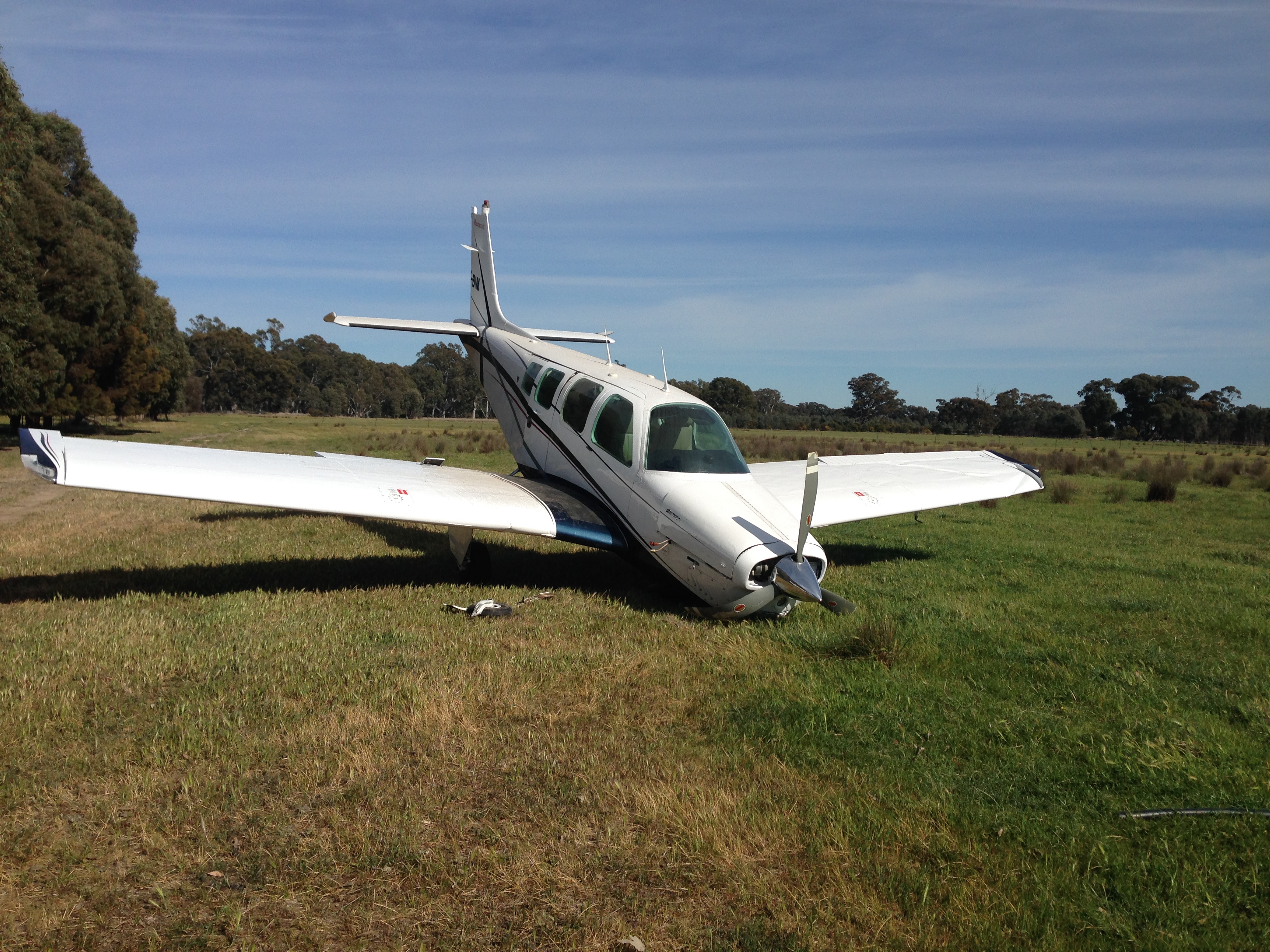
At about 1800 Eastern Standard Time, at approximately 800 ft, the pilot turned onto the base leg of the circuit in preparation to land at Euroa, at which time the engine lost power. The pilot reported that he suspected fuel exhaustion in the right tank, currently in use, and changed tanks. He was unable to get the engine re-started. Due to the low altitude, he did not have enough time to troubleshoot or turn the aircraft back to the Euroa aircraft landing area. He selected a nearby paddock as a suitable location for his emergency landing; however, due to the high sink rate he was unable to make this location and instead landed early in a rough area.

The aircraft skidded about 70 m upon landing and the impact caused the front wheel to buckle and the nose to impact with the ground, bending the propeller blades. The pilot was uninjured.

After landing, the pilot called a nearby friend. The pilot’s phone battery ran out before he gave details of his exact location. The pilot’s friend contacted the chief pilot of Euroa airstrip, who called emergency services. Emergency services attended the site and foamed the aircraft as a precautionary measure.

The pilot said that he likely forgot to change fuel tanks because he was distracted – he was trying to land before last light and he was checking the runway for kangaroos.

Figure 1: Beechcraft A36 after landing

Figure 1: Beechcraft A36 after landing. Source: Victoria Police

Source: Victoria Police

Safety message

Accidents involving fuel mismanagement are an ongoing aviation safety concern. Pilots need to:

  • understand how their aircraft fuel system works
  • know how much fuel they have in each tank
  • ensure that the appropriate tank is selected at all times.

In this instance, and others like it, selecting the appropriate fuel tank during pre-descent checks would avoid having to manage fuel during the higher workload period of approach. This would reduce the risk of a fuel starvation event.

For more information on fuel management, see ATSB research report, Starved and Exhausted: Fuel management aviation accidents (AR-2011-112).

About this report

Decisions regarding whether to conduct an investigation, and the scope of an investigation, are based on many factors, including the level of safety benefit likely to be obtained from an investigation. For this occurrence, no investigation has been conducted and the ATSB did not verify the accuracy of the information. A brief description has been written using information supplied in the notification and any follow-up information in order to produce a short summary report, and allow for greater industry awareness of potential safety issues and possible safety actions.

Occurrence summary

Mode of transport Aviation
Occurrence ID AB-2018-117
Occurrence date 30/09/2018
Location 2 km N of Euroa ALA
State Victoria
Occurrence class Incident
Aviation occurrence category Fuel starvation
Highest injury level None
Brief release date 22/01/2019

Aircraft details

Manufacturer Hawker Beechcraft Corporation
Model Beechcraft A36
Sector Piston
Operation type General Aviation
Departure point Lilydale, Victoria
Destination Euroa, Victoria
Damage Substantial

Fuel starvation involving Jabiru J160-C, at Camden Airport, New South Wales, on 22 June 2018

Brief

Occurrence Briefs are concise reports that detail the facts surrounding a transport safety occurrence, as received in the initial notification and any follow-up enquiries. They provide an opportunity to share safety messages in the absence of an investigation.

What happened

On 22 June 2018, a Jabiru J160-C was conducting a training flight. The crew consisted of a student (the pilot flying) and an instructor (the pilot monitoring).

Approximately 90 minutes into a planned two hour flight, the student attempted a touch and go. The engine failed on the runway and the aircraft rolled to a stop. The instructor advised Air Traffic Control and attempted unsuccessfully to restart the engine.

The instructor and student pushed the aircraft onto an adjacent grass taxiway. The crew were able to restart the engine and taxi to the apron area.

Post-flight, the right wing fuel cap was found to be loose. After refitting the cap, the aircraft returned to service.

Safety message

ATSB publication Avoidable Accidents No. 5 - Starved and exhausted: Fuel management aviation accidents found from 2001 to 2011, accidents involving fuel starvation resulted in 10 fatalities and 18 serious injuries.

Fuel starvation happens when the fuel supply to the engine(s) is interrupted although there is adequate fuel on board.

This incident reinforces the need to:

  • conduct a thorough pre-flight inspection
  • determine prior to flight the expected rate of fuel consumption
  • monitor fuel consumption during flight
  • be fully familiar with the fuel systems operation.

About this report

Decisions regarding whether to conduct an investigation, and the scope of an investigation, are based on many factors, including the level of safety benefit likely to be obtained from an investigation. For this occurrence, no investigation has been conducted and the ATSB did not verify the accuracy of the information. A brief description has been written using information supplied in the notification and any follow-up information in order to produce a short summary report, and allow for greater industry awareness of potential safety issues and possible safety actions.

Occurrence summary

Mode of transport Aviation
Occurrence ID AB-2018-085
Occurrence date 22/06/2018
Location Camden Airport
State New South Wales
Occurrence class Incident
Aviation occurrence category Fuel starvation
Highest injury level None
Brief release date 14/11/2018

Aircraft details

Model Jabiru J160-C
Sector Sport and recreational
Operation type Flying Training
Departure point Camden Airport, NSW
Damage Nil

Fuel starvation and collision with terrain involving Piper PA-28, Bankstown Airport, New South Wales, on 2 April 2018

Brief

Occurrence Briefs are concise reports that detail the facts surrounding a transport safety occurrence, as received in the initial notification and any follow-up enquiries. They provide an opportunity to share safety messages in the absence of an investigation.

What happened

On 2 April 2018, a student pilot was conducting solo circuit training in a Piper PA-28 from Bankstown Airport, New South Wales.

At 1114 Eastern Standard Time, the aircraft was passing through 700 ft on climb to circuit height on the crosswind leg runway 29L, when the engine failed. The pilot immediately turned the aircraft towards the airport and conducted a forced landing, omitting the required checks. During landing, the aircraft contacted trees resulting in substantial damage. The pilot was not injured.

Post-flight it was determined that fuel starvation was the cause of the engine failure. The pilot stated they thought the right fuel tank was full and the left fuel tank was just under full before the flight. After the accident, fuel on board prior to the flight was calculated to be 24 litres in the left tank and 43 litres in the right tank. After the engine failed, the pilot did not switch fuel tanks.

The operator has an arrangement with a local refueller whereby they fill up the aircraft to full tanks and leave a chalk mark on a tyre. When an aircraft has been moved, the refueller can see this and tops up the tanks to full capacity. This did not occur on this occasion and may have led to complacency with the expectation that the tanks would be full.

Safety message

Accurate fuel management starts with knowing exactly how much fuel is being carried at the commencement of a flight. This is easy to know if the aircraft tanks are full, or filled to tabs. If the tanks are not filled to a known setting, then a different approach is needed to determine an accurate quantity of usable fuel.

Fuel starvation continues to be a common cause of engine failure. Effective fuel management in flight and the checking of fuel quantities reduces the risks of a fuel starvation event. Once an engine has failed or runs rough due to fuel starvation, changing the selected tanks should restore power but may take some time to take effect. Fuel tank changes should be done in conjunction with any other checks as recommended by the aircraft flight manual. For more information on fuel management, see ATSB research report, Starved and Exhausted: Fuel management aviation accidents (AR-2011-112).

About this report

Decisions regarding whether to conduct an investigation, and the scope of an investigation, are based on many factors, including the level of safety benefit likely to be obtained from an investigation. For this occurrence, no investigation has been conducted and the ATSB did not verify the accuracy of the information. A brief description has been written using information supplied in the notification and any follow-up information in order to produce a short summary report, and allow for greater industry awareness of potential safety issues and possible safety actions.

Occurrence summary

Mode of transport Aviation
Occurrence ID AB-2018-047
Occurrence date 02/04/2018
Location Bankstown Airport
State New South Wales
Occurrence class Accident
Aviation occurrence category Fuel starvation
Highest injury level None
Brief release date 28/09/2018

Aircraft details

Manufacturer Piper Aircraft Corp
Model PA-28
Sector Piston
Operation type Flying Training
Damage Substantial