Fuel starvation

Fuel starvation event - Bell Jetranger 206B, VH-JTI, Coomera, Queensland, on 10 June 2009

Summary

On 10 June 2009, at about 1545 Eastern Standard Time, the pilot of a Bell Jetranger 206B helicopter, registered VH-JTI, was conducting a 20-minute scenic flight, with four passengers, from a helipad at an entertainment facility at Coomera, Queensland.

After about 15 minutes flying, the fuel boost pump low pressure (FUEL PUMP) warning light illuminated briefly. The pilot believed he had sufficient fuel on board and continued the flight. While the helicopter was descending to land at the helipad, the FUEL PUMP warning light illuminated again and shortly afterwards the engine lost all power.

During the final stages of the autorotative landing, the pilot was unable to arrest the helicopter's descent rate and the helicopter struck the ground heavily, resulting in substantial damage. Two passengers sustained serious injuries; the other two passengers and the pilot were uninjured.

A subsequent check of the helicopter and its fuel system showed that the fuel gauge may have been over reading. The operator's practice when calculating the quantity of fuel to be added during refuelling relied on the fuel gauge reading, without using an independent method to crosscheck that reading against the actual fuel tank quantity.

The investigation found that the helicopter departed with insufficient fuel to complete the flight. The low fuel quantity and manoeuvring combined to uncover the fuel boost pumps and the engine was starved of fuel. The helicopter's low speed, height and rotor RPM at that time precluded a safe landing from the subsequent autorotation.

Occurrence summary

Investigation number AO-2009-026
Occurrence date 10/06/2009
Location Coomera
State Queensland
Report release date 15/07/2011
Report status Final
Investigation level Systemic
Investigation type Occurrence Investigation
Investigation status Completed
Mode of transport Aviation
Aviation occurrence category Fuel starvation
Occurrence class Accident
Highest injury level Serious

Aircraft details

Manufacturer Bell Helicopter Co
Model 206
Registration VH-JTI
Serial number 771
Sector Helicopter
Operation type Charter
Departure point Dreamworld, Qld
Destination Dreamworld, Qld
Damage Substantial

Fuel Starvation, Piper Navajo PA-31, VH-IHR, 22 km north of Mount Isa, Queensland, on 17 July 2008

Summary

On 17 July 2008, at approximately 0915 Eastern Standard Time, the pilot of a Piper Navajo PA-31 aircraft, registered VH-IHR, was en route from Century Mine, Qld to Mt Isa, Qld when the left engine lost power. Shortly after, the right engine lost power and the pilot attempted to land the aircraft in sparsley wooded bushland about 4 km from the Barkly Highway. The pilot received serious injuries, and the aircraft was seriously damaged.

A subsequent check of the aircraft found that the loss of power to both engines was due to fuel starvation.

Occurrence summary

Investigation number AO-2008-048
Occurrence date 17/07/2008
Location Mount Isa Aero 342 deg/24 km
State Queensland
Report release date 02/04/2009
Report status Final
Investigation level Systemic
Investigation type Occurrence Investigation
Investigation status Completed
Mode of transport Aviation
Aviation occurrence category Fuel starvation
Occurrence class Accident
Highest injury level Serious

Aircraft details

Manufacturer Piper Aircraft Corp
Model PA-31
Registration VH-IHR
Serial number 31-8012077
Sector Piston
Operation type Charter
Departure point Century Mine, Qld
Destination Mount Isa, Qld
Damage Destroyed

Fuel-related event, 16 km south-east of Townsville Airport, Queensland, on 9 April 2009

Summary

On 9 April 2008, the crew of a McDonnell Douglas Helicopter Company MD369ER helicopter registered VH-PLU, experienced a substantial loss of engine power while conducting low-level powerline stringing operations. The helicopter impacted the ground and was seriously damaged. The two occupants were seriously injured.

The investigation determined that the pilot in command was operating the helicopter with a fuel tank quantity that did not guarantee continuous operation of the engine at the flight attitudes experienced during the powerline stringing operation.

As a result of the accident, the operator revised its fuel management procedures for powerline stringing operations.

Occurrence summary

Investigation number AO-2008-025
Occurrence date 09/04/2008
Location Townsville
State Queensland
Report release date 29/06/2009
Report status Final
Investigation level Systemic
Investigation type Occurrence Investigation
Investigation status Completed
Mode of transport Aviation
Aviation occurrence category Fuel starvation
Occurrence class Accident
Highest injury level Serious

Aircraft details

Manufacturer McDonnell Douglas Corp.
Model 500
Registration VH-PLU
Serial number 0384E
Sector Helicopter
Operation type Charter

Ditching - Brampton Island, Queensland, on 03 April 2008

Summary

On 3 April 2008, a Piper PA-32-300 Cherokee Six aircraft, registered VH-ZMP, lost engine power shortly after take-off from Brampton Island, Qld and ditched into the sea. The pilot and the four passengers evacuated the aircraft before it sank and were later recovered by rescue helicopter. The engine power loss was consistent with fuel starvation.

Following the event, the aircraft operator amended Cherokee Six fuel procedures to require a minimum of 30 L of fuel in the selected fuel tank for any take off.

Occurrence summary

Investigation number AO-2008-022
Occurrence date 03/04/2008
Location Brampton Island
State Queensland
Report release date 20/03/2009
Report status Final
Investigation level Systemic
Investigation type Occurrence Investigation
Investigation status Completed
Mode of transport Aviation
Aviation occurrence category Fuel starvation
Occurrence class Accident
Highest injury level Minor

Aircraft details

Manufacturer Piper Aircraft Corp
Model PA-32
Registration VH-ZMP
Serial number 32-7440019
Sector Piston
Operation type Charter
Departure point Brampton Island Qld
Damage Destroyed

Fuel Starvation, 2.4 km north-west of Bathurst Island Aerodrome, Northern Territory, VH-JDJ

Preliminary report

Preliminary report released 7 August 2006

On 1 June 2006, at about 07011 Central Standard Time2, a Beech Aircraft Corp. A36 (Bonanza) aircraft, registered VH-JDJ, departed Kununurra, WA on a private category visual flight rules (VFR) flight to Bathurst Island, NT. The flight was for the pilot, who was the sole aircraft occupant, to visit clients in regional and remote areas of the country.

At about 0900, an aircraft advised air traffic services (ATS) of a radio distress beacon transmitting on the 121.5 MHz distress frequency. That beacon transmission was confirmed at 0912, when a COSPAS-SARSAT satellite download to an AusSAR3 local user terminal, indicated that a radio distress beacon was transmitting in the vicinity of Bathurst Island.

The Rescue Coordination Centre at AusSAR coordinated the search for the source of the distress beacon transmission. A search aircraft subsequently located aircraft wreckage approximately 1.3 NM north-west of the Bathurst Island aerodrome. The ground party that located the wreckage determined that the pilot had sustained fatal injuries. There was no fire.

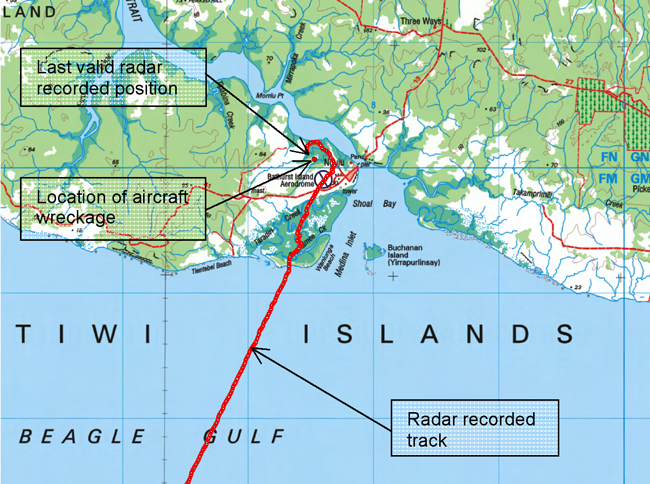
A review of ATS recorded radar data identified a VFR aircraft on the direct track between Kununurra and Bathurst Island at an altitude of 5,500 ft4 above mean sea level (AMSL). The aircraft commenced descent from cruise altitude about 30 NM from the aerodrome and, at 0846, arrived overhead at an altitude of 1,400 ft. That was, about 1 hour 45 minutes after the Bonanza departed Kununurra. The recorded radar track was consistent with the aircraft joining the circuit mid-downwind for a landing on runway 15.

The aircraft continued downwind and commenced decent from 1,000 ft just prior to turning onto the base leg of the circuit. The aircraft then turned onto a long final approach for runway 15. The last valid radar return was received at 0848 at an altitude of 600 ft.

The aircraft wreckage was located slightly left of the extended runway 15 centreline, approximately 1,200 m north-west of the runway threshold.

Figure 1 depicts the aircraft's recorded radar position during the final stages of the flight.

Figure 1: Bathurst Island aerodrome, recorded radar track and location of aircraft wreckage

aair200603140_001.jpg

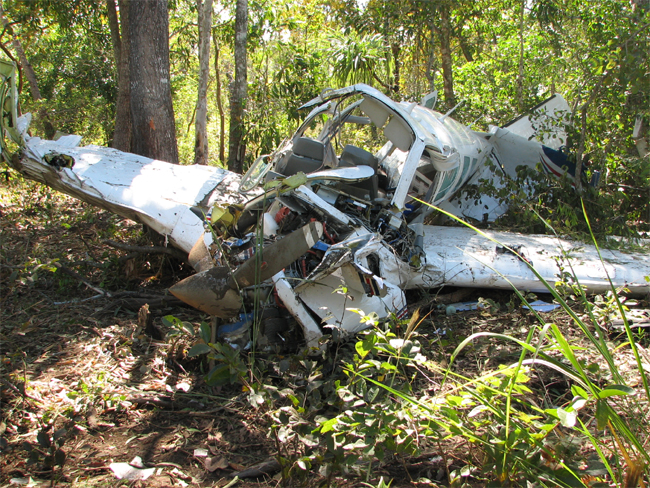
Examination of the wreckage indicated that the aircraft had impacted terrain in a left wing-low, steep nose-down attitude. The accident site was located in scrub-type terrain, moderately populated with trees approximately 10 to 20 m in height (Figure 2).

Figure 2: Accident site and surrounds

aair200603140_002.jpg

The aircraft collided with the upper branches of a tree during the final stages of the decent. Damage to the foliage was consistent with the aircraft descending steeply as it approached the ground. All aircraft components were accounted for at the accident site, and the aircraft was assessed as being intact prior to impact. The landing gear was down, and the wing flaps were retracted (up position) at that time. The propeller sustained relatively minor damage, and the hub of the propeller remained intact.

There was no evidence of bird strike or of a collision with any other object prior to the final impact sequence.

The aircraft's Continental IO-520 engine had accumulated approximately 62 hours time in service since its last overhaul. The engine was recovered from the accident site for further examination. That examination found no evidence of catastrophic failure of any of the engine's components. The engine's ignition system was tested and found to be capable of normal operation. The fuel-injection nozzles for each cylinder were clear of any obstruction and capable of normal operation.

The aircraft was equipped with an EDM 700 engine data monitoring system that monitored a number of parameters of the engine operation. That instrument was recovered for further examination.

The aircraft was equipped with main and auxiliary fuel tanks. The main fuel tanks were located in each wing, and each had a capacity of 140 litres (L) useable fuel. The auxiliary tanks were located on the tip of each wing, and each had a capacity of 75 L. The cockpit fuel selector had 5 positions: 'OFF', 'L. MAIN', 'R. MAIN', 'R. TIP' and 'L. TIP'. The auxiliary tanks were also equipped with a tank cross feed and an 'ON' 'OFF' cross-feed selector.

During the impact sequence, the right auxiliary fuel tank detached from the right-wing tip. Although the tank was intact, it did not contain a significant quantity of fuel. The left auxiliary fuel tank remained attached to the left-wing tip. Although that tank sustained impact damage, it remained substantially intact and did not contain a significant quantity of fuel.

The left main tank was intact. Approximately 65 L of fuel was recovered from that tank and a sample was retained for testing. The right main tank was breached along the leading edge of the wing and the fuel line from that tank sustained impact-related damage and was fractured in the vicinity of the wing root5. All of the fuel tank caps were secure and there was no evidence that any fuel had been lost overboard during flight.

The aircraft fuel selector was found in the R. TIP position and the cross feed for the auxiliary tank was found in the OFF position. A separate fuel gauge was capable of indicating the quantity of fuel in the aircraft's tip tanks. A switch located beside that gauge allowed the pilot to display the quantity of fuel in either of the tip tanks. That switch was found in the L. TIP position. A number of components from the aircraft's fuel system were recovered for further examination/testing. Those components included the cockpit fuel selector and selector valve, cockpit fuel quantity gauges and the fuel tank float and sender units.

The aircraft was last refuelled at Halls Creek on 30 May 2006. Fuel company records indicated that one of the aircraft's swipe cards was used to purchase 268 L of aviation gasoline. Other aircraft had also refuelled from the same fuel source that day. The aircraft's records indicated that, at the time of the accident, the Bonanza had operated approximately 3.6 hours since refuelling at Halls Creek. Flight planning documents recovered at the accident site indicated that, when fully fuelled, the pilot had planned the aircraft's endurance as 7.3 hours.

A number of local residents and other pilots reported that visual meteorological conditions (VMC) prevailed in the vicinity of Bathurst Island at the time of the accident.

The pilot held an unrestricted Private Pilot (Aeroplane) Licence and had accumulated approximately 526 hours total aeronautical experience.

The investigation is continuing and will include the:

  • examination of the engine data monitoring equipment
  • testing of recovered components
  • review of operational factors associated with the flight.
  1. First light at Kununurra on 1 June was 0652 CST (0522 Western Standard Time).
  2. The 24-hour clock is used in this report to describe the local time of day, Central Standard Time (CST), as particular events occurred. Central Standard Time was Coordinated Universal Time (UTC) + 9.5 hours.
  3. Australian Search and Rescue - in general terms, AusSAR coordinates the response to aviation SAR incidents across Australia.
  4. Altitude information is encoded by the aircraft's radar transponder to the nearest 100 ft.
  5. During the subsequent salvage of aircraft components on behalf of the insurance company, a quantity of about 20 L of fuel was reported to have drained from the right main tank.

Summary

On 1 June 2006, at about 0848 Central Standard Time, a Beech Aircraft Corp A36 Bonanza aircraft, registered VH-JDJ, was approaching to land at Bathurst Island aerodrome.

Air traffic services radar data recorded the aircraft overflying the aerodrome and that the pilot joined the circuit on left downwind for a landing on runway 15. The aircraft impacted terrain 2.4 km north-west of the aerodrome. The pilot, who was the sole occupant of the aircraft, sustained fatal injuries.

The aircraft was assessed as being intact prior to the impact with terrain and no anomaly was identified with the aircraft that could have affected its normal operation.

Data recovered from an onboard engine data recording system was consistent with an interruption of the fuel flow and the loss of engine power about 42 seconds before impact. The pilot may have been attempting to perform an emergency landing to a nearby clearing when control of the aircraft was lost.

Occurrence summary

Investigation number 200603140
Occurrence date 01/06/2006
Location 2.4km N Bathurst Island, Aero.
State Northern Territory
Report release date 08/06/2007
Report status Final
Investigation type Occurrence Investigation
Investigation status Completed
Mode of transport Aviation
Aviation occurrence category Fuel starvation
Occurrence class Accident
Highest injury level Fatal

Aircraft details

Manufacturer Beech Aircraft Corp
Model 36
Registration VH-JDJ
Serial number E-1448
Sector Piston
Operation type Private
Departure point Kununurra WA
Destination Bathurst Island NT
Damage Destroyed

Engine power loss, Lancair 360, VH-ZNZ, Bankstown Airport, New South Wales, on 5 April 2006

Summary

On 5 April 2006, the pilot of an amateur-built Lancair 360 aircraft, registered VH-ZNZ, was conducting circuits at Bankstown Airport, NSW. It was the aircraft's first flight since being repaired after a landing accident in 2003.

Following an overflight and a touch-and-go, the pilot conducted another touch-and-go and shortly after lift-off, at an altitude estimated by witnesses to be between 100 ft and 400 ft, the engine was heard to malfunction. Almost immediately, while still not above 500 ft, the aircraft rolled into a steep right turn. Engine power was heard to return but sounded intermittent. After turning approximately 90 degrees, the aircraft rolled out of the turn momentarily to about wings level, before the turn steepened again to the right. The aircraft was observed to roll further to the right and descend steeply. The aircraft impacted a taxiway, the pilot was fatally injured, and the aircraft destroyed.

The investigation found that the engine power loss was probably due to interruptions of fuel flow to the engine but could not conclusively determine the reason. The aircraft stalled at a height insufficient to allow the pilot to recover.

The investigation identified a number of safety issues related to stall warning, management of incomplete engine power loss after take-off, pilot transition training and the provision of information to purchasers of amateur-built aircraft.

Following the occurrence, the Civil Aviation Safety Authority and Sport Aircraft Association of Australia implemented a number of safety actions. As a result of this and other occurrences the Australian Transport Safety Bureau initiated a broader investigation into loss of control following engine power loss after take-off.

Occurrence summary

Investigation number 200601688
Occurrence date 05/04/2006
Location Bankstown, Aero
State New South Wales
Report release date 21/02/2007
Report status Final
Investigation type Occurrence Investigation
Investigation status Completed
Mode of transport Aviation
Aviation occurrence category Fuel starvation
Occurrence class Accident
Highest injury level Fatal

Aircraft details

Manufacturer Neico Aviation Inc
Model Lancair 360
Registration VH-ZNZ
Sector Piston
Operation type Private
Departure point Bankstown, NSW
Destination Bankstown, NSW
Damage Destroyed

Cessna 207, VH-LFU

Safety Action

The operator reported that the fuel management procedure at the remote operating base was changed to be consistent with the procedure for operations from Jabiru.

Analysis

The engine failed after exhaustion of the fuel from the selected tank. Despite the pilot's engine failure recovery actions, 700 to 800 ft of altitude was lost before the engine restarted. If the engine failure had occurred while the aircraft was below 700 ft AGL, it would have resulted in a forced landing.

The different fuel management procedures at the two operational bases led to the inappropriate fuel selector position for operations from Jabiru. The pilot then overlooked the specific fuel tank selection during the pre-flight checks, because he had an expectation that it would already be appropriately positioned. During both the preceding and the occurrence flight, the fuel gauges had the potential to alert the pilot to the developing unsafe condition. This required reliable fuel gauges and regular comparison of their indications with planned fuel usage and fuel tank selection.

The pilot's response to the engine failure was not consistent with the aircraft manufacturer's or the operator's emergency and abnormal checklist instructions. It is likely that sustained operation of the auxiliary fuel pump introduced excessive fuel into the engine preventing an immediate restart. Selection of the fuel pump to the OFF position after priming the engine in accordance with the operator's Cessna 207 emergency and abnormal checklist should have resulted in a quicker restart with minimal altitude loss.

Although the pilot had read the operations manual that contained the relevant checklist, the operator did not require him to be able to recall the specific checklist items following an engine failure. The operator's induction training did not ensure that the pilot was able to follow the type-specific procedure when responding to an engine failure at a relatively low altitude. Standard operating procedures are an accepted means of reducing the risk of aircraft operation. By allowing the use of procedures that were inconsistent with the operations manual, the operator reduced the effectiveness of that risk control.

The chief pilot's belief that emergency procedures learned during early training could be effectively applied to any general aviation aircraft did not allow for significant variations between aircraft systems and in particular fuel systems. For example, the in-flight engine restart procedure for a low-wing aircraft with a carburetted engine that is commonly used for initial flight training is significantly different from the engine restart procedure for the Cessna 207, which is a high-wing aircraft with a fuel injected engine.

Induction training that facilitated memorisation of the Cessna 207 `engine failure during flight (restart procedures)' checklist with the opportunity for in-flight simulated engine failures would have decreased the risk of an inappropriate response to an engine failure.

Summary

The Australian Transport Safety Bureau did not conduct an on-scene investigation of this occurrence.

During the early afternoon of 30 August 2004, the pilot and six passengers onboard a Cessna Aircraft Company 207 Stationair (Cessna 207) departed Jabiru, NT for a 30 minute scenic charter flight.

The pilot reported that about 10 minutes after departure and while cruising at about 1,500 ft above ground level (AGL), the engine abruptly failed. The pilot reset the mixture and throttle controls, changed the selector position from the left to the right fuel tank, switched the auxiliary fuel pump to ON and established a glide speed of 80 kts. When the engine did not immediately respond, the pilot positioned the aircraft for a forced landing at a nearby outstation airstrip. At about 750 ft AGL the engine restarted. Unsure of why the engine had lost power, the pilot continued with the approach and transmitted a PAN alert. When assured of a landing he shut down the engine as a precaution against fire and landed.

The left fuel tank was found to contain no usable fuel and the right tank about 100L. The aircraft was ferried back to Jabiru with the right fuel tank selected and was operated on subsequent flights without incident.

The day before the occurrence, the aircraft was relocated to Jabiru from a remote base. The procedure at the remote base was to use the left fuel tank for flight fuel, and the right tank for reserve fuel. The fuel selector was positioned to the left tank when the aircraft arrived at Jabiru. However, for scenic flights from Jabiru the procedure was the opposite. The aircraft was refuelled to provide 40L reserve in the left tank and 100L in the right tank. The operator advised that these procedures were intended to reduce the risk of fuel starvation during scenic flights.

Early on the day of the occurrence, the pilot conducted a daily inspection of the aircraft and by dipping the tanks, visually confirmed that the fuel quantity accorded with the operator's procedure. He then conducted a 30 minute scenic flight without incident. As the total fuel on board for the occurrence flight was adequate, the quantity of fuel in each tank was not verified visually. The operator stated that the fuel gauges were serviceable. However, the pilot stated that the fuel gauge indicators constantly flickered between full and empty, which prompted him to disregard them.

The operator's maintenance controller informed the ATSB that the maintenance release had not been annotated with details of a fuel gauge defect. A check following the incident revealed that the indications on the aircraft's fuel gauges matched the dip stick measurements for the left and right fuel tanks. He advised that the aircraft was returned to service and there has been no report of a fuel gauge defect.

The aircraft's fuel selector valve had LEFT, OFF and RIGHT positions. The pilot said that, during the pre-flight cockpit checks for both the preceding flight and the occurrence flight, he had checked that the fuel selector was positioned to a fuel tank, but did not realise that it was positioned to the tank containing only reserve fuel.

The Cessna 207 `engine failure during flight (restart procedures) checklist' in the operations manual was similar to the corresponding procedure produced by the aircraft manufacturer. Importantly, both identified the need to use the auxiliary fuel pump only briefly. However, the pilot said that he had applied a memorised generic engine failure procedure that he had learnt in initial flight training. That procedure did not address specific use of the auxiliary fuel pump. The pilot said that, had there been more time after the engine failure, he would have referred to the copy of the operations manual checklist in the aircraft.

Information provided by the operator indicated that, one week prior to the occurrence, the pilot's induction training had included discussion of engine failure procedures based on a generic procedure similar to that used by the pilot. That training did not include the Cessna 207 `engine failure during flight (restart procedures) checklist' in the operations manual, or in-flight simulated engine failures.

The chief pilot reported that the operator's pilots were required to apply whatever normal and emergency/abnormal procedures they had learnt during early training. The chief pilot stated that: `Once learnt, I believe these checks stand a pilot in good stead for their entire flying career in GA [general aviation] and cannot see any reason to change that approach.' The chief pilot added that: `… all pilots are told when time permits to use the supplied check lists in an emergency.'

The ATSB recently completed an investigation into an engine failure involving a similar aircraft type (Cessna 206, ATSB report 200402049). Although there was fuel on board and no identified aircraft defects, the engine did not restart. The four occupants were seriously injured during the subsequent forced landing. The investigation found that the in-flight engine restart procedures published by the aircraft manufacturer were not followed.

Occurrence summary

Investigation number 200403210
Occurrence date 30/08/2004
Location 19 km NE Jabiru, (ALA)
State Northern Territory
Report release date 24/12/2004
Report status Final
Investigation type Occurrence Investigation
Investigation status Completed
Mode of transport Aviation
Aviation occurrence category Fuel starvation
Occurrence class Incident
Highest injury level None

Aircraft details

Manufacturer Cessna Aircraft Company
Model 207
Registration VH-LFU
Serial number 20700296
Sector Piston
Operation type Charter
Departure point Jabiru, NT
Destination Jabiru, NT
Damage Nil

Bell 206B, VH-EWH

Summary

The Bell 206 helicopter was being operated on water-bombing tasks in support of fire-fighting east of Armidale, NSW. As the pilot commenced a climb following water pick-up, the `engine out’ audio warning sounded, and the master warning annunciator illuminated as the engine failed. The pilot jettisoned the water and Bambi bucket and conducted an autorotative descent into a cleared area. During the landing the helicopter's main rotor contacted the tail boom and severed the tail rotor assembly. The pilot, the sole occupant, was not injured. The pilot indicated that immediately following the accident, he drained approximately 0.5L of fuel from the helicopter to check for water contamination and fuel boost pump operation.

Occurrence summary

Investigation number 200304105
Occurrence date 01/10/2003
Location 40 km E Armidale, (NDB)
State New South Wales
Report release date 12/07/2004
Report status Final
Investigation type Occurrence Investigation
Investigation status Completed
Mode of transport Aviation
Aviation occurrence category Fuel starvation
Occurrence class Accident
Highest injury level None

Aircraft details

Manufacturer Bell Helicopter Co
Model 206
Registration VH-EWH
Serial number 1380
Sector Helicopter
Operation type Aerial Work
Departure point East of Armidale, NSW
Destination East of Armidale, NSW
Damage Substantial

Piper PA-31-350, VH-UBC

Safety Action

Local safety action

Aircraft operator

As a result of the contractor's requirements, the operator reported that future flights for the contractor would be operated by two pilots.

Australian Transport Safety Bureau

Fuel exhaustion and starvation accidents accounted for over 6 per cent of all accidents between 1991 and 2000 and the rate remains relatively constant.

In December 2002 the ATSB published a research paper titled `Australian Aviation Accidents Involving Fuel Exhaustion and Starvation'. It is available on the ATSB's website www.atsb.gov.au, or from the Bureau on request.

Analysis

The descriptions of the loss of engine power and the subsequent engine surging were consistent with fuel starvation, a situation where the fuel to the engine is interrupted, although there is adequate fuel on board the aircraft.

Although the left high-pressure fuel pump failed to deliver the required pressure and fuel flow and was found leaking during subsequent testing, it would have had little effect on the development of the occurrence and its defect may have occurred during the accident sequence.

The pilot reported that he had selected inboard tanks for the flight. The investigation was unable to reconcile the pilot's reported recollection of inboard tank selection and the evidence of the remaining fuel quantities in the inboard tanks.

Summary

History of the flight

The Piper Aircraft Corporation PA-31-350 Navajo Chieftain, registered VH-UBC, departed Albury on a charter flight with a pilot and six passengers on board. About 5 minutes into the flight, as the aircraft climbed through approximately 5,000 ft, the pilot reported that the right fuel flow light illuminated. The pilot moved the right engine mixture control lever to full rich and advised the Albury Tower controller that he was returning to Albury. A short time later, the right engine started surging. The pilot reported that he changed the right fuel selector from the inboard to the outboard tank selection, although he was aware that there was only a small quantity of fuel in that tank. The engine continued to surge and he reselected the inboard tank. The pilot reported that he did not shut down the engine and feather the propeller because he thought the engine was producing some power.

The pilot reported that approximately a minute after the onset of the right engine problem, the left fuel flow light illuminated and the left engine also started surging. He advised the controller that he was diverting to Holbrook. The pilot found a break in the clouds and descended the aircraft, maintaining visual contact with the ground. On levelling out after the descent through cloud, he reported that the engines operated smoothly, but at reduced power. He reported that he maintained blue line speed for a short time, before power reduced to a level which would not allow altitude to be maintained. During the descent, the pilot opened the crossfeed valve and checked that all fuel pumps were on, mixture controls were rich and the inboard tanks selected. Unable to restore power, the pilot decided to make an emergency landing in an open field below the aircraft. Before landing, the pilot extended the flaps and the landing gear and instructed the passengers to prepare for an emergency landing.

The aircraft contacted the ground with its right wingtip and slewed for approximately 93 metres while rotating almost 180 degrees to the right. The aircraft was substantially damaged, but there was no fire. Neither the pilot nor the passengers sustained any injuries. The pilot reported that before exiting the aircraft he switched off the fuel pumps, magnetos and master switches.

Weather

The weather at Albury and the surrounding area was overcast with low cloud and fog patches. Rain and isolated thunderstorms were forecast for the area. Moderate icing was forecast above 10,000 feet.

Pilot qualification

The pilot held a Commercial Pilot Licence (Aeroplane) with a Multi-engine Command Instrument Rating and was appropriately endorsed on the aircraft type. He held a valid Class 1 medical. On 4 August 2003 he satisfactorily completed a type proficiency check on the Chieftain aircraft. Although not a training and checking requirement for charter flights, the operator additionally stipulated this check for its pilots.

Aircraft

The aircraft was owned by a locally based company that used it to transport its employees between numerous production facilities and was operated by an Albury based charter and training operator on their behalf.

The aircraft was maintained in accordance with the maintenance requirements applicable at that time and had a valid Maintenance Release. It had flown approximately 50 hours since the last maintenance release (periodic) inspection. There were no outstanding maintenance issues at the time of the accident.

Fuel status

The aircraft had flown during the previous day, returning to Albury late that afternoon. The pilot who flew the aircraft that day reported that the aircraft and its systems operated normally. He refuelled the aircraft for the next day's flying, filling only the inboard tanks. No fuel was added to the outboard tanks and the pilot estimated that about 25 to 35 litres remained in each outboard tank.

The rostered pilot reported that, on the morning of the occurrence, he carried out a preflight check during which he visually inspected the fuel tank contents. The pilot reported that he found both inboard tanks full, but could not see any fuel in the outboard tanks. In accordance with the operator's practice, the pilot started and warmed the engines so that the flight could proceed without delay when the passengers arrived.

The `Before starting engine' and `Before take-off' checklist procedures required the pilot to check that the fuel selector valves were selected to INBOARD tanks. Both the manufacturer's and the operator's `Before taxiing' checklist procedures then required the pilot to check the fuel selector at each detented position. The operator reported that pilots were encouraged to check the operation of the fuel selector valves in all detented positions during the engine warm up run. The pilot reported that in order to conserve the fuel in the inboard tanks for the trip, he preferred to warm the engines using the fuel from the outboard tanks.

The departure had been delayed due to fog at the destination. The flight commenced approximately two hours later than planned, when the fog cleared. The pilot reported that he carried out another engine warm up with the passengers aboard and had checked the INBOARD tanks selection before take-off.

Fuel system

The aircraft fuel system consisted of four fuel cells, two in each wing, and had a total capacity of 734 litres, of which 690 litres were useable. It was also fitted with two long-range nacelle tanks that were not used on this flight. The inboard tanks each had a capacity of 212 litres and each of the outboard tanks 155 litres. The tanks were a bladder type and were located between the main and the rear wing spars. The filler caps were located at the outboard end of each tank. The slenderness of the tanks and the wing dihedral resulted in the fuel accumulating at the inboard end of each tank. That meant that unless the tank was full, or nearly full, it was not possible to assess the quantity of fuel remaining in the tank by visual inspection or by dipping through the filler cap opening.

The left and the right wing fuel systems were independent. Two fuel selector valves, one for each wing's fuel system, allowed the pilot to select either OUTBOARD, OFF or INBOARD positions. When a tank was selected, the fuel was fed to the respective engine system. A crossfeed line with a crossfeed valve was the only interconnection between the two wing fuel systems. The crossfeed valve is normally closed.

Wreckage Examination and Component Testing

The aircraft sustained substantial damage during the emergency landing. The right wing was damaged, the landing gear was torn off and both propellers damaged. Damage to the blades of both propellers was almost identical and was consistent with them rotating at impact. Calculations based on an aircraft speed of about 110 kts, as reported by the pilot, and propeller blade slash marks at the initial point of impact, indicated that both propellers were rotating at approximately 1,830 RPM at impact.

When visually inspected through the filler caps shortly after the accident, both inboard tanks were full, but no fuel could be seen in the outboard tanks. The investigation determined that there were 210 to 211 litres of fuel in each inboard tank. The right outboard tank contained approximately 25 litres and the left outboard tank approximately 1 litre of fuel.

Detailed examination of the tanks and the fuel system found no evidence of flow restriction or the presence of any foreign material inside the system. Fuel samples taken from the aircraft were tested and found to comply with the respective fuel specification. The fuel was of the correct type and grade for the aircraft.

Both engines were removed from the aircraft. When tested, they operated normally in accordance with the manufacturer's test schedule. There was no evidence of any defect that would have accounted for the reported malfunction.

The fuel system and its components were tested in situ, and found to operate normally. The selector valves and the pumps were removed and tested. Operation of all but the left high-pressure fuel pump was normal.

The left high-pressure fuel pump failed to deliver the required pressure and fuel flow and was found to leak at the rate of about 1/4 litre per minute. The test facility specialist reported that the possibility of the fault resulting from damage during the accident could not be excluded.

There was no evidence of any other abnormality of the individual fuel system components and controls.

Fuel consumption

Calculated fuel consumption, based on the manufacturer's Take Off and Climb performance charts, determined that from the time the aircraft commenced take-off to its emergency landing, approximately 32 litres of fuel would have been consumed. In addition, 12 litres of fuel was estimated to have been used during the engine warm ups and taxiing.

Occurrence summary

Investigation number 200303599
Occurrence date 12/08/2003
Location 2 km W Mullengandra
State New South Wales
Report release date 29/04/2004
Report status Final
Investigation type Occurrence Investigation
Investigation status Completed
Mode of transport Aviation
Aviation occurrence category Fuel starvation
Occurrence class Accident
Highest injury level None

Aircraft details

Manufacturer Piper Aircraft Corp
Model PA-31
Registration VH-UBC
Serial number 31-7952196
Sector Piston
Operation type Charter
Departure point Albury, NSW
Destination Bathurst, NSW
Damage Substantial

Cessna 404, VH-ANV

Technical Analysis

(Cessna 404, VH-ANV Jandakot WA, 11 August 2003)

Introduction

At 0735 UTC on 11 August 2003, VH-ANV was cleared on a MANTL 1 departure from runway 24R at Jandakot airport. Onboard were the pilot and five passengers. The aircraft called ready and was cleared to climb to 3,000 feet. The aircraft rotated and the tower staff noticed a sound similar to an asymmetric operation. The aircraft was turned left and subsequently impacted the ground to the southeast of the tower near the NDB site. This Technical Analysis Investigation report should be read in conjunction with ATSB report BO/200303579.

Summary

EXECUTIVE SUMMARY

On 11 August 2003, at about 1535 Western Standard Time, a Cessna Aircraft Company 404 Titan (C404) aircraft, registered VH-ANV, took off from runway 24 right (24R) at Jandakot Airport, WA. One pilot and five passengers were on board the aircraft. The flight was being conducted in the aerial work category, under the instrument flight rules.

Shortly after the aircraft became airborne, while still over the runway, the pilot recognised symptoms that he associated with a failure of the right engine and elected to continue the takeoff. The pilot retracted the landing gear, selected the wing flaps to the up position and feathered the propeller of the right engine.

The pilot later reported that he was concerned about clearing a residential area and obstructions along the flight path ahead, including high-voltage powerlines crossing the aircraft's flight path 2,400 m beyond the runway. The aircraft was approximately 450 m beyond the upwind threshold of runway 24R when the pilot initiated a series of left turns. Analysis of radar records indicated that during the turns, the airspeed of the aircraft reduced significantly below the airspeed required for optimum single-engine performance.

The pilot transmitted to the aerodrome controller that he was returning for a landing and indicated an intention to land on runway 30. However, the airspeed decayed during the subsequent manoeuvring such that he was unable to safely complete the approach to that runway. The pilot was unable to maintain altitude and the aircraft descended into an area of scrub-type terrain, moderately populated with trees. During the impact sequence at about 1537, the outboard portion of the left wing collided with a tree trunk and was sheared off. A significant quantity of fuel was spilled from the wing's fuel tank and ignited. An intense post-impact fire broke out in the vicinity of the wreckage and destroyed the aircraft.

Four passengers and the pilot vacated the aircraft, but sustained serious burns in the process. One of those passengers died from those injuries 85 days after the accident. A fifth passenger did not survive the post-impact fire.

The investigation assessed that the aircraft was below its maximum permitted take-off weight and within centre of gravity limits at the time of the accident. Analysis of radar data indicated that the aircraft was operating significantly below the optimum speed for maximum single-engine climb performance for most of the flight.

A number of factors affect an aircraft's one-engine inoperative performance, including any variation from the airspeed to achieve the one-engine inoperative best rate of climb, control inputs made by the pilot to manage the situation and the effect of manoeuvring/turning the aircraft. One-engine inoperative climb performance would have significantly reduced during the turns, with a loss of at least 25 per cent during a 10 degree angle of bank turn, 50 per cent during a 20 degree angle of bank turn and more than 90 per cent had there been a 30 degree angle of bank turn.

Examination of the right engine revealed a material anomaly with the sleeve bearing from the engine-driven fuel pump. That bearing exhibited evidence of localised adhesive wear (galling) that had restricted the rotation of the pump spindle shaft. The bearing had previously been replaced during the last engine overhaul. Analysis of the bearing revealed that it had been manufactured from material that possessed inferior galling resistance when compared with bearings from similar pumps. The investigation concluded that the specified material for the replacement sleeve bearing was inadequate with respect to its galling resistance. High torsional loads between the spindle shaft and the sleeve bearing had caused the pump's drive shaft to shear at a critical phase of flight. Associated with a loss of drive to the pump shaft was a reduction in fuel pressure, which was insufficient to sustain operation of the engine at take-off power.

Following the occurrence, the operator modified other C404 aircraft in its fleet to incorporate a warning light to indicate low fuel pressure. The ATSB has previously issued three recommendations (see ATSB report BO/200105618) relevant to pilot training for engine-out operations in multi-engine aircraft. Those recommendations are also relevant to the circumstances of this occurrence.

Records from the Fire and Emergency Services Authority of Western Australia (FESA) indicated that the first responding appliances reached the Jandakot Airport emergency gate, about 1,500 m from the accident site, at 1551:52, about 12.5 minutes after being notified by the police. The fire fighting vehicles were not able to track direct to the accident site and had to negotiate runways and bush tracks. The FESA records indicated that the first information from the accident site was received at 1558:28, which stated 'MT is tackling the fire, some persons are out, some persons are missing.'

Following an occurrence at Bankstown Airport in November 2003, the ATSB conducted an investigation at the direction of the Minister for Transport and Regional Services to '…investigate the effectiveness of the fire fighting arrangements for Bankstown Airport as they affected transport safety…'. Bankstown Airport is a General Aviation Aerodrome Procedure (GAAP) aerodrome that had similar provisions for aerodrome rescue and fire fighting services (ARFFS) to Jandakot Airport at the time of the occurrence involving ANV. The ATSB report (200305496) on that investigation is available on the ATSB website.

Download complete report (3,970 Kb PDF) or Download report (1,287 Kb PDF) and Download appendices (2,900 Kb PDF)

Related Documents: | Media Release |

Occurrence summary

Investigation number 200303579
Occurrence date 11/08/2003
Location Jandakot, Aero.
State Western Australia
Report release date 23/03/2005
Report status Final
Investigation type Occurrence Investigation
Investigation status Completed
Mode of transport Aviation
Aviation occurrence category Fuel starvation
Occurrence class Accident
Highest injury level Fatal

Aircraft details

Manufacturer Cessna Aircraft Company
Model 404
Registration VH-ANV
Serial number 4040820
Sector Piston
Operation type Aerial Work
Departure point Jandakot, WA
Destination Jandakot, WA
Damage Destroyed