Forced/precautionary landing

Grumman AA5B, VH-IFT, 8 km south-east of Lithgow, New South Wales, on 28 June 1989

Summary

Circumstances:

During a flight from Orange to Camden, the pilot was unable to proceed beyond the Hartley Valley due to low cloud on the ranges. He attempted to return to Orange but found that route was also blocked by deteriorating weather conditions. In decreasing light, the pilot began a search and located a paddock where he conducted a precautionary landing, during which the main landing gear and wing struck a fence, causing substantial damage. The area forecast had indicated extensive areas of low cloud, with reduced visibility associated with drizzle, over the mountain ranges.

Occurrence summary

Investigation number 198902563
Occurrence date 28/06/1989
Location 8 km south-east of Lithgow
State New South Wales
Report release date 01/08/1991
Report status Final
Investigation type Occurrence Investigation
Investigation status Completed
Mode of transport Aviation
Aviation occurrence category Collision with terrain, Forced/precautionary landing
Occurrence class Accident
Highest injury level None

Aircraft details

Manufacturer American Aircraft Corp
Model AA-5
Registration VH-IFT
Serial number AA5B-0621
Sector Piston
Operation type Private
Departure point Orange NSW
Destination Camden NSW
Damage Substantial

Fuel starvation involving Cessna 210-M, VH-JXA, 2 km south-east of Hamilton Island, Queensland, on 8 January 1992

Summary

Circumstances:

The pilot reported that, soon after completing the pre-landing checks during the descent to land, the engine lost power. After checking that the mixture was full rich, he called Hamilton Tower to advise of his situation and was cleared for a straight-in approach. The pilot then changed the fuel selector from the left to the right tank for a short time, but did not actuate the electric fuel boost pump. When the engine did not respond, he re-selected the left tank and again attempted unsuccessfully to restart the engine. Moments later the aircraft made a forced landing into the sea approximately 2 km short of the runway. No fault was found with the aircraft which might have contributed to the accident. Only minute quantities of fuel were found in the fuel system and both tanks contained only sea water. The pilot stated that the aircraft departed Maroochydore with full tanks (337 L) with the left tank selected, and that he changed tanks every 30 min during the flight. He said he had not personally refuelled the aircraft but had noted the fuel level in both tanks prior to DEPARTURE to be at the bottom of the filler tubes. These tubes extend downward into each fuel tank from the filler caps a distance of approximately 10-12 cm. The pilot advised that much of the flight was conducted below 2000 ft with the mixture full rich or only slightly lean. Investigation determined that the actual fuel quantity on board at DEPARTURE was 270-280 L (135-140 L per tank). This meant that 55-65 L remained on board at the time of the accident. Judging from the duration of the flight and the tank selection procedure used by the pilot, the left tank should have been selected for 120 min (4x30 min periods) and the right tank for 90 min. Total usage from the left tank should therefore have been 110-120 L, still leaving 20-30 L in the tank when the power loss occurred. However, had the pilot missed a tank change and had the left tank been selected for 150 min instead of 120, the fuel quantity used from the tank would have been around 150 L, close to the calculated quantity in the tank of 135-140 L. It is likely, therefore, that the pilot missed a tank change, thereby draining the left tank, and that the engine lost power as a result of fuel starvation. Because the electric boost pump was not actuated when the pilot selected the right tank after the power loss, it would have taken more time for the fuel to flow from the right tank to the engine. The left tank was probably reselected before this had time to take place.

Significant Factors:

The following factors were considered relevant to the development of the accident

1. The pilot did not have adequate knowledge of the aircraft fuel system.

2. The aircraft fuel tanks were not filled to capacity prior to DEPARTURE.

3. The pilot probably missed a tank change, thereby draining the left fuel tank.

4. The pilot did not actuate the electric fuel boost pump when attempting to restart the engine.

Occurrence summary

Investigation number 199202552
Occurrence date 08/01/1992
Location 2 km south-east of Hamilton Island
State Queensland
Report release date 28/05/1992
Report status Final
Investigation type Occurrence Investigation
Investigation status Completed
Mode of transport Aviation
Aviation occurrence category Engine failure or malfunction, Forced/precautionary landing, Fuel starvation
Occurrence class Accident
Highest injury level None

Aircraft details

Manufacturer Cessna Aircraft Company
Model 210
Registration VH-JXA
Serial number 21061846
Sector Piston
Operation type Private
Departure point Maroochydore QLD
Destination Hamilton Island QLD
Damage Substantial

Cessna R172K, VH-XPA, Bunbury, Western Australia, on 10 September 1990

Summary

Circumstances:

The pilot planned a short flight to Bunbury prior to boarding an international flight from Perth Airport that afternoon. He dipped the fuel tanks and checked the fuel gauge reading against the fuel calibration card, concluding that the aircraft contained about 70 litres of fuel, which was sufficient for the intended flight. Enroute to Bunbury, the pilot noticed that the fuel usage appeared higher than normal but did not take any action to remedy the situation, beyond leaning the mixture. The pilot noticed that both fuel tank indicators were approaching empty when he broadcast the inbound to Bunbury radio transmission. He was not concerned, as a check of the fuel gauge calibration card indicated that there were still 40 litres remaining. Eleven kilometres from Bunbury, the engine stopped and except for one brief burst of power would not restart. The pilot attempted to enter a forced landing pattern two or three times but had to change the selected landing area on each occasion due to a proliferation of power lines in the area. The aircraft eventually touched down on the bank of a river and overturned. A check of the aircraft found that eight and a half litres of fuel remained in the system, this was three and a half litres less than the published unusable fuel for the aircraft. Perusal of the aircraft records indicated that an error had been made during the latest fuel gauge calibration, and the fuel gauge calibration card was inaccurate. It is probable that the aircraft contained much less than 70 litres on DEPARTURE. The pilot sustained facial lacerations when the aircraft overturned on landing. He was not wearing the shoulder portion of the lap/sash seat belt. It is probable that there would have been no injuries if the complete belt had been worn.

Significant Factors:

The following factors were considered relevant to the development of the accident:

1. Inaccurate fuel gauge calibration chart.

2. Fuel exhaustion resulting in a forced landing on unsuitable terrain.

3. The pilot did not ensure that the complete seat belt was fastened.

Occurrence summary

Investigation number 199000100
Occurrence date 10/09/1990
Location Bunbury
State Western Australia
Report release date 21/08/1991
Report status Final
Investigation type Occurrence Investigation
Investigation status Completed
Mode of transport Aviation
Aviation occurrence category Abnormal engine indications, Forced/precautionary landing, Fuel exhaustion
Occurrence class Accident
Highest injury level Serious

Aircraft details

Manufacturer Cessna Aircraft Company
Model 172
Registration VH-XPA
Serial number R1722260
Sector Piston
Operation type Private
Departure point Jandakot WA
Destination Bunbury WA
Damage Substantial

Engine malfunction involving Hiller UH12-E, VH-FBQ, 10 km north-west of Quirindi, New South Wales, on 19 December 1990

Summary

The pilot reported that the helicopter was cruising normally at 2500 feet when there was a loud noise from the engine. He entered autorotation and landed but the helicopter rolled on its side on landing. Specialist examination of the engine revealed that the number four piston connecting rod failed as a result of fatigue cracking initiated by galling between the connecting rod and the crankshaft bearing. Galling is the deposition of metal from one surface on another when the two surfaces come into forceful contact. The galling was induced by continual over speeding of the engine. Other connecting rods from the engine also showed evidence of galling.

Significant Factors:

The following factors were considered relevant to the development of the accident

1. The engine had previously been subjected to over speeding.

2. The connecting rod suffered a fatigue failure as a result of galling.

3. Uncontained mechanical failure of the engine.

4. The pilot was forced to land the helicopter on unsuitable terrain. This accident was not the subject of an on-scene investigation.

Occurrence summary

Investigation number 199003119
Occurrence date 19/12/1990
Location 10 km north-west of Quirindi
State New South Wales
Report release date 02/03/1992
Report status Final
Investigation type Occurrence Investigation
Investigation status Completed
Mode of transport Aviation
Aviation occurrence category Engine failure or malfunction, Forced/precautionary landing
Occurrence class Accident
Highest injury level Minor

Aircraft details

Manufacturer Hiller Aviation
Model UH-12
Registration VH-FBQ
Serial number 5092
Sector Helicopter
Operation type Private
Departure point Merriwa NSW
Destination Caloundra QLD
Damage Substantial

Engine malfunction involving De Havilland DHC-2/A1, VH-AAX, Somersby, New South Wales, on 26 October 1990

Summary

Circumstances:

The aircraft was being ferried to a strip in the Hunter Valley to carry out parachute dropping. En-route, although performance appeared normal, the pilot sensed a possible problem with the turbine engine and landed at Somersby NSW. After landing, a visual inspection of the engine was undertaken and several ground runs carried out, without any defect being found. The pilot elected to return to Camden where further checks could be made. The aircraft took off towards the south and climbed to a height of about 1000 feet, at which point the pilot heard a bang from the engine compartment which was followed soon after by a very loud bang associated with noises described by the pilot as like "forcing a crowbar into the engine".

During the ensuing forced landing in fine, calm conditions, the pilot misjudged the final stage of the landing approach, resulting in the aircraft landing very heavily and sustaining considerable damage. A subsequent engineering investigation found the engine had suffered a catastrophic malfunction resulting from fatigue failure of a helical thrust washer from the high-speed pinion assembly. The fatigue crack growth resulted from applied alternating loads, probably due to excessive wear of the helical gear shaft bearing. About one week prior to the flight, engine oil sample and filter element had been removed in accordance with Airworthiness Directive AD/TPE 331/9.

Although the samples had not been immediately sent for laboratory analysis, the owner was allowed to operate the engine for a further 50 hrs before satisfactory test results were received. When the samples were examined during the investigation, articles were found which indicated bearing deterioration prior to the engine failure. Earlier in the year, the aircraft had sustained a propeller ground strike, resulting in the engine being removed and returned to an overhaul facility for inspection. It has been reported that when the engine was re-installed in the aircraft, a torque meter calibration check was not carried out in accordance with the procedures published in the manufacturer's maintenance manual. Although not positively established, the mode of engine failure was consistent with an excessive torque setting.

Significant Factors:

The following factors were considered relevant to the development of the accident:

1. Probable excessive wear of the helical gear shaft bearing.

2. Torsional loading of the helical thrust washer from the high-speed pinion gear assembly.

3. Fatigue failure of the helical thrust washer.

4. Pilot-in-command misjudged distance, speed and altitude during forced landing approach.

Occurrence summary

Investigation number 199002017
Occurrence date 26/10/1990
Location Somersby
State New South Wales
Report release date 16/12/1991
Report status Final
Investigation type Occurrence Investigation
Investigation status Completed
Mode of transport Aviation
Aviation occurrence category Engine failure or malfunction, Forced/precautionary landing, Hard landing
Occurrence class Accident
Highest injury level Serious

Aircraft details

Manufacturer De Havilland Canada/De Havilland Aircraft of Canada
Model DHC-2
Registration VH-AAX
Serial number 1411
Sector Piston
Operation type Private
Departure point Somersby NSW
Destination Camden NSW
Damage Substantial

Technical assistance to the NTSC regarding the accident involving PK-YRP, an Avions de Transport Régional ATR-42-300F, on 11 February 2010

Summary

The ATSB has completed its technical analysis report of the flight recorder data from an Avions de Transport Régional ATR-42-300F aircraft, registered PK-YRP, on behalf of the Indonesian National Transportation Safety Committee (NTSC). The aircraft carried out a forced landing in a rice field, approximately 33 km (18 NM) north-east of Balikpapan-Sepinggan Airport, Indonesia, after reportedly losing power from both engines.  The aircraft was operating a scheduled passenger service from Berau-Kalimaru Airport to Temindung Airport, Indonesia. Two of the 51 passengers on-board sustained serious injuries.

The NTSC is responsible for investigating this occurrence. The NTSC requested assistance from the Australian Transport Safety Bureau (ATSB) in the recovery and analysis of information from the aircraft's flight data recorder and cockpit voice recorder.

To protect the information supplied by the NTSC to the ATSB and investigative work undertaken to assist the NTSC, the ATSB initiated an investigation under the Transport Safety Investigation Act 2003.

The ATSB's technical analysis report has now been provided to the NTSC, who is responsible for releasing a final investigation report on this occurrence.

National Transportation Safety Committee
Ministry Of Transportation Republic Of Indonesia
Transportation Building 3rd Floor
Jalan Medan Merdeka Timur No. 5
Jakarta Pusat 10110
Indonesia

Phone  :  +62 21 384 7601
Email    :  knkt@dephub.go.id

Website: http://knkt.dephub.go.id/knkt/ntsc_home/ntsc.htm


______________

Released in accordance with section 25 of the Transport Safety Investigation Act 2003.


Occurrence summary

Investigation number AE-2010-010
Occurrence date 11/02/2010
Location 33 km (18 nm) NE of Balikpapan-Sepinggan Airport, Indonesia
State International
Report release date 17/05/2010
Report status Final
Investigation level Systemic
Investigation type External Investigation
Investigation status Completed
Mode of transport Aviation
Aviation occurrence category Forced/precautionary landing
Occurrence class Accident
Highest injury level Serious

Aircraft details

Model ATR-42-300F
Registration PK-YRP
Serial number 050
Operation type Air Transport High Capacity
Departure point Berau-Kalimaru Airport
Destination Temindung Airport

Robinson R22, VH-KHU

Summary

The Australian Transport Safety Bureau did not conduct an on-scene investigation of this occurrence. The report presented below was derived from information supplied to the Bureau.

At 1015 hours Eastern Standard Time (EST) on 28 July 2004, the Robinson Helicopter Co R22, VH-KHU, was being operated to conduct circuit training at Mangalore aerodrome, Victoria. The pilot, the sole occupant of the helicopter, held a current private pilot licence (helicopter). The pilot reported that shortly after reaching circuit height on the crosswind leg of the circuit, the helicopter began to yaw rapidly in alternating left and right directions. The pilot turned the helicopter towards the aerodrome for an immediate landing. He subsequently reported that during the descent, the main rotor low RPM horn sounded twice, accompanied by the illumination of the main rotor low RPM light. The pilot also reported that at about 200 ft above ground level the main rotor low RPM warnings were again triggered by `the full collapse of engine RPM'. The pilot performed an autorotation, but the helicopter was landed heavily. Impact forces destroyed the helicopter, and the pilot received minor injuries.

The helicopter was not recovered from the aerodrome until the following day. The weather at Mangalore aerodrome included some periods of rain after the accident, and the operator reported that some water may have entered the helicopter's fuel tank, which was ruptured by the impact forces.

The helicopter's engine was removed and tested to determine its serviceability, but the engine operated normally, and no mechanical faults were detected. Some water was found in the engine's fuel system. The operator reported that testing was performed on a fuel sample taken from the Mangalore aerodrome fuel supply. The testing revealed that the fuel was not water contaminated. The operator also reported that an instructor and the pilot had each completed independent daily inspections of the helicopter before the accident flight. Both had conducted fuel drains, and both reported that the fuel samples contained no water.

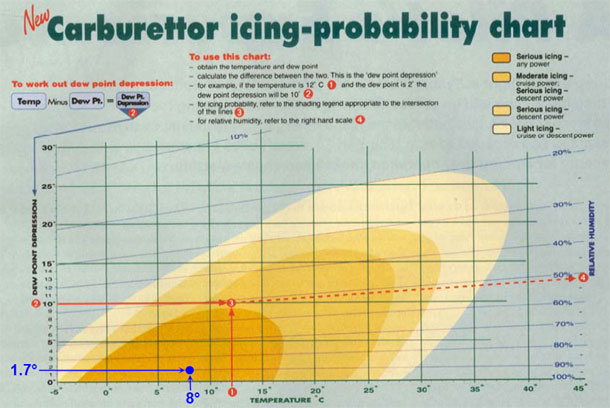
It was subsequently reported that at the time of the occurrence, the cloud base at Mangalore aerodrome was about 1,400 ft. The 1000 EST Mangalore automatic weather station data revealed that the temperature was 8 degrees C, and the dewpoint temperature was 6.3 degrees C. The dew point depression was therefore 1.7 degrees C, which meant that there was a probability of serious carburettor-icing, as depicted at fig. 1. Other helicopters were operating in the Mangalore circuit at the time of the occurrence. Although the pilots of those helicopters reported that their helicopters had not been affected by carburettor-icing, the investigation was unable to discount that carburettor-icing may have been the factor that resulted in the abnormal operation of the helicopter's engine.

Figure 1: Carburettor icing-probability chart.

aair200402791_001.jpg

Source: Melting Moments: understanding carburettor icing, Asia Pacific Air Safety, June 1999, Issue 22.

Occurrence summary

Investigation number 200402791
Occurrence date 28/07/2004
Location Mangalore, Aero.
State Victoria
Report release date 05/11/2004
Report status Final
Investigation type Occurrence Investigation
Investigation status Completed
Mode of transport Aviation
Aviation occurrence category Forced/precautionary landing
Occurrence class Accident
Highest injury level Minor

Aircraft details

Manufacturer Robinson Helicopter Co
Model R22
Registration VH-KHU
Sector Helicopter
Operation type Flying Training
Departure point Mangalore, VIC
Destination Mangalore, VIC
Damage Substantial

Cessna 150F, VH-DDQ

Summary

The Australian Transport Safety Bureau did not conduct an on-scene investigation of this occurrence. The information presented below was obtained from information supplied to the Bureau.

At about 1130 Eastern Standard Time on 20 June 2004, the Cessna 150F departed runway 28 at Gladstone, Qld for a local flight. As the aircraft climbed through 200 ft above ground level, the engine began to lose power. The pilot selected the fuel shutoff valve to OFF for a forced landing on a nearby road. During the landing, the aircraft's right wing struck an embankment and the aircraft sustained substantial damage. The two occupants received minor injuries.

The pilot later reported that the aircraft had been washed about two hours before the flight, and had departed with 35 litres of fuel in the tanks. Meteorological information indicated that induction system icing was possible but it could not be verified. Similarly, the possibility of water contamination of the fuel system was considered, but could not be substantiated. The reason for the engine failure was not established.

Occurrence summary

Investigation number 200402259
Occurrence date 20/06/2004
Location Gladstone, Aero.
State Queensland
Report release date 03/09/2004
Report status Final
Investigation type Occurrence Investigation
Investigation status Completed
Mode of transport Aviation
Aviation occurrence category Forced/precautionary landing
Occurrence class Accident
Highest injury level Minor

Aircraft details

Manufacturer Cessna Aircraft Company
Model 150
Registration VH-DDQ
Serial number 15063461
Sector Piston
Operation type Private
Departure point Gladstone, QLD
Destination Gladstone, QLD
Damage Substantial

Cessna 207, VH-EHL

Summary

The Cessna 207 aircraft (C207) was engaged on a sight-seeing flight from Cradle Mountain to Lake St. Clair and return. On board were the pilot and 4 passengers. The flight departed Cradle Mountain at approximately 1310 ESuT and tracked direct to Lake St Clair at 7000 ft due to turbulence. The aircraft then returned to Cradle Mountain.

At approximately 1404, as the aircraft was approaching the airfield, the pilot configured the aircraft for a straight in approach to strip 02. The pilot had selected two stages of flap, and had reduced power to approximately 19 inches of manifold pressure. He reported that at approximately half a mile from the airfield the engine stopped without any prior warning. After completing trouble checks, the pilot became aware that the aircraft would not reach the airfield. He then manoeuvred the aircraft towards an open area on his right while broadcasting a MAYDAY call. Melbourne air traffic control acknowledged this call. The pilot then completed additional trouble checks and changed the fuel tank selection, but the engine failed to respond.

The aircraft touched down heavily on the main wheels and slid approximately 40 metres before coming to a stop. During the touchdown and subsequent ground slide, the nose wheel detached from the aircraft, the propeller was damaged and the right wing was partially separated from the airframe. After the aircraft stopped the pilot checked the passengers and discovered that two of them had suffered serious injuries. As fuel was leaking from the damaged right wing, the pilot and uninjured passenger assisted the injured passengers from the aircraft. The pilot was then able to make his way to the airstrip to raise the alarm. The Australian Transport Safety Bureau did not attend the site but conducted the investigation relying upon information provided by the pilot, the operator, and the Bureau of Meteorology.

The pilot reported that he had completed a daily inspection of the aircraft earlier in the morning. That inspection included assessing the fuel quantity on board the aircraft and completing a fuel drain and water check. Both of these checks did not reveal any problem with the fuel. The pilot estimated that there was approximately 185 litres of fuel on board the aircraft, 90 litres in the right tank and 95 litres in the left tank. The aircraft had last been refuelled the day previously from drum stock. The aircraft had completed two flights since that refuelling with no problems being reported. The engineers that recovered the aircraft reported that there was approximately 30 litres of fuel in the left tank and approximately 100 litres of fuel in the right tank.

The C207 aircraft has a fuel selector in the cockpit that allows the pilot to supply fuel to the engine from either the right tank or the left tank, but not from both tanks simultaneously. The pilot reported that he conducted the flight with the fuel selector switched to the left tank. He also reported that he did not move the selector during the flight and only moved it to the right tank as part of his trouble checks when the engine failed.

The pilot reported that he did not complete flight or fuel plans for the flight, but operated on previous knowledge from other flights. A post occurrence analysis of the weather indicated that the winds at 7000 feet were as forecast. Post flight analysis of the flight revealed that the aircraft would have required 57 litres of fuel to complete the flight, which included allowances for taxi and climb.

The engine was sent by the owner to an engine overhaul facility for testing. The ATSB did not attend the testing of the engine. The engine was fitted to the test cell in the condition as removed from the aircraft. The engine was started and test run in accordance with the engine manufacturer's overhaul manual. The engine ran normally and all temperature and pressure limits were within normal ranges.

The investigation was unable to determine why the engine failed to operate normally in the latter stages of the flight.

Occurrence summary

Investigation number 200205223
Occurrence date 07/11/2002
Location 4 km S Cradle Mountain (Valley)
State Tasmania
Report release date 22/07/2003
Report status Final
Investigation type Occurrence Investigation
Investigation status Completed
Mode of transport Aviation
Aviation occurrence category Forced/precautionary landing
Occurrence class Accident
Highest injury level Serious

Aircraft details

Manufacturer Cessna Aircraft Company
Model 207
Registration VH-EHL
Serial number 20700141
Sector Piston
Operation type Charter
Departure point Cradle Mountain (ALA), TAS
Destination Cradle Mountain (ALA), TAS
Damage Substantial

Bell 206B(II), VH-PHA

Analysis

The engine failure required the pilot to enter an autorotation while manoeuvring at low level and over inhospitable terrain. The investigation could not determine conclusively whether the single 'beep' reported by the survivor was a momentary warning of an impending engine power failure.

Once the main rotor blade struck the tree, further autorotation flight to landing was not possible and the helicopter impacted the ground in an out of control condition.

The survivor's seating position in the right rear of the helicopter shielded him from the majority of the impact. Although severely injured, he was able to escape from the wreckage. The rapid spread of the fire post impact did not allow the survivor to extricate any other occupants from the wreckage.

Summary

The pilot of the Bell 206 helicopter had been tasked with conducting a survey operation in the Dhoyndji area of the Northern Territory. He had flown the helicopter from Gove earlier in the morning with two passengers on board. Some equipment was offloaded at Dhoyndji and another two passengers boarded the helicopter. The pilot departed Dhoyndji at approximately 1150 Central Standard Time (CST) and tracked to the southwest to commence the survey work. He initially tracked to the Goyder River and landed to the west of the river. The passengers conducted ground survey work in the area for 40-60 minutes. They then reboarded the helicopter and began aerial survey work in the same area for approximately 10 minutes. The pilot then flew the helicopter in a north-easterly direction towards the Mitchell Ranges.

At 1330 a refuelling party realised that the helicopter was overdue for a scheduled refuelling stop and that its SARTIME had expired. The aircraft operator and the refuelling party commenced a local search and CENSAR notified Australian Search and Rescue (AusSAR) of the expired SARTIME. AusSAR assumed responsibility for search coordination and the wreckage of the helicopter was found the following day. The pilot and three passengers received fatal injuries.

The survivor reported that as the helicopter approached the Mitchell Ranges, one of the passengers indicated that they would have to land in the area to conduct a brief ground survey. The pilot acknowledged the requirement and began to search the area for a landing spot. The surrounding terrain was generally flat and lightly treed. The tree spacing was such that a landing area was not readily apparent.

The survivor reported that he heard a single 'beep' in his headphones as the pilot searched for a landing area. The pilot looked into the helicopter cockpit and appeared to be checking his instruments. Shortly after, the pilot appeared to return to the task of selecting a landing spot. The survivor estimated that about 2-3 seconds after the single 'beep', he heard continuous 'beeping' in his headphones. He reported that the pilot told everyone to "hang on boys, this is going down".

The survivor was seated in the right rear seat of the helicopter, immediately behind the pilot. He reported that when the continuous beeping started, the helicopter "appeared to fall out of the sky". At that time, he estimated that the helicopter had been at a lower height, and a considerably lower speed than when flying from the Goyder River area to the Mitchell Ranges.

The Pilot

The pilot held a Commercial Pilot (Helicopter) Licence with an endorsement on the Bell 206 series helicopter. He had accumulated 5,455 hours total aeronautical experience with 5,330 hours on the Bell 206 helicopter. He held a Class 1 medical certificate with a condition that vision correction be worn while exercising the privileges of the licence. The pilot was reported to have always worn his glasses. The survivor reported that the pilot was wearing his glasses when the helicopter departed the Goyder River area.

The pilot was adequately rested prior to commencing the survey and had not exceeded any flight or duty times. He had flown his entire career in the Arnhem Land area and was considered by his peers to be a meticulous and safety conscious pilot.

The helicopter

The helicopter had completed 8,226.5 hours of flight time. All required maintenance had been completed. It last underwent maintenance 3 weeks prior to the accident. During that scheduled maintenance, the main rotor transmission was overhauled. The helicopter had since completed 24.6 flying hours. There were no reported problems with the helicopter during that period.

The engine fuel control unit was last removed from the helicopter in February 2002, as the engine was not achieving predicted starting performance. The fuel control unit was repaired in accordance with the manufacturer's overhaul instructions and refitted to the helicopter. The engine subsequently started normally.

The helicopter was refuelled to full tanks at Gove on the evening prior to the day of the accident. Two additional 200 litre drums of fuel were taken from the same fuel supply and road transported to the Dhoyndji area for use during the survey. Search aircraft subsequently used this fuel with no problems being reported. Analysis of the Gove fuel supply revealed it was of the correct aviation turbine fuel specification and contained no contamination. It was estimated that the helicopter had approximately 150 litres of fuel remaining on board at the time of the accident. The survivor reported that he had been covered in a liquid after the helicopter's impact with the ground. He described it as being consistent with aviation turbine fuel.

At the time of the accident the helicopter was within weight and balance limitations.

Wreckage examination

The advancing main rotor blade had collided mid span with a tree that was about 30 cm in diameter. The helicopter then impacted the ground heavily on its left side. A severe post-impact fire consumed most of the wreckage. The wreckage trail, including the engine, engine compartment, transmission and hydraulics pack, was orientated along a bearing approximating 155 degrees magnetic. The distance from the base of the tree to the main wreckage area was approximately 15 metres.

The retreating main rotor blade was found lying leading edge down and in a normal orientation to the main wreckage. No leading edge deformities were found on this blade. Both main rotor blades remained attached to their respective rotor grips and to the main rotor mast. The main rotor mast exhibited a slight bending towards the advancing blade.

The main rotor transmission remained attached to the fuselage-to-transmission 'A' frame supports. Examination of the transmission magnetic chip detector found no debris adhering to the plug and the remaining transmission oil was clear of contamination.

Both tail rotor blades remained attached to their respective grips, and to the tail rotor gearbox assembly. The blades exhibited minor leading edge impact damage consistent with low speed rotation through light tree branches. The tail rotor gearbox magnetic chip detector was clean and free of debris.

All flight control tube rod structures had been consumed during the fire. A search of the wreckage found the control tube rod junction bolts securely fastened and lock wired.

The fire had completely destroyed the accessory gearbox housing and all attached ancillary components. The remainder of the engine was recovered for off-site examination.

The inspection of the engine was carried out at an authorised overhaul facility, under the supervision of the Australian Transport Safety Bureau and observed by a representative of the engine manufacturer. The engine compressor and power sections exhibited signs of rotation, but not power, at impact. The reason the engine failed could not be determined due to the extensive fire damage to the accessory gearbox and other engine components.

The survivor was played a number of randomly sequenced warning tones that had been recorded from a similar Bell 206 helicopter. He identified the continuous 'beeping' as that of the engine-out audio warning tone. He also described the single 'beep' as the commencement of the engine-out audio warning tone. The helicopter Flight Manual stated that the engine-out warning tone warned the pilot of an engine power failure.

Occurrence summary

Investigation number 200202656
Occurrence date 05/06/2002
Location 58 km SSW Lake Evella Aero.
State Northern Territory
Report release date 06/01/2003
Report status Final
Investigation type Occurrence Investigation
Investigation status Completed
Mode of transport Aviation
Aviation occurrence category Forced/precautionary landing
Occurrence class Accident
Highest injury level Fatal

Aircraft details

Manufacturer Bell Helicopter Co
Model 206
Registration VH-PHA
Serial number 1454
Sector Helicopter
Operation type Charter
Departure point Dhoyndji, ALA
Damage Destroyed