Section 21 (2) of the Transport Safety Investigation Act 2003 (TSI Act) empowers the Australian Transport Safety Bureau (ATSB) to discontinue an investigation into a transport safety matter at any time. Section 21 (3) of the TSI Act requires the ATSB to publish a statement setting out the reasons for discontinuing an investigation.
On 18 May 2015, the ATSB commenced an investigation into a number of loss of separation occurrences and radar vectors issued to flight crew when an aircraft was below the minimum vector altitude on 18 May 2015, near Adelaide Airport, South Australia involving:
a SAAB Aircraft Co 340B (S340), registered VH‑OLL (OLL), conducting a low capacity regular public transport flight from Mount Gambier, South Australia
an Airbus A320-232 (A320), registered VH‑VNH (VNH), conducting a high capacity regular public transport flight from Melbourne, Victoria
a Boeing 737‑8FE (B737), registered VH‑YVC (YVC), conducting a high capacity regular public transport flight from Melbourne
a Boeing 737 (B737) conducting a high capacity regular public transport flight from Sydney, New South Wales.
The aircraft were under the jurisdiction of an Airservices Australia (Airservices) Check and Standardisation Supervisor (workplace assessor), conducting a final assessment on a trainee Approach East controller (trainee). During the approach sequence there were two loss of separation occurrences, then OLL was below the minimum vector altitude while on a vector on one occasion, and OLL was not confirmed above the minimum vector altitude while being vectored on another.
An Airservices investigation into the occurrences found that the Adelaide Tower controller did not have sufficient understanding of the minimum vector altitude, that the intervention by the workplace assessor was not effective and that the controllers involved in a transfer of separation responsibility did not have a shared understanding, as there was no standard phraseology. The investigation report identified the following safety issues:
Compromised separation training for controllers at Adelaide Tower did not incorporate scenarios where aircraft were below the minimum vector altitued at night.
The updated Intervention Techniques and Prompting initial qualification training was not provided to existing on-the-job training instructors or workplace assessors. Additionally, the relevent refresher training module had not been updated.
There was no defined explicit requirements, including the required phraseology, for coordinating the transfer of separation responsibility between controllers.
Airservices subsequently advised that each of the safety issues had been addressed and all related safety actions had been completed.
The ATSB reviewed the Airservices report, safety issues and safety actions. Based on this review, the ATSB considered it was very unlikely that further investigation would identify any systemic safety issues. Consequently, the ATSB has discontinued this investigation.
On 15 May 2015 at about 0135 Eastern Standard Time, an Airbus A319 aircraft, registered VH‑VCJ and operated by Skytraders Pty Ltd, was positioning to commence an approach to runway 16 at Melbourne airport. Following the receipt of a clearance to descend the aircraft to 3,000 ft, the pilot flying (PF) made a number of autoflight mode selections. These mode selections led to the autothrust system disengaging and the engines entering the thrust lock condition. The PF’s actions to correct the condition resulted in an unexpected increase in thrust.
In response to the thrust increase, the PF made a number of pitch-down inputs and retarded the thrust levers. The pitch-down inputs, when combined with the increased thrust, resulted in the aircraft developing a high rate of descent with an accelerating airspeed. The aircraft descended below the cleared altitude and a Terrain Avoidance and Warning System (TAWS) alert activated. The PF responded to the alert by declaring an intent to ‘go around’ and advanced the thrust levers to full power. When the engines responded with increased power, the PF again reacted with pitch-down inputs. A further two TAWS alerts activated before the PF reversed the descending flight path and started to climb the aircraft.
What the ATSB found
The ATSB found that a number of autoflight mode selection errors led to the aircraft’s engines entering the thrust locked condition. The correct procedure when disconnecting the autothrust was not completed, which in turn resulted in the unexpected sudden power increase.
The ATSB also found that the PF likely experienced pitch-up illusions during periods of unexpected and rapid thrust increase. The PF instinctively responded with pitch-down side stick inputs that resulted in the initial high speed and high rate of descent, as well as continued descent after initiating a go-around.
The rapidly changing aircraft state led to the crew experiencing a high workload. This significantly limited their capacity to identify the autoflight system mode changes and respond to the aircraft's high airspeed and high rate of descent.
The pilot monitoring’s ability to identify and influence the rapidly changing situation was likely affected by the non-routine nature of actions of the PF, multiple autoflight system mode changes and alerts, the reduced communication between the crew, and a focus on the flap limitation airspeeds.
Safety message
A pitch-up illusion can affect the most experienced pilot. Ideally, adherence to instrument scan techniques, setting and maintaining known aircraft attitudes for specific phases of flight, and using flight aids such as autopilots and/or flight directors, are all strategies to reduce the risk of responding inappropriately to pitch-up illusions. However, when pilots are experiencing a high workload this can be difficult to achieve. In this case, there are benefits in increasing crew communication, to enable more time to identify issues and consider solutions as well as to facilitate the pilot monitoring’s ability to monitor the situation.
Aviation operators conduct non-technical skills training for their pilots. An occurrence such as this demonstrates the way in which topics such as human error prevention and detection, information processing, decision making and communication continue to be relevant.
The occurrence
Introduction
On the evening of 14 May 2015 an Airbus A319, call-sign Snowbird Two (SND2) departed Perth, Western Australia for Melbourne, Victoria. The aircraft was registered as VH-VCJ and operated by Skytraders Pty Ltd as a passenger charter service with 5 crew and 18 passengers. The aircraft’s flight crew consisted of two captains. The pilot-in-command occupied the left seat and was the pilot flying (PF).[1] The other captain occupied the right seat and was performing the pilot monitoring (PM) duties.
As the aircraft was positioning to commence the approach into Melbourne, the PF made a number of inadvertent autoflight mode selections, which led to the autothrust system disengaging and the engines entering the thrust lock condition. The PF’s actions to correct the thrust lock resulted in an unexpected increase in thrust. In response to the thrust increase, the PF made a number of pitch-down inputs and retarded the thrust levers. The pitch-down inputs, when combined with the increased thrust, resulted in the aircraft developing a high rate of descent with an accelerating airspeed. This led to the aircraft descending below the cleared altitude, as well as the triggering of a number of Terrain Avoidance and Warning System (TAWS) alerts. During the subsequent response to these alerts, the aircraft did not commence climbing for about another 10 seconds, and after two further TAWS alerts had activated.
Events leading up to the inadvertent autoflight mode selections
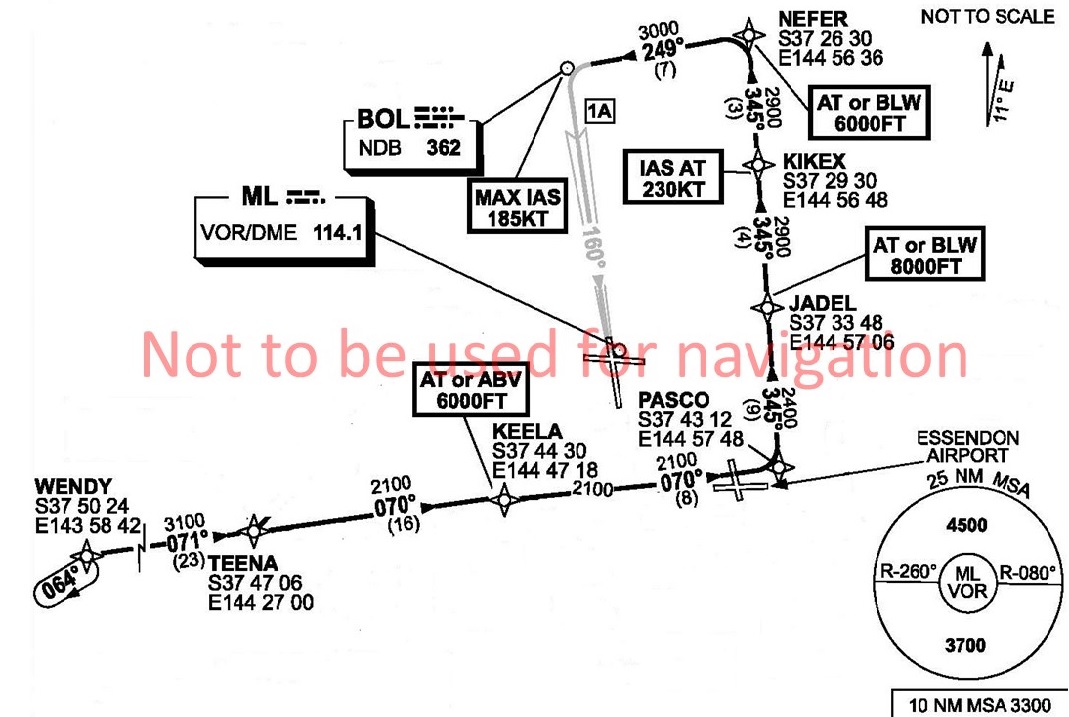
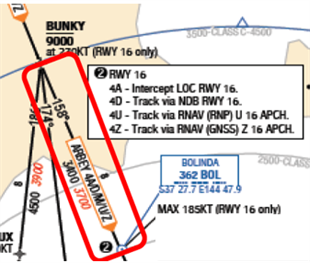
Approaching Melbourne and before commencing descent, the flight crew set up the aircraft’s flight management guidance system and then briefed for an expected WENDY 1A standard arrival route (STAR) procedure, with an instrument landing system (ILS)[2] approach to runway 16[3] for landing (Figure 1). Shortly after, air traffic control (ATC) cleared the aircraft for the WENDY 1A STAR. In the early morning of 15 May 2015, at about 0120 Eastern Standard Time,[4] the aircraft commenced the descent into Melbourne.
The PF commenced the descent with the following autoflight systems and modes selected:
Autopilot 1 (AP1) was controlling the aircraft.
Lateral navigation was in the ‘navigation’ (NAV) mode, while vertical navigation was in the ‘descent’ mode, both of which were managed modes[5] where the aircraft follows a pre-planned horizontal and vertical flight path loaded in the flight management guidance computer.
Autothrust system was on, with the thrust levers at the managed thrust position—the climb thrust detent that equated to a thrust lever angle of 22.5 degrees.
Figure 1: The Wendy 1A standard arrival procedure to Melbourne runway 16 ILS approach
Source: Airservices Australia
At 0128, SND2 called ATC and advised that the aircraft was on descent to a cleared altitude of 9,000 ft, and that they had received ATIS[6] information Romeo.
As SND2 approached waypoint KIKEX (Figure 1) at 0134:25, ATC cleared the aircraft to descend to 3,000 ft and for the ILS approach to runway 16. The PF set 3,000 ft into the altitude function of the aircraft’s flight control unit (FCU). At that time, the aircraft was passing 5,900 ft at an indicated airspeed of 253 kt.
Approaching waypoint NEFER, at 0135:30 and passing about 4,700 ft, SND2 commenced a left turn towards BOL (Figure 1). At 0136:38 the PF requested, and the PM selected, flap 1. The flaps reached this setting two seconds later. At 0136:39, the aircraft had completed the turn and rolled level on the NEFER to BOL track.
The inadvertent autoflight mode selections and following events
The following sequence of events, covering the next 39 seconds of flight, was drawn from the aircraft’s digital flight data recorder (DFDR), cockpit voice recorder (CVR) and crew interviews. This period can be divided into three distinct phases:
inadvertent FCU selections
thrust increases and the PF’s responses
recovery.
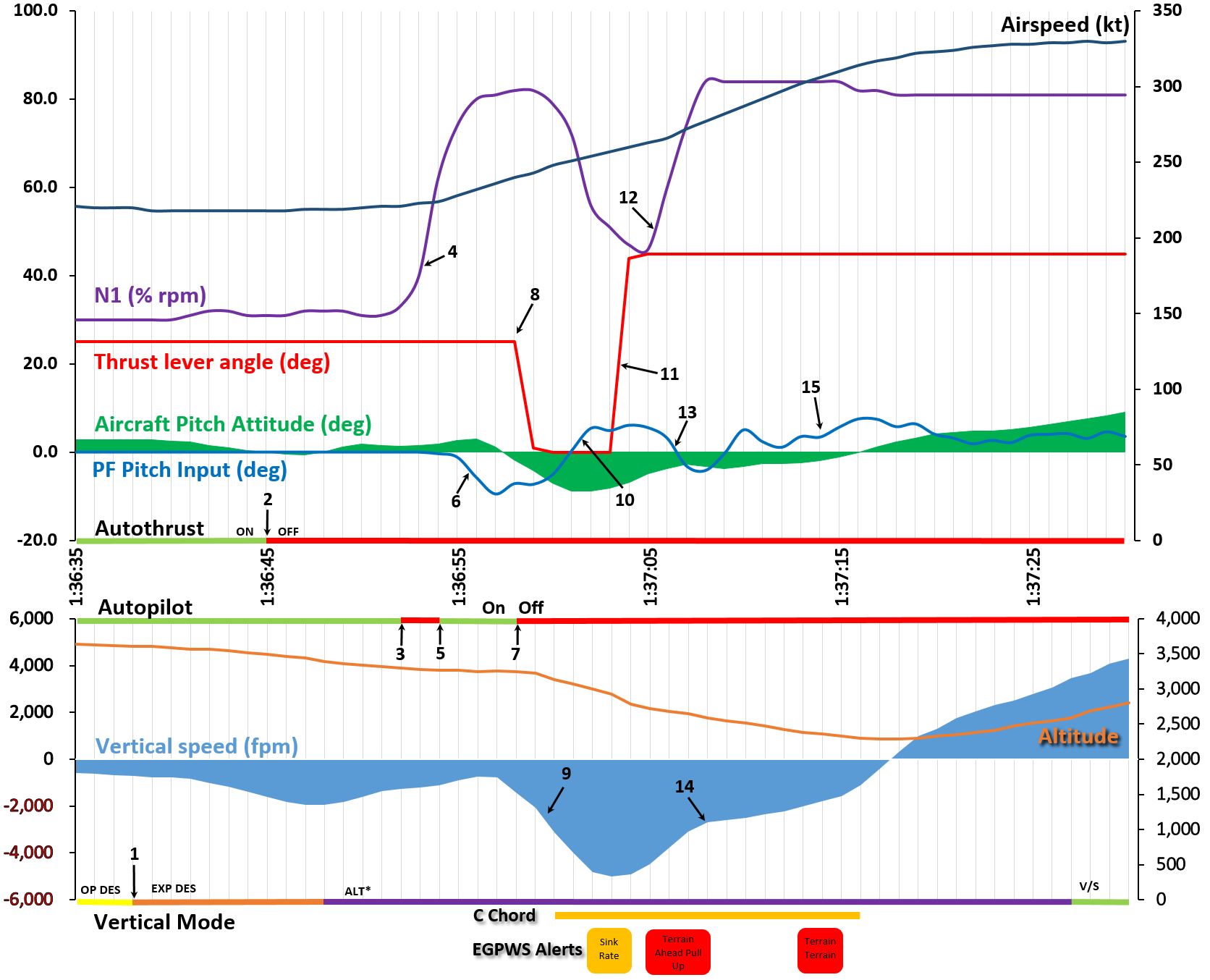
The sequence of events from 0136:35 is graphically presented in a data plot at Figure 2. Specific points on that data plot[7] are identified to enable a clearer understanding of the rapidly changing events.
Figure 2: Data plots based on DFDR and CVR Data
The arrowed numbers identify specific events referred to in the sequence of events. The vertical grid lines each represent 1 second. Source: ATSB
Inadvertent FCU selections
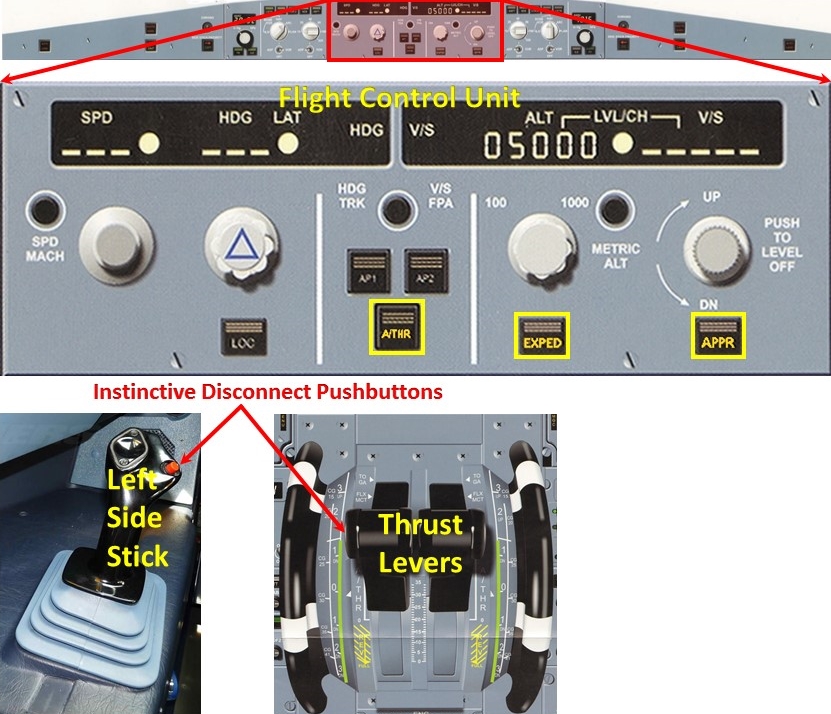
As the aircraft descended through 3,600 ft at 0136:39, the PF announced an intent to ‘arm the approach’. This required the PF to press the APPR (approach) pushbutton on the FCU. Instead, the PF pressed the EXPED (expedite) pushbutton (see Figure 3), resulting in the autoflight vertical mode changing from the open descent mode[8] to the expedite descent mode[9] (point 1). Over the next 5 seconds the vertical descent rate increased from around 800 ft/min to around 1600 ft/min, while the airspeed remained stable at around 220 kt.
Figure 3: Autoflight controls
The flight control unit is expanded and, from left to right, the A/THR, EXPED and APPR buttons highlighted. The PF’s instinctive disconnect buttons on the side stick and thrust levers are also identified. Source: Airbus and ATSB
After a few seconds the PM identified that the vertical mode had changed to expedite descent and announced this change to the PF. At 0136:44, upon recognising the incorrect mode selection the PF, in an apparent attempted to correct the error, pressed the A/THR[10] (autothrust) pushbutton (to off) (point 2). Pressing the A/THR pushbutton had a number of effects:
The autothrust system disengaged and the engines’ thrust was locked at the thrust level prior to disconnection—idle thrust, which was the commanded thrust at that time (the thrust lock condition).
The master caution light and aural alert (a single chime) triggered.
The electronic centralised aircraft monitoring system[11] THR LK message (thrust lock) was displayed, with an associated procedure.
A yellow flashing THR LK message was displayed in the flight mode annunciator on both pilots’ primary flight displays.[12]
Almost immediately, at 0136:47, the PM recognised and announced the thrust lock condition. At about the same time, the autoflight system’s vertical mode transitioned to altitude acquire (ALT* on the vertical mode section of Figure 4), identifying that the autoflight system had captured the 3,000 ft target altitude.
At 0136:51, the PM announced that the aircraft had captured the target altitude. At about the same time the PF recognised the thrust lock condition and pressed the ‘instinctive disconnect’ buttons on both the side stick and thrust levers (see Figure 3). The PF later recalled that the intent behind that action was to reduce the aircraft’s airspeed and to retard the thrust levers. The use of the instinctive disconnect pushbuttons had the following effects:
The action of pressing the instinctive disconnect pushbutton on the sidestick disconnected the autopilot (point 3), which in turn triggered the autopilot disconnect aural alert (‘CAVALRY CHARGE’). The CAVALRY CHARGE sounded for 1 second.
The pressing of the thrust lever instinctive disconnect pushbutton caused the thrust lock condition to disengage. It also removed the THR LK message from the electronic centralised aircraft monitoring system and the pilots’ flight mode annunciators. As the thrust levers remained set to the climb detent, the commanded thrust changed from idle to climb.
Thrust increases and the PF’s responses
At 0136:53 the engines began to respond to the commanded thrust change by rapidly increasing thrust (point 4). At about the same time, the PF reconnected the autopilot (point 5) but left the autothrust system disconnected. The PF responded to the rapidly increasing thrust by applying pitch-down inputs on the sidestick (point 6). The PF did not recall applying pitch-down input during post occurrence interviews, but did recall thinking that the aircraft was pitching up.
As a result of the PF’s pitch-down inputs on the side stick, at 0136:58 the autopilot disengaged (point 7). This disconnection again triggered the autopilot disconnect aural (CAVALRY CHARGE) alert, which sounded for 1 second. At the same time, the PF rapidly moved the thrust levers to idle (point 8). At this point, the aircraft’s airspeed was 240 kt and increasing, and the PM asked if the flaps should be retracted. The PF responded in the affirmative.
The PF’s pitch-down inputs, coupled with the aircraft’s high thrust level and the now downward flight vector, resulted in the aircraft’s airspeed and vertical rate of descent rapidly increasing (point 9). At 0137:00 the altitude warning (C CHORD aural alert) commenced. It continued to sound for 15 seconds. As the engine thrust reduced (from the thrust levers being moved back to idle) the PF transitioned from pitch-down to pitch-up inputs on the side stick (point 10). As a result, the rate of descent stabilised and then decreased.
At 0137:02, the first of the terrain avoidance and warning system (TAWS) alerts triggered. This alert, a ground proximity warning system Mode 1 SINK RATE caution, repeated twice. The PF responded by rapidly placing the thrust levers fully forward (point 11) and instructed the PM to advise ATC that they were ‘going around’. At 0137:05 the engines began to respond to the commanded thrust change and rapidly increased thrust (point 12). At the same time the second TAWS alert, an enhanced ground proximity warning system TERRAIN AHEAD, PULL UP, TERRAIN AHEAD warning activated, which ended after 3 seconds. The PF again responded to the rapidly increasing thrust by reducing the pitch-up inputs and then commencing pitch-down inputs (point 13). This reduced the rate at which the aircraft’s rate of descent was decreasing, which had the effect of prolonging the period that the aircraft was descending.
Recovery
At 0137:08 the PF began to introduce pitch-up commands, which further reduced but did not arrest the aircraft’s rate of descent (point 14). At 0137:13 the third TAWS alert, a ground proximity warning system Mode 2 TERRAIN TERRAIN PULL UP warning activated, ending after 2 seconds. The PF responded with increasing pitch-up commands (point 15), which began to arrest the rate of descent. At 0137:15, the PM advised ATC that the aircraft was ‘going around’.
The lowest altitude attained by the aircraft during the occurrence, as recorded by the digital flight data recorder (DFDR), was 2,280 ft at 0137:17. At the same time, the flaps were recorded as being fully retracted. The lowest recorded height above ground level recorded by the radio altimeter was 1,100 ft. The aircraft’s maximum speed while the flaps were in the process of retracting was 314 kt.
At 0137:17, the ATC minimum safe altitude warning[13] alert activated for SND2 at the ATC workstation. ATC data identified that the aircraft was descending through 2,300 ft at that time. The lowest recorded altitude by ATC was 2,200 ft. As the aircraft began to climb, ATC cleared the aircraft to climb to 4,000 ft and notified SND2 that a low altitude safety warning had triggered. The aircraft was cleared to and continued to climb to 5,000 ft. The flight crew requested vectors to intercept the ILS approach for runway 16. The aircraft landed on runway 16 at 0150 without further incident.
Pilot recollection of the occurrence
The PM later recalled an impression that there was a lot of button pressing, as well as disconnecting and reconnecting of the autopilot during the event. The PM did not recall any TAWS alerts and neither pilot recalled hearing the altitude alert.
Cockpit voice recorder data identified that the PF did not verbalise any intention to change flight mode selections or other actions during the occurrence, other than the initial call identifying an intention to arm the approach.
The PM commented on the low lighting levels set for the flight instruments, which he considered may have resulted in a difficulty in identifying what selections the PF was making on the FCU.
The Airbus A320 aircraft is a twin engine, narrow body, short to medium range commercial passenger aircraft. The Airbus A320 family of aircraft comprises the A318, A319, A320 and A321 variants. Based on the original A320, the A319 is a shorter variant.
The air operator’s certificate authorised passenger charter operations using the Airbus A319. The operator used an A320 based simulator for training and proficiency checks.
Personnel information
The pilot flying
The pilot flying (PF) held an Air Transport Pilot (Aeroplane) Licence (ATP(A)L) and had accumulated about 17,250 hours of aeronautical experience. Of these, approximately 2,835 hours were on Airbus A320 type aircraft. In the 90 days preceding the occurrence, the PF had logged 69.5 hours, of which 57.1 were on A319.
The PF held a current Class 1 medical certificate, and as a condition of that certificate was required to wear distance vision correction and have available reading correction. These vision requirements were determined to have not influenced the occurrence.
About three months prior to the occurrence, the PF had completed a recurrent training session to a satisfactory standard in an A320 simulator, and in April 2015 a line check in an A319. The PF was current with all training requirements. The PF’s training reports identified that he had satisfactorily completed the required competency checks and was properly trained and proficient on the A320; however, of the 10 training records available that preceded the occurrence, there were two that contained reports of an occasional tendency to rush actions, and that this led to procedural lapses.
The PF was one of three flight crew employed by the operator who were authorised to conduct instrument training and checking on the A320 aircraft family. The PF was cross-trained on the operator’s other aircraft type, the CASA 212, and was also authorised to conduct training and checking on that type. Additionally, the PF held a management role, although the time required to conduct this role was reducing.
A significant proportion of the PF’s recent flight hours leading up to the occurrence were assigned to conducting check flights on the A319, rather than as the primary operating crewmember. The PF’s training and checking reports did not identify any recency or skill detriment resultant from the PF’s management and/or training roles. However, as the records were limited to approximately five years there was insufficient evidence to assess this further.
The pilot monitoring
The pilot monitoring (PM) held an ATP(A)L with a current Class 1 medical certificate, and had accumulated about 12,290 hours of aeronautical experience, of which about 2,200 hours were on an Airbus A320 type aircraft. The PM was also a check and training captain. Prior to the occurrence, the PM had completed a recurrent training session in an Airbus A320 simulator in February 2015 and a line check in July 2014.
Operations manuals
The operator’s Operations Manual suite was subdivided into five parts. The relevant parts to the investigation included:
Part A – Operations Manual (OPSA). OPSA contained company policy, requirements and standard operating procedures (SOP)
Part B – Aeroplane type operating procedures (OPSB). A suite of manuals that contained specific aeroplane type operating procedures and requirements.
The Operations Manual suite was supplemented by Notices to Aircrew. These notices were temporary information that required urgent distribution and notification to the company’s aircrew. There were no notices relevant to the occurrence.
OPSB covered company specific matters that related to a particular aircraft type. The OPSB-A319 stated that flight crew were to use Airbus A319 procedures and limitations, unless modified by information contained within that manual. OPSB-A319 did not include any company specific A319 procedures that were relevant to the investigation.
Airbus procedures were published in company tailored Airbus A319 manuals as part of the OPSB suite. These manuals included the Flight Crew Operating Manual (FCOM), Flight Crew Training Manual (FCTM) and Quick Reference Handbook (QRH).
Aircraft information
The operator’s Airbus documentation was A320 family based. The source of the information presented in this section is the operator’s A320 family FCOM, FCTM and QRH, which Airbus had tailored to meet specifications of the operator’s aircraft, including VH-VCJ.
The primary flight display and flight mode annunciator
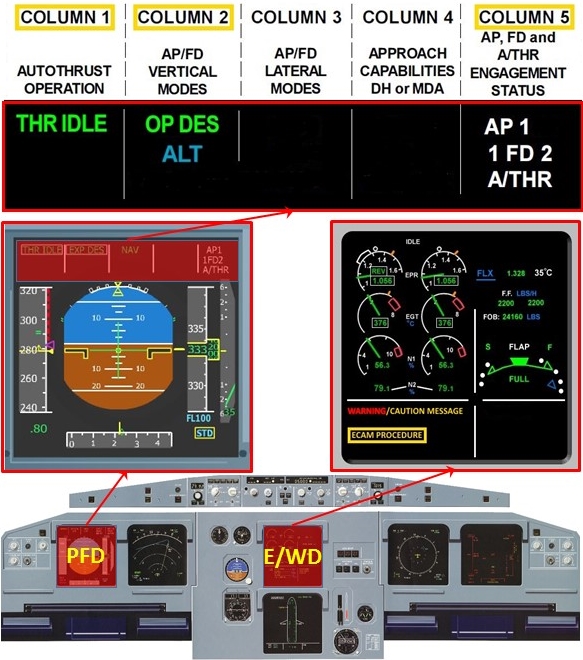
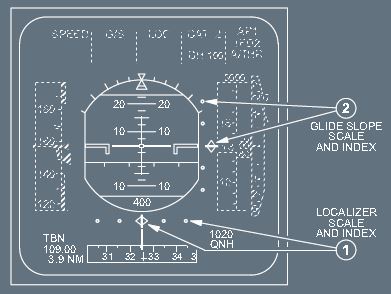
The pilot’s primary flight display (PFD) is the outboard of the pilot’s two display screens (Figure 4). The PFD incorporated the primary flight instruments, as well as the flight mode annunciator (FMA). The FMA, which is located just above the primary flight instruments in the top section of the PFD, showed the status of the:
autothrust in column 1
autopilots and flight directors vertical and lateral modes in columns 2 and 3 respectively
approach capabilities and set decision height or minimum descent altitude in column 4
engagement status of the autopilots, flight directors and autothrust in column 5.
The FCOM section on normal procedures stated that:
The PF should call out any FMA change, unless specified differently (e.g. CAT II & III task sharing). Therefore, the PF should announce:
‐ All armed modes with the associated color (e.g. blue, magenta): "G/S blue", "LOC blue".
‐ All active modes without the associated color (e.g. green, white): "NAV", "ALT".
The PM should check and respond, "CHECKED" to all FMA changes called out by the PF.
Figure 4: The PFD and E/WS displays expanded, with FMA highlighted
Source: Airbus, modified by ATSB
The electronic centralised aircraft monitor
The electronic centralised aircraft monitor (ECAM) monitors aircraft systems, displays aircraft system information, and specifies flight crew actions to be taken in the event of abnormal or emergency situations. The ECAM components relevant to this investigation included the engine/warning display (E/WD) (see Figure 4) and the flight warning computer’s aural and visual alerting systems.
The E/WD display provides the flight crew with the following types of information. On the:
upper part of the display, primary engine parameters, fuel, and slats/flaps position
lower part of the display, warning and caution messages and ECAM procedures.
When the ECAM detects a failure, and there is no flight phase inhibition active,[14] the flight warning computer generates alert messages, aural alerts, and synthetic voice messages. The flight warning computer also drives the master warning light and master caution light. The E/WD displays the alert message as well as the procedures to be followed by the flight crew.
Individual aircraft system failures are graded according to their safety effect on the aircraft, which in turn prioritises how multiple failures are presented to the flight crew. The ECAM has three failure mode levels:
Level 3: Red warning, denoting a dangerous aircraft configuration, limiting flight condition or system failure that alters flight safety that requires immediate action. They are accompanied by: - a continuous repetitive chime or a specific synthetic voice aural alert - illumination of the master warning light - a warning message on the E/WD.
Level 2: Amber caution, denoting a system failure that does not have a direct consequence on flight safety. The flight crew should be aware of the condition and, time and situation permitting, these cautions should be considered without delay. They are accompanied by: - a single chime aural alert - illumination of the master caution light - a caution message on the E/WD.
Level 1: Amber caution, requiring crew monitoring. These failures are accompanied by: - a caution message on the E/WD, generally without an accompanying procedure.
In the event of simultaneous failures, a level 3 warning has priority over a level 2 caution, which has priority over a level 1 caution.
ECAM procedures
The FCOM included some basic crew co-ordination procedures associated with the conduct of abnormal and emergency actions. For response to an ECAM, the crewmember that first recognises the ECAM was required to reset the master warning/caution and announce the title failure as indicated on the E/WD. The PF should then order ECAM actions. This cues the PM to manage the failure by first confirming the failure and then conducting the procedure as displayed on the lower section of the E/WD.
OPSA included the following with respect to emergency and abnormal checklists:
Emergency drills and procedures were to be carried out as per the relevant aircraft emergency checklists and/or in accordance with ECAM procedures.
If a drill required the movement of a thrust lever, this was to be called for by the PM and conducted by the PF.
Autoflight system
The autoflight system (AFS) comprised four broad functional subsystems:
Input: through the multifunctional control and display units (which were not relevant for this investigation) and the flight control unit (FCU).
Data: from the aircraft’s navigation systems, as well as performance and navigational data.
Computing: through the two flight management guidance systems (FMGS).
Output: to the flight directors, autopilots, autothrust, and the electronic flight information system that included the PFD and navigation displays.
The FMGS had two distinct functions:
Flight management, which enabled the aircraft to follow a pre-planned route with vertical, horizontal and speed profiles, through computing the aircraft’s position in conjunction with stored performance and navigational data.
Flight guidance, which controlled the flight directors, autopilots and autothrust.
The autopilots, flight directors, and autothrust used two types of guidance modes to direct the aircraft:
Managed guidance, where the FMGS guided the aircraft along a pre-planned route with vertical and speed profiles computed by the FMGS’s flight management function.
Selected guidance, where the FMGS’s flight guidance function guided the aircraft using targets for lateral, vertical and speed profiles set by the flight crew through the FCU.
The flight control unit
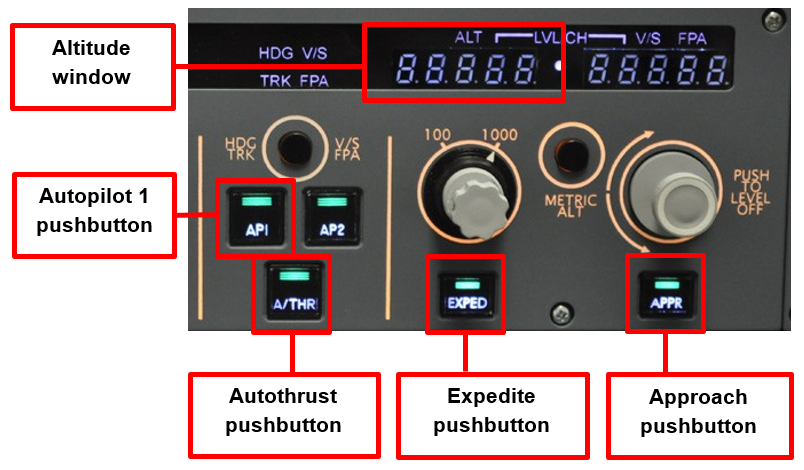
The horizontal and vertical controls for the aircraft’s AFS were located on the glare-shield FCU (Figure 3) equidistant to both pilots. There were a number of switches that selected various modes and functions of the AFS, including anticlockwise, from left to right (Figure 5), the:
AP1 pushbutton, which engaged or disengaged autopilot number 1
A/THR pushbutton, which armed, activated or disconnected the autothrust
EXPED pushbutton, which engaged the expedite mode
APPR pushbutton, which armed, disarmed, engaged or disengaged the approach modes
altitude window, which displayed the altitude target as selected by the flight crew.
Expedite descent
The expedite mode is used in climb or descent to reach the target altitude that is set on the FCU altitude window (Figure 5) using a maximum vertical gradient. The expedite mode will ignore any altitude and/or speed constraint set in the flight management part of the FMGS. When the aircraft is in the descent phase, and the EXPED pushbutton on the FCU is pressed (Figure 5), the AFS will enter the expedite descent mode (EXP DES). In this mode:
the autopilot or flight director will command the aircraft to increase the vertical speed by pitching the aircraft down
the autothrust will command idle thrust
with flap selected, the target speed is the limit speed for the flap setting selected
the first column of the FMA will display THR IDLE, while the second column will display EXP DES (see Figure 4).
The selection of another managed or selected vertical guidance mode, or the selection of a higher altitude on the FCU, will disengage the expedite mode. The expedite mode will automatically disengage when the FMGS captures the target altitude set in the FCU altitude window. When this occurs, column 2 of the FMA (Figure 4) will display ALT*.
Figure 5: Part of the FCU with AP1, A/THR, EXPED and APP pushbuttons as well as the altitude window highlighted in red
Source: flightdecksolutions.com modified by the ATSB
Autothrust system
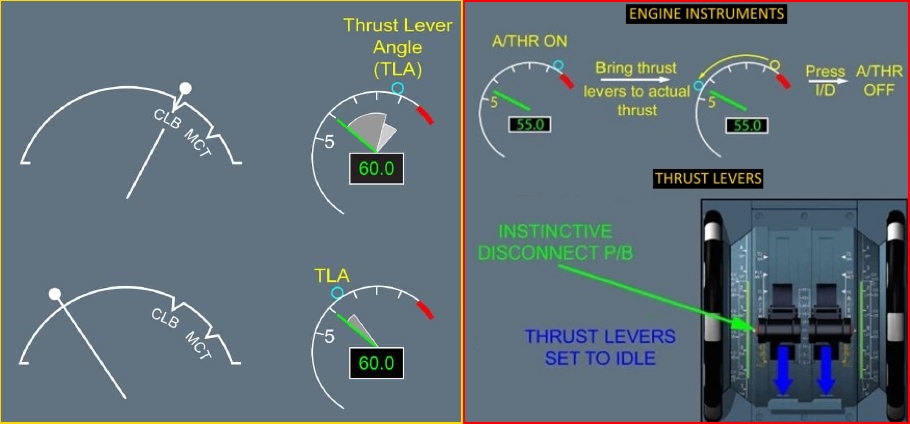
The autothrust computer is part of the flight guidance system. It interfaces with each engine’s electronic control unit. With autothrust active, the autothrust computer does not move the thrust levers to match the commanded thrust, but instead uses the thrust lever angle (TLA) to determine the maximum thrust that autothrust can command. The E/WD display shows the TLA (that is, the position of the thrust levers) as a small blue circle on the top engine instrument indicator (left side of Figure 6). With autothrust active, the normal position for the thrust levers is the climb detent on the thrust lever range.
Figure 6: The thrust lever angle
Engine instruments showing the relationship between the thrust lever angle and the TLA, (left hand diagram) and the autothrust disengagement procedure (right hand diagram). Source: Airbus, modified by ATSB
The normal method for disconnecting autothrust is by pressing the instinctive disconnect pushbutton on the thrust levers (right side of Figure 6). Pressing the instinctive disconnect pushbutton transfers the commanded thrust from the autothrust computer to the position of the thrust levers. When disconnecting autothrust, the PF should first ensure that the thrust levers are matched to approximately the current thrust setting, as indicated by the TLA on the E/WD, before pressing the instinctive disconnect pushbutton. If the pilot does not match the TLA to the actual thrust when the instinctive disconnect pushbutton is pressed, engine thrust will change to that commanded by the thrust lever position.
In the event of a failure of the instinctive disconnect pushbuttons, an alternative method of disconnecting autothrust is to press the A/THR pushbutton on the FCU (Figure 5). This is not a recommended method of disconnection as it will result in the engines entering the thrust lock mode. In the thrust lock mode:
thrust is frozen and remains locked at the thrust value when the A/THR pushbutton was pressed
column 1 of the FMA (Figure 4) will display THR LK, flashing, in amber
the master caution light will flash and the single chime audio alert will sound
the ECAM caution messages AUTOFLT: A/THR OFF and ENG: THRUST LOCKED will be displayed on the E/WD
the E/WD will display the procedure THR LEVERS … MOVE.
As indicated by the ECAM procedure displayed on the E/WD, the required method for disengaging thrust lock is to move the thrust levers. Pressing the instinctive disconnect pushbutton will also disengage thrust lock, however, if the TLA is not matched to the frozen thrust, the thrust will change to that commanded by the thrust lever position. Both methods of disengaging thrust lock will clear the THR LK message from the FMA and the ECAM caution from the E/WD.
Altitude alert system
The flight warning computer will generate an altitude warning when the aircraft approaches or deviates from a preselected altitude or flight level (Figure 5). The warning comprises an aural ‘C chord’ alert, and the PFD altitude window pulsing yellow or flashing amber. The warning may be cancelled by either selecting a new altitude, pressing one of the cancellation pushbuttons, or returning the aircraft to the altitude selected on the FCU.
Instrument lighting
The A320 instrument panels have both integral instrument lighting and flood lighting. The brightness of all panel lighting is adjustable. Each pilot has individual instrument and flood lighting controls for that station’s lighting, while the centre instrument panels also have individual flood lighting and integral lighting controls.
Aircraft flaps
The aircraft had five selectable stages of flap: UP, 1, 2, 3, and FULL. The flap 1 setting, in the approach configuration, is extension of the leading edge slats only. The limit speed for this flap setting is 230 kt.
Terrain avoidance and warning system
VH-VCJ was fitted with a terrain avoidance and warning system (TAWS). The TAWS comprised two primary systems. The first, a ground proximity warning system, used the aircraft’s radio altimeter to produce aural and visual alerts when the aircraft’s radio height was between 30 ft and 2,450 ft, and certain flight conditions were met. These flight conditions were separated into five modes. The relevant modes to this investigation were:
Mode 1: Excessive rate of descent. This mode produced the SINK RATE caution and PULL UP warning aural alerts
Mode 2: Excessive terrain closure rate. This mode produced the TERRAIN TERRAIN caution and the PULL UP warning aural alerts.
The second was a terrain hazard warning system, commonly called an enhanced ground proximity warning system. The terrain hazard warning system used a worldwide terrain database, as well as aircraft navigation system input to produce a:
terrain awareness display that provided predicted terrain conflict and terrain representation on the pilot’s navigation display
calculated terrain clearance floor, which improved terrain warning during final approach and landing.
The terrain awareness system also produced aural alerts associated with terrain conflicts. These alerts were the TERRAIN AHEAD, PULL UP warning and the TERRAIN AHEAD caution.
The abnormal procedures section of the FCOM contained the following procedures for TAWS alerts:
“PULL UP” - “TERRAIN AHEAD PULL UP” Simultaneously: AP................................................................................OFF PITCH..........................................................................PULL UP Pull to full backstick and maintain in that position. THRUST LEVERS.......................................................TOGA SPEED BRAKES lever................................................CHECK RETRACTED BANK...........................................................................WINGS LEVEL or ADJUST Best climb performance is obtained when close to wings level. Then, for “TERRAIN AHEAD PULL UP” only, and if the crew concludes that turning is the safest way of action, a turning maneuver can be initiated. - When flight path is safe and the warning stops: Decrease pitch attitude and accelerate. - When speed is above VLS, and vertical speed is positive: Clean up aircraft, as required.
“TERRAIN TERRAIN” – “TOO LOW TERRAIN”: Adjust the flight path, or initiate a go-around.
“TERRAIN AHEAD": Adjust the flight path. Stop descent. Climb and/or turn, as necessary, based on analysis of all available instruments and information.
“SINK RATE” – “DON’T SINK”: Adjust pitch attitude and thrust to silence the alert.
The standard operating procedures section in OPSA included specific requirements with respect to TAWS alerts and warnings. This section stated, that, while these systems were not infallible, all TAWS alerts and warnings require an immediate and positive response. With respect to any TAWS warning, the required response was to level the wings and initiate a maximum gradient climb to the minimum sector altitude for the sector being flown. The response to an alert varied according to the stage of flight, but in essence involved correcting the condition that gave rise to the alert.
Operational philosophy
Communication
In a Flight Operations Briefing Notes (FOBN), Airbus[15] identified the critical role of effective communications between flight crew. The FOBN stated that the communication between the flight crew ‘allows sharing of goals and intentions and enhancing crew’s situational awareness’. With respect to the topic of communication between the flight crew, the FCTM contained the following:
The term "cross-cockpit communication" refers to communication between the PF and the PM. This communication is vital for any flight crew. Each time one flight crewmember adjusts or changes information and/or equipment on the flight deck, the other flight crewmember must be notified, and an acknowledgement must be obtained.
Such adjustments and changes include:
- Flight management guidance systems (FMGS) alterations
- Changes in speed or Mach …
- Flight path modifications
- System selections...
When using cross-cockpit communication, standard phraseology is essential to ensure effective flight crew communication. This phraseology should be concise and exact, and is defined…
Take action when things do not go as expected
The FCTM included guidance for flight crew on what to do when the aircraft is not performing as expected.
If the aircraft does not follow the desired vertical or lateral flight path, or the selected targets, and if the flight crew does not have sufficient time to analyze and solve the situation, the flight crew must immediately take appropriate or required actions, as follows:
The PF should change the level of automation:
‐ From managed guidance to selected guidance, or ‐ From selected guidance to manual flying.
Optimal use of automation
When interfacing with automation, such as when arming or selecting various autoflight modes or selecting guidance targets, Airbus[16] recommended adherence to the following:
before performing any action on the flight control unit (FCU), check that the knob or pushbutton is the correct one for the desired function
after each action on the FCU, verify the result of this action on the FMA and by reference to the aircraft flight path and airspeed response
announce all changes in accordance with standard calls as defined in SOPs.
Meteorological information
The pilots reported that during the relevant period of the occurrence, the aircraft was in cloud with showers, and the visibility was zero.
ATIS
Prior to descent, the flight crew transcribed the latest ATIS for Melbourne. That ATIS was designated as information Romeo and stated that:
runway 16 was the arrivals runway, and the runway condition was wet
low visibility procedures were in force
the wind was 230° at 10 kt
cloud was scattered[17] at 200 ft and broken at 500 ft[18]
visibility was 10 km reducing to 6 km in rain
the temperature was 11 °C
the barometric pressure was 1034 hPa
low visibility procedures were in force.
Bureau of Meteorology
The Bureau of Meteorology provided a number of weather observations for Melbourne Airport that covered the period from when the aircraft commenced descent, at about 0120, until it landed at 0150. The observations recorded the:
wind as being from the south west at about 10 kt
visibility as 5 km in drizzle
cloud as few at 300 ft, broken at 1,400 ft and broken at 2,400 ft
temperature as 11 °C, while the dew point was fluctuating between 10 °C and 11 °C.
The observations also included a forecast, indicating that over the following three hours, for periods of between 30 and 60 minutes, visibility would decrease to 3 km in showers, rain and drizzle, with the cloud becoming broken at 300 ft.
Air traffic services
Minimum Safe Altitude Warning
The Australian Advanced Air Traffic System (commonly known as TAAATS) is fitted with a Minimum Safe Altitude Warning (MSAW) system to assist in the prevention of controlled flight into terrain.
TAAATS used a general terrain monitoring type of MSAW system that monitors the aircraft’s reported altitude (Mode C)[19] against a terrain map. The terrain map is based on a mosaic grid comprising areas of about 0.5 km square with each square set to an altitude represented by the highest terrain within that square, with obstacle data (such as towers or buildings) overlaid on that map. A predictive function calculates an aircraft’s rate of descent from a number of Mode C returns and projects this rate of descent and the aircraft’s track forward 60 seconds. If the projection predicts that the aircraft would impact the terrain map, a warning is provided to the controller.
Human performance related information
As part of this investigation, several human factors-related aspects were considered in the context of the flight crew’s actions during the descent. These included the:
PF experiencing pitch-up illusions with thrust changes
PF inadvertently pressing the EXPED pushbutton and what could be considered other inadvertent actions by the PF
effect of fatigue
role of workload on both crew.
The pitch-up illusion
Pitch-up illusions are a vestibular misperception of acceleration, confused with a climb, and is amplified when visual cues are absent. Given that it was night-time, there would have been very limited visual cues outside the aircraft available to the pilots. The pitch-up illusion is also referred to as a somatogravic effect when referring to what a pilot experiences and is explained by Stott (2011) as follows:
…forward acceleration of the aircraft produces an equal inertial acceleration acting backwards on the pilot and increasing the sense of pressure from the back of the seat….The sensory information provided by the otolithic system[20] is exactly similar to the…sensation of backward tilt…Thus from non-visual sensations a pilot is unable to distinguish between an actual backward tilt associated with the climb and an illusory sense of tilt associated with forward acceleration.
The pilot’s pitch-down inputs during the descent are consistent with this type of pitch-up illusion event.
Airbus perspective on pitch-up illusions
Airbus has identified the all-engine go-around as a specific manoeuvre where the pitch-up illusion can adversely affect the outcome of a normal procedure. In July 2011, Airbus published a procedural review of the all-engine go-around manoeuvre in their Safety First magazine.
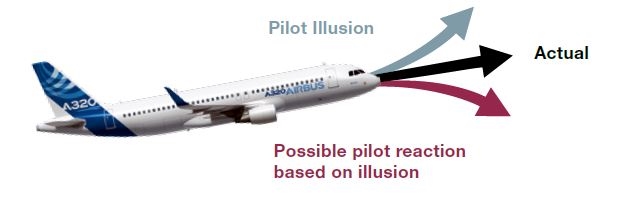
The review was initiated as a result of a number of poorly handled all-engine go-arounds. Most real world go-arounds were conducted at light weights and with high thrust. It was found that the likely consequence of not maintaining the correct pitch attitude during the go-around is acceleration towards the flap limit speed—when autothrust is not active, there is no speed protection to prevent a flap limit speed exceedance. A representation of the pitch-up, or what Airbus termed the false climb illusion, is shown in Figure 7.
Figure 7: Pitch-up illusion
Pitch-up (somatogravic) illusion, experienced as a result of acceleration during the go-around manoeuvre, showing the illusion as experienced by the pilot and the possible response to pitch-down. Source: Airbus
The review included the following points pertinent to the second event, where the PF introduced pitch-down inputs while conducting the go-around manoeuvre:
All pilots must know the required initial pitch target for their aircraft BEFORE commencing a missed approach. They must maintain that pitch target by following the [speed reference system] commands in manual flight. With the autopilot engaged, they should use this knowledge to confirm the autopilot behaviour.
The go-around pitch target for the A320 was quoted as 15 degrees nose up, the importance of which was highlighted as follows:
During a manual Go Around, if the required pitch is not reached or maintained, linear acceleration will result. Research has shown that this may cause a “false climb illusion”. The false climb illusion may lead a pilot to believe that the aircraft is already above the required pitch. Consequently, a pilot may respond with an opposite and dangerous pitch-down input.
Inadvertent pilot actions
Regarding the PF’s inadvertent selection of the EXPED pushbutton, Reason (1990) stated that
A slip is a type of error which result from some failure in the execution stage of an action sequence…These slips could arise because, in a highly routinized set of actions, it is unnecessary to invest the same amount of attention in the matching process….with oft-repeated tasks it is likely that [they] become automatized to the extent that they accept rough rather than precise approximations to the expected inputs.
Additionally, consideration was given to the outcome when similar objects (in this case, the pushbuttons A/THR, EXPED and APPR) were confused for each other. Perceptual confusion is a type of attentional slip and on that, Wickens and Hollands (2000) stated the following:
Perceptual confusions occur because a person may recognise a match for the proper object with an object that looks like it, is in the expected location, or does a similar job…
The pushbuttons on the FCU were the same colour and size. Colour coding and placement of objects has an effect on perception, in the sense that if two items are the same colour, then using colour-coding can tie together items that are spatially separated on the display (Wickens and Hollands, 2000). Additionally, two items on a cluttered display will be more easily integrated or compared if they share the same colour (different from the clutter), but the shared colour may disrupt the ability to focus attention on one while ignoring the other.
In addition to considering objects of similar size and shape, the effect of flight deck lighting was also considered. Woodson and Conover (1964) described several important factors that should be considered in the design of any lighting system:
suitable brightness for the task at hand
uniform lighting for the task at hand
suitable brightness contrast between task and background
lack of glare from either the light source or the work surface
suitable quality and colour of illumination and surfaces.
With regard to the FCU pushbutton layout, lighting and colour coding (see Figure 5), the physical similarities (shape, size, and colour) and close proximities between the A/THR, EXPED and APPR pushbuttons on the FCU could have contributed to any perceptual confusion.
Decision making and conscious automaticity
Wickens and Hollands (2000) outline that when undertaking a task, we must translate the information that is perceived about the environment into an action, and this action may be either an immediate response, or based on a more thorough, time-consuming evaluation.
In relation to the PF’s reaction to the thrust lock condition, the limitations of decision making were considered, as was the concept of automatic actions. As outlined by Klein and Klinger (1991) cited in Harris (2011), naturalistic decision making is characterised by ‘dynamic and continually changing conditions, real-time reactions to these changes, ill-defined tasks, time pressure, significant consequences for mistakes’.
In instances where actions that have become well-learned, ‘it is as though practice leads to a mental repackaging of our behaviour…that can be set off with only a brief conscious thought…’ (Wheatley and Wegner, 2001). In this case, the PF pressing the instinctive disconnect buttons was achieved without any time-consuming conscious elements.
Fatigue
The International Civil Aviation Organization (ICAO 2016) defined fatigue as:
A physiological state of reduced mental or physical performance capability resulting from sleep loss, extended wakefulness, circadian phase, and/or workload (mental and/or physical activity) that can impair a person’s alertness and ability to perform safety related operational duties.
Fatigue can have a range of adverse influences on human performance. These include:
slowed reaction time
decreased work efficiency
increased variability in work performance
lapses or errors of omission (Battelle Memorial Institute 1998).
Time of day can be important for determining whether an individual is in a circadian low or high. Human circadian rhythm is partially determined by the environmental light-dark cycle (Duffy, Kronauer, & Czeisler, 1996). The challenge can be for people to maintain alertness during the night-time hours and reduced sleepiness during the daytime rest break.
The Civil Aviation Safety Authority (2012) stated the following:
The circadian cycle has two periods of sleepiness, known as the circadian trough and the circadian dip. The circadian trough occurs typically between 0200 and 0500 hours (or dawn). During the circadian trough the body’s temperature is at its lowest level and mental performance, especially alertness, is at its poorest.
In the context of time on duty, Goode (2003) identified numerous studies that show an empirical relationship between work patterns and deteriorating performance. In accidents where fatigue was attributed, 20 per cent occurred in the tenth (or more) hour of duty.
Caldwell (2003) stated that ‘the primary determinant of the level of fatigue is the time awake since the last sleep period.’ Russo and others (2005) found that ‘significant visual perceptual, complex motor, and simple reaction time impairments began in the 19th hour of continuous wakefulness.’ As part of an NTSB study of short haul domestic air carrier accidents from 1978 to 1990, ‘time since awake’ was a predominant factor, and often related to ‘ineffective decision making’.
The following data was relevant to the PF’s fatigue assessment. The PF:
usually obtained about 7 hours of sleep a night between 2300 and 0600
had conducted two flights over the previous 3 days (one of which was a positioning flight)
duty ended at 2115 the previous day, resulting in a 17 hour break prior to starting duty on the day of the occurrence
woke at about 0600 and commenced duty in Melbourne at 1415
reported feeling well rested
positioned to Perth, before operating the occurrence flight
recalled feeling ‘okay’ around the time of the occurrence, but had been awake for about 19.5 hours.
The occurrence took place at about 0130, which was 11 hours and 15 minutes after the PF’s duty commenced. However, the descent was taking place close to a known window of circadian low. Along with the night conditions, with a relatively low-level of lighting in the flight deck, this may have contributed to feelings of sleepiness.
The ATSB evaluated the PF’s level of fatigue using two biomathematical models, Fatigue Avoidance Scheduling Tool (FAST) and System for Aircraft Fatigue Evaluation (SAFE). These models are decision aids designed to assess and forecast performance changes induced by sleep restriction and time of day.
Both models indicated a moderate level of fatigue. The FAST results indicated that at the time of the occurrence, there was a moderate likelihood that the PF was experiencing a level of fatigue known to have a demonstrated effect on performance. The SAFE results predicted that the PF would have felt ‘moderately tired, let down’ at the time of the occurrence, and in a moderate to high-risk category for experiencing the effects of fatigue.
The following data was relevant to the PM’s fatigue assessment. The PM:
usually obtained about 7.5 hours sleep a night between 2300 and 0630
was on a rostered period of leave in the two weeks prior to the occurrence
was in Perth on the day of the occurrence and woke at about 0630 Western Standard Time,[21] and had therefore been awake for about 17 hours at the time of the occurrence
commenced duty in Perth at 1800
reported feeling well rested and having adequate sleep the night before the occurrence
did not report any fatigue-related concerns associated with the occurrence flight.
Operator fatigue management
Organisations holding an Air Operator Certificate are generally required to comply with the Civil Aviation Orders Part 48 Flight Time Limitations (CAO 48). However, the Civil Aviation Safety Authority had granted the operator an exemption from CAO 48, under a specific instrument. This exemption was in force at the time of the occurrence. In place of the CAO 48 limitations, the operator was required to observe specific flight and duty limits contained in schedules to the instrument. With respect to this occurrence, the following flight and duty limits were relevant:
where the previous duty period did not exceed 12 hours, the time free of duty shall be 10 hours
the maximum hours per flight duty period for a local start time between 1300 and 1459, with one or two sectors, was 13 hours
flight deck duty limits for operations involving two crew was 10 hours.
Workload
In the context of aviation, workload has been described as ‘reflecting the interaction between a specific individual and the demands imposed by a particular task. It represents the cost incurred by the human operator in achieving a particular level of performance’ (Orlady and Orlady, 1999). A person experiences workload differently, based on their individual capabilities and the local conditions at the time. These conditions can include the following:
training and experience in the situation at hand
the operational demands during that phase of flight
if the person is experiencing the effects of fatigue
level of automation in use, and the mental requirements in interpreting their actions.
Research on unexpected changes in workload during flight has found that pilots who encounter abnormal or emergency situations experience a higher workload with an increase in the number of errors compared to pilots who do not experience these situations (Johannsen and Rouse, 1983).
Additionally, Holmes and others (2003) outline that high workload and distractions can result in a pilot scanning fewer instruments and checking each instrument less frequently.
Pilot recency and skill decay
The Civil Aviation Safety Regulations CASR 1998Part 61: Flight Crew Licencing outlines that recent experience, or recency, refers to undertaking particular flight operations in the past 90 days. These flying experiences include take-off and landings, or instrument approaches, for example. Recency will generally be measured by flight hours (Haslbeck and others, 2014) or sectors flown (Ebbatson, and others, 2010).
The concept of maintaining recency is important to reduce flight skill decay. In a commercial aviation context, Childs and Spears (1986) suggest that cognitive and procedural elements of flying skills decay more rapidly than control-oriented skills. Pilots were observed to have difficulty correctly identifying cues and classifying situations, although once a situation was correctly classified, they remembered what to do. Therefore, they propose that flying training should focus on pilot monitoring skills and recognition of different situations.
Despite the PF having management responsibilities, the PF had almost 70 hours in the previous 90 days, albeit with a significant training duty component. As a result, there was insufficient evidence to determine whether recency and/or skill decay had any influence on the flight crew’s actions.
Operator crew resource management training
The operator’s Operations Manual part A included the statement that ‘flight crewmembers should complete the major elements of the full length [crew resource management (CRM)] course over a three-year recurrent training cycle’. The Civil Aviation Advisory Publication (CAAP) SMS-3(1) Non-Technical Skills Training and Assessment for Regular Public Transport Operations provides the Civil Aviation Safety Authority’s preferred method for training in the human performance aspects of flight crew work performance. This CAAP provides the following definition of CRM:
A team training and operational philosophy with the objective of ensuring the effective use of all available resources to achieve safe and efficient flight operations.
CRM is now more commonly referred to as non-technical skills, which are defined as follows:
…the mental, social, and personal-management abilities that complement the technical skills of workers [and] include competencies such as decision-making, workload management, team communication, situation awareness, and stress management.
The operator’s CRM training program required pilots to complete a two-day classroom-based CRM course within one year of starting with the operation, and an annual refresher course. These courses were run by an external training provider, and the subjects included:
human perception and the learning process
personality type, delegation
leadership and effective communication skills
effective communication and co-ordination within the flight crew and between crewmembers
implications of automation on CRM.
Pilots also undertook a CRM course during command upgrade training, and each company line check and operational proficiency check also included an assessment of CRM principles as they were applied during normal, non-normal and emergency procedures. The ATSB was not able to determine the methods by which CRM principles were assessed.
A review of the company’s line check reports showed that ‘crew management/co-operation’ was an assessment criteria for the departure, en route, approach and landing phases of flight. Additionally, ‘CRM technique’ was assessed as a general criteria. The ATSB did not identify any specific criteria included in the operator proficiency check records.
Related occurrences
A review of the ATSB’s occurrence database did not identify any recent similar occurrences on scheduled passenger transport flights that were investigated by the ATSB.
While conducting an arrival procedure, prior to commencing an approach into Melbourne, Victoria on 15 May 2015, the Skytraders Airbus A319 descended to about 2,200 ft, which was below the ATC-assigned altitude of 3,000 ft. The crew broke off the arrival procedure and climbed to the new ATC cleared altitude of 5,000 ft before returning to land at Melbourne.
During the descent below 3,000 ft, the aircraft’s Terrain Avoidance and Warning System (TAWS) initiated a number of warning alerts, the speed limit for the aircraft flaps was exceeded, and the Minimum Safe Altitude Warning System (MSAW) initiated an alert to the ATC controller. Critically, during the 26 seconds from the time that the PF pressed the instinctive disconnect pushbutton on the thrust levers to when the aircraft reached its minimum altitude, the aircraft descended just over 1,000 ft and increased speed by about 100 kt.
The event was initiated by an inadvertent switch selection by the pilot flying (PF). This was followed by a combination of errors, rapidly changing events, high workload and an apparent response to a pitch-up illusion, resulting in the aircraft quickly developing a very high rate of descent and increasing airspeed.
Inadvertent FCU selections
As the aircraft was approaching the localiser for Melbourne runway 16, the PF recalled intending to arm the aircraft’s autoflight system (AFS) to capture the localiser for the approach. This required the PF to press the APPR pushbutton on the Flight Control Unit (FCU). Instead, the PF mistakenly pressed the EXPED pushbutton and the AFS entered the expedite descent mode. In an apparent attempt to cancel the expedite descent mode, the PF inadvertently pressed the A/THR pushbutton, which was adjacent to the EXPED pushbutton.
The acts of pressing the EXPED and then the A/THR pushbuttons were both predicated by a prior intention to act, but neither action went as planned. In this case, this prior intention was the pressing of the APP push button, which was part of a routine set of actions. Routine actions are generally characterised as requiring less attention.
The pressing of the A/THR was an apparent instinctive reaction to realising that an error had been made. Both selections were consistent with unintentional slips. Furthermore, the similar size, shape and colour of the EXPED and APPR buttons on the FCU, as well as their close proximity, may have contributed to the error. The lighting conditions in the flight deck may have increased the difficulty for the pilot monitoring (PM) to monitor the actions of the PF.
Reaction to ‘thrust lock’ condition
After the PF inadvertently pressed the A/THR pushbutton on the FCU, the Flight Mode Annunciator and Electronic Centralised Aircraft Monitor (ECAM) identified that the autothrust system had disengaged and the thrust locked at the existing setting, which was idle. The ECAM notified the flight crew of this change by displaying the THR LK caution message, as well as an associated procedure. The flight warning computer simultaneously sounded the caution aural alert, while the FMA’s autothrust column displayed the changed mode. The PM immediately identified this changed autothrust condition and verbally notified the PF of the change. It could not be determined whether this call was in response to the ECAM notification with associated master caution aural alert, or the FMA change.
Normal procedure for disconnecting the autothrust system was to press the autothrust instinctive disconnect (I/D) pushbutton, but this procedure first required the pilot to match the position of the thrust lever with the actual thrust setting. The thrust lever angle indicator assisted in this process. The aim of the THR LK ECAM procedure was to remove the engines’ locked thrust condition. That procedure also included matching the thrust lever position to the actual thrust setting.
On becoming aware that the engines’ thrust had been locked, the PF reacted by pressing the autopilot and autothrust instinctive disconnect pushbuttons, thereby removing the thrust lock condition. The likely intent of disconnecting both autopilot and autothrust was to revert to a fully manual flight mode. This is supported by the simultaneous disconnection of the autopilot and autothrust systems through the use of the instinctive disconnect buttons, an automatic action to complete the apparent intent.
However, in disconnecting the autothrust, the PF did not match the thrust levers to the current power, or set a desired power. This was likely to be a lapse, which is ‘simply omitting to perform one of the required steps in a sequence of actions’ (Harris, 2011). As to why this lapse occurred, the PF’s incomplete response to the ‘thrust lock’ condition may have been a result of a response consistent with a perceived urgency to handle an undesirable state, particularly as the instinctive disconnect pushbuttons were designed for a quick response
High thrust with pitch-down attitude
As a result of not matching the thrust lever angle to the locked thrust setting when disengaging the thrust lock condition, the thrust increased to the climb setting at which the thrust levers were positioned. This resulted in a significant, unexpected thrust increase. The PF responded by applying pitch-down inputs on the side stick and a few seconds later retarded the thrust levers to idle. The pitch-down attitude with high thrust—the engines did not respond to the commanded thrust reduction for a further few seconds—resulted in the aircraft adopting a rapidly accelerating downward vector. At about this time the altitude alert began to chime and, shortly thereafter, the aircraft descended through its clearance limit altitude.
As the aircraft passed through the clearance limit altitude, the first of the TAWS alerts triggered. The PF responded with a declared intent to go-around and rapidly positioned the thrust levers to full power. However, the PF did not raise the aircraft’s pitch attitude to the recommended 15 degrees nose up for the conduct of a go-around. While the PF commenced some pitch-up commands, the aircraft’s attitude remained well below the horizon, resulting in a continuation of the accelerating airspeed and high rate of descent.
Just as the engines began to increase thrust, the second TAWS alert triggered. The procedural response to this second alert was to apply full backstick and maintain that position while setting the thrust to maximum power. However, the PF again responded to the increasing engine thrust with pitch-down commands, resulting in a continuation of the aircraft’s downward flight path. The PF arrested the descent after about 10 seconds, during which time a further TAWS alert triggered.
The flap overspeed
During the period of high thrust, the PM selected the flaps from 1 to UP as the aircraft was accelerating through 260 kt. The slats were not fully retracted for a further 12 seconds, by which time the aircraft had accelerated to more than 310 kt. The limit speed for flap 1 was 230 kt.
The effect of pitch-up illusions during rapid thrust increases
The PF did recall applying pitch-down side stick input during the rapid thrust increases and did not identify the increasing rate of descent, resulting from the nose-down attitude. The PF did, however, recall thinking that the aircraft was pitching up. Throughout the occurrence, the night conditions and operations within cloud resulted in the absence of a natural horizon. It was therefore likely that the PF’s pitch-down side stick inputs were in response to pitch-up (somatogravic) illusions caused by the unexpected and rapid increase in thrust. The PF’s susceptibility to the effects of pitch-up illusions was possibly exacerbated by also experiencing a high workload, which would likely reduce monitoring of flight instruments.
The effect of the pitch-up illusion influenced the breach of altitude, the EGPWS alerts, and the exceedance of the flap limit speed.
The PM’s ability to influence the events
The primary role of the PM is to monitor the aircraft’s flight path and performance and immediately bring any concern to the PF’s attention. However, Dismukes and Berman (2010) have shown that, while flight crew monitoring is an important defence that is performed appropriately in the vast majority of cases, it does not always catch flight crew errors and equipment malfunctions. They also noted:
…even though automation has enhanced situation awareness in some ways…it has undercut situation awareness by moving pilots from direct, continuous control of the aircraft to managing and monitoring systems, a role for which humans are poorly suited.
When considering whether the PM was likely to be able to identify and therefore influence the events that led to the flap overspeed and the breaching of the cleared altitude, the following factors were considered. The:
PM verbally identified the expedite descent mode change and the appearance of the ‘thrust lock’ condition
PM had difficulty in identifying the PF’s actions, being unable to see the PF selections on the FCU
lighting levels in the flight deck were low
reduced communication between the flight crew—specifically, the PF did not communicate an intended response to the expedite descent mode engagement, THR LK ECAM message, or the various autopilot disconnections and reconnections
PF did not announce mode changes annunciated on the FMA as required by the standard operating procedures, those changes being resultant from FCU and autoflight system inputs made by the PF
PF’s response to the thrust lock condition was contrary to normal procedure
PM’s attention was probably focused on the flap speed, when the aircraft started to rapidly accelerate early in the occurrence. By the time that the PM had selected the flap up, the aircraft had developed a very high rate of descent and descended through the clearance limit altitude
PM recalled that there was ‘a lot of button pressing’ throughout the occurrence, and that the autopilot was disengaged several times.
The period of time from the inadvertent FCU selections through to the aircraft returning to a positive rate of climb was short, but characterised by rapidly changing events with multiple visual and aural alerts. The PM’s ability to identify and influence the rapidly changing situation was likely affected by the non-routine nature of the event, actions of the PF, reduced communication between the flight crew and an apparent focus on the flap speed exceedance as the aircraft started to accelerate.
Crew workload
Pilots who encounter abnormal or emergency situations experience a higher workload with an increase in performance errors compared to pilots who do not experience these situations (Johannsen and Rouse, 1983). During the occurrence, the attention of the flight crew was likely divided between a number of different information cues and task requirements, from the time the PF made the inadvertent selections on the FCU, through to when the aircraft began to climb. These included:
multiple aural warnings and alerts
identifying and responding to mode changes, including appropriate actions to address the THR LK ECAM message
disengagements and re-engagement of the autopilot
focus on airspeed (mostly by the PM)
interactions with ATC towards the end of the occurrence sequence.
At the time, the aircraft was in the descent phase, which inherently has a higher workload. The PM recalled that the workload became very high after the inadvertent FCU selections occurred. The high workload experienced by the PM was demonstrated in the use of an incorrect call sign during ATC communications, as the aircraft started to climb out.
The degree of recollection from both crew after the occurrence also indicated that they experienced a high workload over a short period of time, as details including the numerous aural warnings (including the EGPWS), one of the inadvertent FCU selections and autopilot changes were not recalled. Overall, the high workload the flight crew experienced appeared to have limited their capacity to identify mode changes, such as autopilot disconnections, and to respond to the aircraft’s undesired high rate of descent.
Crew fatigue
The PF awoke at a normal time of 0630, signed on at Melbourne and did not report receiving any rest before or during the operation from Perth to Melbourne. It is reasonable to conclude that, due to time awake, time on duty and the time of day, the PF was probably experiencing a level of fatigue known to have at least some effect on performance. This was predicted by biomathematical fatigue models. There was, however, insufficient evidence to indicate that fatigue contributed to the occurrence. The ATSB also did not ascertain any systemic issues associated with the operator's management of fatigue.
Findings
From the evidence available, the following findings are made with respect to the descent below minimum permitted altitude involving an A319, VH-VCJ, near Melbourne Airport, Victoria on 15 May 2015. These findings should not be read as apportioning blame or liability to any particular organisation or individual.
Safety issues, or system problems, are highlighted in bold to emphasise their importance. A safety issue is an event or condition that increases safety risk and (a) can reasonably be regarded as having the potential to adversely affect the safety of future operations, and (b) is a characteristic of an organisation or a system, rather than a characteristic of a specific individual, or characteristic of an operating environment at a specific point in time.
Contributing factors
The pilot flying inadvertently selected the EXPED pushbutton instead of the APPR pushbutton, and, in an attempt to correct the error, pressed the A/THR pushbutton, creating a thrust lock condition.
In attempting to remove the thrust lock condition, the pilot flying pressed the instinctive disconnect pushbutton but did not move the thrust levers to match the locked thrust setting. As the thrust was locked at idle while the thrust levers were set to climb thrust, this resulted in an unexpected, significant thrust increase.
The pilot flying likely experienced pitch-up illusions during two rapid thrust increases and responded to these illusions with pitch-down sidestick input.
Pitch-down inputs by the pilot flying, combined with a very high thrust setting, resulted in a very high rate of descent with rapidly increasing airspeed. This led to the breach of the cleared minimum descent altitude, as well as triggering a number of Enhanced Ground Proximity Warning System alerts.
The rapidly changing aircraft state led to the crew experiencing a high workload. This was likely to have limited their capacity to identify mode changes and to respond to the aircraft’s undesired high airspeed and rate of descent.
The pilot monitoring’s ability to identify and influence the rapidly changing situation was likely affected by the non-routine actions of the pilot flying, the reduced communication between flight crew and an apparent focus on the flap speed exceedance as the aircraft started to accelerate.
Other factors that increased risk
At the time of the occurrence, the pilot flying was likely experiencing a level of fatigue known to have a demonstrated effect on performance, predominantly due to the time of day and time awake.
The aircraft’s rapidly increasing airspeed resulted in the limit speed for the extension of the aircraft slats being significantly exceeded.
Sources and submissions
Sources of information
The sources of information during the investigation included:
the aircraft’s cockpit voice recorder and flight data recorder
the flight crew
Skytraders Pty Ltd
the Bureau d’Enquêtes et d’Analyses.
Airbus SAS
Airservices Australia
Bureau of Meteorology.
References
Battelle Memorial Institute 1998, An Overview of the scientific literature concerning fatigue, sleep, and the circadian cycle, Report prepared for the Office of the Chief Scientific and Technical Advisor for Human Factors, US Federal Aviation Administration.
Caldwell Jr, JA & Caldwell, JL, 2003. Fatigue in aviation: A guide to staying awake at the stick. Ashgate: Burlington, Vermont.
Childs, JM and Spears, WD., 1986. Flight-skill decay and recurrent training. Perceptual Motor Skills, pp.235-242
Dismukes, R. and Berman, B., 2010. Checklists and Monitoring in the Cockpit: Why Crucial Defenses Sometimes Fail, NASA Ames Research Center
Duffy JF, Kronauer RE, & Czeisler CA. 1996, Phase-shifting human circadian rhythms: influence of sleep timing, social contact and light exposure. The Journal of Physiology, 15, 289-297.
Ebbatson, M., Harris, D., Huddlestone, J. and Sears, R., 2010. The relationship between manual handling performance and recent flying experience in air transport pilots, Ergonomics, 53:2, 268-277.
Haslbeck A, Kirchner P, Schubert E, & Bengler K, 2014, A Flight Simulator Study to Evaluate Manual Flying Skills of Airline Pilots, Proceedings of the Human Factors and Ergonomics Society 58th Annual Meeting. Available on pro.sagepub.com
Goode, JH., 2003. Are pilots at risk of accidents due to fatigue? Journal of safety research, 34(3), pp.309-313.
Harris, D., 2011. Human Performance on the Flight Deck, Ashgate Publishing Ltd., Surrey, England
Holmes, S., Bunting, A., Brown, D., Hiatt, K., Braithwaite, M., & Harrigan, M. (2003). Survey of spatial disorientation in military pilots and navigators. Aviation, Space, and Environmental Medicine, 74, 957-965
International Civil Aviation Organization 2016, Manual for the Oversight of Fatigue Management Approaches, 2nd edition, Montreal, Canada.
Johannsen, G & Rouse, WB, 1983. Studies of planning behavior of aircraft pilots in normal, abnormal, and emergency situations. Systems, Man and Cybernetics, IEEE Transactions on, (3), pp.267-278.
Noyes, J., 2007. Automation and Decision Making, Decision Making in Complex Environments, Ashgate Publishing Limited, Aldershot, England
Orlady, HW, & Orlady, LM, 1999. Human factors in multi-crew flight operations. Ashgate: Aldershot, UK p.203.
Reason, J. 1890. Human Error, Cambridge University Press, United Kingdom
Russo, M., Johnson, D., Escolas, S. and Hall, S., 2005. Visual Perception, Psychomotor Performance, and Complex Motor Performance During an Overnight Air Refueling Simulated Flight, Aviation, Space and Environmental Medicine, Vol. 76, pp. C92-103
Stott, R.J., Spatial Orientation and Disorientation, in Nicholson, A. (ed.), 2011, The Neurosciences and the Practice of Aviation Medicine, Ashgate Publishing Limited, Surrey, England, pp.55-91
Wheatley, T. and Wegner, DM. 2001. The Psychology of Automaticity of Action, International Encyclopaedia of the Social & Behavioural Sciences, In Smelser, NJ and Baltes, PB, Elsevier Science Ltd.
Wickens, CD. And Holland, JG. 2000. Engineering Psychology and Human Performance, Prentice Hall, New Jersey, USA
Woodson, W. and Conover, D., 1964. Human engineering guide for equipment designers, University of California Press, Los Angeles, USA
Submissions
Under Part 4, Division 2 (Investigation Reports), Section 26 of the Transport Safety Investigation Act 2003 (the Act), the Australian Transport Safety Bureau (ATSB) may provide a draft report, on a confidential basis, to any person whom the ATSB considers appropriate. Section 26 (1) (a) of the Act allows a person receiving a draft report to make submissions to the ATSB about the draft report.
A draft of this report was provided to:
The flight crew
Skytraders Pty Ltd
The Bureau d’Enquêtes et d’Analyses.
Airbus SAS
Civil Aviation Safety Authority.
Submissions were received from Skytraders Pty Ltd, the flight crew, the Bureau d’Enquêtes et d’Analyses, and the Civil Aviation Safety Authority. The submissions were reviewed and where considered appropriate, the text of the report was amended accordingly.
Glossary
A319
Airbus A319 model aircraft
A320
Airbus A320 family of aircraft
AFS
Autoflight system
ALT*
Altitude acquire is engaged
AP1
Autopilot number 1
APPR
Approach pushbutton
ATC
Air traffic control
ATIS
Automatic terminal information service
ATP(A)L
Air transport pilots (aeroplane) licence
ATS
Autothrust system
A/THR
Autothrust pushbutton
C
Celsius
CVR
Cockpit voice recorder
DFDR
Digital flight data recorder
ECAM
Electronic centralised aircraft monitor
EGPWS
Enhanced ground proximity warning system
EXPED
Expedite pushbutton
EXP DES
Expedite descent vertical mode
E/WD
Engine/warning display
FCOM
Flight crew operating manual
FCTM
Flight crew training manual
FCU
Flight control unit
ft
Feet
FMA
Flight mode annunciator
FMGS
Flight management guidance system
FWC
Flight warning computer
GPWS
Ground proximity warning system
hPa
Hectopascals
ILS
Instrument landing system
I/D
Instinctive disconnect
km
Kilometre
kt
Knots
MSAW
Minimum safe altitude warning system
NAV
Navigation lateral mode
PF
Pilot flying
PFD
Pilot’s flight display
QRH
Quick reference handbook
OP DES
Open descent vertical mode
OPSA
Operations Manual part A
OPSB
Operations Manual part B
PM
Pilot monitoring
SNB2
Snowbird 2
SOP
Standard operating procedures
STAR
Standard arrival
TAAATS
The Australian advanced air traffic system
TAWS
THR LK
Terrain avoidance and warning system
Thrust lock condition
TLA
Thrust lever angle
Purpose of safety investigations
The objective of a safety investigation is to enhance transport safety. This is done through:
identifying safety issues and facilitating safety action to address those issues
providing information about occurrences and their associated safety factors to facilitate learning within the transport industry.
It is not a function of the ATSB to apportion blame or provide a means for determining liability. At the same time, an investigation report must include factual material of sufficient weight to support the analysis and findings. At all times the ATSB endeavours to balance the use of material that could imply adverse comment with the need to properly explain what happened, and why, in a fair and unbiased manner. The ATSB does not investigate for the purpose of taking administrative, regulatory or criminal action.
Terminology
An explanation of terminology used in ATSB investigation reports is available here. This includes terms such as occurrence, contributing factor, other factor that increased risk, and safety issue.
Publishing information
Released in accordance with section 25 of the Transport Safety Investigation Act 2003
Ownership of intellectual property rights in this publication
Unless otherwise noted, copyright (and any other intellectual property rights, if any) in this report publication is owned by the Commonwealth of Australia.
Creative Commons licence
With the exception of the Coat of Arms, ATSB logo, and photos and graphics in which a third party holds copyright, this publication is licensed under a Creative Commons Attribution 3.0 Australia licence.
Creative Commons Attribution 3.0 Australia Licence is a standard form licence agreement that allows you to copy, distribute, transmit and adapt this publication provided that you attribute the work.
The ATSB’s preference is that you attribute this publication (and any material sourced from it) using the following wording: Source: Australian Transport Safety Bureau
Copyright in material obtained from other agencies, private individuals or organisations, belongs to those agencies, individuals or organisations. Where you wish to use their material, you will need to contact them directly.
On 11 February 2015, an Airbus A320 aircraft, registered VH‑VND and operated by Tiger Airways, was conducting a scheduled passenger service from Hobart Airport, Tasmania to Melbourne Airport, Victoria.
At about 1750 Eastern Daylight-saving Time, about 9 NM (17 km) north of Melbourne Airport, and after the flight crew had been cleared by air traffic control to conduct a visual approach, the aircraft descended below the minimum safe altitude, though the aircraft remained in controlled airspace.
During the descent, both flight crew became pre-occupied with other tasks inside the flight deck, which had the effect of increasing their workload and distracting them from monitoring the aircraft’s flight path and altitude. About two minutes after commencing descent on the visual approach, the flight crew levelled the aircraft after realising that it appeared to be low on profile. A safety alert issued by air traffic control soon followed, where in response, the aircraft was climbed to intercept the recommended visual approach descent profile. The remainder of the flight was uneventful and the aircraft landed on runway 16 at Melbourne Airport.
What the ATSB found
The ATSB found that after being vectored off the expected pre-planned shortened arrival route, and then cleared for a visual approach, a combination of increased workload and distraction diverted the flight crew’s attention from monitoring the aircraft’s descent. During the descent, the captain elected to intercept the final approach course by entering a radial intercept waypoint into the aircraft’s auto-flight system, which differed from the first officer’s more familiar plan to conduct a localiser intercept. This had the effect of diverting both crew members’ attention to inside the flight deck, as they discussed and demonstrated the intercept and resulting flight mode reversions. The aircraft continued to descend below the normal approach profile and entered the 500 ft vertical buffer at the base of the control area step. This reduced separation with terrain and any aircraft operating outside controlled airspace.
The flight crew’s mental model of the approach was not consistent with the actual flight path of the aircraft. This affected their ability to fly a normal descent profile and remain within the required control area step.
The flight crew miscalculated and did not adequately communicate the aircraft’s descent from 3,000 ft during the conduct of a visual approach. This limited their awareness of the descent rate and the below-profile altitude of the aircraft during a critical phase of flight.
Safety message
Flight crew should be mindful that during higher workload phases of flight, such as during approach and landing, introducing tasks that divert both flight crew members’ attention from monitoring the aircraft’s flight profile and altitude should be minimised. Further, if tasks that bring attention into the flight deck are required to be completed during a visual approach, pilots must ensure that at least one pilot monitors the aircraft’s flight path profile and energy state. Setting an appropriate lower altitude limit may be an effective risk control to alert flight crew and/or prevent the aircraft’s descent below a desired altitude. Communication and confirmation of any changes to the aircraft’s flight modes are also important during this period.
The occurrence
On 11 February 2015, an Airbus A320 aircraft, registered VH-VND (VND) and operated by Tiger Airways Australia Pty. Ltd. (Tigerair), was operating a scheduled passenger service from Hobart Airport, Tasmania to Melbourne Airport, Victoria. The flight, including departure and climb from Hobart, was uneventful until shortly prior to the commencement of descent into Melbourne.
Descent preparation and descent from flight level 360
At about 1710 Eastern Daylight-saving Time,[1] and prior to commencing the descent, the flight crew were issued a clearance from air traffic control (ATC) to conduct a WAREN EIGHT ALPHA standard arrival route (STAR) for runway 16[2](see Appendix A). In preparation for the arrival, the first officer, who was pilot flying (PF),[3] entered the STAR into the aircraft’s auto-flight system.
After completing other normal pre‑descent flight deck preparation, the flight crew recalled that they conducted an approach and landing briefing, which included a review of the prescribed arrival route and any potential flight restrictions including controlled airspace limits and terrain along the intended flight path. Following the briefing, ATC advised the flight crew that they could expect track shortening. The PF sought clarification about the expected track shortening, to which ATC responded to expect ‘SANDR direct ROCKDALE approximately’ (see Appendix A). ATC also advised the arrival was to be flown at maximum speed and that any STAR speed restrictions were cancelled.
The PF reported amending the previously entered active flight plan to reflect the expected vectoring. The PF stated that a more accurate computed descent profile would be displayed by having the expected track shortening and the associated instrument approach as the active flight plan. At that time, they also selected the complete STAR as the secondary flight plan.
The PF recalled reviewing the controlled airspace limitations along the modified flight planned route. This revealed that the programmed altitude limitations along the flight path would maintain the aircraft within the limits of the controlled airspace steps. The captain reported that as the area along the expected track-shortened route was familiar, the control steps for the arrival along that route were not fully briefed.
After the descent preparations were complete, the PF commanded the aircraft’s auto-flight system to descend the aircraft from flight level (FL) 360[4] to FL 250 using a managed descent flight mode. In this mode, the aircraft followed a pre-computed profile that allowed for aircraft deceleration and airspace restrictions along the active flight planned route.
Upon commencing the descent, ATC re-cleared the flight crew to descend and maintain 9,000 ft and to expect a left circuit for runway 16. To assist the flight crew with descent planning, ATC advised the flight crew that they had 46 track miles remaining to the runway.
After being cleared by ATC for further descent, the flight crew descended to 5,000 ft and advised that they were maintaining that altitude and reported visual.[5] ATC followed with a stepped descent clearance to 3,000 ft and provided information to the flight crew that they would be vectored for a turn onto base leg of the circuit in 3 NM (6 km).
At 1748, which coincided with the aircraft being located at about the SANDR waypoint, ATC advised the flight crew that the STAR was cancelled and to turn left onto a heading of 290°M (Figure 1). To comply with ATC heading and descent instructions, the flight crew used the aircraft’s heading and vertical speed/flight path angle (V/S FPA) mode selectors, both located on the aircraft’s Flight Control Unit (FCU). The use of the aircraft’s selected modes allowed the flight crew to vary the aircraft’s lateral track and descent manually.
Figure 1: Recorded flight route of VH-VND showing approximate period where flight plan modification and mode changes were conducted
Source: Google Earth modified by ATSB
About one minute after turning onto a heading of 290°, ATC instructed the flight crew to turn further left onto a heading of 260°. While on that heading, ATC advised the flight crew that they were 6 NM (11 km) to the left of the runway 16 centreline and requested the flight crew to report the runway in sight.
At about 1749, the flight crew reported being visual with the runway. At 1749:46 ATC instructed them to turn further left onto a heading of 240° to intercept final, and cleared them to conduct a visual approach[6] for runway 16. The flight crew were also instructed to change radio frequency and to contact Melbourne tower when established on final approach.
The captain reported inputting a radial intercept waypoint into the aircraft’s auto-flight system after being cleared to conduct the visual approach. This method of intercepting the localiser using a radial intercept waypoint was preferred as it provided more accurate tracking guidance. The method of inserting a radial intercept waypoint was a valid procedure highlighted in the operator’s flight crew operating manual (FCOM) for conducting an intercept (see the section titled Approach procedures) during a visual approach.
Visual approach from 3,000 ft
At 1749:51, the PF armed the approach mode (APPR)[7] and engaged both autopilots, as the intent was to conduct a visual approach with an intercept of the instrument landing system (ILS) from the current heading. The PF also set a missed approach altitude of 4,000 ft in the altitude select window on the FCU, which was in accordance with the altitude setting requirements for the conduct of a visual approach in the Tigerair operations manual part B.
At 1749:54, when the aircraft was about 5 NM (9 km) from the extended runway centreline or about 10 NM (18 km) in a direct line from the runway, the PF commanded the aircraft to descend from 3,000 ft by using the vertical speed (V/S) mode. The captain reported being aware that the V/S mode was being used, but unaware of the descent rate that followed.
The flight crew made a number of selections on the FCU and aircraft configuration changes in the period from 1749:55 to 1751:15. At 1750:17, the ILS approach mode (ILS) disarmed and the lateral flight mode changed to the navigation (NAV) mode. This was likely the result of the flight crew selecting a direct to command in the auto-flight system after the ILS had already been armed. This initiated a series of automatic flight mode reversions.
The period of time for which both flight crew reportedly went ‘heads in’ (that is, both pilots had their attention inside the cockpit) the flight deck to program and discuss the radial intercept, flight mode reversions and auto-flight system changes was uncertain, but likely occurred from 1750:25 to 1751:14.
After the incident, the captain reported that by conducting the radial waypoint inbound intercept, the PF needed to go ‘heads in’ to confirm the new flight plan entry, which was probably not ideal for that phase of flight. The PF perceived this period was already one of high workload. Table 1 highlights the key events during that time.
Table 1: Relevant recorded flight data from VH-VND after the flight crew commenced the visual approach from 3,000 ft
Time
Pressure altitude (ft)
(QNH corrected)
Selected vertical speed changes
Glideslope deviation (see operational information)
Localiser deviation
Aircraft configuration
Relevant flight mode changes and selections
1749:51
3050
Heading (HDG), Localiser (LOC) armed
1749:54
3040
-1000 ft/min
2.2 dots high
3.4 dots left
V/S
1750:02
3000
-1400 ft/min
1.7 dots high
Flap 1
1750:08
3040
Gear down
1750:17
2770
NAV armed
1750:25
2610
LOC armed
1750:30
2510
-1300 ft/min
1.1 dots high
1750:36
2420
Flap 2
1750:41
2270
-1400 ft/min
ON SLOPE
3.2 dots left
1750:44
2220
-1300 ft/min
0.3 dots low
HDG
1750:52
2040
-1200 ft/min
0.9 dots low
3.2 dots left
1750:55
1960
-1000 ft/min
0.8 dots low
3.2 dots left
1751:00
1860
-800 ft/min
1.1 dots low
3.1 dots left
1751:03
1810
NAV armed
1751:14
1650
3.3 dots low
3.4 dots left
Flap 3
1751:15
1640
0 ft/min
3.6 dots low
3.4 dots left
V/S pushed to level off
1751:44
1600
3.2 dots low
1751:51
1610
0 ft/min
4.8 dots low
3.8 dots left
NAV
1752:23
1630
+1000 ft/min
5.1 dots low
ON LOC
V/S
1752:31
1650
LOC armed
1752:35
1650
4.7 dots low
ON LOC
LOC capture
1752:45
1860
LOC
1753:23
2000
ON SLOPE
ON LOC
G/S / LOC
Source: Operator quick access recorder (QAR) data modified by the ATSB
At 1751:15, about 1 minute and 21 seconds after commencing descent from 3,000 ft, the captain reportedly pressed the V/S push-button on the FCU to level the aircraft. The captain reported observing the aircraft’s flight profile at that time being ‘a bit low’, and was more consistent with the expected runway intercept altitude from a track-shortened SANDR direct to ROCKDALE (ROC) route. At 1751:24, the flight crew established communication with Melbourne tower after changing to the tower frequency.
At 1751:42, the Melbourne approach controller became aware of the aircraft’s altitude of 1,600 ft and attempted to contact the flight crew. This attempt to alert the flight crew to the low altitude failed as the flight crew had changed to the tower frequency earlier than instructed. The approach controller then instructed the tower controller to alert the crew of the aircraft’s low altitude, which the tower controller did.
At 1751:59, the tower controller issued a safety alert[8] to the flight crew to check their altitude, as the aircraft was below profile altitude and had entered the 500 ft vertical buffer at the base of the control area (CTA) step, reducing separation with terrain and any aircraft operating outside controlled airspace.
At 17:52:23, the flight crew initiated a climb to 2,000 ft where the auto-flight system subsequently intercepted the ILS glide slope and made an uneventful landing.
After landing, the captain contacted Melbourne Air Traffic Control to discuss the altitude safety alert. They advised that the aircraft had descended to 1,600 ft, which was below the required altitude for flight in that section of CTA. The minimum altitude in that section of CTA for aircraft that were not visual was 2,700 ft, and for aircraft that were visual, it was 2,000 ft as they were required to maintain a 500 ft buffer above the 1,500 ft CTA lower limit (Figure 2).
Figure 2: Flight pathand altitude of VH-VND(black and orange dots) relative to the controlled area steps and terrain during the visual approach to Melbourne Airport
The captain held an Air Transport Pilot (Aeroplane) Licence and was appropriately qualified to conduct the flight. The captain:
had about 14,380 hours of aeronautical experience, of which approximately 4,280 hours were on the A320/A321
had about 7,800 hours total time in command
held a current Class 1 Aviation Medical Certificate
reported no recent or ongoing medical or personal issues.
Training
In 2013, the captain was certified as a ground instructor. This role was additional and separate to the captain’s usual activities as a line pilot. In fulfilling this role, the captain was responsible for the provision of specialist operational training as required by the head of checking and training. The ground instructor role differed from that of a line-training captain in that the duties did not pertain to in-flight training. Additional, role-specific training and competencies were required for a pilot to be endorsed as a line-training captain.
The captain had conducted a number of approaches for runway 16 at Melbourne Airport during initial and recurrent training assessments. The approaches were mainly instrument landing system (ILS) approaches, however a visual approach for runway 16 from a track-shortened route was conducted in 2014.
First officer
The first officer held an Air Transport Pilot (Aeroplane) Licence and was appropriately qualified to conduct the flight. The first officer:
had about 2,690 hours of aeronautical experience, of which approximately 250 hours were on the A320/A321
held a current Class 1 Aviation Medical Certificate
reported no recent or ongoing medical or personal issues.
Training
The first officer conducted line training on the A320 in 2014, which included conducting a number of ILS approaches for runway 16 at Melbourne Airport. Although there was no recorded evidence that a visual approach was made for runway 16 at Melbourne Airport from a track-shortened route or radar vectors, the pilot had conducted visual approaches into other major airports. The pilot completed the required training program and was approved to commence line-flying operations in January 2015.
Aircraft information
Auto-flight descent modes
Managed descent mode
Flight crew normally control the descent of an Airbus A320 using the aircraft’s auto-flight system in either managed descent mode, or a selected descent mode. With the managed descent mode engaged, the aircraft follows a descent profile computed by the Flight Management Guidance System (FMGS), based upon the flight plan and descent conditions entered by the crew. This mode is only available if the aircraft follows a programmed lateral navigation track (NAV). During descent in managed descent mode, the FMGS optimises the descent profile and ensures compliance with all programmed altitude constraints without crew intervention.
Selected (basic) descent modes
In a selected descent mode, the flight crew controls the aircraft descent by making appropriate selections on the Flight Control Unit (FCU). Selected descent modes include vertical speed (V/S), flight path angle (FPA), and open descent.
In V/S mode, the auto-flight system adjusts the aircraft pitch attitude to maintain a set vertical speed as selected by the crew on the FCU. The aircraft descends to the altitude selected by the crew on the FCU, disregarding any intervening FMGS-programmed altitude constraints. If an FCU altitude limit lower than the aircraft’s current altitude is not set, the auto-flight system will continue descending the aircraft at the commanded vertical speed until the flight crew intervene, or there is an Enhanced Ground Proximity Warning System (EGPWS) (see the section titled Enhanced Ground Proximity Warning System) terrain or aircraft configuration warning alerting the flight crew to intervene. Flight crews sometimes prefer to use V/S mode to initiate further descent from a captured altitude, or incrementally change the descent rate to regain a preferred flight path profile.
Approach mode
Pushing the approach mode (APPR) push-button illuminates the APPR switch light and arms the FMGS for localiser and glideslope capture and tracking. One of the aircraft’s very high frequency navigation (VHF NAV) receivers must be tuned to an ILS frequency before APPR mode can be engaged. Once armed, localiser (LOC) is displayed in blue in the roll mode column of the Flight Mode Annunciator (FMA) and, in the pitch mode column, glide slope (G/S) is displayed in blue to indicate that the APPR mode has been armed.
The localiser capture point is variable and depends on intercept angle and closure rate with the centreline. The glideslope capture point is also variable and depends on the closure rate. The APPR light remains illuminated after localiser and glideslope capture and LOC and G/S are displayed in green on the FMA as the active engaged modes. ILS identifier, approach track and ILS/distance measuring equipment (DME) distance are displayed on the Primary Flight Display (PFD) on the lower left, when both LOC and G/S are the active modes. The localiser and glideslope deviation scales are displayed when the localiser frequency is tuned and the ILS (labelled LS on VH-VND) is selected on the Electronic Flight and Information System (EFIS) control panel.
Descent indications
The aircraft’s descent progress relative to the FMGS-computed descent profile is displayed by a symbol adjacent to the altitude scale representing the aircraft’s vertical deviation. The symbol moves above the central position as the aircraft descends beneath the FMGS-computed profile, and below the central position as the aircraft deviates above the FMGS-computed descent profile. The vertical deviation symbol remains displayed on the PFD despite the ILS push-button being selected on the EFIS panel, until the aircraft captures the LOC and GS. Deviation from the FMGS computed descent profile is also presented as a digital value on the progress page of the multipurpose control and display unit (MCDU).
In this case, the vertical deviation indicator would have been inaccurate as the indications related to the current aircraft altitude relative to the pre-programmed track-shortened route. The track‑shortened route was the active flight plan during most of the visual approach. Other available sources of information to assist the flight crew with determining a more appropriate descent profile were limited, but included:
cross-referencing other data sources such as the DME displayed on the PFD
monitoring the glideslope indication when within range
referencing the runway offset distance displayed on the navigation display (ND)
using the range ring on the ND to determine the approximate runway intercept distance
requesting Air Traffic Control (ATC) for the derived radar distance to the runway from the current intercept heading
using the runway PAPI or T-VASIS guidance when within range.
Figure 3: Example of a navigation display (ND) with distance information and cross track error displayed
Source: Tigerair FCTM, modified by ATSB
Enhanced Ground Proximity Warning System
The aircraft was fitted with an EGPWS. The EGPWS considers a range of data and in-flight parameters, and provides a distinctive warning to flight crew if the aircraft enters a potentially hazardous position in relation to the earth’s surface. No EGPWS warnings were triggered during this occurrence.
Meteorological information
The flight crew reported that the weather conditions at the time of the incident did not adversely affect the ability to conduct the flight. The flight crew confirmed that visual conditions existed prior to leaving 3,000 ft for the visual approach.
Operational information
Navigation
Operation of the Instrument Landing System (ILS)
The ILS provides lateral and vertical position data necessary to align the aircraft with the runway for approach and landing. The system uses angular deviation signals from the glideslope antennas (located approximately 1,000 ft from the touchdown point on the runway) and the localiser antennas (located past the far end of the runway). The glideslope signals provide the angular deviation from the nominal glide path (usually 3°) and the aircraft’s auto-flight system generates fly-up or fly-down commands to enable the flight crew to track the glide path down to the touchdown point on the runway. Glideslope deviation is displayed on the PFD in units of dots, where one dot equates to 0.4° deviation from the glide path.
The localiser signals provide the angular deviation from the runway centreline and the autopilot generates fly-left or fly-right commands to track the centreline until the landing roll is completed. Localiser deviation is displayed on the PFD in units of dots where one dot equates to 0.8° deviation from the localiser.
Figure 4: Primary flight display showing an example of instrument landing system (ILS) scale indications
Source: Tigerair FCOM
Approach procedures
Standard Arrival Route (STAR) information
To program a STAR such as the WAREN EIGHT ALPHA arrival into the FMGS, the flight crew were required to select the appropriate arrival from the MCDU flight plan arrivals page. After selecting the arrival, a relevant approach such as the runway 16 ILS approach is selected and appended to the STAR. This inserted additional en route waypoints such as the final approach fix (FAF) to the flight plan and would later provide localiser and glideslope guidance when within the capture area. Manual selection of the ROCKDALE (ROC) Non-directional beacon (NDB) waypoint was required to amend the flight plan route to comply with ATC clearances and other enroute constraints, before briefing the arrival and the approach.
Selection of the full WAREN EIGHT ALPHA STAR included tracking to intercept the final approach path for runway 16 at a greater distance than the track-shortened route from SANDR to ROCKDALE. To intercept a 3° profile from the track-shortened route, the aircraft would intercept final approach at about 4 NM (7 km) from the runway at an altitude of about 1,680 ft.
In contrast to the track-shortened route, the calculated runway intercept distance if the flight crew maintained a heading of 240° after flying radar vectors to the north, was about 9 NM (17 km). The profile altitude required for a recommended 3° profile at that distance was about 3,500 ft.
Visual approach
The operator’s flight crew operating manual (FCOM) outlined the standard operating procedure for the conduct of a visual approach. It included general information about conducting the approach on a nominal 3° glideslope, using visual references. The method for conducting a visual approach included:
the autopilot is off
both flight directors are off
the use of flight path vector (‘the BIRD’)[9] is recommended
autothrust use is recommended with managed speed.
The flight crew training manual (FCTM) highlighted that, although the approach should be flown visually, having the cross-track error distance displayed on the ND provided the pilot with a visual cue as to the lateral position of the aircraft to the runway centreline. The cross-track error could be obtained by performing a direct to (DIR TO) radial inbound intercept on the last available waypoint (such as ROCKDALE or the ILS FAF) positioned on the extended runway centreline.
Although the FCTM recommended that the visual approach be conducted by amending the FMGS flight plan to include a radial inbound intercept, the company’s operations manual Part A stated that any flight path changes to the FMGS below 10,000 ft should be avoided where possible. Instead, it highlighted that using basic flight modes (selected modes) in the terminal area was preferred where a visual procedure could not be planned. This ensured that flight crew’s primary focus of attention was monitoring the aircraft’s flight path, the surrounding terrain, and potential aircraft conflicts, by having ‘two heads up’ at all times. Further, it was highlighted that flight crew must not rely solely on the FMGS, but should reference all applicable navigation aids to ensure safe navigation in the terminal area.
The missed approach altitude setting requirements for a visual approach was highlighted in the Tigerair operations manual Part B. It stated that for visual approaches, the missed approach altitude for the instrument missed approach procedure for the landing runway must be set.
Final approach course intercept
The FCTM highlighted to flight crew that, to ensure a smooth interception of the final approach course, the aircraft’s ground speed should be appropriate for the runway intercept angle and the distance remaining to the runway (Appendix B). In an attempt to ensure a smooth interception of the extended runway centreline, the Captain elected to input a radial inbound waypoint. The FCTM stated that where ATC provided radar vectors, the flight crew would use the direct to radial inbound (DIR TO RADIAL IN-BND) function. This would:
ensure proper flight plan sequencing
provide a comprehensive ND display
assist lateral interception
allow for the vertical deviation to be computed on reasonable distance assumptions.
When intercepting the final approach course using this method, the flight crew should correctly sequence the flight plan before pressing the approach push-button. If the localiser was armed or engaged before a DIR TO was actioned, the armed flight mode would revert to NAV, meaning that the localiser would have to be rearmed, which could increase workload. In this occurrence, the PF had pressed the approach push-button before the DIR TO was actioned.
Descent monitoring procedures
The operator’s procedures provided guidance regarding descent monitoring. This included the reference to appropriate pages on the MCDU and the use of vertical profile information on the PFD, where applicable. The descent procedure called for careful monitoring, including guidance that during non-precision approaches, appropriate distance/altitude checks will be called. This was of particular importance where an altitude/height versus range/fix was required.
FMA monitoring
The operator’s procedures required the pilot flying to ‘announce’ the FMA following the initiation of the descent, and for the pilot monitoring to confirm that annunciation. This required the pilot flying to state the auto-flight mode change annunciated on the FMA associated with the commencement of descent, and the pilot monitoring to check the annunciation and respond. Importantly, the effect of those changes on the flight path must be monitored on basic flight instruments associated with heading, speed, altitude, V/S and the like.
Other occurrences
The ATSB is aware of a number of occurrences on scheduled passenger transport flights where a flight crew have descended either below their normal flight path profile during a visual approach or below a minimum descent altitude while conducting an instrument approach. These involved different operators and different aircraft types to the occurrence involving VH-VND, but the fundamental nature of these occurrences is similar (see www.atsb.gov.au).
At 2019 Eastern Standard Time on 24 July 2011, a Thai Airways Boeing 777-3D7 aircraft, registered HS-TKD, was conducting a runway 34 VOR approach to Melbourne Airport, Victoria. During the approach, the tower controller observed that the aircraft was lower than required and asked the flight crew to check their altitude. The tower controller subsequently instructed the crew to conduct a go-around. However, while the crew did arrest the aircraft’s descent, there was a delay of about 50 seconds before they initiated the go-around and commenced a climb to the required altitude.
The ATSB established that the captain may not have fully understood some aspects of the aircraft’s automated flight control systems and probably experienced ‘automation surprise’ when the aircraft pitched up to capture the VOR[10] approach path. As a result, the remainder of the approach was conducted using the autopilot’s flight level change mode. In that mode, the aircraft’s rate of descent is unrestricted and therefore may be significantly higher than that required for an instrument approach. In addition, the flight crew inadvertently selected a lower than stipulated descent altitude, resulting in descent below the specified segment minimum safe altitude for that stage of the approach and the approach not being managed in accordance with the prescribed procedure.
On 16 July 2012 at about 0830 New Zealand Standard Time[11], an Airbus A320-232 aircraft, registered VH-VQA and operated by Jetstar Airways (Jetstar), was conducting an Area Navigation (Required Navigation Performance) approach to runway 05 at Queenstown, New Zealand. During the approach the aircraft descended below two segment minimum safe altitudes. Upon recognising the descent profile error, the crew climbed the aircraft to intercept the correct profile and continued the approach to land.
The ATSB found that, contrary to their intentions, the flight crew continued descent with the auto-flight system in open descent mode, which did not provide protection against infringing the instrument approach procedure’s segment minimum safe altitudes. The ATSB also found that the flight crew was not strictly adhering to Jetstar’s sterile flight deck procedures, which probably allowed them to become distracted.
The ATSB found that the Jetstar procedures did not specifically draw the flight crew’s attention to unchanged auto-flight system modes during descent or prompt crew reconsideration of the most suitable descent mode at any point during descent. Additionally, the Jetstar’s procedures allowed the crew to select the altitude to which they were cleared by air traffic control on the flight control unit altitude selector, irrespective of intervening altitude constraints. This combination of procedures provided limited protection against descent through segment minimum safe altitudes.
On 8 March 2013, the flight crew of a Qantas Airways Limited (Qantas) A330 aircraft, registered VH-EBV, was conducting a visual approach to Melbourne Airport, Victoria. The captain was the pilot flying with autopilot engaged.
Soon after being cleared for the approach, on descent through 3,000 ft, the captain set an altitude target of 1,000 ft in the auto-flight system and selected the landing gear down, the first stage of wing flap and 180 kt as the target speed. The descent was continued in auto-flight open descent mode and reached a maximum descent rate of 2,200 ft/min. As the aircraft was descending through about 1,800 ft, the first officer advised the captain that they were low. The captain reduced the rate of descent by selecting auto-flight vertical speed mode but a short time later the enhanced ground proximity warning system (EGPWS) provided ‘TERRAIN’ alerts followed by ‘PULL UP’ warnings. The crew carried out an EGPWS recovery manoeuvre and subsequently landed via an instrument approach.
At the time of the EGPWS alert, the aircraft had descended to 1,400 ft, which in that area was 600 ft above ground level, with 9 NM (17 km) to run to touchdown. This was 100 ft below the control area lower limit and 1,900 ft below a normal 3° descent profile.
While on approach to Melbourne, Victoria, a Jetstar Airways (Jetstar) Airbus A320 aircraft left 3,000 ft on descent, entering the 500 ft buffer above the lower limit of controlled airspace. When the aircraft passed 2,500 ft, the aircraft left controlled airspace. The aircraft again re-entered controlled airspace as it reached the airspace with a lower limit 1,500 ft, 11 NM south of Melbourne. The elapsed time from the point the aircraft left 3,000 ft to the point it re-entered controlled airspace was about 1 minute and 15 seconds. The aircraft was outside controlled airspace for about 45 seconds. There was no conflict with other known air traffic and the approach continued normally from 2,100 ft following intercept of the intended descent profile.
This incident highlighted the need for clear procedural guidance and careful auto-flight system management under conditions where the transition from a STAR to an instrument approach procedure is interrupted. Furthermore, under these conditions, awareness of the position of the aircraft relative to the intended vertical profile, relevant controlled airspace boundaries and lowest safe altitudes assumes elevated significance. The incident also highlights the importance of seeking clarification if an ATC instruction or clearance appears incomplete.
While conducting a visual approach into Melbourne Airport, Victoria on 11 February 2015, the flight crew of an Airbus A320 aircraft descended below the nominal 3° descent profile and entered the 500 ft vertical buffer at the base of the control area (CTA) step. This reduced separation with nearby terrain and with any aircraft operating outside controlled airspace. The flight crew were alerted to the aircraft’s low altitude by air traffic control after levelling the aircraft close to the lower limit of controlled airspace. The flight crew subsequently climbed the aircraft to regain a normal approach profile by capturing the Instrument Landing System (ILS) glide slope. The approach continued and an uneventful landing was made onto runway 16. This analysis will examine the factors that contributed to the abnormal descent, and review the risk controls as they apply to visual approaches.
Approach and descent management
Prior to descent, the flight crew were cleared by Air Traffic Control (ATC) to commence an arrival to Melbourne by flying the WAREN EIGHT ALPHA standard arrival route (STAR). The flight crew reported fully briefing the arrival and associated ILS approach, which included reviewing the arrival route, CTA steps and surrounding terrain. Soon after, however, the STAR clearance was amended to a track-shortened route which brought the final runway intercept closer, to about 4 NM (7 km) from the threshold, with an on-profile intercept altitude of about 1,680 ft. Although the flight crew did not fully re-brief the entire track-shortened route at that time, they reported reviewing any applicable restrictions/limitations and calculated the aircraft’s descent based on those requirements.
As the aircraft approached the SANDR waypoint, however, the flight crew were radar vectored to the north of the expected track-shortened route, which positioned the aircraft in an area that was unplanned by the flight crew. It also meant that there was little time to re-brief and review the surrounding terrain and to identify the higher CTA step that the aircraft was being vectored into. During the radar vectoring, ATC was responsible for terrain clearance and flight within controlled airspace; on completion of the vectors, however, ATC had instructed the flight crew to resume own navigation and that they were cleared for the visual approach. This transferred the responsibility for terrain clearance and flight within the CTA steps back to the crew. Despite ATC giving the flight crew a position fix from the extended runway centreline, it was likely that this information alone was insufficient, and the flight crew had lost awareness of the altitude that would be required to remain above the vertical buffer for the CTA steps.
To comply with the vectors north of the SANDR waypoint, the flight crew needed to revert to basic flight modes (selected modes) and forego the programmed altitude constraints that were active to limit the aircraft had it remained on the STAR. This meant that more onus was placed on the flight crew to adjust the aircraft’s vertical profile manually to ensure the aircraft remained on the desired 3° visual approach flight path profile. Further, the altitude protections set on the aircraft’s flight control unit (FCU) were removed when the missed approach altitude for the landing runway’s instrument approach was set as per procedures. As this was higher than the aircraft’s altitude, more attention was required from the flight crew to ensure the aircraft did not descend below the desired altitude.
Reverting to basic flight modes (selected modes) and deviating off the pre-programmed route also removed some of the information available to assist the flight crew in managing the aircraft’s vertical profile. The vertical deviation indicator, which was available if the ILS push-button on the EFIS was not selected, was only accurate if the aircraft was on, or close to, the programmed route.
The captain reported that an alternative method of using the ILS glideslope as a reference was useful, and recalled mentioning this to the first officer, who was the pilot flying (PF) during the approach. The captain observed that during the approach, the ILS glide slope indications were active and indicated that the aircraft was initially above the glide slope, which was consistent with their expectation. As a result, the flight crew probably considered the glide slope indications to be valid and useful for flight path guidance. It was therefore likely that when not focussed on the activities associated with reprogramming the Flight Management and Guidance System (FMGS) and demonstrating the radial intercept, which resulted in flight mode reversions, the PF used the glide slope for profile guidance. This probably resulted in the early descent from 3,000 ft during the visual approach, and the multiple V/S changes made by the PF in an attempt to capture the on-slope indications. Following a glide slope indication with more track miles to fly than the straight-line distance to the glideslope antenna would, with reference to the track miles to run, result in a shallower flight path than the nominal 3° profile. This required a reduced descent rate from what would normally be expected. In addition, the PF also became more distracted as the aircraft approached the on-slope indications and the aircraft continued to descend below profile. Reference by the crew to the other available cues before commencing descent for the visual approach would have increased the likelihood of the aircraft remaining at an appropriate profile altitude until the runway intercept.
Approach path profile
The method used by the flight crew to calculate the required descent point to achieve an optimal 3° profile was not effective, as the descent had commenced early given the aircraft’s actual versus intended position. Further, the PF was likely uncertain about the aircraft’s profile and relative position as it descended, as indicated by the number of VS changes made, the appropriateness of those changes, and that the aircraft continued to descend well below the nominal 3° visual approach profile. The time available and the PF’s capacity to calculate and re-assess the aircrafts position and descent was likely impeded by having:
to re-assess the relative position of the aircraft and its appropriate configuration
to perform the tasks associated with the role of PF
to divert their attention to observe the reprogramming of the FMGS
to observe the demonstration of the flight mode reversions
to complete the aircraft configuration and checklists in preparation for landing
a resulting increased workload.
The operations manual Part A recommendation was not to use FMGS or make flight plan changes in the terminal area but instead to use basic flight modes (selected modes) to conduct an intercept. This would have provided the flight crew the opportunity to prioritise their attention on more critical tasks associated with the final stages of the approach and ensured both crew were not focussed inside the flight deck at the same time. This was important as the conduct of a visual approach using selected flight modes put more onus on the flight crew for flight path management.
In addition to the increased attention required to maintain the flight path profile, the altitude setting procedure to set the missed approach altitude for the runway instrument approach removed the only altitude constraint that would automatically level the aircraft when using selected descent modes. Other alerts, however, such as the aircraft’s enhanced ground proximity warning system (EGPWS), would still have been available to alert the crew to a low altitude/terrain proximity as a final defence, in the event that the aircraft’s descent continued undetected.
Data entry and crew co-ordination
During the visual approach, it was likely that there was a degree of demonstration or instruction between the flight crew in relation to data inputting in relation to the radial intercept and mode awareness. Although it is possible the intention of the captain was to increase the first officer’s understanding of the auto-flight system and approach management, the captain was not approved as a line-training captain. It is also likely that the captain was required to explain the radial intercept to the first officer so the first officer could check the inputs made by the captain. It is therefore likely that, independent of an instructional focus, there was probably little consideration of the effect the instruction or explanation would have on the relatively inexperienced first officer’s workload or the ability of the flight crew to manage the aircraft’s descent during that phase of flight.
Distraction
Researchers (United Kingdom Civil Aviation Authority, 2013) have found that distraction has been a major factor affecting flight crew allocation of attention when monitoring breaks down. Humans are capable of attending to more than one task through the use of selective attention techniques, however they have limited total cognitive capacity. If one of the tasks consumes all the attentional capacity of a crew member, then task shedding will occur. Distraction has been found to have been instrumental in the breakdown of monitoring in major accident investigations[12]. In these instances, flight crew became distracted during an important phase of flight. This distraction resulted in a breakdown in monitoring and combined with the flight crew inappropriately managing their workload, this led to the loss of the pilot flying’s understanding of the state or position of the aircraft.
In the occurrence event, the captain’s decision to explain the process for programming the radial waypoint intercept to the PF meant that both flight crew diverted their attention away from other flight deck tasks. While this was necessary to ensure the data entered was accurate, this distraction resulted in the flight crew’s reduced performance in effectively monitoring the aircraft’s descent profile shortly after commencing descent on the visual approach.
Workload
Workload has been defined as ‘reflecting the interaction between a specific individual and the demands imposed by a particular task. Workload represents the cost incurred by the human operator in achieving a particular level of performance’ (Orlady & Orlady, 1999, p.203). A discussion of the effect of workload on the completion of a task requires an understanding of an individual’s strategies for managing tasks.
An individual has a finite set of mental resources they can assign to a set of tasks (for example, performing a take-off). These resources can change given the individual’s experience, training, and the level of stress and fatigue being experienced at the time. An individual will seek to perform at an optimum level of workload by balancing the demands of their tasks. When workload is low, the individual will seek to take on tasks. When workload becomes excessive the individual must, as a result of their finite mental resources, shed tasks.
An individual can shed tasks in an efficient manner by eliminating performance on low-priority tasks. Alternately, they can shed tasks in an inefficient fashion by abandoning tasks that should be performed. Tasks make demands on an individual’s resources through the mental and physical requirements of the task, temporal demands and the wish to achieve performance goals (Hart & Staveland, 1988; Lee & Liu, 2003).
The flight crew reported that they felt their workload increased once they received vectors to the north following the SANDR waypoint. They stated that the approach requirement changed from the modified route, SANDR direct ROCKDALE (ROC) approach that they had programmed into the FMGS, and this increased their workload.
The PF reported that the vector changes put them in a position where they had not been able to review the control area steps. The PF felt that by the time they had been vectored onto the final intercept heading and cleared for a visual approach, he was behind the aircraft. The increase in workload, combined with the distraction caused by both crew being involved in the re‑programming of the FMGS, decreased the flight crew’s ability to monitor and correctly assess the aircraft’s descent profile.
Flight path monitoring
Monitoring has been very broadly defined by the Flight Safety Foundation (2014) as: ‘adequately watching, observing, keeping track of, or cross-checking.’ (p.3) It has been more fully defined by the United Kingdom Civil Aviation Authority (UK CAA) (2013) as:
The observation and interpretation of the flight path data, configuration status, automation modes and on-board systems appropriate to the phase of flight. It involves a cognitive comparison against the expected values, modes and procedures. It also includes observation of the other crew member and timely intervention in the event of deviation. (p.9)
Monitoring is an extensive set of behavioural skills that all flight crew members are expected to have. This skill set is outlined in the aircraft operator’s standard operating procedures. It involves the primary roles of monitoring the aircraft’s flight path, communications, and the activities of the pilot flying. The difficulties that flight crew can have with maintaining effective monitoring is due to the difficulties in sustaining vigilance. Vigilance decreases as interaction with a system decreases. Therefore, as the pilot monitoring is not directly controlling the system being monitored, it can be harder for them to stay alert to changes. Flight crew members rarely receive direct feedback on the effectiveness or consistency of their monitoring, unlike the feedback they get by flying an aircraft manually.
In a study conducted to identify issues with flight crew checklist use and monitoring behaviour, researchers found that monitoring deviations were grouped into three clusters: late or omitted callouts, omitted verification and not monitoring aircraft state or position (Dismukes & Berman, 2010). In failing to monitor the aircraft state or position, the researchers found that most instances resulted from competing concurrent task demands on the crew’s attention. This leaves an individual vulnerable to losing track of the status of one task while being engaged in another. Crew are taught workload management in crew resource management training but this tends to focus on priorities and distributing the workload amongst crew members and not on how to manage attention when juggling concurrent task demands.
The captain stated that once the flight crew had gone ‘heads in’ to re-program the FMGC, the aircraft went below the descent profile. After programming the new intercept waypoint into the FMGC, the captain looked outside and saw the aircraft was lower than expected. The captain reported that their mental model of where the aircraft should be at the time was not consistent with where the aircraft was. The captain stated that had they been more aware of the aircraft’s position, they might have recognised they were below the profile. It took a little longer for the flight crew to determine they were low on profile, and it was not until the ATC altitude alert was issued that they commenced the climb.
Due to both flight crew’s attention being diverted from the monitoring task after commencing descent for the visual approach, their ability to detect the aircraft’s descent below profile became adversely affected. This resulted in the aircraft descending below profile altitude and entering the 500 ft vertical buffer at the base of the CTA step, reducing separation with terrain and any aircraft operating outside controlled airspace.
Mental models and perception
Researchers have stated that an individual’s mental models are representations of the world based on the individual’s knowledge and built on sensation and perception (Johnson-Laird, 2010; Wickens & Flach, 1988). Sensation is the human sensory system’s ability to detect or determine changes to the sensory inputs picked up by our sensory channels (visual, auditory, haptic, etc.). Perception occurs by assigning meaning to these sensory inputs, and the transfer of this information from perception to working memory/reasoning faculties is controlled by our attentional processes. Therefore, sensation is a passive process and perception is active in that an individual will select, organise and interpret data from the senses. Mental models are shaped by perceptions and vice versa – the process is dynamic and cyclic.
An individual’s ability to gather information relating to their current environment and task is critically influenced by the state of the individual’s knowledge or the mental model constructed (Wickens & Flach, 1988). Individuals will use mental models to reason and infer what will happen next in their world and what actions they need to take in order to get an optimal outcome based on their understanding of how the world works within the current context (Johnson-Laird, 2010; Staggers & Norcio, 1993).
Individuals can make incorrect inferences if there is a mismatch between what is sensed and the meaning given to it through the perceptual processes. In selection or placement of perceptual attention, experienced operators generally rely on a strategy of efficient sampling of reliable information sources (Wickens & Flach, 1988).
Following the vectoring to the north, the flight crew’s workload increased and they became distracted by both going ‘heads in’ to re-programme the FMGS. At that time, they did not get the opportunity to re-set their mental model of how the approach should proceed and they prepared the aircraft for landing too early. This is evidenced by the crew commencing descent early, selecting multiple vertical speeds which were not appropriate for their position, and configuring the aircraft for final approach.
Further evidence of the crew having an incorrect mental model of the aircraft’s position is in the captain’s statement that, on looking up from the FMGS re-programming task, it took 30 seconds for them to realise that the aircraft was not where they had expected it to be. This realisation was coincident with the ATC safety alert to check their altitude.
Summary
The aircraft continued descent below the recommended visual approach profile and entered the 500 ft vertical buffer at the base of the CTA step, reducing separation with terrain and any aircraft operating outside controlled airspace. The ability of the flight crew to assess the aircraft’s relative position accurately and manage the flight path profile was reduced after being vectored off the pre-programmed shortened route. The subsequent involvement of both flight crew to reprogram the FMGS and the conduct of various flight deck activities created a distraction. This increased workload, and distracted the crew from the primary task of monitoring, assessing, and managing the aircraft’s approach path.
Flight crew are reminded that descending near the terminal area during a visual approach using selected flight modes requires vigilance in flight path monitoring. This is especially the case when lower altitude constraints/limits are no longer available with a selected flight mode, and the aircraft is navigated in an unplanned area, off a pre-determined route.
Findings
From the evidence available, the following findings are made with respect to the flight path management and descent toward the lower limit of controlled airspace involving Airbus A320, registered VH‑VND and operated by Tiger Airways Australia Pty Limited (Tigerair). The incident occurred about 9 NM (17 km) north of Melbourne Airport, Victoria on 11 February 2015. These findings should not be read as apportioning blame or liability to any particular organisation or individual.
Contributing factors
The flight crew's mental model of the aircraft's position relative to the control area steps and terrain during the vectors north of the pre-briefed track-shortened arrival route was not consistent with what was flown. This affected the flight crew's ability to recognise they were below the required altitude.
The flight crew’s attention was diverted from the required task of flight path monitoring due to the re-programming of the Flight Management and Guidance System (FMGS) during a visual approach. This increased their workload and reduced their ability to detect that the aircraft had descended toward the lower limit of controlled airspace.
Demonstration and discussion of flight mode reversions that occurred after re-programming the Flight Management Guidance System (FMGS) reduced the flight crew's ability to calculate and manage the aircraft's descent.
Other findings
The Melbourne tower controller issued a safety alert to the flight crew after they had already levelled the aircraft, prompting them to climb the aircraft back to profile altitude, which re‑established terrain and traffic separation assurance.
Decisions regarding whether to conduct an investigation, and the scope of an investigation, are based on many factors, including the level of safety benefit likely to be obtained from an investigation. For this occurrence, a limited-scope, fact-gathering investigation was conducted in order to produce a short summary report, and allow for greater industry awareness of potential safety issues and possible safety actions.
Publishing information
Released in accordance with section 25 of the Transport Safety Investigation Act 2003
Ownership of intellectual property rights in this publication
Unless otherwise noted, copyright (and any other intellectual property rights, if any) in this report publication is owned by the Commonwealth of Australia.
Creative Commons licence
With the exception of the Coat of Arms, ATSB logo, and photos and graphics in which a third party holds copyright, this publication is licensed under a Creative Commons Attribution 3.0 Australia licence.
Creative Commons Attribution 3.0 Australia Licence is a standard form licence agreement that allows you to copy, distribute, transmit and adapt this publication provided that you attribute the work.
The ATSB’s preference is that you attribute this publication (and any material sourced from it) using the following wording: Source: Australian Transport Safety Bureau
Copyright in material obtained from other agencies, private individuals or organisations, belongs to those agencies, individuals or organisations. Where you wish to use their material, you will need to contact them directly.
On the morning of 18 July 2014, a Boeing 777 operated by Emirates Airlines, registered A6-ECO, was on descent into Melbourne, Victoria via an ARBEY 4U Standard Arrival Route (STAR)[1] for the Area Navigation U (RNAV-U) Required Navigation Performance (RNP) runway 16 approach. There was some cloud and showers in the area at the time, with the wind from the south-west.
The ARBEY 4U STAR required that the aircraft track from ARBEY to BUNKY, then to the Bolinda (BOL) non-directional (radio) beacon (NDB).[2] The arrival procedure included speed and altitude restrictions at BUNKY, and a speed restriction at BOL, but there was no altitude restriction at BOL depicted on the STAR chart. Even though there was no altitude restriction depicted at BOL, the STAR chart depicted a minimum en route altitude (MEA) of 3,400 ft and a minimum terrain clearance altitude (MTCA) of 3,700 ft, between BUNKY and BOL (Figure 1).[3]
Figure 1: Excerpt from the ARBEY 4 STAR chart used by the operator depicting MEA (3400) and MTCA (3700)
Source: Aircraft operator – image cropped by the ATSB
The ARBEY 4U STAR linked to the RNAV-U (RNP) runway 16 approach at BOL, which was identified as the initial approach fix for the RNAV-U (RNP) runway 16 approach. While no altitude was specified at BOL on the STAR chart, the RNAV-U (RNP) runway 16 approach chart depicted two altitudes at BOL (Figure 2). These were:
an ‘at or above’ 4,000 ft altitude restriction at BOL when joining the approach from the ARBEY STAR
an ‘at or above’ 3,000 ft altitude restriction at BOL applicable when the approach was linked with STAR procedures other than the ARBEY STAR.
Figure 2: Excerpt from the RNAV-U (RNP) runway 16 approach chart used by the operator depicting two altitudes at BOL
Source: Aircraft operator – image cropped by the ATSB
As the aircraft approached BUNKY, air traffic control (ATC) cleared the crew to descend to 4,000 ft, and to conduct the RNAV-U (RNP) runway 16 approach. ATC radar data shows that the aircraft overflew BUNKY at 5,000 ft, then continued descent, passing through 4,000 ft about 5 NM prior to BOL. During the approach setup, the Flight Management Computer (FMC)[4] indicated an altitude constraint for BOL of ‘at or above 3,000 ft’. The crew then selected this to an ‘at 3,000 ft’ constraint, which programmed the aircraft to overfly BOL at a ‘hard altitude’ of 3,000 ft.
Descent then continued, and ATC received a Minimum Safe Altitude Warning (MSAW)[5] alert, as the aircraft descended through 3,400 ft about 4 NM prior to BOL (Figure 3). ATC questioned the crew about their altitude, and advised them that the relevant radar lowest safe altitude was 3,200 ft. Moments later, the aircraft passed over BOL at about 3,000 ft and maintained that altitude until intercepting the vertical profile of the RNAV-U (RNP) runway 16 approach. ATC then transferred the crew to the next frequency, and the crew confirmed they had the correct QNH setting.[6] The approach continued for an uneventful landing.
A subsequent review of the ATC radar data showed that the aircraft left controlled airspace as it descended through 3,500 ft. The aircraft was briefly outside controlled airspace until it reached the 15 NM airspace boundary step, where the lower limit of controlled airspace became 2,500 ft. There was no report of conflict with other traffic outside of controlled airspace. Throughout the incident, the crew maintained visual contact with the terrain, and could see the airport environment from some distance out. No aircraft ground proximity warning system alerts were triggered during the incident.
Figure 3: ATC radar image at the time the MSAW alert activated
Source: Airservices Australia (modified by the ATSB)
Review of the factors identified in the investigation
The operator’s investigation found that descent below the 4,000 ft altitude restriction at BOL occurred because the crew selected the ‘hard altitude’ of 3,000 ft for BOL. The potential for deviation below the 4,000 ft minimum altitude restriction at BOL was increased by factors related to aeronautical charts and the FMC navigation database. Some of these factors are discussed in the following paragraphs.
The ATSB obtained comments and responses from involved parties including:
the United Arab Emirates General Civil Aviation Authority on behalf of Emirates Airlines
Airservices Australia
the Civil Aviation Safety Authority (CASA).
The RNP approach had been designed by GE Naverus (Naverus), based on information in the Airservices Australia Aeronautical Information Package (AIP). The charts and FMC data used by Emirates were supplied by LIDO. LIDO developed the charts and database based on information in the Airservices AIP.
Procedure design – level depiction on the ARBEY STAR
No minimum altitude was specified at BOL on the ARBEY FOUR STAR.
Operator comments
Within the STAR, BOL had a coded speed restriction of a maximum 185 kt for approaches to runway 16, but did not specify a minimum crossing altitude. This allowed arrivals from other directions to cross BOL at a minimum altitude of 3,000 ft, instead of 4,000 ft as required via ARBEY. This conditional altitude restriction was specified in the approach charts only and not on the STAR chart. This procedure design did not protect the MEA of 3,400 ft on the arrival segment from position BUNKY to position BOL by a 'hard procedural altitude'. BOL is located at a distance of 11.6 NM from runway 16 and a crossing altitude of 4,000 ft would permit a constant approach angle crossing BOL on a 3.0° vertical descent path. Based on this, a lower crossing altitude (3,000 ft) for other arrival directions does not seem necessary.
The operator suggested that Airservices Australia consider procedural amendments to specify a minimum crossing altitude over BOL (of 4,000 ft or above) for all approaches and within the STAR design. This would protect against descents below MEA (and outside controlled airspace) within the arrival segment from BUNKY to BOL. It would also satisfy the requirement of Airservices Australia to be able to specify higher crossing altitudes (above 4,000 ft) for traffic separation. If Airservices Australia, as the State AIP, changed the procedure design, the various chart providers would then amend their corresponding FMC/FMS databases as well as the STAR and instrument approach charts.
CASA comments
CASA suggested a possible solution would be to include the altitude restriction in the STAR chart. This would then make the altitude obvious on the text and plan view, and the altitude restriction would be coded in the FMS. They also found that the overall complexity of the STAR chart did not aid pilots’ awareness.
Airservices response
In controlled airspace, the approach procedures are designed to keep aircraft 500 ft above the control area steps. The 4,000 ft minimum altitude was designed to keep aircraft in controlled airspace prior to BOL, rather than for terrain clearance.
Airservices further commented that a minimum altitude of 4,000 ft was not depicted on the STAR chart at BOL, as BOL was also applicable to the runway 27 arrival. This allows ATC to assign a higher altitude at that point for a runway 27 arrival due to potential runway 34 departures. No altitudes are depicted because two (or more) levels would be required to cater for the different runways. Only one level is permitted to be depicted against a waypoint (for a STAR) to avoid potential confusion as per Section 1-1-22 of Airservices 'Departure, Arrival and Air Route Management Design Rules' manual (ATS-MAN-0010).
Altitude requirements are not always specified on a STAR chart, and ATC is generally responsible for deciding whether altitudes are to be included or not. This occurs in the procedure design phase. When they are not included on the chart, ATC assigns individual altitudes to aircraft in order to facilitate vertical separation between them and assure terrain clearance.
RNAV-(U) RNP runway 16 approach chart design
Approaches with multiple altitudes at a common fix
Airservices withdrew the RNAV-U (RNP) runway 16 approach early in 2015. Its withdrawal was not related to this incident. The ATSB reviewed all Australian approach charts published in the AIP Departure and Approach Procedures (DAP) current at the time of writing. The approach charts with a discrepancy between the STAR minimum segment altitude and the approach start altitude were Melbourne approach charts ILS – X, Y and Z runway 16, RNAV Z (GNSS) runways 16 and 27. No other Australian approach charts existed with that condition.
Chart depiction of the altitude restriction at BOL – operator comments
The operator reported that the absence of altitude restriction information on the STAR chart reduced the level of protection against deviation below the BOL minimum altitude restriction. The 4,000 ft altitude restriction at BOL when tracking from ARBEY STAR was physically depicted below the 3,000 ft altitude restriction applicable to other STAR procedures (see Figure 4a). This may also have influenced the crew’s interpretation of the FMC altitude.
The following two figures show a comparison of two presentation options for multiple arrival altitudes. These altitudes are boxed in red.
Figure 4a: RNAV (RNP) approach chart used by the crew
Source: GCAA for chart provider (LIDO) modified by the ATSB
Figure 4b: RNAV (GNSS) Z approach chart
Source: GCAA for chart provider (LIDO) modified by the ATSB
Chart provider comments
The chart provider (LIDO) commented that presentation of information on a chart is normally at the discretion of the chart editor and based on:
the amount of information which needs to be charted
the amount of information already on the chart
the space available for the information, based on standard font sizes.
If the information can be charted clearly using a leader line, this is used (see Figure 4a). As soon as the information exceeds two lines, the preference is usually for the information framed together in a box with a ball note[7] at the point in question (see Figure 4b).
The chart provider advised that on the RNAV (RNP) chart the higher value (4000) should have been depicted above the lower value (3000). They reiterated that the approach chart (Figure 4a) used in this incident is no longer valid.
The approach chart provided a vertical profile view of the approach, but the view began immediately prior to intermediate fix (IF), waypoint UGARU, which is 4.4 NM beyond BOL (Figure 5a). As such, there was no profile view information on the approach chart for the approach from the initial approach fix (IAF) BOL, to UGARU. Had this information been present in a vertical profile, it may have alerted the crew to the different altitude requirements at BOL, associated with the different STAR procedures.
Figure 5a: Excerpt from the RNAV-U (RNP) runway 16 approach chart used by the operator showing vertical profile information
Source: Aircraft operator
Vertical profile view – operator comments
The operator noted that the profile view of Naverus charts was inconsistent with similar Airservices Australia charts. For example, the RNAV-Z (GNSS) runway 16 approach chart, which was designed by Airservices Australia, provided the important hazard information of the different minimum crossing altitudes over BOL in the profile view (Figure 5b). However, the RNAV-U (RNP) runway 16 approach chart, which was designed by Naverus, depicted these altitudes in the plan view only. The operator considered that extension of the profile view, as published on similar Airservices Australia charts, would assist flight crews to select the correct altitude for the IAF.
Figure 5b: Excerpt from the Airservices RNAV-Z (GNSS) runway 16 approach chart for comparison
Source: Airservices Australia
The operator suggested that the profile view of the Naverus charts should be amended to conform to that of the Airservices Australia charts.
Airservices response
Airservices advised that the standard for the approach profile view was to commence at the final approach fix (FAF), and not to include the initial approach fix (IAF). Airservices opted to trial the inclusion of the IAF, in this case BOL, in the profile view of other similar charts. While its inclusion made the approach altitude clearer, Airservices stated that it was not likely to be adopted as the convention, either generally by Airservices or internationally. Naverus charts conform to the ICAO standard, and therefore the profile view did not commence at the IAF.
FMC navigation data
Consistent with the STAR chart, the ARBEY 4U STAR FMC navigation data did not include an altitude restriction at BOL (Figure 6). FMC navigation data for the RNAV-U (RNP) runway 16 approach included an altitude restriction at BOL, but that altitude restriction was ‘3000A’ (meaning ‘at or above’ 3,000 ft) (Figure 7). The 3,000 ft restriction was applicable to a number of STARs that linked with the RNAV-U (RNP) runway 16 approach. But it was not applicable to the ARBEY STAR which had a 4,000 ft restriction.
Figure 6: ARBEY 4U STAR FMC navigation data
Source: Aircraft operator modified by the ATSB
Figure 7: RNAV-U (RNP) runway 16 approach FMC navigation data
Source: Aircraft operator modified by the ATSB
Compliance with the published procedure on this occasion required the crew to modify the FMC vertical profile at BOL by increasing the ‘at or above’ altitude restriction from 3,000 ft to 4,000 ft. Any requirement to modify the vertical profile brings about the potential to introduce errors, the consequences of which may be more significant when the FMC default altitude needs to be increased. If an error is introduced when the FMC vertical profile is modified, vertical path indications displayed to the crew during the approach may be misleading.
FCOM procedure
At the time of the incident, the FCOM stated that crews could change an FMC IAF ‘at or above’ altitude constraint, to an ‘at’ altitude constraint, using the same altitude. Technically therefore, the crew were unable to change the coded 3000A to the correct 4000A. This ambiguity within the FCOM procedure was raised with the aircraft manufacturer via the fleet technical pilots. At the time of publication, a response from the manufacturer was still pending.
FMC approach altitude
As depicted in Figure 6, there was no altitude on the STAR coded in the FMC, so when the crew selected approach mode, the 3000A appeared as the relevant altitude restriction for BOL. Only one altitude can be selected by the FMC. The ATSB was unable to clarify what coding logic was applied to determine which altitude is selected when two are provided.
The aircraft operator commented that they did not raise this issue with the FMC database provider, as the database coding reflects the AIP procedure design. The aircraft operator considered the conditional altitude over the waypoint BOL to be a procedure design weakness and raised that with Airservices Australia accordingly. The approach is no longer valid, but the operator intends to closely monitor for this issue in any new approaches.
Safety action
Whether or not the ATSB identifies safety issues in the course of an investigation, relevant organisations may proactively initiate safety action in order to reduce their safety risk. The ATSB has been advised of the following proactive safety action in response to this occurrence.
Aircraft operator
Crew awareness of restrictions on STAR
Soon after the occurrence, the aircraft operator published a company Notice to Airmen (NOTAM) for crew awareness. The NOTAM pointed out that approaches into Melbourne may include altitude restrictions that depend on the particular STAR being flown. The NOTAM also pointed out that some altitude restrictions may be depicted on the approach chart plan view only, and not necessarily on the relevant STAR chart, or the approach chart profile view. The NOTAM advised crews to exercise caution when reviewing STAR and approach procedures to ensure that all applicable altitude restrictions were observed.
Flight crew operations manual
The operator intends to reconsider Flight Crew Operations Manual guidance dealing with the benefits of changing initial approach fix ‘at or above’ altitude restrictions to hard altitudes, and discuss the depiction of altitude restrictions on the relevant charts with the chart provider.
Flight management computer coding
The operator has identified the FMC coding issue as a threat in their Hazard Identification and Risk Assessment statements. All new destinations and also, within the review cycle, existing destinations, will be checked against this threat and corrective action will be taken if applicable.
Airservices and CASA
CASA and Airservices intend to discuss the coding of the FMC at the next international instrument procedures panel, where an ‘integration’ subgroup includes FMC coding specialists. The aim of the discussion is to ensure the charts are used in the cockpit the way they are intended.
Safety message
For operators, this incident highlights the need for careful attention to FMC navigation data management, particularly any procedures that relate to crew modification of navigation data. Operators should remain mindful that any manipulation of FMC navigation data by flight crew has the potential to introduce errors. Additionally, operators are encouraged to work closely with aeronautical information service providers to ensure that aeronautical charts (and any other operational information) are presented in a manner that minimises ambiguity and reduces the potential for misinterpretation.
For flight crew, this incident highlights the need for careful attention to approach procedure documentation and FMC navigation data management.
For producers and providers of aeronautical information products, a guiding principle specified in Procedures for Air Navigation Services, Aircraft Operations is to keep all charts as simple as possible. This may assist in reducing flight crew workload and the risk of error, and coding issues when entering data into flight management systems.
Decisions regarding whether to conduct an investigation, and the scope of an investigation, are based on many factors, including the level of safety benefit likely to be obtained from an investigation. For this occurrence, a limited-scope, fact-gathering investigation was conducted in order to produce a short summary report, and allow for greater industry awareness of potential safety issues and possible safety actions.
Publishing information
Released in accordance with section 25 of the Transport Safety Investigation Act 2003
Ownership of intellectual property rights in this publication
Unless otherwise noted, copyright (and any other intellectual property rights, if any) in this report publication is owned by the Commonwealth of Australia.
Creative Commons licence
With the exception of the Coat of Arms, ATSB logo, and photos and graphics in which a third party holds copyright, this publication is licensed under a Creative Commons Attribution 3.0 Australia licence.
Creative Commons Attribution 3.0 Australia Licence is a standard form licence agreement that allows you to copy, distribute, transmit and adapt this publication provided that you attribute the work.
The ATSB’s preference is that you attribute this publication (and any material sourced from it) using the following wording: Source: Australian Transport Safety Bureau
Copyright in material obtained from other agencies, private individuals or organisations, belongs to those agencies, individuals or organisations. Where you wish to use their material, you will need to contact them directly.
On 11 April 2013, at about 0851 Eastern Standard Time, an Aero Commander 500 aircraft, registered VH-TQA (TQA), departed Townsville, Queensland on a private flight to Moorabbin, Victoria, under the instrument flight rules (IFR).
After take-off, passing through 200 ft, the pilot attempted to establish communications with Townsville Approach ATC, but no response was received. The Approach controller reported they did not hear this call.
While passing through 400 ft, the pilot checked his radios to confirm the correct frequency had been selected. At the same time, the Tower controller alerted the Approach controller that TQA did not appear to be turning left at 1 NM, as per the published standard instrument departure (SID) procedure. As TQA passed through 500 ft, the pilot again contacted the Approach controller. The Approach controller responded and was about to question the pilot regarding the aircraft’s track, when he noted that TQA’s predicted tracking line on the radar display indicated that a turn in the direction of the SID had commenced.
At the same time, the pilot suspected TQA may have had a partial engine failure, and started troubleshooting actions.
When at about 3 NM, the Approach controller noted that the aircraft’s predicted tracking line had changed and was pointing to the south, indicating the aircraft was not on the SID. The Approach controller reminded the pilot of the SID requirement to turn onto a track of 105o at 1 NM.
Believing this was a radar vector, the pilot read back ‘left 105°’ and commenced a turn onto that heading. The aircraft was 4 NM from Townsville Airport when it turned and about 2,000 ft when it turned, putting it in close proximity to Mount Stuart.
This incident highlights the importance of maintaining situational awareness. Much of the research on this topic provides loss of situational awareness mitigation concepts.
On 16 July 2012 at about 0830 New Zealand Standard Time, an Airbus A320-232 aircraft, registered VH-VQA and operated by Jetstar Airways, was conducting an Area Navigation (Required Navigation Performance) approach to runway 05 at Queenstown, New Zealand. During the approach the aircraft descended below two segment minimum safe altitudes. Upon recognising the descent profile error, the crew climbed the aircraft to intercept the correct profile and continued the approach to land.
What the ATSB found
The ATSB found that, contrary to their intentions, the crew continued descent with the auto-flight system in open descent mode, which did not provide protection against infringing the instrument approach procedure’s segment minimum safe altitudes. The ATSB also found that the crew were not strictly adhering to the operator’s sterile flight deck procedures, which probably allowed the crew to become distracted.
The ATSB found that the operator’s procedures did not specifically draw the crew’s attention to unchanged auto-flight system modes during descent or prompt crew reconsideration of the most suitable descent mode at any point during descent. Additionally, the operator’s procedures allowed the crew to select the altitude to which they were cleared by air traffic control on the Flight Control Unit altitude selector, irrespective of intervening altitude constraints. This combination of procedures provided limited protection against descent through segment minimum safe altitudes.
What's been done as a result
Following this occurrence, the operator included additional guidance material in its Flight Crew Training Manual regarding mode awareness. It also included a warning on its Queenstown approach charts to state that managed descent was required beyond the initial approach fix.
Safety message
The ATSB reminds operators and flight crew of the importance of continuous attention to active and armed auto-flight system modes. Equally, the ATSB stresses the importance of continually monitoring descent profiles and an aircraft’s proximity to segment minimum safe altitudes, irrespective of any expectation that descent is being appropriately managed by the auto-flight system. For flight crew, this occurrence illustrates once again the fallibility of prospective memory and the potentially serious effects of pilot distraction. For operators, it highlights the importance to safe operations of robust management procedures for auto-flight systems.
On 4 and 29 May 2010, an Airbus A330-343E aircraft, registered 9M-XXB, was being operated by AirAsia X on scheduled passenger services from Kuala Lumpur, Malaysia to the Gold Coast, Queensland. On both occasions, there was low cloud and reduced visibility on arrival at the Gold Coast.
During non-precision instrument approaches conducted at Gold Coast Airport on both days, the flight crews descended the aircraft below the segment minimum safe altitudes. As a result, the aircraft descended to an altitude where there was no longer separation assurance from terrain and aircraft operating outside controlled airspace.
While those operational non-compliances occurred prior to the final approach fix for the instrument approaches and not below 1,200 ft above aerodrome height, they were indicators of a minor safety issue regarding the operator's training of its flight crews.
In response to this incident, the aircraft operator made a number of changes to flight crew procedures when conducting instrument approaches. The operator also modified the recurrent simulator training program to include more complex non‑precision instrument approaches.
As a result of this occurrence the operator issued a Flight Crew
Operational Notice in response to the occurrence warning crews
that:
…it is essential that the approach is correctly entered into the
FMC and the appropriate vertical path is checked on the LEGS
page.
The operator has advised that it is taking action to amend the
Operations Manual to expand the requirements for the PNF to provide
support calls of altitude and distance from the IAF.
Significant Factors
The crew did not detect the FMC data entry errors.
The crew did not apply effective crosschecking procedures following FMC modification.
The PNF was not required to provide any altitude or distance support calls during the approach until after the FAF.
Analysis
When the crew of the 737 inadvertently omitted waypoint/altitude constraint data from the flight management computer (FMC) LEGS page, they received no warning from the FMC. The only way to safeguard against this type of erroneous data manipulation is the application of standard operating procedures (SOPs) for FMC data entry and cross-checking.
Additional defences could be achieved by implementing SOPs for the monitoring of flight profile throughout critical stages of flight. The operator had published instructions requiring crew members to provide support calls from the Final Approach Fix (FAF). As a consequence, no calls were initiated by the pilot not flying (PNF) until well after the aircraft had descended below 6,500 ft.
The benefits of adhering to a proven set of SOPs are well documented. The procedures must be appropriate, well understood, and complied with.
Factual Information
The crew reported that when they made preparations for descent the Cairns Automatic Terminal Information Service (ATIS) nominated runway 15 for landing. The crew selected the appropriate approach and landing charts and programmed the flight management computer (FMC) for an arrival to runway 15.
Three minutes before the crew commenced descent, the ATIS was changed to indicate that arriving aircraft from the south could expect to carry out the runway 33 Locator/Distance Measuring Equipment (LOC/DME) approach to runway 33. The crew was not aware of the change to the landing runway until the air traffic controller assigned the crew a HENDO-Three standard instrument arrival (STAR) which included a NORMA transition. In order to comply with the STAR, the 737 was required to proceed via waypoint NORMA and then track 031 degrees to waypoint1 HENDO, which, as the last waypoint of the STAR, also became the initial approach fix (IAF) for the runway 33 LOC/DME approach (Refer figure 1 & 2).
The crew selected the STAR and the runway 33 LOC/DME approach from the FMC navigation database and incorporated the required tracking and altitude requirements into the active FMC-LEGS page. During that interaction the crew did not select waypoint HENDO as the IAF when prompted by the FMC to do so and consequently critical 'Not below 6,500 ft' altitude constraints at the HENDO and 20 DME Cairns waypoints were omitted. The STAR and runway 33 LOC/DME approach became part of the FMC active flight plan and the FMC provided the crew with lateral and vertical navigation guidance.
While on descent, the crew was instructed by air traffic controller to reduce speed and fly a heading that would take the aircraft away from the published STAR track. The crew subsequently reported that this was done to ensure separation with preceding traffic. Once the required separation had been achieved, the crew was instructed to rejoin the localiser approach. They modified the route legs (RTE LEGS) page of the FMC by selecting track direct (TRK DCT) to HENDO. That action removed waypoints from the active route that were no longer required.
At 24 DME, the FMC calculated descent point, the aircraft left 6,500 ft. That occurred because the waypoints and their associated altitude constraints, which ensured that the aircraft would not descend below 6,500 ft until passing 20 DME had been omitted. The autopilot was engaged with vertical navigation (VNAV) mode active.
Analysis of information recovered from the flight data recorder showed that the 737 passed 20 DME Cairns at an altitude of 5,860 ft. The crew reported to air traffic control (ATC) that they were in cloud.
Figure 1: Cairns LOC DME Rwy 33
Reprinted with permission of Jeppesen Sanderson Inc.
Figure 2: Cairns - HENDO THREE ARRIVAL
Reprinted with permission of Jeppesen Sanderson Inc.
Cairns runway 33 LOC/DME approach
To ensure appropriate terrain clearance, flight crews conducting the Cairns runway 33 LOC/DME approach must maintain track within appropriate tolerances and not descend below the minimum altitude specified on the instrument approach chart until passing the next step-down point. Once the next step-down point has been passed, the aircraft is permitted to descend to the next lower minimum altitude. That allows crews to progressively descend, remaining safely clear of terrain as the aircraft approaches the airport for landing.
In order to accommodate aircraft arrivals from various directions, the Cairns runway 33 LOC/DME approach has a number of IAFs. Depending on the STAR issued by ATC, the crew should operate the aircraft to track via COBUN, HENDO, or ZORBA. The IAF forms an integral part of the runway 33 LOC/DME approach.
Flight Management Computer
The FMC system fitted to the 737 provided lateral and vertical flight path guidance as well as performance information to the crew. The FMC can also provide control and guidance information to the autopilot.
The 737 autopilot and flight director system has a number of descent modes. The crew reported that they conducted the Cairns runway 33 LOC/DME approach using VNAV2 path.
Before the crew could utilise the FMC to provide vertical navigation guidance, the FMC needed to compute a descent path, which conformed to the requirements of the instrument approach. Waypoints and associated altitude constraints required by the FMC to compute an accurate approach profile that corresponded to the LOC/DME approach path gradient had been inadvertently omitted by the crew.
The FMC database contained the Cairns runway 33 LOC/DME approach, which the crew selected. They were then prompted to select from one of three transitions; COBUN, HENDO, or ZORBA. During the occurrence flight, the FMC operated as designed.
Communication of safety information
The Operator's Operations Manual included detailed instructions to ensure that crews selected the HENDO transition when activating the runway 33 LOC/DME approach into the FMS.
The operator experienced similar events on three occasions during December 2003. In response to those occurrences the operator produced an article for its Safety Shorts Operational newsletter, which warned crews to follow published procedures when conducting a Cairns runway 33 LOC/DME approach.
The operator's manuals contained the following instruction:
The 737 Flight Crew Training Manual (FCTM) Set all mandatory altitude restrictions and at or above constraints in the MCP altitude window. The next altitude may be set when the restriction has been assured, and further clearance has been received.
The Flight Crew Operations Manual (FCOM) (Part B) Volume B1 Approaching intercept heading, select flaps 5 and select LNAV or other appropriate roll mode. Approaching the FAF, select gear down and flap 15. Set the [altitude] minima in the MCP altitude window.
Crew communication during instrument approaches
The FCOM issued to crew members referred to the crewmembers as either the pilot flying (PF) or pilot not flying (PNF) and contained the following instruction regarding support calls:
Operations Manual (Part B) 2.11.3.9 On a non-ILS instrument approach, including DME Arrival, the PF shall brief the descent profile to be flown from the Final Approach Fix (FAF). After passing the FAF, the PNF shall call the profile (distance/altitude) at each published or briefed distance/altitude. The PF shall acknowledge the call and initiate any profile correction. The PNF shall then call the next profile distance/altitude.
Note: In the case of the Cairns 33 LOC/DME approach the FAF is at 8 DME.
The PNF was required to provide support calls (of distance/altitude) from the FAF. No calls were required to be made between the IAF, and the FAF. In the case of the Cairns runway 33 LOC/DME approach, the aircraft may be as low as 1,600 ft (the minimum altitude at 8 DME) before any calls were required to be made. The aircraft was between the IAF and the FAF when it descended below 6,500 ft.
On 27 May 2004, a Boeing 737-705 (737) aircraft, registered VH-VBX, was being operated on a scheduled passenger service from Melbourne, Vic, to Cairns, Qld, in instrument meteorological conditions.
Occurrence Briefs are concise reports that detail the facts surrounding a transport safety occurrence, as received in the initial notification and any follow-up enquiries. They provide an opportunity to share safety messages in the absence of an investigation.
What happened
On 18 October 2019, a Piper PA-28-140 operated a private return flight from Archerfield, Queensland to Narrabri, New South Wales with one pilot on board. The flight was to be operated under visual flight rules (VFR)[1] by day.
At 1915 Eastern Daylight Time, the aircraft returned to Archerfield after last light[2] at 1,500 ft, which was below the lower safe altitude (LSALT) of 2,900 ft that is applied after last light. Air traffic control subsequently issued a safety alert to the pilot.
Pilot comments
At the time of the occurrence, the pilot was yet to undertake night VFR and instrument flight rules training. He had planned to arrive back at Archerfield before last light, however had miscalculated the time and had a subsequent delayed departure from Narrabri. The pilot was unaware of the night VFR procedures for Archerfield, in particular the LSALT and therefore the approach was flown at 1,500 ft as per day VFR procedures.
The pilot advised that in response to this occurrence he plans to undertake night VFR training.
It is recommended that VFR pilots should also use a personal minimums checklist to identify and manage risk factors. A personal minimums checklist is an individual pilot’s own set of rules and criteria for deciding if and under what conditions to fly or to continue flying based on their knowledge, skills and experience.
The ATSB SafetyWatch highlights the broad safety concerns that come out of our investigation findings and from the occurrence data reported to us by industry. One of the safety concerns is inflight decision making.
About this report
Decisions regarding whether to conduct an investigation, and the scope of an investigation, are based on many factors, including the level of safety benefit likely to be obtained from an investigation. For this occurrence, no investigation has been conducted and the ATSB did not verify the accuracy of the information. A brief description has been written using information supplied in the notification and any follow-up information in order to produce a short summary report, and allow for greater industry awareness of potential safety issues and possible safety actions.
Occurrence Briefs are concise reports that detail the facts surrounding a transport safety occurrence, as received in the initial notification and any follow-up enquiries. They provide an opportunity to share safety messages in the absence of an investigation.
What happened
On 30 August 2018, a Piper Seminole departed Jandakot, Western Australia on a dual IFR training flight.
During an ILS approach to Perth runway 24, the crew became visual at 1,800 ft and reported visual to tower. The crew were issued missed approach instructions to turn left 080 and climb to 2,500 ft visual. At the missed approach point, the crew initiated the missed approach under simulated asymmetric conditions and the instructor restored power to the engines once established in the climb. During the climb, the crew contacted the approach controller who issued an amended visual heading. The instructor then replied not visual to the approach controller who sought to confirm that the aircraft was in cloud, to which the instructor replied yes. The controller then, with the belief that the aircraft was in cloud below the minimum vector altitude, instructed the crew to climb at best rate to 2,800 ft which the crew complied with.
The pilot later reported that the crew were visual at the time they reported not visual, however were unable to maintain visual with the current clearance. As a result, the crew were instructed to climb above the minimum vector altitude of 2,500 ft in Instrument Metrological Conditions (IMC).
Following the incident, the operator advises that an investigation was undertaken and the pilot in command was interviewed and de-briefed.
Safety message
Pilots are responsible to inform ATC if they are unable to comply with a clearance. Doing so early will give more time for a controller to issue an alternative clearance.
About this report
Decisions regarding whether to conduct an investigation, and the scope of an investigation, are based on many factors, including the level of safety benefit likely to be obtained from an investigation. For this occurrence, no investigation has been conducted and the ATSB did not verify the accuracy of the information. A brief description has been written using information supplied in the notification and any follow-up information in order to produce a short summary report, and allow for greater industry awareness of potential safety issues and possible safety actions.