Occurrence Briefs are concise reports that detail the facts surrounding a transport safety occurrence, as received in the initial notification and any follow-up enquiries. They provide an opportunity to share safety messages in the absence of an investigation.
What happened
On 1 October 2020, at about 0800 Eastern Standard Time, the crew of a Jetstream 32 were preparing to depart from Canberra, Australian Capital Territory, on a scheduled passenger flight to Ballina, New South Wales. As the luggage was being loaded onto the aircraft, the captain observed smoke and fire emanating from a piece of baggage. The captain removed the baggage and aerodrome fire services were called to extinguish the fire. The source of the fire was determined to be an e-cigarette and battery pack, which had subsequently ignited.
Safety message
This incident highlights the importance of ensuring that all items taken on board an aircraft do not pose a safety risk to the flight. E-cigarettes can be taken in a passenger’s carry-on luggage, however, cannot be checked in. Spare batteries must also be taken as carry-on luggage only and be individually protected so as to prevent short circuits or by placing each battery in a separate plastic bag or protective pouch. More information regarding dangerous goods can be found on the CASA website, including the Can I pack that? dangerous goods app for passengers.
About this report
Decisions regarding whether to conduct an investigation, and the scope of an investigation, are based on many factors, including the level of safety benefit likely to be obtained from an investigation. For this occurrence, no investigation has been conducted and the ATSB did not verify the accuracy of the information. A brief description has been written using information supplied in the notification and any follow-up information in order to produce a short summary report, and allow for greater industry awareness of potential safety issues and possible safety actions.
Occurrence Briefs are concise reports that detail the facts surrounding a transport safety occurrence, as received in the initial notification and any follow-up enquiries. They provide an opportunity to share safety messages in the absence of an investigation.
What happened
On 8 April 2019 at 0725 Eastern Standard Time, the pilot of a Kavanagh E-240 balloon with eight passengers on board was conducting a rapid descent from 2,500 ft to 100 ft at Yarra Glen, Victoria.
At approximately 600 ft, the balloon encountered windshear resulting in the distortion of the envelope. The pilot was unaware the envelope had caved-in due to the windshear and subsequently did not angle the burner to compensate. When he began to arrest the rate of descent by applying heat, the burner flame contacted the balloon fabric close to the mouth of the envelope, resulting in substantial burn damage to the Nomex[1] and ripstop nylon.[2] The balloon landed safely and no passengers were injured.
Safety message
This accident highlights the importance of maintaining situational awareness of the environment the balloon is operating in and the state of the balloon to better assess and manage risk. Looking up before applying heat will ensure that the burner is angled away from the envelope in the event of windshear.
About this report
Decisions regarding whether to conduct an investigation, and the scope of an investigation, are based on many factors, including the level of safety benefit likely to be obtained from an investigation. For this occurrence, no investigation has been conducted and the ATSB did not verify the accuracy of the information. A brief description has been written using information supplied in the notification and any follow-up information in order to produce a short summary report, and allow for greater industry awareness of potential safety issues and possible safety actions.
Occurrence Briefs are concise reports that detail the facts surrounding a transport safety occurrence, as received in the initial notification and any follow-up enquiries. They provide an opportunity to share safety messages in the absence of an investigation.
What happened
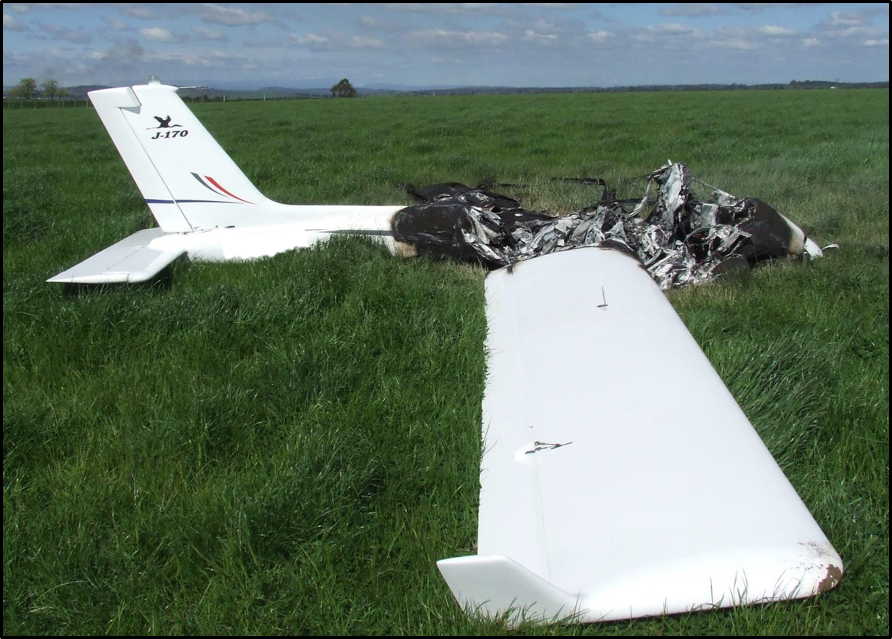
On 21 October 2018, an experimental Jabiru J170-D departed Launceston Airport, Tasmania for a local flight. In cruise between 1,500 ft and 2,500 ft above ground level (AGL), a fire began in the cockpit. The pilot, who was the sole occupant on board, conducted an emergency landing into a paddock. The aircraft struck a fence and fire destroyed the aircraft. The pilot sustained serious injuries and received first aid from the landowners until emergency services arrived.
On the morning of the accident, the aircraft was difficult to start. The pilot reported that the aircraft was started using an external portable power supply. This power supply remained connected from inside the cockpit for the duration of the flight, and the pilot reported switching this off after the start. During the flight, the pilot observed the electrical overvoltage alarm both visually and audibly activate on a Dynon D10 engine management system.
It indicated that the electrical system was charging the battery above normal capacity and possibly greater than 15 volts (normal range is 13-13.5v). The pilot had never encountered this problem previously and dismissed the alarm. However, about 5-10 minutes later the fire was observed entering the cockpit.
The pilot began an emergency descent into a paddock as fire began to engulf the cockpit. He opened his door to provide some outside visibility given cockpit windows were no longer transparent, which also assisted with cooling the flames. However, the pilot’s clothes had caught alight. During a high-speed landing, the aircraft bounced and the pilot exited the aircraft prior to the aircraft touching down again. The aircraft collided with a fence and was consumed by fire. (Figure 1).
The pilot found a cattle trough, immersed himself and called for help to a nearby farmhouse. The residents rendered first aid until emergency services arrived.
Figure 1: J170-D consumed by fire
Source: Tasmanian Fire Service, Fire investigation Report Aircraft Fire TFS Incident Number 18033397- Photograph 2, annotated by the ATSB
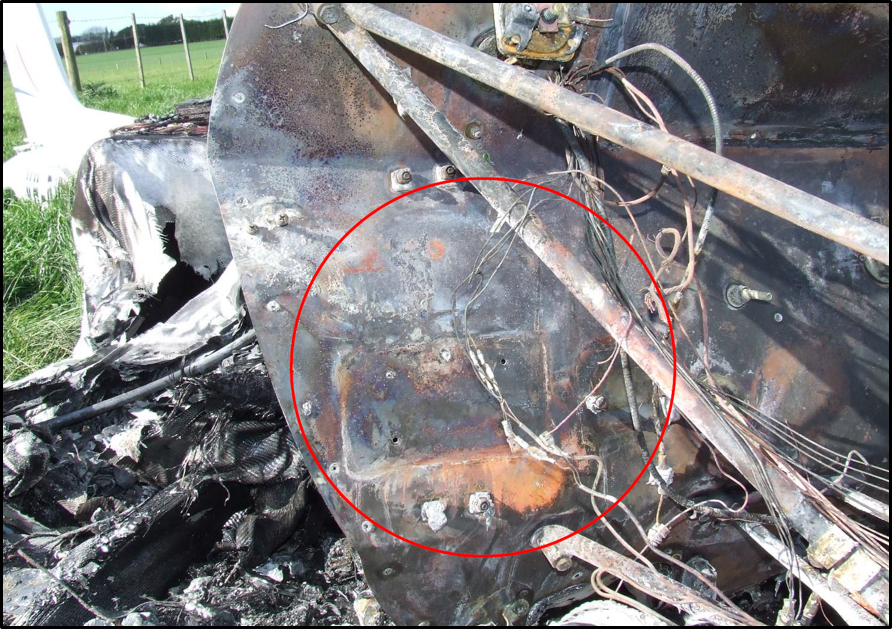
The Tasmanian Fire Service, Fire Investigation Report[1] established the area of fire origin on the engine side of the aircraft firewall[2] in front of the passenger’s feet position and within 400 mm radius of the battery (Figure 2).
Figure 2: J 170-D area of fire origin
Source: Tasmanian Fire Service, Fire investigation Report Aircraft Fire TFS Incident Number 18033397- Photograph 23, annotated by the ATSB, indicating fire origin.
The pilot reported that the engine did not exhibit any abnormal vibration and continued to run until impact with the fence. The pilot stated that the spread of the flames in the cockpit was sustained by a fuel source. This hastened the rapid spread of flames into the cockpit.
The aircraft had about 760 hours total time and had a Deltran 330 Lithium-iron Phosphate battery installed in September 2016, which had recently developed problems. The pilot recalled accidentally flattening the battery a month or two prior by leaving the master switch on. He had experienced problems with the battery since that time. The pilot reported that he used a Deltran trickle charger when the aircraft was not in use. However, the battery was not holding sufficient charge to start the engine consistently. The aircraft then required elevated RPM[3] in order to get sufficient voltage for the radios to be serviceable during taxi.
The J170-D Pilot’s Operating Handbook indicates that below 2000 RPM the alternator cannot supply sufficient power output to run ancillaries. This power then comes from the battery. Jabiru Service Letter JSL021 further identifies charging system limitations and risks of overvoltage situations. Operating the aircraft with a low voltage battery or one that will not accept electrical system charge may increase this risk.
Thermal runaway in a Lithium-ion battery is a dynamic chemical reaction accompanied by the release of heat. The temperature of the affected cell increases exponentially, triggering nearby cells to also increase their temperature and continue the reaction.
Lithium-ion battery thermal runaway is a known aviation safety hazard and can be initiated by mechanical, thermal of electrical abuse. Over discharge and overcharging of battery cells are two factors that can lead to an electrically induced thermal runaway and subsequent fire.
Safety message
In retrofitting Lithium-ion batteries to experimental aircraft, operators should consider the risks and to be aware of the appropriate charge and discharge requirements for the battery. They may not be suitable for the existing aircraft electrical systems.
Operators should also be aware of the potential risk of damage to Lithium-ion batteries should they be discharged below their minimum cell voltage.
Should a pilot notice any performance change in a fitted Lithium-ion battery, they should take action immediately to remove and replace the battery. This may prevent irreversible damage that may instigate a thermal runaway situation while in use.
In-depth knowledge of individual aircraft systems and regular emergency procedures practice is essential to ensure that pilots provide the most appropriate responses to uncharacteristic warnings or emergencies in flight.
About this report
Decisions regarding whether to conduct an investigation, and the scope of an investigation, are based on many factors, including the level of safety benefit likely to be obtained from an investigation. For this occurrence, no investigation has been conducted and the ATSB did not verify the accuracy of the information. A brief description has been written using information supplied in the notification and any follow-up information in order to produce a short summary report, and allow for greater industry awareness of potential safety issues and possible safety actions.
Occurrence Briefs are concise reports that detail the facts surrounding a transport safety occurrence, as received in the initial notification and any follow-up enquiries. They provide an opportunity to share safety messages in the absence of an investigation.
What happened
On the 26 September 2018 at 0615 Eastern Standard Time, an Airbus 380 was in cruise toward the end of the flight from Los Angeles, United States to Melbourne, Victoria.
Shortly after a passenger in seat 18B had moved their seat they heard a cracking noise and could not locate their personal electronic device (PED). Smoke and flames were then observed emanating from the seat. Cabin crew confirmed the source of the smoke and flames was coming from under the seat.
Power to the row of seats was cut and cabin crew followed their basic fire drill training and discharged four BCF extinguishers and water to extinguish the fire.
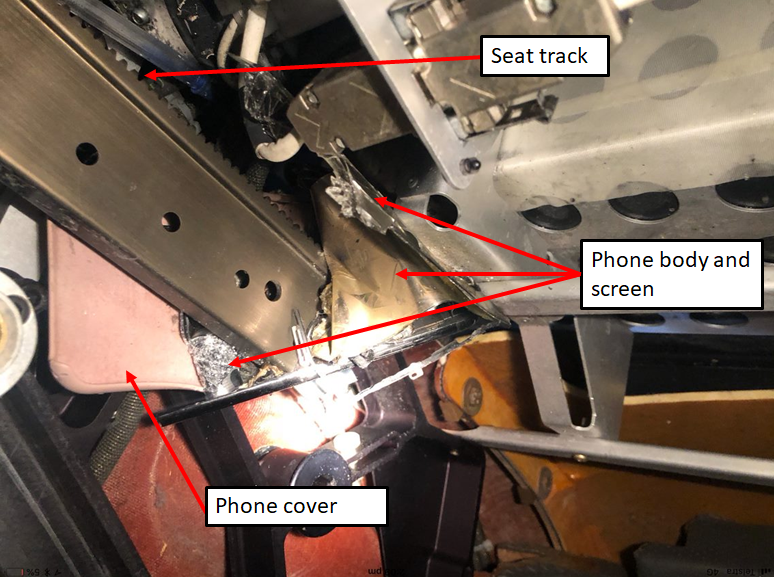
The smoke dissipated and crew were able to distinguish the remains of a mobile phone at the rear of the left hand seat track, but were unable to remove it from its position. The decision was made to continue the flight to Melbourne and a cabin crew member was tasked with remaining seated beside the seat to ensure the phone did not reignite.
There were no injuries sustained and the remainder of the flight proceeded without further incident.
Engineers disassembled and checked the seat and found no damage to the seat, wiring or the surrounding area. The phone had been completely crushed by the seat.
Figure 1. Crushed PED in the seat track
Safety message
Dropping a PED whilst in flight is not uncommon, however passengers are reminded to never attempt to move the seat or extricate the PED themselves. If a PED becomes lost, alert a crewmember immediately. They will employ the appropriate techniques to find and remove the item, to ensure the device does not become a hazard in flight.
This incident highlights the effective response by cabin crew to an emergency situation. By quickly implementing the basic fire drill procedure the incident was effectively contained.
Decisions regarding whether to conduct an investigation, and the scope of an investigation, are based on many factors, including the level of safety benefit likely to be obtained from an investigation. For this occurrence, no investigation has been conducted and the ATSB did not verify the accuracy of the information. A brief description has been written using information supplied in the notification and any follow-up information in order to produce a short summary report, and allow for greater industry awareness of potential safety issues and possible safety actions.
Occurrence Briefs are concise reports that detail the facts surrounding a transport safety occurrence, as received in the initial notification and any follow-up enquiries. They provide an opportunity to share safety messages in the absence of an investigation.
What happened
On 18 February 2018, an Airbus A320-232 departed Melbourne, Victoria (Vic.) on a scheduled passenger flight to Sydney, New South Wales (NSW). At about 0915 Eastern Daylight-saving Time (EDT), cabin crew were alerted to a fire in the cabin.
The cabin crew traced the source of the fire to three smartphone devices located in a passenger bag at row five. The crew subsequently discharged a fire extinguisher and followed the operator’s procedure for the management of a lithium battery fire. The fire was successfully extinguished, and the devices isolated in a container until the end of the flight.
Safety message
Personal electronic devices (PEDs) such as smartphones contain lithium batteries, which are classed as dangerous goods. The incidence of passenger smartphones resulting in fire on board aircraft has increased. The Civil Aviation Safety Authority (CASA) has published advice on the ‘Least wanted dangerous goods’ carried by passengers. Lost or damaged smartphones were identified as the number one hazardous item on passenger aircraft in 2017. Previous Australian Transport Safety Bureau (ATSB) investigations AO-2016-051 and AO-2016-066 provide further examples of incidents of passenger smartphones causing in-flight fires and smoke events.
This incident highlights the need for passengers to become familiar with the hazards associated with the carriage of personal electronic devices, in particular, the potential for fire if a device is damaged or overheated.
Fire on board aircraft is potentially catastrophic if not managed quickly and appropriately. It is important for operators to ensure crew receive training and are periodically tested in the management of lithium battery fires on board aircraft.
About this report
Decisions regarding whether to conduct an investigation, and the scope of an investigation, are based on many factors, including the level of safety benefit likely to be obtained from an investigation. For this occurrence, no investigation has been conducted and the ATSB did not verify the accuracy of the information. A brief description has been written using information supplied in the notification and any follow-up information in order to produce a short summary report, and allow for greater industry awareness of potential safety issues and possible safety actions.
Occurrence Briefs are concise reports that detail the facts surrounding a transport safety occurrence, as received in the initial notification and any follow-up enquiries. They provide an opportunity to share safety messages in the absence of an investigation.
What happened
On 7 January 2018, at about 1327 Eastern Daylight-saving Time (EDT), a Fairchild Industries Inc. SA227-DC was conducting training exercises in the circuit area at Ballina, New South Wales, with two crew on board. While on the downwind leg of the circuit, the crew noticed the right engine fire warning light had illuminated on the warning panel. The warning light went out as the crew were about to commence the memory items required for an engine fire warning, and the approach and landing were completed normally.
After parking and shutting the aircraft down, the crew identified smoke stains on the cowls of the right engine. Further inspection revealed evidence of a fire on the upper rear section of the engine. The aircraft was subsequently grounded pending a maintenance inspection.
Maintenance engineers identified a fuel leak from the manifold had ignited resulting in damage to the fuel lines and associated fittings and controls in the immediate vicinity (Figure 1). All damaged parts were replaced and tested prior to the aircraft being returned to service.
Figure 1: Pictures of fire damaged components within the right engine bay
Source: Operator
Safety action
As a result of this occurrence, the operator has advised the ATSB that they have taken the following safety action.
Inspections have been completed on all aircraft in the fleet with no other potential fuel system faults identified.
Safety message
This incident highlights the importance of flight crews maintaining awareness of all system states and being prepared to act at the first sign of trouble. A fire during flight has the potential to rapidly propagate unless it is quickly identified and managed, and the aircraft landed at the earliest opportunity.
About this report
Decisions regarding whether to conduct an investigation, and the scope of an investigation, are based on many factors, including the level of safety benefit likely to be obtained from an investigation. For this occurrence, no investigation has been conducted and the ATSB did not verify the accuracy of the information. A brief description has been written using information supplied in the notification and any follow-up information in order to produce a short summary report, and allow for greater industry awareness of potential safety issues and possible safety actions.