Fire

Fire prior to passenger disembarkation involving Kavanagh Balloons B400, VH-WNV, near Cessnock Airport, New South Wales, on 24 April 2016

Final report

What happened

At about 0725 Eastern Standard Time (EST) on the morning of 24 April 2016, the pilot of a Kavanagh Balloons B-400, registered VH-WNV (WNV), prepared to land at Rothbury near Cessnock, New South Wales (Figure 1). On board the scenic flight were the pilot and 16 passengers. The balloon was one of a number of balloons conducting a similar scenic flight that morning.

The pilot had selected a landing site, and informed the ground crew by radio, but the light wind carried WNV, and the other balloons in the group, a little further past this site. The pilot in WNV (and the other balloon pilots) then selected a nearby paddock for landing, and updated the ground crew accordingly. The pilot lined the balloon up to land, but then noticed a small dam along the intended landing path. The pilot manoeuvred the balloon over the dam before turning off the burners, and making a gentle landing.

Figure 1: VH-WNV landing area (green circle)
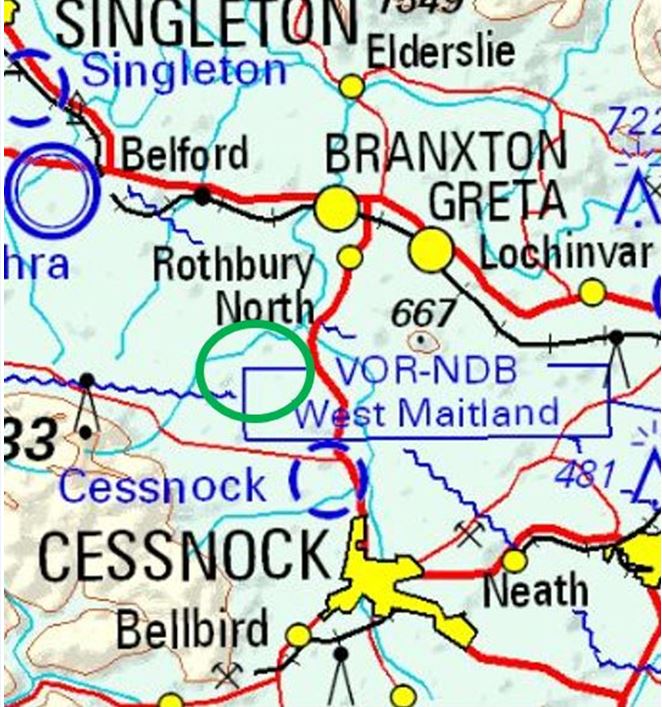
Figure 1: VH-WNV landing area (green circle)

Source: Airservices Australia: Extract of Sydney World Aeronautical Chart, annotated by ATSB

The manoeuvring over the dam resulted in the balloon being a little closer to the tree line than ideal (Figure 2). Mindful that the ground crew had to pack up the 400,000 cubic foot balloon once the passengers has disembarked, the pilot advised them that they would move the balloon back about 10m further from the trees. To assist with this process, and make the balloon more buoyant, the pilot checked the neck of balloon was still sufficiently open, and then turned on the pilot light of one of the two burners.

Moments later, the pilot again checked the neck of the balloon and noticed the gentle wind had blown part of the deflating balloon back on itself and there was black smoke emanating from this area. The pilot then observed that some of the fabric had melted and had begun to drip onto the occupants of the basket. The pilot quickly re-directed the ground crew from the task of pulling the top of the balloon down, to assisting the passengers disembark and move away to a safe area.

To avoid any potential of the balloon becoming aloft during the disembarkation process, the pilot pulled the smart vent[1] to rapidly release air. The pilot reported it was difficult to assess the extent of the fire from the basket, but they were aware that the balloon envelope ‘sliding’ on itself was adding more fabric as ‘fuel’ to the fire.

The balloon envelope deflated and landed next to the basket. The pilot (still on board) and the ground crew, after ensuring the passengers were safe, discharged fire extinguishers. Within a few minutes, the crew were able to spread the balloon envelope out and extinguish the fire.

During the emergency disembarkation, two of the passengers received minor burn injuries. The lower section of balloon envelope was substantially damaged.

Figure 2: Kavanagh Balloons B-400, VH-WNV at Rothbury
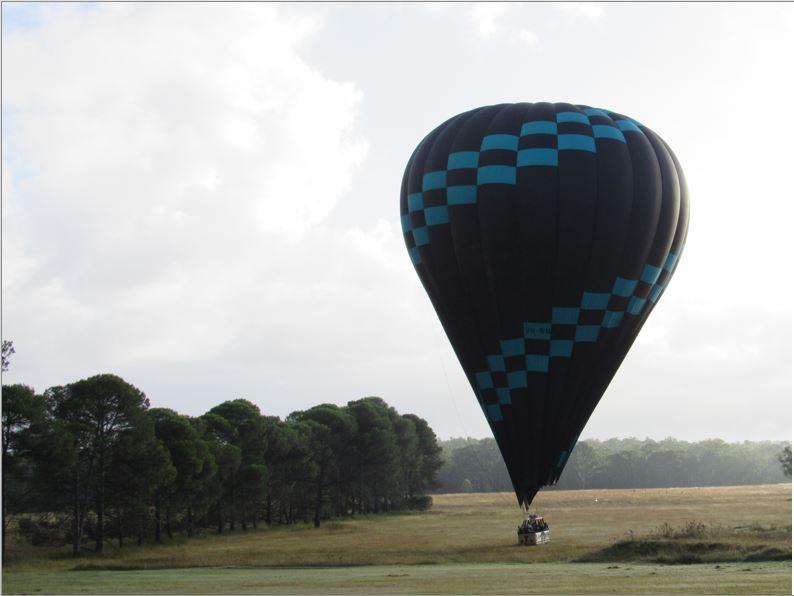
Figure 2: Kavanagh Balloons B-400, VH-WNV at Rothbury

Source: Pilot

Pilot comments

The pilot had logged over 1,330 flying hours, with about 350 hours on the Kavanagh Balloons B‑400.

In hindsight, the pilot advised that the decision to move the balloon back 10 m to assist the ground crew with the collapse and pack-up of such a large balloon was not the correct one. Other balloons landing nearby did not attempt to move their balloons away from the tree line.

Safety message

This occurrence highlights how quickly events may change. The simple decision by an experienced pilot to move the balloon back 10 m from the tree line to assist the ground crew inadvertently led to a fire.

The Federal Aviation Administrations’ (FAA) comprehensive Balloon Flying Handbook (2008) covers all aspects of balloon flying including aeronautical decision-making. Aeronautical decision-making is a systematic approach to the mental process used by pilots to determine the best course of action in response to a given set of circumstances. It builds on the foundation of conventional decision-making but enhances the process to decrease the probability of pilot error.

As almost all ballooning operations are conducted as single-pilot operations, ballooning uses a variant of crew resource management, known as single-pilot resource management. This integrates:

  • human resources
  • situational awareness
  • decision-making process
  • risk management
  • training.

One way in which the risk management decision path can be framed is through the perceive-process-perform model, which offers a structured way to manage risk.

  • Perceive the hazard by looking at:

– pilot experience, currency, condition
– aircraft performance, fuel
– environment (weather, terrain)
– external factors.

  • Process the risk level by considering:

– consequences posed by each hazard
– alternatives that eliminate hazards
– reality (avoid wishful thinking)
– external factors (‘get-home-itus’).

  • Perform risk management:

– transfer – can someone be consulted?
– eliminate – can hazards be removed
– accept – do benefits outweigh risk?
– mitigate – can the risk be reduced?

Other decision-making models are also covered in the manual.

Aviation Short Investigations Bulletin- Issue 52

Purpose of safety investigations

The objective of a safety investigation is to enhance transport safety. This is done through:

  • identifying safety issues and facilitating safety action to address those issues
  • providing information about occurrences and their associated safety factors to facilitate learning within the transport industry.

It is not a function of the ATSB to apportion blame or provide a means for determining liability. At the same time, an investigation report must include factual material of sufficient weight to support the analysis and findings. At all times the ATSB endeavours to balance the use of material that could imply adverse comment with the need to properly explain what happened, and why, in a fair and unbiased manner. The ATSB does not investigate for the purpose of taking administrative, regulatory or criminal action.

Terminology

An explanation of terminology used in ATSB investigation reports is available here. This includes terms such as occurrence, contributing factor, other factor that increased risk, and safety issue.

Publishing information 

Released in accordance with section 25 of the Transport Safety Investigation Act 2003

Published by: Australian Transport Safety Bureau

© Commonwealth of Australia 2016

image_5.png

Ownership of intellectual property rights in this publication

Unless otherwise noted, copyright (and any other intellectual property rights, if any) in this report publication is owned by the Commonwealth of Australia.

Creative Commons licence

With the exception of the Coat of Arms, ATSB logo, and photos and graphics in which a third party holds copyright, this publication is licensed under a Creative Commons Attribution 3.0 Australia licence.

Creative Commons Attribution 3.0 Australia Licence is a standard form licence agreement that allows you to copy, distribute, transmit and adapt this publication provided that you attribute the work.

The ATSB’s preference is that you attribute this publication (and any material sourced from it) using the following wording: Source: Australian Transport Safety Bureau

Copyright in material obtained from other agencies, private individuals or organisations, belongs to those agencies, individuals or organisations. Where you wish to use their material, you will need to contact them directly.

__________

  1. The smart vent is a vent at the top of the balloon allowing air to rapidly escape (opens in less than three seconds).

Occurrence summary

Investigation number AO-2016-039
Occurrence date 24/04/2016
Location near Cessnock Airport (Rothbury)
State New South Wales
Report release date 28/09/2016
Report status Final
Investigation level Short
Investigation type Occurrence Investigation
Investigation status Completed
Mode of transport Aviation
Aviation occurrence category Fire
Occurrence class Accident
Highest injury level Minor

Aircraft details

Manufacturer Kavanagh Balloons
Model B-400
Registration VH-WNV
Serial number B400-482
Sector Balloon
Operation type Ballooning
Departure point Cessnock, NSW
Destination Rothbury, NSW
Damage Substantial

Engine fire involving a Fairchild SA227, VH-UZI, near Brisbane, Queensland, on 22 March 2016

Final report

What happened

On 22 March 2016, the pilot of a Fairchild SA227 aircraft, registered VH-UZI, operated a freight charter flight from Mackay Airport to Brisbane Airport, Queensland. The flight was uneventful. After landing, the pilot calculated that about 100 lb (45 kg) of additional fuel had been used during the flight to that planned, with 1,100 lb rather than 1,200 lb of fuel remaining. As that amount was within the allowable deviation, the pilot was not required to and did not report the discrepancy.

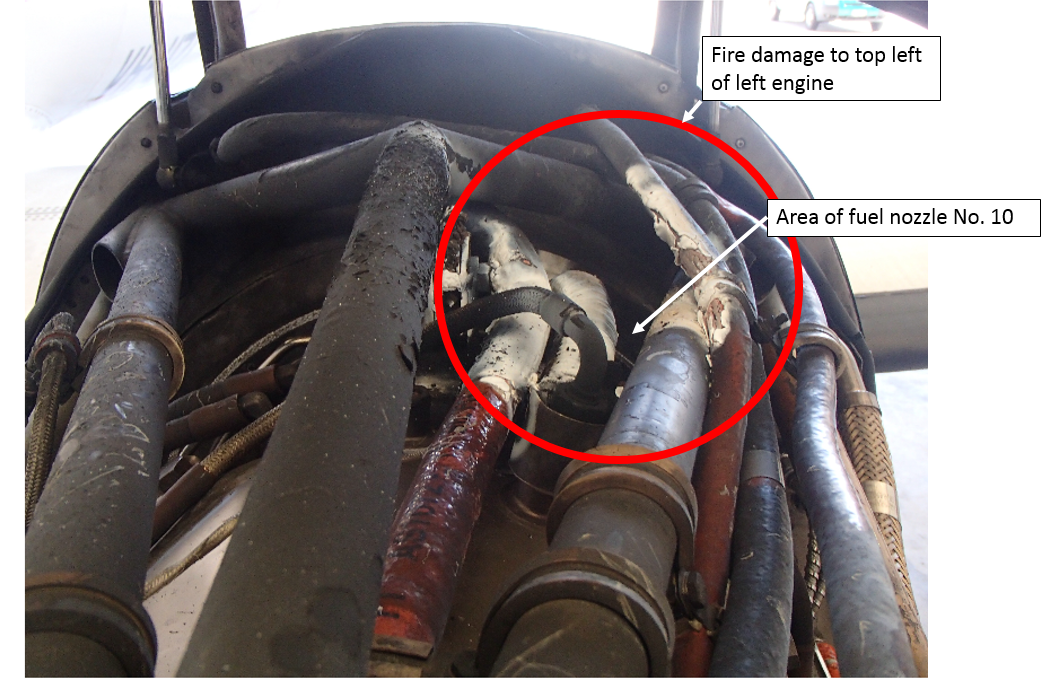
During a transit check of the aircraft, maintenance personnel at Brisbane Airport found evidence of a substantial fuel leak in the left wheel well of the aircraft. Further investigation found fuel pooling in the cowls, and about 400 ml of fuel spilled out when the cowls were opened. The maintainers found evidence of fire damage to the engine combustion case and a number of components forward of the firewall (Figure 1). The upper engine mount, fuel manifold, adjacent components and the engine frame had evidence of high temperature damage.

The pilot was unaware of the engine fire, as no fire warning had been generated (see Fire detection system).

Figure 1: Fire damage to the left engine

Figure 1: Fire damage to the left engine. Source: Aircraft operator

Source: Aircraft operator

Engineering report

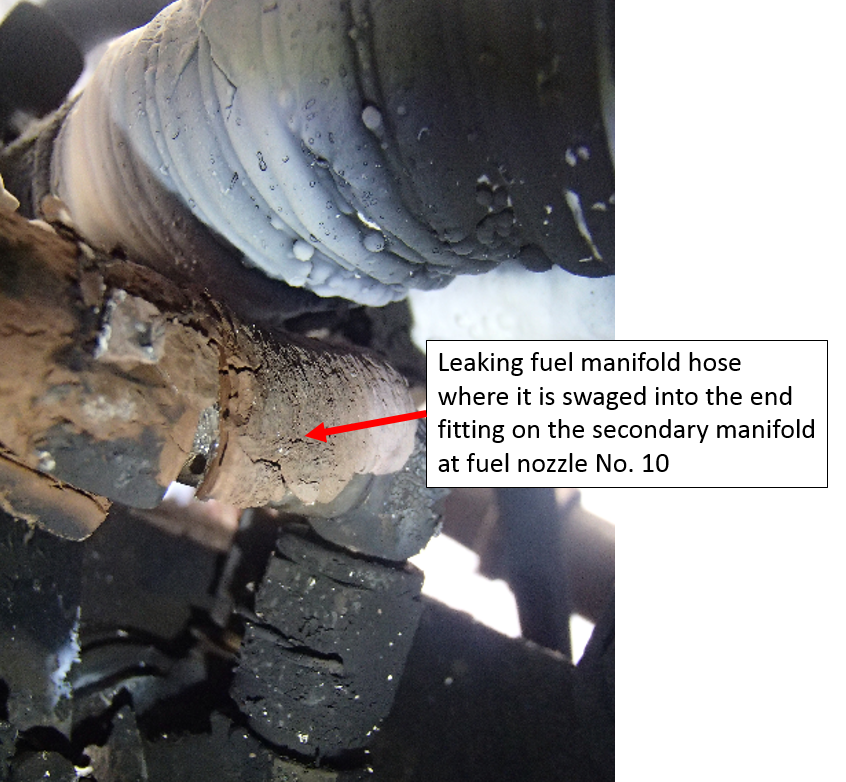
The post-incident inspection found evidence of fire in the area of the number 10 fuel nozzle. The fuel leak was due to a leaking flexible fuel manifold hose in the area where it is swaged[1] into the end fitting of the secondary manifold at the number 10 fuel nozzle (Figure 2).

Figure 2: Leaking flexible fuel manifold hose

Figure 2: Leaking flexible fuel manifold hose

Source: Aircraft operator

A fuel nozzle change had been carried out on the left engine during the last maintenance check, and engine ground runs were then carried out with no leaks detected.

A functional check of the engine fire detection system was conducted after the incident in accordance with the aircraft maintenance manual with no defects evident.

Airworthiness bulletin

The Civil Aviation Safety Authority issued Airworthiness Bulletin (AWB) 73-006 in August 2011. This was in response to three service difficulty reports regarding fuel leaks from the fuel manifold hose, and one associated engine fire. Another 14 fuel leaks and 3 engine fires due to the failure of the same hose had been reported to the equivalent US and Canadian authorities since 1990. 

The AWB commented that these manifolds did not have a life limit, but were subject to removal after a specified number of hours for a fuel nozzle inspection. That frequent removal may have contributed to cracks. The flexible portion of the manifold was concealed and could not be inspected visually.

The AWB (non-mandatory) recommendations included:

  • every time the manifolds are installed, they should be leak tested
  • when the manifolds are removed for a scheduled fuel nozzle inspection they should be sent to the maintenance provider with the nozzles for inspection and testing
  • special attention should be paid to removal and installation, as improper practices may contribute to cracking.

Maintenance conducted

The relevant maintenance inspections conducted by the operator prior to the incident covered the replacement of engine flammable fluid lines forward of the firewall (except the nozzle manifold hose which leaked in this incident), cleaning and testing of the fuel nozzles, fuel nozzle assembly inspection and a detailed inspection of the plumbing. The inspection included a visual check of fuel nozzle flexible manifold hoses for condition and ground run leak checks. The engine repair agency advised that periodic pressure leak testing of the manifolds was conducted after a maximum of 3,600 flight hours.

At the time of the incident, the operator’s system of maintenance did not cover all aspects of the recommended practices specified in AWB 73-006. The operator did not find any evidence that they had carried out an assessment of that bulletin. 

Fire detection system

The aircraft had a fire detection system, however, there were no sensors in the immediate area of the leak. As such (and noting that the fire detection system tested serviceable following the incident), the system was ineffective in alerting the pilot to the fire. Without the fire detection system being activated, the pilot was not aware of the issue.

Safety action

Whether or not the ATSB identifies safety issues in the course of an investigation, relevant organisations may proactively initiate safety action in order to reduce their safety risk. The ATSB has been advised of the following safety action in response to this occurrence.

Aircraft operator

As a result of this occurrence, the aircraft operator has advised the ATSB that they are taking the following safety actions.

Continuing airworthiness

The aircraft operator has introduced procedures in accordance with the recommendations specified in Airworthiness Bulletin 73-006.

Safety message

This incident highlights the importance of assessing any recommendations relating to maintenance. A recommendation is generally made in response to an event and complying with procedures specified may avoid a similar incident occurring.

Aviation Short Investigations Bulletin - Issue 49

Purpose of safety investigations

The objective of a safety investigation is to enhance transport safety. This is done through:

  • identifying safety issues and facilitating safety action to address those issues
  • providing information about occurrences and their associated safety factors to facilitate learning within the transport industry.

It is not a function of the ATSB to apportion blame or provide a means for determining liability. At the same time, an investigation report must include factual material of sufficient weight to support the analysis and findings. At all times the ATSB endeavours to balance the use of material that could imply adverse comment with the need to properly explain what happened, and why, in a fair and unbiased manner. The ATSB does not investigate for the purpose of taking administrative, regulatory or criminal action.

Terminology

An explanation of terminology used in ATSB investigation reports is available here. This includes terms such as occurrence, contributing factor, other factor that increased risk, and safety issue.

Publishing information 

Released in accordance with section 25 of the Transport Safety Investigation Act 2003

Published by: Australian Transport Safety Bureau

© Commonwealth of Australia 2016

image_5.png

Ownership of intellectual property rights in this publication

Unless otherwise noted, copyright (and any other intellectual property rights, if any) in this report publication is owned by the Commonwealth of Australia.

Creative Commons licence

With the exception of the Coat of Arms, ATSB logo, and photos and graphics in which a third party holds copyright, this publication is licensed under a Creative Commons Attribution 3.0 Australia licence.

Creative Commons Attribution 3.0 Australia Licence is a standard form licence agreement that allows you to copy, distribute, transmit and adapt this publication provided that you attribute the work.

The ATSB’s preference is that you attribute this publication (and any material sourced from it) using the following wording: Source: Australian Transport Safety Bureau

Copyright in material obtained from other agencies, private individuals or organisations, belongs to those agencies, individuals or organisations. Where you wish to use their material, you will need to contact them directly.

[1]     Forged shape.

Occurrence summary

Investigation number AO-2016-026
Occurrence date 22/03/2016
Location Brisbane Airport
State Queensland
Report release date 27/07/2016
Report status Final
Investigation level Short
Investigation type Occurrence Investigation
Investigation status Completed
Mode of transport Aviation
Aviation occurrence category Fire
Occurrence class Incident
Highest injury level None

Aircraft details

Manufacturer Fairchild Industries Inc
Model SA227-AT
Registration VH-UZI
Serial number AT-570
Aircraft operator Toll Aviation
Sector Turboprop
Operation type Charter
Departure point Mackay, Qld
Destination Brisbane, Qld
Damage Unknown

Fire involving a Boeing 737-377, VH-CZE, Darwin, Northern Territory, on 7 November 1993

Summary

The aircraft took off and departed Darwin with engine bleed air off, utilizing the auxiliary power unit (APU) for air-conditioning. The APU was not shut down immediately after take-off to allow it a longer cooling period. As the aircraft reached flight level 330, the purser noticed a vibration near the rear entry door and advised the flight crew. The first officer investigated the problem, and as he returned to the cockpit the APU fire warning light illuminated, and the fire bell sounded. Fire procedures were carried out, the extinguisher bottle discharged, and the fire warning ceased. The purser also reported that the vibration then ceased. The flight continued to Alice Springs and landed without further incident. Subsequent investigation of the APU revealed evidence of burning near the thermocouple and the APU was replaced.

Occurrence summary

Investigation number 199303747
Occurrence date 07/11/1993
Location Darwin
State Northern Territory
Report release date 14/06/1994
Report status Final
Investigation type Occurrence Investigation
Investigation status Completed
Mode of transport Aviation
Aviation occurrence category Fire
Occurrence class Incident

Aircraft details

Manufacturer The Boeing Company
Model 737-377
Registration VH-CZE
Sector Jet
Operation type Air Transport High Capacity
Departure point Darwin NT
Destination Alice Springs NT
Damage Nil

Fire involving a Fokker B.V. F28 MK 3000, VH-EWF, Sydney, New South Wales, on 12 October 1993

Summary

After the aircraft cleared the runway after landing, the tower reported what appeared to be a fire in the starboard engine. The engine was shut down and the fire bottle discharged. The aircraft then taxied to its allocated parking bay followed by the RFFS vehicles.

Investigation revealed there had been no engine fire, but the APU was 'torching' from the tail pipe. The APU igniter plug, fuel atomiser and combustor liner were changed and the APU then operated normally.

Occurrence summary

Investigation number 199303234
Occurrence date 12/10/1993
Location Sydney
State New South Wales
Report release date 30/10/1993
Report status Final
Investigation type Occurrence Investigation
Investigation status Completed
Mode of transport Aviation
Aviation occurrence category Fire
Occurrence class Incident

Aircraft details

Manufacturer Fokker B.V.
Model F28 MK 3000
Registration VH-EWF
Sector Jet
Operation type Air Transport High Capacity
Departure point Norfolk Island NSW
Destination Sydney NSW
Damage Nil

Fire involving a Hughes Helicopters 369HS, VH-CHD, Near HARRIETVILLE 6NW, VIC on 19 April 1978

Summary

HELI DROPPING OF DELAYED ACTION INCENDARIES FOR BURN AT APPROX 250'.BURNT OUT WRECK FOUND.EVIDENCE T

Occurrence summary

Investigation number 197802539
Occurrence date 19/04/1978
State Victoria
Report status Final
Investigation type Occurrence Investigation
Investigation status Completed
Mode of transport Aviation
Aviation occurrence category Fire
Occurrence class Accident
Highest injury level Fatal

Aircraft details

Manufacturer Hughes Helicopters
Model 369HS
Registration VH-CHD
Sector Helicopter
Departure point WONDILIGON VIC
Destination BRIGHT VIC
Damage Destroyed

Fire involving a Piper Aircraft Corp PA-31-350, VH-MBK, Near MELBOURNE VIC 2NE, VIC on 30 March 1978

Summary

JUST AFTER NGT T/O PLT REPTD ENG FIRE.ENG SHUTDWN-ATTEMPT TURN BACK-CRASHED.HOLED #2 PISTON CAUSED OIL SPRAY ON EXHAUST.65 KG OVERWEIGHT.REDUCED PWR LH ENG-TURBO DENSITY CONTROLLER OUT OF ADJUSTMENT.

Occurrence summary

Investigation number 197802533
Occurrence date 30/03/1978
State Victoria
Report status Final
Investigation type Occurrence Investigation
Investigation status Completed
Mode of transport Aviation
Aviation occurrence category Fire
Occurrence class Accident
Highest injury level Fatal

Aircraft details

Manufacturer Piper Aircraft Corp
Model PA-31-350
Registration VH-MBK
Sector Piston
Departure point MELBOURNE VIC
Destination CANBERRA ACT
Damage Destroyed

Fire involving a British Aerospace PLC BAe 146-200A, VH-YAD, 2 km south-west of Adelaide Aerodrome, South Australia, on 16 November 1998

Summary

The aircraft was on climb passing through 1200 ft, when the crew observed a fire warning on the right outboard (No. 4) engine. Following completion of the checklist items, the engine was shut down. The aircraft returned to Adelaide and conducted an overweight landing. Engineering inspection of the No 4 engine, found that an "O" ring in the combustion chamber fuel manifold at the No 7 fuel nozzle, had split internally.

The resultant small fuel leak and fire had triggered the fire warning. The detector wire is approximately 3 inches downstream of the failed ring. As the engine was approaching a 5,000-cycle heavy inspection, an engine change was carried out and the aircraft returned to service. The fuel nozzle "O" ring has a finite life of 5,000 cycles. The failed ring had completed 4673 cycles and is the subject of a Defect Report submission to CASA.

Occurrence summary

Investigation number 199805069
Occurrence date 16/11/1998
Location 2 km south-west of Adelaide Aerodrome
State South Australia
Report release date 04/12/1998
Report status Final
Investigation type Occurrence Investigation
Investigation status Completed
Mode of transport Aviation
Aviation occurrence category Fire
Occurrence class Incident

Aircraft details

Manufacturer British Aerospace
Model BAe 146-200A
Registration VH-YAD
Sector Jet
Departure point Adelaide SA
Destination Launceston Tas.
Damage Nil

Fire involving a Saab SF-340B, VH-OLM, Bindook VOR, New South Wales, on 16 May 1997

Summary

A significant proportion of this report is based on information provided by the operator.

Whilst approaching Bindook at FL180, on a scheduled air transport flight from Dubbo to Sydney, the crew of a SAAB 340B observed the right engine air intake caution light illuminate. The abnormal procedures checklist for this condition was carried out and the caution light extinguished.

A short time later a strong burning smell became evident on the flight deck. However, there were no associated warning indications. Discussions with the flight attendant (FA) revealed that the smell was isolated to the cockpit, indicating that the burning smell may have been associated with the right air conditioning system, which supplied conditioned air to the cockpit. The 'Air Conditioning Smoke' emergency checklist was not utilised. The right engine bleed air valve was closed in an attempt to further diagnose the problem. Several minutes later the bleed air valve was re-opened. The burning smell in the cockpit intensified. Reports from the FA continued to indicate no noticeable smell in the cabin.

The co-pilot then looked out the right, side window and reported to the pilot in command (PIC) that there was a fire in the right engine. There were no fire warning indications in the cockpit. The engine fire checklist was carried out, the right engine fire bottle was discharged, and the engine shut down. An inflight emergency was declared to Air Traffic Control, who initiated a distress phase and expedited the entry of the aircraft to Sydney.

All three crewmembers then prepared for an emergency landing at Sydney. The PIC advised the FA that the landing would be normal, and would be followed by a normal disembarkation on an adjacent taxiway. With local emergency services in attendance, the aircraft subsequently landed safely on runway 07 and was stopped on taxiway G3. All occupants disembarked normally through the main cabin door and were transported to the terminal.

An engineering examination revealed that the right engine lower intake anti-ice duct had short-circuited and was excessively burnt around the inner-upper lip at the particle separator mounting flange. The damage was consistent with the duct material smouldering for some time. Based on the recollection of the co-pilot, there had been no visible flames but rather a very bright red/orange glow inside the intake. The lower duct, and the particle separator, were replaced with serviceable items and the aircraft returned to service.

The engine intake anti-ice system consists of electrically heated intake ducts. The heater elements are made of a copper alloy material sprayed onto a glass fibre mat and covered with an outer glass mat. The mat is bonded to the metal inlet, making them an integral unit. Should the duct intake surface suffer damage which allows moisture to penetrate to the heater elements, short-circuits can occur. Although required as part of the engine fire emergency checklist, the activation of the fire extinguisher has no effect on the engine intake duct. The intake duct anti-ice remote circuit breaker is designed to trip as a result of a short-circuit. In this case the circuit-breaker failed to trip.

The aircraft manufacturer has been aware of short-circuiting intake duct heaters in aircraft equipped with this particular type of intake, and had developed a specific checklist titled 'Intake Sparks' to cover this particular situation. At the time of this occurrence the checklist was being distributed as an amendment to the Aircraft Operations Manual, but had not been available to the flight crew.

Local safety action

As a result of this occurrence the company has introduced improvements to flight operations training and procedures, designed to assist flight crews in the recognition and handling of intake duct problems. In addition, both flight and cabin crew emergency disembarkation procedures are being reviewed.

Other safety actions include increasing the frequency of engineering inspections and resurfacing of duct heater elements, as well as streamlining procedures to ensure new information from the aircraft manufacturer is distributed to all crews without delay.

Occurrence summary

Investigation number 199701563
Occurrence date 16/05/1997
Location Bindook VOR
State New South Wales
Report release date 19/09/1997
Report status Final
Investigation type Occurrence Investigation
Investigation status Completed
Mode of transport Aviation
Aviation occurrence category Fire
Occurrence class Incident

Aircraft details

Manufacturer Saab Aircraft Co.
Model SF-340B
Registration VH-OLM
Sector Turboprop
Operation type Air Transport Low Capacity
Departure point Dubbo NSW
Destination Sydney NSW
Damage Minor

Fire involving a Boeing 767-300, OE-LAW, Melbourne Aerodrome, Victoria, on 14 November 1996

Summary

As the aircraft took off from Sydney bound for Melbourne, sparks were seen in the area of the right main landing gear. Rescue and firefighting services were placed on local alert for the aircraft's arrival at Melbourne. As the aircraft slowed at the end of the landing roll, the attending firemen reported smoke coming from the right main landing gear. The aircraft was halted while the fire crews extinguished a small fire and reported that one tyre was deflated. The engines were shut down and the aircraft towed to the terminal. Fire crews remained in attendance and reported that the tyre began to smoulder as the aircraft was approaching the parking bay. The passengers were deplaned normally. Forty minutes after landing the situation was reported under control.

Initial maintenance investigation found that the inner bearing on the number 8 wheel had seized. Extensive secondary damage had been sustained by the tyre, wheel and bogie unit. Further examination disclosed that the number 4-wheel inner bearing, fitted to the left bogie, showed similar damage.

The damaged components were returned to the operator for investigation under control of the Austrian airworthiness authority (AustroControl). The results of the metallurgical assessment of the bearing damage have not been received to date.

The manufacturer advised that there has been a small number of failed bearings on B767 aircraft. A service letter (767-SL-32-070) has been issued to introduce a grease seal and grease dam to resolve the problem of abnormal wear, overheating and damage to wheel bearings caused by inadequate bearing lubrication. To date the operator has not advised whether the bearings that failed were modified to the service letter standard, although AustroControl advised that the pattern of wear observed on the failed bearings, plus the presence of a quantity of grease residue would tend to preclude lack of lubrication as a causal factor.

The service letter also advised that the existing grease type, Aeroshell 5, was replaced with Aeroshell 22 or Mobil 28. The service letter advised that Aeroshell 5 could still be used on B767 aircraft, but not on B747 aircraft. To date the operator has not advised which grease was in use on the failed bearings.

There is no information from the operator on these aspects, but because the service bulletin was issued on 29 August 1996, only 8 weeks prior to this incident, it is considered unlikely that its requirements had been incorporated into the failed bearings.

The manufacturer also prescribed a critical wheel bearing torquing procedure that required double torquing of the bearings. AustroControl advised that the double torquing procedure is well known and observed within Lauda Air, and that a recent audit of the brake and wheel shop in accordance with JAR145 found that all pertinent procedures were being followed. The factors surrounding the failure of the 2 bearings have not been determined.

Occurrence summary

Investigation number 199603730
Occurrence date 14/11/1996
Location Melbourne Aerodrome
State Victoria
Report release date 07/07/1997
Report status Final
Investigation type Occurrence Investigation
Investigation status Completed
Mode of transport Aviation
Aviation occurrence category Fire
Occurrence class Incident

Aircraft details

Manufacturer The Boeing Company
Model 767-300
Registration OE-LAW
Sector Jet
Operation type Air Transport High Capacity
Departure point Sydney NSW
Destination Melbourne Vic
Damage Minor

Fire involving a de Havilland Canada DHC-8-102, VH-WZI, En route Mildura to Melbourne, Victoria, on 21 May 1996

Summary

The pilot-in-command reported that during cruise at flight level 210 an intermittent acrid electrical burning smell was noted. Shortly afterwards a white flash occurred near the wiring terminals of the right forward windscreen. This was followed by a fire at the electrical terminals. Appropriate emergency drills were completed by the crew and a fire extinguisher was used to extinguish the fire. The windshield heat was switched off and a descent commenced. Passing flight level 130 on descent the outer windshield panels shattered. A safe landing was made into Melbourne.

Maintenance found that the windscreen integral bus bar had overheated and ignited. The window is to be returned to the manufacturer for analysis. The windshield temperature controller was also changed as a precautionary measure.

Occurrence summary

Investigation number 199601691
Occurrence date 21/05/1996
Location En route Mildura to Melbourne
State Victoria
Report release date 27/08/1996
Report status Final
Investigation type Occurrence Investigation
Investigation status Completed
Mode of transport Aviation
Aviation occurrence category Fire
Occurrence class Incident

Aircraft details

Manufacturer De Havilland Canada/De Havilland Aircraft of Canada
Model DHC-8-102
Registration VH-WZI
Sector Turboprop
Operation type Air Transport Low Capacity
Departure point Mildura Vic
Destination Melbourne Vic
Damage Nil