The aircraft was engaged in spraying an Insecticide solution on
a maturing cotton crop varying In height from 2 feet to 4 feet 6
Inches. Operations had begun one hour previously and were to
continue into the night with the pilot making easterly and westerly
runs working from south to north across the field. The wind was
suitable for the operation being mainly light In strength and
variable In direction, with an occasional gust to ten knots.
Approximately three minutes before last light, with the work lights
on, the pilot approached from the west for his third spraying run,
over a tree 45 feet in height situated 120 feet back from the edge
of the crop. He then descended to begin spraying but the descent
was not arrested before the undercarriage entered the crop.
Believing the aircraft might not come free from the crop the pilot
reduced power to minimise the Impact, but the drag on the aircraft
decreased slightly and the pilot applied full power and dumped the
load. The aircraft failed to accelerate and sank deeper Into the
crop, and the pilot again reduced power. The right wing caught in
the crop and the aircraft skidded to the left still decelerating
and came to rest pointing 140 degrees to the flight path with the
undercarriage collapsed beneath it.
The landing strip at Wongrabry Station is 2, 600 feet long and is aligned in approximately an east-west direction. The station homestead is near the eastern end. The aircraft was fitted with dual controls and it is not known which pilot was controlling the aircraft. The aircraft took off into the west and made a partial circuit to the south of the airstrip, approached the strip from the east, passed over the homestead at a height estimated at between 600 and 800 feet and then new parallel with and above the strip. At a point approximately above the western end of the strip the aircraft completed a controlled roll to the left through 360 degrees, recovered and continued westward in level flight. About 1 1/2 miles beyond the strip it zoomed sharply upward into a stall turn type manoeuvre to the left and entered into a steep 70 degree dive. As the dive progressed the speed increased to about 200 knots and the dive angle progressively decreased. When the aircraft was about 200 feet above the ground it had attained a nearly level attitude but was still descending. It passed out of sight of eye witnesses and struck a tree and then the ground.
The aircraft was observed in low level flight along the western
and northern shores of the island. Approaching-a beach from which a
group of men were fishing, the aircraft descended and turned to fly
along the waters edge, descending further directly towards the men
on the beach. The pilot states that it was his intention to carry
out a landing on the beach but it is significant that the tide was
full, the width of beach was restricted and the party of fishermen
would constitute an obstruction to a landing. Before reaching the
location of the fishermen, the aircraft was seen to lurch to the
left and the port wing struck the water, bending the wing tip
upward and tearing off the outboard section of the aileron. The
pilot applied full power and the aircraft successfully climbed
away. A landing was subsequently made at Rockhampton without
further damage.
Occurrence Briefs are concise reports that detail the facts surrounding a transport safety occurrence, as received in the initial notification and any follow-up enquiries. They provide an opportunity to share safety messages in the absence of an investigation.
What happened
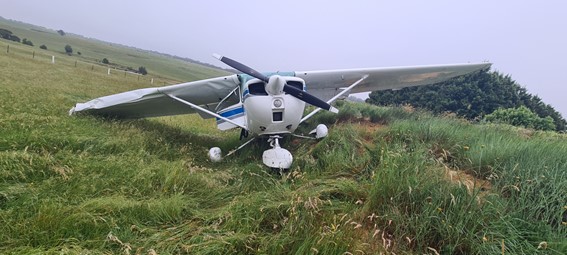
On the morning of 23 November 2020, a Cessna 150 departed Peterborough, Victoria on a private flight to Deniliquin, New South Wales, with the pilot and one passenger on board. The en-route weather forecast obtained prior to flight indicated a band of marginal weather moving to the east followed by clearing weather behind. The pilot assessed that the conditions on the route chosen would be initially suitable for flight under VFR[1] with conditions improving during the day.
During the flight, the weather began to deteriorate approaching the Ballarat area. The pilot observed increasing overcast cloud on the intended track and was forced to descend to stay in VMC.[2] Approximately 15 NM south of Ballarat airfield, at 800 ft and now several miles right of track, the pilot received the weather from the aerodrome weather information service which was indicating a cloud ceiling at Ballarat of 5,000 ft. After the sudden appearance of wind turbines off to the right of track, the instrument-rated pilot decided to commence a climb to get above the cloud, which was believed to be 1,000 ft thick. Passing 3,500 ft the airspeed indicator became unreliable and was fluctuating significantly despite the pitot heat being on. The decision to reverse course and descend out of cloud was made. The pilot became visual with the ground about 200 ft above the trees and began searching for a suitable landing area.
As the pilot searched, it became increasingly difficult to maintain visual reference with the ground and they decided to immediately land in a paddock. Selecting a paddock, the pilot lined up on approach and on short final a wire fence was sighted which required an adjustment just prior to touchdown. This adjustment increased the ground roll and the aircraft passed through another fence before the wing tip collided with a small shed and the aircraft came to rest on an embankment.
Figure 1: Aircraft in situ post collision
Source: Operator
Pilot comments – In hindsight the pilot suggested they could have either delayed the departure of the flight until the marginal weather had passed or planned a route further to the west to remain clear of it altogether.
Safety message
The ATSB continues to investigate weather-related general aviation accidents. VFR into IMC remains one of the most significant causes for concern in aviation safety; the often-fatal outcomes of these accidents are usually avoidable. In the 5 years prior to the occurrence, there were 57 reported VFR into IMC occurrences, 7 of which resulted in accidents, with 10 fatalities.
The ATSB SafetyWatch highlights the broad safety concerns that come out of our investigation findings and from the occurrence data reported to us by industry. One of the safety concerns is inflight decision-making.
The decision whether to proceed is the first decision the VFR pilot faces when confronted with less than visual meteorological conditions. Flight Safety Australia article '178 seconds to live' illustrates the stark reality of attempting to fly in IMC conditions without adequate training.
About this report
Decisions regarding whether to conduct an investigation, and the scope of an investigation, are based on many factors, including the level of safety benefit likely to be obtained from an investigation. For this occurrence, no investigation has been conducted and the ATSB did not verify the accuracy of the information. A brief description has been written using information supplied in the notification and any follow-up information in order to produce a short summary report, and allow for greater industry awareness of potential safety issues and possible safety actions.
Occurrence Briefs are concise reports that detail the facts surrounding a transport safety occurrence, as received in the initial notification and any follow-up enquiries. They provide an opportunity to share safety messages in the absence of an investigation.
What happened
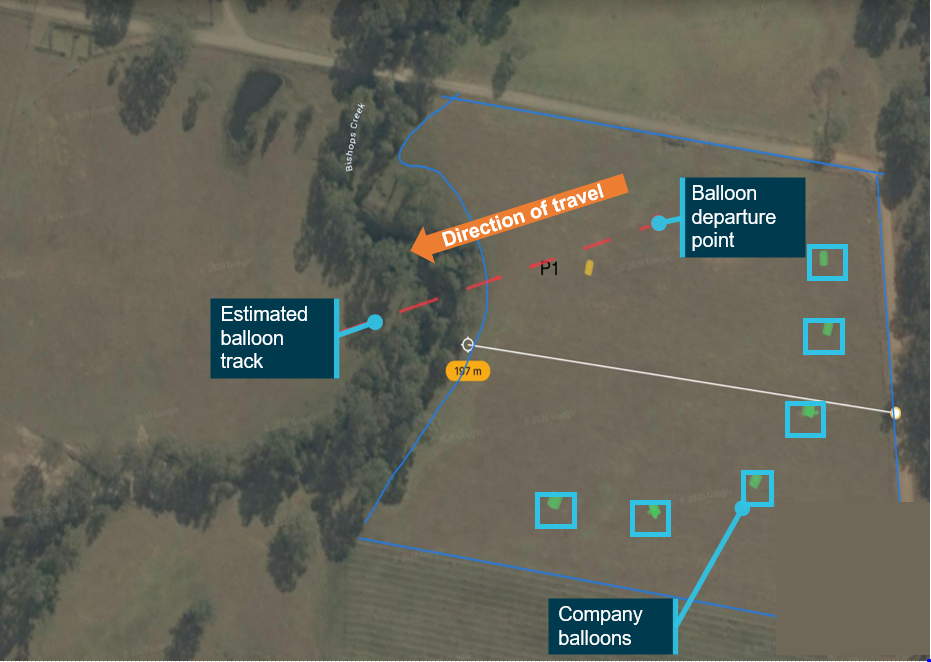
On 31 October 2020, at 0605 Eastern Daylight-saving Time, the pilot of a Kavanagh Balloons B425-581 balloon was preparing for launch near Maitland, New South Wales, with 20 passengers on board. The balloon was to operate in company with another seven passenger-carrying charter balloons and was the second to launch.
The pilot inadvertently released the launch restraint with sufficient heat being applied to the envelope only to become airborne (due to false lift) but not to climb. The balloon then travelled approximately 100 m downwind at 50 ft above the ground before coming into contact with the trees (Figure 1). This resulted in damage to seventeen panels of the balloon envelope. The pilot and passengers were uninjured.
Decisions regarding whether to conduct an investigation, and the scope of an investigation, are based on many factors, including the level of safety benefit likely to be obtained from an investigation. For this occurrence, no investigation has been conducted and the ATSB did not verify the accuracy of the information. A brief description has been written using information supplied in the notification and any follow-up information in order to produce a short summary report, and allow for greater industry awareness of potential safety issues and possible safety actions.
Occurrence Briefs are concise reports that detail the facts surrounding a transport safety occurrence, as received in the initial notification and any follow-up enquiries. They provide an opportunity to share safety messages in the absence of an investigation.
What happened
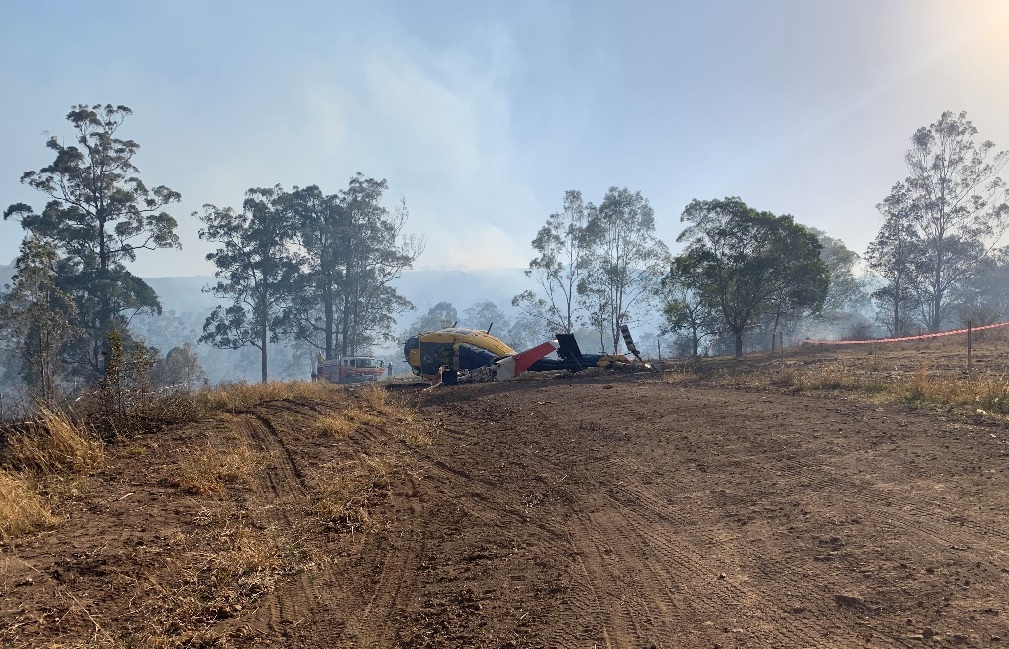
On 13 November 2019, a Bell 214B helicopter was water bombing during fire control operations near Pechey, Queensland. At 1344 Eastern Standard Time, the helicopter approached the bushfire downwind and downhill from the north-west at about 60 knots, and made a descending right-hand turn back into wind over the fire.
The descent was continued towards the drop zone. The airspeed was further slowed and the height was reduced to about 150 feet above ground level (50 feet above treetop level). The pilot then released the load of water before departing the drop area into rising terrain. The pilot heard the low rotor RPM warning and had insufficient altitude and clearance from obstacles to recover the rotor RPM and continue flying. He was concerned that further actions required to recover the rotor RPM would result in the helicopter possibly striking trees or ending up in the actively burning fire.
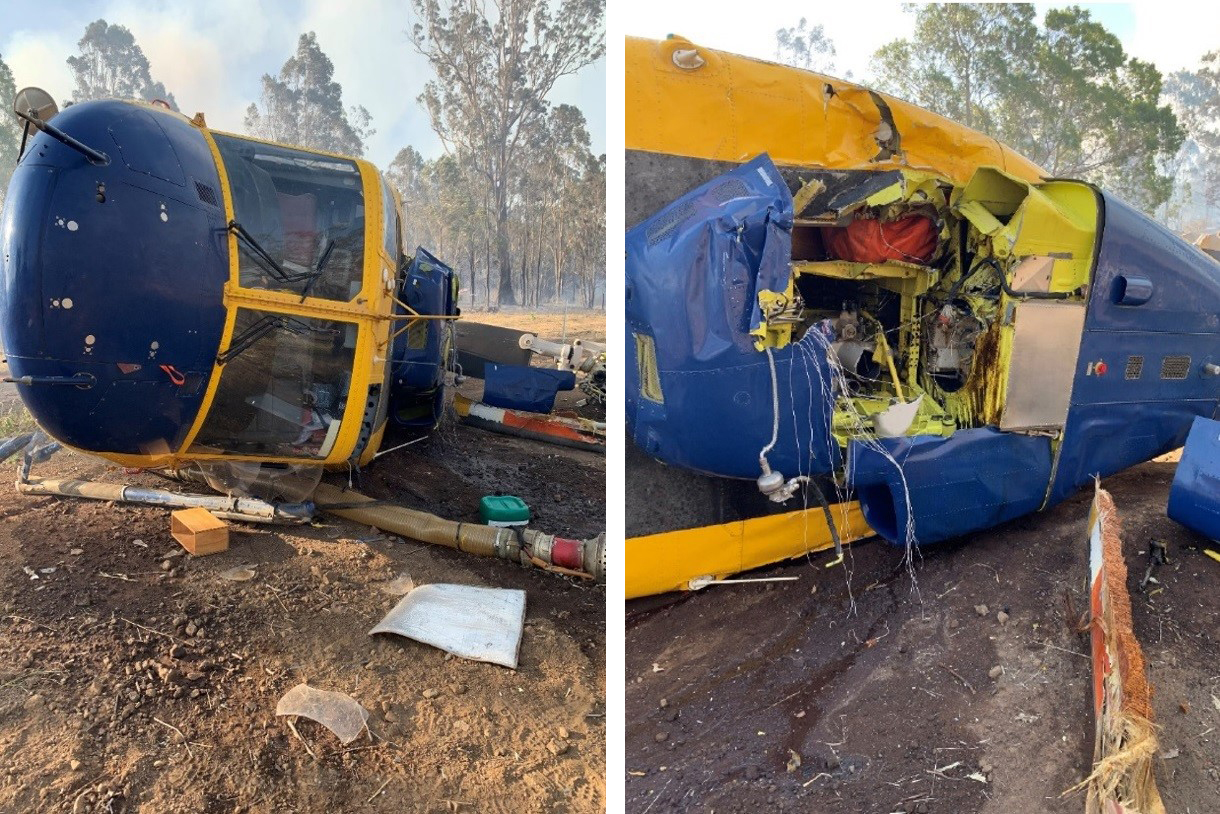
In maintaining the climb to avoid rising ground, trees and fire, the rotor RPM appeared to decay further. As the helicopter cleared the trees, it began to descend, yawed to the right and the left-hand skid collided with the ground. The helicopter rolled onto its left side resulting in substantial damage. The pilot was able to turn off the fuel to stop the engine and exited the helicopter via the overhead window with minor injuries. Neither the g-force activated ELT beacon or flight tracking alarm were triggered.
The distance from the last water drop to the impact point was less than 100 metres and the recovered aircraft showed little evidence of damage from forward moment.
Figure 1: Aircraft prior to recovery – looking at reciprocal direction of approach. The final water drop occurred beyond the fuselage where the smoke is rising.
Source: Operator
Figure 2: Aircraft wreckage
Source: Operator
Operator’s investigation and comments
Based on the pilot’s account of the accident and assessment of the recovered aircraft, mechanical malfunctions were ruled out as a contributing factor. The operator determined that the accident was most likely the result of a loss of rotor RPM that the pilot was unable to recover, due to a downwind descending turn, low altitude for the water drop, and a departure into rising terrain. The pilot had to make a decision between putting the helicopter into tall trees and active bushfire or climbing over the trees to clear ground. In choosing the latter, the rotor RPM decayed further, and the helicopter contacted the ground.
The operator stated that the helicopter type is renowned for its ‘hot and high’ performance making it a very effective firefighting platform. Firefighting combines a number of factors which result in flying that is close to the performance limits of the aircraft – high gross weights, low airspeeds, low altitude, close quarters manoeuvring, high work rate environment and adverse weather conditions. In this case the combination of factors immediately leading up to the accident resulted in the helicopter operating outside its performance envelope without having enough space and height to recover.
Safety action
As a result of this occurrence, the aircraft operator has advised the ATSB that they are taking the following safety actions:
The operator has provided a briefing to all of their pilots on the circumstances and the outcome of this accident. The pilot involved in this accident will be involved in future training and checking to enable the recognition and avoidance of the circumstances that saw the limitations and flight envelope exceeded. This training will become part of the operator’s annual training for all pilots conducting fire control operations.
Safety message
Fire control flying operations can involve challenges and complexities that require crews to maintain a heightened awareness of their aircraft’s operating limits and the environmental conditions. Flying within operating limits can ensure pilots have a performance margin to react to unforeseen circumstances.
About this report
Decisions regarding whether to conduct an investigation, and the scope of an investigation, are based on many factors, including the level of safety benefit likely to be obtained from an investigation. For this occurrence, no investigation has been conducted and the ATSB did not verify the accuracy of the information. A brief description has been written using information supplied in the notification and any follow-up information in order to produce a short summary report, and allow for greater industry awareness of potential safety issues and possible safety actions.
Occurrence Briefs are concise reports that detail the facts surrounding a transport safety occurrence, as received in the initial notification and any follow-up enquiries. They provide an opportunity to share safety messages in the absence of an investigation.
What happened
On the morning of 16 November 2019, a BRM Aero Bristell departed Essendon Airport, Victoria to conduct an instructor-rating proficiency check flight. There was an authorised testing officer (ATO) and instructor on board.
During approach into Drouin, Victoria, the ATO directed the instructor to perform a practice forced landing onto the grass airstrip. The instructor reduced power to idle, adopted best glide speed for the aircraft and began the approach. During the approach, the instructor acknowledged that he would not make the selected touch down point. He applied power of about 100 RPM to assist in the approach. Upon the application of power, the ATO noticed that the aircraft contacted treetops and foliage. Further power was then applied to correct the flight path and to clear the obstacles.
The aircraft landed without further incident and was taxied to the parking area for inspection by the crew. There was no visible damage identified. The crew notified the training organisation’s on-duty instructor and subsequently conducted a return flight to Essendon.
Safety action
As a result of this occurrence, the aircraft training organisation has advised the ATSB that they are taking the following safety action:
A meeting was held with the organisation’s instructional staff to brief them of this occurrence and to advise them that if an incident of this nature should occur, an engineer must confirm the aircraft is safe for further flight.
Safety message
During training flights, testing officers and instructors need to be vigilant and prepared to discontinue a glide approach if it is established that a successful landing cannot be achieved. It is important to be aware of any obstacles or obstructions in the flight path and to ensure clearance is maintained at all times. In the event of contact between an aircraft and treetops or obstacles, such as in this occurrence, it is imperative that an engineer confirms the aircraft is safe for flight.
About this report
Decisions regarding whether to conduct an investigation, and the scope of an investigation, are based on many factors, including the level of safety benefit likely to be obtained from an investigation. For this occurrence, no investigation has been conducted and the ATSB did not verify the accuracy of the information. A brief description has been written using information supplied in the notification and any follow-up information in order to produce a short summary report, and allow for greater industry awareness of potential safety issues and possible safety actions.
Occurrence Briefs are concise reports that detail the facts surrounding a transport safety occurrence, as received in the initial notification and any follow-up enquiries. They provide an opportunity to share safety messages in the absence of an investigation.
What happened
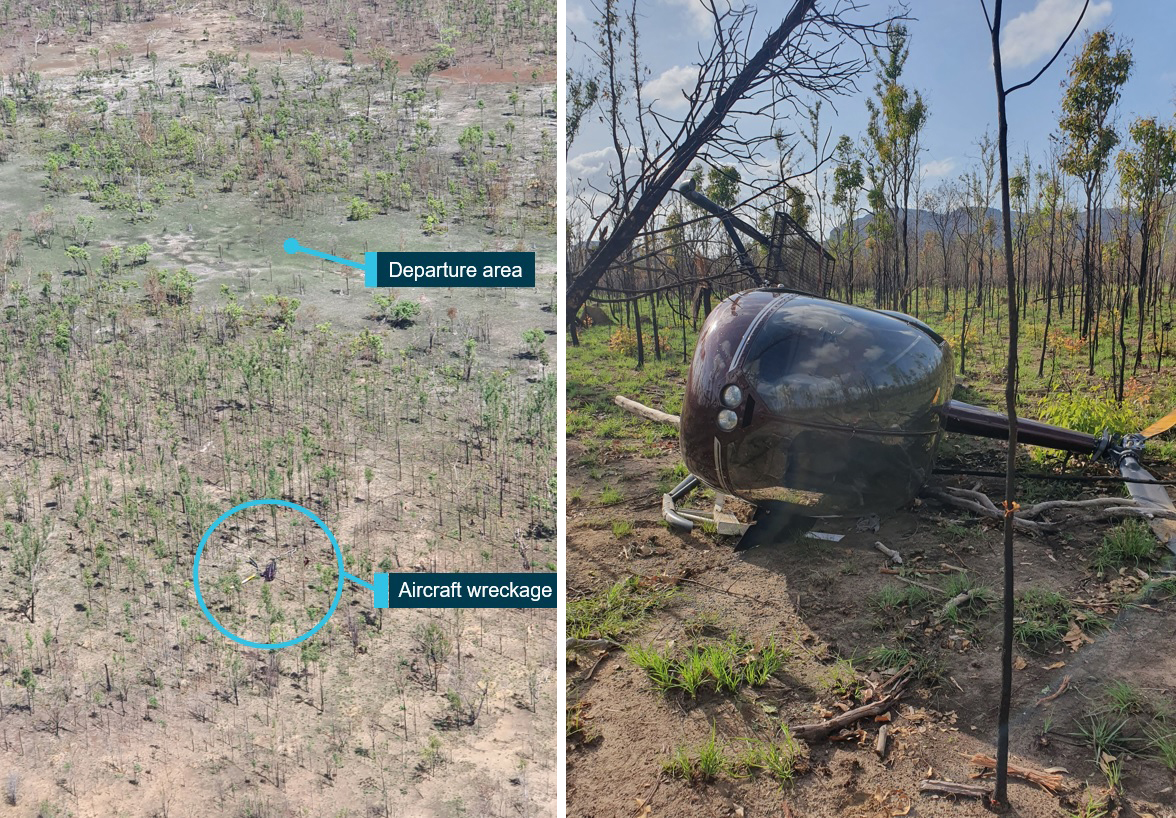
On 8 November 2019, a Robinson R44 helicopter was conducting sling load operations about 10 NM north-east of Jabiru, Northern Territory. On the first lift of the day at approximately 1430 Central Standard Time, the pilot attached a load estimated to be about 120 kilograms to the helicopter by a 30-foot sling. In the prevailing windless conditions, the pilot lifted into a high hover, began to lift the load off the ground, and continued to climb until the load was clear of the surrounding trees. Once established in the hover, at approximately 80-100 feet AGL, the pilot observed all the engine gauges to be in the normal range and the helicopter appeared to be operating normally.
As the pilot commenced the translation into forward flight over a treed area, the rotor RPM began to decay and the low rotor RPM warning horn sounded. The pilot unsuccessfully attempted to regain rotor RPM by lowering the collective[1] and increasing the throttle. In an attempt to alleviate the situation by reducing the weight on the helicopter, the pilot released the slung load. This action did not assist with the recovery of rotor RPM and the aircraft continued to descend into the trees before colliding with the ground.
Figure 1: Area of operations and wreckage
Source: Operator
Operator’s investigation
The operator has conducted an investigation into the circumstances surrounding this accident.
The investigation revealed that in the hot and humid operating conditions, a contributing factor to the accident was the pilot over-pitching during the sling load operation. The over-pitching was to such a degree that it made successful recovery in the circumstances unlikely. The operator’s investigation also stated the pilot’s decision to depart the pick-up location over a treed area when clearer areas were available also restricted the options available once the helicopter started to descend.
Over-pitching
The International Civil Aviation Organization (ICAO) manual of aircraft accident and incident investigation, chapter 15: Helicopter investigation, described over-pitching as a phenomena that happens when collective pitch is increased to a point where the main rotor blade angle of attack creates so much drag that all available engine power cannot maintain or restore normal operation rotor speed. At low rotor speed, the rotor blades bend upwards and drag increases. The high inflow angles and rotor drag quickly decay main rotor speed, which may decrease to the point where the main rotor blades stall.
Hover performance
Hover performance is essentially a product of engine power available and engine power required. The main factors affecting engine power required in a hover are helicopter weight, density of air and proximity to the ground (ground effect).
To maintain a steady high hover, lift a sling load or climb, the helicopter requires more main rotor thrust to act as lift, which in turn requires more engine power.
As air density decreases with an increase in altitude, temperature, and to a lesser degree humidity a normally aspirated engine produces less power. Additionally, if the same amount of rotor thrust is needed, the rotor blades need a higher angle of attack, which creates more drag and generates a requirement for more engine power.
When a helicopter is hovering within about one rotor diameter[2] of the ground, the performance of the main rotor is affected by ground effect. A helicopter hovering in-ground-effect requires less engine power to hover than a helicopter hovering out-of-ground-effect.
Safety action
As a result of this occurrence, the operator has advised the ATSB that they are taking the following safety actions:
The operator will produce a report for all company pilots to fully explain the circumstances surrounding this accident to further educate and train pilots of the considerations when undertaking similar operations. To increase the safety of company operations, this further training will concentrate on decision-making, helicopter performance and weather effects, over pitching and using available terrain features when approaching and departing from unprepared landing sites.
Safety message
This accident serves as a reminder that when operating helicopters from unprepared landing sites, pilots should consider the approach and departure routes available in conjunction with operational constraints, weather (particularly wind), performance available and possible emergency recovery. Time spent considering and confirming the fundamental factors of decision-making, helicopter performance and limitations and the consideration of actions in an emergency may help prevent injury to crew and damage to, or loss of, an aircraft.
About this report
Decisions regarding whether to conduct an investigation, and the scope of an investigation, are based on many factors, including the level of safety benefit likely to be obtained from an investigation. For this occurrence, no investigation has been conducted and the ATSB did not verify the accuracy of the information. A brief description has been written using information supplied in the notification and any follow-up information in order to produce a short summary report, and allow for greater industry awareness of potential safety issues and possible safety actions.
Occurrence Briefs are concise reports that detail the facts surrounding a transport safety occurrence, as received in the initial notification and any follow-up enquiries. They provide an opportunity to share safety messages in the absence of an investigation.
What happened
On 22 September at about 0700 Eastern Standard Time, a Kavanagh E-240 balloon was operating a charter flight over Melbourne, Victoria with a pilot and 10 passengers on board.
While landing at a reserve, the pilot deployed the handling line to ground crew. The pilot then determined that the balloon was unable to land in the available space and instructed the ground crew to let go of the handling line in order to manoeuvre to a different landing site.
The balloon continued the descent and the basket subsequently made contact with the roof of a house. The balloon then landed in the original landing site with the assistance of the ground crew utilising the handling line, which was still attached to the basket. The pilot and passengers were uninjured.
Pilot comments
The pilot stated that the main contributing factor to the occurrence was the use of the handling line in an attempt to guide the balloon into the landing site. Although this is common practice, during this particular landing the pilot ran out of sufficient space in the landing site.
About this report
Decisions regarding whether to conduct an investigation, and the scope of an investigation, are based on many factors, including the level of safety benefit likely to be obtained from an investigation. For this occurrence, no investigation has been conducted and the ATSB did not verify the accuracy of the information. A brief description has been written using information supplied in the notification and any follow-up information in order to produce a short summary report, and allow for greater industry awareness of potential safety issues and possible safety actions.
Occurrence Briefs are concise reports that detail the facts surrounding a transport safety occurrence, as received in the initial notification and any follow-up enquiries. They provide an opportunity to share safety messages in the absence of an investigation.
What happened
On 12 September 2019, a Robinson R44 II helicopter landed at Parachilna, South Australia to unload passengers after conducting a scenic flight in the Wilpena Pound area. The landing area was a raised disused railway platform that the pilot had used previously as it allowed the tail rotor to be maintained well clear of any possible obstacles.
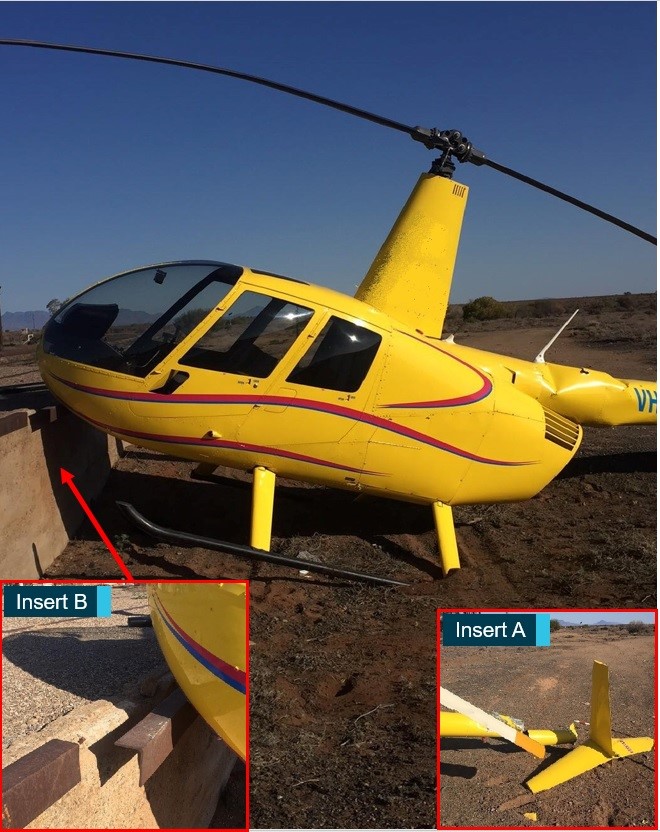
At approximately 1540 Central Standard Time, after the passengers were unloaded and had moved away from the helicopter, the pilot commenced the lift into the hover. As the helicopter became light on the skids, the helicopter‘s nose pitched up and it began to roll to the left. The tail rotor impacted the ground and the main rotor struck the tail boom (Figure 1 Insert A).
After securing the helicopter, the pilot determined that a section of steel on the edge of the platform had dislodged and caught on the rear of the left hand skid (Figure 1 Insert B). This resulted in the unanticipated pitch and roll during the take-off sequence.
Figure 1: Accident site showing aircraft and platform
Source: Aircraft operator
Safety action
As a result of this occurrence, the aircraft operator advised the ATSB that they ceased operations to the landing site. The operator advised that operations may recommence in the location after the necessary maintenance has been completed on the platform and a site inspection is carried out to confirm the suitability and safety for future operations. They will also ensure that periodic inspections are performed at any helicopter landing sites to ensure ongoing safe operations.
Safety message
The assessment of suitability and safety of helicopter landing sites does not end after the initial reconnaissance or even after operating from the site for a period of time. Pilots must be aware of all potential hazards to operations, particularly in the critical phases of flight such as lifting to the hover, taxiing and commencing take-off.
About this report
Decisions regarding whether to conduct an investigation, and the scope of an investigation, are based on many factors, including the level of safety benefit likely to be obtained from an investigation. For this occurrence, no investigation has been conducted and the ATSB did not verify the accuracy of the information. A brief description has been written using information supplied in the notification and any follow-up information in order to produce a short summary report, and allow for greater industry awareness of potential safety issues and possible safety actions.