Collision with terrain

Collision with a fence involving a Cessna 150M, Lismore Airport, New South Wales, on 11 June 2019

Brief

Occurrence Briefs are concise reports that detail the facts surrounding a transport safety occurrence, as received in the initial notification and any follow-up enquiries. They provide an opportunity to share safety messages in the absence of an investigation.

What happened

On 11 June 2019, a Cessna 150M departed Lismore, New South Wales to conduct a training flight. There was an instructor and a student on board.

The student was conducting a practice glide approach to runway 15 at Lismore when the aircraft’s approach profile became too low. The instructor took over control of the aircraft to correct the profile, however, was unable to do so in time resulting in the wheel spat colliding with the airport’s perimeter fence. The aircraft sustained minor damage.

Safety message

During training flights, instructors need to be vigilant and prepared to take over control of the aircraft at short notice. When conducting practice glide approaches, correct speed and approach profile need to be maintained, as power is not used. If the approach is too low and intervention is delayed, there is an increased risk of the aircraft colliding with obstacles.

About this report

Decisions regarding whether to conduct an investigation, and the scope of an investigation, are based on many factors, including the level of safety benefit likely to be obtained from an investigation. For this occurrence, no investigation has been conducted and the ATSB did not verify the accuracy of the information. A brief description has been written using information supplied in the notification and any follow-up information in order to produce a short summary report, and allow for greater industry awareness of potential safety issues and possible safety actions.

Occurrence summary

Mode of transport Aviation
Occurrence ID AB-2019-022
Occurrence date 11/06/2019
Location Lismore Airport
State New South Wales
Occurrence class Serious Incident
Aviation occurrence category Collision with terrain
Highest injury level None
Brief release date 31/07/2019

Aircraft details

Manufacturer Cessna Aircraft Company
Model 150M
Sector Piston
Operation type Flying Training
Departure point Lismore, New South Wales
Damage Minor

Collision with terrain involving Ayres Corporation S2R, 5 km north of Dalby, Queensland, on 21 December 2018

Brief

Occurrence Briefs are concise reports that detail the facts surrounding a transport safety occurrence, as received in the initial notification and any follow-up enquiries. They provide an opportunity to share safety messages in the absence of an investigation.

What happened

On 21 December 2018, the pilot, and sole occupant of the Ayres Corporation S2R departed Dalby, Queensland to conduct aerial agriculture spraying.

During initial climb, at about 200 ft above ground level, the aircraft did not respond to control inputs to climb further. The pilot turned right to avoid hitting obstructions but found the aircraft was not performing in the way he expected. The pilot attempted to climb by increasing the throttle to maximum and lowering the nose of the aircraft to increase airspeed, but the aircraft was unable to maintain height.

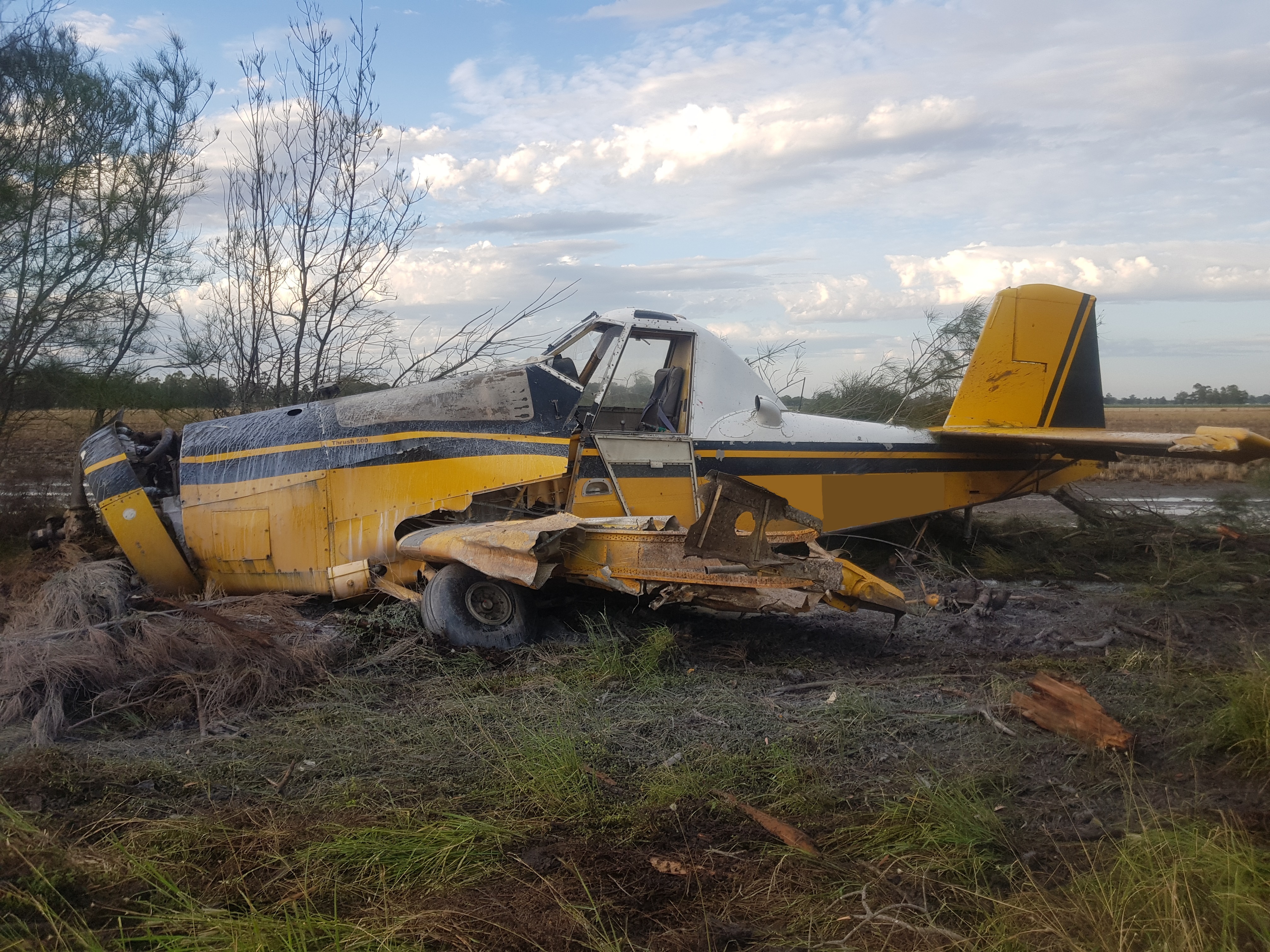
As the aircraft’s airspeed decreased, the pilot experienced wallowing[1]. The pilot attempted to drop the chemical load to lighten the aircraft’s weight, but the aircraft did not respond. The pilot then lowered the nose of the aircraft to conduct a forced landing. The aircraft entered a stall and subsequently impacted a row of trees resulting in substantial damage and minor injuries to the pilot.

Figure 1: Ayres Corporation S2R post-accident

Figure 1: Ayres Corporation S2R post accident. Source: Chief Pilot

Source: Chief Pilot

Safety message

This accident highlights the importance of monitoring and checking instruments during flight, to ensure aircraft speed and performance is maintained. As aircraft speed reduces and approaches Vmca[2], low speed controllability of the aircraft becomes very difficult. Pilots and operators are also reminded of the need to ensure that the aircraft’s weight is within limits and maximum take-off weight to ensure the on-going safety of the aircraft and operations.

The pilot involved in this accident was required to make important decisions in a short period of time, including where to land and how to manage the remaining altitude. Pre-flight self-briefing is an important tool in reinforcing planned emergency actions.

About this report

Decisions regarding whether to conduct an investigation, and the scope of an investigation, are based on many factors, including the level of safety benefit likely to be obtained from an investigation. For this occurrence, no investigation has been conducted and the ATSB did not verify the accuracy of the information. A brief description has been written using information supplied in the notification and any follow-up information in order to produce a short summary report, and allow for greater industry awareness of potential safety issues and possible safety actions.

__________

  1. Wallowing - Uncommanded motion about all three axes of an aircraft occurring simultaneously.
  2. Vmca - Minimum control speed in the take-off configuration minimum control speed.

Occurrence summary

Mode of transport Aviation
Occurrence ID AB-2018-132
Occurrence date 21/12/2018
Location 5 km north of Dalby
State Queensland
Occurrence class Accident
Aviation occurrence category Collision with terrain
Highest injury level Minor
Brief release date 19/02/2019

Aircraft details

Manufacturer Ayres Corporation
Model S2R
Sector Piston
Operation type Aerial Work
Departure point Dalby, Queensland
Damage Substantial

Collision with vessel involving a remotely piloted aircraft, at Fort Hill Wharf, Darwin, Northern Territory, on 8 September 2018

Brief

Occurrence Briefs are concise reports that detail the facts surrounding a transport safety occurrence, as received in the initial notification and any follow-up enquiries. They provide an opportunity to share safety messages in the absence of an investigation.

What happened

On 8 September 2018, at 0700 Central Standard Time, a Da-Jiang Innovations (DJI) Inspire 2 remotely piloted aircraft (RPA) was conducting a test flight above Fort Hill Wharf, Northern Territory.

During the test flight, the operator flew the RPA near a cruise ship. The RPA lost signal and the operator initiated the return-to-home procedure. During this procedure, at a height of 120 feet above ground level, the RPA deviated from the return-to-home path and collided with the ship, resulting in the aircraft being destroyed.

The pilot speculated that the ship caused interference with the datalink signal, resulting in the RPA deviating off course and subsequently colliding with the ship.

Safety message

The ATSB SafetyWatch highlights the broad safety concerns that come out of our investigation findings and from the occurrence data reported to us by industry. One of the ATSB’s SafetyWatch priorities is Safety risk of RPAs.

This incident highlights the importance of ensuring that while operating RPAs, a sufficient distance is maintained from vehicles, ships, buildings and people at all times. The Civil Aviation Safety Authority has published an extensive amount of information on flying drones/remotely piloted aircraft in Australia.

Further information about flying your RPA safely can be found on the ATSB website, under the news item: Know your drone and the rules to fly safely.

About this report

Decisions regarding whether to conduct an investigation, and the scope of an investigation, are based on many factors, including the level of safety benefit likely to be obtained from an investigation. For this occurrence, no investigation has been conducted and the ATSB did not verify the accuracy of the information. A brief description has been written using information supplied in the notification and any follow-up information in order to produce a short summary report, and allow for greater industry awareness of potential safety issues and possible safety actions.

Occurrence summary

Mode of transport Aviation
Occurrence ID AB-2018-109
Occurrence date 08/09/2018
Location Near Darwin, NT (Fort Hill wharf)
State Northern Territory
Occurrence class Accident
Aviation occurrence category Collision with terrain
Highest injury level None
Brief release date 04/01/2019

Aircraft details

Model Da-Jiang Innovations (DJI) Inspire 2 (RPA)
Sector Remotely piloted aircraft
Operation type Aerial Work
Departure point Fort Hill Wharf, near Darwin, NT
Damage Destroyed

Collision with terrain involving Yamaha RMAX RPA, near Muswellbrook, New South Wales, on 20 November 2018

Brief

Occurrence Briefs are concise reports that detail the facts surrounding a transport safety occurrence, as received in the initial notification and any follow-up enquiries. They provide an opportunity to share safety messages in the absence of an investigation.

What happened

On 20 November 2018, a Yamaha RMAX remotely piloted aircraft (RPA) was conducting an air work flight in a paddock near Muswellbrook, New South Wales. A ground support officer and navigator/spotter aided the RPA pilot.

The pilot climbed the RPA to provide ample clearance above trees and put the RPA into a hover. The pilot then moved to position himself better for the area of operation. The pilot unknowingly stepped over an electric fence. He received an electric shock, dropping the controller as a result. In the process of dropping the controller, the throttle moved to full negative. The pilot quickly picked up the controller and increased the throttle. The RPA’s descent reduced as a result but not enough to avoid contacting trees. The RPA subsequently collided with the ground resulting in substantial damage. The pilot and support personnel positioned at a safe distance from the accident were not injured.

Safety action

As a result of this occurrence, the operator has made changes to the way electrical fencing is identified and labelled. Crews will also carry an electric fence testing meter to be used at relevant sites.

Safety message

Electric fences along with other distractions and trip hazards need consideration when operating an RPA. Any operation that requires the operator to reposition themselves while operating an RPA increases the risk of trip hazards.

About this report

Decisions regarding whether to conduct an investigation, and the scope of an investigation, are based on many factors, including the level of safety benefit likely to be obtained from an investigation. For this occurrence, no investigation has been conducted and the ATSB did not verify the accuracy of the information. A brief description has been written using information supplied in the notification and any follow-up information in order to produce a short summary report, and allow for greater industry awareness of potential safety issues and possible safety actions.

Occurrence summary

Mode of transport Aviation
Occurrence ID AB-2018-126
Occurrence date 20/11/2018
Location Near Muswellbrook
State New South Wales
Occurrence class Accident
Aviation occurrence category Collision with terrain
Highest injury level None
Brief release date 21/12/2018

Aircraft details

Manufacturer Yamaha
Model RMAX Type IIG
Sector Remotely piloted aircraft
Operation type Aerial Work
Destination Muswellbrook, NSW
Damage Substantial

Collision with terrain involving Bell 206B, near Norseman, Western Australia, on 8 September 2018

Brief

Occurrence Briefs are concise reports that detail the facts surrounding a transport safety occurrence, as received in the initial notification and any follow-up enquiries. They provide an opportunity to share safety messages in the absence of an investigation.

What happened

On the morning of 8 September 2018, a Bell 206B helicopter departed a caravan park on a private flight with a pilot and three passengers on board. Approximately 30 minutes into the flight, the pilot conducted an orbit around a cleared area intended for landing and completed his landing checks. During late downwind, the pilot reports that the helicopter experienced an uncommanded yaw to the right. To counteract the yaw, the pilot applied left pedal, however the helicopter continued to yaw to the right and subsequently began an uncontrolled descent into trees. As the helicopter entered the trees, the pilot rolled off the throttle and pulled on the collective[1] and the helicopter contacted the ground, resulting in the tail rotor severing. The main rotor also sustained damage from contact with the trees. The pilot and passengers exited the helicopter without injury.

At the time of the accident, the pilot reports that gusty, variable winds were encountered which may have caused a loss of tail rotor effectiveness (LTE),[2] contributing to the accident.

Safety message

There are various factors that can contribute to a loss of tail rotor effectiveness. The NTSB Safety Alert, Loss of Tail Rotor Effectiveness in Helicopters identifies these factors and the subsequent risks associated with LTE.

About this report

Decisions regarding whether to conduct an investigation, and the scope of an investigation, are based on many factors, including the level of safety benefit likely to be obtained from an investigation. For this occurrence, no investigation has been conducted and the ATSB did not verify the accuracy of the information. A brief description has been written using information supplied in the notification and any follow-up information in order to produce a short summary report, and allow for greater industry awareness of potential safety issues and possible safety actions.

__________

  1. Collective: a primary helicopter flight control that simultaneously affects the pitch of all blades of a lifting rotor. Collective input is the main control for vertical velocity.
  2. In helicopters, loss of tail rotor effectiveness (LTE), or unanticipated yaw, is an uncommanded rapid yaw that does not subside on its own accord.

Occurrence summary

Mode of transport Aviation
Occurrence ID AB-2018-108
Occurrence date 08/09/2018
Location 102 km from Norseman Aerodrome
State Western Australia
Occurrence class Accident
Aviation occurrence category Collision with terrain
Highest injury level None
Brief release date 06/11/2018

Aircraft details

Manufacturer Bell Helicopter Co
Model 206B
Sector Helicopter
Operation type Private
Damage Substantial

Collision with terrain involving Robinson R22, near Alice Springs, Northern Territory, on 2 June 2018

Brief

Occurrence Briefs are concise reports that detail the facts surrounding a transport safety occurrence, as received in the initial notification and any follow-up enquiries. They provide an opportunity to share safety messages in the absence of an investigation.

What happened

On 2 June 2018 the pilot and a passenger departed a station west of Alice Springs, Northern Territory, in a Robinson R22 helicopter for a routine property inspection.

At approximately 1215 Central Standard Time, the pilot conducted a landing at a bore site and the passenger exited the helicopter. The pilot then also exited the helicopter with the engine still running. Shortly after exiting and moving away from the helicopter, the pilot heard the engine power up and began to run towards the helicopter. The helicopter then began to move and the pilot stopped moving towards it.

The helicopter was observed to move backwards and the tail rotor dug into the ground, flipping the helicopter onto its side resulting in substantial damage.

Pilot comments

The pilot reported that during maintenance the previous day, the collective was adjusted to loosen the friction. Before exiting the helicopter, the pilot tightened the cyclic, ensured the collective was down, and the friction nut tightened. The pilot suspects that the friction has loosened, causing the collective to rise and the helicopter to power up.

Safety message

Leaving engines running without a pilot in a control seat presents a significant hazard to the helicopter and persons on the ground. The aircraft manufacturer includes a warning against such practice in the aircraft flight manual, Safety Notice SN-17, Never exit helicopter with engine running.

About this report

Decisions regarding whether to conduct an investigation, and the scope of an investigation, are based on many factors, including the level of safety benefit likely to be obtained from an investigation. For this occurrence, no investigation has been conducted and the ATSB did not verify the accuracy of the information. A brief description has been written using information supplied in the notification and any follow-up information in order to produce a short summary report, and allow for greater industry awareness of potential safety issues and possible safety actions.

Occurrence summary

Mode of transport Aviation
Occurrence ID AB-2018-080
Occurrence date 02/06/2018
Location 93 km West of Alice Springs
State Northern Territory
Occurrence class Accident
Aviation occurrence category Collision with terrain
Highest injury level None
Brief release date 05/11/2018

Aircraft details

Manufacturer Robinson Helicopter Co
Model R22
Sector Helicopter
Operation type Aerial Work
Departure point Property west of Alice Springs, NT
Damage Substantial

Collision with terrain involving Robinson R44, Lethbridge, Victoria, on 12 July 2018

Brief

Occurrence Briefs are concise reports that detail the facts surrounding a transport safety occurrence, as received in the initial notification and any follow-up enquiries. They provide an opportunity to share safety messages in the absence of an investigation.

What happened

On 12 Jul 2018, at about 1000 Eastern Standard Time, the pilot of a Robinson R44 helicopter took off with one passenger on board to conduct a few circuits[1] at Lethbridge Airport, Victoria, prior to departing the airport for a private flight.

The pilot conducted two circuits and on the third circuit, set up for an autorotation[2] to demonstrate to the passenger the rate of descent during the manoeuvre. The pilot selected a landing point 1/3 down the runway and established the helicopter at 70 kt, 600 ft above ground level (AGL). The pilot then partially rolled off the throttle to reduce the motor RPM and lowered the collective[3] to enter autorotation. The pilot was explaining the autorotation to the passenger when the low rotor RPM horn and light came on followed by a significant wobble and shake of the helicopter. The pilot checked the rotor RPM and it was about 70 per cent. The pilot initiated recovery by increasing collective and winding the throttle back on. This made little difference and at 300 ft, the pilot pitched the nose of the helicopter forward to increase RPM. Just prior to impact with the ground the pilot flared the helicopter and pulled full collective, however there was little rotor RPM left.

The pilot called for the passenger to brace and the helicopter landed somewhat level. As it skidded forward, the helicopter rolled to the left side and came to a stop. The helicopter was destroyed and the passenger sustained serious injuries.

Figure 1: R44 wreckage at Lethbridge Airport, Victoria 

Figure 1: R44 wreckage at Lethbridge Airport

Source: Owner

Safety message

Practice of emergency recovery techniques such as autorotations should not be conducted with passengers on board. These carry an inherently elevated degree of risk. Additionally, passengers increase a pilot’s workload and can cause distractions. When conducting an autorotation; attitude, airspeed and rotor RPM should be the focus of the pilot’s attention. Practice autorotations are a dynamic manoeuver, increasing the potential to mishandle the helicopter. Two serious conditions associated with a mishandled autorotation are low rotor RPM stall and vortex ring state.

Safety Notice SN-10 on the Robinson Helicopter Company website states that, ‘No matter what causes the low rotor RPM, the pilot must first roll on throttle and lower the collective simultaneously to recover the RPM before investigating the problem.’

Safety Notice SN-24 Low RPM Rotor Stall can be Fatal and Safety Notice SN-22 Vortex Ring State Catches Many Pilots by Surprise, both detail recovery actions that require the collective to be lowered as part of the initial recovery actions.

About this report

Decisions regarding whether to conduct an investigation, and the scope of an investigation, are based on many factors, including the level of safety benefit likely to be obtained from an investigation. For this occurrence, no investigation has been conducted and the ATSB did not verify the accuracy of the information. A brief description has been written using information supplied in the notification and any follow-up information in order to produce a short summary report, and allow for greater industry awareness of potential safety issues and possible safety actions.

__________

  1. Circuit: The circuit is an orderly pattern that involves the pilot making approaches to a landing area, touching down and then applying power to take off again.
  2. Autorotation: Autorotation is a condition of descending flight where, following engine failure or deliberate disengagement, the rotor blades are driven solely by aerodynamic forces resulting from rate of descent airflow through the rotor. The rate of descent is determined mainly by airspeed.
  3. Collective: a primary helicopter flight control that simultaneously affects the pitch of all blades of a lifting rotor. Collective input is the main control for vertical velocity.

Occurrence summary

Mode of transport Aviation
Occurrence ID AB-2018-089
Occurrence date 12/07/2018
Location Lethbridge ALA
State Victoria
Occurrence class Accident
Aviation occurrence category Collision with terrain
Highest injury level Serious
Brief release date 02/11/2018

Aircraft details

Manufacturer Robinson Helicopter Co
Model R44 II
Sector Helicopter
Operation type Private
Departure point Lethbridge Airport, Victoria
Destination Lethbridge Airport, Victoria
Damage Destroyed

Collision with terrain involving Victa Airtourer, near Somerset Dam, Queensland, on 7 July 2018

Brief

Occurrence Briefs are concise reports that detail the facts surrounding a transport safety occurrence, as received in the initial notification and any follow-up enquiries. They provide an opportunity to share safety messages in the absence of an investigation.

What happened

On 7 July 2018 at 0915 Eastern Standard Time, a Victa Airtourer with two crew was on a private flight from Kilcoy, Queensland (Qld) to a private grass airstrip near Somerset Dam, Qld. Weather conditions were reported as cloud at 2,500 ft with a slight crosswind.

During landing, the pilot landed long on the airstrip which was made up of wet grass. The pilot considered conducting a go-around or conducting a controlled ground-loop[1]. The pilot briefly opened the throttle to attempt the go-around, but quickly closed it as the aircraft was reaching the end of the strip.

The aircraft overran the strip and collided with a barbed wire fence. After shutting down the aircraft, both occupants evacuated uninjured.

The aircraft was assessed to have sustained extensive damage including to the left-wing leading edge, right aileron, bent propeller blades and a torn off landing gear and nose wheel.

Contributing factors to the overrun include:

  • wet grass runway
  • minimal wind conditions
  • a long touchdown on the strip
  • opening the throttle late.

Safety message

When conducting flights into unfamiliar locations, pilots should attempt to research the airstrip or field prior to departure. For private or undocumented strips, conducting a pass over the strip first before landing will aid in determining runway length and characteristics.

In some cases, a wet runway may not be evident prior to landing. Utilising the full length of the strip allows pilots extra time to execute recovery manoeuvres (such as conducting a go-around) from compromising situations such as a wet runway, which can limit an aircraft’s braking abilities.

Additionally, pilots should familiarise themselves with their aircraft operating handbook to build confidence on their decision making in time-critical situations.

About this report

Decisions regarding whether to conduct an investigation, and the scope of an investigation, are based on many factors, including the level of safety benefit likely to be obtained from an investigation. For this occurrence, no investigation has been conducted and the ATSB did not verify the accuracy of the information. A brief description has been written using information supplied in the notification and any follow-up information in order to produce a short summary report, and allow for greater industry awareness of potential safety issues and possible safety actions.

__________

  1. A ground loop is an ‘involuntary uncontrolled turn while moving on the ground, especially during take-off or landing’ (Bill Gunston, The Cambridge Aerospace Dictionary, New York, New York; Cambridge University Press, 2004, p.275).

Occurrence summary

Mode of transport Aviation
Occurrence ID AB-2018-088
Occurrence date 07/07/2018
Location Near Somerset Dam
State Queensland
Occurrence class Accident
Aviation occurrence category Collision with terrain
Highest injury level None
Brief release date 23/10/2018

Aircraft details

Manufacturer Victa Ltd
Model Airtourer 115
Sector Piston
Operation type Private
Departure point Kilcoy, Qld
Destination Grass airstrip near Somerset Dam, Qld
Damage Substantial

Collision with terrain involving remotely piloted aircraft, at Hope Downs 4 Mine, Western Australia, on 13 May 2018

Brief

Occurrence Briefs are concise reports that detail the facts surrounding a transport safety occurrence, as received in the initial notification and any follow-up enquiries. They provide an opportunity to share safety messages in the absence of an investigation.

What happened

On 13 May 2018, a remotely piloted Da-Jiang Innovations (DJI) Phantom 4 aircraft was launched from a lookout near Hope Downs 4 Mine, with the pilot and observer intending to conduct an aerial berm[1] inspection within one of the mining pits. At about 0735 Western Standard Time, the aircraft lost power and fell to the pit floor, resulting in the aircraft being destroyed.

During the flight, witnesses observed the battery separate from the body of the aircraft and fall to the ground. An inspection revealed hairline fractures around the catch, which locks the battery in place. The recovered battery was also fractured in this area.

Later, it was determined that a post-flight check had not been completed on the previous flight. In addition, the pre-flight inspection of the aircraft just prior to the accident flight had not included a check of the battery connection and locking mechanism.

Safety action

As a result of this occurrence, the remotely piloted aircraft operator has advised the ATSB that they have taken the following actions:

  • modifying their procedures to include the recording of all maintenance activities to their sub 2 kg remotely piloted aircraft
  • including in their pre-flight checklist that the observer or a secondary person will check the installation of the battery.

In addition, the operator has emphasised the importance of pre and post-flight checks of the aircraft.

Safety message

This accident highlights the importance of pre and post-flight inspection of remotely piloted aircraft. Aircraft manufacturer user manuals, which are generally accessible online, provide specific guidance in relation to each model of aircraft, including information in relation to the correct fitment of the battery. Additionally, the Civil Aviation Safety Authority provides generic guidance in relation to the operation of remotely piloted aircraft and the training requirements of operators on their Flying drones/remotely piloted aircraft in Australia web page.

About this report

Decisions regarding whether to conduct an investigation, and the scope of an investigation, are based on many factors, including the level of safety benefit likely to be obtained from an investigation. For this occurrence, no investigation has been conducted and the ATSB did not verify the accuracy of the information. A brief description has been written using information supplied in the notification and any follow-up information in order to produce a short summary report, and allow for greater industry awareness of potential safety issues and possible safety actions.

__________

  1. Berm is a term used to describe a barrier, such as a wall.

Occurrence summary

Mode of transport Aviation
Occurrence ID AB-2018-070
Occurrence date 13/05/2018
Location Hope Downs 4 Mine
State Western Australia
Occurrence class Accident
Aviation occurrence category Collision with terrain
Highest injury level None
Brief release date 17/10/2018

Aircraft details

Model Da-Jiang Innovations (DJI) - Phantom 4
Sector Remotely piloted aircraft
Operation type Aerial Work
Damage Destroyed

Collision with terrain involving Cessna 340, Lilydale Airport, Victoria, on 24 March 2018

Brief

Occurrence Briefs are concise reports that detail the facts surrounding a transport safety occurrence, as received in the initial notification and any follow-up enquiries. They provide an opportunity to share safety messages in the absence of an investigation.

What happened

On 24 March 2018 the pilot of a Cessna 340 was on a private flight from Bankstown, New South Wales to Lilydale, Victoria. The aircraft was operating under the instrument flight rules (IFR)[1]. The aircraft arrived at Lilydale at 1205 Eastern Daylight-saving Time.

During descent into Lilydale the pilot reported passing through broken cloud and becoming visual with the airfield. The pilot then cancelled IFR and proceeded to overfly the airfield to inspect the runway and windsock. The windsock indicated little wind. There was rain forecast in the area and showers in the vicinity, however there was no rain reported over the airfield at the time of arrival.

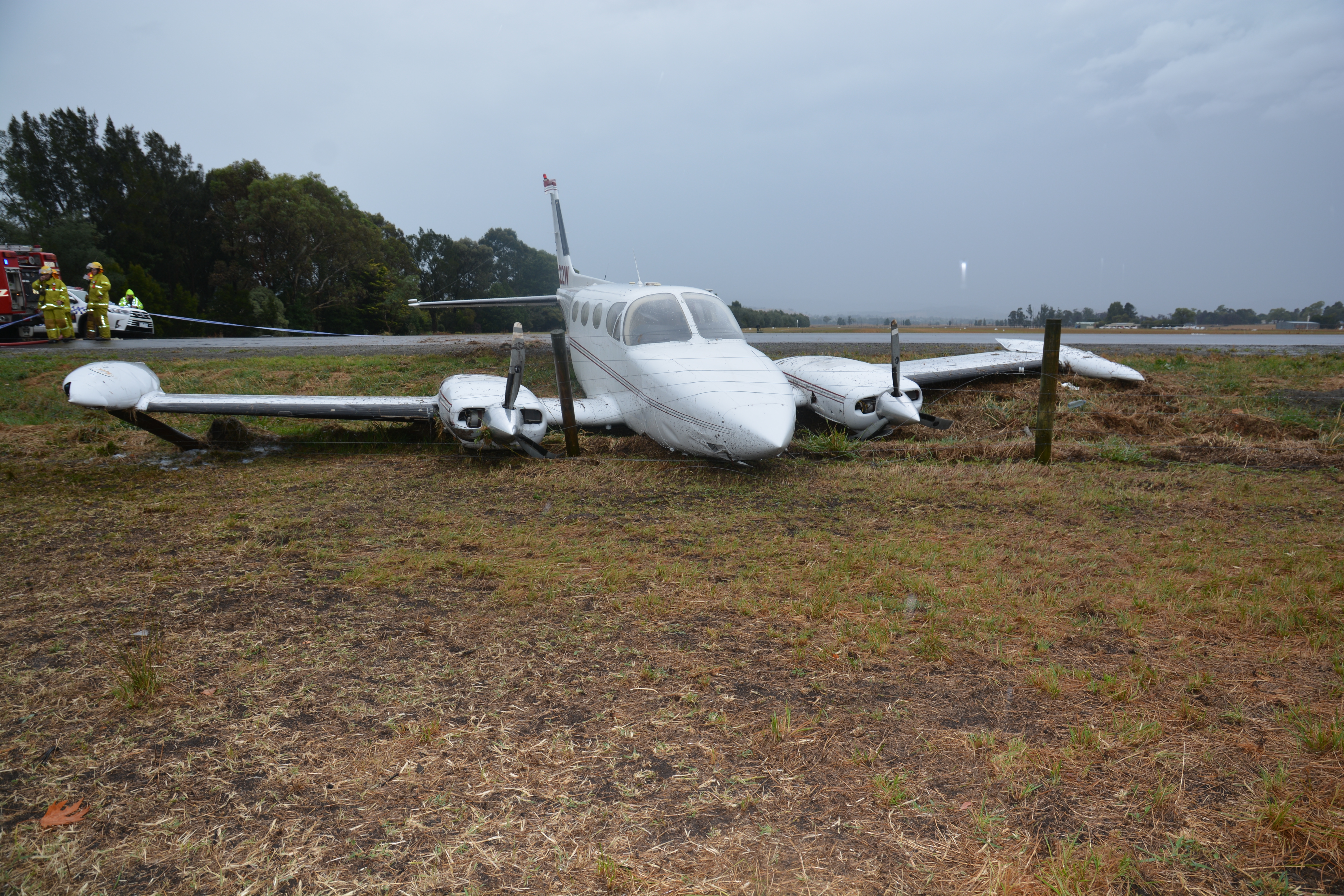
The pilot conducted a normal approach and touched down 250-300 m down the 850 m grass runway. After touchdown, the pilot applied moderate braking force. After realising that the aircraft was not slowing, the pilot applied further braking. The aircraft failed to slow and the pilot confirmed the throttles were at idle and pumped the brakes. The aircraft continued to slide down the runway. As the aircraft approached the end of the runway, the pilot applied full left rudder to turn the aircraft which resulted in a slight veer to the left. The aircraft collided with an embankment at the end of the runway, passed over a road and coming to rest against a fence (Figure 1). The aircraft was substantially damaged, and the pilot was not injured.

Post-flight it was determined that the airfield had received significant rain within around 1 hour before the landing which may have resulted in aquaplaning[2]. The pilot reported that flap was set at 30 degrees for landing, less than the maximum available of 40 degrees. Contributing factors to the overrun include;

  • wet grass runway (with possible standing water)
  • nil wind conditions
  • selection of less than full flap
  • touchdown one third down the runway.

Figure 1: Final resting position of the aircraft 

Figure 1: Final resting position of the aircraft. Source: Victoria Police

Source: Victoria Police

Safety message

Wet runways present a hazard as the braking ability of the aircraft may be limited, particularly if there is standing water. Pilots should familiarise themselves with the pilots operating handbook for their aircraft and make allowances for runway length, size, slope, construction and condition.

__________

  1. Instrument flight rules (IFR): a set of regulations that permit the pilot to operate an aircraft in instrument meteorological conditions (IMC), which have much lower weather minimums than visual flight rules (VFR). Procedures and training are significantly more complex as a pilot must demonstrate competency in IMC conditions while controlling the aircraft solely by reference to instruments. IFR-capable aircraft have greater equipment and maintenance requirements.
  2. Aquaplaning: occurs when a layer of water builds up between the tyres and the runway. This results in loss of traction, preventing effective braking and aircraft control.

Occurrence summary

Mode of transport Aviation
Occurrence ID AB-2018-040
Occurrence date 24/03/2018
Location Lilydale Airport
State Victoria
Occurrence class Accident
Aviation occurrence category Collision with terrain
Highest injury level None
Brief release date 02/08/2018

Aircraft details

Manufacturer Cessna Aircraft Company
Model 340
Sector Piston
Operation type Private
Damage Substantial