The aircraft was operating from an agricultural airstrip 600 ft above mean sea level, spreading superphosphate over moderately steep undulating terrain. The duration of each flight was 6-7 minutes. The accident flight was the seventh and probably intended to be the last for the day.
A witness, who was situated under the flight path, reported that the aircraft was tracking east-north-east in what appeared to be normal flight. Her attention was distracted for a few moments and when she next saw the aircraft it was in a near vertical dive with the upper surface of the wings facing her. The aircraft then struck the hillside and burst into flames.
Examination of the wreckage did not reveal any pre-existing defect which may have contributed to the accident. Impact marks on the propeller indicated that the engine was operating at impact.
The superphosphate load remained in the hopper and the emergency dump system actuating lever was in the closed position. Inspection indicated that the dump system was serviceable prior to impact.
Calculations indicated that at the time of the accident the aircraft, although heavily loaded, was operating within the flight manual maximum weight limitation.
A light north-easterly wind was observed at the airstrip. However, at the accident site, which was about 250 ft higher, the wind was a moderate west-north-westerly. Sky conditions were clear with a visibility of 30 km.
The aircraft probably experienced windshear and turbulence as it encountered a quartering tailwind approaching the ridgeline. The result would have been a reduction in climb performance, and it is likely that the pilot attempted to turn the aircraft away from the rising terrain. During the turn it appears that the aircraft stalled and that the pilot was unable to regain control before it struck the ground.
The reason the pilot did not dump the load when the climb performance was reduced could not be determined.
Significant factors
The following factors were determined to have contributed to the accident.
1. Shifting wind conditions conducive to windshear and turbulence were present in the area.
2. The aircraft was climbing at near to maximum allowable weight.
3. Control of the aircraft was lost with insufficient height available to effect a recovery.
Occurrence summary
Investigation number
199403835
Occurrence date
19/12/1994
Location
60 km north-west of Taree (Cooplacurripa Station)
State
New South Wales
Report release date
19/05/1995
Report status
Final
Investigation type
Occurrence Investigation
Investigation status
Completed
Mode of transport
Aviation
Aviation occurrence category
Loss of control
Occurrence class
Accident
Highest injury level
Fatal
Aircraft details
Manufacturer
De Havilland Canada/De Havilland Aircraft of Canada
The pilot received an endorsement on the MU2 after completing 3.4 hours on the aircraft type with the operator's check-and-training pilot. The operator's policy was that before being cleared to operate as pilot in command on company MU2 aircraft, pilots were required to accumulate 150 hours in command under supervision (ICUS) on the aircraft type. Company records indicated the pilot had completed this flying.
On the evening of 19 December 1994 the company check-and-training pilot gave the pilot a 45-minute check flight. Following this flight the pilot went on a final route check flight with a senior company training captain, from Bankstown to Melbourne and back to Sydney. These three flights were all conducted in VH-IAM. No instrument landing system (ILS) approaches were undertaken on these flights. After the return to Sydney the pilot was assessed as suitable to act as pilot in command on company MU2 aircraft.
Early on the morning of 20 December 1994 the pilot flew VH-IAM from Sydney to Melbourne International airport on his first company flight as pilot in command. On the approach into Melbourne there were three octas of cloud at 600 ft, three octas at 1,000 ft and an ILS approach was required. After landing at 0410 ESuT he rested at a nearby motel. Following this rest period, the pilot spent the afternoon with a fellow pilot. The only problem he mentioned with VH-IAM was that it did not have a serviceable distance measuring equipment (DME) unit.
Early in the evening of 20 December 1994 a flight plan was submitted for an instrument flight rules (IFR) flight to Sydney, departing Melbourne at 1930, and from Sydney to Melbourne, departing Sydney at 2230. The aircraft did not depart Melbourne until 2215. The ILS for runway 34 left at Sydney was out of service. Due to cloud at 800 feet a runway 34 left VOR/DME approach was flown.
The runway 34 left VOR/DME approach involves a progressive descent to specific altitudes at specific DME distances, but VH-IAM did not have a serviceable DME. The controller offered to keep the pilot advised of the aircraft's distance by radar to facilitate the approach. This offer was accepted. During the approach, the aircraft was noted on radar to descend to 1,000 ft when it should still have been at 1,900 ft. The pilot was advised, and the aircraft was noted to climb back to 1,500 ft, still below the required 1,900 ft. The aircraft landed without any further problems.
The aircraft departed Sydney for Melbourne International airport at 0130 on 21 December 1994. En-route cruise was conducted at flight level 140. Melbourne Automatic Terminal Information Service (ATIS) indicated a cloud base of 200 feet for the aircraft's arrival and runway 27 with ILS approaches, was in use. Air Traffic Control advised the pilot of VH-UZB, another company MU2 that was also en-route from Sydney to Melbourne, and the pilot of VH-IAM while approaching the Melbourne area, that the cloud base was at the ILS minimum and that the previous two aircraft landed off their approaches.
VH-UZB was slightly ahead of VH-IAM and made a 27 ILS approach and landed. In response to an inquiry from the Tower controller the pilot of VH-UZB then advised that the visibility below the cloud base was 'not too bad'. This information was relayed by the Tower controller to the pilot of VH-IAM, who was also making a 27 ILS approach about five minutes after VH-UZB. The pilot acknowledged receipt of the information and was given a landing clearance at 0322. At 0324 the Approach controller contacted the Tower controller, who had been communicating with the aircraft on a different frequency and advised that the aircraft had faded from his radar screen.
Transmissions to VH-IAM remained unanswered and search-and-rescue procedures commenced. Nothing could be seen of the aircraft from the tower. A ground search was commenced but was hampered by the darkness and reduced visibility. The terrain to the east of runway 27 threshold, in Gellibrand Hill Park, was rough, undulating and timbered. At 0407 the wreckage was found by a police officer. Due to the darkness and poor visibility, the policeman could not accurately establish his position.It took approximately another 15-20 minutes before a fire vehicle could reach the scene of the burning aircraft. The fire was then extinguished.
Wreckage examination
The aircraft had struck the ground on a descent path of about three degrees while banked about five degrees to the left. The ground impact position was about 150-200 metres to the right of the centreline for the 27 ILS approach. The track of the aircraft at the time of the accident was about 245 degrees. Examination of the badly fire-damaged wreckage did not produce evidence of any significant defects. At the time of ground contact the landing gear was extended and the flaps were in the 20-degree position.
The tuning units for the VHF radios and navigation receivers were badly fire damaged. However, it was established that the cockpit selector for the number one VHF navigation receiver was tuned to 109.3 MHz, the frequency for the runway 27 ILS and the number two VHF navigation receiver to 114.1 MHz, the frequency for Melbourne VOR. One glidepath receiver was fitted and although some impact damage was sustained in the accident, no evidence of any pre-existing defect was identified. Examination of the altimeters established that the pilot's was correctly adjusted to a QNH setting of 1008 hectopascals and the co-pilot's was set to 1013 hectopascals.
Weather data
The amended terminal area forecast for Melbourne, issued at 1929, included a prediction of 7 octas of stratus cloud, base 500 ft. The 0100 aerodrome weather report for Melbourne included an observation of 2 octas of stratus at 500 ft and 3 octas of stratus at 1,000 ft. The ATIS current at the time of arrival of VH-IAM, was runway 27, damp, wind light and variable, QNH 1008, temperature 17, 7 octas cloud, base 200 ft, drizzle, expect ILS approach. Flight conditions for the ILS approach were smooth. The Bureau of Meteorology estimated that the low stratus cloud layer extended up to an altitude of 4,500 ft.
ILS approach procedure
The published chart for this procedure showed that the approach commenced at an altitude of 3,000 ft at the Epping locator beacon which was 8.5 NM east of the runway threshold. The specified track was 263 degrees magnetic, and the glideslope angle was 3 degrees.The outer marker beacon was at 3.8 NM from the runway threshold and the middle marker was 0.6 NM from the runway threshold. The pilot was required to keep the aircraft within two dots of the on glidepath and on track ILS indications to remain within specified tolerances. If the aircraft was on the glidepath at the outer marker the altitude would have been 1,645 ft.
As the aircraft gets closer to the runway the ILS localiser and glide path beams become progressively narrower, requiring increased flying accuracy to remain within limits. The minimum altitude for the approach was 610 ft and this altitude should have been reached at about the position of the middle marker. Provided that the high intensity runway and approach lights were on, the required flight visibility to continue the approach was 800 metres. If this minimum visibility did not exist, a missed approach was required. The missed approach procedure was to maintain a track of 263 degrees magnetic and climb to 4,000 ft.
The ILS chart also provides a table of DME distances against altitudes. This allows pilots to make progressive checks of altitude, independent of the ILS cockpit needle indications, to monitor the progress of the ILS. However, DME is not mandatory for the approach which can be satisfactorily completed by reference to the needle indications and by making altitude checks at the locator beacon, the outer marker and middle marker beacons. The elevation of the runway 27 threshold was 407 ft.
Radar data
A readout of the air traffic control radar data tape for the approach indicated that tracking, altitude, and speed anomalies had occurred during the approach.
Tracking
At 3 NM from the runway threshold the aircraft was about 440 metres left of the runway centreline. A heading alteration to the right of about 30-40 degrees was made and the aircraft passed through the centreline and went about 250-300 metres to the right. At the time of ground impact, the aircraft heading had again been altered, and the aircraft was closing on the centreline from the right.
Altitude
The aircraft had passed slightly north of the Epping locator beacon, which marks the start of the ILS final approach, at an altitude of about 2,800-2,900 ft. This altitude was maintained until 2 NM past Epping, when the aircraft was about 200 ft above the glidepath. The descent was then started and continued with the aircraft descending through the glideslope at about 5 NM from touchdown. The descent continued with displacement below the glidepath increasing. Between approximately 2 NM and 1.5 NM from touchdown the descent temporarily stopped at about the minimum altitude for the approach. (This minimum altitude was 610 ft but the radar data only reads out in increments of 100 ft.)At this stage the aircraft was about 400-450 ft below the glidepath. Descent then recommenced, probably at an increased rate. The last altitude recorded was at approximately 400 ft in the vicinity of the accident site.
Speed
Radar data records calculations of ground speed.From 10 NM into 6 NM the speed was about 145-150 knots. It then increased and at 5 NM peaked at about 170 knots. The speed then decreased to about 120 knots at 2.5 NM. It briefly increased to about 138 knots at 2 NM then decreased to 120 knots at the accident area. During the ILS approach the wind at 3,500 ft was estimated to be a south-easterly at 20 knots. This varied moderately to be a southerly at 7 knots at 1,000 ft. This indicated that the winds were mainly from abeam and that most of the ground speed fluctuations were probably associated with pilot handling.
Pilot/aircraft handling information
The pilot's logbook was not located after the accident. Most of his experience was on twin piston-engine aircraft such as the Cessna 310 and the Piper PA 31. He also had some time on Nomad aircraft. His last instrument rating renewal was carried out on a Cessna 310 aircraft. The renewal for conduct of an ILS or VOR approach was not covered on that flight but was completed separately in a synthetic trainer.
Advice on the aircraft handling characteristics was obtained from a pilot who was very experienced on the type. He indicated the MU2 was a faster, more difficult type to fly in comparison to general aviation twin piston-engine aircraft on which the accident pilot had gained most of his experience.After inspecting the radar readout data, he said that VH-IAM was never stabilised on the ILS approach.
The MU2 is an aerodynamically clean and pressurised aircraft. This means that unlike piston engine types the pilot had flown, there would not have been the audible changes in wind noise associated with airspeed changes which provide clues to the changing situation. The experienced pilot consulted during the investigation indicated that with changes in airspeed and/or engine power it is very easy for the MU2 to quickly develop a rate of descent. This can only be detected by close monitoring of the cockpit instruments.
Medical/Fatigue
There was no medical evidence of any condition that might have contributed to the accident.
Specialist advice provided to the investigation indicated that persons involved in night shift work experience circadian disruption. This is because of the disruption of normal sleep and the quality of sleep gained. The main factor known to regulate the sleep/wake cycle is core body temperature. The best quality of sleep is gained when the core body temperature is at its lowest point, which usually happens between 0200 and 0600. As body temperature increases during the day, sleep quality and duration decreases.
Research shows that even where people are exposed to long periods of night shift the human circadian rhythm does not adjust. However, if the individual forms a routine of night shift that is consistent, they can partially compensate. Techniques to assist include the use of heavy drapes and air conditioning and buffering of outside noise.
The pilot was on the second night of night operations. Flying at night is a normal situation for pilots engaged in these type of freight operations. The pilot spent the afternoon before the accident with a pilot friend who had also flown the night before. The friend understood the pilot had slept through to 1300 after the previous night of flying and did not feel fatigued.
ANALYSIS
Because of the specialist advice that the effect of changing to night operations inevitably affects the quality of sleep achieved, it is likely that some fatigue effect existed.
No evidence was found to suggest any aircraft malfunction existed or contributed to the accident.
The cloud base being at the approach minimum altitude would have required the pilot to fly the aircraft to the minima in cloud, at night. Even so, the smooth conditions in the cloud should have made the flying task relatively easy. The knowledge that other aircraft had landed off an ILS approach may have given the pilot an expectation that he should also be able to land.
The evidence indicated that the pilot flew an erratic and unstable approach, in terms of airspeed, track, and glidepath maintenance. The safe operation of the aircraft on the approach required keeping it within specified limits for tracking and glidepath and not going below the permitted minimum. This was not done. The reason for descent below the glideslope and the minimum altitude at a late stage of the approach was not determined but was very likely unintentional.
The MU2 is a faster and more demanding type to fly compared to general aviation piston engine twin-engined aircraft on which the pilot had gained most of his experience. Anecdotal evidence suggests that to minimise costs, many pilots undertake the flight segment of their instrument rating renewal in relatively low-performance aircraft and complete the balance in a synthetic trainer. Therefore, a pilot may be endorsed and operate a high-performance aircraft in IMC yet not have practised instrument flying in that type of aircraft.
Civil Aviation Regulations 5.81 and 5.108 require non-instrument rated private and commercial pilots to undertake Biennial Flight Reviews. The Biennial Flight Review must be conducted in an aircraft type in which the pilot flew the greatest number of hours as pilot in command during the 10 flights before the review.
The Bureau believes that a similar criterion should apply to instrument-rated pilots. It would be appropriate for flight segments of instrument rating renewals to be conducted on a complex, high-performance aircraft, representative of the types that the pilot wishes to operate.
Considering the length of the pilot's ICUS training on the MU2, the approach into Sydney and the accident approach indicated a deficiency with his instrument flying skills. The company training system had not detected this situation, but the specific reasons for this were not determined.
SIGNIFICANT FACTORS
The company's training system did not detect deficiencies in the pilot's instrument flying skills.
The cloud base was low at the time of the accident and dark night conditions prevailed.
The pilot persisted with an unstabilised approach.
The pilot descended, probably inadvertently, below the approach minimum altitude.
The pilot may have been suffering from fatigue.
SAFETY ACTION
As a result of the investigation, the Bureau issued Safety Advisory Notice 960032 to the Civil Aviation Safety Authority on 02 September 1996.
"SAN 960032
"CAO 40.2.1 lays down the requirements when synthetic trainers are used for instrument rating renewals. This allows for the instrument rating renewal to be undertaken on a category B synthetic trainer except for the renewal of one aid which shall be conducted in flight. However, the CAO does not stipulate the type of aircraft that must be used. The renewal therefore can be carried out on a relatively low-performance aircraft.
"The Civil Aviation Safety Authority should note the safety deficiency identified in this report."
The following response was received from the Civil Aviation Safety Authority on 19 November 1996.
"I refer to your Safety Advisory Notice SAN 960032 concerning the accident involving Mitsubishi MU2B-30, VH-IAM during an instrument approach at Essendon, Victoria on 21 December 1994. The following comments are forwarded for your consideration.
"It can only be speculated that the accident occurred due to the pilot's lack of currency on type. The accident could equally have been caused by distraction, fatigue, or the like. It is current CASA policy that the multi-engine command instrument rating is a generic rating for multi-engine aeroplanes. Given that there are several thousand command instrument rating tests undertaken each year there does not appear to be an accident trend to suggest that the associated flight test provisions are deficient.
"The desirability, or otherwise, of reviewing Civil Aviation Order 40.2.1 will be raised as an issue under the Regulatory Framework Review program. The Personnel Licensing Technical Committee will be responsible for this issue. The suggestion to align flight test aircraft requirements with similar provisions that exist for flight reviews has merit and will be referred to this committee.
"We shall keep BASI appraised of the outcomes of this, and other committee deliberations."
The helicopter had been hired to spray noxious weeds on steep, hilly terrain and had sprayed several local properties in the two days prior to the accident.On the day of the accident, the pilot began his preparations at 0410 local time but did not begin spraying until 1030 because of fog in the treatment areas.He then sprayed three sites before arriving at about midday over the property where the accident occurred.
The pilot conducted an aerial inspection before commencing to spray a very steep rocky area at the northern end of the property.He systematically flew about ten short spray runs north of the powerline then crossed to the southern side of the powerline and flew two spray runs over a small paddock. Ground witnesses then observed the helicopter flying north at about 100 ft towards a previously treated area. They became very concerned that it was flying towards the powerline at about the same height as the wires.One witness used hand signals in an attempt to prompt the pilot to climb but the aircraft struck the powerline. It pitched steeply nose-down and began breaking up before impacting the ground, inverted, about 70 m beyond the powerline, then rolled 15 m before coming to rest. There was no fire.
At the time of the accident, the temperature was about 24 degrees Celsius, there was a light breeze but no cloud or turbulence, and visibility was at least 20 km.
The wreckage was subsequently examined by engineers.Evidence was found in the engine compressor and the combustion chamber to confirm that power was still being produced at ground impact.No pre-existing faults were found with the aircraft which may have contributed to the accident.
Wire strike marks on the helicopter showed that it first contacted the powerline with the forward right fuselage at about cabin floor level.Two wires then slid down the chin and snagged on the right spray boom which then separated from the aircraft.The helicopter pitched nose down so severely that the tail boom, along with much of the airframe directly above the engine, was severed by the main rotor blades, one of which detached from the aircraft.
The helicopter carried fuel sufficient for the flight and was within its approved centre of gravity and gross weight limits at the time of the accident.
The pilot was endorsed on the Hughes 396HS helicopter and held an Agricultural Rating Class 2.His total agricultural flying experience was 1079 hours. He had been provided with detailed maps of the treatment areas.
The pilot was seen wearing a crash helmet minutes before the accident, but it came off during the accident sequence. Damage to the seat belt inertia reel housing was consistent with the pilot wearing the full harness at ground impact.
The helicopter was equipped with a survival beacon which did not transmit a distress signal because it had not been either armed or switched on by the pilot.
The powerlines did not carry markers on the wires. Treatment areas were either side of the powerline and not far apart so the pilot should have been aware of the powerline even though it traversed the valley with a span of 478 metres between poles.However, due to poor contrast between the powerline and the terrain, the pilot probably found it difficult to detect the two wires in time to avoid them. It could not be determined if the pilot applied an appropriate method of identifying the position of the wires from the air before he began spraying.
VH-YEA was not fitted with a wire-strike protection system (WSPS).The Hughes 500 may be fitted with a WSPS as an optional extra.A standard helicopter WSPS includes one wire-cutter fitted forward on the roof of the cabin and a second cutter forward on the belly, plus devices to guide the wires into the cutters.VH-YEA was fitted with a Simplex agricultural spray kit which included a belly tank, pressure pump and boom.When fitted, this particular model Simplex tank protruded so far forward that there was not enough available space for a lower wire-cutter to be installed on the fuselage.Other helicopter spray tanks are available which, when installed, allow space for both cutters to be fitted.
Had an approved WSPS been fitted to VH-YEA, the lower cutter would probably have severed both wires and the helicopter may have received minor wire-strike damage.
Significant Factors
The following factors were considered relevant to the development of the accident:
the powerline was probably difficult to detect due to a lack of contrast with the background terrain; and
the helicopter was not fitted with wire-strike protection equipment.
Safety Action
Helicopters are not specifically designed for agricultural work, unlike most modern agricultural aeroplanes which come with re-enforced cabin and wire deflectors/cutters. Helicopters have been adapted for agricultural operations and have approved spray kits or spreaders attached. However, most helicopters used for agricultural operations do not have added crashworthiness built into their cockpits; nor do they have WSPS fitted.
WSPS have been developed and approved for several helicopter types, mostly as a result of low-level military roles. However, rescue operators, fire bombers, medical retrieval helicopters and particularly agricultural helicopters are often in the low-level environment where powerlines exist.
Analysis of Bureau records indicate that, wire-strikes account for about 9% of helicopter accidents in Australia. Since 1984 there have been 73 reported occurrences of wire strikes by helicopters. Of these approximately 50% may have benefited by having an approved WSPS fitted, including 12 occurrences that resulted in fatalities. It is probable that had a WSPS been fitted to this helicopter, the accident would not have occurred.
Recommendation R950120
The Bureau of Air Safety Investigation recommends that the Civil Aviation Authority:
require the fitment of approved wire-strike protection system kits for all helicopters engaged in low flying activities for which a kit exists; and,
that only agricultural spray kits compatible with wire-strike protection systems be approved for fitment to these helicopters.
The glider had been prepared for its first flight of the day and found airworthy. The pilot was considered to be competent and had been trained in all emergency procedures pertaining to winch launches.
Witnesses reported that although the take-off appeared normal, the glider climbed at a steep angle and slow forward speed. At about 200 ft above ground level the winch tow cable failed. The pilot lowered the nose to about the level flight attitude before commencing a turn to the right and releasing the broken tow cable. As he had not lower the nose sufficiently for the glider to gain flying speed, it stalled, entered a spin and impacted the ground.
Winch tow cable are known to break regularly, and glider pilots are trained to cope with this situation. It could not be determined why the pilot failed to apply the correct recovery procedures.
VH-SPP departed Cloncurry on a low level aero-magnetic survey flight at the estimated time of 0730 EST with an endurance of about 7 hours. The aircraft was due to return to Cloncurry by 1230 but failed to arrive. Attempts were made to contact the aircraft throughout the afternoon before it was declared overdue at about 2030. The burnt-out wreckage of the aircraft was found by search aircraft the following morning about 9 km north of the survey area and 30 km south of Cloncurry.
The aircraft had struck the ground in a nose-down, inverted attitude. It bounced from this position and came to rest upright, facing the opposite direction. At impact, the left propeller was in the feathered position and fuel to this engine had been shut off. The right engine was operating normally at impact, with fuel being fed from the centre tank.
The investigation revealed that, apart from a 2-hour flight the previous day, the pilot had no other experience in SPP. It was also revealed that there were two significant differences between the fuel system in SPP and that of other Aero Commander models the pilot had flown. These differences concerned the time taken for the outboard fuel tanks to empty and the orientation of the cockpit fuel selector switches.
The analysis concludes that these differences probably led to mismanagement of the fuel system by the pilot and to failure of the left engine due to fuel starvation, followed a short time later by failure of the right engine, also due to fuel starvation. It is possible that the pilot realised what had happened and was able to restart the right engine but not before the performance of the aircraft had deteriorated to such an extent that control of the aircraft with one engine operating could not be maintained.
1. FACTUAL INFORMATION
1.1 History of the flight
The aircraft was engaged in aero-magnetic survey operations in an area which extended from approximately 40–130 km south of Cloncurry. The task involved flying a series of north-south tie lines spaced 2 km apart at a height above ground of 80 m and a speed of 140 kts. At this speed, each tie line occupied about 20 minutes of flight time. The flight was planned to depart Cloncurry at 0700–0730 EST and was to return by 1230 to prepare data collected during the flight for transfer to the company’s head office.
An employee of the operating company saw the crew (pilot and equipment operator) preparing to depart the motel for the airport at about 0500. No person has been found who saw the crew at the aerodrome or who saw or heard the aircraft depart.
At about 1000, three witnesses at a mining site in the southern section of the survey area saw a twin-engine aircraft at low level heading in a northerly direction. One of these witnesses, about 1.5 hours later, saw what he believed was the same aircraft flying in an easterly direction about 1 km from his position. Between 1000 and 1030, two witnesses at a mine site some 9 km north of the survey area (and about 5 km west of the accident site) heard an aircraft flying in a north-south direction, apparently at low level.
On becoming aware that the aircraft had not returned to Cloncurry by 1230, a company employee at Cloncurry initiated various checks at Cloncurry and other aerodromes in the area, with Brisbane Flight Service, and with the company’s head office later in the afternoon. At about 2030, the employee advised the company chief pilot that the aircraft was overdue. The chief pilot contacted the Civil Aviation Authority Search and Rescue organisation at about 2045, and search-and-rescue action was initiated. The burnt-out wreckage of the aircraft was found early the following morning approximately 9 km north of the survey area.
1.2 Injuries to persons
Crew
Passengers
Other
Total
Fatal
2
–
–
2
Serious
–
–
–
–
Minor
–
–
–
–
None
–
–
–
–
Total
2
–
–
2
1.3 Damage to aircraft
The aircraft was destroyed by impact forces and post-impact fire.
1.4 Other damage
No other damage was reported.
1.5 Personnel information
PilotEquipment operator
Sex
Male
Male
Age
60 years
47 years
Licence category
ATPL
N/A
Medical certificate
Class 1
N/A
Total hours
Approx. 11400
N/A
Total on type
Approx. 710 (see note below)
N/A
Total last 90 days
Approx. 82
N/A
Total last 24 hours
Approx. 2
N/A
Note. As far as could be ascertained, all 710 hours on type were flown in 500 Series Aero Commander aircraft. No record was found of the pilot having flown a 680F model Aero Commander until he flew SPP for about 2 hours on the day before the accident.
Two of the 500 Series aircraft the pilot had flown (VH-KAC and VH-FGS) were 500S models which had been modified by the fitment of long-range (outboard) tanks. Operation of the fuel systems in these aircraft was similar to that in SPP (see 1.17.4).
Pilot’s recent flying experience
Company records showed that, between 7 July and 7 October 1994, the pilot flew approximately 113 hours on overwater low-level survey tasks in a Ted Smith 601-P aircraft.
There was evidence that the pilot next flew on 4 November 1994 when he conducted endorsement training on an Aero Commander 500S aircraft for a pilot from another survey company. According to this pilot, the endorsing pilot said that he was not very practised in asymmetric flight or in asymmetric operations and that he would leave all the flying to the pilot undergoing the endorsement. Notwithstanding this information, the pilot had extensive check-and-training experience in Aero Commander aircraft.
During the flight, aircraft speed was reduced towards VMCA but not to VMCA.
Pilot’s previous 72-hour history
The pilot travelled from Perth to Cloncurry on 7 November arriving at approximately 2100. On the afternoon of 8 November he conducted a survey flight in SPP which was restricted to approximately 2 hours because of problems with the on-board sensor equipment. After dining at about 2000 and retiring to his motel room at about 2200 on 8 November, the pilot, along with the equipment operator, was observed preparing to depart the motel at about 0500 on 9 November. Neither crew member was supplied any breakfast by the motel.
1.6 Aircraft information
1.6.1 Significant particulars
Registration
VH-SPP
Manufacturer
Aero Commander Division
Model
680-F
Serial no.
680F-1128-74
Country of manufacture
USA
Year of manufacture
1961
Engines
2 Avco Lycoming IO-720-BIBD
Propellers
Harzell 3-blade, variable pitch
Certificate of airworthiness
Issued 2 Feb. 1979
Maintenance release
No. 226763 Issued 3 Nov. 1994
Total airframe hours
7,546 (at 3 Nov. 1994)
Maximum take-off weight
3,630 kg
Basic weight (survey configuration)
2,914 kg
No outstanding maintenance requirements were identified concerning the aircraft.
1.6.2 Weight and balance
Basic weight (survey configuration)
2,914 kg
Fuel load
669 kg (956 L, see 1.6.5)
Pilot, equipment operator
172 kg (standard weight 86 kg x 2)
Take-off weight
3,755 kg
Maximum take-off weight
3,630 kg
Exceedance
125 kg or 3.4%
1.6.3 Single-engine rate of climb
The aircraft flight manual lists single-engine rate of climb figures for the aircraft using maximum continuous power on the operating engine, landing gear and flaps up, and the inoperative engine feathered. In this configuration, at an aircraft gross weight of 3,630 kg, a pressure altitude of 2,000 ft and an outside air temperature of 37 degrees C, a rate of climb of 160 ft/min should be achieved at a best climb speed of 102 kts.
1.6.4 Cabin environmental control
The operator advised that cockpit/cabin cooling in the aircraft was via ram air only. The aircraft was not equipped with air-conditioning or blower fans as electrical motors interfered with the survey equipment. Fresh (ram) air was available through the normal aircraft system which included vents in the cockpit. Additional ram air ducts had been installed to provide supplementary outside air to both the cockpit and the survey equipment rack.
1.6.5 Fuel load for the flight
Information from the operator indicated that the aircraft fuel load for the flight was approximately 956 L, including a full centre tank, full outboard tanks, and 90 L useable fuel in the boot tank. This estimate was based on the flight time for the previous day’s flight.
1.6.6 Fuel usage rate
The aircraft flight manual indicated that, at sea level, 24 degrees C, 21 inches MAP, 2,100 RPM and 137 KIAS, the aircraft would have been using 112 L fuel per hour. Fuel consumption at rated power was 256 L/h. According to the operator, based on actual fuel usage, SPP had been using 112 L fuel per hour on low-level survey at 140 KIAS.
1.7 Meteorological information
The following information was recorded at Mt Isa on 9 November 1994:
Time (EST)
Ambient temperature (degrees C)
0600
23
0700
26
0800
29
0900
32
1000
34
1100
34
1200
36
The sky was clear throughout the period and the relative humidity was around 10%. The low-level winds were from the south-east at about 10 kts. There was moderate thermal and mechanical turbulence at low level.
No weather observations were taken at Cloncurry, which is situated approximately 104 km east of Mt Isa. It is likely, however, that weather conditions at Cloncurry were similar to those at Mt Isa.
1.8 Aids to navigation
Not relevant.
1.9 Communications
No record was found of any communications from the aircraft to any Air Traffic Services agency. See also 1.15.2 (‘SAR activities’).
1.10 Flight recorders
The aircraft was not equipped with a flight data recorder or a cockpit voice recorder, nor were these required by regulation.
1.11 Wreckage and impact information
The aircraft struck the eastern slope of a 200-ft high ridge running approximately northsouth. At impact, the aircraft was heading in a westerly direction, was banked left in excess of 120 degrees, and was in a nose-down attitude of about 35 degrees. Initial impact occurred when the left engine and forward fuselage struck embedded rocks, causing severe airframe disruption. The aircraft then bounced up the hill a short distance, coming to rest right way up and pointing east. Most of the aircraft was destroyed by the subsequent fire, although some components, including the engines and propellers, were recovered for later examination.
1.11.1 Left engine
A strip examination of the left engine did not reveal any fault which might have precluded normal operation. Examination of a section of damaged exhaust pipe from the engine confirmed that the damage occurred when the pipe was cold.
1.11.2 Right engine
A strip examination of the right engine did not reveal any fault which might have precluded normal operation. Examination of a section of damaged exhaust pipe from the engine confirmed that the damage occurred when the pipe was hot.
1.11.3 Propellers
Both propellers were dismantled. Inspection confirmed that the left propeller was in the feathered position and the right propeller in or near the fine pitch position. There was no pre-existing fault evident in either propeller mechanism.
1.11.4 Fuel tank selector valves
Inspection of the fuel tank selector valves (see 1.17.2) at the accident site revealed the following:
For the left engine, both the centre and outboard tank selector valves were in the closed position.
For the right engine, the centre tank selector valve was in the open position while the outboard tank selector valve was in the closed position.
1.12 Medical and pathological information
Post-mortem examination was unable to confirm the medical condition of the pilot at the time of the accident. However, the pilot held a current Class 1 medical certificate issued by the CAA.
1.13 Fire
The impact caused the fuel tanks to be disrupted, releasing a substantial quantity of
aviation gasoline. Ignition probably resulted from electrical arcing and/or contact with high-temperature engine components.
1.14 Survival aspects
The accident was not survivable due to both impact forces and fire.
1.15 Search and rescue
1.15.1 Company procedures
The company operations manual stated that all operational flights were to be the subject of prior flight plan notification on the minimum basis of a SARTIME for the end of the last flight of the day. The manual also stated that, when an operation from any temporary base was likely to continue for more than a few days, application might be made to the appropriate airways operations unit for the acceptance of a standard plan to cover daily flying activities.
No flight plan had been submitted for the flight. Another company pilot participating in the survey indicated that no plan was submitted because the operation was only scheduled for a few days and local company SAR was being maintained by the other company personnel at Cloncurry.
1.15.2 SAR activities
No information was held by the CAA concerning the flight prior to the initial telephone call from a company employee at Cloncurry at about 1640. During the progress of this conversation, attempts were made by Brisbane Flight Service to contact SPP through another aircraft in the Cloncurry area. At 1641, the pilot of this aircraft advised Flight Service that he was in contact with SPP. He was asked by Flight Service to request an estimate for when SPP would return to Cloncurry. A short time later, the pilot of the other aircraft advised that he was no longer in contact with SPP. (The pilot later advised that radio communications on the day of the accident were very scratchy.) Flight Service advised the company employee that contact with SPP had been lost, at which stage he terminated the call. At 1826, the company employee again called Brisbane Flight Service, asking if there was any contact with SPP. Flight Service advised that there had been no contact with the aircraft. At 2043, the company chief pilot called Flight Service and advised that SPP was overdue. He was then transferred to SAR, whereupon search action was initiated.
1.16 Human performance aspects
1.16.1 Heat stress
Heat stress, or hyperthermia, occurs when the body’s temperature regulation mechanisms fail. In extreme conditions, heat stress can lead to an inability to control body temperature and result in mental impairment and collapse. Individual responses to heat stress are influenced by factors such as age, lack of sleep, the amount and rate of work being performed, and acclimatisation to environmental conditions.
Heat stress not only causes physiological changes but also results in performance impairment. Even a slight increase in body temperature can impair an individual’s ability to perform complex tasks such as those required to operate an aircraft safely. Some of the known effects of heat stress on individuals are that:
error rate increases;
short-term memory becomes less reliable; and (c) perceptual motor skills slow.
Importantly, the affected individual may not recognise a decrease in efficiency but may feel perfectly normal and able to continue operations.
1.16.2 Time zone change
When the pilot travelled from Perth to Cloncurry two days before the accident, he moved into the Eastern Standard Time zone, which is 2 hours ahead of Western Standard Time. In other words, 0500 EST is equivalent to 0300 WST.
1.16.3 Food and water
The operator advised that two flasks containing 7–8 L water were on board the aircraft for the flight. Food was generally not carried on survey flights. Whether any food was carried on this flight could not be determined but the crew did not request that the motel provide any food for the flight.
1.17 Aircraft fuel systems
Among the various Aero Commander models that have been produced, aircraft fuel systems have differed. Long-range models of the aircraft were fitted with integral wing tanks (called outboard tanks), and in some cases boot tanks in the rear fuselage, in addition to the main, or centre tank. In some aircraft, additional tanks were incorporated during manufacture, while in others, they were fitted as a modification after manufacture.
1.17.1 Fuel system Aero Commander 680F Series aircraft
The Aero Commander 680F fuel system comprises four tanks: the centre tank, the boot tank, and two outboard tanks. The centre tank consists of five interconnected cells having a total capacity of 601 L (592 useable). This tank supplies fuel to both engines. Tank contents are indicated on a cockpit gauge. The boot tank has a capacity of 439 L (419 L useable). Fuel is transferred from this tank to the centre tank by the activation of a switch on the cockpit instrument panel. This is normally conducted in cruise, in stages, when the centre tank level has reduced to 90 US gallons indicated (340 L) or below. The left and right outboard tanks each have a capacity of 127 L (254 L total useable). The contents of these tanks are indicated on gauges in the cockpit. The total fuel capacity of the aircraft is 1,294 L (1,265 useable).
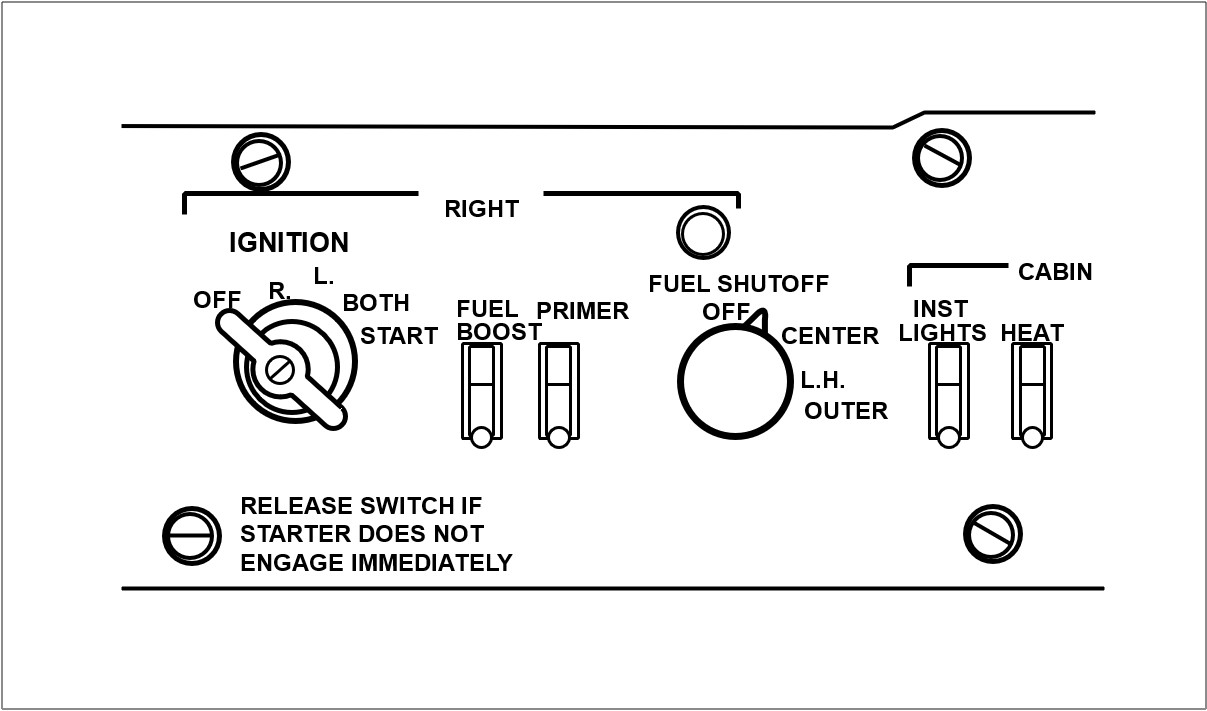
Rotary fuel selector switches located on the cockpit overhead switch panel control the flow of fuel to the engines from either the centre tank or the outboard tanks by way of electrically operated shut-off valves located in each main landing-gear wheel well. Rotating the switches to the right and left OUTBOARD positions (three o’clock and nine o’clock positions respectively) allows fuel from the outboard tanks to flow to the respective engine. At the same time, fuel flow from the centre tank is shut off. Fuel vapour return from the fuel injector pumps is fed to the centre tank.
Switching the selector switches to the CENTRE position (half-past ten o’clock position on the left switch and half-past one o’clock position on the right switch) allows fuel to flow from the centre tank to the respective engine and shuts off flow from the outboard tanks. Selecting the switch to OFF (twelve o’clock position on both switches) closes both shut-off valves and cuts off fuel flow to the engines. A sketch of the right fuel control selector panel is shown below.
The aircraft flight manual, section 4 (‘Normal Procedures’) contained a caution note which stated (emphasis theirs):
CAUTION. Burn centre tank first. When 100 gallons is shown on centre tank gauge, switch to outboard tanks. Do not allow engine to be starved of fuel when outboard tanks run dry. Select centre tank at first indication of fuel pressure loss. Fuel boost pumps must be on when switching tanks.
Anecdotal evidence obtained during the investigation indicated that, should a tank run dry and air enter the fuel lines, up to 2–3 minutes were required to restore normal engine operation following selection to another tank. It was not uncommon for there to be substantial engine power surges during this period.
1.17.2 Fuel selector valves
The centre and outboard tank fuel systems each have their own electrically operated shutoff valve. Electrical power is required to both open and close the valves. Placing the fuel selector switch in the OFF position closes both shut-off valves controlled by that selector.
Control of the valves is lost in the event of a total loss of electrical power in the aircraft.
1.17.3 VH-SPP fuel system and modification
According to the aircraft logbook, in October 1963 the six-cylinder IO-540 engines which were standard fitment for the aircraft were replaced with eight-cylinder Lycoming IO-720 engines. As part of this conversion, bypassed fuel from the engine-driven pump was returned to the pump inlet instead of being fed to the centre tank. The engines were later fitted with turbochargers.
In 1981, apparently to overcome fuel pump cavitation problems, the fuel system was modified to incorporate a pressure relief return line. According to the aircraft logbook, the modification was completed on 25 May 1981 to approved Engineering Order DFS-AC-08. No reference could be found in the (then) CAA Aircraft History File concerning the modification. Further, the approved flight manual for the aircraft contained no flight manual supplement or other reference to the modification However, a copy of the engineering order cover sheet was obtained from the operator. This indicated that the order had been approved by the then Department of Transport on 11 May 1981. The delegate of the Secretary, Department of Transport, who approved the modification, was unable to recall, other than in a very broad sense, the events surrounding approval of the modification. In particular, he was unable to recall what consideration might have been given to including detail of the modification as an approved supplement to the approved flight manual for the aircraft. (The then ANO (now CAO) 100.6 addresses ‘Administration and Procedure – Design Approval of Modifications, Repairs and Replacement Components’. The order indicates, among other things, that the Secretary may require the (approved) flight manual to be amended upon an approved modification being installed in an aircraft.)
The operator advised that the modification fed bypassed fuel to the centre tank. Advice from pilots who had flown SPP was that, during typical low-level survey operations, outboard tank transfer was complete in about 20 minutes. In other words, in excess of 5 L of fuel per minute was bypassed from each outboard tank to the centre tank. These pilots also indicated that the left outboard tank fed at a slightly higher rate than the right outboard tank so that, during typical low-level survey flight, it emptied 3–5 minutes quicker than the right tank.
1.17.4 VH-SPP fuel system management
Information from the operator indicated that its fuel system management procedures, and those probably followed by the pilot of SPP, were as follows:
Start, taxi, and take-off with centre tank selected.
After approximately 1 hour, when centre tank contents indication falls to about 80 US gallons, transfer boot tank fuel to centre tank.
When centre tank contents again indicates about 80 US gallons, select both outboard tanks.
Re-select centre tank as each outboard tank indication approaches empty.
During survey operations, tank changes were only made during turns between line runs because operation of the boost pumps (which was part of the tank change procedure) caused electrical interference in the survey equipment.
1.17.5 VH-SPP briefing
Another company pilot at Cloncurry, who was experienced on SPP, briefed the accident pilot on the operation of the aircraft prior to the 2-hour flight he conducted on 8 November 1994. The briefing was conducted in a motel room. Matters covered included the aircraft fuel system. The briefing pilot indicated that he told the accident pilot that the outboard tanks were normally selected when the centre tank contents were indicating about 80 gallons and that they emptied in 15–20 minutes. He recalled some discussion on the latter point as the accident pilot had thought it would take about 60 minutes for the outboard tanks to empty. (This belief was probably based on his experience in 500S Series Aero Commander aircraft in which outboard tank transfer during low-level survey flight took approximately 60 minutes.) During this discussion, the accident pilot indicated that his habit was to select the left and right outboard tanks so that both were feeding at the same time.
1.17.6 Alternative outboard tank transfer procedure
Discussions with other Aero Commander pilots during the investigation revealed an alternative outboard tank transfer procedure. This involved selecting the outboard tank for one engine and leaving the other engine to continue to receive fuel from the centre tank. When the outboard tank neared empty, the procedure was reversed. The advantage of this procedure was that it ensured centre tank fuel was always available to at least one engine, thus providing a safeguard against failure of the aircraft electrical system (which rendered the fuel selector valves inoperative).
1.17.7 Flight in VH-SPP by pilot on 8 November 1994
The flight in SPP conducted by the pilot on the day before the accident was limited to 2 hours due to survey equipment malfunction. According to the operator, the aircraft fuel load on departure was 844 L, this being a full centre tank (590 L) and full outboard tanks (254 L). The boot tank was empty. Approximately 290 L fuel was used during the flight, all from the centre tank. The outboard tank fuel was reported not to have been used.
1.17.8 Fuel system 500S Models VH-KAC and VH-FGS
500S Model Aero Commander aircraft KAC (Aircraft Serial No. 3185) and FGS (Aircraft Serial No. 3315) were fitted with long-range (outboard) tanks shortly after leaving the factory. According to the relevant documentation, KAC was modified in July 1974 in accordance with STC SA 973SW, and FGS was modified in August 1978 in accordance with STC SA-2826-SW. A check revealed that the STCs were identical except that, in SA-2826-SW, figures 24 and 24.1 (‘Overhead Switch Panel Cover Rework’) contained the following: ‘NOTE: 500 B, U, S, thru s/n 3075 only’.
The modification involved the fitment of outboard wing tanks and associated system work. The capacity of the outboard tanks was 254 L, the same as in SPP. Part of the modification involved the installation of rotary fuel selector switches to the cockpit overhead switch panel.
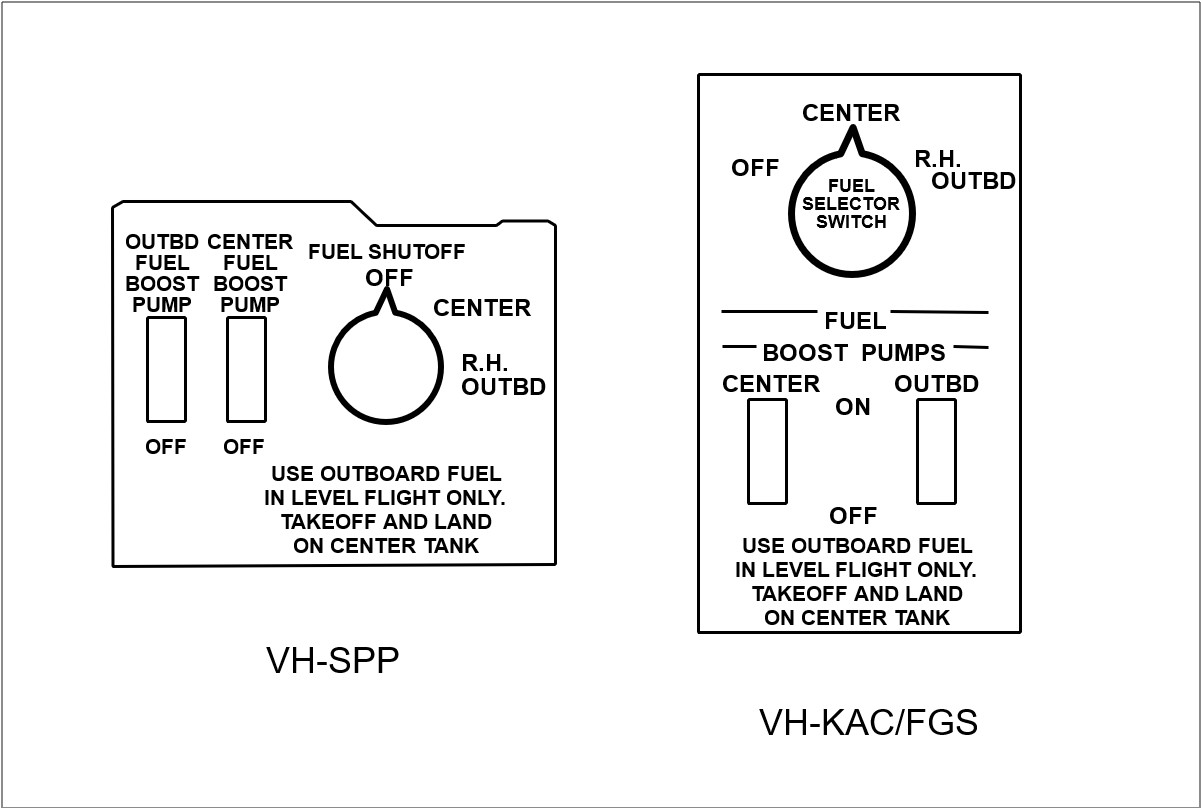
A physical check of the fuel selector panels on KAC and FGS revealed that, in these aircraft, the CENTRE tank selections were at the 12 o’clock position. In turn, this meant that the left and right OFF positions were at half-past one/half-past ten o’clock, while the OUTBOARD positions were at half-past ten/half-past one o’clock. In other words, the orientation of the selector switches was different to that in SPP. The holder for STC SA-2826-SW advised that to maintain the selector switch OFF position at twelve o’clock would have required considerable rework.
A sketch comparison of the fuel control panels for SPP and KAC/FGS is shown below.
1.18 Class endorsement
CAO part 40, section 40.1.0, subsection 4, para. 4.1 states:
A class endorsement specified in Part 1, Part 2 or Part 3 of Appendix IA authorises the holder of the endorsement to fly an aeroplane included in that class as pilot in command.
The notes to this sub-section state:
NOTE 1: The holder of a class endorsement should not act as pilot in command of any aeroplane included in the class on any flight unless he or she is familiar with the systems, the normal and emergency flight manoeuvres and aircraft performance, the flight planning procedures, the weight and balance requirements and the practical application of take-off and landing performance charts of the aeroplane to be flown and has sufficient recent experience or training in the aeroplane type, or in a comparable type, to safely complete the proposed flight.
NOTE 2: The owner and the operator of a type of aeroplane included in a class of aeroplane should ensure that any person who proposes to fly as pilot in command of the aeroplane complies with the requirements set out in Note I and should, where necessary, require the pilot to provide evidence of recent experience or training in the aeroplane type, or in a comparable aeroplane type.
Part 2 of appendix IA (‘Class Endorsements’) includes Aero Commander as a class.
Appendix IB (‘Classes of Aeroplanes’) includes, among other things, Aero Commander 680F and various Aero Commander 500 models (including Aero Commander 500S) in the Aero Commander class.
1.19 Time/event information
The operator provided information concerning pre-flight preparation and in-flight activities, which enabled the following time/event sequence to be developed. This information was based on the experience of other company pilots and was, therefore, an estimate only.
Time
Event
0515
Depart motel
0520
Arrive airport
0630
Survey equipment ground calibration complete
0700
Refuelling complete
0710
Taxi
0720
Airbourne
0745
Survey equipment airborne tests complete
0750
Commence survey
The estimated amount of fuel used from engine start to commencement of survey at 0750 was 160 L.
2. ANALYSIS
2.1 Impact and wreckage information
The factual information obtained from examination of the accident site and the wreckage enabled a number of deductions to be made concerning the accident sequence.
Fire damage to the wreckage indicated that there was substantial fuel on board the aircraft at impact.
The extreme, unusual attitude of the aircraft at impact indicated that the pilot lost control of the aircraft prior to impact. The respective propeller positions and engine operating conditions at impact imply that, with the right engine operating and the left propeller feathered, such an impact attitude could have resulted from the aircraft developing an uncontrollable roll left as a result of aircraft speed reducing below VMCA.
No mechanical fault was identified in the left engine which might have been reason for the left propeller to have been feathered. The closed position of both selector valves implied deliberate movement of the fuel selector in the cockpit to the OFF position.
The right engine was operating at impact and the aircraft performance charts indicated that the aircraft had sufficient single-engine performance at its estimated operating weight to climb from the survey operating height and return to Cloncurry. This leaves the following questions:
Why was the (serviceable) left engine shut down?
Why did the pilot apparently lose control of the aircraft?
2.2 Hypothesis
In the absence of any recorded or witness information, the answers to these questions are necessarily speculative. However, after consideration of the factual evidence, the following hypothesis is considered a plausible explanation of the accident sequence.
Background relevant to the hypothesis centres on the accident flight being only the second time the pilot had flown SPP but the first time he had cause to feed fuel from the outboard tanks. Significant differences between SPP and other Aero Commander aircraft the pilot had flown involved the orientation of cockpit fuel tank selector switches and outboard tank fuel transfer time.
With respect to the fuel selectors, in the 500 Series aircraft the centre tank selection was at the twelve o’clock position. This compared with SPP where the twelve o’clock position was OFF. Fuel transfer from the outboard tanks took approximately 1 hour in the 500 Series aircraft, while it took some 20 minutes in SPP. Also, the left outboard tank emptied 3–5 minutes more quickly than the right outboard tank.
Assuming that the aircraft commenced survey at about 0750 (see 1 .17.2) and had, at that time, used 160 L fuel, the following time/event sequence is hypothesised (based on a fuel usage rate of 112 L/h on survey):
Time
Event
Fuel Situation
0750
Commence survey
160 L used from centre tank
432 L remaining in centre tank
776 L remaining total
(432 + 90 (boot) + 254 (outboard))
Time
Event
Fuel situation
0859
Commence boot tank transfer
Reduce centre tank to 80 US gallons
(303 L) = 129 L used in 69 minutes
0947
Centre tank again at 80 US gallons commence outboard tank transfer
90 L boot tank fuel used in 48 minutes
1007
Outboard tanks empty in approx.
20 minutes
Total fuel remaining = 530 L
If the pilot followed his normal habit of selecting both outboard tanks at about the same time but forgot that the tanks emptied in about 20 minutes in SPP instead of at least 60 minutes as he was accustomed to from his experience in other Aero Commander aircraft, then at about 1007, the left engine would have ceased operating as the tank ran dry. The expected reaction to such an event would be for the pilot to reselect the centre tank and switch the boost pump on. However, in the stress of the moment, he may have regressed to previously learned behaviour and placed the cockpit selector in the twelve o’clock position, forgetting that this was OFF in SPP, even though this involved passing the centre tank detent and greater angular rotation of the knob than from the OUTBOARD to CENTRE position. When normal left engine operation was not restored, it would have been reasonable for the pilot to have increased power on the right engine, feathered the left propeller, and commenced a climb from survey height. Within a short time, however, the right engine would have begun to run roughly as the right outboard tank became empty. The resultant power loss would have caused the aircraft to lose performance rapidly. Now with similar malfunctions in both engines, the pilot might have realised that he had made an incorrect fuel selection for the left engine and positioned the right selector correctly at the centre tank (half-past one o’clock) position. Given that these events would take time and could have resulted in air entering the right engine fuel line, the aircraft could have lost both performance and altitude by the time the fuel supply to the engine was restored. The sudden power increase as fuel flow was restored could have been sufficient to yaw and roll the aircraft uncontrollably to the left and result in the impact attitude found at the accident site.
The location of the wreckage north of the survey area could mean that the aircraft was heading towards Cloncurry at the time of the accident. It could also indicate that the pilot selected outboard tanks prior to commencing a south-north survey run, and that those tanks emptied around the time that run was completed (20 minutes later).
Apart from the possible sighting of the aircraft by one witness at about 1130, there is consistency between the time of the accident deduced above (1002–1007 EST) and the other witness sightings. That the 1130 sighting was a possible sighting could be reason enough to discount this report.
There is a disparity between the deduced time of the accident and the reported radio contact established with SPP by the other aircraft at 1641. However, as the aircraft endurance was only some 7 hours, fuel exhaustion would have occurred before 1500. It would appear, therefore, that, perhaps due to the poor radio conditions existing at the time, the pilot of the other aircraft may have misidentified the transmission from another aircraft as being from SPP. The possibility that SPP had landed at a remote strip for some reason and later taken off again to continue the survey task was considered. However, as the crew were aware of the requirement to return to Cloncurry by 1230, it would be reasonable to expect that they would have contacted the company if this requirement could not be met. No such contact was made.
2.3 Aircraft single-engine climb performance
Assuming the aircraft weight at take-off was 3,735 kg, then 105 kg (153 L) of fuel had to be used before weight reduced to maximum take-off weight (3,630 kg). Given that approximately 160 L fuel was used by 0750 EST when the survey proper was estimated to have begun, it follows that, at any later time, the aircraft should have been able to achieve a single-engine rate of climb of at least 160 ft/min (see 1.6.2).
2.4 Fuel system modification
It is arguable that the fuel system modification to SPP (1.17.3) did warrant inclusion in the approved flight manual because of its effect on outboard tank transfer time, not only with respect to SPP, but also in comparison to other Aero Commander models with similar fuel systems. However, given that the pilot was briefed on the operation of the SPP fuel system the day before the accident (including specific reference to the outboard tank transfer time), it is debatable whether flight manual reference to the fuel system modification could be considered a factor in the accident.
2.5 Fuel system briefing
CAO part 40 places responsibility on the operator and the pilot for ensuring that the pilot is familiar with the aircraft systems. It seems clear that a briefing took place and that the unique features of the SPP fuel system were discussed with the pilot. However, the briefing may have been more effective had it been conducted in the aircraft.
2.6 Human performance
There are a number of human performance aspects which could have affected the pilot’s ability to operate the aircraft safely. These include:
The high ambient temperatures and the non-airconditioned cockpit could have resulted in the pilot experiencing some degree of heat stress. The longer the flight continued, the more serious this would have become.
There was no evidence of the pilot having consumed any food before or during the flight. Thus, the pilot had probably not eaten for up to 14 hours before the accident.
Low-level survey flying is both physically and mentally demanding on the pilot. High temperatures and turbulence increase these demands.
The pilot had been at Cloncurry for less than 40 hours at the time of the accident.He therefore had only limited opportunity to adjust to the local weather conditions and the 2-hour time change from Perth.
The pilot’s ability to cope with the above influences could have been limited by his age.
2.7 Other aspects
In analysing this accident, other possibilities such as pilot incapacitation and bird strike were considered. However, given the engine, propeller, and fuel selector valve configurations at aircraft impact, and the deliberate actions by the pilot these configurations imply, neither of these possibilities was considered realistic.
3. CONCLUSIONS
3.1 Findings
The pilot held a valid ATPL, was appropriately endorsed, and held a current medical certificate at the time of the accident.
The pilot had substantial experience on 500-S Series Aero Commander aircraft but minimal experience on VH-SPP.
A modification to the fuel system of VH-SPP reduced the time taken for the outboard tanks to empty to approximately 20 minutes compared to about 60 minutes in some 500 Series Aero Commander models.
The approved flight manual for the aircraft contained no reference to the fuel system modification.
The pilot’s fuel system management technique involved feeding fuel from the left and right outboard tanks simultaneously.
An alternative fuel system management technique, as used by some other pilots, was to feed fuel from one outboard tank at a time.
On the day before the accident, the pilot was briefed by another company pilot on the aircraft fuel system and its operation, including reference to the outboard tank transfer time. The briefing was not conducted in the aircraft.
The aircraft maintenance release was valid and no outstanding maintenance requirements were identified.
The aircraft departed Cloncurry at a weight which exceeded the MTOW by about 125 kg; however, this was not considered to have been a factor in the accident.
There was no indication that either engine or either propeller had suffered any mechanical failure.
The aircraft impacted the ground inverted, in a steep nose-down attitude.
Both fuel selector valves for the left engine were closed and the left engine was not operating at impact.
The left propeller was in the feathered position at impact.
The outboard tank selector valve for the right engine was closed, while the centre tank selector valve was open.
The right engine was operating at impact.
Water, but no food, was carried on the aircraft.
The pilot had been in the Cloncurry area for less than 40 hours at the time of the accident.
The flight was conducted in very hot, dry, conditions with moderate thermal turbulence.
During the 2-hour flight on the day before the accident, the pilot did not operate the outboard tank fuel-feed system.
3.2 Significant factors
For reason(s) which could not be conclusively established, the pilot shut off the fuel supply to the left engine and feathered the left propeller.
For reason(s) which could not be conclusively established, the pilot lost control of the aircraft.
The pilot had carried out a local flight with his wife, and a number of circuits and landings were made at the property airstrip. His wife then alighted from the aircraft and went inside the residence which was adjacent to the runway. The pilot had said he intended to do a few more circuits and landings. The aircraft was heard taking off a few minutes later, and witnesses located to the south of the strip saw it making what appeared to be a "flat" left turn onto a northerly heading. The witnesses said the aircraft was about 100 m above ground level and that the engine noise level was low. The aircraft then went out of their field of view. A short time later, the crashed aircraft was discovered by a neighbour who was driving towards the property. The weather was fine and there was a light southerly wind at the time.
Impact Information
The aircraft impacted flat ground whilst upright, descending, and slightly left-wing low. It then bounced beneath powerlines which were approximately 11 m high, and across a road in a direction of 315 degrees. The canopy, ailerons, and various small pieces of aircraft separated before the aircraft came to rest upright, 52 m from the initial impact point. There was no fire. The point of impact was about 300 m to the north of the airstrip which is aligned northeast-southwest.
Wreckage Examination
Detailed technical examination of the aircraft was carried out. Specialist examination of a portion of the exhaust pipe confirmed that the engine had been operating at the time of the accident, albeit at low power, as evidenced by the nature of damage to the propeller and the spinner. There were no mechanical defects found that would have prevented the engine from operating normally.
The structure of the aircraft was examined, and no pre-existing structural defects were found. However, a fibreglass fairing from the base of the tailfin had become detached in such a way that it could have restricted the movement of the elevator control surface. Two small screws had pulled out of the lower rear edge of the fairing. A white paint witness mark on the fairing matched the top inboard edge of the left elevator and showed that the two surfaces had at some stage been in contact. When the fairing was placed against the elevator with the witness marks aligned, it was evident that the detached section of fairing could restrict the upward movement of the elevator. In addition, the elevator trim tab was found in the fully down position.
ANALYSIS
The available evidence does not support pilot incapacitation being a factor in this accident.
Examination of the aircraft indicated that it was capable of operating normally at the time of impact. However, there is a possibility that a fibreglass fairing had detached in flight and restricted up movement of the elevators. The elevator trim tab appears to have been fully down at the time of impact, as it had punctured the rudder surface in that position. This trim-tab position is that which normally gives full nose-up trim. However, if the elevator were restricted in upwards movement and only the tab was movable, then downwards movement of the tab would result in a nose-down effect, the reverse of that expected by the pilot.
A control working in the opposite sense to that expected would be extremely confusing to the pilot. A pilot placed in this situation might reduce the power, because the effect of controls is influenced by power and airspeed. The witnesses who saw the aircraft said it seemed to be making very little noise and was flying slow and at a low altitude. The effect of reducing power, however, would be for the aircraft to adopt a nose-down attitude, compounding the difficulty faced by the pilot.
The pilot was possibly attempting to fly the aircraft back onto the airstrip. From the position of the aircraft before ground impact, and in relation to the airstrip, the pilot would have had to make a left descending turn to align the aircraft with the strip. At this point it would have also been necessary to make a power reduction. This would have further compounded the nose-down tendency of the aircraft which the pilot would have instinctively tried to overcome with the use of nose up trim, further exacerbating the nose-down tendency.
While the above hypothesis offers an explanation for the circumstances of the accident, it relies on an assumption that the fibreglass fairing became detached before impact. However, it has not been possible to determine conclusively whether the fairing became detached before or after impact.
CONCLUSIONS
Findings
There was no evidence to support pilot incapacitation being a factor in this accident.
The aircraft was operating normally on the flight preceding the accident flight.
The weather was fine.
The aircraft was seen operating at a low altitude with low power setting immediately before the time of the accident.
The engine was capable of normal operation but was delivering low power at the time of impact.
The nature of the ground impact indicates that the pilot lost control of the aircraft.
The elevator trim tab was in the fully down position at the time of impact.
The tailfin fairing was detached and showed evidence of having been in contact with the left elevator control.
It could not be determined if the fairing became detached before or as a result of the impact.
Significant Factors
Control of the aircraft was lost at low altitude for reasons which could not be determined.
The pilot was scheduled to spray 50 acres of rice with Londax. The paddock was level and open with no significant obstructions.
The aircraft departed Wakool with a fuel quantity of 200 L (144 kg) of AVGAS and approximately 510 kg of a mixture of Londax and water in the spray hopper.
About five minutes before arriving overhead the treatment area, the pilot established radio contact with the farmer, who was to act as the swath marker. After completing the first spray run in a northerly direction, a second run was completed in a southerly direction. During this run the marker observed that the spray equipment was operating. The aircraft departed the area, heading approximately towards Wakool, however, the pilot did not advise the marker of any reason for departing.When unable to re-establish radio contact, the marker arranged for the operator at Wakool to be advised.
The operator's chief pilot commenced an airborne search from Wakool to the paddock where the aircraft had been spraying.Finding nothing, he returned to Wakool and arranged for the police to be advised that the aircraft was missing, before re-commencing the air search.He found the wreckage near the base of trees about 2 km south-east of the spray site, close to a private airstrip.This strip, aligned 080/260 degrees, was about 850 m long and suitable for a Pawnee Brave landing.
The accident site was in trees about 100 m east and about 50 m south of the unmarked 260 degree strip threshold.
At the time of the accident, the temperature was about 20 degrees Celsius.The weather was fine with a north-north-easterly wind of 5 to 10 kts.There were no significant gusts, no significant cloud and visibility was excellent.
The aircraft was within its approved centre of gravity and gross weight limits at the time of the accident and the fuel on board was adequate for the flight.
The pilot was appropriately endorsed on the Pawnee Brave, however, he was relatively inexperienced in agricultural operations.His Grade 2 Agricultural Rating was issued on 5 July 1994, and he completed 10 hours under direct supervision on 28 October 1994, and then a further 8 hours unsupervised prior to accident.
There were no known witnesses to the accident.Examination of the impact marks on the trees, fence and the ground indicated that the aircraft had struck the trees while tracking 230 degrees, displaced to the south of the extended strip centreline, with an angle of bank of about 110 degrees to the right and an attitude of 30 degrees nose down.The short distance of about 20 m from the initial impact point to the final resting position of the wreckage was indicative of a relatively slow horizontal velocity.Damage to the propeller was consistent with the engine producing power at impact.Flaps were ascertained to have been at 15 degrees which was the recommended landing setting for a heavily loaded Pawnee Brave. There was no fire.
The wreckage was examined by engineers at the accident site and the engine and propeller assemblies were later subjected to more detailed inspection.No pre-existing faults were found with the aircraft which may have contributed to the accident.
The aircraft was not equipped with a survival beacon.
It is possible that the pilot was intending to land into the west on the airstrip near which he crashed.The approach path for a landing to the west was over open, flat, dry pasture clear of obstacles.However, on the southern side of the approach path a tree line converged towards the airfield's southern boundary.
Given the impact position in relation to the airstrip, it is possible that the pilot conducted a low-level right turn onto final for a downwind landing into the west and that the aircraft stalled at a height from which recovery was not possible before ground impact.
Significant Factors
The following factor was considered relevant to the development of the accident:
1.The pilot probably underestimated the effect of the tailwind component during the turn onto final.
The flight was an international regular public transport operation between Sydney, Australia and Osaka, Japan on 19 October 1994. The technical crew consisted of a very experienced (B747) pilot in command who was also acting as a training pilot, an experienced co-pilot who had not yet completed his line training on the B747, and an experienced but newly B747-rated flight engineer who was on his first revenue flight as a qualified B747 flight engineer.
Approximately one hour after departure the crew shut down the number one engine because of an oil leak. They returned the aircraft to Sydney where the approach proceeded normally until the landing gear was selected. With selection of the landing gear and selection of the flap beyond a setting of flaps 20, the landing gear warning horn began to sound because the nose landing gear had not extended. The flight crew unsuccessfully attempted to establish the reason for the warning. Believing the gear to be down, the crew elected to complete the landing, with the result that the aircraft was landed with the nose gear retracted. There was no fire and the pilot in command decided not to initiate an emergency evacuation.
The investigation found that the oil loss was caused by the failure of a threaded insert used to retain the engine angle gearbox housing cover. The cover came loose, allowing oil to escape. An opportunity to action service bulletin SB JT9D-7R4-72-410, which would have prevented the oil leak had not been taken. Although the same engine is used on a number of aircraft approved for extended range operations over water, the manufacturer had not made the incorporation of this service bulletin mandatory. The owners of an aircraft can elect not to action a manufacturer's recommendation to incorporate a service bulletin.
An unexplained reduction in air-driven hydraulic pump output caused slower than expected operation of the number one hydraulic system. The system may still have been capable of extending all the landing gear, given adequate time. However, the aircraft landed before the system could complete the landing gear extension.
The flight crew had the opportunity to recognise and correct the landing gear problem prior to landing. The pilot in command attempted to determine the actual landing gear situation from the flight engineer. Although the flight engineer's panel indicated the nose gear was not down and locked, the flight engineer did not recognise this and subsequent communication and co-ordination between the flight crew failed to detect this error.
During the latter part of the flight, the crew did not adequately manage the operation of the aircraft. The crew's performance reflected a lack of effective crew resource management, the crew's lack of knowledge about some of the company's procedures for B747 operations, the flight engineer's and the co-pilot's lack of experience in the B747 and perceived pressure.
A review of events associated with the introduction of the B747 indicated that organisational factors involving both Ansett and the Civil Aviation Authority led to a situation where there was increased potential for an accident of this nature to occur. These factors included deficiencies in the planning and implementation of the introduction program for the new aircraft, particularly with respect to manuals, procedures and line training. In addition, all regulatory requirements were not observed, nor were they enforced.
The flight crew's performance combined with the organisational factors to breach defences that had been put in place to ensure the safety of regular public transport operations in high-capacity aircraft.
A number of recommendations were made as a result of the investigation.
Ansett Australia has advised the Bureau that it has taken a number of significant actions in response to this occurrence. Details of the actions taken can be found in Section 4 of this report.
Download the final report PDF to read the investigation report in full. See link in sidebar.
The flight was planned as a regular public transport flight from Williamtown to Lord Howe Island. After departure, the pilot reported to Sydney Flight Service that he intended climbing to flight level 230. However, as the aircraft passed flight level 200 the pilot advised flight service that he was now climbing to flight level 210.
The pilot did not report at the first scheduled position code named 'Shark' on time but subsequently advised that he was descending to flight level 130. Shortly afterwards, the pilot reported having crossed 'Shark' and provided an estimate for the next scheduled position, 'Shrimp'. He also stated at this time that the aircraft was maintaining flight level 160. No further communications were recorded by Air Traffic Services from the aircraft. However, during the above period the pilot was in radio communication with two other company aircraft, both bound for Lord Howe Island. One aircraft was crewed by the company managing director and the company chief pilot.
When Sydney Flight Service did not receive the 'Shrimp' position report communications checks were commenced, and following the failure of these checks to establish contact with the aircraft, a search-and-rescue uncertainty phase was declared.
After the managing director arrived at Lord Howe Island, he contacted Melbourne Rescue Co-ordination Centre in response to a request from that centre and inquired about the aircraft. The crews of both other company aircraft subsequently reported hearing a radio transmission from the pilot of VH-SVQ stating that he had 'lost it'.
An extensive air and sea search failed to locate the aircraft or its occupants. Only a small number of pieces of the aircraft were found floating on the sea surface.
The investigation determined that the flight was not a regular public transport flight as the company did not hold the required approval from the New South Wales Air Transport Council to operate such flights over the Williamtown to Lord Howe Island route.
The factors that directly related to the loss of the aircraft could not be determined. However, a number of factors relating to the operation this flight, the operation of the company and the oversight of that operation by the regulator were identified.
The report concludes with a number of safety recommendations.
The aircraft had returned to Walgett late on the afternoon of the day before the accident, having completed a five-day charter to the Gulf of Carpentaria.
On the day of the accident the Walgett Aero Club held a barbecue and flying competition. The pilot of the Cessna 337 indicated that he did not intend to take part in this competition. Later in the day, he advised the flying instructor who was supervising the flying competition that he wished to carry out a low pass over the aerodrome. The instructor had no objection to this request.
At approximately 1550 hours the pilot took off from runway 18 with three passengers. After what appeared to be a normal circuit and approach, the aircraft made a high-speed pass, with the landing gear retracted, parallel to runway 18 at approximately 20-30 ft above ground level (AGL).
At 100-150 m from the runway intersection, witnesses observed the aircraft enter a steep climb. Witness estimates of the attitude adopted by the aircraft ranged from 40 to 70 degrees nose-up. The aircraft remained in this high nose attitude for 6-10 seconds until an altitude of approximately 700-1,000 ft AGL was reached.
At this point the aircraft's left wing dropped, the nose lowered steeply, and witnesses noted that the engine noise reduced significantly. The instructor supervising the competition stated that after the aircraft appeared to stall, he saw the rudder surface on the tailplane fully deflect in a direction opposite to the observed rotation. The aircraft rotated slowly to the left in an extreme low-nose attitude. Another witness commented that when the aircraft had descended to approximately 200-300 ft AGL, it appeared to adopt a slightly higher nose attitude. This change of attitude was transitory. The nose attitude lowered again quickly, and the aircraft impacted the ground in a very steep nose-down attitude.
Wreckage Examination
The wreckage was located on the Walgett aerodrome, 42 m to the south of the runway strip markers of runway 36.
The aircraft had impacted the ground in a steep nose-down attitude, wings level, with negligible rotation after impact. It did not slide along the ground after impact. The structural deformation was related to the onset of impact loads.
All aircraft extremities, including doors and all control surfaces, were present in the wreckage.
Technical examination of the engines and propellers showed them to be capable of normal operation prior to the impact. No indication was found of any aircraft system malfunction which may have contributed to the accident. However, destruction of the cockpit and the instruments precluded the individual systems' pre-impact status being determined.
The accident was not survivable.
Pilot Information
The pilot was the holder of a commercial pilot licence (aeroplanes). He held a valid medical certificate with a requirement to wear glasses. He was also the aircraft owner. He held an air operator's certificate, re-issued by the Civil Aviation Authority on 30 June 1994, which allowed him to carry out charter operations in VH-DRI.
The last entry in the pilot's logbook was made on 23 August 1994. At this time, he had accumulated approximately 3,200 hours total flight time (3,100 hours in single-engine aircraft and 3,050 hours as pilot in command).
The pilot had completed his endorsement training on the C337A on 11 June 1994. This was his first multi-engine endorsement. At the time of the last logbook entry, he had accumulated 102 hours in the aircraft type, most of which was in VH-DRI.
On 27 June 1994 the pilot undertook a flight check with a Civil Aviation Authority flying operations inspector in order to complete his chief pilot requirements and to include the C337A on his air operator's certificate.On this occasion it was considered that the pilot met requirements but was to complete further training in the handling of emergency procedures. The CAA pilot file notes that an approved air test officer completed this training and advised that the pilot's handling of emergency procedures was satisfactory. The variation on the air operator's certificate was issued on 30 June 1994.
Post-mortem examination of the pilot revealed the presence of marked atherosclerosis of the coronary artery but there was no evidence of a coronary occlusion. Some alcohol was detected in liver and muscle fluid which was used for testing as sampling of blood or vitreous humour was not possible.
Weather
The weather on the day of the accident was mild with a temperature of 23 degrees C. A high-pressure system was located over south-east Australia.The sky was clear and there was a gentle breeze from the south-west of up to 5 kts. The visibility was good.
2. ANALYSIS
Aircraft Handling Characteristics
Cessna aircraft are generally docile in most areas of handling. A number of pilots who had extensive experience on the C337, including flight instructors, agreed that placing the aircraft in the attitude that was witnessed on the day of the accident would have resulted in a much more aggravated stall than would be experienced as a result of a stall from straight and level flight. Witness statements agree that the aircraft was being operated at or near full power during the manoeuvre. It could not be ascertained whether the pilot reduced power before or after the point of the stall.
As the aircraft was seen to adopt and maintain a very high nose attitude, the stall that resulted would have occurred quickly due to the rapid loss of airspeed. The height required to recover from such a stall would have been significant and probably greater than that which was available.
The observed full deflection of the rudder surfaces was consistent with the actions of a pilot who may have been attempting to counter an incipient spin.
The C337A was certified under the United States Civil Aviation Regulations Part 3 which preceded the Federal Aviation Regulations Part 23.As this aircraft was considered a multi-engine aircraft, it was not required to undergo spin testing as part of its type certification. Consequently, no data is available to indicate the typical height loss expected as the result of a spin.
VH-DRI was certified for operations in the normal category. The flight manual stated that operation shall be limited to normal flying manoeuvres but may include straight and steady stalls and turns in which the angle of bank to the horizontal is 60 degrees or less. Other acrobatic manoeuvres shall not be performed.
The Australian Civil Aviation Regulations define aerobatics as "manoeuvres intentionally performed by an aircraft involving an abrupt change in its attitude, an abnormal attitude, or an abnormal variation in speed". A glossary of aeronautical terms used for accident investigation by the US Department of Transportation Safety Institute, Oklahoma, defines an aerobatic manoeuvre as "a pre-planned flight manoeuvre in which the aircraft exceeds either 60 degrees of bank or 30 degrees of pitch".
The observed manoeuvre is consistent with the pilot's probable intention to attempt a wingover or possibly a stall turn. By any of the above definitions, wingovers and stall turns are aerobatic manoeuvres and are outside the normal flight envelope for this aircraft type.
Fuel System
VH-DRI was equipped with a main fuel tank of 174 litres usable fuel capacity in each outboard wing panel and a sump tank of 2.7 litres fuel capacity in the lower portion of each tail boom. Fuel flows to the sump tanks via two outlets in each main tank, one at the bottom forward edge and one at the bottom rear edge of each tank. Fuel then flows from the sump tanks through a bypass in each electric auxiliary fuel pump (when the pump is not operating) to selector valves located at the wing roots.
The inclusion of sump tanks reduces the risk of interruption of the fuel flow when the aircraft is placed in a range of flight attitudes including those that were witnessed during the accident. Had fuel been unable to drain from the main cells to the sump tanks due to the observed manoeuvre, it would have taken approximately two minutes and thirty seconds to unport the fuel lines in the sump tanks with the aircraft operating at full power, assuming that the sump tanks were full at the time the aircraft entered the nose-high attitude. As witnesses reported that the elapsed time between the aircraft entering the pull-up and the nose lowering at the top of the manoeuvre did not exceed 10 seconds, it is unlikely that engine failure would have occurred as a result of interruption to the fuel flow due to unporting of the fuel outlets from the main fuel cells.
VH-DRI was also equipped with an optional auxiliary fuel tank (68 litres usable capacity) in each wing between the cabin and the tail boom. The auxiliary tanks feed directly through the engine-driven fuel pump to the engine. The fuel from each auxiliary tank drains via a single outlet near the bottom of the tank approximately halfway between its forward and aft edges.
If the auxiliary tanks were selected it might be possible, at very low fuel levels, to unport the outlet to the tanks if the aircraft were in a very nose-high attitude for a considerable length of time.
The C337A engine is fuel injected. The fuel injection system delivers fuel, under pressure, to the inlet manifolds of the engine and is unlikely to be affected by the placement of the aircraft in unusual attitudes.
It was not possible, due to the severity of the damage, to accurately determine the position of the fuel selectors in the cockpit prior to impact. The flight manual stated that main fuel tanks should be selected for take-off, landing and the first 60 minutes of flight. It is therefore most likely that the main tanks were selected for this flight. Calculations have determined that there was approximately 150 litres of fuel on board the aircraft prior to its last flight. It was also not possible to accurately determine the quantities of fuel in each tank as every fuel cell was ruptured on impact with little or no fuel being observed in each cell. Nonetheless, it is unlikely that either engine failed due to fuel starvation.
Weight and Balance
Calculations of the weight and balance of the aircraft were based on the following:
The pilot was in the front left pilot seat while the three passengers occupied the right front seat and the two centre seats directly behind.
According to fuel agent records, the pilot purchased fuel at Birdsville but did not purchase fuel after return to Walgett. The aircraft flew direct from Birdsville to Walgett, a flight time of four hours. Assuming full tanks at Birdsville and a fuel consumption of 85 litres per hour (based on the pilot's operating handbook), fuel remaining at Walgett was calculated at 154 litres. After return to Walgett the pilot told the passengers that the aircraft had consumed 90 litres per hour. The pilot also informed the instructor supervising the flying competition that the aircraft had approximately 150 litres of fuel on board.
A bag of flour was found in the cabin area of the aircraft.It was estimated to have weighed 20 kg.
Using these figures, it was determined that the aircraft was within weight limits but that the centre of gravity (c.g.) was outside limits, marginally forward of the c.g. envelope.
Having more or less fuel on board would not have significantly affected this result, with the c.g. close to or just forward of the c.g. envelope.The only factor that would have made a significant difference to the position of the
c.g. would have been the seating position of the passengers. Had they been seated in the rear row of seats or some combination of centre and rear seats, the position of the c.g. would have moved to within the envelope.
Despite this finding, discussions with C337 pilots indicate that it is unlikely that the forward position of the c.g. had a significant effect on the handling characteristics of the aircraft.
Seat Mechanism
There have been documented occasions when control seats have dislodged from their previously locked position and moved backwards when loads have been imposed by rotation for take-off, or by g-loads in aerobatic manoeuvres or in turbulence. This has been attributed to excessive wear in the seat adjustment mechanism.
A sudden rearward movement of the seat could make it difficult for the pilot to reach the control column. There is also the possibility that the pilot could instinctively grab at the control column in an attempt to counter the seat movement, causing an abrupt nose-up change in attitude.
The Civil Aviation Authority issued an Airworthiness Directive (AD) in relation to the seat adjustment mechanism in September 1988 (AD/CESSNA 337/27 Amt. 1 Seat Adjustment Mechanism). This AD was required as a periodic inspection every 100 hours or 12 months, whichever occurred earlier.
The aircraft logbook indicated that the AD had been complied with. The most recent inspection was carried out on 5 July 1994, approximately three months prior to the accident.
Due to the severity of the damage to the cockpit area, it was not possible to determine if the seat had dislodged, in flight, from the desired position.
Pilot Performance
Estimates of any degree of pilot performance degradation due to the presence of alcohol in liver and muscle tissue should be treated with caution. It was therefore not possible to accurately determine the blood alcohol level.
There was no evidence to suggest that the pilot had consumed alcohol on the day of the accident.
There was no evidence that pilot incapacitation was a factor in the accident.
Weather
The weather was not considered to be a contributing factor to this accident.
Summary
As the aircraft was observed to adopt a very nose-high attitude and to sustain it, airspeed would have reduced significantly. As the pilot attempted to turn out of the nose-high attitude, the observed subsequent flight path of the aircraft was consistent with a stall and spin. The altitude of the highest point in the flight path was insufficient to permit the pilot to effect a recovery from a spin.
Loss of engine power at or near the highest point in the flight path would have reduced the power available during the manoeuvre intended to bring the aircraft out of the nose-high attitude. This could have increased the rate of airspeed loss and may have slightly advanced the time at which control was lost. It is doubtful, however, that an engine failure would have precipitated the loss of control.
3.CONCLUSIONS
Findings
The pilot held a valid licence and was endorsed on the aircraft type.
The pilot carried out a manoeuvre for which the aircraft was not certified.
The aircraft appeared to stall at the highest point in its flight path.
The aircraft descended in a steep nose-low attitude and impacted the ground shortly after.
The aircraft was within maximum weight limits.
The centre of gravity of the aircraft was marginally forward of the forward limit of the c.g. envelope.
The engines and propellers were capable of delivering power prior to impact.
No other pre-existing airframe or system malfunction that could have directly affected the flight was found.
There was no evidence of a medical condition that could have affected the pilot's ability to control the aircraft.
Significant factors
The pilot lost control of the aircraft at an altitude which was insufficient to permit a recovery before the aircraft impacted the ground.