The position of the Boeing 767 was displayed incorrectly on the Brisbane sector controller's Air Situation Display (ASD). The aircraft passed ATMAP at 0404 Coordinated Universal Time and was estimating Curtin at 0503. At 0404 the aircraft was displayed on the ASD just south of Bali with an estimate for Bali of 0404. Bali ATC had previously advised Brisbane ATC that the aircraft was estimating ATMAP at 0404. As the aircraft was not within radar coverage and not fitted with Automatic Dependant Surveillance equipment, the ASD displayed the aircraft position consistent with the input data, not the aircraft's actual position.
The investigation revealed that the controller had used the electronic strip intending to enter the time of 0404 for ATMAP, but instead entered 0404 as the time overhead Bali.
There was no infringement of separation standards.
The flight to Shepparton appears to have proceeded normally up to and including the circuit entry for runway 18. It is not possible to precisely describe the wind affecting the aircraft during the attempted landing. However, the crosswind component was probably about 7-15 knots and the tailwind component about 5-12 knots.
The go-around was commenced at a late stage as the aircraft was approaching the trees at the far end of the aerodrome. Due to the late decision to go-around, the pilot was possibly distracted by the need to avoid the trees. The airspeed was low and the pilot may have been experiencing difficulty with climb performance.
The reason for the sharp left turn could not be determined. That turn resulted in the aircraft flying downwind with a reduced climb angle performance and decaying airspeed as the pilot tried to increase height. At which stage the flaps were retracted remains unknown, but fully retracting the flaps at such a low level would have seriously degraded the aircraft's immediate climb performance.
Retracting flap with a high nose attitude probably reduced the aircraft's speed such that the wings stalled at a height that was insufficient to allow recovery before the aircraft impacted the ground.
Summary
The pilot of a Cessna 172M was conducting a private visual flight rules (VFR) flight, with two passengers, from Narromine to Shepparton. The passenger seated next to the pilot was also a qualified private pilot and the owner of the aircraft.
On arrival at Shepparton, the aircraft overflew the aerodrome. After noting from the aerodrome windsock that the wind was a moderate westerly, the pilot decided to use runway 18 for landing. The owner of the aircraft observed that the aircraft was high on the base leg and on final approach. He remarked that the pilot was having difficulty with the crosswind conditions, since the aircraft was drifting left during the landing attempt.
Witnesses noticed from several locations around the aerodrome that the aircraft was flying erratically 3 or 4 metres above the level of the runway, with a pronounced nose-up attitude. It was flying slowly and making apparently repeated attempts to touch down on the runway. Its height was varying slightly and its wings were rocking from side to side. This was confirmed by the pilot of a following aircraft who noticed that the Cessna 172 was only a few metres above ground level, three-quarters of the way down the runway and drifting out across the grass to the eastern side of the runway. A second witness, who was a private pilot endorsed on Cessna aircraft, reported seeing some flap but could not remember how much.
A go-around from the attempted landing was commenced as the aircraft neared the end of runway 18. The aircraft continued south beyond the runway, drifting east with the wind and out over the boundary fence at the southern end of the aerodrome. The witnesses feared that the aircraft would not clear a line of trees, approximately 20 metres tall, running approximately east-west beyond the aerodrome boundary. The aircraft then turned to the left while banking sharply and tracked eastwards at very low altitude with its wings rocking and a pronounced nose-high attitude. Its nose then suddenly dropped and it adopted a steep nose-down attitude before impacting the ground. Witnesses attended to the seriously injured occupants while waiting for the local emergency services to arrive. The pilot died in hospital from his injuries.
The owner, who had flown regularly with the pilot, said he was very meticulous with his procedures and that his late decision to go around was out of character. The owner only vaguely remembered the go-around procedure but said he believed that the pilot's actions were standard.
The aircraft came to rest in an open field about 600 metres south of the departure end of runway 18. Ground scars and propeller slash marks showed that the aircraft had impacted in a steep, nose-down, almost wings-level attitude with little forward velocity. It had then bounced about 9 metres to the south-east, where it came to rest. Impact forces severely disrupted the forward section of the fuselage. Post-accident inspection of the airframe indicated that it was intact when it struck the ground.
Approximately 25 litres of clean avgas was drained from each fuel tank 2 days after the accident. Tests revealed no indication of fuel contamination. The weight and balance of the aircraft was calculated to be within limits for landing at Shepparton.
No defects or deficiencies were identified with the aircraft engine or the aircraft's systems that may have compromised its performance or contributed to the accident. The flaps were in the fully retracted position when the aircraft struck the ground and this was verified by the position of the flap position actuator. Damage to the propeller and the ground slash marks made by the propeller at the impact point indicated that the engine was under power at the time of impact. Several witnesses described the engine sound as being normal for an engine at high power.
The Bureau of Meteorology had installed an Automatic Weather Station (AWS) at Shepparton aerodrome. The AWS provided 1-minute averaged data for wind direction and speed and automatically recorded the data for future reference. At the time of the accident the surface wind, as measured by the AWS, was 310 degrees at 9 knots, with a maximum gust within the previous 10 minutes of 20 knots. An experienced private pilot who was flying his aircraft in the Shepparton circuit area at the time of the accident described the wind as a moderate westerly of approximately 15 knots. He noted that he experienced a combination of both mechanical and thermal turbulence, particularly at low level.
With the wind from the west and a turn to the east from a runway heading of 180 degrees, the aircraft will drift downwind while turning. This can create visual illusions that may result in mishandling of the flight controls which, combined with turbulence and wind gusts, may result in height loss, particularly if the aircraft is operating at a high angle of attack.
The maintenance organisation has indicated that it will ensure that the sealant on the fire detection sensors is adequate to seal against moisture ingestion.
Summary
During descent into Cairns, the pilot of the Embraer EMB-110 observed the right engine fire warning annunciator illuminate. The pilot then conducted the quick reference handbook `fire during flight phase' checks, which included shutting down the right engine. During these checks the fire warning annunciator extinguished, and as there was no visual indication of fire or smoke, the pilot elected not to discharge the engine fire bottle. The quick reference handbook allows for an 8-second wait after the engine is shut down. If the fire warning persists then the fire extinguisher should be discharged. The pilot advised Air Traffic Control and the aircraft passengers of the engine shutdown. An uneventful single engine approach and landing was successfully completed.
The engine fire detection system consists of two independent circuits for each engine. The sensors are located in the hot section, accessories section and the generator cooling air discharge, and are connected to a control box. When a fire or overheat condition is detected a fire warning light will illuminate in the T handle for the affected engine, the master caution light will illuminate, and the fire horn will sound.
Investigation by the operator's maintenance organisation found that three fire detector sensors had failed, resulting in a false fire warning. The failed sensors were found to contain moisture. The operator indicated that the aircraft had operated in rain shortly before the incident flight.
A comparison of the take-off run used by the aircraft and that predicted by the manufacturer shows that the aircraft's performance during the take-off was significantly less than expected. The fact that the aircraft could get airborne and slowly climb, but later could not maintain altitude with the landing gear retracted indicates that the aircraft's performance decreased during the flight. As the pilot and the witnesses agreed that no sudden loss of performance occurred, it was concluded that a slow deterioration in engine power output occurred over the period of the flight. As the take-off run was longer than expected, this deterioration began at the start of, or during, the take-off run.
The reduction in performance that was felt by the pilot after take-off was consistent with the normal loss of performance produced by the gear retraction.
A loss of performance of an aircraft can be due to an increase in drag, a decrease in power from the engine, environmental factors such as down draughts, or a combination of these factors. An increase in drag can be the result of:
damage to the airframe,
a configuration change (flaps or gear extended), or
poor technique by the pilot (for example, incorrect airspeed or unbalanced flight).
An increase in drag is not considered a likely explanation for the degraded performance for the following reasons:
After the accident, there was no damage evident other than that which was consistent with the circumstances of a ditching and recovery.
The aircraft was recovered with landing gear retracted and flaps at the 10 degree position.
It is considered unlikely that an experienced pilot who was current on single-engined, light aircraft could mishandle the aircraft to an extent that would have produced the observed performance.
As no other aircraft flying at the time experienced difficulty in climbing after take-off, environmental factors are not considered to have contributed to the degraded performance of the accident aircraft. This leaves a reduction in engine power as the most likely explanation for the degraded performance. This is also supported by the witness evidence that the engine note on the accident flight was unusual for the aircraft type.
As no fault could be found with the engine and propeller, other reasons for the power loss were considered. Taking off with the propeller control in the cruise position would have produced sufficient power for the aircraft to maintain altitude or to climb slowly. Selecting the fuel pump to the high position would have produced a total loss of power (as shown by previous accidents) or a sudden, substantial loss of power, not the gradual loss of power observed. Fuel starvation resulting from prolonged, unbalanced flight with less than one quarter full fuel tanks would have produced a sudden, total loss of power. Vapour lock in the fuel line would also have produced total loss of power. The ambient conditions were not conducive to induction system icing.
The observed performance of the aircraft was consistent with a restriction in the fuel supply line. If such a restriction existed, it would only have become apparent at high power settings; it would not have shown up during the engine runup. At medium and low power settings, sufficient fuel could flow past the restriction to produce normal engine power output and indications. However, at high power settings, such as take-off power, the engine would consume fuel at a faster rate than could flow past the restriction. A high power output would be produced for a short period as excess fuel in the engine fuel system was consumed. As the amount of excess fuel reduced, the engine power output would progressively decrease until the rate of fuel consumed by the engine equalled the rate of fuel passing through the restriction.
The partially open fuel selector valve would have restricted the fuel flow to some extent, but should have allowed the engine to produce sufficient power to maintain altitude or slowly climb. The fact that the aircraft was apparently unable to maintain altitude during the later stages of the flight indicates that the partially open fuel selector valve, on its own, does not explain this accident. The partially open fuel selector valve could have restricted the fuel flow to a greater extent and produced the observed aircraft performance if:
dirt or other foreign matter further obstructed the partially open port in the fuel selector valve, or
during the accident flight, the fuel selector valve was in a "more-closed" position than when the aircraft was recovered (only one or two millimetres of movement would have been needed).
Although the pilot had sufficient distance in which to reject the take-off at any point up until liftoff, he was unfamiliar with this specific aircraft and its expected performance. Even though the take-off run was longer than predicted, it was similar to the take-offs in the Maule floatplane that the pilot was most familiar with and to him, may have appeared normal. That perception was reinforced by the lack of any obvious changes in engine indications or aircraft performance during the take-off. The first indication the pilot perceived of the deteriorating performance was when the aircraft was slow to climb as the landing gear was retracting. Rejecting the take-off at this point may have presented a serious risk to the aircraft and its occupants. It was concluded that the pilot did not perceive that the take-off was abnormal until he was past the point at which the take-off could be safely rejected.
The report by the pilot of seeing 22 inches of manifold air pressure after take-off could not be reconciled. Such an indication could only be produced by a blockage of the engine induction system or by the throttle valve closing. Examination after the accident found no blockages and the throttle linkages were operating normally. However, in a high stress situation and in an aircraft type that he had not flown recently, the pilot may have misread the manifold air pressure gauge.
CONCLUSION
Although the observed performance of the aircraft was consistent with a restriction in the fuel supply system, the reason for the low power output from the engine could not be conclusively determined.
Summary
At the time of the accident, the Cessna 210 was for sale. The pilot had conducted a pre-purchase inspection, including an engine run, the day before the accident. On the day of the accident, the pilot and two passengers boarded the aircraft for an evaluation flight to a nearby aerodrome. Following an uneventful engine run-up, the aircraft was observed to take off from runway 31R and flew for approximately 2.5 km at low level. The pilot subsequently carried out a successful ditching into a water-filled quarry. The pilot and both passengers successfully exited the aircraft but one passenger, who was unable to swim, drowned before reaching land.
The aircraft was manufactured in 1965 and had accumulated 8,013 airframe hours. All required maintenance had been performed and the aircraft had a current maintenance release, which listed no outstanding unserviceabilities.
During most of the previous year, the aircraft was in short-term storage at Mt Gambier SA. Approximately four months before the accident, a rough running engine was noted in the aircraft logbooks. The problem was later diagnosed as a cracked number 4 cylinder. The cylinder was subsequently replaced and the aircraft's 100 hourly inspection was carried out on 26 November 1999. On 24 December 1999, the aircraft was refuelled at Mt Gambier and flown to Moorabbin, Vic. by a ferry pilot who reported that the engine and aircraft performed normally. Except for one short flight five weeks before the accident, the aircraft remained on the ground until the accident flight. The engine was started and ground run four days before the accident flight. During the ground run, the pilot, who was not the accident pilot, noticed that the fuel selector valve was stiff but did not record the problem on the maintenance release.
Examination of the aircraft after it had been recovered from the quarry found that the flaps were at approximately the 10 degree position and the landing gear was retracted. Visible damage to the exterior of the airframe was limited to distortion of the main landing gear doors. The line to the manifold air pressure gauge was broken at the engine firewall. The throttle was in the idle position, the propeller control was in the full fine position and the mixture control was in the fully rich position. However, as the recovery of the aircraft from the quarry probably distorted the engine mounts, the positions of engine controls were not considered reliable. The magneto switch was in the BOTH position and both fuel pump switches were OFF. All engine instruments displayed readings that were consistent with a non-operating engine.
Engine and propeller
After recovery, the Teledyne Continental IO520 engine was dismantled for examination and all appropriate fuel and ignition system components were removed and tested. The propeller was examined and its governor bench tested. No fault that could have produced a significant loss of power was found with either the engine or the propeller. No blockages or loose baffles were found in the exhaust system.
Fuel system
The fuel selector valve handle was found in the left tank position but the selector valve, which is connected to the handle by two linkages, was found in the position of partly open to the left tank. The movement of the valve was stiff and the linkages were worn, allowing the movement of the valve to lag behind the handle, thereby giving a false indication of the valve's true position. The inside of the valve was corroded and the detent in the left tank position could not be felt when the valve was tested.
Fuel system testing
The position of the fuel selector valve had been index marked on the valve before its removal from the aircraft. The valve was rotated to the indexed position four times during testing and the flow rate measured. The measured flow rates at the indexed position varied between a minimum of 90 pounds per hour (PPH) and a maximum of 280 PPH. The engine manufacturer's specifications for the fuel system stated that the required fuel flow at full power was between 136 and 146 PPH. The engine manufacturer advised that with the fuel flow restricted to 90 PPH, this engine would develop approximately 75% of maximum power. The owner's manual stated that normal cruise power setting should be between 65% and 75% of maximum power.
When all the fuel system components, except the fuel selector valve, were connected to a test rig, they were confirmed to be capable of delivering to the engine a fuel flow that was slightly in excess of the engine manufacturer's specifications.
Fuel
Approximately 60 litres of fuel was drained from each wing tank after the aircraft was recovered from the quarry. When tested, that fuel was the correct type for the aircraft. A small amount of free water was present in the fuel. Ethylene Diamine (EDA) was the contaminant involved in the aviation gasoline contamination problem that occurred in southern Australia over the December 1999/January 2000 period. There was no EDA detected in the fuel samples taken from the aircraft, nor were any of the deposits, that are typically produced by EDA, found in any fuel system components.
Pilot experience
The pilot had held a Commercial Pilot Licence since 1962 and an Air Transport Pilot Licence since 1982. He had flown more than 13,000 hours on a range of aircraft including multi-engined turboprop aircraft. Since 1997, he had flown approximately 1,200 hours on Maule floatplanes and in the three months to the accident, almost all his flying had been on this type. He last flew an aircraft from the Cessna 200 series approximately three months before the accident, however, he had not flown the accident aircraft since 1966. He was correctly licensed and endorsed for the flight.
Witnesses
Six people located around the aerodrome witnessed the aircraft take-off. Their evidence was consistent on the following points:
the aircraft engine ran normally during start, taxi and run-up,
the engine note during the latter stages of the takeoff and the initial climb was unusual for the aircraft type,
the aircraft became airborne at a point between 2/3 and 3/4 along the runway,
the landing gear began retracting as soon as the aircraft left the ground, and
the aircraft's angle of climb after takeoff was lower than normal.
Of the five witnesses who heard the aircraft takeoff, four reported that the engine sounded as though it was running smoothly at less than full power. The fifth witness reported that the engine sounded uneven, as though it was "running on only four of its six cylinders".
Pilot's recollection
The pilot reported that on the day before the accident and the day of the accident, the aircraft's engine had started and run without difficulty. Both fuel tanks were dipped and found to be slightly less than one quarter full. For the accident flight, the fuel selector valve remained in the left tank position from the engine start until the aircraft ditched. The engine run-up, that did not include a full power check, had not shown any unserviceabilities with the engine. The takeoff was normal until the landing gear was selected up. The pilot recalled that at that point the aircraft experienced a gradual loss of performance and was unable gain any further altitude. He recalled that after takeoff the manifold air pressure gauge read 22 inches which is approximately 5 inches less than would be expected. The pilot reported that when he realised that the aircraft would not make it back to the aerodrome, he decided to land in the first clear area that he saw. When the water-filled quarry came into view, he decided that a ditching was the best option available to him.
Performance of accident aircraft
The evidence of the ground witnesses and the pilot was consistent on the following points.
No sudden loss of performance occurred.
The aircraft displayed lower performance than expected after takeoff; however, it was still able to climb to a height of between 50 ft and 100 ft.
The aircraft was unable to maintain height during the later stages of the flight.
Data provided by the aircraft manufacturer indicated that a Cessna 210E aircraft with 10 degrees of flap extended, would become airborne after a takeoff run of 104 metres, under the same conditions as the accident aircraft experienced. Eyewitness statements indicated that the aircraft did not leave the ground until it was at least two thirds of the distance along the runway, a distance of 748 m. That represented a takeoff run 719% longer than expected.
The aircraft manufacturer advised that the operation of the hydraulic pump during the landing gear retraction cycle in a normally operating Cessna 210E aircraft consumed approximately 7 horsepower, which was 3.8 % of the engine output at the maximum power setting. That would result in a small reduction in climb performance during gear retraction. In addition, the drag of the landing gear doors, which open during the retraction cycle, would also reduce the aircraft's performance by a significant margin. If the engine was producing less than maximum power, the percentage loss of performance during the landing gear retraction cycle would be proportionally greater.
The distance required to stop the aircraft, if the takeoff had been rejected from the lift off point, would be approximately equal to the landing ground roll distance under the same conditions. From the lift off point, the aircraft had 750 m to run before the aerodrome perimeter fence. Half of this distance was sealed runway; the other half was level grass. The manufacturer's data showed that at maximum weight, 233 metres would have been required to stop on a grass runway.
Performance of pilot's most recent aircraft type
The Maule floatplane, the aircraft that the pilot had flown most often in the previous three months, at maximum weight had a take-off run of approximately 500 m from smooth water and longer from rough water. Compared to a fully serviceable Cessna 210E aircraft, the Maule floatplane normally required a longer take-off run and had a much lower rate of acceleration.
Related accidents
In 1984, a US registered Cessna 210 sustained total power loss in-flight and the pilot force landed the aircraft. A factor in the accident was the use of the auxiliary fuel pump in the high position (NTSB CHI84FA282). In 1976, an Australian registered Cessna 210 was damaged in a force landing after the engine lost all power as a result of incorrect use of fuel pump in the high position (BASI 197606853). The owner's manual stated that the electric fuel pump should not be switched to the high position during normal operation because richer mixture than normal will result.
In 1972, a Cessna 210 was damaged in a force landing after the engine lost all power. A factor contributing to that accident was the prolonged sideslipping of the aircraft with low level of fuel in the tanks. (BASI 197204960). The owner's manual advised that with fuel tanks one quarter full or less, prolonged uncoordinated flight can uncover the fuel tank outlets, causing fuel starvation and engine stoppage. It further advised that "prolonged" means more than one minute.
ATSB records contain reports of four accidents (BASI 197304110, 198101450, 198201391, 198802338) involving Cessna 210 aircraft in which vapour lock in the engine fuel system resulted in complete power loss.
As a consequence of this and other accidents where the integrity of the occupant restraint system has not met design specifications, the Civil Aviation Safety Authority has informed the Australian Transport Safety Bureau that it is developing educational material for the aviation industry about the adequacy of maintenance to safety harness attachments. The information would also emphasise the responsibilities of aircraft owners, maintenance personnel and pilots, in providing the designed level of protection to aircraft occupants.
Significant Factors
1. The pilot was not adequately prepared to fly the assigned instrument approach in IMC.
2. The pilot did not change the fuel tank selection when fuel from the auxiliary tanks was exhausted.
3. The pilot's shoulder harness upper attachment was not correctly installed.
Analysis
The circumstances of this accident were consistent with the pilot not being adequately prepared for an instrument approach in IMC. The pilot did not meet recency requirements for an NDB approach and was not qualified to make a GPS instrument approach. IFR pilots are required to consider their instrument flight currency before attempting flight in IMC. The amended Bankstown forecast obtained by the pilot at Warren should have alerted him to the possibility of an approach in IMC. The proximity of controlled airspace did not provide the pilot with the option of flying a cloud break procedure from a radar vector as intended. Subsequently, the pilot's decision not to divert when advised by the controller to expect an NDB approach led to the distraction from his normal flying duties and forgetting to select the main fuel tanks for the approach and landing.
The abrupt track change and subsequent excessive rate of descent at 17 NM from Sydney, as recorded by radar, was consistent with the pilot attempting to descend below the cloud base through a break in the cloud. Such a manoeuvre, below the minimum safe altitude, posed a significant risk of collision with obstructions or the ground.
The pilot's upper body restraint attachment failed due to an incorrect and weak installation. The investigation was unable to determine the circumstances of this installation but it was likely that it had remained undetected by maintenance personnel for a considerable period of time. The incorrect installation was not an obvious defect and maintenance personnel had no means of readily referencing the relevant installation information for comparison.
Summary
History of the flight
The pilot hired a Beechcraft D55 Baron aircraft for travel associated with business commitments and submitted an instrument flight rules (IFR) flight plan from Bankstown to Warren and return. The flight to Warren proceeded normally. The pilot obtained an amended forecast before the return flight. The forecast indicated instrument meteorological conditions (IMC) for his arrival. Accordingly, he replanned via Bathurst in anticipation of an instrument arrival procedure to Bankstown.
The pilot departed Warren at 1628 ESuT and at 1705 reported 20 NM north west of Bathurst at 9,000 ft. That placed the aircraft inside controlled airspace without a clearance. The pilot was subsequently issued a clearance along the planned track. Approaching Bankstown the pilot encountered IMC and requested a Bankstown Radar Two arrival, anticipating a cloud break procedure from a radar vector. However, due to the missed approach flight path of that procedure conflicting with Sydney airspace requirements, the Sydney departures (west) controller, after determining that the pilot did not want the GPS approach, advised the pilot to expect a clearance for the Runway 11C Radar/Bankstown NDB/Sydney DME instrument approach. The pilot acknowledged the instruction. The approach controller subsequently observed the aircraft on radar to the right of the assigned approach track. He advised the pilot that he was right of track and cleared him to leave controlled airspace tracking to Bankstown along that procedure.
The pilot contacted Bankstown tower and advised that he was flying the Bankstown Runway 11C Global Positioning System (GPS) approach. The tower controller, who had been expecting the aircraft to be on a Runway 11C Radar/Bankstown NDB/Sydney DME approach, queried the pilot as to which approach he was using. The pilot confirmed that he was flying the GPS approach.
Recorded radar data showed that the aircraft had closely tracked the Runway 11C GPS approach path to a point 17 NM from Sydney, heading about 120 degrees at 2,500 ft. The aircraft then turned left to a heading of about 065 degrees and descended to 600 ft. The descent rate during that period was between 2,200 and 3,400 ft per minute. The aircraft then turned right to about 240 degrees and climbed to 1,100 ft. The minimum altitude for that segment of the approach profile was 1,400 ft. The Sydney departures (west) controller observed the aircraft on radar and advised the Bankstown tower controller. A short time later, the tower controller heard the transmission 'India Lima Mike emergency emergency'. Subsequent transmissions from the tower controller to the pilot went unanswered.
A witness, located approximately 2.5 km east of the accident site, reported seeing an aircraft pass overhead on a westerly heading with its engines surging before stopping. Other witnesses saw an aircraft apparently attempting to land in a nearby field. They described its approach as steep and slow. The aircraft descended into a grass-covered gully and impacted the ground. The impact collapsed the extended landing gear and the aircraft, although otherwise intact, was substantially damaged. The pilot, who was the sole occupant, received severe head and facial injuries.
Witnesses described weather conditions at the time of the accident as overcast with light rain falling and visibility estimated to have been between 3 and 5 km.
The pilot later stated that he had not previously flown a Runway 11C Radar/Bankstown NDB/Sydney DME instrument approach. Although he had acknowledged the controller's instructions for the approach to Bankstown, his intention had been to descend to the lowest safe altitude (LSALT) on that track and, if not in visual contact with the ground, to climb and divert to Bathurst. He reported that when he was not visual at 600 ft he commenced a climbing right turn onto a reciprocal track with the intention of diverting.
The pilot reported that after initiating the climbing turn onto a westerly heading, the left engine failed. He carried out the initial actions for engine failure but did not check the fuel selection at that time. He reported that checking the fuel selection was an item of his memorised trouble checks that in a multi-engine aircraft are performed after the initial actions and prior to feathering and securing the failed engine. However, before commencing the trouble checks the right engine failed and the pilot discontinued any further checks. He broadcast an emergency radio transmission and concentrated on controlling the aircraft. When clear of cloud, he manoeuvred the aircraft to avoid some towers and positioned the aircraft for a landing ahead, clear of houses and power lines.
The pilot later stated that he had intended to change from the auxiliary fuel tanks to the main tanks before commencing the approach. However, anxiety at having to fly an unfamiliar approach in IMC had distracted him and he had forgotten to change tanks. The pilot had not referred to either the approach or landing checklists that each included a check of the fuel tank selection.
Pilot experience, qualifications and recency
The pilot held a Commercial Pilot Licence and a valid Class 2 Medical Certificate. His Command Instrument Rating was endorsed for ILS, LLZ, VOR and NDB approaches. A log book entry on 24 May 1996 certified him as competent to use the GPS for en route navigation only. His total instrument flight time was 129 hours. No instrument flight time was recorded in the 90 days prior to the accident. His instrument rating renewal on 13 April 1999 had included an NDB approach. He had subsequently recorded an NDB approach, in flight, on 13 August 1999 and had made two practice NDB approaches in a ground procedure trainer on 20 September 1999. Recent experience requirements in Civil Aviation Orders Part 40.2.1 specified that the holder of a command instrument rating must not carry out an NDB approach in IMC unless in the preceding 90 days the holder has flown that type of approach either in flight or in a synthetic flight trainer.
At the time of the occurrence the pilot was operating under the privileges of a Command Instrument Rating (Multi-engine). On 10 March 2000 the Civil Aviation Safety Authority promulgated Civil Aviation Order 40.2.3 "Private IFR Rating" that allowed private pilots who had received appropriate training to fly in IMC under conditions less strict than those required for an instrument rating. The Private IFR Rating specified a flight review at intervals of two years. Civil Aviation Advisory Publication 5.13-1(0) Private IFR Rating recommended that recent experience requirements of the command instrument rating be used for guidance as to instrument flight time and instrument approaches.
The pilot had recorded 45.7 hours on the Beechcraft Baron type. His initial Baron endorsement training was undertaken in the B58 model but all his recent time on type was in the D55 model.
Fuel system and management
The D55 Baron fuel system consisted of a separate main and auxiliary tank in each wing. A selector for each fuel system was located on the floor between the front seats. The selector had four positions marked OFF, AUX, MAIN and CROSSFEED. A placard on the fuel selector directed pilots to use the auxiliary tanks in level flight only. The Pilot's Operating Handbook advised pilots to preplan fuel and fuel tank management before the actual flight and to utilize the auxiliary tanks only in level cruise flight. The last item of the descent checklist was "Fuel Selector Valves - MAIN".
Single fuel quantity indicators for both the left and right fuel systems were mounted on the pilot's lower panel. A toggle switch on the electrical sub-panel enabled selection of the quantity indication for either the main or auxiliary tanks.
The later model Beechcraft B58 Baron has a single tank in each wing, simplifying fuel selection and fuel quantity indication.
Wreckage examination
Examination of the wreckage did not reveal any pre existing defect that may have contributed to the accident sequence. There was no fuel in the auxiliary tanks. Approximately 170 litres of Avgas was recovered from the main tanks. The fuel selectors and the fuel quantity gauge switch were selected to the auxiliary tank positions. The wing flaps were not extended.
The aircraft was certified for IFR flight and was equipped with a GPS receiver that met the requirements for conducting GPS non-precision approaches. Documentation found in the wreckage included a set of current approach charts but the investigation was unable to determine which approach chart the pilot had used for the approach.
Shoulder harness attachment
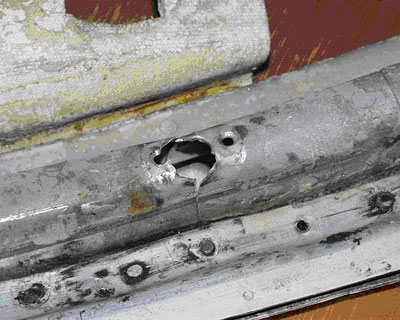
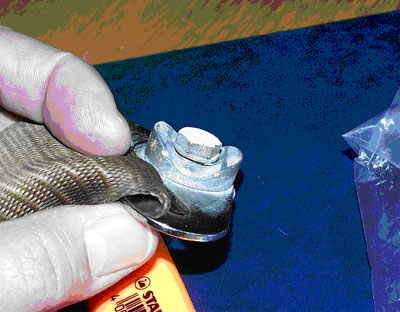
The upper attachment of the pilot's shoulder harness failed during the accident sequence. The harness had no inertia reel and required manual adjustment. The pilot reported that he had been unable to adjust the shoulder harness as firmly as he desired. Examination of the upper attachment found that the installation was not in accordance with the approved modification and the bolt had pulled through the window pillar (see photos Fig. 1 and 2 below). The attachment for the right seat shoulder harness conformed to the approved modification.
Figure 1: Photograph of the failed shoulder harness attachment showing (above) where the bolt had pulled through the pillar.
Figure 2: Photograph of the bolt and harness end fitting.
Attachments for the shoulder harnesses had been installed in January 1973. This was carried out to comply with Airworthiness Directive AD /GENERAL/28 "Safety Belt and Harness Installations" that was issued in May 1972. The AD required an additional, single, shoulder strap to be fitted to the front cockpit seats of all Australian registered aircraft. The aircraft's logbook indicated compliance with the AD in accordance with an approved design drawing.
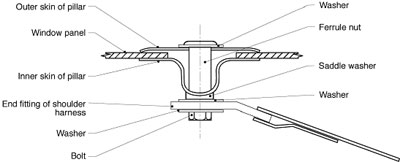
Figure 3: Cross-section through pilot's window pillar as appeared on the approved modification drawing.
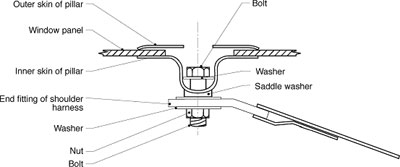
Figure 4: Cross-section through pilot's window depicting the installation as found on VH-ILM.
The investigation was unable to determine how and when this attachment was altered. Maintenance records showed that since modification the aircraft had been resprayed and the pilot's side window panel had been replaced. Either procedure may have required removal and reinstallation of the attachment. The attachment in the aircraft, as depicted in the diagram at Fig. 4, was significantly weaker than the approved method of attachment shown in the diagram at Fig. 3, thereby reducing the protection provided by the design. The fact that it was an incorrect installation may not have been apparent to maintenance personnel. The approved installation drawings were held by the organisation that originally performed the modification and were not readily available for reference by subsequent maintenance personnel.
Maintenance personnel normally referred to the illustrated parts catalogue for identifying correct components and assemblies. That catalogue, produced by the aircraft manufacturer, did not incorporate modifications by other than the aircraft manufacturer. As such, the modification of the shoulder harness installation did not appear in the catalogue. Approved maintenance data, as required under Civil Aviation Regulation CAR 2A, provided guidance as to the information and documentation required to assist licenced aircraft maintenance engineers (LAMEs) to carry out aircraft maintenance, including modifications.
"…the holder of the Certificate of Registration for an Australian aircraft must:
(a) keep a log book for the aircraft, and (b) make the log book available, and other documents referred to in the log book, available to CASA and to persons engaged in maintenance on the aircraft…."
Investigation into a fatal floatplane accident at Calabash Bay, NSW on 26 July 1998 (Occurrence 199802830) also found incorrectly fitted seat belt attachments. The report noted that failure of these attachments might have contributed to the severity of injury to the occupants. In both the Calabash Bay accident and this occurrence, aircraft had been found to have been operated with incorrectly attached restraint systems.
A group of pilots had arranged to conduct a fly-in at Clifton, Queensland. As part of their day's outing, they had also arranged for a visit to a collection of aircraft at Toowoomba. The accident pilot was to fly a single-seat RV-3 amateur-built aircraft on behalf of the aircraft owner. To re-familiarise himself with the aircraft, the pilot had conducted some local flying at Southport on the previous day.
Soon after the RV-3 became airborne during the departure from Southport for Toowoomba, the engine began to run roughly. The pilot landed the aircraft and operated the engine to clear what he suspected to be spark plug fouling. The subsequent take-off was apparently normal, and the aircraft arrived at Toowoomba without further incident.
Following the visit to the aircraft collection, the pilots prepared for departure to Clifton. The pilot of the RV-3 taxied to the threshold of runway 11 for departure. Witnesses reported that the take-off and initial climb were normal until the aircraft reached a height of about 200 ft, when the engine suddenly lost power.
The nose-attitude of the aircraft was observed to lower and the engine subsequently regained power. The aircraft then began a gentle climb and turned left. Witnesses reported that it appeared the pilot was attempting to manoeuvre the aircraft to land on the aerodrome. After the aircraft gained some altitude, the engine again lost power. The bank angle steepened and the nose-attitude lowered significantly. The aircraft's wings were then seen to level and the nose lifted to a near level attitude, however, the aircraft continued to descend at a high rate until impact on a playing field. The sides of the cockpit buckled outwards during the impact, allowing the fuselage behind the pilot to move forward, and the pilot's shoulder harness to slacken. He was no longer adequately restrained and received fatal injuries.
The pilot was correctly licensed and qualified to conduct the flight.
The aircraft was registered as Experimental, and was fitted with a fuselage fuel tank and a tank in each wing. The fuel selector valve was positioned to the right-wing tank and there were indications that both wing tanks had contained a significant quantity of fuel at impact.
Examination of the aircraft found that a fuel line connecting the fuel filter to the engine-driven pump had a loose connection at the filter. The carburettor float showed evidence that the carburettor fuel level had been low during aircraft operation. The condition of the spark plugs was consistent with operating in a lean mixture immediately prior to the engine stopping. No other defects considered likely to have contributed to the accident were found.
In addition to the engine-driven fuel pump, the aircraft was fitted with an electrically-powered auxiliary fuel pump. Both pumps were tested and found to operate normally. The loose fuel line connection could have allowed air to enter the carburettor. This may have been prevented had the electric pump been selected on, as it would have provided fuel pressure to the engine-driven pump. The investigation could not determine whether the electric fuel pump had been selected on for the take-off. The aircraft owner said that he had never used the electric pump for take-off.
One of the operators involved in the occurrence issued a safety article to crews notifying the limitations in the use of pilot sight and follow procedure and reminding them to carefully consider the situation prior to participating in the application of visual separation.
Australian Transport Safety Bureau safety action
Following the review of a number of occurrences in which the use of visual separation criteria was investigated, there was insufficient evidence to support a recommendation. However, there were a number of concerns in relation to the guidance, for the use of visual separation procedures, provided to flight crew. Consequently, the following was sent to the Civil Aviation Safety Authority (CASA) on 27 October 1999:
"Subject: Aeronautical Information Publication Guidance for Operations within CTA and GAAP Aerodrome CTRs The AIP ENR 1.1 - 32 paragraph 2 1. 1.1 details a pilot's responsibilities in relation to operations in GAAP control zones including a requirement to:
"advise ATC if unable to sight, or if sight lost of, other aircraft notified as traffic." The AIP ENR 1.3 - 2 paragraph 3.2.1 details the requirements for the provision of separation in controlled airspace (excluding GAAP CTRs) and includes a special provision of:
"under certain conditions, the pilot of one aircraft may be given the responsibility for separation with other aircraft. In this circumstance, the pilot is also responsible for the provision of wake turbulence separation."
This latter entry would appear to be inconsistent with the GAAP entry in that it does not provide any guidance or provisos which require air traffic control to be advised by the pilot when they have lost sight of a previously reported and sighted aircraft (or one that they were following).
Any pilot requirements in relation to the application of visual separation in the AIP should be consistent with the visual separation criteria in the Airservices Australia Manual of Air Traffic Services and should include:
the requirement for pilots to advise air traffic control when they are unable to maintain sight of an aircraft, and
the issue of traffic information to the pilot of an IFR aircraft that is subject to the application of visual separation.
I therefore request that these aspects be considered for future AIP amendments to ensure a consistent approach to the application of visual separation, both inside and outside controlled airspace, and between the AIP and the MATS."
CASA responded on 5 January 2000 and advised:
"I refer to your letter BS9710004 of 27 October 1999 in which you requested that aspects of visual separation criteria contained in MATS be considered for future amendment of AIP. In response to your request, the following amendments will be incorporated in AIP by the next amendment list. ENR 1.3 - 3 sub-paragraph 3.2.1 d. will be amended to include:
the requirement for pilots to advise ATC when they are unable to maintain, or have lost, sight of an aircraft, and
the advice that, where an aircraft has been instructed to maintain separation from, but not follow, an IFR aircraft, ATC will issue traffic information to the pilot of the IFR aircraft including advice that responsibility for separation has been assigned to the other aircraft."
Analysis
Although the Keppel controller intimated to the crew of UUQ that a minor reduction in airspeed would assist in the sequencing into Mackay, the crew either did not appreciate the need for a speed reduction or ignored the information. If the Keppel controller had advised the Swampy controller that the crew of UUQ had been forewarned of the likelihood of the imposition of a speed reduction, or had the crew reduced speed when advised, the loss of separation and subsequent situation may not have occurred.
The Swampy controller, despite not being endorsed for the sector, was only required to use standards and procedures that were commonly used on the Daintree sector. However, he did not issue the required instructions to either crew to establish separation using pilot visual separation procedures. The infringement of separation standards may not have occurred if the controller had issued instructions to either crew to follow the other aircraft and confirmed their ability to do so, or alternatively, issued control instructions to ensure that either vertical or radar separation was maintained until at least one aircraft exited controlled airspace.
The controller was probably more fatigued than he believed and he may have endeavoured to operate with minimal restrictions and/or control instructions in a situation which he thought was readily appreciated by both crews. The time of the day (early morning) and the resultant circadian disrhythmia may have also adversely affected his performance. As a consequence of the small amount of aircraft activity in the area at the time, the controller may have also been lulled into being less situationally aware than normal.
The lack of appreciation of the situation by the crew of UUG following the Keppel controller's suggestion to reduce speed and the acceptance by both crews of visual separation responsibility when the forecast indicated IMC in the area, were indicators that their performance may have also been sub-optimal. The limited guidance available in the AIP in relation to the assignment of separation responsibility to pilots does not clearly indicate pilot and controller responsibilities in such cases. Provision of additional information in the AIP would probably assist pilots in their decision making regarding the safe conduct of a flight.
The perceived benefit of transferring separation responsibility to pilots rather than imposing alternate air traffic control standards and procedures requires careful consideration by both controllers and pilots. This is more so the case for night operations when en route or terminal weather conditions may not be readily apparent. Additionally, any forecast that indicates that instrument meteorological conditions may be encountered should be an alert to crews and controllers to be wary of the use of visual separation procedures. The issued forecasts indicated potential instrument meteorological conditions for the Mackay terminal area and it would have been prudent for the pilots to request alternate separation procedures from the controller.
Summary
Two Fairchild Industries Inc S227 aircraft, VH-EEP and VH-UUQ, operating under instrument flight rules (IFR) were inbound to Mackay at approximately 0408 eastern standard time. EEP was from Rockhampton, maintaining FL140 and was being followed by UUQ on the Brisbane track at FL160. Near the descent point, approximately 55 NM south of Mackay, UUQ was above and abeam EEP when the Swampy sector controller issued instructions for the crew of EEP to leave control area on descent. The lower level of controlled airspace was 4,500 ft. About 1 minute later the crew of UUQ requested descent and advised the controller that they had EEP in sight. The controller instructed the crew to descend to FL140 and then to FL130. As EEP was descending through FL130, as indicated by the aircraft's Mode C altitude readout on the controllers' radar display, the lateral distance between the two aircraft reduced to 4.5 NM while there was less than the required vertical separation standard of 1,000 ft between them. The required radar separation standard was 5 NM. There was an infringement of separation standards.
The controller advised the crew of EEP that "traffic is UUQ". That was acknowledged by the crew who also advised that they had UUQ in sight. The air traffic system short term conflict alert activated and the controller queried both crews with respect to their ability to maintain their own separation on descent. Both crews acknowledged and advised that they could maintain their own separation. At this stage UUQ was ahead and above EEP. The controller instructed the crew of UUQ to leave control area on descent. Shortly after both crews reported transferring from the Swampy sector frequency to the Mackay mandatory broadcast zone frequency. As EEP was passing 7,000 ft it entered instrument meteorological conditions and the crew lost sight of UUQ. The crew of EEP contacted the crew of UUQ to establish the relative positions of the aircraft and found that the UUQ crew had descended their aircraft so that it was below EEP. The crew of EEP reduced power and manoeuvred their aircraft in an endeavour to increase the lateral spacing between them and UUQ. The aircraft subsequently landed at Mackay.
Both the area forecast and the Mackay terminal area forecast indicated the possibility of instrument meteorological conditions below 10,000 ft during the period when the aircraft were expected to be in the area.
The controller managing the Keppel sector, adjacent to the southern boundary of the Swampy sector, controlled the aircraft before the crews transferred to the Swampy sector. The Keppel controller noted the similar groundspeed readouts from the aircraft and queried both crews with respect to their respective indicated airspeeds. The crews both advised their indicated airspeeds as 205 kts. The controller advised the crew of UUQ that as they were about 2 NM behind EEP and that the next sector would probably make them second in the arrival sequence and, "if you would like you can start to reduce speed back to about 20 kt groundspeed reduction would probably fit you nicely behind". The crew acknowledged the transmission and advised that they had that aircraft in sight and were gaining on it.
The Keppel controller did not instruct the crew of UUQ to reduce speed and was not responsible for arranging the arrival sequence into Mackay. If the controller had issued such an instruction the crew of UUQ would have been required to read back and comply with the speed requirement. The Keppel controller informed the crew that he would advise the next sector that they had EEP in sight and subsequently told the Swampy controller. The Keppel controller did not advise the Swampy controller that he had pre-warned the crew of UUQ to possibly expect a speed requirement for sequencing. The investigation did not establish why the crew of UUQ did not reduce speed.
The crew of EEP was operating on the Keppel sector frequency and heard the advice passed by the controller. The crew later reported that they did not hear the response from the crew of UUQ but expected that aircraft to be following them on arrival into Mackay.
Due to the early hour, the Swampy sector was not busy and there was little other traffic in the area. The controller at the Swampy sector was endorsed and rostered for duty on the adjacent Daintree sector, but was not endorsed for the Swampy sector. The rostered and endorsed controller for the Swampy sector had left the position for a break. In that situation it was normal practice for the controller managing the adjacent position to monitor the radio frequencies and communication links while the position was vacant. If a radio or coordination call occurred, an appropriately endorsed controller would be recalled to operate the position. Immediately prior to and during the occurrence, the non-endorsed Swampy controller did not recall the other controller. Although the controller was not endorsed on the Swampy sector, the standards, procedures and techniques used were common to both Swampy and Daintree sectors. The controller should have been capable of maintaining separation using either radar, vertical, lateral, longitudinal or visual standards or a combination of these standards. The controller later reported that he believed that visual separation was being applied and consequently did not ensure that radar or vertical separation standards were maintained while the aircraft descended.
The Manual of Air Traffic Services (MATS 4-5-1) detailed how responsibility for separation may be assigned to a pilot using visual separation. For arriving aircraft above FL125 a controller was to instruct the pilot of one of the aircraft involved to follow and track behind the other aircraft, provided the pilot has reported sighting the aircraft and at least one of the aircraft is on descent. This was particularly so when the following aircraft was faster. In this case, a controller should have confirmed that the pilot was capable of following the slower aircraft. The Swampy controller did not instruct either crew to follow the other aircraft nor did he confirm whether the pilot of UUQ could follow EEP. Prior to a controller issuing any control instruction requiring a pilot to keep an aircraft in sight, the controller should consider a number of aspects that may limit a pilot's ability to comply. One of the aspects related to restrictions on atmospheric visibility that may not have been apparent to the pilot.
The Aeronautical Information Publication (AIP) contained a number of references about the application of visual separation. The references were different to what was in MATS. Also, the reference that related to controlled airspace provided little guidance to assist pilots in the application of visual separation. AIP ENR13-3 paragraph 3.2.1.d stated, "under certain conditions, the pilot of one aircraft may be given the responsibility for separation with other aircraft. In this circumstance, the pilot is also responsible for the provision of wake turbulence separation".
Controllers were responsible for assessing their fitness for an operational shift and if there were any doubts they were expected to notify a supervisor. The controller managing the Swampy sector had recently experienced some difficulties with obtaining satisfactory rest during his time off at home and had also been involved in a traffic incident the evening prior to the occurrence shift. The controller later reported that at the time he believed that he was capable of undertaking the shift despite his recent experiences.
Human performance varies during the day, tending to correspond with the body's circadian rhythm. Generally, the standard of human performance of some tasks decreases during the early morning hours. The reduction in performance is separate to that observed due to sleep deprivation. Additionally, an individual's ability to recognise the on-set of fatigue or a reduction in performance diminishes with fatigue and low points in the circadian rhythm.
The pilot of the Gippsland Aeronautics GA-200C aircraft had been tasked to apply superphosphate fertiliser to a sloping paddock located close to steeply rising terrain. He reported that prior to commencing spreading operations he intended to conduct an aerial inspection of the area. The pilot had flown in the area before and was familiar with the general terrain.
The pilot reported that just before reaching the treatment area, his aircraft encountered sinking air. Although it appeared that adequate terrain clearance existed to fly the aircraft straight ahead and under powerlines spanning a valley between two hilltop poles, the pilot became concerned about the possibility of an unseen power line between a nearby group of buildings and the nearest hilltop pole. Accordingly, he applied full power and turned the aircraft toward higher terrain. To improve the climb performance of the aircraft, the pilot dumped the contents of the hopper, however he was unable to manoeuvre the aircraft to avoid colliding with the terrain.
A witness reported that he saw the aircraft fly out of a gully towards steeply rising terrain, and recalled that the engine had sounded normal up to the point of impact. The aircraft struck the ground in a wings level attitude, approximately 6 m below the hill-crest and stopped in a distance of less than 10 m.
While running to the aircraft, the witness noticed that a fire had broken out in the wreckage and was slowly spreading through the centre fuselage area. The witness assisted the pilot to move clear of the wreckage.
The pilot sustained burns to his face, both arms, and one hand. He also suffered a fractured skull, a depressed fracture to a cheekbone, spinal injuries and a broken ankle. At the time of the accident he was wearing a helmet, a shirt with cut-off sleeves and denim jeans. Impact forces and post-impact fire destroyed the aircraft.
It was reported that the fuel tanks located in each wing remained intact and contained a significant quantity of fuel, which was not burnt in the post-impact fire. The aircraft's battery was equipped with a 50 amp circuit breaker that had tripped during the accident, thereby removing power from the electrical system. A possible ignition source for the fire was a low-voltage electric livestock fence that was in contact with the wreckage. The fire was fed by fuel leaking from the fuselage mounted fuel collector tank.
The tethering cable for the pilot's upper body restraint was reported to have failed in a mode consistent with a load that had exceeded the design requirements of the harness restraint system. The front and rear supports for the pilot's seat had folded together and distorted the seat pan. The design of the seat and harness system had been tested and demonstrated to be compliant with the 25 G static test requirement.
The pilot subsequently reported that there was not a powerline between the buildings and the nearest hilltop pole as he had anticipated.
The Australian Transport Safety Bureau did not conduct an on-site investigation.
The pilot of a Cessna 206, with one passenger, was tracking for Ceduna via Naracoorte and Kangaroo Island, SA.
At 1020 CSuT, the pilot advised air traffic control that the aircraft engine had failed and he would have to ditch the aircraft in the ocean. The controller asked the pilot to switch on the transponder and press the `ident' button. He subsequently identified the aircraft at about 33 NM south of Victor Harbor, SA at an altitude of 7,500 feet. The controller estimated that the aircraft was descending at about 1,000 feet per minute. Radar contact ceased at 1027 as the aircraft was descending through 1,400 feet.
After the first transmission from the pilot, the controller asked the crew of a Royal Australian Air Force (RAAF) aircraft to divert to the area to assist with search and rescue. The RAAF aircraft located the passenger in the ocean and remained in the area until a helicopter arrived and winched him aboard. The pilot was not found.
The Cessna 206 was not carrying a life raft, nor was it required to.
The passenger later said that the aircraft engine was operating normally until it suddenly made a loud grinding sound and the propeller stopped rotating. The cockpit then filled with smoke. The pilot tried unsuccessfully to restart the engine. The passenger fitted life jackets to himself and the pilot. On contact with the water the aircraft overturned and rapidly filled with water. The passenger was unable to sight the pilot so he made his way to the surface and inflated his life jacket.
Examination of the aircraft was not possible as it sank without trace.
The passenger said that, just before the engine failed, the aircraft fuel tank gauges indicated about 3/4 in the right tank and 1/4 in the left tank. Examination of fuel records indicated the aircraft should have had sufficient fuel at the time of the accident. Records also indicated the aircraft had not been refuelled with contaminated fuel in late 1999 and consequently was not subject to an airworthiness directive that required the complete cleaning and flushing of the fuel system.
Examination of the aircraft maintenance records indicated that on 10 April 1995, about 339 flight hours before the accident, the crankcase, sump, camshaft and a connecting rod assembly were replaced due to a connecting rod failure, with components assessed as serviceable by an engineer.
At about 132 flight hours before the accident, on 03 September 1998, a replacement engine cylinder assembly was fitted.
On 23 September 1999, a new propeller and two serviceable engine cylinder assemblies were fitted following a propeller strike. The aircraft had then flown for about 56 hours before the accident.
Four days prior to the accident, on 04 March 2000, the aircraft had undergone a routine 100 hourly maintenance check. At the time of the accident, the aircraft would have completed about six hours flight time since the maintenance check.
The reason for the reported engine failure could not be determined.
As a result of investigations into the circumstances of this accident the Bureau expressed concern to the helicopter manufacturer about aspects of the text in the Flight Manual relating to the Low Fuel Warning Indicator. These were:
references to the remaining flight time from when the warning light first illuminates. The test of this system only determined a remaining fuel quantity. The remaining endurance was predicated on a fuel consumption that may differ from actual fuel consumption rates.
the wording of the CAUTION could be misinterpreted and it should be made clear that flight is discontinued as soon as possible after the low fuel indicator lamp illuminates, and
the importance attached to this information was better emphasised by a WARNING annotation, rather than a CAUTION.
Correspondence from the helicopter manufacturer, dated 18 October 2000, stated that they intend to incorporate these changes with an upgraded and reformatted Flight Manual within the next 12 months.
Significant Factors
The pilot planned the flight using a fuel consumption rate that was significantly less than the actual consumption.
There was no logging of fuel usage for the helicopter that would have alerted the pilot to the greater than planned consumption rates.
The pilot did not check the actual fuel consumption.
Analysis
The circumstances leading to the loss of engine power were consistent with fuel exhaustion. The same consumption rate achieved on the flight from Bankstown to Moruya would have used all the helicopter's useable fuel in the elapsed flight time from Moruya to the accident site at Raymond Island.
The lack of any recorded fuel consumption checks meant that actual fuel consumption rates were not readily available to pilots flying the helicopter. This meant significant differences between planned and actual fuel consumption rates remained undetected. However, the quantity of fuel added at Moruya was greater than the planned fuel burn-off and should have alerted the pilot to the need for a check of the helicopter's actual fuel consumption. The remaining useable fuel at Moruya represented the minimum recommended allowance of 20 minutes fixed reserve. Any attempt to fly a greater distance under those conditions would have only been achieved by reducing the reserve fuel allowance.
The fuel consumption rate may have been masked by the reported anomalous fuel quantity indication. The reported 1/4 indication on the fuel gauge prior to the loss of engine power was just greater than the quantity that the pilot would have expected at his planned consumption rate. This may have reinforced his assessment of the actual fuel status and caused him to doubt the veracity of the low fuel warning.
Pilots of single-engine aircraft should always consider the possibility of an in-flight engine failure and its consequences. The engine failure occurred over water and at an altitude that did not permit an unpowered descent to a suitable land emergency landing site. This meant that the pilot was not in a position to conduct a forced landing without risk of damage to the helicopter and possible injury to its occupants. Evidence at the accident site suggested that contact with the tree canopy was not consistent with an autorotation landing that would have achieved minimum forward speed and rate of descent as recommended in the flight manual. Consequently, the attempted landing into the tree canopy did not achieve optimum conditions for survival.
Witnesses immediately initiated search and rescue action. However, had the helicopter not been seen just before descending into the trees, as might have been the case in more remote parts of the island, the consequences of not carrying an ELT may have been crucial to the survival of both the pilot and passenger.
Factual Information
History of the flight
The pilot and passenger were making a private flight in a Brantly two-place helicopter in accordance with the visual flight rules (VFR) from Bankstown to Lilydale with planned fuel stops at Moruya and Orbost. They departed Bankstown at 1100 ESuT and, following an uneventful flight to Moruya, refuelled the helicopter to full tanks at 1313. While on the ground at Moruya the pilot telephoned the fuel distributor at Orbost to confirm the availability of Avgas and was told that they did not hold any Avgas drum stock. The distributor suggested that he try Bairnsdale where Avgas was readily available. The pilot then elected to fly the extra distance to Bairnsdale after having determined that it was within the safe range of the helicopter and overfly Merimbula where fuel was readily available. At 1412 he departed Moruya with a planned endurance of 2 hours and 50 minutes.
The pilot monitored the progress of his flight by comparing the 10-minute time increments he had marked on his charts against an electronic timer attached to the instrument panel. The passenger reported that as they were approaching Bairnsdale she saw the low fuel warning light begin to flicker. The fuel gauge showed just above one quarter full. Shortly after, she saw the needle of the fuel gauge drop below the quarter full mark and the low fuel warning light stopped flickering and remained on. A few moments later the engine began to run roughly.
The pilot reported that soon after he saw the low fuel warning light illuminate, the engine lost power. He was flying at approximately 1,500 ft over water and turned toward Raymond Island, 7 NM east of Bairnsdale. He elected to land on the tree-covered shore rather than attempt to ditch the helicopter, which was not equipped with flotation gear or life jackets. He could not recall actioning any emergency drills.
At 1640 witnesses on Raymond Island reported seeing a helicopter approaching the southern shore of the island at low altitude with its engine running roughly and intermittently. As it passed low over bushland the engine was heard to cut out and the helicopter descended out of sight behind trees. A few seconds later witnesses heard the sound of two distinct impacts. They immediately commenced a search of the area and after 10 to 15 minutes located the wreckage of the helicopter in the undergrowth. The seriously injured occupants were administered first aid. Rescue and emergency personnel reported that there was no smell or evidence of fuel at the accident site and the injured passenger had told them the helicopter had run out of fuel.
Examination of the wreckage
The helicopter entered the tree canopy at moderate forward speed and travelled through the light timber and scrub for nearly 30 metres before contacting the ground, pitching forward and coming to rest inverted. Although damaged, one of the three main rotor blades was still attached to the rotor hub. The other two blades were shattered outboard of the secondary hinge and the fragments dispersed. Damage to the transmission and main rotor was consistent with no power being delivered to the rotor system. Examination of the wreckage and subsequent testing of components did not reveal any defect that would have contributed to the accident. The upper fuel cell was perforated during the accident sequence and the fuel plumbing damaged. The fuel system was drained and a small quantity of Avgas, approximately 50 mL, was found. The accuracy of the low fuel warning system could not be determined.
Pilot qualifications and experience
The pilot held a Special Pilot (Helicopter) Licence and a valid Class 1 medical certificate. The special licence validated his United States of America, Federal Aviation Administration (FAA) Commercial Helicopter Licence. He also held a United Kingdom Civil Aviation Authority Private Pilot's Licence (Helicopters). His total flying experience was 262 hours helicopter flight time of which 100 hours were on type. Prior to this flight, all but 10 hours of flight time on this type had been undertaken in the United Kingdom.
Fuel consumption and flight planning
A fuel gauge and engine instrumentation provided pilots with fuel flow information. Apart from this the only fuel consumption data provided to pilots was on a specification sheet published by the manufacturer of the helicopter. This listed a normal cruise fuel consumption of between 38 and 42 Litres per hour (LPH) at a power setting of 75 percent. The engine manufacturer's charts gave fuel consumption rates for the equivalent power from a lean limit of 43 LPH up to a "suggested high limit" of 52 LPH. The reason for the apparent difference in quoted fuel consumption rates was not able to be determined. The fuel consumption rate for the flight from Bankstown to Moruya was calculated to have been between 46 and 47 LPH. This was based on the flight time of 2 hours and 13 minutes. An accurate average fuel consumption rate for the helicopter was not possible because flying times and fuel records were incomplete. Only one pilot had established a consumption rate, reported to have been 48 LPH. Other pilots reported they had conservatively flown the helicopter for periods less than two hours and although they were unsure of actual consumption rates they thought that it was greater than 40 LPH.
The pilot had planned this flight using a fuel consumption rate of 40 LPH, a figure he had used for all his previous flying on the type. The flight from Bankstown to Moruya was the first extended flight he had undertaken in Australia. He had not checked the fuel consumption after refuelling at Moruya and used the same flight planned fuel consumption rate in his fuel calculations for the flight to Bairnsdale.
The helicopter was fitted with a manually operated vernier mixture control. The fuel flow gauge was graduated in US gallons per hour with a corresponding non-linear outer scale for the manifold air pressure (MAP) setting. The pilot reported that he had used a MAP setting of 21 inches of mercury and had adjusted the mixture in accordance with the flight manual procedure. The corresponding fuel flow indication for this power setting equated to 41.7 LPH. In contrast the estimated consumption rate of 47 LPH was equivalent to a MAP setting of 22.5 inches of mercury.
Fuel quantity indications and warnings
The helicopter had an electrically powered fuel gauge with graduations for each quarter of tank capacity. The calibration card showed that the 1/4 capacity graduation corresponded to a quantity of 29 L. Other pilots who had flown the helicopter reported that the gauge readings appeared to be inconsistent with fuel usage and that at lower fuel quantities they thought the gauge over-read.
A warning light provided the pilot with a low fuel quantity warning. The system was pneumatically operated and was independent of the fuel quantity indication system. The low fuel quantity warning light was designed to flash as the fuel level approached the 10 minute reserve. The length of flash became progressively longer until finally a steady red light appeared when approximately 5 minutes of flight time remained. The aircraft Flight Manual stated that flight should not be attempted beyond the first indication of the low fuel warning light. A few pilots reported that on occasions the low fuel warning light had illuminated intermittently during manoeuvring and in turbulence with low fuel quantities.
Autorotation technique
Autorotation facilitates a controlled descent and landing when engine power to the rotor system is removed, such as when an engine fails. The technique normally requires the helicopter to be flared toward the end of the approach in order to arrest its forward speed and use the energy stored in the rotor system to reduce the vertical speed and cushion the helicopter's touchdown. The flight manual recommended a speed of 48 kts for a power-off approach. It also stated that in the event of an engine failure over rough terrain "Increase angle of flare to reduce airspeed to near zero ground speed and allow helicopter to settle vertically".
Search and rescue
The pilot had not lodged flight details or nominated a Sartime, but had arranged for an operator at Bankstown to provide a SARWATCH. Although the pilot had nominated carriage of an Emergency Locator Transmitter (ELT) on his flight plan the aircraft was not equipped with one, nor had he carried a portable unit. Civil Aviation Regulation (CAR) 252A required the carriage of an ELT for this flight. The pilot later reported that he thought the aircraft had an ELT installed. An entry on the Maintenance Release stated "Carriage of ELT in accordance with CAR 252A - As Required".