

Final report
Report release date: 20/12/2012
Safety summary
What happened
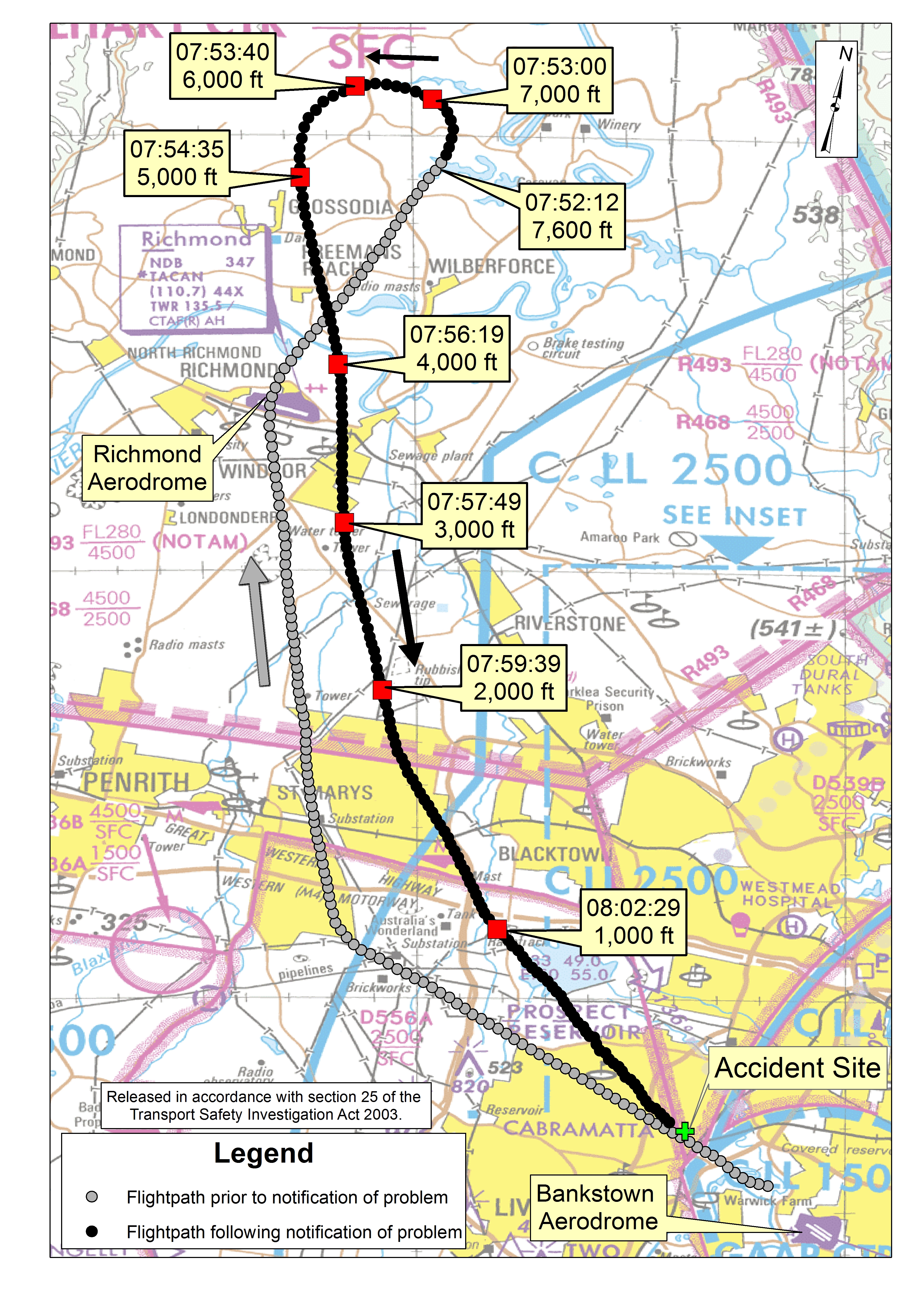
At about 0806 Eastern Standard Time on 15 June 2010 a Piper PA-31P-350 Mojave aircraft, registered VH-PGW, with a pilot and a flight nurse on board, collided with terrain in a suburban area about 6 km north-west of Bankstown Airport, New South Wales. At the time of the accident, the pilot was attempting to return to Bankstown following a reported in-flight engine shutdown. Both occupants were fatally injured, and the aircraft was destroyed by the impact forces and an intense post-impact fire.
What the ATSB found
The Australian Transport Safety Bureau (ATSB) found that following the shutdown of the right engine, the aircraft’s airspeed and rate of descent were not optimised for one engine inoperative flight. In addition, spectral analysis indicated it was unlikely that the left engine was being operated at maximum continuous power as the aircraft descended. As a result, the aircraft descended to a low altitude over a suburban area and the pilot was then unable to maintain level flight, which led to the collision with terrain.
Examination of the engines, propellers and governors and other aircraft components found no evidence of any pre-impact faults. However, the engine surging identified by the spectral analysis of radio transmissions during the flight was consistent with uneven fuel distribution to the cylinders.
What has been done as a result
The Civil Aviation Safety Authority has started a project to amend advisory material relating to multi-engine aircraft training and operations to include guidance information about engine problems encountered during the climb and cruise phases of flight. This amended guidance material will include information about aircraft handling, engine management, and decision making during these phases of flight.
Safety message
This accident reinforces the importance when flying twin-engine aircraft with one engine shutdown that the optimal speed be selected, along with maximum continuous power on the operative engine, and that the aircraft’s performance should be verified prior to conducting a descent. Pilots should also use the appropriate PAN or MAYDAY phraseology when advising air traffic control of non-normal or emergency situations.
Preliminary report
Report release date: 15/07/2010
This preliminary report details factual information established in the investigation’s early evidence collection phase and has been prepared to provide timely information to the industry and public. Preliminary reports contain no analysis or findings, which will be detailed in the investigation’s final report. The information contained in this preliminary report is released in accordance with section 25 of the Transport Safety Investigation Act 2003.
Abstract
At about 0807 Eastern Standard Time on 15 June 2010, a Piper PA-31P-350 Mojave aircraft, registered VH-PGW, with a pilot and flight nurse on board, collided with terrain in a suburban area about 6 km north-west of Bankstown Airport, New South Wales. At the time, the pilot was attempting to return to Bankstown following a reported in-flight engine shutdown. Both occupants were fatally injured, and the aircraft was destroyed by the impact forces and an intense post-impact fire.
The Australian Transport Safety Bureau has conducted a series of examinations of the propellers, engines and some associated engine and airframe components that were not destroyed during the impact and subsequent fire. The examination of the propellers indicated that, at the time of impact, the right propeller was in the feathered position and the left propeller was in the full fine position, which was consistent with low engine power. The examination of the engines did not find any evidence of mechanical failure. Impact and fire damage to the cockpit area resulted in most of the instruments and systems being destroyed or extensively damaged. The position of several cockpit switches was determined but an examination of the cockpit instruments was unable to determine any instrument indications at the time of impact.
The investigation is continuing and will include:
- an ongoing examination of operational issues including pilot training and checking
- continued analysis of recorded radar data and voice transmissions
- an ongoing human factors review.
It is anticipated that the final investigation report will be released to the public in the first quarter of calendar year 2012.
Aircraft flight path chart
Inquest
ATSB response to Findings
The Coroner’s Court of New South Wales (NSW) recently made findings and recommendations into a 2010 fatal accident involving a Piper PA-31P-350 Mojave aircraft, registered VH-PGW, which occurred 6 km north-west of Bankstown Airport, NSW.
The ATSB summary explains that on 15 June 2010, the pilot of a Piper PA-31P-350 Mojave aircraft and a flight nurse passenger took off from Bankstown Airport. At about 0806 Eastern Standard Time, the aircraft collided with terrain. At the time of the accident the pilot was attempting to return to Bankstown following a reported in-flight engine shutdown.
The Coroner made two recommendations, the first of which reflects a minor safety issue identified by the ATSB in its report:
Coroner’s Recommendation
That the Civil Aviation Safety Authority (CASA) finalise the guidance material for Civil Aviation Advisory Publication (CAAP) 5.23 Multi-engine Aeroplane Operations and Training such that the guidance material is completed and released as soon as possible. The coroner noted that the guidance material provides for multi‑engine aeroplane operations and training to support the flight standard in Appendix A of s.1.2 of the CAAP. This relates to engine failure in the cruise.
Safety message
This accident reinforces the importance when flying twin-engine aircraft with one engine shutdown that the optimal speed be selected, along with maximum continuous power on the operative engine, and that the aircraft’s performance should be verified prior to conducting a descent. Pilots should also use the appropriate PAN or MAYDAY phraseology when advising air traffic control of non-normal or emergency situations.
What has been done as a result
CASA has started a project to amend advisory material relating to multi-engine aircraft training and operations to include guidance information about engine problems encountered during the climb and cruise phases of flight. This amended guidance material will include information about aircraft handling, engine management, and decision making during these phases of flight. Updates on this work by CASA are available on the ATSB website
Inquests are separate to ATSB investigations
Coronial investigations are separate to ATSB investigations. In this matter the respective authorities are largely in accord as to the factors that contributed to the development of the accident involving VH-PGW.
The ATSB's report can be downloaded by clicking on the link:
The Coroner's report can be obtained from the Coroner's Court of NSW. Contact details are available at: www.coroners.justice.nsw.gov.au. Queries regarding the Coroner's findings should be directed to the NSW Coroner’s Court.
Occurrence summary
| Investigation number | AO-2010-043 |
|---|---|
| Occurrence date | 15/06/2010 |
| Location | 6 km NW of Bankstown Airport |
| State | New South Wales |
| Report release date | 20/12/2012 |
| Report status | Final |
| Investigation level | Systemic |
| Investigation type | Occurrence Investigation |
| Investigation status | Completed |
| Mode of transport | Aviation |
| Aviation occurrence category | Engine failure or malfunction |
| Occurrence class | Accident |
| Highest injury level | Fatal |
Aircraft details
| Manufacturer | Piper Aircraft Corp |
|---|---|
| Model | PA-31 |
| Registration | VH-PGW |
| Serial number | 31P-8414036 |
| Sector | Piston |
| Operation type | Aerial Work |
| Departure point | Bankstown, New South Wales |
| Destination | Archerfield, Queensland |
| Damage | Destroyed |