

Preliminary report
Report release date: 26/10/2026
| The ATSB has released this preliminary report to provide a timely update on evidence gathered and investigation activities to date. It outlines areas of further investigation but does not contain analysis or findings, which will be detailed in a final report at the conclusion of the investigation. The information in this report is released in accordance with section 25 of the Transport Safety Investigation Act 2003. |
The occurrence
On the morning of 17 August 2026, a Virgin Australia Boeing 737-800, registered VH‑IXJ, was being operated as flight VA1589 from Melbourne, Victoria, to Newcastle, New South Wales. While en route to Newcastle, the flight crew determined that the weather conditions at Newcastle were not suitable for landing and diverted to Sydney, New South Wales.
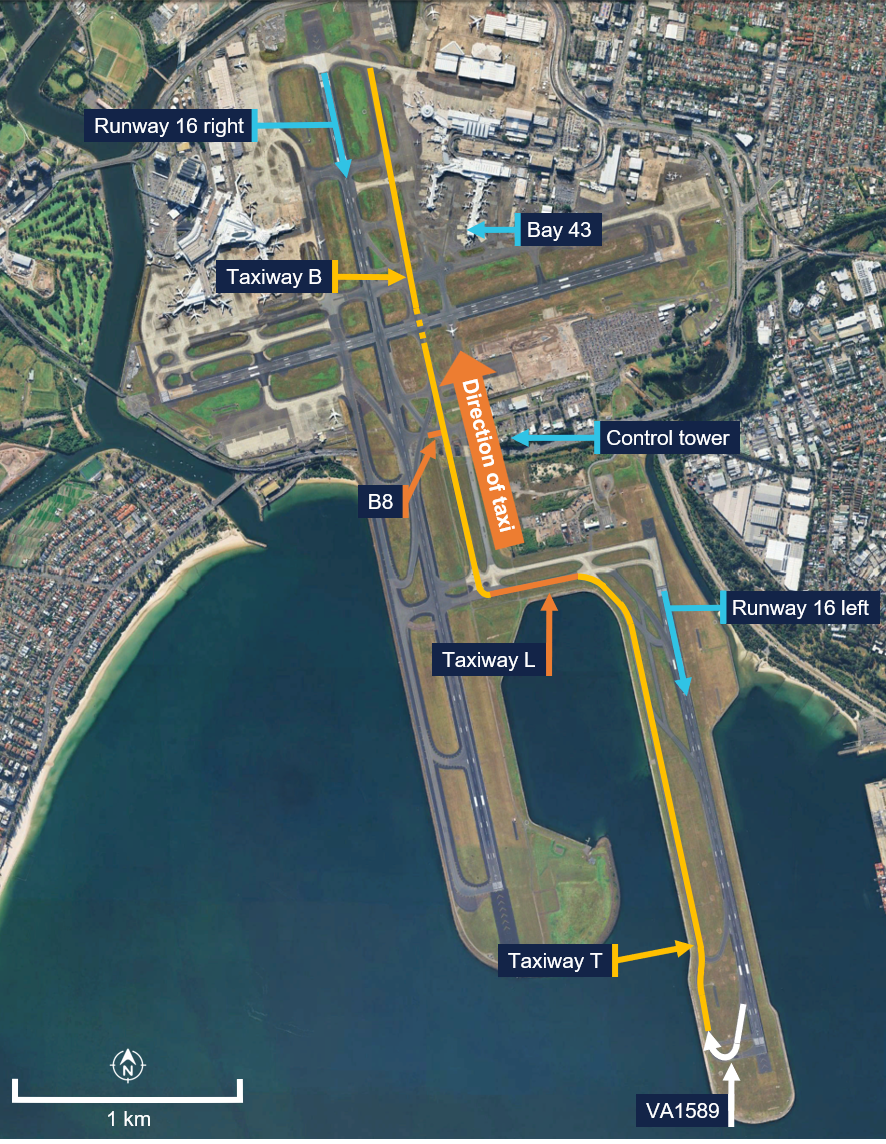
At 0933 local time, VA1589 landed on runway 16 left (16L) at Sydney. The aircraft vacated the runway and followed the standard taxi route (see Airport information) from runway 16L along taxiways T, L and B towards the domestic terminal’s bay 43 (Figure 1). At 0939, as VA1589 taxied west along taxiway L, the surface movement controller (SMC) east (see Air traffic services) instructed the crew to hold short of taxiway B8 and the crew read back this instruction. At the same time, a Qantas Airways Boeing 737-800, registered VH-VZV and operating as flight QF420 from Melbourne to Sydney, was on final approach to runway 16 right (16R) at Sydney.
Figure 1: Taxi route for VA1589
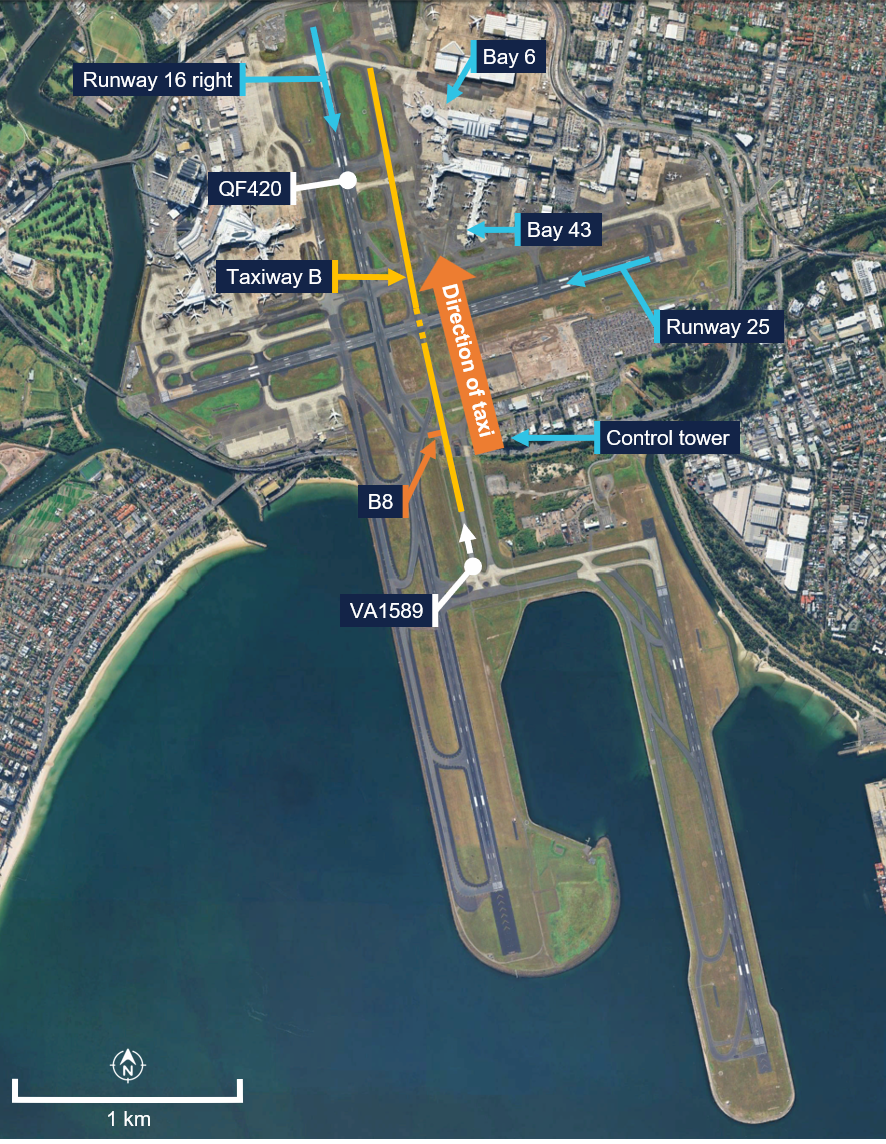
At 0940, while VA1589 was at the southern end of taxiway B and QF420 was touching down on runway 16R, the VA1589 first officer contacted Virgin Australia’s Sydney ground operations via radio to discuss arrival arrangements. At the same time, the SMC east instructed the crew of VA1589 to ‘follow the Qantas to vacate ahead, hold short runway 25’ (Figure 2). The captain of VA1589 read back ‘hold short of runway 25’ and did not readback the ‘follow the Qantas’ instruction (see Recorded information). The SMC east did not recognise the incomplete readback and moved on to other tasks. At that time, the crew of QF420 were communicating with the aerodrome controller using a different air traffic control frequency (Sydney Tower) and did not hear these communications.
Figure 2: Positions at the time of ‘follow’ instruction (0940)
As QF420 slowed on runway 16R, the crew elected to use taxiway B8 to vacate the runway. As QF420 turned into the taxiway, the crew contacted the SMC east to request taxi clearance along the standard taxi route (taxiway B) to domestic bay 6. The SMC east instructed the crew of QF420 to follow that route and hold short of runway 25.
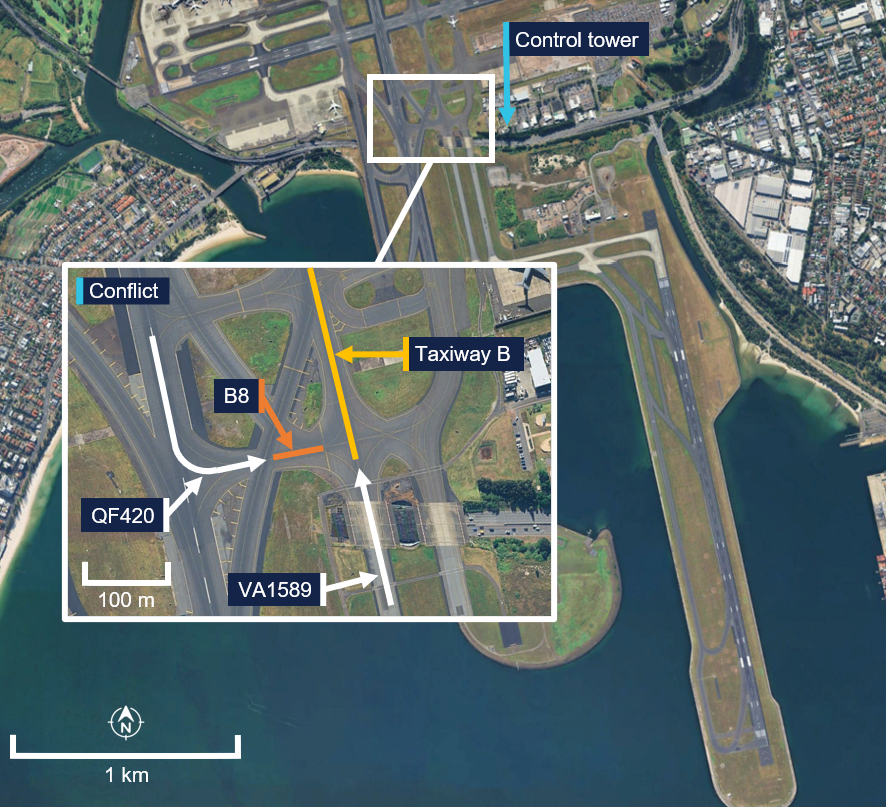
As the crew of QF420 read back the taxiing instructions, they sighted VA1589 and noted that it was approaching the taxiway B and B8 intersection at a speed that indicated that it would not give way. The crew of QF420 stopped the aircraft using normal braking and asked the SMC east if they were to give way to VA1589 (Figure 3). The SMC east responded that VA1589 should have given way, but that QF420 should now follow VA1589.
Figure 3: Taxiing conflict
The crew of VA1589 were not aware of the conflict until hearing the question from the crew of QF420. By that time, VA1589 was already passing in front of QF420. Both aircraft then taxied to the terminal without further incident.
Context
Personnel information
Surface movement controller east
The surface movement controller (SMC) east held the appropriate endorsement and ratings for the role and reported that they were fully endorsed on all air traffic control roles at Sydney Airport, apart from the tower shift manager position. They had been an air traffic controller for 14 years, of which 6 years were in Sydney Airport control positions.
On the day of the occurrence, the controller began their shift at 0530 and had acted in multiple SMC and aerodrome controller (ADC) positions during the shift. The controller had 2 45-minute breaks from duties between 0600–0645 and 0815–0900 before taking on the SMC east role (see Air traffic services). Shortly after the occurrence, the controller was removed from duty for the rest of the day.
At the time of the occurrence, the controller was identified as having a high predicted fatigue level (see Fatigue management) based on their roster (Table 1).
Table 1: Controller rostered duty times for 11 to 17 August 2026
| Date | Duty time |
11 August | 1350 – 2150 |
12 August | 1250 – 2135 (2050 – 2135 administrative duties) |
13 August | 0600 – 1400 |
14 August | 1450 – 2250 |
15 August | Off |
16 August | 1250 – 2050 |
17 August | 0530 – 1230 |
Source: Airservices
The controller described their mental fatigue level at the time of the occurrence as ‘fine and alert’ and that they were ‘fit for duty’.
VA1589 captain
The captain of VA1589 held an Air Transport Pilot Licence (Aeroplane), a Boeing 737‑800 type rating, and a class 1 aviation medical. They had approximately 13,000 hours of flight experience with 4,700 hours on type. The captain described their mental fatigue level at the time of the occurrence as ‘okay and not unduly fatigued’.
QF420 captain
The captain of QF420 held an Air Transport Pilot Licence (Aeroplane), a Boeing 737-800 type rating, and a class 1 aviation medical. They had approximately 16,260 hours of flight experience with 7,419 hours on type. The captain described their fatigue level at the time of the occurrence as ‘okay, somewhat fresh’.
Aircraft information
VH-IXJ
VH-IXJ was a Boeing 737-8SA operated by Virgin Australia Airlines as flight VA1589. It was manufactured in the United States in 2015 and issued serial number 44226. It was first registered in Australia in February 2022.
VH-VZV
VH-VZV was a Boeing 737-838 operated by Qantas Airways as flight QF420. It was manufactured in the United States in 2011 and issued serial number 34189. It was first registered in Australia in February 2022.
Airport information
Sydney Airport has 3 runways: parallel runways 16 right (16R)/34 left (34L) and 16 left (16L)/34 right (34R), and runway 25/07. On the morning of the occurrence, aircraft were arriving and departing using runways 16R and 16L.
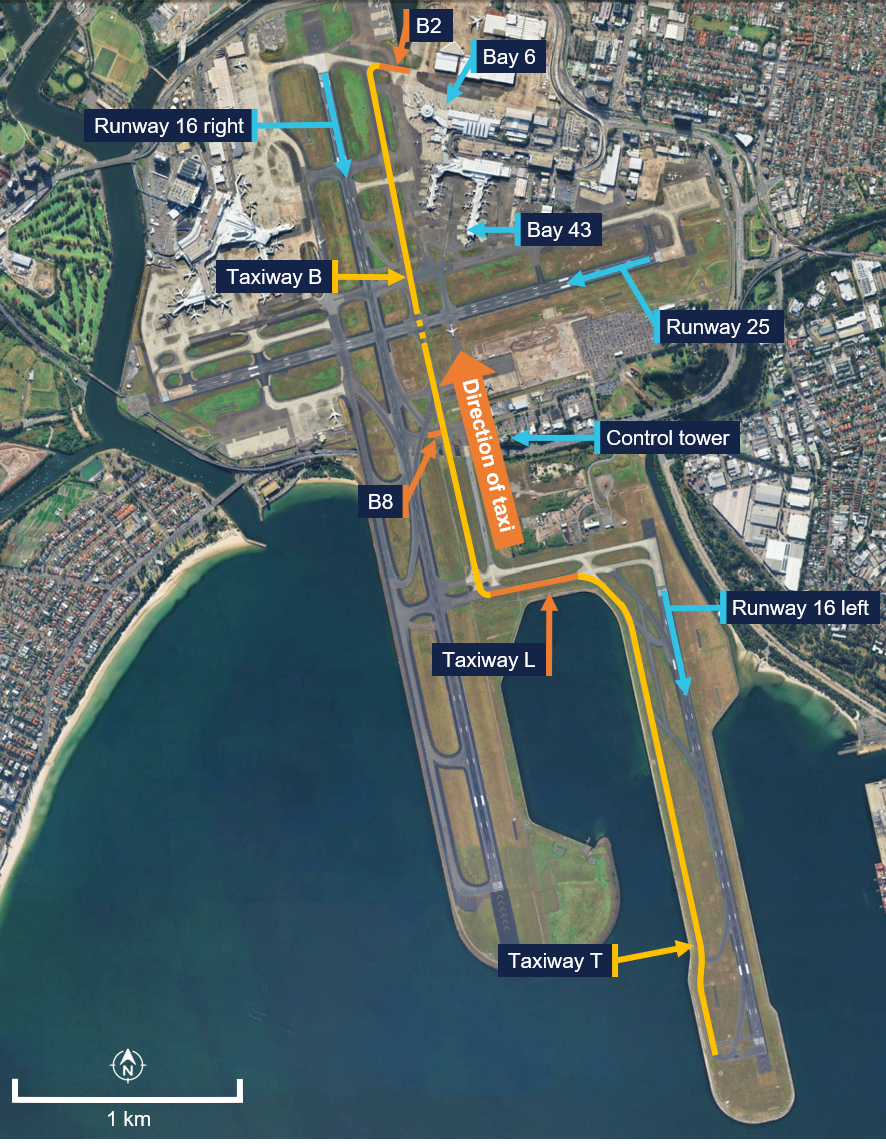
For domestic arrivals, the Aeronautical Information Publication (AIP) Departure and Approach Procedures provided standard taxi routes from the runways to the domestic terminals on the eastern side of the airport (Figure 4) which pilots were required to follow unless explicitly instructed otherwise by an air traffic controller. The standard taxi route for domestic aircraft arriving on runway 16L bound for bay 43 (the bay for VA1589) followed taxiways T, L and B. A domestic aircraft arriving on runway 16R bound for bay 6 (the bay for QF420) followed taxiways B and B2.
Figure 4: Standard taxi routes for VA1589 and QF420
Air traffic services
Overview
Air traffic services were provided by Airservices Australia (Airservices). Sydney control tower had 7 control positions (Table 2):
Table 2: Sydney tower operational positions
| Operational position | Responsibility |
| Tower shift manager | General supervision of operational staff to ensure a safe and efficient air traffic service, the supervision of controllers, and the application of operational command authority. |
| Coordinator | The overall operation of the tower, automatic terminal information service updates, and working with external stakeholders on departure times. |
| Clearance delivery | Obtaining and providing airways clearances to aircraft in preparation for their departure. |
| Surface movement controller west | The provision of surface movement control on all manoeuvring areas and taxiways (including pushback procedures and entry/exit regulation) west of runway 16R/34L. |
| Surface movement controller east | The provision of surface movement control on all manoeuvring areas and taxiways (including pushback procedures and entry/exit regulation) east of runway 16R/34L, excluding taxiways controlled by Aerodrome controller east. |
| Aerodrome controller west | Providing traffic management to aircraft taking off and landing on runway 34L/16R. |
| Aerodrome controller east | Providing traffic management to aircraft taking off and landing on runway 34R/16L and management of operations on all taxiways between runway 34R/16L and taxiway C. |
These positions could be combined in various ways and operated by fewer controllers depending on traffic state and other factors.
The ADC east was responsible for movements on runway 34R/16L, and ADC west was responsible for movements on 34L/16R.
At the time of the occurrence, the SMC east and west positions were staffed by separate controllers. The SMC east was responsible for vehicles and aircraft using taxiways east of runway 16R/34L, and SMC west was responsible for vehicles and aircraft using taxiways west of runway 16R/34L.
The clearance delivery controller was responsible for obtaining and providing airways clearances to aircraft in preparation for their departure.
The coordinator was responsible for keeping the automatic terminal information service (ATIS)1 updated and working with external stakeholders on departure times. The position helped control the flow of departures and keep aircraft ground running times to a minimum.
At the time of the occurrence, 6 control positions were occupied by individual controllers and 2 roles (Tower shift manager and Coordinator) were combined and being operated by one controller. One of the controllers (SMC west) was undertaking training at the time.
Surface movement control
The Manual of Air Traffic Services (MATS) stated that the separation of aircraft taxiing on an airport manoeuvring area2 was a joint pilot and controller responsibility. It instructed that controllers should provide taxi instructions that:
- give adequate information to assist pilots in determining correct taxi routes and avoid collision with other aircraft or obstructions; and
- regulate entry to and movement on taxiways
Controllers regulated the entry and movement on taxiways by issuing limits to taxi clearances, such as an instruction to hold short of a particular taxiway intersection. Where the paths of taxiing aircraft were likely to conflict, controllers could also issue the aircraft with sequence priorities3 to assist them in self-separation.
Readback requirements
The AIP General (GEN) 3.4 6.6 General phrases provided the following guidance for air traffic control phraseology when a pilot was assigned and required to maintain separation with a sighted aircraft:
…when a pilot is assigned and required to maintain separation with a sighted aircraft [controllers are to use the phrase] FOLLOW (or MAINTAIN OWN SEPARATION WITH [AND PASS BEHIND]) (aircraft type or identification) [instructions or restrictions].
The MATS pilot readback requirements stated:
Obtain a readback in sufficient detail that clearly indicates a pilot’s understanding of and compliance with all ATC clearances, including conditional clearances, instructions and information which are transmitted by voice.
MATS did not explicitly require sequencing instructions to be part of a readback but stated that readback discrepancies must be immediately corrected by the controller.
ATSB safety issue AO-2025-033-SI-01
ATSB investigation AO-2025-033 (Separation occurrence involving Piper PA-44, VH‑KZJ, and Cessna 172, VH‑ZER, near Jandakot Airport, Western Australia, on 12 June 2025) identified safety issue4AO-2025-033-SI-01 related to ‘follow’ type clearance instructions:
The Manual of Air Traffic Services did not explicitly state that sequencing instructions were required to be readback by a pilot, providing no assurance that this safety-critical aspect had been correctly understood.
In response to this safety issue, Airservices conducted a review of the MATS and AIP guidance related to these clearance types (see Safety action).
Surveillance
The SMC position was equipped with advanced surface movement guidance and control system (A‑SMGCS) display. The A-SMGCS showed the position of aircraft and ground vehicles on a screen in front of the controller in the tower. This provided the SMC with control of routing, guidance and surveillance of aircraft ground movement at Sydney Airport.
The controller reported that when seated at their control position in the tower, their view of the intersection of taxiways B and B8 was limited by equipment within the tower cab.
Controller equipment and procedures
Controllers used physical flight progress strips (FPS) to keep track of aircraft details and positions (Figure 5). The FPS was moved between different controller positions as aircraft moved around the aerodrome and transferred between controller frequencies. Within control positions, controllers arranged the FPS on a flight progress board to indicate the aircraft sequence, and which aircraft were cleared to occupy a runway. Controllers were able to mark the FPS to record specific information, such as the limit of an aircraft’s taxi clearance.
Figure 5: Flight progress strips for the involved aircraft
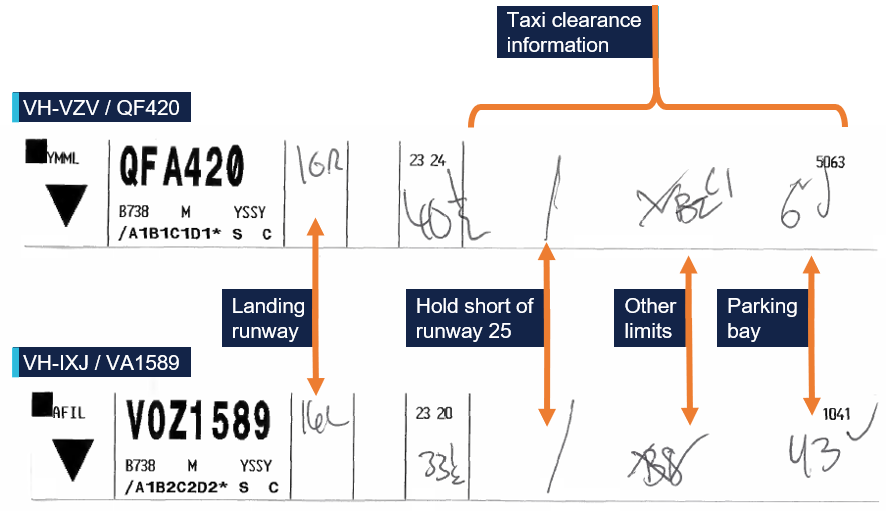
Source: Airservices, annotated by the ATSB
Fatigue management
Regulatory information
The Civil Aviation Safety Regulations Part 172 (Air Traffic Service Providers) Amendment (Fatigue Rules) Manual of Standards 2023 required Airservices to have a fatigue risk management system (FRMS) that was approved by the Civil Aviation Safety Authority (CASA) for implementation by 1 September 2024. Airservices had submitted a draft FRMS to CASA, however the FRMS had not yet been approved. Airservices had been operating under a CASA exemption since 1 September 2024 which permitted operations without an approved FRMS.
CASA reported that, while the exemption was in place, Airservices continued to operate under existing fatigue risk management arrangements and was required to meet a number of additional conditions. This included providing CASA with regular reports on fatigue risk management and progress towards the development of an FRMS.
The current exemption commenced on 1 September 2026 and was due to expire on 28 February 2027. CASA expects Airservices to have an approved FRMS in place by the expiry of the exemption.
Fatigue risk management practice
The Airservices fatigue risk management process focused on 2 controls: work scheduling, and education and awareness. Managing fatigue-related risk involved developing planned rosters/work cycles via a strategic roster planning process (which contained 12 strategic roster planning rules) and application of the tactical roster management process (risk identification, assessment and control) when changes to planned rosters/work cycles were required.
A controller could be allocated to a shift if their predicted fatigue level was ‘medium’ or ‘high’. However, a formal risk assessment was required. The risk assessment considered the expected operational situation for the shift (for example, the time of day and traffic volume) and applicable controls. The outcome of the risk assessment required acceptance by a supervisor or manager, dependent on the risk level. At the time of the occurrence, Sydney Airport air traffic control tower was operating with a high predicted fatigue level for one controller— the SMC east (the occurrence controller).
Fatigue level predictions did not indicate that a controller was fatigued, but rather, that they were at risk of fatigue based on their roster. In addition to the organisational fatigue monitoring, Airservices required all controllers to advise their manager if they felt they were not fit for duty.
Airservices provided a list of risk controls that could be implemented to mitigate the impact of fatigue, which was managed by the TSM. Some of those risk controls included extra breaks for controllers at risk, change of duties during the shift, and releasing the controllers from their duties earlier than their scheduled finish time.
Meteorological information
The SMC east and both flight crews reported that meteorological conditions did not contribute to the incident.
At the time of the occurrence, the Bureau of Meteorology automatic weather station at Sydney Airport recorded the visibility as 8 km in light rain showers. The temperature was 14°C and the wind was recorded as 8 kt from a north-easterly direction.
Recorded information
Airservices data
Airservices provided recordings of very high frequency (VHF) radio communications between the ADC and SMC positions and both aircraft (Table 3), as well as recordings of phone calls between the tower shift manager and air traffic management director (based in Melbourne).
Table 3: Radio broadcasts prior to the conflict
Time | From | To | Broadcast |
|---|---|---|---|
0938:38 | ADC east | QF420 | Qantas 420, wind 030 degrees, 5 knots, so 3 knots of tail wind. Runway 16 right, cleared to land. |
0938:45 | QF420 | ADC east | 16 right, cleared to land, Qantas 420. |
0939:03 | VA1589 | SMC east | Sydney ground, g’day, Velocity 1589 for bay 43. |
0939:07 | SMC east | VA1589 | Velocity 1589, g’day, hold short Bravo 8. |
0939:11 | VA1589 | SMC east | Hold short Bravo 8, Velocity 1589. |
0940:21 | SMC east | VA1589 | Velocity 1589, follow the Qantas to vacate ahead, hold short runway 25. |
0940:28 | VA1589 | SMC east | Hold short of runway 25, Velocity 1589. |
0940:56 | QF420 | SMC east | Sydney ground, Qantas 420, bay 8. |
0940:58 | SMC east | QF420 | Qantas 420, g’day, I’m showing bay 6, just check for me, hold short runway 25. |
0941:03 | QF420 | SMC east | Hold short runway 25 Qantas, ah, 420, are we giving way to Virgin? |
0941:08 | SMC east | QF420 | They should be, they should be, just give way, they were meant to follow you, just give way sorry. |
0941:15 | QF420 | SMC east | Giving way, Qantas 420. |
Source: Airservices
Airservices also provided a recording of the A-SMGCS display (Figure 6).
Figure 6: Advanced surface movement guidance and control system prior to the conflict
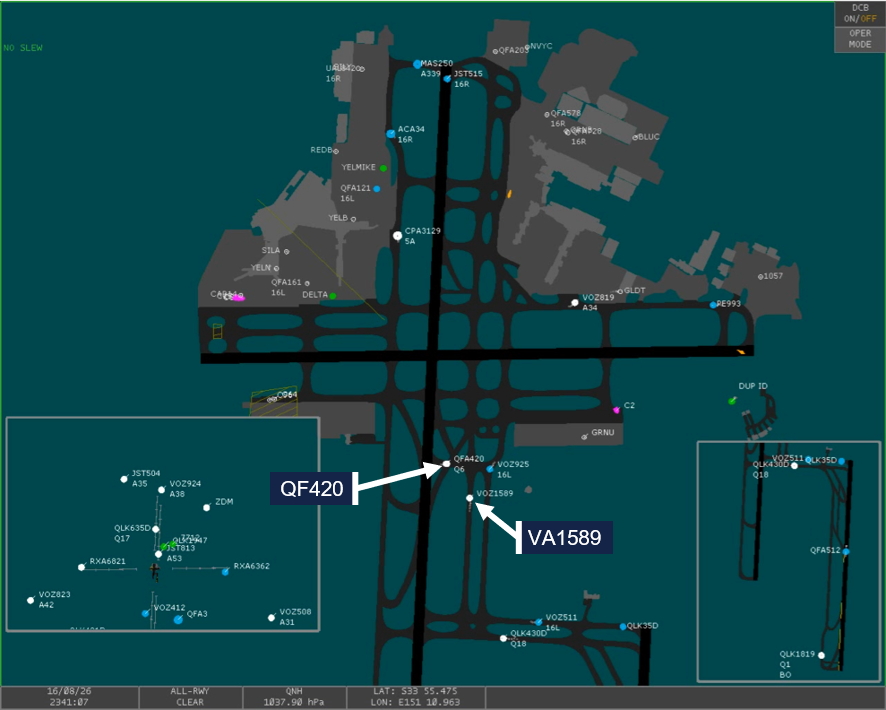
VA1589 and QF420
The operators of each aircraft provided the ATSB with data from the respective quick access recorders, which captured the incident flights. Due to the time elapsed between the occurrence and the initiation of the investigation, the cockpit voice recorder (CVR) data was not available.
The quick access recorder data from VA1589 showed that at 0940:21, when the SMC east provided the ‘follow’ instruction, the first officer’s microphone key was active (transmitting) (Figure 7).
Figure 7: Graphical representation of recorded flight data
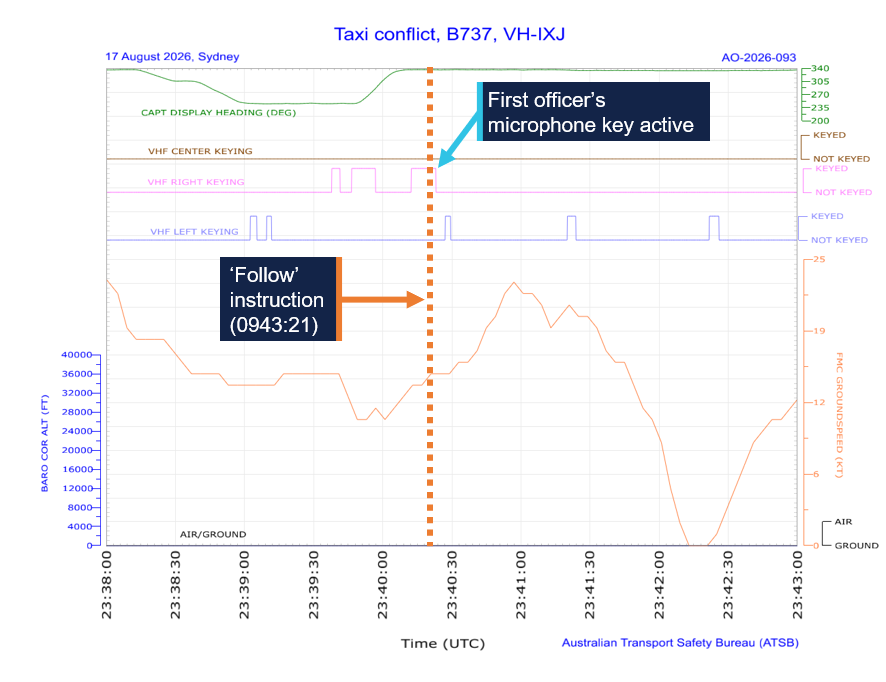
Sydney Airport CCTV
Sydney Airport provided closed-circuit television (CCTV) footage from a camera directed towards the intersection of taxiways B and B8 (Figure 8). Footage was also provided that captured the movements of VA1589 and QF420 leading up to the conflict.
Figure 8: Taxiing conflict
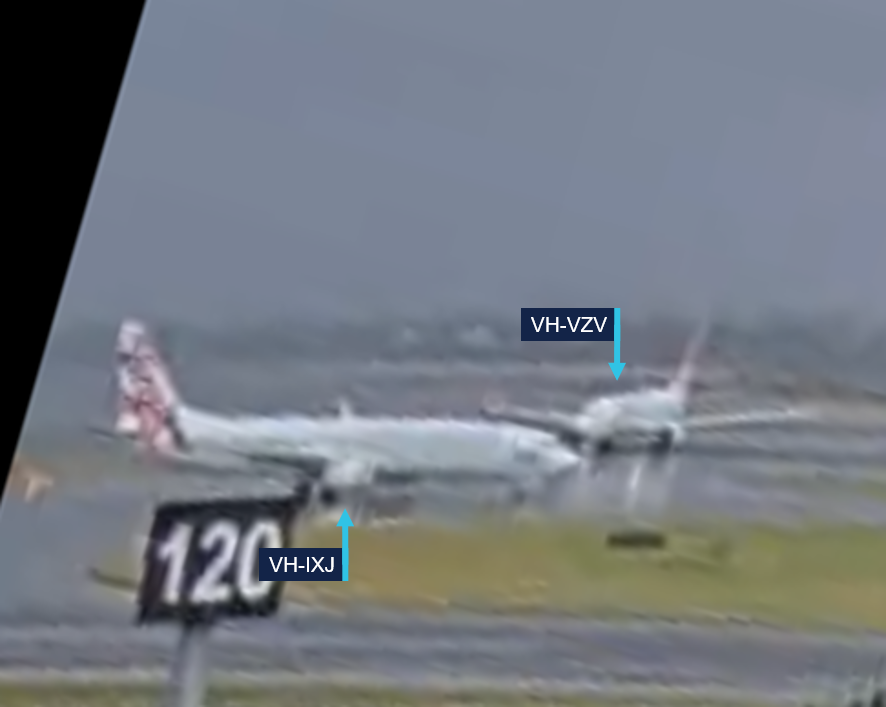
Further investigation
To date, the ATSB has received and commenced analysis of:
- Airservices surveillance and air traffic control recordings
- Airservices staffing rosters, manuals, and procedures
- aircraft flight data recordings from both aircraft
- CCTV footage of the occurrence from Sydney Airport.
Additionally, the ATSB has interviewed the involved controller and both aircraft captains.
The investigation is continuing and will include:
- analysis of recorded aircraft and air traffic control data
- review of Airservices Australia fatigue management and rostering
- examination of Airservices Australia occurrence reporting procedures
- review of similar occurrences.
Should a critical safety issue be identified during the course of the investigation, the ATSB will immediately notify relevant parties so appropriate and timely safety action can be taken.
A final report will be released at the conclusion of the investigation.
Safety action
Safety action by Airservices Australia
In response to ATSB safety issue AO-2025-033-SI-01, Airservices Australia Air Traffic Management Standards and Senior Air Traffic Services Specialists conducted a review of the MATS and AIP guidance related to ‘follow’ clearance types.
On 17 September 2026, Airservices advised the ATSB that this review had led to a decision to implement a change to MATS 9.2.2.13.2 and the respective AIP reference (GEN 3.4) to include the instruction ‘follow’ in the list of items requiring readback. These changes will be implemented on 26 November 2026.
Purpose of safety investigationsThe objective of an ATSB safety investigation is to improve transport safety through:
In accordance with the TSI Act, the ATSB does not investigate for the purpose of taking administrative, regulatory or criminal action, and cannot apportion blame, assist in determining liability, or, as a general rule, assist in court proceedings. About ATSB reportsATSB safety investigation reports are developed in accordance with ATSB procedures and guidelines, and with regard to applicable international standards and instruments. Reports must include factual material of sufficient weight to support the investigation’s analysis and findings. At all times the ATSB endeavours to balance the use of material that could imply adverse comment with the need to properly explain what happened, and why, in a fair and unbiased manner. An explanation of terminology used in ATSB investigation reports is available here. Publishing informationReleased in accordance with section 25 of the Transport Safety Investigation Act 2003 Published by: Australian Transport Safety Bureau © Commonwealth of Australia 2026 Ownership of intellectual property rights in this publication Unless otherwise noted, copyright (and any other intellectual property rights, if any) in this report publication is owned by the Commonwealth of Australia. Creative Commons licence 
With the exception of the Commonwealth Coat of Arms, ATSB logo, and photos and graphics in which a third party holds copyright, this report is licensed under a Creative Commons Attribution 4.0 International licence. The CC BY 4.0 licence enables you to distribute, remix, adapt, and build upon our material in any medium or format, so long as attribution is given to the Australian Transport Safety Bureau. Copyright in material obtained from other agencies, private individuals or organisations, belongs to those agencies, individuals or organisations. Where you wish to use their material, you will need to contact them directly. |
- ^ Automatic terminal information service (ATIS): an automated pre-recorded transmission indicating the prevailing weather conditions at the aerodrome and other relevant operational information for arriving and departing aircraft.
- ^ Manoeuvring area: the part of an airport to be used for the take-off, landing and taxiing of aircraft, excluding aprons.
- ^ Sequence priority: control information issued to an aircraft to indicate what traffic they should give way to, and what traffic will give way to them.
- ^ Safety issue: a safety factor identified during an ATSB investigation that can reasonably be regarded as having the potential to adversely affect the safety of future operations and is a characteristic of an organisation or a system, rather than a characteristic of a specific individual, or characteristic of an operational environment at a specific point in time.
Occurrence summary
| Investigation number | AO-2026-093 |
|---|---|
| Occurrence date | 17/08/2026 |
| Occurrence time and timezone | 0941 Australian Eastern Standard Time |
| Location | Sydney Airport |
| State | New South Wales |
| Report release date | 26/10/2026 |
| Report status | Preliminary |
| Anticipated completion | Q1 2027 |
| Investigation level | Short |
| Investigation type | Occurrence Investigation |
| Investigation phase | Examination and analysis |
| Investigation status | Active |
| Mode of transport | Aviation |
| Aviation occurrence category | ANSP info/procedural error |
| Occurrence class | Incident |
| Highest injury level | None |
Aircraft details
| Manufacturer | The Boeing Company |
|---|---|
| Model | 737-8SA |
| Registration | VH-IXJ |
| Serial number | 44226 |
| Aircraft operator | Virgin Australia Airlines Pty Ltd |
| Sector | Jet |
| Operation type | Part 121 Air transport operations - larger aeroplanes |
| Activity | Commercial air transport-Scheduled-Domestic |
| Departure point | Melbourne Airport, Victoria |
| Destination | Williamtown Airport, New South Wales |
| Injuries | None |
| Damage | Nil |
Aircraft details
| Manufacturer | The Boeing Company |
|---|---|
| Model | 737-838 |
| Registration | VH-VZV |
| Serial number | 34189 |
| Aircraft operator | Qantas Airways Limited |
| Sector | Jet |
| Operation type | Part 121 Air transport operations - larger aeroplanes |
| Activity | Commercial air transport-Scheduled-Domestic |
| Departure point | Melbourne Airport, Victoria |
| Destination | Sydney Airport, New South Wales |
| Injuries | None |
| Damage | Nil |