

Final report
Report release date: 04/12/2025
Investigation summary
What happened
On 12 June 2025, a student pilot conducting a solo navigation flight in a Piper PA-44 was returning to Jandakot Airport, Western Australia, at the same time a Cessna 172 was approaching the airport from the training area. Air traffic control (ATC) directed the pilot of the faster PA-44 to overtake the C172 as they approached the circuit area. However, the PA-44 did not pass the C172 prior to joining the circuit and, consequently, ATC amended their instruction to the pilot of the PA-44, instructing them to ‘follow the Cessna’ and instructed the C172 pilot to join downwind and land first.
Despite that instruction, the pilot of the PA-44 continued to overtake the C172 as per the previous instruction, by accelerating, descending and turning inside the C172.
What the ATSB found
The ATSB found that the PA-44 pilot did not identify the final part of the amended instruction to ‘follow the Cessna’, likely due to receiving an unexpected cockpit traffic alert at the time the approach clearance was issued. Consequently, the PA-44 pilot passed the C172 as per the original clearance, resulting in reduced separation between the 2 aircraft.
The ATSB also found that, although a key element of the revised approach clearance, the pilot’s incomplete readback was not corrected by the controller as the Manual of Air Traffic Services did not explicitly require sequencing instructions to be read back. This was a missed opportunity to resolve the situation and, more generally, provided no assurance that this safety-critical aspect had been correctly understood.
What has been done as a result
Following the incident, the operator of both aircraft completed a presentation to students regarding compliance with ATC instructions and conducted a flight with the incident pilot to assure circuit rejoin procedures and to regain their confidence. Similar flights were also conducted with other student pilots at the company. Additionally, the operator and Airservices have engaged to better understand the challenges with student training at Jandakot.
In addition, Airservices Australia advised that the Air Traffic Management Standards and Senior Air Traffic Services Specialists conducted a review, and will investigate a change to Manual of Air Traffic Services 9.2.2.13.2 and the respective Aeronautical Information Publication reference (GEN 3.4 – 37) to include the instruction ‘follow’ in the list of items requiring readback.
Safety message
This incident highlights the importance of ensuring that all parties have an accurate situational understanding, especially when plans change. Sequencing of aircraft is a safety critical component of assuring separation and needs to be unambiguous for all. For flight crew, they should seek confirmation from controllers if they are unsure of what is required of them or if the picture doesn’t look right. Similarly, if there is any doubt, ATC should confirm that pilots have a correct understanding of sequencing requirements.
The occurrence
At 1124 local time on 12 June 2025, a pilot conducting a navigation flight in a Piper Aircraft Inc. PA-44-180 (PA-44) aircraft, registered VH-KZJ, was inbound to the circuit area at Jandakot Airport, Western Australia. The flight was the third solo flight for the pilot in a twin-engine aircraft, and their first time operating VH-KZJ. At the same time, a Cessna 172 (C172) aircraft, registered VH-ZER, was also inbound to Jandakot Airport, with an instructor and student on board after conducting a training flight.
The runway in use at Jandakot was 06L[1] and local procedures required aircraft to contact air traffic control (ATC) at specified approach points (in this instance Oakford and Russell) then track to Forrestdale Lake. From there, aircraft were to fly overhead the airport at 1,500 ft above mean seal level (AMSL) towards the north and join the circuit as directed by Jandakot Tower (Figure 1).
As the PA-44 was passing the inbound reporting point Russell, ATC passed traffic information on the C172 inbound to the circuit area via the Forrestdale Lake inbound reporting point (Figure 1). With the PA-44 being the faster aircraft, ATC instructed the PA-44 pilot to overtake the C172 on the right which was acknowledged by the PA-44 pilot by a callsign response. The pilot then reported at Forrestdale Lake with the C172 in sight. Both aircraft were at 1,500 ft.
Figure 1: Aircraft inbound tracks
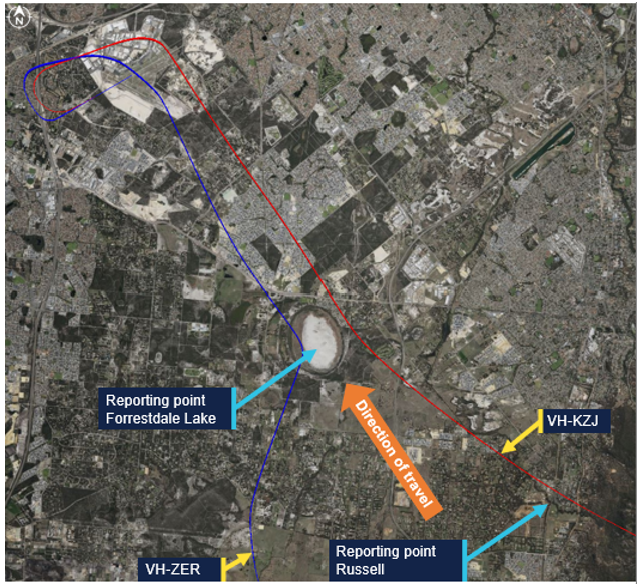
Source: Google Earth with fight radar tracking, annotated by the ATSB
Despite the ATC instruction to overtake the C172, the pilot in the PA-44 reduced the engine power to circuit power, which resulted in the aircraft slowing down. As such, the PA-44 did not overtake the C172 prior to joining the downwind leg of the circuit.[2]
Observing that the PA-44 had not overtaken the C172 as they had anticipated, the controller changed their sequencing plan to have the C172 land first. The table below details the exchange between the pilots and controller and Figure 2 shows where these calls were in relation to the flight paths.
Table 1: Communication
| Time | From | To | Transcript | |
| A | 1127:55 | Controller | C172 | ZER make a left turn, join late downwind RWY 06L maintain 1,500 |
| C172 | Controller | Take a left turn join late downwind 06L and maintain 1,500 ZER | ||
| B | 1128:13 | Controller | PA-44 | KZJ join downwind from that heading, cleared visual approach and follow the Cessna out to your left joining late downwind, high mid downwind |
| 1128:20 | PA-44 | Controller | Join downwind clear, 06L, cleared visual approach KZJ | |
| C | 1128:28 | Controller | C172 | ZER cleared visual approach you’re number one |
| C172 | Controller | Cleared visual approach, number one ZER | ||
| D | 1128:58 | Controller | C172 | ZER that twin has cut you off they’re low in your 12 o’clock |
| C172 | Controller | Yeah we’ve got the company twin, we’ll make number two to them ZER | ||
| Controller | C172 | ZER thanks |
Figure 2: Aircraft track with ATC clearances
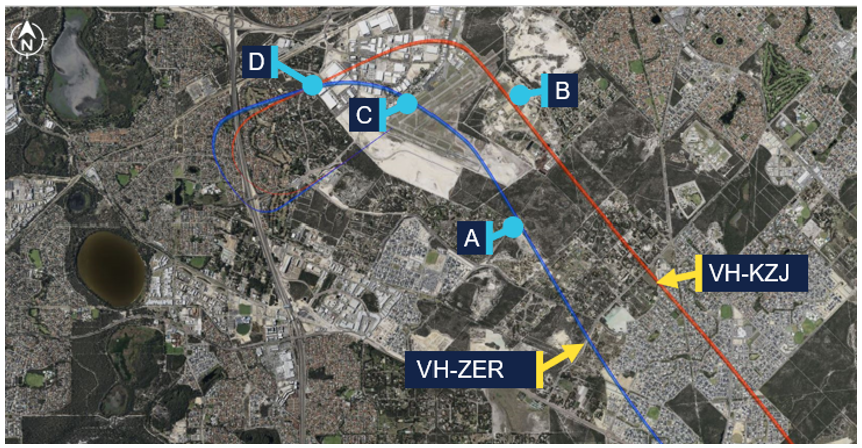
Source: Google Earth with fight radar tracking, annotated by the ATSB
The pilot in the PA-44 reported that, as ATC was issuing its approach clearance, the traffic advisory system (TAS) in the aircraft began audibly alerting. The pilot later advised they were not familiar with the TAS and had never heard the audible alert before. They reported that as their attention was focused on the alert, they did not hear the sequencing part of the instruction to ‘follow the Cessna’. As such, they did not repeat this part of the instruction during the readback of their clearance and believed they were still cleared to pass the C172.
They further advised they had always previously been required to read back the complete sequencing instruction and as they were not prompted for any further readback on this occasion, did not consider that they had not heard the instruction correctly.
The PA-44 continued to overtake the C172 on downwind by descending and accelerating, and then turning inside the C172. The pilot recalled that they thought the sight picture of the close overtake ‘did look a bit odd’, but did not consider questioning the controller.
The instructor in the C172 was also an instructor of the pilot in the PA-44. When hearing their student’s interactions with ATC, they were concerned that the pilot may not have understood the intention of ATC. As such the instructor ensured they maintained visual contact with the PA-44 throughout the sequence.
Both pilots reported that they could see the other aircraft for the duration of the incident.
Context
Pilot details
The pilot of the Piper Aircraft PA-44 held a private pilot licence (aeroplane) and had a class 1 aviation medical certificate. They were undergoing training to obtain their commercial pilot licence (aeroplane) and had a total of 128 hours of flying experience, of which 22 were on the PA-44. They had flown 37 hours in the previous 90 days.
The instructor of the Cessna Aircraft Company 172 (C172) held a commercial pilot licence (aeroplane) with a class 1 aviation medical certificate. They held an instructor and instrument flight rating. They had a total of 1,200 hours of flying experience, of which 390 were on the C172. They had flown 155 hours in the previous 90 days.
Aircraft details
The Piper Aircraft Inc PA-44-180 is 4-seat, low-wing, retractable-undercarriage aircraft with 2 piston engines. VH-KZJ was equipped with the Garmin G1000 avionics suite and optional traffic advisory system (TAS).
The Cessna Aircraft Company 172S is a 4-seat, high-wing, fixed-undercarriage aircraft with one piston engine.
Training
The operator advised that VH-KZJ was the only aircraft in its fleet fitted with the optional traffic advisory system (TAS) with the avionics suite (G1000) and it does not provide formal syllabus training on the TAS. A general awareness was provided during a dual flight, where the TAS system test was conducted as part of the PA-44 (G1000) Normal Checklist – After Start Checklist.
Provision of separation in Class D airspace
In accordance with Aeronautical Information Publication Enroute 1.4-13 as both aircraft were operating under Visual Flight Rules (VFR) in Class D airspace there was no requirement for Air Traffic Control (ATC) to provide separation.
Readback requirements
Airservices Safety net – operating in Class D airspace highlighted the importance of correct readbacks from pilots to prevent frequency congestion. As part of this guidance, it referred pilots to Aeronautical Information Publication (AIP) General (GEN) 3.4.
AIP GEN 3.4 6.6 General Phrases provided the following phraseology when a pilot was assigned and required to maintain separation with a sighted aircraft:
when a pilot is assigned and required to maintain separation with a sighted aircraft ATC are to use the phrase FOLLOW (or MAINTAIN OWN SEPARATION WITH [AND PASS BEHIND]) (aircraft type or identification) [instructions or restrictions].
Manual of Air Traffic Services (MATS) pilot readback requirements stated:
Obtain a readback in sufficient detail that clearly indicates a pilot’s understanding of and compliance with all ATC clearances, including conditional clearances, instructions and information which are transmitted by voice.
MATS further stated that readback discrepancies must be immediately corrected by the controller.
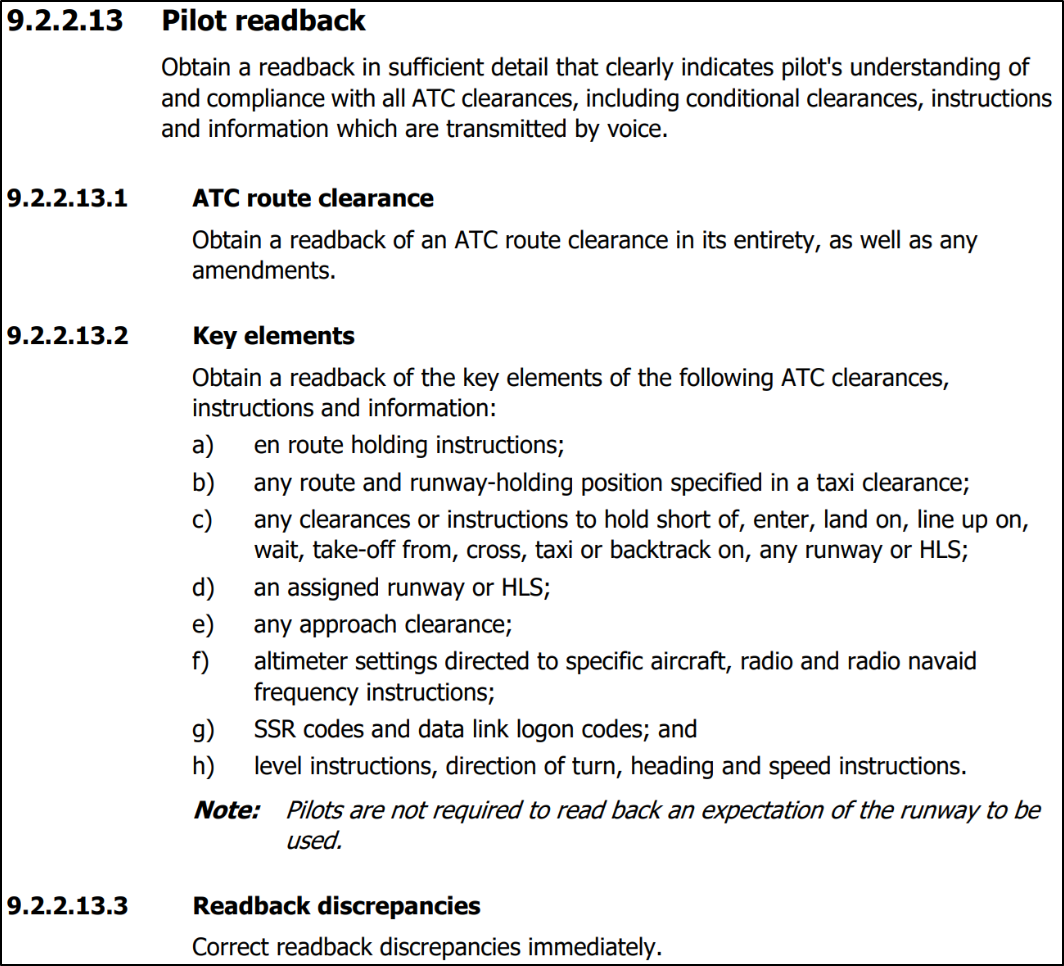
The controller later advised that the ‘follow the’ instruction was not required to be read back as part of the [key elements] readback requirements in MATS (Figure 3), and therefore there was no reason to correct the incomplete readback.
Airservices Australia later confirmed it does not require ‘follow the’ type instructions to be read back.
Figure 3: Manual of air traffic services
Safety analysis
When the air traffic controller identified that the PA-44 had not overtaken the C172 as expected, they amended the PA-44 pilot’s approach clearance to require them to follow it as the second aircraft in the landing sequence. However, when the amended clearance was issued, the pilot’s attention was focused on the aural alert from the traffic advisory system and they did not identify the final part of the instruction to ‘follow the Cessna’. Consequently, and despite recognising that the sight picture was ‘looking a bit odd’, the PA-44 pilot passed the C172 as per the original clearance, resulting in reduced separation between the 2 aircraft.
Contributing factor The PA-44 pilot did not identify the final part of the amended instruction to ‘follow the Cessna’. Consequently, the PA-44 pilot passed the C172 as per the original clearance, resulting in reduced separation between the 2 aircraft. |
Having missed the requirement in the amended clearance to follow the C172, the PA-44 pilot did not include the sequencing information in their readback. Although this was a key element of the revised approach clearance, the pilot’s incomplete readback was not corrected by the controller as they considered that the pilot was not required to read back that instruction. This was a missed opportunity to resolve the situation.
Contributing factor Although a key element of the revised approach clearance, the pilot’s incomplete readback was not corrected by the controller as they considered that the pilot was not required to read back the ‘follow the Cessna’ instruction. |
Safe circuit pattern operation relies on all the involved pilots having a common understanding of the aircraft sequence. Additionally, overarching guidance in the Manual of Air Traffic Services (MATS) required controllers to ‘obtain a readback of sufficient detail that clearly indicates pilots’ understanding of and compliance with all ATC clearances.’ Despite that, MATS did not explicitly require sequencing instructions to be read back as a ‘Key element’ of the approach clearance, providing no assurance that this safety-critical aspect had been correctly understood.
Contributing factor The Manual of Air Traffic Services did not explicitly state that sequencing instructions were required to be read back by a pilot, providing no assurance that this safety-critical aspect had been correctly understood. (Safety issue) |
Finally, the situation awareness maintained by the instructor in the C172 ensured that adequate separation was maintained between the 2 aircraft as the situation developed, possibly preventing a more serious outcome.
Findings
ATSB investigation report findings focus on safety factors (that is, events and conditions that increase risk). Safety factors include ‘contributing factors’ and ‘other factors that increased risk’ (that is, factors that did not meet the definition of a contributing factor for this occurrence but were still considered important to include in the report for the purpose of increasing awareness and enhancing safety). In addition ‘other findings’ may be included to provide important information about topics other than safety factors. Safety issues are highlighted in bold to emphasise their importance. A safety issue is a safety factor that (a) can reasonably be regarded as having the potential to adversely affect the safety of future operations, and (b) is a characteristic of an organisation or a system, rather than a characteristic of a specific individual, or characteristic of an operating environment at a specific point in time. These findings should not be read as apportioning blame or liability to any particular organisation or individual. |
From the evidence available, the following findings are made with respect to the separation occurrence involving Piper PA-44, VH-KZJ, and Cessna 172, VH-ZER, near Jandakot Airport, Western Australia, on 12 June 2025.
Contributing factors
- The PA-44 pilot did not identify the final part of the amended instruction to ‘follow the Cessna’. Consequently, the PA-44 pilot passed the C172 as per the original clearance, resulting in reduced separation between the 2 aircraft.
- Although a key element of the revised approach clearance, the pilot’s incomplete readback was not corrected by the controller as they considered that the pilot was not required to read back the ‘follow the Cessna’ instruction.
- The Manual of Air Traffic Services did not explicitly state that sequencing instructions were required to be read back by a pilot, providing no assurance that this safety-critical aspect had been correctly understood. (Safety issue)
Safety issues and actions
Readback requirements
Safety issue number: AO-2025-033-SI-01
Safety issue description: The Manual of Air Traffic Services did not explicitly state that sequencing instructions were required to be read back by a pilot, providing no assurance that this safety-critical aspect had been correctly understood.
Glossary
| AIP | Aeronautical information publication |
| AMSL | Above mean sea level |
| ATC | Air traffic control |
| MATS | Manual of Air Traffic Services |
| TAS | Traffic Advisory System |
| VFR | Visual Flight Rules |
Sources and submissions
Sources of information
The sources of information during the investigation included:
- the pilots of both aircraft
- the air traffic controller
- Airservices Australia
- ADS-B data for both aircraft
- the operator of both aircraft.
Submissions
Under section 26 of the Transport Safety Investigation Act 2003, the ATSB may provide a draft report, on a confidential basis, to any person whom the ATSB considers appropriate. That section allows a person receiving a draft report to make submissions to the ATSB about the draft report.
A draft of this report was provided to the following directly involved parties:
- pilots of both aircraft
- the air traffic controller
- Airservices Australia
- the operator
- Civil Aviation Safety Authority.
Submissions were received from:
- the air traffic controller
- Airservices Australia
- the operator.
The submissions were reviewed and, where considered appropriate, the text of the report was amended accordingly.
Purpose of safety investigationsThe objective of a safety investigation is to enhance transport safety. This is done through:
It is not a function of the ATSB to apportion blame or provide a means for determining liability. At the same time, an investigation report must include factual material of sufficient weight to support the analysis and findings. At all times the ATSB endeavours to balance the use of material that could imply adverse comment with the need to properly explain what happened, and why, in a fair and unbiased manner. The ATSB does not investigate for the purpose of taking administrative, regulatory or criminal action. About ATSB reportsATSB investigation reports are organised with regard to international standards or instruments, as applicable, and with ATSB procedures and guidelines. Reports must include factual material of sufficient weight to support the analysis and findings. At all times the ATSB endeavours to balance the use of material that could imply adverse comment with the need to properly explain what happened, and why, in a fair and unbiased manner. An explanation of terminology used in ATSB investigation reports is available here. This includes terms such as occurrence, contributing factor, other factor that increased risk, and safety issue. Publishing informationReleased in accordance with section 25 of the Transport Safety Investigation Act 2003 Published by: Australian Transport Safety Bureau © Commonwealth of Australia 2025 
Ownership of intellectual property rights in this publication Unless otherwise noted, copyright (and any other intellectual property rights, if any) in this report publication is owned by the Commonwealth of Australia. Creative Commons licence With the exception of the Commonwealth Coat of Arms, ATSB logo, and photos and graphics in which a third party holds copyright, this report is licensed under a Creative Commons Attribution 4.0 International licence. The CC BY 4.0 licence enables you to distribute, remix, adapt, and build upon our material in any medium or format, so long as attribution is given to the Australian Transport Safety Bureau. Copyright in material obtained from other agencies, private individuals or organisations, belongs to those agencies, individuals or organisations. Where you wish to use their material, you will need to contact them directly. |
Occurrence summary
| Investigation number | AO-2025-033 |
|---|---|
| Occurrence date | 12/06/2025 |
| Location | Near Jandakot Airport |
| State | Western Australia |
| Report release date | 04/12/2025 |
| Report status | Final |
| Investigation level | Defined |
| Investigation type | Occurrence Investigation |
| Investigation status | Completed |
| Mode of transport | Aviation |
| Aviation occurrence category | Operational non-compliance, Separation issue |
| Occurrence class | Incident |
| Highest injury level | None |
Aircraft details
| Manufacturer | Piper Aircraft Corp |
|---|---|
| Model | PA-44-180 |
| Registration | VH-KZJ |
| Serial number | 4496462 |
| Aircraft operator | Airflite Pty Ltd |
| Sector | Piston |
| Operation type | Part 142 Integrated and multi-crew pilot flight training |
| Departure point | Jandakot Airport, Western Australia |
| Destination | Jandakot Airport, Western Australia |
| Damage | Nil |
Aircraft details
| Manufacturer | Cessna Aircraft Company |
|---|---|
| Model | 172S |
| Registration | VH-ZER |
| Serial number | 172S10855 |
| Aircraft operator | Airflite Pty Ltd |
| Sector | Piston |
| Operation type | Part 142 Integrated and multi-crew pilot flight training |
| Departure point | Jandakot Airport, Western Australia |
| Destination | Bunbury Airport, Western Australia |
| Damage | Nil |