

Final report
Report release date: 26/08/2026
Investigation summary
What happened
On 14 April 2026, at approximately 1330 local time, 2 pilots were operating a Cessna 172P, registered VH‑CIY, on a return trip from Tyabb Airport to Latrobe Regional Airport, Victoria.
Approximately 20 minutes into the flight, in the vicinity of Drouin Airport, the engine began to run rough. The pilots misdiagnosed this indication as the effect of carburettor icing, took appropriate mitigation actions and continued the flight. Shortly after, the aircraft experienced an engine failure and the pilots commenced preparations for a forced landing. However, the engine was restarted and the pilots re‑gained altitude and diverted to Drouin Airport.
Before reaching Drouin airport, the engine failed a second time and the crew conducted a forced landing into a paddock. There was no reported damage to the aircraft and no injuries to the crew. Inspection of the aircraft’s fuel tanks showed that no fuel was on board.
What the ATSB found
The fuel dipstick used to establish the amount of fuel in the aircraft’s tanks was not calibrated correctly for the aircraft. This resulted in the pilots having an incorrect understanding of the amount of fuel on board. The ATSB was unable to establish how the incorrectly calibrated dipstick came to be in use, and it had no marks to identify it as being calibrated for a particular aircraft.
The pilots relied solely on their pre‑flight fuel quantity dipstick measurement to form an understanding of the fuel on board the aircraft. They did not refer to the fuel indicators (gauges) to crosscheck the fuel status.
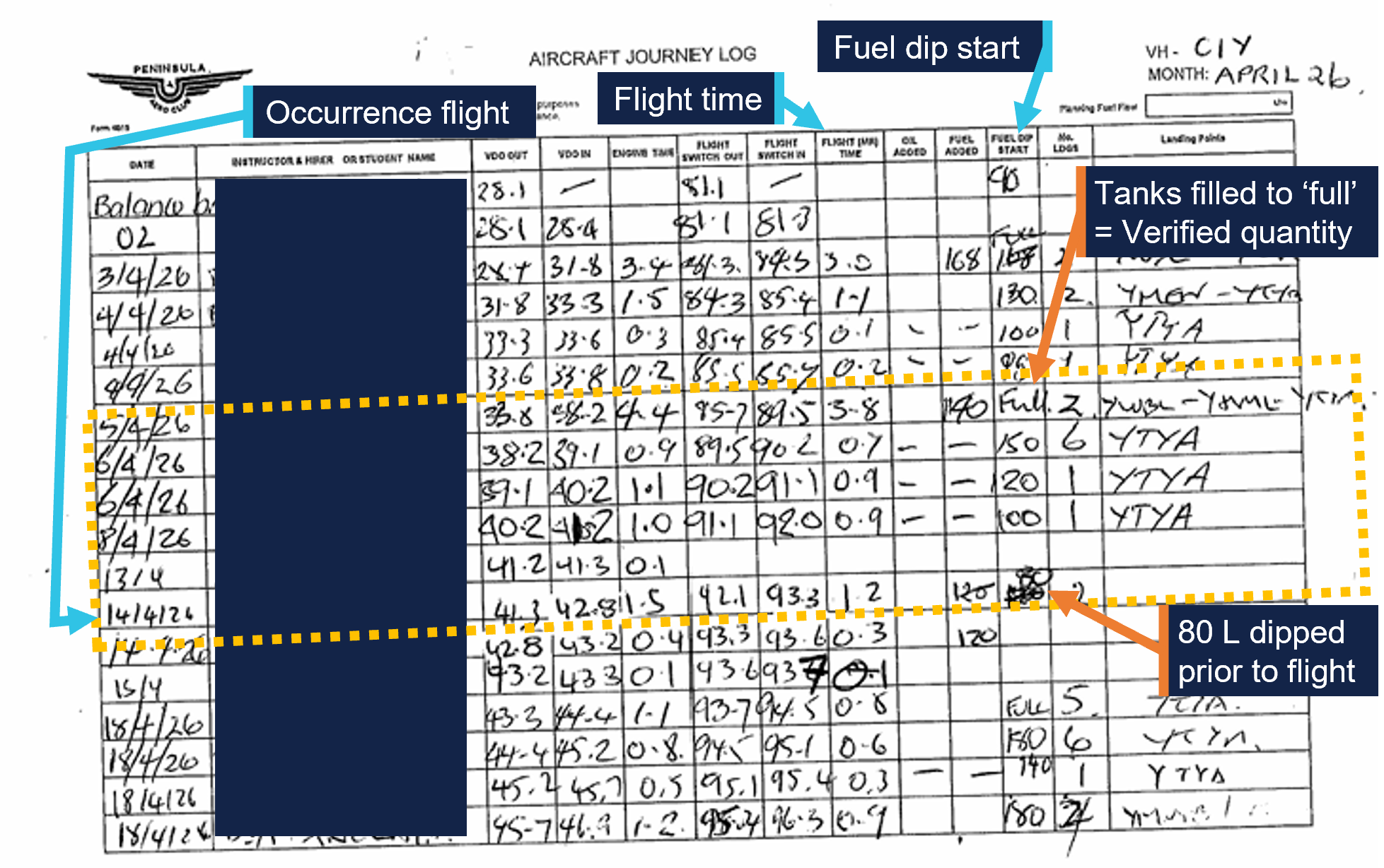
Additionally, the operator’s journey log used for pilots to record the fuel on board the aircraft only included the dipstick measurement and any fuel uplift. This did not allow the pilots and operator to readily crosscheck across different verification methods to identify fuel on board discrepancies, such as the incorrectly calibrated dipstick.
What has been done as a result
The operator organised for a new, correctly‑calibrated dipstick to be installed in the aircraft. In addition, the operator debriefed the pilots on fuel management issues and reported using the occurrence as a case study in training. The operator also reported introducing a revised fuel checking and recording process and conducting a fleetwide review of fuel measurement equipment.
Safety message
This occurrence highlights the importance of establishing a known fuel status regularly and the need to use multiple sources to determine and crosscheck the fuel on board. Unless the aircraft’s fuel tanks are completely full, sole reliance on one verification method can leave the operation vulnerable to fuel exhaustion or starvation.
The recording and comparison of fuel consumption, uplift and fuel on board can allow for error checks to identify discrepancies that can arise from issues such as fuel leaks and faulty equipment (dipsticks and indicators).
Further reading is available in the ATSB research report, Starved and exhausted: Fuel management aviation accidents (AR‑2011‑112). This report discusses methods that pilots can use to ensure they will have sufficient fuel to land at their destination.
The investigation
| The ATSB scopes its investigations based on many factors, including the level of safety benefit likely to be obtained from an investigation and the associated resources required. For this occurrence, the ATSB conducted a limited‑scope investigation in order to produce a short investigation report, and allow for greater industry awareness of findings that affect safety and potential learning opportunities. |
The occurrence
On 14 April 2026 at approximately 1230 local time, 2 pilots (both instructors) and 2 passengers (company pilots) departed Tyabb Airport, Victoria, in a Cessna 172P, registered VH‑CIY and operated by Peninsula Aero Club, for Latrobe Regional Airport, Victoria, as part of a 2‑sector flight. The occurrence flight was the return sector to Tyabb, after the passengers had disembarked at Latrobe (Figure 1).
Figure 1: The 2 sectors flown prior to forced landing
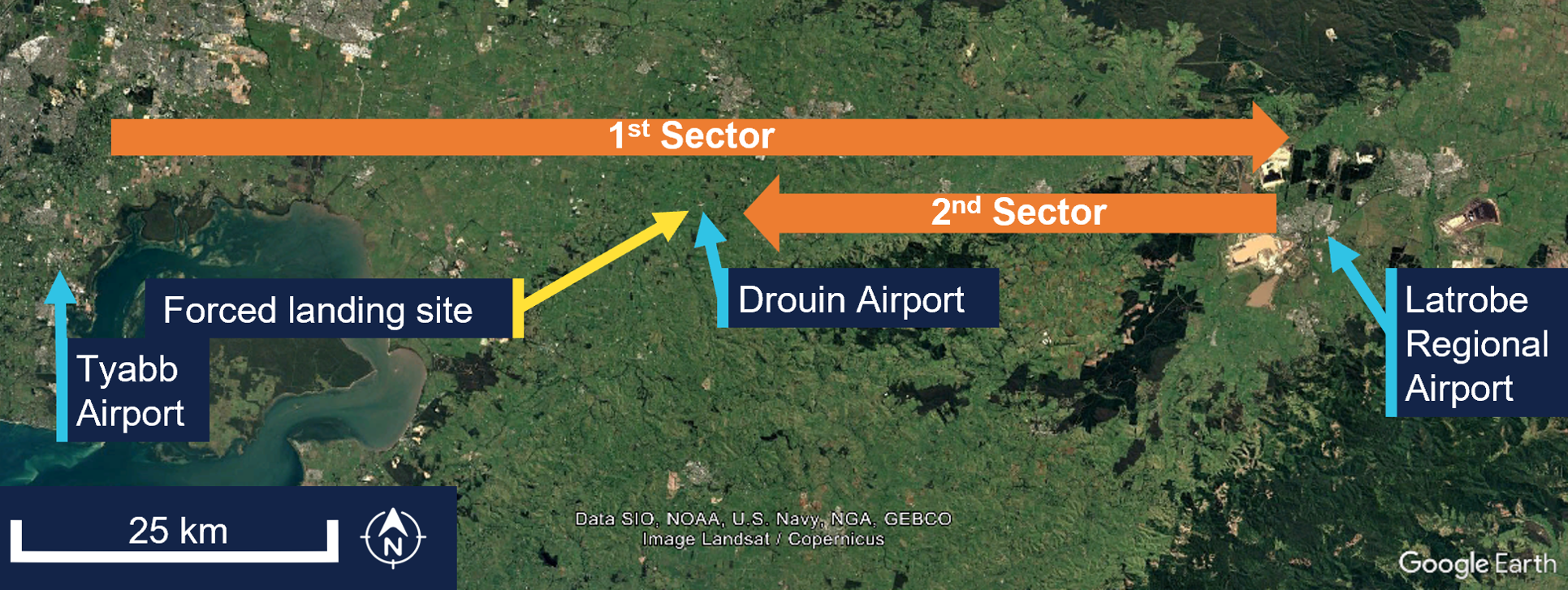
Peninsula Aero Club advised that both sectors were being conducted as a general competency flight1 for the pilot in command under supervision (PICUS), who was the pilot flying. The PICUS occupied the right‑hand seat and the pilot in command (PIC), occupied the left‑hand seat. In post‑occurrence interviews, the PICUS reported the same understanding as the operator as to the roles and responsibilities of each pilot. However, the left‑seat pilot understood their role was as a safety pilot,2 as opposed to PIC for general competency training for the PICUS.
Prior to departing Tyabb on the first sector, the PICUS generated a flight plan and conducted the aircraft preflight inspections. During preflight inspection, the PICUS used the fuel dipstick and measured the fuel on board (FOB) as 80 L (40 L in each tank). The pilots determined that this amount of fuel was sufficient to allow a return flight to Latrobe. The pilots reported that they did not refer to the aircraft’s fuel indicator (gauge) prior to, or during, either flight.
The flight from Tyabb to Latrobe was uneventful, and the aircraft was on the ground at Latrobe for approximately 5 minutes while the passengers disembarked. No further assessment was made of the FOB before the instructors commenced the second sector.
At approximately 1330 the aircraft departed Latrobe for Tyabb, climbing to a cruising altitude of 2,500 ft which was just below the cloud base.
In the vicinity of Drouin Airport, around 1346, the pilots reported that the engine started to run rough (Figure 2).
Figure 2: Flight path from engine first ‘running rough’ to forced landing site
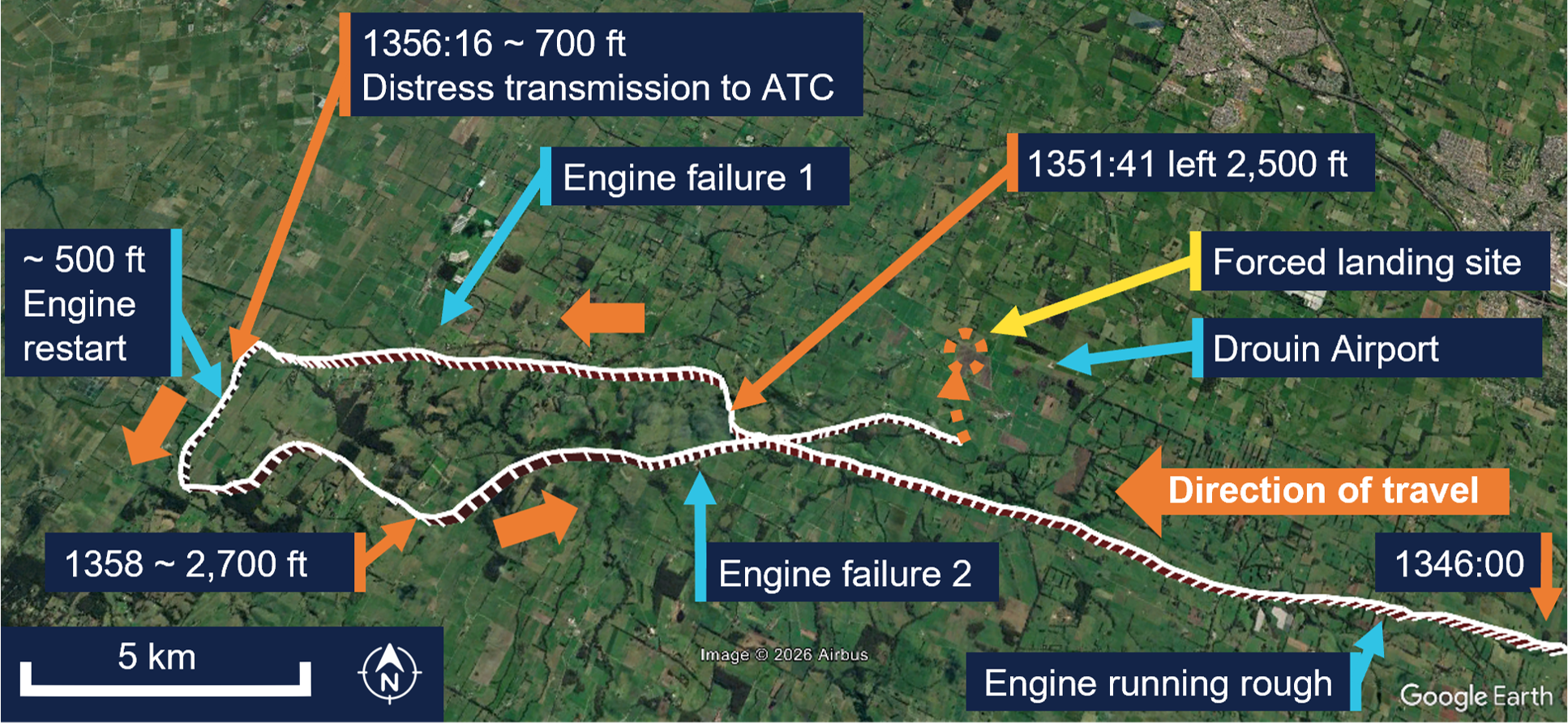
As the pilots were flying just below the cloud base, they suspected that the rough running engine was a consequence of carburettor ice.3 In response they descended to 2,000 ft and applied carburettor heat in an attempt to resolve the issue. The engine then ran normally.
Shortly after, approximately 5 NM (9 km) to the west of Drouin Airport, the aircraft experienced an engine failure, which led the pilots to commence preparation for a forced landing.
At 1356:16, 16 NM (30 km) south‑west of Drouin, the aircraft squawked 7700,4 identifying to air traffic control (ATC) that they were in distress. This prompted the controller to contact the pilots about 10 seconds later, whereby the pilots advised they had suffered an engine failure.
At approximately 500 ft above ground level (AGL), the engine was restarted. At 1358, the pilots then advised ATC that they had regained full power and were diverting to Drouin Airport, maintaining an altitude of approximately 2,700 ft.
A few minutes later, approximately 3 NM (5.5 km) west of Drouin, the aircraft experienced another engine failure.
At 1402, ATC lost surveillance identification of the aircraft when it descended through 1,200 ft, south of Drouin Airport.
The crew conducted a forced landing in a paddock 1.5 NM (3 km) from Drouin Airport at approximately 1411. There were no injuries to the crew or damage to the aircraft.
After landing, the pilots identified that the aircraft’s fuel tanks were empty. An inspection of the aircraft was then carried out by the operator’s licensed aircraft maintenance engineer, before it was refuelled and flown to Tyabb airport.
Once the aircraft was back at Tyabb airport the operator established that the aircraft’s dipstick was over‑reading the amount of FOB. A new dipstick was manufactured and calibrated to the aircraft.
Context
Pilot information
Pilot in command
The pilot in command (PIC) held a Commercial Pilot Licence (Aeroplane), grade 2 instructor rating and had a class 1 aviation medical certificate. They had a total of 685 hours flying experience, of which 38 were on the Cessna 172. They had flown 86 hours in the previous 90 days.
Pilot in command under supervision
The pilot in command under supervision (PICUS) held a Commercial Pilot Licence (Aeroplane), a grade 3 instructor rating and had a class 1 aviation medical certificate. They had a total of 230 hours flying experience, of which 46 were on the Cessna 172. They had flown approximately 10 hours in the previous 90 days.
Meteorological information
Meteorological information recorded at 1300 at Latrobe regional airport:
- wind from 270° at 13 kt
- visibility greater than 10 km
- cloud overcast at 4,300 ft
- temperature was 17°C and dew point 12°C
- QNH5 of 1,019 hectopascals.
The area forecast indicated a cloud base of broken6 at 3,500 ft.
En route the pilots reported flying just below the cloud base, at 2,500 ft.
Aircraft information
The Cessna 172P Skyhawk is a 4‑seat, single‑engine, high‑wing aircraft.
VH‑CIY, serial number 17274321, was manufactured in 1980 in the United States and registered in Australia on 8 May 1981. The aircraft was powered by a Lycoming O‑320‑D2J engine.
Fuel system
VH‑CIY was fitted with 2 integral fuel tanks that held 257 L (68 gallons), of which 235 L (62 gallons) was usable.7 This was divided into approximately 115 L of usable fuel in each tank.
Fuel management
Regulatory guidance
The operational goal of effective fuel management is to ensure protection of fuel reserves to allow safe completion of flight. Part 91 of the Civil Aviation Safety Regulations (CASR) required fuel to be planned, uplifted, and managed to ensure that an aircraft is landed with not less than the required final reserve fuel on board.
The Part 91 Manual of Standards (MOS) stated that the pilot must ensure that the amount of useable fuel on board is determined before the flight commences and checked at regular intervals throughout the flight. Furthermore, the Civil Aviation Safety Authority’s advisory circular (AC) 91‑15 provided guidance that:
a cross‑check should use at least two different verification methods to determine the amount of fuel on board.
Operator fuel policy
The operator’s fuel policy was consistent with the Part 91 MOS and guidance. The procedures required pilots to make a determination of fuel on board before the flight, by crosschecking the fuel quantity indicator readings with a visual confirmation (e.g. dipstick reading) or calculated value (e.g. aircraft journey log or flight plan) (see Fuel verification methods).
In addition, pilots were required to conduct fuel checks at 30‑minute intervals by cross‑referencing the fuel remaining on the aircraft’s indicators with the calculated fuel in the aircraft’s journey log.
Fuel verification methods
Pilots could determine the amount of fuel on board by:
- a visual assessment of the fuel in the tanks (dipstick or filling the tanks to capacity)
- referring to the aircraft’s fuel indicators
- utilising administrative methods.
Fuel dipstick
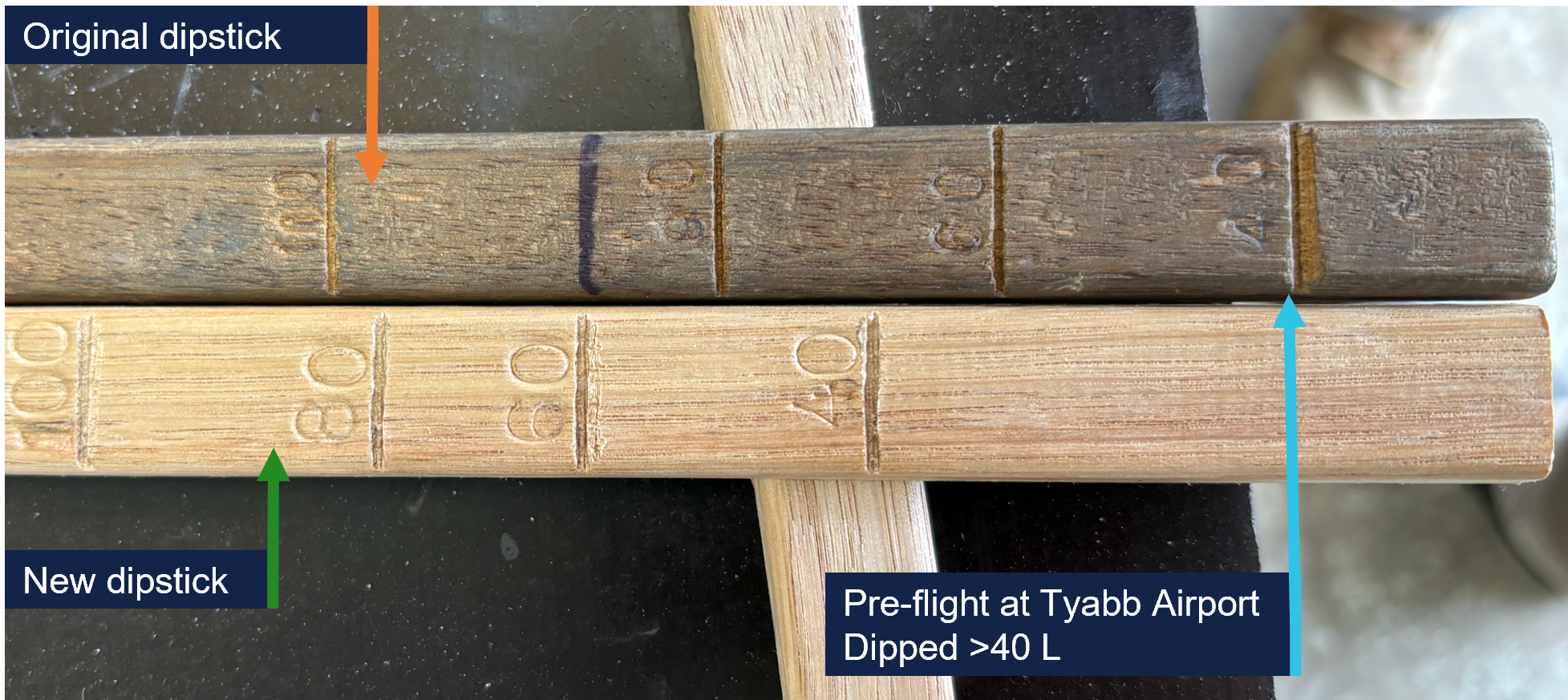
The use of a dipstick as a tool to assess the amount of FOB is a common, accepted practice in general aviation. VH‑CIY was equipped with a dipstick that had the aircraft registration recorded on it and had been on‑board the aircraft since before 2022. The dipstick was normally carried with the aircraft.
Post‑occurrence, the aircraft’s dipstick was found to be incorrectly calibrated to the amount of FOB, and a new, calibrated dipstick was subsequently generated. Figure 3 shows the variation between the 2 dipsticks and the indication for recorded FOB when checked at Tyabb (40 L per side). The ATSB was unable to establish how the incorrectly calibrated dipstick came to be in use.
Figure 3: Old dipstick and new dipstick
Fuel indicators
The fuel quantity was measured by 2 float‑type fuel quantity transmitters (one in each tank) and indicated by 2 electrically operated fuel quantity indicators on the left side of the instrument panel. An empty tank was indicated by a red line and the letter E (Figure 4). A placard giving a conversion to fuel in litres from the indicated quantity in pounds (LBS) was also placed below the fuel indicators.
Figure 4: Fuel quantity indicators and placard on the aircraft
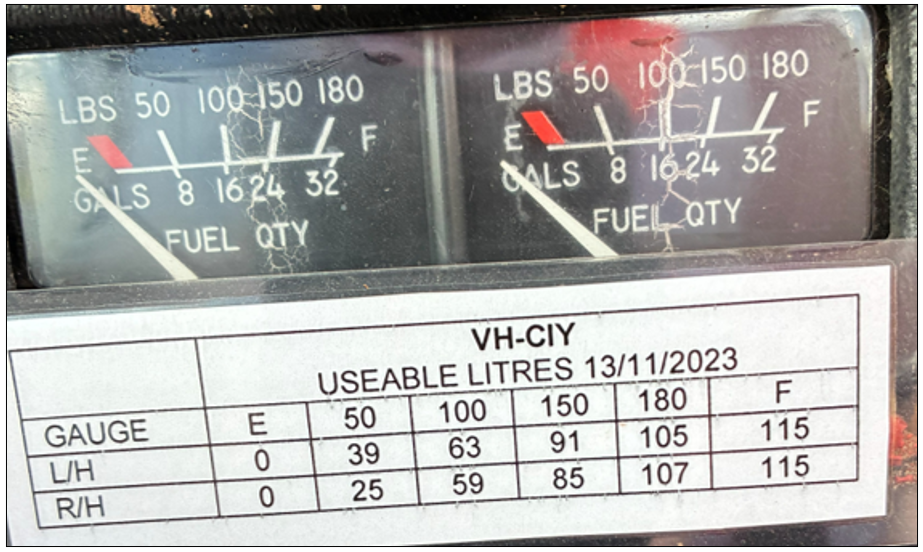
Fuel calibrations had been carried out as part of the Civil Aviation Order (CAO) 100.58 requirements on 13 November 2023. The Head of Operations9 reported that the fuel indications observed on this aircraft were considered accurate at the time.
The pilots involved in the occurrence reported not trusting the fuel indications on the aircraft and instead relied on the dipstick indication to develop an understanding of the FOB. The PICUS advised that this was in part due to the aircraft’s fuel quantity indicators not accurately reflecting the fuel quantity measured by the dipstick. Both pilots reported that they trusted the dipstick measurement.
Fuel indicators must have a required degree of accuracy as part of the airworthiness requirements of the aircraft. However, the accuracy of fuel indicator readings between the extremes of ‘full’ and ‘empty’, particularly on smaller aircraft like the Cessna 172, can be influenced by a number of factors, including:
- having a coarse, non‑linear scale
- float movement in the tank due to turbulence, aircraft movement or the attitude of the aircraft
- manufacture tolerance
- gauge/indicator calibration differences
- electrical system faults influencing the input and output readings.
Administrative methods
The operator’s procedures included the following administrative process for identification of significant discrepancies between fuel quantity verification methods:
Upon returning from a flight, pilots are required to complete all relevant fuel documentation including the journey log [Form 4B15] with the amount of fuel at shut‑down. Any significant fuel quantity discrepancy variation between actual fuel on‑board (gauge) and completed journey log is reported to a qualified licenced aircraft maintenance engineer for further investigation.
Figure 5 shows an excerpt from VH‑CIY’s aircraft journey log (Form 4B15). Of relevance to fuel use, the log had columns to record the flight time, fuel dip measurement at startup and any fuel added. However, there was no column to record the fuel amount indicated on the cockpit instruments nor any planned fuel usage.
Nine days prior to the occurrence (5 April) the aircraft journey log indicated that the tanks were filled to ‘full’ (235 L). After this, 7.5 flying hours were recorded (as well as a maintenance event of 0.1 hours on 13 April) prior to the occurrence flight on 14 April.
While not recorded on the journey log, the operator provided a fuel record indicating that 80 L of fuel was added to VH‑CIY at the halfway point (1.9 hours) of the flight on 5 April 2026, which reportedly refilled the tanks to full. This indicated that the fuel was exhausted from full tanks after a total of 5.6 logged flight hours.
Figure 5: VH‑CIY aircraft journey log
Pilot fuel planning
The operator’s procedures required the pilot to use a fuel consumption planning rate of 36 L per hour and a fixed reserve of 45 minutes. The PICUS complied with the operator’s procedures and used this rate, resulting in them calculating that 78 L of fuel was required to complete the 2 sectors.
This fuel planning figure was more conservative than that in the Cessna 172P aircraft flight manual (AFM), which indicated that the engine’s fuel consumption was 30 L/hr when operating at 70% power and 2,500 RPM, at an altitude of between 2,000 ft and 4,000 ft.
The fixed reserve was also more conservative than that required for daytime VFR operations, which was 30 minutes.
Related occurrences
The ATSB has investigated a number of previous occurrences of fuel exhaustion in smaller aircraft due to insufficient pilot awareness of fuel on board.
Fuel exhaustion involving Aero Commander 500‑S, VH‑MEH, 6 km east of Bathurst Airport, New South Wales, on 8 March 2024 (AO‑2024‑008)
On 8 March 2024, the pilot of an Aero Commander 500‑S flew 2 sectors where the fuel cap was found to be off after landing, secured only by the retention chain. After the second flight, a maintenance engineer rectified an issue that was preventing the cap from locking.
Later the same day, shortly after departing Bathurst for the final sector, both engines lost power and the pilot conducted a forced landing in a field.
The ATSB found that fuel had been syphoned overboard while the fuel cap was off during the first 2 flights. While the pilot identified a discrepancy between the expected fuel remaining and the aircraft’s indicators after an earlier sector, they did not amend the flight log or fill with fuel to a known quantity. As such, there was insufficient fuel on board to complete the remaining flights.
The pilot likely did not monitor the fuel indicator after this time and continued to use fuel calculations based on an incorrect fuel quantity. This resulted in fuel exhaustion shortly after the aircraft departed from Bathurst.
On 2 March 2018 a Cessna 441 Conquest was on descent into Broome, Western Australia, when the ‘fuel level low’ annunciators illuminated, despite both fuel quantity gauges indicating sufficient fuel on board. Both engines subsequently lost power and were unable to be restarted. The pilot landed the aircraft safely on the nearby highway.
The ATSB found that, due to water contamination in the fuel tanks, the aircraft’s fuel quantity gauges were found to have been significantly over‑reading on the day of the occurrence and on previous days.
Although the pilot routinely compared indicated versus calculated fuel quantities, and indicated versus flight‑planned fuel quantities, the pilot did not routinely conduct 2 other methods stated in the operator’s procedures for crosschecking fuel quantity gauge indications.
Pilots also did not record (and were not required to record) sufficient information on flight logs to enable trends or patterns in fuel quantity gauge indications to be effectively identified, and pilots did not routinely crosscheck information from the fuel quantity gauge indications with information from the independent fuel totaliser.
Fuel exhaustion and forced landing involving Beech 58, VH‑PBU, 6 km north of Normanton Airport, Queensland, on 26 June 2017 (AO‑2017‑067)
On the morning of 15 June 2017, about 10 NM north of Normanton, Queensland, the pilot of a Beech 58 experienced an engine failure due to fuel exhaustion. The pilot was not injured, however, the aircraft sustained substantial damage.
The ATSB found that the aircraft had been refuelled that morning with only half of the requested amount (400 L), but this was not detected by the pilot due to a calculation error on the fuel delivery receipt. The pilot therefore added an incorrect amount of fuel to the fuel log, which was not detected over a number of subsequent flights before the occurrence on 26 June.
In addition, the refuelling procedures did not require a crosscheck against the fuel meter readings. Therefore, the refueller also did not detect the error until the end of the day and ultimately did not communicate the error to the pilot or operator.
Safety analysis
Preflight fuel quantity measurement
During the preflight inspections prior to the first planned flight, the pilot in command under supervision used the aircraft’s dipstick to measure the fuel quantity. However, because the dipstick was not calibrated correctly to the fuel on board (FOB) the aircraft, the fuel available was significantly less than the fuel measured.
The pilots were not aware that the dipstick was incorrectly calibrated for the aircraft, resulting in the pilot having an incorrect understanding of the fuel available to complete the planned flights.
Contributing factor The dipstick used to determine fuel on board was not calibrated for the aircraft. This resulted in the pilot’s understanding of the amount of fuel on board being incorrect. |
Awareness of fuel on board
While it was operator policy to conduct fuel checks at regular intervals, the pilots did not cross‑reference the measured or expected amount of FOB with the aircraft’s fuel indicators in preparation for, or during, either flight. As such, the pilot’s understanding of fuel on board the aircraft was essentially based on the incorrectly calibrated dipstick and planned fuel consumption.
Had the pilots cross‑referenced the dipped measurement against the fuel indicators prior to departure from Tyabb Airport, there would have been a perceptible difference between the dipped FOB and the (estimated) indications (Figure 6). However, one of the reasons that the pilots did not refer to the fuel indicators was their belief that they did not read correctly. This perception appears to have been influenced by the incorrectly calibrated dipstick, and their trust in physically measuring the fuel quantity with it.
Contributing factor Both pilots relied on the pre‑flight fuel quantity measurement and did not use the fuel indicators to crosscheck the amount of fuel on board, prior to or during either flight. |
Figure 6: Estimated discrepancy between expected and actual fuel indications on Tyabb departure
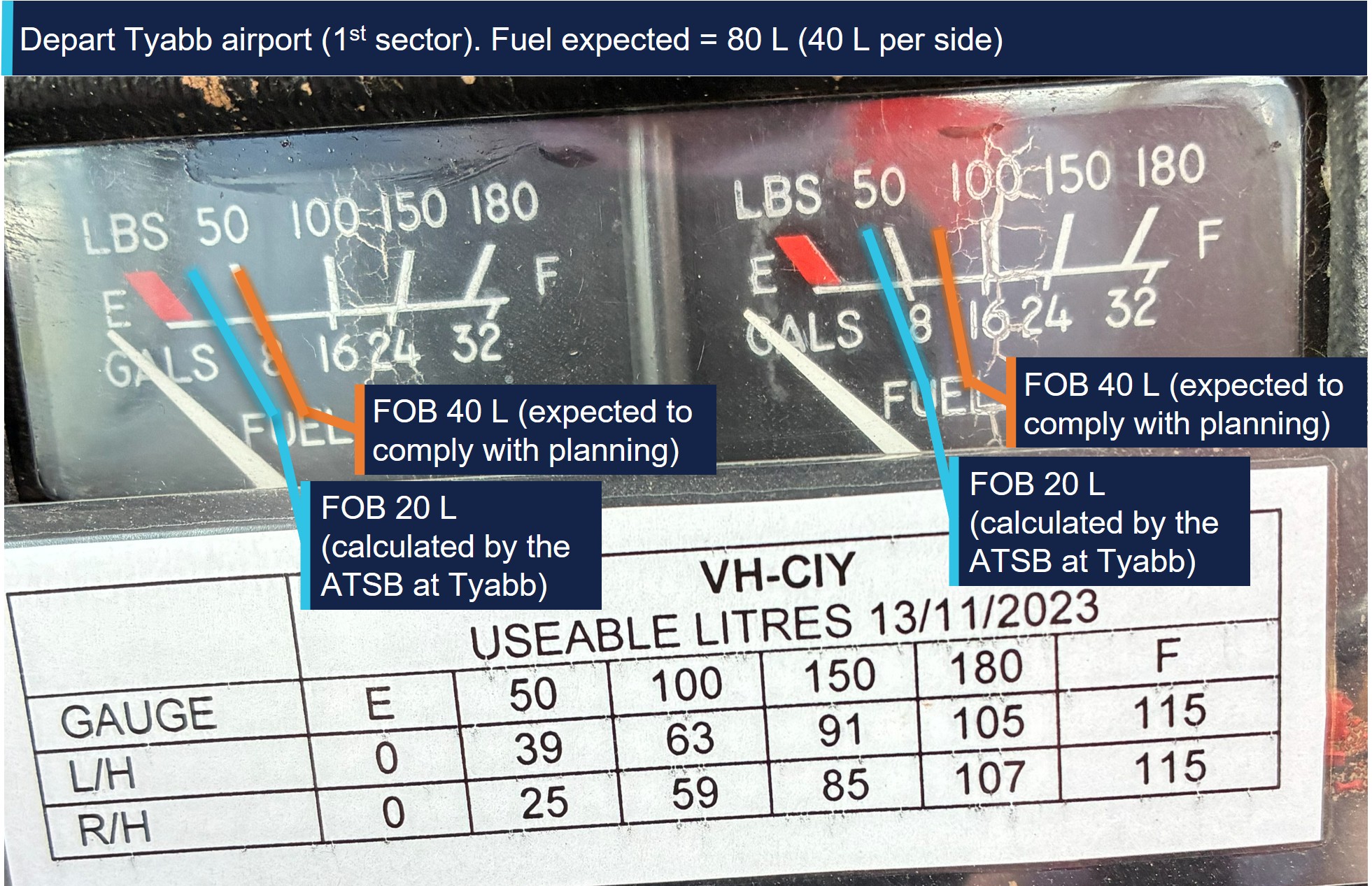
While the precision or readability of fuel indicators on some aircraft can be influenced by numerous factors, VH‑PLY’s indicators had been calibrated to a volume in litres in 2023. Therefore, allowing for precision errors, any significant discrepancy between the indicators and the dipstick measurement would have almost certainly indicated an error in one of the two verification methods. As it was, by not referring to the fuel indicators, the pilots removed an opportunity to identify the fuel discrepancy.
Cross‑referencing fuel quantity
One of the operator’s fuel management procedures was to record and cross‑reference fuel quantity at aircraft shutdown, between the fuel indicator and the completed ‘journey log’. This was intended to identify any inconsistency in fuel quantity, so that discrepancies could be identified and investigated. However, the fact that the incorrectly calibrated dipstick had been on board this aircraft for a number of years without detection indicated that this procedure was not effective at finding discrepancies.
The administrative process to monitor fuel was limited to recording the volume of any fuel added, and the fuel dipstick reading. There was no space or prompt on the journey log to enable the pilots to document fuel indicated and planned fuel usage to facilitate a comparison between fuel verification methods. Had there been, noting the fuel dipstick calibration error was significant, the existing discrepancy would have very likely been identified prior to the occurrence. Similarly, the 80 L fuel uplift that was not recorded in the journey log, should also have presented as a significant discrepancy across fuel verification methods and warranted further investigation in accordance with the operator’s procedures.
Contributing factor The Peninsula Aero Club’s form for pilots to record measurements of fuel on board the aircraft only included one verification method. This did not allow the pilots and operator to readily crosscheck across different verification methods to identify fuel on board discrepancies. |
Findings
ATSB investigation report findings focus on safety factors (that is, events and conditions that increase risk). Safety factors include ‘contributing factors’ and ‘other factors that increased risk’ (that is, factors that did not meet the definition of a contributing factor for this occurrence but were still considered important to include in the report for the purpose of increasing awareness and enhancing safety). In addition ‘other findings’ may be included to provide important information about topics other than safety factors. These findings should not be read as apportioning blame or liability to any particular organisation or individual. |
From the evidence available, the following findings are made with respect to the fuel exhaustion resulting in a forced landing, involving Cessna 172P, VH‑CIY, 58 km west of Latrobe Regional Airport, Victoria, on 14 April 2026.
Contributing factors
- The dipstick used to determine fuel on board was not calibrated for the aircraft. This resulted in the pilot’s understanding of the amount of fuel on board being incorrect.
- Both pilots relied on the pre‑flight fuel quantity measurement and did not use the fuel indicators to crosscheck the amount of fuel on board, prior to or during either flight.
- The Peninsula Aero Club’s form for pilots to record measurements of fuel on board the aircraft only included one verification method. This did not allow the pilots and operator to readily crosscheck across different verification methods to identify fuel on board discrepancies.
Safety actions
| Whether or not the ATSB identifies safety issues in the course of an investigation, relevant organisations may proactively initiate safety action in order to reduce their safety risk. All of the directly involved parties are invited to provide submissions to this draft report. As part of that process, each organisation is asked to communicate what safety actions, if any, they have carried out to reduce the risk associated with this type of occurrences in the future. The ATSB has so far been advised of the following proactive safety action in response to this occurrence. |
Safety action
After the occurrence, Peninsula Aero Club identified that the aircraft’s fuel dipstick did not correctly reflect the amount of fuel on board the aircraft and organised for a new, correctly calibrated dipstick to be installed in the aircraft.
The operator also debriefed the pilots on fuel management issues and reported using the occurrence as a case study in training. The operator also reported introducing a revised fuel checking and recording process and conducting a fleetwide review of fuel measurement equipment.
Sources and submissions
Sources of information
The sources of information during the investigation included:
- the pilots
- the operator
- Civil Aviation Safety Authority
- Airservices Australia.
Submissions
Under section 26 of the Transport Safety Investigation Act 2003, the ATSB may provide a draft report, on a confidential basis, to any person whom the ATSB considers appropriate. That section allows a person receiving a draft report to make submissions to the ATSB about the draft report.
A draft of this report was provided to the following directly involved parties:
- pilot in command
- pilot in command under supervision
- operator
- Civil Aviation Safety Authority
- Airservices Australia.
Submissions were received from:
- pilot in command
- operator.
The submissions were reviewed and, where considered appropriate, the text of the report was amended accordingly.
Purpose of safety investigationsThe objective of an ATSB safety investigation is to improve transport safety through:
In accordance with the TSI Act, the ATSB does not investigate for the purpose of taking administrative, regulatory or criminal action, and cannot apportion blame, assist in determining liability, or, as a general rule, assist in court proceedings. About ATSB reportsATSB safety investigation reports are developed in accordance with ATSB procedures and guidelines, and with regard to applicable international standards and instruments. Reports must include factual material of sufficient weight to support the investigation’s analysis and findings. At all times the ATSB endeavours to balance the use of material that could imply adverse comment with the need to properly explain what happened, and why, in a fair and unbiased manner. An explanation of terminology used in ATSB investigation reports is available here. Publishing informationReleased in accordance with section 25 of the Transport Safety Investigation Act 2003 Published by: Australian Transport Safety Bureau © Commonwealth of Australia 2026 Ownership of intellectual property rights in this publication Unless otherwise noted, copyright (and any other intellectual property rights, if any) in this report publication is owned by the Commonwealth of Australia. Creative Commons licence 
With the exception of the Commonwealth Coat of Arms, ATSB logo, and photos and graphics in which a third party holds copyright, this report is licensed under a Creative Commons Attribution 4.0 International licence. The CC BY 4.0 licence enables you to distribute, remix, adapt, and build upon our material in any medium or format, so long as attribution is given to the Australian Transport Safety Bureau. Copyright in material obtained from other agencies, private individuals or organisations, belongs to those agencies, individuals or organisations. Where you wish to use their material, you will need to contact them directly. |
- ^ The general competency rule is a requirement under CASR 61.385 to address the requirements for a pilot to be competent to safely conduct the operation.
- ^ A safety pilot is a pilot who is current and qualified to act as pilot in command (PIC) on the class/type of aeroplane and carried on board the aeroplane for the purpose of taking over control should the person acting as the PIC become incapacitated.
- ^ Carburettor icing can restrict the air intake to an engine and result in power loss, a rough running engine, or complete engine failure. It typically occurs at lower temperatures when moisture is present.
- ^ 7700 is the transponder code transmitted by an aircraft to identify an emergency situation to air traffic control.
- ^ The altimeter barometric pressure subscale setting used to indicate the height above mean seal level.
- ^ ‘Broken’ indicates that more than half to almost all the sky is covered by cloud.
- ^ The amount of fuel which is available in the fuel tanks for supply to the engine(s). Due to their design, fuel tanks will generally have an amount of fuel that is unable to be used.
- ^ Civil Aviation Order 100.5 (General requirements in respect of maintenance of Australian aircraft) 2011, Appendix 1, clause 6 notes that the indicated quantity of fuel must equal the actual fuel in the fuel tank less the unusable quantity of fuel and fuel quantity gauges must be checked for accuracy at all major graduations.
- ^ The Head of Operations is responsible for the effective management and oversight of all flight training activities.
Occurrence summary
| Investigation number | AO-2026-072 |
|---|---|
| Occurrence date | 14/04/2026 |
| Occurrence time and timezone | 14:11 Australian Eastern Standard Time |
| Location | 58 km west of Latrobe Regional Airport |
| State | Victoria |
| Report release date | 26/08/2026 |
| Report status | Final |
| Investigation level | Short |
| Investigation type | Occurrence Investigation |
| Investigation phase | Final report: Dissemination |
| Investigation status | Completed |
| Mode of transport | Aviation |
| Aviation occurrence category | Forced/precautionary landing, Fuel exhaustion |
| Occurrence class | Serious Incident |
| Highest injury level | None |
Aircraft details
| Manufacturer | Cessna Aircraft Company |
|---|---|
| Model | 172P |
| Registration | VH-CIY |
| Serial number | 17274321 |
| Aircraft operator | Peninsula Aero Club |
| Sector | Piston |
| Operation type | Part 91 General operating and flight rules |
| Activity | General aviation / Recreational-Instructional flying-Instructional flying - dual |
| Departure point | Latrobe Regional Airport, Victoria |
| Destination | Tyabb Airport, Victoria |
| Injuries | None |
| Damage | Nil |