

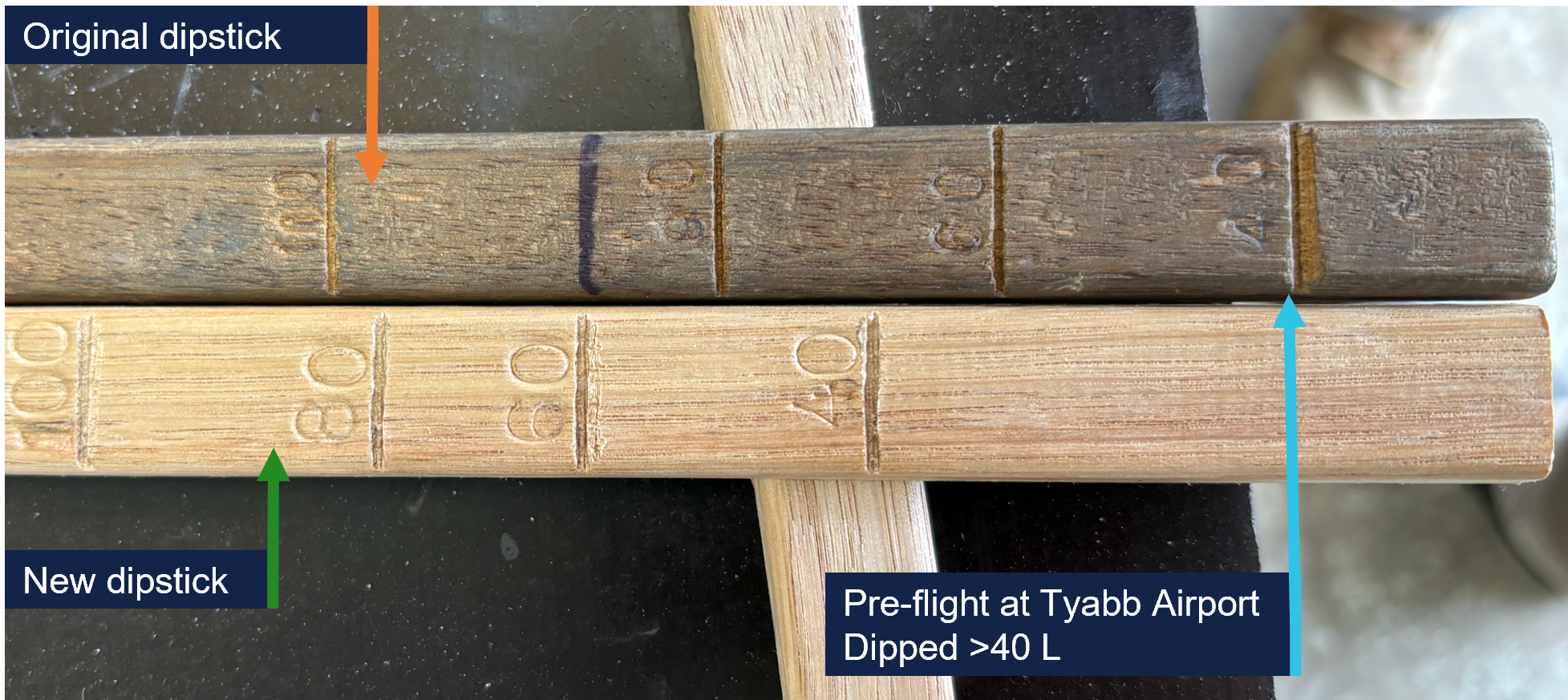
The forced landing in a paddock of a Cessna 172 with 2 instructors on board following fuel exhaustion highlights to pilots the importance of regularly crosschecking their aircraft’s fuel status.
An ATSB investigation report details that on the afternoon of 14 April 2026, the Peninsula Aero Club‑operated Cessna 172P was conducting a return flight to Tyabb from Latrobe Regional Airport, Victoria, as a general competency flight for the pilot in command under supervision.
Approximately 20 minutes into the flight, the engine began to run rough, which the pilots misdiagnosed as due to carburettor icing. In response they descended to 2,000 ft and applied carburettor heat. The engine then ran normally.
“Shortly after, the aircraft experienced an engine failure and the pilots began preparing for a forced landing,” explained ATSB Director Transport Safety Dr Stuart Godley.
“The engine was able to be restarted and the pilots regained altitude and diverted to Drouin Airport.”
However, a few minutes later, approximately 3 NM (5.5 km) west of Drouin, the aircraft experienced a second engine failure.
The pilots then conducted a forced landing in a paddock 1.5 NM (3 km) from Drouin Airport. There were no injuries to the crew or damage to the aircraft.
“After landing, the pilots identified that the aircraft’s fuel tanks were empty,” said Dr Godley.
“An inspection of the aircraft was then carried out by the operator’s licensed aircraft maintenance engineer, before it was refuelled and flown to Tyabb.”
Once the aircraft was back at Tyabb the operator established that the aircraft’s dipstick was over‑reading.
“This resulted in the pilots having an incorrect understanding of the amount of fuel on board,” Dr Godley said.
The investigation found the pilots relied solely on their pre‑flight fuel quantity dipstick measurement to form an understanding of the fuel on board the aircraft, and did not refer to the fuel gauges to crosscheck the fuel status.
It was not possible to establish to establish how the incorrectly calibrated dipstick came to be in use.
“The operator’s journey log used for pilots to record the fuel on board the aircraft only included the dipstick measurement and any fuel uplift,” Dr Godley said.
“This did not allow the pilots and operator to readily crosscheck across different verification methods to identify fuel on board discrepancies, such as the incorrectly calibrated dipstick.”
Following the incident the operator organised for a new, correctly‑calibrated dipstick to be installed in the aircraft, and will use the occurrence as a case study for future pilot training.
“Unless the aircraft’s fuel tanks are completely full, sole reliance on one verification method for fuel quantity can leave open the risk of fuel exhaustion or starvation,” Dr Godley concluded.
“The recording and comparison of fuel consumption, uplift and fuel on board can allow for error checks to identify discrepancies that can arise from issues such as fuel leaks and faulty equipment dipsticks and indicators.”
Read the final report: Fuel exhaustion resulting in a forced landing, involving Cessna 172P, VH-CIY, 58 km west of Latrobe Regional Airport, Victoria, on 14 April 2026