

Final report
Report release date: 25/08/2026
Investigation summary
What happened
On 19 November 2025, a Regional Express (Rex) Saab 340B aircraft, registered VH‑ZRM, was cleared for take‑off from Townsville for a flight to Hughenden, Queensland. Shortly after take‑off, the first officer (FO) engaged the flight directors and autopilot to follow the standard instrument departure (SID) procedure programmed in the flight management system (FMS). The aircraft immediately commenced a left roll away from the SID track and the pilot in command (PIC) intervened by disengaging the autopilot and resuming manual flight. The crew subsequently requested radar vectors and re‑engaged the autopilot and continued the flight to Hughenden without further incident.
What the ATSB found
The ATSB found that the PIC likely programmed the SID before engine start using external power, and for reasons undetermined, the SID waypoints subsequently appeared as invalid data in the FMS. This resulted in the aircraft turning away from the expected track when the autopilot was engaged after take‑off as it directed the aircraft to the first active waypoint in the FMS, located at the end of the SID procedure.
In addition, when flight crew programmed the FMS before engine start using external power, the Regional Express procedures did not require them to verify their FMS‑programmed flight plan between engine start and take‑off, which increased the risk of an aircraft departing with a data error.
Furthermore, the PIC misunderstood the operator's intent of their check of the first FMS waypoint to mean the first waypoint of the company flight plan instead of the first waypoint after take‑off. While it could not be determined if this contributed to the incident, it increased the risk of a data error going undetected.
What has been done as a result
The operator has completed a review of a similar occurrence and identified an omission with the SID entry, in which the SID was inserted into the flight plan, but the active leg was not correctly sequenced. It subsequently issued an operations notice (RNAV Based SID Departures) and notice to air crew (NOTAC: UNS Standby Power Cycle) to address these occurrences. Regional Express is also implementing changes to the Flight crew operating manual workflows to reduce the risk of similar future occurrences.
Safety message
Data errors happen for many varied reasons, and this incident highlighted one of several risks associated with erroneous data in the FMS. The FMS cannot identify data entry errors in all cases, and therefore it is the responsibility of the pilot(s) to perform this critical function. Data error risks can be reduced by operators and pilots with a comprehensive set of procedures for data entry monitoring and verification before take‑off and inflight.
The occurrence
On 19 November 2025, at 0716 local time, a Regional Express (Rex) Saab 340B aircraft, registered VH‑ZRM, was being prepared for a scheduled passenger service from Townsville to Hughenden, Queensland. The aircraft had 2 flight crew, 1 cabin crew and 15 passengers on board. The pilot in command (PIC) was the pilot flying1 in the left seat, and the first officer (FO) was the pilot monitoring in the right seat. The first officer (FO) requested and received their airways clearance from Townsville air traffic control for their flight to Hughenden via CATEY (waypoint) with the CATEY ONE standard instrument departure (SID).2
Townsville Airport had external power available for the operator’s aircraft, which allowed the flight crew to program the flight management system (FMS) and conduct their FMS brief before engine start. The PIC reported that they would have loaded the company flight plan for CATEY (waypoint) to Hughenden and then the CATEY ONE SID into the FMS prior to engine start. This would have inserted the SID at the start of the flight plan in the FMS and was in accordance with their airways clearance.
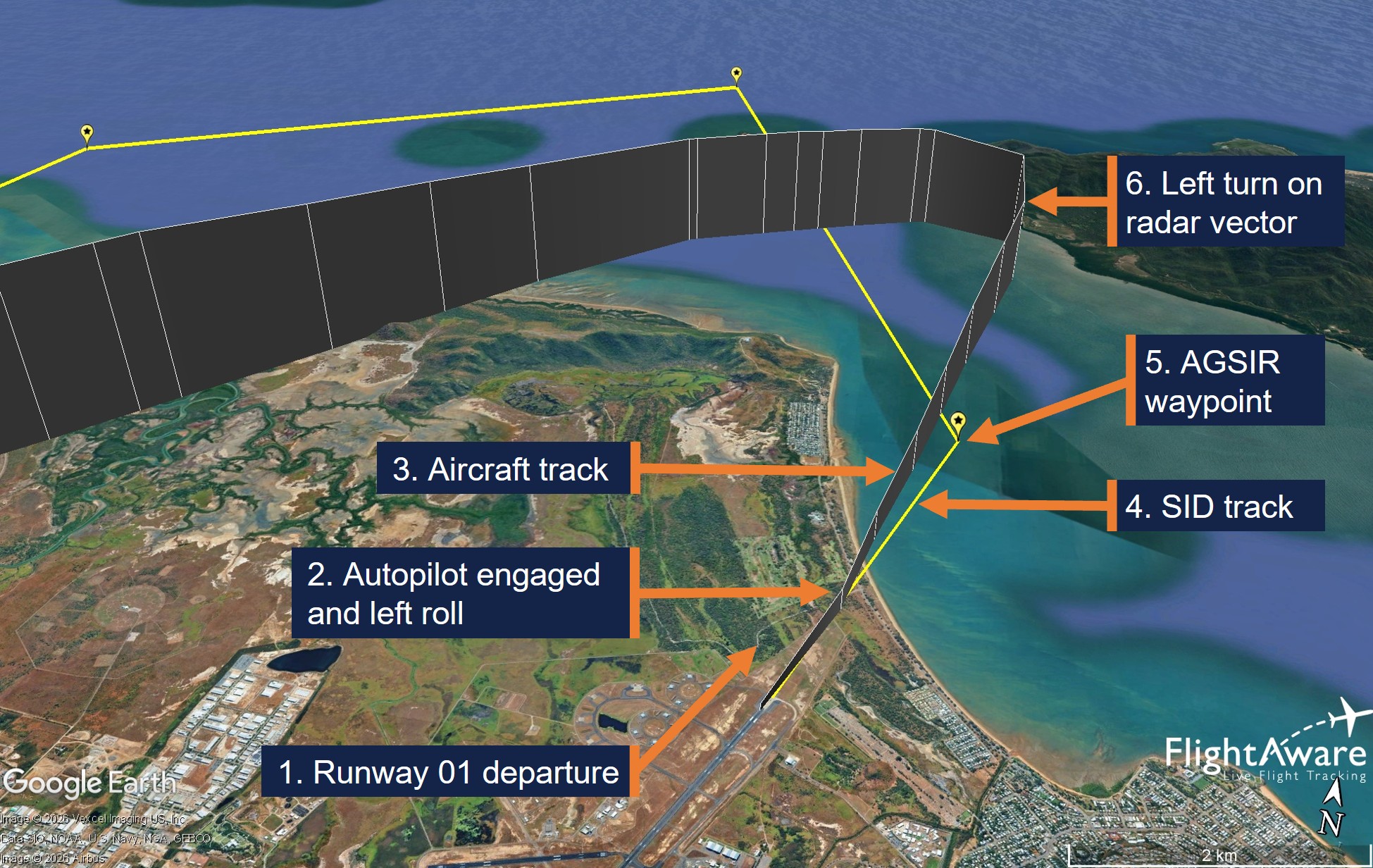
The PIC taxied the aircraft for an intersection departure from runway 01 and was cleared for take‑off at 0742. After take‑off, as the aircraft climbed through an altitude of 656 ft, tracking towards the first SID waypoint of AGSIR, the FO selected both flight directors ON, followed by the autopilot in the long range navigation mode, in accordance with their procedures. The aircraft immediately commenced a left roll, deviating from the departure track to AGSIR but consistent with the flight director indications. The PIC promptly disengaged the autopilot, reversed the left roll and returned the aircraft to an approximate departure heading.
The FO then selected the FMS flight plan page and observed that the FMS had sequenced the flight from Townsville direct to the waypoint CATEY. The FO also observed that all the CATEY ONE SID waypoints were present and in the correct order in the FMS but appeared different to the other waypoints and later reported that they might have been ‘greyed out’.3 They attempted to manually sequence the SID by selecting the ‘Direct‑To’ function to a SID waypoint, but this was not accepted by the FMS. The FO opened the navigation page and again attempted to manually sequence the SID but was unsuccessful. They later reported that the SID waypoints either did not appear as options or that the FMS did not accept them.
At 0743, the crew were transferred from tower to approach air traffic control and at 0744 the FO informed the approach controller that the aircraft was heading 012° and requested radar vectors. The approach controller noted the aircraft was passing 2,400 ft, had passed AGSIR, and that the lowest safe altitude for the area was 2,800 ft. The controller instructed the crew to continue their climb to 2,800 ft and then fly their requested heading. The FO clarified that they were having a problem with their FMS and would need vectors for the departure, which the approach controller acknowledged and provided.
The crew re‑engaged the autopilot at 2,800 ft in heading mode and confirmed that the aircraft was responding correctly to heading control inputs. They conducted confidence checks on the FMS flight plan route tracks and distances and then re‑engaged long range navigation mode and the flight continued to Hughenden without further incident. Both pilots later reported that they were in visual meteorological conditions throughout the incident. Figure 1 depicts the departure flight path and SID track with key events.
Figure 1: Departure flight path with key events
Context
Flight crew information
Pilot in command
The pilot in command (PIC) was based in Brisbane and held an Air Transport Pilot Licence (Aeroplane), issued on 17 October 2023, a multi‑engine aeroplane instrument rating, type rating for the SF340 (includes Saab 340B), and a Class 1 civil aviation medical certificate with no restrictions. They completed their cadetship with Rex in 2018, were checked to line as an FO in December 2019 and as a PIC in December 2023. The PIC reported that they had never previously experienced this type of event in training or operations.
First officer
The first officer (FO) was based in Townsville and held a Commercial Pilot Licence (Aeroplane), issued on 15 November 2023, a multi‑engine aeroplane instrument rating, type rating for the SF340, and a Class 1 civil aviation medical certificate with no restrictions. They started flying in 2012 and had previous work experience as a general aviation flight instructor and aeromedical pilot before joining Rex as an FO. They completed their SF340 type rating in June 2024. The FO reported that they also had never previously experienced this type of event in training or operations.
Aircraft information
The aircraft was a Saab 340B (extended wing tips) manufactured in Sweden in 1996, certified to the Transport Category standards and fitted with 2 General Electric CT7‑9B turboprop engines. It was certified for 2 pilots, 1 cabin crew and a maximum of 37 passengers. The aircraft was registered VH‑ZRM on 25 February 2010 and commenced operations with Regional Express (Rex) on 13 April 2019. The aircraft was fitted with a single Universal Avionics flight management system (FMS), which met the accuracy requirements for area navigation (RNAV)4 terminal instrument flight rules operations.
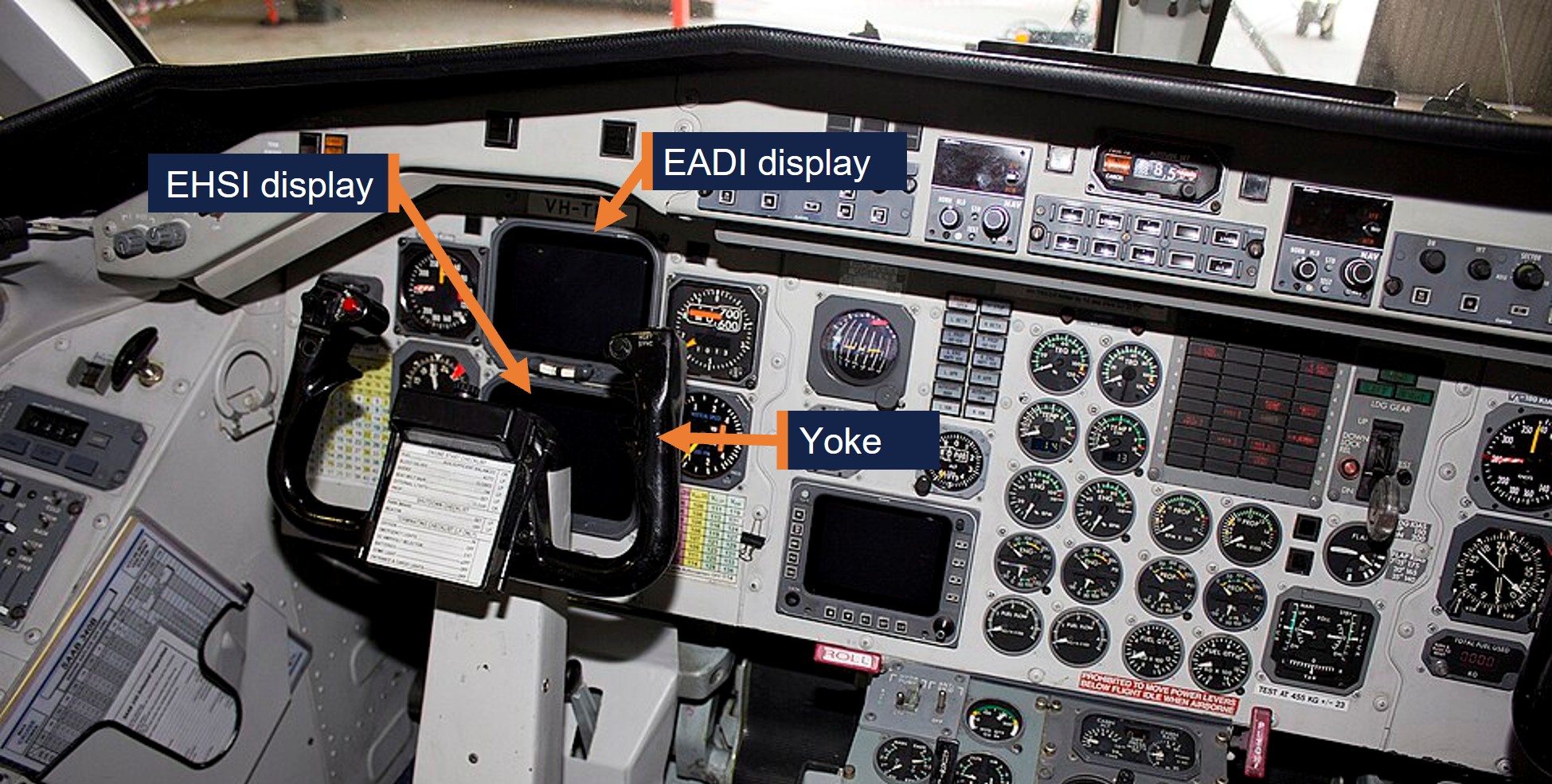
The operator’s aircraft were fitted with an electronic flight instrument system comprising an electronic attitude direction indicator (EADI) and an electronic horizontal situation indicator (EHSI) (also known as a navigation display). The EADI was positioned above the height of the yoke, but the EHSI was positioned below the EADI and partially obscured by the yoke when the yoke was forward (Figure 2).
Figure 2: Position of the flight displays relative to the yoke in the forward position
Recorded information
The operator’s notification of the incident was received by the ATSB on 27 November 2025. By this time, the aircraft had exceeded 20 hours operating time following the occurrence. The FMS manufacturer reported that the FMS unit holds 20 hours of recorded data, and therefore both the FMS and cockpit voice recorder were overwritten. However, the operator was able to provide the ATSB with flight data recorder information from the incident flight. The recorded autopilot engagement after take‑off, followed by a left roll, autopilot disengagement and later re‑engagement were consistent with the notification details and flight crew interviews.
CATEY ONE standard instrument departure
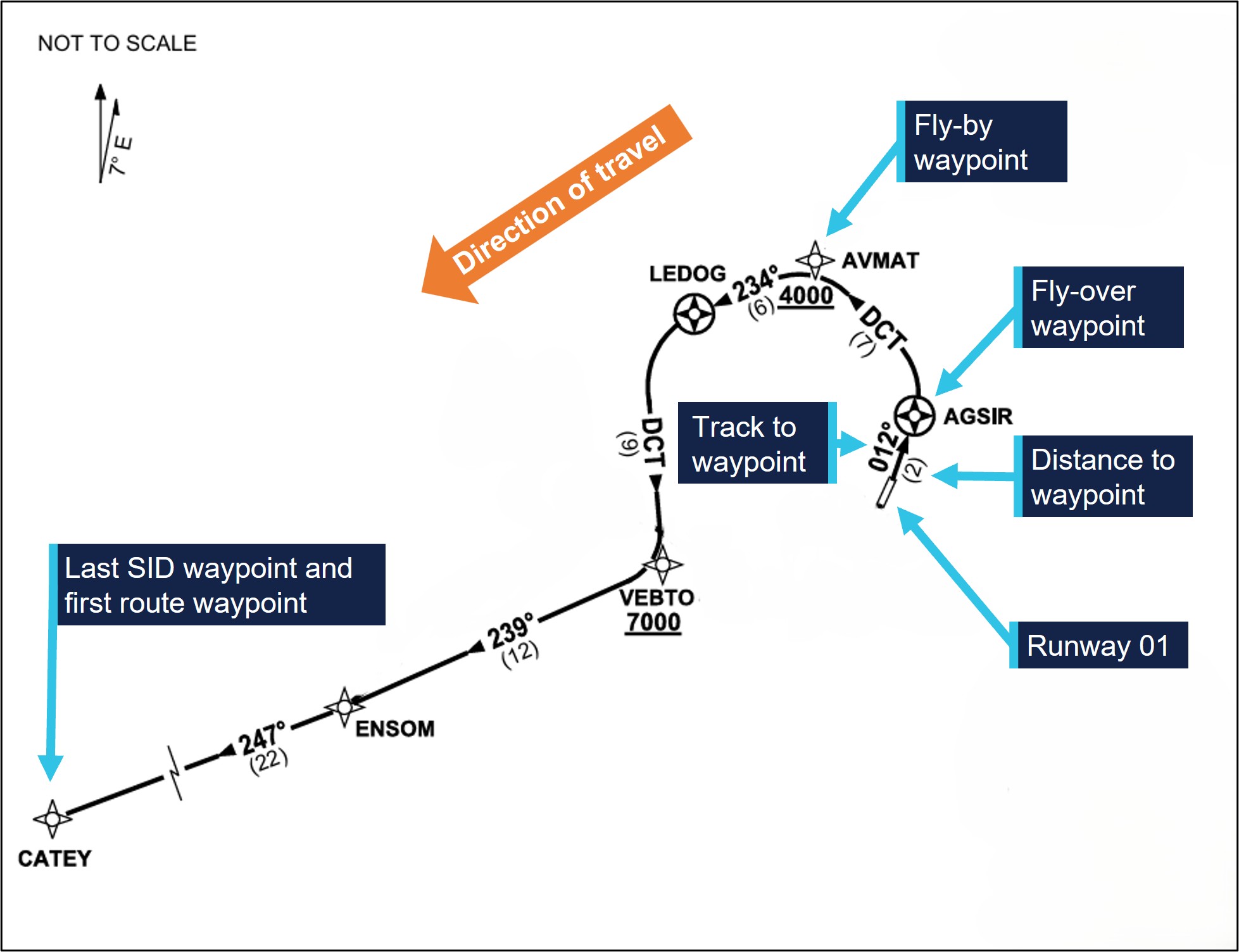
The CATEY ONE departure from Townsville runways 01/19 was an RNAV SID with the specification required navigation performance (RNP) 15 (Figure 3). The runway 01 magnetic direction was 017° and the first waypoint on the runway 01 SID was AGSIR, which was a fly‑over6 waypoint. It was located 2 NM upwind from the departure end of runway 01 on a track of 012°. Since AGSIR was a fly‑over waypoint, the aircraft should not have turned before reaching it.
Figure 3: Townsville runway 01 CATEY ONE standard instrument departure
Tests and research
Operator
The operator checked its FMS database for the cycle that was in use at the time of the incident and provided screenshots of the CATEY ONE SID and AGSIR waypoint entries to the ATSB. The SID had the correct waypoint parameters, and the AGSIR waypoint had the correct coordinates, course and RNP classification.
The operator researched its reporting database and could not locate any other incidents where its aircraft turned the wrong way after take‑off when the autopilot was engaged. However, they were able to locate 2 reports of aircraft departing with the incorrect flight plan loaded in the FMS.
Aircraft manufacturer
The aircraft manufacturer reported that 5 other recent FMS‑related incidents had been reported to them. They provided the ATSB with copies of those notifications, with the earliest in 2020. The ATSB reviewed the notifications, which included corrective maintenance actions, and concluded that there were sufficient differences in the reported symptoms and findings to exclude them as related occurrences.
Flight management system manufacturer
The ATSB provided the FMS manufacturer with the steps in the operator’s FMS programming procedure, software version and copy of the CATEY ONE SID procedure. The manufacturer used this data to conduct tests with its FMS training device but could not reproduce the circumstances reported by the flight crew. Following further investigation, the manufacturer’s engineering department provided the following scenarios as potential explanations for the flight crew’s observations:
- The FMS SID will appear greyed‑out under one specific circumstance, which is if the SID is entered as a pilot‑created (user‑defined) SID procedure instead of a navigation database selection.
- The SID entry might have been initiated but not fully completed before the aircraft taxied and departed, leaving the SID displayed but not linked to the active guidance.
- A runway selection mismatch within the SID (incorrect runway selected) could result in the procedure appearing in the flight plan with fewer waypoints but not connecting to the active leg.
- If the aircraft already had an active navigation leg loaded from Townsville to CATEY prior to the SID entry, and the SID was then loaded, the FMS may have retained the original active leg rather than automatically sequencing to the first SID waypoint (AGSIR). In this scenario, the SID waypoints would appear in the flight plan, but the active guidance would remain on the pre‑existing leg and is consistent with the flight director commanding a turn toward CATEY rather than AGSIR. A ‘Direct‑To’ AGSIR would have been required to manually sequence onto the SID.
The engineering department concluded that they required a download of the FMS from the incident flight for deeper analysis. However, the FMS was overwritten by the time the ATSB investigation was commenced (see the section titled Recorded information).
Operational information
The operator’s Saab Flight crew operating manual included its normal procedures for the aircraft. The After start scan‑action flow included a NAV AIDS (navigation aids)/FMS brief, which was required to be delivered by the left‑seat pilot and checked by the right‑seat pilot. This included a left‑seat pilot check, and right‑seat pilot confirmation, of the ‘First Waypoint’ in the FMS. The PIC reported their understanding that this was the first waypoint for the company flight plan, which was CATEY, while the FO reported that it was the first waypoint after take‑off which, for the CATEY ONE SID, was AGSIR. The operator confirmed that the ‘First Waypoint’ referred to in the procedures was the first waypoint after take‑off, which would be the first SID waypoint for an RNAV SID.
At Townsville, with external power connected and the right avionics switch on, power was available for the FMS before engine start. In this case, the operator permitted the NAV AIDS/FMS brief to be conducted before engine start. The FMS then had to be powered down for engine start, and the flight plan data would be retained, provided it was powered back up within 7 minutes. In this case, the NAV AIDS/FMS check in the After start scan‑action flow was abbreviated to the left‑seat pilot announcing ‘Nav aids set.’
The Take‑off brief followed the NAV AIDS/FMS brief and was conducted by the PIC for the sector. The Take‑off brief included the SID, and the brief could be conducted up to 30 minutes prior to departure including before engine start. If the Take‑off brief was conducted before engine start, then it was omitted in the After start scan‑action flow, and in the After start checklist the left seat pilot was only required to announce that the brief was ‘Complete’.
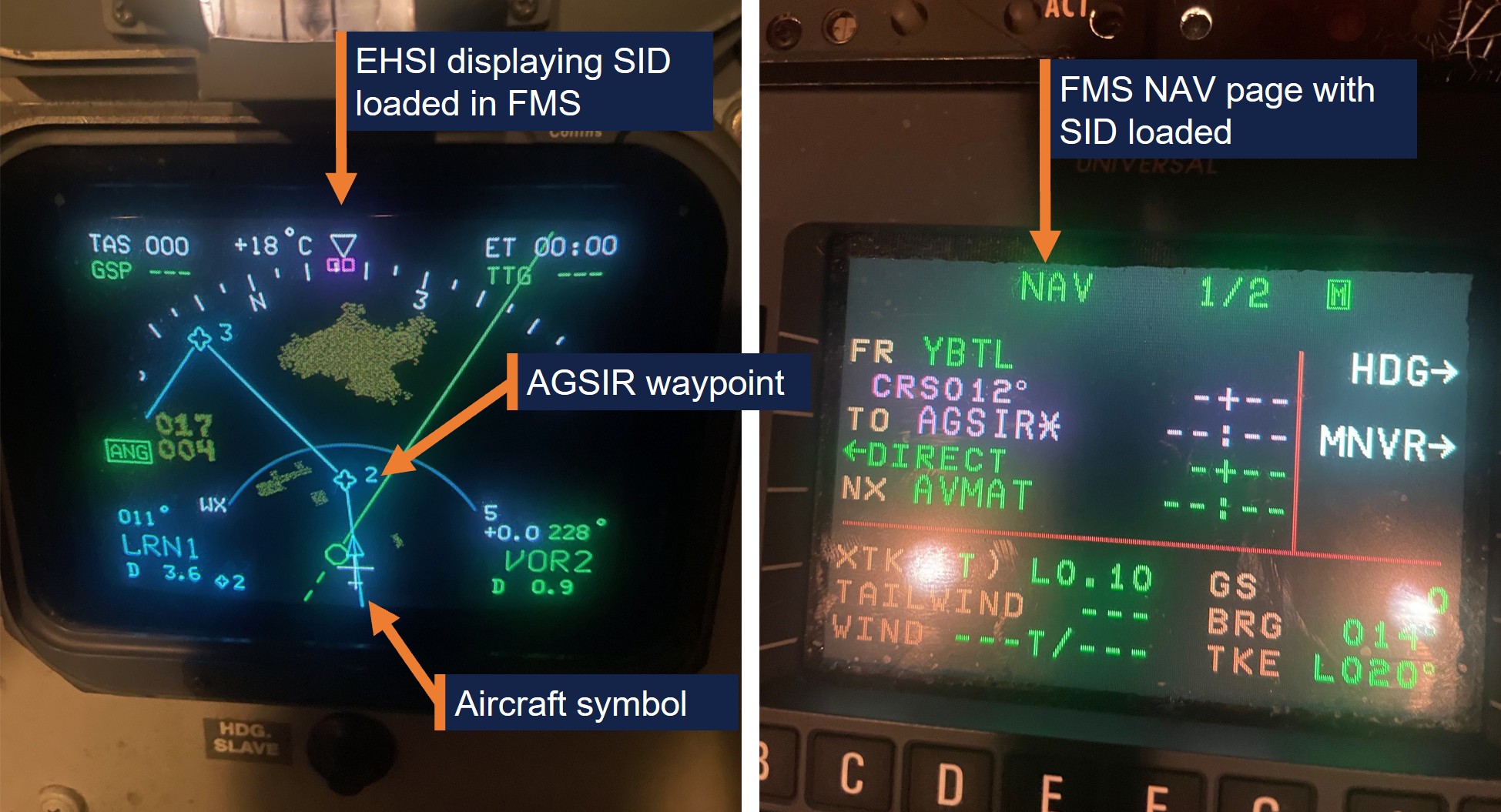
The Taxi checklist included a check of the flight instruments. However, it did not include a check of the FMS programming, or a crosscheck of the EHSI displays to verify that the correct information was displayed before take‑off. The operator confirmed that the flight instruments check in the Taxi checklist related to primary flight instruments and not to navigation instruments or an FMS check. The following figure depicts the EHSI display of the SID when loaded in the FMS (Figure 4).
Figure 4: EHSI display of SID (left) loaded in FMS (right)
The PIC reported that since Townsville had external power available, the SID was likely loaded before engine start. If the FMS first waypoint check was then conducted before the power‑down of the FMS for engine start, there would not have been a subsequent FMS programming check after engine start. The PIC confirmed they did not check the SID was presented on their EHSI display before take‑off as it was not required by procedures.
Comparison with other operators
The ATSB reviewed the FMS programming and check procedures from 2 other regional airlines, one from Australia and one from the United States (US). Both airlines included the FMS programming step in the before engine start checklists. However, the departure briefs were conducted after engine start, and the flight crew were required to verify that their displays presented the correct information.
- In the Australian operator’s Taxi pre‑take‑off checklist, the flight instruments check included checking the primary flight display and navigation display for ‘correct indications’, and the take‑off data and briefing check included verification of the SID and tracking. This was the last checklist prior to runway verification and lineup.
- In the US operator’s Before take‑off checklist, both flight crew were required to verify the runway, and that the first waypoint and initial altitude were properly displayed on their respective displays. The FO then briefed the runway, SID and initial altitude, which was confirmed set by the PIC.
Risks associated with data errors
The International Air Transport Association (2015) reviewed 309 air safety reports involving FMS data entry error, reported between 2007 and 2011. Its analysis revealed that errors related to navigational data, potential for midair collision or controlled flight into terrain accident, accounted for 80% of the reports.7 The main reported data entry errors were those errors made during FMS programming and in 44% of these reports the errors went unnoticed by the pilots due to failures in monitoring and crosschecking. In its conclusion, it reported that:
…the FMS is a sophisticated system integrated into virtually every function of the aircraft… However, the FMS has also introduced threats and the potential for errors, which can have catastrophic implications for the safety of flight.
Modification of procedures
The ATSB asked the aircraft manufacturer if it had any guidance or recommended best practices for FMS crosschecks before take‑off. It responded that it did not have any guidance or recommendations for FMS crosschecking and that such procedures and practices should be developed by operators and their flight crew.
The US Federal Aviation Administration (2017) provided guidance on how to determine when the manufacturer’s procedures need to be modified as follows:
Although an Original Equipment Manufacturer (OEM) will typically supply its customers with suggested procedures and checklists for its equipment, operators may choose to develop, or modify, the procedures and checklists provided by the OEM.
Potential factors which may drive changes to OEM procedures and checklists include new or modified equipment, changes to the operational environment, company mandated procedures, standardization among related fleets, observed operational problems, incidents, accidents, or airline mergers.
The Civil Aviation Safety Authority advisory circular 91‑22: Aircraft checklists, indicated that aircraft checklists can be provided by the aircraft manufacturer or other third party. While there is no regulatory approval from the Civil Aviation Safety Authority for aircraft checklists, they are part of an operator’s exposition and therefore any changes are subject to the operator’s change management processes.
Similar occurrence
In May 2026, another of the operator’s Saab 340B aircraft departed from Perth for Esperance, Western Australia. The FMS was programmed by the FO with the flight plan from waypoint LENVU to Esperance. The crew were also issued with the LENVU ONE RNAV SID for departure with the first waypoint HOVEA. However, the PIC did not identify before take‑off that the FMS was not sequenced to HOVEA. Subsequently, when the autopilot was engaged after take‑off, the aircraft commenced a turn towards LENVU. The crew immediately intervened to correct the tracking; the FMS was sequenced to HOVEA and the flight proceeded without further incident.
Safety analysis
Invalid data in the flight management system
On the morning of 19 November 2025, the first officer (FO) for the Regional Express Saab 340 flight from Townsville to Hughenden requested and received their airways clearance from air traffic control for their flight to Hughenden via CATEY with the CATEY ONE standard instrument departure (SID). The pilot in command (PIC) programmed the flight management system (FMS) with the company flight plan for CATEY to Hughenden and the CATEY ONE SID. This was likely done on external power, which would have required the FMS to be subsequently powered down for engine start and then powered up after engine start. As the flight plan was retained by the FMS after power up, the 7‑minute data retention period associated with the FMS power down cycle was likely not exceeded.
When the flight directors and autopilot were engaged after take‑off, the autopilot immediately attempted to turn the aircraft left, off the SID track. The FO noted that the flight directors and FMS were indicating that CATEY was the first active waypoint instead of AGSIR, which was the first SID waypoint. They also noted that the SID waypoints were in the FMS flight plan and in the correct sequence but had a different appearance to the active waypoints and were possibly ‘greyed out’. The FO attempted to re‑sequence the SID with the ‘Direct‑To’ function, but the FMS would not accept any of the SID waypoints they selected.
No fault was found with the CATEY ONE SID in the operator’s FMS database, and the FMS manufacturer was unable to replicate the reported symptoms using its FMS Trainer. Subsequently, the FMS manufacturer provided several potential scenarios for review by the ATSB. The manufacturer’s scenarios and ATSB analysis of each one was as follows:
- The FMS SID will appear greyed‑out if it is entered as a pilot‑created SID procedure instead of a navigation database selection. However, the PIC reported that they selected the CATEY ONE SID from the departures menu in the FMS and therefore this scenario was considered unlikely.
- An incorrect runway selection could result in the procedure appearing in the flight plan with fewer waypoints but not connecting to the active leg. However, there was no runway change before departure and the FO reported seeing the correct SID waypoints in the FMS, therefore this scenario was also considered unlikely.
- Loading an active navigation leg for Townsville to CATEY prior to the SID entry would retain the original active leg rather than automatically sequencing to the first SID waypoint. A ‘Direct‑To’ would have been required to manually sequence onto the SID. However, the FO reported that they could not re‑sequence the SID with the ‘Direct‑To’ function, so this scenario was also considered unlikely.
- The SID entry might have been initiated but not fully completed before the FMS was powered down for engine start. After engine start, the aircraft would have then taxied and departed with the SID displayed but not linked to the active guidance. This scenario could explain the FO’s observation that the SID waypoints appeared different in the FMS flight plan. However, the manufacturer could not replicate the fault.
Without a download of the FMS or cockpit voice recorder, further analysis was not possible and therefore, the reason for the appearance of invalid data could not be determined.
Contributing factor For reasons undetermined, the CATEY ONE standard instrument departure likely appeared as invalid data in the flight management system, which resulted in an unexpected turn off the departure procedure when the autopilot was engaged. |
Operator’s procedures
The operator’s Flight crew operating manual included the checklists for its normal procedures. The After start scan‑action flow included the NAV AIDS (navigation aids)/FMS brief. This item was required to be delivered by the PIC (left seat pilot) and checked by the FO (right seat pilot) and included confirmation of the first waypoint in the FMS. However, external power was available at Townsville Airport, which allowed the FMS programming and NAV AIDS/FMS brief to be conducted before engine start. In that case, the NAV AIDS/FMS check in the After start scan‑action flow was abbreviated to the PIC announcing ‘Nav aids set’. Similarly, the Take‑off brief, which included the SID brief and followed the NAV AIDS/FMS brief, could also be conducted before engine start and, after engine start, the flight crew were only required to announce that it was ‘Complete’.
If the FMS was programmed before engine start, it was required to be powered down for engine start and then powered up again after. Provided it was powered up within 7 minutes of being powered down, it would retain its programmed data. The flight plan was retained by the FMS after power up, and therefore, it was likely the FMS was powered up within the 7‑minute data retention period.
The Taxi checklist included a check of the flight instruments. However, it did not include a check of the FMS programming, or a crosscheck of the navigation displays (EHSI) to verify that the correct information was displayed before take‑off. The PIC reported that they did not crosscheck their navigation display with the SID before take‑off because it was not required by the procedures and the operator acknowledged that there was no specific validity check of FMS data after engine start if the FMS was programmed on external power and then powered down for engine start. Furthermore, the navigation display can be partly obscured by the yoke if it is in the forward position.
An ATSB review of FMS programming and check procedures for an Australian and US regional airline identified that both airlines included the FMS programming and waypoint verification steps in their checklists before engine start. However, their departure briefs were conducted after engine start, and both required their flight crew to verify that their displays presented the correct information. This occurred in the Taxi pre‑take‑off checklist for the Australian operator and in the Before take‑off checklist for the US operator.
The aircraft manufacturer advised that it did not have any specific guidance or recommendations for FMS crosschecks before take‑off, and that such procedures and practices should be developed by operators and their flight crew. Of note, the US Federal Aviation Administration’s (2017) guidance on when operators may need to modify checklists provided by the manufacturer included after incidents.
Noting the International Air Transport Association’s (2015) report finding that the main reported FMS data entry errors occurred during programming, it was considered likely that this fault occurred either during the programming of the FMS, or when the FMS was powered down for engine start. It was considered unlikely that the FMS was powered up with valid SID data that later became invalid during taxi or take‑off.
As the FMS and flight director were pointing to CATEY after take‑off, it was considered likely that this was the case when the aircraft was taxied for take‑off. Therefore, it was also considered likely that the invalid data could have been detected by the pilots verifying the SID programming on their navigation displays in one of the checklists after engine start and before take‑off. This would have mitigated the likelihood of an unexpected turn on departure and the risk of a loss of safe separation standards with terrain or traffic.
Contributing factor When flight crew programmed the flight management system before engine start using external power, Regional Express procedures did not require them to verify their programmed flight plan after engine start and before take‑off, which increased the risk of an aircraft departing with a data error. (Safety issue) |
Pilot in command misunderstanding
The After start‑action flow included an item where the left seat pilot (PIC) briefed the NAV AIDS/FMS setup. This included a check of the first waypoint on the FMS, which was confirmed by the right seat pilot (FO). The PIC reported their understanding that the FMS first waypoint brief was for the first waypoint of the company flight plan, which was CATEY on the incident flight. However, the FO reported that the brief was for the first waypoint after take‑off, which was the first waypoint of the SID – AGSIR.
The operator confirmed the FMS first waypoint brief was for the first waypoint after take‑off, which should have been AGSIR for the incident flight. However, without a download of the FMS, it could not be determined exactly what was programmed and how it was programmed; and without a download of the cockpit voice recorder, it could not be determined exactly what was briefed by the PIC and how the FO responded.
Therefore, while the PIC and FO provided different interpretations for the first waypoint in the FMS they checked, there was insufficient evidence to determine if this discrepancy contributed to the incident. However, more generally, the PIC's misunderstanding of the operator’s intent for the FMS first waypoint brief could contribute to the check missing a data entry error with unforeseen consequences.
Other factor that increased risk The pilot in command misunderstood the operator's intended flight management system check of the first waypoint to mean the first waypoint of the company flight plan instead of the first waypoint after take‑off. While it could not be determined if this contributed to the incident, it increased the risk of a data entry error going undetected. |
Findings
ATSB investigation report findings focus on safety factors (that is, events and conditions that increase risk). Safety factors include ‘contributing factors’ and ‘other factors that increased risk’ (that is, factors that did not meet the definition of a contributing factor for this occurrence but were still considered important to include in the report for the purpose of increasing awareness and enhancing safety). In addition ‘other findings’ may be included to provide important information about topics other than safety factors. Safety issues are highlighted in bold to emphasise their importance. A safety issue is a safety factor that (a) can reasonably be regarded as having the potential to adversely affect the safety of future operations, and (b) is a characteristic of an organisation or a system, rather than a characteristic of a specific individual, or characteristic of an operating environment at a specific point in time. These findings should not be read as apportioning blame or liability to any particular organisation or individual. |
From the evidence available, the following findings are made with respect to the avionics/flight instruments occurrence involving Saab 340B, VH‑ZRM, 3 km north‑north‑east of Townsville Airport, Queensland, on 19 November 2025.
Contributing factors
- For reasons undetermined, the CATEY ONE standard instrument departure likely appeared as invalid data in the flight management system, which resulted in an unexpected turn off the departure procedure when the autopilot was engaged.
- When flight crew programmed the flight management system before engine start using external power, Regional Express procedures did not require them to verify their programmed flight plan after engine start and before take‑off, which increased the risk of an aircraft departing with a data error. (Safety issue)
Other factors that increased risk
- The pilot in command misunderstood the operator's intended flight management system check of the first waypoint to mean the first waypoint of the company flight plan instead of the first waypoint after take‑off. While it could not be determined if this contributed to the incident, it increased the risk of a data entry error going undetected.
Safety issues and actions
Central to the ATSB’s investigation of transport safety matters is the early identification of safety issues. The ATSB expects relevant organisations will address all safety issues an investigation identifies. Depending on the level of risk of a safety issue, the extent of corrective action taken by the relevant organisation(s), or the desirability of directing a broad safety message to the aviation industry, the ATSB may issue a formal safety recommendation or safety advisory notice as part of the final report. All of the directly involved parties were invited to provide submissions to this draft report. As part of that process, each organisation was asked to communicate what safety actions, if any, they had carried out or were planning to carry out in relation to each safety issue relevant to their organisation. Descriptions of each safety issue, and any associated safety recommendations, are detailed below. Click the link to read the full safety issue description, including the issue status and any safety action/s taken. Safety issues and actions are updated on this website when safety issue owners provide further information concerning the implementation of safety action. |
Operator’s procedures
Safety issue number: AO-2025-072-SI-01
Safety issue description: When flight crew programmed the flight management system before engine start using external power, Regional Express procedures did not require them to verify their programmed flight plan after engine start and before take‑off, which increased the risk of an aircraft departing with a data error.
Glossary
| EADI | Electronic attitude direction indicator |
| EHSI | Electronic horizontal situation indicator |
| FMS | Flight management system |
| FO | First officer |
| OEM | Original equipment manufacturer |
| PIC | Pilot in command |
| RNAV | Area navigation |
| RNP | Required navigation performance |
| SID | Standard instrument departure |
| US | United States |
Sources and submissions
Sources of information
The sources of information during the investigation included:
- Civil Aviation Safety Authority
- the flight crew of the incident flight
- FlightAware
- Regional Express
- Royal Australian Air Force (452 Squadron)
- Saab AB
- Universal Avionics Systems Corporation.
References
Civil Aviation Safety Authority. (2024). Aircraft checklists (AC 91-22 v2.1). Retrieved 25 May 2026 from https://www.casa.gov.au/sites/default/files/2021-12/advisory-circular-91-22-aircraft-checklist.pdf
Federal Aviation Administration. (2017). Standard operating procedures and pilot monitoring duties for flight deck crewmembers (AC 120-71B). Retrieved 22 May 2026 from https://www.faa.gov/documentLibrary/media/Advisory_Circular/AC_120-71B.pdf
International Air Transport Association. (2015). FMS Data Entry Error Prevention Best Practices. Retrieved 20 May 2026 from https://www.iata.org/contentassets/b6eb2adc248c484192101edd1ed36015/fms-data-entry-error-prevention-ed-1-2015.pdf
Submissions
Under section 26 of the Transport Safety Investigation Act 2003, the ATSB may provide a draft report, on a confidential basis, to any person whom the ATSB considers appropriate. That section allows a person receiving a draft report to make submissions to the ATSB about the draft report.
A draft of this report was provided to the following directly involved parties:
- Civil Aviation Safety Authority
- flight crew of the incident flight
- United States National Transportation Safety Board
- Regional Express
- Royal Australian Air Force (452 Squadron)
- Saab AB
- Swedish Accident Investigation Authority
- Universal Avionics Systems Corporation.
A submission was received from Regional Express. The submission was reviewed and, where considered appropriate, the text of the report was amended accordingly.
Purpose of safety investigationsThe objective of an ATSB safety investigation is to improve transport safety through:
In accordance with the TSI Act, the ATSB does not investigate for the purpose of taking administrative, regulatory or criminal action, and cannot apportion blame, assist in determining liability, or, as a general rule, assist in court proceedings. About ATSB reportsATSB safety investigation reports are developed in accordance with ATSB procedures and guidelines, and with regard to applicable international standards and instruments. Reports must include factual material of sufficient weight to support the investigation’s analysis and findings. At all times the ATSB endeavours to balance the use of material that could imply adverse comment with the need to properly explain what happened, and why, in a fair and unbiased manner. An explanation of terminology used in ATSB investigation reports is available here. Publishing informationReleased in accordance with section 25 of the Transport Safety Investigation Act 2003 Published by: Australian Transport Safety Bureau © Commonwealth of Australia 2026 Ownership of intellectual property rights in this publication Unless otherwise noted, copyright (and any other intellectual property rights, if any) in this report publication is owned by the Commonwealth of Australia. Creative Commons licence 
With the exception of the Commonwealth Coat of Arms, ATSB logo, and photos and graphics in which a third party holds copyright, this report is licensed under a Creative Commons Attribution 4.0 International licence. The CC BY 4.0 licence enables you to distribute, remix, adapt, and build upon our material in any medium or format, so long as attribution is given to the Australian Transport Safety Bureau. Copyright in material obtained from other agencies, private individuals or organisations, belongs to those agencies, individuals or organisations. Where you wish to use their material, you will need to contact them directly. |
- ^ Pilot flying (PF) and pilot monitoring (PM): procedurally assigned roles with specifically assigned duties at specific stages of a flight. The PF does most of the flying, except in defined circumstances, such as planning for descent, approach and landing. The PM performs support duties and monitors the PF’s actions and the aircraft’s flight path.
- ^ A SID is a standard air traffic services route identified in an instrument departure procedure by which aircraft should proceed from take-off to the en route phase of flight.
- ^ A delay between the incident occurring, its reporting and the associated interviews resulted in a degree of uncertainty with the flight crew recalling specific incident-related events.
- ^ Area navigation (RNAV) is a method of navigation which permits aircraft operations on any desired flight path within the coverage of ground or space-based navigation aids or the limits of the capability of self-contained navigation aids or a combination of these. An RNAV system may be included as part of a flight management system (FMS).
- ^ Required navigation performance (RNP) system is an area navigation system which supports on-board performance monitoring and alerting. RNP 1 provides connectivity between en route airspace and instrument flight procedures in terminal airspace, such as SIDs.
- ^ Fly-over waypoint: a waypoint at which a turn is initiated in order to join the next segment of a route or procedure. These are different to a fly-by waypoint which requires turn anticipation to allow tangential interception of the next segment of a route or procedure.
- ^ The other 20% were related to performance data and associated loss of control inflight or runway excursion accident.
Occurrence summary
| Investigation number | AO-2025-072 |
|---|---|
| Occurrence date | 19/11/2025 |
| Occurrence time and timezone | 0744 Australian Eastern Standard Time |
| Location | 3 km north-north-east of Townsville Airport |
| State | Queensland |
| Report release date | 25/08/2026 |
| Report status | Final |
| Investigation level | Defined |
| Investigation type | Occurrence Investigation |
| Investigation phase | Final report: Dissemination |
| Investigation status | Completed |
| Mode of transport | Aviation |
| Aviation occurrence category | Avionics/flight instruments |
| Occurrence class | Incident |
| Highest injury level | None |
Aircraft details
| Manufacturer | Saab Aircraft Co. |
|---|---|
| Model | 340B |
| Registration | VH-ZRM |
| Serial number | 340B400 |
| Aircraft operator | Regional Express Pty Ltd |
| Sector | Turboprop |
| Operation type | Part 121 Air transport operations - larger aeroplanes |
| Activity | Commercial air transport-Scheduled-Domestic |
| Departure point | Townsville Airport, Queensland |
| Destination | Hughenden Aerodrome, Queensland |
| Injuries | None |
| Damage | Nil |