

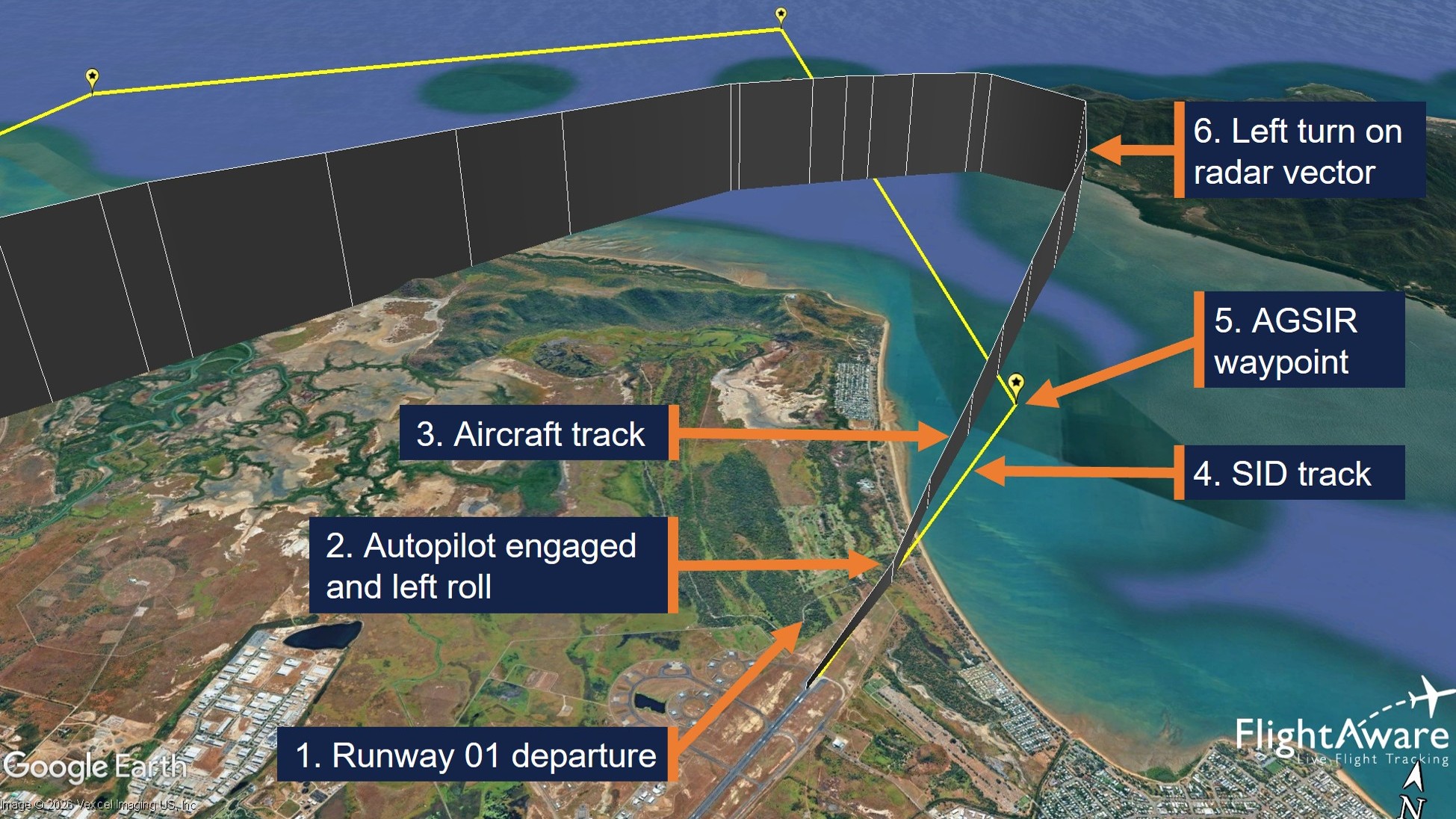
The pilot in command of a Saab 340 regional airliner had to intervene and resume manual flight when the aircraft commenced a left roll away from the planned SID track, an ATSB investigation report details.
Shortly after the Regional Express Saab had taken off from Townsville for a flight to Hughenden, Queensland, with 2 flight crew, 1 cabin crew and 15 passengers on board, the first officer engaged the flight directors and autopilot with the intent the aircraft followed the standard instrument departure (SID) procedure as programmed into the flight management system (FMS).
“Upon doing so the aircraft immediately commenced a left roll away from the SID track and the pilot in command promptly intervened by disengaging the autopilot and resuming manual flight,” explained ATSB Director Transport Safety Stuart Macloed.
“The crew subsequently requested radar vectors and re‑engaged the autopilot and continued the flight to Hughenden without further incident.”
Mr Macleod said the investigation found that the pilot in command had likely programmed the SID into the FMS before the aircraft’s engines were started using external power. For reasons that could not be determined, the SID waypoints subsequently appeared as invalid data in the FMS.
“This resulted in the aircraft turning away from the expected track when the autopilot was engaged after take‑off as it directed the aircraft to the first active waypoint in the FMS, located at the end of the SID procedure,” Mr Macleod noted.
The investigation found that Rex’s procedures did not require the flight crew to verify their FMS programmed flight plan after engine start if it was programmed with external power, which increased the risk of an aircraft departing with a data error.
Another investigation finding, although it could not be determined if it contributed to the occurrence, was that the pilot in command misunderstood the operator's intent of their check of the first FMS waypoint to mean the first waypoint of the company flight plan instead of the first waypoint after take-off.
“This incident highlights that flight management systems cannot always identify data errors,” Mr Macleod concluded.
“As such it is the responsibility of the pilot(s) to perform this critical function.
“Data error risks can be reduced by operators and pilots with a comprehensive set of procedures for data entry monitoring and verification before take-off and in flight.”
Read the final report: Avionics/flight instruments occurrence involving Saab 340B, VH-ZRM, 3 km north‑north‑east of Townsville Airport, Queensland, on 19 November 2025