

Final report
Report release date: 02/10/2026
Investigation summary
What happened
On 12 November 2025, at around 2030 local time, the pilot of a Sharp Airlines Fairchild Industries SA227-DC, registered VH-HPE and using callsign ‘Sharp 161’, was preparing to conduct a scheduled freight operation from Mackay Airport to Brisbane Airport, Queensland. Mackay Airport was operating on a common traffic advisory frequency (CTAF) at the time.
As the aircraft was taxiing, backtracking and lining up on runway 14, an airport safety vehicle, callsign ‘Car 1’, had been stationary at an adjacent runway holding point, with the intention to conduct a routine runway inspection after the preceding aircraft to Sharp 161 had departed.
While both the pilot and the driver of the car made radio broadcasts, neither heard the other, and shortly after the car entered the runway to complete their runway inspection, the aircraft commenced its take-off run.
When the car approached the midway point of the runway, the driver observed the approaching aircraft. In response, the driver manoeuvred the vehicle to the edge of the runway and accelerated towards a runway exit. Approximately 5 seconds after the vehicle exited the runway via a taxiway, the aircraft rotated adjacent to that taxiway.
What the ATSB found
The ATSB identified that CTAF radio transmissions from the aircraft were of poor quality due to a combination of the pilot’s rapid speech, non-standard phraseology and interference caused by use of a radio with the ground‑facing antenna.
Additionally, while the pilot did not hear the broadcast from Car 1, likely due to the reduced reception strength of the transmission and concurrent broadcast on another frequency, the pilot did not confirm the runway was clear after seeing a flash of unidentified light prior to commencing their take-off run.
Finally, the airport safety officer did not scan for aircraft ground movements or keep a constant radio listening watch prior to entering the occupied runway, possibly due to being distracted while using a company-issued iPad and not expecting the aircraft at that time.
The ATSB also found that the airport operator did not have specific guidance for the use of company-issued iPads and the aircraft operator had not formally risk assessed identified hazards at non-controlled aerodromes, as was required by their safety management system.
What has been done as a result
Following this occurrence Mackay Airport updated and reinforced existing human factors training and supplemented existing guidance on iPad use for operational demands.
Sharp Airlines issued a safety advisory to flight crew reiterating the requirement for clear and effective radio communication and introduced a procedure to ensure that any discussions around the identification and assessment of hazards are now documented in safety meetings. Sharp Airlines also conducted a formal assessment of the placement of antennas on its aircraft and pilot radio selection at non-controlled aerodromes, with detail incorporated into its risk register.
Safety message
This investigation reiterates how important it is for pilots and drivers operating at non‑controlled airports to actively listen to the CTAF and always maintain a vigilant lookout. Additionally, it is crucial for broadcasts on the CTAF to be clear, concise and accurate.
According to CASA’s Be heard. Be seen. Be safe publication, when it comes to ensuring your radio call is effective, attention to detail is essential. This includes pausing at the beginning and end of a transmission to avoid ‘clipping’, using standard phraseology, and speaking slowly and clearly.
For operators, hazard identification and risk mitigation should be a continuous and ongoing activity. Safety performance needs to be monitored and re-assessed to assure the effectiveness of any risk control.
The occurrence
On 12 November 2025, the pilot of a Sharp Airlines Fairchild Industries SA227-DC, registered VH-HPE and operating as ‘Sharp 161’, was preparing to conduct a scheduled freight flight from Mackay Airport to Brisbane Airport, Queensland. The pilot was the sole occupant.
The aircraft was scheduled to depart at 1955 local time, as it did 3–4 times per week. However, due to the flight plan being inadvertently cancelled, the pilot was required to liaise with Mackay Tower air traffic control (ATC) to rectify the issue, including re‑submission of flight details. This delayed their departure by around 30 minutes.
When the aircraft was ready to depart, Mackay Tower had closed, and communication and coordination were now being conducted between airport users on a common traffic advisory frequency (CTAF).1
The pilot had been communicating with Mackay Tower on the aircraft’s VHF COM 1 (COM 1) radio, and once the tower closed, the pilot selected the CTAF on VHF COM 2 (COM 2), and Brisbane Centre on COM 1. The pilot then used COM 1 to make a taxi broadcast to Brisbane Centre and was given traffic for their departure (see the section titled Readability of radio broadcasts).
The pilot commenced taxiing for departure from the western general aviation apron, along taxiway ‘Juliet’ and made a taxiing broadcast on the Mackay CTAF (Figure 1 and Figure 3). A subsequent review of this broadcast identified that the quality of the transmission was poor and barely audible. In addition, the pilot did not state they were at Mackay, advised they would hold short of the incorrect holding point, and used the incorrect flight number.
As the aircraft was taxied towards holding point Juliet, another scheduled aircraft (aircraft 2) backtracked on runway 142 and departed.
Figure 1: Holding points and receivers at Mackay Airport
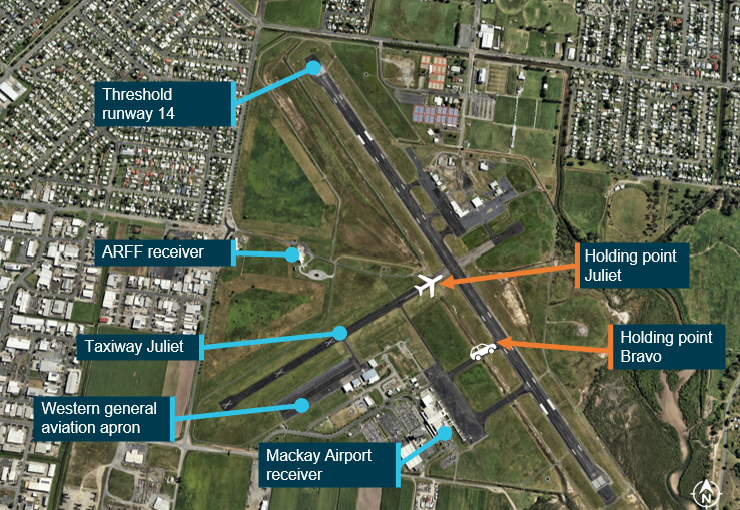
After being stopped at the holding point for about 1 minute and 30 seconds, the pilot made a broadcast on the CTAF advising they were entering and backtracking runway 14. Again, this broadcast was of poor quality and barely audible. While the pilot did state ‘Mackay’ at the end of the broadcast, it was difficult to hear.
The aircraft then commenced backtracking on runway 14. As they were backtracking, the pilot was contacted by Brisbane Centre, questioning how long before they would be departing, to which they advised they were backtracking on the runway. Despite that broadcast from the pilot also being poor quality, the controller understood it. Neither the Brisbane Centre controller nor the pilot mentioned Mackay during the interaction.
At 2029:45, as the aircraft was turning around at the runway threshold, the pilot advised Brisbane Centre, on COM 1, that they were lining up on runway 14 at Mackay. While the pilot again used the incorrect flight number, the broadcast was audible and stated ‘Mackay’ at the end. The aircraft then stopped at the threshold. Between 2030:01 and 2031:19 there were near-continuous broadcasts on the Brisbane Centre frequency from different aircraft, none of which were relevant to Mackay.
At 2030:11, the pilot broadcast on the CTAF (COM 2) that they were rolling. This transmission was slightly better quality than the previous 2 broadcasts, although still difficult to understand. In it, the pilot did not mention Mackay at the start of the broadcast but did state ‘Mackay’ at the end.
The pilot then commenced their line-up checklist that consisted of 6 items, during which they detected a flash of light coming from the opposite end of the runway. They stopped the checklist to try to identify the source of the light but could not determine where it had come from. As they had been distracted and could not recall what items had been completed, they restarted the checklist.
Shortly after Sharp 161 commenced taxiing, an airport safety vehicle, callsign ‘Car 1’, stopped at the taxiway ‘Bravo’ holding point. Car 1 remained stationary for approximately 5 minutes, including during the time that Sharp 161 taxied to, backtracked and lined up on runway 14. This holding point was 350 m from taxiway Juliet, on the same side of the runway (Figure 1). The driver of Car 1 advised that their intention was to conduct a routine runway inspection once aircraft 2 departed.
The driver did not recall seeing aircraft 2 take-off but advised that they heard their departure call. The driver used their company-issued iPad to pre-emptively open and start completing an installed runway inspection form prior to entering the runway (see the section titled Airport safety officer – electronic device usage).
They stated that there was another scheduled aircraft around 30 NM (about 55 km) away and inbound to Mackay, and that they would usually commence their runway inspection between the departure of aircraft 2 and the arrival of the inbound aircraft.
A review of recovered information from the aircraft’s flight data recorder (FDR) identified that the pilot of Sharp 161 increased engine power at 2030:21. At the same time, the driver of Car 1 made a broadcast on the Mackay CTAF that they were entering runway 14. This broadcast was of good quality.
Approximately 20 seconds after the broadcast from Car 1, the car crossed the holding point and, about 10 seconds later, the FDR information and CCTV footage showed the aircraft began to move.
As the driver commenced their runway inspection, they observed a light and queried to themselves if it was a vehicle from the road behind the threshold (see the section titled Visual limitations) but did not clarify on the radio if there was anyone on the runway. CCTV footage showed that when the car was about halfway between taxiways Bravo and Juliet, the vehicle’s speed noticeably increased. The driver stated this was when they detected the approaching aircraft, moved the vehicle to the edge of the runway and accelerated towards taxiway Juliet to exit the runway.
The pilot advised that as they passed approximately 100 kt in the take-off run, they observed 2 lights. However, as they blended in with the runway edge lights, they were difficult to distinguish. They only realised they were car headlights as they approached rotation speed and the vehicle was exiting the runway.
Approximately 5 seconds after the vehicle exited taxiway Juliet, the aircraft rotated adjacent to taxiway Juliet.
The pilot then contacted Car 1 on the CTAF to discuss the incident. There were a couple of exchanges, with all radio broadcasts from the aircraft being of good quality.
Context
Pilot information
The pilot held a Commercial Pilot Licence (Aeroplane) and a class 1 aviation medical certificate. They had accumulated 3,035 flight hours, including 1,753 hours on the SA227‑DC.
Driver information
The driver had been an airside safety officer (ASO) at Mackay Airport for 12 years and had not previously been involved in an airside driving incident. Their most recent ASO proficiency check was successfully completed on 22 May 2025.
Aircraft information
The Fairchild Industries SA227-DC is a low-wing, pressurised, twin-turboprop aircraft. VH-HPE was manufactured in the United States in 1993 and issued serial number DC‑823B. It was registered in Australia as VH-HPE in 2002. The aircraft was fitted with 2 Garrett turbine TPE331 engines.
Recorded data
The aircraft was fitted with a flight data recorder (FDR) and cockpit voice recorder (CVR). The CVR was not obtained by the ATSB, as the recording would have been overwritten. The FDR was downloaded and analysed by the ATSB.
CCTV
The incident was captured on Mackay Airport’s closed‑circuit television camera located at the eastern general aviation apron.
Radio recordings
Common Traffic Advisory Frequency (CTAF) recordings were obtained for the night of the incident from the aviation rescue and firefighting services (ARFF) receiver (Figure 1) and the Mackay Airport receiver. ATC recordings were also obtained for the Brisbane Centre frequency.
For comparison, the ATSB also obtained CTAF and ATC recordings for the same aircraft during operation (by different pilots) on other days and times. There were no readability issues identified in the other recordings. However, the ATSB did not verify the orientation of the aircraft to the receivers during these radio broadcasts.
VHF radio antenna position
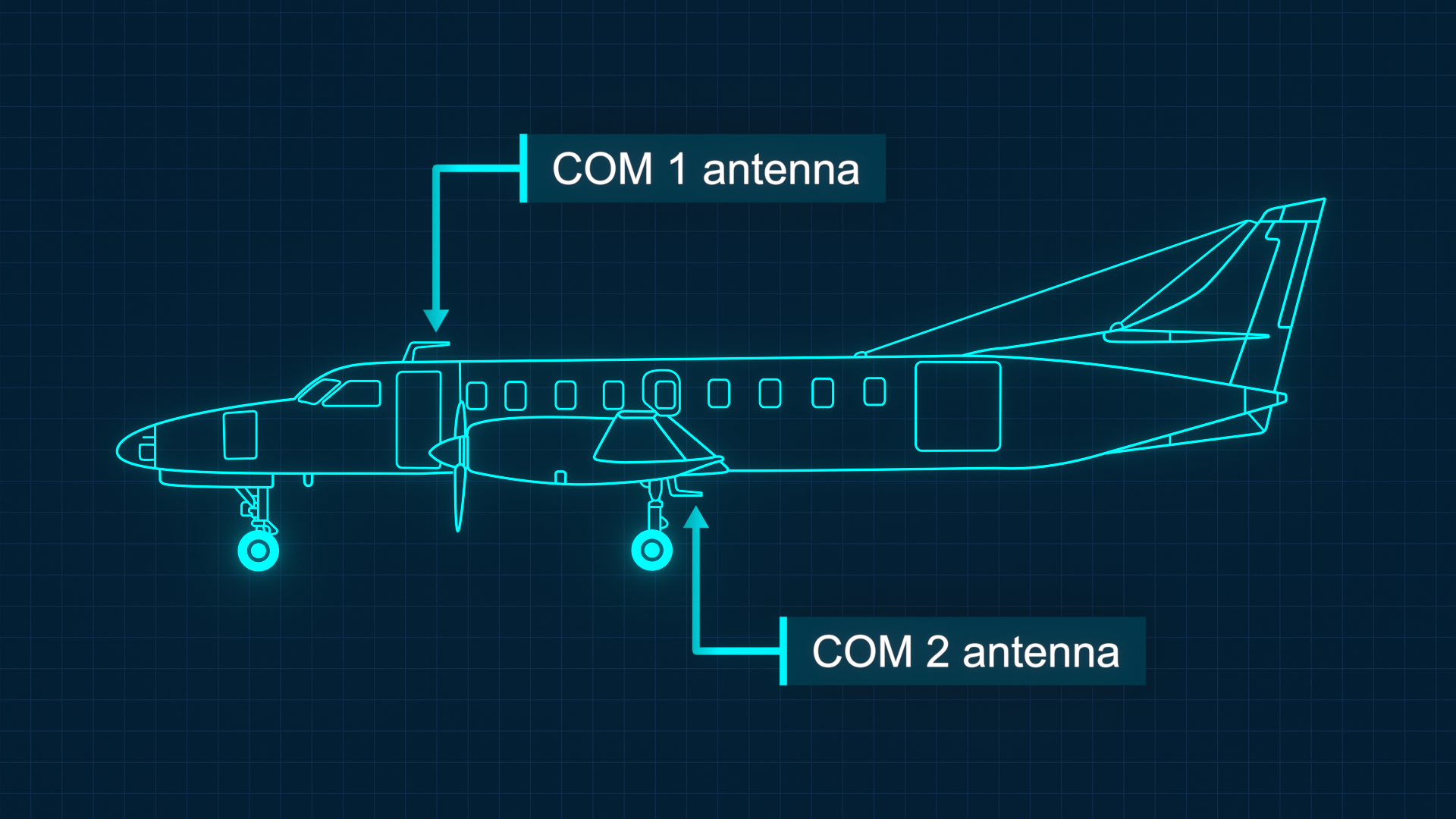
VH-HPE had 2 VHF antennas installed (Figure 2), with the:
- antenna for VHF COM 1 (COM 1) mounted centrally on the roof of the aircraft forward of the wings
- antenna for VHF COM 2 (COM 2) mounted centrally on the underside of the aircraft laterally in line with the wings.
The pilot confirmed they could hear received transmissions from both COM 1 and 2 at the same time when there were simultaneous transmissions on both frequencies.
Figure 2: Antenna positions on VH-HPE
Post‑incident inspection
During a post‑flight inspection, the right landing light was found to be dull and was replaced.
An inspection was also conducted on the antennas, and the operator reported that corrosion was detected on the connectors for the coaxial cable for COM 1 and the cable was returning a higher than acceptable resistance. This likely reduced the transmission strength of the broadcasts. However, there was no reported corrosion present under the COM 2 antenna, which was likely the antenna in use for the CTAF transmissions.
Vehicle radios
Car 1 was fitted with 2 separate radios, both outputting through separate loudspeakers in the cabin. The driver reported that it was their standard practice when the tower was not operating to have the CTAF tuned on COM 1, and a different frequency tuned on COM 2.
Normally, and on this occasion, COM 2 was tuned to Coral Approach (retransmitting the Brisbane Centre frequency) and was used to monitor for aircraft approaching the airport. Both receivers were active, and the driver would monitor transmissions on both frequencies.
The driver advised that they deliberately configured the radios such that the volume on COM 2 (approach frequency) was set to a lower volume than COM 1 (CTAF). The driver reported that they did this to help distinguish between the 2 channels, however, COM 2 was still loud enough that the driver could clearly hear broadcasts to assist with their situation awareness.
Post‑incident inspection
A maintenance test of the vehicle’s radios was conducted after the incident, and they were determined to be fully functional.
Readability of radio broadcasts
CASA’s radiotelephony manual outlined that readability of a broadcast should be classified in accordance with the scale in Figure 3.
Figure 3: CASA readability scale
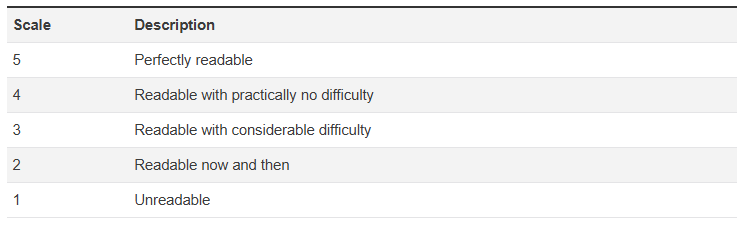
The content and readability of the various radio broadcasts during the occurrence are shown below in Table 1.
The ATSB assessed that while the pilot made the required calls on the Mackay CTAF, it would have been very difficult to discern the word ‘Mackay’ in any of the broadcasts. In addition, individual words were very difficult to understand. The ATSB also assessed that the transmissions on the Brisbane Centre frequency, while slightly clearer, were still difficult to understand.
Table 1: Readability of the radio broadcasts recorded on the Mackay CTAF
| Time | Broadcast | Source | Aircraft VHF radio | Readability |
| 2024:23 | Brisbane Centre, Sharp 161 [unreadable] Mackay runway 14 for Brisbane | Sharp 161 on BNE Centre | COM 1 | 3-4 |
| 2026:29 | Traffic, 191 taxi runway 14 hold short of Bravo [incorrect call sign and incorrect holding point] | Sharp 161 on Mackay CTAF | COM 2 | 3 |
| 2028:36 | [unreadable] runway 14. Mackay | Sharp 161 on Mackay CTAF | COM 2 | 1-2 |
| 2028:50 | Backtracking now departure IFR to flight level..? [inaudible] 191 | Sharp 161 on BNE Centre | COM 1 | 2-3 |
| 2029:45 | Sharp 191 lining up runway 14, Mackay | Sharp 161 on BNE centre | COM 1 | 4 |
| 2030:11 | [Unreadable] Rolling on 14 departing to Blackwater on climb to flight level..? Mackay | Sharp 161 on Mackay CTAF | COM 2 | 3 |
| 2030:21 | Traffic Mackay, Safety Car 1 on taxiway Bravo now entering, operating runway 14 for inspection. Traffic Mackay | Car 1 on Mackay CTAF | N/A | 5 |
The ATSB also reviewed the radio broadcasts made by the preceding departing aircraft on the CTAF and assessed the readability to be 5.
Mackay Airport
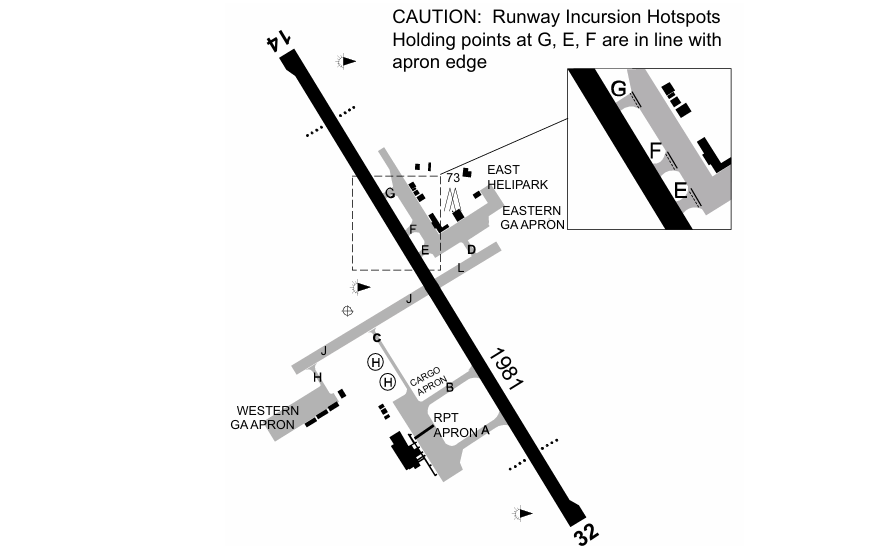
Mackay Airport is a certified airport at an elevation of 19 ft above mean sea level, with a sealed runway orientated in a north-west/south-east direction – 14/32. The runway was 1,981 m long and 45 metres wide (Figure 4).
Figure 4: Mackay Airport
Visibility
Last light at Mackay Airport on the date of the incident was at 1842 and CCTV footage showed a clear night with good visibility.
Similarly, weather forecasts and observations obtained from the Bureau of Meteorology showed there was no significant weather in the area, such as thunderstorms.
Visual limitations
Car 1 was at holding point Bravo, approximately 1.3 km from the runway 14 threshold (Figure 1). A 4-way road intersection is situated behind the threshold, and Mackay Airport personnel advised that aircraft lights may be confused with vehicle lights from this intersection.
Vehicle
While the car was parked at the holding point, it had both its headlights and an amber rotating beacon on the roof selected on. As it passed the holding point, 2 spotlights and a light bar were also selected on, and all were visible in the CCTV footage of the incident. The vehicle was not fitted with an ADS-B transponder, nor was it required to be.
Aircraft lights
The aircraft’s navigation, rotating beacon and taxi lights were on during taxi. As the aircraft entered the runway the strobe lights were selected on. As the aircraft lined up the landing lights were also selected on as part of the line-up checklist.
VHF receivers
Airport
At Mackay Airport, VHF radio transmissions on the CTAF frequency were received from an antenna on the main terminal. These transmissions were recorded and, due to its elevated position, this antenna was within line of sight of the entire runway environment.
An additional receiver, operated by Airservices Australia, was mounted on the aviation rescue and firefighting (ARFF) building, located on the western side of the airport, also in line of sight of the entire runway environment. This receiver also recorded the CTAF transmissions made by the pilot and the driver.
The readability of all the transmissions were the same on both receivers, however, broadcasts made by the pilot were recorded at a higher volume on the ARFF receiver.
Airspace and traffic services
Mackay Airport had an air traffic control tower that operated from 0620–2020 local time Monday to Friday. The tower provided class D services from surface to 1,000 ft above mean sea level (AMSL), with Coral Approach providing class D services from 1,000 ft to 4,500 ft.
Outside tower hours, the airspace within a 10 NM (18.5 km) radius of Mackay Airport operated on a CTAF. In addition, outside approach hours, the airspace around the Mackay CTAF became Class G airspace to 4,500 ft AMSL. Consequently, no air traffic control services were provided, and aircraft were responsible for their own separation. This was done by using ‘alerted see and avoid’ practices, using VHF communications and visual reference to other aircraft. Aircraft intending to operate within controlled airspace were required to contact ATC (Brisbane Centre) on the ground prior to take-off, to receive an airways clearance for the overlying airspace.
Procedures at non-controlled airports
Pilot positional broadcasts
Traditionally, VHF radio broadcasts are made at non-controlled aerodromes to provide situation awareness, traffic separation and deconfliction with other traffic. The effectiveness of these broadcasts relies on the accuracy of the information being broadcast and the ability of other traffic [or vehicles] receiving, comprehending and reacting to this information.
The Civil Aviation Safety Authority’s Advisory Circular, AC 91-14 v1.3 Pilots’ responsibility for collision avoidance, section 10 stated:
Pilots should be mindful that transmission of information by radio does not guarantee receipt and complete understanding of that information. Many of the worst aviation accidents in history have their genesis in misunderstanding of radio calls, over-transmissions, or poor language/phraseology which undermined the value of the information being transmitted.
Without understanding and confirmation of the transmitted information, the potential for alerted see-and-avoid is reduced to the less safe situation of unalerted see-and-avoid.
The Aeronautical Information Publication (AIP) Enroute 1.1 section 9.1.14 recommended pilot broadcasts to alert other traffic to their location and intentions:
- before take-off
- inbound to land at, or if intending to overfly a non-controlled aerodrome.
Included in the recommended broadcasts was when the pilot taxied with the intention to take-off and when the pilot intended to enter a runway.
For non-controlled aerodromes, including Mackay, the standard broadcast format, as outlined in AIP En route 1.1 section 9.1.13 was:
a. {location} traffic
b. {aircraft type}
c. {call sign}
d. {position/level/intentions}
e. {location}
CASA’s advisory circular (AC) 91-10 Operations in the vicinity on non-controlled aerodromes also stated that pilots should speak at a normal pace, as rapid speech can make transmissions difficult to understand. It further stated that if calls are not made clearly and concisely, using standard phraseology, confusion can arise.
An ATSB research report Limitations of the See-and-Avoid Principle (Hobbs, 1991) found that an alerted search is likely to be 8 times more effective than an unalerted search, because knowing where to look greatly increases the chances of sighting traffic.
Departures from a non-controlled airport
AIP En route 1.1 section 9.5.2 further outlined the standard ATC report required for IFR departures at a non-controlled aerodrome, as follows:
• Aircraft type
• [number] POB (for flights other than air transport operations)
• IFR
• location
• destination
• runway to be used.
Vehicle positional broadcasts
According to the Mackay Airport runway and taxiway operations standard work procedures (Figure 5), airport safety officers (ASOs) were required to make the following CTAF broadcasts when the airport was operating outside tower hours:
Figure 5: Extract from Mackay airport standard work procedures
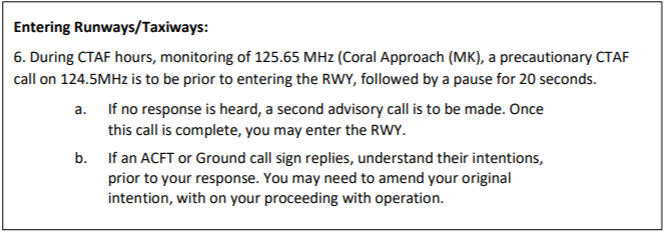
The airside driver’s handbook available to ASOs advised that ‘no acknowledgment is expected to this call’.
The driver reported that they were not aware of the requirement to make a second broadcast prior to entering the runway, and a review of Mackay Airport CTAF recordings on other dates confirmed that it was common practice for ASOs to only make one broadcast when entering the runway. After the incident, Mackay Airport management made enquiries with other airport managers and found that they also did not require a second entering broadcast by a vehicle driver.
The Mackay Airport runway and taxiway operations standard work procedures also required drivers to:
continue to scan air and ground for aircraft movements when operating on runway/taxiways.
Additionally, the Mackay airside driver’s handbook stated:
Once you have entered the manoeuvring area, you must keep a constant radio listening watch, staying alert to what is happening around you by listening to radio communications.
VHF radio line of sight limitations
VHF radio requires line of sight between the transmitting and receiving stations to function effectively. If an aircraft does not have a clear visual path direct to another aircraft (or vehicle) in the vicinity, then the radio wave signal strength and clarity can be affected. In some cases, terrain, vegetation or buildings can create areas that may shield or substantially reduce radio wave propagation and adversely affect broadcast signal strength and clarity.
In areas where there are no physical obstacles on the airport, it has been found that using an antenna that is positioned underneath the aircraft may also affect the transmission or reception strength and clarity on the ground due to airframe shielding.
As found in ATSB investigation AO-2023-050Aircraft separation issue during take-off involving Lancair, VH-VKP, and De Havilland Aircraft of Canada Limited DHC-8-315, VH‑TQZ, Mildura Airport, Victoria, on 29 September 2023:
While geographic obstacles and structures between the stations had the likelihood of reducing signal strength and readability in general, it was identified that a significant reduction in radio signal strength and consequent readability existed when VHF COM 2 was used for ground-based communications when compared with VHF COM 1, even when no geographical or man-made structures were present between the stations.
Further, signal strength and shielding testing conducted by the ATSB found that:
the signal strength of VHF COM 2 was consistently less (greater than half strength) at all locations with the VHF COM 2 maximum loss (−10 dBm) at the front and right rear quarter most notable.
The testing identified that the closer and clearer the line of sight of the antenna on the aircraft to the receiver, the clearer the radio transmission. It also found that the orientation of the aircraft to the receiver affected the quality of the transmission.
CASA guidance
CASA released Advisory Circular AC 91-10 Operations in the vicinity of non-controlled aerodromes (Figure 6) (amended in September 2025) which strongly recommended the use of radios connected to the upper antenna for ground communications.
Figure 6: CASA advisory circular
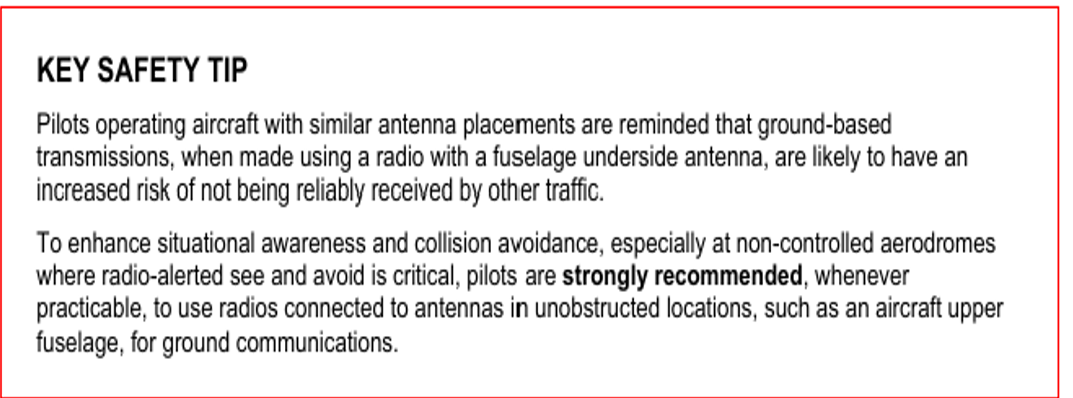
The aircraft type certificate holder advised that VHF COM 1 is normally used for more important communication functions while the VHF COM 2 can be used for arguably less important ones. They also advised that they were not aware of any communication issues due to the placement of the VHF COM 2 antenna.
Operator procedures
The operator’s standard operating procedure at the time of the occurrence, required communication with air traffic services to be conducted using COM 1 (upper antenna on Sharp 161) and communication within the CTAF to be conducted using COM 2 (lower antenna on Sharp 161).
Safety management system
Awareness of potential ground/airframe shielding
The ATSB discussed the potential for ground shielding to result in poor-quality radio transmission with Sharp Airlines throughout the course of the investigation.
In November 2025, during a discussion with the safety manager and a senior maintainer, the maintainer advised that it was known best practice to make ground transmissions through the communication unit that had the antenna on the roof, i.e. VH COM 1.
On 19 December 2025, a Sharp Airlines Fairchild Industries SA227-AC was involved in a separation issue at Flinders Island Airport, Tasmania, where the departing SA227 did not hear the radio broadcasts from a second departing aircraft on a crossing runway. At the time of writing, the second occurrence was being investigated by the ATSB.
In February 2026, the ATSB further discussed antenna ground shielding, including the value of making ground transmissions through COM 1 when operating in non-controlled airspace, with the operator. In response, the operator stated that if the procedures required the pilots to switch between COM 1 and COM 2 when on the ground were changed, it would introduce confusion, in addition, some of the fleet (2 out of 18 aircraft) had both COM 1 and COM 2 antennas mounted on the underside of the aircraft.
Following receipt of the draft report, Sharp Airlines provided a written assessment of the benefits and risks associated with radio selection, concluding that:
the more appropriate risk control is to retain a clear and consistent radio-management procedure while expressly allowing either VHF system to be used whenever communication quality or operational circumstances require it.
However, this assessment had not been internally documented in safety meetings, risk registers or the operator’s internal investigation.
Sharp Airlines advised that it also conducted a review of possible alternate antennas and/or alternate antenna location on its aircraft and determined that there were no viable options. Detail of that review was also not internally documented.
Sharp Airlines’ safety management system manual stated:
Hazard identification is a prerequisite to the safety risk management process.
Hazard identification is the first step in a formal process of collecting, recording, acting on and generating feedback about hazards and safety risks. Hazard identification is based on a combination of reactive, proactive and predictive safety data collection methods.
The scope of hazards in aviation is wide. Examples of the scope of factors and processes that should be looked into when engaging in hazard identification include:
• normal operations monitoring schemes
• investigation and follow-up of incidents.
Examples of external sources of hazard identification available to an organisation include:
• accident reports.
The safety management system required that an executive safety review meeting occur every 2 months and should:
- discuss new occurrences
- review the hazard/risk register.
The safety management system manual went on to state:
Safety risks are conceptually assessed as acceptable, tolerable or intolerable. Risks assessed as initially falling in the intolerable region are unacceptable under any circumstances. If the likelihood and/or severity of the consequences of the hazards are of such a magnitude and the damaging potential of the hazard poses such a threat to safety, then mitigating action is required to be implemented to reduce the level of risk to [as low as reasonably practicable] ALARP. The implemented mitigation measures should then be monitored to ensure that they have the desired effect.
Hazards identified as high risk required:
Perform risk review mitigation as necessary. Departmental approval of control measures required.
The risk can only be said to be ALARP when it can be demonstrated that all justifiable risk reduction measures have been considered and the remaining mitigation strategies cannot be justified.
The operator provided the ATSB with the agendas for a number of executive safety review meetings that occurred after the occurrence. These identified that the ATSB was investigating the incident. It was also reported that related hazards had been discussed. However, as there were no meeting minutes, it was not possible to identify any detail of the discussion, including outcomes.
Risk register
For routine operations at non-controlled aerodromes, the operator’s risk register had identified the following hazards and their assessed risk:
- CTAF communications affecting safety of flight - assessed as ‘low risk’
- Vehicle incursion on the runway resulting in aircraft accident - assessed as ‘low risk’
As both risks were deemed low risk, no further mitigation or treatment was deemed necessary.
Following the incident, Sharp Airlines updated its risk register associated with non‑controlled aerodromes to include several additional previously‑unidentified hazards. However, although the operator had assessed the issue in documents sent to the ATSB, the potential risks of poor ground communications due to ground shielding were not identified or assessed in a risk assessment.
Incident investigation
Sharp Airlines SMS manual outlined that:
An internal investigation shall be conducted following a [Sharp Aviation Group] SAG accident or serious incident that is the subject of an external investigation. It should be emphasised that any investigation focuses on the facts of an occurrence, to identify the causal factors, human interactions and systemic causes underlying the incident, and to facilitate the development of agreed actions to either prevent or reduce the probability of a recurrence.
In March 2026, in response to its investigation findings, Sharp Airlines issued a safety advisory to flight crew reiterating the requirement for clear and effective radio communication.
Airport safety officer – electronic device usage
Airport safety officers (ASO’s) were issued with iPads to enable completion of required runway inspection forms in the Airside Tracker application. The application login screen required the user to accept the conditions of its use, one of which included not using the application while driving. Mackay Airport also provided an induction program for the use of the application when it was first introduced in 2023.
The iPads were also installed with flight tracking applications to assist with scheduling runway inspections and for situation awareness. The FlightAware application was considered useful for this purpose, as the flights inbound to Mackay could be easily visually distinguished from other aircraft.
The airside driver’s manual stated that ‘mobile phones were not permitted by a driver on a manoeuvring area’, this included a taxiway. However, Mackay Airport did not have a specific policy for the use of iPads in the vehicles beyond the requirement not to use them while driving.
The driver of Car 1 reported that they planned their runway inspections around the scheduled movements of air transport operations at the airport by consulting the airport’s flight information displays and the FlightAware application on their iPad. The driver further advised that they routinely used their iPad to monitor the track of inbound aircraft before entering a runway and also to mark off departing and arriving aircraft in the Airside Tracker application. The driver could not specifically recall if they were using the iPad at the time of the occurrence, but stated they may have been.
Records show that a runway inspection form was commenced by the driver at 2029:44, 1 second prior to the pilot of Sharp 161’s line up broadcast on the Brisbane Centre frequency and 27 seconds prior to their rolling call on the CTAF.
As Sharp 161 was not a passenger service, it was not displayed on the airport flight information display, nor did the FlightAware application show aircraft on the ground at Mackay Airport. The driver also stated that as Sharp 161 was not displayed on these devices, and the Sharp flight normally departed prior to the tower closing, they did not expect the aircraft to be on the runway.
FlightAware advised that it did not have consistent ADS-B source data at Mackay Airport. As such, it was common for departing aircraft to only become visible on the application at around 100 ft AMSL.
Human factors
Selective auditory attention
Research into human information processing has shown that auditory stimuli, such as radio transmissions, may sometimes be unconsciously supressed to allocate attentional resources to other tasks (Broadbent 2013, Treisman 2012). Stimuli may be automatically selected for attentional focus, or otherwise suppressed, based on their saliency. The threshold at which this automatic filtering occurs is dependent on the level of competition for attentional resources.
In addition, Broadbent’s Filter model of attention (2013) proposed that because of limited information processing capacity, the human brain applies a filter to auditory information, based on physical properties, such as loudness and pitch. Treisman’s Strategies and models of selective attention (2012) proposed that any information that does not make it through the filter can be processed at some basic level if it is somehow meaningful to the listener i.e. a particular callsign or location is mentioned.
Similar occurrences
ATSB investigation (AO-2012-090)
On 29 June 2012, an ASO at Mackay Airport, Queensland, contacted Mackay Tower air traffic control (ATC) to request a clearance to enter the airport runway for a routine runway and lighting inspection. Mackay Tower cleared Car 2 to enter runway 14 and runway 05. Car 2 entered runway 14 at taxiway Alpha.
At about this time, the pilot of a Piper PA-31 Navajo aircraft contacted Mackay Ground for a taxi clearance from the western general aviation apron and requested runway 05 for departure. Mackay Ground cleared the PA-31 to taxi for runway 05 via taxiway Hotel. Mackay Tower then instructed the ASO in Car 2 to hold short of runway 05. The ASO understood and correctly read back the instruction. They later reported that they were aware that an aircraft was about to depart off runway 05.
As the aircraft backtracked on runway 05, the ASO proceeded to the threshold of runway 32. Between the time the ASO acknowledged the ATC instruction and positioning at the threshold of runway 32, the ASO received a mobile telephone call. The ASO accepted and continued with the call as they travelled to the threshold of runway 32.
Contrary to the ATC instruction to hold short of runway 05, the ASO continued through the runway intersection. The aircraft passed over Car 2 at the runway intersection, at about 30 ft above ground level.
The investigation highlighted the importance of remaining vigilant during airside operations, and to be mindful of the potential distraction presented by all portable communication devices, including mobile telephones.
ATSB investigation (AO-2023-025)
On 6 June 2023, a Piper PA-28 and a De Havilland Aircraft of Canada Limited DHC-8 (Dash 8) taxied at Mildura Airport for crossing runways. Both aircraft broadcast their intentions on the local CTAF. Despite that, while the pilot of the PA-28 was aware of the Dash 8, the crew of the Dash 8 were not aware of the PA-28. The Dash 8 commenced their take-off on runway 09 as the pilot of the PA-28 gave a rolling call on runway 36 with the Dash 8 crossing the runway intersection about 600 m ahead of the PA-28.
The ATSB’s investigation identified that the pilot of the PA-28 incorrectly identified the runway direction at Mildura Airport during their radio calls (saying ‘runway 35’ instead of ‘runway 36’). This led to an incomplete comprehension of traffic at Mildura by the Dash 8 crew (who believed that the PA-28 was not at Mildura) due to the Dash 8 crew’s focus on obtaining their pre-departure information from air traffic control, with the volume for the radio tuned to the CTAF frequency turned down, and only receiving certain elements of the PA-28 pilot’s radio calls due to an over transmission from air traffic control.
ATSB investigation (AO-2024-009)
On 19 March 2024, a Fairchild SA226 Metroliner taxied at Geraldton, Western Australia, for runway 03. About 1 minute later, a Beechcraft A36 Bonanza taxied for runway 14. After reaching their respective runway thresholds, both pilots attempted to contact the other, however, they did not hear or see each other. A third aircraft assisted by relaying information. Based on the information received, the Bonanza and Metroliner pilots commenced their take-off within 3 seconds of each other. The Metroliner crossed runway 14 about 400 m in front of the Bonanza, with a vertical separation of about 250–300 ft.
The investigation found that, when aircraft were positioned at the thresholds of runway 03 and 14 (and 08), they will unlikely be visible to each other due to the position of the airport buildings. Further, they may not be contactable on VHF radio due to potential shielding effects. This resulted in the pilots being unable to verify each other’s position and intentions prior to commencing their take-off.
While the pilot of the third aircraft was attempting to assist, the details provided were inaccurate and incomplete. This inadvertently resulted in misinterpretation by the Bonanza and Metroliner pilots and influenced their decision to take off.
ATSB investigation (AO-2024-041)
On 15 July 2024, a De Havilland Aircraft of Canada Limited DHC-8 (Dash 8) was taxied to reposition to a different bay at Wagga Wagga Airport, New South Wales. This repositioning required the Dash 8 crew to taxi out onto the runway and then return to a different bay. As the Dash 8 entered runway 05, the crew were unaware that a Piper PA‑28, operating on a training flight, had already commenced its take-off run from the opposite end of the runway.
The instructor of the PA-28 was aware of the Dash 8 taxiing and assumed that the Dash 8 had received and understood their previous positional broadcasts. However, the crew of the Dash 8 were not aware of the PA-28 preparing for take-off.
Upon entering runway 05 the Dash 8 was notified, by a preceding aircraft that had landed, that there was another aircraft taking off from runway 23. The captain of the Dash 8 immediately stopped the aircraft and engaged reverse thrust to clear the runway. Simultaneously, the PA-28 pilot rejected their take-off.
The Dash 8 operator’s radio procedure required crew to use the number 2 VHF radio to broadcast and receive on local frequencies during operations at a non-controlled aerodrome. This likely reduced ground-based reception strength and the likelihood of the Dash 8 hearing other traffic in certain circumstances.
ATSB investigation (AO-2025-074)
The ATSB is investigating a near collision involving a Gippsaero GA8, and a Fairchild SA227, at Flinders Island Airport, Tasmania, on 17 December 2025. Passing 150 ft on take-off from runway 14, the crew of the Fairchild SA227 observed the Gippsaero GA-8 taking off on the crossing runway 23 in close proximity.
Safety analysis
Introduction
This analysis will discuss the readability of the radio broadcasts from the Sharp Airlines Fairchild Industries SA227 and why neither the pilot or the driver of the safety vehicle heard each other’s transmissions or saw each other, prior to the near collision. This section will further examine Mackay Airport’s procedures regarding the use of electronic devices for airside safety officers and Sharp Airlines’ hazard identification process.
CTAF radio transmissions
The recordings of the CTAF broadcasts, made on the ground by the pilot of Sharp 161 using COM 2, ranged from unreadable to readable with considerable difficulty. However, once the aircraft became airborne, the transmissions were clear and readable and after the incident, no faults were found with the radio or the antenna.
While the reduced quality was due in part to the pilot’s rapid speech, the variation in quality between the ground and airborne transmissions indicated that the use of the ground facing antenna (COM 2) also contributed by reducing the signal strength. That conclusion was consistent with previous ATSB investigations that identified that using an antenna positioned underneath the aircraft may not allow optimal ground‑based transmission or reception strength and clarity due to airframe shielding.
In addition, the information in the broadcasts from Sharp 161 was not transmitted in the expected order which required that the location be stipulated at the beginning and end of each call.
Contributing factor Common traffic advisory frequency radio transmissions from the aircraft were of poor quality. This was due to a combination of the pilot’s rapid speech, non-standard phraseology and interference caused by use of the VHF COM 2, the radio with the ground‑facing antenna. |
Unidentified safety car
The pilot taxied from the western general aviation apron to holding point Juliet without observing Car 1 at holding point Bravo. This may have been influenced by their focused attention on taxiway Juliet during the night manoeuvring followed by looking for any airborne traffic approaching runway 14 prior to backtracking that runway. In addition, they did not hear the driver of Car 1 transmit on the CTAF to advise they were about to enter the runway. While the recording of that transmission was of high quality, it is likely that the reception quality of this incoming broadcast was also reduced to the pilot of Sharp 161 due to it being received via the antenna on the underside of the aircraft.
At the time of the driver’s broadcast, the pilot was increasing engine power and focusing on pre-take-off tasks. In addition, other transmissions were being made on the Brisbane Centre frequency. The pilot confirmed they could hear both transmissions in the aircraft when this occurred, however, the high overall transmission activity likely reduced the ability of the pilot to identify the driver’s broadcast.
While the pilot did not see the car, they saw a flash of light, which was likely the vehicle’s headlights turning on to the runway, however, they did not question on the radio if there was something on the runway prior to commencing the take-off.
Contributing factor While the pilot did not hear the transmission from the driver of Car 1, likely due to the reduced reception strength of the radio broadcast and concurrent transmission on the Brisbane Centre frequency, the pilot did not confirm the runway was clear after seeing a flash of unidentified light prior to commencing their take-off run. |
Unidentified aircraft
While the airport safety officer (ASO) was holding on Bravo for an extended period, they did not observe aircraft 2 depart or Sharp 161 enter runway 14 and backtrack to the runway threshold.
The ASO heard the clear departure broadcast from aircraft 2 but did not hear any of the 5 radio broadcasts, made on both the CTAF and area frequency, by the pilot of Sharp 161. While the 3 broadcasts on the CTAF were of poor quality and key words were not audible, radio transmissions on the frequency could clearly be heard, indicating that an aircraft was operating within the CTAF area. Additionally, the 2 broadcasts made by the pilot on the Brisbane Centre frequency, which the ASO was also monitoring, were readable.
The evidence showed that the ASO opened the runway inspection form 1 second prior to the lining up call made on the Brisbane Centre frequency. While they could not specifically recall doing so on this occasion, they reported that they routinely used their iPad to gain situation awareness of the arriving and departing aircraft before entering the runway. As such, it is possible that the driver had also used the iPad prior to the lining up call. Further, the driver was not expecting the aircraft to be on the runway at that time, due to its delayed departure time.
Research has shown that when a person’s attention is diverted to a different task, unless a meaningful phrase is used, information such as that contained in a radio transmission, may not be processed. In this case, as:
- the radio broadcasts were very difficult to understand
- the pilot did not state the location at the beginning of the broadcasts
- they were likely received by the ASO at a lower volume than expected for a CTAF transmission
they may have been perceived as irrelevant transmissions on the Brisbane Centre frequency and so did not break through the ASO’s attention filter.
Contributing factor The airport safety officer did not scan for aircraft ground movements or keep a constant radio listening watch prior to entering the occupied runway, possibly due to being distracted while using an iPad for other operational tasks and an expectation that the aircraft would not be departing at that time. |
Airport procedures
Mackay Airport provided iPads to ASOs and required that they were used to complete runway inspection forms. They advised that the iPads were also to assist with aircraft movement awareness.
Despite their intended operational benefit, the airport had not provided specific guidance on iPad usage to ensure there were no unintended consequences, such as distraction.
Other factor that increased risk Mackay Airport provided its airport safety officers with iPads for operational benefits but did not provide specific guidance on their usage to ensure there were no unintended consequences, such as distraction. (Safety issue) |
Safety management system application
At the time of the incident, Sharp Airlines had completed 2 risk assessments that identified hazards at uncontrolled airports however, it had not identified or assessed the potential risks associated with poor ground-based communications due to interference from the ground facing (VH COM 2) antenna. After the incident, they conducted an internal investigation and updated the risk register. However, this did not include the potential risks associated with ground shielding, although they did risk assess communication issues at the CTAF.
Following receipt of the draft report, Sharp Airlines provided the ATSB with an evaluation of the use of VHF COM 2 at non-controlled aerodromes, however, this was not formally documented in any safety meetings, the internal investigation or its risk register.
While Sharp Airlines advised that identified hazards were discussed and evaluated at its safety meetings, there were no minutes kept for the meetings.
In addition, there was no formal evaluation or documentation of those hazards via its safety management system. This is an important part of the process to ensure identified risks are managed appropriately and that any mitigations are consistently understood by all.
Other factor that increased risk Contrary to the requirements in its safety management system, Sharp Airlines did not formally assess known hazards for operations at non-controlled aerodromes in its risk register to ensure that the associated risks were adequately managed. (Safety issue) |
Findings
ATSB investigation report findings focus on safety factors (that is, events and conditions that increase risk). Safety factors include ‘contributing factors’ and ‘other factors that increased risk’ (that is, factors that did not meet the definition of a contributing factor for this occurrence but were still considered important to include in the report for the purpose of increasing awareness and enhancing safety). In addition ‘other findings’ may be included to provide important information about topics other than safety factors. Safety issues are highlighted in bold to emphasise their importance. A safety issue is a safety factor that (a) can reasonably be regarded as having the potential to adversely affect the safety of future operations, and (b) is a characteristic of an organisation or a system, rather than a characteristic of a specific individual, or characteristic of an operating environment at a specific point in time. These findings should not be read as apportioning blame or liability to any particular organisation or individual. |
From the evidence available, the following findings are made with respect to the runway incursion and near collision involving Fairchild Industries SA227-DC, VH-HPE, and an airport safety vehicle at Mackay Airport, Queensland, on 12 November 2025.
Contributing factors
- Common traffic advisory frequency radio transmissions from the aircraft were of poor quality. This was due to a combination of the pilot’s rapid speech, non-standard phraseology and interference caused by use of the VHF COM 2, the radio with the ground‑facing antenna.
- While the pilot did not hear the transmission from the driver of Car 1, likely due to the reduced reception strength of the radio broadcast and concurrent transmission on the Brisbane Centre frequency, the pilot did not confirm the runway was clear after seeing a flash of unidentified light prior to commencing their take-off run.
- The airport safety officer did not scan for aircraft ground movements or keep a constant radio listening watch prior to entering the occupied runway, possibly due to being distracted while using an iPad for other operational tasks and an expectation that the aircraft would not be departing at that time.
Other factors that increased risk
- Contrary to the requirements in its safety management system, Sharp Airlines did not formally assess known hazards for operations at non-controlled aerodromes in its risk register to ensure that the associated risks were adequately managed. (Safety issue)
- Mackay Airport provided its airport safety officers with iPads for operational benefits but did not provide any specific guidance on their usage to ensure there were no unintended consequences, such as distraction. (Safety issue)
Safety issues and actions
Central to the ATSB’s investigation of transport safety matters is the early identification of safety issues. The ATSB expects relevant organisations will address all safety issues an investigation identifies. Depending on the level of risk of a safety issue, the extent of corrective action taken by the relevant organisation(s), or the desirability of directing a broad safety message to the aviation industry, the ATSB may issue a formal safety recommendation or safety advisory notice as part of the final report. All of the directly involved parties were provided with a draft report and invited to provide submissions. As part of that process, each organisation was asked to communicate what safety actions, if any, they had carried out or were planning to carry out in relation to each safety issue relevant to their organisation. Descriptions of each safety issue, and any associated safety recommendations, are detailed below. Click the link to read the full safety issue description, including the issue status and any safety action/s taken. Safety issues and actions are updated on this website when safety issue owners provide further information concerning the implementation of safety action. |
Sharp Airlines hazard identification
Safety issue number: AO-2025-067-SI-01
Safety issue description: Contrary to the requirements in its safety management system, Sharp Airlines did not formally assess known hazards for operations at non-controlled aerodromes in its risk register to ensure that the associated risks were adequately managed.
Mackay Airport electronic device usage
Safety issue number: AO-2025-067-SI-02
Safety issue description: Mackay Airport provided its airport safety officers with iPads for operational benefits but did not provide any specific guidance on their usage to ensure there were no unintended consequences, such as distraction.
Safety action not associated with an identified safety issue
Following this occurrence, Mackay Airport:
- arranged for testing of the radios in airside vehicles by an external communications technician and confirmed they were fully functional
- conducted an internal investigation immediately and implemented mitigation actions
- designed and delivered additional human factors training for all safety operations team members (annual refresher scheduled) to accompany existing training
- reviewed the standard work procedures relating to runway and taxiway operations for consistency with other aerodromes and discussed CTAF radio calls and situational awareness with wider safety team via toolbox talks.
Glossary
| AC | Advisory circular |
| ASO | Airport safety officer |
| AIP | Aeronautical information publication |
| AMSL | Above meal sea level |
| ARFF | Aviation rescue and fire fighting |
| ATC | Air traffic control |
| CASA | Civil Aviation Safety Authority |
| CAAP | Civil Aviation Advisory Publication |
| CTAF | Common traffic advisory frequency |
| CCTV | Closed-circuit television |
| CVR | Cockpit voice recorder |
| FDR | Flight data recorder |
| SMS | Safety management system. |
Sources and submissions
Sources of information
The sources of information during the investigation included:
- the pilot of the incident flight
- the driver of the airport safety vehicle
- Sharp Airlines
- B2 maintainer of Sharp Airlines
- safety manager of Sharp Airlines
- Mackay Airport
- Airservices Australia
- the flight data recorder
- CCTV footage of the incident flight
- audio recordings from the CTAF
- the aircraft certificate holder.
References
Broadbent, D. E. (2013). Perception and communication. Elsevier.
CASA, (2025) ‘Be heard. Be seen. Be safe - Radio procedures for non-controlled aerodromes and operations.
CASA, (2025) ‘Operations in the vicinity of non-controlled aerodromes’ - Advisory Circular, AC 91-10 v.17, p.37
CASA, (2025) ‘Pilots’ responsibility for collision avoidance’, Advisory Circular, AC 91-14 v1.3
Hobbs (1991), Limitations of the see-and-avoid principle. ATSB.
Treisman, A. (2012). Strategies and models of selective attention. In J. W. L. Robertson (Ed.), From perception to consciousness: Searching with Anne Treisman (pp. 1–12). Oxford University Press.
Submissions
Under section 26 of the Transport Safety Investigation Act 2003, the ATSB may provide a draft report, on a confidential basis, to any person whom the ATSB considers appropriate. That section allows a person receiving a draft report to make submissions to the ATSB about the draft report.
A draft of this report was provided to the following directly involved parties:
- the pilot of the incident flight
- the driver of the airport safety vehicle
- Sharp Airlines
- Mackay Airport
- the aircraft certificate holder
- the Civil Aviation Safety Authority
- the United States National Transportation Safety Board.
Submissions were received from:
- Mackay Airport
- Sharp Airlines
- the Civil Aviation Safety Authority.
The submissions were reviewed and, where considered appropriate, the text of the report was amended accordingly.
Purpose of safety investigationsThe objective of an ATSB safety investigation is to improve transport safety through:
In accordance with the TSI Act, the ATSB does not investigate for the purpose of taking administrative, regulatory or criminal action, and cannot apportion blame, assist in determining liability, or, as a general rule, assist in court proceedings. About ATSB reportsATSB safety investigation reports are developed in accordance with ATSB procedures and guidelines, and with regard to applicable international standards and instruments. Reports must include factual material of sufficient weight to support the investigation’s analysis and findings. At all times the ATSB endeavours to balance the use of material that could imply adverse comment with the need to properly explain what happened, and why, in a fair and unbiased manner. An explanation of terminology used in ATSB investigation reports is available here. Publishing informationReleased in accordance with section 25 of the Transport Safety Investigation Act 2003 Published by: Australian Transport Safety Bureau © Commonwealth of Australia 2026 Ownership of intellectual property rights in this publication Unless otherwise noted, copyright (and any other intellectual property rights, if any) in this report publication is owned by the Commonwealth of Australia. Creative Commons licence 
With the exception of the Commonwealth Coat of Arms, ATSB logo, and photos and graphics in which a third party holds copyright, this report is licensed under a Creative Commons Attribution 4.0 International licence. The CC BY 4.0 licence enables you to distribute, remix, adapt, and build upon our material in any medium or format, so long as attribution is given to the Australian Transport Safety Bureau. Copyright in material obtained from other agencies, private individuals or organisations, belongs to those agencies, individuals or organisations. Where you wish to use their material, you will need to contact them directly. |
Occurrence summary
| Investigation number | AO-2025-067 |
|---|---|
| Occurrence date | 12/11/2025 |
| Occurrence time and timezone | 2030 Australian Eastern Standard Time |
| Location | Mackay Airport |
| State | Queensland |
| Report release date | 02/10/2026 |
| Report status | Final |
| Investigation level | Defined |
| Investigation type | Occurrence Investigation |
| Investigation phase | Final report: Dissemination |
| Investigation status | Completed |
| Mode of transport | Aviation |
| Aviation occurrence category | Airspace related - Other, Near collision, Runway incursion |
| Occurrence class | Serious Incident |
| Highest injury level | None |
Aircraft details
| Manufacturer | Fairchild Industries Inc |
|---|---|
| Model | SA227-DC |
| Registration | VH-HPE |
| Serial number | DC-823B |
| Aircraft operator | Sharp Airlines |
| Sector | Turboprop |
| Operation type | Part 135 Air transport operations - smaller aeroplanes |
| Activity | Scheduled freight |
| Departure point | Mackay Airport, Queensland |
| Destination | Brisbane Airport, Queensland |
| Injuries | None |
| Damage | Nil |