

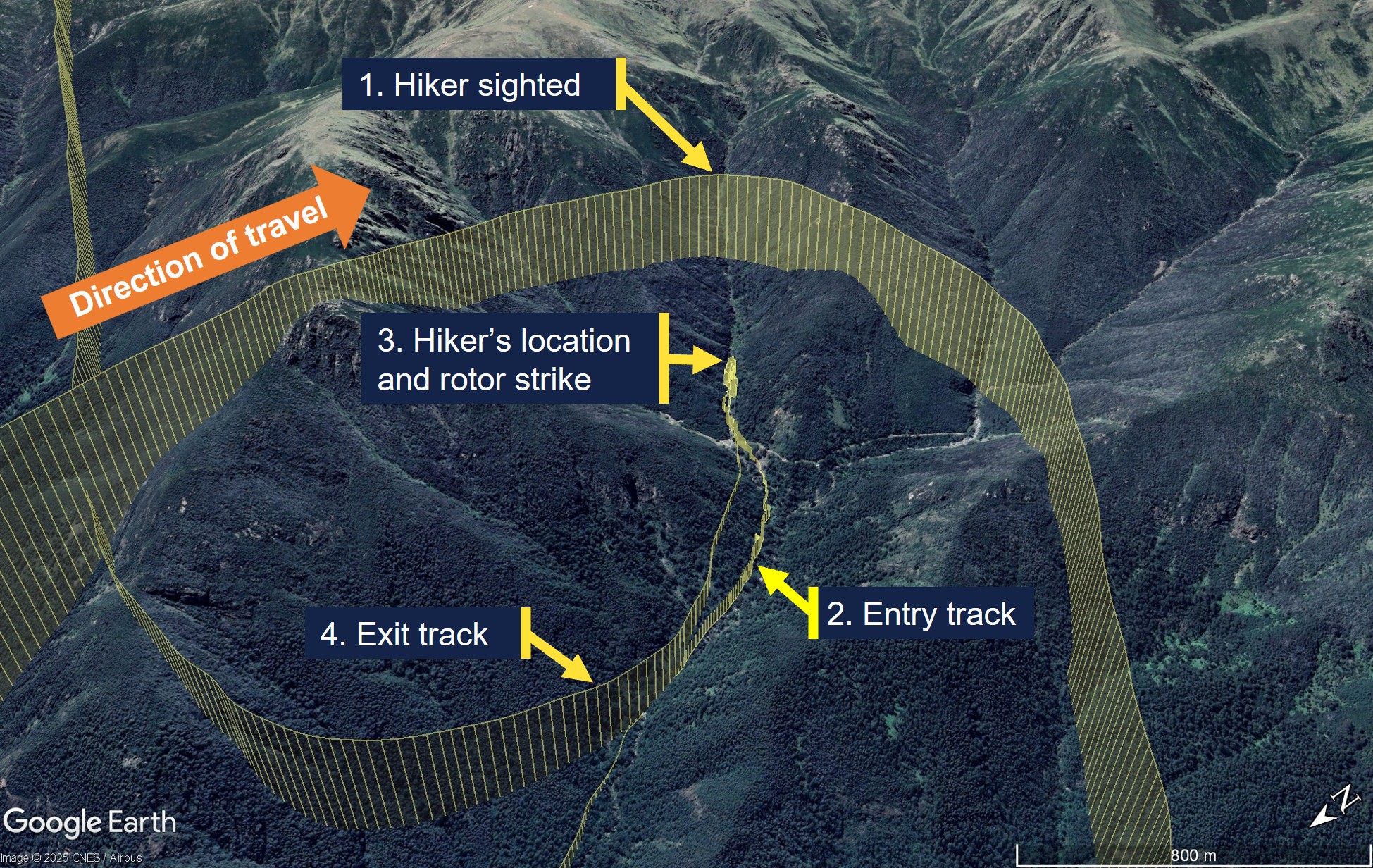
The main rotor of an AW139 rescue helicopter struck a tree that was in the pilot’s blind spot during an attempted winching operation in the Snowy Mountains earlier this year, an ATSB investigation final report details.
On 5 January 2026, the Canberra-based Helicorp (Toll Helicopters) AW139 rescue helicopter was tasked with a likely winch retrieval of a hiker in the Snowy Mountains, NSW.
Taking off from the operator’s base, the pilot was in the front right seat with an air crew officer (ACO) in the front left seat. A doctor and a paramedic were sat in the cabin.
About 30 minutes after take-off, the paramedic and ACO transitioned to moving around the cabin, each attached to a flexible tether.
After locating the hiker in a valley, the ACO assisted the pilot in positioning the helicopter in a hover above the hiker, with the helicopter orientated such that it was pointed downslope.
The ACO then briefed the pilot on the nearest obstacles, with the closest being a tree about 10 ft above and 10 ft to the left of the main rotor.
“At this stage the ACO’s attention moved inside the cabin, as they began to prepare for the paramedic winching,” ATSB Director of Transport Safety Stuart Macleod said.
“While this was clearly communicated, it left the pilot with sole responsibility for keeping the helicopter clear of obstacles, while the nearest obstacle was in their blind spot.”
Subsequently, the helicopter drifted towards the tree and its main rotor blades struck branches.
“Thanks to the helicopter’s position facing downslope, the pilot was provided an escape path option, which they used immediately after the main rotor strike occurred,” Mr Macleod noted.
After the helicopter was transitioned to forward flight, the pilot conducted a control check, and the helicopter subsequently landed at the Perisher helipad. Post-flight inspection found minor repairable damage to three main rotor blade tips, the horizontal stabiliser and tail boom.
Mr Macleod said the incident was a reminder that the use of minimum clearances in confined areas should be limited to those occasions when the nearest obstacles can be actively monitored by appropriately trained crew.
“If this is not achievable, flight crews should use greater margins wherever practicable,” Mr Macleod said.
“Fortunately, this incident also demonstrates the importance of flight crews always considering their plan for escape path options, particularly in mountainous areas,” he added.
“The preparation and positioning of the helicopter in this instance provided the pilot with an escape path option when the main rotor blade struck the tree.”
In response to this incident the operator has taken a range of safety steps, including the release of a bulletin to flight crews on helicopter clearance limits, and collaboration with the tasking agency to improve operations.
Read the final report: Main rotor strike involving Leonardo Helicopters AW139, VH-TJF, 41 km south-east of Corryong Airport, New South Wales, on 5 January 2026