

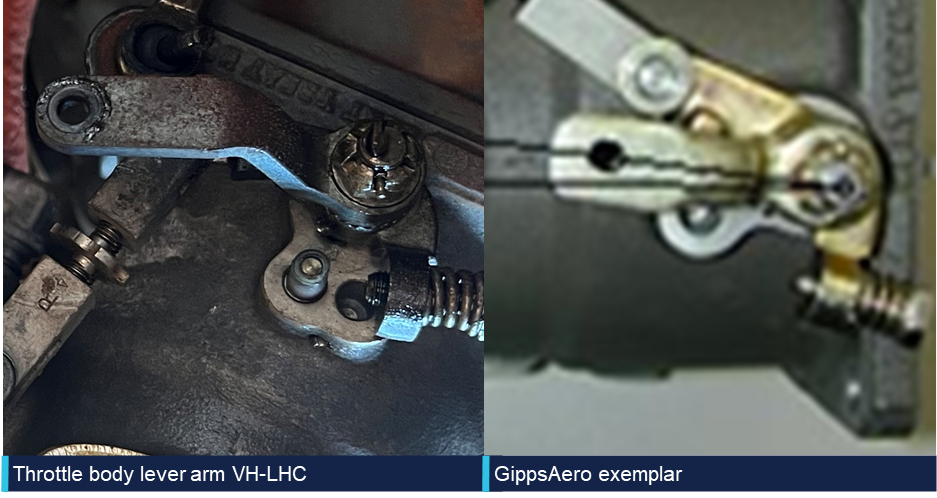
Airvan owners and operators are encouraged to examine their aircraft’s throttle linkage assemblies, after a charter pilot encountered a partial power loss prior to landing in northern WA.
An ATSB investigation report details that on 22 August 2025, the GippsAero GA8 Airvan, operated by Air Kimberley, was being flown from Broome Airport to Djarindjin Airport, on WA’s Dampier Peninsula. On board were a pilot and a passenger, and freight.
During the approach, the pilot identified an uncommanded drop in engine manifold pressure.
After consulting with their chief pilot via mobile phone, the pilot conducted an orbit between the base and final legs of the circuit to prepare for landing.
Then, crossing over the runway threshold, the pilot identified they were about 20 to 25 kt above the target approach speed. When approximately two-thirds down the runway, the pilot assessed there was not enough distance to complete the landing, and commenced a go-around.
During the attempted go-around, the pilot found the aircraft did not have enough power to climb, and elected to instead level at 300 ft above ground level, and conduct a turnback to land on the reciprocal runway.
The pilot then landed without further incident, using the mixture control to reduce the engine’s power.
An inspection then found the securing mechanism for the aircraft’s throttle linkage had disconnected, resulting in the loss of throttle control.
The manufacturer required a torsion spring be installed such that, in the event of a disconnection, the throttle would be opened to at least 75% of the open position.
However, the ATSB found it was very likely this required torsion spring was not fitted to the aircraft at the time of the occurrence.
As a result, the investigation’s final report notes the go-around and return to landing was conducted with less power available than that required by the manufacturer to sustain ‘continued safe flight and landing’.
The investigation identified several inconsistencies between the throttle linkage hardware fitted to the incident aircraft, and what was laid out in the aircraft documentation.
After the incident, the aircraft’s maintenance organisation identified and took action to rectify various inconsistencies identified within all three GA8 aircraft that it was responsible for.
“Although the ATSB could not determine whether these inconsistencies contributed to this incident, they did increase the risk of throttle disconnection,” ATSB Director of Transport Safety Stuart Macleod said.
“Airvan owners and operators are encouraged to review this report in full, and consider whether these types of inconsistencies may be present in their aircraft.
“Aircraft maintainers should be aware of, and adhere to the manufacturer’s assembly requirements,” he continued.
“Reconnecting a component’s attachment hardware on a like-for-like basis may not ensure compliance with the manufacturer’s requirements, and can increase the risk of an adverse outcome.”
Turning back to the incident itself, Mr Macleod said it demonstrated the complex nature of partial power loss scenarios.
“The response to a complete loss of engine power is definitive and standardised,” Mr Macleod said.
“In contrast, the response to a partial power loss may be dependent on the amount of power lost, and the reliability of the remaining power.”
Mr Macleod said where the manufacturer does not provide guidance, pilots should refer to CASA guidance, and treat partial power loss as though it were a complete power loss, landing as soon as possible.
“Flight time should only be extended when necessary to identify a better landing site, and when sufficient engine power is available,” he added. “And this should be done with the awareness that the power may reduce or fail at any time.”
Read the final report: Engine malfunction involving GippsAero GA-8, VH-LHC, at Djarindjin/Lombadina Airport, Western Australia, on 22 August 2025