

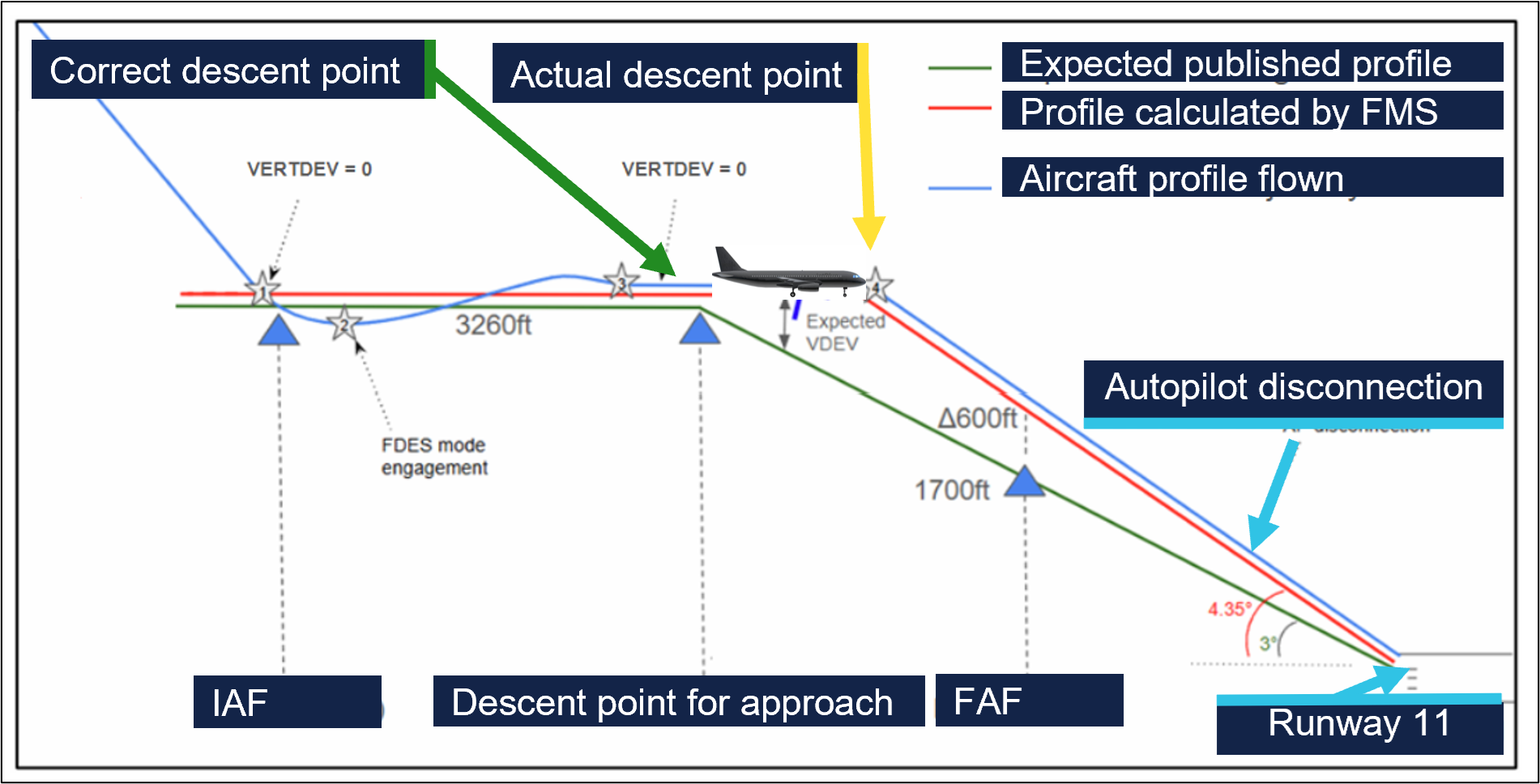
An A320 flight crew continued an unstable approach into Hervey Bay Airport, on Queensland’s Fraser Coast, after being unable to activate aerodrome lighting, and unknowingly encountering a software issue, an ATSB final report details.
The incident occurred on the afternoon of 11 August 2025, when the Jetstar-operated Airbus A320 was landing at Hervey Bay in daytime visual meteorological conditions at the conclusion of a passenger flight from Sydney.
Prior to arrival, the first officer attempted to activate the pilot-activated lighting system at Hervey Bay via a radio keying sequence, which would provide visual guidance for the vertical approach path via pilot approach path indicators (PAPI).
The lights did not activate, however, due to the first officer using an outdated radio keying sequence, rather than the updated sequence published in the relevant notice to airmen (NOTAM).
As a result, when the crew turned onto final approach, they observed the PAPI were not illuminated.
In addition, the ATSB found that near the top of the descent, the flight crew had selected DIR TO (direct to) the initial approach fix for the approach in the flight management system (this was to direct the autopilot to track to this position at which point the crew would commence the approach to land).
However, this selection very likely triggered a previously-known software abnormality.
“Although the flight crew knew about the software issue, they did not recall it at the time of the incident,” ATSB Director of Transport Safety Dr Stuart Godley said.
“As a result of this software error, the flight crew were provided with erroneous vertical guidance which, combined with a lack of PAPI lighting, led them to believe they were on the correct flight path, when in fact the flight path was too steep.”
The approach did not meet the operator’s stabilised approach criteria according to multiple parameters: vertical speed, the use of speed brake, and the extension of flap, the investigation found.
“However, the flight crew likely did not fully recognise multiple exceedances of the stable approach criteria, or erroneously considered some exceedances to be momentary, and continued the landing.”
Dr Godley noted the continuation of an unstable approach – instead of conducting a go-around – is a known precursor to runway excursions and other landing incidents.
“This occurrence highlights the importance of flight crews being aware of known and documented limitations or anomalies with aircraft systems, particularly those that can result in incorrect flight information being used and presented to pilots at a critical phase of flight,” he said.
“It can be challenging for flight crews to recognise the point at which multiple small issues can become serious, but effective monitoring in a multi-crew environment, and prudent communication of concerns, can help flight crews adequately manage these scenarios.”
The investigation also found that Jetstar had deferred an optional software update to correct the known software issue in the A320 fleet FMS, in order to await a newer update that ultimately did not become available.
“As a result, for nearly 5 years the operator continued to rely on a procedural control that was subject to human factors limitations,” Dr Godley said.
Jetstar has subsequently advised it is updating its A320 fleet to the newer H3 software standard, which should resolve the temporary software abnormality.
Read the final report: Unstable approach involving Airbus A320, VH-VQL, Hervey Bay Airport, Queensland, on 11 August 2025