

Final report
Report release date: 24/09/2026
Investigation summary
What happened
On 13 January 2023, Pacific National intermodal service 1150, collided with Qube Logistics intermodal service T296 while conducting a propelling movement in Port Botany yard, New South Wales.
Both trains were positioned on adjacent arrival roads when train 1150 passed a signal indicating stop and collided with the side of train T296, propelling on a proceed signal, on converging track at the end of the 2 arrival roads.
As a result of the collision, several wagons from both trains derailed and sustained significant damage. One derailed wagon crossed a vehicle access road and came to rest against a privately‑owned building.
There were no injuries, but there was significant damage to rollingstock and rail infrastructure.
What the ATSB found
Propelling train 1150 passed signal BY31 at stop, colliding with train T296, which was propelling on a proceed signal on the converging adjacent track.
The qualified driver directing the propelling movement of train 1150 mistook the location of their train. As a result, when signal BY29 cleared to allow T296 to proceed, the qualified driver incorrectly authorised train 1150 to also move.
ARTC's line of sight shunting procedure was unique to Port Botany yard and was described by train crew as difficult and time consuming to conduct. This led to operators routinely deviating from the procedure, for a perceived simpler method of working.
Aspects of ARTC's line of sight shunting instructions were ambiguous, resulting in varying interpretations of the procedure by stakeholders.
ARTC did not proactively follow risk assessment principles specific to propelling movements to ensure safe rail operations within shunting yards under its control. ARTC conducted operations without the hazards/risks being fully or effectively assessed, examples of this included:
- Proposed treatments (risk controls) which may have reduced risk were not further evaluated
- risk reviews were not conducted in accordance with ARTC’s procedures
- active train crew were not well represented in risk assessment processes
- issues raised by operators with line of sight shunting procedures were not risk assessed
- minimal compliance monitoring of risk controls.
The second person, who was not authorised to drive a train under instruction of the qualified driver, operated 1150 en route to Port Botany. On arrival at Port Botany, the qualified driver of 1150 performed the on-ground duties, leaving the unauthorised second person to operate the train unattended during the propelling movement.
What has been done as a result
ARTC has responded to safety concerns raised as part of this investigation and has:
- Updated and clarified local instructions for line of sight shunting in Port Botany yard, contained in Network Information Book OGW-30-25.
- Developed OPE-PR-072 Line of Sight Shunting Port Botany procedure with requirements consistent with Network Information Book OGW-30-25. The procedure includes a new requirement for ARTC to conduct assurance activities on rail operators conducting Line of sight shunting in Port Botany.
- Undertaken a structured review of risks associated with line of sight shunting at Port Botany in accordance with ARTC procedure RSK-PR-001 Risk Management. This process included formal risk workshops, review of existing controls, assessment of proposed treatments and establishment of ongoing review requirements. The workshop included operational subject matter experts and frontline rail safety workers involved in Port Botany line of sight shunting activities, including train crew, shunters and driver trainers. The following rail operators were involved:
- Pacific National Pty ltd
- Qube Logistics (Rail) Pty Ltd
- Holdco Holdings Pty Ltd (trading as Southern Shorthaul Railroad)
- Sydney Rail Services.
- Reviewed and updated the risk assessment in June 2025, October 2025 and January 2026. ARTC procedure RSK-PR-001 Risk Management requires this risk to be reviewed at a period no longer that every 12 months as the highest current risk level is medium. The risk assessment includes a review of all current controls and proposed treatments with justifications where treatments have been rejected.
- Noted, as an additional risk mitigation strategy, ongoing infrastructure developments at Port Botany that are expected to significantly reduce reliance on line of sight shunting operations over time. This includes installation of locomotive traversers at both DP World Stevedores (completion due Q4 2027) and Patrick Stevedores allowing for loco-leading arrival of trains.
Safety message
Rail infrastructure managers should follow their accredited risk management procedures, to ensure risk controls remain relevant and effective.
An effective risk assessment1 requires effective and meaningful engagement with subject matter experts and end users to identify risks and guide decision‑makers on the most appropriate way to manage risks; and if controls are administrative, also guide the thoughtful design and development, and practical implementation of procedures.
Once procedures are developed and implemented, accredited operators should provide rail safety workers with sufficient guidance and means to access written procedures, to allow the end users to refresh their theoretical knowledge on practical protocols.
End users must be given the opportunity to provide feedback on procedures. This feedback should be incorporated in risk reviews to ensure procedures remain fit for purpose and effective in managing risk.
When unique procedures are developed, care should be taken to align protocols with existing overarching procedures to minimise the risk of ambiguity when implementing local controls.
Rail operators must ensure that rail safety workers hold a verified competency for the task they are conducting.
The occurrence
Arrival of trains 1150 and T296 at Port Botany
On the morning of Friday 13 January 2023, Pacific National (PN) intermodal service 1150, consisting of 1 locomotive and 31 container flat wagons, was scheduled to travel from the Pacific National Intermodal Terminal in St Marys, to Port Botany yard, New South Wales (NSW), and return.
The train crew of 1150 consisted of a qualified driver and second person employed by RailTrain (RT), a labour provider of train crew to PN. At the start of their shift on the day, the qualified driver and the second person swapped roles, with the second person driving under the supervision of the qualified driver on the trip from St Mary’s to Port Botany.
At approximately 0430, train 1150 arrived onto arrival road number 2 at Port Botany yard.
Positioned on the adjacent arrival road number 1 was Qube Logistics (Qube) train T296, an intermodal service that was scheduled to travel between Qube Intermodal terminal in Minto, NSW, to Port Botany and return. T296 consisted of 1 locomotive and 30 container flat wagons and was crewed by a driver and second person employed by Sydney Rail Services (SRS), a labour provider to Qube.
T296 had arrived at Port Botany at 0410, approximately 20 minutes prior to 1150, and had carried out a run around movement to place the locomotive on the rear end of their train in readiness for propelling towards the stevedore ports. Shortly after arrival, the crew of 1150 also went through the process of placing their locomotive on the rear end of their train, in preparation for a similar propelling movement.2
Trains 1150 and T296 in readiness for propelling movements
By approximately 0450, T296 and 1150 were both ready to carry out their respective propelling movement towards the stevedore ports, with the second person of 1150 continuing to act as the driver, and the qualified driver acting as the second person.
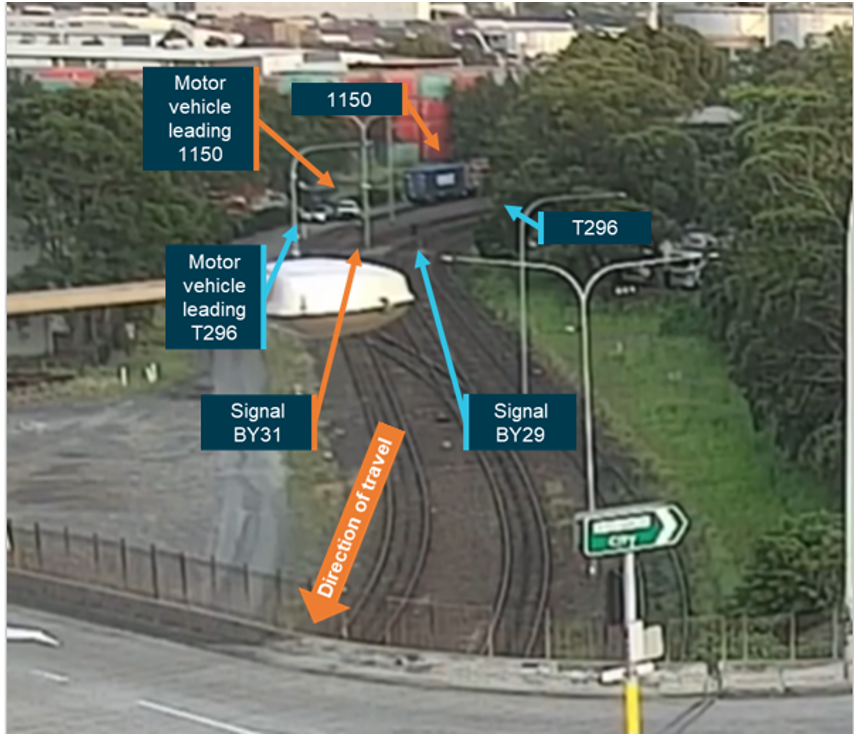
Both ‘second persons’ were in motor vehicles3 parked ahead of their respective trains, on the rail access road near signal numbers BY29 (for train T296 on arrival road 1) and the adjacent BY31 (for train 1150 on arrival road 2)4 (Figure 1). These signals protected the converging track at the stevedore end of the 2 arrival roads.
Figure 1: Trains 1150 and T296 prepare to propel to the Stevedore Ports
Events leading up to the SPAD and collision
At 0605:03 the network control officer (NCO) contacted the driver of T296 on arrival road 1 via the in-cab communications equipment (ICE) radio, to notify them that the stevedores at DP World were ready for their train and that the route and signal indications will be given shortly. T296’s driver relayed this message via handheld UHF two-way radio to the second person controlling their propelling movement at the rear of the train.
At 0605:32 signal BY29 located on arrival road 1 cleared for the passage of T296 towards DP World stevedores. Shortly afterwards, the second person of T296 communicated to their driver that the signal was now indicating proceed and to begin propelling their train.
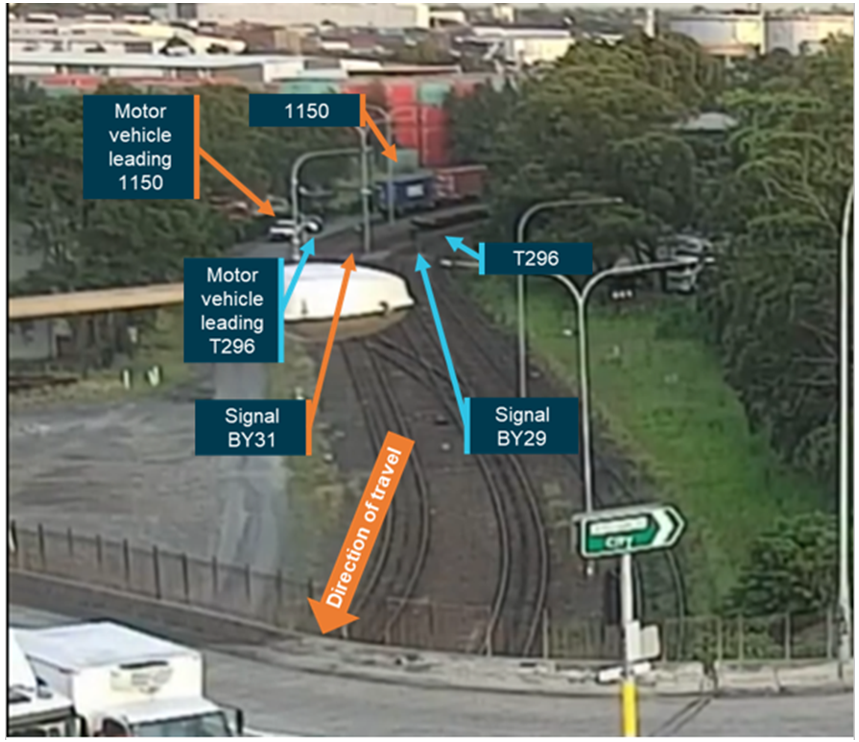
The lead wagon on T296 passes signal BY29 indicating proceed at 0606:17. Adjacent signal BY31 for 1150 located on arrival road 2 remained in the stop position (Figure 2).
Figure 2: T296 commencing its authorised propelling movement
Train 1150 SPAD event
The qualified driver of 1150, in their role as second person leading the propelling movement, also observes the proceed indication on signal BY29 on the adjacent arrival road and directs (via their UHF two-way radio) the second person acting as driver to also start propelling 1150.
At 0606:21, train 1150 begins an unauthorised propelling movement towards signal BY31 at stop on arrival road 2, towards the converging track and T296 which had commenced its authorised propelling movement moments earlier.
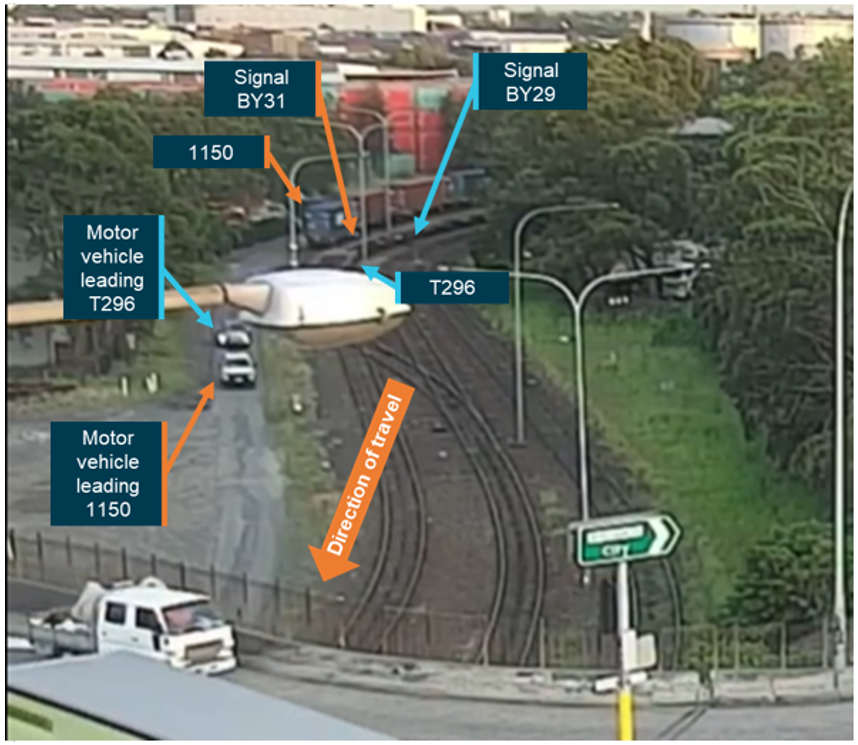
Both motor vehicles are then observed on CCTV footage to be moving simultaneously with the movement of T296, towards the stevedore ports, with both vehicles eventually well ahead of, and facing away from, their propelling trains (Figure 3).
Figure 3: Motor vehicles for 1150 and T296 moving away from the propelling trains
Collision of trains 1150 and T296
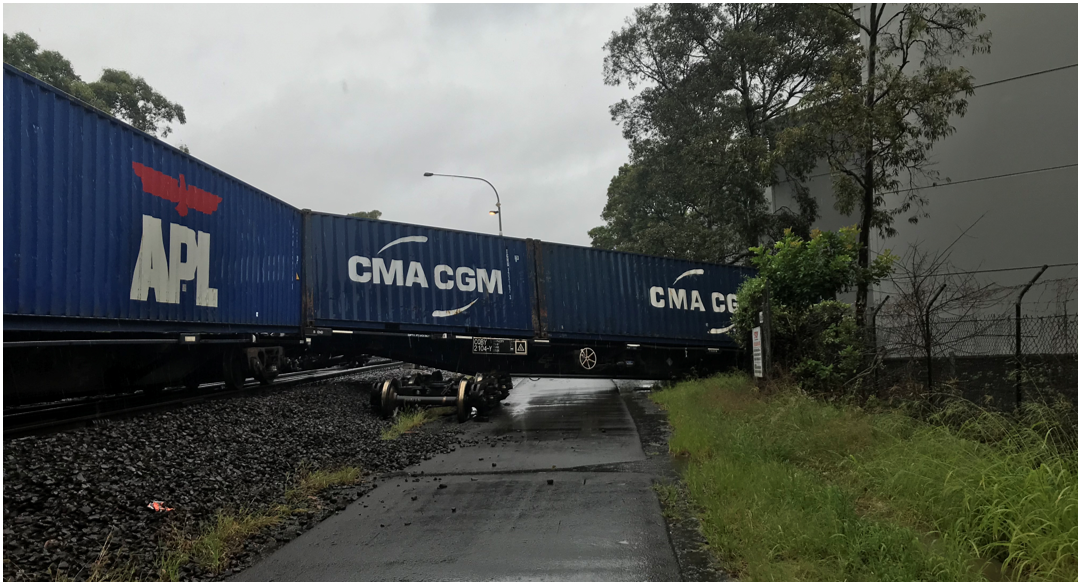
At 0607:16, with both trains propelling towards the converging track, the lead wagon on 1150 collided with the side of the fourth wagon of T296 (Figure 4). The lead wagon of 1150 then derailed and traversed the rail access road before coming to a stop against a nearby building. The following 3 wagons on 1150 also derailed, with the second wagon tilting laterally at approximately 30 degrees, causing its container to fall to the ground on the access road Figure 5).
On train T296, the collision caused 4 wagons to derail and the fourth wagon to collide with a yard light pole. This pole then fell to the ground across tracks, triggering track circuit alarms on the network controller’s panel, alerting the NCO to an issue in the yard.
During the collision and derailment both motor vehicles continued to move in a southerly direction facing away from their propelling trains.
The second person driving 1150 reported observing a loss of air on the locomotive gauges5 during the derailment. As they did not have visibility of the collision from the locomotive cab at the rear of the train, they radioed the qualified driver leading the movement from the motor vehicle to ask if everything was OK.
The qualified driver reported observing a cloud of dust rising from the train in the rear‑view mirror of their motor vehicle on being contacted by the second person.
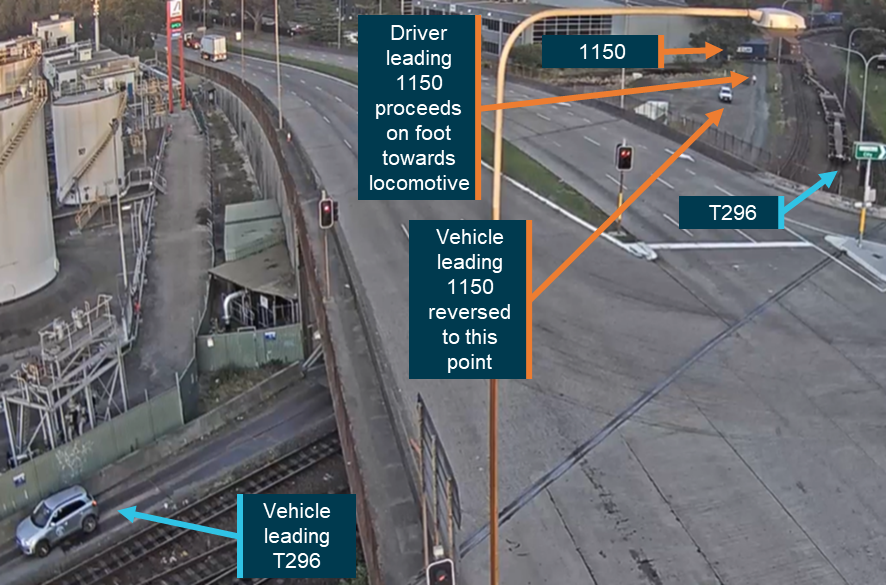
The qualified driver is then seen on CCTV to reverse their motor vehicle rapidly back to the point of collision. They are then seen to exit the motor vehicle, crouch under the derailed wagon that was blocking the vehicle access road and run towards the locomotive on the rear of the train (Figure 6).
Figure 4: Train 1150 colliding with the side of T296
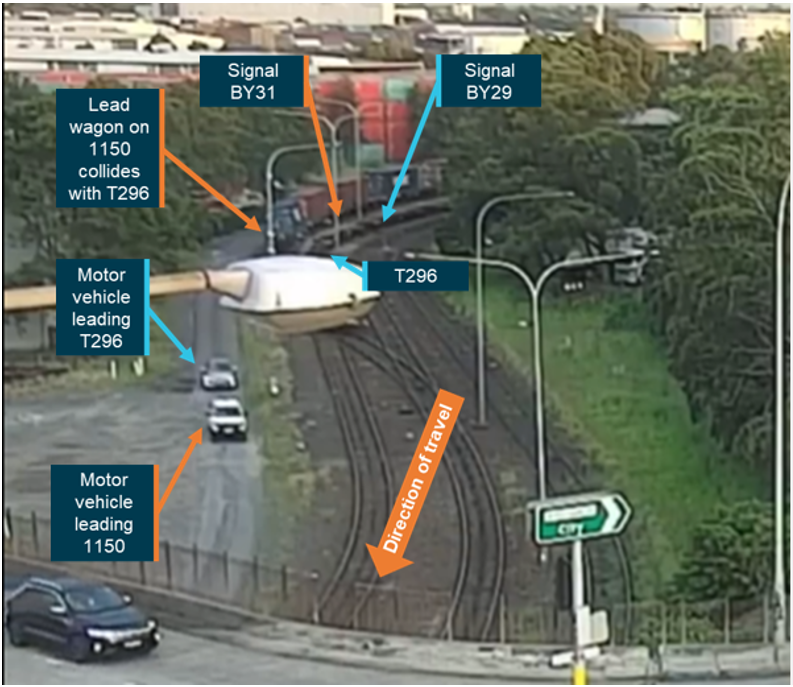
Figure 5: Train 1150 derailing with wagon crossing the access road
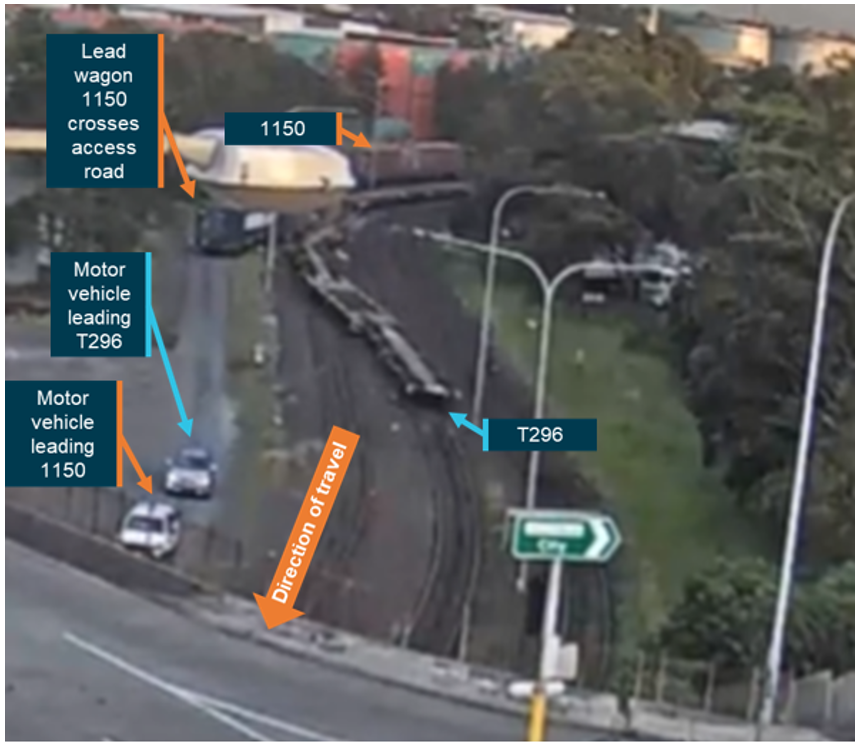
Figure 6: Motor vehicle for train 1150 reversed back to collision site
Events post-derailment
In the moments after the initial collision and derailment, the NCO’s Phoenix train control screen displayed numerous track circuit failures caused by the derailment. The NCO contacted the driver of T296 (via the ICE radio) and asked them to confirm their location, stop their train and standby. The driver of T296 confirmed these, and the call was then terminated.
Shortly afterward, the NCO called the driver of T296 back and after reconfirming their location and that they were at stop, advised them to continue movement towards DP World logistics. The driver of T296 replied, ‘no we can’t, apparently the PN train has run into us’.
The NCO acknowledged the message from T296 and then made an initial attempt to contact 1150 using a standard controller call6 to 1150’s ICE radio. This was unsuccessful as the second person driving 1150 had left the locomotive cab to inspect the damage.
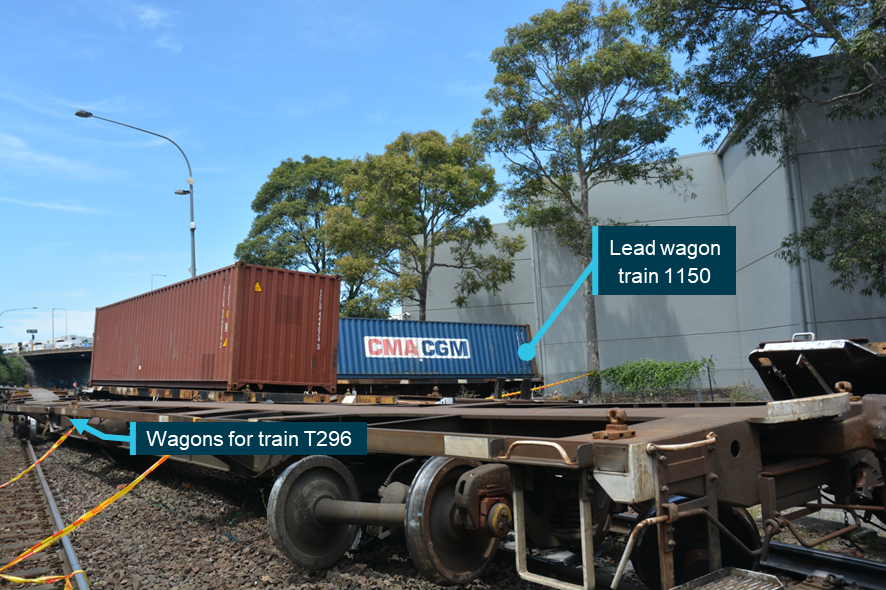
Moments after the NCO’s initial call attempt, an emergency call7 was received by the NCO from the qualified driver of train 1150, who had run the length of the train to the locomotive from the motor vehicle to report the incident. The transmission included emergency protocols, such as announcing ‘emergency, emergency, emergency’, identifying the location, the significant number of derailed wagons (Figure 7), clarifying that nobody was injured, and that the rear wagon of 1150 was touching a nearby building. The NCO immediately contacted emergency services and requested their attendance.
Figure 7: Derailed wagons from trains 1150 and T296
Context
Weather conditions
On Friday 13 January 2023, the weather recorded at nearby Sydney Airport was high cloud, light winds, good visibility and a temperature low of 19.3°C through to a high of 27.8°C. Sunrise was at 0557. At the time of the incident at approximately 0600, the temperature was 21°C and the weather was clear. The investigation concluded that weather was not a factor involved in the incident.
Port Botany yard
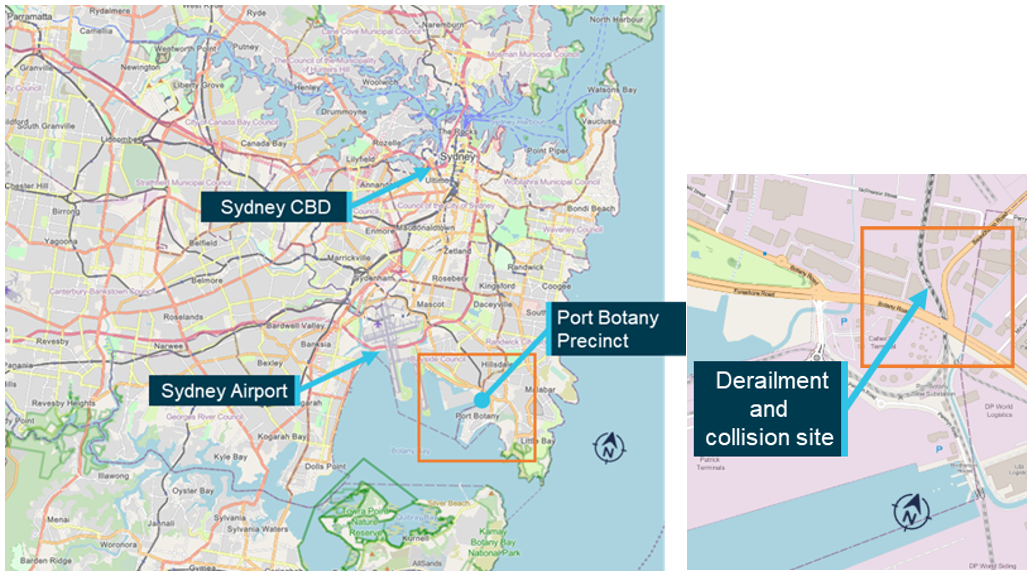
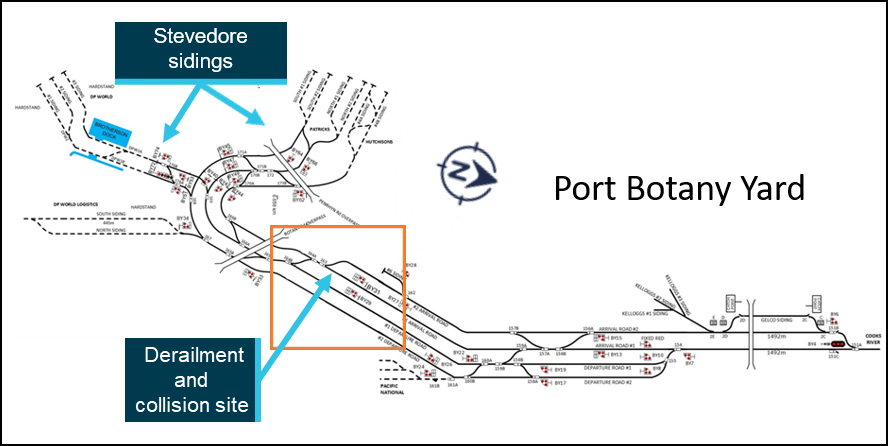
Port Botany yard is located alongside the eastern shore of Botany Bay in New South Wales, approximately 10 km south of the Sydney central business district. It comprised of multiple stevedore sidings for containerised rail traffic. The sidings included Veolia, Hutchinsons, Patricks and 2 separate siding locations for DP World logistics.
Port Botany yard was surrounded by the heavily populated and well-established industrial area of south-eastern Sydney (Figure 8).
Figure 8: Port Botany position in relation to the Sydney CBD
General
Since April 2011, the rail infrastructure manager (RIM) responsible for Port Botany was the Australian Rail Traffic Corporation (ARTC). Prior to April 2011, the RIM responsible for Port Botany was RailCorp.8
Yard signalling
At the time of the incident, Botany yard signalling predominantly comprised of shunting signals, with rail vehicle detection system (RVDS) in use.
RVDS used continuous track-circuiting to detect the presence of rail traffic and prevent following rail traffic from entering an occupied section of track.
Yard design
Port Botany yard comprised 2 arrival and 2 departure roads allowing access to a variety of stevedore ports and private sidings. The yard extended almost 5 kilometres, inclusive of the stevedore port sidings.
The track layout negotiated around surrounding buildings and roadways utilising tight track curvature and at times narrow track clearances (Figure 9).
The yard had numerous motor vehicle access roads that followed beside rail tracks, allowing rail safety workers to access both track and rolling stock for operational and maintenance purposes.
However, owing to constraints with established non-rail related infrastructure surrounding the rail corridor, some track clearances were too tight for pedestrian access and some motor vehicle access roads at Port Botany deviated away from rail sidings.
Shunting operations at Botany therefore required a mix of traditional (walking beside the lead vehicle in the direction of travel) and adapted propelling procedures (line of sight shunting, where in some instances pedestrian access was limited).
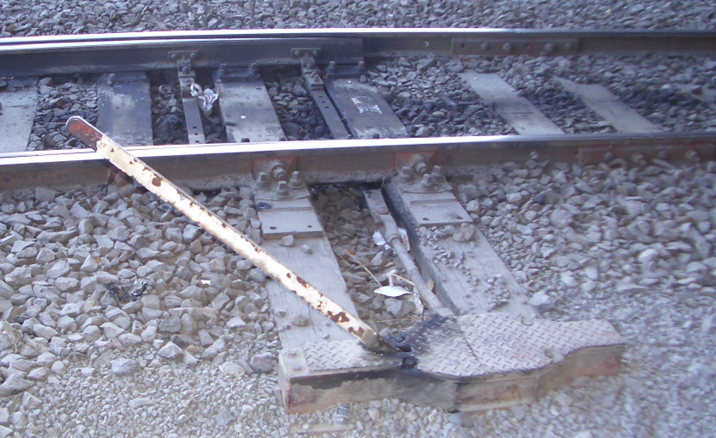
On taking control of the yard in April 2011, ARTC completed an upgrade program which installed shunting signals with interlocked motor operated points throughout Botany yard. These replaced existing stop signs/boards and manual point levers. Additional tracks were also added by ARTC to the Port Botany site allowing for greater operational flexibility.
Figure 9: Port Botany yard track layout
Yard arrangements prior to April 2011
Prior to ARTC upgrading the yard, stop signs and manual point levers were predominantly used in lieu of signals and interlocked points (Figure 10 and Figure 11). Train movements were managed by a RailCorp/Rail Infrastructure Corporation NCO located on site. Movement authorities were given verbally via UHF two-way radio. The NCO instructed train crew to manually set routes, and verbally authorised movements past stop signs, manually managing track occupancy and authorising trains to occupy specific portions of track.
A procedure known as ‘line of sight shunting’ was used to manage movements within the yard. The same procedure was used for both yard configurations, i.e. stop signs and RVDS.
Figure 10: Port Botany yard track layout
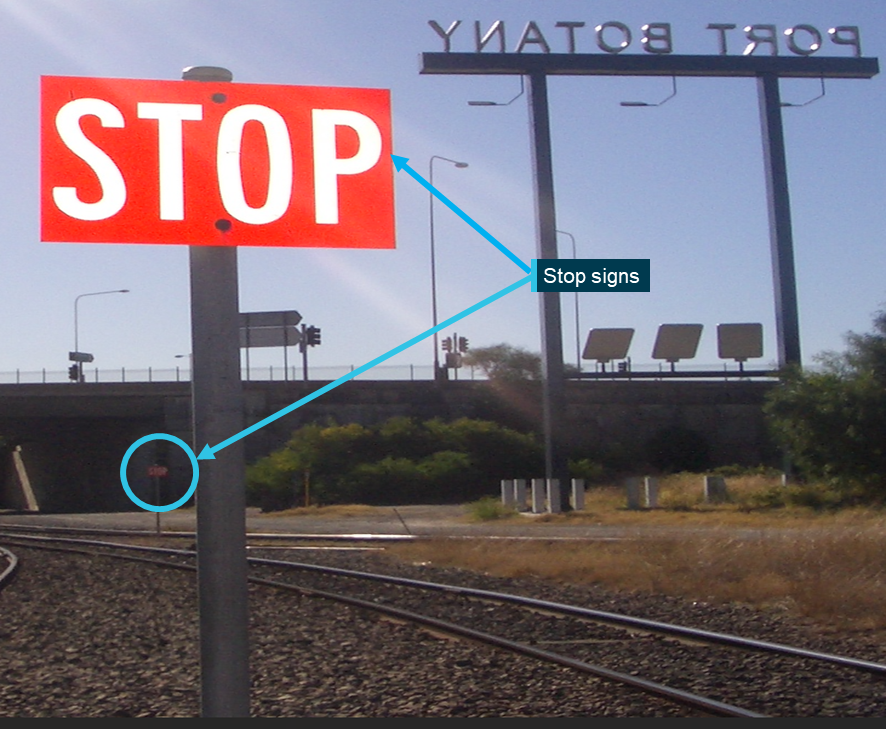
Figure 11: Example of point levers that were replaced by interlocked point motors
Train crew information
Training and assessment for train crew
In addition to the foundational training and qualifications required for their respective roles (see Train crew roles), drivers and second persons are also qualified on specific routes.
The qualified driver and the second person of 1150 were both assessed as competent for the route between St Mary’s and Port Botany in their respective substantive roles. They were also assessed as competent in the line of sight propelling shunting procedures local to Port Botany yard in their substantive roles.
These were the only route qualifications held by the qualified driver and second person.
Qualified driver 1150
The qualified driver of 1150 had 3.5 years of rail experience. They had completed the requirements of Certificate IV in Train Driving in July 2022.
The qualified driver had also been previously qualified as a second person on the route from St Mary’s to Port Botany, and in line of sight procedures at Botany, prior to obtaining their drivers qualification in 2022.
On the day of the incident the qualified driver signed on for duty at 0300. It was their second day back from 4 consecutive days off. They reported they were feeling well rested. There was no evidence fatigue was a contributing factor to this incident.
Second person 1150
The second person of 1150 had started in the rail industry in June 2021 and received their Verification of Competency (VoC) as a second person on the route and at Port Botany in October 2021.
On the day of the incident the second person signed on for duty at 0300, it was also their second day back from 4 consecutive days off. They reported feeling well rested. There is no evidence fatigue was a contributing factor to this incident.
Train crew roles
Driver role
While the position descriptions of train drivers may vary between operators, RailTrain’s key purpose, responsibilities and competencies for a driver’s role were as follows:
Key purpose:
- to drive trains to the operational requirements of the client.
Key responsibilities and duties include but are not limited to:
- comply with all policies and procedures
- operate various locomotives on various freight networks including coal, iron ore, grain, general freight and work trains on mainlines, yards and construction site environments
- operate trains on various gradients utilising train handling techniques to avoid damage
- follow legislative and regulatory values on safeworking practices.
Qualifications and experience include but are not limited to:
- certificate IV in Train Driving TLI42615 or equivalent (including shunting and safeworking)
- dangerous goods and radio protocol training qualifications
- air or electric braking systems experience and/or competency
- shunting experience and/or competency
- train examination experience to respond and rectify minor faults en route to rollingstock.
Second person/driver’s assistant role
Similarly, for the second person the key purpose, responsibilities and competencies were described as:
Key purpose:
- to assist the locomotive driver in accordance with organisational policies and procedures and relevant safeworking requirements
- the position includes preparing and conducting a visual inspection, shunting and marshalling, cross calling signals, roll-by inspections, motor vehicle driving and actioning train inspection results.
Key responsibilities and duties include but are not limited to:
- comply with all policies and procedures
- follow legislative and regulatory values on safeworking practices.
Qualifications and experience include but are not limited to:
- current safeworking accreditation equivalent or willing to obtain
- high level of rail safety awareness
- shunting experience and/or competency.
Train crew 1150 role swap
On the day of the incident, the train crew of 1150 swapped roles at the beginning of their shift at St Mary’s. The second person assumed the role of the driver controlling 1150 and the qualified driver assumed the position of second person en route.
The second person was not qualified to drive the train. The qualified driver supervised the second person driving 1150 on the journey from St Mary’s to Port Botany. However, during the propelling move, the second person continued to drive 1150 without supervision, while the qualified driver led the propelling movement as the second person from within a motor vehicle at the front of the train.
Train information
Train 1150
Train 1150 was a PN intermodal shuttle service scheduled from St Mary’s to Port Botany and return. It comprised of 31 container flat wagons, each 60 foot long, and a single 82 Class locomotive. Some of the wagons were loaded with containers, and some were empty.
Train 1150 was scheduled at the Hutchisons stevedores from 0600 through to 0930, totalling 3 and a half hours to service the 31-wagon train. Upon completion of servicing, the train was scheduled to depart Port Botany at 1202 returning to St Mary’s. It is understood that additional time in the schedule is allocated for trains requiring access to multiple stevedores at Port Botany.
1150 was driven from St Mary’s to Port Botany by the second person, within the speed and signal limitations and for the duration of the shunting activities, prior to and during the collision and derailment.
Train T296
T296 was a Qube intermodal shuttle service scheduled from Minto to Port Botany and return. It comprised of 30 container flat wagons, a mix of both 40 and 60 foot long, and a single MZ class locomotive. Like 1150, some of the wagons were loaded with containers and some were empty.
Train T296 was scheduled at the DP World stevedores from 0600 through to 0945 totalling 3 hours and 45 minutes to service 20 wagons of the 30-wagon train. Upon completion of servicing, the train was scheduled to depart Port Botany at 1015 returning to Minto.
Train braking system
General
On propelling trains, movement is controlled by a driver operating power and brake controls in a locomotive pushing from the rear of the train, with the leading end directed by a qualified worker on the ground, using a two-way radio, instructing the driver on safe movement.
There were 2 pneumatically operated, ‘airbrake’ systems fitted to the trains involved:
- automatic brake, which controlled brakes on the entire train, including the wagons and the locomotive
- an independent brake which controlled brakes on the locomotive/s only.
Drivers must be qualified in air brake systems and apply the fundamentals of both systems in various operating environments, to avoid unsafe movements, or damage to the train.
The use of each of these 2 braking systems depends on the circumstance during which braking effort is required. For both airbrake systems, braking is achieved by the application of brake blocks directly to the locomotive or wagon wheels.9
Automatic brake
For shunting at Botany, the automatic brake is the primary applicable braking system.
Central to the automatic brake operation is the brake pipe, which runs along the length of the train.
The driver regulates the pressure within the brake pipe through operation of the automatic brake handle in the driver’s cabin. To apply the brakes, the driver reduces pressure in the brake pipe.
Conversely to release the brakes the driver recharges the brake pipe. Chokes on the wagons slow the release of the brakes to assist with brake pipe recharge. This delays wagon movement by up to 40 seconds each time the brakes release.
In an environment where brakes are regularly applied and released, such as Port Botany yard, drivers must wait for the brakes to fully release before they can proceed.
Automatic brake is termed ‘automatic’ because the brakes will automatically apply when brake pipe air pressure is lost, such as in a major derailment or train separation where the brake pipe is broken.
Train handling
Drivers are trained in train handling techniques while obtaining their driving qualifications.
Train handling is best described as controlling a train in a safe and efficient manner by utilising route knowledge, train driving skills and taking into consideration the total environment.
The method of control depends on environmental and operational factors such as gradients, allowable train speeds, signalling aspects, locomotive capabilities, train weights and lengths, and whether the train is on the main line or shunting in a yard.
On main lines generally the margin of error is broader than that of a yard environment. For example, drivers aim to stop their train some distance from a red signal, this distance creates a margin of error for drivers to avoid passing a stop signal.
Train movements in yards such as Port Botany require more precision, as coupling and uncoupling of vehicles may be required.
While shunting crew are in close proximity to the train to carry out coupling and uncoupling tasks, it is critical that communication requests from the crew member on the ground are acted upon by the driver accurately and in a timely manner, to avoid asset damage and personal injury. As the driver may have limited visibility of the movement.
This precision is gained through appropriate knowledge, experience and training in driving tasks and should only be carried out by those rail safety workers qualified to drive trains.
Line of sight shunting at Port Botany
General
A procedure known as ‘line of sight shunting’ was used within Port Botany yard as described in ARTC operational document OGW-30-25 Network Information Book. This procedure informed operators how to perform propelling movements specifically within Port Botany yard.
A propelling movement (Figure 12)is described as a locomotive pushing rail traffic in a direction away from the controlling locomotive and occurs after the locomotive performs a run around manoeuvre and is placed on the end of a train consist.
Line of sight shunting was unique to the Port Botany environment in that there were site‑specific variations to standard propelling procedures, such as the use of motor vehicles to assist the shunter leading the propelling movement to navigate the yard, and communication requirements.
History of propelling procedures
ARTC advised that Port Botany yard was designed for train push pull operations10 where a locomotive is attached at either end of a train consist (Figure 13). This configuration eliminated the need for locomotives to perform a run around manoeuvre to place the locomotive(s) on the opposite end of the train to enable departure in the reverse direction.
Despite the yard being designed for push pull operations, alternate propelling operations had become widely adopted by the operators. Several reasons were provided for this such as:
- operators had not moved to push pull operation as it was resource heavy, requiring an additional locomotive and crew. Instead, most operators had opted for single locomotive operations and shorter trains
- an incident in one of the stevedore ports in 2003 resulted in some stevedore’s banning locomotives remaining coupled to wagons in their terminals.
Standard practice had therefore become to propel trains rather than lead them into the stevedore terminal and run around for departure. In addition, not all stevedore sidings had rail infrastructure to support run around manoeuvres and propelling allowed locomotives to easily be uncoupled and moved clear of hardstand areas once wagons were placed for servicing.
Figure 12: Propelling train configuration

Figure 13: Push pull train configuration

History of line of sight shunting procedure
Line of sight shunting procedures specific to Port Botany were inherited by ARTC in 2011 from the previous rail infrastructure manager, RailCorp/Rail Infrastructure Corporation (RIC), with the same procedures remaining in place after the ARTC yard upgrades.
These were introduced following a fatality in 2004 where a shunter fell from a moving wagon whilst propelling in the yard.11 The rules at the time allowed shunters to ‘safely ride’ on rolling stock when directing propelling movements. This incident led to the rail regulator at the time prohibiting the practice.
This prohibition necessitated an alternate method to be developed to lead a propelling movement. The traditional method involved shunters walking beside the leading end of their train in the direction of movement. At Port Botany the RIM identified specific site risks with this standard procedure including tight track clearances and the distance of the shunt. This led to the introduction of the unique line of sight shunting procedures at Port Botany, which included the use of a motor vehicle.
OGW-30-25 Network Information Book – Line of Sight Procedure
The line of sight shunting procedure established unique yard protocols on how competent workers were to propel trains with the use of motor vehicles within the confines of Port Botany yard as follows:
• The Competent Worker controlling the shunting movement must gain authorisation from the ARTC Network Controller in Network Control Centre South (NCCS) before commencing any Line-of-Sight Shunting movements
• The Competent Worker must ensure all points are set for the intended route
• Prior to commencing the movement, the Competent Worker must proceed from the rear of the train to the line-of-sight location
• The Competent Worker must then instruct the driver to propel towards the line-of-sight location
• The Competent Worker must always maintain sight of the lead vehicle of the movement
• The movement must be stopped at the line-of-sight location
• Once the movement is stationary at the line-of-sight location, the Competent Worker must then proceed to the next line-of-sight location
• Repeat steps 3 to 7 for each successive line-of-sight location until the propelling movement is completed
• Any issues associated with the use of line-of-sight shunting must immediately be reported to the Network Controller in NCCS.
ARTC standard shunting procedures
General
ARTC’s procedural requirements for shunting in yards were in ARTC’s general network rules and procedures. These rules and procedures described the standard requirements for responding to signals, propelling trains, and communication protocols that must be followed by both train crew and NCOs.
In addition to the standard procedures, shunters and network controllers at Port Botany were also required to apply the local rules outlined in ARTC’s document OGW-30-25 Network Information Book (NIB). This NIB contained the local line of sight shunting procedures and the specific rules and procedures for propelling in Port Botany yard.
ARTC rules and procedures
Signals
Signals were principally designed to ensure the separation and regulation of rail traffic and provide competent workers with information on the status of the line ahead and the route that is set.
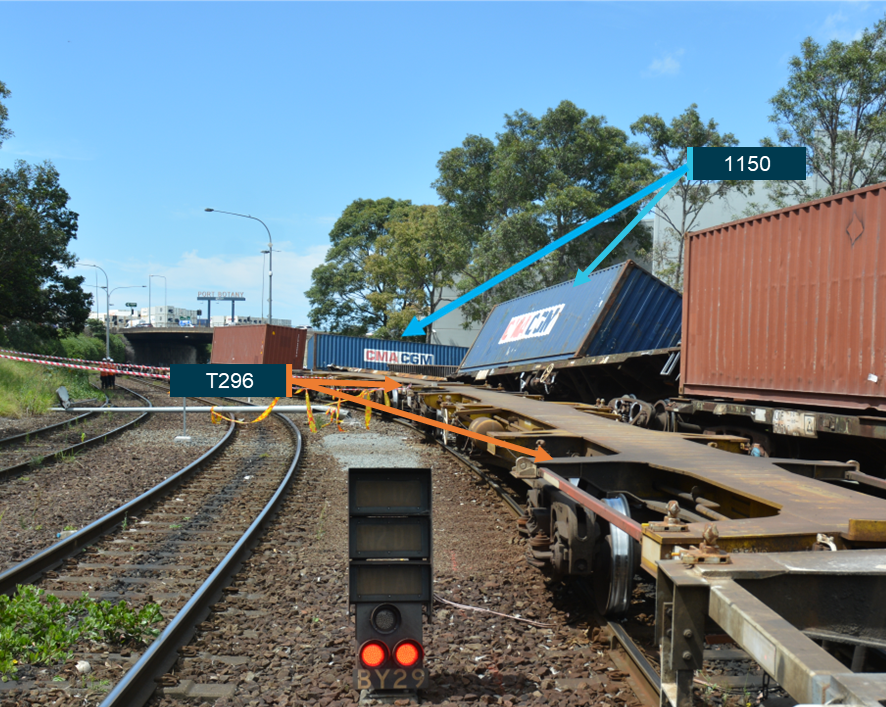
The shunting signals (Figure 14) used at the incident site in Port Botany yard were identical except for the signal numbering and were situated in line with one another on each adjacent arrival road.
Figure 14: Shunting signal BY29 at stop in Port Botany post-incident
The general rules associated with responding to signals were contained within ARTC’s rule ANSG 606 Responding to signals and signs.
This procedure described that a signalled proceed indication authorises the shunting movement and means:
- interlocked points protected by the signal are set in the correct position for the movement and no conflicting route has been set
- movement past the signal is now authorised.
In addition to the general rules above, the local line of sight shunting procedure for Port Botany stipulated that the competent worker controlling the shunting movement must gain authorisation from the ARTC NCO in NCCS before commencing any line of sight shunting movements.
The line of sight procedure however did not provide guidance on how the authority from the NCO was to be used in conjunction with a signalled proceed authority.
Signs
Prior to ARTC taking over as the rail infrastructure manager for Port Botany in April 2011, train movements were managed in the yard by stop signs and manually set points and routes.
In accordance with ARTC’s rule ANSG 606 Responding to signals and signs, a stop sign may only be passed if ‘verbal authority’ has been given to proceed.
In addition, where signage is used it is a requirement in ARTC’s procedure ANTR 420 Shunting and marshalling, that competent workers:
- ensure that routes are correctly set and safe for movements
- make sure that it is safe to shunt
- make sure that workers have been warned about the intended shunting
- tell signallers when shunting movements within the signaller’s area of control have been completed.
These requirements contrast with signalled proceed authorities which provide the competent worker with confirmation that the route has been set by the NCO, and it is safe to proceed.
Propelling movements
Propelling movements on the ARTC network were also subject to general rules and procedures and were described in ARTC’s procedure, ANTR 424 Propelling trains.
This rule stated that propelling movements:
- must be directed from the leading end by a competent worker
- and that the competent worker directing propelling must safely walk beside the leading vehicle.
Local line of sight shunting procedures at Port Botany differed from the standard procedures in that, rather than walking beside the leading vehicle as it propels, the procedure called for the competent worker to move ahead of the stationary train, to a line of sight location via the use of a motor vehicle.
The competent worker then authorised the driver to propel to their location whilst visually monitoring the rear of the train from a stationary position as it progressed. The procedure then stated that the train was to stop and wait until the competent worker moved to the next line of sight location. This was to be repeated until the train reached its destination.
Unlike the standard propelling procedure, the line of sight procedure allows a motor vehicle to be used to transport the competent workers between the line of sight locations.
Responsibilities of crews
Rules and procedures also existed to outline the general responsibilities of train crew.
ARTC rule ANGE 232 responsibilities of Rail Traffic Crews states that it is the primary responsibilities of rail traffic crews to operate trains and track vehicles safely and efficiently through the ARTC network.
For drivers of rail traffic crew specifically, the relevant rules state that they must:
• be qualified to operate the rail traffic they drive in the ARTC Network, and
• as necessary, be qualified in the systems of Safeworking relevant to their area of operation, and
• delegate duties only to qualified workers.
The qualified driver of 1150 on the day of the incident delegated the driving duties to the second person, on the journey from St Mary’s to Port Botany, and whilst they were propelling in Botany yard.
Responsibilities of rail safety workers
A rail safety worker is defined by Rail Safety National Law (RSNL) as an individual who carries out or is about to carry out rail safety work. Rail safety work includes driving, despatching, controlling or affecting the movement of rolling stock.
Rail safety workers have general duties under Subdivision 2 Duties, s56 of the RSNL which includes:
(1) A rail safety worker must, when carrying out rail safety work—
(a) take reasonable care for his or her own safety; and
(b) take reasonable care that his or her acts or omissions do not adversely affect the safety of other persons; and
(c) comply, so far as the worker is reasonably able, with any reasonable instruction given by the rail transport operator to allow the operator to comply with this Law.
The ARTC ‘line of sight procedure’ formed part of ARTC’s accredited safety management system, and it was the responsibility of all rail safety workers involved in controlling movements in the yard to comply with these procedures under RSNL.
Methods of communication at Port Botany
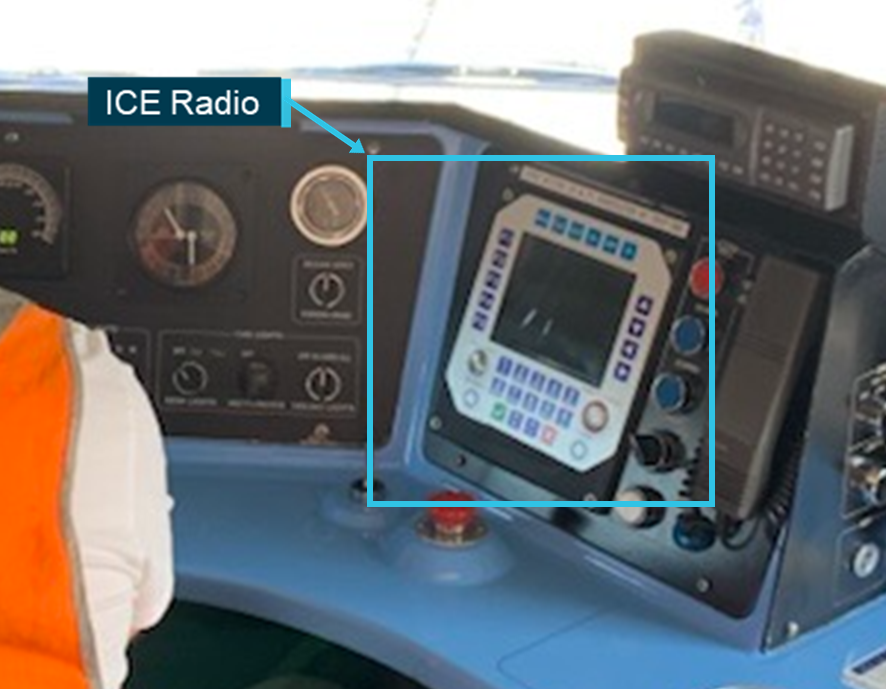
ICE (in-cab communications equipment) radio system
The ICE Radio communication system was developed by a Queensland company named ‘base2’ and is a modular system designed specifically for the rail industry.
The base2 ICE radio system which is located within locomotive drivers compartments, provided the train crew with multiple communications options (Figure 15), including:
- establishing, broadcasting and receiving emergency calls across the network
- calling and receiving direct communications from the Network Control Officer
- establishing multiple channel UHF communications
- text message receival and acknowledgement sending
- receiving electronic authorities in the form of train orders and conditions affecting the network (CANs).
Figure 15: In cab communications equipment radio (ICE)
Operator closed/discreet channel UHF two-way radio system
Each rail operator had their own discrete UHF closed radio channel, that was not recorded or broadcast to other operators in the area. The UHF feature on the ICE radio allowed the driver in the locomotive cab to have contact with the competent worker leading shunting movements at Port Botany.
UHF was primarily used for communications between train crew of the same operator during critical coupling and uncoupling duties and other duties such as propelling. The discreet channel lessened the likelihood of disruption during these task critical communications.
Mobile phone usage
Rail operators in most instances also had work issued mobile phones for use in an operational environment such as Port Botany. These may have been a personally issued phone or mobile phones issued to crew at start of shift to assist in communications for the task required.
Competent workers leading propelling movements at Port Botany did not have access to ICE radio communications when leading the movement from the ground, therefore relied on both their hand-held UHF radio and mobile phone for communications.
Each operator had guidelines on when and where mobile phone usage could occur.
Network control for Port Botany
General
Botany yard was remotely controlled from ARTC’s network control centre south (NCCS) located at Junee (485.500 km), in the Riverina region of south-western New South Wales.
The Sydney 1 network control officer (NCO) at the NCCS, was responsible for managing rail traffic in the Port Botany yard.
Phoenix train control system
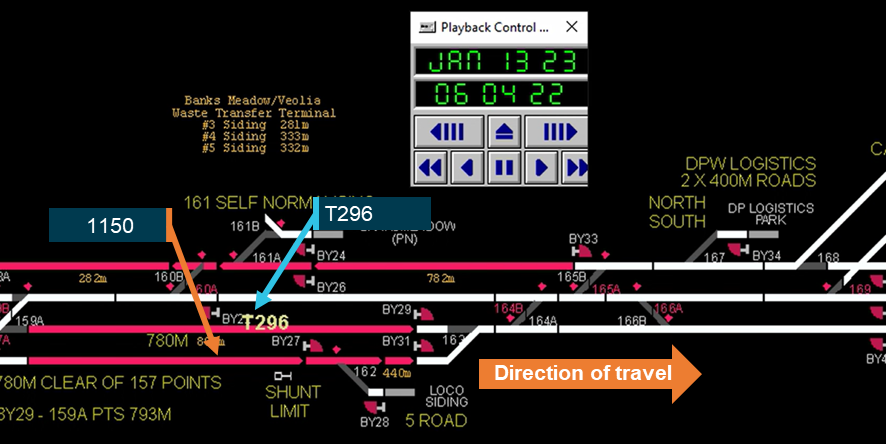
The Phoenix train control system provided the NCO with a graphical user interface, through which they could control signalling equipment at remote locations. The functionality included setting signals, points and routes.
The system used the track circuits from the rail vehicle detection systems (RVDS) in the yard, with each section of track showing on the controller’s screen as either occupied or free.
The Phoenix system display for Port Botany below (Figure 16) showed the 2 adjacent trains on the arrival roads, with signals BY29 and BY31 both set to stop prior to the incident.
Figure 16: Phoenix replay prior to route being set on signal BY29 for train T296
ARTC network control procedures
NCO’s for Port Botany were also required to apply a mix of both the standard rules and procedures and local procedures where applicable to Port Botany.
ARTC Network Information Book Sydney 1 board
Train crew and NCO’s had available for reference the ARTC Network Information Book (NIB) for Sydney 1 board, Botany yard to Enfield South (OGW-30-25). This document included the line of sight shunting procedure in section 2.1.1 (see below), and contained other relevant network information such as:
1. General Information describing infrastructure:
• board control boundaries of control
• type of Safeworking system
• applicable Rules
• maximum Permanent Speeds and Permanent Speed Restrictions
• communications
• drawing Legend
2. Locations and Sections Information:
• Port Botany Yard, includes line of sight shunting
• Cooks River Loop
• Cooks River
• Marrickville Junction
ARTC network control officer training and assessment for Sydney 1 board
Similar to train crew, following general training and assessment, new NCO’s undergo additional training to become qualified for specific areas of control, otherwise known as panels or boards. This is a requirement as general network rules and procedures do not necessarily cover all the essential information needed to manage each specific area.
For Sydney 1 board at NCCS, the NCO would be required to prove competency in a variety of Port Botany specific processes and procedures such as:
- following local shunt procedures
- identifying and following local special instructions
- using local radio protocols
ARTC train control auditing
NCCS had processes in place to monitor NCOs daily for procedural compliance. Audits were conducted at random, on a structured list of network control procedures. However, there were no compliance activities within the standard audit program for Sydney 1 Board specifically related to Port Botany local line of sight shunt procedures.
Accessing rules and procedures
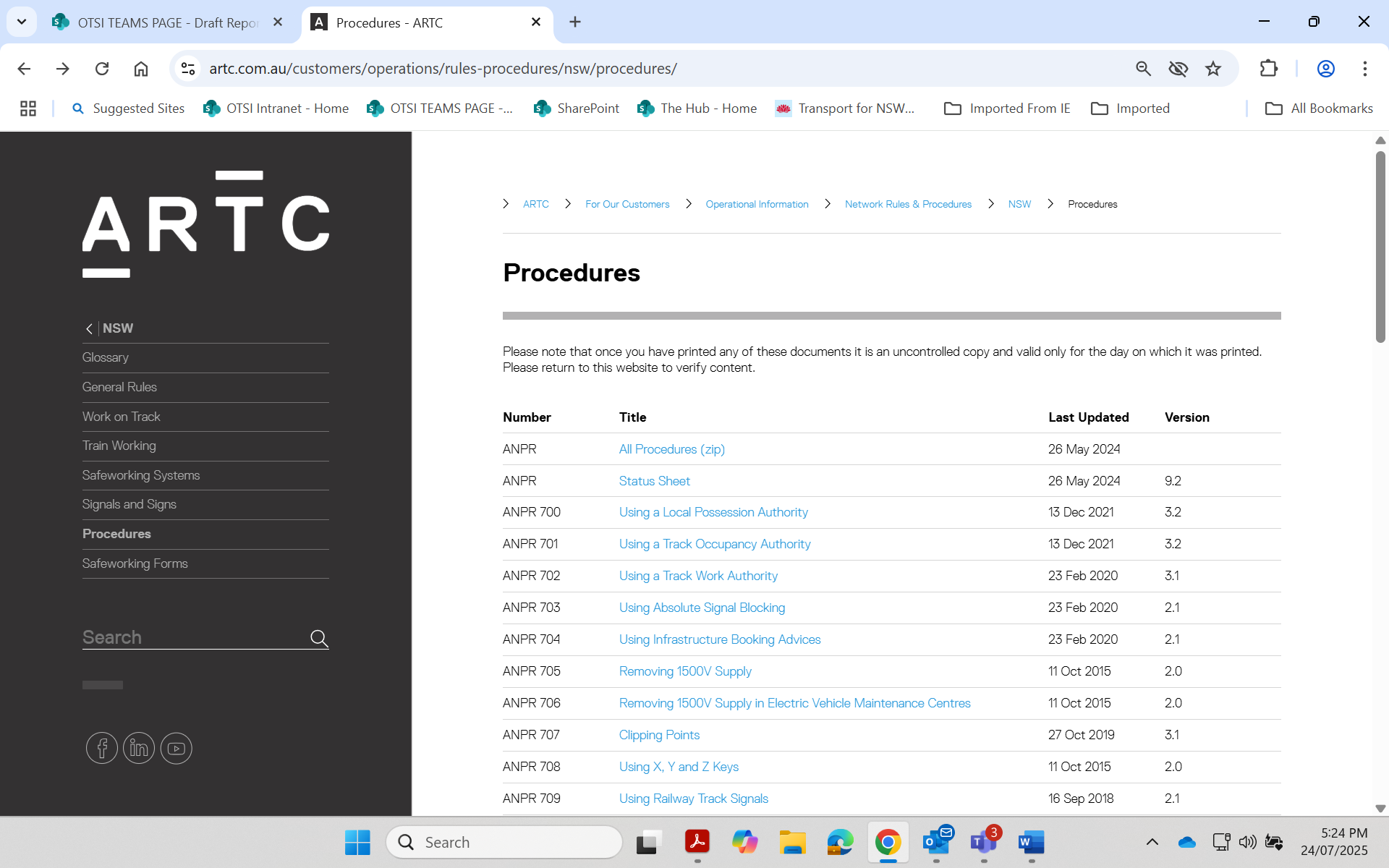
ARTC published all applicable rules and procedures for its network on its website (Figure 17).
Figure 17: Australian Rail Track Corporation procedures home page
ANGE 212 Network Information Publications prescribed the rules about access to Australian Rail Track Corporation (ARTC) NSW network information.
ANGE 212 Network Information Publications
This rule states that competent workers must have access to the following publications that relate to their area of work in the ARTC Network:
- network rules
- network procedures
- network forms
- Network Information Books (NIBs)
- electrical safety instructions
- Train Alteration Advice (TAA)
- Route Access Standard (RAS)
- Train Operating Conditions (TOC) manual
- TOC waivers
- SAFE notices
- speed restriction notices.
Competent workers must be provided with relevant information about changes to the above publications that affect their work duties and responsibilities.
Organisations employing competent workers in the ARTC network must make sure that they provide workers with information and ARTC network publications relevant to their duties.
Competent workers must read and use the information in relevant publications to do their work.
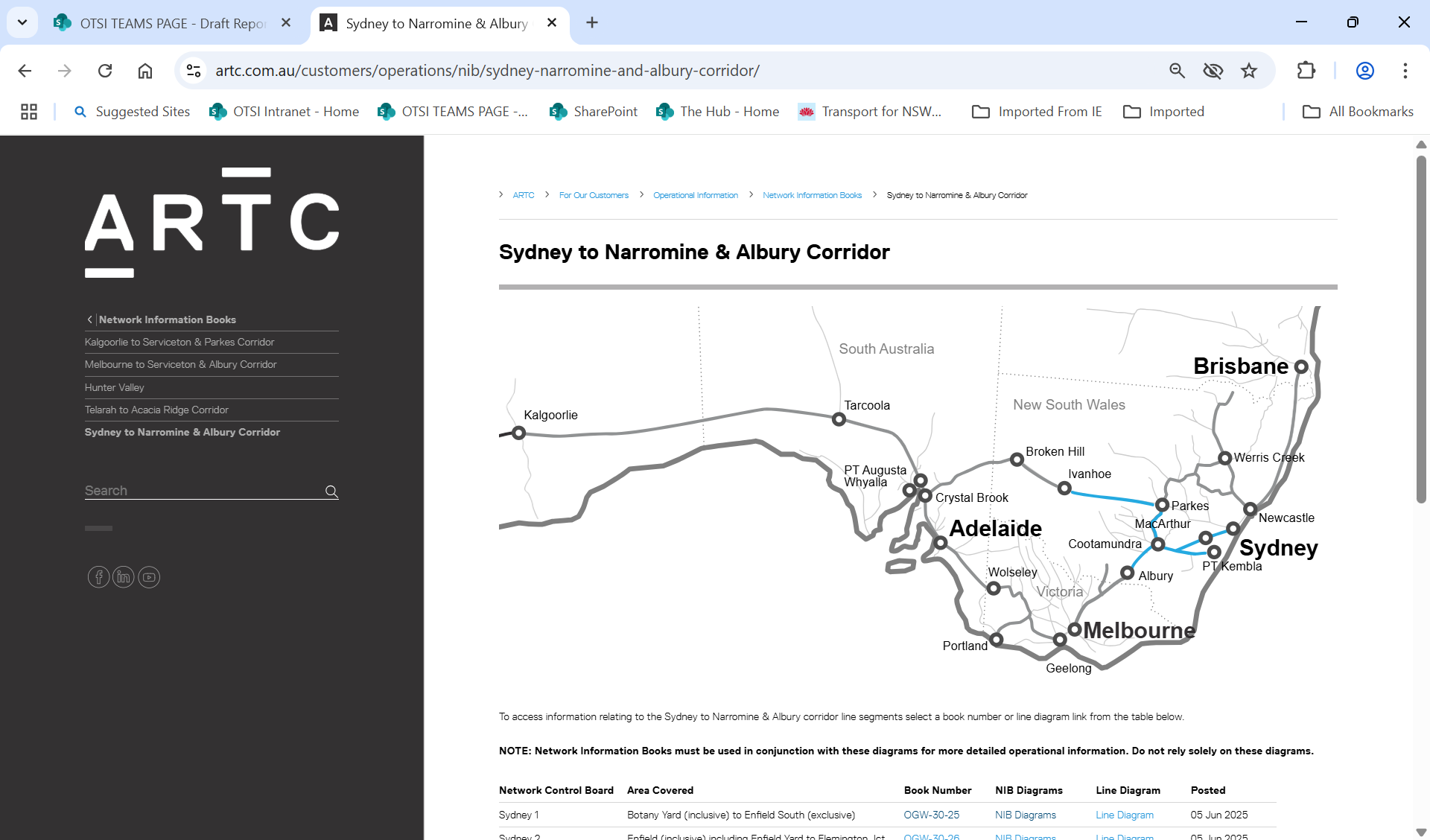
The Network Information Book for Port Botany was also located on the ARTC website and was accessible to rail operators.
The network control board controlling specific areas of track was displayed, along with the relevant NIB book, NIB diagrams and line diagrams (Figure 18).
Figure 18: Australian Rail Track Corporation network information books home page
Shunting rules and procedures at other ARTC locations
Leightonfield, Sydney, NSW
Leightonfield yard was located 26 km west of the Sydney CBD and was controlled by Network Control Centre South (NCCS) Sydney 2 board located in Junee, NSW.
As line of sight shunting was exclusive to Botany yard, standard ARTC network rules applied to Leightonfield yard as described in Network Information Book OGW-30-26.
Motor vehicles were not used for shunting movements at Leightonfield yard.
Kooragang Island, Newcastle, NSW
Kooragang Island yard was located approximately 6 km north of the city of Newcastle, NSW. This location was controlled by the Kooragang NCO located within Network Control Centre North (NCCN) situated in the Hunter Valley near Newcastle, in northern NSW. The Kooragang NCO was responsible for controlling the track in the immediate area of the Kooragang Island coal unloading facility through to Sandgate (exclusive).
Like Port Botany, a specific procedure existed for propelling trains in the wrong running direction at the Kooragang departure sidings. This procedure was described in Network Information Book OGW-30-13 located in the Hunter section of the ARTC website.
At this location the NCO activated warning bells and cleared the rail discharge shed of employees at Kooragang Island prior to the propelling movement being carried out by competent workers. Competent workers controlling the movement utilised the standard method of propelling a train as set out in ARTC procedure ANTR 424 Propelling Trains.
Motor vehicles were not used for shunting movements at Kooragang Island.
Human error
Incidents that involve an element of human error, such as the collision at Port Botany, typically involve individuals, or a group of individuals, assessing a task and the environment in which the task is to be done. This assessment then leads to decision‑making and actions that can unintentionally contribute to an incident, or an incident outcome, either directly or indirectly.
For investigators to understand and explain why individuals took certain action, and to help identify ways to prevent incidents from happening again, the science of human factors is frequently employed.
Error types
Human factors is a science that studies the capabilities and limitations of human performance.
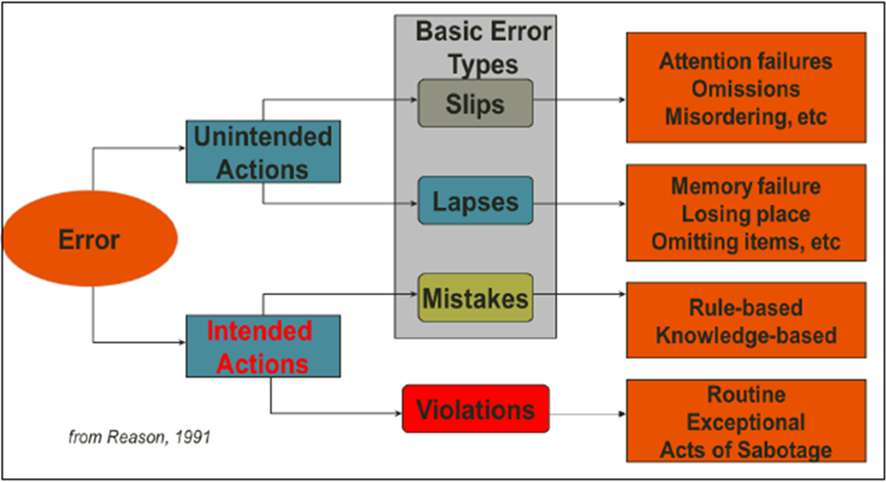
Professor James Reason was a renowned expert in human behaviour, human factors and organisational safety. His research into human error and its involvement in incidents, led to clear differences being distinguished between intended and unintended actions, which were then broken down into distinct error types as illustrated in Figure 19).
Figure 19: Human factors error types
Unintended actions
Reason’s model describes that unintended actions are typically skill-based errors.
Generally, when these types of errors occur, the individual has the right knowledge, skills and experience to carry out the task properly, thus they are defined as skill-based errors.
The crew were qualified for operations within Port Botany yard, with operations in the yard forming part of their daily routine.
Skill-based errors typically occur during highly routine or familiar activities, when our attention is diverted from a task, either by our own thoughts or external factors.
They can be divided into 2 main categories:
- Slips, which are errors made when we don’t pay attention, or where we have the correct intention or plan in place, but it is incorrectly carried out.
- Lapses are a slightly different error in executing a plan, in that we fail to carry out an intended action entirely, usually due to memory failure.
Intended actions
Reason’s model describes that intended actions are typically skill-based failures, rather than errors, and that these can also be divided into 2 main types:
- Mistakes are distinct and “intentional”. They occur when we plan on doing something and carry out our plan correctly, however it does not produce the outcome we wanted. Often this is the result of inadequate knowledge or deciding that the rules applied were inappropriate.
- Violations are a different form of intended action as they involve deliberate deviations from the rules, procedures or values. Generally, some of the reasoning behind such acts can be described as:
- workers thinking rules don’t apply to them
- being under time pressure (both actual and perceived)
- perception they won’t get caught
- lack of understanding of why the rule is in place
- perceptions that rules are too strict or unnecessary
- taking the easy option
- peer pressure.
Violations
Violations can also be divided into 2 main types:
- Routine violations are commonly described as “no one follows that rule”. It occurs over time due to habitual practice, where individuals or groups of individuals believe the rules to be unnecessary leading to the violation being considered commonplace, and committed by most of the workplace
- Situation violations can occur due to factors such as time pressures, inadequate equipment, lack of resources or poor planning. Generally, this occurs as a “one-off”, however if not addressed may become routine over time. This is indicative of a worker not following a rule because of a perceived lack of time to perform a specific task and attempting to complete something as quickly as possible.
Biases
Bias is another human factors concept. Biases are described as often unconscious errors in decision making. Humans will consider the immediate circumstances but then reach a decision based on, not only the immediate information at hand, but their own knowledge, beliefs and previous experiences.
Expectation bias for example occurs when we interpret information in a way that confirms our pre-existing beliefs and/or expectations based on past experiences.
Information processing
Information processing is another important part of the decision-making process. A number of human factors concepts such as ‘automatic pilot’, and ‘assumptions’ can play a significant role in the way we process information and make decisions.
Automatic pilot
Automatic programming or ‘automatic pilot’ is a key attribution to being human, in that we have the ability to transform complex tasks into skills we can apply automatically and at will when something is done regularly. However, this skill can also lead to errors when applied inappropriately in a situation that is not the same as usual.
Prior experience
We may also over rely on our prior experiences and consequently may make incorrect assumptions when processing the situation and evidence in front of us. Prior experience may lead to us not always considering variability in circumstances and evidence.
Risk management
General
For the purposes of the Rail Safety National Law (RSNL), a Rail Transport Operator (RTO) was required to ensure the safety of its railway operations ‘so far as is reasonably practicable’.12 The Office of the National Rail Safety Regulator’s (ONRSR’s) guideline Meaning of duty to ensure safety so far as is reasonably practicable, provided RTOs guidance on how to apply this concept to their operations. Within this guideline, ONRSR considered ISO 31000 (Risk management – guidelines) as ‘good practice’ in the management of risk, in addition to requirements of the RSNL. ISO 31000 described risk management as:
…the systematic application of policies, procedures and practices to the activities of communicating and consulting, establishing the context and assessing, treating, monitoring, reviewing, recording and reporting risk.
RTOs were required to implement a safety management system (SMS) to comply with their risk management obligations. This was to include formal processes for the identification, assessment, control, monitoring and review of risk.13
Rail Safety National Law (RSNL) {NSW}, Section 50 states rail safety is the shared responsibility of:
• rail transport operators;
• rail safety workers;
• other persons who –
• design, commission, construct, manufacture, supply, install, erect, maintain, repair, modify, or decommission rail infrastructure or rollingstock; or
• supply rail infrastructure operations or rollingstock operations to rail operators
• and ONRSR.
In relation to the above it was the responsibility of all involved in yard operations to effectively manage risk in Port Botany yard.
ARTC risk control monitoring and review
RSK-PR-001 Risk Management Procedure documented ARTC’s risk management framework and risk matrix. This document described risk levels and the associated review periods as shown in Figure 20:
Figure 20: ARTC risk level vs risk review period
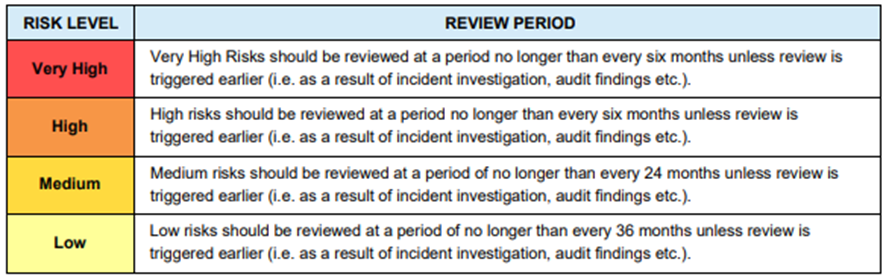
This document also described how review of risk controls should take place soon after implementation, and the intervals appropriate for risk level, anticipated adequacy and effectiveness of the risk controls.
For Port Botany, the line of sight procedure was highlighted as a specific risk control, not in use anywhere else on the ARTC network.
April 2020 ARTC risk assessment
Following an almost identical incident that occurred on 5 March 2020 at the same location in Port Botany yard, ARTC facilitated a risk assessment on operations within the yard on 30 April 2020, referencing its risk management procedure. Representatives from 4 operators and ARTC were in attendance.
The ARTC risk assessment took into consideration investigation reports on previous incidents at Port Botany and considered the constraints to operating in the yard.
The subsequent report identified the following risks and consequences and tabled risks to be either accepted, rejected or investigated.
Identified risk:
- train to train collision
- train derailment
- train to person incidents.
Identified consequences:
- Signals Passed At Danger (SPAD’s)
- damage to assets
- delays in operation within Botany yard
- increased oversight by regulatory bodies
- damage to ARTC’s reputation.
The risk assessment used a combined risk rating method, with the overall risk rating taking into consideration combined events. The risk at Port Botany assessed as ‘High 3B’, based on a ‘moderate’ consequence and a ‘likely’ likelihood.
Proposed treatments were identified as shown in Figure 21:
Figure 21: Proposed Treatments from ARTC risk assessment 2020
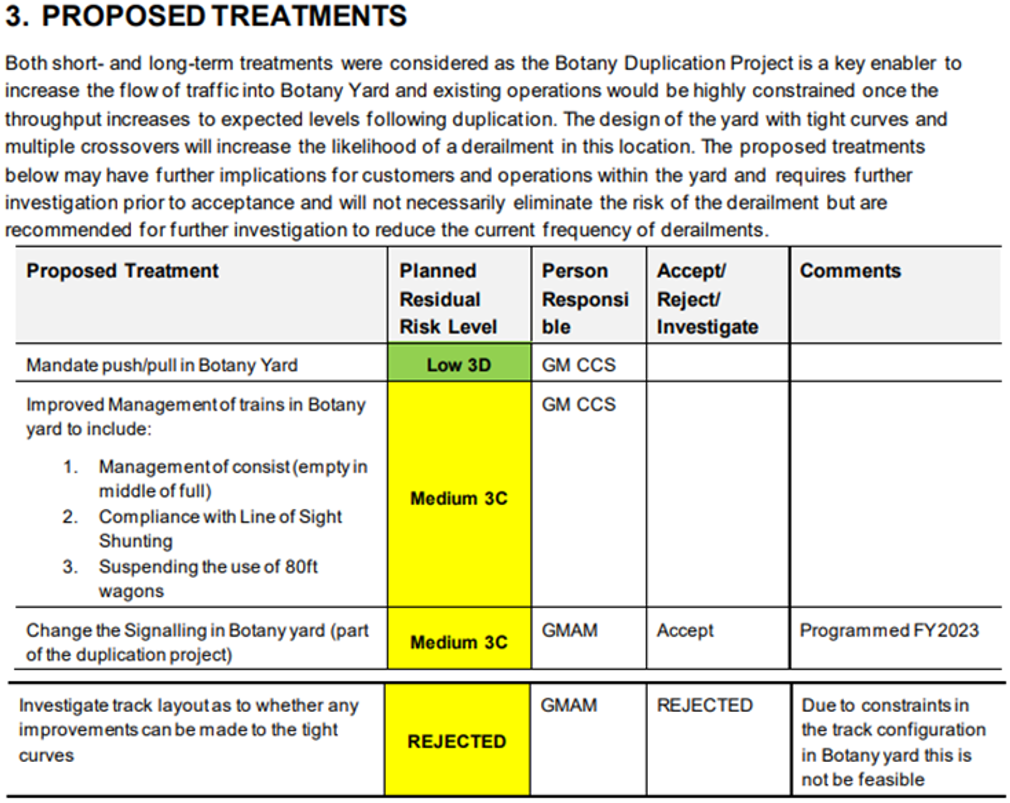
The proposed treatment table provided by ARTC was observed to be incomplete, displaying blank fields under Accept/Reject/Investigate for management of trains in Botany Yard, and mandate push pull operations, although the introductory text suggests that the proposed treatments may require further investigation prior to acceptance. The document does not display any future review date.
OTSI requested evidence of all risk assessments conducted by ARTC from the date of takeover as the rail infrastructure manager on 25 April 2011 through to the incident date of 13 January 2023.
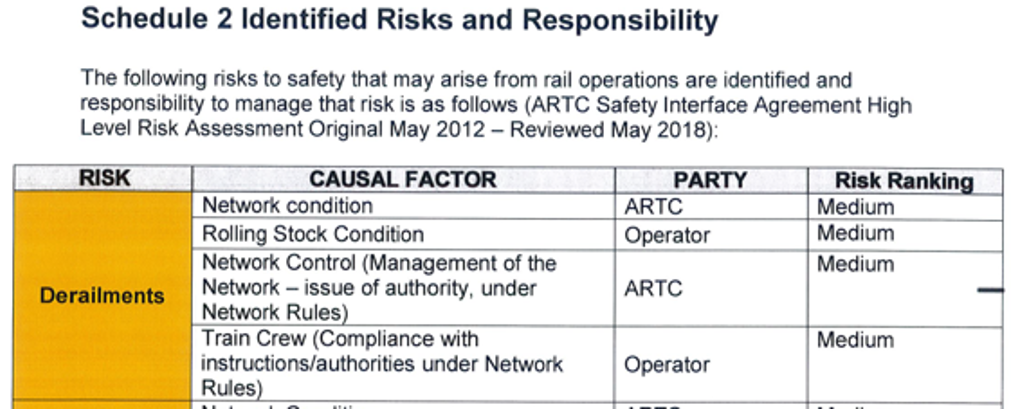
ARTC’s safety interface agreement with Pacific National dated 23/05/2018 notes in Schedule 2 that a high-level risk assessment was carried out in May 2012 and reviewed in May 2018, however this assessment related to network‑wide operations and did not include line of sight operations at Port Botany.
At the time of the incident the only record of risk assessment for Port Botany was of the one conducted on 30 April 2020. And following enquiries it was also unclear what subsequent action had been taken arising from this assessment beyond the proposed duplication project.
Communication and consultation
A key component of risk management processes was communication and consultation with internal and external stakeholders. ISO 31000 described the aims of communication and consultation as bringing together different areas of expertise and views, and to gather sufficient information during the risk management process. It was an integral part of:
- establishing the scope and context within which the risk to be managed resided
- identification, analysis and evaluation of the risk
- identification and implementation of effective risk controls.
A companion handbook HB 327:2010 (Communicating and consulting about risk) applied to ISO 3100014 described the benefit of effective communication and consultation as ‘…a shared and better understanding of the risks faced and the range of treatment options.’ It further noted that consultation would help to comprehensively identify risks, increase acceptance of implemented controls and encourage feedback of effectiveness after implementation.
The importance of consultation was recognised within the RSNL, with an objective of the Act ‘to promote the effective involvement of relevant stakeholders, through consultation and cooperation, in the provision of safe railway operations.’
To achieve this, the RSNL advised that participation and consultation in establishing, reviewing or varying an RTO’s SMS (risk management), should include:
those that may be affected by the SMS, such as rail safety workers
health and safety representatives (where applicable)
relevant unions
other RTOs (where interface agreements were required)
the public (where appropriate).
It was a requirement of the Rail Safety National Law National Regulations 2012 that an RTO’s SMS contained systems and procedures to ensure this consultation occurred.15
A large variety of stakeholders were recorded to be in attendance at the risk assessment facilitated by ARTC in 2020. Of the train operator attendees, one member had previous experience from an end user cohort and one had current operational experience at Port Botany as a second person. The other attendees were described as ‘Train Operator’ and principally held management roles.
Safety interface coordination
General
Rail Safety National Law National Regulations 2012 required that an RTO’s SMS contained systems and procedures for safety interface coordination.
Clause 22 in Schedule 1 of Rail Safety National Law National Regulations 2012 prescribed that safety interface coordination between parties was to include:
1. Procedures for the identification of interface risks to the safety of railway operations and for the development and implementation of interface agreements in accordance with Part 3 Division 6 Subdivision 2 (Interface agreements) of the Law.
2. Procedures for monitoring the implementation and effectiveness of and compliance with interface agreements.
ONRSR’s guideline safety management system describes safety interface coordination as:
(v) safety interface coordination – this includes systems to ensure that where risks occur at or arising from an interface, the responsibility for risk controls is appropriately assigned and understood by all those with a role in the implementation of the control as well as monitoring compliance to the implementation.
In addition, the guideline advises each party had a responsibility to identify and assess risk. And interface coordination agreements should cover how parties would effectively communicate to manage their interface risks.
ARTC and PN safety interface agreement
Document IA4019 – Interface Agreement between Pacific National and ARTC was the interface agreement between ARTC and PN for PN operations on the ARTC network, including Port Botany yard.
Section 5 - Identification, assessment and management of risk, states:
…the parties acknowledge and agree that they have identified and assessed risks to safety (or will endeavour to do so as soon as is practicable) that may arise in relation to the Interfaces and the results of this assessment are set out in Schedule 2.
Section 5.6 clarifies that those persons set out in Schedule 2 under the heading ‘Party’ are responsible for implementing, maintaining and monitoring the performance of the applicable risk control measures, and evaluating, testing and revising the risk control measures as applicable.
The extract from Schedule 2 in Figure 22 illustrates the nominated responsible parties for derailment risks. There was no risk of collision identified in the table.
Figure 22: Extract from network safety interface agreement schedule 2
Section 6 of the interface agreement, covering Monitoring and review of the risk, stated that the nominated risk review representative will, from time to time as is reasonable, review and monitor the compliance by that party of its obligations under the agreement. And if following a party’s review and monitoring the safety risk is considered to be intolerable the parties will work collaboratively to resolve.
Section 11 titled Compliance, stated that each party will report annually to the other party, or at such other times that the parties may agree, on its progress in implementing agreed safety management measures.
ARTC compliance monitoring
ARTC was requested to supply evidence of compliance monitoring of both operators and network control officers (NCO’s) at Port Botany relating to line of sight shunting procedures.
ARTC network control
Internal to ARTC, NCOs were subject to random audits on processes and procedures to do with communication and adherence to procedures.
ARTC had refresher training in place to reiterate procedures for NCOs who may take extended leave. This refresher training and examples of audits were provided to OTSI and showed areas for improvement identified by assessors and how network controllers were coached to rectify these process shortfalls.
However, the only reference to specific ARTC control board procedures entailed general communication protocols and nothing specific to line of sight procedures for the Sydney 1 Board NCO for Port Botany.
Operator compliance monitoring
ARTC advised that the operators were responsible for the compliance monitoring of the line of sight shunting procedure and that ARTC entrusted that adequate training of the procedure was being carried out by the individual operators that accessed Port Botany yard.
ARTC advised that whilst it had no specific procedures for monitoring compliance, it had conducted monitoring through face-to-face conversations within the yard and random audits witnessing correct shunting movements being carried out. However, these were not documented.
Post‑incident, ARTC conducted compliance audits of operators carrying out the line of sight shunting procedures. These audits were pre-arranged with train crew having knowledge of the audit being conducted.
Also post‑incident, ARTC requested that operators confirm that they both educate their rail safety workers and comply with the line of sight shunting procedure at Port Botany.
PN responded as follows:
1. PN can confirm that line of sight shunting requirements are included in the PN‑PRO-‑OPS Shunting Procedure and all current PN workers qualified for the Port Botany Yard have been taken through the OGW 30-25 procedure. The PN Training Standard outlines the requirement to complete Verification of Competency (VoC) assessments periodically and specifically RSW-VOC-0018 is the process used to verify knowledge and application of the PN-PRO-OPS Shunting procedure including the line-of-sight aspects. Records are kept in the PN Learning Hub system when completed. PN can confirm all PN workers currently used for Port Botany operations have current VoC’s.
2. PN can confirm that the Critical Risk Management (CRM) Framework used to monitor PN worker behaviours and compliance to required PN procedures is being applied at Port Botany. Part of the CRM process is the requirement to complete infield Critical Control Verifications (CCVs) with PN workers and in relation to line-of-sight shunting, this is specifically addressed by the completion of “Struck by rollingstock” CCVs at Port Botany. For example, PN can confirm that since the 20th January 2023, 27 CCV’s have been completed on PN workers confirming that line-of-sight shunting is completed as per the PN Shunting Procedure and OGW 30-25.
It was unclear how these procedures were applied to labour hire crew.
Training of train crew in the line of sight procedure
General
Driver trainers or mentor drivers from each operator typically provide trainees with instruction on the Port Botany line of sight procedures.
Initially the trainee learns the theory behind the procedure and then is placed with competent crew to learn the procedure in an operational environment. Once they are comfortable executing the procedure for themselves, whilst supervised, the trainee requests a practical verification of competency (VoC) to prove to an assessor that they can properly execute the procedure. The VoC typically involves an assessor assessing the trainee on components such as communication protocols, safely carrying out the work, etc. Once the trainee is deemed competent, they can then be rostered without supervision aboard Port Botany services.
VoC’s for shunting in the yards was also carried out by the operator’s assessors at scheduled intervals in accordance with their safety management system to verify that the competency of the crew operating at Port Botany remained adequate post initial assessment and verification.
Compliance monitoring
During interview, competent crew from 3 different operators in Botany yard were asked if they had witnessed any compliance monitoring of the line of sight procedure from either their employer or ARTC. Of the crew interviewed none had witnessed any form of compliance monitoring by ARTC.
The only compliance audits that crew witnessed at Port Botany were from an employer’s perspective in the form of what is known by some operators as a ‘check ride’. A check ride is best described as a driver trainer attending the shift of both train crew on board a train service and checking/auditing compliance or carrying out a VoC. The compliance check is carried out whilst the crew conduct their normal duties and results are fed back to each employee for any potential areas of improvement and/or recertification to continue normal duties.
Often the crew being assessed were forewarned of the impending check ride or VoC, giving time to prepare and conduct the line of sight procedure properly.
Crew reported they carried out line of sight shunting correctly, as per procedure during these check rides and VoCs. One driver commented that they would also carry out the procedure correctly if the other crew member wanted to.
Reporting of issues with the line of sight procedure
Section 9 of the OGW-30-25 Network Information Book – Line of Sight Procedure states:
9. Any issues associated with the use of line of sight shunting must immediately be reported to the Network Controller in NCCS.
The procedure documents an opportunity for crew to notify the NCO of any issues identified with line of sight shunting.
ARTC advised it had not received any reports of problems with the line of sight procedures.
Previous collision and derailment March 2020
On Thursday 5 March 2020 at 1355, intermodal SSR Train T170 was positioned on arrival road 1 in Port Botany yard, with intermodal Qube Train T254 positioned on the adjacent arrival road 2.
Both trains were awaiting proceed signals to conduct propelling movements to their respective stevedore ports. The crew controlling the propelling movements of T170 and T254 were positioned within motor vehicles alongside the lead wagons of both trains, on the rail access road near signals BY29 (arrival road 1) and BY31 (arrival road 2).
ARTC’s incident investigation report described Qube Train T254 propelling and passing signal BY29 in the stop position, simultaneously with SSR Train T170 as they began an authorised propelling movement past signal BY31. These 2 simultaneous propelling train movements resulted in the collision of the rear of both T170 and T254 and subsequent derailment of 3 SSR wagons and 4 Qube wagons. The leading wagon of Train T170, whilst derailed, came to rest across the rail access road close to a privately‑owned building adjacent to the rail corridor (Figure 23).
ARTC’s report identified contributory factors for this event were:
- Botany Yard is designed for train push pull operations, however these push pull operations are not in use. Stevedore enforced restrictions are currently in place on locomotives being attached to wagons being serviced within port hardstand areas. This restriction requires trains to perform propelling movements into the port hardstand areas.
- The competent worker for Train T254 misidentified their location and the clearing of the incorrect signal for their intended movement from within a motor vehicle.
- There were no formal communications protocols applied between the shunter of train T254 and the NCO. At no time were formal communication protocols applied such as stating full names, train service identification, train location, or the signal number.
- Finally, the line of sight shunting procedure in place was not adhered to with the violations identified as train crew propelling trains from within motor vehicles and failing to bring propelling trains to a halt per line of sight shunting procedures.
Regulatory action – March 2020 collision and derailment
Following the above incident that occurred on 5 March 2020, the Office of the National Rail Safety Regulator (ONRSR) requested and received the rail transport operator's internal investigation report16 conducted as part of its safety management system. This report was obtained through ONRSR's regulatory interactions with the operator.
In November and December of 2021, ONRSR conducted site visits at Yennora, Cooks River (near St Peters) and Minto, New South Wales. The site visits that took place were unannounced and focused on yard derailments and runaways.
Figure 23: Image from March 2020 Port Botany derailment
ARTC investigation for collision and derailment January 2023
ARTC conducted and supplied its own investigation report into the later 13 January 2023 collision and derailment. This report included the following relevant factual information:
• the investigation review of the NCO voice recordings revealed there were no communications conducted between RailTrain Services train 1150 and the NCO prior to the incident.
• the individual who was operating train 1150 at the time of the collision was assigned as the 2nd person for the train and has admitted that they were not a qualified driver and had not completed training. They had accepted an offer by the qualified driver to drive the train of 1150.
• the qualified driver of train 1150 had stated that due to the length of time waiting for the authority to propel the train into the terminal, they had forgotten which was their train and on which track, and had incorrectly identified the proceed signal as the one for their train and has given a proceed to the driver.
• the qualified driver has lost situational awareness due to time waiting for the authority to proceed and has also been subject to confirmation bias due to previous movements being from arrival road 1
• additionally, the CCTV footage does not show at any time the crew leading either service checking the route (points) prior to the movement of either train.
Regulatory action – January 2023 collision and derailment
Following the incident on 13 January 2023, the Office of the National Rail Safety Regulator (ONRSR) commenced a compliance investigation of involved rail transport operators. Upon conclusion of the ONRSR compliance investigation, findings were considered in the conduct of additional ONRSR regulatory activities17 at Port Botany focusing on observing shunting and stabling operations.
ONRSR conducted 3 compliance inspections at Port Botany Yard in 2023, followed by a further compliance inspection in February 2025. A site visit was conducted in October 2025 to observe line of sight shunting operations at Port Botany. Safety improvements from a previous inspection were verified in an additional compliance inspection conducted in November 2025.
SPAD management
A signal passed at danger (SPAD) is when rolling stock passes a stop indication or exceeds authorised location limits.
The qualified driver of 1150, in their role as second person leading the propelling movement, observed the proceed indication on signal BY29 on the adjacent arrival road, and directed the second person of 1150 acting as driver to start propelling 1150 past the stop indication on their signal BY31, resulting in a SPAD.
Rail Industry Safety Standards Board (RISSB) SPAD management guidelines provided guidance to operators on the minimum requirements for managing SPADs and proceed authority exceedance events, to reduce the likelihood of recurrence and minimise the potential consequences as follows.
Local conditions
Local conditions have a significant impact on human performance and therefore may be a major contributor to SPAD incidents.
For example, signal sighting decisions taken by an infrastructure manager can contribute to a more hazardous work environment for an operator. If the rail infrastructure manager does not engage the operators in decisions about signal sighting, they may inadvertently overlook risks.
Design risk should be controlled through proactive risk management and system safety processes. Similarly, human factors should be systematically considered and integrated into design decisions.
Signal sighting standards are commonly based on the viewing of signals from locomotives.
Reacting to the wrong signal
Some SPADs have been attributed to the driver reacting to the wrong signal or reading across through to a non-target signal. This error occurs when a target signal has been stopped at correctly, however due to other distractions such as shunting duties etc, the driver responds to a change in aspect on a non-target signal that is also in view.
Organisational factors
Organisational factors are conditions associated with business and operational systems that may have an impact on working conditions and workforce performance. Impractical procedures, which lead to frustration, may contribute to violations.
Organisational factors usually occur some time before the actual SPAD event and are usually only identified in systemic investigations.
Organisational factors are typically controlled through the implementation of an effective SMS.
One organisational factor that should be carefully considered is the effect key performance targets can have on staff performance and SPAD risk.
Figure 24: View of signals BY29 and BY31 from access roadway adjacent to arrival roads 1 and 2, Port Botany
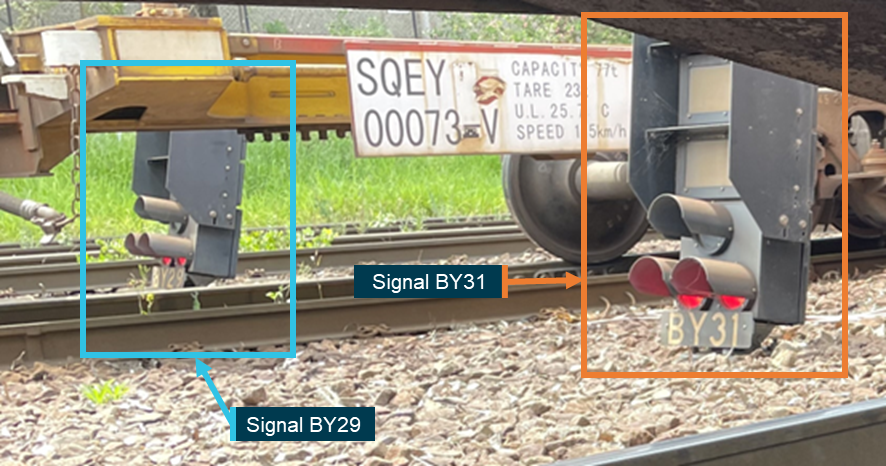
ATSB observation Normally, signal sighting is optimised for viewing from a position within a locomotive. Signals BY29 and BY31 at Port Botany are located at ground level and were being viewed from a motor vehicle, adjacent to the arrival roads on the rail access roadway. These roadways are located parallel and lower than that of the track creating difficulties in sighting the full aspects of the signals from the motor vehicle. |
Safety analysis
Introduction
On 13 January 2023, Pacific National train 1150 collided with Qube logistics train T296 in Port Botany yard, New South Wales. Train 1150 was a single locomotive, 31 wagon intermodal shuttle service from St Mary’s to Port Botany and return, crewed by RailTrain. Train T296 was also an intermodal service with a single locomotive and had 30 wagons, operating from Minto to Port Botany and return and crewed by Sydney Rail Services.
Both trains were performing a propelling movement at the time of collision and subsequent derailment.
The following analysis will discuss the conditions prior, during and post‑collision and the risk management of the rolling stock operators and rail infrastructure manager in relation to operations at Port Botany.
Propelling train 1150 passes signal BY31 at stop
Both T296 and 1150 required access to the stevedore ports by means of a propelling manoeuvre. This was reportedly due to the stevedore ports banning locomotives from remaining coupled to the train after an incident in 2003 where the train moved whilst a reach stacker was loading it. Propelling into the stevedore sidings allowed the locomotive(s) at the exit end to uncouple and move clear of the hardstand area during loading.
CCTV gathered by OTSI shows both trains moving towards each other, however due to the footage angle it does not show the relevant signal aspects on BY29 and BY31.
When the CCTV is analysed in parallel with the Phoenix train control replay, an accurate record of the events can be obtained.
With both trains ready to propel towards the stevedore sidings, the Phoenix train control system replay displayed a proceed indication on signal BY29 for T296, located on arrival road 1.
This signal indicated to the second person leading T296, that the route was correctly set, and that they had been authorised to start their propelling movement towards the DP World stevedore port sidings. The Phoenix train control system replay also showed 1150 occupying arrival road 2 and a stop aspect on their signal BY31.
As T296 began its propelling movement, 1150 can also be seen to begin an unauthorised propelling movement passing BY31 in the stop position. As the 2 trains approached converging tracks, 1150 collided with the side of T296. This collision resulted in several wagons from both trains derailing.
The Phoenix replay shows the route set by the NCO for T296 in green, with signal BY29 set to proceed and BY31 remaining at stop (Figure 25). Additional Phoenix replays show track circuit alarms seen by the NCO, caused by derailed wagons and a light pole when it fell across an adjacent unoccupied track (Figure 26 and Figure 27).
Had 1150 not passed signal BY31 in the stop position, it is certain that the collision with T296 and subsequent derailment would not have occurred.
Contributing factor Propelling train 1150 passed signal BY31 at stop, converging into and colliding with train T296, which was propelling on the adjacent track. |
Figure 25: ARTC Phoenix replay screenshot displaying route on BY29 for T296
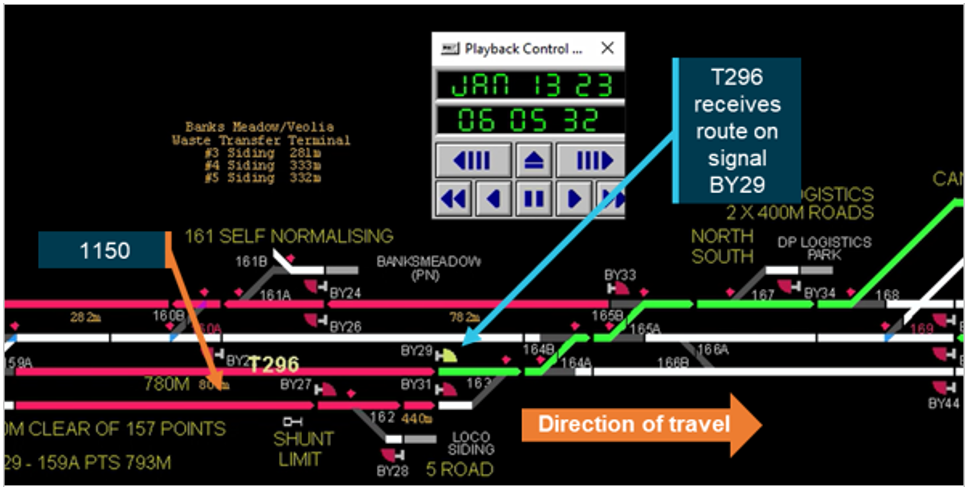
Figure 26: ARTC Phoenix replay screenshot during collision and derailment
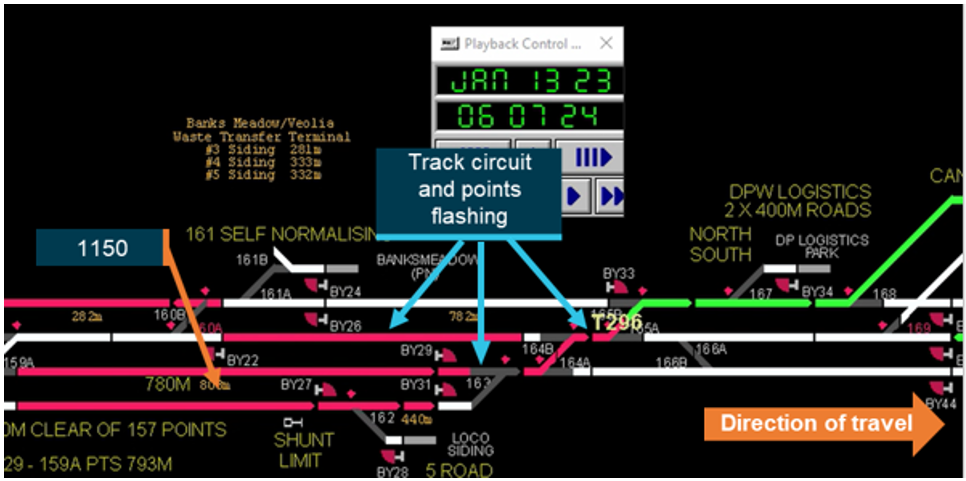
Figure 27: ARTC Phoenix replay screenshot post‑collision and derailment
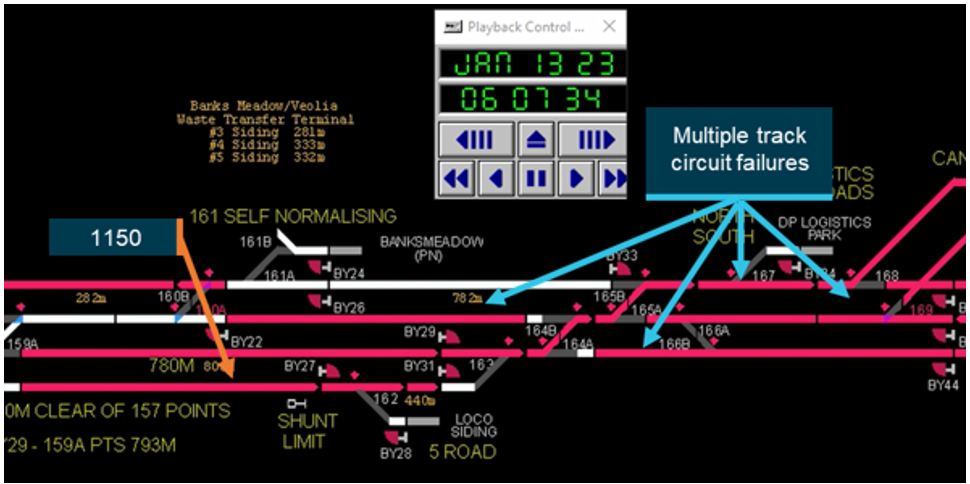
Figure 28: Collision at 163 points
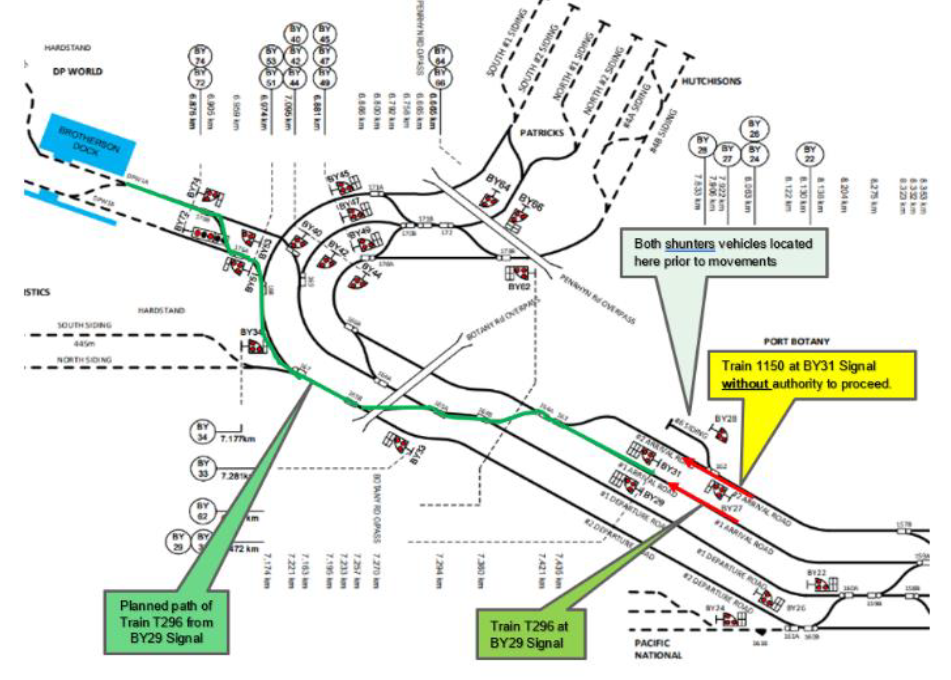
Qualified driver directing train 1150 mistook the location of their train
The competent worker responsible for directing the propelling movement for 1150 was the qualified driver for the train service. This resulted from a mutual Train crew 1150 role swap agreed to early in the shift, with the second person controlling the locomotive.
Trains T296 and 1150 were both ready for propelling movements towards the stevedore port sidings and located adjacent to one another on arrival roads 1 and 2 respectively (Figure 28). The crew leading the propelling movements were positioned inside separate motor vehicles, allowing sighting of the rear wagons on both trains and signals BY29 and BY31.
The previous day the qualified driver for 1150 was rostered for the same shift on the same train, but on arrival at Port Botany yard had been positioned on arrival road 1. On the day of the incident 1150 was positioned on arrival road 2.
At interview the qualified driver commented that the end of train markers on the rear wagons of both trains looked identical. However, when viewing CCTV of the incident, it is apparent that the rear few wagons on 1150 had a payload of containers, whereas the rear few wagons on T296 were empty.
The qualified driver leading 1150 did not mention the payloads aboard the wagons, probably as these were expected to vary from shift to shift. Instead, it is likely that the qualified driver’s focus was inadvertently on signal BY29 on arrival road 1, based on the events of the previous shifts.
Expectation Bias occurs when an individual’s expectation influences their perception and interpretation of information. This in turn can impact decision‑making. James Reason describes further that the people prone to these Error types are those that possess the right knowledge, skills and experience. However, as tasks become more familiar and routine, they are performed with less conscious effort, making the worker more susceptible to inattention to the task at hand.
For both the qualified driver and second person of 1150, St Mary’s to Port Botany and return was the only route competency they held, and this train had become extremely familiar and routine. The qualified driver for 1150 in interview commented that arrival road 1, which on the day of the incident was occupied by T296, felt the most familiar and was a common location for train 1150 on previous occasions.
The qualified driver also describes in interview that they realised their error moments after the collision and derailment. Originally, they perceived the accident as their train derailing whilst it negotiated the points. However, on closer inspection they realised that the incident was a collision and subsequent derailment. The qualified driver leading 1150 had mistaken the location of their train.
RISSB SPAD mitigation guidelines state that signal sighting decisions taken by RIMs can contribute to a more hazardous work environment. Reacting to the wrong signal or reading across through to a non-target signal occurs when a target signal has been stopped at correctly, however due to other distractions such as shunting duties, train crew respond to a change in aspect on a non-target signal that is also in view.
OTSI observes also that shunting signals at Port Botany were being observed from within a motor vehicle.
Train crew reported during interviews feeling safer staying within motor vehicles whilst conducting the line of sight procedure, likely contributing to train crew not exiting their vehicles to gain a better vantage point to view signals BY29 and BY31. Exiting the vehicle may have provided the qualified driver with another opportunity to locate their train correctly.
Also signal sighting standards are commonly based on the viewing of signals from within locomotives and not within motor vehicles. It was noted that the signal aspects were not fully visible from a motor vehicle, also potentially adding to the risk of read errors (see Figure 24).
Contributing factor The qualified driver directing the propelling movement of train 1150 mistook the location of their train. As a result, when signal BY29 cleared to allow T296 to proceed the qualified driver incorrectly authorised train 1150 to move. |
Line of sight procedure non-compliance
The line of sight procedure is a unique stand-alone procedure only in use at Port Botany. The procedure allows motor vehicles to be used to assist train crew in performing propelling movements. Thus, replacing the standard requirement of crews to walk beside lead vehicles whilst propelling as described in the ANTR 424 Propelling Trains procedure.
Through the course of the incident investigation OTSI observed widespread non‑adherence to line of sight shunting procedures in Port Botany yard post‑incident. Specifically, train crew routinely leading line of sight propelling were not:
- stationary at a selected line of sight location
- sighting the lead vehicle moving towards the selected location
- stopping the propelling movement once the lead wagon reaches the selected location
- repeating the process until the destination had been reached as required by ARTC’s line of sight shunting procedure.
Instead, OTSI observed instructions were being given from moving motor vehicles, ahead of the lead wagon and whilst the trains were kept moving, in a similar manner to the day of the incident.
Reasons for observed non-compliance were explored through interviews with crew from 3 different operators, analysis of human factors and available evidence.
Crew from 3 different operators in Botany yard were observed during the site visit and on CCTV as specifically not selecting a line of sight location during propelling movements. OTSI interviewed a sample of crew from these observations.
When questioned about their reasons for using an alternate shunting procedure crew reported that the line of sight procedure was complex, inefficient and impractical to carry out and they considered the alternative method to be significantly more efficient, although being aware of the line of sight shunting procedural requirements.
The reasons stated by train crew for not selecting a line-of sight location as per procedure were:
- brake recharge time following a train brake application (40‑second chokes on wagons)
- easier to keep trains moving (driving motor vehicle alongside the rear of train)
- avoiding stop/start nature of procedure
- impractical in that procedure takes too long to complete
- hazardous to exit motor vehicle during propelling movements.
Yard topography
The second person contingent identified line of sight visibility issues arising from the surrounding buildings and topography of the rail corridor, which has created tight track curvature. The track layout around buildings and roadways restricted vision and as a result it was difficult to carry out the line of sight shunting procedures.
To maintain line of sight around this topography crew could only move a short distance before calling the train onto their line of sight location, stopping the train, and then moving to the next location to repeat the process. This required that trains be stopped and started several times over a few hundred metres to fulfill line of sight location requirements.
Additionally, owing to narrow access roads, crew identified risks in stopping motor vehicles in some areas and deviated from procedure for personal safety reasons. This meant that the line of sight location was not selected, and propelling movement instructions were given from within moving motor vehicles while the trains also kept moving. Some second persons also reported in interview that they witnessed other operators, in their view, placing themselves in danger outside of the motor vehicles, to gain better vantage points in attempting to apply line of sight procedures.
Train brake operation
The main reasons cited by drivers for not following the correct procedure is that line of sight shunting takes too long. Resoundingly, the issues related to the stop/start nature of the procedure while the alternate method used kept trains moving.
The driver cohort in particular cited delays caused by the train braking systems. Once the train is stopped, the Automatic Brakerequires time to recharge the brake pipe, which in turn, allows train movements to recommence. This is due to the fitment of 40‑second chokes on wagons. When release and running is selected on the driver’s brake lever, the brake pipe begins to recharge. However, the train brakes are prevented from immediately releasing via the chokes fitted to wagons.
The stop/start requirements combined with delays to recharge the brake system meant that significant time was needed to comply with the procedures.
Compliance and training
Train crews were asked if they follow the line of sight procedure, to which all answered no.
The interviewed train crew also stated that they were shown the correct procedure during their training, however then witnessed the alternate method being conducted when on site.
Train crew described at the time of their Verification of Competency (VoC) assessment, that they carried out the procedure correctly to be deemed competent.
However, of the train crew interviewed, all commented that in normal operations (not during a VoC), they had never witnessed the procedure being followed correctly. Instead, the alternate method was almost exclusively being used by all crew at Port Botany.
Additionally, they advised compliance activities were not being undertaken by the rail infrastructure manager and only minimally from the various operators’ perspectives. Of the train crew interviewed, all reported they had never seen the rail infrastructure manager undertake compliance activities.
Operator compliance was undertaken in the form of ‘check rides’, whereby driver trainers periodically assessed train crew on numerous activities which included line of sight procedural compliance. However, crew advised that on nearly every occasion, they were forewarned of the assessment taking place and therefore complied with the requirements of the line of sight procedure. As soon as practical assessments were completed, train crew reported returning to the alternate method of propelling trains, contrary to the procedure.
Time pressures
Most train crew interviewed reported a perceived time pressure, of not wanting to hold up other operators arriving and departing stevedore sidings.
ARTC provided Train Information pathing times for the incident trains for both arriving and departing the stevedore sidings and Port Botany yard. The pathing allowed on average over 3 hours at the stevedore sidings to service up to around 30 wagons for each train. Typically, this would provide sufficient time for stevedores to service the train.
When questioned, only one of the drivers interviewed reported experiencing delays or reportedly caused the delay of other trains at Port Botany. However, an operator representative commented that it was common to be delayed accessing stevedore ports because of other operator movements.
Summary
Crew interviewed from 3 separate operators in Port Botany yard cited line of sight procedures as being inadequate for the task. This inadequacy combined with minimal compliance monitoring was described as the most common reason for the observed routine violations.
Situational violations, normally described as a ‘one off’ violation, are Intended actions/ violations. Breaking the rules to respond to an immediate situation, such as a time pressure, they are a choice rather than an accident and arise when people feel the violation is necessary to achieve a desired outcome, such as completing tasks quickly and as easily as possible. They do not arise due to a lack of knowledge, or malicious intent.
Combined with poor or absent compliance activities, these situational violations may lead to routine violations if the conditions remain.
Routine violations, described as ‘no one follows that rule’, become habitual practice, particularly where rules are considered unnecessary, time consuming or onerous.
Crew operating in Port Botany yard cited numerous concerns with the practical application of, and time required to complete, line of sight procedures. They described low visibility around curves limiting the distance to the next line of sight location and creating the need for multiple stop/starts over a short distance. Brake pipe recharging times created further delays. Tight track clearances were also specifically called out as a safety concern.
Overwhelmingly crew considered the line of sight procedure, when carried out correctly, to be time consuming and onerous, and combined with perceived time pressure, crew had created an alternate means to complete propelling movements as quickly and efficiently as possible.
OTSI found training in the procedure had been adequate. But once crew commenced working at Port Botany, they routinely observed line of sight procedures not being followed, and a faster and perceived ‘safer’ alternative method being in its place.
With minimal compliance monitoring train crew had formulated the alternate method of propelling over a significant period of time. Competent workers were routinely not following the rules, and the alterative propelling procedures had become a custom practice in the workplace.
Had both crew leading their respective propelling movements chosen a line of sight location, it is highly likely they would have seen the 2 trains converging towards one another and stopped their respective trains prior to any collision.
Contributing factor Operators at Port Botany were routinely deviating from the ARTC line of sight shunting procedure for a perceived simpler method of working. The procedure was described by train crew as difficult, time consuming and at times unsafe to conduct. |
Ambiguity in the ARTC line of sight procedure
Through train crew interviews and reviewing recent ARTC investigation reports for the March 2020 and January 2023 incidents, the ATSB/OTSI observed some perceived ambiguity specific to steps 1 and 2 in the line of sight procedure, and inconsistencies with the requirements in the line of sight protocols and the general network rules and procedures. The line of sight procedure states that the competent worker controlling the shunting movement must:
1) gain authorisation from the ARTC Network Controller in NCCS before commencing any line of sight shunting movements
2) ensure all points are set for the intended route.
There is a likely link between these inconsistencies and some of the perceived non‑compliances observed.
Gaining authorisation to commence line of sight shunting
The line of sight procedure does not specify how train crew should gain authorisation to commence line of sight shunting. Gaining authority in the procedure could be interpreted as verbal authority, however the procedure does not explicitly state verbal.
Movement authorities are described in the general network rules and procedures, specifically ANGE 606 Responding to signals and signs and ANTR 424 Propelling Trains as:
- a shunting signal authorises a movement at restrictive speed past that signal (ANSG 606)
- if possible, signallers must use shunting signals to authorise shunting movements (ANSG 606)
- unless the signaller instructs that a movement is to proceed for a shorter distance, a proceed indication by a shunting signal is an authority to proceed (ANSG 606)
- signals, if available, must be used to authorise shunting movements (ANTR 424)
Where there are no signals available for a shunting movement, or additional instructions are required, then verbal authority from the NCO must be sought.
Verbal authorities at Port Botany were necessary when stop signs, rather than signals, were used throughout the yard. Historically, verbal authorisation was required from the NCO to pass these stop signs. When the yard was upgraded to shunting signals the requirement for verbal authorisation was effectively negated as train crew could then gain authority to proceed on the indications the shunting signals provided in accordance with the standard network rules and procedures.
During interviews, it was evident that the majority of Botany qualified train crew considered the clearing of a shunting signal as the authority to commence line of sight shunting. However, one operator with considerable experience at Port Botany, that pre‑dated ARTC taking over as the RIM in April 2011, considered authority to be verbal prior to any signal being cleared.
The ARTC investigation reports for both the March 2020 and January 2023 incidents found that no line of sight verbal communication occurred between the incident train crews and the NCO in both incidents. Whilst this statement is correct, the line of sight procedure has no clear requirement for the competent worker leading the propelling movement to obtain verbal authority from the NCO.
Ensuring points are set for intended routes
The line of sight procedure also required that train crew ensure points are set for an intended route. This suggests that crew visually check the positioning of points prior to propelling movements commencing.
Again, prior to April 2011, points were protected by stop signs, not signals. The NCO at Port Botany directed train crew via UHF radio to set and check certain routes manually via hand thrown point levers throughout the yard. After ARTC took over as the RIM these stop signs and manually hand thrown points were replaced by shunting signals and corresponding interlocked motorised points.
The line of sight procedure stated that the competent worker must ensure all points are set for the intended route. However, the general network rules and procedures, specifically ANGE 606 responding to signals and signs, under the headings of ‘signal indications’ and ‘proceed’, state:
• a proceed signal indication shows that interlocked points protected by the signal are set in the correct position for the movement, and
• no conflicting route has been set, and
• if available the signal may show which route is set (via a route indicator).
Train crew advised at interview, that they utilise shunting signals and route indicators to ensure points are set correctly, negating the requirement to visually check the point switchblades. They further identified that exiting motor vehicles to conduct a visual point check during line of sight propelling was considered a risk owing to narrow clearances on motor vehicle access roads.
ARTC’s investigation report for the January 2023 incident states that both crew members leading the propelling movements for both trains T296 and 1150 did not visually check points, as required by ARTC’s interpretation of the line of sight procedure. However, the standard network procedures state that the crew members leading the propelling movement for T296 were able to accept the route was set correctly by the indication on signal BY29.
Train crew and ARTC appear to interpret the checking of points directive in the procedure differently in that ARTC believe it to be a physical visual inspection, whilst crew utilise the signal and route indications.
Summary
It is important to have clear and concise written procedures so that they are interpreted correctly and carried out uniformly by all stakeholders.
The line of sight shunting protocols when read in conjunction with existing network rules and procedures may explain why there is a perceived ambiguity to certain aspects of the procedure.
Movement authorities and route requirements in the line of sight procedure may be interpreted as being adhered to, given the supporting evidence in the general network rules and procedures.
For example, the requirement for authority to be given by the NCO for line of sight shunting to the competent worker may be understood as the clearing of a signal, rather than a direct verbal communication.
Similarly, if the competent worker receives the intended proceed route on a shunting signal, this verifies that the points are set for the intended movement.
Competent workers may have fulfilled the requirement of ensuring points are set correctly via the route displayed on the shunting signal per standard rules and procedures rather than visually checking them per ARTC’s interpretation of line of sight procedures.
Crews may not be following some protocols set out in the line of sight procedure unintentionally. Crews are likely utilising their knowledge of the wider network rules and procedures and interpret this as compliance with protocols required in the standalone line of sight shunting procedure.
Train crew also report that exiting a motor vehicle to check points is not considered by them to be safe if they were to apply ARTC’s interpretation of the procedure.
Therefore, alignment of the line of sight procedures with standard network rules may reduce risk, and any ambiguity and confusion when propelling at Port Botany in comparison to other yards where similar shunting movements take place.
Other factor that increased risk Aspects of ARTC's line of sight shunting instructions were ambiguous, resulting in a varying interpretation of the procedure by stakeholders. (Safety issue) |
ARTC risk assessment process
Risk controls which may have reduced risk were not further evaluated
A formal risk assessment of propelling movements in Port Botany yard was conducted by ARTC on 30 April 2020. This risk assessment was instigated in response to the earlier almost identical collision and derailment that occurred in March 2020.
During this risk assessment it was documented that train operators referred to ‘the difficulty in compliance to this procedure’ due to the ‘access and vision restrictions’ arising from the yard layout and infrastructure.
Section 2 of the ARTC risk assessment report captured the identified risks from the workshop, including train to train collision, with the overall current risk rating assessed as High 3B.
Section 3 documented the proposed treatments for these risks. One of these proposed treatments was ‘compliance with line of sight shunting’. Although the table documented ownership of managing compliance with line of sight shunting in Port Botany yard, it is not clear from the assessment what was required for the control, as the accept/reject or investigate column was not complete. It was noted in the document section preamble that some of the treatments may have ‘further implications for customers and operators’ and ‘requires further investigation’. However, ARTC was unable to provide evidence that further evaluation of line of sight protocols took place, or that risks associated with ‘difficulty with compliance’ were documented or addressed.
As the documented table for the Proposed Treatments from ARTC risk assessment 2020 (see Figure 21) was incomplete, it did not record any decision i.e. adopt, reject or investigate compliance with line of sight shunting procedure.
ARTC has stated that it considers the line of sight shunting procedure to be an adequate control in the prevention of collisions/accidents at Port Botany, however this was not documented. There was no evidence the risks identified by operators were reviewed prior to the second derailment and collision that occurred on 13 January 2023.
Risk reviews were not conducted in accordance with ARTC procedures
The April 2020 risk assessment was ARTC’s only risk assessment of operations at Port Botany prior to 2023. This was initiated because of the collision and derailment that occurred in March 2020.
ARTC’s risk management process document describes how overall risk ratings trigger risk review periods. For Port Botany, the overall risk rating was determined to be a High 3B at the March 2020 workshop, which called for a review period no longer than every 6 months, unless a review is triggered earlier (i.e as a result of incident investigation, audit findings, etc).
This risk review period should have led to a risk review being done around October 2020. Instead, it wasn’t until the January 2023 incident, at the same location as the March 2020 collision and derailment, that another risk assessment was convened. The time elapsed between risk assessments was over 2 years.
Active train crew were not well represented in risk assessment processes
Operators labelled as present at the ARTC Port Botany risk assessment held on 30 April 2020 primarily held management positions. Only 2 of the 7 operators’ representatives in attendance were identified to be from an end user cohort. One was a qualified second person and the other was identified by their employer as a Subject Matter Expert (SME). The SME had been previously qualified as train crew at Port Botany.
International standard ISO 31000 Risk Management – Guidelines stated best practice was consulting the end user cohort who carry out the procedures, as they are the most effective at identifying risk relating to their use.
Having additional Port Botany qualified train crew present at the 30 April 2020 risk assessment may have reinforced some of the challenges identified with compliance.
Issues raised by operators with line of sight shunting procedure were not risk assessed
In the April 2020 risk assessment workshop operators described difficulty in compliance with the procedure due to safe access to line of sight locations and vision restrictions, arising from the access roadways deviating away from the rail track, and some tight clearances at Port Botany. Whilst this was mentioned in the 2020 risk assessment background, there is no record of the specific concerns raised, or evidence that the concerns/risks were assessed or addressed.
The proposed treatments section of the 2020 risk assessment highlights, ‘compliance with line of sight shunting’, under the heading of ‘improved management of trains in Botany yard’. However, the document did not state how ARTC planned to address the risks and difficulties with carrying out the procedure identified by the operators.
Minimal compliance monitoring of risk controls
On the proposed treatment table in the 2020 risk assessment, compliance activities were not labelled as accept, reject nor investigate, although ownership sat with a designated ARTC general manager.
ARTC was requested to provide evidence of compliance monitoring of line of sight procedures in the yard, prior to the incident date of 13 January 2023. No evidence was provided.
Compliance activities by ARTC did not begin until after the January 2023 incident date. ARTC stated that in relation to compliance monitoring, the interface manager at Port Botany observed shunting movements and conversed with operators in March 2024. There was no formal documentation to support this occurring, and it is observed that this was more than 12 months after the January 2023 incident.
It is important to note also that OTSI observed ongoing routine non-compliance with the procedures during 2 random site visits post the 2023 incident.
Contributing factor ARTC did not proactively follow risk assessment principles specific to propelling movements to ensure safe rail operations within shunting yards under their control. ARTC conducted operations without the hazards/risks being fully or effectively assessed. (Safety issue) |
Exemplar risk assessment
OTSI requested an exemplar risk assessment for reference to Kooragang Island, Newcastle NSW as a propelling movement procedure (not line of sight) also exists for this location. ARTC advised that a risk assessment for Kooragang Island could not be supplied, as this activity had not been conducted.
Second person operated train 1150
On the day of the incident, the train crew of 1150 swapped roles at the beginning of their shift at St Mary’s. The second person assumed the role of the driver controlling 1150 and the qualified driver assumed the position of second person.
The second person drove the train supervised by the qualified driver from St Mary’s to Port Botany, including during the required run around movement shortly after arrival.
During the propelling movement the second person was left unsupervised to drive the train whilst the qualified driver performed the role of second person.
During interviews, the crew of 1150 described this swap as common practice within the industry. The qualified driver perceived the second person to be knowledgeable, although this second person had not completed training that would have likely allowed them to fully understand the locomotive and airbrake systems.
Train handling is a key skill that combines practical train driving experience with the knowledge of locomotive systems. Shunting in a yard environment such as Port Botany requires competency in train driving for the purposes of coupling and uncoupling wagons in such a way as to not injure crew and avoid damage to rolling stock.
The operator’s driver position description outlined key responsibilities, which did not include any mentoring role. The key responsibilities of the qualified drivers role stated the requirements to follow both occupational health and safety procedures. These procedures required rail traffic crews (specific to drivers) to be qualified to operate the rail traffic they drive in the ARTC network and delegate duties only to competent workers.
The operator’s second person position description does not state any requirement to operate locomotives or rolling stock. Additionally, the role description also prescribes compliance with network policies and procedures, specifically ARTC network procedure ANGE 232 Responsibilities of rail traffic crews. These responsibilities specifically state that employees of the operator must have competency to perform specific work functions and must only undertake duties and tasks for which they have been deemed competent for, based on knowledge, training and experience.
Whilst OTSI found that the role swap occurred, it did not directly contribute to the occurrence event and is described as a factor that increased risk. Operators and train crew, however, are reminded to only conduct work that they are qualified for.
Other factor that increased risk The second person who was not authorised to drive a train under instruction of the qualified driver, operated 1150 en route to Port Botany. On arrival at Port Botany, the qualified driver of 1150 performed the on-ground duties during the shunt, leaving the unauthorised second person to operate the train unattended. |
Findings
ATSB investigation report findings focus on safety factors (that is, events and conditions that increase risk). Safety factors include ‘contributing factors’ and ‘other factors that increased risk’ (that is, factors that did not meet the definition of a contributing factor for this occurrence but were still considered important to include in the report for the purpose of increasing awareness and enhancing safety). In addition, ‘other findings’ may be included to provide important information about topics other than safety factors. Safety issues are highlighted in bold to emphasise their importance. A safety issue is a safety factor that (a) can reasonably be regarded as having the potential to adversely affect the safety of future operations, and (b) is a characteristic of an organisation or a system, rather than a characteristic of a specific individual, or characteristic of an operating environment at a specific point in time. These findings should not be read as apportioning blame or liability to any particular organisation or individual. |
From the evidence available, the following findings are made with respect to the collision and derailment of trains 1150 and T296, in Port Botany New South Wales, on 13 January 2023.
Contributing factors
- Propelling train 1150 passed signal BY31 at stop, converging into and colliding with train T296, which was propelling on the adjacent track.
- The qualified driver directing the propelling movement of train 1150 mistook the location of their train. As a result, when signal BY29 cleared to allow T296 to proceed the qualified driver incorrectly authorised train 1150 to move.
- Operators at Port Botany were routinely deviating from the ARTC line of sight shunting procedure for a perceived simpler method of working. The procedure was described by train crew as difficult, time consuming and at times unsafe to conduct.
Other factors that increased risk
- Aspects of ARTC's line of sight shunting instructions were ambiguous, resulting in a varying interpretation of the procedure by stakeholders. (Safety Issue)
- ARTC did not proactively follow risk assessment principles specific to propelling movements to ensure safe rail operations within shunting yards under their control. ARTC conducted operations without the hazards/risks being fully or effectively assessed. (Safety Issue)
- The second person who was not authorised to drive a train under instruction of the qualified driver, operated 1150 en route to Port Botany. On arrival at Port Botany, the qualified driver of 1150 performed the on-ground duties during the shunt, leaving the unauthorised second person to operate the train unattended.
Safety issues and actions
Central to the ATSB’s investigation of transport safety matters is the early identification of safety issues. The ATSB expects relevant organisations will address all safety issues an investigation identifies. Depending on the level of risk of a safety issue, the extent of corrective action taken by the relevant organisation(s), or the desirability of directing a broad safety message to the rail industry, the ATSB may issue a formal safety recommendation or safety advisory notice as part of the final report. All of the directly involved parties were provided with a draft report and invited to provide submissions. As part of that process, each organisation was asked to communicate what safety actions, if any, they had carried out or were planning to carry out in relation to each safety issue relevant to their organisation. Descriptions of each safety issue, and any associated safety recommendations, are detailed below. Click the link to read the full safety issue description, including the issue status and any safety action/s taken. Safety issues and actions are updated on this website when safety issue owners provide further information concerning the implementation of safety action. |
Ambiguity in the ARTC line of sight procedure
Safety issue number: RO-2023-002-SI-02
Safety issue description: Aspects of ARTC's line of sight shunting instructions were ambiguous, resulting in a varying interpretation of the procedure by stakeholders.
ARTC risk assessment process
Safety issue number: RO-2023-002-SI-03
Safety issue description: ARTC did not proactively follow risk assessment principles specific to propelling movements to ensure safe rail operations within shunting yards under their control.
ARTC conducted operations without the hazards/risks being fully or effectively assessed.
Additional safety action by Pacific National
Pacific National advised that after reviewing the draft report that it has:
- Reviewed the ARTC OGW-30-25 Network Information Book – Line of Sight Procedure (Section 2.2.1) and has confirmed that the PN shunting procedure meets or exceeds the requirements outlined in the ARTC OGW-30-25 document.
- Confirmed that frequent (quarterly) combined Port Botany shunting inspections are occurring with ARTC and PN on site verifying protection of propelling movements (line of sight shunting) and this activity is being completed by PN qualified workers not in a moving or stationary vehicle.
- Confirmed that in addition to the scheduled ARTC on site activity, critical control verifications are carried out by Enfield/Clyde leaders on PN crews performing shunting at Port Botany frequently and have a scheduled process in place to prompt this Port Botany focus.
ATSB comment
ATSB welcomes the additional safety action taken by Pacific National, in response to findings within the report.
Glossary
| ANGE | ARTC general network rules |
| ANSG | ARTC network signals and signs rules |
| ANTR | ARTC network train working rules |
| ARTC | Australian Rail Track Corporation – the rail infrastructure manager for this accident |
| CCTV | Closed-circuit television |
| CCV | Critical control verification |
| CRM | Critical risk management |
| ICE | In-cab communications equipment (communications system) |
| NIB | Network Information Book |
| NCO | Network control officer. Coordinates and manages train paths and track occupancy authorities. |
| NCCS | Network Control Centre South |
| NCCN | Network Control Centre North |
| OTSI | Office of Transport Safety Investigations. Based in Sydney, NSW, OTSI undertakes rail accident/incident investigations in NSW on behalf of the ATSB. In this capacity it operates under the provisions of the Transport Safety Investigation Act 2003 (Cwlth). |
| ONRSR | Office of the National Rail Safety Regulator – administered and enforced compliance with the Rail Safety National Law and Regulations |
| PN | Pacific National |
| RIM | Rail infrastructure manager |
| RISSB | Rail Industry Safety and Standards Board – responsible for the provision of standards, codes of practice, guidelines, rules, safety data and analysis for the Australian rail industry |
| RSO | Rolling stock operator – operates above‑rail assets, for example locomotives and wagons |
| RVDS | Rail vehicle detection system |
| SFAIRP | So far as is reasonably practicable |
| SMS | Safety management system – a systematic approach to organisational safety encompassing safety policy and objectives, risk management, safety assurance, safety promotion, third party interfaces, internal investigation and SMS implementation |
| SPAD | Signal Passed At Danger |
| RTO | Rail transport operator – encompassed both rail infrastructure managers (track, signalling etc.) and rolling stock operators (locomotives, wagons etc.) |
| UHF | Ultra-high frequency (communications radio) |
| VoC | Verification of Competency |
Sources and submissions
Sources of information
The sources of information during the investigation included:
- ARTC rules and procedures
- Australian Rail Track Corporation
- crew of Train 1150
- digital voice recordings
- documentation that is publicly available
- Informa corporate learning
- Office of Transport Safety Investigations
- Pacific National
- photographs taken on the day of the incident
- QR Train Handling guide
- RailTrain
- recorded data from locomotive on train 1150
- RISSB (now known as ARISO)
- Southern Shorthaul Railroad
- Sydney Rail Services
- Transport for New South Wales.
References
- James Reason 1991
- Rail Safety National Law (RSNL).
Submissions
Under section 26 of the Transport Safety Investigation Act 2003, the ATSB may provide a draft report, on a confidential basis, to any person whom the ATSB considers appropriate. That section allows a person receiving a draft report to make submissions to the ATSB about the draft report.
A draft of this report was provided to the following directly involved parties:
- Crew of train 1150
- RailTrain
- ARTC
- Sydney Rail Services (SRS)
- Southern Shorthaul Railroad (SSR)
- Pacific National
- Qube Logistics
- Office of the National Rail Safety Regulator (ONRSR).
Any submissions from those parties will be reviewed and, where considered appropriate, the text of the draft report will be amended accordingly.
Submissions were received from:
- Sydney Rail Services (SRS)
- Office of the National Rail Safety Regulator (ONRSR)
- ARTC
- Pacific National.
The submissions were reviewed and, where considered appropriate, the text of the report was amended accordingly.
Rail safety investigations in New South WalesMost transport safety investigations into rail accidents and incidents in New South Wales (NSW) and Victoria are conducted in accordance with the Collaboration Agreement for Rail Safety Investigations and Other Matters between the Commonwealth Government of Australia, the State Government of NSW and the State Government of Victoria. Under the Collaboration Agreement, rail safety investigations are conducted and resourced in NSW by the Office of Transport Safety Investigations (OTSI) and in Victoria by the Chief Investigator, Transport Safety (OCI), on behalf of the ATSB, under the provisions of the Transport Safety Investigation Act 2003. The Office of Transport Safety Investigations (OTSI) is an independent statutory body which contributes to improvements in the safety of bus, ferry and rail passenger and rail freight services in NSW by investigating safety incidents and accidents, identifying system-wide safety issues and sharing lessons with transport operators, regulators and other key stakeholders. Visit www.otsi.nsw.gov.au for more information. Purpose of safety investigationsThe objective of an ATSB safety investigation is to improve transport safety through:
In accordance with the TSI Act, the ATSB does not investigate for the purpose of taking administrative, regulatory or criminal action, and cannot apportion blame, assist in determining liability, or, as a general rule, assist in court proceedings. About ATSB reportsATSB safety investigation reports are developed in accordance with ATSB procedures and guidelines, and with regard to applicable international standards and instruments. Reports must include factual material of sufficient weight to support the investigation’s analysis and findings. At all times the ATSB endeavours to balance the use of material that could imply adverse comment with the need to properly explain what happened, and why, in a fair and unbiased manner. An explanation of terminology used in ATSB investigation reports is available here. Publishing informationReleased in accordance with section 25 of the Transport Safety Investigation Act 2003 Published by: Australian Transport Safety Bureau © Commonwealth of Australia 2026 Ownership of intellectual property rights in this publication Unless otherwise noted, copyright (and any other intellectual property rights, if any) in this report publication is owned by the Commonwealth of Australia. Creative Commons licence 
With the exception of the Commonwealth Coat of Arms, ATSB logo, and photos and graphics in which a third party holds copyright, this report is licensed under a Creative Commons Attribution 4.0 International licence. The CC BY 4.0 licence enables you to distribute, remix, adapt, and build upon our material in any medium or format, so long as attribution is given to the Australian Transport Safety Bureau. Copyright in material obtained from other agencies, private individuals or organisations, belongs to those agencies, individuals or organisations. Where you wish to use their material, you will need to contact them directly. |
- ^ The Office of the National Rail Safety Regulator (ONRSR) provides useful guidance on effective risk assessment to operators in its Safety Message dated 27 October 2022.
- ^ A propelling movement requires one crew member to be situated on the ground, typically walking beside the front of their reversing train. Their role is to observe signals and monitor the path of the train as it propels, communicating instructions via handheld two-way radio to the driver in a locomotive attached at the rear of the train. Controlling the movement was the role of the second person.
- ^ At Port Botany, rather than walking, motor vehicles were used to assist the second person on the ground leading the propelling movement.
- ^ Signals BY29 and BY31 were shunting signals that protected 163 points which converged arrival roads 1 and 2 into one track at the stevedore end (southern end) of Port Botany yard.
- ^ Loss of air was a result of the train separating during the derailment.
- ^ Standard calls are direct point to point calls only between the driver and the NCO.
- ^ Emergency calls are broadcast to all rail traffic in the area via the ICE radio emergency call function.
- ^ RailCorp was responsible for the infrastructure maintenance, train control and safeworking rules that applied to the metropolitan freight network that Port Botany yard was a part of.
- ^ For a more detailed explanation of train airbrake systems, refer to OTSI/ATSB investigation: RO-2020-022, Runaway and derailment of loaded grain train 3966, Dombarton, NSW, on 15 December 2020.
- ^ Push pull operations described as locomotive placed on either end of a train consist.
- ^ Further information is contained in the 1 July 2004 OTSI Rail Safety Investigation Report, Shunting Fatality Port Botany Rail Yard (OTSI file reference 02325).
- ^ Commonly referred to as ‘SFAIRP,’ the Rail Safety National Law (NSW), s. 47, defined this as ‘…that which is (or was at a particular time) reasonably able to be done in relation to ensuring safety.’
- ^ Rail Safety National Law (NSW), s. 99.
- ^ While this referred to an earlier version of the standard (ISO 31000:2009), at the time of the accident it remained current.
- ^ Rail Safety National Law National Regulations 2012, Sch. 1, item 13.
- ^ For more information relating to ONRSR investigations, visit Investigations | ONRSR
- ^ For more information relating to ONRSR regulatory activities, visit Audits, inspections, compliance measures | ONRSR
Occurrence summary
| Investigation number | RO-2023-002 |
|---|---|
| Occurrence date | 13/01/2023 |
| Occurrence time and timezone | 13 January 2023 – 0607 Australian Eastern Daylight saving Time |
| Location | Port Botany |
| State | New South Wales |
| Report release date | 24/09/2026 |
| Report status | Final |
| Investigation level | Defined |
| Investigation type | Occurrence Investigation |
| Investigation phase | Final report: Dissemination |
| Investigation status | Completed |
| Mode of transport | Rail |
| Rail occurrence category | Collision, Derailment |
| Occurrence class | Incident |
| Highest injury level | None |
Train details
| Train operator | RailTrain (Pacific National) |
|---|---|
| Train number | 1150 |
| Track operator | Australian Rail track Corporation |
| Type of operation | Freight |
| Rail vehicle sector | Freight |
| Consist | 31 wagons and single locomotive |
| Departure point | St Marys, New South Wales |
| Destination | Port Botany, New South Wales |
| Persons on board | Crew - 2, Passengers - Nil |
| Injuries | None |
| Train damage | Substantial |
Train details
| Train operator | Sydney Rail Services (Qube Logistics) |
|---|---|
| Train number | T296 |
| Track operator | Australian Rail Track Corporation |
| Type of operation | Freight |
| Rail vehicle sector | Freight |
| Consist | 30 wagons and single locomotive |
| Departure point | Minto, New South Wales |
| Destination | Port Botany, New South Wales |
| Persons on board | Crew – 2; Passengers – 0 |
| Injuries | None |
| Train damage | Substantial |