

Final report
Report release date: 19/11/2025
Investigation summary
What happened
At 1100 local time on 15 March 2025, Gaschem Homer was departing for sea from its berth in the port of Brisbane, Queensland, under the conduct of a harbour pilot. At 1104, while the ship was being turned towards the port's entrance, it experienced an electrical blackout, resulting in the total loss of propulsion and steering control. About 2 minutes later, the crew restored the electrical power. The incident did not result in damage or injury.
What the ATSB found
The ATSB found that, during departure preparations, the crew had forgotten to switch 2 of the ship’s 3 generators to automatic mode. As a result, the ship’s power management system was unable to automatically distribute electrical load across all generators, restricting generating capacity to only 1 generator. The increased power demand when the bow thruster was operated during departure manoeuvring could not be supported by the single generator and it tripped on overload, causing the blackout.
The investigation also identified a safety issue relating to the shipboard safety management system, which had not identified operational risks associated with Gaschem Homer’s electrical installations and implemented effective controls. Procedures were generic and non-informative and there were no other controls in place to prevent such operational lapses resulting in a power failure.
What has been done as a result
The ship manager, Hartmann Gas Carriers, risk-assessed potential failure modes associated with its ships’ power management systems and established additional controls to prevent total power failures. The shipboard safety management system(s) has been amended to include guidelines for blackout prevention and procedures requiring generators to be set for automatic load sharing before manoeuvring.
Pre-departure and arrival checklists for the engine room and bridge were amended to include verification of generator mode status. To supplement these updates, a power demand matrix has been developed to specify the minimum number of generators required to be online for each operational mode.
In addition, the company has introduced targeted training for watchkeeping engineers on critical power management and monitoring tasks, along with enhanced bridge and engine room information exchange protocols, as further controls against power failures.
The ATSB considers that the safety action adequately addresses the safety issue.
Safety message
This incident highlights the importance of ensuring all risks associated with shipboard operations and critical equipment are identified, assessed and effectively controlled. The safety management system should encompass up-to-date and useable ship-specific procedures, as well as any additional technical controls if procedural barriers alone are insufficient to mitigate risk.
The occurrence
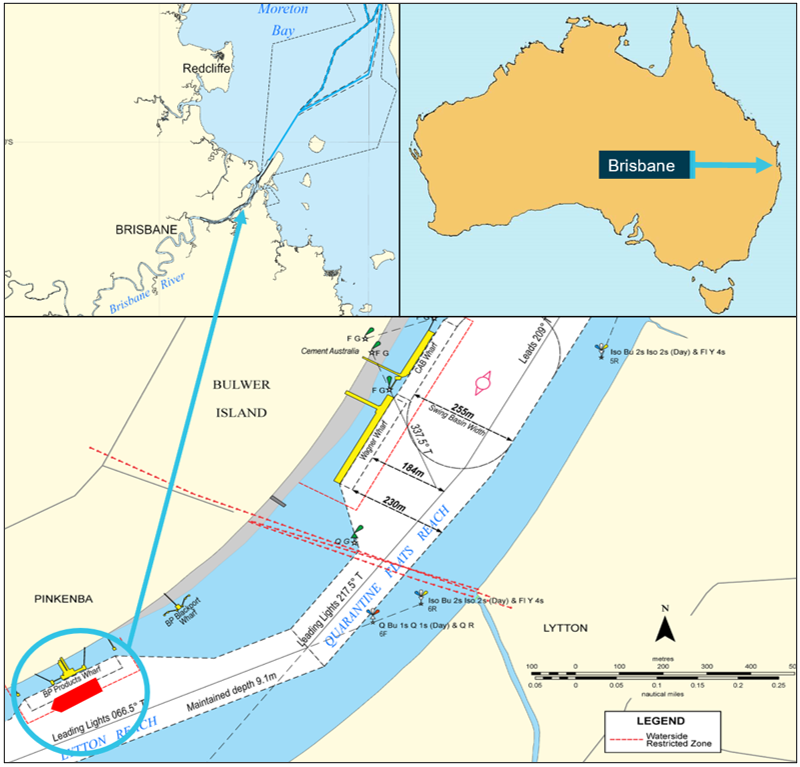
At 1036 local time on 14 March 2025, the 100 m gas tanker Gaschem Homer was made fast, starboard side alongside, at the BP Products berth in the port of Brisbane, located in the Brisbane River, Queensland (Figure 1). The ship had arrived from Westernport, Victoria, to discharge its cargo of propane and butane gas.
One week prior to Gaschem Homer’s arrival, the port had experienced heavy rainfall and river flooding following a significant weather event.[1] Although the associated weather system had dissipated by the time the ship had berthed, its impact had resulted in increased ebb tidal flows and an accumulation of debris along the river.
Figure 1: Gaschem Homer's position at the BP products wharf
Source: Maritime Safety Queensland and Australian Hydrographic Office, annotated by the ATSB
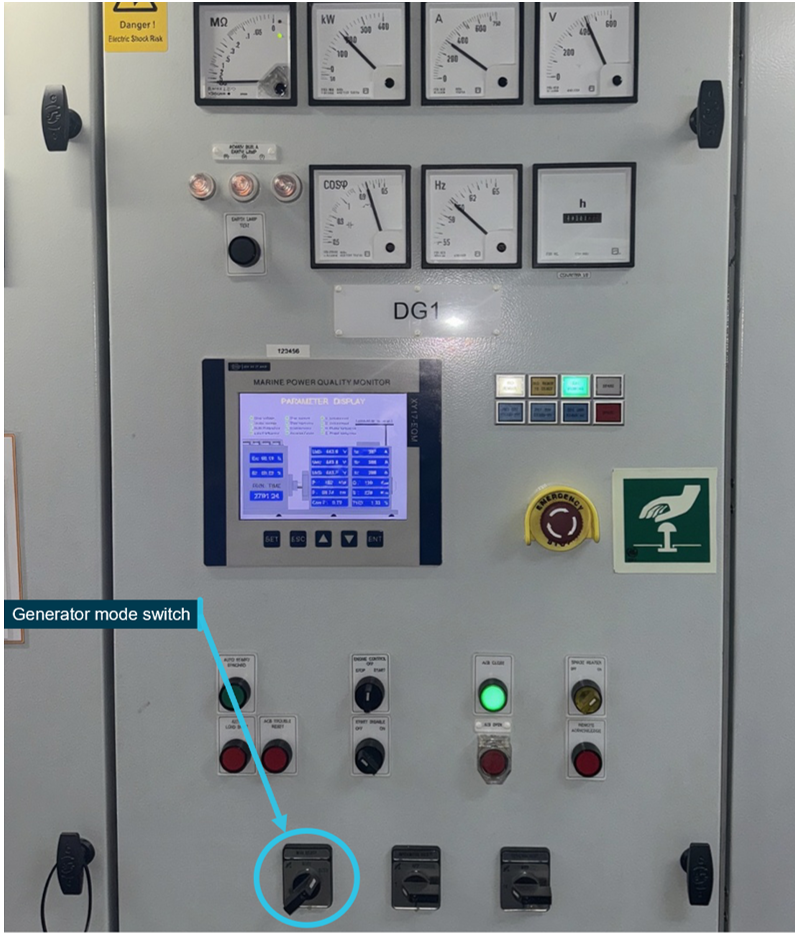
After berthing, the ship’s crew began preparing for cargo operations. Cargo handling increased demand for electrical power, necessitating the operation of at least 2 of the ship’s 3 auxiliary diesel generators in parallel. The ship was fitted with an automated power management system (PMS) designed to optimise and automate the generation and distribution of electrical power. The duty engineer set 2 generators to ‘automatic’ mode using the respective mode selector switches on each generator control panel (Figure 2), enabling the PMS to manage generator synchronisation and load sharing automatically between all three 3 auxiliary generators.
Figure 2: Control panel for diesel generator 1 (DG1)
Source: Hartmann Gas Carriers, annotated by the ATSB
Cargo operations commenced at 1200 with all 3 generators operating and continued until 0424 the following morning. After their completion, the electrical demand was reduced and all generators except diesel generator 3 (DG3) were shut down. The machinery spaces remained unattended[2] until 0800, when the chief engineer, second engineer, and electro-technical officer (ETO) commenced their shift in the engine control room (ECR). With departure from port under the conduct of a harbour pilot scheduled for 1100, the engine room team began standard departure preparations.
At 1001, the engine room team received a one-hour departure notice from the bridge and the second engineer, the duty engineer, initiated the engine room pre-departure checklist. As DG3 was already supplying the main switchboard (MSB), the second engineer started generators 1 and 2 (DG1 and DG2) and set them to ‘automatic’ mode to enable the PMS to synchronise all 3 generators. After synchronisation, DG1 and DG2 were returned to ‘manual’ mode and allowed to warm up under low load. The second engineer then continued with other pre-departure checklist tasks. These included preparing the main engine, starting the bow thruster, and transferring control to the bridge.
At 1012, the pilot boarded and proceeded to the bridge, where the master joined shortly after. A master-pilot information exchange was conducted and the passage plan reviewed. Due to higher ebb river flows following the recent weather event, the regional harbour master had issued temporary restrictions for ship movements. While Gaschem Homer did not normally require tug assistance, the restrictions meant that a single tug was to be allocated for the departure. The plan involved manoeuvring the ship off the berth using the bow thruster and tug assistance before it was to be swung to port in the adjacent channel towards the port entrance for sea.
High water (2.38 m) at Pinkenba was predicted for 1025 with low water (0.53 m) predicted for 1649. While the tidal flow was predicted to be minimal (slack water) during the departure, the pilot observed that the tide had already started to ebb and assessed this was due to high freshwater outflows following the recent weather event. There was a light south-easterly breeze at about 7 knots.
At 1047, after the tug made fast on the port quarter, the main engine and bow thruster were satisfactorily tested from the bridge under the pilot’s advice. The master then ordered mooring parties (fore and aft) to let go the head and stern lines.
During the pre-departure activities, the chief engineer observed a large amount of debris around the ship and berth via the ship’s CCTV[3] system display in the ECR. Concerned that seawater inlets for the main engine and generator cooling systems could be fouled, the chief engineer, second engineer, and ETO began to monitor coolant temperatures and continued to check for debris on the CCTV display.
Meanwhile on the bridge, as mooring lines were being released, the master proceeded to the starboard bridge wing console in preparation for departure. At 1059, after the release of the last line was confirmed, the pilot began giving helm and main engine orders and requested the bow thruster be set to port (bow to port) at half thrust. The pilot then instructed the attending tug to bear weight on its tow line. Once the ship commenced movement off the berth, the pilot instructed the master to increase the bow thruster to 70% thrust. At approximately 1102, the pilot instructed the bow thruster to port at full thrust. As the swing continued, it remained at full thrust while the pilot continued to conduct the pilotage.
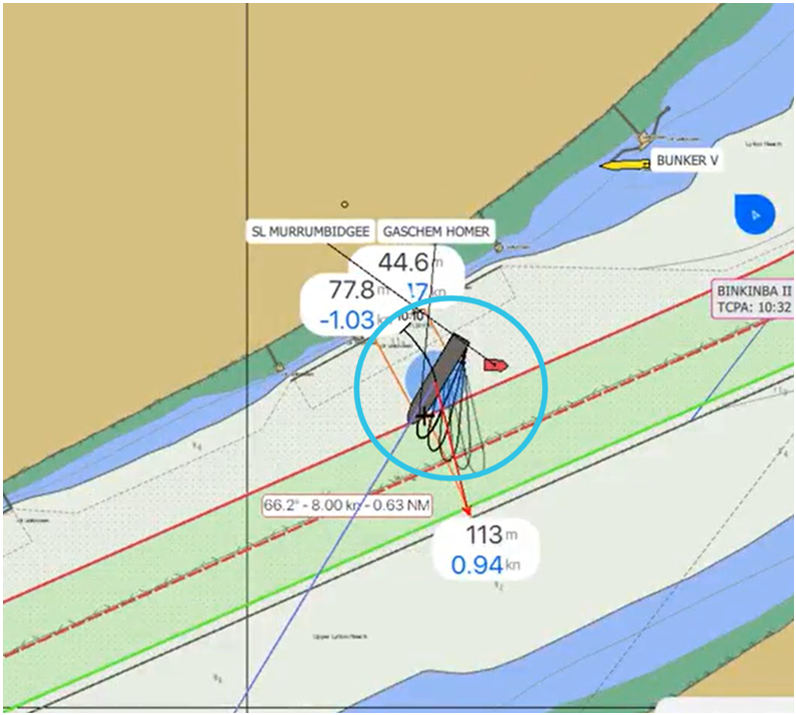
At 1104, while the ship was about one-third of the way through its swing (Figure 3), DG3 tripped on overload. This was immediately followed by a series of secondary power failure alarms for DG1 and DG2. Within 15 seconds, multiple alarms activated both on the bridge and in the ECR, indicating a blackout resulting in a total loss of electrical power, propulsion and steering.
Figure 3: Ship's position at the time of the power failure
Source: Poseidon Sea Pilots, annotated by the ATSB
As soon as the master confirmed the loss of propulsion, the pilot ordered the tug to push up on the port quarter to keep the ship in the centre of the channel. The pilot also advised the master to stand by the anchors. Meanwhile in the ECR, the crew had started the emergency generator, with steering restored. They then restarted DG1 and DG2 and restored power to the MSB. By 1106, the main engine had been restarted.
By the time propulsion was restored, the ship’s swing had been nearly completed, assisted by the tug and river flow. With power now restored, the pilot elected to continue the pilotage. As the cause of the blackout was not known, the pilot retained the tug until the ship had passed the cruise ship terminal near the river mouth. The pilot then radioed Brisbane vessel traffic service (VTS), advising of the blackout and the intention to proceed. Use of the bow thruster was not considered necessary and it remained isolated.
At 1136, after passing the cruise ship terminal, the tug’s line was cast off but retained to escort the ship until clearing the river entrance beacons. The pilotage proceeded without incident with the pilot disembarking off Caloundra at 1454.
Context
Gaschem Homer
Gaschem Homer was a liquefied gas tanker built in 2021 by Nantong CIMC Sinopacific Offshore & Engineering, China. The ship was registered in Liberia and classed with Det Norske Veritas (DNV). At the time of the blackout, it was owned by Sydney Shipping Company (a subsidiary of Hartmann Schiffahrts) and managed by Hartmann Gas Carriers, Germany.
The ship had an overall length of 99.98 m, a moulded breadth of 18 m, and a depth of 11.6 m. At its summer draught of 6.3 m, it had a deadweight of 7,623 tonnes.
Propulsion was provided by a single MAN B&W 5S35ME 2-stroke engine, designed to operate on both marine gas oil and liquid petroleum gas. It delivered 3,240 kW to a controllable pitch propeller, enabling a service speed of 14 knots. The ship was also fitted with an electrically-driven 450 kW bow thruster.
Electrical power for onboard systems was supplied by 3 Caterpillar D13MG-HE medium‑speed diesel generators, each rated at 300 kW, and a shaft generator providing an additional 500 kW.
Gaschem Homer was one of the 3 identical ships chartered to Origin Energy on a long‑term contract, transporting liquid petroleum gas to terminals within the Australia Pacific region. It typically frequented the ports of Westernport, Botany Bay, Brisbane, Gladstone, Cairns, Darwin and Port Moresby.
Crew
At the time of the incident, Gaschem Homer’s crew was comprised of 15 Polish, Filipino, Ukrainian and Latvian nationals.
The master, who held a master’s certificate of competency (CoC), had been with the company for over 19 years and had more than 9 years of experience on gas tankers, including 6 years as master.
The chief engineer possessed a chief engineer CoC and more than 7 years of seagoing experience on gas tankers, over 4 of which were as chief engineer.
The second engineer held a chief engineer CoC and had served over 3 years on gas carriers in the rank of second engineer.
The electro-technical officer (ETO), who held an ETO certificate, had nearly 1 year of seagoing experience on gas tankers and had worked for 2 months in this role.
Pilot
The pilot had worked as a pilot for over 3 years, having trained and qualified as a licensed Brisbane pilot when the pilotage provider (Poseidon Sea Pilots) commenced the provision of pilotage services for the port in January 2022. Prior to joining PSP, the pilot had about 25 years seagoing experience, having worked as a master on various ship types including tankers, ferries, cruise ships, anchor handlers and platform supply vessels.
Electrical distribution system
Main switchboard
Gaschem Homer was equipped with a central main switchboard (MSB), which integrated the ship’s multiple power sources and was capable of operating in manual, semi‑automatic, and fully automatic modes via a power management system (PMS).
The MSB served as the central hub for electrical distribution, ensuring power was supplied to all essential and non-essential systems on board. It included protective devices, synchronising systems, and interlocks to manage generator load sharing, fault isolation and shore power integration. The system included:
- automatic and manual generator control, including start/stop sequencing and load transfer capabilities
- monitoring of busbar voltage and frequency, with automated responses to abnormal conditions, including preferential tripping to disconnect non-essential loads during overloads
- interlocks to prevent concurrent connection of shore power with onboard generators.
The MSB's automatic functions, including generator replacement on fault detection, load shedding, and synchronisation, were designed to maintain continuity of power supply and protect onboard systems.
Any failure in the electrical distribution system, such as an abnormal trip of an air circuit breaker (ACB), failure of automatic synchronisation, or incorrect manual operation, could lead to a loss of power. The MSB's design prioritised manual override capability and system isolation to ensure safety in the event of an automation failure. The system’s multiple layers of protection and redundancy were dependent on proper configuration of control modes and the application of manual override procedures and alarm response protocols.
Power management system
A ship’s PMS is an advanced automation platform that manages and optimises electrical power distribution on board, aiming to enhance stability, efficiency, and safety.
Gaschem Homer’s PMS was a Siemens SIMATIC S7-1200 model programmable logic controller (PLC) system that served as the central automation platform for the ship’s electrical power generation and distribution. The PMS was designed to manage generator operations, load balancing, blackout recovery and protection functions.
A principal component of the system was the synchronising panel (Figure 4), which was critical for ensuring the safe and effective connection of generators to the MSB. The synchronising panel supported both manual and automatic synchronisation, allowing for the alignment of generator voltage, frequency and phase angle with the busbar prior to circuit breaker closure.
Source: Hartmann Gas Carriers, annotated by the ATSB
In manual mode, operators used the synchroscope and synchronising lamps to visually confirm synchronisation. Selector switches and pushbuttons allowed for precise control of excitation and breaker operation. In automatic and semi-automatic modes, the PMS used inputs from the synchronising panel to execute synchronisation logic and issue breaker close commands autonomously.
This automation was essential during blackout recovery, load sharing transitions and generator changeovers. Automatic mode was intended to manage most generator operations, unless there was a fault or issue with the automation functions of the PMS, necessitating manual override by the operator.
The synchronising panel was fully integrated with the system’s human-machine interface (HMI), providing real-time feedback and alarm visibility. The system was designed to inhibit breaker closure unless all synchronisation conditions were satisfied and it would trigger alarms upon synchronisation failure. This layered control and monitoring architecture was intended to enhance operational safety and contribute to continuous power supply during varying load and fault conditions.
A key function of the PMS was blackout recovery. In the event of complete power loss, the system automatically initiated the start-up of standby generators and connected them to the MSB once synchronisation was achieved. The PMS also managed load‑dependent generator start/stop logic, automatically bringing additional generators online when the load exceeded 90% of capacity and withdrawing them when the load dropped below 60% (for 2 generators) or 120% (for 3 generators).
For high-demand operations, such as bow thruster engagement, the PMS included a heavy consumer management function to ensure sufficient surplus power was available before large motor starts were permitted. Furthermore, the PMS continuously monitored busbar voltage and frequency, triggering alarms and corrective actions in the event of operational parameter deviations.
Protective features incorporated into the system included reverse power detection, overload protection and preferential tripping of non-essential loads, enhancing generator integrity and maintaining continuous power supply. Collectively, these functions supported the ship’s operational resilience and mitigated the risk of power-related incidents.
System integration and feedback
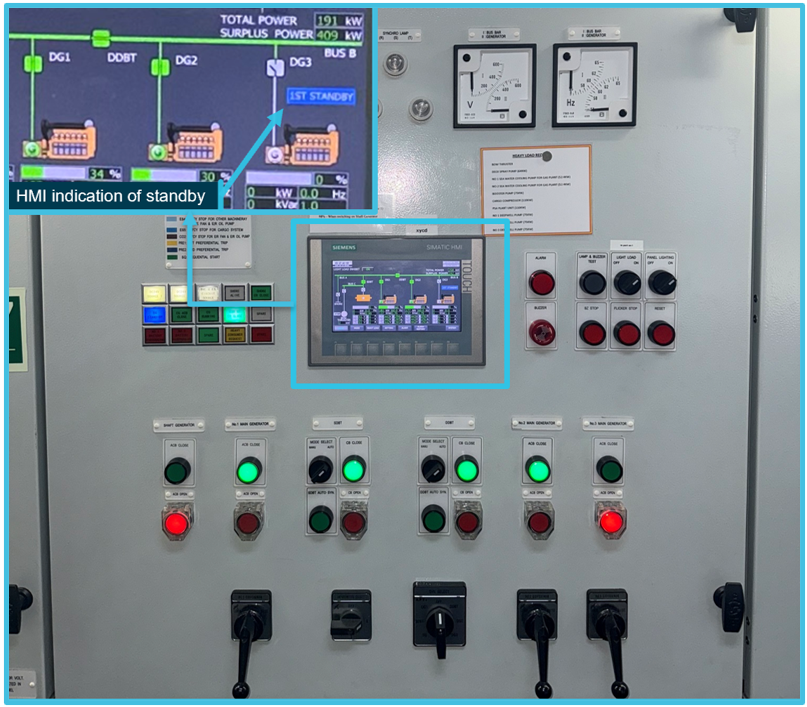
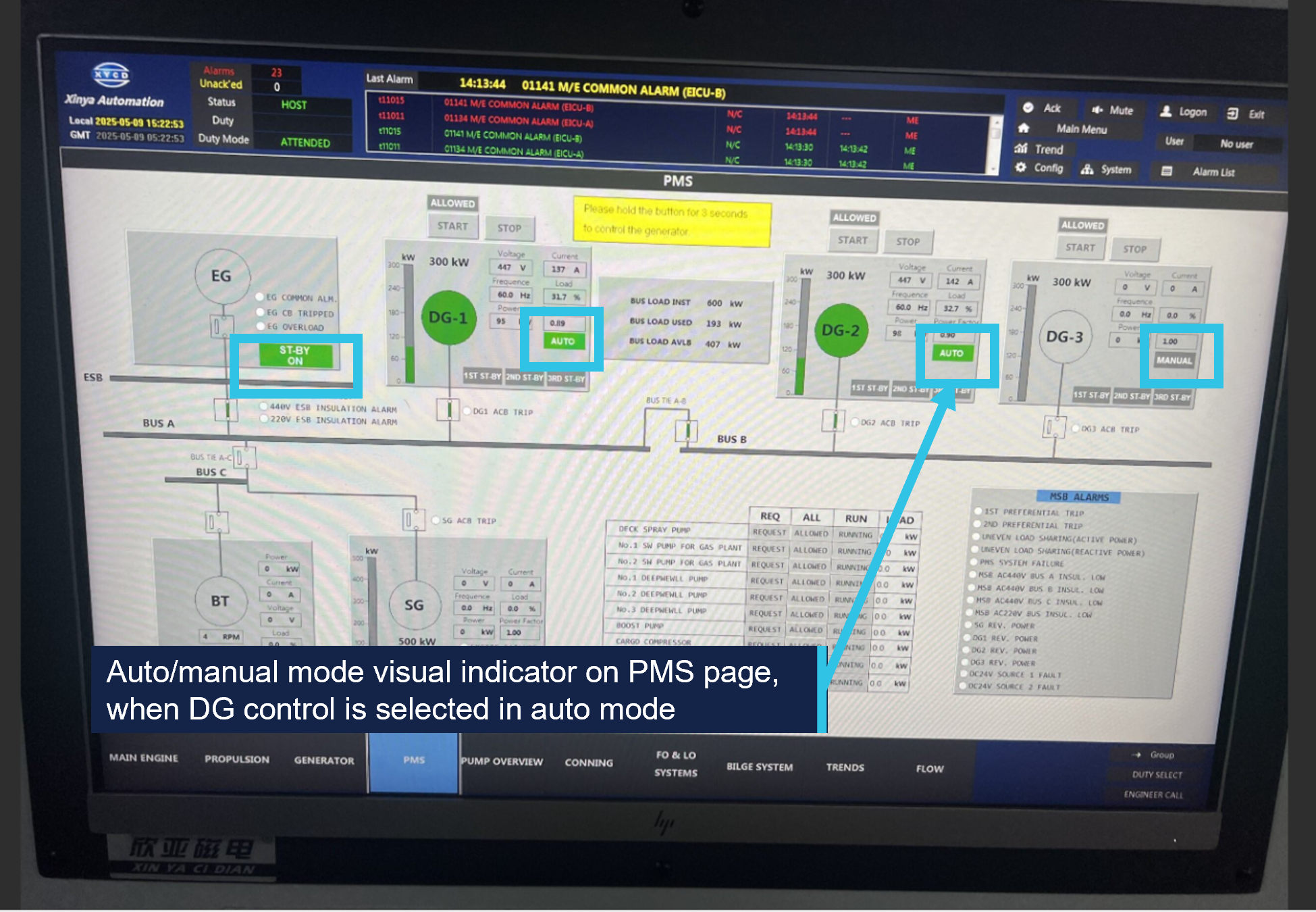
The PMS was configured to display generator status and alarm conditions via a central Siemens KTP700 HMI, integrated into the ship’s machinery and alarm monitoring system. The integration of the HMI with the alarm monitoring system allowed the crew to monitor machinery status in real time from both the engine control room (ECR) and the bridge (Figure 5). The generator interface display featured a line diagram of the electrical system, representing DG1, DG2, DG3, the shaft generator (SG) and associated busbars.
Figure 5: PMS monitoring display
Source: Hartmann Gas Carriers, annotated by the ATSB
A key feature of this integration was the colour-coded mode indication for each generator. When the generator control status was highlighted in green and read ‘AUTO’, the generator was in automatic mode with the PMS autonomously managing generator start/stop, synchronisation, load sharing, and fault recovery. When the status was grey and read ‘MANUAL’, the generator was in manual mode, requiring direct operator control. This visual differentiation enabled the crew to easily determine the operational mode of each generator and respond appropriately during normal or fault conditions. Because the HMI provided monitoring capability for multiple onboard systems, operators were required to manually select the PMS display to view generator status.
Integration of the PMS with the ship’s machinery monitoring and alarm system was designed to support visibility of critical alarms relating to the power supply system. The system was not configured to generate active alerts for generator mode status changes or indicate when generators were in manual mode during high-demand operations, such as bow thruster engagement.
The ship’s operator identified that the blackout was due to DG1 and DG2 not being configured to automatic mode. This prevented the PMS from distributing load across all 3 generators, resulting in DG3 tripping on overload when the bow thruster was operated.
Electrical equipment regulations
The minimum standards for ship construction and equipment, including electrical power installations, machinery and control systems, were prescribed by SOLAS[4] Chapter II-1.[5] Regulations 40 to 44 addressed performance requirements for main and emergency electrical power sources.
These requirements were designed to ensure that a ship’s electrical systems remained reliable and safe, supporting essential functions under both normal and emergency conditions. Key provisions addressed automatic load shedding and the automatic starting of, and switching to, standby generators to safeguard propulsion, steering and other essential services in the event of a generator failure.
Other SOLAS regulations required that ships be designed, constructed and maintained in compliance with the structural, mechanical and electrical requirements of a recognised classification society.
Classification society rules
Classification of a ship verifies the strength, integrity, function and reliability of its structure and systems to maintain essential services on board.[6] This is achieved through the development and application of classification society rules, and by verifying compliance with applicable international and national statutory requirements on behalf of flag State administrations.
Det Norske Veritas (DNV) is an internationally accredited classification society headquartered in Høvik, Norway. The DNV rules for ships[7] set out the technical and procedural requirements used by the society as the basis for ship classification.
Technical requirements and guidance for design, manufacturing and installation of electrical installations on ships, as well as procedures for their operation, were detailed in Part 4, Chapter 8 of the DNV rules.
Generator control, redundancy and load shedding
The DNV rules closely aligned with SOLAS regulations for control, redundancy and load shedding requirements for main sources of electrical power. They provided that generators operating in parallel should be capable of stable load sharing and automatic reconnection following a blackout. For redundancy, the power system was to be arranged such that failure of any one generator did not cause loss of power to essential services. The rules required that in the event of overload or failure of a generator, the system must automatically shed non-essential loads and start a standby generator within 30 to 45 seconds to prevent blackout.
Interlock requirements
The rules stipulated that, if the starting of a motor (such as a bow thruster) required 2 or more generators to operate in parallel, an interlock must be fitted to ensure that the circuit could only be energised when a sufficient number of generators were connected. Alternatively, this requirement could be met by posting operating instructions at the starter panels.
The rationale for this interlock was to prevent hazardous or damaging conditions, such as generator overload or power system failures. By ensuring specific operational criteria were met before a motor was started, the interlock reduced the risk of overloading and tripping the generators.
During the preparations for the Gaschem Homer’s departure, no interlocks acted to prevent the starting of the bow thruster because all 3 generators were operational and connected to the MSB. However, the PMS could not distribute the additional load demand across all 3 generators because DG1 and DG2 were not set to automatic mode. Under these conditions, the interlocks did not prevent generator overload because the actual configuration did not support effective load sharing.
Indication of standby
The rules governing operation of automatic control systems required that when a main source of electrical power was in standby mode, an indication of this status was to be provided on the control panel. The rules did not specify the method by which this indication was to be displayed.
Industry guidance
Blackout prevention
Classification societies frequently publish guidance on a range of operational and safety matters, including blackout prevention. In 2022, DNV published comprehensive guidance[8] on preventing and responding to blackouts. Among other measures, DNV recommended that operators carry out a risk assessment to identify the ship operations for which a blackout would represent a particularly high risk, such as berthing and navigating in high traffic areas. It also recommended that procedures for the identified high-risk ship operations be reviewed to ensure that clear specifications of the required state of machinery and equipment were defined. These specifications were to address:
- the number of generators and propulsion units online or in standby
- auxiliary system configuration (common or separated) and bus-tie status (closed or open)
- crew manning levels across departments and operational stations.
Finally, DNV recommended that clear and straightforward operating procedures improve crew risk awareness and enhance safety during operations where a blackout could have serious consequences. It noted that implementing robust operating procedures and ensuring crews’ risk awareness, in combination with correct maintenance and operation of essential equipment, may have a significant positive impact on ship safety and reliability.
Automated systems
As automation technology becomes more prevalent on ships, several studies have highlighted safety considerations associated with human-machine interaction.
For example, a 2019 Canadian Transport Safety Bureau (TSB) study[9] found that, from 1998 to 2018, 16% of occurrences it investigated involved some form of automated equipment HMI design issue. In 10 cases, ambiguous or inadequate feedback contributed to misinterpretation of system status, delayed crew responses, decreased situational awareness or reduced decision-making effectiveness. Another study[10] found that over‑reliance on automated systems may also foster complacency, causing operators to disengage from active monitoring of system processes.
These studies highlighted a need to consider human factors in the design and operation of shipboard automation to maintain safety and reliability.
Safety management systems
The objective of the SOLAS-mandated International Safety Management (ISM) Code[11] is the prevention of human injury or loss of life and the avoidance of damage to the environment and to property. The ISM Code requires shipping companies to maintain a safety management system (SMS), with instructions and procedures to ensure safe shipboard operations and to prepare for and respond to emergencies. Section 10.3 of the Code provided that:
The Company should establish procedures in its safety management system to identify equipment and technical systems the sudden operational failure of which may result in hazardous situations. The safety management system should provide for specific measures aimed at promoting the reliability of such equipment or systems.
Critical equipment typically includes propulsion, steering and electrical power distribution systems, including generators. Measures to support reliability may include equipment testing, maintenance and engineering controls as well as measures such as crew training and operating procedures intended to serve as barriers to hazardous events.[12] In this context, the SMS should encompass a combination of administrative and technical defences to prevent, control or mitigate risks. Companies are also required to conduct regular audits and reviews of the SMS to ensure its ongoing effectiveness.
Gaschem Homer’s system
To meet its obligations under the ISM Code, Hartmann Gas Carriers maintained a fleetwide SMS. It was intended to provide instructions for key shipboard operations on all company ships and was not specific to Gaschem Homer. It contained a procedure for preparing the engine room for standby condition and a pre-departure checklist, which were both relevant to this incident. At the time of the blackout, the SMS had last been revised in July 2024. Meanwhile, the checklist’s document control information identified it as the first revision in 2020, indicating that it was developed approximately one year prior to the ship’s launch.
The engine room standby procedure included several tasks. It provided for switching on the second generator and second steering pump and changing over to manual steering. The procedure also required that the main engine, steering gear and bow thruster were to be tested and confirmed functional prior to switching to standby condition. The SMS did not contain any specific procedures or guidance for engine room pre-departure preparations other than the pre-departure checklist.
The checklist was a one-page document which listed 26 action items for preparing the main engine and other essential machinery. The items were to be checked as being ‘ready’ or ‘not ready’. A single check covered the ship’s electrical systems, which stated that auxiliary engine generators were to be ‘in operation for sufficient power supply.’
A laminated copy of the checklist was kept in the ECR and reused for each departure after entries for the previous departure had been erased. Before departure on the day of the incident, the second engineer ticked all items as ‘ready’ and signed the form. An entry in the engine room logbook indicated that the checklist was completed at 1100.
Safety analysis
Introduction
At 1100 local time on 15 March 2025, Gaschem Homer was departing its berth in the port of Brisbane under the conduct of a harbour pilot. At 1104, while the ship was being swung to port towards the port's entrance, it experienced an electrical blackout, resulting in the loss of propulsion and steering.
Power management system
Gaschem Homer’s power management system (PMS) was designed to automate processes such as load sharing across the ship’s 3 auxiliary diesel generators (DG1, DG2 and DG3). However, during departure, despite completing the relevant checklist, DG1 and DG2 were incorrectly left in manual mode after being synchronised and connected to the main switchboard (MSB). In this configuration, the PMS was unable to manage automatic load distribution, restricting generating capacity only to DG3. This capacity was insufficient for supporting the anticipated electrical load demand and specifically the operation of the bow thruster.
The PMS featured interlocks intended as a safeguard to prevent bow thruster engagement when available power generation was insufficient. However, because all 3 generators were connected to the MSB, the interlocks were bypassed as the system did not account for the lack of automatic load sharing. As a result, although DG1 and DG2 were operating effectively, they were not available to share the load demand.
The status of each generator’s operating mode could be readily observed by the engine room team via the generator control panels or the PMS interface on the ship’s machinery and alarm monitoring system. However, the team was mainly focused on monitoring the seawater cooling systems due to concerns about potential blockage by debris. In the absence of automated alarms or system warnings for incorrect generator mode selection, their incorrect configuration went undetected.
Consequently, when the bow thruster was engaged during departure, the resultant surge in electrical load was imposed solely upon DG3, leading to its overload and subsequent trip. Without DG1 and DG2 capable of sharing the redistributed load, there was a total loss of power generation, resulting in a blackout and propulsion loss.
Contributing factor Two of the ship’s 3 auxiliary diesel generators were not configured for automatic load sharing. Therefore, the increased power demand when the bow thruster was operated during departure manoeuvring could only be provided by one generator that tripped on overload, resulting in a power blackout and loss of propulsion. |
Risk management
The International Safety Management (ISM) Code required ship operators to establish and maintain a safety management system (SMS) to ensure all operational risks were identified, assessed and effectively controlled. Gaschem Homer’s PMS was specifically designed to prevent hazardous events such as blackouts when it was configured and operated correctly. The effectiveness of this system was therefore dependent on the adequacy of procedures and controls contained within the shipboard SMS.
The ship operator, Hartmann Gas Carriers, had implemented an SMS, which encompassed generic engine room operational procedures across its fleet. As such, the SMS did not take into account specific systems on board Gaschem Homer. Although the SMS contained a general procedure for engine room preparation to standby engines and a pre-departure checklist, these documents contained no process to confirm generator control mode settings.
Industry practice dictates that a procedure should provide sufficient detail as to how a task is carried out, including when and by whom, while a checklist is typically purposed as a memory aid, itemising key actions to ensure nothing is overlooked.[13] In this instance, the pre-departure checklist was purposed as a substitute for a detailed procedure but provided little in the way of specific and usable task descriptions. Consequently, the crew had to rely on memory and experience to complete critical tasks, which increased the likelihood of an oversight.
Further, the ISM Code required operators to systematically identify, evaluate and mitigate risks associated with critical shipboard equipment, which included the implementation and periodic review of both technical and procedural safeguards to guarantee its reliability. The correct operation of the ship’s generators, which was dependent on the PMS, was essential to the ship’s propulsion and steering and, hence, an item of critical equipment. However, comprehensive mitigations, such as tailored, system-specific procedural guidance or integrated system prompts to address the risk of generators remaining in manual mode during critical operations, were not established.
Additionally, the continued use of a generic checklist, unmodified since before the ship’s launch, indicated that the company had not adequately reviewed and verified its SMS controls for operation of the ship’s electrical systems, including the PMS.
Contributing factor The ship’s safety management system did not have adequate controls to manage the risk of a complete power failure due to generators being inadvertently left in manual mode during manoeuvring operations. (Safety issue) |
Findings
ATSB investigation report findings focus on safety factors (that is, events and conditions that increase risk). Safety factors include ‘contributing factors’ and ‘other factors that increased risk’ (that is, factors that did not meet the definition of a contributing factor for this occurrence but were still considered important to include in the report for the purpose of increasing awareness and enhancing safety). In addition ‘other findings’ may be included to provide important information about topics other than safety factors. Safety issues are highlighted in bold to emphasise their importance. A safety issue is a safety factor that (a) can reasonably be regarded as having the potential to adversely affect the safety of future operations, and (b) is a characteristic of an organisation or a system, rather than a characteristic of a specific individual, or characteristic of an operating environment at a specific point in time. These findings should not be read as apportioning blame or liability to any particular organisation or individual. |
From the evidence available, the following findings are made with respect to the loss of propulsion of Gaschem Homer in the port of Brisbane, Queensland, on 15 March 2025.
Contributing factors
- Two of the ship’s 3 auxiliary diesel generators were not configured for automatic load sharing. Therefore, the increased power demand when the bow thruster was operated during departure manoeuvring could only be provided by one generator that tripped on overload, resulting in a power blackout and loss of propulsion.
- The ship’s safety management system did not have adequate controls to manage the risk of a complete power failure due to generators being inadvertently left in manual mode during manoeuvring operations. (Safety issue)
Safety issues and actions
Effectiveness of risk controls
Safety issue number: MO-2025-003-SI-01
Safety issue description: The ship’s safety management system did not have adequate controls to manage the risk of a complete power failure due to generators being inadvertently left in manual mode during manoeuvring operations.
Glossary
| CCTV | Closed circuit television |
| ECR | Engine control room |
| ETO | Electro-technical officer |
| HMI | Human-machine interface |
| IMO | International Maritime Organization (www.imo.org) |
| ISM Code | International Safety Management Code – an international standard for the safe management and operation of ships and for pollution prevention. |
| PMS | Power management system |
| SOLAS | The International Convention for the Safety of Life at Sea, 1974, as amended. |
| SMS | Safety management system |
| VTS | Vessel traffic service. A VTS is any service implemented by a competent authority, designed to maximise the safe and efficient movement of waterborne traffic within the jurisdiction. |
Sources and submissions
Sources of information
The sources of information during the investigation included:
- the master and crew of Gaschem Homer
- Hartmann Gas Carriers
- the marine pilot for departure Brisbane
- Poseidon Sea Pilots
- Australian Maritime Safety Authority.
References
Danish Marine Accident Investigation Board (DMAIB). (2016). Proceduralizing Marine safety – procedures in accident causation.
Det Norske Veritas (DNV). (2022). Managing the risks of blackouts. Available at www.dnv.com.
DNV Rules for Classification – Ships, Part 4 Systems and Components, Chapter 8 Electrical Installations.
International Maritime Organisation (IMO), 1974, The International Convention for the Safety of Life at Sea, 1974, as amended (SOLAS 1974), IMO, London.
Løvmo, S A. (2016). Analysis of potential critical equipment and technical systems on a modern PSV, Faculty of Science and Technology Department of Engineering and Safety Analysis, University of Norway.
Narlis C. (2019). Control and automation systems onboard the vessel: Lessons in human-centred design learned from 20 years of marine occurrences in Canada, Proceedings of the Human Factors and Ergonomics Society Annual Meeting, Canada.
Parasuraman R, Rile V. (1997). Humans and Automation: Use, Misuse, Disuse, Abuse, Human Factors Jun 1997 39(2) 230-253, United States.
SOLAS Chapter II – 1 Reg 43: Ch II-1 Construction – Structure, subdivision and stability, machinery and electrical installations, Part D Electrical installation, Reg. 43 Emergency source of electrical power in cargo ships.
Submissions
Under section 26 of the Transport Safety Investigation Act 2003, the ATSB may provide a draft report, on a confidential basis, to any person whom the ATSB considers appropriate. That section allows a person receiving a draft report to make submissions to the ATSB about the draft report.
A draft of this report was provided to the following directly involved parties:
- the master, chief engineer, second engineer and electro-technical officer of Gaschem Homer
- the pilot at the time of the incident
- the ship’s managers, Hartmann Gas Carriers
- Poseidon Sea Pilots
- Australian Maritime Safety Authority
- the ship’s flag State Administration, Registry of Liberia
- Maritime Safety Queensland.
Submissions were received from:
- Hartmann Gas Carriers
- Poseidon Sea Pilots.
The submissions were reviewed and, where considered appropriate, the text of the report was amended accordingly.
Purpose of safety investigationsThe objective of a safety investigation is to enhance transport safety. This is done through:
It is not a function of the ATSB to apportion blame or provide a means for determining liability. At the same time, an investigation report must include factual material of sufficient weight to support the analysis and findings. At all times the ATSB endeavours to balance the use of material that could imply adverse comment with the need to properly explain what happened, and why, in a fair and unbiased manner. The ATSB does not investigate for the purpose of taking administrative, regulatory or criminal action. About ATSB reportsATSB investigation reports are organised with regard to international standards or instruments, as applicable, and with ATSB procedures and guidelines. Reports must include factual material of sufficient weight to support the analysis and findings. At all times the ATSB endeavours to balance the use of material that could imply adverse comment with the need to properly explain what happened, and why, in a fair and unbiased manner. An explanation of terminology used in ATSB investigation reports is available here. This includes terms such as occurrence, contributing factor, other factor that increased risk, and safety issue. Publishing informationReleased in accordance with section 25 of the Transport Safety Investigation Act 2003 Published by: Australian Transport Safety Bureau © Commonwealth of Australia 2025 
Ownership of intellectual property rights in this publication Unless otherwise noted, copyright (and any other intellectual property rights, if any) in this report publication is owned by the Commonwealth of Australia. Creative Commons licence With the exception of the Commonwealth Coat of Arms, ATSB logo, and photos and graphics in which a third party holds copyright, this report is licensed under a Creative Commons Attribution 4.0 International licence. The CC BY 4.0 licence enables you to distribute, remix, adapt, and build upon our material in any medium or format, so long as attribution is given to the Australian Transport Safety Bureau. Copyright in material obtained from other agencies, private individuals or organisations, belongs to those agencies, individuals or organisations. Where you wish to use their material, you will need to contact them directly. |
[1] Severe Tropical Cyclone Alfred developed off the Australian east coast on 21 February 2025 and made landfall on 8 March, shortly after being downgraded to a tropical low. The weather system brought heavy rainfall and severe flooding to large areas of South East Queensland and northern New South Wales.
[2] Gaschem Homer’s machinery spaces were classified as UMS (Unmanned Machinery Spaces).
[3] Closed circuit television.
[4] International Maritime Organisation (IMO), 1974, The International Convention for the Safety of Life at Sea, 1974, as amended (SOLAS 1974), IMO, London.
[5] SOLAS Chapter II – 1 Reg 43: Ch II-1 Construction – Structure, subdivision and stability, machinery and electrical installations, Part D Electrical installation.
[6] Refer to International Association of Classification Societies (IACS) for additional information.
[7] DNV Rules for Classification – Ships, Part 4 Systems and Components, Chapter 8 Electrical Installations.
[8] Det Norske Veritas (DNV). (2022). Managing the risks of blackouts. Available at www.dnv.com.
[9] Narlis C. (2019). Control and automation systems onboard the vessel: Lessons in human-centred design learned from 20 years of marine occurrences in Canada, Proceedings of the Human Factors and Ergonomics Society Annual Meeting, Canada.
[10] Parasuraman R, Rile V. (1997). Humans and Automation: Use, Misuse, Disuse, Abuse, Human Factors Jun 1997 39(2) 230-253, United States.
[11] International Maritime Organization. (1995). International Management Code for the Safe Operation of Ships and for Pollution Prevention (ISM Code) as amended, IMO, London.
[12] Løvmo, S A. (2016). Analysis of potential critical equipment and technical systems on a modern PSV, Faculty of Science and Technology Department of Engineering and Safety Analysis, University of Norway.
[13] Danish Marine Accident Investigation Board (DMAIB). (2016). Proceduralizing Marine safety – procedures in accident causation.
Occurrence summary
| Investigation number | MO-2025-003 |
|---|---|
| Occurrence date | 15/03/2025 |
| Location | Port of Brisbane |
| State | Queensland |
| Report release date | 19/11/2025 |
| Report status | Final |
| Investigation level | Defined |
| Investigation type | Occurrence Investigation |
| Investigation status | Completed |
| Mode of transport | Marine |
| Marine occurrence category | Machinery failure |
| Occurrence class | Serious Incident |
| Highest injury level | None |
Ship details
| Name | Gaschem Homer |
|---|---|
| IMO number | 9915258 |
| Ship type | Liquified Gas |
| Flag | Liberia |
| Manager | Hartmann Gas Carriers |
| Departure point | Port of Brisbane, Queensland |
| Destination | Port of Westernport, Victoria |