

Final report
Report release date: 20/01/2026
Investigation summary
What happened
At around 1830 on 10 February 2025, a Sharp Airlines Fairchild SA227, registered VH‑UZN, was being prepared for a freight operations flight from Townsville Airport to Brisbane Airport, Queensland, with 2 crew on board.
The captain conducted an undocumented abbreviated external inspection of the aircraft. Around the same time, the first officer removed engine bungs and static port covers, however, could not reach the pitot tube covers located on the nose of the aircraft. This was communicated to the captain, who advised they would remove them, however, the captain subsequently forgot.
During the take-off run, both crew members recognised that the airspeed indicators were rising slower than anticipated, however, by this time, the captain was uncertain if there was sufficient runway remaining to safely stop the aircraft and elected to continue the take-off. During the climb, the first officer identified that the pitot tube covers have been left installed on the pitot tubes, which they announced to the captain. The crew then returned the aircraft to Townsville for an uneventful landing.
What the ATSB found
The ATSB found that due to a combination of a memory lapse and incorrect assumption the pitot tube covers were not removed prior to departure. It was also identified that the operator’s expectation as to what external aircraft inspection was required prior to this flight was not clearly stated in the procedures. In addition, the operator’s expectation that crews would fit pitot tube covers when the aircraft was unattended on the ground for 60 minutes or longer was inconsistent with its written procedures.
Further, the external security check, required to be completed prior to every flight, did not include ensuring the pitot tube covers had been removed.
Finally, the flight crew did not recognise that slow rising airspeed indications was symptomatic of blocked pitot tubes and, as a result, did not reject the take-off.
What has been done as a result
Sharp Airlines advised that it was reviewing the company standard operating procedures to ensure clarity of process for pre-flight inspections.
Safety message
This occurrence highlights the importance of conducting an airspeed check early in the take-off run and recognising that if this is not as expected that the take-off should be rejected. Flight crews should be aware of the typical symptoms associated with a blocked pitot tube, and that the airspeed may slowly increase.
The occurrence also illustrates the importance of procedures clearly stating what inspections are required and when. Flight crew pre-flight inspections are an important risk control. If inspections are not done correctly, it increases the risk of defects not being identified and/or the aircraft not being correctly configured for flight.
The occurrence
Background
This incident occurred on 10 February 2025, however, due to a reported administrative error, the ATSB was not advised until 18 July 2025. The ATSB subsequently commenced an investigation on that day. As the interviews with the flight crew were conducted 5 months after the occurrence, their recollection of the occurrence was degraded.
Pre-flight
At around 1830 local time on 10 February 2025, a Sharp Airlines Fairchild SA227-DC Metro 23, registered VH-UZN, was being prepared for a freight flight from Townsville Airport to Brisbane Airport, Queensland with 2 crew on board.
The operator’s freight flights were usually conducted as a single-pilot operation, however, due to the aircraft’s autopilot being unserviceable, 2 flight crew were required to operate the aircraft. As such, the captain and first officer (FO), who normally conducted regular public transport operations, were relocated to Queensland for one week, to conduct freight operations.
Both crew members signed on for duty that morning at 0100 in Brisbane and signed off at 0818 in Townsville, where they spent the day resting in a hotel room. They re‑commenced the shift shortly after 1800 to operate the Townville to Brisbane sector. All of the flight planning had been completed during the first duty, so the crew reassessed the conditions to ensure nothing had changed. The preparation for the flight, including the inspection of the aircraft, was conducted just prior to last light with no visibility restriction.
It was the captain’s responsibility to conduct or allocate the pre-flight external inspection (see the section titled External inspections). They advised that, as they had flown the aircraft earlier that day, a daily inspection had already been completed, and a crew change inspection (see the section titled Crew change inspection) was not required.
Instead, the captain advised they conducted an abbreviated inspection, which they did not discuss with the FO. The FO advised that they had flown with the captain on a few occasions previously and the captain had always conducted the pre-flight inspection, and they expected this to occur on this day.
Regardless, to assist the captain, as they had done on previous days, the FO commenced some of the pre-flight tasks by removing the engine bungs and static port covers and preparing the aircraft for the aircraft loaders to arrive. They were unable to reach the pitot tube covers on the top of the nose cowl of the aircraft (Figure 1). The FO reported that they normally used a portable step, that was available in the passenger transport aircraft, to remove the pitot tube covers. However, the step was not available in the freight configuration aircraft.
In addition, they could not reach a ladder that was stowed in the rear locker as it had moved to the far side of the locker during flight. They placed the engine bungs and static port covers into a bag that they then placed on the ground beside the forward cargo hold, to remain until the pitot tube covers were removed and also placed in the bag.
Figure 1: Pitot tubes on Fairchild SA227
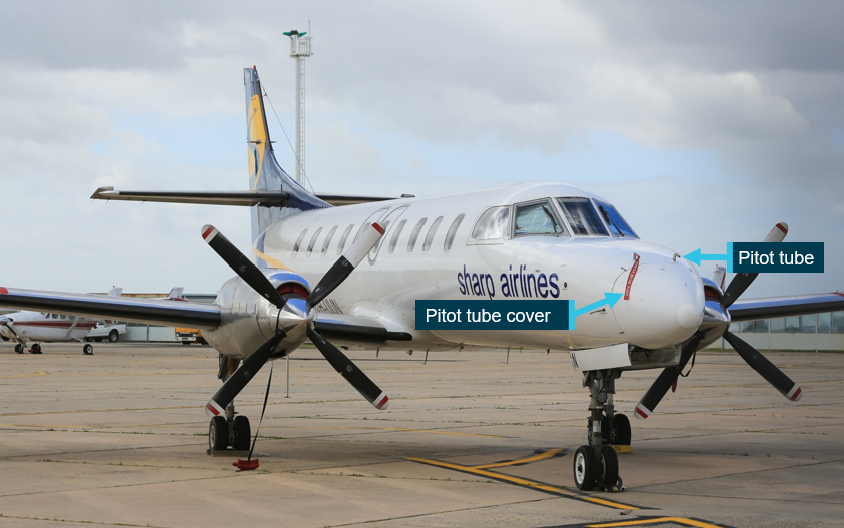
Source: EastWest Aviation, annotated by the ATSB
The captain was inside the aircraft completing pre-flight paperwork when the FO entered the aircraft and advised them that they could not reach the pitot tube covers. The captain acknowledged this and advised they would remove them.
There were delays of around 30 minutes while the crew waited for the aircraft loading to be completed. During this time, it had started raining heavily and became dark. The FO noticed that the bag containing the bungs and static covers was filling with water from the rain. In response, they retrieved the bag and placed it into the forward locker, observing ‘remove before flight’ tags in the bag.
Only aircraft operating at the Brisbane base had static port covers that also had ‘remove before flight’ tags attached, which the FO advised were identical to the tags attached to the pitot tube covers. As such, the FO, seeing the ‘remove before flight’ tags, presumed the captain had removed the pitot tube covers and placed them in the bag.
There were then further delays as the aircraft required reloading, and the captain was required to recalculate the manual trim configuration for the aircraft. The captain later stated feeling frustrated by the loading delays and that they likely felt some self-induced time pressure to depart, to avoid the worst of the incoming weather. They also later advised the operator that due to the heat and humidity, they did not wear the rain jacket provided, which may have influenced them not wanting to be outside the aircraft longer than necessary.
Once loading was complete and the aircraft was ready for departure, in accordance with company procedure, the FO commenced the final external security check (see the section titled External security check) which included a ‘4,3,2,1 check’ (see the section titled 4321 check). This check did not require that they inspect the pitot tubes to ensure the covers had been removed.
As the FO returned to the entry door, the captain stepped outside the aircraft. The FO incorrectly presumed that the captain was going to inspect the aircraft. However, neither crew discussed the external inspection, nor the final 4,3,2,1 check, prior to closing the aircraft’s main door.
Flight
The crew reported that as the aircraft commenced taxiing the heavy rain continued and it was very difficult to see out the front of the aircraft, and they did not detect the pitot tube covers. The crew reported that they completed all the required procedures prior to lining up on the runway including, as part of the ice protection and ignition step, selecting the pitot heat to ON.
During the initial stage of the take-off run, the captain set take-off power and then the FO took control of the aircraft (see the section titled Flight crew responsibilities during take‑off). At this time, the FO checked the airspeed, expecting to see it around 80 kt, but noted that it was fluctuating around 60–70 kt. The FO referenced the left side airspeed indicator, which also appeared to be fluctuating below 80 kts, quickly assessed how much runway was remaining, and called words to the effect of ‘Airspeed. Reject’.
Around the same time, the captain had also observed that their airspeed was indicating lower than they expected, and when the FO made the ‘reject’ call, they looked at the GPS unit which was indicating around 100–110 kt groundspeed. Noting there was minimal wind, the captain believed the GPS unit to be reasonably accurate and felt that the aircraft was ready to rotate.
Taking into consideration the wet runaway and not being sure how much runway was left due to the limited visibility, the captain made the decision to continue the take-off as they considered it was safer rather than risk running off the end of the runway. The captain called words to the effect of, ‘too fast, we’re going’.
During the initial climb, the FO heard a flapping noise coming from the front of the aircraft and identified that the pitot tube covers had been left installed on the pitot tubes, which they announced to the captain.
The FO referenced the GPS for speed to continue the climb and, shortly after, the FO’s airspeed indicator appeared to return to normal operation as it was indicating consistent with the GPS speed.
The crew discussed the situation and decided to return to Townsville Airport. The FO remained pilot flying due to having an operable airspeed indicator, while the captain contacted air traffic control (ATC) requesting a return to Townsville due to a technical problem. ATC provided radar vectors for the return, and the FO landed the aircraft uneventfully at 1958.
Following the post-flight inspection, the operator reported that the captain’s side pitot cover was mostly intact, and heat fused to the pitot tube. The FO’s side pitot cover had disintegrated, and the remnants of the cover had slid down to the rear of the pitot tube such that it did not obstruct normal operation.
Context
Flight crew details
The captain held a Commercial Pilot License (Aeroplane) and a class 1 aviation medical certificate. They had accumulated 3,642 flight hours, including 3,424 on the SA227‑DC.
The first officer (FO) held a Commercial Pilot License (Aeroplane) and a class 1 aviation medical certificate. They had accumulated around 5,000 flight hours, including 854 hours on the SA227-DC.
Analysis was undertaken to determine if fatigue was a factor which contributed to the captain forgetting to remove the pitot covers prior to departure. The time of day, crew work and rest patterns, and indicators of alertness were considered. The analysis concluded that the captain was unlikely to be experiencing fatigue at the time of the occurrence.
Due to the time that had passed between the incident and the crew being interviewed, the FO was unable to accurately recall their rest patterns in the days leading up to the occurrence. However, they advised that they felt rested and fit for duty.
Aircraft information
The Fairchild Swearingen SA227-DC is a low-wing, pressurised, twin-turboprop aircraft, manufactured in the United States in 1996 and issued serial number DC881B. It was registered in Australia as VH-UZN in 2005. The aircraft was fitted with 2 Garrett turbine TPE3311 engines.
The aircraft was fitted with a flight data recorder; however, the data was not downloaded by the operator at the time and had been overwritten when the ATSB was notified of the occurrence.
External inspections
The operator’s Flight crew operating manual (FCOM) stated there were 3 types of external inspections:
- daily inspection (first flight of the day)
- crew change inspection
- post-flight inspection.
In addition, prior to closing the aircraft’s main door, both crew members were required to conduct a final security check, and the FO was required to do a ‘4321 check’.
Daily inspection
The operator’s Operations manual stated that:
A daily inspection is to be carried out as per the instructions in the Flight Crew Operating Manual for the aircraft type by the Pilot-in-Command or if he / she so delegates to, a person with the appropriate authority … on the first flight of the day for that aircraft.
The FCOM stated that the inspection consisted of an internal and external inspection. Further it stipulated (Figure 2) the path that flight crew should take when conducting the daily walk-around inspection. The numbers represent pause points to inspect a particular section of the aircraft, and each were associated with certain check items. One of the items to be checked was the condition of the pitot probes.
Figure 2: Schematic showing pre-flight walk-around path required prior to the first flight of the day

Source: Sharp Airlines flight crew operating manual
Crew change inspection
The crew change inspection was to be conducted whenever crew accepted an aircraft for duty and the aircraft had already flown that day.
The FCOM stated that:
It is not to be confused with a daily inspection. If an aircraft already operated by the crew has been taken offline for maintenance this inspection will be repeated. It consists of a Crew Change External Inspection and a Crew Change Internal Inspection. These inspections are similar to the Daily Inspection but omitting [first flight of the day] FFD items (unless that system had maintenance performed on it) and complete only hash (#) items on the internal component. Certification for the completion of this inspection was not required.
Among other items, the removal of bungs, pitot covers and wing tip flags was required as part of the crew change inspection.
External security check
In addition to the daily inspection (required for the first flight of the day), the FCOM required both crew members to conduct an external security check every flight, immediately prior to the cabin door being closed. This check comprised of the following:
• Check cargo and baggage is secure
• Tail stand (if fitted) is removed, stowed and pin retained
• All hatches, cowls and fuel caps closed
• Rotate the propellors to check for thermal distortion
• Check all ground equipment and the manoeuvring area is clear
4321 check
Prior to the cabin door being closed, the FO was also required to do an extra check, which the operator called a ‘4321 check’, and included:
Whilst standing at the front of the aircraft confirm with the “4,3,2,1 check” the following:
• 4 x doors latched and secure (excluding the main door at this stage)
• 3 x wheel chocks removed
• 2 x engine intakes and area underneath are clear, and 2 x fuel caps secure
• 1 x pogo stick (if fitted) removed.
Whilst this check is the RP [right pilot] responsibility, LP [left pilot] are not absolved from taking due care and diligence in this matter.
Post-flight inspection
The FCOM also set out the requirements for post-flight inspection. This was required to be conducted after each sector, and at the end of a duty period. The FCOM stated that after each sector the flight crew was required to, among other items:
• Ensure engine bungs, pitot covers and tail stand (if applicable) are in place.
An overview of the aircraft was to be conducted, checking the general condition and presence of any fluid (leaks or drips) on the aircraft or the adjacent ground.
Securing the aircraft
In addition to the post-flight inspection, the FCOM stated that on the last flight of the day, or if the aircraft was to be left unattended for greater than 60 minutes, the crew were required to secure the aircraft and conduct a terminating checklist (Figure 3). Securing the aircraft required the crew to:
• Ensure the A/C is parked correctly and in a safe secure area
• Ensure controls are locked (seat belt on last flight only)
• Chock all 3 landing gears.
• Tail stand in place (if fitted).
• Fit Engine Intake and Pitot covers (last flight only).
• Check cargo compartment lights (nose locker and rear) are off.
• Check for any fluid leaks under the A/C.
• Check tyres for wear and condition.
• Check all Beacons/Exterior Lights are serviceable.
• Complete and secure all Company Documentation (as appropriate).
• Complete a review of spare [Aircraft maintenance logs] AML, [Deferred defect list] DDL, [Flight deck log] FDL & ensure a spare book is available.
• Consult the TERMINATING Checklist when carrying out the above actions (Figure 3)
Despite the above list including the item ‘Fit engine intake and pitot covers (last flight only)’, Sharp Airlines later clarified that engine intake and pitot tube covers were expected to be fitted if the aircraft was left unattended for 60 minutes or more.
Figure 3: Sharp Airlines terminating checklist
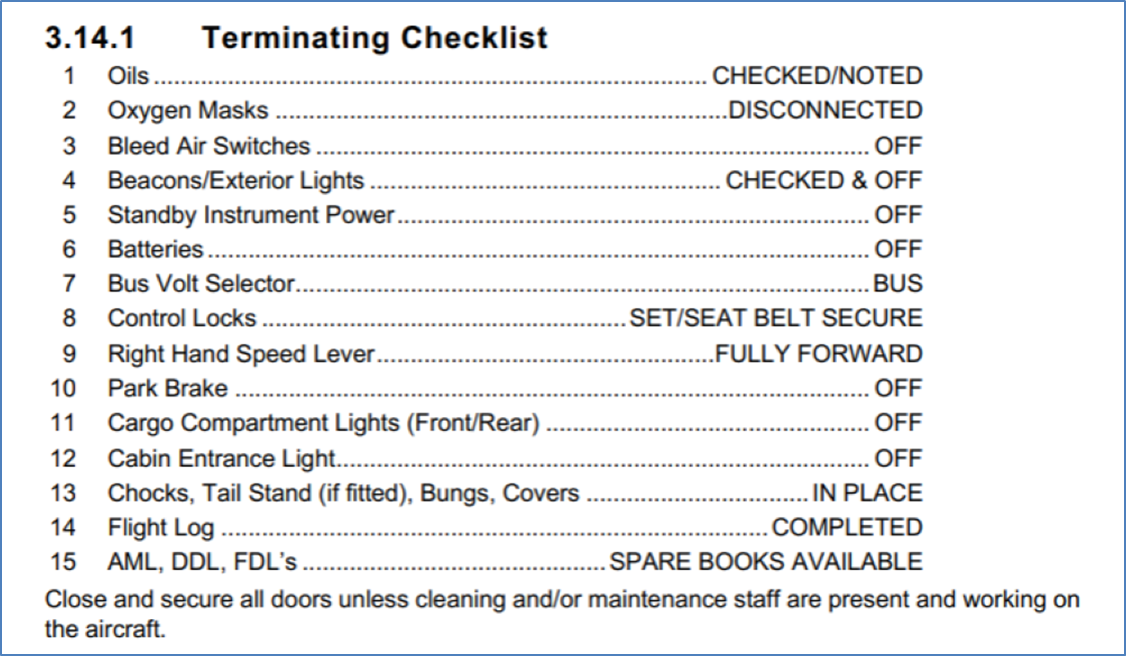
Source: Sharp Airlines flight crew operating manual
Sharp Airlines further advised that, although the first part of the duty was conducted on the same day, it expected that the flight crew should have conducted a full external (preflight) inspection, as a termination check had been completed at the end of the previous flight. However, the procedures did not state what checklist was required in this situation.
Flight crew responsibilities during take‑off
The captain (left pilot (LP)) was responsible for the take-off brief which included stating:
If prior to V1 you see anything that could adversely affect the safety of the flight clearly call “FAILURE” or clearly state “[the condition]”. I will decide whether to continue or reject the take-off by clearly stating either “CONTINUE” or “REJECT”
For a right pilot (FO) take-off the FCOM stated that:
• The LP advances the power levers to approx. 25–40% [torque] TQ whilst holding the aircraft on the brakes (paved surfaces only) and checks the BETA lights are off and calls [continuous alcohol water injection] “CAWI ON” (if CAWI required).
• The LP (Captain) observes the increase in TQ and the AWI pump lights are on (if CAWI required). Sets the power levers at 3% below required TQ calls “HANDING OVER” at approx. 60kts (ensure [nose wheel steering] NWS is released) and then calls “POWER SET” and leaves their hand on top of the power levers until V1.[1]
• RP responds, “TAKING OVER” and his/her hands remain clear of the power levers.
• LP Constantly scans the instruments for an impending failure or abnormality and calls “80kts”.
Sharp Airlines’ policy was that between 80 kt and V1 the take-off would only be rejected if there was an engine failure, a fire or the aircraft was otherwise unsafe or unable to fly.
Pitot static system
Pitot tubes
Pitot tubes are components of the aircraft’s pitot-static system. The Fairchild SA227-DC has 2 pitot tubes, which are attached to the upper cowl of the aircraft’s nose (Figure 1). The pitot tubes point directly into the airflow, measuring the total air pressure. This information and the static pressure, delivered by static ports on the fuselage, are used to compute the aircraft’s indicated airspeed. If the pitot tube is partially or completely blocked, airspeed indications will be inaccurate.
The pitot tubes have a heating system to prevent ice build-up. This is required to be selected ON prior to entering known icing conditions. The weather information from the Bureau of Meteorology for the time of the flight indicated that icing conditions were forecast above 10,000 ft. This required that the pitot heat was selected ON prior to take‑off.
Pitot tube covers
Pitot tube covers provide protection from foreign object obstruction when the aircraft is on the ground. They typically incorporate a ‘remove before flight’ warning tag/streamer (also known as a flag or ribbon) intended to alert relevant personnel of their presence.
Flight data
Take-off and landing data was not retained by the crew or the operator post-incident, however, the operator provided a recreated take-off and landing data (TOLD) card, with V1 calculated to be 114 kts.
The ADS-B flight data available to the ATSB had limited data points and parameters. During the take-off run, the recorded data periodicity was approximately 20 seconds, and this restricted an accurate estimation of the take-off location and groundspeed of the aircraft.
This data was compared to historical recorded flight data of 19 take-offs of another SA227-DC aircraft from Townsville Airport runway 01. Comparing the pitch attitude and indicated airspeed parameters in the historical data against the available ADS-B parameters for the flight, the ATSB was able to identify an approximate rotation location on runway 01 during the incident flight (Figure 4).
Figure 4: Estimated rotation location VH-UZN from historical flight analysis

Source: Google Earth using ADS-B exchange data, annotated by the ATSB
The ATSB estimated that the rotation speed (VR)[2] of VH-UZN, based on historical flights, was likely in the lower range of values between 112–130 kt.
Related occurrences
The ATSB has investigated several occurrences where ground use equipment has been left on aircraft due to inadequate flight crew inspections and/or inadequate operator guidance.
Airspeed indication failure on take-off involving Airbus A330 (AO-2018-053)
On 18 July 2018, a Malaysia Airlines Airbus A330, took off on a regular public transport flight from Brisbane, Queensland, to Kuala Lumpur, Malaysia. As the covers had been left on the aircraft’s 3 pitot probes, the instruments showed a red speed flag in place of the airspeed indication from early in the take-off, and unrealistically low airspeeds afterwards. The flight crew did not respond to the speed flags until the aircraft’s speed was too high for a safe rejection of the take-off, and the take-off was continued.
Aircraft preparation event involving Link Airways Saab 340 (AO-2022-055)
A propeller strap became embedded in a Link Airways Saab 340B regional airliner’s cabin on take-off from Canberra in November 2022. The ATSB’s investigation found that several factors contributed to the propeller strap not being noticed or removed by the first officer, captain, or dispatcher, prior to departure, including that the guidance provided by Link Airways for training of Swissport dispatchers did not explain the appearance, function and importance of the propeller strap.
Aircraft preparation event involving Saab 340B (AO-2022-058)
On 16 November 2022, a Regional Express (Rex) Saab 340B, was prepared for a scheduled air transport flight from Cairns Airport to Bamaga, Queensland. As the crew taxied the aircraft to the runway, an engineer on a nearby parking bay noticed something hanging from the aircraft and contacted the tower. The crew returned the aircraft to the bay. Aircraft parked overnight at Cairns were required to be fitted with an operator designed bung installed in the horizontal stabiliser trim actuator cove to prevent bird nesting. The inspection revealed the horizontal stabiliser bungs had not been removed and were still installed in the left trim actuator cove.
Aircraft preparation event involving a Hawker Beechcraft Corporation B200 (AB-2024-025)
On 8 May 2024, a Hawker Beechcraft B200 was being prepared for an air transport flight at Darwin Airport. Prior to departure, the pilot completed the preflight inspection, confirmed that both red flags were in their possession, and secured these items along with the propeller covers inside the aircraft. However, the pilot did not detect that the flag for the right-side cover had detached from the cover, nor that the cover was still attached to the pitot tube.
During the take-off, the pilot detected a speed discrepancy on their cockpit instrumentation. They continued the climb to 3,000 ft before returning via a visual approach to Darwin Airport.
During the post-flight inspection, the pilot identified that the right-side pitot cover was still in place, covering the pitot tube.
Aircraft preparation event involving Saab 340B (AO-2024-059)
On 19 November 2024, the aircraft was prepared for departure from Melbourne Airport. After the pilots started the engines, a passenger told the flight attendant they had seen a strap restraining the left propeller before it began to spin. The propeller strap was then found attached to the propeller, with the pins that connect it to the engine cowling broken on start‑up.
The report noted the final external walkaround check of the aircraft required the first officer to remove the propeller strap from the propeller, before rotating the propeller to a required position. However, the first officer inadvertently left the propeller strap attached, instead only disconnecting and removing the strap extension, which connected the propeller strap to the aircraft stairs to prevent them from being retracted while the strap is in place.
Once the first officer was in the flight deck, the ground handler assigned to the dispatch, who was a trainee, did not detect the propeller strap from their position at the nose of the aircraft, and provided the crew with a signal to start the engine.
Meanwhile, the pilots conducted the engine start checklist, which included a requirement for the captain to check that the left engine was clear. The captain also did not detect the propeller strap and proceeded to start the engine.
Safety analysis
A Sharp Airlines Fairchild SA227 departed Townsville Airport with pitot tube covers fitted. This analysis will discuss the pre-flight actions of the flight crew regarding the pitot tube covers and consider the operator’s procedures for pre-flight inspections. It will further examine the crew’s decision to take-off with unreliable airspeed.
Pre-flight inspection
The captain considered that the daily inspection had already been completed in the early hours of the morning on the previous sector, and therefore, it was not required to be completed prior to this flight. They also did not consider that a crew change external inspection was required. Consequently, they reportedly conducted an abbreviated walk‑around inspection prior to the incident flight but did not reference any aircraft or operator checklist.
The first officer (FO) assisted the captain by removing the engine bungs and static port covers. However, they were unable to reach the pitot covers on the nose of the aircraft and asked the captain to remove them. The captain advised that they would do so, but subsequently forgot. Additionally, the FO did not confirm with the captain that the pitot covers had been removed, likely due to seeing ‘remove before flight’ tags in the bag and incorrectly assuming those were attached to the pitot covers.
There was no further discussion between the captain and the FO regarding the external aircraft inspection, and the pitot covers were not removed prior to departure.
Contributing factor Due to the combination of a memory lapse and incorrect assumption, the aircraft’s pitot covers were not removed prior to departure. |
Operator’s guidance
The operator’s Flight crew operating manual (FCOM) required flight crews to secure the aircraft and conduct a terminating check if the aircraft was to be unattended for more than 60 minutes. While it was the operator’s expectation that a full daily inspection of the aircraft was required once a termination check had been completed; the procedures did not clearly state this, and it did not occur on this occasion.
The operator did have an abbreviated checklist, the crew change checklist, and it is possible some flight crew were conducting this checklist on returning to the aircraft after completing the terminating check, however, the procedures also did not specify that this was required.
In addition, the operator also expected that engine bungs and pitot covers would be fitted when the aircraft was on the ground for periods over 60 minutes; however, the procedure (securing the aircraft) specifically stated that they should be fitted only after the last flight. This created the potential for confusion among flight crew as to when they should be fitted.
Further, while the final ‘4321’ visual check was designed for quick turnarounds, it required that the engine intakes were checked, and although engine bungs were only required to be installed when the pitot tube covers were installed, it did not require that the pitot tube covers were checked.
Contributing factor Sharp Airlines’ Flight crew operating manual required that:
In addition, the final visual check, completed by the first officer prior to closing the doors, did not include checking that pitot covers had been removed. (Safety issue) |
Poor visibility
It is likely that due to the night‑time conditions and heavy rain, neither flight crew detected the pitot covers in place, as they would have during the day, while taxiing the aircraft.
Similarly, there was no opportunity for air traffic control, other pilots or ground staff to visually observe the pitot tube covers in place. As such, the pitot tube covers remained in place undetected.
Contributing factor Likely due to poor visibility, the flight crew did not detect the pitot tube covers were still in place prior to commencing the take-off. |
Airspeed indications during take-off
The captain's decision to take off once the crew recognised that the airspeed was unreliable was understandable in the circumstances, and probably at, or close to V1. However, there was opportunity for the crew to have recognised earlier in the take-off run that the airspeed indicators were not functioning correctly, as the speeds were slowly increasing. Continuation of the take-off was likely due in part to neither crew realising that airspeed could still increase with pitot covers on.
Contributing factor During the take-off run, the crew did not detect that the airspeed indicators were not indicating correctly, likely due to observing that they were slowly increasing, resulting in the crew not rejecting the take-off. |
Findings
ATSB investigation report findings focus on safety factors (that is, events and conditions that increase risk). Safety factors include ‘contributing factors’ and ‘other factors that increased risk’ (that is, factors that did not meet the definition of a contributing factor for this occurrence but were still considered important to include in the report for the purpose of increasing awareness and enhancing safety). In addition ‘other findings’ may be included to provide important information about topics other than safety factors. Safety issues are highlighted in bold to emphasise their importance. A safety issue is a safety factor that (a) can reasonably be regarded as having the potential to adversely affect the safety of future operations, and (b) is a characteristic of an organisation or a system, rather than a characteristic of a specific individual, or characteristic of an operating environment at a specific point in time. These findings should not be read as apportioning blame or liability to any particular organisation or individual. |
From the evidence available, the following findings are made with respect to the unreliable airspeed indications on 10 February 2025:
Contributing factors
- Due to the combination of a memory lapse and incorrect assumption, the aircraft’s pitot covers were not removed prior to departure.
- Sharp Airlines’ Flight crew operating manual required that:
- a terminating check be completed if the aircraft was unattended for more than 60 minutes, but did not specify what checks were to be completed on return to the aircraft
- pitot covers should be installed after the last flight of the day only, where the operator required that they be installed if the aircraft was unattended for longer than 60 minutes.
In addition, the final visual check, completed by the first officer prior to closing the doors, did not include checking that pitot covers had been removed. (Safety issue)
- Likely due to poor visibility, the flight crew did not detect the pitot tube covers were still in place prior to commencing the take-off.
- During the take-off run, the crew did not detect that the airspeed indicators were not indicating correctly, likely due to observing that they were slowly increasing, resulting in the crew not rejecting the take-off.
Safety issues and actions
Final pre-flight external inspection
Safety issue number: AO-2025-041-SI-01
Safety issue description: Sharp Airlines’ Flight crew operating manual required that:
- a terminating check be completed if the aircraft was unattended for more than 60 minutes, but did not specify what checks were to be completed on return to the aircraft
- pitot covers should be installed after the last flight of the day only, where the operator required that they be installed if the aircraft was unattended for longer than 60 minutes.
In addition, the final visual check, completed by the first officer prior to closing the doors, did not include checking that pitot covers had been removed.
Glossary
| ATC | Air traffic control |
| FO | First officer |
| FCOM | Flight crew operating manual |
| GPS | Global positioning system |
| TOLD | Take off and landing data |
| V1 | The critical engine failure speed or decision speed required for take-off. Engine failure below V1 should result in a rejected take off; above this speed the take-off should be continued. In this aircraft, V1 and VR are the same value. |
| VR | The speed at which the rotation of the aircraft is initiated to take-off attitude. |
Sources and submissions
Sources of information
The sources of information during the investigation included the:
- flight crew of the incident flight and another pilot who conducted flights for the operator
- Sharp Airlines
- ADS-B data.
References
- Sharp Airlines, Metro 3/23 Flight Crew Operating Manual, Issue 09, Revision 2, 24 June 2024
- Sharp Airlines, Operations Manual, Section A6 – Flight Conduct, Revision 22, 24 June 2024.
Submissions
Under section 26 of the Transport Safety Investigation Act 2003, the ATSB may provide a draft report, on a confidential basis, to any person whom the ATSB considers appropriate. That section allows a person receiving a draft report to make submissions to the ATSB about the draft report.
A draft of this report was provided to the following directly involved parties:
- flight crew of incident flight
- Sharp Airlines
- Civil Aviation Safety Authority.
Purpose of safety investigationsThe objective of a safety investigation is to enhance transport safety. This is done through:
It is not a function of the ATSB to apportion blame or provide a means for determining liability. At the same time, an investigation report must include factual material of sufficient weight to support the analysis and findings. At all times the ATSB endeavours to balance the use of material that could imply adverse comment with the need to properly explain what happened, and why, in a fair and unbiased manner. The ATSB does not investigate for the purpose of taking administrative, regulatory or criminal action. About ATSB reportsATSB investigation reports are organised with regard to international standards or instruments, as applicable, and with ATSB procedures and guidelines. Reports must include factual material of sufficient weight to support the analysis and findings. At all times the ATSB endeavours to balance the use of material that could imply adverse comment with the need to properly explain what happened, and why, in a fair and unbiased manner. An explanation of terminology used in ATSB investigation reports is available here. This includes terms such as occurrence, contributing factor, other factor that increased risk, and safety issue. Publishing informationReleased in accordance with section 25 of the Transport Safety Investigation Act 2003 Published by: Australian Transport Safety Bureau © Commonwealth of Australia 2026 
Ownership of intellectual property rights in this publication Unless otherwise noted, copyright (and any other intellectual property rights, if any) in this report publication is owned by the Commonwealth of Australia. Creative Commons licence With the exception of the Commonwealth Coat of Arms, ATSB logo, and photos and graphics in which a third party holds copyright, this report is licensed under a Creative Commons Attribution 4.0 International licence. The CC BY 4.0 licence enables you to distribute, remix, adapt, and build upon our material in any medium or format, so long as attribution is given to the Australian Transport Safety Bureau. Copyright in material obtained from other agencies, private individuals or organisations, belongs to those agencies, individuals or organisations. Where you wish to use their material, you will need to contact them directly. |
[1] V1: the critical engine failure speed or decision speed required for take-off. Engine failure below V1 should result in a rejected take off; above this speed the take-off should be continued. In this aircraft, V1 and VR are the same value.
[2] VR: the speed at which the rotation of the aircraft is initiated to take-off attitude.
Occurrence summary
| Investigation number | AO-2025-041 |
|---|---|
| Occurrence date | 10/02/2025 |
| Location | Townsville Airport |
| State | Queensland |
| Report release date | 20/01/2026 |
| Report status | Final |
| Investigation level | Defined |
| Investigation type | Occurrence Investigation |
| Investigation status | Completed |
| Mode of transport | Aviation |
| Aviation occurrence category | Aircraft preparation, Avionics/flight instruments, Diversion/return |
| Occurrence class | Serious Incident |
| Highest injury level | None |
Aircraft details
| Manufacturer | Fairchild Industries Inc |
|---|---|
| Model | SA227-DC |
| Registration | VH-UZN |
| Serial number | DC881B |
| Aircraft operator | Sharp Airlines |
| Sector | Turboprop |
| Operation type | Part 135 Air transport operations - smaller aeroplanes |
| Departure point | Townsville Airport, Queensland |
| Destination | Brisbane Airport, Queensland |
| Damage | Nil |