

Final report
Report release date: 26/08/2025
Investigation summary
What happened
On 12 February 2025, Alliance Airlines Embraer E190, VH-UYO, was operating Qantas flight QF1888 from Cairns, Queensland to Darwin, Northern Territory. At 1634 local time, passing the initial approach fix for the instrument landing system (ILS) approach to Darwin Airport’s runway 29, the auto‑flight system approach mode unexpectedly disarmed and reverted to basic flight director modes. The aircraft then deviated right and then left of the ILS course, before intercepting the lateral course at about the final approach fix.
Passing 1,000 ft above aerodrome elevation, the aircraft was above the glideslope, at a high rate of descent and high airspeed. The flight crew elected to continue the approach, as the aircraft was then in visual meteorological conditions. Passing 500 ft, the flight crew assessed that the aircraft was stabilised, although still too fast. The pilot monitoring subsequently identified that the flaps were not in the landing configuration and selected the correct position. The flight crew continued the approach and conducted an uneventful landing.
What the ATSB found
The ATSB found that on crossing the initial approach fix for the ILS approach, due either to a system synchronisation issue or the pilot flying inadvertently disarming the approach mode, the aircraft’s auto‑flight system reverted to roll and flight path angle modes.
Following the unexpected mode change, the pilot flying did not reengage approach mode or disconnect the autopilot. This likely contributed to the aircraft deviating outside the required lateral tolerance of the approach below the minimum safe altitude while in instrument meteorological conditions.
Additionally, the ATSB found that the flight crew did not discontinue the approach when the aircraft was unstable at the 1,000 ft stabilisation height as they incorrectly assessed that they could continue to 500 ft in visual meteorological conditions with multiple stabilised approach criteria unmet.
In the limited time available to stabilise the aircraft by 500 ft, the flight crew incorrectly assessed that the aircraft was stable and continued the approach, unaware that the pilot monitoring had inadvertently selected an incorrect flap configuration.
Finally, the ATSB found that Alliance Airlines' standard operating procedures were unclear about the criteria for continuing an unstable instrument approach to 500 ft when aircraft entered visual conditions.
What has been done as a result
Following this incident, Alliance Airlines issued an operations notice ‘to improve clarity and compliance’ with the stabilised approach criteria. The notice detailed the stabilised approach policy. It also amended the stabilisation height such that for 3‑dimensional and 2‑dimensional instrument approaches, and straight‑in visual approaches, the stabilised criteria were to be met by 1,000 ft above aerodrome elevation. The 500 ft stabilisation height applied only to a visual circuit or circling manoeuvre approaches. The notice reminded flight crew of Alliance’s ‘non punitive go‑around policy’ and required all unstable approaches to be reported. Finally, Alliance Airlines conducted a flight data review of unstable approaches over the previous 6 months operations to identify similar occurrences.
Safety message
The Flight Safety Foundation’s (FSF) Reducing the risk of runway excursions report found that, in the 16 years to 2009, the most common accident was a runway excursion, accounting for 33% of all aircraft accidents. The highest risk factor for runway excursions was identified as an unstable approach. Further, an FSF survey (Normalization of Deviance) identified that only 3–4% of approaches were unstable but that in over 97% of those, the flight crews did not conduct a go-around. It stated:
Noncompliance with standard operating procedures (SOPs) — especially tolerance of unstabilized approaches — is a serious impediment to further reduction of accident risk.
Guidance from the International Air Transport Association for preventing unstable approaches stated that pilots must be trained to understand the risks of an unstable approach, because an unstable approach can be completed successfully, which may reinforce bad practice.
Additionally, this incident highlights how important continuous attention to automatic flight system modes displayed on the primary flight display is to the maintenance of situation awareness.
This incident also illustrates the need for effective flight crew monitoring. The Flight Safety Foundation identified that monitoring can be improved by standard operating procedures, increased emphasis and practice, and stated:
One of the most important aspects of a safe flight operation is the requirement for crewmembers to carefully monitor the aircraft’s flight path and systems, as well as actively cross-check each other’s actions.
The investigation
| The ATSB scopes its investigations based on many factors, including the level of safety benefit likely to be obtained from an investigation and the associated resources required. For this occurrence, the ATSB conducted a limited-scope investigation in order to produce a short investigation report, and allow for greater industry awareness of findings that affect safety and potential learning opportunities. |
The occurrence
On the afternoon of 12 February 2025, Alliance Airlines (Alliance) Embraer ERJ 190‑100 IGW (E190), registered VH‑UYO, was operating Qantas flight QF1888 from Cairns, Queensland to Darwin, Northern Territory. On board were 2 flight crew, 2 cabin crew and 49 passengers. The captain was the pilot flying (PF), and the first officer was the pilot monitoring (PM).[1]
After departing Cairns, the aircraft climbed to cruise at flight level (FL) 340.[2] En route the flight crew obtained air traffic control (ATC) clearances, first to deviate up to 30 NM (56 km) left, and later up to 50 NM (93 km) right of the planned route to avoid hazardous weather. At 1614 Darwin local time the flight crew received clearance to descend to FL 120. Just over 2 minutes later they requested a further clearance to deviate up to 60 NM (111 km) right to avoid weather.
At 1619 the flight crew requested, and received, a clearance to deviate up to 70 NM (130 km) right of route and to track direct to waypoint LAPAR, once clear of the weather. About 2 minutes later, descending through FL 190, the aircraft turned left from a position about 30 NM (56 km) right of the planned route, to track 60 NM (111 km) direct to LAPAR (Figure 1).
Figure 1: VH-UYO recorded flight data showing weather diversion and tracking to LAPAR
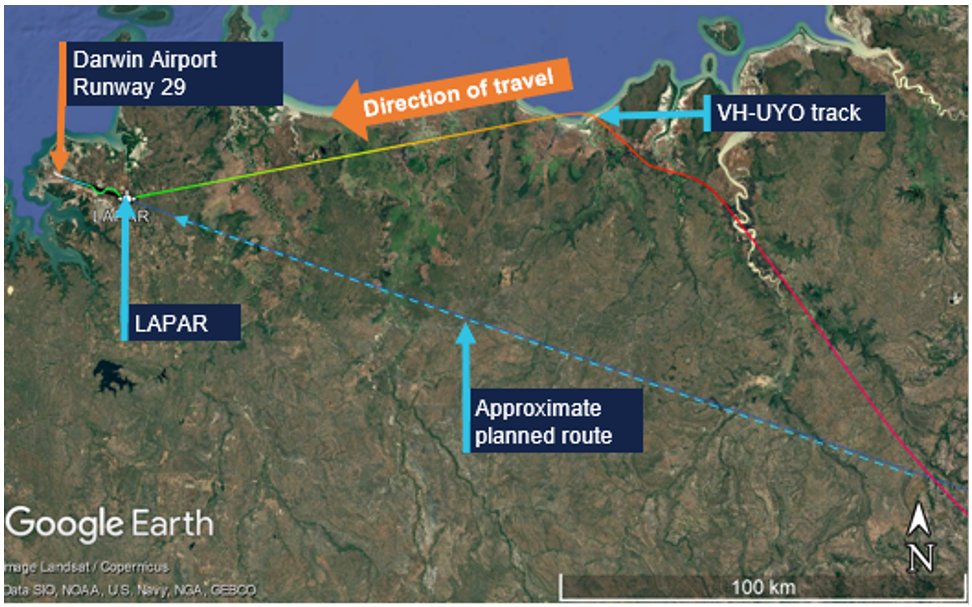
Source: Google Earth overlaid with FlightRadar24 data, annotated by the ATSB
At 1622 the PM contacted Darwin Approach ATC, advised they were descending to FL 120, had received automatic terminal information service (ATIS) X‑ray (X), and were tracking direct to LAPAR. ATIS X included advice of:
- the expectation of an instrument approach
- wet runways
- wind from 340° at 15 kt, with a maximum 15 kt crosswind on runway 29
- visibility of 2,000 m
- showers of rain
- scattered[3] cloud 1,200 ft above aerodrome elevation.
The PM advised the approach controller when the aircraft was approaching FL 120, and received further clearance to descend to 9,000 ft and, 2 minutes later, to 7,000 ft. At 1629, as the aircraft descended through about 8,000 ft, the controller requested a reduction to ‘minimum clean speed’, as by radar VH‑UYO was showing a groundspeed of 270 kt, which exceeded the 250 kt maximum indicated airspeed below 10,000 ft. Although the aircraft’s airspeed at that time was 250 kt, the flight crew actioned the request to reduce speed, advised that they were approaching 7,000 ft, and were then cleared to descend to 5,000 ft.
At 1631, the approach controller cleared the flight crew to descend to 3,000 ft and conduct the instrument landing system (ILS)[4] -Z approach to runway 29. LAPAR was the initial approach fix[5] for the ILS and was aligned with the runway centreline (Figure 2).
Figure 2: VH-UYO flight path (green/blue) and ILS‑Z localiser path (black) showing key events (blue arrows)
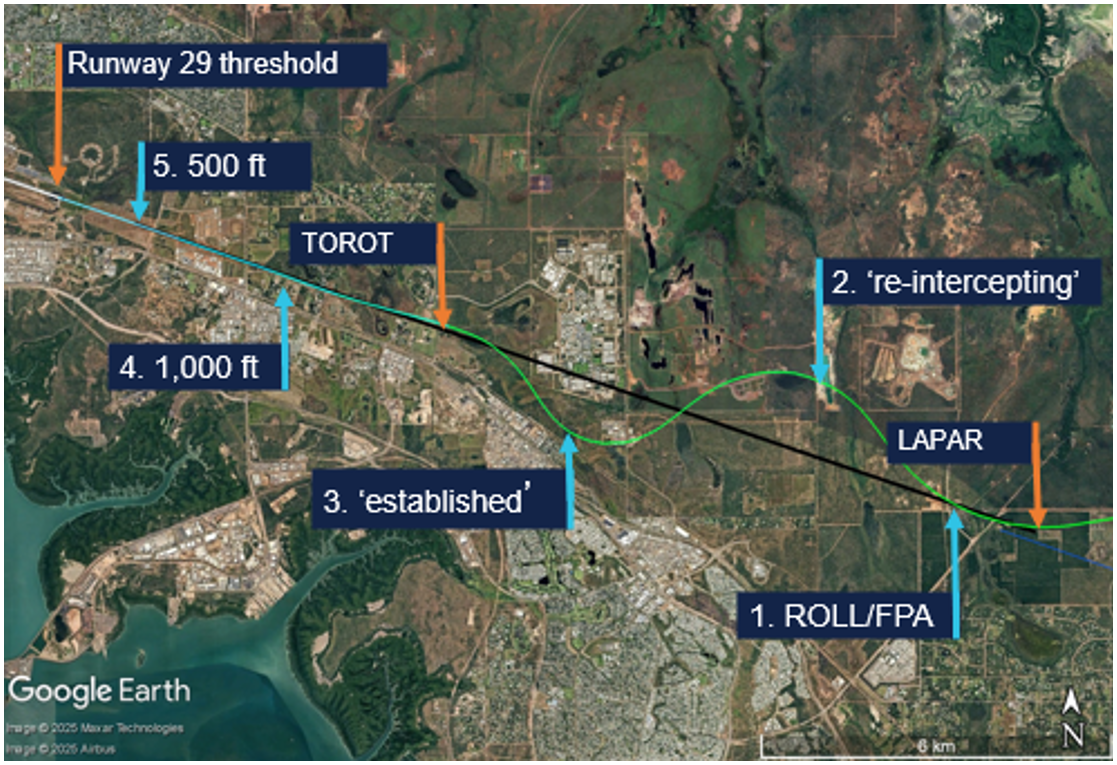
Source: FlightRadar24 data overlaid on Google Earth, annotated by the ATSB
The PM selected flap 1 as the aircraft descended through about 4,600 ft. About 30 seconds later, the approach controller instructed the PM to contact the tower controller when leaving 3,000 ft. In preparation for the ILS, the PF then pressed the approach (APP) pushbutton on the aircraft’s guidance panel, arming the approach mode. This also armed flight director (FD) localiser (LOC) lateral and glideslope (GS) vertical modes. With approach mode armed, when the aircraft intercepted the localiser (at LAPAR), LOC should become the active lateral mode and when it subsequently intercepted the glideslope, GS should become the active vertical mode.
As LAPAR was a ‘fly-by’ (rather than a ‘flyover’) waypoint, the aircraft’s flight guidance and control system (FGCS) pre‑empted the turn and passed by LAPAR at 1634:51, at 183 kt airspeed and at the selected altitude of 3,000 ft. The selected altitude was then wound down to 2,200 ft and 2 seconds later, the FGCS captured the localiser and the recorded flight data showed LOC and flight path angle (FPA) modes became active. One second later, the lateral mode reverted to the basic FD ROLL mode (Figure 2 No 1 and Figure 3).
Figure 3: Flight mode annunciation display showing localiser (LOC) capture followed by reversion to basic modes (ROLL/FPA)

Recorded flight data showed LOC mode became active and then disarmed within 1 second. The active mode was recorded every second, but the armed mode was recorded every 2 seconds. Hence at 1634:56, the recorded data showed LOC as both the armed and active mode. Source: Embraer animation of recorded flight data, annotated by the ATSB
The FO recalled being very surprised seeing the ROLL/FPA modes. In those modes, the aircraft captured and maintained the roll angle and flight path angle it was in at the time of activation. At that time, the aircraft was:
- aligned with the localiser
- at a flight path angle of approximately 0°
- half a dot above the glideslope
- banked 20° right.
After intercepting the localiser, the ILS frequency became the active navigation source for the aircraft’s primary flight display (PFD), for the remainder of the flight. As such, lateral deviation from the localiser and vertical deviation from the 3° glideslope would be depicted on the PFD with 2 dots in each direction (left‑right/up‑down), with 2.5 dots representing full‑scale (or greater) deviation. Localiser deviation was also depicted by a course deviation indicator (CDI) and dots either side of the course on the compass instrument on the lower part of the PFD (Figure 4).
Figure 4: Compass instrument course deviation indicator aligned with the localiser at 1634:56

Source: Embraer animation of recorded flight data, annotated by the ATSB
Following activation of the ROLL/FPA modes, the aircraft deviated right of the localiser, maintaining approximately 20° roll for about 20 seconds, as it descended. After 14 seconds, the PM selected the landing gear down and the PF moved the heading bug and selected heading (HDG) mode to command the aircraft to turn left towards the localiser.
The CDI exceeded half scale deflection (1.5 deviation dots) at 1635:16. The aircraft was then outside the lateral flight tolerance for the ILS and below the 10 NM minimum safe altitude of 3,000 ft.
At 1635:30, the PM contacted the Darwin aerodrome (tower) controller and advised that they were ‘just slightly right of the localiser and re‑intercepting’ (Figure 2 No 2). The controller responded with the instruction to ‘maintain 2,000 [ft] until glidepath interception’. The PM read back ‘maintain 2,000’, but not ‘until glidepath interception’. The controller then stated: ‘once you’ve intercepted the glidepath, cleared the ILS’. The PM did not respond.
The controller later advised the ATSB that 2,000 ft was the highest minimum vector altitude around Darwin Airport, which assured terrain separation, and there was no conflicting traffic. The controller reported that although the PM did not complete the readback, they had read back the safe altitude. The controller assessed that the flight crew were ‘working really hard’ to get back onto the ILS and would let ATC know when they wanted further descent or commenced a missed approach. The captain reported that they wanted to get re‑established on the localiser so they could conduct the published missed approach under automation if required. On reaching the maximum deviation to the right of the localiser, the aircraft was (Figure 5):
- banked 27° left
- at full scale localiser deflection
- one dot above the glideslope
- at 2,470 ft above mean sea level (AMSL)
- descending at 1,254 ft/minute (fpm).
Figure 5: Primary flight display at 1635:30 showing full‑scale localiser deviation (localiser left of the aircraft)
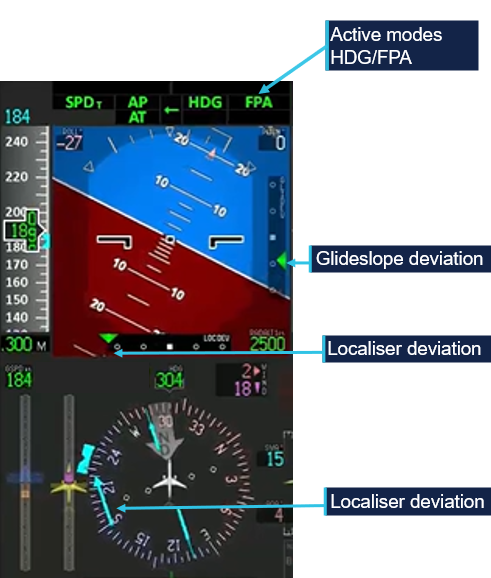
Source: Embraer animation of recorded flight data, annotated by the ATSB
Flap 2 was selected at 1635:55, at about 2,200 ft AMSL. The active lateral mode automatically changed from HDG to LOC mode one second later, but because the APP mode was not armed, GS mode did not become active although the aircraft was within one dot of the glideslope. The aircraft then passed through the localiser 52° off the runway heading, before entering a right turn, as the FGCS commanded re‑interception of the localiser course.
At 1636:22, 177 kt airspeed and 2,000 ft, the PF advised the controller that ‘Qantas 1888 is established’ (Figure 2 No 3). Established was defined as being within half full‑scale deviation of the specified track.[6] The aircraft was then (Figure 6):
- at full-scale localiser deviation
- banked 33° right
- nearly 2 dots above the glideslope.
Figure 6: Primary flight display at 1636:22 showing full‑scale localiser deviation (localiser right of the aircraft) and nearly 2 dots glideslope deviation (glideslope below the aircraft)

Source: Embraer animation of recorded flight data, annotated by the ATSB
The PM then requested further descent, to which the controller replied, ‘cleared ILS runway 29’, and just below 2,000 ft, the PM selected flap 3.
At 1636:51, the aircraft passed the final approach fix (FAF) TOROT (Figure 2). At the FAF, the PM was required to call out ‘FAF, height checked, missed approach altitude set’. At that time:
- the FAF procedure height was 1,330 ft and the aircraft was at 1,695 ft (AMSL)
- the aircraft was at full‑scale deviation above the glideslope and descending at 1,331 fpm
- the set altitude was 800 ft, and the missed approach altitude was 3,000 ft.
After the FAF, Alliance’s standard operating procedures required the aircraft to be within one dot of the localiser and glideslope. The procedures also stated that the aircraft should regain the 3° profile no later than 1,500 ft above aerodrome elevation. However, passing 1,500 ft, the aircraft was full‑scale deviation above the glideslope and descending at over 1,500 fpm.
Passing about 1,100 ft AMSL, the PM intended to select flap 5, but inadvertently selected flap 4. Flap 4 had the same flap and slat extension as flap 5, but flap 4 was a take‑off configuration not a landing configuration (see the section titled Flap configuration).
At 1637:16, the aircraft passed 1,000 ft radio altitude,[7] which coincided with Alliance’s stabilisation height of 1,000 ft above aerodrome level (AAL) for conducting an instrument approach. Contrary to the stabilised approach criteria, the:
- airspeed was 162 kt, 29 kt above approach speed (VAP) – faster than the permitted VAP + 10
- flap setting was 4 instead of flap 5 – not in the landing configuration
- before landing checks had not been completed
- aircraft was 1.4 dots above the glideslope – not within the allowable 1 dot of the glideslope
- descent rate was 1,582 fpm – higher than the allowable rate of descent than 1,000 fpm.
Providing all other stabilisation criteria were met, Alliance permitted the airspeed to be higher than VAP + 10 until 500 ft in visual meteorological conditions (VMC)[8] by day.
The captain recalled that the aircraft entered VMC at about 2,500 ft. However, the FO reported that just prior to 1,000 ft, they were ready to call out ‘unstable’ approach, when the captain stated that they were now ‘visual’ and could therefore continue the approach and be stabilised by 500 ft. The captain later reported that the lower stabilisation height of 500 ft in VMC was the approved procedure at their previous company. The FO reported being uncertain about Alliance’s policy and deferred to the captain.
Alliance procedures stated that below 1,000 ft AAL, the descent rate ‘shall not normally’ exceed 1,000 fpm. The descent rate exceeded 1,000 fpm until 1637:29, when passing 723 ft radio altitude, with the PF arming the APP mode 3 seconds later and LOC/GS becoming the active modes. The selected altitude was then set to the missed approach altitude of 3,000 ft.
At 1637:42 and 500 ft radio altitude, contrary to the stabilisation criteria in VMC, the:
- airspeed was 17 kt above VAP, with a maximum of VAP + 10 permitted
- aircraft was not in the landing configuration (flap 4 was a take‑off setting).
The PM observed that although slightly fast, the speed was trending down, and the flight crew reported thinking the aircraft met the stabilised approach criteria at 500 ft. The PM reported having completed the before landing checklist (gear and flaps) at about 800 ft, but at 411 ft radio altitude, identified that the flap lever was in the flap 4 detent and quickly moved it to the flap 5 position. The flap transitioned to the flap 5 position at 345 ft radio altitude.
The aircraft decelerated to the target approach speed VAP (133 kt) at 264 ft radio altitude. The captain disconnected the autopilot at 212 ft radio altitude and manually flew the aircraft to an uneventful landing at 1638:32.
Context
Flight crew information
The captain and first officer each held an air transport pilot licence (aeroplane), Embraer E190 type rating and a class 1 aviation medical certificate.
The captain had a total flying time of 7,100 hours, 4,000 of which were on Embraer E190 aircraft, and 150 of those were accrued in the last 90 days. The captain had previously flown Embraer E120 aircraft for about 6 years and E190 aircraft for another 4–5 years with a different operator. As a direct entry captain to Alliance, the captain conducted 6 sectors and then a line check before operating for about 2 years with Alliance on the E190 aircraft. The captain was a training captain at their base and had conducted some of the first officer’s training.
The first officer had a total flying time of 16,325 hours, 274 of which were on the Embraer E190, and 130 of those were accrued in the last 90 days. The FO commenced ground training for the Embraer E190 type rating with Alliance in May 2024 and started operating for Alliance in late September 2024.
The captain reported having slept 7 hours the previous night, 6 hours the night before that, and assessed their fatigue as ‘Okay, somewhat fresh’. The FO reporting having slept 8.5 hours on each of the previous 2 nights and assessed their fatigue as ‘Very lively, responsive, but not at peak’.[9] There was no evidence that fatigue was a factor in this occurrence.
The captain assessed their workload during the approach as 8/10. Their workload was increased by diverting around weather and a thunderstorm building in the vicinity of the airport, flying the descent in manual speed mode and the approach in manual modes. The FO assessed their workload during the approach as 10/10, in attempting to achieve the stabilised approach criteria.
Approach mode disarming
VH-UYO had Load 27 Honeywell flight management system (FMS) software, which used flight director (FD) modes and non‑FMS navigation for the ILS approach. Provided the ILS approach was part of the flight plan and NAV 1 and 2 were in AUTO FMS mode, the system would transition from FMS navigation to ILS approach through the preview mode at 150 NM. The recorded flight data showed that both NAV 1 and 2 frequencies were selected to the Darwin runway 29 ILS‑Z, and the PM reported that preview mode selected as expected.
The transition from FMS to FD navigation could also be done manually by pressing the VOR/LOC (V/L) button on the guidance panel. The V/L button selects VOR or LOC as the primary navigation source for the on‑side PFD and toggles between VOR/LOC1 and VOR/LOC2. The recorded data showed that the primary navigation source was FMS1 until it changed to VOR/LOC1 at 1634:57, less than one second after LOC became active before dropping out, and remained VOR/LOC1 until after landing.
Embraer analysed the recorded flight data and identified that when the auto‑flight control system (AFCS) captured LOC mode, the display systems had not transitioned to the LOC navigation source. In that situation, the localiser capture is invalidated, and the autopilot reverts to ROLL/FPA. Although the navigation source only recorded every 4 seconds, Embraer advised that this was the most likely reason for the mode reversion. Honeywell advised that as the recorded data rate was less than the system update rate, there was insufficient information to assess whether a synchronisation issue existed. However, Honeywell will assess whether aircraft operators have reported any similar events.
Pressing the approach (APP) pushbutton arms approach mode if it is not armed or active, and disengages or disarms approach mode if it is armed or active. In interview several weeks after the incident, the captain reported that they pushed the APP button once to arm the approach mode after receiving ATC clearance for the ILS, and probably inadvertently pushed it again, disarming the mode, on receiving a second clearance for the ILS.
However, ATC recordings showed that the second ILS clearance was received about 50 seconds after the mode reversion and a third clearance 40 seconds later. The captain also reported having re‑armed approach mode as soon as they selected heading mode after the reversion (at about 2,700 ft), but a review of flight data identified that the approach mode was not re‑armed until 620 ft AAL.
The approach mode armed status was recorded every 2 seconds in the flight data and was armed 1 second before LOC captured and not armed (just less than) 1 second after LOC capture. Therefore, the possible second press of the APP button would have to have occurred within 1 second of the LOC capture.
Mode reversion
The E190 Aircraft Operations Manual described roll hold (ROLL) mode as the basic lateral mode. Depending on the bank angle at the moment of ROLL activation, the autopilot (AP) will maintain the following bank angles until another lateral mode is selected:
- bank angle at 6° or below: AP levels the wings
- bank angle above 6° and below 35°: AP holds the present bank angle
- bank angle at or above 35°: AP maintains a bank angle of 35°
Relevant to this occurrence, roll mode is activated:
- when there is no lateral mode active and a vertical mode is selected
- by deselecting an active lateral mode.
Roll mode is deactivated when another lateral mode is activated.
Flight path angle (FPA) is the basic vertical mode, except during take‑off. The FPA can be used for vertical navigation by selecting a higher or lower altitude and then pressing the FPA button.
Alliance’s procedures required changes in lateral and vertical engaged modes to be announced by the pilots:
- the pilot who changes the flight mode checks on the flight mode annunciator (FMA) and verbally confirms the selected mode
- the other pilot verbally confirms the new flight mode.
The procedures also stated that:
When the aircraft does not perform as expected, the autopilot must be disconnected and manual flight promptly established.
Flap configuration
The E190 has slats on the leading edge of the wing and flaps on the trailing edge. There are 7 slat/flap control lever positions: up, 1–5 and full. Flap 4 is a take‑off configuration, and normal landing configurations are flap 5 or full. In flap 4 and flap 5 positions, the flaps extend to 20° and slats to 25°. Although the physical positioning of the flaps and slats is identical, the flight system logic triggers different warnings based on the selected position as follows:
- Retard mode reduces the thrust levers to idle during flare on landing. This only occurs when the slat/flap lever position is at 5 or full and landing gear is down.
- Enhanced ground proximity warning system (EGPWS) mode 2 – excessive terrain closure rate operates mode 2A when flaps are not in the landing position and 2B with flaps down and in the landing position. Violations of the alert envelopes produce aural ‘TERRAIN TERRAIN’ and ‘PULL UP’ alerts. Mode 2B has a desensitized alert envelope with a reduced upper height limit and a higher closure rate when:
- flaps are in the landing position
- on an ILS, the aircraft is within +/- 2 dots of the localiser and glideslope
- within 5 NM and 3,500 ft of the runway (and terrain awareness is functioning)
- during the first 60 seconds after take‑off.
- EGPWS mode 3 alerts if a decrease in altitude occurs immediately after take‑off or during a go‑around when the flaps are not in a landing configuration (‘DON’T SINK’ aural and GND PROX PFD alerts).
- EGPWS mode 4 unsafe terrain clearance depends on radio altitude, airspeed, landing gear and flap position. In mode 4B, with landing gear down and flaps not in the landing configuration, pilots hear a ‘TOO LOW, FLAPS’ alert and see a GND PROX alert on the PFD, when below 159 kt airspeed and 245 ft radio altitude. Mode 4C operates when the landing gear or flaps are not in the landing configuration and will trigger a ‘TOO LOW, TERRAIN’ aural alert.
On this occasion, had the flight crew continued towards landing with flap 4 configured, they would likely have received any or all of ‘TERRAIN TERRAIN’, ‘PULL UP’, ‘TOO LOW FLAPS’, and ‘TOO LOW TERRAIN’ aural alerts.
Threshold and approach speeds
The aircraft’s reference speed (VREF) is 1.3 times the stalling speed (VS) and is the minimum recommended speed at 50 ft over the threshold. It is used for landing distance calculation and is the speed to which the airspeed reference bugs are set before an approach. The approach speed (VAP) exceeds the reference speed to account for gusts or windshear. Alliance’s E190 standard procedures defined VAP = VREF = + 1/2 steady headwind component + gust increment, limited to a minimum of VREF + 5 kt and maximum VREF + 20 kt.
Meteorological conditions
Forecast
The Bureau of Meteorology (BoM) graphical area forecast encompassing the Darwin area, issued at 1359 and valid between 1430–2030 local time, stated:
- visibility greater than 10 km, scattered cumulus/stratocumulus clouds with bases 4,000 ft above mean sea level and tops above 10,000 ft, and bases from 2,000 ft over sea to 30 NM (56 km) inland
- 1,000 m visibility in scattered heavy showers of rain, occasional towering cumulus clouds with bases at 2,000 ft and tops above 10,000 ft
- 500 m visibility in occasional heavy thunderstorms with rain, occasional cumulonimbus clouds with bases from 2,000 ft and tops above 10,000 ft, broken stratus between 500 and 1,500 ft
- moderate turbulence below 400 ft in smoke and thermals over land until 1830.
There was a tropical cyclone off the northern coast of Western Australia but no SIGMET[10] for the Northern Territory.
The Darwin Airport forecast (TAF)[11] issued at 0851 was valid for 30 hours from 0930 on 12 February until 1530 on 13 February. Two subsequent TAF amendments were issued before the occurrence, one at 1148 and another at 1452. All TAF cloud heights are above aerodrome elevation. All had the same forecast for:
- wind from 340° (True) at 12 kt
- visibility greater than 10 km
- light showers of rain
- scattered cloud at 2,000 ft.
For the period of the aircraft’s approach, 1614–1638, the forecast and amendments included (intermittent) periods of up to 30 minutes of:
- visibility reducing to 1,000 m in heavy showers of rain
- broken cloud at 500 ft
- scattered towering cumulus with bases at 2,000 ft.
Forecast to occur from 2330 on 11 April to 1330 on 12 April, there was a 30% probability of thunderstorms for periods up to 1 hour with:
- variable direction winds of 15 kt winds gusting to 30 kt
- visibility reducing to 500 m in thunderstorms and heavy rain
- broken cloud at 400 ft
- scattered cumulonimbus clouds with bases at 2,000 ft.
A third TAF amendment was issued at 1642 (4 minutes after the aircraft landed), which included an additional intermittent period lasting up to 30 minutes of:
- visibility reducing to 500 m in thunderstorms and heavy rain
- broken cloud at 400 ft
- scattered cumulonimbus clouds with bases at 2,000 ft.
Observations
The following weather observations at Darwin Airport occurred during the time of the aircraft’s approach.
At 1617, a special report of meteorological conditions (SPECI)[12] was issued, which included:
- 3,000 m visibility
- thunderstorms in the vicinity (lightning detected outside the 8 km radius of the airport)
- few cloud at 1,500 ft
- broken cloud at 2,600 ft
- few cumulonimbus clouds at 2,000 ft.
At 1630, a SPECI was issued that included:
- 4,000 m visibility
- heavy showers of rain
- few cloud at 1,500 ft
- scattered cloud at 1,900 ft
- broken cloud at 4,000 ft
- detail that 2 mm of rain had fallen in the previous 10 minutes.
At 1637, one minute prior to landing, a SPECI was issued that included:
- 8,000 m visibility
- thunderstorms and rain
- scattered cloud at 1,300 ft
- broken cloud at 3,600 ft
- few cumulonimbus clouds with bases at 2,000 ft
- advice that 0.6 mm of rain had fallen in the previous 10 minutes.
Radar imagery
The BoM Darwin/Berrimah radar was located 7 km south‑east of Darwin Airport.
Radar images showed moderate rain in the Darwin Airport area at 1614, that reduced to light to no rain around the time of the approach. The associated cloud/cell was stationary, and according to the BoM, it was not unusual to have a stationary rain/storm sitting over the airport in the wet season. The BoM information about that radar included:
Heavy rain over the radar site will cause attenuation of all signals. Path attenuation also occurs when the radar beam passes through an intense thunderstorm cell; the returned signal from cells further along that path will be reduced...it may 'undershoot' high level storms and rain echoes may appear less intense than actual rainfall rate.
The BoM advised that due to attenuation, the light rainfall indicating on the radar image at 1634, may have been less intense than the actual rainfall rate.
Webcam
The BoM provided webcam images for each minute from 1634–1638 facing north and east.
At 1638, the aircraft would have been due east of the webcam on final approach, at about 300 ft, probably the light visible in the east view at 1638 (Figure 7).
Figure 7: BoM webcam image facing east at 1638 and probable aircraft light
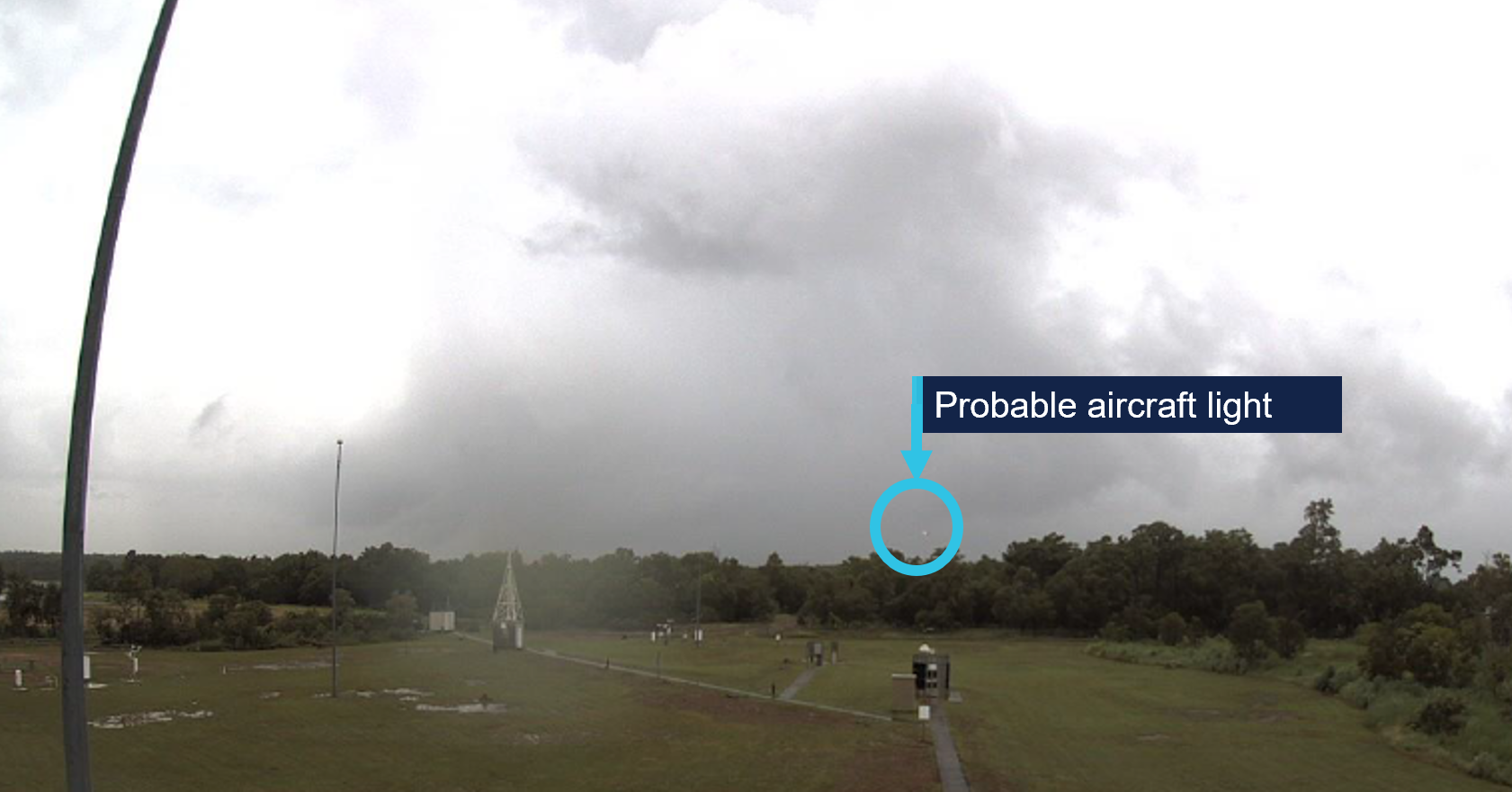
Source: Bureau of Meteorology, annotated by the ATSB
The cell with heavier rain to the north was evident in the north view at 1638 (Figure 8).
Figure 8: BoM webcam image facing north at 1638

Source: Bureau of Meteorology
Figure 9 shows satellite imagery of cloud cover at Darwin Airport at 1640, and lightning strikes that occurred in the 10 minutes prior (red) and during the period 10–30 minutes prior (orange).
Figure 9: Cloud cover at 1640 and recorded lightning strikes
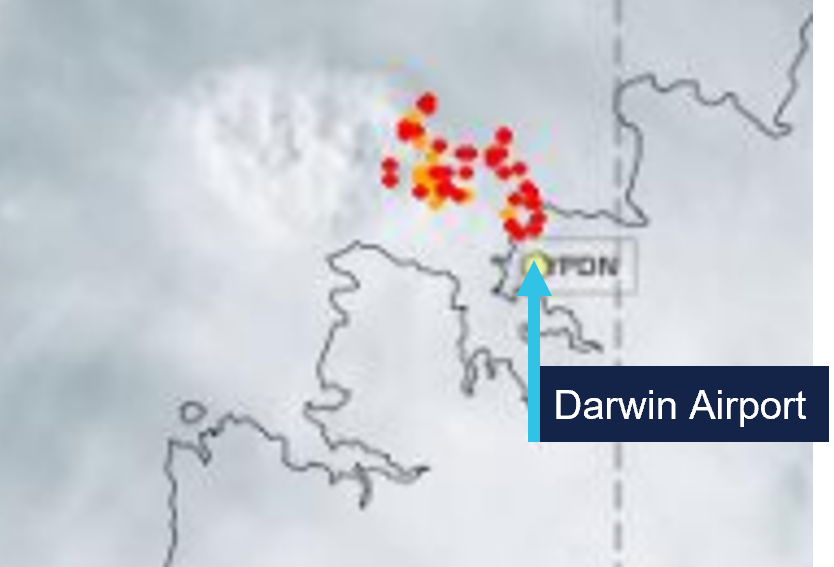
Source: Satellite image originally processed by the Bureau of Meteorology from the geostationary meteorological satellite Himawari-9 operated by the Japan Meteorological Agency. Lightning data sourced from Weather Zone Lightning Network
Automatic terminal information service
The Royal Australian Air Force’s Darwin Airport automatic terminal information service (ATIS)[13] X‑ray (X) was issued at 1610 and included advice to expect an instrument approach and that runways 29 and 36 were active for arrivals, with runway 29 in use for departures. The runways were wet, with surface condition code 555. ATIS X‑ray also detailed the following weather conditions:
- wind from 340° at 15 kt, maximum 15 kt crosswind on runway 29
- visibility 2 km
- showers of rain
- cloud scattered at 1,200 ft
- temperature 30°C
- QNH 1007.[14]
ATIS Yankee (Y) came into effect at 1624, with the only change being a temperature reduction to 27°C.
Based on the forecast and observed weather conditions at the time of the approach, the flight crew could not have anticipated VMC or expected to remain clear of cloud until below about 1,200 ft.
Recorded data
Flight data from the aircraft’s quick access recorder (QAR) for the incident flight was analysed by the ATSB and Embraer.
Key parameters in the vertical flight path, depicted in Figure 10, identified that between LAPAR and about 600 ft AAL, there were:
- 7 vertical mode changes (purple)
- 11 selected altitude changes (cyan)
- significant variations in flight path angle (orange)
- significant variations in vertical speed (pink) and rates of descent exceeding 1,600 fpm including below 1,000 ft AAL.
Figure 10: QAR data including key vertical flight path parameters
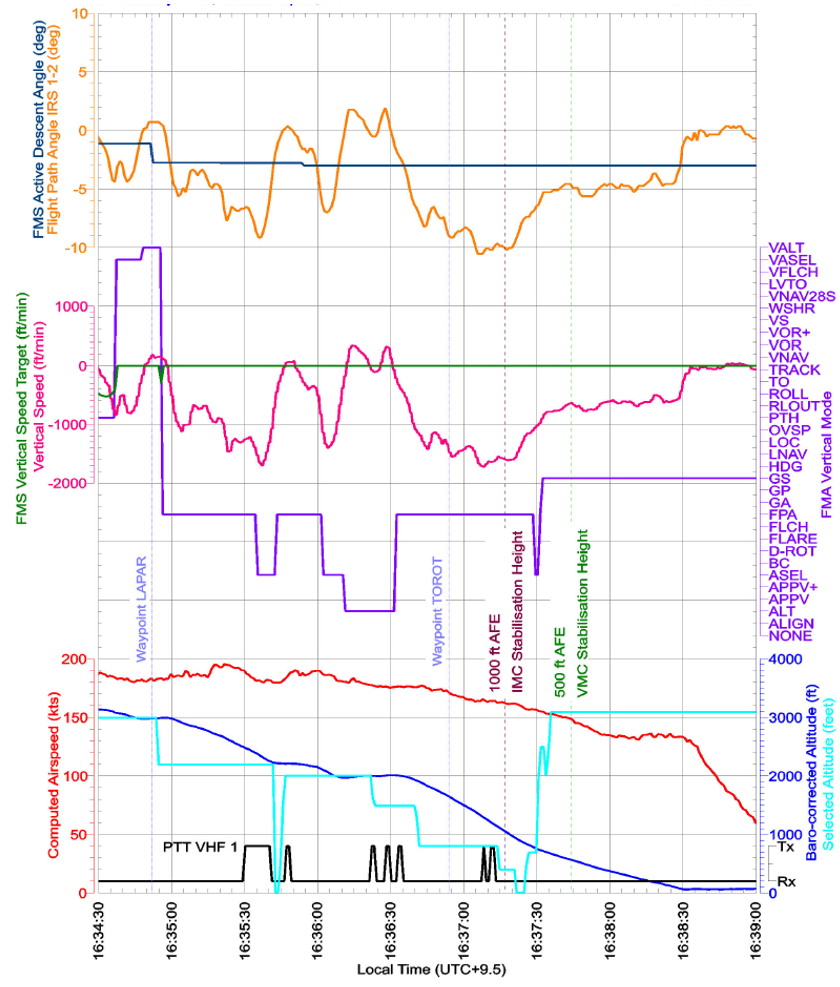
Source: Alliance Airlines QAR data, analysed by the ATSB
Although cockpit localiser and glideslope indications showed full‑scale deviation of 2.5 dots on the primary flight display and compass instrument, the recorded QAR data captured up to 5 dots deviation. Key parameters depicted in Figure 11 showed:
- airspeed (red) remained above the target approach speed of 133 kt (VAP) (purple) until 1638 (deviation in kt – green)
- 5 dot left and right deviations from the localiser course between LAPAR and TOROT
- 3 dot deviation above the glideslope approaching TOROT.
Figure 11: QAR data depicting speeds and key lateral flight path parameters
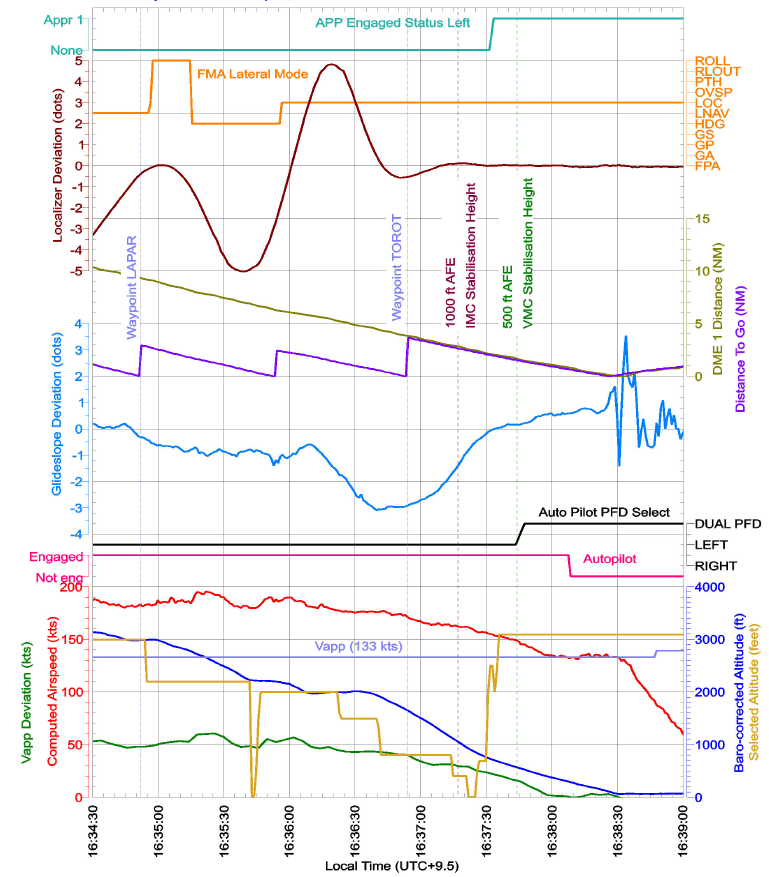
Source: Alliance Airlines QAR data, analysed by the ATSB
Approach briefing
Alliance procedures required flight crew to conduct a briefing before commencing an approach. It detailed the requirements for an instrument approach briefing and a visual approach briefing. There was no policy on re‑briefing during an instrument approach if a transition to a visual approach occurred. Alliance advised that the expectation was for flight crew to continue an instrument approach even if visual reference was established.
Descent below lowest/minimum safe altitude
Alliance’s Operations Policy and Procedures Manual (OPPM) required all flights to be planned and conducted under instrument flight rules (IFR).[15] Company policy allowed the use of visual approaches and departures, but pilots were not permitted to downgrade to visual flight rules.
The OPPM section 7.4.11.1 stated that operation below the lowest/minimum safe altitude (LSALT/MSA) was permissible only when:
• under radar control;
• in accordance with a published [distance measuring equipment] DME arrival instrument approach or holding procedure;
• when necessary during climbing after departure from an airport, or
• when flying in VMC by day.
CASR Part 91 Plain English Guide stated that in accordance with sub‑regulation 91.305 Minimum heights – IFR flights, aircraft must not be flown below the lowest/minimum safe altitude except when taking off or landing in VMC by day, or in accordance with:
- a published visual or instrument approach or departure procedure
- an air traffic control clearance.
Instrument landing system approach
Darwin Airport runway 29 ILS-Z approach is depicted in Figure 12.
Figure 12: Darwin ILS-Z approach

Source: Jeppesen
The Aeronautical Information Publication (AIP)[16] stated that:
Unless authorised to make a visual approach, an IFR flight must conform to the published instrument approach procedure nominated by ATC.
During an instrument approach, flight crew were required to maintain the aircraft’s flight path within certain flight tolerances. For an ILS approach the AIP stated:
Pilots must conform to the following flight tolerances:
a) To ensure obstacle clearance, both [localiser/Ground based augmentation system (GBAS) landing system] LOC/GLS final approach course and glideslope should be maintained within half scale deflection (or equivalent on expanded scale).
b) If, at any time during the approach after the [final approach point] FAP, the LOC/GLS final approach or glideslope indicates full scale deflection, a missed approach should be commenced.
Although the AIP wording combined the terms ‘must’ and ‘should’, Airservices Australia confirmed that aircraft were required to comply with the vertical guidance of the glideslope when conducting an ILS approach, and that descent outside this vertical guidance could be safety critical.
Alliance’s Standard Operating Procedures Manual (SOPM) detailed the procedure for conducting an ILS approach. This included:
The standard profile assumes the aircraft will approach 3,000 ft AFE [above field elevation] with Flap 1 selected and will be configured with landing flap with checklists complete prior to stabilization altitude.
Standard calls were documented in the Alliance SOPM, which stated:
Deviation calls are to be made if the listed deviation limit is exceeded and no corrective action has been observed. Upon acknowledgement of a deviation, corrective action must be taken.
Table 1 is an extract of the standard calls relevant to this approach.
Table 1: Selected standard calls
| Situation/deviation | PM | PF |
| VAPP + 10 kt / < VREF | “SPEED” | “CHECKED” |
| GS or glide path (GP) ¼ scale | “SLOPE” | “CHECKED” |
| GS or GP ½ scale | “SLOPE LIMIT” | “GO AROUND…” |
| localiser (NAV) ¼ scale | “TRACK” | “CHECKED” |
| NAV ½ scale | “TRACK LIMIT” | “GO AROUND…” |
| High rate of descent (ROD) | “SINK RATE” | “CHECKED” |
| Unstable approach | “UNSTABLE” | “GO AROUND…” |
Source: Alliance Airlines
Alliance’s OPPM section Instrument approaches included:
Any time the PNF [pilot not flying]/PM calls deviations from 'on slope' the PF should make corrections to avoid flight path excursions towards full scale.
The PNF/PM should continue slope deviation calls until the glideslope indicator stops moving toward full scale and whenever the indicator is at full scale.
…
When continuing the approach, continually cross-check visual profile indications against glideslope profile indications down to 100 ft AGL…Duties of the PNF/PM apply on all instrument approaches through to 100 ft above threshold height, even if visual flight conditions are encountered before reaching the minimum.
The same section stated:
During a visual approach using the ILS, the glideslope calls do not need to be given.
Visual approaches
The term ‘visual’ was used by:
- ATC to instruct a pilot
- a pilot to accept responsibility
to see and avoid obstacles while operating below the minimum vector altitude or minimum/lowest safe altitude.
Alliance permitted flight crew to conduct visual approaches by day and night in accordance with AIP requirements. The AIP required an IFR flight to conform to the published instrument approach procedure unless they were authorised by ATC to make a visual approach. By day, ATC could authorise an IFR aeroplane to conduct a visual approach when:
- the aircraft is within 30 NM of the aerodrome
- the pilot has established and can continue flight to the aerodrome with continuous visual reference to the ground or water
- visibility along the flight path is not less than 5,000 m or the aerodrome is in sight.
If these conditions existed, the AIP stated:
the pilot need not commence or may discontinue the approved instrument approach procedure to that aerodrome…
In controlled airspace, an ATC clearance was required to conduct a visual approach. The pilot was required to report ‘visual’ to signify to ATC that the visual approach requirements could be met and maintained as part of any request for a visual approach. The pilot was then required to maintain the track or heading authorised by ATC until (by day) within 5 NM (9 km) of the aerodrome.
The Alliance OPPM stated that in VMC on a visual approach, the aircraft must join the circuit on the upwind, crosswind or downwind leg, or make a straight-in approach after establishing on final approach by 5 NM. During this occurrence, when 5 NM from the airport, the aircraft was about 1 km left of the extended runway centreline.
The required visual approach callouts at 500 ft stabilisation height were:
- if stabilised criteria satisfied: PM verifies or calls out ‘500 STABLE’
- otherwise: PM verifies or calls out ‘500 NOT STABLE’ and the PF initiates a go‑around.
The flight crew had not briefed for a visual approach, advised ATC they were visual or received clearance to conduct a visual approach.
Go-around and discontinued approach
The Alliance OPPM included Non punitive go around policies, and listed conditions which, if encountered, the PF should consider carrying out a go‑around. The conditions included those that could lead to stabilised approach requirements not being adhered to. The Alliance SOPM distinguished between a discontinued approach and a go‑around in which take‑off/go‑around (TOGA) thrust was applied.
SOPM 5.20.4 Discontinued approach included:
During the initial phase of the approach, there may be a situation where the approach needs to be discontinued. If the aircraft is at or near the missed approach altitude, far from the missed approach point and not fully configured for landing, a go around procedure may not be appropriate. The go around can lead to an excess thrust that may result in overshooting the missed approach altitude. For this situation, a discontinued approach is recommended.
NOTE
❖ A Go-around should be conducted:
o In Day VMC below 500FT AFE,
o In [instrument meteorological conditions] IMC[17] or at night below 1000ft AFE.
SOPM 5.20.3 Go-around included:
No approach should be initiated unless the prevailing conditions have been understood and the crew found that landing is acceptable without undue risk. Philosophically all approaches should be treated as approaches followed by missed approaches, and landing should be treated as the alternate procedure. This mindset depends on a good approach briefing, on the knowledge of the missed approach procedure and on proper programming of the FMS.
Alliance advised that in this incident, a discontinued approach at 3,000 ft (when the approach mode disarmed) would have been appropriate.
Stabilised approach criteria
A stabilised approach is one where an aircraft maintains a constant angle descent to the runway while other key flight parameters such as airspeed and aircraft configuration are controlled within specific ranges. An approach is stable when all the stabilisation criteria specified by the operator are met.
According to an International Air Transport Association report Unstable approaches: risk mitigation policies, procedures and best practices (IATA, 2017), historical commercial aviation accident data indicated that many accidents occurred during the approach and landing phases of flight. Frequent contributing factors were an unstable approach and subsequent failure to initiate a go‑around. Failure to maintain a stable approach could result in landing too fast or too far down the runway, a hard landing, runway excursion, loss of control, or collision with terrain. The report also highlighted the importance of callouts in enhancing situational awareness and encouraging rapid error correction.
The report described an operator’s minimum stabilisation height as a ‘gate’ at which if the aircraft was not stable on the approach path in the landing configuration, a go‑around must be executed. Additionally, although many operators have one gate for IMC and a lower gate for VMC, variations in stabilisation heights between operators, approach types and meteorological conditions (VMC/IMC) could cause confusion. As a result, many airlines implemented a single set of criteria and one gate for a particular approach type, such as 1,000 ft for an instrument approach, and 500 ft for visual circuit or circling approaches. Having a single gate also makes it easier for an operator to track compliance using flight data monitoring programs.
The Flight Safety Foundation’s Approach and landing accident reduction briefing note 7.1 – Stabilized Approach described the benefits of a stabilised approach as:
- increasing the flight crew’s situational awareness of the:
- horizontal
- vertical
- airspeed
- energy state
- more time and attention for monitoring communications, weather and aircraft systems
- more time for monitoring by the PM
- defined criteria to support land or go‑around decision‑making
- consistent landing performance.
Alliance’s standard operating procedures required all flights conducting instrument approaches to be stabilised by 1,000 ft above aerodrome level, and an immediate go‑around was required for any approach that did not meet the following stabilised approach criteria:
a) the correct flight path;
b) only small changes in heading/pitch are required to maintain the correct flight path;
c) the aircraft speed is not more than VAPP + 10 knots indicated airspeed and not less than VREF;
d) the aircraft is in the correct landing configuration;
e) sink rate is no greater than 1,000 feet per minute
f) thrust or power setting is appropriate for the aircraft configuration;
g) all briefings and checklists have been completed;
h) specific types of approaches are stabilized if they also fulfil the following
i. instrument landing system (ILS) approaches must be flown within one dot of the glideslope and localizer
ii. a Category II or Category III ILS approach must be flown within the expanded localizer band
i) unique approach procedures or abnormal conditions requiring a deviation from the above elements of a stabilized approach require a special briefing to have been completed prior to beginning the approach.
• Note 1: A momentary excursion is permitted for points (c) & (e). A momentary excursion is defined as a deviation lasting only a few seconds and where every indication is that it will return to the stabilised criteria as listed in points (c) & (e).
• Note 2: Where the nominal descent path for a particular approach requires a descent rate greater than 1000 fpm. This is only permitted when expected rates of descent have been briefed prior to the approach being commenced.
Stabilized Heights
All flights shall meet all of the above stabilized approach criteria by 1,000 feet above aerodrome level except under the following circumstances:
Visual approach:
Speed may be higher than VAPP + 10, provided it is within limits and expected to reduce to Vapp+10 or below by no later than 500ft AAL.
Note 3: Visual conditions as defined by Jeppesen AUS or AIP - the pilot has established and can continue flight to the airport with continuous visual reference to the ground or water; and visibility along the flight path is not less than 5000m.
…[followed by Visual circuit, Circling approach and RNP-AR approach]
An approach that does not meet, or subsequently exhibits sustained deviations outside of these criteria requires an immediate go-around.
Alliance advised that the Note 3 under the Visual approach heading was supposed to clarify that the term ‘visual approach’ and the associated policy was not only for the situation where flight crew were cleared for a visual approach, but included when they encountered visual conditions during an instrument approach.
Alliance SOPM section Intercepting glideslope from above, included:
Several different situations, such as ATC restriction, may lead to a glideslope interception from above. If that happens, the pilots must take the appropriate actions to guarantee a stabilized approach. If the stabilized approach criteria are not met, the PF must initiate a Go Around. The approach must be stable before reaching 1000 ft AGL (IMC), 500 ft (VMC), or other altitude in accordance with company policies.
Alliance’s SOPM (5.16.7) Stabilised approach stated that the aircraft must meet the stabilised approach criteria in the OPPM, and included:
For a 3D instrument approach or a visual approach (except for a visual circuit or circling approach) the aircraft should be established on profile by 3000ft AFE. If, due to operational circumstances the aircraft is not on a 3° profile, an acceptable flight path should be maintained to regain profile no later than 1500ft AFE. Descent rate limits are outlined in the OPPM.
The OPPM specified ‘Descent rate limits’:
The following values for the rate of descent below the transition altitude shall not normally be exceeded:
• 3000 fpm down to an altitude of 3000 ft above aerodrome level (AAL).
• 2000 fpm down to an altitude of 2000 ft AAL transitioning to 1000 ft AAL
• 1000 fpm below 1000 feet AAL
The SOPM (5.16.7) Stabilised approach also stated:
On the normal profile, the aircraft should approach 3,000 ft AFE with Flap 1 selected. Flap 2 should be selected leaving 3000ft. The landing gear should be selected down and flap 3 selected no later than 2000ft AFE. Final landing flap should be selected such that all stable approach criteria can be satisfied.
Alliance advised that in the previous 4 years, almost all their approach incidents occurred following selection of flap 2 below the prescribed 3,000 ft. They reported that delayed selection of flap 2 ‘then compresses everything’.
Guidance material for Part 121.200 from CASR Part 121 Acceptable means of compliance/guidance material - Australian air transport operations—larger aeroplanes included discontinuing an approach to continue in VMC as one situation that reduced the likelihood of a stabilised approach and should be avoided where not operationally necessary.
Crew coordination
The captain reported being aware when the aircraft was outside half scale deflection of the localiser and more than half scale deflection above the glideslope, which was why they advised ATC and were cleared to maintain the minimum vector altitude. The captain could not recall whether they had advised ATC they were visual but assessed that they could continue the unstable approach below 1,000 ft as they were in visual conditions. The captain reported that there were no callouts from the PM and if they were not stable at 500 ft, the captain would have expected an ‘unstable’ callout from the PM and would have conducted a go‑around.
The FO (PM) reported that normally they would aim to be fully configured and stable by 1,500 ft and the ‘absolute latest’ by 1,000 ft for an instrument approach. In this case they were not, which is why the captain called ‘visual’ and said they would use the visual approach ‘gate’ of 500 ft. The FO reported that in that split second (passing 1,000 ft), they agreed with the captain to continue because they were visual, although the aircraft was above the glideslope and ‘slightly’ fast, the speed was trending down, and the FO thought that the aircraft was fully configured for landing. The FO assessed that the aircraft was stable at 500 ft, unaware that the flaps were incorrectly configured, and had they called ‘unstable’ at 500 ft, the captain would have been obliged to conduct a go‑around.
The FO also reported that the en route diversions and storms near the airport may have resulted in perceived time pressure to continue the landing. They had sufficient fuel to discontinue the approach and make a second attempt.
The cockpit voice recording was not retained for the investigation. The flight crew could not recall whether the PF called out mode changes after the mode reversion. The PM reported calling distance and heights for the profile, but did not make speed, slope or track deviation calls because the PF was taking corrective action.
The Alliance OPPM detailed task sharing and the responsibilities of the PF and PM and noted that this was particularly important in high workload phases of flight, including approach and landing. It also stated that the PM should:
query the PF actions that are not understood or considered inappropriate. He/she should also demonstrate assertiveness and express advocacy to share any concern on the flight progress.
Alliance OPPM defined authority gradient as ‘the relative authority of air crew in the chain of command … if the gradient is too steep, air crew may be unwilling or unable to express their beliefs to those in higher authority’.
Similar occurrences
Unstable approach involving Embraer 190, VH‑UZI, about 4 km north‑east of Brisbane Airport, Queensland, on 9 May 2024 (AO‑2024‑030)
During approach to Brisbane Airport, the aircraft automated ILS flight mode unexpectedly disengaged. The flight crew focused on troubleshooting the unexpected change and recapturing the ILS flight director mode, rather than conducting a go‑around. During that time, the flight crew did not effectively monitor the aircraft's flight path, and the aircraft exceeded the stabilised approach criterion of one dot glideslope deviation.
After recognising that the aircraft was low, the captain increased the aircraft pitch, resulting in an enhanced ground proximity warning system (EGPWS) glideslope warning. The flight crew did not perform the required terrain avoidance manoeuvre, instead continued the approach. The captain arrested the aircraft’s descent and re‑established the aircraft on the glidepath, before continuing the approach and landing.
Alliance took safety action in response to that occurrence including issuing an operational notice to remind flight crew of the stabilised approach criteria and go‑around requirements.
Descent below glideslope involving Fairchild SA227, VH‑VEU, about 17 km north‑east of Brisbane Airport, Queensland, on 2 July 2024 (AO‑2024-040)
During the ILS approach, the aircraft descended below the 3° glideslope, triggering an air traffic control ATC minimum safe altitude warning about 8 NM (14 km) from the runway. ATC advised the crew that they were observed below the glideslope, however the aircraft continued descent below the glideslope until 3 NM (6 km) when the descent rate was reduced. The aircraft then passed above the glideslope before the rate of descent increased again and subsequently the glideslope was re‑intercepted from above 1 NM (2 km) from the runway at 500 ft. The aircraft then followed a stabilised flight path to landing.
The investigation found that the pilot monitoring was not monitoring the glideslope and did not challenge the pilot flying to correct the deviation and reduce the aircraft’s descent rate. Additionally, the operator's standard operating procedures contained areas of inconsistency when an aircraft entered visual conditions during an instrument approach, and that the AIP was unclear as to whether pilots were required to comply with precision approach flight tolerances.
The aircraft operator subsequently amended its standard operating procedures as follows:
- the instrument approach procedure has been updated:
- the approach brief now requires discussion of expectations if visual conditions arise
- the statement that ‘during a visual approach using the ILS, the glideslope calls do not need to be given’ has been removed
- a requirement to make callouts using reference to visual slope indications has been added.
- a note has been added to the visual approach procedures stating that crew require a clearance to discontinue an instrument approach in controlled airspace
- increased focus on pilot monitoring skills during:
- proficiency checks, which will now include standard instrument departure and standard arrival routes
- line training for new flight crew
- addition of a pilot monitoring sector to the annual line check.
Safety analysis
Mode reversion
Nearing the initial approach fix (LAPAR) for the Darwin Airport runway 29 instrument landing system (ILS)‑Z approach, the aircraft’s approach, localiser and glideslope modes were armed, with the correct ILS frequency set as the armed navigation source. As the aircraft flew by LAPAR, the localiser mode engaged for one second before the auto‑flight system reverted to lateral roll and vertical flight path angle modes.
It is possible that this occurred due to the captain inadvertently pressing the approach pushbutton at the same time the localiser captured. The captain recalled that this occurred because they received a second ATC clearance for the ILS, however, at that time, they had only been cleared for the ILS once. They received a second clearance about 50 seconds later and a third clearance 40 seconds after that. The pushbutton was not recorded in the data but pressing it when approach mode was armed would disarm approach mode consistent with the mode reversion.
Embraer's analysis of the recorded data found that the ILS navigation display source had not engaged at the time localiser mode became active. Therefore, it was most likely that this non‑synchronisation led the flight control and guidance system to invalidate the capture and revert to basic modes. The avionics manufacturer, Honeywell, advised that as the recorded data did not update as frequently as the system status, it was not possible to determine whether a synchronisation issue existed.
The mode reversion resulted in the aircraft maintaining the 20° right bank and approximately level flight path angle that were present at the time of the mode reversion.
Automation and approach continuation
Alliance’s procedures stated that if the auto‑flight system was not doing what the pilot expected, they were to disconnect the autopilot and manually fly the aircraft. However, following the unexpected mode change, the captain, who was the pilot flying (PF), did not re‑engage approach mode or disconnect the autopilot until about 200 ft above the aerodrome elevation, in accordance with normal landing procedures. This resulted in the aircraft deviating beyond the permitted tolerance from the localiser course and above the glideslope.
It took less than 3 minutes from the mode reversion at 3,000 ft, to the aircraft being established on the ILS and in the landing configuration, about 400 ft above aerodrome elevation. During that time, there were several changes to the lateral and vertical modes, selected heading and altitude, and significant variations in vertical speed, as the PF manipulated the auto‑flight system to recapture the localiser and glideslope.
There were also several triggers for the flight crew to discontinue the approach. The flight crew reported that their en route weather deviations and thunderstorms in the vicinity of the airport may have led to perceived pressure to continue the approach, but that there was adequate fuel on board to discontinue and conduct a second approach.
Once outside the lateral tolerance of the approach, the aircraft was operating contrary to the air traffic control (ATC) clearance and descended below the minimum safe altitude, likely while in instrument meteorological conditions (IMC). The pilot monitoring (PM) reported that they did not call out the course deviations, as the PF was actively working to correct them. Instead, after descending about 500 ft, the PM advised ATC they were re‑intercepting the localiser and was assigned the minimum vector altitude to ensure terrain separation. As a result, the aircraft then maintained altitude, while the glideslope diverged beneath the flight path.
The PM did not read back the ATC clearance to descend once they had intercepted the glideslope, consistent with being focused on monitoring tasks and their self‑assessed 10/10 workload during the approach. The PM selected flap 2 as the aircraft captured the localiser, about 800 ft below the normal (but not mandatory) 3,000 ft flap 2 selection height. Alliance reported that this late selection had a similar effect to other recent approach incidents, where the associated delayed speed reduction reduced the time available to stabilise the approach.
As the aircraft passed the final approach fix (FAF) and then descended through 1,500 ft, it was established on the localiser but 3 dots above the ILS glideslope. Alliance’s procedures required the ILS to be flown within 1 dot of the glideslope, and stated that aircraft ‘should be’ on the 3° glideslope no later than 1,500 ft.
The PF reported stating to the PM that they were visual at about 2,500 ft, but the PM reported this occurred just as the aircraft approached 1,000 ft. Without a cockpit voice recording, it could not be determined when visual flight conditions were established.
At 1,000 ft, which was the stabilisation height for an instrument approach, the PF incorrectly assessed that although several stabilised criteria were not met, as they were then in visual conditions, they could continue (unstable) to 500 ft. Although this had been the procedure at the PF’s former company, Alliance required all stabilised approach criteria, other than airspeed, to be met at 1,000 ft. The PM was sufficiently unsure of Alliance’s policy to defer to the captain’s experience, as the senior base training captain who had conducted some of the PM’s training.
At 500 ft, the PM assessed that the stabilised approach criteria were met as, although the airspeed was still slightly fast, it was trending down, and they continued the approach. Although the flight crew reported having completed the before landing checks prior to 500 ft, shortly afterwards, the PM identified that they had inadvertently selected a take‑off flap setting (passing about 1,100 ft) instead of a landing setting, which they had not detected earlier. The PM rectified the flap setting and an uneventful landing followed.
Although the landing was uneventful, had the incorrect flap setting not been rectified, thrust retard mode would not have engaged during the landing flare, and EGPWS warnings would have been triggered by the use of different tolerances than with the aircraft configured for landing. The use of selected heading and selected altitude to drive the aircraft’s trajectory meant that these may not have been set correctly had a go‑around been initiated either by the flight crew or ATC.
A coupled ILS approach should require minimal flight crew intervention other than monitoring. Continuing an approach using inappropriate modes increased the likelihood of an unstable approach. International research showed that unstable approaches and failure to initiate a go-around could result in landing too fast or too far down the runway, a hard landing, runway excursion, loss of control, or collision with terrain. Although visual conditions reduce the risk of collision with terrain, they do not mitigate against landing incidents resulting from poor energy management.
Alliance stabilisation heights
Alliance provided stabilised approach criteria consistent with international and Civil Aviation Safety Authority guidance, including airspeed, flight path and energy management parameters, to reduce the risk of landing accidents. However, Alliance’s minimum stabilisation heights at which these criteria were required to be met, varied between approach types and meteorological conditions, and were not clearly documented.
Alliance specified a stabilisation height of 1,000 ft for instrument approaches, but under the heading Visual approach, permitted a 500 ft stabilisation height for an instrument approach in VMC, provided only the airspeed exceeded the stable speed criterion, and all other stabilised approach criteria were met. Additionally, elsewhere in the procedures for intercepting a glideslope, it stated that an approach must be stable before reaching 1,000 ft in IMC, 500 ft in VMC ‘or other altitude in accordance with company policies’. Alliance did not have a policy for transitioning from an instrument approach to a visual approach and advised that its expectation was for flight crew to continue an instrument approach even when entering VMC.
In this incident, the lack of clarity regarding which of the stabilised approach criteria were not required before continuing to 500 ft, resulted in the flight crew incorrectly assessing that they could continue to 500 ft in VMC while the criteria were not met for:
- speed
- rate of descent
- glideslope
- landing configuration
- before landing checks complete.
International Air Transport Association guidance stated that using a single stabilisation height for one type of approach, regardless of weather conditions, can reduce confusion and make it easier for operators to track stabilised approach compliance using flight data monitoring. Clear stabilisation heights also support flight crew decision-making to initiate a go‑around.
Findings
ATSB investigation report findings focus on safety factors (that is, events and conditions that increase risk). Safety factors include ‘contributing factors’ and ‘other factors that increased risk’ (that is, factors that did not meet the definition of a contributing factor for this occurrence but were still considered important to include in the report for the purpose of increasing awareness and enhancing safety). In addition ‘other findings’ may be included to provide important information about topics other than safety factors. These findings should not be read as apportioning blame or liability to any particular organisation or individual. |
From the evidence available, the following findings are made with respect to the unstable approaching involving Embraer E190, VH-UYO, near Darwin Airport, Northern Territory, on 15 February 2025.
Contributing factors
- On crossing the initial approach fix for the instrument landing system (ILS) approach, due either to a system synchronisation issue or the pilot flying inadvertently disarming the approach mode, the aircraft’s auto‑flight system reverted to roll and flight path angle modes.
- Following the unexpected mode change, the pilot flying did not re‑engage approach mode or disconnect the autopilot. This likely contributed to the aircraft deviating outside the required lateral tolerance of the approach below the minimum safe altitude while in instrument meteorological conditions.
- The flight crew did not discontinue the approach when the aircraft was unstable at the 1,000 ft stabilisation height as they incorrectly assessed that they could continue to 500 ft in visual meteorological conditions, with multiple stabilised approach criteria unmet.
- In the limited time available to stabilise the aircraft by 500 ft, the flight crew incorrectly assessed that the aircraft was stable and continued the approach, unaware that the pilot monitoring had inadvertently selected an incorrect flap configuration.
- Alliance Airlines' standard operating procedures were unclear about the criteria for continuing an unstable instrument approach to 500 ft when aircraft entered visual conditions.
Safety actions
| Whether or not the ATSB identifies safety issues in the course of an investigation, relevant organisations may proactively initiate safety action in order to reduce their safety risk. All of the directly involved parties are invited to provide submissions to this draft report. As part of that process, each organisation is asked to communicate what safety actions, if any, they have carried out to reduce the risk associated with this type of occurrences in the future. The ATSB has so far been advised of the following proactive safety action in response to this occurrence. |
Safety action by Alliance Airlines
Alliance Airlines issued an operations notice ‘to improve clarity and compliance’ with the stabilised approach criteria. It detailed the stabilised approach policy. It also amended the stabilisation height such that for 3‑dimensional and 2‑dimensional instrument approaches, and straight‑in visual approaches, the stabilised criteria were to be met by 1,000 ft above aerodrome elevation.
The 500 ft stabilisation height applied only to visual circuit or circling manoeuvre approaches. The notice reminded flight crew of Alliance’s ‘non punitive go around policy’ and required all unstable approaches to be reported.
Alliance Airlines also conducted a flight data review of unstable approaches over the previous 6 months to identify similar occurrences.
Sources and submissions
Sources of information
The sources of information during the investigation included:
- the flight crew and air traffic controllers
- Alliance Airlines
- Airservices Australia
- Bureau of Meteorology
- Embraer
- Honeywell
- recorded flight data.
References
Civil Aviation Safety Authority (2023, December 20). CASR Part 121 Acceptable means of compliance/guidance material - Australian air transport operations—larger aeroplanes. Retrieved May 15, 2025, from Part 121 of CASR Australian air transport operations - larger aeroplanes | Civil Aviation Safety Authority
Civil Aviation Safety Authority (2025, January). CASR Part 91 Plain English Guide version 4.2. Retrieved May 15, 2025, from Part 91 plain English guide version 4.2
Flight Safety Foundation (2000). Approach and landing accident reduction Briefing Note 7.1: Stabilized Approach. Retrieved May 15, 2025, from FSF ALAR Briefing Note 7.1: Stabilized Approach
Flight Safety Foundation (2015, June 8). Normalization of Deviance. Retrieved May 15, 2025, from Normalization of Deviance - Flight Safety Foundation
International Air Transport Association (2017). Unstable approaches: risk mitigation policies, procedures and best practices. Retrieved May 15, 2025, from Unstable approaches: risk mitigation policies, procedures and best practices
Submissions
Under section 26 of the Transport Safety Investigation Act 2003, the ATSB may provide a draft report, on a confidential basis, to any person whom the ATSB considers appropriate. That section allows a person receiving a draft report to make submissions to the ATSB about the draft report.
A draft of this report was provided to the following directly involved parties:
- the flight crew and air traffic controllers
- Alliance Airlines
- Airservices Australia
- Civil Aviation Safety Authority
- Bureau of Meteorology
- Embraer
- Honeywell
- United States National Transportation Safety Board
- Brazil Aviation Accident Investigation and Prevention Center.
Submissions were received from:
- Airservices Australia
- Alliance Airlines
- the first officer
- Embraer.
The submissions were reviewed and, where considered appropriate, the text of the report was amended accordingly.
Purpose of safety investigationsThe objective of a safety investigation is to enhance transport safety. This is done through:
It is not a function of the ATSB to apportion blame or provide a means for determining liability. At the same time, an investigation report must include factual material of sufficient weight to support the analysis and findings. At all times the ATSB endeavours to balance the use of material that could imply adverse comment with the need to properly explain what happened, and why, in a fair and unbiased manner. The ATSB does not investigate for the purpose of taking administrative, regulatory or criminal action. TerminologyAn explanation of terminology used in ATSB investigation reports is available here. This includes terms such as occurrence, contributing factor, other factor that increased risk, and safety issue. Publishing informationReleased in accordance with section 25 of the Transport Safety Investigation Act 2003 Published by: Australian Transport Safety Bureau © Commonwealth of Australia 2025 
Ownership of intellectual property rights in this publication Unless otherwise noted, copyright (and any other intellectual property rights, if any) in this report publication is owned by the Commonwealth of Australia. Creative Commons licence With the exception of the Commonwealth Coat of Arms, ATSB logo, and photos and graphics in which a third party holds copyright, this report is licensed under a Creative Commons Attribution 4.0 International licence. The CC BY 4.0 licence enables you to distribute, remix, adapt, and build upon our material in any medium or format, so long as attribution is given to the Australian Transport Safety Bureau. Copyright in material obtained from other agencies, private individuals or organisations, belongs to those agencies, individuals or organisations. Where you wish to use their material, you will need to contact them directly. |
[1] Pilot Flying (PF) and Pilot Monitoring (PM): procedurally assigned roles with specifically assigned duties at specific stages of a flight. The PF does most of the flying, except in defined circumstances, such as planning for descent, approach and landing. The PM carries out support duties and monitors the PF’s actions and the aircraft’s flight path.
[2] Flight level: at altitudes above 10,000 ft in Australia, an aircraft’s height above mean sea level is referred to as a flight level (FL). FL 340 equates to 34,000 ft.
[3] Cloud cover: in aviation, cloud cover is reported using words that denote the extent of the cover – ‘few’ indicates that up to a quarter of the sky is covered, ‘scattered’ indicates that cloud is covering between a quarter and a half of the sky, ‘broken’ indicates that more than half to almost all the sky is covered, and ‘overcast’ indicates that all the sky is covered.
[4] Instrument Landing System (ILS): a 3-dimensional precision instrument approach system comprising a VHF localiser providing horizontal guidance and a UHF glideslope providing vertical guidance.
[5] Initial approach fix (IAF): the commencement of an instrument approach.
[6] Airservices Australia’s Aeronautical Information Publication ENR 1.22.2.
[7] Radio altitude is the height of the aircraft above terrain immediately below the aircraft measured by a radio altimeter.
[8] The pilot has established and can continue flight to the airport with continuous visual reference to the ground or water; and visibility along the flight path is not less than 5,000 m.
[9] Self-assessed Samn-Perelli 7-point fatigue scale
[10] A SIGMET provides a concise description of the occurrence or expected occurrence of en route weather phenomena that are potentially hazardous to aircraft, in areas over which meteorological watch is being maintained.
[11] A TAF is a coded statement of meteorological conditions expected at an aerodrome and within a radius of five nautical miles (8 km) of the aerodrome reference point.
[12] SPECI is used to identify reports of observations when conditions are below specified levels of visibility and
cloud base, certain weather phenomena are present, or temperature, pressure or wind change by defined
amounts.
[13] The provision of current, routine information to arriving and departing aircraft by means of continuous and repetitive broadcasts during the hours when the unit responsible for the service is in operation.
[14] QNH: the altimeter barometric pressure subscale setting used to indicate the height above mean seal level.
[15] Instrument flight rules (IFR): a set of regulations that permit the pilot to operate an aircraft in instrument meteorological conditions (IMC), which have much lower weather minimums than visual flight rules (VFR). Procedures and training are significantly more complex as a pilot must demonstrate competency in IMC conditions while controlling the aircraft solely by reference to instruments. IFR-capable aircraft have greater equipment and maintenance requirements.
[16] Aeronautical Information Publication (AIP): A publication issued by or with the authority of a State and containing aeronautical information of a lasting character essential to air navigation.
[17] Instrument meteorological conditions (IMC): weather conditions that require pilots to fly primarily by reference to instruments, and therefore under instrument flight rules (IFR), rather than by outside visual reference. Typically, this means flying in cloud or limited visibility.
Occurrence summary
| Investigation number | AO-2025-012 |
|---|---|
| Occurrence date | 12/02/2025 |
| Location | Near Darwin Airport |
| State | Northern Territory |
| Report release date | 26/08/2025 |
| Report status | Final |
| Investigation level | Short |
| Investigation type | Occurrence Investigation |
| Investigation status | Completed |
| Mode of transport | Aviation |
| Aviation occurrence category | Incorrect configuration, Unstable approach |
| Occurrence class | Incident |
| Highest injury level | None |
Aircraft details
| Manufacturer | Embraer-Empresa Brasileira De Aeronautica |
|---|---|
| Model | ERJ 190-100 IGW |
| Registration | VH-UYO |
| Serial number | 19000098 |
| Aircraft operator | Alliance Airlines Pty Limited |
| Sector | Jet |
| Operation type | Part 121 Air transport operations - larger aeroplanes |
| Departure point | Cairns Airport, Queensland |
| Destination | Darwin Airport, Northern Terrirory |
| Damage | Nil |