At approximately 0523 hours GMT on 30th April, 1970, a Boeing 707/338C aircraft, registered VH-EAD, ran off the runway and became bogged in soft sand after commencing a take-off from Runway 25 at Fiumicino Airport, Rome, Italy. The aircraft was engaged in operating Qantas Flight 755/192, a regular public transport flight from Sydney to London with intermediate stops at Hong Kong, New Delhi, Teheran and Rome. The aircraft was only slightly damaged in the occurrence and only one passenger of the ten crew members and 45 passengers on board sustained a minor injury during the emergency evacuation.
Occurrence Briefs are concise reports that detail the facts surrounding a transport safety occurrence, as received in the initial notification and any follow-up enquiries. They provide an opportunity to share safety messages in the absence of an investigation.
What happened
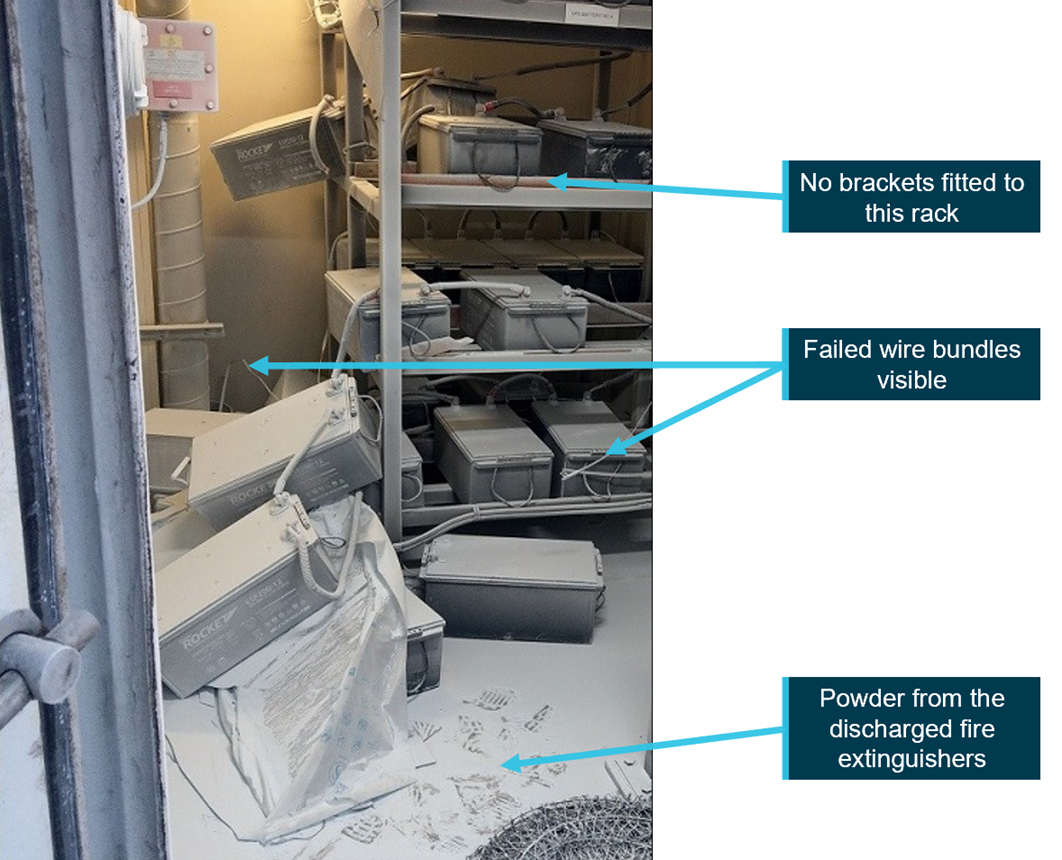
On 29 January 2021, at 0655 Coordinated Universal Time, a multi-purpose vessel encountered heavy seas in the Southern Ocean. The 6-metre swell and confused sea state [1] caused the vessel to roll heavily, listing more than 30 degrees. As a result of this movement, several bundled wire restraints on battery racks failed and numerous batteries fell to the floor of the top deck battery room (Figure 1).
Wires to the batteries were cut and at least two of the batteries short circuited internally between the cells. This resulted in a fire, which triggered an alarm on the bridge. The captain initiated the emergency response procedures and the fire was extinguished.
Figure 1: Battery room after the fire was extinguished
Source: Vessel operator
Battery racks
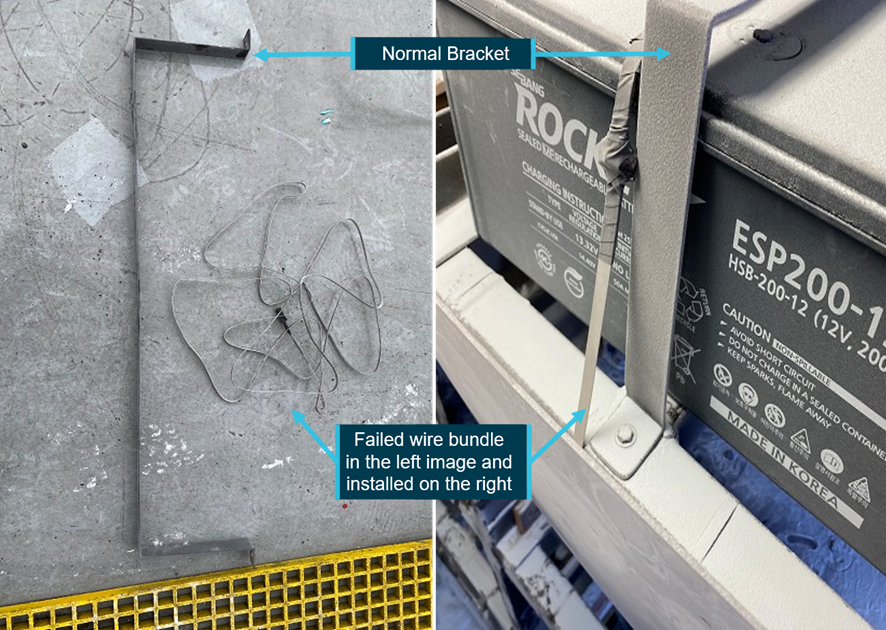
The battery room contained multiple shelved racks with large batteries secured to them. These racks used an L-shaped frame to prevent fore and aft movement, and metal brackets or bundled wires to prevent any lateral movement in the rack. The batteries that fell from the racks, including the two that had confirmed fire damage, were secured by bundled wire straps. These had been
installed 5 months prior to the occurrence. The other batteries were secured to the racks by heavy metal brackets that bolted into the rack frame. Figure 2 depicts a battery secured with both types. The large brackets were the normal method of restraint and it could not be determined why they were not used to secure the more recently delivered batteries or why some batteries were secured by both types of restraints. The bundled wire straps proved to be inadequate in the heavy swell of the Southern Ocean.
Figure 2: Battery rack with both types of restraints
Safe Work guidance
While there are no mandated standards for battery racks on ships, securing loose items prior to departure is a key principle of good seamanship. The Seacare Authority Code of Practice Approval 2018 - Health and Safety in Shipboard Work, including Offshore Support Vessels (paragraph 12.5) stated 'Batteries should be kept battened into position to prevent shifting in rough weather’. In this occurrence, the batteries were secured, although inadequately so for the prevailing conditions. The departure checklist used by the operator included securing loose items above deck in preparation for heavy weather and was completed by the crew.
Safety action
The operator of the vessel advised the ATSB they have taken the following safety actions:
all battery rooms were checked for suitable sea fastening
the bundled wire securing bands were immediately replaced with the original metal securing brackets or another equally robust arrangement
damaged batteries were replaced as required
a meeting with involved parties was held to discuss the lessons learned and corrective action.
Safety message
Although believed to be sufficient at the time of installation, the methods used to secure the batteries were inadequate for the conditions experienced in the Southern Ocean. At sea, particularly in heavy weather, unsecured items risk being damaged and may also pose a danger to the crew, or, as in this case, the safety of the ship. The risk to life associated with an emergency such as a major shipboard fire, is significantly increased when it occurs in heavy weather, far out to sea, where any possibility of assistance from ashore or from another ship is significantly reduced.
About this report
Decisions regarding whether to conduct an investigation, and the scope of an investigation, are based on many factors, including the level of safety benefit likely to be obtained from an investigation. For this occurrence, no investigation has been conducted and the ATSB did not verify the accuracy of the information. A brief description has been written using information supplied in the notification and any follow-up information in order to produce a short summary report, and allow for greater industry awareness of potential safety issues and possible safety actions.
Occurrence Briefs are concise reports that detail the facts surrounding a transport safety occurrence, as received in the initial notification and any follow-up enquiries. They provide an opportunity to share safety messages in the absence of an investigation.
What happened
On 18 November 2018 an Airbus A330-202 aircraft was being operated on a scheduled passenger flight from Jakarta, Indonesia, to Sydney, New South Wales.
During take-off, the flight crew detected improper adjustment to the trim controls. After take-off, the flight crew received an aircraft communications addressing and reporting system (ACARS) message advising that there was a discrepancy between the weight of a loaded cargo pallet on the load sheet and the actual weight of the pallet.
During the loading of the aircraft, all pallets had been packed and weighed correctly. The Load Control system requires a ground handler to enter the load data (pallet weights) into an electronic messaging system for transmission to the regional load control who generate the aircraft load sheet and load instruction report. The ground handler made an error when entering this data.
Therefore, the final load sheet had included a cargo pallet that was 3,000 kg whereas the actual weight of the pallet was 2,000 kg. This resulted in the zero fuel weight (ZFW) used being 1,000 kg heavier than the actual ZFW. The stabilizer setting from the final load sheet was 4.4 up, but should have been 4.7 up. The crew reported that the out of trim condition was evident during rotation.
Safety action
As a result of this incident, the operator has advised the ATSB that they are taking the following safety action:
The ground handling agent has added the requirement for a second ground handler to cross- check data entry prior to transmission. Freight scanning has been introduced in a number of airports, and is to be introduced across the whole network including in Jakarta. This will assist in identifying errors such as this.
Safety message
This occurrence highlights the importance of cross-checking all container, pallet and baggage weights when loading an aircraft. The use of a second person or an electronic system will assist in reducing these types of data entry errors. ATSB research report, Aircraft loading occurrences July 2003 to June 2010 (AR-2010-044), documents the number and types of safety occurrences involving the loading of high-capacity aircraft to raise awareness within the industry of the associated issues.
About this report
Decisions regarding whether to conduct an investigation, and the scope of an investigation, are based on many factors, including the level of safety benefit likely to be obtained from an investigation. For this occurrence, no investigation has been conducted and the ATSB did not verify the accuracy of the information. A brief description has been written using information supplied in the notification and any follow-up information in order to produce a short summary report, and allow for greater industry awareness of potential safety issues and possible safety actions.
Occurrence Briefs are concise reports that detail the facts surrounding a transport safety occurrence, as received in the initial notification and any follow-up enquiries. They provide an opportunity to share safety messages in the absence of an investigation.
What happened
On 28 March 2018, a Boeing 787-8 departed Bali, Indonesia on a scheduled passenger flight to Melbourne, Victoria (Vic.). After arrival in Melbourne, at about 0230 Eastern Standard Time, maintenance engineers were investigating a right engine anti-ice fault indication, when they discovered a cabin passenger blanket within the engine cowling (Figure 1).
Investigation by the operator found that maintenance had been performed in Bali prior to the aircraft returning to Australia, and five blankets from the passenger cabin had been used in place of correct personal protective equipment to prevent burn injuries to the engineers while maintenance was conducted. One of these blankets was inadvertently left on the engine after maintenance. The area in which the blanket was discovered was protected by fire suppressant, should it have been required.
Figure 1: Passenger blanket as found on engine
Source: Aircraft operator
Safety message
This incident highlights the importance of maintenance personnel remaining vigilant in the conduct of their duties. There are a number of factors that can lead to errors occurring. The ATSB research report AR-2008-055, An Overview of Human Factors in Aviation Maintenance is available from the ATSB website.
Utilising an independent inspector may also minimise the possibility of items being missed upon the completion of maintenance.
About this report
Decisions regarding whether to conduct an investigation, and the scope of an investigation, are based on many factors, including the level of safety benefit likely to be obtained from an investigation. For this occurrence, no investigation has been conducted and the ATSB did not verify the accuracy of the information. A brief description has been written using information supplied in the notification and any follow-up information in order to produce a short summary report, and allow for greater industry awareness of potential safety issues and possible safety actions.
Occurrence Briefs are concise reports that detail the facts surrounding a transport safety occurrence, as received in the initial notification and any follow-up enquiries. They provide an opportunity to share safety messages in the absence of an investigation.
What happened
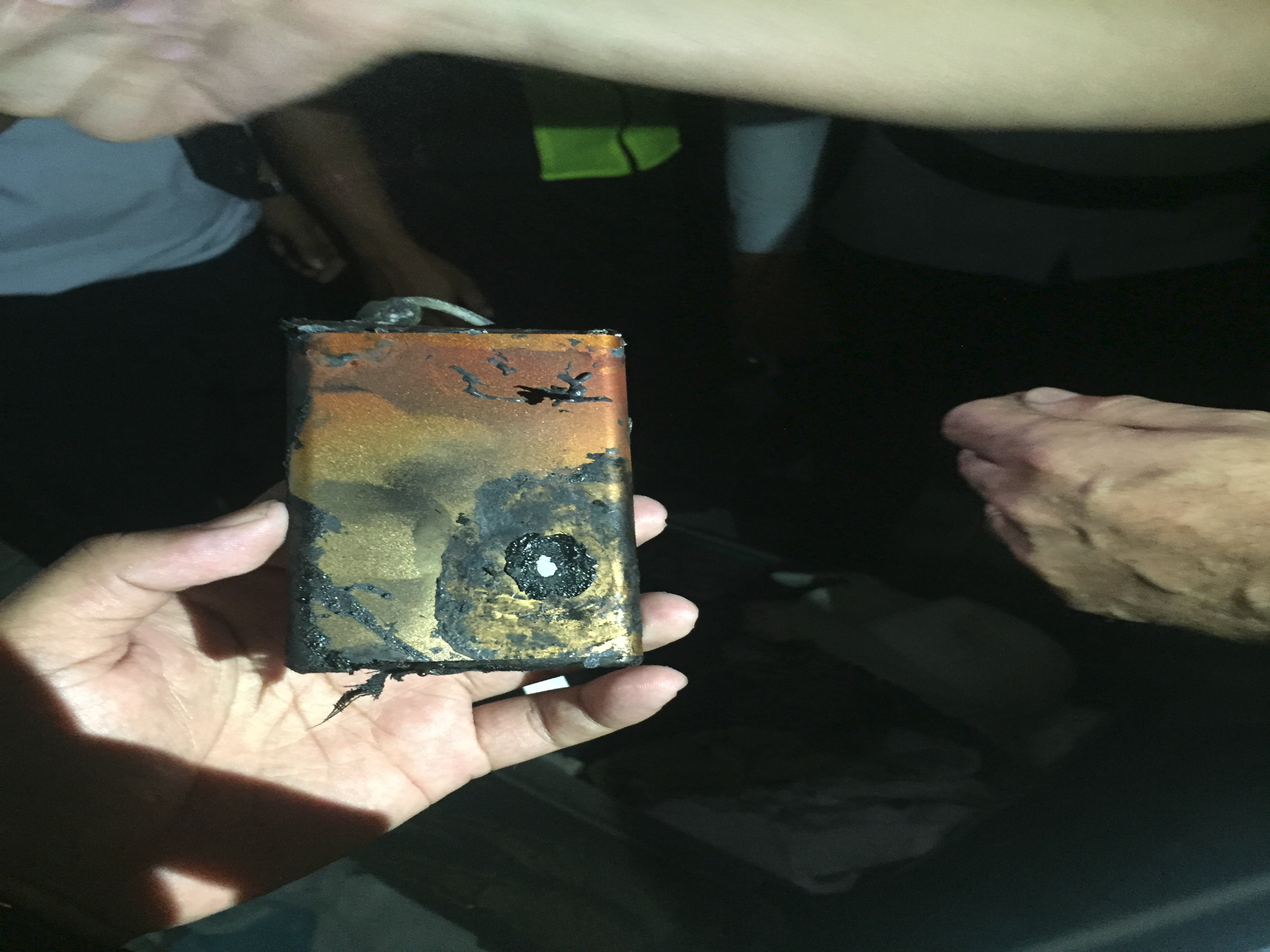
On 28 March 2018, a Boeing 787-8 departed Melbourne, Victoria (Vic.) on a scheduled passenger flight to Bali, Indonesia. On arrival into Bali, while the aircraft was being unloaded, the ground crew noticed smoke emanating from the cargo hold and identified a burnt passenger bag as the potential source. The ground crew subsequently removed the bag from the aircraft. Following further inspection, it was found that a power bank[1] (Figure 1) contained within the passenger bag was the cause of the smoke.
Figure 1: Power bank removed from passenger bag
Source: Operator
Safety message
Spare lithium and lithium-ion batteries can present a significant hazard when carried in the cargo hold of an aircraft. If a battery is damaged or overheats, it can result in a fire. Such fires require the device or battery to be cooled with non-alcoholic liquids. Cabin crew and flight crew are specifically trained in the management of lithium battery smoke and fire incidents in the cabin. If a battery in the cargo hold catches fire, however, it might not be possible to extinguish the fire, with potentially catastrophic results.
Power packs and power banks are classified as spare lithium-ion batteries, therefore only permitted in a passenger’s carry-on baggage. The Civil Aviation Safety Authority (CASA) provides guidance on their “Travelling safely with batteries and portable power packs” webpage and via the ‘Can I pack that? dangerous goods app for passengers.
About this report
Decisions regarding whether to conduct an investigation, and the scope of an investigation, are based on many factors, including the level of safety benefit likely to be obtained from an investigation. For this occurrence, no investigation has been conducted and the ATSB did not verify the accuracy of the information. A brief description has been written using information supplied in the notification and any follow-up information in order to produce a short summary report, and allow for greater industry awareness of potential safety issues and possible safety actions.