On 15 January 2023, at 1055 Local Time, an ATR-72-212A, registered 9N-ANC, was approaching Pokhara International Airport, Gandaki Province, Nepal. During the approach, the aircraft collided with terrain, fatally injuring all 72 occupants, including one Australian citizen.
The Civil Aviation Authority of Nepal (CAAN) investigated the occurrence. As an Australian citizen was fatally injured in the accident, the CAAN invited the ATSB to appoint an expert to the investigation.
To facilitate this appointment, the ATSB undertook an accredited representative investigation under the provisions of the Transport Safety Investigation Act 2003.
On 28 December 2023, CAAN completed its investigation and released the final report into the accident. For further information in relation to the investigation of this accident, please refer to the CAAN.
The Tonga Civil Aviation Office (TCAO) commenced an investigation into a loss of control during taxi, and a subsequent ground collision involving a SAAB 340B, registered A3-PUA, at Fua'amotu International Airport, Tonga, on 8 December 2023. The TCAO requested assistance and the appointment of an accredited representative from the ATSB.
To facilitate this support and to provide the appropriate protections for the information, the ATSB appointed an accredited representative in accordance with paragraph 5.23 of the International Civil Aviation Organization Annex 13 and commenced an investigation under the Australian Transport Safety Investigation Act 2003.
On 26 June 2025, the TCAO released its final report into this accident. Accordingly, the ATSB has concluded its involvement in the investigation.
Any enquiries relating to the accident investigation should be directed to the TCAO.
On 25 June 2023, at 0619 local time, the pilot of an amateur-built hot air balloon (DB-6R), registered G-CMFS, was taking part in a balloon competition, from Worcestershire, England. One part of the competition involved dropping a marker as close as possible to a target location. The accident occurred whilst the balloon was climbing rapidly away from this target. The balloon envelope collapsed, and the basket descended to the ground, fatally injuring the pilot.
The AAIB requested assistance and the appointment of an accredited representative from the ATSB. To facilitate this support, the ATSB appointed an accredited representative in accordance with paragraph 5.23 of the International Civil Aviation Organization Annex 13 and commenced an investigation under the Australian Transport Safety Investigation Act 2003.
On 23 May 2024, the AAIB completed its investigation and released the final report into the accident. For further information in relation to the investigation of this accident, please refer to the AAIB.
On 5 November 2022, an Airborne Australia Edge XT-912-L collided with terrain near Mokuleia, Hawaii. The aircraft was substantially damaged, and 2 people on board were fatally injured.
As the aircraft was Australian manufactured, the United States. National Transportation Safety Board (NTSB) requested that the ATSB appoint an accredited representative to assist in their investigation.
To facilitate this support and to provide the appropriate protections for any information gathered, the ATSB appointed an accredited representative in accordance with paragraph 5.23 of ICAO Annex 13 and commenced an investigation under the Australian Transport Safety Investigation Act 2003.
On 19 November 2024, the NTSB released its final report into this accident. Accordingly, the ATSB has concluded its involvement in the investigation.
Any enquiries relating to the accident investigation should be directed to the National Transportation Safety Board, United States at www.ntsb.gov.
On the 22 September 2023, a Bell Helicopters 407, conducting a passenger flight from Sengapi to Gerbrau Airstrip in Madang Province, collided with terrain during the approach to the airstrip. All of the occupants sustained serious injuries and the helicopter was destroyed.
The Accident Investigation Commission (AIC) of Papua New Guinea requested assistance from the ATSB to oversee the data being downloaded from the engine control unit, at a maintenance organisation in Australia.
To facilitate this support and to provide the appropriate protections for the information, the ATSB appointed an accredited representative in accordance with paragraph 5.23 of ICAO Annex 13 and commenced an investigation under the Australian Transport Safety Investigation Act 2003.
The ATSB attended the successful download of the aircraft engine control unit data at an Asia Pacific Aerospace facility on 1 November 2023 with a technical representative of Rolls Royce. The data was extracted according to Rolls Royce procedures, however it was not possible to determine whether it contained all the relevant data for the occurrence as it could not be accessed locally. The data was provided to the Rolls Royce technical representative for further analysis. No further assistance was sought by, and further enquiries should be directed to the Papua New Guinea AIC as the investigating agency.
On 28 August 2023 an Air New Zealand Q300 passenger aircraft ZK-NES, enroute from Whangarei to Auckland, and a Beech 76 Duchess aircraft ZK-JED, enroute from Auckland to Whangarei, were on reciprocal tracks when reportedly a close proximity event occurred. The crew of ZK-NES took avoiding action. There was no collision, no damage, and nobody was injured.
The Transport Accident Investigation Commission (TAIC) requested assistance from the Australian Transport Safety Bureau (ATSB) to download the aircraft’s cockpit voice recorder (CVR) and assist with reviewing the flight data recorder (FDR) to assist their investigation in Sep 2023.
To facilitate this support and to provide the appropriate protections for the information, the ATSB appointed an accredited representative in accordance with paragraph 5.23 of ICAO Annex 13 and commenced an investigation under the Australian Transport Safety Investigation Act 2003.
On 24 May 2023, VH-IKJ, an Embraer ERJ 190-300, was flown below the minimum safe altitude at night while conducting the Napier RNP 16 instrument approach procedure. The flight crew conducted an orbit at 1,800 ft where the minimum safe altitude was 3,300 ft. After completing the orbit, the crew re-intercepted the final approach and landed at Napier Airport, New Zealand.
What the ATSB found
The ATSB found that the crew experienced a high workload during a critical phase of flight and the aircraft became high on the vertical descent profile for the instrument approach. Perceived time pressures by the flight crew and the belief the visual approach criteria could be complied with, influenced a decision to conduct an orbit during the approach rather than conducting a missed approach.
What has been done as a result
The proactive safety action taken by Pionair Australia as a result of this incident includes but is not limited to the following:
the aircraft’s quick access recorder card was replaced and data is now being captured and analysed
a simulator exercise was developed to replicate the Napier event and how to manage a 2D approach should the aircraft become high on the approach; the simulator exercise commenced on 6 June 2023 as part of the E190 recurrent simulator program
a notice to staff (NTS) has been issued reiterating their obligations to check the operational flight plan is correct and they have received all the NOTAMS and weather forecasts required for the flight
the decision-making events that occurred on the ground in Auckland, during flight and approach to Napier Airport will be included in the human factors and non-technical skills training.
Safety message
This incident highlights the effect that perceived time pressures can have on flight safety. Crews should be focused on arriving at the destination as safely as possible and where unexpected tasks arise, they should take time to reassess the situation and develop a new plan if needed. Flight crews can utilise published holding patterns on approaches to ensure all crew members have completed individual tasks and are ready to provide their full attention during the critical stage of flight. Complying with a published holding pattern combined with flight path monitoring will ensure the aircraft has terrain clearance while the crew are completing other tasks.
The investigation
Decisions regarding the scope of an investigation are based on many factors, including the level of safety benefit likely to be obtained from an investigation and the associated resources required. For this occurrence, a limited-scope investigation was conducted in order to produce a short investigation report, and allow for greater industry awareness of findings that affect safety and potential learning opportunities.
The occurrence
On 24 May 2023, an Embraer Regional Jet (ERJ) 190-300, registered VH-IKJ, and operated by Pionair Australia Pty Ltd on a non-scheduled air transport flight, with 6 crew members (2 flight crew, 3 cabin attendants, one aircraft maintenance engineer) and 86 passengers on board, was planned to depart Brisbane, Australia, for Napier, New Zealand, with a scheduled stop in Auckland to clear New Zealand customs. The flight departed Brisbane at 0343 UTC[1] (1343 local) and arrived in Auckland at 0658 (1858 local). On arrival in Auckland, the aircraft was 52 minutes behind schedule.
Further delays were experienced in Auckland, where the international customs process took longer than expected and a passenger requested personal items be retrieved from the cargo hold. When the crew began preparing the aircraft for departure, they requested extra fuel to plan-ahead for the return leg to Auckland, requesting 3,014 kg more than the figure stated on the flight plan. The fuel had already been loaded when the crew requested their airways clearance. Air traffic control (ATC) advised the crew that the planned track was to fly approximately 113 NM to the north before turning and tracking south again overhead Auckland, adding an unnecessary 227 NM to the flight. The crew accepted an airways clearance to avoid the extra track miles, opting for a more direct route.
As the ground delay increased, the crew were advised by a company operations member that they would need to depart shortly, or Napier Airport would be closed when they arrived. At 2247 local time, the aircraft departed Auckland, 2 hours and 47 minutes after the planned departure time.
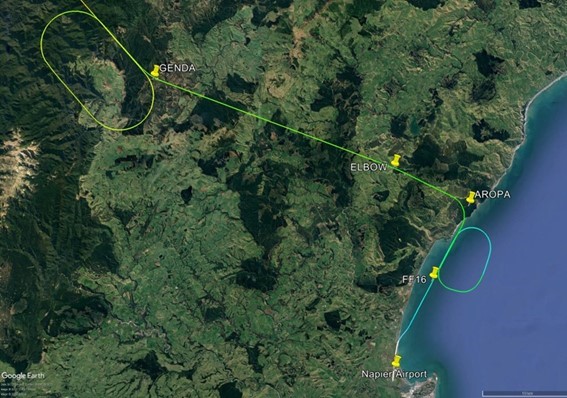
During descent, approaching the waypoint[2] GENDA (Figure 1), the crew determined that due to the reduced track miles and extra fuel uplifted in Auckland, the aircraft would be approaching its maximum landing weight on arrival at Napier. To reduce the aircraft weight, they conducted a holding pattern and started the auxiliary power unit (APU) to increase the fuel burn. After the holding pattern, a descent toward the Napier RNP 16 initial approach fix, waypoint ELBOW, (see section titled Napier RNP 16 instrument approach) was conducted and the crew completed the required checklists.
Figure 1: VH-IKJ flight path
Source: Google Earth with ADS-B exchange data, annotated by ATSB
Near waypoint ELBOW, the aircraft flew through a thin layer of stratus cloud resulting in an ice detection system advisory alert. This required the crew to conduct the Stall Protection Ice Speed checklist, and to recomplete the Approach checklist. Passing the intermediate approach fix at AROPA, the crew observed that the aircraft was now high on the approach and increased the descent rate in an attempt to capture the vertical profile from above.
Just prior to reaching the final approach fix at FF16, the captain, who was the pilot flying,[3] engaged altitude hold along with heading mode on the autopilot, and commanded the aircraft to conduct a left orbit over the ocean. This took the aircraft beyond the inbound approach track tolerance for the approach segment and below the minimum safe altitude (see section titled Minimum altitude for flight). The crew completed the Stall Protection Ice Speed checklist and after re-intercepting the final approach track, re-commenced the descent, before continuing the procedure and landing at Napier Airport.
Context
Aircraft
The aircraft was an ERJ 190-300, manufactured in Brazil in 2019 and issued serial number 19020029. It was registered in Australia as VH-IKJ on 13 February 2020. The aircraft was fitted with 2 Pratt & Whitney PW1919G turbofan engines.
The aircraft requires external stairs for access to the cabin and it was reported that scaffolding had been arranged at Napier Airport as appropriate stairs could not be sourced locally. It had also been arranged for a local ground crew to assist the aircraft on arrival.
Flight Crew
Captain
The captain held an air transport pilot licence (aeroplane) and at the time of the occurrence had a total flying experience of 7,507 hours of which 2,794 were accrued on Embraer 190 type aircraft. On the Embraer 190-300 variant, they had 65 hours flight experience, of which 17 hours were in command. In the previous 90 days, they had flown 19.6 hours. The captain also held an instrument rating[4] with 374 hours of instrument flight time.
The captain reported having experience in many other countries however, the incident flight was the first international leg as pilot in command of an E190-300 type aircraft.
Captain’s duty period
The captain was free of duty in the 72 hours prior to the beginning of the flight duty period and reported receiving a total of 14 hours and 55 minutes of sleep in the previous 48 hours. They received 7 hours and 30 minutes of average quality sleep prior to the flight duty period and had been awake for 16 hours and 30 minutes at the time of the incident.
The captain advised that during the approach, they were mentally tired due to the logistical issues throughout the flight duty period.
First Officer
The first officer held a commercial pilot licence (aeroplane) with a total flying experience of 7,467 hours and 2,556 hours on the Embraer 190 type aircraft. They had 19 hours flight time on the E190-300 variant. The first officer also held an instrument rating with 377 hours of instrument flight time. In the previous 90 days, the first officer had completed 24 hours of flight time.
First officer duty period
The first officer was free of duty for 72 hours prior to the occurrence flight and received approximately 12 hours of good quality sleep in the previous 48 hours.
At the time of the incident, the first officer believed their fatigue level was very lively, responsive, but not at peak.
Flight planning
Flight dispatch
A computer-based flight planning program was used to generate a flight plan for the flight between Auckland and Napier. A flight dispatcher generated the flight plan package (package) however, it was the flight crew who were responsible for ensuring the plan was correct before departure.
The package provided to the flight crew did not include weather reports for Napier Airport, as the system was not designed to retrieve weather from regional airports. A weather forecast for Napier was obtained by the flight crew from the ground handlers in Auckland.
The package included wind direction, velocity and outside air temperature. However, the outside air temperature at 32,000 ft at waypoint TAUPO was -5°C whereas at waypoint GOSTI, 19 NM from TAUPO, the package indicated a temperature of -53°C which would be closer to the expected temperature at this altitude. At Napier, the 5,000 ft temperature was reported as -3°C.
As the crew had obtained a weather report for Napier before departure, it was determined that the omission of destination weather from the package did not contribute to the incident.
Weather
The terminal area forecast (TAF) for Napier Airport was issued on 23 May at 2305 UTC and was valid from 24 May 0000 to 1200 UTC. The active forecast for the arrival at 1200 UTC was light showers of rain and scattered[5] cloud at 3,000 ft with periods of 30–60 minutes where showers of rain were forecast reducing visibility to 7,000 m.
The Meteorological aerodrome report (METAR)[6] prior to the aircraft departure was:
METAR NZNR 241030Z AUTO 22009KT 20KM BKN070 11/09 Q1019
The METAR at the time of arrival was:
METAR NZNR 250000Z AUTO 25006KT 20KM NCD 09/08 Q1020
Basic operating weight
The flight plan reflected a basic operating weight[7] for the aircraft of 33,800 kg however, the load instruction report indicated a dry operating weight of 34,233 kg. The 2 weights should match however, on this occasion they did not, and the weight discrepancy was not rectified prior to departing.
The basic operating weight used by the crew on the load instruction report at the time of departure was higher than the figure provided on the flight plan. Using the higher weight of 34,233 kg, the aircraft remained below the maximum zero fuel weight,[8] maximum take-off weight,[9] and maximum landing weight.
The operator later advised that the basic operating weight for VH-IKJ, when configured as it was on the flight (2 pilots and 3 cabin crew), was 33,907 kg.
The basic operating weight discrepancies did not result in an aircraft limitation exceedance however, if the correct figure had been used, the margin to the maximum landing weight would have been greater. If the crew had not completed the hold at GENDA, they would have arrived about 5 minutes earlier.
The time saved was unlikely to be significant enough to have changed the perceived time pressures (see section titled Perceived time pressure). Therefore, it was unlikely that the weight discrepancy contributed to the descent below minimum safe altitude.
Perceived time pressure
The aircraft was scheduled to arrive in Napier at 2125 local time however, it arrived 2 hours and 35 minutes late. The airport does not have a curfew and does not close to operating aircraft overnight.
While the flight plan listed Auckland as an alternate aerodrome if they could not land at Napier, there were no plans in place to ensure the aircraft could obtain ground handling to assist with disembarking the aircraft at Napier if the flight was delayed.
Checklists
Approach checklist
The Approach checklist is part of the normal procedures and is completed on all flights. It requires the flight crew to check the following items are set appropriately for the approach phase of flight:
passenger signs panel
ice speed reset
landing speeds
speed knob
altimeters
approach aids.
After completing the tasks, a challenge and response checklist must be completed which verifies the following items are set correctly and completes the Approach checklist:
passenger signs panel
ice speed reset
altimeters.
Stall Protection Ice Speed checklist
If the aircraft detects icing conditions exist, the stall protection ice speed system will automatically increase the approach and landing reference speeds. At a landing weight of 49,000 kg, a typical full flap approach speed is 126 kt; with ice detected, the speed increases to 130 kt. The higher speeds result in a longer landing distance. However, it is possible to reset the reference speeds under the following conditions:
ice detectors are not detecting icing conditions
static air temperature[10] (SAT) is at or above 5°C.
The Stall Protection Ice Speed checklist is found in the aircraft electronic Quick Reference Handbook (e-QRH).
The ATSB could not verify the static air temperature at the time the checklist was completed however, the flight crew completed the Stall Protection Ice Speed checklist and reset the ice speeds.
Napier RNP 16 instrument approach
The crew were operating in a foreign country at night and conducted the instrument approach procedure to ensure the aircraft remained clear of terrain. The New Zealand Civil Aviation Authority (CAA) required IFR aircraft to remain at or above the minimum altitudes published in the applicable instrument approach procedure to ensure minimum obstacle clearance.
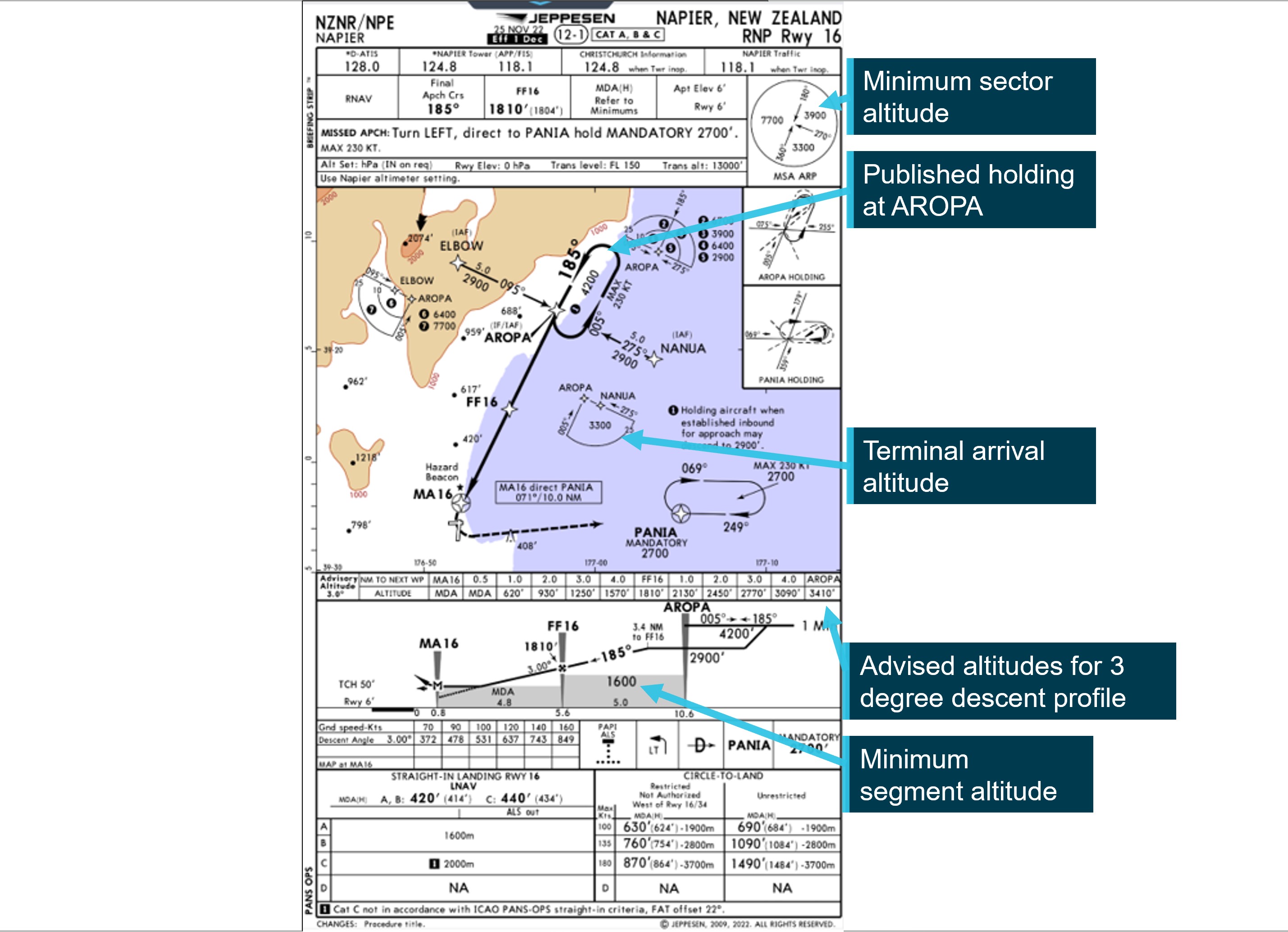
A minimum sector altitude is provided for different areas centred on the airport reference point and defined on the approach plate. They define the minimum altitude an aircraft may descend to unless established on a published approach track with a lower altitude. The minimum sector altitude for the area northeast of Napier was 3,900 ft (Figure 3).
The terminal arrival altitude (TAA) provides a minimum safe altitude from an approach reference point providing a minimum terrain clearance of 1,000 ft at the TAA altitude. The instrument approach has a TAA referenced to AROPA of 3,300 ft (Figure 3).
When flying the RNP approach, the inbound track has a minimum segment altitude which applies to a lateral tracking tolerance[11] on the inbound track. This is often lower than the minimum sector and terminal arrival altitudes. The minimum segment altitude for the inbound track between AROPA and FF16 was 1,600 ft.
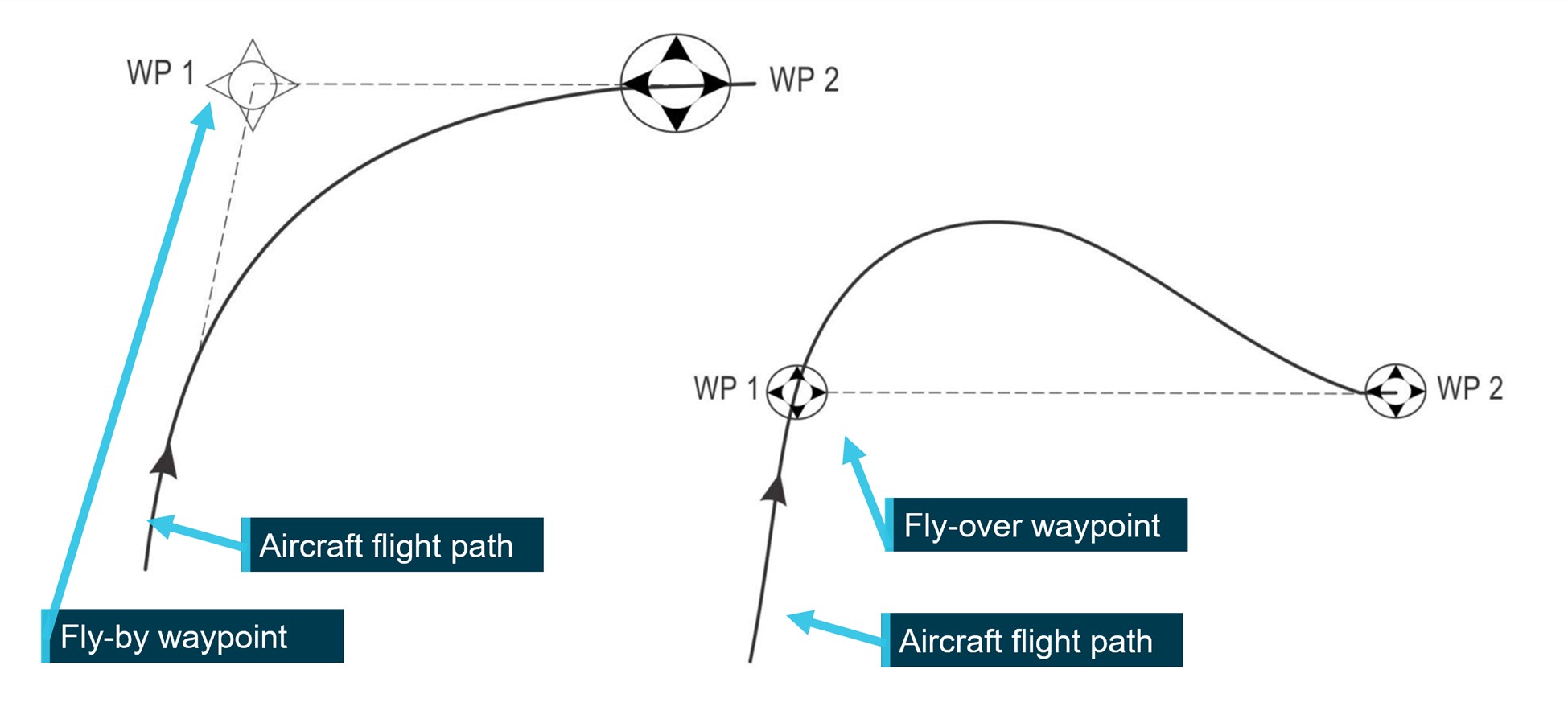
The Napier RNP 16 approach procedure used fly-by waypoints for the initial, intermediate, and final approach waypoints. The fly-by waypoints (when the next waypoint is not on the same track) are different to fly-over waypoints in that the flight path generated creates a constant rate turn toward the next waypoint in the sequence and the aircraft does not pass directly overhead the waypoint (Figure 2). The result of the fly-by waypoint is a reduction in flight distance to the next waypoint. The total track miles lost, when using a fly-by waypoint, changes depending on the aircraft turn radius which is determined by the aircraft bank angle and speed.
Figure 2: Fly-by / fly-over waypoints
Source: PANS Doc 8186 annotated by ATSB
The aircraft was classed as a category C (CAT C) type aircraft. According to the ICAO Doc 8186 Procedures for Air Navigation Services – Aircraft Operations (PANS-OPS), for CAT C aircraft, the maximum change between the final approach track (FAT) and runway centreline was 15°. Advisory Circular AC173-1 - Instrument Flight Procedure Design, published by the Civil Aviation Authority (CAA) of New Zealand, noted that the Napier RNP 16 approach for CAT C aircraft was ‘not in accordance with ICAO PANS-OPS straight in criteria, as it had an offset FAT of 22°.
The CAA also advised that the RNP approach does not intersect the runway centreline at a minimum of 1400 m as per the PANS-OPS requirements. The Napier RNP approach is the only example of this in New Zealand.
Despite these differences to PANS-OPS requirements, as the aircraft had not reached the point in the approach where these differences would have affected the flight, they were not considered to have influenced the event.
Figure 3: Napier RNP 16 approach
Source: Jeppesen approach plate provided by operator and annotated by ATSB
Data
The ATSB was unable to review the aircraft’s quick access recorder as there was an issue with the data card used to record the information.
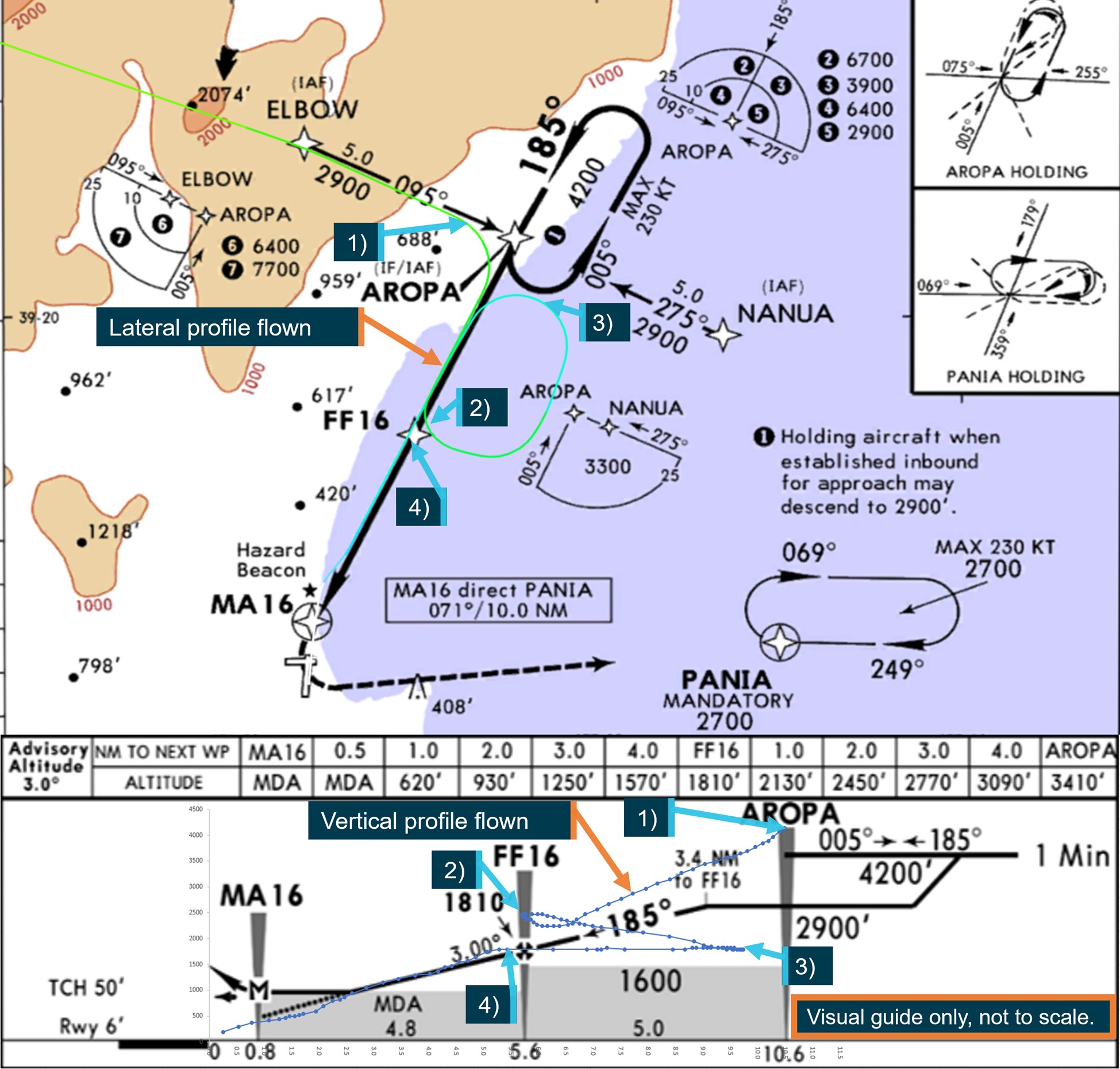
ADS-B data was transmitted by the aircraft and was obtained by the ATSB from a third-party website to analyse the aircraft’s lateral and vertical flight path (Figure 4). The ADS-B data also provided information on the selected autopilot modes at the time of the approach (Table 1).
Figure 4: ADS-B data overlay on the RNP 16 approach
The approach track is labelled to show the altitude the aircraft was at against the vertical profile.
Source: ADS-B data overlay on Jeppesen NZNR RNP 16 annotated by the ATSB
Autopilot modes
The aircraft is equipped with an autopilot system capable of vertical navigation (VNAV) and lateral navigation (LNAV).
While there are multiple VNAV sub-modes available to the flight crew, the ones listed below were appropriate for this occurrence:
flight path angle – maintains a constant angle of descent or climb set by the flight crew until the selected altitude is reached.
altitude hold – maintains the aircraft’s altitude at the time of selection or after the selected altitude has been successfully captured by the autopilot.
Approach mode is a combination of a VNAV and LNAV. When approach mode is active, the aircraft descends using the pre-loaded instrument approach procedure in the aircraft flight management computer database. VNAV autopilot function follows the vertical glide path, and LNAV follows the instrument approach procedure waypoints.
Vertical Glide path – to engage the vertical glide path functionality, approach mode must be armed, and the aircraft must be within 5 NM of the final approach fix with the lateral navigation active. If there is a change in vertical procedure profile, the vertical glide path does not engage.
The flight crew advised that at about AROPA, when they recognised the approach mode had not automatically become the active mode, the pilot flying used the VNAV sub-mode, flight path angle, to try to intercept the glide path from above. It was reported that an angle of 4.5° was utilised in an attempt to recapture the desired 3° vertical profile.
Table 1: ADS-B data showing autopilot modes
Time (UTC)
Position description
Altitude (ft)
Ground speed (kts)
Vertical speed (ft/min)
Vertical Autopilot mode
ATSB Comment
11:47:20
Prior to inbound turn at AROPA
4,875
215
-1,472
VNAV
Autopilot is engaged in VNAV and the sub-mode is unknown
11:47:48
During inbound turn at AROPA
3,900
203
-2,112
VNAV
Approach mode is not active as was expected by the crew
11:48:56
Turning off the final approach track prior to FF16
2,300
187
-640
Altitude Hold
Aircraft is maintaining the selected altitude
11:52:50
Established inbound on the final approach leg after completing orbit
1,700
142
-1,088
Approach
Approach mode has become active
Standard operating procedures
Missed approach procedure
The operator’s operations manual stated that in accordance with Civil Aviation Safety Regulations (CASR) Part 91 Manual of standards section 15.11:
During an instrument approach (IAP), the pilot in command of an aircraft must immediately execute the missed approach procedure for the IAP in any of the following circumstances:
a) during the final segment of the IAP — if the aircraft is flown outside the navigational tolerance for the navigation aid being used; …
Minimum altitude for flight
The operations manual also stated that in accordance with CASR Part 91.305:
The flight crew will not allow the aircraft to be flown below the minimum flight altitude, except when:
• the aircraft is taking off or landing
• the aircraft is being flown in accordance with:
- requirements relating to visual approach or departure procedures published in the authorised aeronautical information for the flight
- an authorised instrument departure procedure or an authorised instrument approach procedure
- an air traffic control clearance
- the aircraft is being flown in VMC by day.
Forecasts
The operator required a forecast for the destination airport be obtained for all flights.
For all Company flights a flight forecast must be obtained.
The [pilot in command] PIC must ensure that the forecasts cover the period for the flight and the aerodrome forecasts for the destination and alternate aerodromes nominated in the flight plan, are valid for a period of not less than 30 minutes before and 60 minutes after the planned ETA. When a flight is delayed so that the meteorological and operational information does not cover the period of the flight, updates must be obtained, as necessary, to allow the flight to be concluded safely.
When a pre-flight briefing is obtained more than one hour prior to [estimate off-block time] EOBT, pilots shall obtain an update before each departure to ensure that the latest information available can be used for the flight. The update shall be obtained via the Company service provider or NAIPS, or by telephone or when this is impractical, by radio.
The approved external briefing services are:
Bureau of Meteorology website
Airservices Australia website – National Aeronautical Information Processing System (NAIPS)
NAIPS iPad application
None of the above approved methods will generate a forecast for Napier Airport, New Zealand.
Inexperienced flight crew
The operations manual also stated:
Inexperienced Flight Crew members, defined within this section, must not be crewed together. Flight Crew members are considered as inexperienced, until they have achieved 100 hours and 10 sectors on the aeroplane type during line operations (This may include experience while the Flight Crew member is flying under supervision.)
Safety analysis
Prior to the departure from Auckland, the flight was significantly delayed, and the crew were advised that the airport at Napier would close if they did not depart within a short timeframe. This resulted in the crew feeling rushed during their preparations. They advised they continued to feel rushed during the flight and the requirement to enter a holding pattern to burn extra fuel added to this perceived time pressure.
During their approach brief, the crew did not identify icing as a potential threat and therefore were not prepared to complete the Stall Protection Ice Speed checklist when they received the advisory message. A high workload quickly developed inside the cockpit as the first officer had difficulty locating the checklist in the electronic Quick Reference Handbook.
ADS-B data confirmed that the aircraft became high on the vertical approach profile prior to joining the Napier RNP 16 instrument procedure. It also confirmed that the crew did not enter the published holding pattern at AROPA to complete the preparations and instead, continued descending to join the vertical profile. At this time, the pilot monitoring was still completing the checklist and was unable to give full attention to monitoring the aircraft’s flight path.
The pilot flying was using the VNAV autopilot function to descend the aircraft and had expected the autopilot to capture the vertical glide path and begin a constant rate of descent. However, a combination of the aircraft been too high, and underestimating the distance to run due to a misinterpretation of the fly-by waypoint, resulted in the aircraft’s position not being within the autopilot parameters to capture the vertical glide path. The pilot flying attempted to capture the glide path from above using the flight path angle autopilot mode but was unable to successfully do so.
The captain decided that they needed to reduce the workload in the cockpit prior to continuing through the final approach fix. Due to the perceived time pressure and a desire to minimise further delay they decided to do this by conducting an orbit rather than a missed approach which would take significantly longer. They believed the visual approach criteria could be complied with and without further discussion, a left turn was commanded via the autopilot descending to 1,800 ft. The left turn took the aircraft beyond the lateral tolerance of the intermediate approach segment and below the minimum safe altitude of 3,300 ft.
The flight crew reported that the E190-300 flight characteristics and autopilot system are slightly different to other variants the crew were more experienced with. So, while their experience on the type technically exceeded the ‘inexperience flight crew’ requirements, the combined 89 hours of E190-300 experience likely contributed to the high workload in the cockpit.
Findings
ATSB investigation report findings focus on safety factors (that is, events and conditions that increase risk). Safety factors include ‘contributing factors’ and ‘other factors that increased risk’ (that is, factors that did not meet the definition of a contributing factor for this occurrence but were still considered important to include in the report for the purpose of increasing awareness and enhancing safety). In addition ‘other findings’ may be included to provide important information about topics other than safety factors.
These findings should not be read as apportioning blame or liability to any particular organisation or individual.
From the evidence available, the following findings are made with respect to the flight below lowest safe altitude involving Embraer ERJ 190-300, registration VH-IKJ at about 11 km north‑north-east of Napier Airport, New Zealand.
Contributing factors
After passing the initial approach fix at ELBOW, the aircraft unexpectedly encountered ice, requiring the crew to conduct the appropriate checklists which increased their workload during a critical phase of flight.
After passing the intermediate approach fix at AROPA, the aircraft was high on the approach and the crew felt time pressure to land the aircraft resulting in the crew conducting an orbit, which was not part of the approach criteria.
The pilot flying believed the visual approach criteria had been met resulting in the flight crew conducting an orbit below the minimum safe altitude.
Safety actions
Whether or not the ATSB identifies safety issues in the course of an investigation, relevant organisations may proactively initiate safety action in order to reduce their safety risk. All of the directly involved parties are invited to provide submissions to this draft report. As part of that process, each organisation is asked to communicate what safety actions, if any, they have carried out to reduce the risk associated with this type of occurrences in the future.
Safety action
The proactive safety action taken by Pionair Australia as a result of this incident includes but is not limited to the following:
the quick access recorder card was replaced and data is now being captured and analysed
Two E190 charter debriefings were held on 6 July and 25 August 2023. The purpose of the debriefings was to bring all key stakeholders together and discuss the issues that had occurred on this charter and other recent E190 charters and develop an action plan to prevent recurrence
the E190 fleet manager and training manager developed a simulator exercise to replicate the Napier event and how to manage a 2D approach should the aircraft become high on the approach. The simulator exercise commenced on 6 June 2023 as part of the E190 recurrent simulator program
a different flight planning software has been selected for use by the operator
a preliminary risk assessment will be developed and will be required to be completed prior to accepting charters
registered access to the Airways New Zealand Internet Flight Information Service (IFIS) will be obtained
a notice to staff (NTS) has been issued reiterating their obligations to check the operational flight plan (OFP) is correct and they have received all the NOTAMS and weather forecasts required for the flight. If there are any issues with the OFP and/or the NOTAMS or weather forecasts provided, the pilot in command must contact the operations controller and have errors corrected. The NTS also states that weather forecast can only be from an approved source
the decision-making events that occurred on the ground in Auckland, during flight and approach to Napier Airport will be included in the human factors and non-technical skills training
an email has been sent to company E190 pilots requiring them to compare the basic operating weight of the aircraft on the flight plan with the load sheet, this will also be formalised as a notice to pilots.
Sources and submissions
Sources of information
The sources of information during the investigation included:
Under section 26 of the Transport Safety Investigation Act 2003, the ATSB may provide a draft report, on a confidential basis, to any person whom the ATSB considers appropriate. That section allows a person receiving a draft report to make submissions to the ATSB about the draft report.
A draft of this report was provided to the following directly involved parties:
flight crew
Pionair Australia Pty Ltd
aircraft manufacturer
Civil Aviation Safety Authority (Australia)
New Zealand Transport Accident Investigation Commission (TAIC)
New Zealand Civil Aviation Authority
Submissions were received from:
Pionair Australia Pty Ltd
New Zealand Civil Aviation Authority /Airways New Zealand
New Zealand Transport Accident Investigation Commission (TAIC)
The submissions were reviewed and, where considered appropriate, the text of the report was amended accordingly.
Purpose of safety investigations
The objective of a safety investigation is to enhance transport safety. This is done through:
identifying safety issues and facilitating safety action to address those issues
providing information about occurrences and their associated safety factors to facilitate learning within the transport industry.
It is not a function of the ATSB to apportion blame or provide a means for determining liability. At the same time, an investigation report must include factual material of sufficient weight to support the analysis and findings. At all times the ATSB endeavours to balance the use of material that could imply adverse comment with the need to properly explain what happened, and why, in a fair and unbiased manner. The ATSB does not investigate for the purpose of taking administrative, regulatory or criminal action.
Terminology
An explanation of terminology used in ATSB investigation reports is available here. This includes terms such as occurrence, contributing factor, other factor that increased risk, and safety issue.
Publishing information
Released in accordance with section 25 of the Transport Safety Investigation Act 2003
Ownership of intellectual property rights in this publication
Unless otherwise noted, copyright (and any other intellectual property rights, if any) in this report publication is owned by the Commonwealth of Australia.
Creative Commons licence
With the exception of the Commonwealth Coat of Arms, ATSB logo, and photos and graphics in which a third party holds copyright, this report is licensed under a Creative Commons Attribution 4.0 International licence.
The CC BY 4.0 licence enables you to distribute, remix, adapt, and build upon our material in any medium or format, so long as attribution is given to the Australian Transport Safety Bureau.
Copyright in material obtained from other agencies, private individuals or organisations, belongs to those agencies, individuals or organisations. Where you wish to use their material, you will need to contact them directly.
[1] Coordinated Universal Time (UTC): the time zone used for aviation. Local time zones around the world can be expressed as positive or negative offsets from UTC.
[2] Waypoint: A defined position of latitude and longitude coordinates, primarily used for navigation.
[3] Pilot Flying (PF) and Pilot Monitoring (PM): procedurally assigned roles with specifically assigned duties at specific stages of a flight. The PF has responsibility for flying the aircraft and the PM carries out support duties and monitors the PF’s actions and the aircraft’s flight path.
[4] Instrument flight rules (IFR): a set of regulations that permit the pilot to operate an aircraft in instrument meteorological conditions (IMC), which have much lower weather minimums than visual flight rules (VFR). Procedures and training are significantly more complex as a pilot must demonstrate competency in IMC conditions while controlling the aircraft solely by reference to instruments. IFR-capable aircraft have greater equipment and maintenance requirements.
[5] Cloud cover: in aviation, cloud cover is reported using words that denote the extent of the cover – ‘scattered’ indicates that cloud is covering between a quarter and a half of the sky.
[6] METAR: a routine report of meteorological conditions at an aerodrome. METAR are normally issued on the hour and half hour.
[7] Basic operating weight or dry operating weight: includes the weight of everything required to operate the aircraft such as the aircraft weight and operating crew however it excludes passengers and fuel.
[8] Maximum zero fuel weight: the weight of the aircraft and payload, everything required to complete the flight excluding fuel.
[9] Maximum take-off weight: the maximum weight of the aircraft, payload and fuel at take-off.
[10] Static air temperature: often referred to as the outside air temperature, it is the undisturbed temperature of the air mass surrounding the aircraft.
[11] The lateral tracking tolerance reduces from 1 NM at the intermediate approach fix to 0.3 NM at the final approach fix.
Occurrence summary
Investigation number
AO-2023-038
Occurrence date
24/05/2023
Location
About 11km north-north-east of Napier Airport
State
International
Report release date
05/03/2024
Report status
Final
Investigation level
Short
Investigation type
Occurrence Investigation
Investigation status
Completed
Mode of transport
Aviation
Aviation occurrence category
Flight Preparation / Navigation
Occurrence class
Incident
Highest injury level
None
Aircraft details
Manufacturer
Embraer S.A.
Model
ERJ 190-300
Registration
VH-IKJ
Serial number
19020029
Aircraft operator
Pionair Australia Pty Ltd
Sector
Jet
Operation type
Part 121 Air transport operations - larger aeroplanes
On 4 May 2021, at 1130 Wallis and Futuna Time, the pilot of a De Havilland DHC-6-300 aircraft, F-OCQZ reported a reduction in engine power on approach to Point Vele Airport, Territory of the Wallis and Futuna Islands.
The French Bureau d'Enquêtes et d'Analyses pour la sécurité de l'aviation civile (BEA) is investigating this occurrence. As part of the investigation, engine number 2 was shipped to an Australian maintenance facility for further examination, and the BEA requested appointment of an Accredited Representative from the ATSB.
To facilitate this request, the ATSB initiated an external investigation under the provisions of the Transport Safety Investigation Act 2003.
Engine examination reports were provided to the BEA by the Australian maintenance facility, at which point ATSB investigation support was completed. Should further assistance be required, the investigation will be reopened.
Occurrence summary
Investigation number
AE-2021-006
Occurrence date
04/05/2021
Location
Point Vele Airport, Territory of the Wallis and Futuna Islands
State
International
Investigation type
Accredited Representative
Investigation status
Completed
Aircraft details
Manufacturer
De Havilland Canada/De Havilland Aircraft of Canada
On 18 February 2023, at 0643 local time, a Textron Aviation CE340A aircraft, registered RP-C2080, departed Bicol International Airport for Ninoy Aquino International Airport, Philippines. A few minutes after departure, air traffic control lost contact with the aircraft, and the wreckage was subsequently found to have collided with terrain on the slope of Mount Mayon. There were 2 Australian citizens on board.
The Civil Aviation Authority of Philippines (CAAP) investigated this occurrence. As Australian citizens were on board the aircraft, the CAAP invited the ATSB to appoint an expert to the investigation. To facilitate this appointment, the ATSB initiated an accredited representative investigation under the provisions of the Transport Safety Investigation Act 2003.
During 2023, an ATSB investigator provided liaison between the Australian passengers' next-of-kin, Australian Federal Police family liaison officers and CAAP as required. The final report into this investigation was released by CAAP on 16 October 2023. The report is available for download on the CAAP website.
On 27 January 2023 a Boeing 777 aircraft, registered ZK-OKN, was conducting a scheduled passenger flight from Melbourne, Australia to Auckland, New Zealand. Shortly after touchdown at Auckland airport, the aircraft briefly lost directional control and the aircraft veered away from the runway centreline. There was damage reported to 6 runway edge lights and to the aircraft’s undercarriage assembly, including deflation of one tyre, there were no injuries to passengers or crew.
The Transport Accident Investigation Commission (TAIC) requested assistance from the Australian Transport Safety Bureau (ATSB) to download the aircraft’s cockpit voice recorder (CVR) and flight data recorder (FDR) to assist their investigation.
To facilitate this support and to provide the appropriate protections for the information, the ATSB appointed an accredited representative in accordance with paragraph 5.23 of ICAO Annex 13 and commenced an investigation under the Australian Transport Safety Investigation Act 2003.
The recorders were downloaded at the ATSB Canberra facilities on 9 February 2023 and the voice and flight data from the occurrence flight were retrieved and provided to the TAIC investigators in attendance. ATSB staff assisted with further analysis of the data as required.
The TAIC was responsible for the investigation and released the final investigation report regarding this occurrence on 29 May 2025. The report is available here.