On 21 September 2006 at 2356 Eastern Standard Time, the US National Transportation Safety Board (NTSB) notified the Australian Transport Safety Bureau (ATSB) of an accident involving a foreign registered and operated Grumman G-73T, Turbo Mallard, aircraft, which occurred on 19 December 2005 near Watson's Island, US (see www.ntsb.gov and DCA06MA010). The NTSB requested assistance from the ATSB to obtain information relating to the operation of Turbo Mallard aircraft in Australia.
The ATSB appointed an accredited representative to participate in the investigation into the occurrence, in accordance with clause 5.23 of Annex 13 to the Convention on International Civil Aviation. To protect the information supplied by the NTSB to the ATSB and the investigative work undertaken to assist the NTSB, the ATSB initiated an investigation under the Transport Safety Investigation Act 2003.
The ATSB accredited representative coordinated the exchange of airworthiness information from an Australian operator of Mallard aircraft. That operator had modified an aircraft by fitting turbine engines.
The NTSB is responsible for the final investigation report regarding this occurrence.
On 21 December 2005, the State Administration of Ukraine for Aviation Safety Oversight (State Aviation Administration) notified the Australian Transport Safety Bureau (ATSB) that it was investigating an air safety occurrence involving an Australian registered and operated Boeing 747-438 (747) aircraft, registered VH-OJO, and a Ukrainian registered and operated Boeing 767-300 (767) aircraft, registered UR-VVF. The incident occurred in the Yangon Flight Information Region (FIR), Myanmar, on 3 December 2005.
The ATSB appointed an accredited representative to participate in the State Aviation Administration investigation into the occurrence, in accordance with clauses 5.18 1 and clause 5.23 2 of Annex 13 to the Convention on International Civil Aviation. To protect the information supplied to the State Aviation Administration, the ATSB initiated an investigation under the Transport Safety Investigation Act 2003. The report presented was prepared with information supplied to the ATSB. Reported times are referenced to Coordinated Universal Time (UTC).
The 747 was operating a scheduled service from Singapore to London, crossing the Yangon FIR at flight level (FL) 320, via airway route B463. Near position POXEM, the crew of the 767, which was on a converging track with that of the 747, requested a clearance to climb from FL300 to FL320. Yangon Air Traffic Services (ATS) cleared the 767 to climb to FL320.
At approximately 0020 the 747 crew observed the 767 on the aircraft's airborne collision avoidance system, approximately 3 NM ahead and at the same level as the 747. Yangon ATS instructed the crew of the 747 to descend to FL310. Once the 767 had passed, the 747 was re-cleared to FL320.
The State Aviation Administration is the independent Ukrainian government entity responsible for the investigation of accidents and incidents involving Ukrainian registered and operated aircraft. The ATSB accredited representative's role in the investigation has been to provide the State Aviation Administration with relevant information about the 747 and its operation and a record of the pilot's report into the incident. The State Aviation Administration will publish the final investigation report.
The State of Registry, the State of the Operator, the State of Design and the State of Manufacture shall be entitled to appoint an accredited representative to participate in the investigation.
Any State which on request provides information, facilities or experts to the State conducting the investigation shall be entitled to appoint an accredited representative to participate in the investigation.
Summary
The Boeing 747 (747) was cruising at FL320. The crew of the Boeing 767 (767) on a converging track, requested clearance to climb from FL300 to FL320. Yangon ATS cleared the 767 to climb. The 747 crew observed the 767 on TCAS at the same level as the 747 approximately three NM ahead. The Yangon ATS controller instructed the 747 crew to descend to FL310. The 747 was re-cleared to FL320 once the 767 had passed.
The occurrence was investigated by the State Administration of Ukraine for Aviation Safety Oversight. In accordance with para 5.23 of Annex 13 to the Convention on International Civil Aviation, ATSB appointed an Accredited Representative to assist the Ukrainian authority.
While on a scheduled passenger flight from Brisbane, Australia, to Los Angeles, US, the crew of the Boeing Company 747-438 aircraft, registered VH-OJD, observed excessive fuel use by the number three engine. After confirmation that the engine had a fuel leak, the flight crew conducted and in-flight engine shutdown and diverted the aircraft to Sydney.
Inspection of the engine found a fuel manifold drain line had fractured. Detailed examination of the drain line revealed that it had been subjected to high cycle fatigue (HCF), which led to its failure. The HCF was attributed to harmonic resonance from a combustor rumble of unknown origin.
As a result of extensive testing of the engine, the manufacturer redesigned the drain line and reviewed its attachment (clipping) arrangements.
On 21 August 2005, the Aircraft and Railway Accidents Investigation Commission (ARAIC) of Japan notified the Australian Transport Safety Bureau (ATSB) of an air safety occurrence involving an Australian-registered and -operated aircraft, which occurred earlier that day at Kansai International Airport. The ATSB appointed an accredited representative to participate in the investigation into the occurrence, in accordance with clause 5.18 1 and 5.23 2 of Annex 13 to the Convention on International Civil Aviation. To protect the information supplied by ARAIC to the ATSB and investigative work undertake to assist the ARAIC, the ATSB initiated an investigation under the Transport Safety Investigation Act 2003. The report presented below was prepared principally from information supplied to the ATSB.
On 20 August 2005, an A330 aircraft, registered VH-QPE, was being operated on a scheduled passenger service from Narita International Airport, Japan, to Perth International Airport, Western Australia. The aircraft departed Narita at about 1238 Coordinated Universal Time, with 13 crew and 181 passengers on board. At 1405, while the aircraft was in cruise, the crew received an Electronic Centralized Aircraft Monitoring (ECAM) warning indicating that there was smoke in the forward cargo hold. The crew activated the fire extinguishing system, and diverted the aircraft to Kansai International Airport, Japan. At 1551, immediately after the aircraft had landed, emergency services personnel reported that there appeared to be smoke in the vicinity of the nose landing gear. The flight crew initiated an emergency evacuation of the aircraft. During the evacuation, one passenger sustained serious injuries and eight passengers sustained minor injuries. In accordance with its obligations under Annex 13 to the Convention on International Civil Aviation, the ARAIC initiated an investigation of the factors that contributed to the development of the accident.
The ARAIC is the independent Japanese government authority responsible for the safety investigation of aviation accidents and incidents in Japan. The Australian accredited representative's role in the investigation has been to provide the ARAIC with information about the aircraft and its operation, and analyse recorded information.
The ARAIC will publish the final report related to the investigation of this occurrence.
The State of Registry, the State of the Operator, the State of Design and the State of Manufacture shall be entitled to appoint an accredited representative to participate in the investigation.
Any States which on request provides information, facilities or experts to the State conducting the investigation shall be entitled to appoint an accredited representative to participate in the investigation.
Summary
On 21 August 2005, the Aircraft and Railway Accidents Investigation Commission (ARAIC) of Japan notified the Australian Transport Safety Bureau (ATSB) of an air safety occurrence involving an Australian-registered and operated aircraft, which occurred earlier that day at Kansai International Airport. The ATSB appointed an accredited representative to participate in the investigation into the occurrence, in accordance with Annex 13 to the Convention on International Civil Aviation.
On 20 August 2005, an A330 aircraft, registered VH-QPE, was being operated on a scheduled passenger service from Narita International Airport, Japan, to Perth International Airport, Western Australia. The aircraft departed Narita at about 1238 Coordinated Universal Time, with 13 crew and 181 passengers on board. At 1405, while the aircraft was in cruise, the crew received an Electronic Centralized Aircraft Monitoring (ECAM) warning indicating that there was smoke in the forward cargo hold. The crew activated the fire extinguishing system, and diverted the aircraft to Kansai International Airport, Japan. At 1551, immediately after the aircraft had landed, emergency services personnel reported that there appeared to be smoke in the vicinity of the nose landing gear. The flight crew initiated an emergency evacuation of the aircraft. During the evacuation, one passenger sustained serious injuries, and eight passengers sustained minor injuries.
The ARAIC is the independent Japanese government authority responsible for the safety investigation of aviation accidents and incidents in Japan. The ARAIC will publish the final report related to the investigation of this occurrence.
The 747 was being operated on a scheduled passenger flight from Singapore to Frankfurt with four pilots, 14 cabin crew and 378 passengers. At the time of flight planning in Singapore, the terminal aerodrome forecast for Frankfurt indicated CAVOK2 conditions at the estimated time of arrival (ETA), and there was no requirement to plan for an alternate aerodrome. The fuel uplift at Singapore for the flight to Frankfurt was in accordance with the operators Civil Aviation Safety Authority (CASA) of Australia-approved fuel policy. The 747 departed Singapore on 27 July at 1521. The ETA for Frankfurt was 0319 on 28 July.
The 0220 Frankfurt routine aviation weather report obtained by the crew included information that CAVOK conditions existed, with no significant changes expected. The crew of the 747 commenced descent into Frankfurt at about 0300, and the Frankfurt automatic terminal information service provided the crew with information that CAVOK conditions existed. As the 747 approached position GED, which was 35 NM from Frankfurt, the air traffic controller instructed the crew to enter a holding pattern at GED. As the 747 was in the holding pattern, radio transmissions from the crews of other aircraft alerted the crew of the 747 that the weather conditions at Frankfurt had suddenly deteriorated, and that there were thunderstorms and heavy rain showers at the aerodrome. The crew elected to divert the 747 to Munich, where it landed without further incident. A number of other international flights were similarly affected. Because of the unexpected and unscheduled diversion from Frankfurt, the reserve fuel remaining on board the 747 when it arrived at Munich was less than that required by the operators CASA approved fuel policy for the planned flight.
The BFU is the independent German government entity responsible for the investigation of accidents and incidents in Germany. The Australian Accredited Representatives role in the investigation has been to provide the BFU with information about the aircraft and its operation, crew details, and a record of discussion taken during an interview conducted with the pilot in command of the aircraft. The BFU will publish the Final Report related to the investigation of this occurrence.
Footnote: 1 Clause 5.18 - The State of Registry, the State of the Operator, the State of Design and the State of Manufacture shall be entitled to appoint an accredited representative to participate in the investigation. Clause 5.23 Any State which on request provides information, facilities or experts to the State conducting the investigation shall be entitled to appoint an accredited representative to participate in the investigation.
2 CAVOK Visibility 10 km or more; no cloud below 5,000 ft or below the highest minimum sector altitude, whichever is the greater, and no cumulonimbus; no precipitation, thunderstorm, shallow fog, low drifting snow or dust devils.
Summary
On 5 August 2005, the Federal Bureau of Aircraft Accidents Investigation of Germany (BFU) notified the Australian Transport Safety Bureau (ATSB) that it was investigating an air safety occurrence involving an Australian-registered and operated Boeing 747-438 (747) aircraft, registered VH-OJE, which occurred at Frankfurt, Germany on 28 July, 2005. The ATSB appointed an accredited representative to participate in the investigation into the occurrence, in accordance with clause 5.18 and clause 5.231 of Annex 13 to the Convention on International Civil Aviation. To protect the information supplied to the BFU, the ATSB initiated an investigation under the Transport Safety Investigation Act 2003. The report presented below was prepared principally from information supplied to the ATSB. Reported times are referenced to Coordinated Universal Time.
On 3 May 2005, Metroliner SA227-AC, registered ZK-POA, was operating a freight service from Auckland to Blenheim, New Zealand. The aircraft was reported to have experienced an in-flight breakup near Stratford and both pilots, the only occupants, were fatally injured.
The Transport Accident Investigation Commission (TAIC) of New Zealand was responsible for investigating this accident and requested assistance from the Australian Transport Safety Bureau (ATSB) to recover information from the flight recorders. In accordance with the Transport Safety Investigation (TSI) Act 2003, the Executive Director of the ATSB approved the request and the recorders were transported to the ATSB by a TAIC investigator on 16 May 2005.
The cockpit voice recorder (CVR) and flight data recorder (FDR) were examined by ATSB recorder specialists and information was successfully recovered from both recorders.
Once it has been completed, a copy of the TAIC investigation report (05-006) may be found at: www.taic.org.nz or by contacting:
TAIC, PO Box 10-323 Wellington 6036 New Zealand
Summary
Following a request from the New Zealand Transport Accident Investigation Commission, ATSB is providing assistance regarding the recorder data from a Metroliner which was involved in an accident in New Zealand on 03 May 05.
At approximately 4pm local time on 2 April 2005, Sea King helicopter N16-100 (callsign 'Shark 02'), crashed on the Indonesian island of Nias while on a humanitarian support mission.
Nine Australian Defence Force personnel were fatally injured in the accident. An investigation was conducted by the Department of Defence Aircraft Accident Investigation Team (AAIT) and a Board of Inquiry was appointed on 28 April 2005.
The Sea King helicopter was equipped with a deploy-able Beacon Airfoil Unit that recorded four channels of information:
Pilot audio
Co-pilot audio
Cockpit area microphone audio
Rotor speed encoder data
The AAIT requested assistance from the Australian Transport Safety Bureau (ATSB) in the analysis of the audio recovered from the BAU. In accordance with the Transport Safety Investigation Act 2003, the Executive Director of the ATSB approved the request.
A compact disk containing the recovered audio (Department of Defence Evidence Register Item No. 031) was delivered to the ATSB on 21 April 2005.
The audio was replayed and analysed in the ATSB's audio laboratory by a flight recorder specialist. Verbal advice was provided to the AAIT. Audio analysis was also performed separately by the Defence Science and Technology Organisation (DSTO). The AAIT did not request a written report from the ATSB as DSTO would be providing a report.
On 9 April 2005 at about 0815 universal coordinated time, the Transport Accident Investigation Commission (TAIC) of New Zealand notified the Australian Transport Safety Bureau (ATSB) of an air safety occurrence involving an Australian-registered and operated aircraft, which occurred earlier that evening near Auckland International Airport. The ATSB appointed an accredited representative to participate in the investigation into the occurrence, in accordance with clause 5.18 1 of Annex 13 to the Convention on International Civil Aviation. To protect the information supplied by TAIC to the ATSB and investigative work undertaken to assist TAIC, the ATSB initiated an investigation under the Transport Safety Investigation Act 2003. The report presented below was prepared principally from information supplied to the ATSB.
FACTUAL INFORMATION
The occurrence involved a Boeing Company B747-338 (747) aircraft, registered VH-EBW, with a crew of 16 and 346 passengers, which was being operated on a scheduled passenger service between Sydney, Australia, and Auckland, New Zealand. The copilot was the handling pilot for the flight.
As the 747 was on the landing approach to runway 23 right (23R) at Auckland, the Auckland Tower and Terminal controllers observed an unidentified aircraft tracking towards the approach path of the 747. The controllers instructed the crew of the 747 to discontinue the approach, and turn the aircraft right towards the central city area, and to climb to 3000 ft. The aircraft subsequently entered instrument meteorological conditions (IMC) at an altitude of 3,000 ft above mean seal level (AMSL). The flight crew reported that shortly after, and while still in IMC, they received a TERRAIN, PULL-UP warning from the aircrafts enhanced ground proximity warning system (EGPWS). The pilot in command took control of the aircraft and commenced an immediate climb in accordance with the operators 747 procedures. The crew advised air traffic control that they had received a GPWS terrain warning, and that they were climbing the aircraft to 5,000 ft AMSL.
At the same time, a New Zealand-registered 747 was making an instrument approach to runway 23R, and had been cleared to descend to an altitude of 4,000 ft AMSL. As the Australian-registered 747 was climbing to 5,000 ft AMSL, it passed about 1.9 NM behind the New Zealand-registered 747, which was descending through 4,500 ft AMSL. The required separation standard was 3 NM laterally or 1,000 ft vertically. There was an infringement of the required separation standard. No avoiding action was taken, or was required to be taken, by either crew.
The TAIC is the independent New Zealand government entity responsible for no blame safety investigation of accidents and incidents in New Zealand. The Australian accredited representatives role in the investigation has been to provide the TAIC with information about the aircraft and its operation, recorded flight data recovered from the aircraft flight data recorders, crew details, and records of discussions taken during separate interviews conducted with the pilot in command and the copilot of the Australian-registered 747. The TAIC expects to complete the investigation into this occurrence by October 2005, and will publish the final report on its website at www.taic.org.nz.
1Clause 5.18 - The State of Registry, the State of the Operator, the State of Design and the State of Manufacture shall be entitled to appoint an accredited representative to participate in the investigation.
The Australian Transport Safety Bureau did not conduct an on-scene investigation of this occurrence. The report presented below was prepared principally from information supplied to the Bureau.
REPORTED INFORMATION
On 8 March 2005, the Gippsland Aeronautics Pty Ltd GA-8 aircraft, registered VH-FGN, was carrying emergency relief supplies from Muelaboh to Patek in Aceh Province, Indonesia, as part of the Tsunami relief effort. The aircraft occupants comprised the pilot and one passenger.
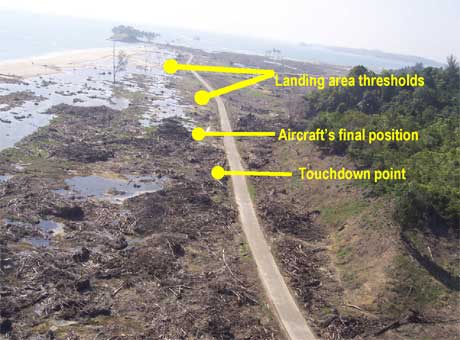
A level, 700 m long and 7 m wide portion of a bitumen-sealed roadway formed the designated landing area for the operator's relief flights into Patek. The landing area was not marked with runway markings.
The operator reported that the pilot misidentified the commencement of the landing area, and that the aircraft touched down about 400 m short of the commencement of that area.
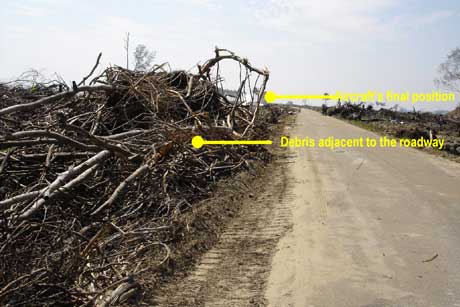
There was debris adjacent to the part of the road where the aircraft landed.
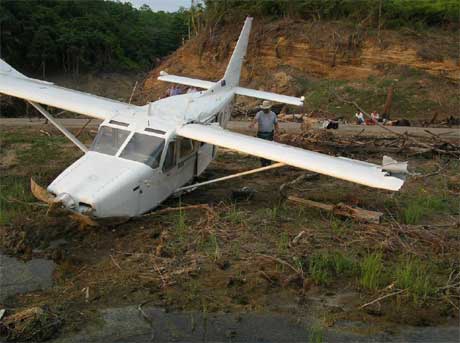
During the landing flare, the aircraft's left wingtip struck some of that debris, and a 1 m portion of the left wingtip was dislodged. The impact yawed the aircraft to the left, and the right wingtip then contacted the ground.
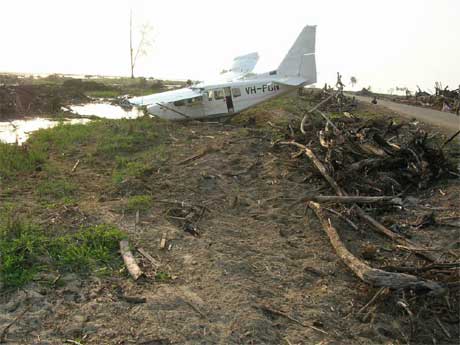
The landing gear collapsed, and the aircraft came to rest to the left of the sealed roadway, about 100 m from where the left wingtip initially struck the debris.
The two occupants were uninjured and were able to exit the aircraft unaided.
The pilot held an Australian Commercial Pilot (Aeroplane) Licence and was endorsed to fly the GA-8 aircraft. The operator provided induction training for the pilot at the commencement of his duties in Aceh Province. The training included one landing at Patek. The accident occurred four days after the pilot commenced duties in Aceh Province. During those four days, the pilot had performed two take-offs from Patek and had landed there twice before the accident flight.
There was no evidence that environmental, mechanical, operational or other factors contributed to the circumstances of the accident.
The operator reported that as a result of the occurrence, it will conduct a risk analysis before the commencement of any new operations such as those conducted at Aceh Province. The operator also reported that it would include a special training module in its Operations Manual for pilots assigned to operations in Aceh, and that procedures for aircraft operating on roads would also be included in its Operations Manual.
Summary
On 8 March 2005, the Gippsland Aeronautics Pty Ltd GA-8 aircraft, registered VH-FGN, was carrying emergency relief supplies from Muelaboh to Patek in Aceh Province, Indonesia, as part of the Tsunami relief effort. The aircraft occupants comprised the pilot and one passenger.
The failure of the forward roller support was due to fatigue. Fatigue is a result of a materials defect and/or the loading conditions of a part. The forward door support proved to exhibit no inherent microstructural defects that would attribute to this failure, therefore, the magnitude and cyclic nature of the load are likely to have been contributing factors.
In this case it was not possible to establish the definitive reason for the failure of the part, as the entire door structure and the locating screws were not available for examination. However, the vibration and resonance of the support during routine use, and the thickness and deterioration of the paint layer applied to the support, are likely to have affected the function and performance of the door support over time.
CONCLUSION
4.1 Contributing factors
Examination and analysis of the forward door attachment and the mating serrated plate identified the support failed in fatigue.
4.2 Other findings
The forward door support proved to exhibit no inherent microstructural defects that would attribute to this failure.
A reason for the fatigue failure was not able to be established as the entire door structure including locating screws was not available to complete the analysis.
Factaul Information
At 0825 local time on 10 March 2005, a Bell 212 helicopter with three crew and five passengers departed Wallaby landing zone near Moliana, East Timor to conduct an aerial survey of the island. Prior to the flight, the passengers requested that the cabin sliding doors be secured in the open position for better observation. At approximately 0935, while tracking along the coast at 90 KIAS at approximately 800 ft AGL, the flight crew reported that they experienced a bump to the helicopter similar to air turbulence. A subsequent control and instrument check did not reveal any problems. The rear crewmember then informed the pilot in command (PIC) that the right cabin sliding door had fallen off. The PIC elected to conduct a precautionary landing in a nearby field. Following the landing, damage to the right side of the tail boom and horizontal stabilizer was noted and the door recovered for examination.
The Australian Transport Safety Bureau examined the sliding door attachment hardware to determine if there were any pre-existing faults of the components.
Examination of the aircraft and wreckage revealed that the forward roller support of the passenger door had fractured. The part had no specified safe life.
1.1 Assembly information
Two parts were recovered from the forward door assembly, the forward roller support and the mating serrated plate.
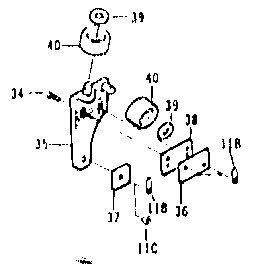
The forward roller support (35), illustrated in figure 1, is located inside the passenger compartment of the helicopter and is one of four roller attachments of the passenger door to the upper track. When the door is in the open position, this attachment carries the entire load of the passenger door. Elliptical holes through the support and its attachment to the mating serrated plate (38) via screws (34), allow the door to be located between the upper and lower roller tracks.
Figure 1: Forward Door Support Assembly.
1.2 Visual Examination
1.2.1 Forward Roller Support
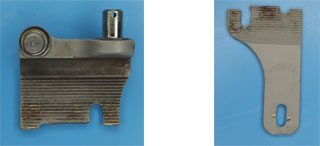
The forward roller support was recovered in two sections shown in figure 2 as A and B. The fracture of this part extended through the serrated area of the support, 45mm from the top of section A and intersecting with the elliptical locating holes. The support was painted with a chromate primer and a grey top coat, together approximately 100µm thick.
Figure 2: Section A of the forward roller support (left) and Section B of the forward roller support (right).
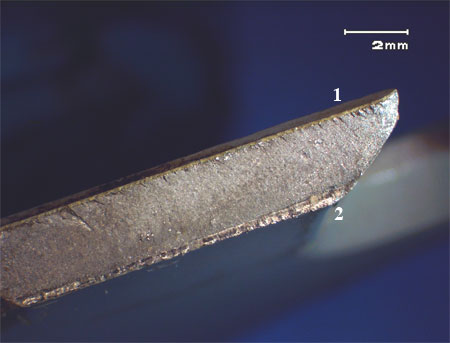
The fracture surface revealed striations and ratchet marks, consistent with fatigue failure. Part of the fracture surface of section B, shown in figure 3, reveals ratchet marks occurring at the serrated edge of the support (1) and final fracture at the back edge of the support (2). This is consistent along the entire fracture surface.
Figure 3: Fracture surface of section B, ratchet marks are visible at the serrated edge of the part (1) and the final fracture of the back edge of the part (2).
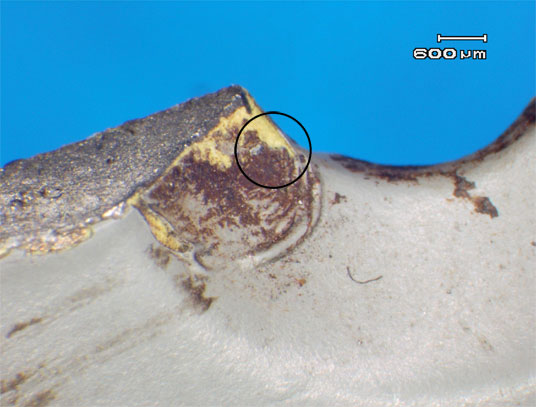
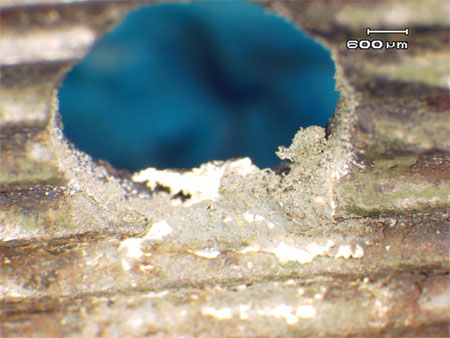
Iron oxide deposits were also observed on sections A and B. Location of the oxide coincided with the mating surfaces of the forward door assembly and the serrated plate and between the elliptical holes and the locating screws. Close examination of the elliptical holes revealed the paint layer was pleated as shown in (figure 4). The location of these pleats coincided with the positions of locating screws. Further deterioration of the paint layer was also observed in this area, leaving the yellow primer exposed.
Figure 4: Oxide products within the elliptical holes of section B. Note the top coat deterioration and pleating (circled) revealing the chromate primer layer (yellow).
1.2.2 The Serrated Plate
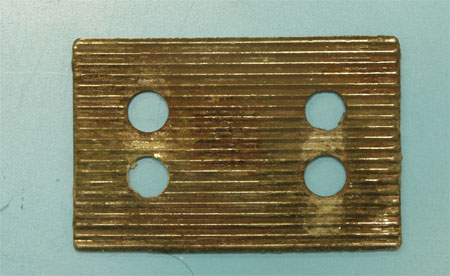
The serrated plate attachment, shown in figure 5, was not painted. Iron Oxide and fretting of the holes were observed, shown in figure 6. The screws that attached the roller support and serrated plate to the passenger door were not recovered for this investigation.
Figure 5: The serrated plate.
Figure 6: Fretting around holes in the serrated plate. Iron oxide products are also visible.
1.3 Metallographic Examination
A segment of the forward roller support including the fracture surface and serrations was removed from section B. The representative sample was prepared and examined to characterise the materials general microstructure.
The material which exhibited magnetic properties, revealed a microstructure typical of a Precipitation Hardened (PH) Stainless Steel . PH Stainless Steels are often used in the aircraft and aerospace industries due to superior hardness and corrosion resistance. The martensitic type microstructure revealed by this sample, shown in figure 7, is typical for this material.
Figure 7: Microstructure of the forward roller support material (10X magnification).
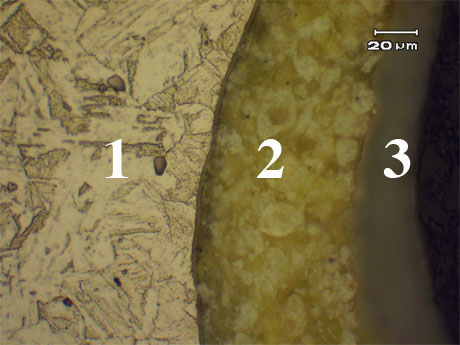
Figure 8: The metal (1), primer (2) and top coat layer (3) interfaces (10X magnification).
Vickers hardness tests were carried out using a 20kg load, a total of five tests returned a mean value of 323 HV. These hardness results are typical of PH stainless steels.
FRACTURE CHARACTERISATION
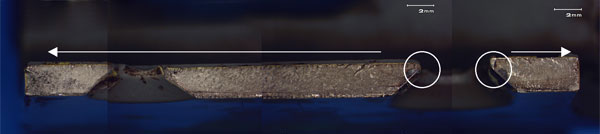
Using light microscopy, the fracture surface of section A revealed the part had failed in fatigue. Crack initiation was identified as occurring on both sides of the right screw hole, circled in figure 9, and more clearly shown in figure 10. Ratchet marks at the serrated edge of the support indicated that crack progression occurred in the direction arrowed in figure 9, and through the thickness of the part. Rapid, unstable fracture characterised by a brighter fracture surface was also observed, shown in figure 11.
Figure 9: Fracture surface of section A. Crack initiation sites are circled and crack propagation directions are indicated with arrows (6X magnification).
Figure 10: Crack initiation sites, section A (6X magnification).
Figure 11: Rapid, unstable fracture surface, section A. Note the brighter appearance of the fracture surface (6X magnification).
Summary
Technical Analysis Report No. 22/05
Occurence No. 200501155
Examination of a Failed Forward Door Attachment from a Bell 212 aircraft, registered VH-LHX, on 10 March 2005.