Wirestrike

Wirestrike involving Cessna 172, VH-TKI, 13 km north-east of Bendigo, Victoria, on 29 October 2012

Previous updates

Update 18 December 2012

The occurrence

On 29 October 2012, a Cessna 172N, registered VH-TKI, was being operated on a flight from Coldstream, Victoria to a private airstrip at Bagshot, Victoria, with a pilot and two passengers on board. The private flight was being conducted to position the aircraft for maintenance.

The aircraft arrived at the airstrip at about 1300 Eastern daylight-saving time. A witness, who was located at the southern end of the airfield, observed a Tecnam aircraft land from the south as the Cessna 172 entered the circuit. The Tecnam landed and backtracked to a maintenance facility located on the southern end of the airstrip.

The pilot of the Cessna overflew the strip then conducted a right circuit to land. The passenger seated behind the pilot stated that all the occupants were focussing their attention on the Tecnam on the airstrip during the circuit and final approach.

The witness at the airfield stated that, as the Tecnam cleared the airstrip, the Cessna was on a short final approach. He saw the aircraft contact a powerline, located at the southern end of the airfield. The aircraft rotated over the powerline, significantly reducing its forward speed and causing it to impact the runway in an almost inverted attitude.

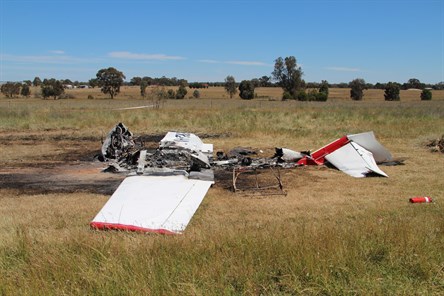
The aircraft came to rest inverted, and a post-impact, fuel-fed fire initiated at the wing roots and destroyed the aircraft (Figure 1). Witnesses reached the aircraft quickly and assisted the occupants. However, the front seat passenger was fatally injured, the pilot was seriously injured and the rear seat passenger sustained minor injuries.

Figure 1: Accident site of the Cessna 172, VH-TKI

Accident site of the Cessna 172, VH-TKI

Source: ATSB

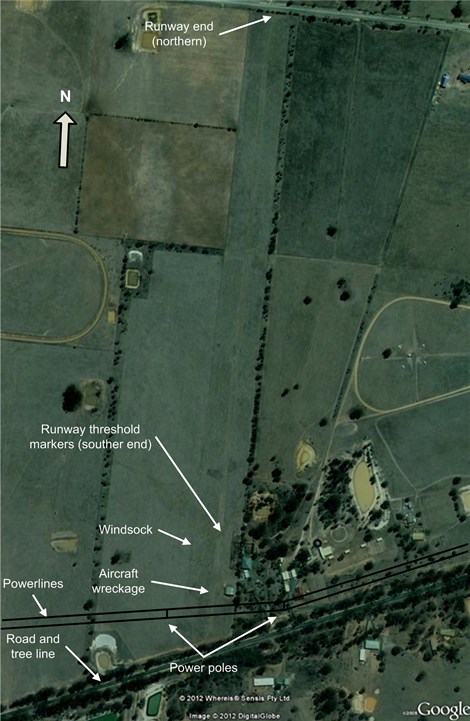
Examination of the aircraft showed that its nose landing gear contacted the powerline. The powerline was located 7 m above ground level and about 140 m from the end of the 900 m long landing strip (Figure 2).

The powerline had no markers fitted, nor were any required under the current Australian Standards for private landing strips. The owner of the landing strip advised that he routinely provided advice to pilots using the airstrip of the location of the powerline and of the need to land a significant distance down the airstrip to avoid the wire if landing from the south.

Figure 2: High level view of runway

Accident site of the Cessna 172, VH-TKI

Source: Google

Investigation activities

The on-site phase of the investigation concluded on 2 November 2012. The investigation is continuing and will include analysis of the circumstances surrounding the wirestrike including, but not limited to:

  • the location of the powerline in relation to the airstrip
  • requirements for powerline markers
  • pilots’ knowledge of the powerline’s location
  • pilot distraction
  • pilot visibility
  • pilot experience
  • the circuit flown by the pilot.

The information contained in this web update is released in accordance with section 25 of the Transport Safety Investigation Act 2003 and is derived from initial investigation of the occurrence. Readers are cautioned that new evidence will become available as the investigation progresses that will enhance the ATSB’s understanding of the occurrence as outlined in the web update. As such, no analysis or findings are included in this update.

Update 2 November 2012

The ATSB team has now completed the on-site stage of the investigation. The team has:

  • examined the wreckage
  • interviewed one of the passengers and the aircraft owner
  • reviewed the aircraft’s maintenance logs.

The ATSB’s investigation will now continue off-site. 

This page will be updated as significant information comes to hand. 

The ATSB aims to finalise its investigation within 12 months.

Subscribe now to receive news and information from the ATSB and follow us on Twitter @atsbinfo for investigation updates. 

Update 30 October 2012

The ATSB team is on-site:

  • coordinating activities with local police and Coronial staff
  • interviewing witnesses
  • conducting initial site assessment
  • planning site activities.

29 October 2012

The ATSB has sent a team of investigators to begin the on-site phase of the investigation. The team comprises experts in engineering and aircraft operations. It is expect they will arrive mid-morning (Tuesday 30 October) and spend three to five days at the accident site.
 
As part of the on-site investigation, the team will be:

  • examining the wreckage for evidence
  • interviewing witnesses and aircraft operator
  • reviewing maintenance documents.

 The ATSB will also review the pilot’s training and experience and collate and analyse witness information. 
 
If you have any information about the accident please call the ATSB on 1800 020 616.

Summary

What happened

On 29 October 2012, a Cessna 172N, registered VH-TKI (TKI), was being operated on a visual flight rules (VFR) flight from Coldstream to a private aircraft landing area (ALA) at Bagshot, Victoria, with a pilot and two passengers on board.

A witness at the airfield stated that as TKI approached short final on the approach, the aircraft contacted a powerline located at the southern end of the airfield. The powerline significantly reduced the aircraft’s forward speed, causing it to rotate about its nose and impact the airstrip in an almost inverted attitude. A post-impact, fuel-fed fire initiated at the wing roots almost immediately and witnesses assisted the aircraft occupants from the aircraft. However, the front-seat passenger was fatally injured, the pilot was seriously injured and the rear seat passenger sustained minor injuries.

What the ATSB found

Examination of the aircraft showed that its nose landing gear contacted the powerline. The powerline was located 8 m above ground level and about 140 m south of the displaced threshold of the landing strip.

The ATSB found that the pilot was aware of the powerline, but that his recollection was that they were closer to the tree line in the undershoot to the landing strip. In addition, a lack of adequate displaced threshold markings and the mown undershoot area led him to believe that the entire strip was useable for landing. This combined with the inherent difficulty of visually detecting wires and the distraction of another recently-landed aircraft on the airstrip to reduce the likelihood of the pilot detecting the wire.

No high visibility devices were attached to the powerlines, nor were they required to be under the current Australian Standards.

What's been done as a result

In response to this accident, the owner of the ALA has made significant changes to the runway markings, landing permission procedures affecting operations at the ALA and the available safety and firefighting equipment. In addition, markers have been erected near the powerline.

Safety message

Aeroplane landing area owners can help manage the risk of collisions with obstacles by assessing their airstrips against the guidance in Civil Aviation Advisory Publication (CAAP) 92-1(1) Guidelines for Aeroplane Landing Areas. Such risk assessments should explicitly consider the needs of first time users of the ALA.

Operational risk can also be reduced by pilots ensuring sufficient time to make appropriate decisions including, if in doubt, an early decision to go around. Pilots should also ensure that everyone in their aircraft is wearing seatbelts correctly, affording the best chance of survival in case of an accident.

Occurrence summary

Investigation number AO-2012-142
Occurrence date 29/10/2012
Location 13 km NE of Bendigo
State Victoria
Report release date 07/11/2013
Report status Final
Investigation level Systemic
Investigation type Occurrence Investigation
Investigation status Completed
Mode of transport Aviation
Aviation occurrence category Wirestrike
Occurrence class Accident
Highest injury level Fatal

Aircraft details

Manufacturer Cessna Aircraft Company
Model 172
Registration VH-TKI
Serial number 17270881
Sector Piston
Operation type Private
Departure point Coldstream, Vic.
Destination Bagshot, Vic.
Damage Destroyed

Wirestrike - Robinson R44, VH-HIE, 21 km east of Maryborough Airport, Victoria, on 12 June 2012

Summary

On 12 June 2012, a Robinson Helicopter Company R44 Raven 1, registered VH-HIE (HIE), departed Moorabbin, Victoria with one person on board to conduct a private flight to a property at Moolort, about 23 km east of Maryborough aerodrome, Victoria.

During the flight, the pilot decided to check on the progress of a bore under construction about 2 km west of the intended destination. The pilot landed at the bore site without incident and after only a short time on the ground, decided to depart in the same direction as his approach.

At about 1130 Eastern Standard Time, the helicopter became airborne and as it transitioned from hover to forward flight, the pilot saw a single strand powerline directly ahead. The helicopter hit the powerline and subsequently impacted the ground. The pilot was not injured, however the helicopter was seriously damaged.

The accident highlights the importance of a proper reconnaissance when flying in a wire environment and remaining focused only on operational tasks. The pilot's reaction to the wirestrike, which was to continue to fly the aircraft to the ground, assisted in him being able to land without injury.

Aviation Short Investigation Bulletin - Issue 12

Occurrence summary

Investigation number AO-2012-079
Occurrence date 12/06/2012
Location 19 Km from Maryborough Airport
State Victoria
Report release date 29/10/2012
Report status Final
Investigation level Short
Investigation type Occurrence Investigation
Investigation status Completed
Mode of transport Aviation
Aviation occurrence category Wirestrike
Occurrence class Accident
Highest injury level None

Aircraft details

Manufacturer Robinson Helicopter Co
Model R44
Registration VH-HIE
Serial number 1112
Sector Helicopter
Operation type Private
Departure point Moorabin Airport
Damage Substantial

Wirestike - Air Tractor AT-802, VH-NIW, 5 km north of Mogumber, Western Australia, on 26 August 2011

Summary

On 26 August 2011, at about 1545 Western Standard Time, an Air Tractor Inc. AT-802, registered VH-NIW, struck power lines and impacted terrain, during agricultural spraying operations.

Earlier that day, the pilot had commenced the first of six agricultural spraying flights. At mid-morning, he was approached by a farmer to carry out an unscheduled spraying operation of wheat paddocks next to a main road. The farmer supplied the pilot with a map of the fields to spray, which included the location of two powerlines.

On reaching the property, the pilot commenced his field inspection and identified the two powerlines and paddocks marked on the farmer's map. At the same time, he noticed vehicle traffic on the main road located next to the spraying area and a third set of powerlines.

The pilot noted a break in the traffic and commenced the spraying operation. When about 300 m into the paddock, the aircraft struck an unseen fourth set of powerlines. The aircraft's engine lost power and impacted terrain in a neighbouring paddock. The aircraft sustained serious damage, and the pilot was not injured.

This accident highlights the vital role hazard identification plays, particularly when operating at low-level, and how distractions can impact operations. It is a reminder that distractions are not unique to any one type of operation and that no pilot is immune.

Occurrence summary

Investigation number AO-2011-107
Occurrence date 26/08/2011
Location 5 km N of Mogumber
State Western Australia
Report release date 14/03/2012
Report status Final
Investigation level Short
Investigation type Occurrence Investigation
Investigation status Completed
Mode of transport Aviation
Aviation occurrence category Wirestrike
Occurrence class Accident
Highest injury level None

Aircraft details

Manufacturer Air Tractor Inc
Model AT802
Registration VH-NIW
Serial number 802-0300
Sector Turboprop
Operation type Aerial Work
Departure point Newdale, WA
Destination Newdale, WA
Damage Substantial

Collision with terrain - Robinson R22 Beta, VH-HSW, 90km south-west Cunnamulla Airport, Queensland, on 12 July 2011

Summary

On 12 July 2011, a Robinson Helicopter R22 BETA II, registered VH-HSW, departed the rural property "Tinnenburra", about 90km SW of Cunnamulla, Queensland, for a local cattle mustering flight.

The take-off was delayed due to another operational matter and the pilot reported feeling distracted and under time pressure to commence the flight.

Shortly after commencing mustering, the pilot initiated a descent to move the cattle away from a fence line. Following the descent, and while focusing on the cattle, the pilot noticed a powerline near the helicopter skid but was unable to avoid the wire. After colliding with the powerline, the pilot could not maintain control of the helicopter and it impacted the terrain.

The pilot sustained serious injuries, and the helicopter was seriously damaged.

The aircraft operator has previously looked into a wire alerting system using the onboard GPS. They are continuing to examine ways in which this technology could be incorporated into their operation.

Occurrence summary

Investigation number AO-2011-080
Occurrence date 12/07/2011
Location Cunnamulla Airport, SW 90 km
State Queensland
Report release date 12/12/2011
Report status Final
Investigation level Short
Investigation type Occurrence Investigation
Investigation status Completed
Mode of transport Aviation
Aviation occurrence category Wirestrike
Occurrence class Accident
Highest injury level Serious

Aircraft details

Manufacturer Robinson Helicopter Co
Model R22 BETA
Registration VH-HSW
Serial number 3298
Sector Helicopter
Operation type Aerial Work
Departure point Tinnenburra Station, Qld
Destination Tinnenburra Station, Qld
Damage Substantial

Wirestrike - Bell 206B (III), VH-BHU, near Mossman Hospital (HLS), Queensland, on 1 June 2011

Summary

On 1 June 2011, a Bell Helicopter 206B (III), registered VH-BHU (BHU), departed Mossman Sports Ground, Queensland for a local area charter flight. The flight was conducted as a weed spotting operation and there was one pilot and three passengers, acting as weed spotters, on board.

The aircraft was operating about 10-15 ft above the tree top level when the pilot initiated a slow left turn, and the helicopter struck a dual-line powerline. The pilot was unaware that there was a powerline in the vicinity prior to the collision. The pilot applied control inputs to keep the helicopter level as it descended though the tree canopy.

The helicopter landed in an upright position and the pilot and three passengers were able to exit. The pilot and one passenger sustained serious injuries, and the other two passengers sustained minor injuries.

As a result of the accident, the helicopter operator conducted a meeting to discuss the factors that led to the accident and highlight the hazards. They also issued a wire awareness information pack to all current pilots and modified the pilot briefing notifications to specifically highlight hazards when working at low level. The Operations Manual was also being updated to enhance the section on low level reconnaissance and changes were made to the Emergency Response Plan.

Occurrence summary

Investigation number AO-2011-067
Occurrence date 01/06/2011
Location near Mossman Hospital
State Queensland
Report release date 12/12/2011
Report status Final
Investigation level Short
Investigation type Occurrence Investigation
Investigation status Completed
Mode of transport Aviation
Aviation occurrence category Wirestrike
Occurrence class Accident
Highest injury level Serious

Aircraft details

Manufacturer Bell Helicopter Co
Model 206
Registration VH-BHU
Serial number 2964
Sector Helicopter
Operation type Aerial Work
Departure point Port Douglas, Qld
Destination near Mossman, Qld
Damage Substantial

Wirestrike - Bell Helicopter 206B, VH-BNG, 6 km east of Ingham, Queensland, on 4 May 2011

Summary

On 4 May 2011, at about 0730 Eastern Standard Time, a Bell Helicopter B206, registered VH-BNG, struck a single power line and conducted a precautionary landing in a nearby field.

The pilot had commenced end of the season, agricultural spraying operations of sugar cane fields earlier that day and was on his third chemical spray load. While approaching a paddock of four hectares, he calculated that with the required buffer zone of 100 m from each house, the effective spray coverage would only be one hectare. As the pilot flew over one of the houses, his focus was diverted from looking for powerlines, to a resident walking from the house to his car.

While observing the resident, the pilot considered where to start the spray run, taking into account, the buffer zone and that he needed to quickly get low over the cane field. After the pilot had assessed that the resident was comfortable with the presence of the helicopter, his focus moved to commencing the spray run and not to looking for powerlines. The pilot quickly descended the helicopter toward the field to begin the spray run and it struck a power line to the house. After a precautionary landing in the field, the pilot observed that the helicopter had sustained damage to the chin view windows and one main rotor blade.

As a result of this accident, the pilot advised that planning for future operations would be carried out by the pilot, not by persons indirectly involved in the operation.

Occurrence summary

Investigation number AO-2011-059
Occurrence date 04/05/2011
Location Ingham (ALA), East 6 Km
State Queensland
Report release date 12/12/2011
Report status Final
Investigation level Short
Investigation type Occurrence Investigation
Investigation status Completed
Mode of transport Aviation
Aviation occurrence category Wirestrike
Occurrence class Serious Incident
Highest injury level None

Aircraft details

Manufacturer Bell Helicopter Co
Model 206
Registration VH-BNG
Serial number 580
Sector Helicopter
Operation type Aerial Work
Damage Minor

Wirestrike - Robinson R44, VH-HUL, near Maitland, New South Wales, on 2 April 2011

Summary

On 2 April 2011, a Robinson Helicopter Company R44 Raven 1, registered VH-HUL, was conducting charter operations from a helicopter landing site at the Lorn Reserve on the east bank of the Hunter River, near Maitland, New South Wales. The helicopter had been positioned on flat ground, facing NE, 23 m south of three overhead 11kv power conductors that spanned the river next to the Belmore Bridge.

On the second flight of the day, the pilot commenced hover checks at the landing site having observed a gradual wind change from the SE to the SW before the flight. The pilot had used the trees on the eastern bank of the Hunter River as a visual cue and saw the wind gusting straight across the river from a SW direction.

After completion of the hover checks, the pilot flew the helicopter forward and commenced a left U turn to face the river. At about 50 ft above ground level, the helicopter was caught in a southerly wind gust and drifted towards the 11kv conductors. As the pilot turned the helicopter south, one of the main rotor blades severed a power conductor. After hearing a loud noise and feeling a slight shudder, the pilot landed back at the Reserve.

One of the severed conductors fell onto a safety railing on the Western side of the Hunter River. The ensuing electrical discharge resulted in a full thickness burn to the leg of a three-year-old child in contact with the railing, about 156 m south of the bridge.

As a result of this occurrence, the aircraft operator has introduced and documented new processes and completed a number of amendments, to their operations manual and safety manual relating to HLS/ALA procedures, pilot qualifications and HLS Records.

Occurrence summary

Investigation number AO-2011-046
Occurrence date 02/04/2011
Location near Maitland
State New South Wales
Report release date 12/09/2011
Report status Final
Investigation level Short
Investigation type Occurrence Investigation
Investigation status Completed
Mode of transport Aviation
Aviation occurrence category Wirestrike
Occurrence class Accident
Highest injury level None

Aircraft details

Manufacturer Robinson Helicopter Co
Model R44
Registration VH-HUL
Serial number 1644
Sector Helicopter
Operation type Charter
Departure point near Maitland NSW
Destination near Maitland NSW
Damage Minor

Wirestrike - Cessna 210L, VH-AQS, 19 km south-west of Cootamundra, New South Wales, on 9 February 2011

Summary

On 9 February 2011, a Cessna 210L aircraft, registered VH‑AQS, departed Temora, for a local low-level survey flight in the vicinity of Junee and Cootamundra, New South Wales.

The survey flight was conducted at 133 ft above ground level. About 1 hour and 20 minutes into the flight, the aircraft struck a powerline, which was strung across a 907 m span over a gully.

Following the collision with the powerline, the pilot diverted to Cootamundra aerodrome and conducted a flapless approach and landing. The pilot reported that the aircraft did not have any control issues following the wirestrike.

As a result of the investigation, the operator has issued a memo to flight crew highlighting the details of the event. The operator has also raised the minimum survey height to 180 ft for high-risk survey tasks and will roster more experienced crews on these jobs.

The operator's Chief Pilot has also reiterated to pilots that they are encouraged to raise the survey height if they believe a safety hazard exists.

Occurrence summary

Investigation number AO-2011-030
Occurrence date 09/02/2011
Location 19 km SW Cootamundra Airport
State New South Wales
Report release date 12/09/2011
Report status Final
Investigation level Short
Investigation type Occurrence Investigation
Investigation status Completed
Mode of transport Aviation
Aviation occurrence category Wirestrike
Occurrence class Accident
Highest injury level None

Aircraft details

Manufacturer Cessna Aircraft Company
Model 210
Registration VH-AQS
Serial number 21059952
Sector Piston
Operation type Aerial Work
Departure point Temora, NSW
Destination Temora, NSW
Damage Substantial

Piper PA28-161, VH-IJK, Goulburn NSW, 22 May 1985

Summary

The pilot was conducting a night cross-country exercise to maintain his recent experience requirements. On final approach he realised that the aircraft was undershooting. Some engine power was applied and the approach was continued but the pilot then saw power lines ahead, too late to take any avoiding action. The aircraft struck the wires and subsequently impacted the ground 211 metres short of the threshold. It came to rest 91 metres further on after colliding with a fence. The wires struck provided power for the airfield lighting, which was extinguished at the time of collision. The power lines struck were 28 feet agl and were 600 metres from the threshold. The pilot had been slow to realise that the undershoot situation was developing and had not taken appropriate action to either regain the normal approach path or to go-around.

Occurrence summary

Investigation number 198502538
Occurrence date 22/05/1985
Location Goulburn
Report release date 08/08/1985
Report status Final
Investigation type Occurrence Investigation
Investigation status Completed
Mode of transport Aviation
Aviation occurrence category Wirestrike
Occurrence class Accident
Highest injury level None

Aircraft details

Manufacturer Piper Aircraft Corp
Model PA-28
Registration VH-IJK
Operation type Private
Departure point Bankstown NSW
Destination Goulburn NSW
Damage Substantial

Piper PA25-235, VH-SPE, Dooen, 10 km NE of Horsham, VIC, 22 December 1984

Summary

Prior to the flight the pilot was given details of the paddock in which the glider was located, by the glider pilot. This information included reference to power lines on the western side. An inspection run into the west was performed at 300 feet agl and as a run at a low height towards the east was commenced the landing gear struck a power line suspended 9 metres above the ground. The aircraft struck the ground in a vertical nose down attitude and came to rest inverted. The power line ran obliquely across the paddock from a line of poles paralleling a railway track. There were no supporting poles in the paddock to alert the pilot as to the whereabouts of a power line and he assumed that those running next to the railway were the ones mentioned in the briefing.

Occurrence summary

Investigation number 198402357
Occurrence date 22/12/1984
Location Dooen, 10 km NE of Horsham
Report release date 05/03/1985
Report status Final
Investigation type Occurrence Investigation
Investigation status Completed
Mode of transport Aviation
Aviation occurrence category Wirestrike
Occurrence class Accident
Highest injury level Minor

Aircraft details

Manufacturer Piper Aircraft Corp
Model PA-25
Registration VH-SPE
Operation type Private
Departure point Horsham, Vic
Destination Dooen, Vic
Damage Destroyed