On 20 September 2014, the pilot of a Piper PA-25 aircraft, registered VH-CPU, conducted a ferry flight from Camden to Bunyan aeroplane landing area, via Goulburn, New South Wales.
After refuelling at Goulburn aerodrome, the pilot tracked to overhead Michelago and continued south towards Bunyan. About 10 km south of Michelago, the pilot intended to overfly a private airstrip to assess its condition and suitability as a potential out-landing site for gliders operating from Bunyan.
The aircraft was heading south and as the airstrip was oriented approximately north-south, the pilot elected to overfly the runway. When about 300 m beyond the runway threshold, the aircraft struck powerlines that crossed the runway about 15 m above ground level, dislodging the windscreen and canopy. The top of the fin was severed by the powerlines. Immediately after the strike, the aircraft banked to the left before returning to level flight. The pilot assessed that the aircraft was too high to land ahead on the remaining runway and made a right turn, initially planning to land towards the north on the adjacent paddock. However, due to the rough surface of the paddock and tailwind, he conducted a short downwind leg before turning to the right, and the aircraft landed into wind on the runway.
The ability of pilots to detect powerlines depends on the physical characteristics of the powerline and the effect of weather conditions. Powerlines may not be contrasted against the surrounding environment and the wire itself can be beyond the resolving power of the eye. Pilots are advised to use additional cues to identify powerlines, such as the power poles and buildings to which the powerlines may connect.
On 20 August 2014, the pilot of a Robinson R66 helicopter, registered VH-JRX, conducted a site inspection from a vehicle prior to commencing aerial spraying near Giru, Queensland. The pilot identified powerlines running along the eastern, southern and northern boundaries of the paddock to be sprayed. He then conducted a flight over the paddock and assessed the hazards in the area and confirmed he was able to see all of the powerlines he had identified from the ground.
At about 1500 Eastern Standard Time (EST), the pilot commenced aerial spraying in an east-west direction. At the end of each run, the pilot climbed the helicopter up and over the powerlines, turned then descended once clear of the powerlines and sprayed the paddock in the opposite direction.
At about 1645, the pilot commenced the final clean-up run. The helicopter was operating along the southern boundary of the paddock, parallel to the powerlines running along the southern and northern borders. The pilot was aware of those powerlines, however when about 5 m from the eastern boundary, he sighted the powerlines running perpendicular to the direction of flight. The pilot assessed that it was too late to climb over the powerlines and elected to fly underneath them and to ensure the helicopter remained above the crop.
The main rotor blade hub struck the powerlines and the helicopter collided with the ground. The helicopter was substantially damaged, and the pilot sustained minor injuries.
This incident provides a reminder to pilots to conduct an aerial reconnaissance to confirm wire locations and other hazards.
On 20 July 2014, the pilot of a Cessna 182L aircraft, registered VH-TRS, was conducting a private flight in the local area surrounding the rural township of Burrumbuttock, NSW. The aircraft was observed by witnesses to be travelling at low altitude in a westerly direction toward the township. As the aircraft was flown above a paddock on the outskirts of the town, the aircraft struck wires from a high voltage powerline. The aircraft subsequently rolled inverted and impacted terrain. The wreckage came to rest a short distance from the Farmers Inn. The pilot was fatally injured, and the aircraft was destroyed.
What the ATSB found
The ATSB found no evidence of any engine or airframe defect that may have contributed to the accident. The pilot did not hold any approval to conduct low flying and had not received training in the identification of hazards or in the operating techniques for flight close to the ground. There was no operational reason identified for the pilot to have been flying at such a low altitude on the day of the accident. The evidence also indicated that the pilot had a history of unauthorized low flying.
The pilot was reported to be in good health with no issues that might have affected his ability to fly an aircraft. Despite this, the postmortem medical examination revealed a pre-existing medical condition that could have resulted in pilot incapacitation. While it is possible that the pilot may have had a medical incapacitation event immediately prior to the accident, the aircraft was being operated in a manner consistent with previous flights undertaken by the pilot and at a level that provided little margin for error should such an event have been experienced.
Safety message
This accident highlights the importance to pilots of not flying below the regulated thresholds of 1,000 ft AGL for flight overpopulated areas and 500 ft for flight over non-populated areas. Pilots who fly below this height without appropriate training and an operational reason to do so are exposing themselves and any passengers that may be on board to an increased risk of striking hazards, such as electrical power lines, many of which are difficult to see from the cockpit of an aircraft in flight.
Accident site VH-TRS
Source: ATSB
Findings
From the evidence available, the following findings are made with respect to accident involving a Cessna 182L aircraft, registered VH-TRS, while being flown around Burrumbuttock, New South Wales on 20 July 2014. These findings should not be read as apportioning blame or liability to any particular organisation or individual.
Contributing factors
While the pilot was operating at low level, the aircraft contacted electrical powerlines and collided with terrain.
Other factors that increased risk
The pilot did not hold any approval to conduct low flying and had not received training in the identification of hazards or in the operating techniques for flight close to the ground.
Other findings
There was no evidence of any defect with the aircraft that might have contributed to the accident.
While it is possible that the pilot may have had a medical incapacitation event immediately prior to the accident, the aircraft was being operated in a manner consistent with previous flights undertaken by the pilot and at a level that provided little margin for error should such an event have been experienced.
The powerline was not fitted with visual warning markers, nor was there a requirement for such markers in accordance with the Australian Standard.
The occurrence
At about 1700 Eastern Standard Time[1] on 20 July 2014, a Cessna 182L aircraft, registered VH-TRS, departed from the pilot’s own airstrip for a private flight under visual flight rules[2]. The pilot was appropriately qualified and endorsed on the type of aircraft. Family members and friends of the pilot reported that he regularly flew on weekends around the Burrumbuttock area. His pilot logbook indicated that the flights were generally short in duration of less than one hour.
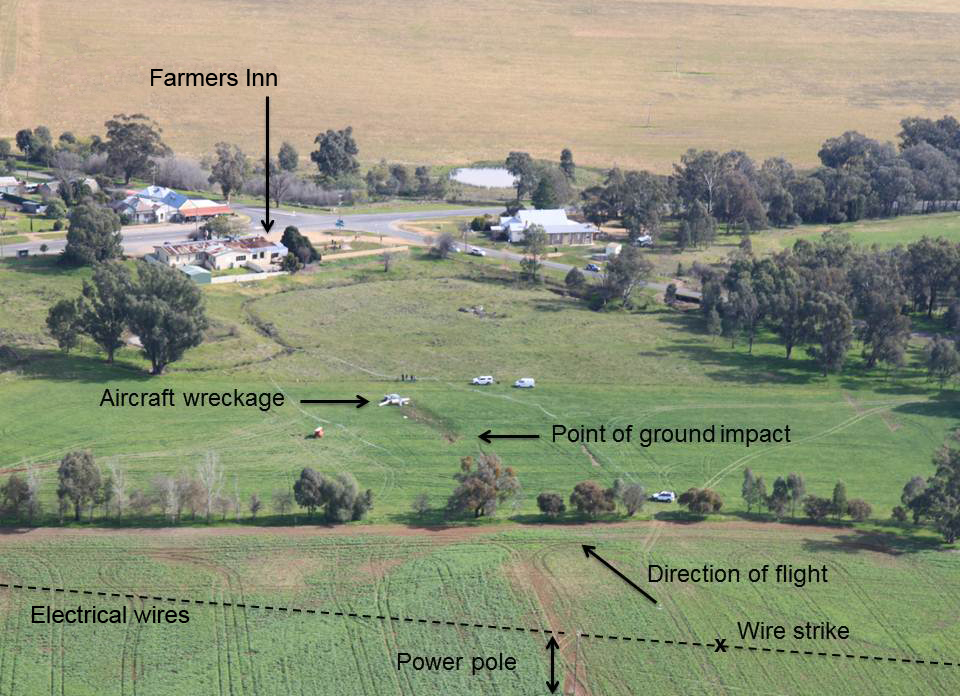
About 30 minutes into the flight the aircraft was observed to be flying at a low altitude above the ground in a westerly direction toward Burrumbuttock. At 1733, the aircraft struck two energised electrical wires from a powerline in a paddock that bordered the town. The aircraft continued on for a short distance before it impacted terrain in a steep nose-down inverted attitude, stopping short of the Burrumbuttock ‘Farmers Inn’ hotel (Figure 1).
Patrons within the inn were alerted to the accident and immediately exited the establishment to investigate. A number of people ran to the wreckage to render assistance to the pilot. Despite the presence of leaking fuel, one of the patrons crawled into the aircraft where it was confirmed the pilot had sustained fatal injuries.
Figure 1: The accident site at Burrumbuttock
Source: ATSB
Witness descriptions
There were a number of witnesses identified during the investigation that had either spoken with the pilot early on the day of the accident, who saw the aircraft flying later that afternoon, or who had seen the accident.
Those who saw or heard the aircraft on the day of the accident reported nothing abnormal in its operation. It was noted that it was not unusual to see the aircraft flying quite late in the day around the local area. Two witnesses reported seeing the aircraft flying quite low as it approached the town.
Immediately prior to the accident, the aircraft was observed approaching the town at low altitude. The aircraft appeared to lose height as it banked left, in the direction of the Farmers. It struck the powerlines shortly afterwards. The aircraft subsequently became unstable and impacted terrain a short distance from the hotel.
While flying at low-level, the aircraft struck powerlines and lost control, resulting in the impact with terrain. The ATSB determined that the aircraft was capable of normal operation up until the wire strike. Upon striking the wires, the left wing aileron cable was severed, rendering the aircraft uncontrollable for the pilot. The aircraft subsequently rolled left and impact terrain at high speed. There was no pre-existing engine or airframe defects that would have contributed to the accident.
The witness descriptions and flight path of the aircraft indicated that the pilot had deliberately intended to overfly the Farmers Inn hotel. The considerable distance at which the aircraft travelled following the wire strike, as well as its configuration as found at the accident site, was not consistent with the pilot attempting to make an emergency landing. No operational reason could be identified for the pilot to fly at a height less than the minimum prescribed levels.
Analysis of the recorded GPS data indicated that the pilot had regularly flown at, and conducted hazardous low-level flying manoeuvres in the months preceding the accident. The pilot resided just outside the Burrumbuttock township and made regular flights over the town. It was therefore probable that he was aware of the presence and location of the powerline and the hazard that it posed. Powerline poles often provide good visual cues to enable a pilot to see the electrical wires. However, when the span between the poles is large this important visual cue is diminished or unavailable.
Additionally, at the time of the accident, the sun had set below the level of the horizon and the sky was overcast, thereby further reducing the ambient light. Under these conditions the pilot’s ability to detect the electrical wires was likely to have been significantly diminished.
Identifying the powerlines
Identifying powerlines and other similar obstructions from an aircraft in low-level flight is not a simple task. If the powerlines are in an area that is known to be a hazard for aircraft operations then they are required to be marked to enhance visibility. In this case, the powerlines were not required to be marked and, therefore, there was no enhancement to indicate their presence or assist in locating them. Factors such as windscreen visibility and environmental conditions can compound the problem of detection.
Wire strike accident investigations have often revealed that the pilot was aware of the presence and location of a powerline, but have nevertheless flown into it. The investigations have shown that even in the event that a subject pilot is able to detect the wires immediately prior to contact, the operating speed of the aircraft would severely limit the opportunity to react.
The effects of a wirestrike at low level are obvious; significant damage to the aircraft, usually leading to a loss of control and, because of the lower margin for recovery, subsequent impact with the ground or water. Pilots must keep in mind that not only do powerlines exist at low levels and in remote areas, they are also not easy to identify. Even against a clear blue sky, wires are difficult to spot for a number of reasons. Wires can oxidise to a blue/grey tinge and may blend into the background, or the wire may be obscured by terrain. Wires are very difficult to detect from the air and can be encountered in the most unexpected places in rural areas. Even if a pilot has spotted a powerline, the ability to judge its distance from the aircraft can be distorted by optical illusions or a lack of nearby visual reference points.
Low-level flying also presents fewer opportunities to recover from a loss of control compared to flight at higher altitudes. It takes time to react and to regain control of an aircraft should something go wrong.
Incapacitation
The postmortem medical examination revealed a pre-existing medical condition that could have led to the pilot being incapacitated during the flight in the moments leading up to the accident. Some coronary damage in the form of plaque haemorrhage and fibrin deposition to the pilot’s heart was found during the examination. Those changes are typically seen as an immediate precursor to a coronary artery thrombosis with the potential for a ‘heart attack’ and subsequent incapacitation. It was also possible that the arterial damage observed during the post-mortem examination had been induced by the impact forces experienced by the pilot.
While this pathological evidence cannot be discounted, the possibility of an incapacitating event is tempered by the facts surrounding the accident. The recorded data supports the numerous witness statements that the aircraft was being flown in a controlled manner and had been conducting low-level manoeuvring prior to the accident. Such operation of the aircraft was consistent with both witness accounts regarding previous flights and the recorded data from the GPS from previous flights.
Context
Pilot information
The pilot had lived and worked in the Burrumbuttock region for around 20 years. He had obtained a private pilot aeroplane license in January 1999 and subsequently gained experience in a range of single- and twin-engine aircraft. Toward the end of 1999, the pilot had attained an Aerobatics and Spinning endorsement and in 2005 had also qualified to fly at night under visual meteorological conditions.[3][4]
The pilot’s logbook showed that he had last undergone and successfully completed a biennial flight review in April 2014. He did not hold a low-level flying endorsement and there was no record of him undergoing low-level flying training. He had accumulated a total of 1,033.6 flying hours, approximately half of which was spent at the controls of the accident aircraft.
The pilot regularly flew the aircraft around the local area and was known to fly over the Farmers Inn, within the Burrumbuttock township, on occasion during weekend flights. A witness to one of these previous flights recalled that the aircraft had passed over the inn, tracking in a westerly direction and that he thought the pilot had maintained a safe altitude.
The pilot occasionally flew with a family friend, also an experienced aviator and one who regarded the accident pilot as someone who flew well and in control. Most of the accident pilot’s flying was around regional New South Wales and Victoria.
Medical and pathological information
The pilot’s last aviation medical assessment was in October 2010, at which time there was no identified medical condition and/or medication which may have affected his ability to operate an aircraft. Family and friends of the pilot reported that he was fit and well rested in the period leading up to the accident.
A post-mortem examination was conducted and the autopsy report stated that the injuries sustained to the pilot were consistent with that of a high energy aircraft accident. Toxicological screening did not reveal the presence of any drugs or toxins.
The autopsy report also stated that narrowing and damage of a major coronary artery to the pilot’s heart was identified. There was an area of plaque haemorrhage and fibrin deposition within the artery that is typically seen as an immediate precursor to a heart attack. The report summarised that, due to abnormalities in the blood vessel, it was possible that the pilot became incapacitated prior to the crash.
Aircraft information
The aircraft was manufactured in the United States in 1968 by the Cessna Aircraft Corporation as a model 182L. The aircraft was a four-seat, single-engine, high-wing configuration with a conventional tricycle undercarriage. The engine fitted was a Teledyne-Continental Motors six-cylinder reciprocating piston variety with a McCauley two-blade, constant speed propeller. The aircraft was certified for visual flight rules (VFR) and VFR Night; where flying during the day or night was permitted under visual meteorological conditions.
The engine fitted to the aircraft had last been overhauled in October 2000. The engine logbooks indicated that it had last been serviced in September 2013, 1,065.5 total hours of engine operation since that last overhaul. All servicing requirements were up to date and the next scheduled service was due on 13 September 2014.
Examination of the daily inspection and service sheet records for the aircraft showed the last complete entry was logged the day before the accident flight at 7,930.8 hours. An incomplete entry on 20 July 2014 indicated that the daily certification inspection had been completed by the pilot. There were no reported problems with the aircraft from family members and persons who were familiar with the aircraft.
Wreckage and impact information
Accident site
A survey of the accident site showed that the aircraft travelled along the flight path for 195 m after contacting the powerlines, before impacting terrain in an inverted, nose-down attitude of approximately 500 - 600. Upon impact with the terrain, the aircraft then slid forward an additional 30 m. These characteristics, in particular, the extended distance travelled from the location of the wire strike, indicated that the aircraft had been travelling with significant forward speed at the time.
Debris along the flight path in advance of the powerline included items from the left wing, comprising a segment of leading-edge skin, plastic pieces from the landing lights and a guide pulley from the aileron controls.
Aircraft structure
The aircraft structure had sustained severe damage from ground impact forces (Figure 2). Both wings were compressed and the tail section had buckled midway along its length. Upon contact with the ground, the nose and front section of the aircraft took the majority of the impact loads, breaking the engine mounts and compromising the survivable cockpit space. The pilot’s seatbelt assembly was locked and secure.
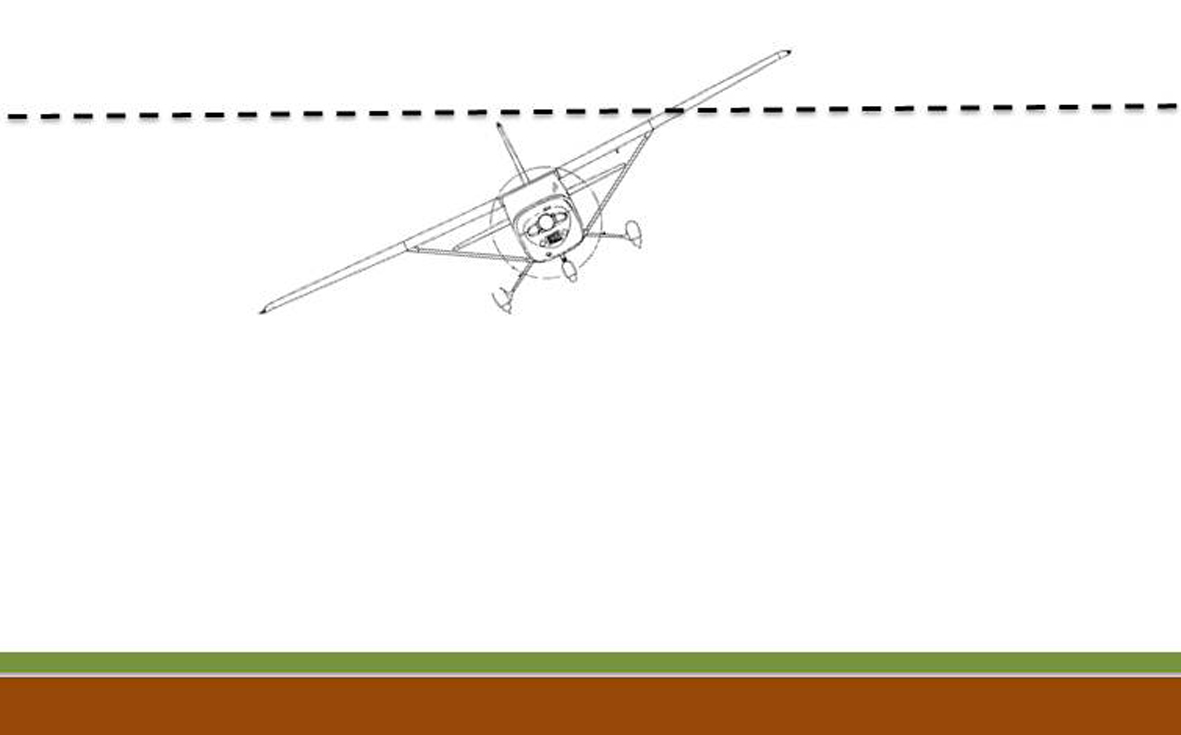
A significant quantity of fuel had leaked from the damaged wing fuel tanks. The front spar from the left wing displayed saw marks and tearing that was consistent with striking the powerline. The marks commenced at the strut-to-spar connection and their general orientation indicated that the aircraft was probably right-wing low at the time of the wire strike (Figure 3).
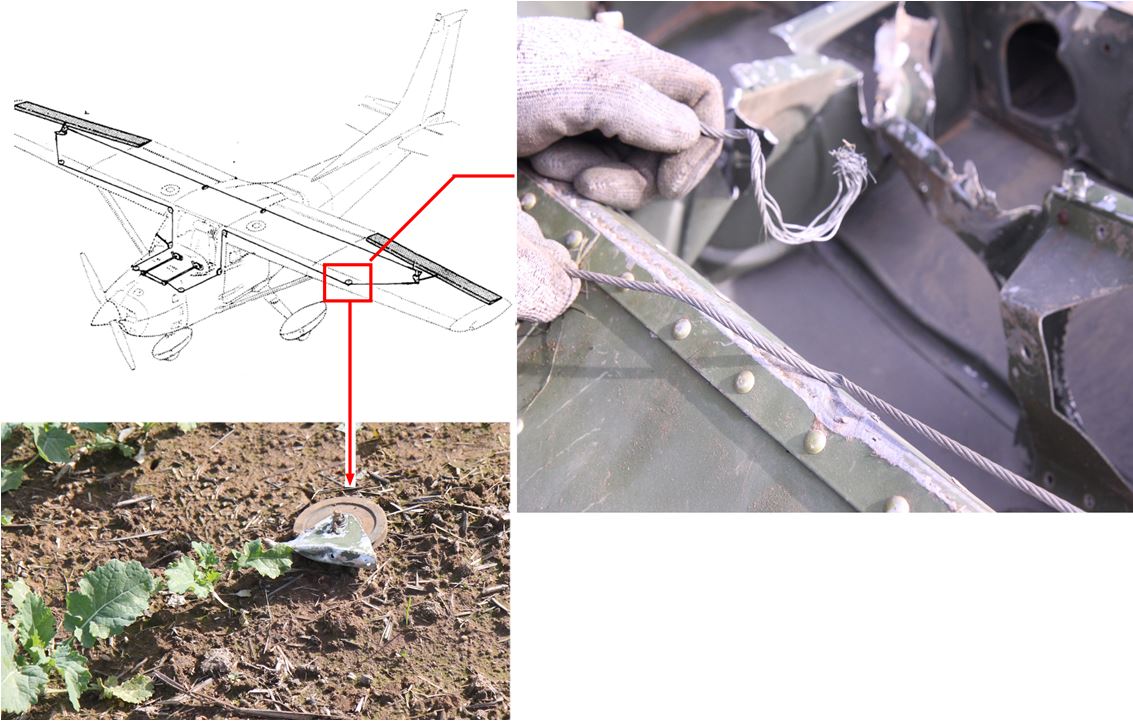
All of the primary structures and controls were accounted at the accident site. With the exception of the left aileron cable, flight control continuity was established and no pre-impact defects were identified. The left-wing aileron cable had fractured in overstress coincident with the strut-to-front spar connection (Figure 4).
A small sample of fuel was recovered from the fuel sump drain. The colour and smell of the fuel was consistent with aviation gasoline. Testing on-site showed that water was not present in the fuel sample.
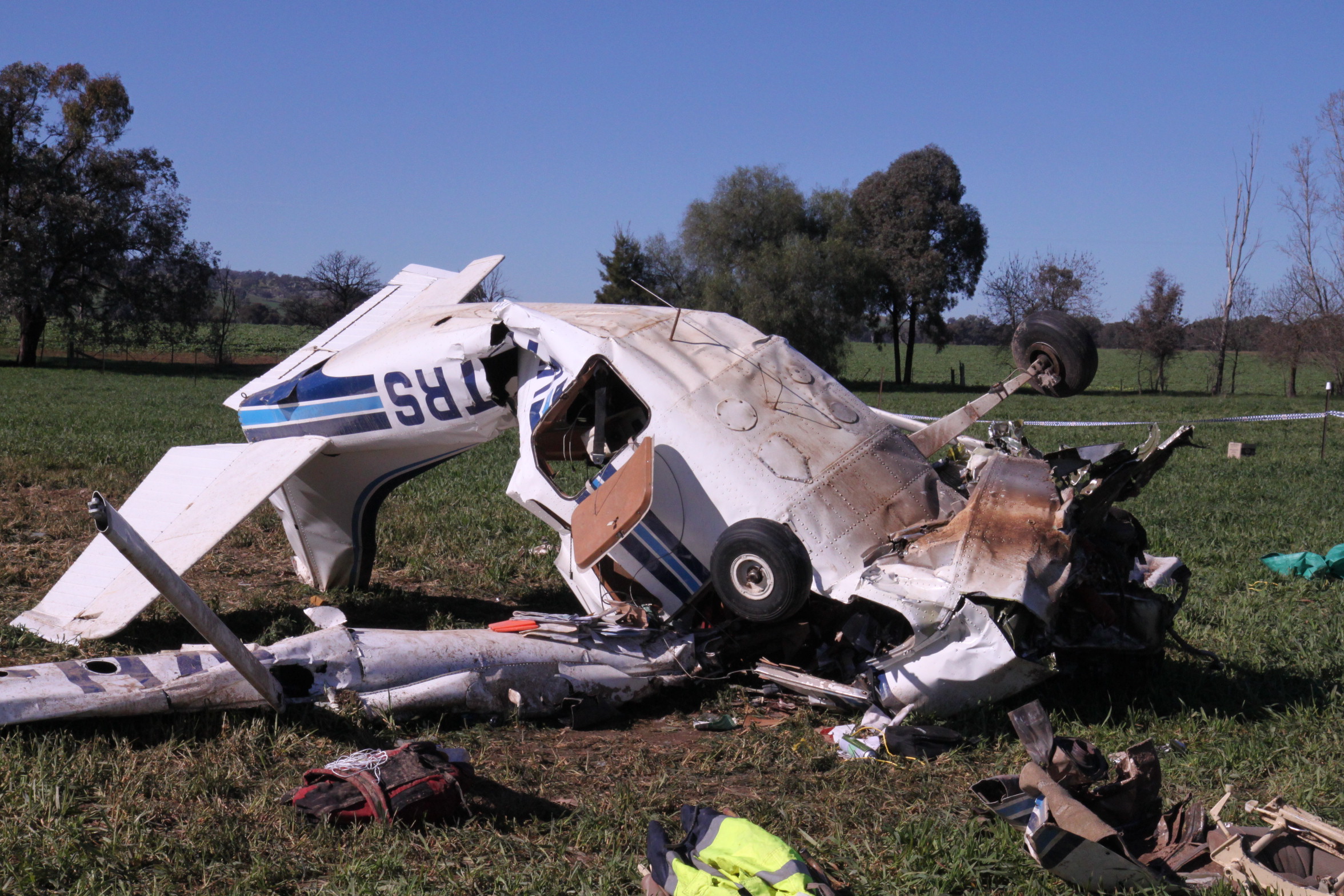
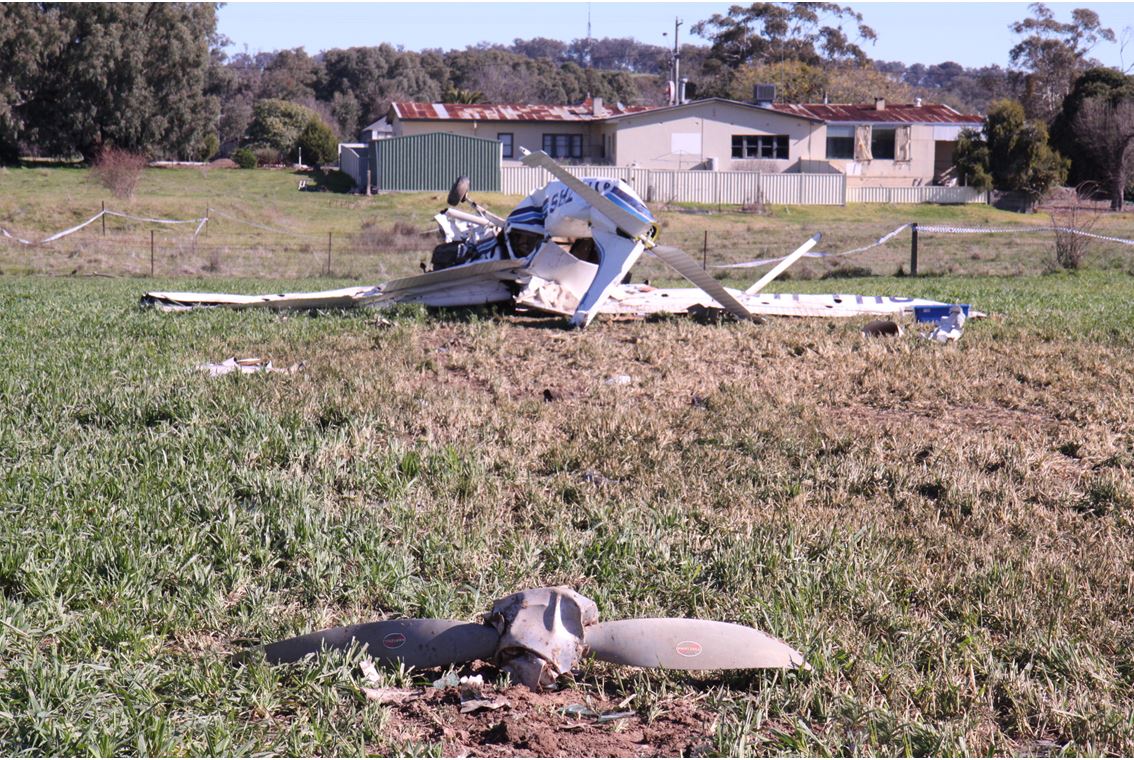
Figure 2: The aircraft impacted terrain near the Farmers Inn hotel. The aircraft was inverted at impact and the propeller separated from the engine
Source: ATSB
Figure 3: Illustration showing the likely aircraft orientation at the time of striking the powerline
Source: Illustration by Cessna Aircraft Corporation (modified by ATSB)
Figure 4: The aircraft’s left wing leading edge structure including the aileron guide pulley and cable, was damaged from contact with the powerline
Source: Illustration by Cessna Aircraft Corporation (modified by ATSB); photographs ATSB
Engine and propeller
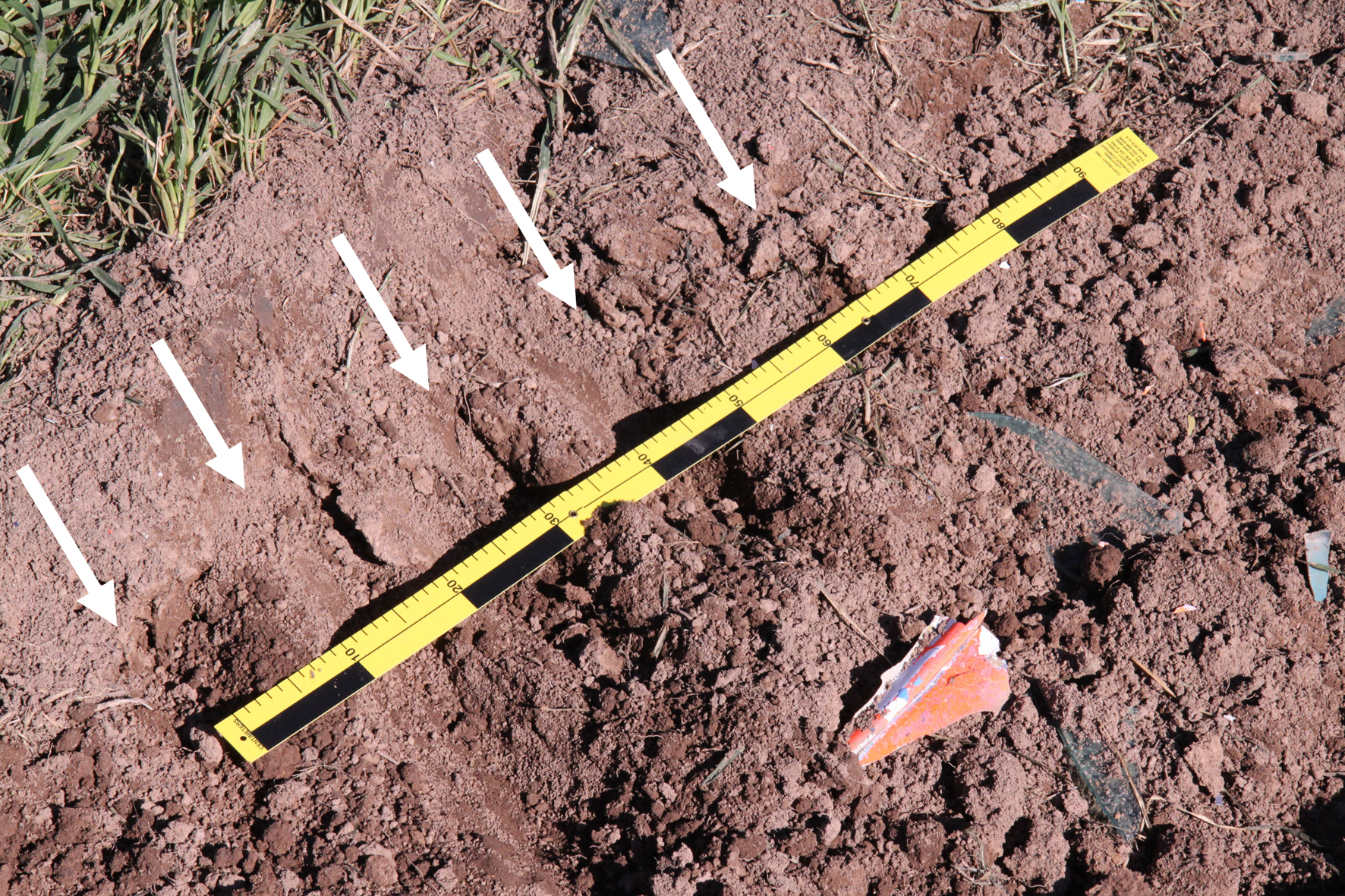
Analysis of propeller damage can provide evidence of the operational state of an aircraft’s engine at the time of any collision with terrain. In this instance, the engine was severely disrupted during the accident sequence and the propeller had separated from the crankshaft and was embedded in soil a few metres forward of the initial point of ground impact. Both blades from the propeller exhibited chordwise scoring and a degree of bending and twist that was consistent with being operated under significant torque at the time of the accident (Figure 5).
Figure 5: Propeller slash marks (arrowed)
Source: ATSB
Recorded data and instrument examination
Garmin GPS
A severely damaged Garmin AERA 500 GPS navigation unit was recovered from within the wreckage at the accident site. The ATSB applied forensic techniques to remove and then interrogate the internal memory module from the GPS.
Data from the previous 4 months of flying, including the accident flight, was able to be recovered. Parameters recorded by the GPS were: latitude, longitude, altitude and time. Analysis of the data revealed the following:
The pilot had routinely conducted low-level flying in the local area throughout the previous 4 months, as well as on the day of the accident flight.
The pilot had flown over the Burrumbuttock ‘Farmers Inn’ on many occasions. On 6 July 2014, 2 weeks prior to the accident, the aircraft was flown over the Inn at approximately 150 ft above ground level. The aircraft then continued to descend over the powerline (struck by the aircraft in this accident) and manoeuvre at very low altitude.
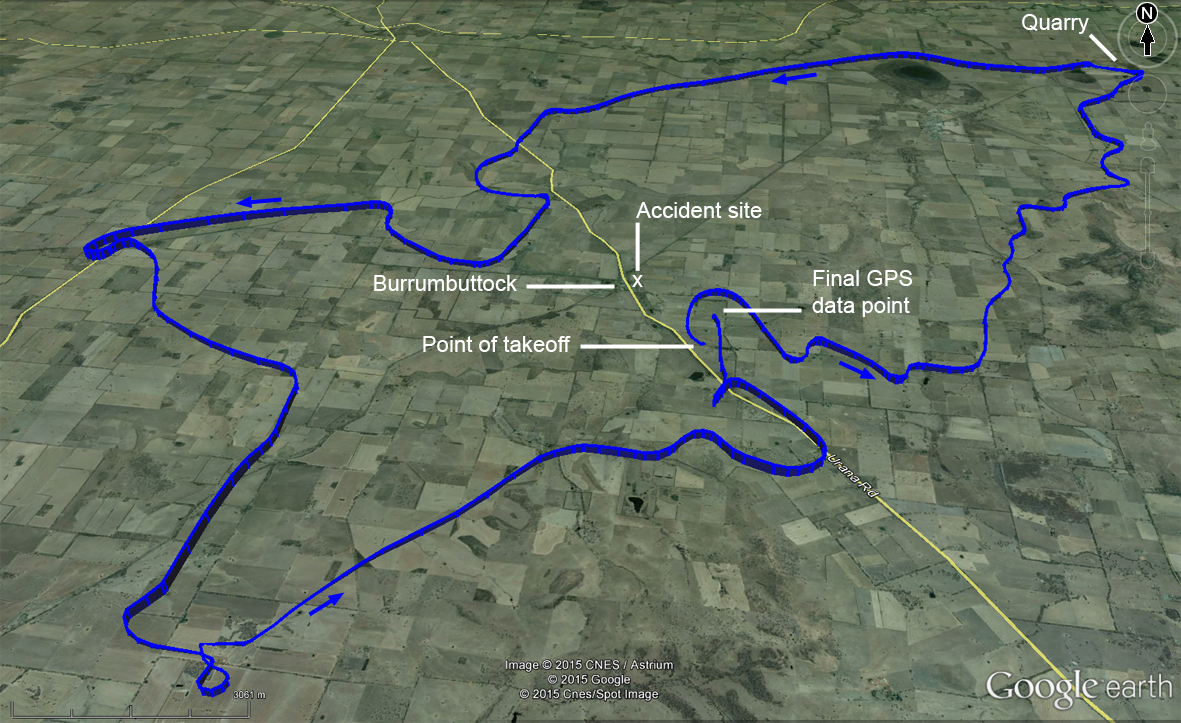
The accident flight data (Figure 6) captured a number of low-altitude and aerobatic manoeuvres, including an extremely low-level pass into a quarry, located north-east of Burrumbuttock. Previous flight data showed that the pilot had conducted that manoeuvre previously.
The final recorded GPS track point for the accident flight was written at 1731, approximately 2 minutes prior to the accident. The aircraft altitude at that time was approximately 420 ft above ground level. The ATSB was unable to determine why the GPS ceased recording data at that point.
Figure 6: Accident flight path noting that the final 2 minutes of data was unable to be recovered
Image Source: Google Earth TM, edited by ATSB
Cockpit instruments
Laboratory examination of the cockpit instruments that were recovered from the aircraft wreckage was conducted at the ATSB’s facilities in Canberra. This type of examination may reveal fine details on an instrument face, or its internal mechanism, that may assist an accident investigation gain further information about the aircraft at the time of the accident. In this instance, no additional evidence was able to be derived.
Weather and environment
The Bureau of Metrology forecast at the time of the accident were for overcast conditions, with a light north-westerly wind of up to 3 kt (6 km/h). Witnesses reported weather conditions, including wind strength that were consistent with the forecast.
Sunset on 20 July 2014 for Burrumbuttock was calculated to have occurred at 1720 and last light[5] was at 1748. The accident occurred at 1733. The position of the sun at the time of the impact with the powerline was calculated to be below the level of the horizon.[6] Under overcast conditions and with the sun having set, the pilot’s ability to observe the fine detail of the electrical wires was likely to have been significantly diminished.
Minimum height requirements
Regulation 157 of the Civil Aviation Regulations 1988 outlines the requirements for conducting low flying. It states:
(1) The pilot in command of an aircraft must not fly the aircraft over:
(a) any city, town or populous area at a height lower than 1,000 feet; or
(b) any other area at a height lower than 500 feet.
The above requirements did not apply if weather conditions made it essential for the pilot to fly at a lower altitude. The regulation also did not apply if the aircraft was engaged in approved low flying operations, the aircraft was taking off or landing, or was engaged in the dropping of articles as part of a search and rescue operation. There was no evidence in the pilot’s documentation to indicate that the pilot was issued with a low-flying approval or permission from CASA. There was similarly no evidence to indicate that the pilot was engaged in any approved low-flying operations.
Powerlines
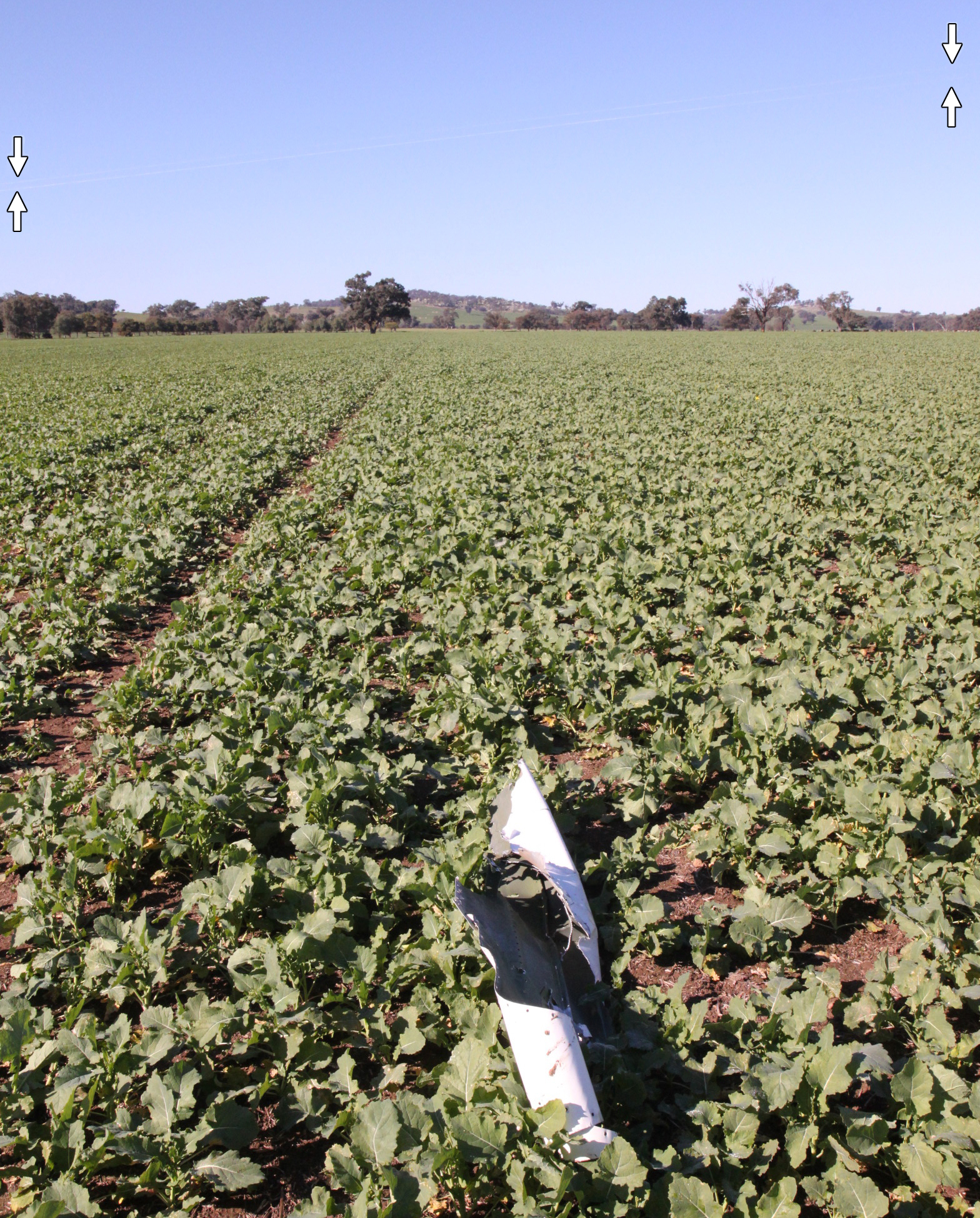
The powerline struck by the aircraft was not required to be marked in accordance with Australian Standard AS 3891.1 - 2008 Air navigation - Cables and their supporting structures - Marking and safety requirements. The electrical supply organisation reported that the section of powerline impacted by the aircraft consisted of a series of wooden poles, each supporting dual, three-strand, interwoven steel wire conductors (Figure 7). Installation drawings for the section of powerline showed that the poles had been erected and the electrical wires strung in 1994. The powerline was energised at the time of the accident and supplied electricity to a number of households in the immediate area. Each pole in the series was separated by distance of about 300 m.
The aircraft’s impact with the powerline dislodged both electrical wire conductors from their insulated tie-off points atop the cross-arm of one of the poles. One of the wires was severed from the impact and a large current fault was recorded at 1733:08 by the company’s electrical system. On-site measurements showed the point of impact to be 30 m to the nearest wooden pole and the wire height at the point of impact was estimated to be 9.5 m above the ground.
Emergency landing
It was known by some members of the local community that an emergency landing strip had existed in a relatively flat farm paddock that bordered the eastern edge of the Burrumbuttock town. The land owner of the paddock reported that the most recent aircraft to have landed on that strip was at least 20 years prior and that any remnants of the strip were probably concealed by crop.
An aerial survey flight was conducted during the on-site phase of the investigation which showed that the paddock was being used for cropping and pasture. No identifying markers or features could be observed that might otherwise indicate the location of such a strip in that paddock and the circumstances of the accident do not indicate that the pilot was seeking to conduct a forced landing.
Figure 7: The powerline (electrical wires arrowed) looking back along the flight path. A piece of the leading edge skin from the left wing is also shown
Source: ATSB
Wire strikes – an avoidable accident
The ATSB has investigated numerous accidents involving wire strikes from previous years. The investigations generally found that the pilot was involved in low flying for no identified operational reason and, in many of the occurrences, was more than likely aware of the presence of wires.
Between 1999 and 2008, there were 147 fatal accidents reported to the ATSB involving aerial work, flying training, private, business, sport and recreational flying in Australia. Of those fatal accidents, at least six were associated with unauthorised and unnecessary low flying; that is, flying lower than 1,000 ft (for a populous area) or 500 ft (for any other area) above ground.
In March 2013, the ATSB published an education series based on avoidable accidents. The first of the avoidable accident series was focused on accidents involving unnecessary and unauthorised low flying:
Recognising the risks and hazards of low-level flying, CASA requires pilots to receive special training and endorsements before they can legally conduct low-level flying. In the accidents examined, many of the pilots did not have low-level training or an endorsement to do so, and none had a legitimate reason to be flying below the minimum limits. For most private pilots, there is generally no reason to fly at low levels, except during take-off and landing, conducting a forced or precautionary landing, or to avoid adverse weather conditions.
Purpose of safety investigations & publishing information
Purpose of safety investigations
The objective of a safety investigation is to enhance transport safety. This is done through:
identifying safety issues and facilitating safety action to address those issues
providing information about occurrences and their associated safety factors to facilitate learning within the transport industry.
It is not a function of the ATSB to apportion blame or provide a means for determining liability. At the same time, an investigation report must include factual material of sufficient weight to support the analysis and findings. At all times the ATSB endeavours to balance the use of material that could imply adverse comment with the need to properly explain what happened, and why, in a fair and unbiased manner. The ATSB does not investigate for the purpose of taking administrative, regulatory or criminal action.
Terminology
An explanation of terminology used in ATSB investigation reports is available here. This includes terms such as occurrence, contributing factor, other factor that increased risk, and safety issue.
Publishing information
Released in accordance with section 25 of the Transport Safety Investigation Act 2003
Ownership of intellectual property rights in this publication
Unless otherwise noted, copyright (and any other intellectual property rights, if any) in this report publication is owned by the Commonwealth of Australia.
Creative Commons licence
With the exception of the Coat of Arms, ATSB logo, and photos and graphics in which a third party holds copyright, this publication is licensed under a Creative Commons Attribution 3.0 Australia licence.
Creative Commons Attribution 3.0 Australia Licence is a standard form licence agreement that allows you to copy, distribute, transmit and adapt this publication provided that you attribute the work.
The ATSB’s preference is that you attribute this publication (and any material sourced from it) using the following wording: Source: Australian Transport Safety Bureau
Copyright in material obtained from other agencies, private individuals or organisations, belongs to those agencies, individuals or organisations. Where you wish to use their material, you will need to contact them directly.
On 12 April 2014, a Maule M-5 aircraft, registered VH-HOG, collided with a powerline spanning the Clarence River, approximately 50 km west-south-west of Casino, New South Wales. The pilot was accompanied on the private category flight by two passengers, an adult and a child. The aircraft departed controlled flight after the wirestrike and impacted the water, coming to rest inverted with the cabin submerged.
The pilot and front-seat adult passenger escaped the cockpit through one of the forward doors and attempted to free the rear-seat child passenger from the flooded cabin. After repeated attempts by the pilot to open the rear-right cabin door, the rear-seat passenger was recovered through a cockpit door. Sustained attempts to resuscitate the rear-seat passenger were unsuccessful.
What the ATSB found
The aircraft was capable of normal operation prior to the wirestrike. The weather conditions in the vicinity were suitable for visual flight.
The wirestrike and resulting loss of aircraft control was an unintended consequence of the pilot’s spur of the moment decision to fly at very low level along the river, in an unfamiliar environment and below the minimum stipulated height for flights over unpopulated areas. The pilot reported seeing the powerline cables just before the collision, but with insufficient time to avoid a wirestrike. The pilot did not hold an approval to conduct low-flying operations and had not completed any training to identify the hazards associated with such operations. The powerline was not fitted with visual warning markers, nor was there any requirement for such markers in this case.
The submerged, flooded and inverted cabin increased the difficulty experienced by the occupants in exiting the aircraft. Furthermore, impact damage sustained by the right wing likely rendered the rear-right cabin door unusable as an emergency exit, delaying the recovery of the rear-seat passenger.
Safety message
This accident reaffirms the risk of unnecessary and unauthorised low flying.
Operations at low altitude expose an aircraft and its occupants to a number of environment‑specific hazards and result in significantly reduced safety margins. Powerline cables and other wires, which can be encountered even in relatively remote locations, are typically very difficult to see and present a critical hazard to any low-flying aircraft. In recognition of these and the other specific risks and hazards of low-level flying, the Civil Aviation Safety Authority requires pilots to receive special training and endorsements before conducting low-level operations.
The operation of an aircraft in close proximity to terrain or water limits the opportunity to recover from any loss of control or respond to any in-flight emergency when compared to flight at higher altitudes.
On 16 December 2013, the pilot of a Robinson R44 helicopter, registered VH-HJT, had completed a full day of aerial agricultural work, after which he reported feeling dehydrated and tired from the time pressures involved with the operation. He then attended a briefing for the next day’s operations, which involved aerial spraying of weeds on three properties. The briefing specified the areas to be sprayed; however, no maps or detailed information regarding the operation was provided to the pilot.
The next day, due to a series of delays, operations commenced at about 0800 Eastern Daylight savings Time. At that time, the pilot reported feeling time pressured and frustrated at the inadequacy of the preparations.
After completing five loads of spraying, the pilot elected to land the helicopter to discuss the remaining areas to be sprayed with the land owner. He was reminded of a rocky gully with blackberries that needed to be sprayed, which was away from the area he had been working on earlier. He did not recall that gully being mentioned at the briefing and he was not alerted to the existence of any power lines. The pilot then overflew the gully and did not observe any power lines or power poles.
The pilot then commenced spraying the gully, which required looking out of the helicopter window and door towards the ground. He then sighted power lines just as the helicopter main rotor disc struck the wires. The pilot immediately conducted a precautionary landing. The helicopter sustained substantial damage to the main rotor blades and the pilot was uninjured. The strike also resulted in the 22,000 volt power lines detaching from a number of insulators.
On 6 December 2013, a Kavanagh Balloons B-350 balloon registered VH-JDI, was on final approach to land near Broke, New South Wales. At a height of about 50 ft, as the balloon flew over a river and a line of trees, the pilot observed the sun glistening off a power line on the left of the landing area and looked for the poles associated with that power line. The pilot did not observe any other power lines coming off the poles. The pilot instructed the passengers to get into the landing position. The landing area looked to be clear of obstacles. As the balloon came over the end of the tree line the pilot slowly vented the hot air in the envelope to descend to the landing area. The pilot then noticed that there was a pole to the right that had been in the shadows and that a power line stretched horizontally in front of the balloon flight path. The pilot opened the envelope ventilation system so the balloon would descend quicker. The basket touched the ground gently and came to rest just under the power line at about 0630 eastern summer time. The envelope folded over the three power wires and when the wires came together there was a spark. The pilot instructed the passengers to remain in the basket and when he considered that it was safe he exited the basket. The pilot telephoned the electrical company who confirmed that the system was isolated and that a technician would be dispatched. The passengers disembarked the basket. The pilot and 15 passengers were not injured. The balloon envelope had a small area of heat damage to the fabric where it had contacted the power lines.
This serious incident highlights the importance of pre-flight planning, especially when landing at an unfamiliar landing area.
On 15 October 2013, the pilot of an Air Tractor AT‑502 aircraft, registered VH‑CJY, was preparing to conduct aerial spraying operations about 33 km west of Temora, New South Wales.
The owner of the property had provided the pilot with a map of the area to be sprayed, which included power lines. There was a road and a row of trees to the south of the paddock, with double power lines (as marked on the map) about 130 m north of the treeline. The pilot planned to fly over the trees and under the power lines on each leg, before turning to commence the next run.
At about 1730 Eastern Daylight-saving Time, when to the south of the paddock at about 15-20 ft above ground level (AGL), after turning to commence the next run, the pilot saw a cross arm indicating the presence of a wire attached to a derelict homestead. He decided not to climb the aircraft as it would have collided with the larger double power lines. The pilot then heard a bang, with the aircraft’s propeller spinner contacting the wire.
The pilot flew the aircraft under the double power lines and climbed to about 150 ft AGL. The engine was vibrating, but continued to produce power. The engine then steadily lost power. The pilot secured the engine and conducted a forced landing in a paddock. During the landing, the aircraft ground-looped and the left wing contacted the ground. The aircraft was substantially damaged, and the pilot received nil injuries.
The pilot did not see the wire at any stage, nor was it marked on the map provided to the pilot by the property owner.
On 23 February 2013, a Robinson R44 Raven I helicopter, registered VH-HGF, was engaged in agricultural operations in a paddock near Clarks Hill, Victoria. The pilot was the only person on board.
As the helicopter approached the paddock from the south, at 50 kt and at spray height, the pilot remembered a wire that extended halfway across the southern boundary of the paddock to a pump house. The pilot judged that it was too late to attempt to pull up over the wire and attempted to avoid the wire by flying underneath it. The vertical stabiliser contacted the wire and the tail rotor gearbox separated from the tail boom. The pilot was able to exit the helicopter with minor injuries however the helicopter was substantially damaged.
The practice within the aerial agricultural industry is to extensively pre-plan an application task that takes into account the specific hazards affecting an application. Any change from the previously planned application runs, including an unplanned change of direction has the potential to affect a pilot’s awareness of the relative position of previously known power lines and other hazards.
On 19 February 2013, at about 1000 Eastern Daylight-saving Time, an Ayres Thrush S2R-T34 aircraft, registered VH-HAH (HAH), struck power lines while conducting aerial agricultural spraying operations, about 7 km south-east of Condobolin aerodrome, New South Wales. The pilot was the only person on board. The aircraft sustained serious damage, while the pilot was uninjured.
The pilot was carrying out the final spray run (clean-up run), before returning to the airstrip. The pilot was flying from west to east, parallel to the main power line, which was located beside the field, outside of the area being sprayed. Another smaller power line with three wires ran diagonally across the field from the main power line. Once the pilot had run out of product, he pulled up to gain altitude, when he struck the smaller power line that ran diagonally across the field. Two of the wires were cut by the aircraft’s wire protection system and the third wrapped around the propeller hub arresting the aircraft and pulling it around in a half circle where it came to rest on the ground.
As a result of this occurrence, the electricity distribution company will install a marking system on the power line.
The practice within the aerial agricultural industry is to extensively pre-plan an application task that takes into account the specific hazards affecting an application. Any change from the previously planned application runs, including an unplanned change of direction has the potential to affect a pilot’s awareness of the relative position of previously known power lines and other hazards.
For this reason, the Aerial Agricultural Association of Australia recommends that an additional hazard check should be performed from a safe height prior to every change of direction or ‘clean up run’. The extra safety check for wires is important, as the obstructions are new from the new direction of flight.
For further reading of suggested approaches to risk management for agricultural pilots see the Aerial Application Pilots Manual, available from the Aerial Agricultural Association of Australia (AAAA) at www.aerialag.com.au/Home.aspx.
On 17 February 2013, an Enstrom 480B helicopter, registered VH-VDC (VDC), was engaged in agricultural spraying operations, near Trida, Victoria. On the final load of chemical to be applied to the paddock the Global Positioning System (GPS) lost reception during the application run. The pilot immediately aborted the run and climbed to about 400 ft above ground level and attempted to resolve the issue with the GPS.
Once the GPS regained reception, the pilot commenced a left turn at about 50 knots indicated airspeed to return to the paddock and recommence the application run. The pilot then heard a loud bang and felt a shudder through the airframe.
The pilot performed a run on landing in the nearest clearing, he had difficulty in maintaining yaw control, because the tail rotor control cables had lost tension. The pilot was able to exit the helicopter without injury, however, the helicopter was substantially damaged.
The ATSB was advised by the owner of the wire, that wire struck was marked with five marker discs. However, the pilot of VDC advised that the wire was unmarked at the time of the wirestrike. The ATSB was unable to independently confirm that the maker discs were still in place at the time of the wirestrike.
As a result of the occurrence the owner of the wire has advised the ATSB that the broken cable was replaced to restore electricity supply as soon as possible and was replaced without new markers installed. However, arrangements are being made to install markers on the line.
Wirestrikes pose an on-going problem to aerial agricultural operations. Despite the advantages of marking a wire, not all wires are marked, and it is simply not feasible to mark all wires. It is important that pilots and operators raise any concerns they may have about the visibility of a wire with the wire owner. Electricity distribution and transmission companies may install aerial markers on wires upon request. Landowners can request to have wires on their property marked and pilots who have a need to fly low-level near powerlines can also request wires to be fitted with markers.