After receiving a sketch plan of the area to be sprayed, the pilot made an aerial inspection and noted the
position of power lines. He then made nine spraying runs which involved pulling up over a power line which
crossed the paddock approximately one third of the distance along the spray runs. On the tenth spray run
the pilot allowed his attention to be temporarily distracted through watching a marker change to a corrected
position. When he again gave his attention to the flight path he became aware that the power line was
immediately ahead and at the same height as the aircraft. He attempted to climb the aircraft, but the
wires became hooked on the tail wheel assembly. The aircraft decelerated rapidly and contacted the
ground on the port main wheel and wingtip. The power lines did not break, but three of the wooden supporting
poles were pulled to the ground.
The helicopter was being ferried from Perth to Mount Newman by two pilots who were taking turns as
pilot -in -command. After an overnight stay at Meekatharra the flight was resumed and a headwind of
12-15 knots was encountered. At Kumarina the aircraft was refuelled from drums carried in the aircraft
and, in an effort to minimise the headwind component, the pilot flew at an extremely low height, following
part of the old Great Northern Highway. At a point where the old road Joins the new highway, the helicopter
struck a steel bracing wire stretched across the highway between two telephone poles. The aircraft crashed
to the roadway and was destroyed by Impact forces.
The Merredln Shire landing field Is 4.5 miles south east of Merredln and, after arrival In the area, the pilot
decided to select a landing field closer to the town since arrangements for transport after landing had not been
made. He selected for examination a field 1.5 miles north of the town, oriented approximately north and south.
After flying at 700 feet above terrain Immediately to the east of the field on a northerly heading, the pilot
carried out a descending turn to port with the intention of examining the surface from a low altitude. He
levelled out on a southerly heading at a height of about 20 feet and almost Immediately the aircraft ran through
three cables of a power line. There was a bright flash of electrical discharge from the port wing, the wlndscreen
disintegrated, one high tension wire was caught In the aircraft fin and all three wires were torn from the two
nearest poles which were 900 feet apart. The aircraft moved to the left of Its Intended flight path and travelled
approximately 550 feet before contacting the ground with the port wing and engine. It then cartwheeled
horizontally on to the starboard wing coming to rest facing 180 degrees from the direction of its final
approach to the landing area.
The aircraft was operating from a strip aligned north and south and located in flat, open, grass covered
terrain. The approaches to the strip were good but 1350 feet south of the southern threshold a power tine
30 feet high and supported on wooden poles ran at right angles to the approach path. After completing the
spraying of an oat crop which was situated about one mile to the south west of the strip, the pilot was
approaching from the south for his third and last landing for the day. The aircraft was observed to be
flying at a low level for a considerable distance before the undercarriage legs struck the power line, some
70 feet to the left of one of the supporting poles. The lines stretched, retarding the aircraft which pitched
down until one wire snapped and the second slipped clear of the undercarriage. The aircraft struck the
ground in a vertical nose down attitude 105 feet beyond the point of impact with the wire, then fell on to its
back and slid inverted for 25 feet. On impact with the ground the forward fuselage collapsed and burst into
flames which spread rapidly. The pilot was trapped in the cockpit for several minutes until the nearest
witnesses, who were one half mile away were able to reach the scene. The aircraft tail had to be physically
lifted and the pilot's harness released before he could be dragged clear of the wreck.
The aircraft took off from Ballarat and arrived In the spraying area fifteen to twenty minutes later. The pilot
was familiar with the field, having sprayed it the previous day, and he commenced spraying on this occasion
with an east to west run on the southern side of a main power line which crosses the field. He made his second
run In the opposite direction, still on the southern side of the main power line, and then proceeded to spray a
four acre paddock a short distance away. On returning to the first field he made a spray run from east to west
on the northern side of the main power line. During this run he looked back to check the drift of the spray and
the aircraft struck a three wire spur power line running north from the main power line approximately half way
along the run. The flight of the aircraft was arrested and It struck the ground nose first and then fell to the
inverted position. A fire broke out and the pilot was assisted from the burning wreckage by two farmers.
The aircraft had been flown on the morning of the accident from
Coonabarabran to the agricultural strip at "Lumley", near
Coonamble, to engage in spraying operations. Finding that the
loader had not arrived, the pilot decided to take off and look for
the vehicle with the object of directing the driver to the strip.
At about this time the driver was entering the "Lumley" property
and the pilot flew low over the loader in the direction of the
airstrip. He did not see the power transmission lines across the
flight path of the aircraft at a height of some 30 feet above the
ground until the aircraft was about to strike them. The aircraft
contacted the wires with the main undercarriage, decelerated and
struck the ground with the nose and right wing before coming to
rest inverted. Fire broke out immediately on ground impact but the
pilot was able to evacuate the aircraft before it was destroyed by
fire.
The aircraft was flown to the training area for revision
exercises, which included simulated forced landings. After
satisfactorily completing a number of exercises, including one
forced landing, the student climbed the aircraft to 3,000 feet
where the instructor again closed the throttle to simulate an
engine failure. The student selected a field and established a
flight pattern for a landing into wind. The instructor states that
he believed that the field selected was of marginal length and he
decided to allow the approach to continue to below the normal
break-off height so that the student could appreciate this fact.
Neither pilot observed during descent that two electricity supply
lines crossed the flight path at approximately a sixty degree
angle. The wires were first seen by the student when about ten feet
away and just as the instructor was about to call "go-around". The
aircraft struck the wires and came to rest In the field on its
landing gear.
With unrestricted visibility and a wind varying between 5 and 15
knots the pilot planned to spray three sugar cane fields In the one
flight. After spraying a supposedly 28 acre field, he found he had
used spray equivalent to only 21 acres. When no additional area was
Indicated by the ground markers he proceeded to the second field
one-half mile distant and made an aerial Inspection, noting all
obstructions. Then, to reduce the aircraft's load he sprayed the
third field which was obstruction free and located one half mile
distant from the second field. He returned to the second field
after approximately ten minutes, descended and lined up for the
first spraying run. The pilot was conscious of a power line to the
south of his Intended run but forgot the existence of a north south
power line. When he saw the line he applied power to the aircraft
and endeavoured to fly over It, but two cables caught on the
aircraft's tall strut. One cable broke but the second arrested the
aircraft, which crashed into the cane, where It was destroyed by
fire.
The pilot, who was not the holder of an Agricultural Pilot
rating, was about to spray a cotton field on his own property. He
was attempting a spraying run from the north into the south which
required passage over two separate power line arrays to the north
of the paddock. The two arrays converged to the east but were
separated by 220 feet at the points at which they crossed the
flight path, the one closer to the paddock being 26 feet high and
the other 18 feet high. The pilot did not make an examination for
possible obstructions before spraying, as he was familiar with the
area. He believed that the wires were only 40 feet apart on the
line of the first spraying run and he approached from the north
with adequate clearance over the lower wires then immediately
commenced a descent to spraying level. The landing gear assemblies
contacted with southern-most power line and the aircraft nosed down
and decelerated sharply. Impact with the ground, with virtually no
forward velocity, was made on the nose and undercarriage, which
collapsed. The aircraft came to rest upright, 150 feet beyond the
point of contact with the power line and there was no fire.
Occurrence Briefs are concise reports that detail the facts surrounding a transport safety occurrence, as received in the initial notification and any follow-up enquiries. They provide an opportunity to share safety messages in the absence of an investigation.
What happened
On 14 March 2021, the pilot of a Kavanagh E-240 balloon was conducting a scenic flight over Melbourne, Victoria with 10 passengers on board.
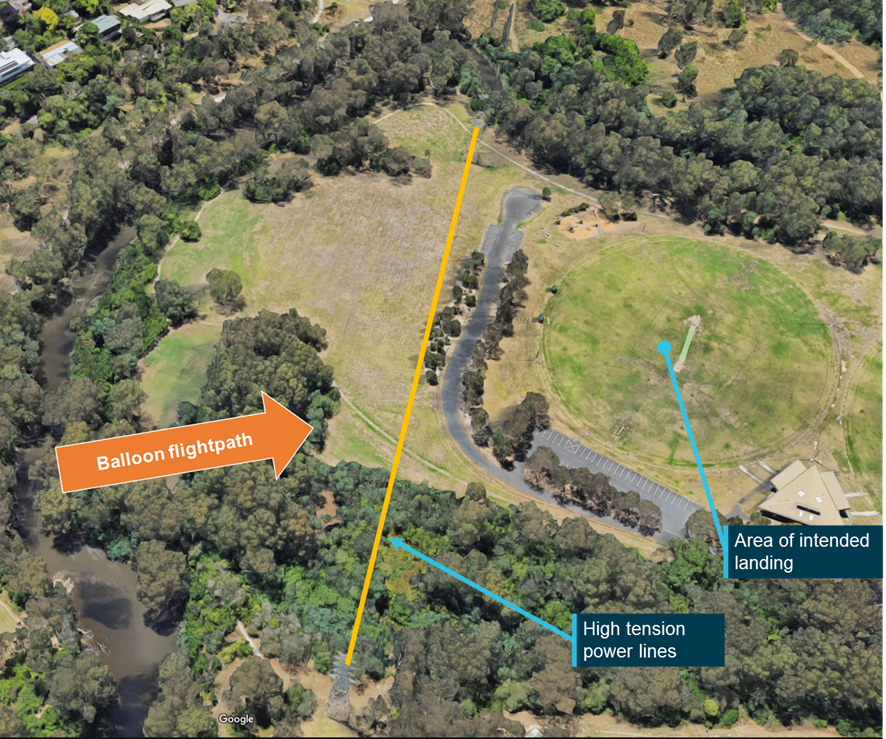
Shortly before 0830 Eastern Daylight-saving Time [1] the balloon approached the planned landing area at Bulleen Park. To reach the landing area, the pilot needed to conduct a descent into a westerly wind. This resulted in the balloon descending over powerlines, which varied from the normal practice of passing over significant obstacles while in level flight. The powerlines were adjacent to the landing area, suspended between two high tension towers (Figure 1), and displayed on the pilot’s iPad.
The pilot conducted the descent so as to pass above the high voltage wires that they could see. However, due to local lighting conditions, approaching the powerlines in a descent and vegetation in the area, the pilot did not see an earthing wire [2] that ran 7.43 m above the high voltage wires.
During the descent, the balloon’s basket struck the earthing wire, which arrested its forward momentum. The basket remained held against the earthing wire, and above the high voltage wires, for about 20 seconds as the pilot engaged the burner to initiate a climb. The balloon then climbed free of the earthing wire, sustaining minor damage in the process.
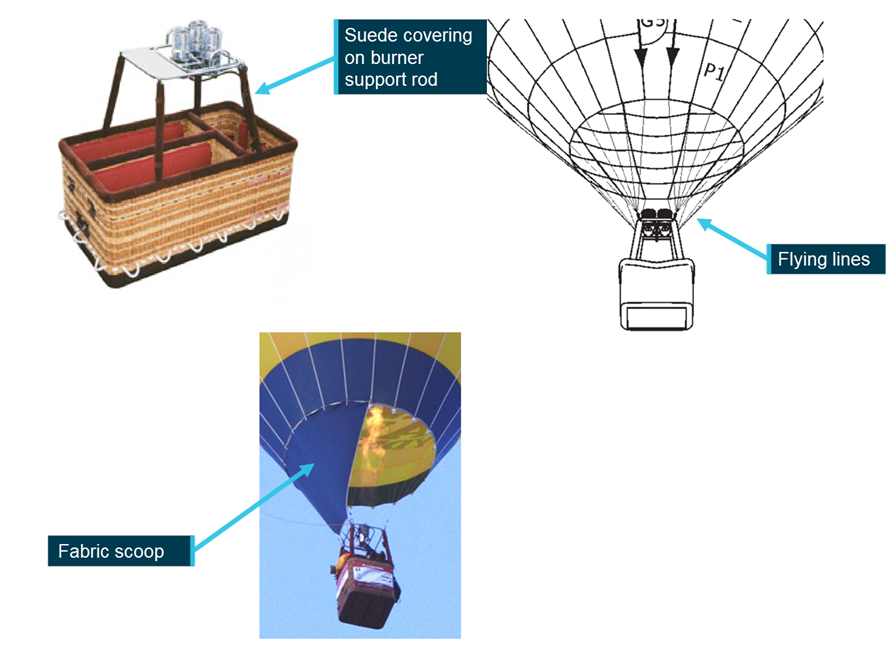
The flight proceeded to an alternative landing area at Westerfolds Park without further incident. The pilot and passengers were uninjured. The balloon sustained damage to five of the 20 woven stainless steel flying lines, the suede covering on a burner support rod and the balloon’s fabric scoop (Figure 2).
Figure 2: Damage to balloon and basket
Source: Kavanagh Balloons, annotated by the ATSB
Safety action
As a result of this incident, the operator has advised the ATSB that it has taken the following safety actions:
instituted a policy that if wind conditions do not permit an approach to this landing area to be conducted in level flight, with a minimum of 40 m clearance above powerlines, the flight is to proceed to the next suitable landing site
reminded pilots that flight should ‘always be carried out with extreme care and consideration to avoid powerline contact’ in line with the operations manual.
Safety message
This incident is an important reminder of the hazards associated with operations around powerlines. It is also a reminder to balloon operators of the importance in planning descents to take place when downwind of any significant obstacles.
In this incident, the pilot had operated into this landing area multiple times and was familiar with the powerlines but struck them anyway. This is not uncommon, as ATSB research indicates that in 63 per cent of wirestrike incidents the pilot was aware of the powerlines that were subsequently struck.
The Australian Ballooning Federation’s Pilot Circular No 18, dated February 2012, also highlights the following hazards to pilots in operations around powerlines that are relevant to this occurrence:
Complacency: Familiarity and repetition regarding operation and location can lead to complacency. Be aware of this and hence be vigilant. Data shows the worst accidents are often made by the most experienced and skilled operators.
Reduced visibility: Sun, mist, haze, contrast. Be vigilant and conservative under these conditions.
See and avoid scanning technique: Avoid focusing too long on close objects or scanning quickly left and right. Focus at a distance and move attention slowly over small arcs pausing briefly for a few seconds each time to closely examine the area.
Decisions regarding whether to conduct an investigation, and the scope of an investigation, are based on many factors, including the level of safety benefit likely to be obtained from an investigation. For this occurrence, no investigation has been conducted and the ATSB did not verify the accuracy of the information. A brief description has been written using information supplied in the notification and any follow-up information in order to produce a short summary report, and allow for greater industry awareness of potential safety issues and possible safety actions.