VFR into IMC

VFR into IMC involving Piper PA-28RT-201T, VH-IWJ, 5 km north-west of Evans Head, New South Wales

Summary

Prior to commencing the Night VFR (Visual Flight Rules) flight, the pilot obtained a pre-flight briefing by facsimile.  This briefing included the appropriate weather forecast for the intended route.

After departing Coolangatta, the pilot reported to Brisbane Flight Service that he intended climbing to 7,500 ft and that he would remain outside controlled airspace. About 22 minutes later a single radio transmission was received by Brisbane Flight Service.  The transmission, by a male voice, said 'I'm doing cartwheels'.  This voice was different from the voice that made the initial transmission from VH-IWJ to Flight Service.

Witnesses in the Evans Head area observed the aircraft flying towards the north-west at an estimated altitude of 1,000 ft above the ground.  They reported that it was flying erratically before commencing a looping manoeuvre.  At the top of that manoeuvre the aircraft appeared to lose all airspeed, then dive vertically into the ground.

The aircraft was extensively damaged by impact forces.  Inspection of the wreckage did not reveal any pre-existing faults that may have contributed to the occurrence.

Post-mortem examination of the pilot did not provide evidence sufficient to determine whether he had suffered from any form of incapacitation.

The weather forecast obtained by the pilot indicated that showers were expected along the route and that some low cloud would be associated with the showers.  Provided the pilot remained clear of the showers a flight under VFR should have been possible.  There is extensive ground lighting in the area from Coolangatta to Ballina but after that the ground lighting reduces as the settlements become more widely spread.  The moon was located in the western sky, but most witnesses reported that it was dark at the time they observed the aircraft and that there was cloud in the area. Consequently, the pilot may have been deprived of a visual horizon from time to time.

The pilot was reported to have been in current flying practice, having last flown at night on 28 February 1993.  He had held a Night VFR rating since 25 September 1987.

The available evidence is consistent with the pilot having lost control of the aircraft and being unable to regain control before it impacted the ground.

SIGNIFICANT FACTORS

The factors leading to an apparent loss of control of the aircraft could not be positively determined.

Occurrence summary

Investigation number 199300822
Occurrence date 09/04/1993
Location 5 km north-west of Evans Head
State New South Wales
Report release date 09/02/1995
Report status Final
Investigation type Occurrence Investigation
Investigation status Completed
Mode of transport Aviation
Aviation occurrence category VFR into IMC
Occurrence class Accident
Highest injury level Fatal

Aircraft details

Manufacturer Piper Aircraft Corp
Model PA-28
Registration VH-IWJ
Serial number 28R-8231066
Sector Piston
Operation type Private
Departure point Coolangatta Qld
Destination Maitland NSW
Damage Destroyed

VFR into IMC involving Cessna 172C, VH-JLG, 7 km south of Coffs Harbour, New South Wales

Summary

The aircraft had been cleared to track south over water at 1,000 feet through the Coffs Harbour zone. At 1324 hours the pilot reported passing Woolgoolga and subsequently reported abeam the control tower. At this time he requested clearance to descend to 500 feet. He was cleared to descend, but two minutes later, at 1334 hours the pilot reported that he was returning to Coffs Harbour for a landing and that he had lost visual contact with the water. He was cleared to join the circuit on downwind for runway 21 on a visual approach and was asked to report abeam the control tower. This was acknowledged by the pilot at 1334:51, but there was no further communication from the aircraft. An overflying jet aircraft reported receiving a transmission from a VHF Survival Beacon for a period of about 10 seconds shortly after the time of the pilot's last transmission.

The Automatic Terminal Information Service (ATIS) was reporting 3 octa of cloud at 1,000 feet, with lower patches, and 4 octa of cloud at 2,000 feet. Showers were reported in the area.

The aircraft wreckage was located in the sea near Sawtell. Wreckage examination suggests the aircraft struck the water in a descending right turn. There was no indication that the aircraft was not capable of normal flight immediately prior to the accident. A heavy rainstorm was reported near Sawtell at the time of the accident. The pilot was not qualified for flight in other than visual conditions. It is most probable that the aircraft inadvertently entered a heavy rain shower which deprived the pilot of visual contact with the land and water. The pilot attempted a turn to head back to Coffs Harbour aerodrome but as he was not qualified for flight by sole reference to the aircraft's flight instruments, it is probable the aircraft entered a steep descent from which the pilot was unable to effect a recovery prior to collision with the sea.

Significant Factors

1. The pilot inadvertently flew into conditions of limited visibility associated with a heavy rain shower.

2. The pilot was not qualified for flight by sole reference to the aircraft's flight instruments.

3. The conditions of visibility reduced such that the pilot was unable to continue the flight by visual reference to the land and water.

4. The pilot attempted to turn to regain visual contact and during the turn entered a descent from which he was unable to effect recovery prior to collision with the sea.

Occurrence summary

Investigation number 199300131
Occurrence date 18/02/1993
Location 7 km south of Coffs Harbour
Report release date 27/07/1993
Report status Final
Investigation type Occurrence Investigation
Investigation status Completed
Mode of transport Aviation
Aviation occurrence category VFR into IMC
Occurrence class Accident
Highest injury level Fatal

Aircraft details

Manufacturer Cessna Aircraft Company
Model 172
Registration VH-JLG
Serial number 17248836
Sector Piston
Operation type Private
Departure point Kooralbyn QLD
Destination Taree NSW
Damage Destroyed

VFR into IMC and loss of control involving a Piper PA-28, 67 km west-north-west of Sydney, New South Wales, on 20 October 2020

Brief

Occurrence Briefs are concise reports that detail the facts surrounding a transport safety occurrence, as received in the initial notification and any follow-up enquiries. They provide an opportunity to share safety messages in the absence of an investigation.

What happened

On the morning of 20 October 2020, a Piper PA-28-181 departed Bankstown Airport on a private flight to Gilgandra, New South Wales, with the pilot as the sole occupant. The en-route weather forecast obtained the morning of departure indicated some cloud over the Blue Mountains to the west of Sydney, but the pilot assessed that conditions would be suitable for flight under visual flight rules (VFR).

After departure, the pilot deviated off the direct track to avoid active restricted airspace before manoeuvring to resume the flight-planned track. The pilot reported that there were scattered clouds in the area at the time. While making the track adjustment, the pilot diverted their attention to the flight log and maps. When the pilot looked up, the aircraft had entered an area of low thick clouds and the pilot initiated a turn to vacate the area.

During the turn, the pilot became disoriented in cloud and the aircraft entered a spiral dive. The pilot recovered control of the aircraft clear of cloud, but the aircraft had descended over 2,000 ft and was surrounded by mountainous terrain. With low cloud over the mountains, visual meteorological conditions[1] did not exist. To maintain terrain clearance, the pilot initiated a climbing turn, which subsequently took the aircraft back into cloud.

Once at a safe altitude, the pilot attempted to contact air traffic control (ATC) with a request but was twice asked to ‘stand by’. Approximately 2 minutes after the first radio call, the pilot made a PAN PAN[2] call reporting that the aircraft was ‘VFR in cloud’. The controller immediately responded and provided assistance for the next 16 minutes, guiding the pilot away from high terrain and to an area of clear of cloud. Once below cloud, the pilot resumed visual navigation back to Bankstown.

Safety message

SafetyWatch

The ATSB SafetyWatch highlights the broad safety concerns that come out of our investigation findings and from the occurrence data reported to us by industry. One of the safety concerns is inflight decision-making.

The decision to proceed is the first decision the VFR pilot faces when confronted with less than visual meteorological conditions. Flight Safety Australia article ‘178 seconds to live’, illustrates the stark reality of attempting to fly in IMC conditions without adequate training.

The ATSB strongly urges pilots to seek assistance from ATC as soon as conditions deteriorate. Controllers are trained to handle such an occurrence and providing them with accurate information on your situational awareness and in-flight conditions will allow them to provide the best possible assistance.

The ATSB continues to investigate weather-related general aviation accidents. VFR into IMC remains one of the most significant causes for concern in aviation safety; the often-fatal outcomes of these accidents are usually avoidable. In the 5 years prior to the occurrence, there were 56 reported VFR into IMC occurrences, 7 of which resulted in accidents, with 10 fatalities.

The ATSB publication Accidents involving Visual Flight Rules pilots in Instrument Meteorological Conditions provides investigation findings, case studies and further reading on managing the risks of flying in reduced visibility.

About this report

Decisions regarding whether to conduct an investigation, and the scope of an investigation, are based on many factors, including the level of safety benefit likely to be obtained from an investigation. For this occurrence, no investigation has been conducted and the ATSB did not verify the accuracy of the information. A brief description has been written using information supplied in the notification and any follow-up information in order to produce a short summary report, and allow for greater industry awareness of potential safety issues and possible safety actions.

__________

  1. Visual Meteorological Conditions (VMC): an aviation flight category in which visual flight rules (VFR) flight is permitted – that is, conditions in which pilots have sufficient visibility to fly the aircraft while maintaining visual separation from terrain and other aircraft.
  2. PAN PAN: an internationally recognised radio call announcing an urgency condition which concerns the safety of an aircraft or its occupants but where the flight crew does not require immediate assistance.

Occurrence summary

Mode of transport Aviation
Occurrence ID AB-2020-047
Occurrence date 20/10/2020
Location 67 km west-north-west of Sydney
State New South Wales
Occurrence class Serious Incident
Aviation occurrence category VFR into IMC
Highest injury level None
Brief release date 10/12/2020

Aircraft details

Manufacturer Piper Aircraft Corp
Model PA-28
Sector Piston
Operation type Private
Departure point Bankstown, New South Wales
Destination Gilgandra, New South Wales
Damage Nil

VFR into IMC involving a Beechcraft A36, near Mundubbera Aerodrome, Queensland, on 9 July 2020

Brief

Occurrence Briefs are concise reports that detail the facts surrounding a transport safety occurrence, as received in the initial notification and any follow-up enquiries. They provide an opportunity to share safety messages in the absence of an investigation.

What happened

On the afternoon of 9 July 2020, a Beechcraft A36 departed Lark Quarry in Central Queensland to conduct a private flight to Gympie, Queensland. There was a pilot and three passengers on board. The pilot received the en route weather forecast on the morning of departure, approximately 10 hours prior to the actual flight time due to lack of phone coverage in the area. The weather report at that point in time was suitable for a flight under VFR.[1]

During the flight, the weather began to deteriorate closer to the coast as the aircraft neared its planned destination. The pilot observed increasing overcast cloud on the intended track and commenced a descent from 9,500 ft to remain clear of cloud. The aircraft levelled at 4,500 ft, which appeared to be well below the cloud base.

A short time later, the aircraft entered cloud and the pilot lost all visual references. The pilot immediately contacted air traffic control (ATC) and declared a PAN PAN[2] to request assistance, while commencing a climbing turn onto a reciprocal heading. The climbing turn enabled the aircraft to regain VMC[3] after about two minutes in cloud.

The pilot then conducted a diversion to Mundubbera, Queensland and was able to maintain VMC for the remainder of the flight.

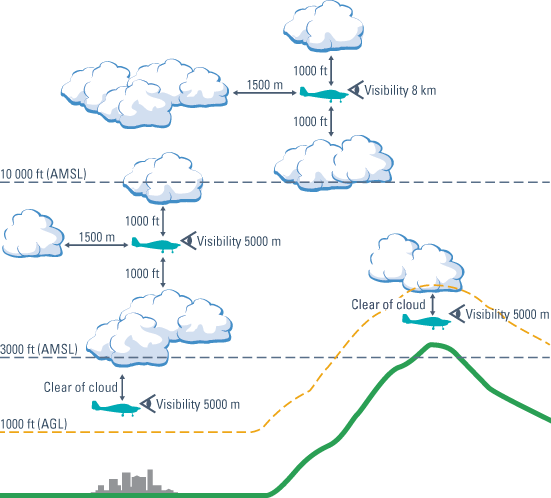
Visual Meteorological Conditions (VMC) requirements

Figure 1: VMC criteria for aeroplanes in Class G airspace

Figure 1: VMC criteria for aeroplanes in Class G airspace.
Source: Aeronautical Information Publication (AIP) Australia: ENR 1.2-4 14 May 20

Source: Aeronautical Information Publication (AIP) Australia: ENR 1.2-4 14 May 20

Pilot comments

The pilot advised the ATSB that they had a pre-planned course of action for the situation of inadvertently flying into weather that was less than VMC. An important part of this plan was to immediately notify ATC of the situation to ensure all possible assistance was gained. The pilot committed to this plan and carried it out to effect a safe recovery.

Obtaining weather forecasts

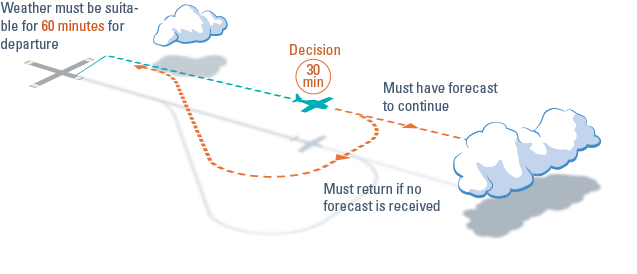
The AIP ENR 1.10 Section 1.2.2 states:

Flights for which a forecast is required and cannot be obtained, are permitted to depart provided the pilot is satisfied that the weather at the departure point will permit the safe return of the flight within one hour of departure. The flight is permitted to continue if a suitable forecast is obtained for the intended destination within 30 minutes after departure.

Figure 2: VMC criteria for aeroplanes in Class G airspace
Source: Visual Flight Rules Guide 14 May 20

Source: Visual Flight Rules Guide 14 May 20

If the pre-flight briefing is obtained more than one hour before the flight, the pilot should obtain an update before departure to ensure that the latest information available can be used for the flight.

Pilots can obtain forecasts and updates by radio en route if other forms of communication are unavailable.

Safety message

Obtaining the latest valid weather forecasts during the pre-flight planning phase is paramount to the safe conduct of a longer-distance VFR flight. Pilots are encouraged to make conservative decisions when considering how forecast weather may affect their flight. If poor weather is encountered en route, timely and conservative decision-making may be critical to ensuring a safe outcome.

ATSB SafetyWatch

VFR pilots are also encouraged to familiarise themselves with the definition of VMC criteria and carefully consider available options where forecast or actual conditions are such that continued flight in VMC cannot be assured.

Flying with reduced visual cues and Inflight decision making are two of the ATSB’s major safety concerns.

About this report

Decisions regarding whether to conduct an investigation, and the scope of an investigation, are based on many factors, including the level of safety benefit likely to be obtained from an investigation. For this occurrence, no investigation has been conducted and the ATSB did not verify the accuracy of the information. A brief description has been written using information supplied in the notification and any follow-up information in order to produce a short summary report, and allow for greater industry awareness of potential safety issues and possible safety actions.

__________

  1. Visual flight rules (VFR): a set of regulations that permit a pilot to operate an aircraft only in weather conditions generally clear enough to allow the pilot to see where the aircraft is going.
  2. PAN PAN: an internationally recognised radio call announcing an urgency condition which concerns the safety of an aircraft or its occupants but where the flight crew does not require immediate assistance.
  3. Visual Meteorological Conditions (VMC): an aviation flight category in which visual flight rules (VFR) flight is permitted – that is, conditions in which pilots have sufficient visibility to fly the aircraft while maintaining visual separation from terrain and other aircraft.

Occurrence summary

Mode of transport Aviation
Occurrence ID AB-2020-030
Occurrence date 09/07/2020
Location 28 km south-east of Mundubbera
State Queensland
Occurrence class Serious Incident
Aviation occurrence category VFR into IMC
Highest injury level None
Brief release date 27/08/2020

Aircraft details

Manufacturer Beechcraft
Model A36
Sector Piston
Operation type Private
Departure point Lark Quarry, Queensland
Destination Gympie, Queensland
Damage Nil

VFR into IMC involving Piper PA-32, near Amberley, Queensland, on 26 March 2019

Brief

Occurrence Briefs are concise reports that detail the facts surrounding a transport safety occurrence, as received in the initial notification and any follow-up enquiries. They provide an opportunity to share safety messages in the absence of an investigation.

What happened

On 26 March 2019, at 1530 Eastern Standard Time, a Piper PA-32 with a pilot and three passengers on board departed Scone, New South Wales for Caloundra, Queensland. The flight was operating under visual flight rules (VFR).[1] As the aircraft was in cruise, the pilot, who was IFR[2] rated, detected a vacuum pump[3] failure, which prevented all vacuum gyroscopes from providing accurate readings.

Due to the high amount of cloud in the area, the pilot contacted air traffic control (ATC) and requested a lower altitude in order for the flight to continue in visual conditions. ATC granted a descent clearance to 4,500 ft, however due to the descent rate and approaching cloud, the aircraft inadvertently entered IMC.[4] The pilot contacted ATC and requested a further descent clearance, which was granted. The rest of the flight continued in visual conditions and the aircraft landed in Caloundra without further incident.

Safety message

The ATSB SafetyWatch highlights the broad safety concerns that come out of our investigation findings and from the occurrence data reported to us by industry. Inflight decision making remains one of the ATSB’s major safety concerns.

This incident highlights the importance of pilots being prepared for high workload situations that may arise, such as managing an equipment failure. In this instance, the pilot recognised the risk of entering into IMC with a faulty vacuum pump and effectively communicated with ATC for a safe outcome.

About this report

Decisions regarding whether to conduct an investigation, and the scope of an investigation, are based on many factors, including the level of safety benefit likely to be obtained from an investigation. For this occurrence, no investigation has been conducted and the ATSB did not verify the accuracy of the information. A brief description has been written using information supplied in the notification and any follow-up information in order to produce a short summary report, and allow for greater industry awareness of potential safety issues and possible safety actions.

__________

  1. Visual flight rules (VFR): a set of regulations that permit a pilot to operate an aircraft only in weather conditions generally clear enough to allow the pilot to see where the aircraft is going.
  2. Instrument flight rules (IFR): a set of regulations that permit the pilot to operate an aircraft in instrument meteorological conditions (IMC), which have much lower weather minimums than visual flight rules (VFR). Procedures and training are significantly more complex as a pilot must demonstrate competency in IMC while controlling the aircraft solely by reference to instruments. IFR-capable aircraft have greater equipment and maintenance requirements.
  3. The vacuum pump works by drawing air through a fine air filter as it enters the instruments to drive the gyro rotor. The vacuum pump has a limited life span and if it fails a slow drop in suction and gyros will slowly start to tumble in the instruments. This effect is especially noticeable in the attitude indicator.
  4. Instrument meteorological conditions (IMC): weather conditions that require pilots to fly primarily by reference to instruments, and therefore under Instrument Flight Rules (IFR), rather than by outside visual reference. Typically, this means flying in cloud or limited visibility.

Occurrence summary

Mode of transport Aviation
Occurrence ID AB-2019-011
Occurrence date 26/03/2019
Location near Amberley
State Queensland
Occurrence class Serious Incident
Aviation occurrence category VFR into IMC
Highest injury level None
Brief release date 14/06/2019

Aircraft details

Manufacturer Piper Aircraft Corp
Model PA-32-300
Sector Piston
Operation type Private
Departure point Scone, NSW
Destination Caloundra, Qld.
Damage Nil

VFR into IMC involving Piper Aircraft Corp PA-28-161, 9 km east of Newcastle Airport, New South Wales, on 19 January 2019

Brief

Occurrence Briefs are concise reports that detail the facts surrounding a transport safety occurrence, as received in the initial notification and any follow-up enquiries. They provide an opportunity to share safety messages in the absence of an investigation.

What happened

On 19 January 2019, the pilot of a Piper Aircraft Corp PA-28-161 departed Bankstown, New South Wales (NSW), to conduct a return solo training flight to Taree, NSW. The weather en-route at the time of departure included low cloud and reduced visibility. The adverse weather and amended flight plan options were discussed with the instructor prior to departure.

On the return leg to Bankstown, the pilot observed cloud building along the coast and en-route. When the aircraft reached Anna Bay, 23 km east of Williamtown Aerodrome, NSW, the pilot attempted to descend below cloud to remain visual, but was unsuccessful due to the low cloud coverage resulting in the pilot climbing back to 1,500 ft above mean sea level (AMSL). At this stage, the cloud cover was overcast[1] with base approximately 600 ft AMSL and tops of 1,500 ft AMSL.

Air traffic control (ATC) contacted the pilot to determine why the aircraft was descending and climbing. The pilot advised ATC that he was trying to get below the cloud but was unable. ATC advised the pilot that further adverse weather was at the destination and provided options to divert to an alternate landing area. The pilot declined the diversion and elected to continue to Bankstown. Shortly after, the pilot asked ATC for further assistance and requested a suitable alternate landing area. ATC advised that Williamtown Aerodrome, NSW was available with favourable weather.

The pilot accepted the diversion and ATC instructed him to track east of Williamtown, over the coast and climb to 2,400 ft. Once over the coast, ATC further instructed the pilot to descend through cloud to 500 ft. ATC further assisted the pilot with instructions to keep wings level, to trust the artificial horizon[2], not to exceed 1,000 ft per minute rate of descent while in cloud to prevent spatial disorientation and to control a stable descent.

As the aircraft descended through cloud, the pilot became visual over the water at 600 ft AMSL. The pilot then advised ATC that he was out of cloud and visual with ground and water. ATC issued a clearance to track direct to the aerodrome.

Visual Meteorological Conditions (VMC) requirements

Table 1: VMC criteria for aeroplanes below 3,000ft above mean sea level

Class of AirspaceFlight VisibilityVertical and Horizontal distance from cloudConditions
Class G 
(Uncontrolled) or within 1,000 ft of ground
5,000MClear of cloud and in sight of ground or waterRadio must be carried and used on the appropriate frequency
Class D 
(Controlled)
5,000M

600M horizontal 1,000FT vertically above cloud

Or 500FT vertically below cloud

ATC may permit operations in weather conditions that do not meet these criteria

(Special VFR).

Source: Aeronautical Information Publication (AIP) Australia: ENR 1.2-4 10 November 201

Safety message

The ATSB SafetyWatch highlights the broad safety concerns that come out of our investigation findings and from the occurrence data reported to us by industry.

Pilots are encouraged to make conservative decisions when considering how forecast weather may affect their flight. If poor weather is encountered en-route, timely and conservative decision making may be critical to ensuring a safe outcome.

VFR[3] pilots are also encouraged to familiarise themselves with the definition of VMC criteria and carefully consider available options where forecast or actual conditions are such that continued flight in VMC cannot be assured.

Flying with reduced visual cues and Inflight decision making such as in this occurrence remains one of the ATSB’s major safety concerns.

Number 4 in the Avoidable Accident series published by the ATSB titled ‘Accidents involving pilots in Instrument Meteorological Conditions’ lists three key messages for pilots:

  • Avoiding deteriorating weather or IMC[4] requires thorough pre-flight planning, having alternate plans in case of an unexpected deterioration in the weather, and making timely decisions to turn back or divert.
  • Pressing on into IMC conditions with no instrument rating carries a significant risk of severe spatial disorientation due to powerful and misleading orientation sensations in the absence of visual cues. Disorientation can affect any pilot, no matter what their level of experience.
  • VFR pilots are encouraged to use a ‘personal minimums’ checklist to help control and manage flight risks through identifying risk factors that include marginal weather conditions.

About this report

Decisions regarding whether to conduct an investigation, and the scope of an investigation, are based on many factors, including the level of safety benefit likely to be obtained from an investigation. For this occurrence, no investigation has been conducted and the ATSB did not verify the accuracy of the information. A brief description has been written using information supplied in the notification and any follow-up information in order to produce a short summary report, and allow for greater industry awareness of potential safety issues and possible safety actions.

__________

  1. Overcast - Overcast or overcast weather, as defined by the World Meteorological Organization, is the meteorological condition of clouds obscuring at least 95% of the sky.
  2. Artificial Horizon - Is a flight instrument that informs the pilot of the aircraft orientation relative to Earth's horizon, and gives an immediate indication of the smallest orientation change.
  3. Visual Flight Rules
  4. Instrument meteorological conditions (IMC): weather conditions that require pilots to fly primarily by reference to instruments, and therefore under Instrument Flight Rules (IFR), rather than by outside visual reference. Typically, this means flying in cloud or limited visibility.

Occurrence summary

Mode of transport Aviation
Occurrence ID AB-2019-003
Occurrence date 19/01/2019
Location 9 km east of Newcastle Airport
State New South Wales
Occurrence class Serious Incident
Aviation occurrence category VFR into IMC
Highest injury level None
Brief release date 25/02/2019

Aircraft details

Manufacturer Piper Aircraft Corp
Model PA-28-161
Sector Piston
Operation type Flying Training
Departure point Bankstown, NSW
Destination Taree, NSW
Damage Nil

VFR into IMC involving Piper, PA-28R, near Sunshine Coast Airport, Queensland, on 22 February 2018

Brief

Occurrence Briefs are concise reports that detail the facts surrounding a transport safety occurrence, as received in the initial notification and any follow-up enquiries. They provide an opportunity to share safety messages in the absence of an investigation.

What happened

On 22 February 2018, a Piper PA-28R departed from a local aerodrome to travel to Sunshine Coast Airport, Queensland (Qld). The weather at the time included rain showers, low cloud and reduced visibility. Approaching the airport, the pilot progressively descended the aircraft to remain clear of cloud.

Air traffic control (ATC) advised the pilot that further adverse weather was approaching the airport and provided options to divert to a suitable landing area. The pilot elected to continue, arriving into the circuit at low level in deteriorating weather conditions.

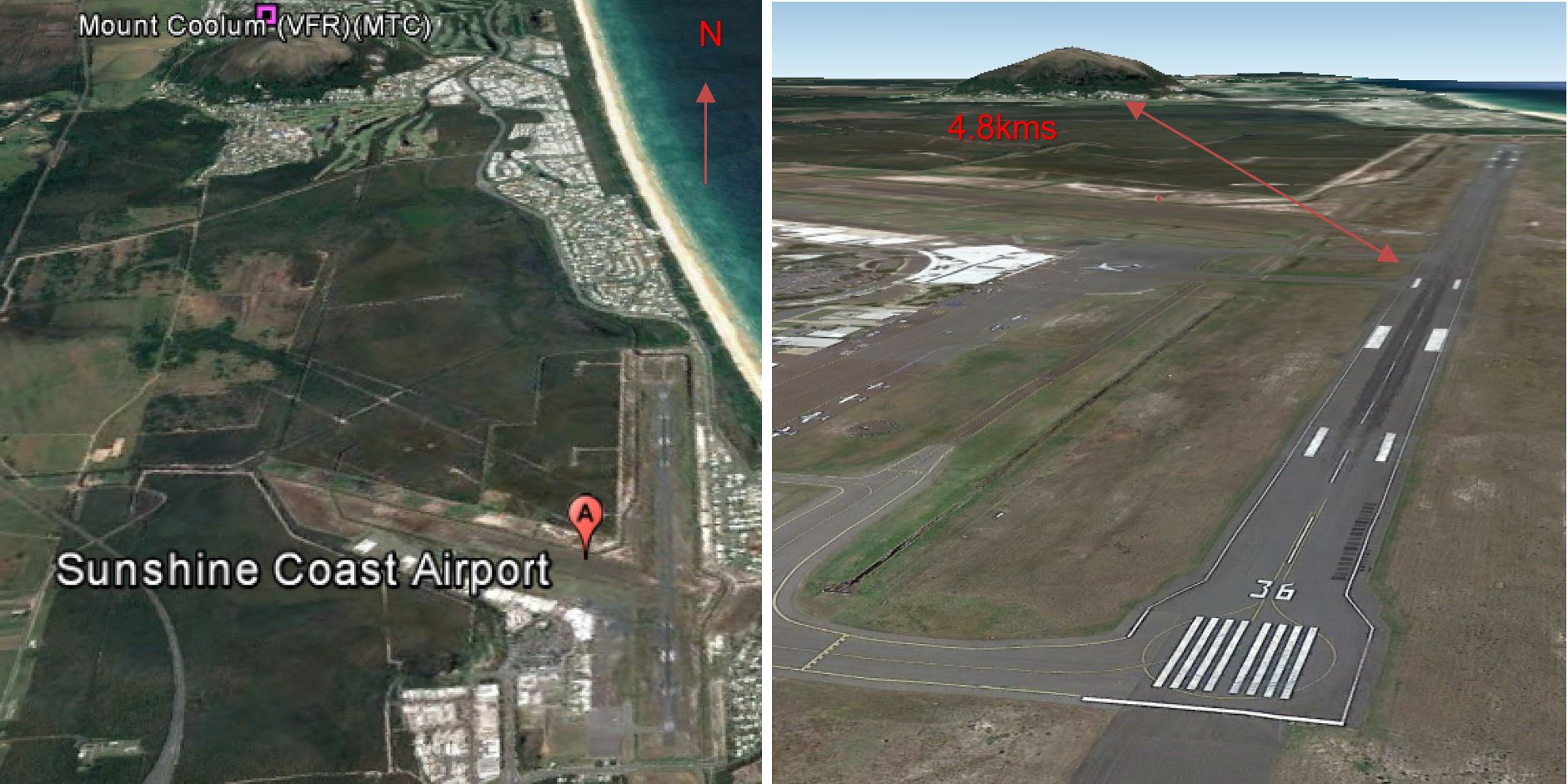
ATC issued a ‘check gear down’ warning to the aircraft shortly before being unable to maintain visual contact with the aircraft in the circuit.[1] Air traffic controllers further issued a ‘Safety Alert, Terrain’[2] call as the aircraft manoeuvred to the north of the airport in the proximity of Mt Coolum (682ft). Air traffic control regained visual contact with the aircraft on short final.

The pilot reported that approaching the airport in the reduced visibility, he relied upon vertical visual contact with the ground to maintain his situational awareness when the horizontal visibility deteriorated. The pilot also stated that he was familiar with the local area and carried two Garmin GPS[3] and two iPads with planning and navigation software.

Figure 1: Sunshine Coast Airport proximity to Mt Coolum, Qld

Figure 1: Sunshine Coast Airport proximity to Mt Coolum, Qld

Source: Google Earth Pro Image 31 October 2017 with ATSB annotations

Visual Meteorological Conditions (VMC) requirements

Table 1: VMC criteria for aeroplanes below 3,000ft above mean sea level

Class of AirspaceFlight VisibilityVertical and Horizontal distance from cloudConditions
Class G (Uncontrolled) or within 1,000 ft of ground5,000MClear of cloud and in sight of ground or waterRadio must be carried and used on the appropriate frequency
Class D (Controlled)5,000M

600M horizontal 1,000FT vertically above cloud

Or 500FT vertically below cloud

ATC may permit operations in weather conditions that do not meet these criteria

(Special VFR).

Source: Aeronautical Information Publication (AIP) Australia: ENR 1.2-4 10 November 2016

Safety message

Pilots are encouraged to make conservative decisions when considering how forecast weather may affect their flight. If poor weather is encountered en-route, timely and conservative decision making may be critical to a safe outcome.

VFR[4] pilots are also encouraged to familiarise themselves with the definition of VMC criteria, and carefully consider available options where forecast or actual conditions are such that continued flight in VMC cannot be assured.

The ATSB SafetyWatch highlights the broad safety concerns that come out of our investigation findings and from the occurrence data reported to us by industry.

The ATSB SafetyWatch highlights the broad safety concerns that come out of our investigation findings and from the occurrence data reported to us by industry.

Flying with reduced visual cues and Inflight decision making such as in this occurrence remains one of the ATSB’s major safety concerns.

Number 4 in the Avoidable Accident series published by the ATSB titled ‘Accidents involving pilots in Instrument Meteorological Conditions’ lists three key messages for pilots:

  • Avoiding deteriorating weather or IMC[5] requires thorough pre-flight planning, having alternate plans in case of an unexpected deterioration in the weather, and making timely decisions to turn back or divert.
  • Pressing on into IMC conditions with no instrument rating carries a significant risk of severe spatial disorientation due to powerful and misleading orientation sensations in the absence of visual cues. Disorientation can affect any pilot, no matter what their level of experience.
  • VFR pilots are encouraged to use a ‘personal minimums’ checklist to help control and manage flight risks through identifying risk factors that include marginal weather conditions.

About this report

Decisions regarding whether to conduct an investigation, and the scope of an investigation, are based on many factors, including the level of safety benefit likely to be obtained from an investigation. For this occurrence, no investigation has been conducted and the ATSB did not verify the accuracy of the information. A brief description has been written using information supplied in the notification and any follow-up information in order to produce a short summary report, and allow for greater industry awareness of potential safety issues and possible safety actions.

__________

  1. A standard path normally flown within 3nm (5.5 km) by aircraft when taking off and landing at an airport
  2. Air traffic control will issue a ‘Safety Alert, Terrain’ to aircraft, when they become aware that an aircraft is in a situation that is considered to place it in an unsafe proximity to terrain along its intended flight path
  3. Global Positioning System
  4. Visual Flight Rules
  5. Instrument meteorological conditions (IMC): weather conditions that require pilots to fly primarily by reference to instruments, and therefore under Instrument Flight Rules (IFR), rather than by outside visual reference. Typically, this means flying in cloud or limited visibility.

Occurrence summary

Mode of transport Aviation
Occurrence ID AB-2018-021
Occurrence date 22/02/2018
Location 9 km S Sunshine Coast, Airport
State Queensland
Occurrence class Serious Incident
Aviation occurrence category VFR into IMC
Highest injury level None
Brief release date 28/03/2018

Aircraft details

Manufacturer Piper Aircraft Corp
Model PA-28R
Sector Piston
Operation type General Aviation
Damage Nil