Runway incursion

Separation issue due to runway incursion involving Cessna 172, VH-EKV and Beech 58, VH-MLB, Alice Springs Airport, Northern Territory, on 16 June 2016

Final report

What happened

At about 0738 Central Standard Time (CST), a Cessna 172 aircraft, registered VH-EKV (EKV), taxied to depart from runway 12 at Alice Springs Airport, Northern Territory for Ayers Rock. The pilot and two passengers were on board the private flight. The air traffic control Tower was scheduled to open at 0800. At the time of departure, procedures for operating in the vicinity of non-controlled aerodromes applied at Alice Springs Airport. The airport has a common traffic advisory frequency (CTAF) when the Tower is closed.

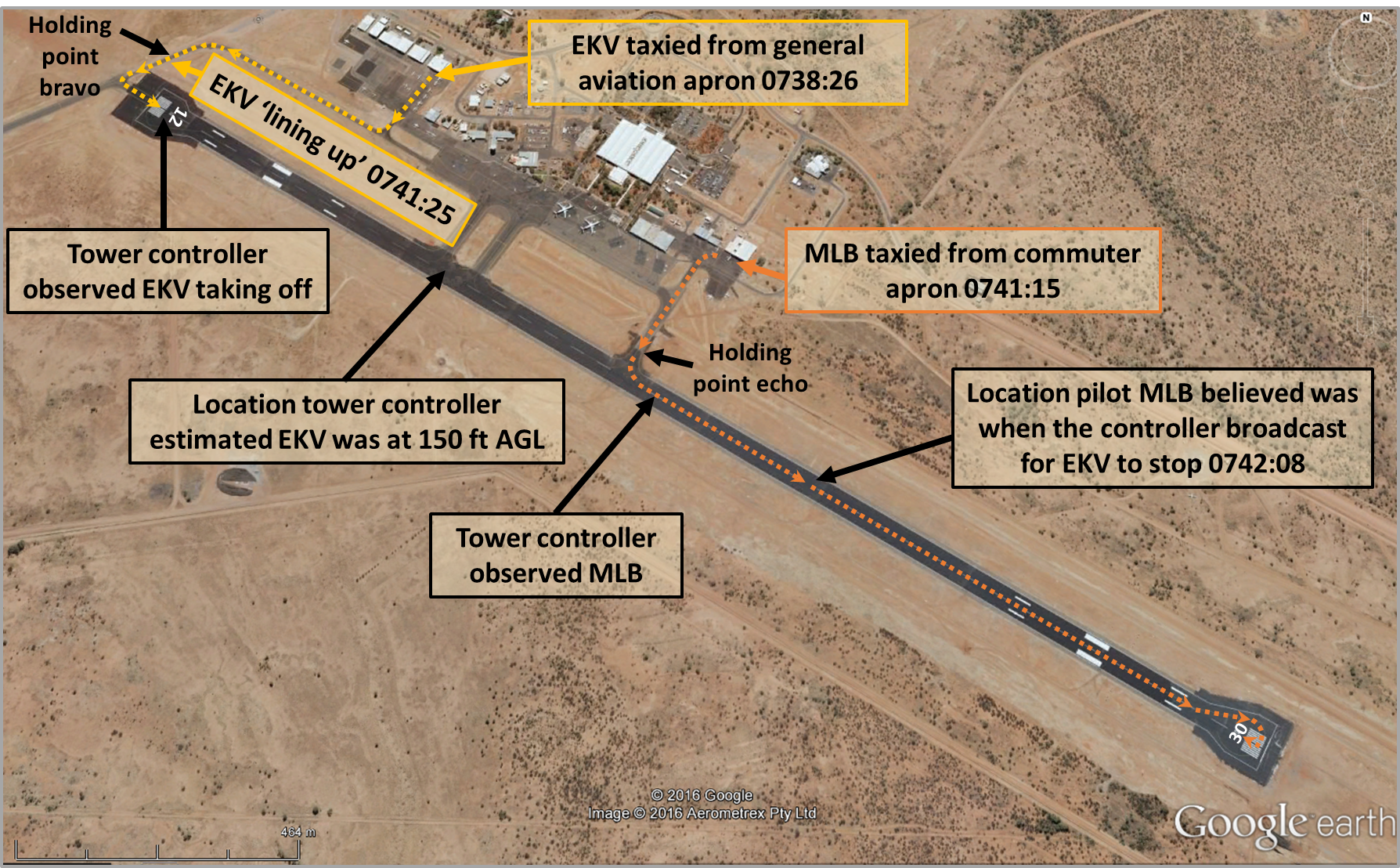
The aircraft was located on the general aviation apron and taxied for holding point bravo for runway 12 (yellow line in Figure 1). The pilot of EKV broadcast a taxi call on the CTAF.

Figure 1: Alice Springs Airport showing the taxi routes and relevant locations of EKV (yellow line) and MLB (orange line)

Figure 1: Alice Springs Airport showing the taxi routes and relevant locations of EKV (yellow line) and MLB (orange line)

Source: Google earth, modified by the ATSB

The transcripts of the relevant CTAF recordings are shown below, with the time, who made the broadcast, the transmission, and readability.[1]

TimeSourceBroadcastReadability
0738:26EKVAll stations EKV Cessna 172 taxiing for the runway 12 [AFRU[2] ‘Alice Spring CTAF’]5. Perfectly readable

Following the broadcast by the pilot of EKV, several broadcasts were made on the CTAF where the airport rescue and firefighting service were conducting routine radio checks.

At 0741:15, the pilot of a Beech 58 aircraft, registered VH-MLB (MLB), broadcast a taxi call on the CTAF (the readability was 2, as the call was badly broken and very hard to understand). The aircraft was located on the commuter apron and taxied for holding point echo with the intention of then backtracking on the runway in preparation for a runway 30 departure (for a flight to Nyirripi) (orange line in Figure 1). The pilot and two passengers were on board the charter flight.

0741:15MLBAlice springs traffic MLB taxiing and backtracking runway 30 for Nirripi Alice Springs [AFRU tone]2. Readable now and then

 At 0741:25, the pilot of EKV broadcast that they were lining up on runway 12 (Figure 1).

0741:25EKVEKV lining up on 12 [No AFRU tone]5. Perfectly readable

 The pilot of MLB reported that they did not hear this broadcast from EKV, nor the earlier broadcast that they were taxiing for runway 12.

At 0741:30, the pilot of a Piper PA32 broadcast a taxi call (the readability was 3, with a loud squeal). The PA32 was located at the general aviation apron, close to where EKV had taxied earlier, and was taxiing for runway 12.

0741:30PA32Alice springs traffic [registration] taxiing runway 12 Alice Spring [AFRU tone]3. Readable but with difficulty

 The pilot of MLB responded to the broadcast by the pilot of the PA32, asking if they were happy for MLB to taxi (which included entering and backtracking the runway) for runway 30, and advised that they were ‘shortly to depart’.

0741:38MLBAircraft taxiing runway 12 you happy for me to taxi runway 30 shortly to depart [No AFRU tone]5. Perfectly readable

 The pilot of the PA32 responded to that broadcast by indicating that they would hold short of runway 12.

0741:43PA32RAffirm [registration] will hold short [No AFRU tone]4. Readable

 The pilot of MLB responded, thanking the pilot of the PA32.

0741:47MLBMLB thank you [No AFRU tone]5. Perfectly readable

 Following this exchange between the pilot of the PA32 and the pilot of MLB, several broadcasts were made on the CTAF, where the airport fire and rescue service were conducting radio checks (at 0741:53, 0741:59, and 0742:02).

The pilot of MLB approached holding point echo and reported looking for other aircraft on approach or lined up on either runway (12 or 30). The pilot of MLB did not see any other aircraft and had not heard any other aircraft on the CTAF except for the PA32, so entered the runway and commenced backtracking runway 30 (orange line in Figure 1).

At about the same time, the pilot of EKV commenced take-off on runway 12. At about take-off speed, the pilot reported observing another aircraft enter the runway and start taxiing on runway 12 (away from them). The pilot assessed that it would be more dangerous to stop, so continued with the take-off.

An air traffic controller arrived in the control tower (which was due to open at 0800) and observed a Cessna 172 aircraft (EKV) taking off on runway 12 and a Beech 58 aircraft (MLB) taxiing on the same runway, about half way down the runway (Figure 1). The controller advised the pilot of EKV to stop immediately.

0742:08ATCEKV stop immediately stop immediately [No AFRU tone]5. Perfectly readable

The pilot of EKV reported not hearing the advice to stop immediately, but was busy with the take-off. The controller reported that EKV was airborne approximately 500 m before the position of MLB and passed overhead MLB at about 150 feet above ground level. The pilot reported banking the aircraft to the north at about 500 feet and two-thirds of the way down the length of the runway to avoid any possible conflict with the aircraft (MLB) on the runway.

The pilot of MLB heard the controller’s advice to another aircraft to stop, but was not aware of the reason. During the turn at the end of the runway to line up on runway 30, the pilot noticed a Cessna 172 (EKV) in a left turn toward the north. The pilot broadcast on the CTAF for the aircraft in the Alice Springs circuit area to notify their intentions.

0743:57MLBAircraft in circuit area at Alice Springs MLB just request your intentions [AFRU tone]5. Perfectly readable

 The pilot of EKV then gave a departure call at 0744:14 (readability was 4).

0744:14EKVEKV on climb to 3,000 departed time 14 [AFRU tone]4. Readable

 The pilot of MLB believed that the pilot of the Cessna 172 (EKV) had responded to their broadcast, and reported that the readability from the Cessna 172 was very poor. The pilot of MLB responded to the Cessna 172 at 0744:27, but that broadcast was over-transmitted by another aircraft making a taxi broadcast.

The next broadcast recorded from MLB was at 0747:19, where the pilot broadcast a departure call. The pilot reported having made lining-up and holding broadcasts, which may have been over-transmitted, and also making a rolling broadcast that was not recorded on the CTAF.

Both aircraft departed without further incident.

Pilot comment VH-EKV

The pilot reported generally operating at Alice Springs Airport when the tower was open, so would normally communicate with the tower controller. At the time of the occurrence, the Tower had not opened and the pilot reported hearing radio calls, but commented that radio calls from aircraft were not as clear as those made from the tower controllers. The pilot was aware that there was another aircraft departing to Nyirripi (destination of MLB).

Pilot comment VH-MLB

The pilot reported identifying the location of the PA32 as they approached holding point echo. The pilot commented that there were some white buildings in the distance behind the threshold of runway 12 that may have made it difficult to see EKV. The pilot indicated that the runway, although long, it is quite flat, and the whole runway was visible. The pilot also indicated that they were focused on known traffic. The pilot recognised the aircraft registration of the PA32 and the voice of the pilot, and confirmed the location of that aircraft before entering the runway.

The pilot reported that the winds were calm. They elected to use runway 30 as it was the most convenient runway for their departure.

Radio communication - Alice Springs airport

A study was conducted in 2010 by the Civil Aviation Safety Authority (CASA) to review the airspace classification above Alice Springs, Aeronautical Study of Alice Springs (YBAS) January 2010, and is available from the CASA website. The study consulted with stakeholders and did not identify any radio transmission ‘black spots’.

ATSB comment

The relevant communication recordings for the Alice Springs CTAF were obtained by the ATSB from Airservices Australia and the relevant broadcasts were given a readability level by the ATSB using the standard in radiotelephony communications as published in the AIP. The communications recorded are not necessarily what a pilot hears in their respective aircraft.

The ATSB could not establish why the pilots of both aircraft did not hear the broadcasts from the other aircraft.

Safety message

The ATSB SafetyWatch highlights the broad safety concerns that come out of our investigation findings and from the occurrence data reported to us by industry. One such concern is Safety around non-controlled aerodromes, which highlights that it is difficult for pilots to detect another aircraft through visual observation alone. The ATSB has identified that insufficient communication between pilots operating in the same area is the most common cause of safety incidents near non-controlled aerodromes.

This incident highlights the fundamental importance of effective communication, particularly during operations at a non-controlled aerodrome. The Civil Aviation Safety Authority (CASA) has produced several publications and resources that provide important safety advice related to operations in the vicinity of non-controlled aerodromes. Relevant guidance and explanatory material provided by CASA includes the following:

Aviation Short Investigations Bulletin - Issue 53

Purpose of safety investigations

The objective of a safety investigation is to enhance transport safety. This is done through:

  • identifying safety issues and facilitating safety action to address those issues
  • providing information about occurrences and their associated safety factors to facilitate learning within the transport industry.

It is not a function of the ATSB to apportion blame or provide a means for determining liability. At the same time, an investigation report must include factual material of sufficient weight to support the analysis and findings. At all times the ATSB endeavours to balance the use of material that could imply adverse comment with the need to properly explain what happened, and why, in a fair and unbiased manner. The ATSB does not investigate for the purpose of taking administrative, regulatory or criminal action.

Terminology

An explanation of terminology used in ATSB investigation reports is available here. This includes terms such as occurrence, contributing factor, other factor that increased risk, and safety issue.

Publishing information 

Released in accordance with section 25 of the Transport Safety Investigation Act 2003

Published by: Australian Transport Safety Bureau

© Commonwealth of Australia 2016

image_5.png

Ownership of intellectual property rights in this publication

Unless otherwise noted, copyright (and any other intellectual property rights, if any) in this report publication is owned by the Commonwealth of Australia.

Creative Commons licence

With the exception of the Coat of Arms, ATSB logo, and photos and graphics in which a third party holds copyright, this publication is licensed under a Creative Commons Attribution 3.0 Australia licence.

Creative Commons Attribution 3.0 Australia Licence is a standard form licence agreement that allows you to copy, distribute, transmit and adapt this publication provided that you attribute the work.

The ATSB’s preference is that you attribute this publication (and any material sourced from it) using the following wording: Source: Australian Transport Safety Bureau

Copyright in material obtained from other agencies, private individuals or organisations, belongs to those agencies, individuals or organisations. Where you wish to use their material, you will need to contact them directly.

--------

[1]     As outlined in the Airservices aeronautical information publication (AIP), the readability scale is as follows: 1. Unreadable, 2. Readable now and then, 3. Readable but with difficulty, 4. Readable, 5. Perfectly readable.

[2]     Alice Springs Airport has an aerodrome frequency response unit (AFRU) installed. The AFRU is to provide an automatic response to CTAF broadcasts to indicate to an operator that the correct radio frequency was selected and to confirm the operation of the radio’s transmitter and receiver, and the volume setting. If a broadcast has not been made on the CTAF in the preceding five minutes, and this transmission is over 2 seconds in length, a voice identification from the ARFU ‘Alice Springs CTAF’ is generated. If a broadcast has been made on the CTAF in the preceding five minutes, a 300-millisecond tone will be generated after each transmission over two seconds long.

Occurrence summary

Investigation number AO-2016-062
Occurrence date 16/06/2016
Location Alice Springs Aerodrome
State Northern Territory
Report release date 14/10/2016
Report status Final
Investigation level Short
Investigation type Occurrence Investigation
Investigation status Completed
Mode of transport Aviation
Aviation occurrence category Runway incursion
Occurrence class Incident
Highest injury level None

Aircraft details

Manufacturer Cessna Aircraft Company
Model 172L
Registration VH-EKV
Serial number 17260094
Sector Piston
Operation type Unknown
Departure point Alice Springs, NT
Destination Ayers Rock, NT
Damage Nil

Aircraft details

Manufacturer Beech Aircraft Corp
Model 58
Registration VH-MLB
Serial number TH-1675
Sector Piston
Operation type Charter
Departure point Alice Springs, NT
Damage Nil

Runway incursion involving Fairchild SA227, VH-HPE, Richmond Airport, Queensland, on 7 June 2016

Final report

What happened

On 7 June 2016, at 0418 Eastern Standard Time (EST), the pilot of a Fairchild SA227-DC, registered VH-HPE (HPE), departed Brisbane Airport, Queensland, for a flight to Mount Isa, Queensland. The flight included intermediate stops at Rockhampton and Richmond. The pilot was the only person on board the scheduled freight flight.

Prior to commencing the flight, the pilot reviewed the weather and NOTAM[1] information. The pilot noted there was no NOTAM information for Richmond Airport for the expected arrival time.

After completing the first leg of the flight, HPE departed Rockhampton for Richmond 30 minutes later than scheduled, at about 0615. The expected arrival time for Richmond was about 0810.

At about 0800, the aerodrome reporting officer (ARO) arrived at Richmond Airport with a work crew to undertake pre-planned work. The planned work was to remove plant growth from around the runway lights. The ARO conducted a pre-work safety briefing which included the work crew actions in the event of an aircraft arrival. The ARO then gave the two available hand-held VHF radios to the workers in the two works vehicles working within the runway strip. The ARO did not have a VHF radio in their vehicle and they were the only person qualified to broadcast on the common traffic advisory frequency (CTAF) used by aircraft, which uses VHF. All other works vehicles carried UHF radios.

At about the same time, the pilot of HPE broadcast on the Richmond CTAF advising they were 40 NM to the east and conducting a straight-in approach to runway 27. The pilot received a full response from the aerodrome frequency response unit (AFRU).[2]

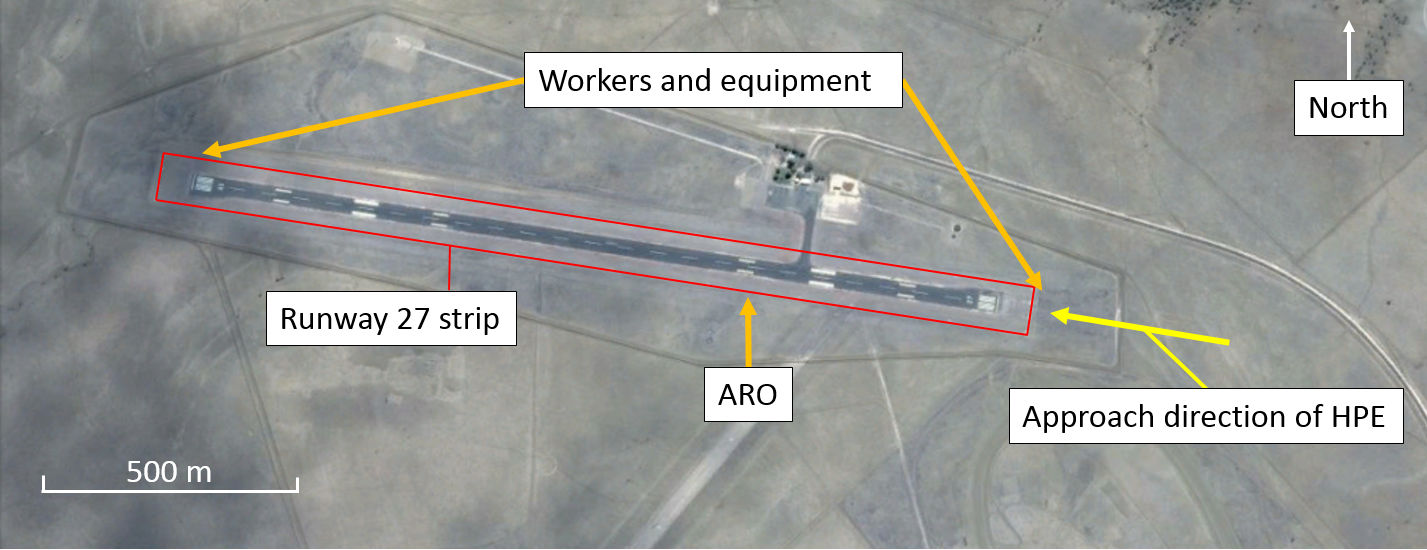
After the brief, the workers undertook the required task in three groups. One group positioned at the eastern end of the runway and a second group at the western end of the runway while the ARO remained at a mid-point along the runway (Figure 1). While the work groups conducted the plant removal, the pilot of HPE activated the pilot activated lighting.[3] The workers in the groups at each end of the runway observed the lights illuminating and immediately began to vacate the runway strip.[4] The pilot made a further broadcast when 20 NM east of Richmond, and received only a short response from the AFRU.

At about 0815, as the aircraft joined a 5 NM final approach to runway 27, the pilot reported that they sighted a vehicle on the runway threshold moving clear of the runway strip. The pilot then broadcast on the Richmond CTAF and broadcast again passing 3 NM on final approach to the runway. They received no response to the broadcasts apart from the AFRU short response.

As HPE approached the runway, the pilot reported that they noticed vehicles and equipment at the far end of the runway and witches hats along the edge of the bitumen. As the vehicles and equipment had moved clear of the runway strip, the pilot continued the approach. At a height of about 100-200 ft above ground level, the pilot reported that they observed a person inside the runway strip near the bitumen of the runway and conducted a go-around.[5]

The pilot then re-joined the circuit, and observed that all workers and equipment were clear of the runway. The pilot conducted a second approach and landed without incident.

No persons were injured, and the aircraft was not damaged in the incident.

Figure 1: Richmond Airport 

Figure 1: Richmond Airport

Source: Google Earth, modified by the ATSB

Aerodrome reporting officer (ARO) comment

The aerodrome reporting officer provided the following comments:

  • The works procedures for Richmond Airport require a NOTAM to be provided for all works within the runway strip exceeding 30 minutes duration. As the ARO did not expect the works to exceed 30 minutes duration, no NOTAM was provided.
  • The ARO elected to conduct the works on a Tuesday, as no passenger service was scheduled for that day.
  • The ARO receives no notification of the actual expected arrival time of the scheduled daily freight service, therefore they were not aware that the service was running late and did not check the airport movement log. Had the ARO checked the log they would have delayed the works until after the aircraft had departed.
  • The work crews carried two hand-held VHF radios for communicating with aircraft. While broadcasts from aircraft further than 5 NM from Richmond Airport may not be heard, calls within 5 NM are generally received.
  • The runway lights were activated about 15 minutes prior to the aircraft landing.
  • HPE conducted a straight-in approach to runway 27. In the past, aircraft arriving overflew the airport prior to approaching to land which the ARO believes is a safer procedure.
  • All workers and equipment were clear of the runway strip at the time HPE arrived. However, the workers and equipment positioned themselves just outside the runway strip. It may have appeared to the pilot that the workers and equipment were not clear.

Pilot comment

The pilot of HPE provided the following comments:

  • When approaching Richmond Airport an inbound radio broadcast was made. The AFRU provided a full response, which confirmed that their radio was working correctly and no radio broadcasts from other sources had been recently made within the Richmond CTAF.
  • No radio call was received from the work crew before or after the incident.

Safety action

Whether or not the ATSB identifies safety issues in the course of an investigation, relevant organisations may proactively initiate safety action in order to reduce their safety risk. The ATSB has been advised of the following proactive safety action in response to this occurrence.

Airport operator

As a result of this occurrence, the airport operator has advised the ATSB that they are taking the following safety action:

Change to works procedure

Prior to conducting works within the runway strip, the flight log is to be reviewed to ensure no flights are scheduled to arrive while work is in progress.

Safety message

The ATSB SafetyWatch highlights the broad safety concerns that come out of our investigation findings and from the occurrence data reported to us by industry. One identified concern is Safety around non-controlled aerodromes.  

This incident shows the importance of communication and ensuring that the systems exist and are used to minimise the likelihood of communication break downs. Effective communication between all parts of the aviation system, along with robust systems in place to support the individuals, is essential for safe operations.

Aviation Short Investigations Bulletin - Issue 53

Purpose of safety investigations

The objective of a safety investigation is to enhance transport safety. This is done through:

  • identifying safety issues and facilitating safety action to address those issues
  • providing information about occurrences and their associated safety factors to facilitate learning within the transport industry.

It is not a function of the ATSB to apportion blame or provide a means for determining liability. At the same time, an investigation report must include factual material of sufficient weight to support the analysis and findings. At all times the ATSB endeavours to balance the use of material that could imply adverse comment with the need to properly explain what happened, and why, in a fair and unbiased manner. The ATSB does not investigate for the purpose of taking administrative, regulatory or criminal action.

Terminology

An explanation of terminology used in ATSB investigation reports is available here. This includes terms such as occurrence, contributing factor, other factor that increased risk, and safety issue.

Publishing information 

Released in accordance with section 25 of the Transport Safety Investigation Act 2003

Published by: Australian Transport Safety Bureau

© Commonwealth of Australia 2016

image_5.png

Ownership of intellectual property rights in this publication

Unless otherwise noted, copyright (and any other intellectual property rights, if any) in this report publication is owned by the Commonwealth of Australia.

Creative Commons licence

With the exception of the Coat of Arms, ATSB logo, and photos and graphics in which a third party holds copyright, this publication is licensed under a Creative Commons Attribution 3.0 Australia licence.

Creative Commons Attribution 3.0 Australia Licence is a standard form licence agreement that allows you to copy, distribute, transmit and adapt this publication provided that you attribute the work.

The ATSB’s preference is that you attribute this publication (and any material sourced from it) using the following wording: Source: Australian Transport Safety Bureau

Copyright in material obtained from other agencies, private individuals or organisations, belongs to those agencies, individuals or organisations. Where you wish to use their material, you will need to contact them directly.

------- 

[1]     A Notice To Airmen (NOTAM) advises personnel concerned with flight operations of information concerning the establishment, condition or change in any aeronautical facility, service, procedure, or hazard, the timely knowledge of which is essential to safe flight.

[2]     Aerodrome frequency response unit provides an automatic response when pilots transmit on the traffic frequency for that particular aerodrome. If no other transmissions have been received by the AFRU within the previous 5 minutes the AFRU will respond with a pre-recorded voice message comprising aerodrome identification followed by ‘CTAF’. If a transmission has been received within the previous 5 minutes the AFRU will respond with only a short tone.

[3]     Pilot activated runway and taxiway lighting is activated by a series of timed transmissions using the aircraft’s very high frequency radio, on either a discrete or the local airport communication frequency.

[4]     Runway strip is a prepared area provided around the runway to reduce risk of damage to an aircraft running off of a runway and also provide an obstacle-free area for aircraft using the runway during take-off and landing.

[5]     Go-around, the procedure for discontinuing an approach to land, is a standard manoeuvre performed when a pilot is not completely satisfied that the requirements for a safe landing have been met. This involves the pilot discontinuing the approach to land and may involve gaining altitude before conducting another approach to land.

Occurrence summary

Investigation number AO-2016-056
Occurrence date 07/06/2016
Location Richmond Airport
State Queensland
Report release date 14/10/2016
Report status Final
Investigation level Short
Investigation type Occurrence Investigation
Investigation status Completed
Mode of transport Aviation
Aviation occurrence category Runway incursion
Occurrence class Incident
Highest injury level None

Aircraft details

Manufacturer Fairchild Industries Inc
Model SA227-DC
Registration VH-HPE
Serial number DC-823B
Aircraft operator Toll Aviation
Sector Turboprop
Operation type Air Transport Low Capacity
Destination Richmond, Qld
Damage Nil

Runway incursion involving a Cessna 172M, VH-EJM and a vehicle, at Townsville Airport, Queensland, on 10 September 2015

Final report

What happened

On 10 September 2015, at about 0930 Eastern Standard Time (EST), an instructor and student pilot of a Cessna 172M aircraft, registered VH-EJM (EJM), were conducting circuits at Townsville Airport, Queensland.

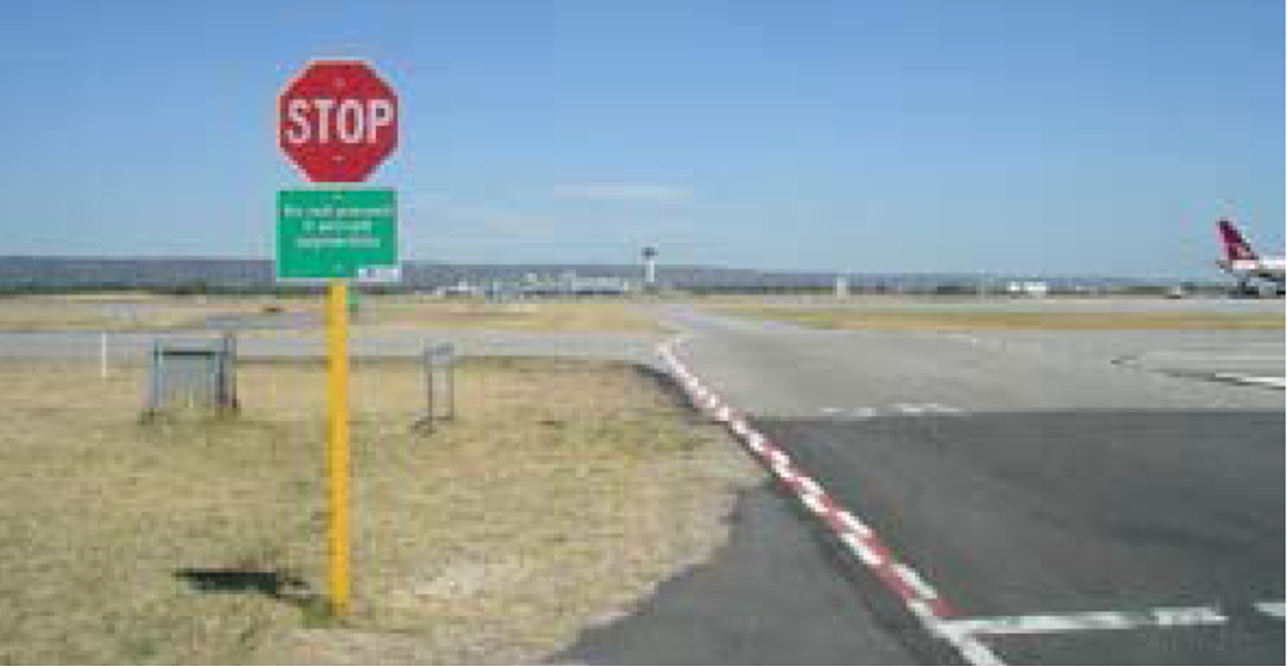
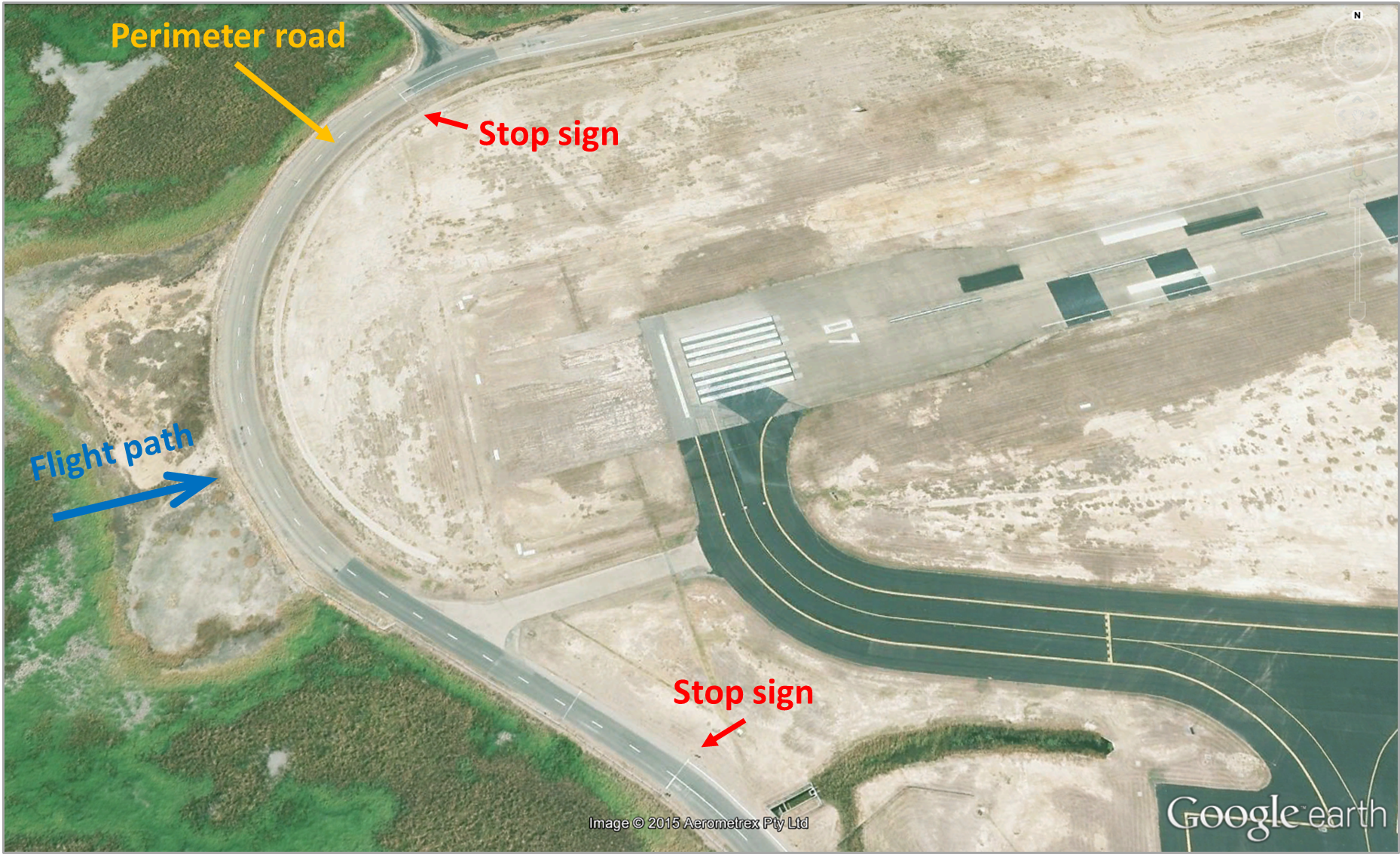
The student was flying the aircraft and on mid-final for a touch-and-go landing on runway 07, when the instructor noticed a truck on the perimeter road, near the threshold to runway 07. The truck had not held at the stop sign. The stop sign required all vehicles to stop, look for aircraft, and not proceed unless there was no aircraft landing (Figure 1).

Shortly after the instructor sighted the truck, the Townsville Tower air traffic controller advised the pilots of EJM that there was a truck on the perimeter road. The instructor acknowledged the controller and they proceeded with the landing.

The aircraft conducted a touch-and-go and continued with several more circuits without incident.

Figure 1: Townsville airport perimeter road near runway 07

Figure 1: Townsville airport perimeter road near runway 07

Source: Google earth, modified by the ATSB

Instructor and aircraft operator comments

The instructor commented that another vehicle on the perimeter road, ahead of the truck, also did not stop at the stop sign.

The operator reported this could potentially have been a more serious issue if the student pilot was conducting their first solo flight, as there would be greater risk that the student might get low on the approach and might not see the truck.

Department of Defence investigation

The Department of Defence conducted an investigation into the serious incident. They determined that a contractor, driving a truck on the western perimeter road, failed to stop at the stop sign near the threshold of runway 07. VH-EJM missed the top of the truck by about 4 to 5 metres and the aircraft landed without incident.

The Department of Defence also conducted a subsequent investigation into an incident where a contractor driving a truck on the western perimeter road failed to stop at the stop sign near the threshold of runway 07. The pilot of a Cessna C172RG aircraft that was on short final, saw the truck coming towards their approach path and informed air traffic control. Air traffic control acknowledged the transmission. The truck stopped almost directly under the path of the arriving aircraft and the aircraft landed without incident.

The investigation determined that the stop signs located on the perimeter road on approach to runway 07 provided drivers with clear direction to stop, observe and give way to approaching aircraft. The failure of the drivers of the vehicles in these incidents to observe those protocols created the potential for a collision between the vehicle and the aircraft.

Safety action

Whether or not the ATSB identifies safety issues in the course of an investigation, relevant organisations may proactively initiate safety action in order to reduce their safety risk. The ATSB has been advised of the following proactive safety action in response to this occurrence.

Department of Defence

As a result of this occurrence, the airport operator has advised the ATSB that they are taking the following safety actions:

  • briefing material for contractors has been updated placing greater emphasis on safety around runways.
  • flashing lights have been installed on the stop signs, for the under-run service road, to improve observation of the sign by drivers.

ATSB comment

At the time of writing this report, two other similar events occurred on 8 and 10 December 2015. The occurrences were subsequent to the update of briefing material for contractors and the installation of flashing lights on the stop signs. The Department of Defence are conducting a review of their safety actions to see if there are any other options to prevent a re-occurrence.

Safety message

The International Civil Aviation Organization (ICAO) has identified runway safety as one of its priorities and has been working with countries and aviation organisations globally to reduce runway safety accidents. ICAO has developed a runway safety website, which offers a range of information and products to assist the aviation community to improve runway safety.

In addition, ICAO has published a Manual on the Prevention of Runway Incursions Doc 9870 AN/463, available from the ICAO website. The manual includes information on the prevention of runway incursions. The manual discusses that deficiencies in design, training, technology, procedures, regulations and human performance can result in a system break down and safety being compromised. A pilot, as part of the last line of defence, cannot assume that anyone will do the right thing, like the driver of the truck stopping at the stop sign, and they need to be prepared to re-evaluate the planned flight.

Additional information on runway safety is also available from the Airservices Australia webpage Runway safety.

In addition, Airservices Australia has published a guide for airside drivers, The Airside Drivers Guide to Runway Safety, which focuses on four aspects of operating safely on an aerodrome:

  1. planning your aerodrome operation
  2. aerodrome procedures
  3. communications
  4. aerodrome markings, signs and lights.

Aviation Short Investigations Bulletin Issue 46

Purpose of safety investigations

The objective of a safety investigation is to enhance transport safety. This is done through:

  • identifying safety issues and facilitating safety action to address those issues
  • providing information about occurrences and their associated safety factors to facilitate learning within the transport industry.

It is not a function of the ATSB to apportion blame or provide a means for determining liability. At the same time, an investigation report must include factual material of sufficient weight to support the analysis and findings. At all times the ATSB endeavours to balance the use of material that could imply adverse comment with the need to properly explain what happened, and why, in a fair and unbiased manner. The ATSB does not investigate for the purpose of taking administrative, regulatory or criminal action.

Terminology

An explanation of terminology used in ATSB investigation reports is available here. This includes terms such as occurrence, contributing factor, other factor that increased risk, and safety issue.

Publishing information 

Released in accordance with section 25 of the Transport Safety Investigation Act 2003

Published by: Australian Transport Safety Bureau

© Commonwealth of Australia 2016

image_5.png

Ownership of intellectual property rights in this publication

Unless otherwise noted, copyright (and any other intellectual property rights, if any) in this report publication is owned by the Commonwealth of Australia.

Creative Commons licence

With the exception of the Coat of Arms, ATSB logo, and photos and graphics in which a third party holds copyright, this publication is licensed under a Creative Commons Attribution 3.0 Australia licence.

Creative Commons Attribution 3.0 Australia Licence is a standard form licence agreement that allows you to copy, distribute, transmit and adapt this publication provided that you attribute the work.

The ATSB’s preference is that you attribute this publication (and any material sourced from it) using the following wording: Source: Australian Transport Safety Bureau

Copyright in material obtained from other agencies, private individuals or organisations, belongs to those agencies, individuals or organisations. Where you wish to use their material, you will need to contact them directly.


Occurrence summary

Investigation number AO-2015-122
Occurrence date 10/09/2015
Location Townsville Airport
State Queensland
Report release date 28/01/2016
Report status Final
Investigation level Short
Investigation type Occurrence Investigation
Investigation status Completed
Mode of transport Aviation
Aviation occurrence category Runway incursion
Occurrence class Serious Incident
Highest injury level None

Aircraft details

Manufacturer Cessna Aircraft Company
Model 172M
Registration VH-EJM
Serial number 17262423
Sector Piston
Operation type Flying Training
Departure point Townsville, Qld
Destination Townsville, Qld
Damage Nil

Runway incursion involving a Beech Aircraft Corp B200C, VH-AMB, Sydney, New South Wales, on 5 June 1993

Summary

Circumstances

At 0341 hours the driver of Qantas tug Red Charlie requested permission to tow a Qantas B767 aircraft from the Qantas Maintenance Area to the International Terminal Bay 30. The driver was cleared by ATC to tow the aircraft via taxiway foxtrot and hold short of runway 16. This instruction was acknowledged by the driver.

VH-AMB was arriving at Sydney on a flight from Armidale and was on final approach to runway 16.

As the tug approached the holding point for runway 16 the Aerodrome Controller [ADC] issued the hold short instruction a second time which was again acknowledged by the driver. The ADC had decided that VH-AMB would land before the tug would be given permission to cross runway 16 and issued a landing clearance to that aircraft at 0345 hours.

It had been common practice during the night shift, for tug drivers to receive a clearance to cross runway 16 at the point at which the ADC issued the second hold short instruction. With this expectancy in mind, the tug driver thought he had received a clearance to cross runway 16 when he acknowledged the second hold short instruction.

The holding point for runway 16 on taxiway foxtrot is not easily recognised from the tower at night and controllers therefore had to rely on pilots/drivers complying with any instruction received. As Red Charlie was approaching this holding point, it was not possible for the ADC to accurately determine the position of the tug and aircraft.

At 0346.10 hours the pilot of VH-AMB informed the tower that he had an aircraft in front of him on the runway. The ADC immediately cancelled the landing clearance and established that Red Charlie was clear of runway 16, having crossed that runway. As VH-AMB was still in a position to land, a second landing clearance was issued at 0346.55 hours.

VH-AMB continued the approach and landed safely.

Significant Factors

1. The driver of Red Charlie had an expectation that he would be given a clearance to cross runway 16 at the time the second hold short instruction was issued.

2. The position of the taxiway foxtrot holding point is difficult to visually judge at night from the control tower. 3. The driver of Red Charlie did not read back the instruction to hold short of runway 16. 4. There is no ATC requirement for the read back referred to in 3 above.

Safety Actions

The Bureau of Air Safety Investigation issued a Safety Advisory Notice [SAN930310] to Qantas Airways, the Civil Aviation Authority and the Federal Airports Corporation. It stated that:

The Bureau of Air Safety Investigation advises that formal radio procedures instruction should be included in all airside driver training and suggests that ATC could have an input into such training.

Occurrence summary

Investigation number 199301641
Occurrence date 05/06/1993
Location Sydney
State New South Wales
Report release date 07/01/1994
Report status Final
Investigation type Occurrence Investigation
Investigation status Completed
Mode of transport Aviation
Aviation occurrence category Runway incursion
Occurrence class Incident

Aircraft details

Manufacturer Beech Aircraft Corp
Model B200C
Registration VH-AMB
Sector Turboprop
Operation type Medical Transport
Departure point Armidale NSW
Destination Sydney NSW
Damage Nil

Runway incursion involving a Beech Aircraft Corp B200C, VH-AJM and Piper PA-31-350, VH-MZM, Sydney, New South Wales, on 22 April 1993

Summary

Simultaneous runway operations were being conducted at the time of the occurrence with departures from runway 16 and arrivals on runways 16 and 07. A busy traffic situation was creating high workload levels for the tower staff. Weather conditions were fine with light winds.

The air traffic situation around the airport was further complicated by an overflying helicopter which had departed from Prince Henry hospital, located 8 km to the east, enroute to Bankstown via overhead Sydney Airport at 1,500 feet.

VH-AJM taxied at 0744 EST and at 0747, reported ready for take-off on runway 16, from the intersection with taxiway Foxtrot, 536 metres south of the runway 16 threshold. VH-MZM taxied at 0750 and was instructed to taxy to and hold at the holding point adjacent to the threshold of runway 16. The planned departure sequence from runway 16 was VH-AJM followed by VH-MZM.

The Tower Controller amended the departure sequence due to the presence of the overflying helicopter, as the departure track of VH-AJM placed that aircraft in potential confliction with the helicopter. He decided that VH-MZM should take-off before VH-AJM.

When VH-MZM was instructed to line up, the crew of VH-AJM mistakenly believed the instruction was addressed to them and commenced to taxy beyond the holding point into the runway strip. They recognised their error when VH-MZM was subsequently cleared for take-off. Although the Tower Controller had not observed VH-AJM move beyond the holding point, as his view of taxiway Foxtrot was obscured by a structural roof support beam, the incursion was immediately noticed by the Tower Coordinator and the Surface Movement Controller who alerted the Tower Controller.

The take-off clearance for VH-MZM was cancelled and both aircraft were instructed to vacate the runway to allow an aircraft on final approach for runway 16 to land.

Significant Factors

1. The crew of VH-AJM expected to depart before VH-MZM.

2. The Tower Controller amended the departure sequence due to overflying traffic in potential conflict with the departure track of VH-AJM.

3. The crew of VH-AJM misinterpreted the callsign when the Tower Controller issued a line up clearance to VH-MZM.

Occurrence summary

Investigation number 199301015
Occurrence date 22/04/1993
Location Sydney
State New South Wales
Report release date 27/05/1994
Report status Final
Investigation type Occurrence Investigation
Investigation status Completed
Mode of transport Aviation
Aviation occurrence category Runway incursion
Occurrence class Incident

Aircraft details

Manufacturer Beech Aircraft Corp
Model B200C
Registration VH-AJM
Sector Turboprop
Operation type Air Transport Low Capacity
Departure point Sydney NSW
Destination Port Macquarie NSW
Damage Nil

Aircraft details

Manufacturer Piper Aircraft Corp
Model PA-31-350
Registration VH-MZM
Sector Piston
Operation type Air Transport Low Capacity
Departure point Sydney NSW
Destination Moruya NSW
Damage Nil

Runway incursion involving a Boeing 737-476, VH-TJO and Partenavia P.68C-TC, VH-TCU, Sydney, New South Wales, on 26 February 1993

Summary

The Partenavia was being flown from Essendon to Sydney. During the final stage of the flight the aircraft was radar vectored for an approach and landing on runway 34, which was accomplished normally.

After landing, the aircraft vacated left into taxiway 'Alpha' and contacted Surface Movement Control (SMC), which cleared the aircraft to cross runway 34 via taxiway 'Hotel' and hold short of runway 07. Although this was acknowledged by the pilot, the aircraft continued past the holding point on taxiway 'Charlie' and infringed the runway 07 flight strip, despite being queried by SMC. When the pilot of the Partenavia recognised the aircraft had entered the flight strip he immediately carried out a 180 degree turn to vacate, during which the runway surface itself was slightly infringed.

In the meantime, a Boeing 737, VH-TJO, which had been cleared to take-off on runway 07, was instructed by the Aerodrome Controller (ADC) to stop immediately. This was accomplished safely from a reported speed of 100 knots. The aircraft was able to vacate the runway via taxiway 'Charlie'.

Occurrence summary

Investigation number 199300322
Occurrence date 26/02/1993
Location Sydney
State New South Wales
Report release date 14/08/1996
Report status Final
Investigation type Occurrence Investigation
Investigation status Completed
Mode of transport Aviation
Aviation occurrence category Runway incursion
Occurrence class Incident

Aircraft details

Manufacturer Partenavia Costruzioni Aeronautiche S.p.A
Model P.68C-TC
Registration VH-TCU
Sector Piston
Operation type Private
Departure point Essendon
Destination Sydney
Damage Nil

Aircraft details

Manufacturer The Boeing Company
Model 737-476
Registration VH-TJO
Sector Jet
Operation type Air Transport High Capacity
Departure point Sydney
Destination Brisbane
Damage Nil

Runway incursion involving a Cessna 172M, VH-MGZ and Cessna 172RG, VH-CSH, Canberra Airport, Australian Capital Territory, on 11 April 1999

Summary

The pilot of VH-MGZ was instructed to taxi for runway 30 and to hold short of runway 35. The aircraft was later observed approaching the holding point and taxiing at a considerable speed. The pilot was instructed to stop immediately. The aircraft came to a halt just within the flight strip of runway 35. VH-CSN was sent around from short final approach. The pilot reported that he had been distracted by his preparation for a navigation exercise and by the two passengers on board his aircraft.

Occurrence summary

Investigation number 199901643
Occurrence date 11/04/1999
Location Canberra Airport
State Australian Capital Territory
Report release date 16/04/1999
Report status Final
Investigation type Occurrence Investigation
Investigation status Completed
Mode of transport Aviation
Aviation occurrence category Runway incursion
Occurrence class Incident

Aircraft details

Manufacturer Cessna Aircraft Company
Model 172M
Registration VH-MGZ
Sector Piston
Departure point Canberra ACT
Destination Tumut NSW
Damage Nil

Aircraft details

Manufacturer Cessna Aircraft Company
Model 172RG
Registration VH-CSH
Sector Piston
Departure point Unknown
Destination Canberra ACT
Damage Nil

Runway incursion involving a Beech Aircraft Corp C90, VH-FDP, Cairns Aerodrome, Queensland, on 2 June 1998

Summary

The pilot of FDP had been instructed to taxy to the holding point at taxiway A2 for departure. The Surface Movement Controller then diverted his attention to other traffic. The Aerodrome Controller then noticed that FDP was holding at the intersection of runway 15 and taxiway A3 , partially inside the holding point.

The pilot advised that the aircraft was slightly inside the holding point and asked for approval to conduct engine checks in that position. As there was no immediate traffic, the aircraft was cleared onto the runway. The pilot reported that he did not see the holding point marking until he had passed over it. He added that the marking did not extend across the full width of the taxiway, and felt that this contributed to the incident. In addition, he had not operated into Cairns for more than 2 years, so he was not completely familiar with the aerodrome layout.

The comments by the pilot on the holding point marking were discussed with the local Airservices manager and the airport owner. Both these agencies indicated that there had been other instances of pilot confusion concerning taxiway markings in the same area. It was agreed that Airservices would arrange for a 'Caution' note to be inserted in the En-route Supplement advising pilots to exercise caution when approaching the taxiway A3 holding point. The airport owner was completing arrangements to repaint the holding point marking to extend the full width of the taxiway, and to repaint the holding point and frequency information on the associated gable marker.

Occurrence summary

Investigation number 199801976
Occurrence date 02/06/1998
Location Cairns Aerodrome
State Queensland
Report release date 16/06/1998
Report status Final
Investigation type Occurrence Investigation
Investigation status Completed
Mode of transport Aviation
Aviation occurrence category Runway incursion
Occurrence class Incident

Aircraft details

Manufacturer Beech Aircraft Corp
Model C90
Registration VH-FDP
Sector Turboprop
Operation type Medical Transport
Departure point Cairns Qld
Destination Kowanyama Qld
Damage Nil

Runway incursion involving a Boeing 767-338ER, VH-OGK, Brisbane Aerodrome, Queensland, on 7 February 1998

Summary

Prior to issuing a take-off clearance the controller checked that the runway was clear. Take-off was rejected when the crew of VH-OGK saw a vehicle on a taxiway and entering the runway. The aircraft exited via the next available taxiway and returned to the runway end for an uneventful departure.

A pest control contractor had been escorted to an aircraft parking area on the domestic apron to fumigate a number of aircraft. He was also informed that another aircraft to be treated was in the maintenance hangar on the other side of the airport. He indicated that he would travel to the hangar via the public roads outside the airport and that he would leave the airport via Gate 1, through which he had entered. He also indicated that he knew the location of the airline's operations office. No airline supervision was provided while the contractor did his work.

On completion of the work on the apron the contractor decided to travel to the hangar via the perimeter road inside the airport. He ultimately arrived at the hangar and completed the task there. No supervision was provided by hangar staff as they were not aware the contractor did not have an airside licence. The contractor departed the hangar intending to return to gate 1 via the perimeter road. While driving along the taxiway from the hangar he missed the turn to the perimeter road and crossed the holding point to the runway. This was when the aircraft crew observed the vehicle and rejected the take-off. A short time later, the vehicle was intercepted by an airport safety officer.

Procedures required that all persons who do not hold an 'Airside Drives Authority' be escorted and supervised at all times while airside. This requirement was not complied with in this instance. As an additional safety measure, a 'Safety Information Note' has been prepared for issue to all airside visitors.

Occurrence summary

Investigation number 199800460
Occurrence date 07/02/1998
Location Brisbane Aerodrome
State Queensland
Report release date 22/06/1998
Report status Final
Investigation type Occurrence Investigation
Investigation status Completed
Mode of transport Aviation
Aviation occurrence category Runway incursion
Occurrence class Incident

Aircraft details

Manufacturer The Boeing Company
Model 767-338ER
Registration VH-OGK
Sector Jet
Operation type Air Transport High Capacity
Departure point Brisbane Qld
Destination Bangkok, Thailand
Damage Nil

Runway incursion involving a Cessna 172N, VH-LHC, Moorabbin Aerodrome, Victoria, on 20 July 1997

Summary

FACTUAL INFORMATION

The pilot of the Cessna 172 (C172) landed the aircraft on runway 31R and vacated the runway at the A2 taxiway intersection. However, the pilot became confused by the numerous taxiway options for his return to the parking area and entered runway 35R, using it as a taxiway in a northerly direction. Runway 35R was not in use at the time and was therefore available for taxiing. Whilst on runway 35R the pilot did not notice that his aircraft had entered runway 31R. He had not requested, nor had he received, a clearance from air traffic control to use runway 31R.

He did not see any signage that indicated that he was approaching the active runway and did not notice the gable markers that were set back from the crossing point of the two runways. A Piper PA28 had just taken off from runway 31R and passed over the C172 at a height of about 50 ft. A second PA28 on final approach to runway 31R was sent around by air traffic control.

SAFETY ACTION

During the course of the investigation the Bureau of Air Safety Investigation issued the following recommendation relating to this occurrence:

R980057

(issued 25 May 1998) "The Bureau of Air Safety Investigation recommends that the Civil Aviation Safety Authority review the adequacy of movement area guidance signs and markings, particularly at runway-to-runway intersections. The review should focus initially on Moorabbin Aerodrome and other aerodromes with multiple runways and complex taxiway systems."

Occurrence summary

Investigation number 199702384
Occurrence date 20/07/1997
Location Moorabbin Aerodrome
State Victoria
Report release date 17/08/1998
Report status Final
Investigation type Occurrence Investigation
Investigation status Completed
Mode of transport Aviation
Aviation occurrence category Runway incursion
Occurrence class Incident

Aircraft details

Manufacturer Cessna Aircraft Company
Model 172N
Registration VH-LHC
Sector Piston
Departure point Moorabbin Vic
Destination Moorabbin Vic
Damage Nil