On arrival overhead the destination the pilot assessed the wind velocity and decided to land on runway 23, a 610 metre long grass strip. The wind direction was north-north-easterly at 15 knots.
The pilot reported that the aircraft touched down further along the strip than normal, and that braking was poor on the grass surface. About two thirds of the way along the strip he considered going around but did not attempt to do so because of trees at the end of the strip. The aircraft overran the strip and collided with an abandoned vehicle before overturning.
The pilot had inadvertently misread the wind direction, and in doing so had operated the aircraft outside the published landing performance criteria.
The aircraft, a Sea scan version of the Westwind 1124, was departing for a normal coast watch operational flight. The outside air temperature (OAT) was 30 degrees C, with a north westerly wind at 5 kt. It was loaded to its maximum all up weight (MAUW) and configured for a flapless take-off. This being normal requirements for the aircraft operating at MAUW with an OAT greater than 28 degrees C. The calculated V1 speed was 140 kt, and the VR speed 148 kt.
With the co-pilot at the controls the aircraft taxied the 4 km to the threshold of runway 29 for departure. The take-off run was normal until the aircraft had travelled approximately 2,000 m and accelerated to 128 kt. At this point the left main wheel tyre suffered a blow out causing the aircraft to veer left.
The captain took control and rejected the take-off. Whilst he was attempting to maintain directional control, using brakes and nose wheel steering, the right main wheel tyre also blew out and the aircraft swung to the right, departing the runway and coming to a stop on the flight strip in the reciprocal direction to the take-off.
The left main gear leg collapsed, and the aircraft suffered damage to the left gear attachment structure, left fuel tank cell, and the infra-red dome mounted to the lower fuselage surface. All occupants evacuated safely.
The left main wheel and tyre remains were examined at the CAA Materials Evaluation Facility. The examination revealed that all three fusible plugs in the wheel hub were loose. Although it could not be established if the fusible plugs were tight before the accident, enquires indicated that they had not been touched by any other party prior to the wheel coming into BASI's possession.
The valve, and gasket between the wheel hub halves, were in good condition, and no flaws or defects were found in the tyre material, or its manufacturing process. An uneven wear pattern across the tread was noted, being more advanced on the middle tread and shoulders than on the intervening sections of tread.
The wear along the tyre shoulders is consistent with under-inflation, but as there was also some wear on the middle tread it was apparent that the tyre had been correctly, or possibly over inflated at some time. Over a period of time an undetected slow leak had probably occurred, with the wear pattern indicating that the tyre had been under-inflated for a number of take-offs and landings. In this condition the sidewalls would have been subjected to increased flexing, resulting in excessive heat generation and delamination between the fabric layers. Eventually the tyre would have been unable to sustain these flexing loads, resulting in rapid deflation and shredding of the tyre from the wheel. The aircraft operating at MAUW, the hot tarmac, and long taxiing distance would have exacerbated the situation.
The reason why the fusible plugs were loose could not be determined, but this was considered as the most probable source of the slow leak.
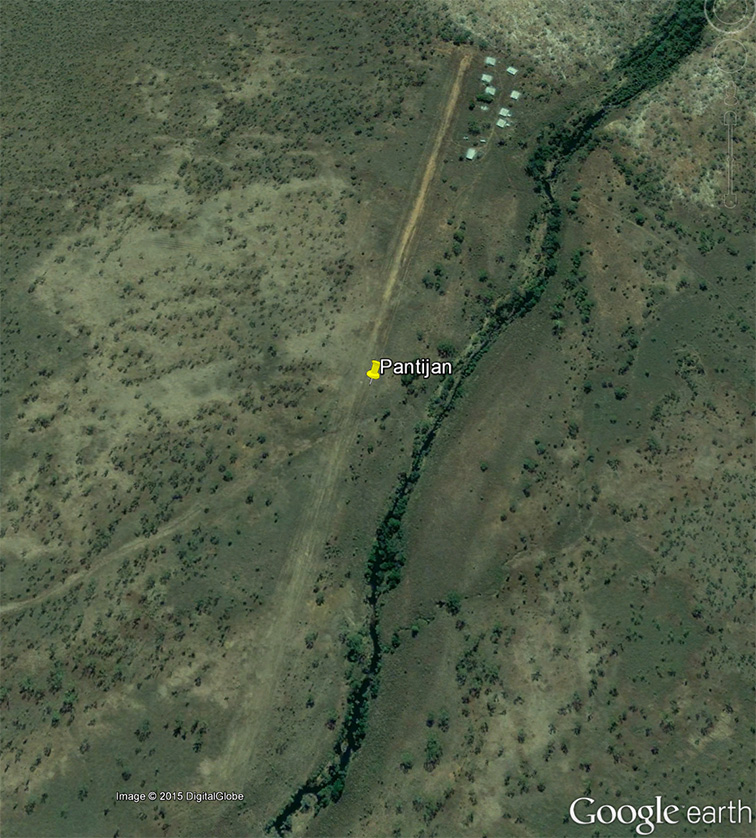
On 12 April 2015, the pilot of a Cessna 404 aircraft, registered VH-JOR (JOR), conducted preflight preparations at Broome Airport, Western Australia. The planned task involved a positioning flight from Broome to Derby, before a charter flight with five passengers, from Derby to Pantijan aeroplane landing area (ALA), Western Australia. The distance from Derby to Pantijan was 117 NM, with an estimated flying time of 49 minutes. The pilot reviewed information about the Pantijan airstrip in company documentation and using Google earth (Figure 1). He also arranged for the condition of the runway to be assessed by a contact person at Pantijan and the pilot of a helicopter scheduled to arrive at Pantijan before JOR.
Figure 1: Pantijan ALA
Source: Google earth
Prior to departing Broome, the pilot received information regarding the serviceability of the airstrip at Pantijan, from the contact person at the airstrip. He was advised that the grass beside the landing area was long, with some termite mounds outside the wingspan of the aircraft. He was also advised that the threshold of runway 02 had grass cover and that midway along the strip the surface was soft. The pilot understood that the contact person had walked the strip to assess its condition, but that no vehicle had been available to drive across the landing surface. Due to rising terrain at the northern end of the airstrip, the pilot was advised to regard the strip as one-way and to land on runway 02, and depart from runway 20.
After arriving in Derby, the pilot weighed the passengers and baggage and loaded the aircraft for the flight to Pantijan. Baggage was loaded into the aircraft lockers and also stowed at the rear of the aircraft and secured with a cargo net. Some bags were placed on a rear seat and secured with seatbelts. After loading the baggage and passengers, the aircraft departed from Derby at 1346 Western Standard Time (WST).
When about 80 NM from Pantijan, the pilot of JOR heard the pilot of the helicopter, who he had spoken to prior to departure, broadcast that he was conducting an approach to the airstrip in the direction of runway 02. The pilot of JOR responded with his current position and did not receive any further communications from the pilot of the helicopter. As JOR approached Pantijan, the pilot observed fires in the area. The direction of the smoke indicated a tailwind of about 5 kt for a landing on runway 02.
At about 1430 WST, the aircraft arrived overhead Pantijan. The pilot slowed the aircraft, lowered the first stage of flap and descended to about 700 ft above ground level. He then conducted a circuit and a visual inspection of the entire length of the runway. The pilot observed that the runway was narrow and bordered by tall grass. The helicopter was parked adjacent to a shed about three quarters of the way along the runway and clear of the landing area. The sand on the airstrip appeared to be uniform in colour, with no obvious darker patches that may have indicated water. There was short grass at the threshold of runway 02 extending for about 200 m. A termite mound was located about half way along the runway and had been placed on its side and moved to the right of the runway centreline.
The pilot then conducted an approach to land on runway 02. The aircraft touched down at the pilot’s aiming point, about 50 m beyond the threshold, and the pilot applied moderate braking. The aircraft continued along the centre of the runway and, as it slowed through about 60 kt, the pilot applied left rudder to turn the aircraft slightly to the left and increase separation from the overturned termite mound. He felt the rudder pedals move to the full left position and the aircraft turned to the left. The pilot immediately applied right rudder in an attempt to counteract the turn, but the aircraft initially continued to veer left towards the edge of the runway.
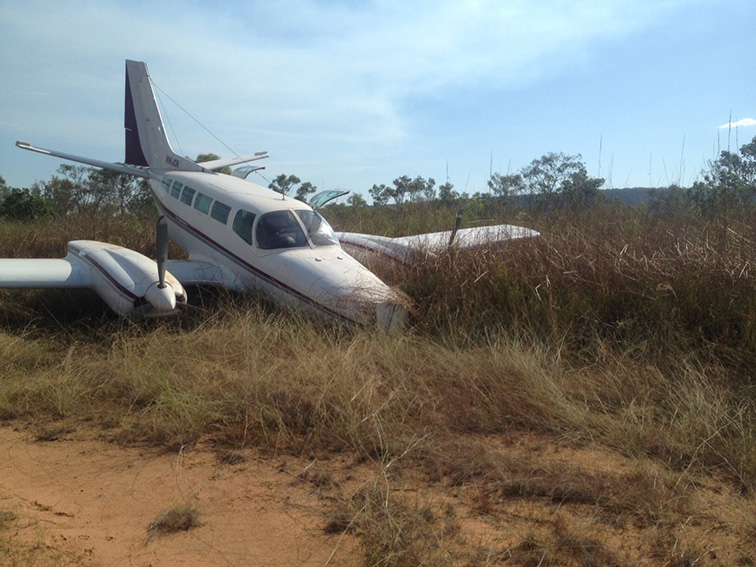
The left main landing gear momentarily lifted off the ground and the aircraft tipped to the right. As the aircraft veered off the runway and entered longer grass, the pilot regained control of the aircraft and it started to turn right and return towards the runway. The nose wheel then collided with a runway marker and collapsed, resulting in the aircraft nose contacting the ground and the aircraft skidded to a stop (Figure 2). The pilot secured the aircraft and assisted the passengers to disembark. One passenger had a cut to the back of the head from a loose object and another sustained a bleeding nose. Three other passengers and the pilot were not injured, however the aircraft sustained substantial damage.
Figure 2: Accident site
Source: Aircraft operator (edited by the ATSB)
Pilot comments
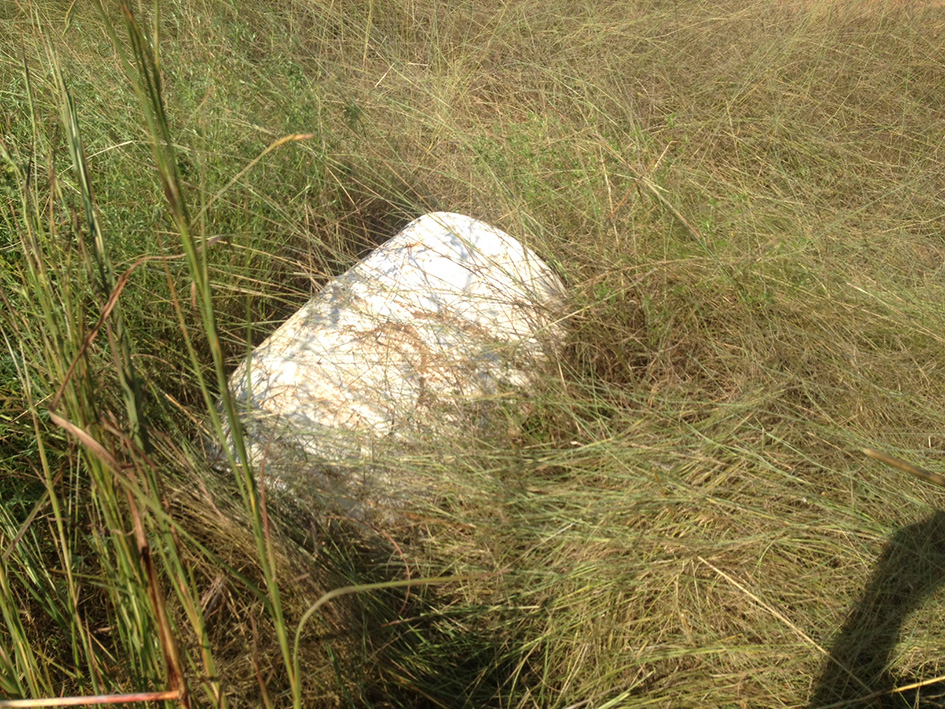
Following the accident, the pilot found that where he had commenced the left turn on the runway, the ground was soft and appeared to have previously held standing water, although the surface was dry at the time. The runway marker was a 44-gallon drum, cut in half longitudinally and laid on the ground and it was obscured by long grass (Figure 3).
None of the baggage had come loose in the cabin; the only unsecured objects were phones, cameras and water bottles.
The pilot stated that when facing similar circumstances, he would select a landing path that did not require any planned directional changes during the landing roll, until the aircraft has decelerated to a safe taxi speed.
Figure 3: Drum runway marker
Source: Aircraft operator
Safety action
Whether or not the ATSB identifies safety issues in the course of an investigation, relevant organisations may proactively initiate safety action in order to reduce their safety risk. The ATSB has been advised of the following proactive safety action in response to this occurrence.
Aircraft operator
As a result of this occurrence, the aircraft operator has advised the ATSB that they are taking the following safety actions:
Company pilots operating beyond mobile phone coverage will be issued with a satellite phone. In this incident, access to a satellite phone may have enabled the aircraft pilot to communicate with the helicopter pilot on the ground and obtain further details regarding the condition of the airstrip.
The operators of remote airstrips will be reminded to follow the company’s runway inspection guide, which required a vehicle to assess the condition of the landing surface.
All company pilots will be reminded of the importance of maintaining directional control on unimproved (sand or gravel) airstrips.
Safety message
Airfields that are used infrequently or seasonally, potentially pose significant hazards to aviation. This incident highlights the importance of identification and management of any risks that might be associated with such an airfield. Potential hazards may be hard to identify, with objects possibly obscured by vegetation. Changes in the runway surface can be hard to detect visually and without a vehicle or some means to apply a similar force to that of a landing aircraft.
The objective of a safety investigation is to enhance transport safety. This is done through:
identifying safety issues and facilitating safety action to address those issues
providing information about occurrences and their associated safety factors to facilitate learning within the transport industry.
It is not a function of the ATSB to apportion blame or provide a means for determining liability. At the same time, an investigation report must include factual material of sufficient weight to support the analysis and findings. At all times the ATSB endeavours to balance the use of material that could imply adverse comment with the need to properly explain what happened, and why, in a fair and unbiased manner. The ATSB does not investigate for the purpose of taking administrative, regulatory or criminal action.
Terminology
An explanation of terminology used in ATSB investigation reports is available here. This includes terms such as occurrence, contributing factor, other factor that increased risk, and safety issue.
Publishing information
Released in accordance with section 25 of the Transport Safety Investigation Act 2003
Ownership of intellectual property rights in this publication
Unless otherwise noted, copyright (and any other intellectual property rights, if any) in this report publication is owned by the Commonwealth of Australia.
Creative Commons licence
With the exception of the Coat of Arms, ATSB logo, and photos and graphics in which a third party holds copyright, this publication is licensed under a Creative Commons Attribution 3.0 Australia licence.
Creative Commons Attribution 3.0 Australia Licence is a standard form licence agreement that allows you to copy, distribute, transmit and adapt this publication provided that you attribute the work.
The ATSB’s preference is that you attribute this publication (and any material sourced from it) using the following wording: Source: Australian Transport Safety Bureau
Copyright in material obtained from other agencies, private individuals or organisations, belongs to those agencies, individuals or organisations. Where you wish to use their material, you will need to contact them directly.
During March 2015 three aircraft operating in Indonesia were involved in separate air safety occurrences:
Runway excursion – British Aerospace ATP-F, PK-DGI at Wamena airport, Papua, Indonesia on 31 March 2015
Runway excursion – Ayres S2R, PK-ELN at The Tajur Beras Airstrip, Kalimantan, Indonesia on 13 March 2015.
Hard Landing – Sikorsky S76C+, PK-FUP at Tanjung Dewa Island, East Kalimantan, Indonesia on 21 March 2015.
Investigations into the circumstances of these occurrences are being conducted by the National Transportation Safety Committee (NTSC) of Indonesia.
The NTSC requested assistance from the ATSB in the recovery of information from flight recorder equipment that was fitted to the aircraft. To facilitate this support and to provide the appropriate protections for the recorded information, the ATSB appointed an accredited representative in accordance with paragraph 5.23 of Annex 13 to the Convention on International Civil Aviation and commenced an investigation under the Australian Transport Safety Investigation Act 2003.
The ATSB successfully recovered data relating to the PK-DGI and PK-FUP occurrences and this information was provided to the NTSC in December 2015. Attempts to recover data from the AG‑NAV unit installed in PK-ELN were finalised in July 2016, however due to a damaged memory chip, no data for that occurrence was recovered.
The NTSC is responsible for releasing the final investigation report into these occurrences and can be contacted at:
National Transportation Safety Committee Ministry Of Transportation Republic Of Indonesia Transportation Building 3rd Floor Jalan Medan Merdeka Timur No. 5 Jakarta Pusat 10110 Indonesia
On 8 March 2015, the pilot of an Aero Commander 500 aircraft, registered VH-WZV, prepared to conduct a charter flight from Badu Island to Horn Island, Queensland, with five passengers. The aircraft had been refuelled earlier that day at Horn Island, where the pilot conducted fuel drains with no contaminants found. He had operated the aircraft for about 2 hours prior to landing at Badu Island with no abnormal performance or indications.
At about 1330 Eastern Standard Time (EST), the pilot started the engines and conducted the standard checks with all indications normal, obtained the relevant clearances from air traffic control, and taxied for a departure from runway 30. As the pilot lined the aircraft up on the runway centreline at the threshold, he performed a pre-take-off safety self-brief and conducted the pre-take-off checks. He then applied full power, released the brakes and commenced the take-off run. All engine indications were normal during the taxi and commencement of the take-off run.
When the airspeed had increased to about 80 kt, the pilot commenced rotation and the nose and main landing gear lifted off the runway. Just as the main landing gear lifted off, the pilot detected a significant loss of power from the left engine. The aircraft yawed to the left, which the pilot counteracted with right rudder. He heard the left engine noise decrease noticeably and the aircraft dropped back onto the runway. The pilot immediately rejected the take-off; reduced the power to idle, and used rudder and brakes to maintain the runway centreline.
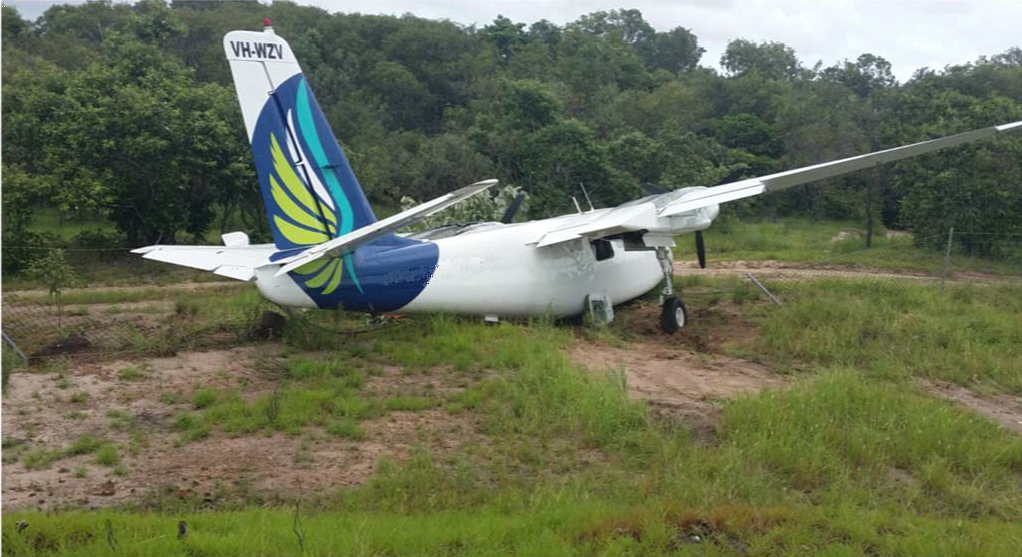
The pilot initially assessed that there was sufficient runway remaining to stop on but, due to the wet runway surface, the aircraft did not decelerate as quickly as expected and he anticipated that the aircraft would overrun the runway. As there was a steep slope and trees beyond the end of the runway, he steered the aircraft to the right towards more open and level ground. The aircraft departed the runway to the right, collided with a fence and a bush resulting in substantial damage (Figure 1). The pilot and passengers were not injured.
Figure 1: Damage to VH-WZV
Source: Aircraft engineer
Engineering inspection
An engineering inspection was carried out following the incident. The engineer reported that both engines started and ran without problems and that he ran both engines to full power for sufficient time to establish that there were no obvious defects with the engines and that both engines produced full power. The magneto drop checks were within limits and fuel flows were normal. Both engines appeared to be in their normal configuration with the appropriate quantities of oil and no defects were noted.
The engineer also reported that there was adequate fuel on board the aircraft, and no contaminants were present in the fuel. The engineer verified that the propeller operation and feather checks were functional.
Pilot comments
The pilot reported that the fuel for both engines was selected to ON. At no time had either been selected to OFF, as it was not normal procedure to switch the fuel off when shutting the aircraft down.
Operator report
A report prepared by the aircraft operator, and provided to the ATSB, included the following:
Due to the prevailing conditions of a wet runway and the extremely powerful brakes fitted to the aircraft type, the wheels locked up and the aircraft skidded off the end of the runway. The operator stated that it was easy to aquaplane or lock the brakes in wet or emergency situations.
The aircraft was loaded within the weight and balance limitations and was 67 kg below the take-off weight for the available runway length, based on the approved performance charts.
Passengers on the flight commented on a problem with the left engine at the time of the incident.
Further engineering assessment of the engine and ancillaries will include fuel on board, fuel pumps (engine driven and electric), fuel control unit, magneto ignition systems, engine air intake system and other systems likely to contribute to a loss of engine power.
Safety message
In this incident the pilot had identified the safest run-off area in the event of an engine failure. Having completed a thorough pre-take-off safety briefing, following partial engine failure, the pilot was able to steer the aircraft to a relatively clear area that he had identified. This may have reduced the amount of damage the aircraft sustained, and the potential for injuries to the pilot and passengers.
The objective of a safety investigation is to enhance transport safety. This is done through:
identifying safety issues and facilitating safety action to address those issues
providing information about occurrences and their associated safety factors to facilitate learning within the transport industry.
It is not a function of the ATSB to apportion blame or provide a means for determining liability. At the same time, an investigation report must include factual material of sufficient weight to support the analysis and findings. At all times the ATSB endeavours to balance the use of material that could imply adverse comment with the need to properly explain what happened, and why, in a fair and unbiased manner. The ATSB does not investigate for the purpose of taking administrative, regulatory or criminal action.
Terminology
An explanation of terminology used in ATSB investigation reports is available here. This includes terms such as occurrence, contributing factor, other factor that increased risk, and safety issue.
Publishing information
Released in accordance with section 25 of the Transport Safety Investigation Act 2003
Ownership of intellectual property rights in this publication
Unless otherwise noted, copyright (and any other intellectual property rights, if any) in this report publication is owned by the Commonwealth of Australia.
Creative Commons licence
With the exception of the Coat of Arms, ATSB logo, and photos and graphics in which a third party holds copyright, this publication is licensed under a Creative Commons Attribution 3.0 Australia licence.
Creative Commons Attribution 3.0 Australia Licence is a standard form licence agreement that allows you to copy, distribute, transmit and adapt this publication provided that you attribute the work.
The ATSB’s preference is that you attribute this publication (and any material sourced from it) using the following wording: Source: Australian Transport Safety Bureau
Copyright in material obtained from other agencies, private individuals or organisations, belongs to those agencies, individuals or organisations. Where you wish to use their material, you will need to contact them directly.
The pilot advised that during the engine run prior to take-off the windscreen fogged up both internally and externally. She shut down the engine and wiped both surfaces free of moisture. There was light fog present in the area. During the subsequent take-off run the windscreen again fogged over and she lost visual reference. The pilot closed the throttle and rejected the take-off. However, the aircraft diverged off the runway and impacted trees before coming to rest substantially damaged. The four occupants were able to evacuate unaided and were not injured.
The pilot of the Piper Arrow reported that his approach to runway 23 at Coonamble, in a gusting 12 knot crosswind, was high and fast.
The aircraft initially touched down on the nosewheel and veered off the runway before he could regain directional control. However, he was unable to prevent the aircraft running into a ditch, resulting in the nose landing gear collapsing, and the propeller striking the ground. The pilot was uninjured in the accident.
A Mig-15 aircraft was being flown on a series of touch and go circuits from runway 06 at Camden, NSW, for the purposes of type endorsement training. The aircraft was being flown by a student, under the supervision of an instructor pilot. During the final landing of the sequence the aircraft overran the runway at moderate speed, resulting in damage to the left hand undercarriage actuator assembly. The owner of the MIG-15 was observing the sortie from the ground, and reported that on each approach the aircraft had appeared to be fast and high on final.
During the final landing he observed the aircraft to touch down approximately 200 m in from the beginning of the runway, bounce slightly, and begin to float in ground effect. The next touchdown was about half way along the runway, after which a skid developed. He lost sight of the aircraft as it neared the end of the runway. The instructor pilot reported that the initial touchdown had been quite smooth, and gentle braking had been applied very soon after. Because the aircraft was bouncing on the nose landing gear, the instructor told the student to correct the nose attitude and progressively apply heavier braking.
However, the student pulled the control column back, resulting in the aircraft becoming briefly airborne. An instruction to the student to relax the brake pressure was apparently not heard. When the aircraft touched down again the left mainwheel tyre burst. The subsequent loss of braking and steering effectiveness resulted in the aircraft leaving the end of the runway. During a previous training sortie flown by the student earlier in the day, both mainwheel tyres had failed during landing.
The pilot was conducting topdressing operations from a property airstrip located in undulating terrain. He reported that he had refuelled the aircraft after 11 flights, and that the accident occurred on the seventh take-off after refuelling. The aircraft appeared to be operating normally but failed to gain flying speed before reaching the end of the strip.
During the subsequent collision with the terrain, both wings, both elevators, the engine, and the main landing gear were torn from the aircraft. The aircraft came to rest facing back towards the airstrip, about 200 m beyond and 100 ft below the level of the airstrip. The pilot stated that he had observed indications of localised whirlwinds and considered it likely that as he attempted to lift the aircraft from the strip, the aircraft's performance had been adversely affected by one. Weather conditions at the time were fine with a north-westerly wind of 6 to 10 kts.
Occurrence summary
Investigation number
199704108
Occurrence date
16/12/1997
Location
37 km south of Walcha (ALA)
State
New South Wales
Report release date
11/07/1998
Report status
Final
Investigation type
Occurrence Investigation
Investigation status
Completed
Mode of transport
Aviation
Aviation occurrence category
Runway excursion
Occurrence class
Accident
Aircraft details
Manufacturer
De Havilland Canada/De Havilland Aircraft of Canada