Propeller/rotor malfunction

Propeller failure involving de Havilland DH-82, VH-ARU, near Shute Harbour ALA, Queensland, on 2 July 2016

Final report

What happened

On 2 July 2016, at about 1420 Eastern Standard Time (EST), a de Havilland DH-82A aircraft, registered VH-ARU, departed Shute Harbour aircraft landing area (ALA), Queensland, for an aerobatic joy flight. On board were a pilot and one passenger.

When the aircraft reached about 4,500 ft over water, the pilot advised air traffic control (ATC) that they were commencing aerobatic operations. The pilot reported that they then raised the aircraft nose and reduced the throttle to idle. The aircraft then pitched nose-down and the pilot initiated a rotation to the left. After about one and a half rotations, the pilot levelled the aircraft wings and stopped the rotation. As the airspeed was then about 110 kt, which was the entry speed for the next manoeuvre (a loop), the pilot raised the aircraft nose and applied full power as the nose passed the horizon.

The aircraft was then passing about 3,500 to 4,000 ft on climb, when the pilot and passenger heard a bang. The pilot saw a small object fly past to their left in close proximity, and the passenger saw that the on-board camera had been knocked.

The pilot discontinued the manoeuvre and stabilised the aircraft in a glide attitude. As the aircraft continued to descend, the pilot elected to return to Shute Harbour ALA. The pilot reported that the aircraft was not vibrating and the tachometer was indicating maximum RPM. The pilot also assessed that the engine was not producing any thrust, regardless of the throttle position. The pilot advised ATC that they had completed operations and were returning to Shute Harbour. At no time did the pilot inform ATC that there was an emergency.

As the aircraft passed the highest terrain en route to Shute Harbour ALA, the pilot assessed that they were not going to be able to reach the ALA (Figure 1). The pilot then turned the aircraft to land on the beach at Funnel Bay, but sighted boats moored on the beach. The pilot therefore aimed to land the aircraft at Funnel Bay on the mudflats. The pilot conducted a forced landing onto the mud and the aircraft continued onto some rocks. After landing, as the pilot inspected the aircraft, they noticed that the propeller was missing.

Figure 1: Shute Harbour ALA and Funnel Bay
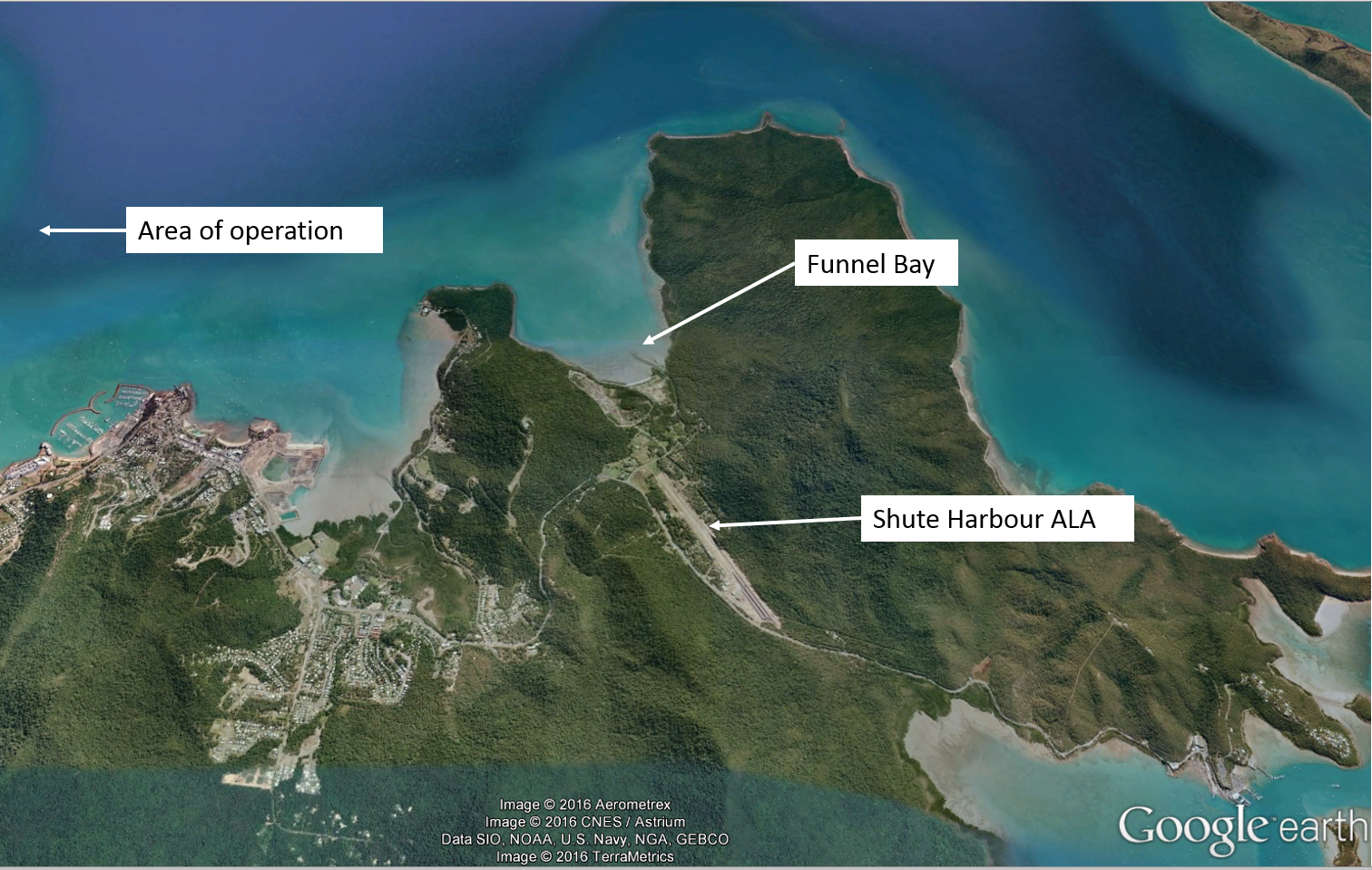
Figure 1: Shute Harbour ALA and Funnel Bay

Source: Google earth – annotated by ATSB

The pilot was uninjured, and the passenger sustained minor injuries. The aircraft sustained substantial damage (Figure 2).

Figure 2: Accident site showing damage to VH-ARU
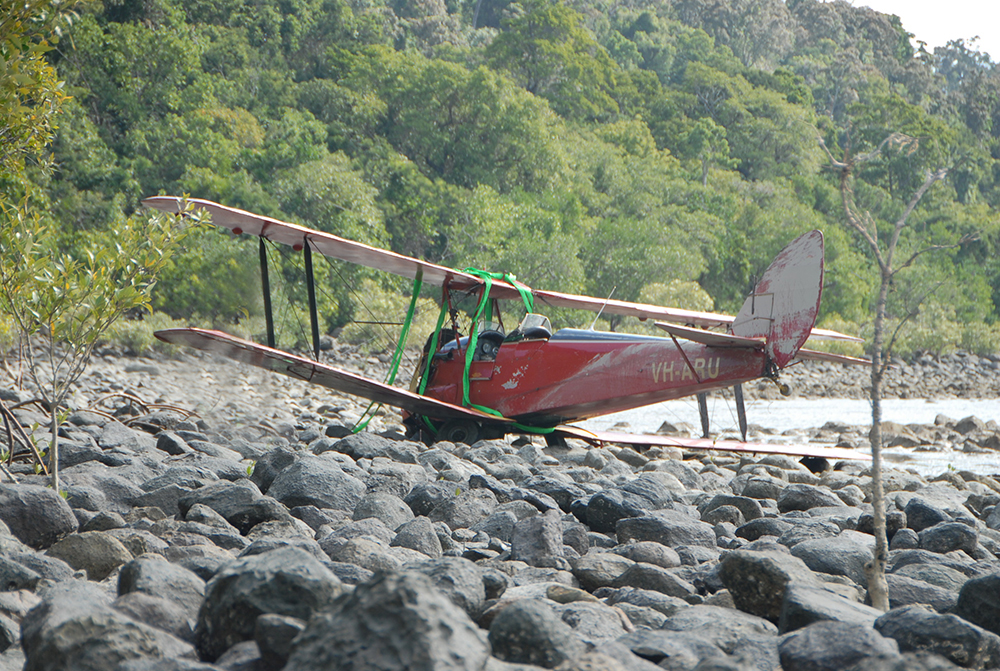
Figure 2: Accident site showing damage to VH-ARU

Source: Aircraft owner – modified by ATSB

Pilot comments

The pilot had completed a daily inspection of the aircraft earlier in the day and had subsequently flown it for about 6 minutes to assess the weather conditions. The incident flight was the first commercial flight of the day. During the pre-flight inspection, the pilot reported having made a visual check of the propeller for defects, gravel rash and any chips, but had not detected anything abnormal.

The pilot had asked the passenger their weight prior to the flight, and although they did not complete a weight and balance calculation, assessed that the aircraft was within its weight and balance limitations for aerobatic flight.

At the time of the incident, they were operating about 4 to 5 NM from the ALA, and over water. The pilot thought that the aircraft probably struck a bird resulting in the propeller failing.

When they realised that the aircraft was unable to reach the runway at Shute Harbour, the pilot had a secondary plan to land on the beach at Funnel Bay. They commented that their training helped to deal with the situation by being aware of their surroundings and having a series of plans in case of emergency.

Engineering report

The aircraft maintenance engineer assessed the aircraft after the incident and sent the remnants of the (timber) propeller that had remained attached to the aircraft to the ATSB. The engineer also spoke to the manufacturer of the propeller and was able to trace its history. The manufacturer suggested the propeller failure was indicative of a propeller overspeed, although they did not inspect the propeller remnants. The propeller was not retrieved as it failed when the aircraft was over water.

ATSB analysis

Video footage

The ATSB analysed the data card from the on-board camera. The camera was facing rearwards and no evidence of a birdstrike was visible on the footage when viewed frame-by-frame. Analysis of the sound component of the recording was conducted to determine the engine frequency at the time of the propeller failure, but the results were inconclusive due to background noise including a radio transmission.

From the video footage, it was evident that the aircraft entered a spiral manoeuvre that involved substantial rudder and aileron input such that the aircraft was in balance (not skidding or slipping sideways). The wings were then levelled and the aircraft pulled out of the dive. The propeller failed just as the aircraft nose passed back up through the horizon at the start of the next manoeuvre and power was applied. The propeller was under substantial load at this stage.

Propeller remnants

The ATSB examined two fragments of the propeller that were identified as parts of the hub section. An area of interest, depicted in Figure 3, showed evidence of bending consistent with the blade breaking away from the hub while under load. No bird remains were found on the fragments. The factors contributing to the propeller failure could not be determined from the timber fragments.

Figure 3: Propeller remnants
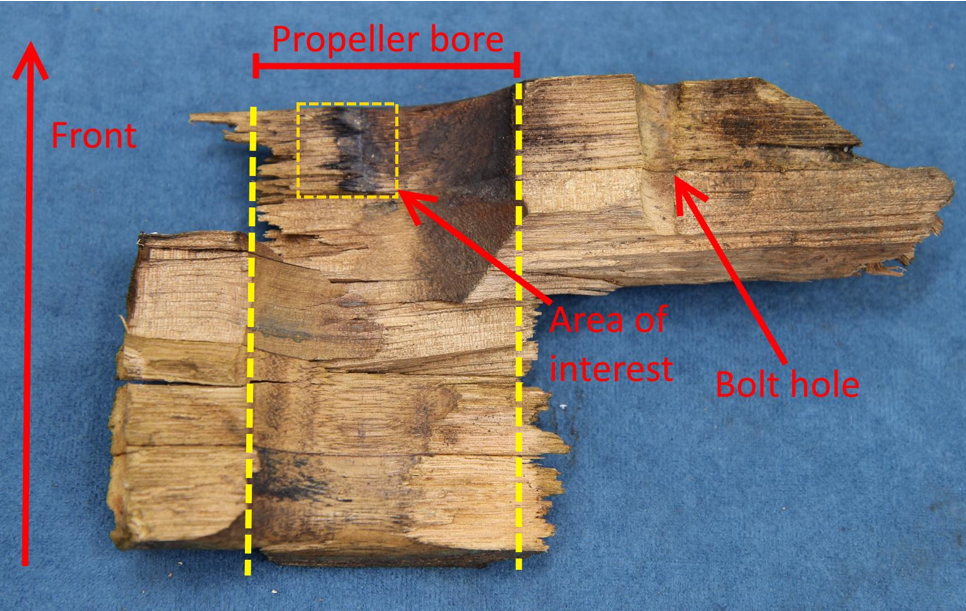
Figure 3: Propeller remnants

Source: ATSB analysis

ATSB comment

One of the findings of ATSB investigation AO-2013-226, In-flight break-up involving de Havilland DH82A Tiger Moth, VH-TSG, 300 m E of South Stradbroke Island, Queensland, 16 December 2013, was that ‘publicly-available video recordings showed that some Australian commercial Tiger Moth operators conducted aerobatic flick (otherwise known as ‘snap’) rolls and tailslide manoeuvres, which were prohibited by the Type Design Organisation’. However, the on-board video recording showed that the types of aerobatic manoeuvres conducted during the accident flight were all permitted for the aircraft type.

The ATSB cautions commercial vintage aircraft operators about the risks associated with aircraft age and the importance of understanding the originally-intended use of the design before commencing their operations.

Safety message

This incident highlights the value of always having a consideration of landing areas available in case a forced landing is required. Alerting air traffic control as emergencies arise enables them to provide the necessary and appropriate assistance.

Aviation Short Investigations Bulletin - Issue 54

Purpose of safety investigations

The objective of a safety investigation is to enhance transport safety. This is done through: 

  • identifying safety issues and facilitating safety action to address those issues
  • providing information about occurrences and their associated safety factors to facilitate learning within the transport industry.

It is not a function of the ATSB to apportion blame or provide a means for determining liability. At the same time, an investigation report must include factual material of sufficient weight to support the analysis and findings. At all times the ATSB endeavours to balance the use of material that could imply adverse comment with the need to properly explain what happened, and why, in a fair and unbiased manner. The ATSB does not investigate for the purpose of taking administrative, regulatory or criminal action.

Terminology

An explanation of terminology used in ATSB investigation reports is available here. This includes terms such as occurrence, contributing factor, other factor that increased risk, and safety issue.

Publishing information

Released in accordance with section 25 of the Transport Safety Investigation Act 2003

Published by: Australian Transport Safety Bureau

© Commonwealth of Australia 2016

image.png

Ownership of intellectual property rights in this publication

Unless otherwise noted, copyright (and any other intellectual property rights, if any) in this report publication is owned by the Commonwealth of Australia.

Creative Commons licence

With the exception of the Coat of Arms, ATSB logo, and photos and graphics in which a third party holds copyright, this publication is licensed under a Creative Commons Attribution 3.0 Australia licence.

Creative Commons Attribution 3.0 Australia Licence is a standard form licence agreement that allows you to copy, distribute, transmit and adapt this publication provided that you attribute the work.

The ATSB’s preference is that you attribute this publication (and any material sourced from it) using the following wording: Source: Australian Transport Safety Bureau

Copyright in material obtained from other agencies, private individuals or organisations, belongs to those agencies, individuals or organisations. Where you wish to use their material, you will need to contact them directly.

Occurrence summary

Investigation number AO-2016-071
Occurrence date 02/07/2016
Location near Shute Harbour (ALA) (Funnel Bay)
State Queensland
Report release date 22/11/2016
Report status Final
Investigation level Short
Investigation type Occurrence Investigation
Investigation status Completed
Mode of transport Aviation
Aviation occurrence category Propeller/rotor malfunction
Occurrence class Accident
Highest injury level Minor

Aircraft details

Manufacturer de Havilland Aircraft
Model DH-82A
Registration VH-ARU
Serial number AM237
Sector Piston
Operation type Charter
Departure point Shute Harbour, Qld
Destination Shute Harbour Qld
Damage Substantial

Propeller/rotor malfunction involving an Air Tractor AT-301, VH-JFA, Coleambally, New South Wales, on 19 March 1993

Summary

During agricultural operations, one propeller blade moved to coarse pitch while the aircraft was flying at a height of 50 feet. Power was reduced, the load dumped and the pilot carried out a forced landing in a nearby paddock.

Investigation revealed that one counterweight roller bearing shaft had failed in fatigue across the split-pin hole. The split-pin hole is drilled close to where the bearing shaft exits the hub flange. The hub has now been modified to locate the split-pin in the threaded section at the opposite end of the shaft.

Occurrence summary

Investigation number 199300819
Occurrence date 19/03/1993
Location Coleambally
State New South Wales
Report release date 30/08/1993
Report status Final
Investigation type Occurrence Investigation
Investigation status Completed
Mode of transport Aviation
Aviation occurrence category Propeller/rotor malfunction
Occurrence class Incident

Aircraft details

Manufacturer Air Tractor Inc
Model AT-301
Registration VH-JFA
Sector Piston
Operation type Aerial Work
Departure point Coleambally NSW
Destination Griffith NSW
Damage Nil

Tail rotor malfunction involving a Robinson R22, VH-HPH, La Belle Downs Station, Northern Territory, on 18 November 2014

Final report

What happened

On 18 November 2014, at about 1728 Central Standard Time (CST), a Robinson R22 helicopter, registered VH-HPH (HPH), departed from La Belle Downs Station, Northern Territory, for a local flight to check the progress of a bush fire, with the pilot and one passenger on board.

About two minutes into the flight, on climb and at about 300 ft above ground level, the pilot felt a vibration through the tail rotor pedals. The pilot decided to return to La Belle Downs station, turned the helicopter to the right and started a descent. The pilot was unable to stop the turn and the helicopter continued to descend and turn to the right. The helicopter started to spin in a tight circle and completed between five and six rotations before landing hard, bouncing once and then coming to a stop. The pilot performed the shutdown procedure and the pilot and passenger exited the helicopter. The pilot and passenger were uninjured. The helicopter was substantially damaged, including damage to the tail boom and both skids.

Pilot comment

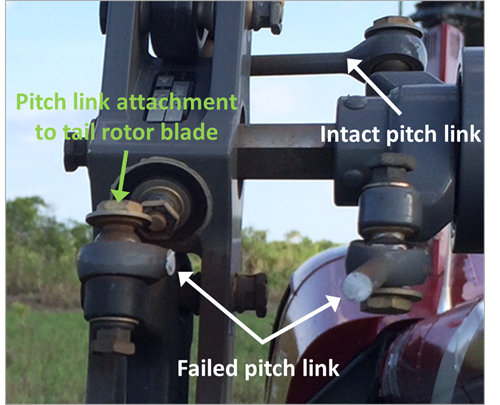
After landing, the pilot observed that the tail rotor pitch link[1] had failed (Figure 1).

Prior to the first flight of the day, the pilot reported carrying out a daily inspection without finding any defects. The pilot had then flown HPH for approximately 2 hours, prior to the accident flight.

Figure 1: Failed tail rotor pitch link

Figure 1: Failed tail rotor pitch link
 

Source: Aircraft operator, annotated by the ATSB

Operator investigation

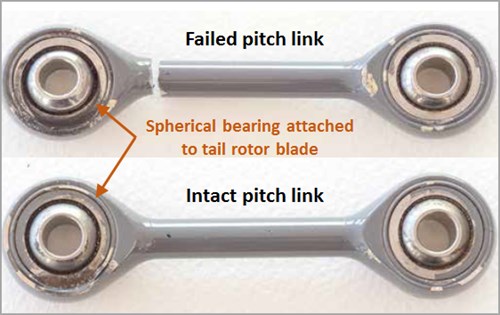
An examination of the tail rotor pitch links was conducted on behalf of the helicopter operator by a consultant in engineered-system failure analysis and the following was found (Figure 2):

  • Alternating stress in the failed pitch link resulted in the initiation and propagation of a fatigue crack.
  • The alternating stress in the pitch link resulted from failure of the spherical bearing to provide a low friction connection between the end of the tail rotor blade and the pitch link.
  • The failed pitch link spherical bearing attached to the tail rotor had extensive wear. Axial wear of the spherical bearing was measured to be about 0.108 inch (2.743 mm).
  • The intact pitch link spherical bearing attached to the tail rotor also showed signs of extensive wear. Axial wear of the spherical bearing was measured to be about 0.041 inch (1.041 mm).
  • The factors that influence the rate of wear in the spherical bearing that attaches the tail rotor blade to the pitch link would not be expected to vary from helicopter to helicopter.
  • No physical explanation was found as to why the specified inspection procedures (R22 Maintenance Manual, Chapter 2 Inspection, section 2.410) failed to detect bearing wear. Possible explanations beyond what could be ascertained by the examination were that the helicopter was operated in an exceptionally abrasive environment or the Teflon bearing lining was affected by some cleaning action.

Figure 2: HPH tail rotor pitch links


Figure 2: HPH tail rotor pitch links

Source: Aircraft operator, annotated by the ATSB

HPH maintenance documentation

About 443 hours prior to the accident, at a 50 hourly inspection, the tail rotor pitch links (part number B345-3) were found to be unserviceable. Two new pitch links, with the same part number, were installed. The pitch link had failed about 2 hours prior to the next scheduled 100 hourly inspection. The maintenance release indicated that all the required daily inspections had been carried out and that there were no outstanding maintenance issues.

Manufacturer comment

The helicopter manufacturer was only aware of one other similar failure that occurred about 10 years ago. The manufacturer believed that the failure was as a result of the axial wear (about five times more than permitted) allowed binding to occur, with resultant fatigue failure to the pitch link.

Pilot operating handbook

Robinson Model R22 Pilot’s Handbook, Section 4 Normal Procedures Daily or Prefight checks, dated 20 April 2007 page 4-3, included an item to check the tail rotor pitch links for “No looseness”.

Robinson maintenance manual

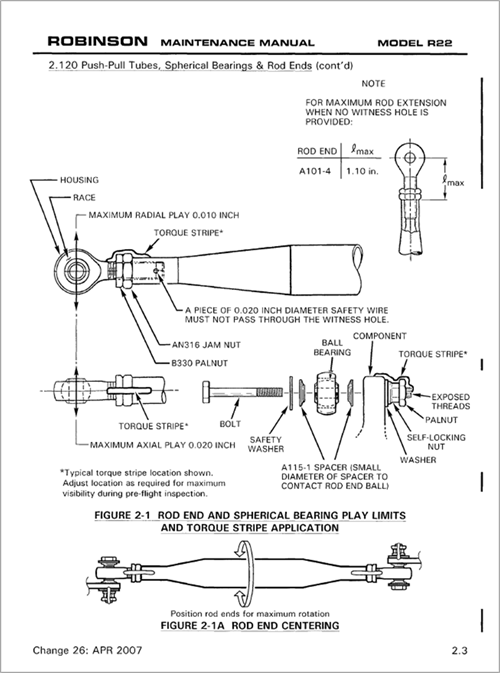
The Robinson Maintenance Manual Model R22 contains inspection requirements to be conducted at the 100-hour or annual inspection. Section 2.410 Inspection procedures and checklist item 12. Rotor Hub Hinge Bolts, dated October 2014, required the condition of the pitch links and rod ends to be inspected. This inspection was to be in accordance with section 2.120 Push-Pull Tubes, Rod Ends, and Spherical Bearings (dated October 2014), with reference to Figure 2-1 (reproduced below in Figure 3). The inspection needed to meet the following conditions:

  • the maximum allowed axial play of 0.020 inch (0.508 mm). The axial play of HPH’s failed pitch link was about 0.108 inch (2.743 mm) and the intact pitch link was about 0.041 inch (1.041 mm)
  • the maximum radial play of 0.010 inch (0.254 mm) for the rod end spherical bearings
  • with no looseness between the bearing outer race and the rod end housing.

The maintenance manual also contained a caution that the Teflon-lined bearings must not be lubricated or cleaned with solvent.

Figure 3: Robinson maintenance manual spherical bearing limits

Figure 3: Robinson maintenance manual spherical bearing limits
 

Source: Robinson

ATSB comment

CASA SDR database search

The operator reported to the ATSB that the R22 helicopter tail rotor pitch links had been failing regularly in mustering operations. CASA provided information from their Service Difficulty Report (SDR) database from 1983 to 2014. The database showed three previously reported defects with the same part number tail rotor pitch link as HPH where the pitch link had failed (Table 1). Two of the failures had occurred in flight.

Table 1: CASA SDR database - Tail rotor pitch link failures

month/year of SDRFailureTime since new (hours)Part number pitch linkOperation
09/2009Tail rotor pitch link failed in flight.434B345-3Mustering
11/2009Tail rotor pitch link failed in flight. Spherical bearing attached to the tail rotor blade was found worn to limits.562B345-3Mustering
04/2014During the scheduled 100 hourly inspection the tail rotor pitch link fractured near the spherical bearing attached to the tail rotor blade.289B345-3Unknown

CASA reported two important points in relation to the CASA SDR system:

in the case of the Robinson R22, there is no legislation requiring the manufacturer to be notified of the tail rotor pitch link failures in Australia that have been reported to CASA. While there is no requirement to provide this information, CASA usually provides data dumps of defect reports on an annual basis to North American NAAs [National Airworthiness Authorities including the US Federal Aviation Administration and Transport Canada].

CASA encourages the industry to pass the defect information to the approval holder [manufacturer] and, as part of any follow up action CASA is likely to send the information to the approval holder [manufacturer], foreign or domestic.

Safety message

Continuing airworthiness relies on inspections identifying damage so that parts can be repaired or replaced prior to failure. Therefore, scheduled maintenance inspections and the pilot’s daily inspection are a central element of the continuing airworthiness of the aircraft.

Regulators and aircraft manufacturers depend on accurate data to ensure the ongoing continued airworthiness of the aircraft. It is important that defects are reported to CASA through the Service Difficulty Reports (SDR) system, and to the manufacturer, so issues can be identified and rectified.

Aviation Short Investigations Bulletin - Issue 42

Purpose of safety investigations

The objective of a safety investigation is to enhance transport safety. This is done through:

  • identifying safety issues and facilitating safety action to address those issues
  • providing information about occurrences and their associated safety factors to facilitate learning within the transport industry.

It is not a function of the ATSB to apportion blame or provide a means for determining liability. At the same time, an investigation report must include factual material of sufficient weight to support the analysis and findings. At all times the ATSB endeavours to balance the use of material that could imply adverse comment with the need to properly explain what happened, and why, in a fair and unbiased manner. The ATSB does not investigate for the purpose of taking administrative, regulatory or criminal action.

Terminology

An explanation of terminology used in ATSB investigation reports is available here. This includes terms such as occurrence, contributing factor, other factor that increased risk, and safety issue.

Publishing information 

Released in accordance with section 25 of the Transport Safety Investigation Act 2003

Published by: Australian Transport Safety Bureau

© Commonwealth of Australia 2015

image_5.png

Ownership of intellectual property rights in this publication

Unless otherwise noted, copyright (and any other intellectual property rights, if any) in this report publication is owned by the Commonwealth of Australia.

Creative Commons licence

With the exception of the Coat of Arms, ATSB logo, and photos and graphics in which a third party holds copyright, this publication is licensed under a Creative Commons Attribution 3.0 Australia licence.

Creative Commons Attribution 3.0 Australia Licence is a standard form licence agreement that allows you to copy, distribute, transmit and adapt this publication provided that you attribute the work.

The ATSB’s preference is that you attribute this publication (and any material sourced from it) using the following wording: Source: Australian Transport Safety Bureau

Copyright in material obtained from other agencies, private individuals or organisations, belongs to those agencies, individuals or organisations. Where you wish to use their material, you will need to contact them directly.

__________

  1. There are two tail rotor pitch links, one for each tail rotor blade. The pitch link connects the blade to the tail rotor pitch control assembly. The tail rotor pitch control assembly is connected via push pull controls to the pedals in the cockpit, which the pilot moves for directional control.


Occurrence summary

Investigation number AO-2014-181
Occurrence date 18/11/2014
Location La Belle Downs Station
State Northern Territory
Report release date 27/08/2015
Report status Final
Investigation level Short
Investigation type Occurrence Investigation
Investigation status Completed
Mode of transport Aviation
Aviation occurrence category Propeller/rotor malfunction
Occurrence class Accident
Highest injury level None

Aircraft details

Manufacturer Robinson Helicopter Co
Model R22 BETA
Registration VH-HPH
Serial number 3988
Sector Helicopter
Operation type Private
Departure point Lavelle Station, NT
Destination Lavelle Station, NT
Damage Substantial

Propeller/rotor malfunction involving a de Havilland Aircraft DH-114 Seaheron CMK1, VH-NJP, Sydney, New South Wales, on 26 March 1995

Summary

Just after liftoff, the pilot noticed a vibration throughout the aircraft then heard a bang and number one engine over-speed. The engine was immediately shut down and the pilot then saw that the number one propeller was missing. He made a MAYDAY call and landed immediately on the crossing runway. Inspection of the failed propeller revealed the barrel assembly, which retains the blades, had failed due to cracking, liberating both blades. During the investigation, the remaining propellers were removed and inspected but no abnormalities were observed. After repairs were completed, the aircraft was released for service. However, after 17 hours of operation, the number three propeller was removed due to an oil leak.

Inspection of the removed propeller revealed cracking in the barrel in the same area as that found on the original failure. The remaining propellers were removed, and fretting was observed on all propeller cone surfaces indicating the propellers had been operating in a loose condition.

Analysis

The manufacturers maintenance data for the propeller requires that, after installation, the propeller nut torque should be checked again after the first flight and then at 150 hourly intervals. Additionally, the barrel should be inspected for cracking every 25 hours. Review of the aircraft history revealed that the propellers had originally been fitted in the United Kingdom and the nuts were re-torqued after the first test flight. The aircraft was subsequently flown to Australia where it operated for 176 hours prior to the failure.

There is no evidence in the aircraft maintenance records that propeller nut re-torque was performed at 150 hours subsequent to its installation, or that the barrel was inspected for cracking at 25 hourly intervals. The manufacturers installation data for the propeller requires that the propeller nut be torqued to 600 lbs/ft and, whilst maintaining that torque, the wrench is given two taps with a soft mallet in the direction of nut rotation to ensure the cones are seated. Maintenance personnel involved with the propeller installation advised they had not used this method but simply torqued the nut to the required value with a torque wrench. Experiments were carried out on applying torque to a propeller nut.

It was found that when the required torque was obtained and the wrench was tapped twice with a soft mallet, the nut rotated a further 1/4 to 1/2 turn. This indicated that the nut was not sufficiently tight to seat the cones when only the initial torque was applied.

The propeller manufacturers Technical News Sheet number 26, dated January 1963, states that investigations of bracket type propellers which have suffered failure of major components have directly attributed the failures to operation of the propeller in a loose condition due to:

1. Incorrect installation.

2. Failure to check tighten or to effectively check tighten due to incorrect procedures.

Findings

1. The initial failure of the number one propeller was consistent with operation of the propeller in a loose condition because propeller nut re-torque was not carried at the recommended time periods.

2. The failure may have been averted had inspections of the barrel at the recommended intervals detected cracking.

3. The cracking of the number three propeller barrel and fretting of the other propeller cones was consistent with operation of the propeller in a loose condition as a result of incorrect nut torquing procedure.

Significant Factors

Maintenance personnel involved in the maintenance of the propellers failed to observe the requirements of the manufacturer's maintenance data.

Safety Action

The safety deficiencies identified during this investigation were corrected as they were identified. Consequently, no safety recommendations have been raised.

Occurrence summary

Investigation number 199500857
Occurrence date 26/03/1995
Location Sydney
State New South Wales
Report release date 04/09/1996
Report status Final
Investigation type Occurrence Investigation
Investigation status Completed
Mode of transport Aviation
Aviation occurrence category Propeller/rotor malfunction
Occurrence class Accident

Aircraft details

Manufacturer de Havilland Aircraft
Model DH-114 SEAHERONCMK1
Registration VH-NJP
Sector Piston
Operation type General Aviation
Departure point Sydney NSW
Destination Bankstown NSW
Damage Substantial

Propeller/rotor malfunction involving a Beech Aircraft Corp 58, VH-FDE, 50 km east of Darwin, Northern Territory, on 10 September 1994

Summary

The aircraft was established in normal cruise at 7,000 ft when the pilot heard a loud bang from the right engine. The pilot believed that the right engine had failed, but as he commenced the propeller feathering procedure, he realised that the propeller was missing. On closer inspection it was clear that the entire right propeller, including the hub and spinner, had detached. The aircraft returned to Darwin where a safe landing was accomplished.

A metallurgical examination of the crankshaft revealed its failure was consistent with the development of an abnormally high force during flight. The engine bearers had been broken, and the engine was supported only by control linkages, cables and the engine cowling. This damage was consistent with the separation of one propeller blade, or portion of a blade. The resulting imbalance causing an overload failure of the engine bearers and crankshaft.

The propeller was not recovered.

Occurrence summary

Investigation number 199402606
Occurrence date 10/09/1994
Location 50 km east of Darwin
State Northern Territory
Report release date 13/06/1996
Report status Final
Investigation type Occurrence Investigation
Investigation status Completed
Mode of transport Aviation
Aviation occurrence category Propeller/rotor malfunction
Occurrence class Accident

Aircraft details

Manufacturer Beech Aircraft Corp
Model 58
Registration VH-FDE
Sector Piston
Operation type Charter
Departure point Darwin NT
Destination Darwin NT
Damage Substantial

Propeller/rotor malfunction involving a Saab SF-340B, VH-TCH, Cudal, New South Wales, on 5 August 1994

Summary

During take-off the crew noticed a small surge on the right engine torque indicator, with no noticeable power change. Shortly after lift-off, as the landing gear was retracting, the right engine torque suddenly increased to 107%. The power lever, although extremely stiff to move, was eventually retarded until the torque was reduced to 85%. By this time the auto coarsen system had commanded the propeller RPM to zero and the engine was shut down. The flight continued to Orange where an uneventful single engine landing was carried out.

Subsequent investigation revealed the right engine Beta tube had failed where it entered the Propeller Control Unit (PCU). The remains of the tube were jammed in the PCU, which was stiff to operate at the power lever input shaft.

Investigation by the manufacturer attributed the failure to localised pick up and seizure of the PCU Beta Sleeve to the Beta Tube Unit Sleeve, resulting from a reduction below the minimum diametrical clearance between the two components. This was due to an incorrectly formed undercut in the Beta Rack during manufacture, which prevented satisfactory location between the two components, and subsequent distortion of the sleeve.

The manufacturer has instigated an inspection requirement for Beta Racks from the same batch number and advised that future batches will be examined prior to assembly.

Occurrence summary

Investigation number 199402191
Occurrence date 05/08/1994
Location Cudal
State New South Wales
Report release date 08/05/1995
Report status Final
Investigation type Occurrence Investigation
Investigation status Completed
Mode of transport Aviation
Aviation occurrence category Propeller/rotor malfunction
Occurrence class Incident

Aircraft details

Manufacturer Saab Aircraft Co.
Model SF-340B
Registration VH-TCH
Sector Turboprop
Operation type Air Transport Low Capacity
Departure point Cudal NSW
Destination Orange NSW
Damage Nil

Rotor malfunction involving a Robinson R44, VH-YYS, Mareeba Airport, Queensland, on 2 March 2014

Summary

On 2 March 2014, at about 1300 Eastern Standard Time (EST), the pilot of a Robinson R44 helicopter, registered VH-YYS, prepared for a private flight from Mareeba, Queensland.

The helicopter lifted off and the pilot reported all engine indications were normal and the blades appeared to be tracking normally. During the translation from hover to forward flight, the helicopter yawed to the left. The pilot raised collective and rolled the throttle on and the helicopter then spun quickly about 90 degrees to the right. The pilot heard an increase in engine noise as a loud buzz. The helicopter then pitched up and down, and as he attempted to control it with the cyclic, the helicopter very quickly yawed about 180 degrees to the left. The helicopter rolled to the left and the pilot noticed the main rotor blades flapping.

The pilot eased the collective into the ground and as the helicopter touched down, it started to roll to the left. He moved the cyclic right, reduced the throttle and the helicopter rocked from side to side and then settled. During the event, the rotor blades contacted the tail boom resulting in substantial damage.

The investigation did not establish any mechanical, maintenance or training issues relevant to the investigation.

Aviation Short Investigations Bulletin - Issue 30

Occurrence summary

Investigation number AO-2014-038
Occurrence date 02/03/2014
Location Mareeba Airport
State Queensland
Report release date 26/04/2014
Report status Final
Investigation level Short
Investigation type Occurrence Investigation
Investigation status Completed
Mode of transport Aviation
Aviation occurrence category Propeller/rotor malfunction
Occurrence class Accident
Highest injury level None

Aircraft details

Manufacturer Robinson Helicopter Co
Model R44
Registration VH-YYS
Serial number 1801
Sector Helicopter
Operation type Private
Departure point Mareeba, Qld
Damage Substantial

Technical assistance to the Office of the Chief Investigator of Air Accidents, Malaysia - analysis of CVR recording

Summary

On 5 May 2013, a Eurocopter AS365N2 helicopter, registered 9M-DBH, was involved in an accident while taxying to park at RMAF Sempang, Malaysia.

An investigation into the circumstances of the accident is being conducted by the Office of the Chief Inspector of Air Accidents, Ministry of Transport, Malaysia. The investigation is being conducted in accordance with Malaysia’s obligations as the State of Occurrence under Annex 13 to the Convention on International Civil Aviation (ICAO Annex 13) and the Malaysian Civil Aviation Regulations 1996.

The Office of the Chief Inspector of Air Accidents requested assistance from the Australian Transport Safety Bureau (ATSB) in the analysis of signals recorded on the helicopter’s cockpit voice recorder (CVR). To facilitate this support and provide the appropriate protections for the CVR information, the ATSB appointed an accredited representative in accordance with paragraph 5.23 of ICAO Annex 13 and commenced an investigation under the Australian Transport Safety Investigation Act 2003.

Download of the CVR was undertaken by the Singapore Air Accident Investigation Bureau (AAIB) and three 30-minute tracks of digital audio information were provided to the ATSB via secure file transfer. Spectral analysis of the audio was undertaken and the observations of interest compiled into a report that was provided to the Office of the Chief Inspector of Air Accidents in September 2013.

The Malaysian Office of the Chief Inspector of Air Accidents is responsible for releasing a final investigation report regarding this occurrence. 

Contact details for the office are:

Pejabat Ketua Inspektor Kemalangan Udara
(Office Of The Chief Inspector Of Air Accident)
Kementerian Pengangkutan Malaysia
Aras 2, Precinct 4
Pusat Pentadbiran Kerajaan Persekutuan
62570 PUTRAJAYA

Tel: 603-88714000
Fax: 603-88714069


______________

Released in accordance with section 25 of the Transport Safety Investigation Act 2003.

Occurrence summary

Investigation number AE-2013-087
Occurrence date 05/05/2013
Location Sempang Airport, Malaysia
State External Territory
Report release date 09/09/2013
Report status Final
Investigation level Defined
Investigation type External Investigation
Investigation status Completed
Mode of transport Aviation
Aviation occurrence category Propeller/rotor malfunction
Occurrence class Accident
Highest injury level None

Aircraft details

Manufacturer Eurocopter
Model Eurocopter AS365N2 Dauphin
Registration 9M-DBH
Serial number 6485
Sector Helicopter
Operation type Private
Destination RMAF Sempang

Propeller loss involving Jabiru J430, VH-TJP, north of French Island, Victoria, on 8 March 2013

Summary

What happened

On 8 March 2013, during climb after departure from Tyabb aerodrome, Victoria, the pilot and sole occupant of a Jabiru J430 aircraft, registered VH-TJP, reported the onset of vibration through the airframe. As a precaution, the pilot began to turn the aircraft back towards Tyabb. During the turn, the propeller separated from the aircraft, necessitating a forced landing upon tidal flats at the western edge of Westernport Bay. The pilot was not injured and was able to disembark the aircraft safely.

What the ATSB found

The ATSB investigation found that most of the cap screws connecting the propeller mounting flange to the engine crankshaft had failed by bending fatigue fracture – principally due to repeated relative movement between the mounted components. This movement was traced to a combination of an ineffective, multi-step torqueing method and the relaxation of tension within the crank–flange joint due to the compression of multiple layers of paint within the joint. It was also found that there were some anomalies within the maintenance documentation that related to these areas.

After attempting to analyse the origin of the worsening vibration in the aircraft, the pilot correctly followed emergency procedures both before and after the propeller loss. The over-water return decision limited the risks associated with the forced landing, and the pilot effectively maintained control of the aircraft throughout the descent and landing.

What's been done as a result

In July 2011, the manufacturer had improved the strength and reliability of the crank–flange joint by adding positive-location dowels in all new-production engines. However, that modification was not extended to earlier design assemblies, which included VH-TJP. The current (revised) issue of the Engine Overhaul Manual has an added, strong recommendation for inclusion of these dowels at the next full overhaul or at bulk strip of engines manufactured prior to July 2011. Furthermore, in addition to the earlier requirement for no paint on mating faces or where screw heads bear, a broad requirement was introduced to ensure that no paint, thread-locking compound or contaminants remain in the propeller flange joint. The fastener torqueing method has been amended to a single-step process in which the required torque is to be obtained dynamically while the fastener is being turned.

Finally, the manufacturer’s Propeller Flange Attachment Service Bulletin now refers maintainers directly to the engine overhaul manual for installation procedures – removing the variability that previously existed between documents.

Safety message

A potentially serious accident was avoided by the pilot’s adherence to emergency procedures and maintaining control of the aircraft after a significant mechanical failure.

Regarding the mechanical assembly, the ATSB encourages manufacturers and maintainers to consider older and legacy operating assemblies when designs are optimised or improved to enhance safety and reliability.

Occurrence summary

Investigation number AO-2013-046
Occurrence date 08/03/2013
Location North of French Island
State Victoria
Report release date 19/08/2014
Report status Final
Investigation level Defined
Investigation type Occurrence Investigation
Investigation status Completed
Mode of transport Aviation
Aviation occurrence category Propeller/rotor malfunction
Occurrence class Accident
Highest injury level None

Aircraft details

Manufacturer Jabiru Aircraft Pty Ltd
Model J430
Registration VH-TJP
Serial number 567
Sector Piston
Operation type Private
Departure point Tyabb, Vic
Destination Leongatha, Vic
Damage Substantial

Double propeller overspeed involving Bombardier DHC-8, VH-SBV, near Weipa, Queensland, on 6 December 2011

Final report

What happened

On 6 December 2011, a Bombardier DHC-8-315 aircraft, registered VH-SBV and operated by QantasLink, was on a scheduled flight from Cairns to Weipa, Queensland. The aircraft was on descent with the power levers in the flight idle position and the first officer’s hand was on the power levers. When the aircraft encountered turbulence, the first officer inadvertently lifted one or both of the flight idle gate release triggers and moved the power levers below the flight idle gate. During the short time that the power levers were in the ground beta range, both propeller speeds increased uncontrollably by over 300 revolutions per minute (rpm). Realising the situation, the first officer immediately moved the power levers back above the flight idle gate and the propellers returned to the normal controlled operating rpm.

What the ATSB found

The aircraft design included features to reduce the likelihood of the power levers being moved below flight idle and into the ground beta mode during flight. However, the ATSB found that many DHC-8-100, -200 and -300 series aircraft did not have a means of preventing inadvertent or intentional movement of power levers below the flight idle gate in flight, or a means to prevent such movement resulting in a loss of propeller speed control. This design limitation has been associated with several safety occurrences.

The ATSB also concluded that the beta warning horn sounded as designed; however, the pilots were not acutely aware of the purpose of the warning horn due to a lack of previous exposure to the sound.

What has been done as a result

The aircraft manufacturer has advised that it will be releasing a Service Bulletin modification to rectify the propeller speed control issue. That bulletin will be mandated by an Airworthiness Directive (AD) from the airworthiness authority of the State of Design (Canada) to ensure that the bulletin is incorporated into all the aircraft affected by the design issue worldwide, including those in Australia. In addition, the aircraft operator has introduced a series of actions to reduce the risk of such occurrences. The ATSB has released an extract from the cockpit voice recorder with the beta warning horn and the audible rise in propeller speed to all Australian operators of the aircraft type and it is also available

here (233.05 KB)
in an effort to increase awareness of the issue.

Safety message

Until appropriate modifications are made to DHC-8 aircraft, pilots and operators of DHC-8-100, -200 and -300 series aircraft should familiarise themselves with the circumstances surrounding this occurrence and take the appropriate steps to minimise the possibility of propeller overspeed due to ground beta selection in flight.

Occurrence summary

Investigation number AO-2011-159
Occurrence date 06/12/2011
Location near Weipa Airport
State Queensland
Report release date 25/02/2013
Report status Final
Investigation level Systemic
Investigation type Occurrence Investigation
Investigation status Completed
Mode of transport Aviation
Aviation occurrence category Propeller/rotor malfunction
Occurrence class Incident
Highest injury level None

Aircraft details

Manufacturer Bombardier Inc
Model DHC-8
Registration VH-SBV
Serial number 595
Aircraft operator QantasLink
Operation type Air Transport High Capacity
Departure point Cairns, Qld
Destination Weipa, Qld
Damage Nil