On 10 February 2015, at about 1145 Eastern Daylight-saving Time (EDT), an instructor and student were conducting an in-ground-effect[1] hover lesson in a Robinson R22, registered VH-YLP (YLP) at Orange Airport, New South Wales.
The lesson had covered individual effect and use of the pedals, the collective[2] and the cyclic[3] and included student practice immediately after each instructor demonstration. Throughout the lesson, the student had progressed from individual use of each control separately, to coordinating combinations of the three controls.
The instructor reported that at times during the student practice, the student allowed the helicopter to hover sideways or forwards, and instead of easing the cyclic or pushing the cyclic in the opposite direction to counter this movement, the student incorrectly pushed it in the direction of movement. Hence on a couple of occasions, the instructor re-briefed the correct procedure.
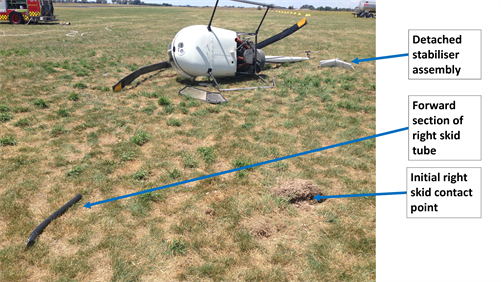
In the last few minutes of the hour long lesson, the student requested a little more time to practice the new sequences. A few moments into this practice, at about 3 ft above ground level (AGL), with the student controlling the cyclic and the instructor lightly controlling the pedals and collective, the helicopter began to roll to the right and move rearwards. The student reacted quickly, but moved the cyclic further backwards and to the right, which resulted in an increase in the rearward speed in this direction. The instructor attempted to regain control, but due to the sudden rearward movement of the cyclic, his thumb had bent back behind his wrist. The instructor managed to ‘grab’ the collective and lift it up a small amount, but by the time any significant control input could be applied, the right skid had struck the ground (Figure 1). The helicopter rolled further to the right, and fell onto the ground. The manner in which the helicopter had pivoted around the right skid and fallen onto its side was described by both the instructor and operator as dynamic rollover[4].
The student and instructor exited the helicopter and moved clear. The instructor was not injured, however the student received minor injuries and the helicopter was substantially damaged.
Instructor experience and comments
The instructor had about 735 hours of helicopter flying experience, with the majority of their commercial experience working as an instructor.
Prior to the lesson, the instructor had conducted a 45-minute pre-flight briefing with the student. This covered the aims, objectives and sequences to be covered in the flight lesson, and also looked at preventative measures to assist in mitigating against any potential threats and errors, including dynamic rollover.
During the flying component of the lesson, the in-ground-effect hover had been practiced at about 3ft. The instructor also reported that with the high temperature and density altitude on the day, the helicopter had limited excess power available.
Figure 1: VH-YLP showing initial contact point
Source: Operator
At the time of the accident, the instructor reported that the student was using all three controls and the instructor was lightly on the collective and pedals, monitoring the student’s performance.
Due to the hot and dry conditions in the previous few weeks, the ground was very hard and dry and caused the helicopter to bounce when the skid first impacted the ground. This further exacerbated the helicopter’s instability.
The instructor felt that as soon as the helicopter tilted to the right, the blades probably struck the ground; the instructor also commented how quickly the whole event happened.
In hindsight, the instructor felt that as the student had progressed so well throughout the lesson, this had possibly influenced the decision for a little less intense instructor engagement, with a belief that with direction, the student would be able to recover the helicopter from the rearward motion. This allowed critical moments of delay when attempting to regain control when it was required.
Student experience and comments
The student had a total of about 5 flying hours, all on helicopters. This was the student’s first lesson in hovering and fifth lesson overall. The student reported that, with the intense instruction throughout the session, it is possible that they both lost situational awareness in relation to proximity to the ground. The student reported that at the time of the loss of control, the instructor had control of the collective and the pedals while they retained control of the cyclic.
The student commented that they felt it would be advantageous to practice sequences such as effects of controls at a higher altitude, gradually moving closer to the ground with increased competence.
The student also noted that they often felt quite tired at the end of an hour long lesson, as there was so much new information to understand and put into practice.
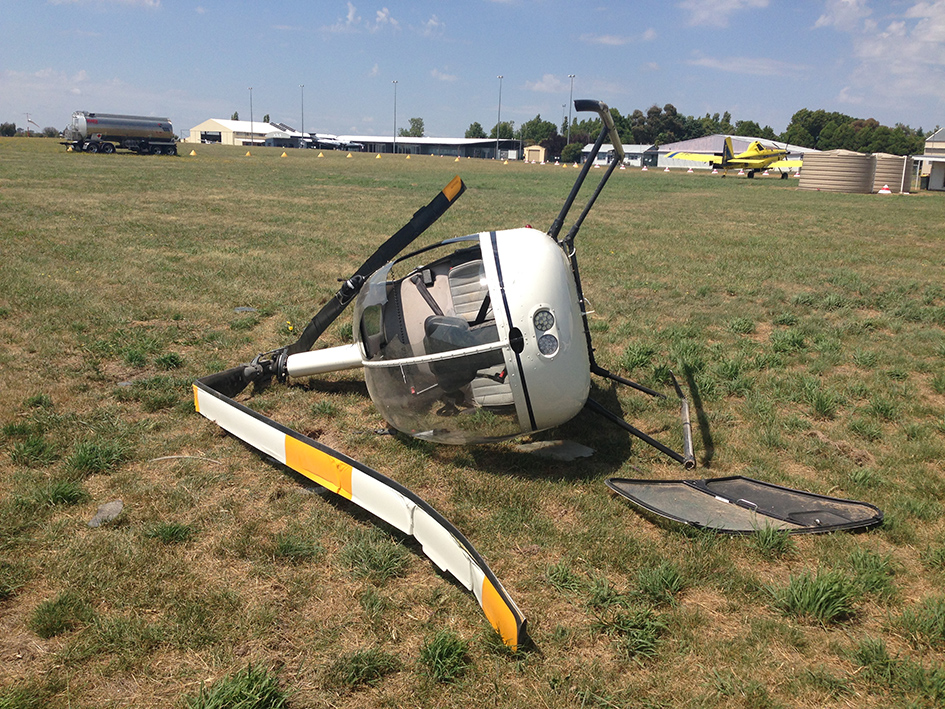
Figure 2: Detached right door and damaged rotor blades
Source: Operator
Operator comments
During the last ten minutes of the dual lesson, the heel of the right skid contacted the ground and the helicopter moved approximately 4 m to the right before coming to rest on its right side.
It is most likely that applied collective pitch may have been the reason for the movement laterally. When the helicopter moved rearward, the student was instructed to correct the unwanted movement. Initially the student applied incorrect aft cyclic, which increased the velocity of the unwanted movement and a subsequent sink off the ‘ground cushion’ created by the downwash from the rotor blades.
The company also identified that the hover height for the sequence was too low.
ATSB Comment
As noted by the instructor and the operator, the pivoting roll by the helicopter to the right, around the skid in contact with the ground, and subsequent loss of control is consistent with the phenomenon known as dynamic rollover.
A helicopter is susceptible to this later roll, but some factor must first cause the helicopter to roll or pivot around a skid until its crucial rollover angle is reached. This angle is around 5° to 8 ° dependent on the type of helicopter, winds and loading.
Once started, dynamic rollover cannot be stopped by application of opposite cycle control alone. Even with full left cyclic applied, the main rotor thrust vector and its moment follows the aircraft as it continues rolling to the right. Quickly reducing collective pitch is the most effective way to stop dynamic rollover from developing.
The role of the instructor as pilot in command is a dynamic and complex one. There remains a fine balance between providing an interesting and beneficial learning experience for your student and keeping the situation safe.
A manual produced by the Civil Aviation Safety Authority (CASA) Australia and the Civil Aviation Authority (CAA) New Zealand for helicopter instructors has many useful tips and tools relating to the principles and methods of flight instruction. It includes 28 chapters on flying sequences from ab initio through to mountain flying awareness.
The manual discusses the need to always closely supervise student practice sequences and to not allow students to make mistakes. It also highlights the necessity of using the correct handing over and taking over model, so there is never any doubt as to who has control at any one time.
In relation to the hovering sequence, it notes that this exercise demands a high degree of coordination and should not be taught until the student has acquired a reasonable state of competence in the first five lessons. An alternative technique is to use slow flight to introduce hovering. This procedure take the form of low, slow flight into the wind across a suitable clear area. Speed and height are progressively reduced in successive passes until the helicopter is creeping forward at a walking pace in ground effect and is then momentarily halted before transitioning into forward flight again. These momentary pauses are in fact periods of hovering, and are gradually extended as competency improves.
Whether or not the ATSB identifies safety issues in the course of an investigation, relevant organisations may proactively initiate safety action in order to reduce their safety risk. The ATSB has been advised of the following proactive safety action in response to this occurrence.
Operator
As a result of this occurrence, the aircraft operator has advised the ATSB that they are taking the following safety actions:
Flight training operations
Since the accident, the company has advised that the hover height should not be below about 1.5 – 2.0 m (5.0 – 6.5 ft) of skid height, particularly in the first or second hover lesson
Instructor’s hand position must be kept closer to the cyclic during a student’s early training and control should be taken as soon as an unwanted movement starts; do not allow rearward movement of the helicopter at this stage of training
Care should be taken to adhere to the power limits in the pilot operating handbook and guidance in the operations manual. Caution should be applied to monitor the helicopter’s height above the ground.
Decisions regarding whether to conduct an investigation, and the scope of an investigation, are based on many factors, including the level of safety benefit likely to be obtained from an investigation. For this occurrence, a limited-scope, fact-gathering investigation was conducted in order to produce a short summary report, and allow for greater industry awareness of potential safety issues and possible safety actions.
Publishing information
Released in accordance with section 25 of the Transport Safety Investigation Act 2003
Ownership of intellectual property rights in this publication
Unless otherwise noted, copyright (and any other intellectual property rights, if any) in this report publication is owned by the Commonwealth of Australia.
Creative Commons licence
With the exception of the Coat of Arms, ATSB logo, and photos and graphics in which a third party holds copyright, this publication is licensed under a Creative Commons Attribution 3.0 Australia licence.
Creative Commons Attribution 3.0 Australia Licence is a standard form licence agreement that allows you to copy, distribute, transmit and adapt this publication provided that you attribute the work.
The ATSB’s preference is that you attribute this publication (and any material sourced from it) using the following wording: Source: Australian Transport Safety Bureau
Copyright in material obtained from other agencies, private individuals or organisations, belongs to those agencies, individuals or organisations. Where you wish to use their material, you will need to contact them directly.
The pilot reports that he intended to conduct a practice flight to rehearse for an upcoming air display. His intention was to activate the aircraft's display smoke system on the runway threshold and complete a tight turn through 360 degrees, prior to commencing the take-off roll. This would be followed by a steep climb out to position the aircraft for commencement of the airborne display routine. A gusting crosswind was blowing across the runway being used for departure.
The pilot indicates that after turning left through approximately 90 degrees, the aircraft accelerated sideways across the grass and the right main wheel began to skip. The pilot was unable to maintain control of the aircraft and the right wheel appeared to dig into the grass runway surface. The aircraft was observed to nose over, before toppling onto its back. The pilot was not injured. The pilot states that the loss of control was most likely a combination of the gusting crosswind conditions and the right main wheel digging into the soft runway surface.
The pilot reported that he descended to approximately 150 ft AGL as he was approaching Bellburn airstrip, and decided to overfly the windsock. He noted that the wind was an easterly breeze of about 7 knots. The pilot then intended to carry out a left turn, fly a downwind leg, and terminate into wind. He then rolled on about 50 degrees of bank, and shortly afterwards the helicopter began shaking violently. The helicopter then rotated through 180 degrees and adopted a nose down attitude. The pilot said he applied full power and full collective control, but was unable to prevent the helicopter striking the ground.
A witness located near the parking area saw the helicopter bank steeply and then begin to descend. The tail rotor then hit a patio attached to an office building and the main rotor struck a tree just before the helicopter impacted the ground.
The pilot of the aircraft reported that the helicopter was being used to spray a sugarcane crop when he attempted to avoid a bird. As he banked the helicopter to the right, he heard two bangs and decided to land the helicopter in an adjacent fallow paddock. During the attempted landing, the helicopter yawed right, and the right skid dug into the ground, rolling the helicopter onto its right side. The pilot was not injured. Examination revealed that the right spray boom had struck the crop during the attempt to avoid the bird.
A portable ELT was carried in the cabin, but it was not activated by the pilot.
The Hughes 269 helicopter had completed a 100 hourly servicing during which, the main rotor abrasion strips were replaced, main rotor damper hydraulic fluid levels replenished, and the landing gear oleos checked to ensure that they were within limits. Ground and hover flight checks were then conducted to adjust blade weights and damper settings. The pilot and licensed aircraft maintenance engineer (LAME) reported that the wind was strong and gusting to about 30 kts. All the landings were made either crosswind or into-wind onto a hard bitumen surface. The LAME reported that, on each occasion, he made only small adjustments to the main rotor damper setting and blade track.
The pilot reported that on each of the flights prior to the accident flight, the helicopter had a significant vibration. At the end of each flight, the pilot would land the helicopter and disconnect the main rotor from the engine so that the LAME could make adjustments to the rotor head and blades. During the flights, the pilot occupied the right seat and the LAME operated the vibration and tracking equipment from the left seat. The LAME reported that during the accident flight, the helicopter's vibration levels and main rotor track had been adjusted to being well within limits, but soon after the pilot had made a very light and gentle landing, the helicopter entered ground resonance.
The pilot reported that after he landed the helicopter and as the engine speed decayed through approximately 2,500 to 2,300 RPM, the helicopter entered severe ground resonance. He forced the collective fully down and wound back the throttle setting. He also attempted to operate the rotor disengage switch but his attempts were hampered by the helicopter's severe vibration experienced during the ground resonance. A witness reported that about 5 seconds after landing, the helicopter rocked three times alternately on each of the two skids. It then spun through 360 degrees before disintegrating. Ground resonance occurs when unbalanced forces in the rotor system cause the helicopter to rock on the landing gear at or near its natural frequency.
Unless corrective action is taken, the amplitude of the vibration increases until the helicopter disintegrates. Corrective actions include immediately becoming airborne as ground resonance can only occur when the helicopter is in contact with the ground or stopping the main rotor as quickly as possible to remove the vibration source. After the helicopter had come to rest, the crew was unable to shut down the engine which continued to operate. A bystander reached into the cockpit to secure the engine and electrical equipment before he and others assisted the crew from the wreckage. There was no fire but the pilot was seriously injured. The LAME received minor injuries. No bystanders were injured.
An examination of the wreckage revealed that there appeared to be no pre-existing mechanical faults. The main rotor system vibration level and blade track were well within limits and the landing gear oleos had been checked during the servicing in accordance with the servicing manual. The landing gear oleos were checked after the accident and were found to be serviceable. Therefore, it was unlikely that a mechanical fault caused the helicopter to enter ground resonance. When the pilot reduced the main rotor speed prior to shutdown, the centrifugal force acting on the main rotor blades also reduced.
The main rotor blades would then have had a potential to excessively flap in response to the gusty wind. The helicopter may then have rocked on its landing gear oleos and subsequently entered ground resonance. Because the helicopter had no apparent mechanical faults, the prevailing wind conditions may have been a factor in the accident. The decision to perform the main rotor track and balance in strong and gusty wind conditions would appear questionable considering that the rotor system would have been experiencing varying degrees of translational lift.
Therefore, stable blade tracking and vibration readings from the equipment would have been difficult to obtain. Because the main rotor RPM was decreasing, the pilot was unlikely to have recovered the helicopter from ground resonance because both the recovery techniques were unavailable to him. He was unable to disconnect the main rotor from the engine due to the helicopter's vibration and, the quick development of the ground resonance meant that it was also unlikely that the pilot had sufficient time to re-accelerate the main rotor and take-off.
The pilot was flying a Cessna 185 aircraft on a VFR charter flight from Moorabbin to Peterborough with 2 passengers. On arrival at Peterborough he overflew the strip and estimated the wind to be from 220 degrees at 5 to 7 kts. The strip has an uphill gradient to the east, and, even though this would result in a slight tailwind from the right quarter for the landing, the pilot elected to accept this and make use of the uphill gradient.
The landing was reported to have been smooth and light and was accomplished with a trickle of power and full flap (4 stages). During the roll out the aircraft diverged slightly left and then made a rapid and increasing swing to the right. Application of rudder and brake was not able to stop the developing ground loop. The aircraft left the mown strip with the group loop tightening until the left main landing gear collapsed. The aircraft came to rest pointing back down the strip towards the touchdown point.
After shutting down the engine the pilot and passengers evacuated without assistance or injury.
The pilot considered that he should have used a different technique when landing. A powered approach with 2 stages of flap, raising the flaps as soon as possible after landing, and using power to ensure adequate rudder authority during roll out would have result in control of the aircraft being maintained.
A Cassuit Racer had completed a short flight in the Camden area. The pilot reported losing directional control on touch down, following a normal approach and flare. The aircraft nosed over during the accident sequence, causing damage to the lower engine cowl and propeller.
The pilot had recently purchased the aircraft, and this was his first flight on type. As it is a single seat aircraft, he was completing a self-endorsement under the supervision of another pilot.
The student helicopter pilot was conducting his second solo flight at Hoxton Park. The weather was fine, with almost no wind. Prior to commencing the solo phase, the student had completed a satisfactory dual circuit check.
As the instructor walked away from the helicopter, he heard a "thump'. As he turned around, he saw the helicopter had rolled onto its side, causing substantial damage to the rotor blades. The accident was consistent with 'dynamic rollover'. The student was not injured and was able to exit the helicopter.
As the student had commenced to lift off the helicopter had rapidly rolled to the right. Although he had expected there would be some rolling tendency, the rate of roll was greater than the student had anticipated, and he had been unable to prevent the rollover.