

Inadvertent load release involving an Airbus Helicopters AS 350 B3, near Wentworth Falls, New South Wales, on 20 February 2020
Brief
| Occurrence Briefs are concise reports that detail the facts surrounding a transport safety occurrence, as received in the initial notification and any follow-up enquiries. They provide an opportunity to share safety messages in the absence of an investigation. |
What happened
On 20 February 2020 at about 1322 Eastern Daylight-saving Time, the pilot of an Airbus Helicopters AS 350 B3 was conducting external load activities at the Rocket Point walking track near Wentworth Falls, New South Wales.
As the remote hook, slung 150 ft below the helicopter lifted a 122 kg load of pipe, the pilot checked the rigging and slowly accelerated the helicopter into forward flight. As the pilot observed the load was stable, the helicopter was accelerated to 40 kt. A short time later, the load was inadvertently released from the hook and fell approximately 1,000 ft into unoccupied bushland.
Operator’s investigation
The operator conducted an in-depth investigation into this occurrence and determined that there were three significant factors that contributed to the load release. They were unable to establish a clear single cause as to what precipitated the occurrence.
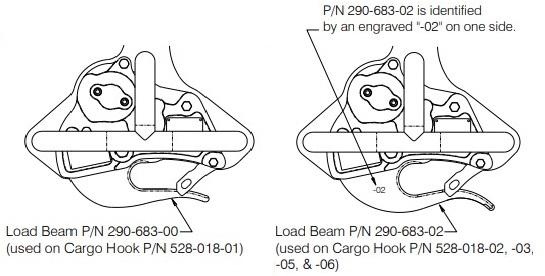
The first contributing factor was the use of load beam part number (P/N) 290-683-00, which is of a different design to the normal in-service load beam P/N 290-683-02, specifically in the length of the beam (Figure 1) and slight variation in geometry. According to the manufacturer’s manual, the shortened load beam can be retrofitted to different P/N cargo hooks, however the load ring warning decal that specifies a smaller diameter shackle must be displayed. The cargo hook and load beam in use at the time of occurrence had incorrectly been marked with warning decal for the longer beam design (this contravened the manufacturer’s manual by not displaying the correct load ring warning decal). This is how the operator received the hook back from a routine equipment servicing in 2017.
The load beam that was in use has approximately 30 mm reduced beam length and different geometry to the more commonly used load beam, further increasing the likelihood of dynamic rollout occurring.
Dynamic rollout (or ring rollout/D-ring reversal) is a phenomenon that can be described as the unintended release of the primary engaging ring from a winch or cargo hook that may occur after a momentary unloading situation. An unloading event permits a dynamic condition allowing the ring to travel up and flip over the beak (tip) of the hook and come to rest on the spring-loaded keeper. The ring is now only supported by the spring-loaded keeper. When the load is re-applied, the spring-loaded keeper allows the ring to fall free from the hook, thereby inadvertently releasing the load.
Figure 1: Remote Hooks – the different load beams
Source: Operator
Secondly, it had become common practice for ground staff to utilise the method of attaching loads by attaching the strop loop directly to the hook’s load beam. As the radius of the loop in the nylon strop is greater than the length of the load beam, the likelihood of dynamic rollout occurring significantly increases. The operator had prepared an internal safety alert stipulating that a correctly sized shackle must be used when attaching loads to the load beam, however due to delays this was not released by the time of the occurrence.
Lastly, with the four strop loops of the load within the hook, it is possible that this created an overcrowding situation which could have prevented the keeper from correctly operating and/or being less visible to the ground crew if the strops had been placed on the hook correctly.
While the operator was unable to determine the exact cause for the inadvertent release of the load, the operator concluded it was reasonable that the load dropped due to dynamic rollout or due to the incorrect rigging of the nylon load strops to the shortened load beam. Dynamic rollout is more likely, as it is a known fault to occur when using the nylon strops without shackles. The use of the remote hook with a shorter load beam further exacerbated the situation leading to the loss of the load.
Safety action
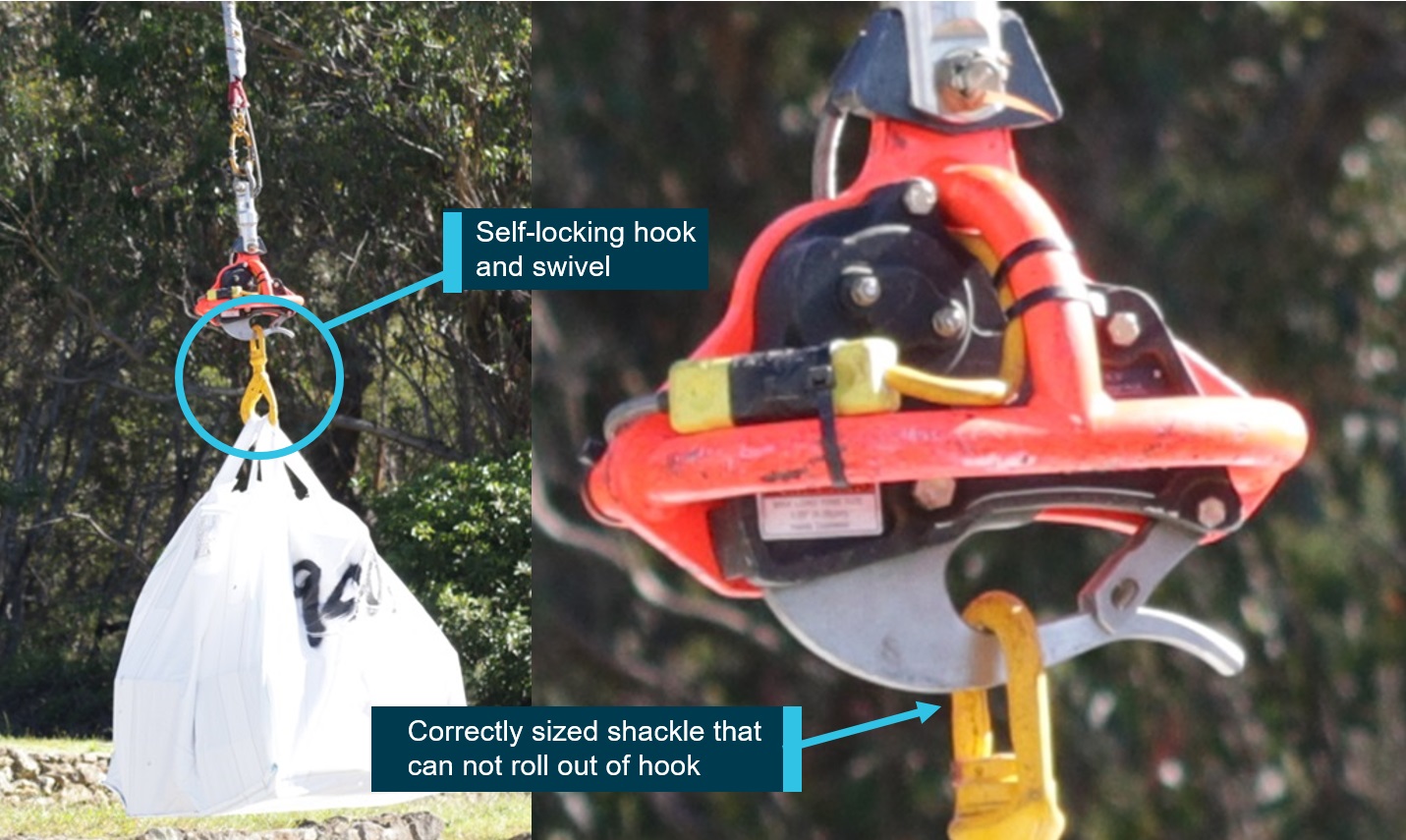
As a result of this occurrence, the aircraft operator has advised the ATSB that they have updated their operations manual procedure to prevent unintentional release from the remote hook. Specifically, this involves the use of a self-locking hook and swivel with a correctly sized shackle as the single attachment to the remote hook.
Figure 2: Remote Hook lifting load with self-locking hook and swivel
Source: Operator
Safety message
This incident serves as a reminder for both ground and aircrew members that while conducting sling and winch operations, there are potential hazards to the safe completion of the task. Identification and communication of such hazards allows safety action to mitigate the associated risk. Further information on dynamic rollout and prevention can be found in CASA’s Airworthiness Bulletin 25-006.
About this report
Decisions regarding whether to conduct an investigation, and the scope of an investigation, are based on many factors, including the level of safety benefit likely to be obtained from an investigation. For this occurrence, no investigation has been conducted and the ATSB did not verify the accuracy of the information. A brief description has been written using information supplied in the notification and any follow-up information in order to produce a short summary report, and allow for greater industry awareness of potential safety issues and possible safety actions.
Occurrence summary
| Mode of transport | Aviation |
|---|---|
| Occurrence ID | AB-2020-023 |
| Occurrence date | 20/02/2020 |
| Location | Near Wentworth Falls |
| State | New South Wales |
| Occurrence class | Incident |
| Aviation occurrence category | Loading related |
| Highest injury level | None |
| Brief release date | 22/06/2020 |
Aircraft details
| Manufacturer | Airbus Helicopters |
|---|---|
| Model | AS 350 B3 |
| Sector | Helicopter |
| Operation type | Aerial Work |
| Damage | Nil |