Fuel starvation

Fuel starvation involving a Grumman GA-7, VH-WPW, Gunnedah, New South Wales, on 23 November 1992

Summary

The pilot had been authorised to conduct a solo navigational exercise as part of a commercial pilot licence course. The authorisation did not include the three passengers, two of whom were trainees from the same training facility as the pilot. The flight was planned to track from Cessnock to Tamworth for a landing, then Gunnedah to refuel before returning to Cessnock.

The flight progressed as planned to Tamworth where the fuel quantity was visually confirmed adequate for the next leg to Gunnedah. At Tamworth, the pilot discussed with the front seat passenger the possibility of performing a simulated engine failure in cruise using the fuel selector to fail the engine. The passenger stated that, as he considered this to be unsafe, he would simulate an engine failure by retarding the throttle only.

The pilot reported that during cruise at 6,500 ft, after departing Tamworth, the front seat passenger retarded the right engine throttle to simulate an engine failure. The engine failure procedure was performed by stating the actions and touching, but not manipulating, the appropriate controls. Power was then restored to a normal cruise setting.

Later, whilst passing through 5,000 ft on descent into Gunnedah, the right engine began to run roughly, and the aircraft yawed to the right. The pilot carried out system checks, including repositioning the throttle to achieve the smoothest operation. He did not shut down the engine, as he considered it to be capable of producing some power. The descent continued to the circuit area, which was entered on the crosswind leg for runway 11. A strong southerly wind was noted. The landing gear was extended at about mid-base leg. A normal circuit was flown until the turn onto final at about 400 feet AGL when the aircraft encountered turbulence and overshot the runway extended centreline. The pilot applied power to go around. However, the aircraft yawed to the right and continued to descend. The landing gear was retracted but the aircraft performance did not improve. Both engines were shut down and an emergency landing was carried out off the aerodrome. The occupants evacuated the aircraft through a shattered side window.

Investigation revealed that the right engine carburettor bowl and its supply line contained no fuel, but there was ample fuel in the right tank. As there was no physical damage to the bowl or line which could have allowed the fuel to leak away, it was concluded that the right engine fuel supply had been selected off some time prior to the accident.

The front seat passenger later stated that he had failed the right engine by selecting the fuel off some time prior to the aircraft entering the circuit. It was determined that the aircraft, as configured, was not capable of maintaining height and that the pilot had misjudged the circuit and approach. It is likely that the aircraft was positioned low and too far from the runway threshold as it overshot the turn onto final. The subsequent attempt to go around was unsuccessful because, with the landing gear extended and the right propeller windmilling, the aircraft had no climb capability. The pilot stated that he had continued with the approach as he believed that the right engine was capable of delivering some power if required.

Significant Factors

1. An engine failure was simulated by turning off the fuel to the right engine.

2. The right propeller was not feathered.

3. The pilot misjudged the circuit and approach to land and attempted to conduct a go-around.

4. The aircraft, as configured, was not capable of maintaining height.

Occurrence summary

Investigation number 199201781
Occurrence date 23/11/1992
Location Gunnedah
State New South Wales
Report release date 25/08/1994
Report status Final
Investigation type Occurrence Investigation
Investigation status Completed
Mode of transport Aviation
Aviation occurrence category Fuel starvation
Occurrence class Accident
Highest injury level Serious

Aircraft details

Manufacturer Grumman American Aviation Corp
Model GA-7
Registration VH-WPW
Sector Piston
Operation type Flying Training
Departure point Tamworth
Destination Gunnedah
Damage Substantial

Fuel starvation event involving a Cessna 210, VH-BKD, 3 km east of Broome Airport, Western Australia, on 3 May 2015

Final report

What happened

On 3 May 2015, at about 0230 Central Standard Time (CST), a Cessna 210 aircraft, registered VH-BKD (BKD), departed from Alice Springs Airport, Northern Territory for a ferry flight to Broome, Western Australia. The pilot was the sole person on board.

At about 70 NM from Broome, the pilot obtained a weather report from the automated aerodrome weather information service (AWIS) located at Broome Airport. The AWIS indicated a dewpoint[1] of 22 °C and an ambient temperature of 22° C, which indicated conditions suitable for the development of fog.

The pilot reported that the AWIS information prompted them to start considering alternatives should fog prevent a landing. The pilot had planned and flown BKD at the optimum endurance profile of 45% power[2] and changed tanks[3] on a regular time-based pattern. The pilot reviewed the fuel log and determined they had sufficient fuel for a 30-minute search for a suitable break in the fog. If unsuccessful, the pilot planned to turn back inland on a reciprocal to the inbound track and land on the highway.

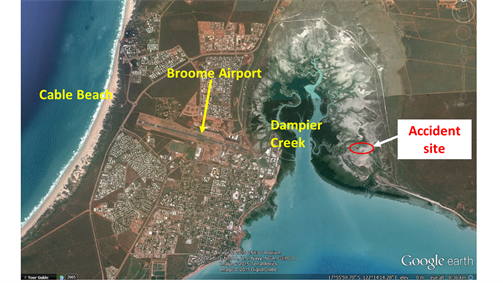
At about 15 NM from Broome, the pilot observed the start of a thick layer of fog below the aircraft. Arriving overhead Broome Airport at about 0622 Western Standard Time (WST), with the right fuel tank selected, the pilot initially surveyed the area from about 1,000 ft above ground level. However, as there were no breaks in the fog, the pilot descended the aircraft to about 650 ft. The pilot kept the aircraft in visual conditions while circling the airport and Cable Beach areas (Figure 1) occasionally flying at a lower level to take a closer look for possible breaks. With the right fuel tank still selected, the pilot’s search continued for about forty-five minutes.

Figure 1: Broome Airport and accident site

Figure 1: Broome Airport and accident site

Source: Google earth annotated by the ATSB

Deciding that landing was not possible until the fog lifted, the pilot sought assistance from the person waiting on the ground for the aircraft. As this person was local and understood the likely extent of the fog, they were able to offer the pilot two alternate airports, as options. The first option, Beagle Bay was about 62 NM to the north, and the second option Eco Beach, about 23 NM to the south. The pilot considered these options, but reasoned that with such widespread fog, these options may also be fog bound. With limited choices and now limited fuel, the pilot turned BKD for one last low-level check along runway 10. The pilot then initiated a climb with the intent of heading back to the highway to land.

Shortly after applying full power to initiate the climb, the aircraft’s engine surged and spluttered. The pilot instantly realised that the right tank had been selected for over an hour, and quickly changed the fuel selector to the left tank. However, the engine did not respond. The pilot then attempted to restart the engine with the ignition key, but reported hearing a crunching noise as the starter motor engaged. The propeller was still windmilling.

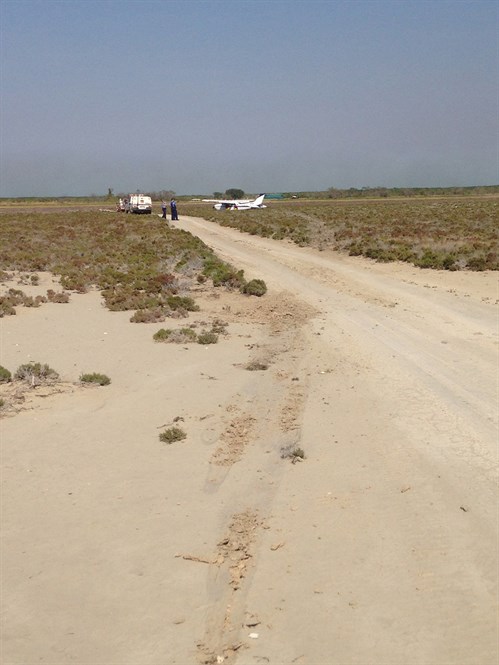
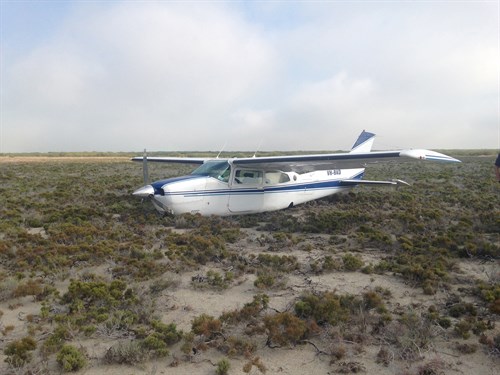
With the aircraft only at about 500 ft and descending into the thick layer of fog, the pilot levelled the aircraft’s wings and prepared for a forced landing. Electing to leave the undercarriage retracted, the pilot descended through the fog and noted the outline of a dirt track. The pilot attempted to land on the track, but the aircraft collided with the sandy terrain just prior to reaching it. The aircraft momentum allowed it to skid across the track, coming to rest in the mangroves a few metres on the other side (Figure 2 and 3). The accident site was located within the mangrove area of the Dampier Creek.

The pilot was not injured; however, the aircraft propeller and engine sustained substantial damage.

Figure 2: Initial contact point

  Figure 2: Initial contact point

Source: WA Police 

Figure 3: VH-BKD in the mangroves

Figure 3: VH-BKD in the mangroves

Source: WA Police

Pilot experience and comments

The pilot had around 3,850 flying hours, with around 830 of those on Cessna 210 aircraft.

Pre-flight planning

The pilot elected to conduct the flight at night to increase their night command hours. The evening before the flight, the pilot checked the weather forecast and completed the flight plan. They noted a 30% probability of fog on the terminal area forecast (TAF) for Broome during the planned arrival time. However, the pilot reported that, in their experience, 30% probability of fog would mean non-existent or minimal impact on operations, so they did not consider or plan for any alternates

The pilot pre-flighted the aircraft in the morning prior to the 0230 departure.

The pilot had personal commitments in Broome that morning and back in Alice Springs the next day. Hence, they needed to deliver the aircraft in time to catch the lunchtime jet flight back from Broome to Darwin and eventually be back in Alice Springs the next morning.

The flight

The pilot made the following comments about the flight:

  • the cruise level was 8,500 ft
  • there was smooth conditions enroute but with a stronger headwind than forecast
  • the flight time between Alice Springs and Broome was about 5 hours.
Fuel management

The pilot maintained a fuel log during the flight. They initially used fuel from the left tank for 30 minutes, then 60 minutes on the right, back to the left. The pilot continued using this pattern until they arrived overhead Broome.

Although the pilot had calculated there was sufficient fuel to search for a break in the fog for 30 minutes, once pressured and distracted looking for an expected opening to be able to land, the pilot reported flying in excess of 60 minutes with the right fuel tank selected.

The aircraft fuel tanks were dipped post- accident. The right tank had no fuel remaining while there was 45 L remaining in the left tank.

Aviation weather forecasts and alternate aerodrome requirements

The Aeronautical Information Publication Australia (AIP) ENR 1.1 87 details the following requirements concerning planning for alternate aerodromes:

A pilot in command must make provision for flight to an alternate aerodrome, when required, in accordance with the following paragraphs:

…Except when operating an aircraft under the VFR by Day within 50NM of the point of departure, the pilot in command must provide for a suitable alternate aerodrome, when arrival at the destination will be during the currency of, or up to 30 minutes prior to the forecast commencement of, the following weather conditions:

Cloud – more than SCT below the alternate minimum

Visibility – less than the alternate minimum

Visibility – greater than the alternate minimum, but the forecast is endorsed with a percentage probability of fog, mist, dust or any other phenomenon restricting visibility below the alternate minimum….

Note: When weather conditions at the destination are forecast to be as above, but are expected to improve at a specific time, provision for an alternate aerodrome need not be made if sufficient fuel is carried to allow the aircraft to hold until that specified time plus 30 minutes.

AIP GEN 3.5-7 explains that:

PROB% is used in terminal area forecasts (TAF) to indicate an expected 30 or 40% probability of occurrence. If greater than or equal to 50% probability is forecast, reference is made to the phenomenon in the forecast itself not by the addition of a PROB statement

Safety message

The pilot had planned the flight using maximum endurance performance figures and kept a fuel log. The pilot’s fuel management used a time-based system up until arriving overhead the destination. Due to the unexpected distraction and increased workload of arriving at the destination airport covered in thick fog, with no planned alternates, the pilot lost situational awareness of the aircraft’s fuel state.

Issue number 5 in the ATSB’s Avoidable Accident Series – Starved and exhausted: Fuel management aviation accidents looks in more detail at such scenarios. The report notes that fuel exhaustion is more likely to occur on flights when there is little flight fuel margin.

The Avoidable Accidents series is available on the ATSB website under the Safety Awareness tab.

The ATSB published a research report titled Dangerous Distraction, an examination of aviation accidents and incidents involving pilot distraction in Australia between 1997 and 2004, covers in detail the role of pilot distraction in a number of aircraft accidents.

The research looked closely at 325 occurrences involving some measure of pilot distraction. The researchers were able to develop a taxonomy of three major causes of distraction. They were ‘flight management tasks’, ‘external objects’, and ‘people on board the aircraft’. The report concludes with a number of tentative suggestions for minimising the risk of pilot distraction. Further reading is available on the ATSB website.

Information regarding alternate aerodrome requirements is available in the Air Information Publication (AIP), ENR 1.1-87. This is available on the Airservices Australia website.

The Civil Aviation Safety Authority flight planning kit covers issues such as planning for alternates, obtaining local knowledge when flying to an unfamiliar destination and the importance of considering all aspects of the weather forecast.

This Flight Planning Kit is available from the online shop on the CASA website.

Aviation Short Investigations Bulletin - Issue 43

Purpose of safety investigations

The objective of a safety investigation is to enhance transport safety. This is done through:

  • identifying safety issues and facilitating safety action to address those issues
  • providing information about occurrences and their associated safety factors to facilitate learning within the transport industry.

It is not a function of the ATSB to apportion blame or provide a means for determining liability. At the same time, an investigation report must include factual material of sufficient weight to support the analysis and findings. At all times the ATSB endeavours to balance the use of material that could imply adverse comment with the need to properly explain what happened, and why, in a fair and unbiased manner. The ATSB does not investigate for the purpose of taking administrative, regulatory or criminal action.

Terminology

An explanation of terminology used in ATSB investigation reports is available here. This includes terms such as occurrence, contributing factor, other factor that increased risk, and safety issue.

Publishing information 

Released in accordance with section 25 of the Transport Safety Investigation Act 2003

Published by: Australian Transport Safety Bureau

© Commonwealth of Australia 2015

image_5.png

Ownership of intellectual property rights in this publication

Unless otherwise noted, copyright (and any other intellectual property rights, if any) in this report publication is owned by the Commonwealth of Australia.

Creative Commons licence

With the exception of the Coat of Arms, ATSB logo, and photos and graphics in which a third party holds copyright, this publication is licensed under a Creative Commons Attribution 3.0 Australia licence.

Creative Commons Attribution 3.0 Australia Licence is a standard form licence agreement that allows you to copy, distribute, transmit and adapt this publication provided that you attribute the work.

The ATSB’s preference is that you attribute this publication (and any material sourced from it) using the following wording: Source: Australian Transport Safety Bureau

Copyright in material obtained from other agencies, private individuals or organisations, belongs to those agencies, individuals or organisations. Where you wish to use their material, you will need to contact them directly.

__________

  1. Dewpoint is the temperature at which water vapour in the air starts to condense as the air cools. It is used among other things to monitor the risk of aircraft carburettor icing or likelihood of fog at an aerodrome.
  2. Endurance power setting allows for the longest time in the air.


Occurrence summary

Investigation number AO-2015-042
Occurrence date 03/05/2015
Location 3 km East Broome Airport
State Western Australia
Report release date 07/10/2015
Report status Final
Investigation level Short
Investigation type Occurrence Investigation
Investigation status Completed
Mode of transport Aviation
Aviation occurrence category Fuel starvation
Occurrence class Accident
Highest injury level None

Aircraft details

Manufacturer Cessna Aircraft Company
Model 210N
Registration VH-BKD
Serial number 21063127
Sector Piston
Operation type Private
Departure point Alice Springs, NT
Destination Broome, WA
Damage Substantial

Fuel starvation involving a Cessna U206F, VH-PQJ, 46 km west-north-west of Kununurra Aerodrome, Western Australia, on 1 August 1998

Summary

The Cessna 206 floatplane was on a charter flight taking passengers from Kimberley Coastal Camp to Lake Kununurra. During descent 25 NM from Lake Kununurra, the aircraft's engine lost power. The pilot reported that he immediately switched the fuel selection from the left to the right fuel tank. He also selected full throttle, full rich fuel mixture, boost pump to low prime and full fine on the propeller pitch control. The engine did not respond so he elected to conduct an emergency landing on the Ord River. The pilot reported that the descent took about five minutes, during which he selected high prime on the boost pump for several seconds.

The engine did not recover power throughout the descent. The landing was conducted without further incident. The aircraft was undamaged, and the passengers were uninjured. The pilot reported that he filled the tanks before leaving Lake Kununurra for the Camp. Because of the amount of fuel he thought was in the left tank, the pilot had intended to select the right tank at 15 NM from Lake Kununurra. However, the engine lost power before he could do so. After the landing, the aircraft's left fuel tank was found to have about 8 L of fuel remaining, approximately 20 L less than the pilot had planned. The right tank had about 60 L. The operator reported that the only fuel system fault was three clips that secured the left fuel tank bladder to the wing were found undone. No fault could be found with the engine.

Occurrence summary

Investigation number 199803287
Occurrence date 01/08/1998
Location 46 km west-north-west of Kununurra Aerodrome
State Western Australia
Report release date 17/12/1998
Report status Final
Investigation type Occurrence Investigation
Investigation status Completed
Mode of transport Aviation
Aviation occurrence category Fuel starvation
Occurrence class Incident

Aircraft details

Manufacturer Cessna Aircraft Company
Model U206F
Registration VH-PQJ
Sector Piston
Departure point Kimberley Coastal Camp WA
Destination Lake Kununurra WA
Damage Nil

Fuel starvation involving a Cessna 310Q, VH-WHI, 16 km south of Crookwell (ALA), New South Wales, on 8 February 1998

Summary

The pilot had planned a solo training flight from Canberra to Scone, returning to Canberra via Goulburn the next day. The aircraft departed Canberra with full fuel tanks and continued to Scone without incident, where it remained overnight. The pilot reported that on the return flight the main fuel tanks were used for take-off, and the auxiliary tanks were selected after the aircraft was established on the departure route. Approximately 50 minutes later, when the right auxiliary tank indicated almost empty, the right main tank was selected. However, as the left auxiliary tank still indicated some 10 to 12 gallons, feed to the left engine from that tank was continued.

A short time later, just prior to commencing descent from 9,000 ft into Goulburn, the left engine lost power. The throttles on both engines were retarded for descent and the left main tank was selected to supply fuel to the left engine. The left throttle was advanced some time later but there was no response from the engine. The pilot reported that his troubleshooting checks consisted of checking that the fuel selectors were on the main tanks, the mixtures were full rich, the ignition was on and that the auxiliary fuel pumps were selected to LOW. The left throttle was again advanced but there was still no response from the engine. The checks were then repeated, but with the auxiliary fuel pumps selected to HIGH. Again, there was no response from the engine.

The same checks were performed on both engines but neither engine responded when the throttles were advanced. Both mixture controls were moved to idle cut-off for about 30 seconds. Full rich mixture was then selected, but the engines still failed to respond. As the aircraft was now at a low height, the pilot concentrated on finding a suitable forced-landing site. Just prior to landing on an open field, he had to manoeuvre the aircraft to avoid a wire and a ditch which lay across the intended approach path. The aircraft subsequently landed heavily, sustaining substantial damage. The pilot evacuated the aircraft without injury.

The investigation determined that although the main tanks had been ruptured in the accident, sufficient fuel would have been available for continued operation of the engines. However, an inspection of the aircraft found there was no HIGH auxiliary fuel pump switch position, as reported by the pilot. The three switch positions available were LOW, which runs the auxiliary fuel pump continuously at low pressure, a centre OFF position, and an up position, placarded ON. In the ON position, the pump runs continuously at low pressure until low fuel pressure is sensed by the engine fuel pressure switch. This could occur due to an engine-driven fuel pump failure, or running a fuel tank empty. The pump then automatically runs at high pressure, and is retained in that mode by a latching relay.

If a fuel tank is allowed to run dry, and fuel supply to the engine is restored by selecting an alternate tank, the engine will then be supplied with an excessive amount of fuel, resulting in a loss of engine power due to over-fuelling. To correct that condition, the auxiliary fuel pump switch must be moved to OFF to unlock the latching relay. The flight manual instructions for the fuel system are to select the auxiliary fuel pumps to ON for takeoff and landing, and to use full rich mixture and auxiliary fuel pumps on LOW when changing fuel tanks. Further investigation determined that the right engine fuel pressure switch had a very high electrical resistance after activation.

Consequently, electrical current was able to flow in the latching circuit and lock the system to high flow mode when selected to the ON position. The left engine initially lost power due to fuel exhaustion of the left auxiliary tank. When the main tank was selected, and the auxiliary fuel pump switch was moved to ON, the pump mode changed to HIGH and the latching relay engaged. The consequent over-fuelling condition prevented the left engine from being restarted the right engine stopped from a similar over-fuelling condition when the right auxiliary fuel pump was selected to ON during troubleshooting.

In 1988, the aircraft manufacturer issued Service Bulletin MEB 88-3, which modified the auxiliary fuel pump system and operation because of reported failures of engine fuel pressure switches. The modification included changing the auxiliary fuel pump ON placard to read HIGH. The service bulletin was applicable to all 300/400 series aircraft. However, the modification was not mandatory in Australia and resulted in aircraft in the Australian fleet having differing operational specifications. Service Bulletin MEB 88-3 had not been incorporated on this aircraft.

Modified aircraft have appropriate cockpit placarding and flight manual instructions, but the pilot's operating handbooks do not include the amended instructions. This leads to a misunderstanding of systems operation between different aircraft. The pilot's response to the engine failure was not in accordance with the manufacturer's checklist.

SAFETY ACTION

The Bureau of Air Safety Investigation is currently investigating a perceived safety deficiency identified as a result of this occurrence. The deficiency relates to a misunderstanding of operational procedures on Cessna 300/400 series aircraft as a result of the optional modification state of the auxiliary fuel system (incorporation of Cessna Service Bulletin MEB 88-3).

Any recommendation issued as a result of this investigation will be published in the Bureau's Quarterly Safety Deficiency Report.

Occurrence summary

Investigation number 199800353
Occurrence date 08/02/1998
Location 16 km south of Crookwell (ALA)
State New South Wales
Report release date 21/08/1998
Report status Final
Investigation type Occurrence Investigation
Investigation status Completed
Mode of transport Aviation
Aviation occurrence category Fuel starvation
Occurrence class Accident

Aircraft details

Manufacturer Cessna Aircraft Company
Model 310Q
Registration VH-WHI
Sector Piston
Departure point Scone NSW
Destination Canberra ACT
Damage Substantial

Fuel starvation involving a Cessna 150M, VH-RZW, 125 km east-north-east of Geraldton Aerodrome, Western Australia, on 17 November 1997

Summary

The aircraft was being used to muster cattle at Tallering Station. The pilot reported that the aircraft's fuel tanks had been filled the night before the accident. On the morning of the accident, the pilot again checked that the fuel tanks were full.

Having been airborne for approximately 4.75 hours, the pilot flew the aircraft towards the station homestead to refuel. The pilot estimated that there was sufficient fuel to remain airborne for at least a further 45 minutes. However, almost immediately, the aircraft's engine began surging and misfiring. The pilot reported that he completed the appropriate checks and when he pumped the throttle, the engine gave some response for approximately 5 to 10 seconds before it finally stopped.

The pilot reported that he attempted to find a suitable forced landing area but the aircraft impacted trees at approximately 40 kts late on final approach. The pilot was uninjured. Later, approximately 22 L of fuel was drained from the aircraft's left fuel tank but none was found in the right tank.

The aircraft's left and right fuel tanks were vented through a vent line connected to the left fuel tank. The vent line is fitted with a vent valve. However, the right fuel tank also had a vented cap. The subsequent engineering inspection found that the vent line valve had deteriorated and was sticking closed. It is likely that the vent valve had stuck closed at some point during the flight. The right tank probably fed quicker than the left tank due to it venting correctly through the vented cap. When the right tank contents had been exhausted, the low air pressure in the left tank probably created an insufficient head of fuel to feed the engine.

A defect report has been submitted to CASA by the operator's engineering organisation, recommending that both fuel tanks be fitted with vented fuel caps.

Occurrence summary

Investigation number 199703792
Occurrence date 17/11/1997
Location 125 km east-north-east of Geraldton Aerodrome
State Western Australia
Report release date 13/02/1998
Report status Final
Investigation type Occurrence Investigation
Investigation status Completed
Mode of transport Aviation
Aviation occurrence category Fuel starvation
Occurrence class Accident

Aircraft details

Manufacturer Cessna Aircraft Company
Model 150M
Registration VH-RZW
Sector Piston
Operation type Aerial Work
Departure point Tallering Station WA
Destination Tallering Station WA
Damage Substantial

Fuel starvation involving a Cessna 177, VH-DZJ, 4 km north-north-west of Cairns Airport, Queensland, on 19 August 1997

Summary

FACTUAL INFORMATION

Circumstances

The company's primary source of revenue was from scenic flights over the Great Barrier Reef. The flights were usually conducted in single-engine aircraft and at an altitude of 1,500 ft AMSL.

The planned one hour scenic flight was the third in a series of similar flights undertaken by the pilot in the aircraft that day. The pilot reported that, after a normal take-off, he was instructed by air traffic control to make a left turn, maintain 1,000ft, and track to a position abeam the control tower before proceeding to Green Island. When the aircraft was approximately abeam the control tower, the engine began to run roughly. This was followed by a significant power loss. The pilot immediately transmitted a mayday broadcast on the Cairns Approach frequency, advising that the engine had failed and that he would be returning to the runway. However, a short time later, the pilot assessed that the aircraft did not have sufficient altitude to reach the runway and he decided to land in a cleared area a short distance inland from the coast.

The pilot reported that he changed the position of the fuel selector soon after the engine lost power. He did this without looking down at the selector which was positioned on the floor of the aircraft. A short time later, when there was no apparent response from the engine, he moved the selector back to its original position, again without looking at the selector.

In the subsequent forced landing, the aircraft landed heavily in a left wing low, nose down attitude. It slewed left and hit a road sign before crossing a narrow sealed road and coming to rest against the gutter. There was no fire.

Communications

The pilot's distress call was his first transmission after changing to the Cairns Approach frequency. The approach controller acknowledged the call and then asked the pilot to report his altitude and confirm the aircraft's registration. Later, the controller requested that the pilot change to the tower frequency. The pilot subsequently advised that these requests increased his workload and distracted him from the primary task of flying the aircraft.

The Manual of Air Traffic Services, page 17-2-1, stated in part; `Distress or urgency communications should be maintained on the frequency on which it was initiated until it is considered that better assistance can be provided by transferring to another frequency'. It also stated that `Staff shall be conscious of the distracting effect that information requests may have on the aircrew'. The investigation could not determine whether, or to what extent, the pilot's performance was affected by the requests from the approach controller.

Wreckage examination

The impact marks and the nature of the damage indicated that the aircraft struck the ground at low forward speed, but with a high descent rate. The aircraft sustained major structural damage to the forward fuselage area. The main spar of the left wing was broken at about the mid-span position and the nose and left main landing gear assembly had separated from the airframe. The engine/cockpit firewall and cockpit floor on the pilot's side was compressed rearward and upward into the cockpit area. The flaps were up.

The right-wing fuel tank, the fuel filter, and the carburettor bowl were empty. The left-wing tank contained approximately 60 lt of fuel. Distortion of the cockpit floor had locked the cockpit fuel selector control in the right tank position, confirming that it was in this position at impact. All fuel lines were clear of obstructions. The nature of the damage to the propeller indicated that it was either stationary or rotating slowly at impact. The magnetos and carburettor were undamaged. These were retained and the engine was removed from the wreckage and test run. It started and operated normally.

The aircraft fuel system

Two integral tanks, one in each wing supplied fuel to the engine. Fuel from these tanks flowed through the fuel selector to a reservoir tank under the cockpit floor, then through a fuel shutoff valve and fuel strainer to the engine driven fuel pump. The fuel selector had three positions - LEFT, RIGHT and BOTH. Useable fuel in each wing tank was 91 lt. The aircraft was refuelled to approximately 60 lt per tank (120 lt total) prior to the first flight on the day of the accident. Recent fuel consumption tests conducted by the operator confirmed a usage rate of about 30 lt per hour.

The pilot advised that he normally operated the aircraft with the fuel selector in the BOTH position, as it was his experience that the tanks emptied at about the same rate during normal operations. Another company pilot advised that, because of an earlier indication of fuel imbalance, he had returned from the last flight on the previous day with the right tank selected. He did not move the selector from that position at the conclusion of the flight.

The aircraft operating handbook called for the fuel selector to be in the BOTH position for engine start and for it to be selected to BOTH during the pre-landing checks. A note in the handbook stated that the purpose of this check was to prevent engine failure due to one tank running empty.

Survival aspects

Whilst the outcome of this occurrence was not a ditching event, it was considered relevant to investigate aspects of survivability given that the majority of flights conducted by the company were overwater scenic flights at an altitude of 1,500 ft AMSL. The single-engine land aircraft used by the company to conduct these flights were therefore operated beyond gliding distance of a suitable landing area in the event of an engine failure for a significant proportion of each flight.

The company provided waist pack type life jackets for passengers and pilots. The normal procedure was for passengers to wear the waist packs, but to not undo the pack or don the jacket. Pilots usually stowed their life jackets under the cockpit seat. The expectation was that, in the event of an emergency occurring while the aircraft was over water, there would be sufficient time for the passengers and the pilot to don their life jackets before the aircraft ditched. The pilot of DZJ reported that, when the emergency situation developed, he had insufficient time to consider the passengers, or to instruct them on the use of life jackets, had that been necessary. A similar situation existed concerning his life jacket.

Recorded radar information

The recorded radar data showed that the aircraft's groundspeed for the last 20 seconds of flight was 49 kts. The aircraft handbook stated that the power off, flaps up stalling speed of the aircraft was 54 kts.

ANALYSIS

The evidence indicated that the engine failed because of fuel starvation that occurred when the right tank contents were exhausted. Given the reported contents of each tank at the start of flying on the day of the accident, and the contents of the left tank when the aircraft impacted the ground, it is likely that the fuel selector was not moved from the RIGHT position after the aircraft was refuelled the day before the accident. This conclusion is supported by the evidence that, in the two-hour period the aircraft had operated that day, the engine would have used about 60 lt fuel.

The reserve fuel tank below the cockpit floor would have emptied after the right tank ran dry, causing the engine power loss. When the pilot moved the fuel selector during the emergency (probably to either BOTH or LEFT), fuel would have begun to flow to the reserve tank. However, it is probable that pilot reselected the empty right tank before there was sufficient fuel in the reserve tank to restore engine power.

The recorded radar data indicated that the aircraft speed in the latter stages of the flight was close to, if not below, the stalling speed. The aircraft impact attitude, and the extent and nature of the damage, supports this conclusion. This evidence, along with the fact that the flaps were in the UP position at impact, indicates that the pilot had mismanaged the aircraft during the forced landing.

SIGNIFICANT FACTORS

1. The pilot did not select the fuel system to the BOTH position prior to take-off.

2. The engine ceased operation due to fuel starvation.

3. The pilot did not configure the aircraft appropriately for the forced landing.

4. The pilot did not maintain proper control of the aircraft.

SAFETY ACTION

While it was determined not to be a contributing factor in this occurrence, the Bureau believed that the safety implications of overwater operations in single-engine land aircraft carrying fare-paying passengers, required further investigation.

The Bureau considers that overwater operations in single-engine land aircraft carrying fare-paying passengers, at altitudes that will not allow the aircraft to glide to land (suitable for an emergency landing) in the event of an engine failure, is a high-risk practice. In particular, the outcome of a ditching event in a high-wing aircraft similar to the accident type presents obvious exit problems. The fact that this aircraft was equipped with fixed landing gear further reduces the survivability of a ditching event.

As a result, the Bureau of Air Safety Investigation issued the following interim recommendation to the Civil Aviation Safety Authority on 28 Jan 1998:

R970176

The Bureau of Air Safety Investigation recommends that the Civil Aviation Safety Authority reconsider the conditions of the current exemption to CAR 258 as it applies to passenger-carrying charter operations in single-engine land aircraft with a view to:

(a) minimising the likelihood of a ditching event; and

(b) minimising the risks associated with the outcome of a ditching event.

no title

Previous safety action

A previous fatal accident highlighted the safety implications of the practice of not correctly "donning" waist pack type life jackets during operations at or below 2,000 ft AMSL.

As a result of the investigation of that occurrence, the Bureau issued the following interim investigation to the Civil Aviation Safety Authority on 9 December 1997 (only the relevant parts of the interim recommendation have been reported below):

"IR960138

The Bureau of Air Safety Investigation recommends that the Civil Aviation Safety Authority:

(i) review the current orders and regulations to ensure that the intention of Civil Aviation Order 20.11 part 5, governing the wearing of a life jacket is clear and unambiguous, and that jackets worn in accordance with the order afford the wearer the maximum safety benefit; and

(ii) educate the industry on the need to have life jackets worn in such a manner that they afford the wearer the maximum safety benefits."

The following response was received from the Civil Aviation Safety Authority on 21 May 1996 (only the relevant part of the response has been reproduced below):

"Interim recommendation(i)

It is CASA's opinion that the current provisions of CAO 20.11.5 are essentially adequate. However, this issue will be referred to the relevant Technical Committee under the Regulatory Review Program for its review.

Interim recommendation (ii)

CASA supports this proposal and is considering the best means to give effect on this recommendation."

Ongoing safety action

As a result of this and other similar occurrences, the Bureau of Air Safety Investigation intends to conduct a review of Australian aviation occurrences involving fuel starvation and exhaustion. This study is due to be completed prior to July 1999. Any recommendations issued as a result of this safety study will be published in the Bureau's Quarterly Safety Deficiency Report.

Occurrence summary

Investigation number 199702649
Occurrence date 19/08/1997
Location 4 km north-north-west of Cairns Airport
State Queensland
Report release date 10/09/1999
Report status Final
Investigation type Occurrence Investigation
Investigation status Completed
Mode of transport Aviation
Aviation occurrence category Fuel starvation
Occurrence class Accident
Highest injury level Serious

Aircraft details

Manufacturer Cessna Aircraft Company
Model 177
Registration VH-DZJ
Sector Piston
Departure point Cairns QLD
Destination Cairns QLD
Damage Destroyed

Fuel starvation involving a Piper PA-32-300, VH-POA, 6 km north-west of Cobden (ALA), Victoria, on 8 December 1996

Summary

Factual information

The pilot had planned to fly from Moorabbin direct to Ocean Grove, then on to Warrnambool. Prior to departure he was advised that there was 40 litres of fuel in the left main tank and the right main tank was full at 91 litres. Both tip tanks were also full at 63 litres each.  Records held by the operator showed that the aircraft was consuming an average of 61 litres per hour. Accordingly, the pilot was advised to use the right main tank for one hour, then use the tip tanks, and go back to the fullest main tank for the landing.

The pilot loaded his five passengers, selected the right main fuel tank, started the engine, conducted engine runs and taxied for take-off. These actions took approximately 20 minutes. After take-off the pilot flew coastal from Moorabbin to Ocean Grove rather than direct as planned, then tracked direct for Warrnambool. Due to weather constraints, he cruised between 2,000 feet and 2,500 feet above mean sea level and also deviated from his track to avoid rain showers. He used a high-power setting of 24 inches of manifold pressure and 2,400 rpm, and did not lean the fuel mixture. Approximately 65 minutes after take-off, at a position about 15 minutes from Warrnambool, the engine suddenly failed. At low altitude over hilly terrain the pilot said he did not have time to conduct a proper assessment of the cause of the power loss, nor did he have time to carry out a successful restart procedure. The pilot forced landed the aircraft onto a sloping field, colliding with a fence before bringing the aircraft to a stop. The aircraft suffered substantial damage, however the six persons on board were uninjured.

Investigation disclosed that the right main fuel tank contained unusable fuel only, and the fuel feed system to the engine was empty. When the system was supplied with fuel the engine was started and ran satisfactorily. Tests indicated that the fuel quantity measuring system was serviceable.

The pilot advised that during the flight he did not maintain a flight log and did not monitor the right main tank fuel quantity. His planning had indicated that the flight would take about one hour and he had intended to change to the fullest tank prior to landing.

The recommended power charts contained in the pilots operating handbook, which was available to the pilot, did not cover the combination of parameters under which this flight was conducted.

Analysis

While the contents of the right main tank prior to departure could not be definitely established it was most probably full at 91 litres. The coastal track taken by the pilot could have added up to an extra ten minutes flying and his deviations from track to avoid showers would also have added to his flight time. While the flying school's flight sheets indicated that the average fuel usage was 61 litres per hour, this was attained by using recommended power settings and correct leaning procedures. It was calculated that the aircraft could use up to 88 litres of fuel per hour while flying at low altitude with high power and a rich mixture. This, coupled with the taxiing, take-off and climb fuel flows would have depleted the 91 litre contents of the tank after approximately one hour in flight, as occurred.

By operating the aircraft as he did, the pilot chose to fly outside of the recommendations contained in the pilots operating handbook. However, even flying in this manner had the pilot maintained a flight time log and a fuel usage log, and monitored the fuel quantity gauges, he would have become aware of the contents of the right main fuel tank before the fuel was depleted.

Significant factors

  1. The pilot did not use effective fuel management techniques.
  2. Engine power was lost when the fuel tank in use was allowed to run dry.

Occurrence summary

Investigation number 199604014
Occurrence date 08/12/1996
Location 6 km north-west of Cobden (ALA)
State Victoria
Report release date 28/01/1997
Report status Final
Investigation type Occurrence Investigation
Investigation status Completed
Mode of transport Aviation
Aviation occurrence category Fuel starvation
Occurrence class Accident

Aircraft details

Manufacturer Piper Aircraft Corp
Model PA-32-300
Registration VH-POA
Sector Piston
Operation type Private
Departure point Moorabbin Vic
Destination Warrnabool Vic
Damage Substantial

Fuel starvation involving a Piper PA-36-285, VH-BQD, 60 km north of Port Lincoln, South Australia, on 11 October 1996

Summary

The pilot reported that while spraying a crop in a scrubby paddock, the engine lost power during a pull-up manoeuvre over a scrub line. There was no suitable landing area ahead, so the pilot turned left through 100 deg in an attempt to reach a suitable clear area. He dumped the load to clear a fence but the angle of approach into the clearing was encroaching on another fence line running in approximately the same direction as the intended landing direction. This required a shallow right turn which was still being completed at touchdown. This resulted in the right-wing spray boom catching in the crop which in turn resulted in a ground loop and left main landing gear collapse.

The maintenance engineer who recovered the aircraft, advised that the engine operated normally when test run. The aircraft is fitted with two fuel tanks, one in each wing. The tanks feed into a common sump and the fuel selector only has two positions - ON or OFF. One tank contained 28 lts of fuel and the other one was empty. The tank vent line for the tank containing fuel was found to be blocked by a wasp's nest. Normally the two tanks would feed evenly to the common sump, but the blocked vent line probably prevented this from occurring and in turn starved the engine of fuel.

Occurrence summary

Investigation number 199603317
Occurrence date 11/10/1996
Location 60 km north of Port Lincoln
State South Australia
Report release date 09/12/1996
Report status Final
Investigation type Occurrence Investigation
Investigation status Completed
Mode of transport Aviation
Aviation occurrence category Fuel starvation
Occurrence class Accident

Aircraft details

Manufacturer Piper Aircraft Corp
Model PA-36-285
Registration VH-BQD
Sector Piston
Operation type Aerial Work
Damage Substantial

Fuel starvation involving a Cessna U206G, VH-BRW, 26 km north of Kununurra Aerodrome, Western Australia, on 6 July 1996

Summary

FACTUAL INFORMATION

Sequence of events

The flight was to conduct photographic work around the Kununurra area. The crew consisted of the pilot in command and a second pilot in the right front seat to assist with look-out, radio communications and communicating with the photographer. The photographer operated from the rear seat without a headset.

After the crew had completed part of the task, the pilot started to climb the aircraft to a higher altitude. As the aircraft passed about 600 ft above ground level, the engine stopped suddenly without warning. The pilot transmitted a Mayday message and carried out a forced landing into 30-foot trees. During the impact, the aircraft turned over and the stitching of the harness of both pilots came undone, releasing the shoulder harnesses.

The pilot in command and the photographer suffered minor injuries. The right-seat pilot was seriously injured.

Wreckage

The aircraft came to rest inverted with the left wing torn off. The propeller blades were broken but showed no signs of rotation during impact. The Bureau was advised that, four days after the accident, an inspection of the fuel tanks indicated that the right tank was about three-quarters full, while the left tank contained only about 20 litres. Fuel was leaking from the impact-damaged left tank-to-engine feed lines. Consequently, the fuel quantity remaining in the aircraft at the time of the engine failure could not be accurately determined. Subsequent specialist inspection of the fuel-system components found that the engine-driven fuel pump outlet port was blocked by grit wrapped in fibrous material. The system filters were also contaminated.

The aircraft was normally refuelled at Kununurra, but had been refuelled from drums when operating from another strip in the area.

Aircraft maintenance

Further inspection of the engine found that the mixture control was excessively worn and that three spark plugs could be unscrewed by hand. The time at which contamination of the fuel system occurred was determined. The last periodic inspection was conducted 94 hours prior to the accident.

Emergency locator transmitter

A portable Pointer 3000 emergency locator transmitter (ELT) was carried in the baggage compartment. The ELT was turned on by the pilot after the accident and its signal was detected by the Brisbane Search and Rescue Co-ordination Centre.

ANALYSIS

The reported blockage of the engine-driven fuel pump outlet port is consistent with the circumstances of the engine failure. Contamination could have been introduced to the system if appropriate filtration was not used during refuelling from drums. Although there were indications that the aircraft maintenance was deficient, there was insufficient evidence to suggest that inadequate maintenance was implicated in the circumstances of the accident.

SIGNIFICANT FACTOR

It is likely that engine power was lost due to fuel starvation caused by system contamination.

Occurrence summary

Investigation number 199602115
Occurrence date 06/07/1996
Location 26 km north of Kununurra Aerodrome
State Western Australia
Report release date 02/05/1997
Report status Final
Investigation type Occurrence Investigation
Investigation status Completed
Mode of transport Aviation
Aviation occurrence category Fuel starvation
Occurrence class Accident
Highest injury level Serious

Aircraft details

Manufacturer Cessna Aircraft Company
Model U206G
Registration VH-BRW
Sector Piston
Operation type Aerial Work
Departure point Kununurra WA
Destination Kununurra WA
Damage Destroyed

Fuel starvation involving a Cessna 207A, VH-WOY, 5 km north-west of Kununurra Aerodrome, Western Australia, on 29 January 1996

Summary

The aircraft was returning to Kununurra following a cargo flight to Kalumburu. There was sufficient fuel on board for the flight to Kununurra (71 min) as well as for an additional one hour flying (a company requirement). The fuel was evenly distributed between the right and left tanks. The pilot had planned to use the fuel in the right tank until he passed over Forrest River (approximately 40 min after departing Kalamburu) and then change to the left tank. On departure from Kalumburu the aircraft was climbed to 13,000 ft to check a Kununurra navigation aid before it was descended back to 9,500 ft for the rest of the trip.  When the pilot completed his enroute check over Forrest River he made a note on the flight plan form indicating that he had changed the fuel selector to the left tank.

The pilot elected to complete a straight-in approach to runway 12 at Kununurra. He completed his pre-landing checks, which included a fuel check, 10 km from the airport and prior to commencing the approach. As the aircraft descended through 600 ft, 5 km from the airport, the engine stopped. The pilot changed the fuel selector to the other tank and selected the fuel boost pump to On. When the engine did not respond the pilot turned the aircraft to the left in an attempt to land on a road that the aircraft had just passed over. Realising that the aircraft would not reach the road the pilot selected full flap and landed in a paddock. Although he was able to avoid trees the pilot was unable to avoid a fence and the aircraft ran through the fence and across a road. The collision with the fence caused the nosewheel to collapse.

A post-accident inspection of the aircraft disclosed that the right fuel tank contained 0.5 L of fuel and the left tank 75 L. No faults were found with either the engine or the aircraft's fuel system.

Calculations indicated that a minimum of 155 L of fuel would have been required to complete the trip as planned at 9,500 ft. Inspection indicated that 160 L was used prior to the engine stoppage. The difference of 5 L can be accounted for by the additional fuel used during the climb from 9,500 ft to 13,000 ft.

The pilot could not recall if he actually changed the selector from the right to the left tank over Forrest River nor could he recall which tank he selected after the engine stopped. The selector was found in the Off position during the post-accident inspection, and it is believed the pilot moved it to this position following the accident as an anti-fire precaution.

The evidence indicates that the pilot probably did not move the selector to the left fuel tank over Forrest River and the engine stopped because all the fuel in the right tank had been exhausted.

Information provided by the pilot and his employer indicated that the pilot was suffering from a significant amount of personal stress at the time of the flight. In addition, he had resigned from his job and was due to leave the area the following week. The distraction provided by both the stress and the lifestyle changes may have contributed to the pilot not changing the tank selection although he noted that he had done so.

The fuel situation should have become evident when the pilot completed his pre-landing checks as the aircraft approached Kununurra. However, the pilot reported that although he was aware that one fuel gauge indicated empty and the other indicated over half full the significance of these readings did not register, nor did he check the fuel tank selection. The pilot could not offer any concrete explanation as to why his fuel management did not meet normal expectations. He did indicate that preoccupation with personal events, as mentioned earlier in the report, or an inappropriate mind-set about fuel systems resulting from recent flying experience in the Partenavia PN68 may have been contributing factors.

Safety Action

The operator has taken action to standardise aircraft checklists and procedures, particularly in those areas relating to fuel management. In addition, the operator conducted a seminar for all its pilots to increase their awareness of the part that human factors can play in pilot performance.

Occurrence summary

Investigation number 199600251
Occurrence date 29/01/1996
Location 5 km north-west of Kununurra Aerodrome
State Western Australia
Report release date 05/02/1996
Report status Final
Investigation type Occurrence Investigation
Investigation status Completed
Mode of transport Aviation
Aviation occurrence category Fuel starvation
Occurrence class Accident

Aircraft details

Manufacturer Cessna Aircraft Company
Model 207A
Registration VH-WOY
Sector Piston
Operation type Charter
Departure point Kalumburu WA
Destination Kununurra WA
Damage Substantial