The aircraft struck an obstacle during an attempted forced landing.
Inspection found that the engine had stopped when the fuel on board had been exhausted after 40 minutes flying. The pilot reported that the tanks were half full prior to departure. This should have been sufficient fuel for about two and a half hours flying. No evidence was found of any fuel leaks.
Occurrence summary
Investigation number
199300323
Occurrence date
21/02/1993
Location
55 km west of Port Macquarie
State
New South Wales
Report release date
01/06/1993
Report status
Final
Investigation type
Occurrence Investigation
Investigation status
Completed
Mode of transport
Aviation
Aviation occurrence category
Collision with terrain, Forced/precautionary landing, Fuel exhaustion
At about 400 feet on climb after take-off the engine began to run roughly and lose power. The pilot was forced to attempt a landing in a cane field. During the landing one wing struck the cane and the aircraft nosed over coming to rest inverted.
Inspection of the aircraft found that the internal timing of the magneto was incorrect and that the magneto was also in a poor state of repair. In addition, the spark plugs were of different types and in varying condition. It was the opinion of the maintenance engineers who inspected the ignition system that the loss of power was a result of the overall condition of the system.
Occurrence summary
Investigation number
199300307
Occurrence date
20/02/1993
Location
Tully
State
Queensland
Report release date
19/10/1993
Report status
Final
Investigation type
Occurrence Investigation
Investigation status
Completed
Mode of transport
Aviation
Aviation occurrence category
Collision with terrain, Engine failure or malfunction, Forced/precautionary landing, Loss of control
The helicopter was hovering about 30 feet over a swamp when the pilot heard a noise and the helicopter began to vibrate. The pilot flew the helicopter towards dry land, but it began to rotate around the main rotor mast. A tail rotor failure procedure was carried out and the machine landed in the water.
The helicopter suffered damage to the tail boom, drive shaft, uprights and cross tubes.
Subsequent examination revealed that the tail rotor extension shaft drive pin had failed at the tail rotor gearbox.
Occurrence summary
Investigation number
199300308
Occurrence date
20/02/1993
Location
7.5 km north-east of Woolner Station
State
Northern Territory
Report release date
11/03/1994
Report status
Final
Investigation type
Occurrence Investigation
Investigation status
Completed
Mode of transport
Aviation
Aviation occurrence category
Forced/precautionary landing, Transmission and gearbox
During the procedure turn at the end of a spray run the engine power failed. During the ensuing forced landing the pilot had to overpitch the rotor to avoid power lines. The helicopter landed heavily fracturing the tail boom, damaging the main rotor blades, and collapsing the skids.
Inspection of the engine disclosed that the left exhaust pipe had fractured inside the carburettor heat shroud. The exhaust gases were then ingested by the engine with consequent total loss of power.
The exhaust pipe fracture was caused by fatigue occasioned by the unsupported nature of the installation. The shroud would have masked the fracture growth, which was not in evidence at the last inspection some 40 hours prior to failure.
Significant Factors
1. The engine power failed due to a fractured exhaust pipe.
2. The pilot was forced to overpitch to avoid obstructions.
3. The helicopter landed heavily.
Occurrence summary
Investigation number
199300092
Occurrence date
23/01/1993
Location
28 km south of Smithton
State
Tasmania
Report release date
10/06/1993
Report status
Final
Investigation type
Occurrence Investigation
Investigation status
Completed
Mode of transport
Aviation
Aviation occurrence category
Engine failure or malfunction, Forced/precautionary landing, Hard landing
About 20 minutes into the flight the pilot detected a change in engine noise. Scanning the engine instruments, he noticed the manifold pressure and fuel flow indications had decreased and were continuing to fall slowly.
Application of full throttle and rich mixture had no effect, but when he changed fuel tanks, switched the emergency boost pump on, and check each magneto individually, the power decreased further. Leaning the mixture tended to increase power momentarily.
Retarding the throttle a small amount resulted in a substantial loss of power with the aircraft unable to maintain normal flight. After briefing the passengers and transmitting a "Mayday" call, the pilot carried out a forced landing into lightly timbered country. The aircraft was substantially damaged, but the pilot and passengers escaped uninjured.
Subsequent examination revealed that the throttle/mixture control cable support bracket had fractured, causing a loss of throttle movement between the cockpit control and the fuel control unit at the engine. The fracture was the result of a fatigue crack in the support bracket. The crack had propagated over a period of time.
On 14 November 2014, at about 1230 Eastern Daylight-saving Time (EDT), a de Havilland Canada DHC-1 (Chipmunk) aircraft, registered VHRVY (RVY), departed from Luskintyre Airfield, New South Wales, for a post-maintenance flight with the pilot and one passenger on board. The flight plan was to conduct the flight near the airfield and at a safe altitude. The aircraft had a history of ongoing problems with both the engine revolutions per minute (RPM) governing system as well as the rear vertical speed indicator (VSI). The passenger who was seated in the rear seat was to monitor and report any engine RPM fluctuations and observe the VSI indication.
After about 10 minutes of straight and level flight, as well as climbs and descents, with no fluctuations in the engine RPM, the pilot commenced some gentle aerobatics. These aerobatics were to ensure the selected engine speed was maintained through a range of flight attitudes and airspeeds. As everything appeared to be functioning correctly, the pilot then progressed to some more advanced aerobatic manoeuvres.
As the aircraft was exiting the bottom of a modified loop manoeuvre, at around 140 kt indicated airspeed (IAS), the engine began to over speed without warning.[1] The pilot reduced the engine power and commenced trouble shooting the problem.
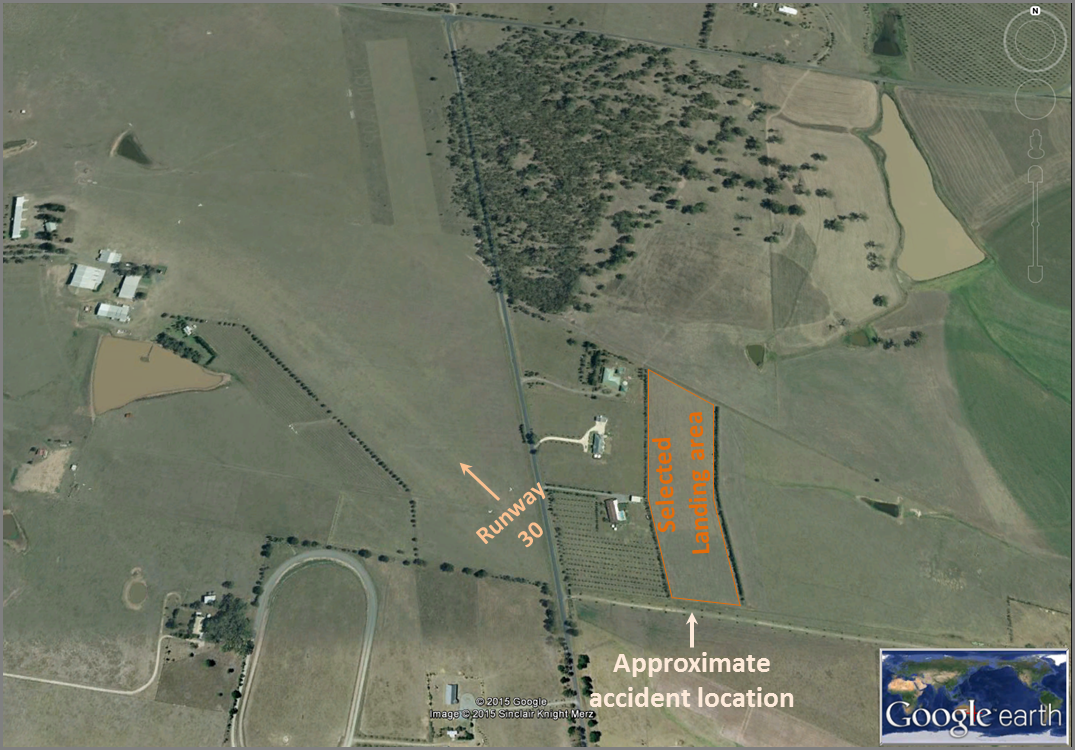
At the time, RVY was about 1 km north of Luskintyre Airfield (Figure 1), heading east at about 3,000 ft above ground level (AGL). The westerly wind was reported to be gusting at around 2030 kt. The pilot joined downwind for a landing on runway 30, noting the groundspeed was around 150-160 kt. While on downwind, the pilot advanced the throttle lever and noted that at about 1/3 lever movement the engine speed was at about 3,000 RPM (maximum continuous RPM at sea level pressure altitude is 2,700). Despite the engine speed, the aircraft was not able to maintain altitude. In an attempt to ‘get back’ to the airfield the pilot turned from a slightly extended downwind onto a ‘base leg’. As the aircraft turned, the engine stopped producing power. The pilot unsuccessfully attempted to restart the engine.
When RVY turned onto a final approach, the aircraft was still descending. At about 500 ft AGL, the pilot determined that they would not make the runway, so he elected to land in a paddock about 500 m east of the airfield (Figure 1). During this manoeuvre, the right wing stalled and dropped slightly. To recover, the pilot lowered the nose of the aircraft to gain more airspeed. The pilot reported that due to the high outside air temperature and gusting wind, the conditions were quite turbulent near the ground. The pilot flared the aircraft in preparation for landing and noted airframe buffeting, with little to no response from the elevator. The aircraft landed heavily, travelling through an electric fence before the aircraft stopped on a drive way just short of the selected landing area (Figure 1).
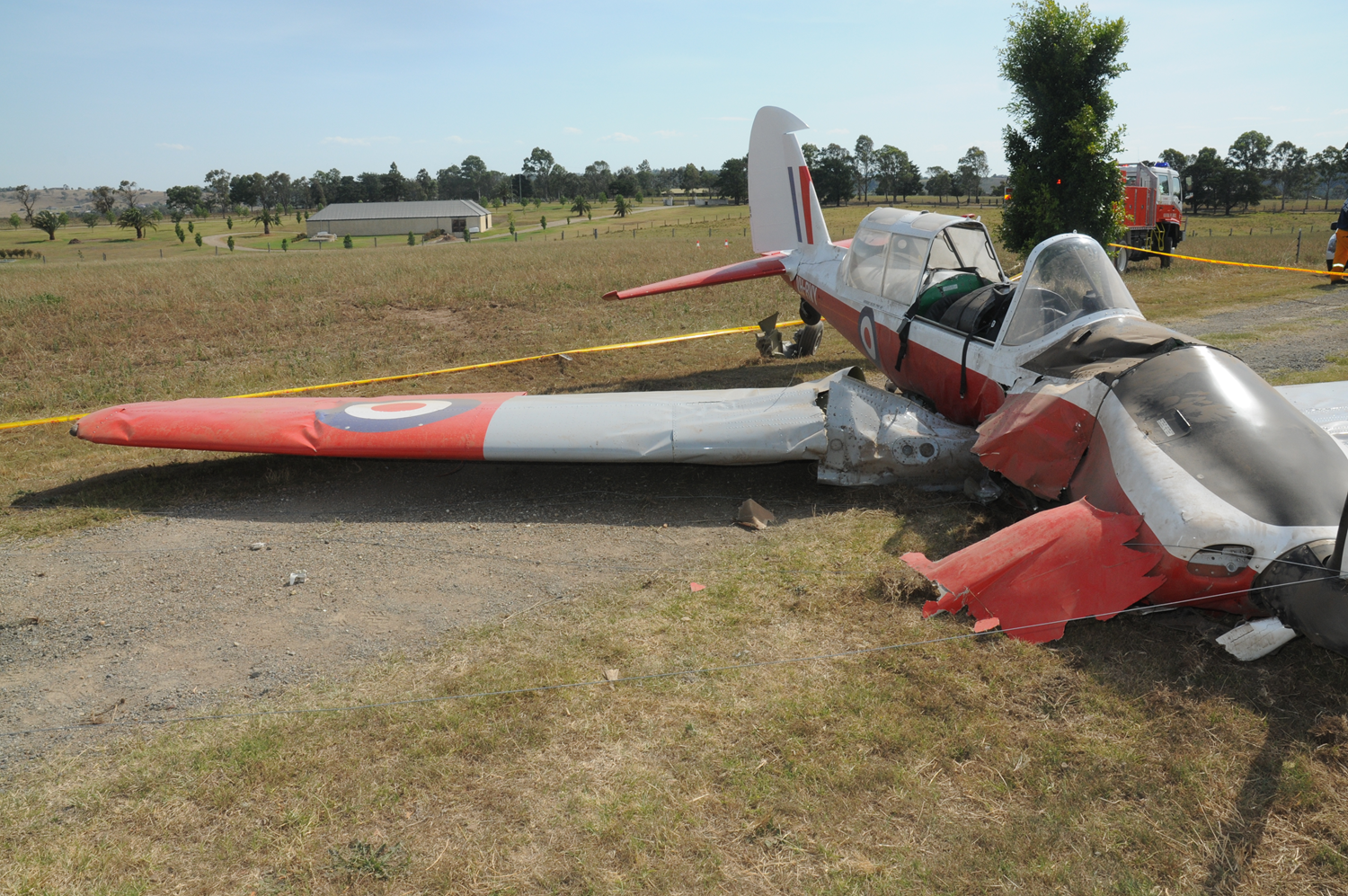
The pilot exited the aircraft quickly as the right wing fuel tank had ruptured during the landing and fuel had spilt onto the ground. The pilot tried to assist the passenger, but due to the pilot’s injuries he was unable to provide any physical assistance. After a short time, the passenger exited the aircraft. The pilot and passenger sustained serious injuries and the aircraft was substantially damaged (Figure 2).
Figure 1: Accident location
Source: Google™ earth, annotated by the ATSB
Figure 2: VH-RVY
Source: New South Wales Police Force
Aircraft information
The aircraft was manufactured in the United Kingdom in 1951 and was first registered in Australia in 1954. The aircraft had been modified by the previous owner, between 1978 to 1983, where the de Havilland Engine Company Gipsy Major engine and fixed pitch propeller instillation was replaced with a Lycoming IO-360A1B6 engine, constant speed propeller, propeller governor and an accumulator installation.
Pilot comment
The pilot worked for the maintenance organisation and had flown the aircraft after its last maintenance in 2013. The pilot indicated that at the annual maintenance inspection in 2013, small fluctuations in the selected engine RPM had been reported. Both the propeller and propeller governor were sent to be overhauled and reinstalled on the aircraft, however there continued to be slight RPM fluctuations. After the annual inspection conducted just prior to the accident, it was found that there was about a 100 engine RPM fluctuation, during gentle climbing and descending. The propeller governor and accumulator were again sent to be overhauled. The components were returned serviceable with no defects found. The pilot reported that during the overhaul some adjustments were made to the internal operating pressures of the propeller governor. The components were reinstalled on RVY and ground tested with no defects found.
The pilot believed that coming out of the modified loop manoeuvre the propeller had gone into full fine pitch, resulting in the engine entering an “overspeed” condition.
The pilot reported that apart from the strong gusty winds, the temperature was about 39°C.
Owner investigation
An investigation was conducted on behalf of the owner that found the following:
After the accident, the engine, propeller, propeller governor and accumulator were removed from the aircraft and were inspected and tested to identify any defects.
The engine was functionally tested on an engine test truck and no defects were found.
The propeller was inspected at a propeller overhaul facility and did not find any evidence of damage or failure within the propeller that would explain an uncommanded movement to fine pitch.
The propeller governor was functionally tested at an aircraft component overhaul facility and no defects were identified.
The accumulator was functionally tested at an aircraft component overhaul facility and no defects were identified. The engineering order that approved the installation of the accumulator was reported to specify an accumulator air charge pressure of about 250 PSI. The overhaul facility test equipment was only capable of testing the accumulator to about 100 PSI.
The investigation determined that there was no conclusive reason why the engine suffered an overspeed and ceased to operate. It was suggested that the overspeed may have been a result of lack of oil pressure to the propeller when the engine of RVY was inverted, during the aerobatic manoeuvre resulting in the propeller moving to fine pitch.
Safety message
Engine failure in flight
This accident is a timely reminder to pilots to consider the effect an in-flight engine failure at different altitudes and in the given conditions can have on the options available to manage that failure and to identify a suitable forced landing area. The combination of two people on board and the high temperature would have adversely affected the aircraft’s performance on the day.
pre-flight decision making and planning for emergencies and abnormal situations for the particular aerodrome including a thorough pre-flight self-brief covering the different emergency scenarios.
taking positive action and maintaining aircraft control either when turning back to the aerodrome or conducting a forced landing until on the ground, while being aware of flare energy and aircraft stall speeds.
The objective of a safety investigation is to enhance transport safety. This is done through:
identifying safety issues and facilitating safety action to address those issues
providing information about occurrences and their associated safety factors to facilitate learning within the transport industry.
It is not a function of the ATSB to apportion blame or provide a means for determining liability. At the same time, an investigation report must include factual material of sufficient weight to support the analysis and findings. At all times the ATSB endeavours to balance the use of material that could imply adverse comment with the need to properly explain what happened, and why, in a fair and unbiased manner. The ATSB does not investigate for the purpose of taking administrative, regulatory or criminal action.
Terminology
An explanation of terminology used in ATSB investigation reports is available here. This includes terms such as occurrence, contributing factor, other factor that increased risk, and safety issue.
Publishing information
Released in accordance with section 25 of the Transport Safety Investigation Act 2003
Ownership of intellectual property rights in this publication
Unless otherwise noted, copyright (and any other intellectual property rights, if any) in this report publication is owned by the Commonwealth of Australia.
Creative Commons licence
With the exception of the Coat of Arms, ATSB logo, and photos and graphics in which a third party holds copyright, this publication is licensed under a Creative Commons Attribution 3.0 Australia licence.
Creative Commons Attribution 3.0 Australia Licence is a standard form licence agreement that allows you to copy, distribute, transmit and adapt this publication provided that you attribute the work.
The ATSB’s preference is that you attribute this publication (and any material sourced from it) using the following wording: Source: Australian Transport Safety Bureau
Copyright in material obtained from other agencies, private individuals or organisations, belongs to those agencies, individuals or organisations. Where you wish to use their material, you will need to contact them directly.
The flight by Tiger Moth VH-AQN was the third in a series of 10-minute joy flights that day from the local airstrip. On board with the pilot were one adult and a 7-year-old child. Both passengers occupied the forward single seat, with the child sitting on the adult's lap. A lap type safety harness attached to the adult harness restrained the child.
The pilot reported that the engine appeared to be slightly harder to start than normal; however, once started, the engine performed normally. At about 150 ft above ground level after takeoff, and without warning, the engine began to run roughly and lose power. The pilot banked the aircraft to the right towards a nearby golf course to avoid the residential area directly ahead. He was able to manoeuvre the aircraft to land on a cleared area of the golf course. However, during the landing roll, the aircraft's left wings came into contact with a tree, which spun it sharply to the left. The aircraft then began to slide sideways and the landing gear collapsed. The aircraft continued to slide until the right wings came into contact with several other trees. After it came to rest, the pilot assisted the passengers from the aircraft. There were no injuries.
The aircraft sustained major structural damage to the upper and lower sections of the wings and the main landing gear separated from the fuselage at the upper attach points.
The aircraft was approved to operate on mogas (automotive gasoline). Examination of the aircraft fuel system indicated that sufficient clean fuel should have been available to power the engine. The engine sustained minimal damage in the accident, which allowed the investigator to conduct a test run of the engine. During the test run, the engine started without difficulty and accelerated normally.
Examination of the carburettor found that the float valve, which was made from natural cork covered with a fuel proof varnish seal, had two large blisters in the varnish. Further examination indicated that the larger of these blisters was binding against the float chamber housing walls. This could have caused either an excessively rich or lean mixture, which would have caused the engine to run rough and stop. When the spark plugs were examined immediately after the accident, they exhibited a slight oil wetness and sooting, which indicated that the power loss was probably due to an excessively rich mixture.
The float was removed and sent for specialist examination. This examination revealed that the blistered lacquer was very fragile, and that it broke easily and peeled in flakes without adhering to the cork. These characteristics were consistent with the use of a non-approved type of nitrocellulose dope, as identified in the Hobson carburettor overhauling and servicing manual. The examination was not able to conclusively determine the cause for the blistering of the varnish. The operator advised that the already varnished float, approved part number CHA31267, was purchased from the UK and was fitted to the Claudel Hobson model A148HIM carburettor approximately 160 flight hours prior to the accident. No other information was available regarding its history, or whether it was recently re-doped or re-lacquered with modern equivalent materials.
A search of the Bureau's database was unable to find any record of a similar event. During the investigation, several experienced Tiger Moth operators were contacted to ascertain their experience with this type of problem. These operators advised that they were aware of several incidents where the varnish surrounding the cork float had cracked and the cork float had then absorbed fuel. However, none had any previous experience of the varnish blistering in this manner.
Occurrence summary
Investigation number
199805459
Occurrence date
05/12/1998
Location
Palm Meadows Golf Course, 20 km north of Coolangatta Aerodrome
The pilot of the Piper Pawnee glider tug reported that soon after take-off, at about 200ft AGL the engine lost power. The pilot of the glider being towed realised there was a problem and released the tow line. The glider was able to return to the airfield for a normal landing. The Pawnee collided with the tops of trees as the pilot attempted to force land into a paddock. The aircraft subsequently landed heavily and suffered substantial damage. The aircraft was fitted with one 84 litre fuel tank in each wing.
The investigation found that the left tank was empty while the right tank was approximately three quarters full. The fuel selector was found selected to the empty left tank. The pilot advised that he had refuelled the aircraft the previous night with 55 litres of fuel. He was unable to recall whether he had put any of that fuel in the left tank. He said that he did not physically check the fuel quantities after the refuelling or during the daily inspection on the morning of the accident. He advised that he conducted the first flight of the day with the fuel selector to the right tank. He noticed during that flight that the aircraft appeared to fly right wing heavy.
For the next flight, the accident flight, the pilot changed the fuel selector to the left tank. He was unable to explain why he had selected the left tank when he knew that the right wing was heavy. He did not check the fuel quantity gauges when he changed the selection. It was reported that a fuel stain had been noted under the aircraft while it was in the hangar prior to the day's operation.
No investigation was carried out to determine if the stain was as a result of a fuel leak. The gliding club has required the pilot to undertake a flight review with an emphasis on fuel management and pre-flight inspection procedures. The club is also to require all tug pilots to undertake a session on tug operating procedures as a part of their biennial flight review.
The aircraft departed Parafield for Renmark on a private flight. He could not land at Renmark when he arrived due to low stratus cloud. He then elected to return to Parafield. En route he flew above cloud to remain in VMC. North-east of Parafield, while still on top of cloud at 3,000 ft, the pilot contacted Adelaide approach and requested navigational assistance. The controller vectored the aircraft to the vicinity of Edinburgh where the pilot was able to resume his own navigation and commenced a descent to 1,500 ft. Shortly thereafter, the pilot called 'Mayday' because the engine had failed. During the forced landing the aircraft landed heavily and crashed through a fence.
The pilot subsequently reported that before leaving Parafield, both fuel tanks had been filled to the tab. He flew with the right tank selected all the time from Parafield until the engine lost power. At no stage had he leaned the fuel mixture. Sometime during the descent from 3,000 ft the right fuel tank ran dry and the engine starved of fuel. The pilot did not realise that the engine had lost power until he tried to increase power at about 1,100 ft. He then changed the fuel selector to the left tank. He also switched on the electric fuel boost pump but the engine still did not regain power except for one quick burst while the boost pump was selected to high.
At about 200 ft AGL, he reselected the right fuel tank but the engine never regained power. After the accident engineers inspected the aircraft and reported that both the right wing tank and the right reservoir tank were empty and had not leaked fuel as a result of the accident. The left wing tank contained about 135 litres, after fuel had spilled from it due to the accident. A subsequent engine run proved that there was no fault with the engine; nor was fault found with the airframe fuel system. No evidence was found that the engine had flooded; the exhaust showed no signs of soot. It is probable that the pilot inadvertently ran the right tank dry while under stress of flying in marginal weather.
When he changed to the left tank, he probably did not persist long enough with the electric boost pump selected on for the air to be purged from the fuel lines to the engine. When the pilot reselected the right tank there was no chance that the engine could regain power.
SAFETY ACTION
After the accident, a flying operations inspector retested the pilot's knowledge of flight planning, fuel management and the Cessna 210N fuel system.
The pilot advised Flight Service (FS) that the engine had failed, and he was attempting a landing at the Mittagong airstrip. The aircraft subsequently landed approximately 2 km short of the airstrip damaging the left-wing tip and landing gear during the rollout. The pilot advised FS of the situation and that there were nil injuries. The initial maintenance investigation discovered that the crankshaft accessory drive gear positioning dowel had sheared. This in turn had ceased the drive to all the engine accessories and the camshaft, resulting in the engine stopping. The initial reason for the failure of the dowel could not be positively determined.
Subsequent to the initial investigation, a detailed failure analysis of the failed engine components was carried out. This examination revealed that a significant factor in the failure of the crankshaft gear/crankshaft attachment had been a manufacturing irregularity on the bearing surface of the head of the attaching bolt. The manufacturing irregularity resulted in a reduced clamping force, between the gear and the crankshaft, being established during assembly. The loss of the clamping force had allowed relative movement between the gear and the crankshaft mounted gear positioning dowel. This eventually led to the fatigue failure of the dowel and the loss of integrity of the accessory gear drive assembly.