Flight control systems

Flight control system failure, Vulcanair P.68C, near Brisbane, Queensland, on 11 April 2021

Brief

Occurrence Briefs are concise reports that detail the facts surrounding a transport safety occurrence, as received in the initial notification and any follow-up enquiries. They provide an opportunity to share safety messages in the absence of an investigation.

What happened

On 11 April 2021, a flight examiner conducted an instrument proficiency check with a commercial pilot in a Vulcanair [1] P.68C aircraft, at an airport near Brisbane, Queensland. At 1000 Eastern Standard Time,[2] as the aircraft was taxied to the apron after the flight, the pilot had difficulty controlling the aircraft’s direction and advised that the rudder seemed jammed.

A post-flight inspection revealed that the top rudder hinge had failed (Figure 1).

Figure 1: Rudder with failed hinge, inset shows failed hinge

Rudder with failed hinge, inset shows failed hinge

Source: Aircraft operator 

Maintenance

The aircraft was being maintained in accordance with the Civil Aviation Safety Authority (CASA) maintenance schedule, which required that a periodic inspection be completed every 100 hours or 12 months, whichever came first. The last inspection had been conducted 26 flight hours prior to the occurrence.

The CASA maintenance schedule was detailed in Civil Aviation Advisory Publication (CAAP) 42B-1(1.1). This CAAP required that the flight control surfaces, including the hinge brackets, be inspected for ‘general condition’. It specified that inspection aids such as work stands, mirrors and torches should be used and that ‘surface cleaning of individual components may also be required’. Paragraph 6.7 specified that the procedures ‘prepared by the aeroplane manufacturer are to be used when performing an inspection required by this schedule’.

In 2015, Vulcanair released Service letter 23 revision 1[3] which has since been incorporated into the P.68C maintenance program. The service letter was an alert to all P.68C owners and operators, providing detailed instructions on how to inspect the hinges. In accordance with the manufacturer’s approved maintenance procedures, the inspection was to be completed every 200 flight hours or 1 year, whichever came first. As the Civil Aviation Safety Authority had not issued an airworthiness directive containing the information in Service letter 23, the service letter was not mandatory. The inspection detailed by Service letter 23 had not been completed on this aircraft.

Safety action

CASA’s Continued Operational Safety and Standards section has contacted the European Union Aviation Safety Authority (EASA) small aircraft section and advised them of the incident and two other defects of a similar nature.

The operator’s maintenance repair and overhaul company has submitted the service letter feedback to the aircraft type certificate holder.

CASA is progressing the project to reform the continuing airworthiness and maintenance regulations. This work is being managed under project SS05/01 and status updates are available on the CASA website. The proposed policies include significant improvements to the current regulations, including the rules involving the CASA maintenance schedule. Subject to priorities in CASA’s wider regulatory program, CASA anticipates making the new regulations in 2022.

The ATSB was informed that on the 21 October 2021, EASA released a Notification of a proposal to issue an airworthiness directive (PAD) 21-158: Stabilisers – Rudder hinges – inspection. This AD proposes to make an inspection of the upper rudder hinge mandatory, in accordance with Service letter 23, revision 2, dated 29 September 2021 and the associated aircraft maintenance manual.

Consultation on the PAD closed on 18 November 2021.

Safety message

The CASA maintenance schedule was intended for those aircraft listed in Civil Aviation Order 100.5 as having inadequate maintenance schedules. Although no Vulcanair aircraft were on that list, nothing precluded the aircraft being maintained in accordance with the schedule. For operators who maintain aircraft in accordance with the maintenance schedule, CASA’s Maintenance guide for owners/operators stated that:

Under [Civil Aviation Regulation] CAR 42V (1), because all maintenance is required to be carried out in accordance with the applicable approved data, you must still consult with the manufacturer’s maintenance manuals for the airframe, engine and propeller, as well as applicable literature such as service bulletins, for instructions on how to carry out inspections and corrective maintenance action.  

A manufacturer may issue service information, such as a service letter, to advise operators about a problem and introduce or clarify an inspection, procedure or new part to prevent the problem recurring.

In 2011, the ATSB investigated a similar occurrence,

, where the aircraft’s two horizontal stabiliser rear attachment brackets failed. During this investigation, the ATSB found that the:

Australian Civil Aviation Regulations 1988 (CAR) were being misinterpreted by some class B aircraft registration holders, to the extent that they believed that their aircraft was exempt from the manufacturer’s supplemental inspections when their aircraft was maintained using the CASA maintenance schedule. While the CASA maintenance schedule did not make any specific reference to the incorporation of the manufacturer’s supplemental inspections, it was a CAR requirement that all aircraft be maintained in accordance with approved maintenance data that, by definition, included those inspections.

About this report

Decisions regarding whether to conduct an investigation, and the scope of an investigation, are based on many factors, including the level of safety benefit likely to be obtained from an investigation. For this occurrence, no investigation has been conducted and the ATSB did not verify the accuracy of the information. A brief description has been written using information supplied in the notification and any follow-up information in order to produce a short summary report, and allow for greater industry awareness of potential safety issues and possible safety actions.

__________

  1. Formerly Partenavia Costruzioni Aeronautics S.p.A. 
  2. Eastern Standard Time (EST): Coordinated Universal Time (UTC) + 10 hours.
  3. The original service letter was released on 1 December 2010.

Occurrence summary

Mode of transport Aviation
Occurrence ID AB-2021-013
Occurrence date 11/04/2021
Location near Brisbane
State Queensland
Occurrence class Incident
Aviation occurrence category Flight control systems
Brief release date 20/05/2021

Aircraft details

Sector Piston
Operation type Flying Training
Departure point near Brisbane, Queensland
Destination near Brisbane, Queensland
Damage Minor

Flight controls involving a Diamond DA 40, Dubbo Airport, New South Wales, on 12 September 2019

Brief

Occurrence Briefs are concise reports that detail the facts surrounding a transport safety occurrence, as received in the initial notification and any follow-up enquiries. They provide an opportunity to share safety messages in the absence of an investigation.

What happened

On 12 September 2019, a Diamond DA 40 departed Bankstown, New South Wales (NSW) for a solo navigation training flight with a student pilot on board.

During approach into Dubbo, NSW at about 500 ft AGL, the pilot extended full flap to prepare the aircraft for landing. Once full flap had been extended, the pilot noticed that he was unable to move the control stick to the left and as a result, the aircraft was unable to roll to the left. He immediately retracted the flaps to the take-off position, regained aileron authority and landed without further incident.

Engineering Inspection

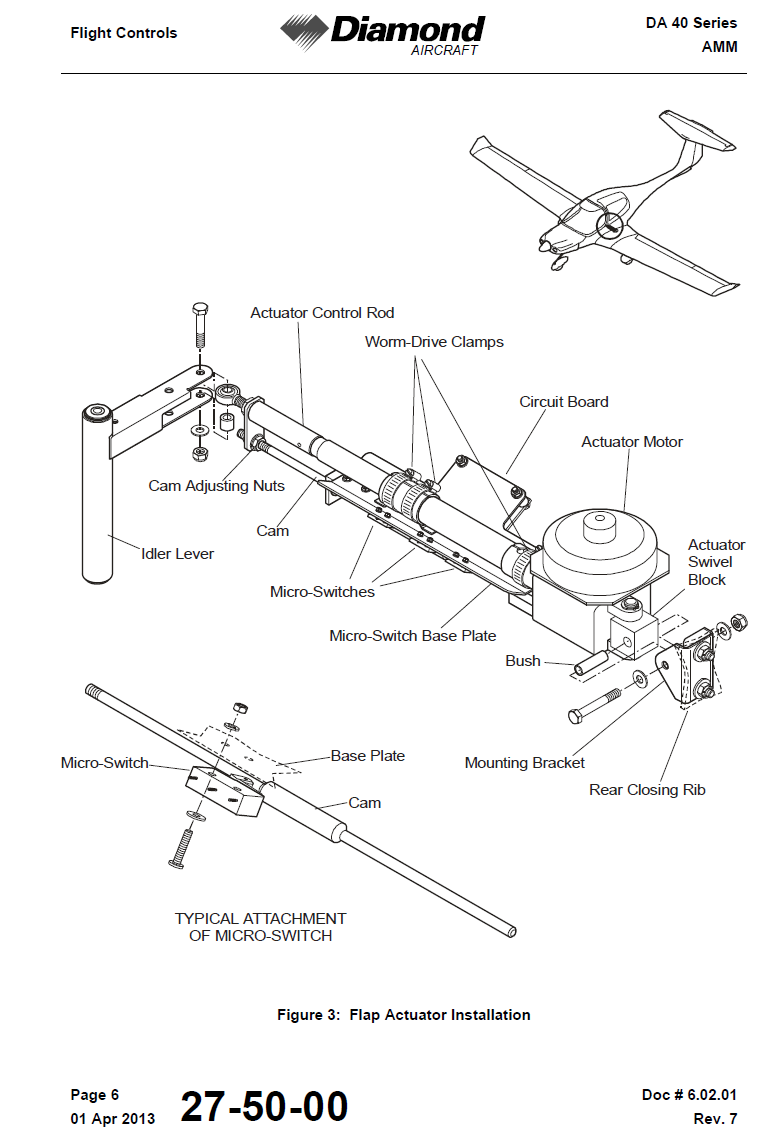
Following the incident, the engineering inspection revealed that a spacer under the flap actuator control rod (Figure 1) was incorrectly re-installed above the flap actuator rod during a routine 200-hourly maintenance inspection.

During the inspection, the bolt attaching the idler arm to the actuator control rod was removed to allow for a bonding cable to be repaired. The flap system was inadvertently activated, resulting in the idler arm and the actuator control rod separating. When this was re-assembled, the spacer was incorrectly positioned on top of the actuator control rod. As a result, the bottom of the flap control rod was displaced downwards by the incorrectly placed spacer causing the cam to catch on the underlying aileron control rod when the flap was extended to the fully deflected landing position. Consequently, the control stick was unable to be moved left of the central position when the flaps were fully deflected.

Although a post-maintenance check flight was conducted before the incident flight, the problem was not detected. The manufacturer’s aircraft flight manual does not require a check of the flight controls in the landing position prior to take-off or during the check flight. Company standard operating procedures called for the extension of landing flap once established on final approach, but as the weather conditions were smooth, the flaps were not extended fully and therefore the fault was not detected.

The manufacturer’s post-maintenance check flight checklist also did not require a check of the flight controls with flap fully extended. 

Figure 1: Flap actuator installation

Flap actuator installation

Source: Diamond DA 40 Aircraft Maintenance Manual

Safety action

As a result of this incident, the training organisation has advised the ATSB that they have taken the following safety action:

  • Pre-flight checklists for all DA 40 flights have been updated to include an item to check that flight controls are full, free and functioning correctly at all flap positions.

Safety message

This incident highlights the importance of maintenance procedures and post-maintenance checks being carried out comprehensively and systematically. While the aircraft is in maintenance, all components must be refitted and reinstalled in accordance with the aircraft’s maintenance manual. Once tasks are completed, it is vital to verify the functionality of all critical aircraft components before returning it to service.

About this report

Decisions regarding whether to conduct an investigation, and the scope of an investigation, are based on many factors, including the level of safety benefit likely to be obtained from an investigation. For this occurrence, no investigation has been conducted and the ATSB did not verify the accuracy of the information. A brief description has been written using information supplied in the notification and any follow-up information in order to produce a short summary report, and allow for greater industry awareness of potential safety issues and possible safety actions.

Occurrence summary

Mode of transport Aviation
Occurrence ID AB-2019-034
Occurrence date 12/09/2019
Location Dubbo Airport, New South Wales
State New South Wales
Occurrence class Serious Incident
Aviation occurrence category Flight control systems
Highest injury level None
Brief release date 22/10/2019

Aircraft details

Manufacturer Diamond Aircraft Industries
Model DA 40
Sector Piston
Operation type Flying Training
Damage Nil

Flap failure involving Cessna U206, Dimbulah, Queensland, on 6 March 2018

Brief

Occurrence Briefs are concise reports that detail the facts surrounding a transport safety occurrence, as received in the initial notification and any follow-up enquiries. They provide an opportunity to share safety messages in the absence of an investigation.

What happened

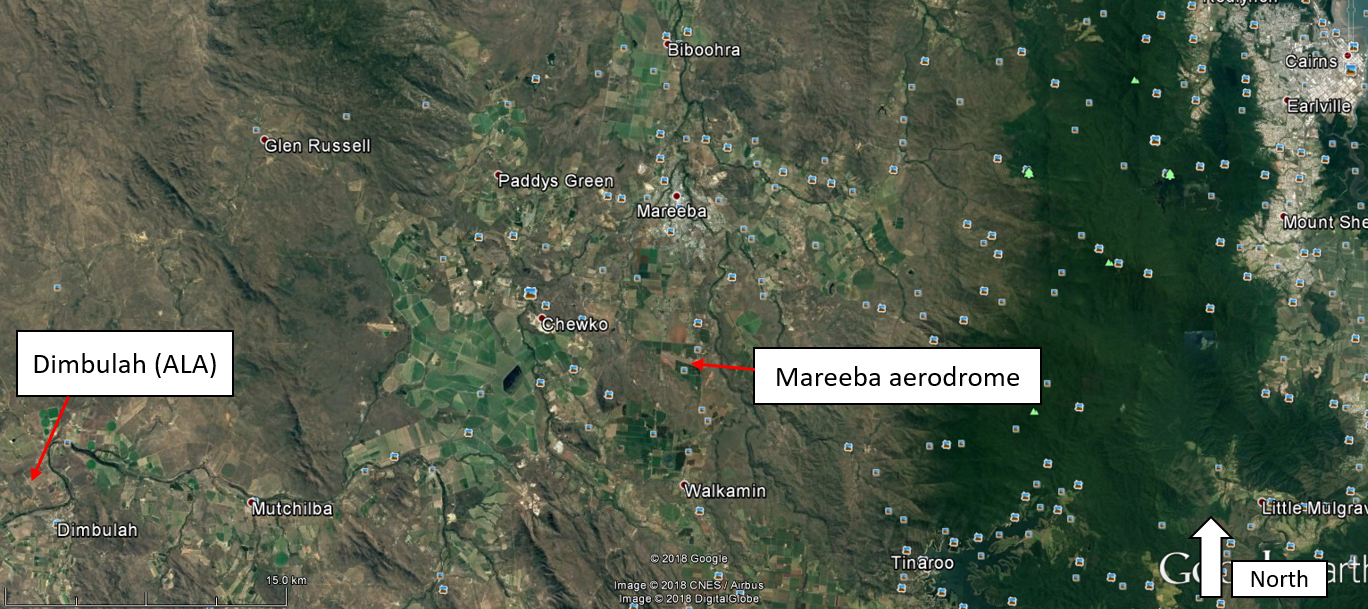
On 6 March 2018, a Cessna 206 was being operated on a training flight from Mareeba, Queensland (Qld) to Dimbulah, Qld (Figure 1) with a student and instructor on board.

Figure 1: Map showing locality

ariel view of terrain with labels

Source Google Earth, annotated by ATSB

At about 1045 Eastern Standard Time, as the aircraft was on approach to Dimbulah, with flaps selected to 20 degrees and at 80 knots, the flight crew heard a loud clunk. The flight crew thought that they may have struck a bird and discontinued the approach. They commenced climbing and found that they required significant right aileron to remain tracking straight. Once at a safe altitude, the crew raised the flaps in stages.

The crew diverted the aircraft to Mareeba to conduct a flapless straight-in approach. As the aircraft slowed during the landing roll, the flaps extended towards 20 degrees.

The operator inspected the aircraft and found several issues, including:

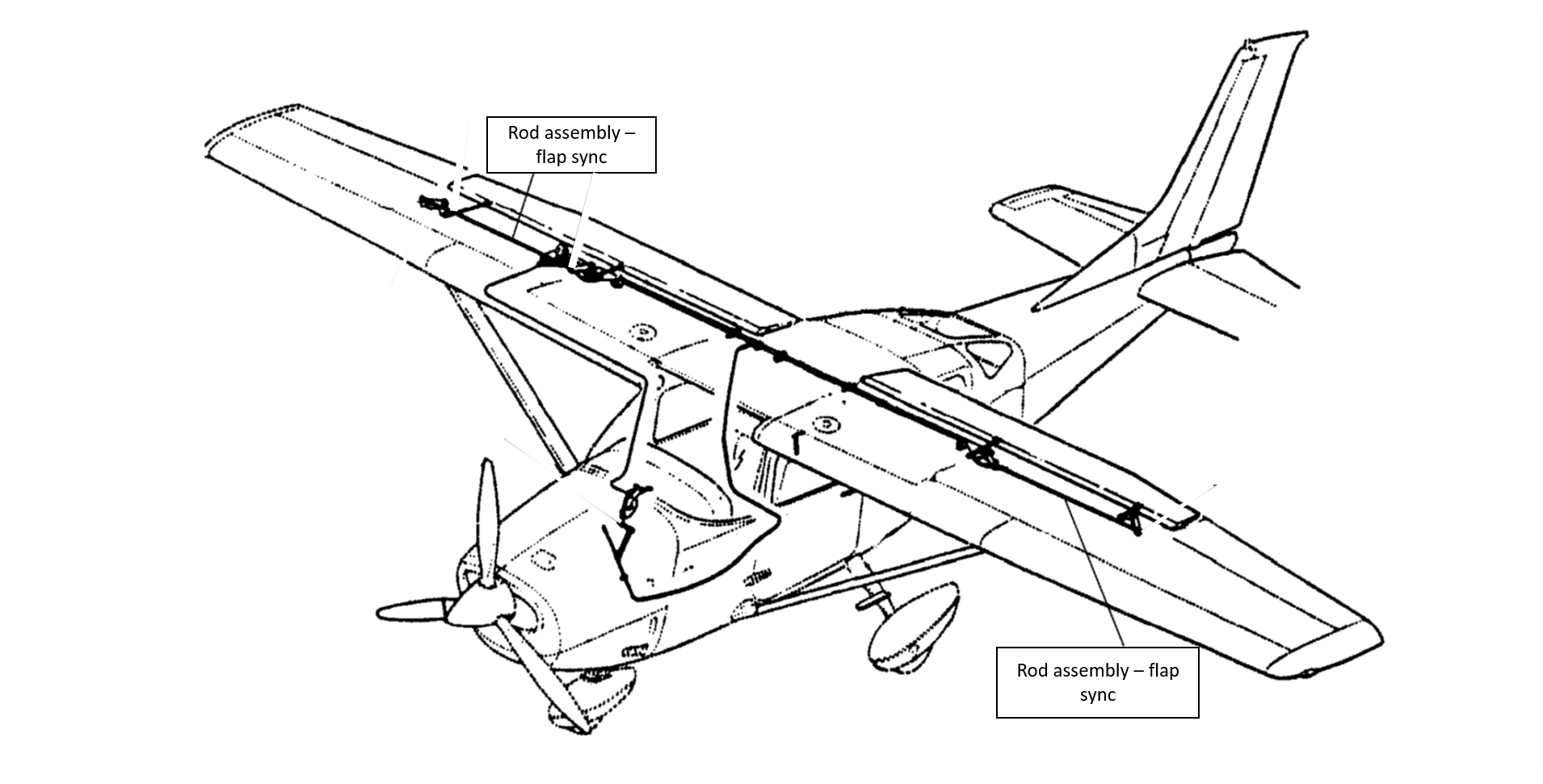
  • failure of the synchronising rod at the rod-end
  • disconnection of the transmission worm drive between the actuating tube and the collar
  • damage to the preselect cable clamp
  • damage to the right flap track
  • failure of the right centre aft roller. 

Figure 2: Diagram showing position of synchronizing rod assembly on aircraft

Black and white illustration of an aircraft with two labels

Source Cessna Illustrated Parts Catalog

The operator replaced the damaged parts. The operator then carried out a return to service flight. The flaps system cable tension was found to be low. Maintenance subsequently readjusted the cable tension.

Safety message

This incident highlights the importance of conducting a go-around if something unexpected occurs during an approach to land. The flight crew immediately conducted a go-around, which allowed them time to consider the implications of the technical failure and the opportunity to conduct a diversion to an airport where appropriate emergency response facilities were available if required.

About this report

Decisions regarding whether to conduct an investigation, and the scope of an investigation, are based on many factors, including the level of safety benefit likely to be obtained from an investigation. For this occurrence, no investigation has been conducted and the ATSB did not verify the accuracy of the information. A brief description has been written using information supplied in the notification and any follow-up information in order to produce a short summary report, and allow for greater industry awareness of potential safety issues and possible safety actions.

Occurrence summary

Mode of transport Aviation
Occurrence ID AB-2018-032
Occurrence date 06/03/2018
Location Dimbulah
State Queensland
Occurrence class Incident
Aviation occurrence category Flight control systems
Highest injury level None
Brief release date 06/07/2018

Aircraft details

Manufacturer Cessna Aircraft Company
Model U206
Sector Piston
Operation type Flying Training
Damage Minor