Flight control systems

Flap cable failure and ground strike involving Airparts NZ FU-24, VH-TTD, 50 km east-south-east of Tamworth Airport, New South Wales, on 26 June 2016

Final report

What happened

On 27 June 2016, the pilot of an Airparts (NZ) FU-24-950 aircraft, registered VH-TTD, was conducting agricultural operations from an airstrip about 50 km east-south-east of Tamworth Airport, New South Wales. The pilot was the only person on board the aircraft.

The airstrip elevation was about 3,200 ft and sloped downhill in the direction used for take‑off, with a steep slope at the end of the runway. The surrounding terrain was below the elevation of the airstrip and the first obstacle in the take-off direction was a fence at the end of the runway.

At about 1130 Eastern Standard Time (EST), after having completed about 35 flights for that morning, the pilot started their next take-off run with the flaps[1] in the normal take-off setting of 20°. The aircraft handled normally until shortly after lift-off, when at an airspeed of about 60 kt, the pilot heard a ‘bang’. The aircraft sank rapidly and the tail struck the runway surface. As the runway sloped steeply downhill, the aircraft became airborne again. Due to the proximity of the fence at the end of the runway, the pilot elected to continue the take-off and dump the fertiliser load. As the load was being dumped, the aircraft struck the fence, but continued to fly.

The pilot quickly detected that there was no response from the elevator[2] to their control inputs. They could move the control column fore and aft, but the aircraft pitch[3] did not respond. They also observed that the flap was fully retracted even though the cockpit flap lever was still set to 20°. The pilot elected to divert to Tamworth Airport, which was below the elevation of the airstrip. The pilot used engine power and elevator trim[4] to control the pitch of the aircraft.

The pilot contacted Tamworth air traffic control (ATC) and informed them that they had a ‘bit of an issue’. They also advised that they had no elevator control, but still had the aircraft under control (Figure 1). ATC cleared the pilot to manoeuvre as required to approach and land on the main runway at Tamworth.

The pilot conducted a long and low straight-in approach to runway 12 left at Tamworth with the aircraft trimmed in the approach attitude, which was slightly nose up. At about 10 ft above the runway, the pilot reduced the throttle to idle for the landing. The aircraft then pitched nose down and the nose wheel contacted the runway first and burst the nose wheel tyre. The aircraft stopped on the runway with minor damage and the pilot was not injured.

Figure 1: VH-TTD flying towards Tamworth Airport on the incident flight
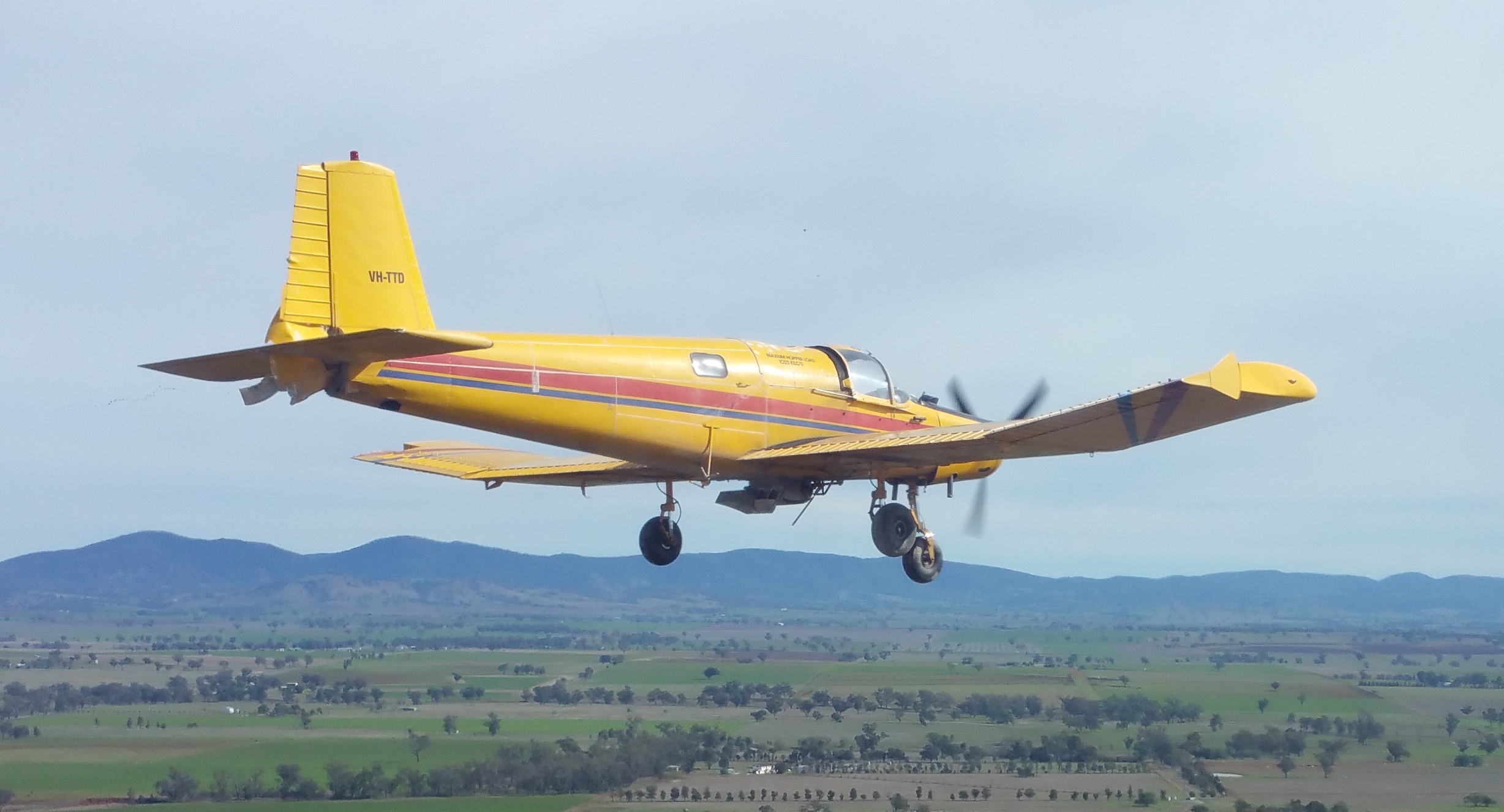
Figure 1: VH-TTD flying towards Tamworth Airport on the incident flight

Source: BAE Systems Flight Training Tamworth

Repair organisation findings

The repair organisation that performed the post-incident inspection found damage to the propeller, tailplane and underside of aircraft consistent with impact with the runway and fence during the take-off. A detailed inspection inside the airframe revealed the following:

  • The structural frame supporting the lower elevator control cable pulley was pushed up about 10 cm (Figure 2).
  • The centre section just aft of the hopper (Figure 3) had about 12 mm of water in it and the drain hole for the centre section was blocked by fertiliser. The repair organisation assessed that the size of the drain hole was inadequate and that a larger hole with a removable bung would be preferable.
  • The flap control cable had failed at the rear flap pulley and the failure appeared to be due to corrosion (Figure 4).

Figure 2: VH-TTD elevator control cable pulley
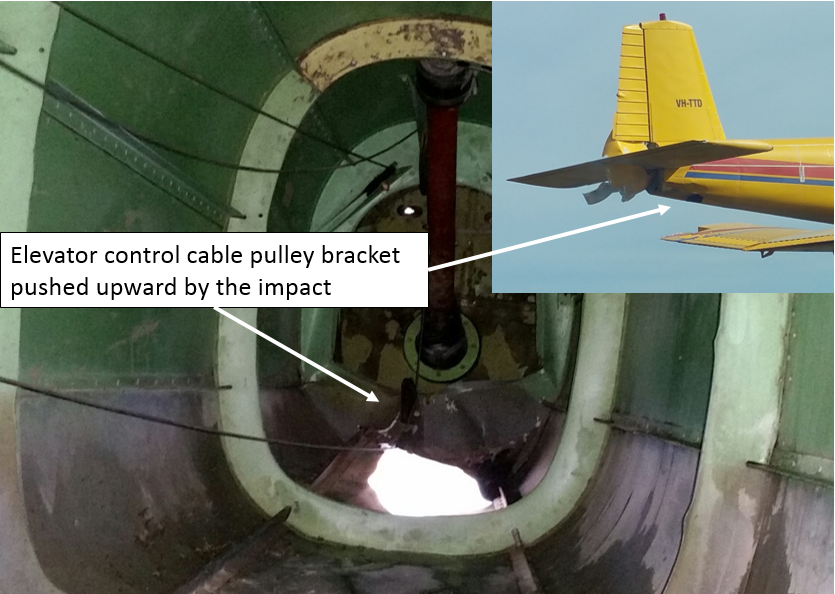
Figure 2: VH-TTD elevator control cable pulley

Source: Repair organisation and BAE Systems Flight Training Tamworth annotated by ATSB

Figure 3: VH-TTD centre section
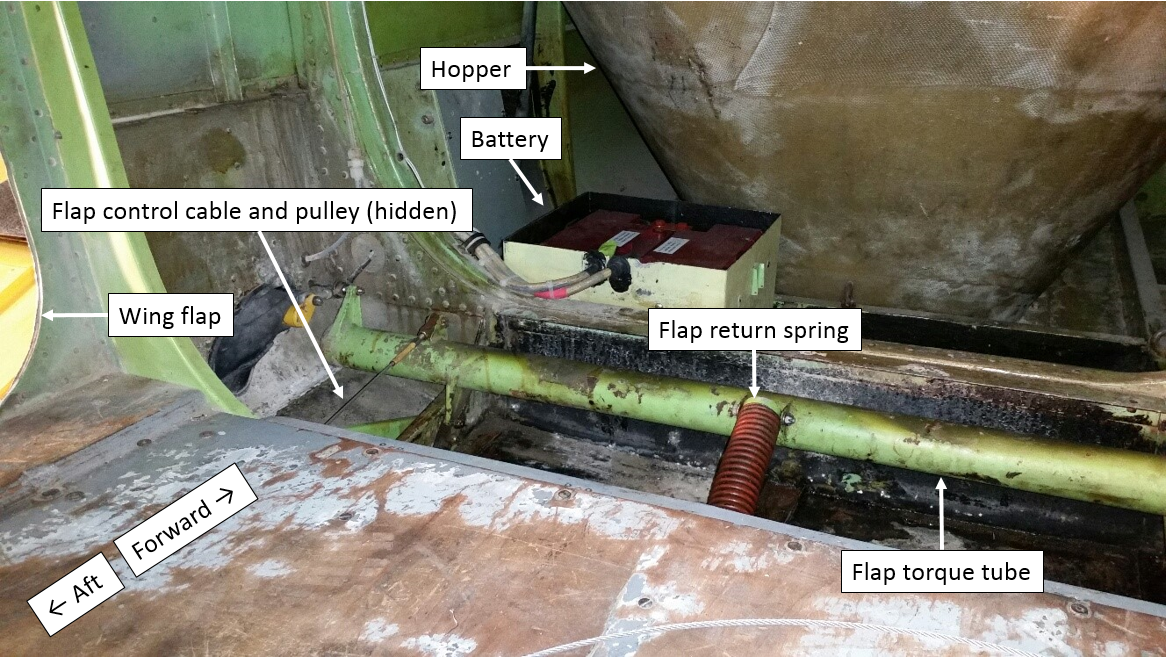
Figure 3: VH-TTD centre section

Source: Repair organisation annotated by ATSB

Figure 4: VH-TTD broken flap cable
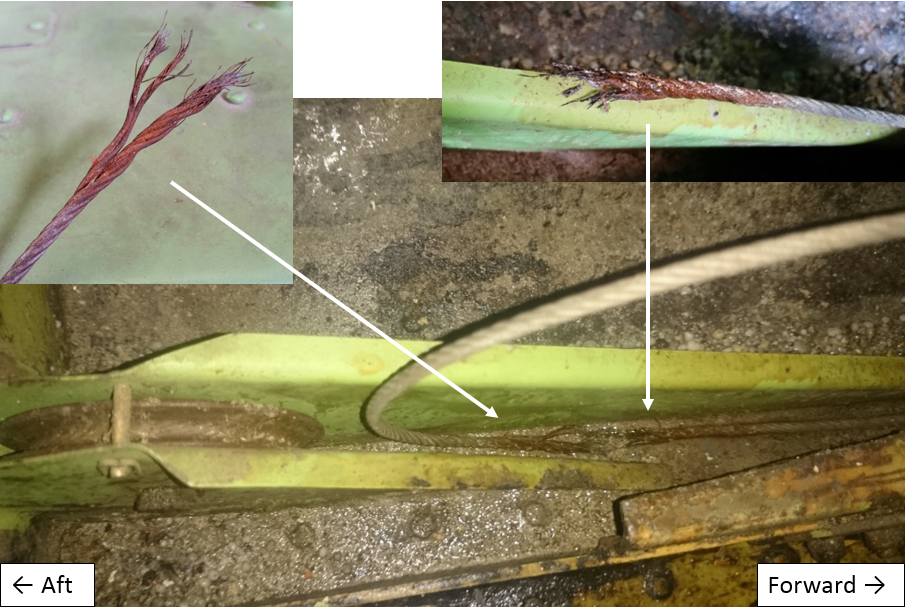
Figure 4: VH-TTD broken flap cable

Source: Repair organisation annotated by ATSB

Maintenance schedule

The aircraft system of maintenance used was the Civil Aviation Safety Authority (CASA) Schedule 5 with 100-hourly periodic inspections. CASA Schedule 5 includes the following inspections relevant to this incident:

  • Item 3 (j) for the airframe periodic inspection: ‘inspect the control wheels, control columns, rudder pedals, control levers, control system bellcranks, push pull rods, torque tubes and cables.’
  • Item 17 for the daily inspection: ‘check that the drain holes are free from obstruction.’[5]

Previous maintenance inspections

The last 100-hourly periodic inspection was certified on 19 May 2016 in accordance with CASA Schedule 5. The previous periodic inspection was on 21 April 2016, and a corrosion inspection was performed on 23 November 2015, which included CASA Airworthiness Directive

. No findings were recorded against the flap control cable for these inspections. During the periodic inspections, the flap cable was inspected by moving a cloth along the cable and no broken strands were detected, and there was no water present in the centre section of the aircraft aft of the hopper. However, the maintenance organisation indicated that they did not remove the flap cable for inspection, nor apply corrosion protection to the flap cable during the inspections.

Recommended practices

CASA Airworthiness Bulletin 27-001 issue 7 includes the following recommendation:

…flight control cables should be periodically inspected in accordance with manufacturer’s data and FAA AC 43-13-1B Chapter 7, AIRCRAFT HARDWARE, CONTROL CABLES AND TURNBUCKLES, section 8, paragraph 7.149d. To inspect all surfaces of a cable throughout its entire length for wear and fatigue (broken wires) usually requires that the cable be disconnected and removed...

United States Federal Aviation Administration Advisory Circular 43-13-1B chapter 7, section 8, paragraph 7.149 states that: ‘deterioration, such as corrosion, is not easily seen, therefore, control cables should be removed periodically for a more detailed inspection and any cable with a broken strand in a critical fatigue area[6] must be replaced.’ See Figure 5 below.

  • Paragraph 7.149i states that: ‘Areas especially conducive to cable corrosion are battery compartments…etc.; where a concentration of corrosive fumes, vapours, and liquids can accumulate.’
  • Paragraph 7.152 states that where control cables pass over pulleys: ‘Provide corrosion protection for these cable sections by lubricating with a light coat of grease or general purpose, low-temperature oil.’

Figure 5: Cable inspection technique
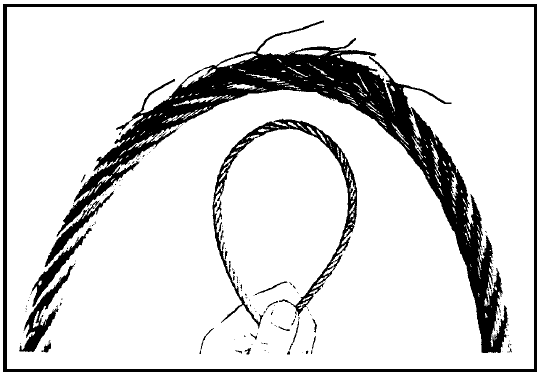
Figure 5: Cable inspection technique

Source: FAA AC 43.13-1B page 7-35

ATSB comment

The ATSB notes that the corrosion present on the flap control cable at the location of the failure takes a considerable amount of time to develop. The corrosion was confined to the working length of the cable that was in contact with the flap control system rear pulley, which is considered to be a critical fatigue area. The failed cable was comprised of woven steel wires plated with zinc or tin. The cable was confirmed to be the correct type for the application.

Over time, in the absence of a suitable lubricant, the plating can wear due to frictional contact with the pulley. This will render the cable susceptible to corrosive attack and elevate the likelihood of a fatigue failure. The flap control cable was not removed during the last periodic inspection, which could have detected the corrosion damage. Nor was grease applied to the working length of the cable, or the rear flap pulley, during the last few inspections to mitigate against the development of corrosion.

Entrapped water, fertiliser and potentially, the previous use of an unsealed lead-acid battery,[7] all contributed to a corrosive environment within the centre section of the aircraft, and corrosion of the flap cable.

Safety action

Whether or not the ATSB identifies safety issues in the course of an investigation, relevant organisations may proactively initiate safety action in order to reduce their safety risk. The ATSB has been advised of the following proactive safety action in response to this occurrence.

Maintenance organisation

As a result of this occurrence, the maintenance organisation has advised the ATSB that they are taking the following safety actions:

Maintenance practices

The FU-24 rear flap control system pulley will be removed during CASA Schedule 5 periodic inspections to facilitate inspection of the flap control cable.

Safety message

This incident highlights the need for maintenance organisations to periodically review the recommended practices published by both the manufacturer and the regulatory authorities. The Schedule 5 system of maintenance details what inspections are required, but does not prescribe how they should be performed. Reference to the relevant industry standard practices can improve the quality of maintenance conducted and ensure an organisation’s practices remain up-to-date with the respective standards, which are periodically updated to incorporate new knowledge.

For further background information on flight control cables and terminals and their failure modes, refer to CASA

(AD/General/87).

Aviation Short Investigations Bulletin - Issue 53

Purpose of safety investigations

The objective of a safety investigation is to enhance transport safety. This is done through:

  • identifying safety issues and facilitating safety action to address those issues
  • providing information about occurrences and their associated safety factors to facilitate learning within the transport industry.

It is not a function of the ATSB to apportion blame or provide a means for determining liability. At the same time, an investigation report must include factual material of sufficient weight to support the analysis and findings. At all times the ATSB endeavours to balance the use of material that could imply adverse comment with the need to properly explain what happened, and why, in a fair and unbiased manner. The ATSB does not investigate for the purpose of taking administrative, regulatory or criminal action.

Terminology

An explanation of terminology used in ATSB investigation reports is available here. This includes terms such as occurrence, contributing factor, other factor that increased risk, and safety issue.

Publishing information 

Released in accordance with section 25 of the Transport Safety Investigation Act 2003

Published by: Australian Transport Safety Bureau

© Commonwealth of Australia 2016

image_5.png

Ownership of intellectual property rights in this publication

Unless otherwise noted, copyright (and any other intellectual property rights, if any) in this report publication is owned by the Commonwealth of Australia.

Creative Commons licence

With the exception of the Coat of Arms, ATSB logo, and photos and graphics in which a third party holds copyright, this publication is licensed under a Creative Commons Attribution 3.0 Australia licence.

Creative Commons Attribution 3.0 Australia Licence is a standard form licence agreement that allows you to copy, distribute, transmit and adapt this publication provided that you attribute the work.

The ATSB’s preference is that you attribute this publication (and any material sourced from it) using the following wording: Source: Australian Transport Safety Bureau

Copyright in material obtained from other agencies, private individuals or organisations, belongs to those agencies, individuals or organisations. Where you wish to use their material, you will need to contact them directly.

__________

  1. Movable surface forming part of trailing edge of wing, able to hinge downwards to alter wing camber to exert a powerful effect on low speed lift and drag.
  2. Movable control surface for governing aircraft in pitch.
  3. The term used to describe motion of an aircraft about its lateral (wingtip-to-wingtip) axis.
  4. The elevator trim tab is a small hinged portion of the trailing edge of elevator control surface whose setting relative to the elevator surface is set by the pilot and whose effect is to hold the elevator in the desired position for trimmed flight.
  5. The pilot indicated that they did not believe there were any drain holes in this section of the aircraft.
  6. A critical fatigue area includes the working length of a cable where the cable runs over, under, or around a pulley.
  7. VH-TTD was previously fitted with an unsealed battery, which can vent corrosive fumes. A sealed battery was installed at the last periodic inspection.

Occurrence summary

Investigation number AO-2016-067
Occurrence date 26/06/2016
Location 50 km ESE of Tamworth Airport
State New South Wales
Report release date 14/10/2016
Report status Final
Investigation level Short
Investigation type Occurrence Investigation
Investigation status Completed
Mode of transport Aviation
Aviation occurrence category Flight control systems
Occurrence class Serious Incident
Highest injury level None

Aircraft details

Manufacturer Airparts NZ Ltd
Model FU-24-950
Registration VH-TTD
Serial number 186
Sector Piston
Operation type Aerial Work
Damage Minor

Flap system failure leading to loss of control, involving Cessna 208, VH-WZJ, Townsville Airport, Queensland, on 10 November 2015

Final Report

What happened

On 10 November 2015, at 1200 Eastern Standard Time (EST), a Cessna 208B aircraft, operated as regular public transport Flight 525 by West Wing Aviation, departed Palm Island Airport for Townsville Airport, Queensland. On board were the pilot and eight passengers.

At about 1250 pm, as the aircraft neared Townsville in instrument meteorological conditions (IMC)[1], air traffic control (ATC) issued the pilot with a runway 07 area navigation (RNAV) instrument approach. The pilot configured the aircraft, and commenced the instrument approach. The pilot reported that approaching the final approach fix,[2] the aircraft was configured with the second stage (20°) of flap, and a power setting of about 1200 ft/lb of torque, resulting in an airspeed of about 125 kt.

Shortly after, at about 1,000 ft above ground level (AGL), the pilot broke visual,[3] and selected the third stage of flap (30°) in preparation for landing. However, this selection of flap resulted in a ‘muffled bang’ from outside the aircraft, which the pilot described as sounding like a tyre blow out. The pilot also reported that the aircraft banked ‘violently’ and steeply to the left.

The pilot immediately attempted to reduce the steep angle of bank and regain control by applying opposite (right) aileron. However, the aircraft continued to roll left, with the subsequent secondary aerodynamic effect of yaw to the left.[4] Descending through about 700 ft, and with the aircraft now travelling at about a 45° angle left of the extended runway centreline and still not responding, the pilot applied full opposite rudder. There was some response from the aircraft to this control input, but the pilot reported it was still not ‘under control’.

The pilot immediately retracted the flaps from 30° to 20°, which resulted in them being able to reduce the angle of bank and regain partial control. The pilot alerted ATC that assistance on the ground might be required after landing.

During this sequence of events, the aircraft had travelled so far off course that the pilot was unable to see the runway even though the aircraft remained in visual conditions. The pilot was able to manoeuvre the aircraft onto an oblique approach and land without further incident. Emergency services followed the aircraft as it was taxied clear of the runway to parking. There were no injuries to those on board, and no damage to the aircraft.

Pre-flight and pre-take-off checks

The pilot reported conducting a thorough daily inspection prior to the first flight of the day. This included fully extending the flaps to check all the eyelets, rods and flap travel. During the pre-take-off checks, the pilot also individually checked each stage of flap to check for correct operation. There were no abnormalities.

Initial post-incident inspection

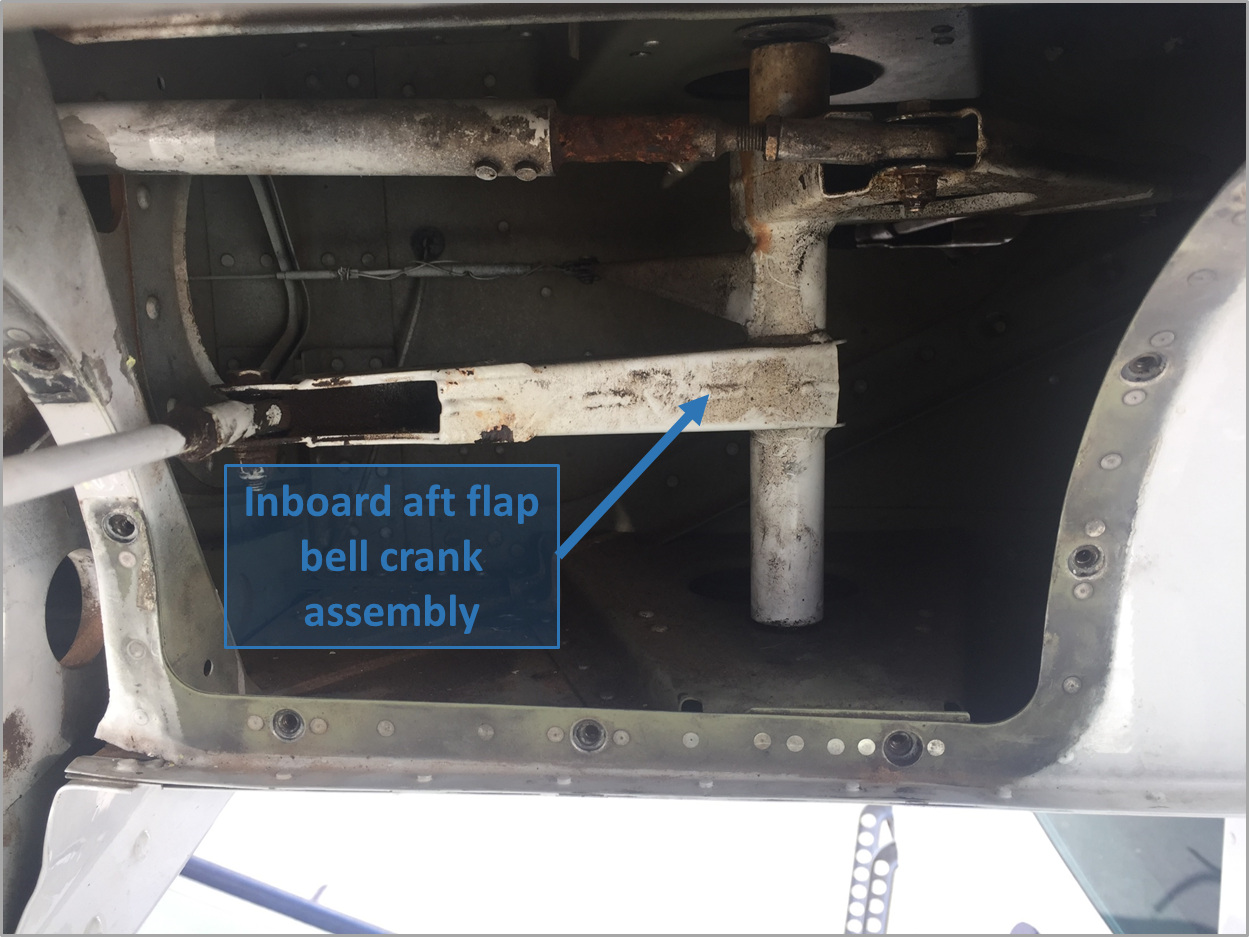
During the taxi to parking, the pilot fully retracted the flaps. With the flaps flush against the trailing edge of the wing, initially, neither the pilot nor the aircraft maintenance engineer could pinpoint the reason for the control issue. However, when the engineer gave the left flap a shake, it fell freely down, unattached on the inboard side. After removing some wing access panels, the engineering inspection discovered a loose flap bell crank retaining bolt.

The Cessna 208B Flap System

The operator provided the following information (modified by the ATSB).

The Cessna 208B flap system is comprised of both mechanical and electrical components. The cockpit flap control selection lever, operated by the pilot, provides input to the flap switch actuator, which controls the primary flap motor. Allowing the pilot to select any flap position between 0 and 30 degrees, with detents at UP, 10, 20 and FULL down settings. The flap actuator assembly drives a bell crank, through a series of pushrods, connecting rods, interconnecting rods, and other bell cranks.

In the event that the primary flap system fails, there is an independent standby switch and motor.

Figure 1: VH-WZJ inboard aft flap bell crank assembly

rid21-picture-5.png

Source: Operator, modified by the ATSB

Operator report

The operator conducted both a ‘hard / overweight landing’ inspection and a ‘severe air turbulence or severe manoeuvres’ inspection after the incident. The operator also sought maintenance guidance from the aircraft manufacturer.

The operator advised that a flap bolt had come loose allowing the lower part of the rear aft bell crank to move free. An inspection indicated that the pivot bolt may not have been lubricated for a long period of time.

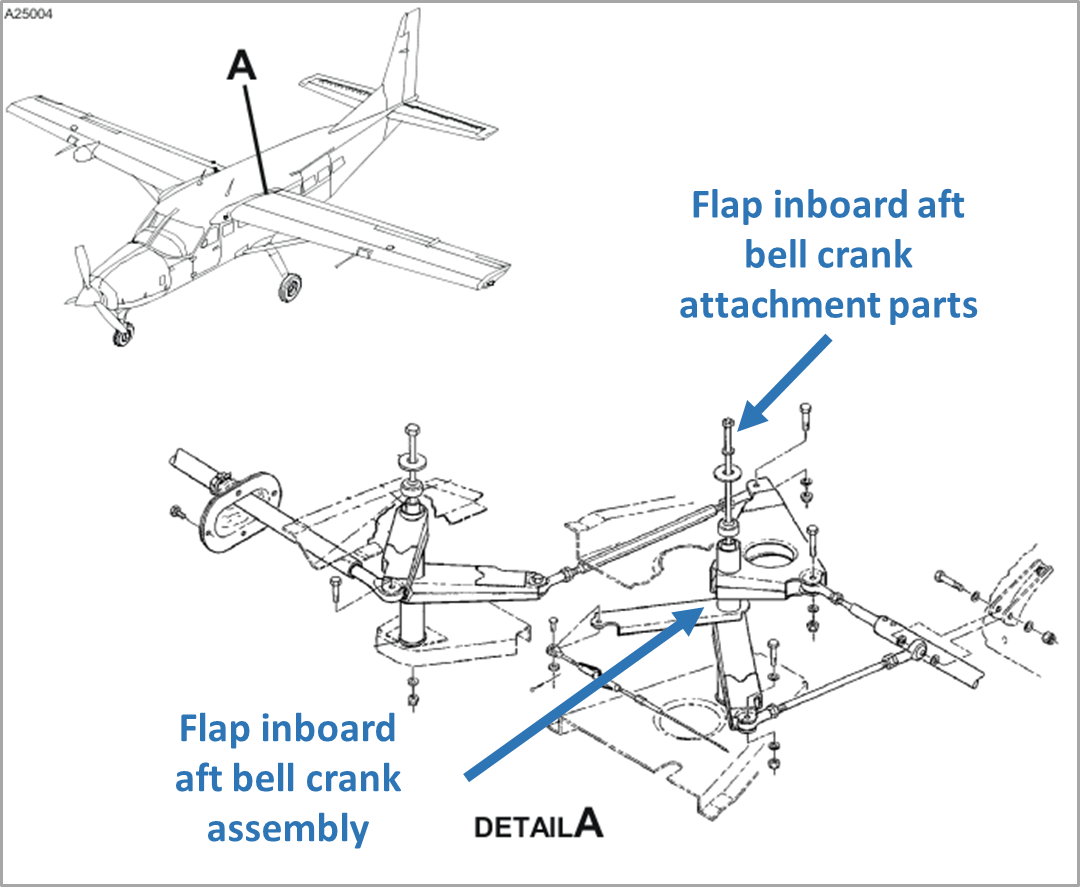
The aft bell crank as referenced to in (Figure 2) showed that the assembly is secured into location with a single bolt securing into an anchor nut assembly on the bottom. According to the operator, there was no secondary locking system.

Figure 2: Diagram showing the location of the left wing flap inboard aft bell crank assembly

rid22-picture-4.png

Source: Cessna 208 illustrated parts catalogue, modified by the ATSB

Manufacturer’s (Cessna) recommended maintenance schedule

Reference was made to the Cessna 208 maintenance manual (maintenance manual), chapter 27-50-01 ‘removal and installation procedures' for this component. However, the instructions did not include a recommended torque setting for any hardware in the flap system. Engineers were required to reference a torque setting in chapter 20 of the maintenance manual – the ‘standard practices’ section. The procedures also advised on the requirement for Loctite 242 to be applied to the component.

As a safety measure, the operator checked all other Cessna Caravan aircraft in the fleet. All were found to have the hardware in the flap system correctly torqued.

Independent audit

An independent audit of the operator’s maintenance system did not find any anomalies. All maintenance, relevant airworthiness directives (AD’s) and Cessna service bulletins (SB) had been correctly complied with. All upcoming inspections were also correctly scheduled.

The independent audit noted that there was no maintenance error. However, the audit concluded that there was a causal combination of both the design of the part, and the limitations of the maintenance schedule instructions.

The Civil Aviation Safety Authority’s (CASA) Service Difficulty Report (SDR) system

The ATSB contacted CASA and requested information regarding reports of any similar occurrences to Cessna 208B aircraft. CASA advised that there have been no similar flap hardware failures reported on these aircraft in the last five years (involving Australian aircraft).

Pilot experience and comments

The pilot has in excess of 4,000 hours flying Cessna 208 aircraft.

Once the left flap mechanism had failed, the aircraft was unresponsive to any control input, and it felt like being in a massive crosswind from the right. The right wing was generating a large amount of lift.

The pilot was not aware of the asymmetric flap situation until sometime after landing. The flap indicator had travelled to 30°, so there had been no reason to doubt it.

The pilot suspects that with the right flap extended to 30°, the dynamic pressure generated by the propeller wash must have pushed the broken left flap back up close to the zero flap position, resulting in the asymmetric flap situation.

Safety action

Whether or not the ATSB identifies safety issues in the course of an investigation, relevant organisations may proactively initiate safety action in order to reduce their safety risk. The ATSB has been advised of the following proactive safety action in response to this occurrence.

West wing Aviation

As a result of this occurrence, West Wing Aviation has advised the ATSB that they are taking the following safety actions:

Type of safety action

The reason for the pivot bolt working loose could not be established. However, as a preventative measure the operators approved Maintenance Program has been amended. This amendment included new maintenance actions and new replacement intervals for the affected bell crank, that are additional to the maintenance requirements in the Cessna maintenance schedule tasks.

This included life limits similar to those mandated by Cessna for the primary flap bell crank assembly and replacement at 10,000 landings for:

  • bearings fitted to all four aft flap bell cranks
  • bearings fitted to the left inboard forward flap bell crank
  • all four aft flap bell crank attaching parts and bolts
  • left inboard forward flap bell crank attaching parts and bolt.

Aviation Short Investigations Bulletin - Issue 48

Purpose of safety investigations

The objective of a safety investigation is to enhance transport safety. This is done through:

  • identifying safety issues and facilitating safety action to address those issues
  • providing information about occurrences and their associated safety factors to facilitate learning within the transport industry.

It is not a function of the ATSB to apportion blame or provide a means for determining liability. At the same time, an investigation report must include factual material of sufficient weight to support the analysis and findings. At all times the ATSB endeavours to balance the use of material that could imply adverse comment with the need to properly explain what happened, and why, in a fair and unbiased manner. The ATSB does not investigate for the purpose of taking administrative, regulatory or criminal action.

Terminology

An explanation of terminology used in ATSB investigation reports is available here. This includes terms such as occurrence, contributing factor, other factor that increased risk, and safety issue.

Publishing information 

Released in accordance with section 25 of the Transport Safety Investigation Act 2003

Published by: Australian Transport Safety Bureau

© Commonwealth of Australia 2016

image_5.png

Ownership of intellectual property rights in this publication

Unless otherwise noted, copyright (and any other intellectual property rights, if any) in this report publication is owned by the Commonwealth of Australia.

Creative Commons licence

With the exception of the Coat of Arms, ATSB logo, and photos and graphics in which a third party holds copyright, this publication is licensed under a Creative Commons Attribution 3.0 Australia licence.

Creative Commons Attribution 3.0 Australia Licence is a standard form licence agreement that allows you to copy, distribute, transmit and adapt this publication provided that you attribute the work.

The ATSB’s preference is that you attribute this publication (and any material sourced from it) using the following wording: Source: Australian Transport Safety Bureau

Copyright in material obtained from other agencies, private individuals or organisations, belongs to those agencies, individuals or organisations. Where you wish to use their material, you will need to contact them directly.

__________

  1. Instrument meteorological conditions (IMC) describes weather conditions that require pilots to fly primarily by reference to instruments, and therefore under Instrument Flight Rules (IFR), rather than by outside visual references. Typically, this means flying in cloud or limited visibility.
  2. Final approach fix (FAF) is a specified point on a non-precision instrument approach, which identifies the commencement of the final segment.
  3. The pilot was able to maintain visibility along the intended flight path within the published circling area.
  4. With a lowered wing and no balancing rudder input the aircraft will begin to slip in the direction of the lowered wing, which leads to a yawing motion in the same direction.

Occurrence summary

Investigation number AO-2015-133
Occurrence date 10/11/2015
Location Townsville Airport
State Queensland
Report release date 27/05/2016
Report status Final
Investigation level Short
Investigation type Occurrence Investigation
Investigation status Completed
Mode of transport Aviation
Aviation occurrence category Flight control systems
Occurrence class Serious Incident
Highest injury level None

Aircraft details

Manufacturer Cessna Aircraft Company
Model 208B
Registration VH-WZJ
Serial number 208B1108
Aircraft operator West Wing Aviation
Sector Turboprop
Operation type Air Transport Low Capacity
Departure point Palm Island, Qld
Destination Townsville, Qld
Damage Nil

Flight control systems involving a de Havilland Canada DHC-8-102, VH-TQO, 50 km north of Sydney Aerodrome, New South Wales, on 10 November 1993

Summary

SEQUENCE OF EVENTS

VH-TQO had been scheduled for an overnight stop in Tamworth where servicing was normally done in preparation for the next day's flying. In addition, the upper torque links were changed on both landing gear legs, as non-scheduled maintenance, to correct main wheel shimmy/vibrations thought to be related to clearances allowed in the links within the service-wear limits.

Immediately after take-off from Tamworth on the following day, the weight-on-wheels (WOW) caution light illuminated. The crew consulted the abnormal procedures checklist which warned that the landing gear might not retract. As the landing gear retracted normally, the crew decided to continue the flight to Sydney. At about 26 NM from Sydney, passing 8,000 ft on descent for an ILS approach, the ground spoilers deployed when the power levers were retarded to 'flight idle'. Indicated airspeed reduced from 230 kts to 150 kts and rate of descent increased from 1,700 ft/min to 2,800 ft/min. The crew selected the Flight/Taxi switch to the Taxi position, which placed the spoiler control system in the ground operating mode, and the spoilers then retracted. A normal descent profile was regained by 7,500 ft and the aircraft continued for a normal approach and landing.

SPOILER SYSTEM

The spoiler deployment system is arranged so that the ground-spoilers will deploy when all the system input conditions have been met - i.e., the throttle levers are retarded to flight idle, and the WOW sensors indicate that the aircraft is on the ground. This system has multiple redundancy as there are four WOW sensors (two on each leg) and two separate bus communication channels. With one faulty sensor, or one channel failed, the system will operate normally. Normal operation is still possible despite some multiple failures. However, in this case, all four sensor gaps were incorrect. This would not normally occur with a single system fault or if one torque link was replaced and the WOW sensor was not adjusted.

TORQUE LINKS

The torque links have ramps on the upper surfaces which set a target near/far dimension. This is read by sensors which send digital signals to the Proximity Switch Electronics Unit (PSEU). The PSEU contains the computer which controls landing gear and ground-spoiler logic (among other functions). The torque links fitted to VH-TQO at Tamworth had ramp dimensions which were different to those on the links removed. Variations in torque link ramp height were found to occur across the company fleet. These variations were the result of production specification changes to the same part number torque links.

MAINTENANCE

Maintenance Manual At the time of the occurrence the Maintenance Manual (MM) was the reference for the torque link change. The MM stated that a WOW sensor adjustment was required after a main gear strut change. There was no statement that a WOW sensor adjustment was required when only the torque links were changed. Consequently, the WOW sensors were not adjusted, the sensor gaps were incorrect, and the ground spoilers deployed in flight when the power levers were retarded to flight idle. The MM has since been amended by issue of temporary revision no. 32-73, dated November 1993, which specifies sensor adjustment after changing the torque links. Maintenance System and Procedures The company's maintenance system control is located in Sydney.

The aircraft manufacturer's Overhaul Special Inspection Procedures (OSIP) program is used to track the time in service of Control Time Limit (CTL) items across the company's fleet. Aircraft are maintained in accordance with the manufacturer's data, under a system of maintenance approved by the Civil Aviation Authority (CAA). All scheduled maintenance in the company is controlled by a computerised database containing OSIP which then produces task cards with instructions for the work. For scheduled maintenance a work package is generated containing the data for the job which is then issued to the Licensed Aircraft Maintenance Engineer (LAME). The MM is normally the reference for unscheduled maintenance but work packages may be raised. In this case, a work package was not raised. Most of the regular overnight maintenance activity is carried out in Sydney.

Tamworth is retained as a subsidiary facility, available for overnight and longer-term or heavy maintenance. The company's Maintenance Control Manual (MCM) applies to both Sydney and Tamworth which thereby use the same method of controlling maintenance and issuing work instructions (i.e.: work packages). The maintenance system is audited by the CAA. The torque link change was carried out on the night shift when maintenance control staff in Sydney were not on duty. The LAME who carried out the work in Tamworth attempted to consult control staff to clarify the procedures applicable to the work, but no staff were available. Consequently, as a work package had not been raised, the only reference available to the LAME was the unrevised MM.

FINDINGS

1. The WOW sensor was not adjusted following change of both upper torque links as this adjustment was not included in the procedures detailed in the MM.

2. The work was carried out on the night shift which prevented the LAME performing the tasks from consulting maintenance control staff.

3. The MM has since been amended to include a requirement to adjust the WOW sensor after a torque link change.

FACTORS

1. The instructions detailed in the MM were inadequate for the task.

2. No means of clarifying procedures was available.

SAFETY ACTION

The MM has been revised, and the CAA requested the company to install an Australian Standard AS3901/3902 type quality assurance system. At the time of the occurrence the company had plans to introduce such a system and is currently implementing the plan.

Occurrence summary

Investigation number 199303801
Occurrence date 10/11/1993
Location 50 km north of Sydney Aerodrome
State New South Wales
Report release date 20/12/1995
Report status Final
Investigation type Occurrence Investigation
Investigation status Completed
Mode of transport Aviation
Aviation occurrence category Flight control systems
Occurrence class Incident

Aircraft details

Manufacturer De Havilland Canada/De Havilland Aircraft of Canada
Model DHC-8-102
Registration VH-TQO
Sector Turboprop
Operation type Air Transport Low Capacity
Departure point Tamworth NSW
Destination Sydney NSW
Damage Nil

Flight control systems involving an Airbus A320-211, VH-HYD, Adelaide, South Australia, on 21 January 1993

Summary

Following a normal take-off, the wing leading edge slats locked in the down position when the crew selected flaps up.

The aircraft returned for a safe landing some five minutes later.

Engineering investigation revealed a failure in the slat asymmetry pick-up unit had caused the slats to lock on retraction.

Occurrence summary

Investigation number 199300088
Occurrence date 21/01/1993
Location Adelaide
State South Australia
Report release date 28/03/1994
Report status Final
Investigation type Occurrence Investigation
Investigation status Completed
Mode of transport Aviation
Aviation occurrence category Flight control systems
Occurrence class Incident

Aircraft details

Manufacturer Airbus
Model A320-211
Registration VH-HYD
Sector Jet
Operation type Air Transport High Capacity
Departure point Adelaide SA
Destination Canberra ACT
Damage Nil

Assistance to the Civil Aviation Safety Authority in the examination of a cracked control cable terminal

Report

The Civil Aviation Safety Authority (CASA) released Airworthiness Directive AD/GEN/87 Primary Flight Control Cable Assembly Retirement in February 2015 which required the retirement of control cable assemblies after 15 years in service. Following the release of the AD, CASA received a service difficulty report where a cable terminal fitting exhibited cracking after less than 10 years in service. As the cable exhibited cracking prior to the retirement life stated in the AD, it was requested that the Australian Transport Safety Bureau (ATSB) examine the terminal to determine the mode of failure, and if it was the same mechanism as that described in the AD.

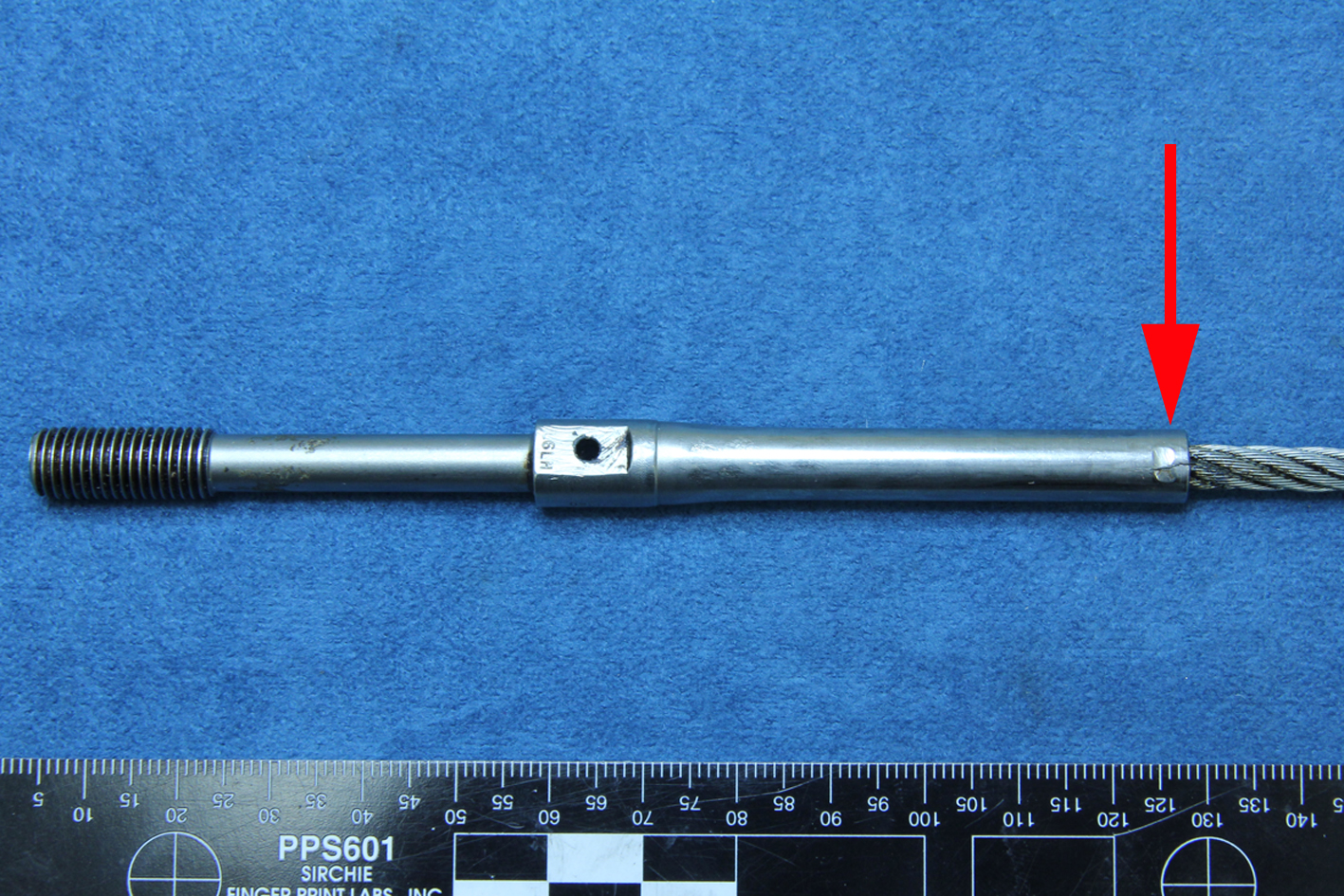
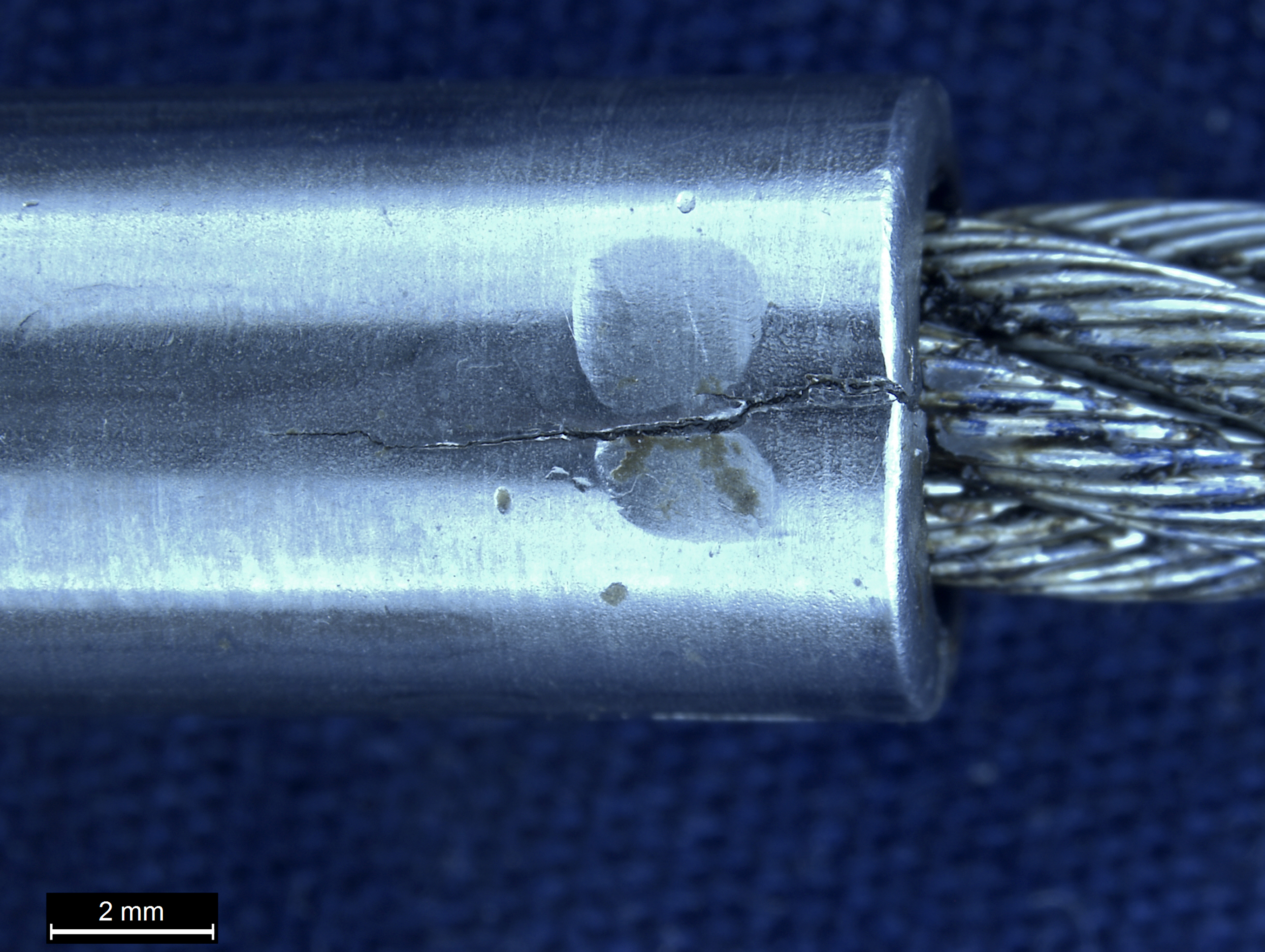
The submitted terminal exhibited four longitudinal cracks extending approximately 5mm from the end of the terminal. Small indentations were identified on either side of two of the cracks on opposite sides of the terminal. These were considered to be an artefact of the swaging process. The location and orientation of the cracking was different to those of the terminals examined previously as part of investigation AE-2012-028. There was no evidence of the highly branched cracking that was seen in other examples and which is normally associated with stress corrosion cracking.

The cracking on the submitted terminal likely initiated as a result of the mechanical damage that occurred during the manufacturing process. The terminal has been returned to CASA, who are continuing their investigations into the origin of the terminal and the mechanical damage.

Figure 1: Terminal submitted to the ATSB, crack location arrowed

Terminal submitted to the ATSB, crack location arrowed

Source: ATSB

Figure 2: Magnified view of terminal, showing the mechanical damage either side of the crack

Magnified view of terminal, showing the mechanical damage either side of the crack

Source: ATSB

______________________

The information contained in this web update is released in accordance with section 25 of the Transport Safety Investigation Act 2003.

Occurrence summary

Investigation number AE-2015-020
Occurrence date 12/02/2015
Location ATSB Central Office
State Australian Capital Territory
Report release date 08/09/2015
Report status Final
Investigation level Defined
Investigation type External Investigation
Investigation status Completed
Mode of transport Aviation
Aviation occurrence category Flight control systems
Occurrence class Other
Highest injury level None

Flight control systems involving a Boeing 737-376, VH-TAV, Melbourne Aerodrome, Victoria, on 24 August 1999

Summary

During a flight controls check prior to take-off, the aircraft experienced an apparent binding of the elevator control system at a location just forward of the aft stop. The flight was aborted and the aircraft returned to the gate for further investigation. Maintenance personnel carried out further investigation into the control system, to include a complete operational check of the elevator control system. The subsequent checks completed both powered and unpowered revealed none of the ratcheting and binding reported by the flight crew. After a thorough check the aircraft was returned to service.

Occurrence summary

Investigation number 199904112
Occurrence date 24/08/1999
Location Melbourne Aerodrome
State Victoria
Report release date 28/09/1999
Report status Final
Investigation type Occurrence Investigation
Investigation status Completed
Mode of transport Aviation
Aviation occurrence category Flight control systems
Occurrence class Incident

Aircraft details

Manufacturer The Boeing Company
Model 737-376
Registration VH-TAV
Sector Jet
Operation type Air Transport High Capacity
Departure point Melbourne Vic.
Destination Brisbane Qld
Damage Nil

Flight control systems involving a Cessna 402C, VH-UCD, 9 km south-east of Palm Island (ALA), Queensland, on 26 February 1999

Summary

During the pre-flight inspection, the pilot of the Cessna 402 noticed an unusual amount of free play in the elevator trim tab system. A maintenance inspection did not detect any abnormality. During the subsequent flight, while in the cruise, the aircraft suddenly pitched nose down without any input from the pilot. He disconnected the autopilot but this did not remedy the pitch problem. Re-trimming the aircraft also made no difference to the pitch down tendency. After an uneventful landing at the destination, an inspection by a licenced aircraft maintenance engineer revealed that the bolt attaching the trim tab actuator rod to the trim jack could not be located.

Occurrence summary

Investigation number 199901176
Occurrence date 26/02/1999
Location Palm Island (ALA)
State Queensland
Report release date 20/07/1999
Report status Final
Investigation type Occurrence Investigation
Investigation status Completed
Mode of transport Aviation
Aviation occurrence category Flight control systems
Occurrence class Incident

Aircraft details

Manufacturer Cessna Aircraft Company
Model 402C
Registration VH-UCD
Sector Piston
Departure point Townsville Qld
Destination Palm Island Qld
Damage Nil

Flight control systems involving a Pilatus Britten-Norman Ltd BN-2A-8, VH-FCO, near Horn Island Aerodrome, Queensland, on 23 November 1998

Summary

The pilot reported that the aircraft appeared to be slow to respond to aileron control inputs during the previous flight. While carrying out a flight control check prior to departure for the next flight, he noticed that the right aileron did not respond to cockpit control column inputs. The pilot cancelled the flight and advised company maintenance personnel of the apparent problem. Examination revealed that the control rod for the right aileron had fractured, separating the aileron from the aileron control system.

Specialist examination of the control rod confirmed that the fracture originated in the internally threaded tube end fitting at the point where the fitting was pinned to the centre tube section of the rod. The features of the fracture were consistent with the application of excessive stress. There was no evidence of pre-existing cracking or other defects. The spherical bearing in the rod end fitting had seized and there was evidence of sliding contact between the outer edge of the inner race of this bearing and the aileron attachment fitting. This suggested that the rod probably failed as a result of aileron control input loads applied after the rod end bearing had seized.

It could not be determined when the control rod had been fitted to the aircraft. A scheduled 100 hourly maintenance inspection of the aircraft had been completed on the day prior to the incident and no abnormality concerning the aileron control system was noted. The maintenance organisation considered that during routine maintenance activities it was difficult to inspect the complete aileron assembly in the area where the failure occurred. Following advice concerning this incident, the Civil Aviation Safety Authority commenced a review of the maintenance organisation's inspection and certification procedures.

Occurrence summary

Investigation number 199805247
Occurrence date 23/11/1998
Location near Horn Island Aerodrome
State Queensland
Report release date 27/01/1999
Report status Final
Investigation type Occurrence Investigation
Investigation status Completed
Mode of transport Aviation
Aviation occurrence category Flight control systems
Occurrence class Incident

Aircraft details

Manufacturer Pilatus Britten-Norman Ltd
Model BN-2A-8
Registration VH-FCO
Sector Piston
Departure point Dauan Island Qld
Destination Horn Island Qld
Damage Nil

Flight control systems involving a Embraer EMB-120 ER, VH-XFZ, Bundaberg Aerodrome, Queensland, on 29 November 1998

Summary

no text

Occurrence summary

Investigation number 199805319
Occurrence date 29/11/1998
Location Bundaberg Aerodrome
State Queensland
Report release date 03/03/1999
Report status Final
Investigation type Occurrence Investigation
Investigation status Completed
Mode of transport Aviation
Aviation occurrence category Flight control systems
Occurrence class Incident

Aircraft details

Manufacturer Embraer-Empresa Brasileira De Aeronautica
Model EMB-120 ER
Registration VH-XFZ
Sector Turboprop
Departure point Brisbane Qld
Destination Bundaberg Qld
Damage Nil

Flight control systems involving a Boeing 737-377, VH-CZJ, Alice Springs Aerodrome, Northern Territory, on 21 July 1998

Summary

When the copilot rotated the aircraft through 17 degrees on the way towards the lift off body angle of 19 degrees the stick shaker activated. Concurrent with the stick shaker activation, the leading edge flaps extend light on the forward panel extinguished and the amber leading edge flaps transit light illuminated. As soon as the stick shaker activated the rotation was stopped. Almost immediately the leading edge flaps transit light extinguished, the leading edge flaps extend light illuminated, and the stick shaker stopped. The activation period was very brief and occurred at approximately 174 knots. 

The take-off and climb were continued normally and no other discrepancies were noted. Maintenance investigation disclosed that one of the leading edge slat position micro switches had failed. The failure of the switch caused the logic system to sense that the leading edge slats were retracted rather than extended. This resulted in the stall warning system being reset and the stick shaker to activate at normal take-off speeds. The operator advised that the manufacturer is considering a change that will ensure that failure of only one switch is insufficient to cause the system to be reset.

Occurrence summary

Investigation number 199802824
Occurrence date 21/07/1998
Location Alice Springs Aerodrome
State Northern Territory
Report release date 18/08/1998
Report status Final
Investigation type Occurrence Investigation
Investigation status Completed
Mode of transport Aviation
Aviation occurrence category Flight control systems
Occurrence class Incident

Aircraft details

Manufacturer The Boeing Company
Model 737-377
Registration VH-CZJ
Sector Jet
Operation type Air Transport High Capacity
Departure point Alice Springs NT
Destination Unknown
Damage Nil