Control issues

Fairchild SA227-DC, VH-HWR

Safety Action

SAFETY ACTION

As a result of this occurrence, the aircraft operator took immediate action and issued a company memorandum to all engineering staff clarifying the requirements of Civil Aviation Regulation 42G in regard to flight control system maintenance and inspections requirements. This memorandum reiterated the requirement for duplicate inspections inclusive of all trim systems.

The aircraft operator also advised the ATSB that the maintenance control and engineering procedures manuals had been revised and that the following corrective action had been taken:

  • a new engineering procedure has been introduced, which addresses hand over of maintenance co-ordination of tasks between shifts that involve multiple personnel across those shifts, and hand over procedures for maintenance tasks between engineers completing separate portions of the one task.
  • The Engineering Procedures Manual (EPM) has been revised to include procedures for certification of stages of maintenance within a task and now incorporates a procedure to identify when duplicate inspections are required and ensures the incorporation of duplicate inspection entries in maintenance documentation for those tasks deemed by civil aviation legislation and company policy to require them. This EPM Section also identifies personnel responsible for ensuring that duplicate inspection requirements are invoked when maintenance activities require them.
  • All maintenance documentation has been reviewed and the layouts amended to address the appropriateness of maintenance log sheets, work cards and other such documents to facilitate these procedural changes.

The operator also advised that they had reviewed the company induction and training program for maintenance engineers and now emphasise the sections of the Fairchild Aircraft Maintenance Manual that relate to the pitch trim and control maintenance practices. The sonalert unit in the aircraft was replaced after the incident. This aircraft’s sonalert operation now conforms to that of the operator’s fleet.

RECOMMENDATION

As a result of this and previous occurrences, the Australian Transport Safety Bureau issues the following safety recommendation:

R20040078

The Australian Transport Safety Bureau recommends that M7 Aerospace Pty Ltd review and amend its Fairchild SA-227 series maintenance manual to ensure that notes on operational tests, with regard to horizontal stabiliser movement versus trim switch position referred to in Section 27-40-10 for removal of the pitch trim switch, are included in Section 27-10-10 for related maintenance activities, or references to them are clearly noted in that part.

Significant Factors

SIGNIFICANT FACTORS

  1. The wiring for the pilot’s control wheel horizontal stabiliser trim switches was reassembled in the reverse sense.
  2. The maintenance manual post-maintenance functional test requirements for the horizontal stabiliser trim switches, which would have identified the reversed trim were not clearly noted by the manufacturer in the chapter that was referred to by the engineers for this task.
  3. The post-maintenance duplicate inspection requirements in accordance with Civil Aviation Regulation (CAR) 42G were not included in the maintenance worksheets for the horizontal stabiliser trim system prior to release of the aircraft for flight and therefore were not performed or certified for.
  4. The post-maintenance functional test that was performed by the engineers did not meet the intent of CAR 42G duplicate inspection criteria, in that the functioning of horizontal stabiliser trim switches did not include correlation of the horizontal stabiliser surface motion to trim switch movement.
  5. Pre-flight inspection by the flight crew did not detect the reversed trim motion.
  6. Having identified a problem with the pitch trim, the flight crew did not select stabiliser trim control from the pilot to the co-pilot control wheel during the occurrence flight.

Analysis

ANALYSIS

The control difficulties experienced by the crew shortly after departure could be attributed directly to the horizontal trim system operating in the reverse travel sense to that commanded by the pilot in command’s (PIC) inputs to the horizontal stabilizer trim switches.

The investigation determined that systemic failures present during maintenance allowed the aircraft to be returned to service with a horizontal stabiliser trim system that operated in the reverse sense. Further, this incorrect flight control function was not detected during the pre-flight inspection by the flight crew.

A task that was maintenance intensive and/or extended over several shift periods involving numerous personnel required careful management in the co-ordination of effort to ensure every requirement was addressed to safely return the aircraft to an airworthy condition. In this incident there was a breakdown in this defence through absent or poorly defined handover procedures, documentation and co-ordination of the maintenance.

Disturbance of a flight control system during maintenance triggers the requirement for an additional layer of defence in the duplicate inspection procedure. In this incident the engineers were unsure of when the procedure was to be employed and this lead to a breakdown of the defence. A clearly defined procedure in the company maintenance control manual for invoking the duplicate inspection would have ensured a duplicate inspection was prescribed, which in turn should have identified the trim reversal prior to the aircraft’s release to service.

The aircraft provided the crew with an aural alert system with a known difference from its fleet siblings. The perception by the pilot in command (PIC) of the aircraft being inherently different, combined with a loading distraction at the critical trim function check time in the pre-flight sequence, probably led to a misinterpretation by the PIC of his response to the anomaly.

Once airborne and with the emergency in progress, the PIC established that he had control but neglected to consider selection of the trim system control to the copilot’s control wheel as an option. This may have been as a result of his decision not to manipulate the trim system any further due to possible mechanical failure.

Summary

FACTUAL INFORMATION

History of the flight

At 1100 Western Standard Time on 2 August 2004, a Fairchild Industries Inc. Metro 23 aircraft, registered VH-HWR, departed Perth on a scheduled passenger service to Kalbarri, WA. with two crew and nineteen passengers. Normal trim inputs were made by the pilot in command (PIC) during the departure and initial climb. He reported that at about the time the flaps were retracted, the control forces increased nose upward in the pitch axis.

The PIC reported that he looked at the horizontal-trim indicator and noticed a large deflection, but did not initially relate this to the control problem or identify the indicator deflection as abnormal. Rather, the PIC assumed that the problem related to the flap retraction, and he instructed the copilot to reselect the flaps to the take-off position, but this appeared to have no effect. The PIC did not attempt to switch electrical control of the aircraft's pitch trim system to the co-pilot's control using the pedestal mounted selector switch. He reported that the control forces required to maintain straight and level flight were very high and fatiguing, and he elected to fly the aircraft in this configuration back to Perth Airport.

A subsequent engineering examination revealed that the pilot in command's (left side) control yoke pitch trim switch had been wired incorrectly and that the left side pitch trim system was operating in the reverse sense from normal operation.

Flight data recorder information

The aircraft was fitted with a solid-state flight data recorder (SSFDR). The parameters recorded by the SSFDR included pitch and roll attitude angles, indicated airspeed, pressure altitude, magnetic heading and stabiliser position. Control column position was not recorded on the SSFDR.

This data was compared with the data readouts from the previous flight, and also to the flight following the incident flight. This comparison showed that stabiliser movement during the incident flight differed from that observed during the comparison flights. During the incident flight, following rotation, the stabiliser moved in an aircraft nose-up direction only. In the comparison flights, following climb out, the stabiliser moved in the opposite sense or a nose-down direction.

Aircraft maintenance

Prior to the incident, the aircraft had undergone maintenance for the flight controls being heavy in the roll (aileron) axis. The problem was traced to a binding bearing in the left side control yoke. To access the bearings, it was necessary to remove the control yoke and the control yoke pitch trim switch by de-soldering the switch wiring and removing the switch from the yoke housing. After the control column bearings were replaced, the control yoke was re-installed, and the trim switch wiring was re-soldered to the respective terminals. During this task, the wiring labelling was misread and the trim switch wires were inadvertently transposed, which would result in the trim switch operating in the reverse sense when activated. The trim switch was then re-installed into the control yoke. There were no markings or labels on the control yoke or the trim switch to indicate trim up or down.

During the aircraft maintenance activity, there were a number of different maintenance engineers involved over several shifts. The handover between the shifts was completed through the use of a shift handover book and details of the aircraft's pitch trim system wiring information was not referred to the incoming shift engineers through the handover book.

Aircraft maintenance manual and post maintenance trim switch functional test

The aircraft operator's maintenance worksheets recorded that the task to remove and replace the control yoke bearing was accomplished in accordance with the Fairchild Aircraft Maintenance Manual (FAMM) Section 27-10-10. This section contained maintenance steps to be followed in relation to the removal and refitting of the control yoke and control yoke switches. However, it contained no reference to a following section, 27-40-01, that detailed the removal and installation procedures for the pitch trim control switches. That procedure included the following note in relation to the operational check of the trim switch:

Pushing switch UP moves horizontal stabilizer toward NOSE DOWN direction;
pushing switch DOWN moves stabilizer towards NOSE UP

Civil Aviation Safety Authority requirements

The Australian Civil Aviation Safety Authority (CASA) promulgated specific inspection requirements for flight controls in Civil Aviation Regulation 42G. Those requirements are for the inspection and functional checks of any part of an aircraft flight control system that is assembled, adjusted, repaired, modified or replaced in the course of carrying out maintenance on an aircraft. In these cases, the flight control system must be inspected by the person who carried out the work and additionally by an independent person.

During the maintenance activities to the aircraft prior to the incident, several tasks were performed that required a duplicate inspection in accordance with the CASA requirements. An examination of the aircraft maintenance records indicated that two duplicate inspections were omitted, including one for the left side control yoke wiring reconnection. A review of the aircraft operator's maintenance control and engineering procedures manual indicated that this requirement was not clearly defined. In addition, in this occurrence, engineers reported that they were unsure of when such a procedure was to be employed.

Pre-flight actions by the flight crew

The PIC stated that he had performed the pre-flight cockpit checks while the copilot conducted the aircraft external checks. He stated that he had performed a daily trim check in accordance with the approved flight manual, during which he said he noticed something was 'not quite right'. He stated that one pilot's trim switch activated the sonalert1 aural warning system, while the other remained silent. The aural warning system in this aircraft was known to have activation characteristics that were different from the rest of the operator's aircraft fleet, and this was in his mind when he discussed the issue with the copilot. However, he was then distracted by a baggage loading issue and did not return to the perceived discrepancy prior to take-off.

Previous occurrences

The ATSB investigated a similar previous incident that occurred on 22 March 2004, involving a different operator (see ATSB report BO/200400998) in which the pitch trim switch had been incorrectly re-installed into the control yoke of a Fairchild Industries Inc. Metro 23 aircraft, resulting in the operation of the pitch trim switch in the reverse sense. As a result of that and other similar occurrences, CASA advised the US Federal Administration of the occurrences and published an article titled Nose up, nose down regarding trim switches in the November/December 2004 issue of Flight Safety Australia magazine. The article analysed the cause of those failures and highlighted the importance of maintaining switches and following correct procedures to prevent similar occurrences.

  1. Sonalert - When pitch trim actuation is detected a tone generator emits an audible low frequency sound in the cockpit to alert the crew when the stabiliser trim is in motion.

Occurrence summary

Investigation number 200402839
Occurrence date 02/08/2004
Location Perth, Aero.
State Western Australia
Report release date 03/01/2006
Report status Final
Investigation type Occurrence Investigation
Investigation status Completed
Mode of transport Aviation
Aviation occurrence category Control issues
Occurrence class Incident
Highest injury level None

Aircraft details

Manufacturer Fairchild Industries Inc
Model SA227
Registration VH-HWR
Serial number DC-851B
Sector Turboprop
Operation type Air Transport Low Capacity
Departure point Perth WA
Destination Kalbarri WA
Damage Nil

Jet blast and control issues involving a Diamond Industries DA 40, Adelaide, South Australia, on 4 September 2020

Brief

Occurrence Briefs are concise reports that detail the facts surrounding a transport safety occurrence, as received in the initial notification and any follow-up enquiries. They provide an opportunity to share safety messages in the absence of an investigation.

What happened

On 4 September 2020, the crew of a Diamond Industries DA 40 were on a dual training exercise and conducted a stop-and-go landing at Adelaide, South Australia. After landing, air traffic control (ATC) cleared the aircraft to taxi to reposition for take-off advising there was a Boeing 737 on the holding bay ahead of them. As the DA 40 approached the taxiway adjacent to the holding bay, the instructor noted the grass moving but continued as instructed.

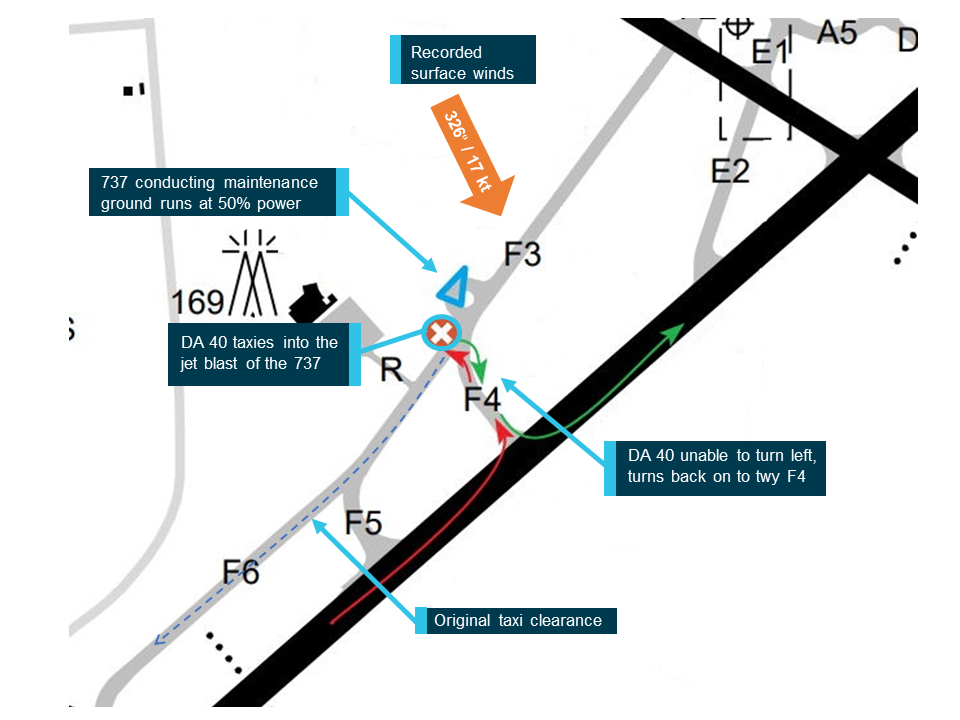
The taxi clearance required the aircraft to make a left turn and as the crew initiated the turn, the aircraft entered the jet blast[1] of the 737 (Figure 1). The instructor was unable to manoeuvre as required with differential braking[2] and made the decision to attempt a turn to the right to exit the jet blast. Upon releasing the brakes and applying right rudder, the pilot reported the DA 40 abruptly turned to the right and the pilot then taxied back towards the runway.

The crew notified the controller they had lost rudder control and ATC responded that the jet was conducting 50 per cent power ground runs.

Figure 1: Location of jet blast

Figure 1: Location of jet blast.
Source: Aerodrome diagram excerpt provided by operator and annotated by the ATSB

Source: Aerodrome diagram excerpt provided by operator and annotated by the ATSB

Jet blast and effect on controls

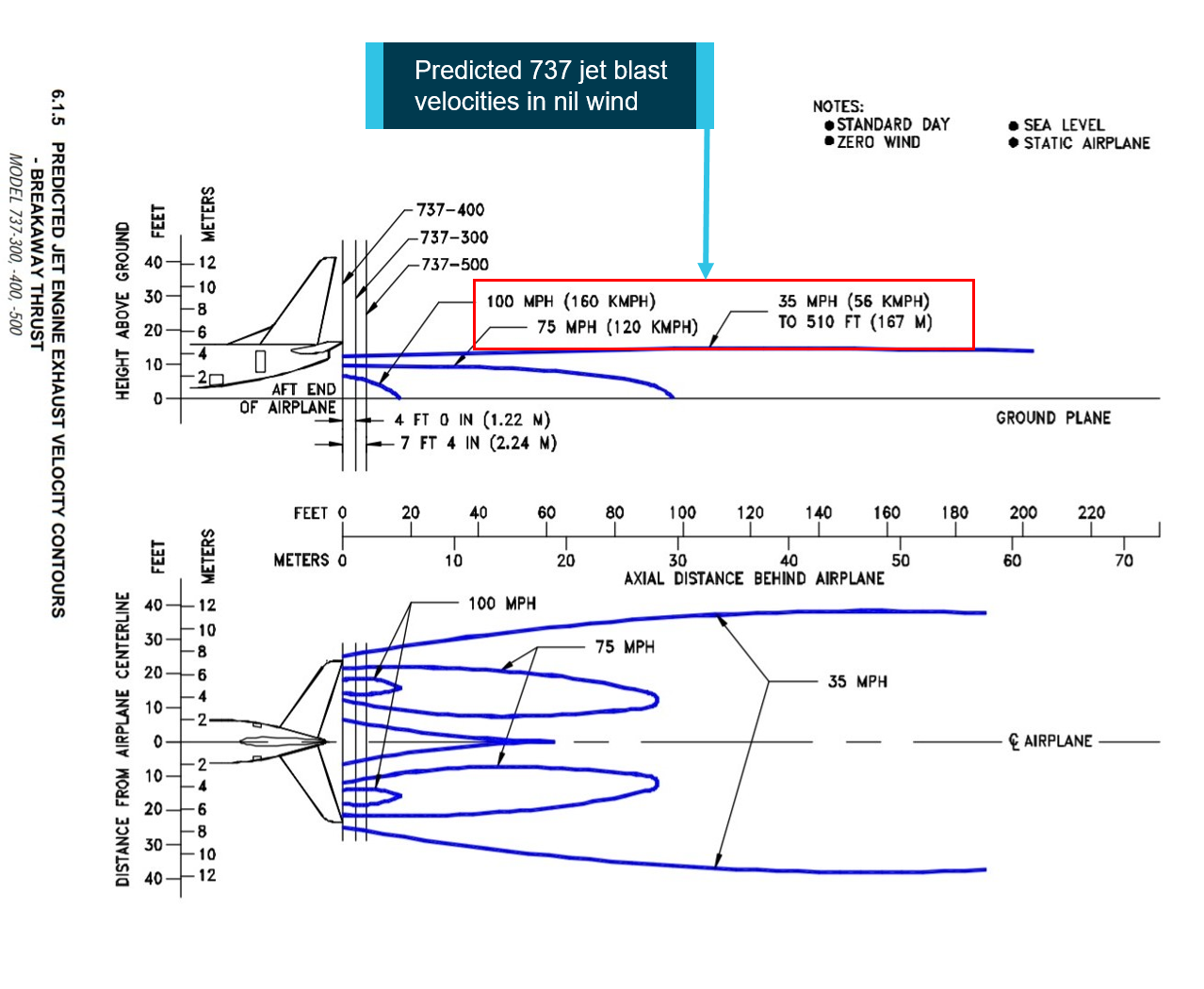
Many manufacturers provide information on predicted velocities and safe distances from jet engine exhausts. Figure 2 shows the predicted exhaust gas velocity using breakaway thrust power settings behind a 737-400 similar to the aircraft in the occurrence. It should, however, be noted that breakaway thrust is approximately 35 per cent power under normal circumstances and this aircraft was conducting maintenance ground runs using 50 per cent, meaning the exhaust velocity would be significantly greater than those indicated in this diagram. The DA 40 passed approximately 80 m behind the 737. At breakaway thrust, the DA 40 would be expected to encounter winds in excess of 30 kt, which is beyond the DA 40 maximum demonstrated crosswind limit of 20 kt. This contributed to the handling difficulties experienced while taxiing.

A review by the airside manager of Adelaide Airport found that the 737 maintenance ground runs were conducted in the appropriate location. The controller believed the level of power being used would not affect the DA 40 given the distance from the 737 and therefore there was no requirement to issue a caution to the DA 40 crew.

Figure 2: Predicted exhaust gas velocity for 737-400 aircraft

Figure 2: Predicted exhaust gas velocity for 737-400 aircraft.
Source: Boeing annotated by the ATSB

Source: Boeing annotated by the ATSB

Operator’s investigation

The operator conducted an investigation that included a review of radio transmission transcripts. Their investigation found that there was no advice or warning given to the DA 40 crew by ATC that the 737 was performing ground runs, or that these were being conducted at 50 per cent power. This was despite the controller being aware of the power setting be used. Although the pilot observed the grass moving along the taxiway, they took no action and it was determined that the crew were unfamiliar with the hazards associated with jet blast. The aircraft was exposed to the jet blast for approximately 1 minute.

Safety action

Airservices Australia advised the ATSB that the unit tower supervisor issued a ‘lessons learned’ to raise awareness of the event.

This was the first jet blast occurrence for the operator and as a result of this occurrence, the operator has advised the ATSB that it is taking the following safety actions:

  • a review of theoretical training relating to identifying and managing jet blast
  • a review of actions to be taken in the event of a jet blast occurrence including initial actions and inspections to be carried out by crew and maintenance personnel.

Safety message

This incident highlights the importance of situational awareness for pilots of smaller aircraft operating around larger aircraft. Jet blast is a hazard at all airports where high performance or transport category aircraft operate. While the risks are generally recognised within the ramp environment, jet blast can be encountered anywhere greater than idle power settings are used.

Avoiding a jet blast hazard requires pilots of light aircraft to be aware of the following:

  • the potential danger area behind large jets
  • the increased risk potential when aircraft may be about to move or use higher than idle power settings
  • being attentive to, and taking cues from, indicators in the operational environment, such as wind socks and grass at the edge of a taxiway.

Notwithstanding the need for pilots’ situational awareness, ATC also needs to be aware of the effects of jet blast on light aircraft. When there is a specific hazard, the requirement for controllers regarding jet blast is detailed in the Manual of Air Traffic Services section 12.1.1.2. Airservices Australia Aeronautical Information Publication stated that ATC should provide a caution to the aircraft. Additionally, taxi clearances should facilitate movement of light aircraft away from jet blast hazards.

About this report

Decisions regarding whether to conduct an investigation, and the scope of an investigation, are based on many factors, including the level of safety benefit likely to be obtained from an investigation. For this occurrence, no investigation has been conducted and the ATSB did not verify the accuracy of the information. A brief description has been written using information supplied in the notification and any follow-up information in order to produce a short summary report, and allow for greater industry awareness of potential safety issues and possible safety actions.

__________

  1. Jet blast: the hazard associated with the blast force generated behind a jet engine, especially at high engine power settings when taxiing, before and during take-off, and during engine maintenance activity.
  2. Differential braking: The use of independent braking systems installed on the left and right wheels of an aircraft to assist in steering.

Occurrence summary

Mode of transport Aviation
Occurrence ID AB-2020-037
Occurrence date 04/09/2020
Location Adelaide
State South Australia
Occurrence class Incident
Aviation occurrence category Control issues
Highest injury level None
Brief release date 03/11/2020

Aircraft details

Manufacturer Diamond Aircraft Industries
Model DA 40
Sector Piston
Operation type Flying Training
Departure point Adelaide, South Australia
Destination Adelaide, South Australia
Damage Nil

Control issues involving a Robinson R44, near Jabiru, Northern Territory, on 3 August 2020

Brief

Occurrence Briefs are concise reports that detail the facts surrounding a transport safety occurrence, as received in the initial notification and any follow-up enquiries. They provide an opportunity to share safety messages in the absence of an investigation.

What happened

On 3 August 2020, a Robinson R44 helicopter was conducting fire surveillance and abatement operations about 50 NM east of Jabiru, Northern Territory. In the early afternoon, the helicopter landed and shutdown in a pre-arranged temporary landing site waiting to pick up three ground personnel. At about 1700 Central Standard Time, once the personnel and their equipment was secured, the helicopter was started and brought into a hover. After checking the power available, a vertical take-off and climb was conducted until the helicopter was approximately 75 ft above ground level when a translation to forward flight commenced. The direction chosen was the most suitable available when considering terrain and wind direction.

As the pilot commenced the translation into forward flight over a treed area, the helicopter initially maintained height but as the pilot increased collective[1] the rotor RPM began to decay. The pilot increased the throttle and lowered the collective in an attempt to regain rotor RPM. As the helicopter descended, the collective was again raised in an attempt to arrest the descent, however the low rotor RPM warning horn sounded. A further attempt to recover the rotor RPM by lowering the collective was unsuccessful leaving a forced landing as the only option available for the pilot.

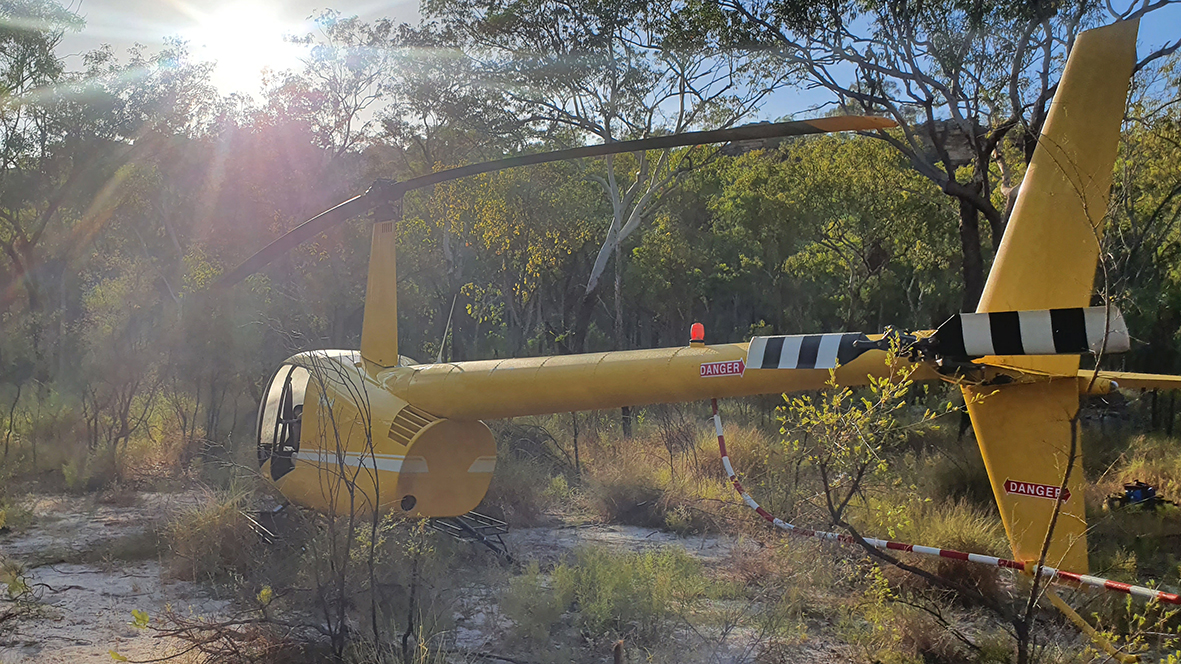
A landing site was selected in the treed area and the helicopter settled onto the ground resulting in a heavy landing. The main rotor blades struck several branches as the helicopter came through the tree canopy resulting in minor damage to the blades. After securing the helicopter, the pilot and ground personnel exited the helicopter and moved a safe distance away. The heavy landing activated the inertia switch on the emergency locator transmitter.[2]

Figure 1: The helicopter in situ after the forced landing

Figure 1: The helicopter in situ after the forced landing.
Source: Operator

Source: Operator

Operator’s investigation

The operator conducted an investigation into the circumstances surrounding this accident that revealed several contributing factors that are summarised below:

  • The aircraft was within the maximum take-off weight limits however it was close to the performance limit for an out of ground effect[3] hover in the prevailing weather conditions.
  • The afternoon weather conditions had changed from both previous days and earlier that day. This was the first afternoon in approximately four months that there was a tropical build up with variable and quickly changing winds as opposed to the consistant south easterly winds associated with the dry season. The afternoon was hotter and more humid than previous days.
  • The helicopter was over-pitched to a degree that successful recovery in the circumstances was not possible.

Over-pitching

Over-pitching is a phenomena that happens when collective pitch is increased to a point where the main rotor blade angle of attack creates so much drag that all available engine power cannot maintain or restore normal operating rotor speed. At low rotor speed, the rotor blades bend upwards and drag increases further, which may decrease to the point where the main rotor blades stall. More information can be found in The International Civil Aviation Organization (ICAO) manual of aircraft accident and incident investigation, chapter 15: Helicopter investigation.

Hover performance

Hover performance is essentially a product of engine power available and engine power required. The main factors affecting engine power required in a hover are helicopter weight, density of air and proximity to the ground (ground effect).

To maintain a steady high hover or climb vertically, the helicopter requires more main rotor thrust to act as lift, which in turn requires more engine power.

As air density decreases with an increase in altitude, temperature, and to a lesser degree humidity, a normally aspirated engine produces less power. Additionally, if the same amount of rotor thrust is needed, the rotor blades need a higher angle of attack, which creates more drag and generates a requirement for more engine power.

When a helicopter is hovering within about one rotor diameter[4] of the ground, the performance of the main rotor is affected by ground effect. A helicopter hovering in-ground-effect requires less engine power to hover than a helicopter hovering out-of-ground-effect.

Safety action

As a result of this occurrence, the operator has advised the ATSB that they are taking the following safety actions:

  • It was identified post occurrence that there were some training and recency issues that were addressed particularly in the correct recovery actions for a low rotor RPM situation and the technique used to translate into forward flight from a vertical take-off or an OGE hover.
  • The operator has limited the number of ground personnel to a maximum of two providing a larger power margin available for operating in these situations.
  • All pilots have undertaken a flight review to identify and analyse any skill or knowledge deficiencies.

Safety message

This accident serves as a reminder that when operating helicopters from unprepared landing sites, pilots should consider the approach and departure routes available in conjunction with operational constraints, weather, performance available and possible emergency recovery. Time spent considering and confirming the fundamental factors of decision-making, helicopter performance and limitations and the consideration of actions in the event of performance limitations or an emergency may help prevent injury to crew and damage to, or loss of, an aircraft.

About this report

Decisions regarding whether to conduct an investigation, and the scope of an investigation, are based on many factors, including the level of safety benefit likely to be obtained from an investigation. For this occurrence, no investigation has been conducted and the ATSB did not verify the accuracy of the information. A brief description has been written using information supplied in the notification and any follow-up information in order to produce a short summary report, and allow for greater industry awareness of potential safety issues and possible safety actions.

__________

  1. Collective: a primary helicopter flight control that simultaneously affects the pitch of all blades of a lifting rotor. Collective input is the main control for vertical velocity.
  2. Emergency locator transmitter (ELT): a radio beacon that transmits an emergency signal that may include the position of a crashed aircraft, and is either impact or manually activated.
  3. Out of ground effect: helicopters require less power to hover when in ‘ground effect’ then when out of ‘ground effect’ due to the cushioning effect created by the main rotor downwash striking the ground. The height of ‘ground effect’ is usually defined as more than one main rotor diameter above the surface.
  4. The Robinson R44 main rotor diameter is 33 ft.

Occurrence summary

Mode of transport Aviation
Occurrence ID AB-2020-032
Occurrence date 03/08/2020
Location 50 NM east of Jabiru
State Northern Territory
Occurrence class Serious Incident
Aviation occurrence category Control issues
Highest injury level None
Brief release date 18/09/2020

Aircraft details

Manufacturer Robinson Helicopter Co
Model R44
Sector Helicopter
Operation type Aerial Work
Departure point East of Jabiru, Northern Territory
Destination East of Jabiru, Northern Territory
Damage Minor

Control issues involving a Kavanagh Balloons G-450, near Kooralbyn, Queensland, on 22 August 2018

Brief

Occurrence Briefs are concise reports that detail the facts surrounding a transport safety occurrence, as received in the initial notification and any follow-up enquiries. They provide an opportunity to share safety messages in the absence of an investigation.

What happened

On 22 August 2018 at 0730 Eastern Standard Time, the pilot of a Kavanagh G-450 balloon was on final approach to land near Kooralbyn Queensland with a pilot and 23 passengers on board. Passing 2,500 ft, the wind was 17 kts with calm conditions on the surface. The pilot did not expect to experience windshear during approach nor was he aware that the envelope was subject to deformation in-flight. Passing 500 ft on approach, the balloon encountered windshear and the turning vent lines were singed by the burner flame as a result of descending with speed from altitude into calm conditions. This resulted in minor damage to the turning vent lines.

As a result of this incident, the operator has conducted training with the pilot and has contacted the manufacturer to look at replacing the turning vent lines with a more flame resistant material.

Safety message

The Australian Ballooning Federation's Pilot Training Manual Part 5 "Aerostatics and Airmanship" describes the responsibilities and duties of the pilot in relation to weather conditions in detail. The manual reminds balloon pilots that when conditions change suddenly and unexpectedly, even a slight vertical movement of air due to local turbulence effects will tend to carry a balloon with it, dramatically reducing vertical (and therefore directional) control. The manual notes that is therefore essential to have a sound knowledge of weather systems and their likely effects on a balloon, and to constantly monitor weather developments while flying.

About this report

Decisions regarding whether to conduct an investigation, and the scope of an investigation, are based on many factors, including the level of safety benefit likely to be obtained from an investigation. For this occurrence, no investigation has been conducted and the ATSB did not verify the accuracy of the information. A brief description has been written using information supplied in the notification and any follow-up information in order to produce a short summary report, and allow for greater industry awareness of potential safety issues and possible safety actions.

Occurrence summary

Mode of transport Aviation
Occurrence ID AB-2018-101
Occurrence date 22/08/2018
Location 17 km East Kooralbyn
State Queensland
Occurrence class Incident
Aviation occurrence category Control issues
Highest injury level None
Brief release date 21/12/2018

Aircraft details

Manufacturer Kavanagh Balloons
Model G-450
Sector Balloon
Operation type Charter
Destination near Kooralbyn, Queensland
Damage Minor

Control issues involving Cessna 172S, overhead Wakefield, New South Wales, on 28 August 2018

Brief

Occurrence Briefs are concise reports that detail the facts surrounding a transport safety occurrence, as received in the initial notification and any follow-up enquiries. They provide an opportunity to share safety messages in the absence of an investigation.

What happened

On the morning of 28 August 2018, the crew of a Cessna 172S departed Tamworth, New South Wales (NSW) to conduct a training flight. There was an instructor and a student on board.

During cruise, while the student was flying and tracking towards Wakefield, NSW, the instructor noticed uncommanded control movement and pitching[1] of the aircraft. The instructor decided to observe the elevator[2] movement and saw that it was moving abnormally. The instructor took control of the aircraft to ascertain the integrity of the elevator and found that the aircraft was pitching without any pilot input.

Although the degree of movement was minor, the aircraft was not operating within prescribed performance parameters. The instructor performed further elevator control and trim checks and decided the best course of action was to conduct a return to Tamworth, NSW. The instructor contacted Air Traffic Control (ATC) to notify them of the control issues, and the aircraft was cleared to track direct to Tamworth. The instructor decided to land without flaps[3] to avoid exacerbating the control issues. The aircraft landed without incident.

Engineering inspection

Following the incident, the engineering inspection revealed that the elevator trim inspection panel had been partially installed causing an airflow disturbance over the right-hand elevator and trim.

Safety action

As a result of this incident, the maintenance organisation has advised the ATSB that they are taking the following ongoing safety actions:

  • handover procedures to be reviewed and improved
  • refresher training regarding the maintenance organisation exposition (MOE) procedures
  • MOE procedures to be reviewed and updated
  • more regular maintenance audits.

Safety message

This incident highlights the importance of ensuring that all pre-flight checks and procedures are carried out comprehensively and systematically. It also highlights the importance of ensuring that while the aircraft is in maintenance, all aircraft components are refitted and reinstalled in accordance with the aircraft’s maintenance manual and to verify the functionality of all critical aircraft components before returning it to service. The flight crew, in this instance, took all appropriate actions in-flight by assessing the situation, notifying ATC and conducting a return to the aerodrome resulting in a safe outcome.

About this report

Decisions regarding whether to conduct an investigation, and the scope of an investigation, are based on many factors, including the level of safety benefit likely to be obtained from an investigation. For this occurrence, no investigation has been conducted and the ATSB did not verify the accuracy of the information. A brief description has been written using information supplied in the notification and any follow-up information in order to produce a short summary report, and allow for greater industry awareness of potential safety issues and possible safety actions.

__________

  1. Pitching: the motion of an aircraft about its lateral (wingtip-to-wingtip) axis.
  2. Elevator: Elevators are flight control surfaces, usually at the rear of an aircraft, which control the aircraft's pitch, and therefore the angle of attack and the lift of the wing.
  3. Flaps: Flaps are a type of high-lift device used to increase the lift of an aircraft wing at a given airspeed. Flaps are usually mounted on the wing trailing edges of a fixed-wing aircraft. Flaps are used for extra lift on take-off. Flaps also cause an increase in drag, which can be beneficial during approach and landing, because it slows the aircraft.

Occurrence summary

Mode of transport Aviation
Occurrence ID AB-2018-106
Occurrence date 28/08/2018
Location Wakefield
State New South Wales
Occurrence class Incident
Aviation occurrence category Control issues
Highest injury level None
Brief release date 28/11/2018

Aircraft details

Manufacturer Cessna Aircraft Company
Model 172S
Sector Piston
Operation type Flying Training
Departure point Tamworth, NSW
Damage Nil