Occurrence Briefs are concise reports that detail the facts surrounding a transport safety occurrence, as received in the initial notification and any follow-up enquiries. They provide an opportunity to share safety messages in the absence of an investigation. Because occurrence briefs are not investigations under the Transport Safety Investigation Act 2003, the information in them is de-identified.
What happened
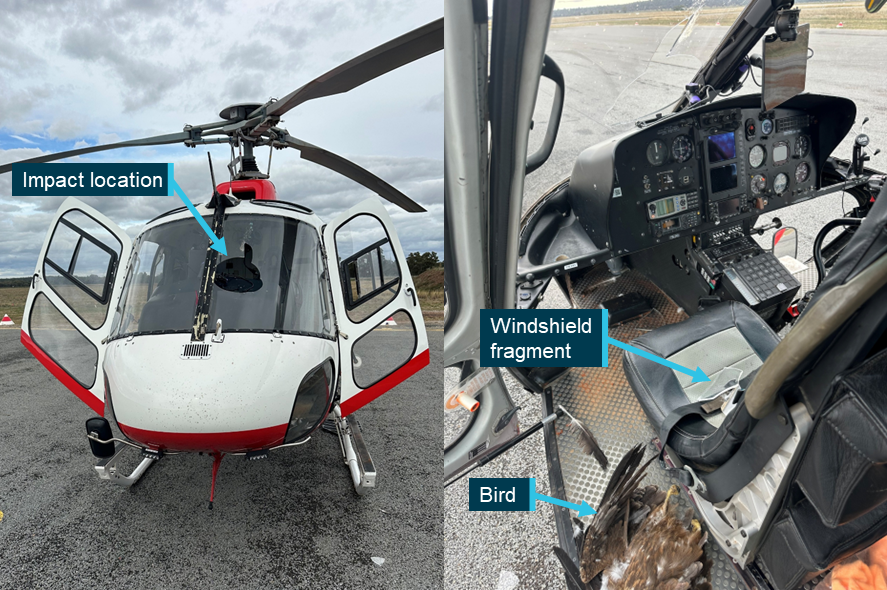
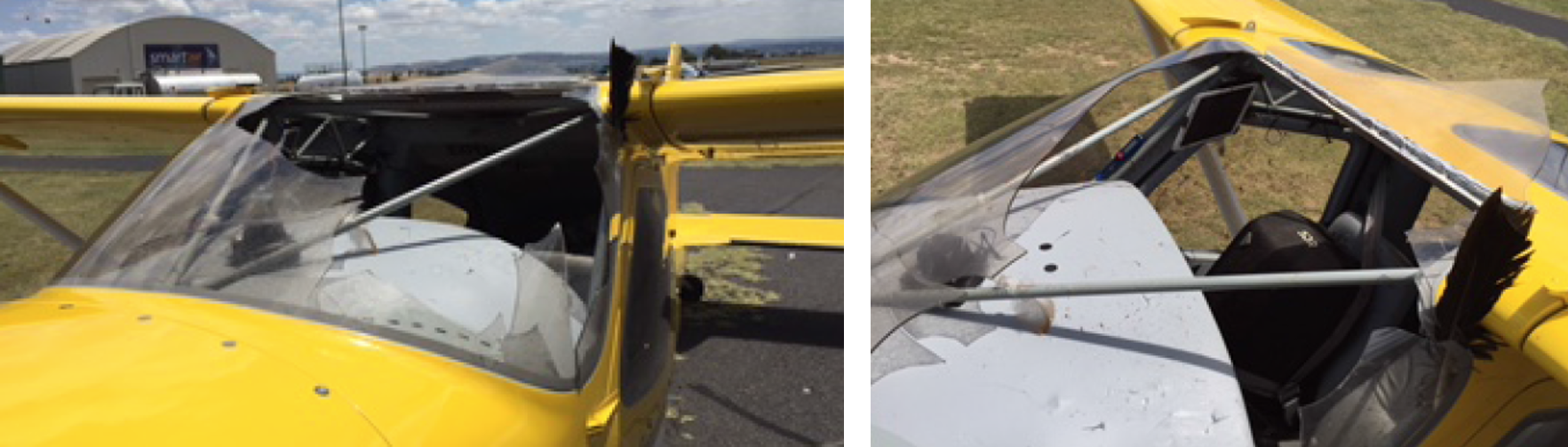
On the early afternoon of 23 May 2026, the pilot of an Airbus Helicopters AS350 B3 was ferrying the helicopter from a work location in Griffith to the operator’s base in Jindabyne, New South Wales. The pilot reported that the helicopter was established in cruise flight around 1,370 ft above mean sea level (AMSL) and at an airspeed of around 120 kt in clear conditions, when a previously unseen bird impacted at the centre of the left windshield. The windshield locally ruptured upon impact, with the bird and fragments of windshield passing into the cockpit and coming to rest on, and next to, the vacant left front (copilot’s) seat. The bird, reported to be a juvenile Black Kite, was killed on impact, which left an irregular hole of around 30 cm diameter in the windshield.
Figure 1: Exterior (L) and interior (R) damage sustained
Source: Operator, annotated by the ATSB
Immediately slowing the helicopter to 40 kt, the pilot checked and confirmed all controls were operating normally, before diverting south to Narrandera Airport for a precautionary landing.
The pilot (the only occupant) was uninjured during the event.
Safety action
The operator advised that the incident was discussed during a safety meeting with all staff. Replacement of the existing acrylic windshields with impact-resistant polycarbonate parts was also being considered for all helicopters in the operator’s fleet – subject to availability for the AS350 models.
Safety message
Occurrences involving aircraft striking wildlife, particularly birds, continue to be the most common aviation occurrence reported to the ATSB.
Encounters between birds and helicopters are inherently riskier than with fixed wing aircraft, due primarily to the sensitivity to damage of the rotor systems and the forward exposure of the cockpit and controls (with larger areas of unreinforced windshield).
Operations at lower altitudes and higher airspeeds further increase the risk of injurious impacts.
The ATSB has recorded 443 birdstrike occurrences involving helicopters in the 10 years 2016 to 2025. Of these, 4 resulted in accidents and 3 in serious incidents.
Data for the summary shown in Table 1 was drawn from the ATSB’s National Aviation Wildlife Strike Dashboard. Aircraft operators and crew are encouraged to review the information contained therein for relevance and reference to their own operations.
Table 1: Summary of accident and serious incidents – helicopter birdstrikes 2015–2025
Date
[Occurrence No.]
Make & model
Classification & damage
Summary text
[Investigation No. where applicable]
29/02/2016
[OA2016-00288]
Robinson R22
Accident,
Destroyed
During low level aerial mustering, the pilot detected severe tail rotor vibration and immediately landed the helicopter. The helicopter landed in long grass which subsequently ignited, destroying the helicopter in the ensuing fire. It was subsequently determined that the severe vibrations were caused by a large bird (bush turkey) that had collided with the tail rotor.
19/01/2019
[OA2019-00308]
Robinson R22
Accident,
Substantial
During landing, the helicopter's tail rotor struck a pelican and the pilot lost directional control. The helicopter subsequently rolled over resulting in substantial damage.
22/06/2021
[OA2021-03932]
Bell 206
Serious Incident, Nil
During initial climb, the pilot received a low inlet pressure engine warning. Shortly after, the pilot heard a loud bang with associated loss of power and conducted an auto‑rotation landing. The engineering inspection revealed an animal was ingested into the engine.
09/07/2022
[OA2022-02585]
Bell 206
Accident, Destroyed
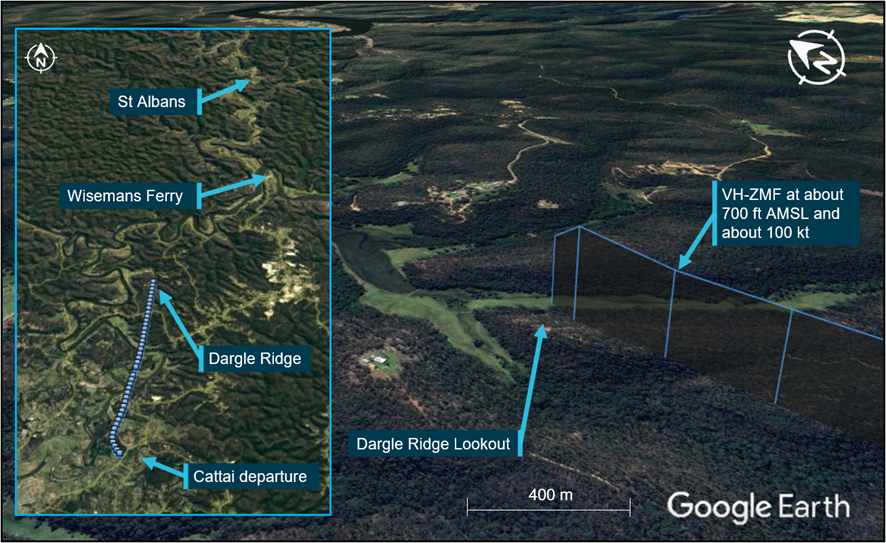
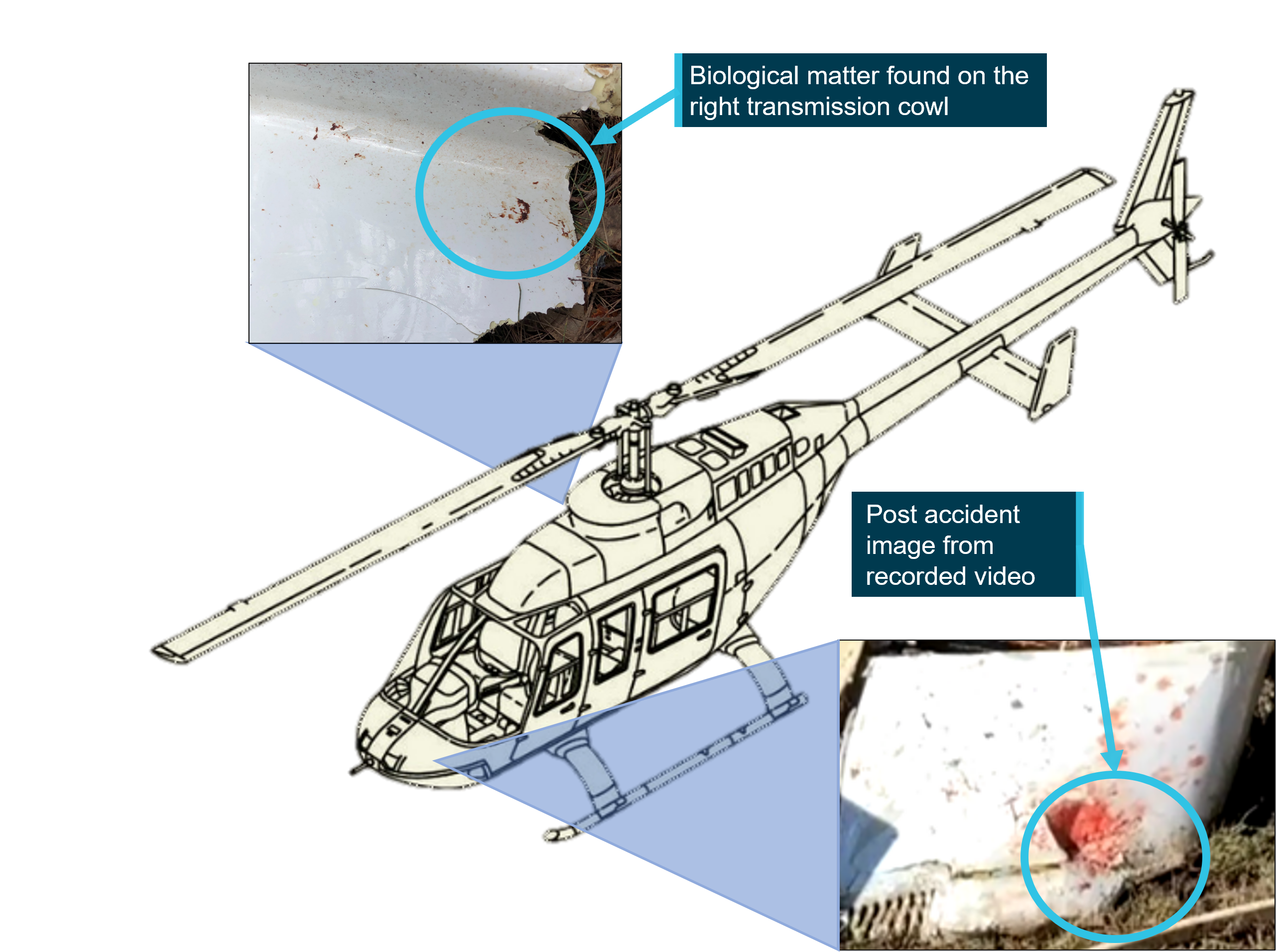
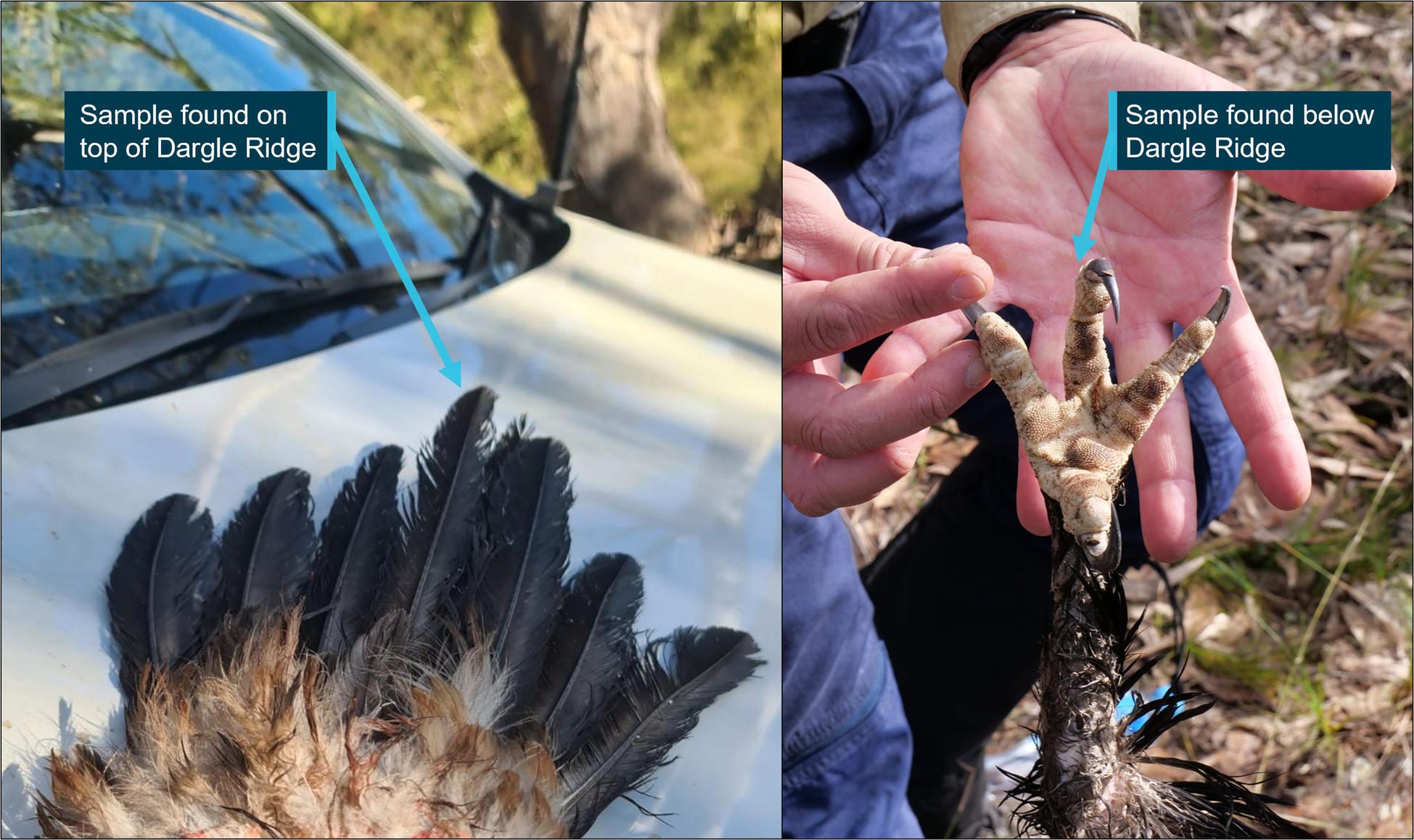
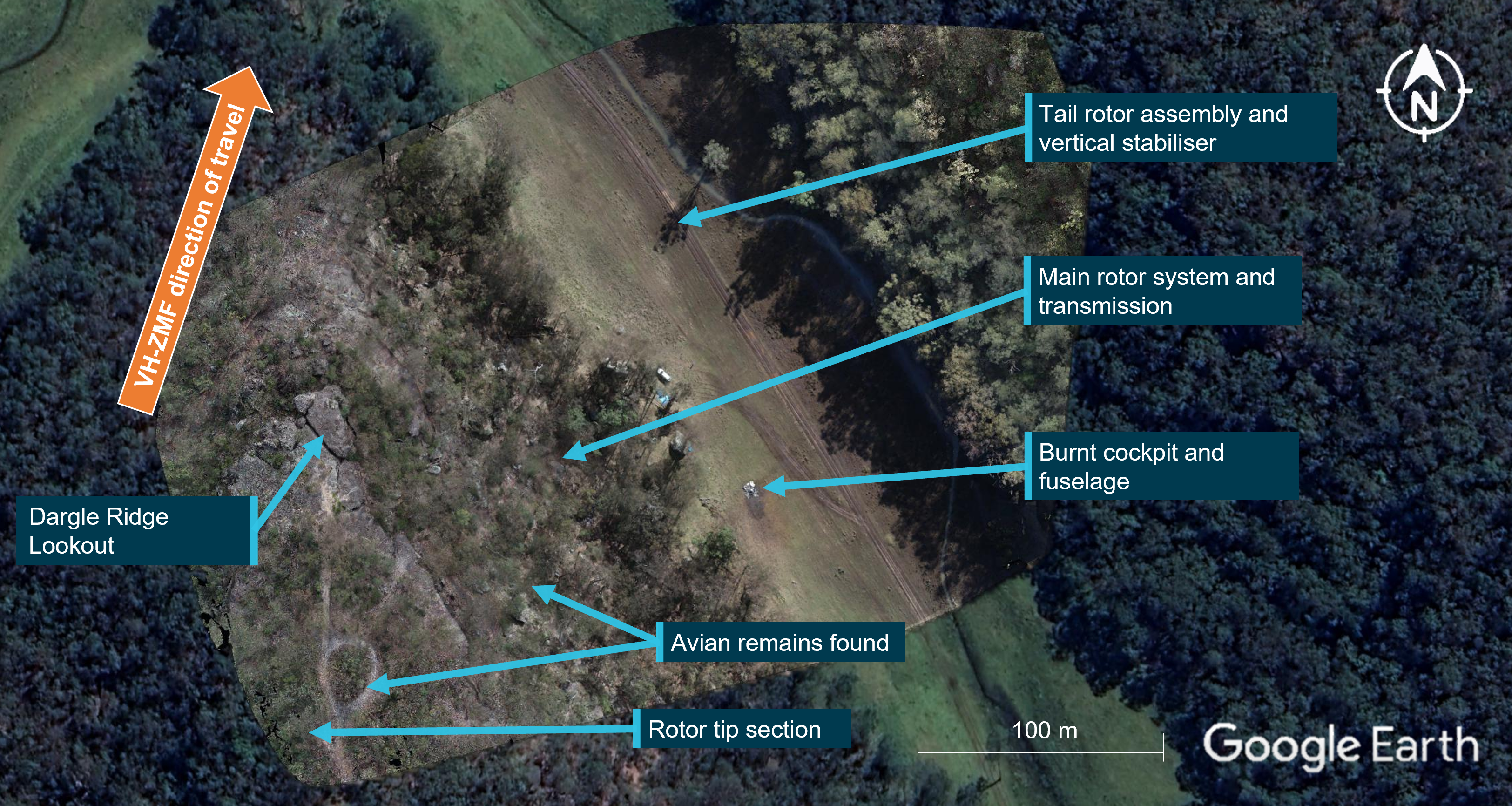
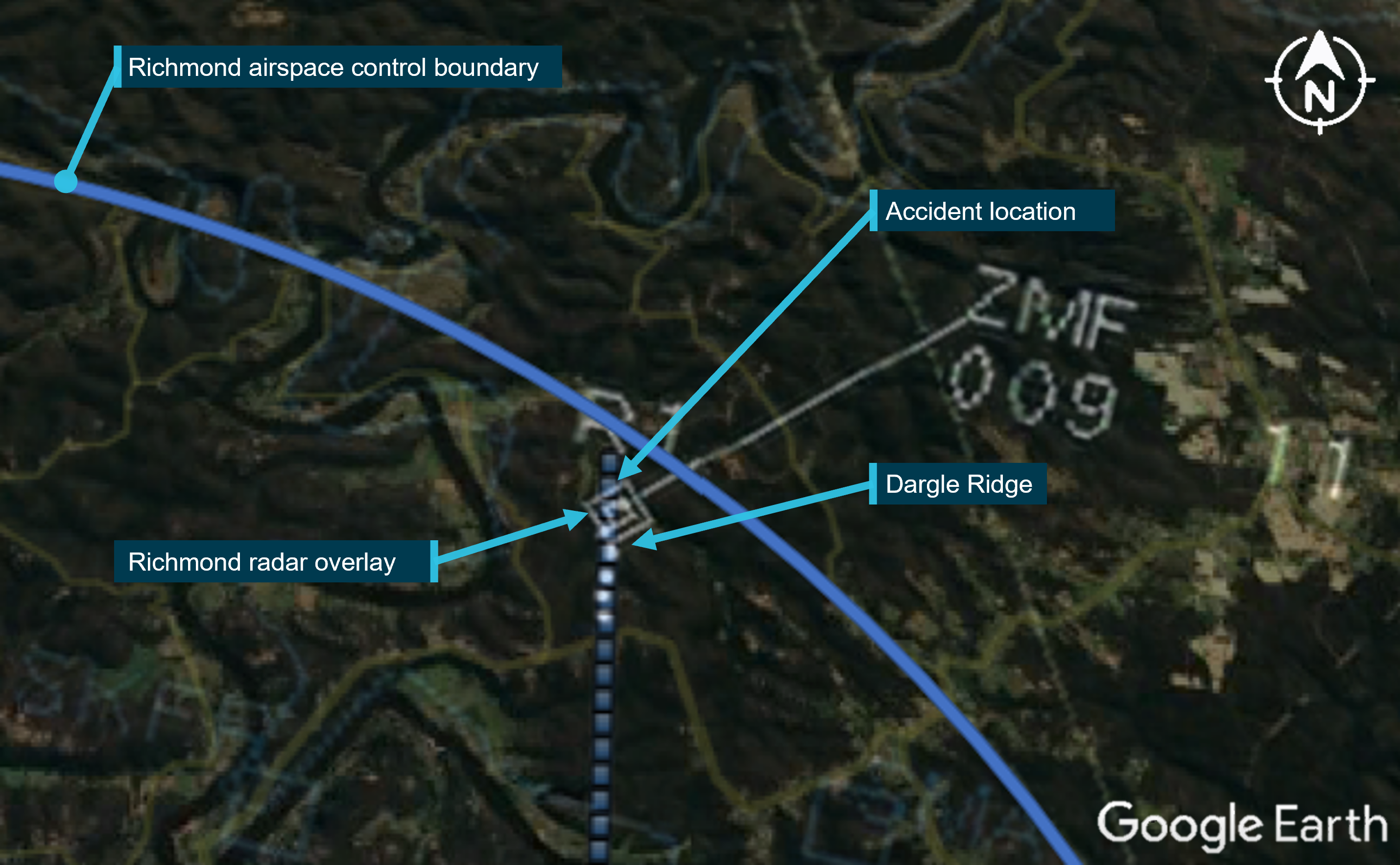
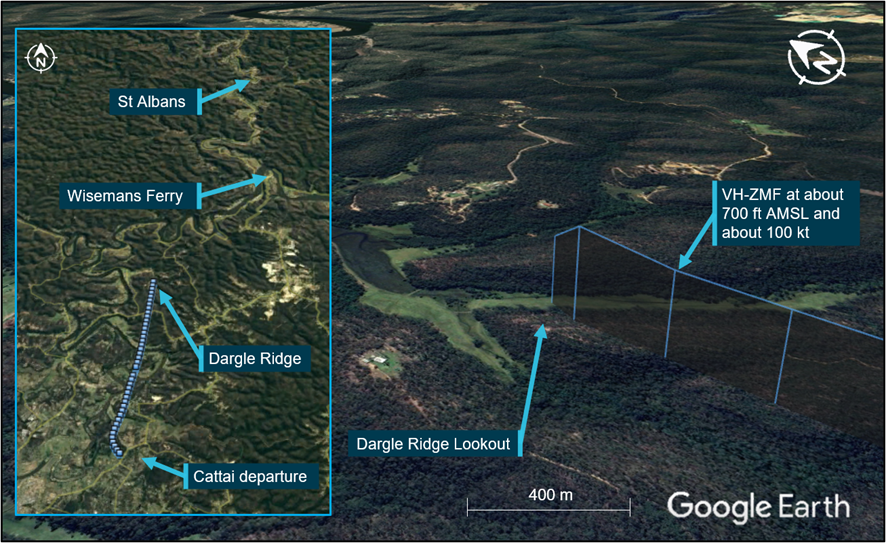
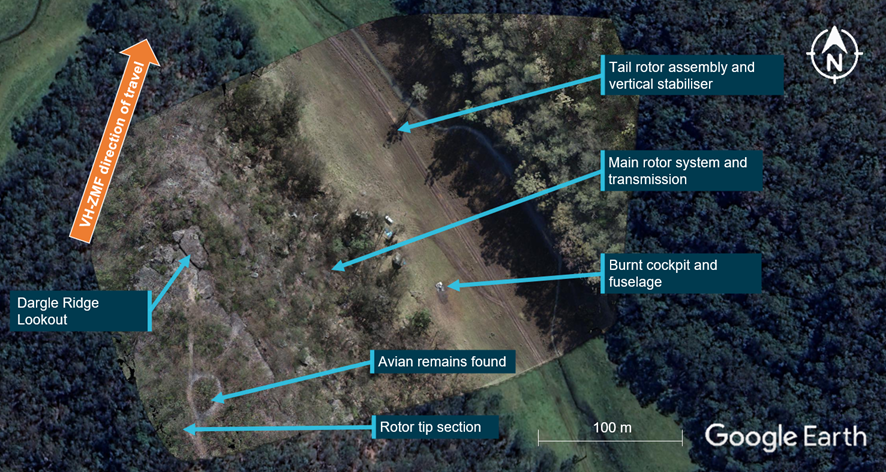
On the morning of 9 July 2022, a Bell 206 L-1, registered VH-ZMF departed a private helipad at Cattai, NSW, for a private flight. About 9 minutes later, the helicopter impacted terrain about 10 km to the north of the departure point. The helicopter was destroyed, and the pilot, who was the sole occupant, was fatally injured. [AO-2022-034] + [News Article]
29/09/2022
[OA2022-04004]
Robinson R44
Serious Incident, Minor
During approach, the aircraft struck an eagle resulting in minor damage.
03/12/2022
[OA2022-04514]
Bell 429
Serious Incident, Minor
During cruise, the aircraft struck an ibis resulting in minor damage.
14/07/2025
[OA2025-01429]
Bell 206
Accident, Minor
On the morning of 14 July 2025, a Bell 206L-3 helicopter, registered VH-JMM, was being operated on multiple passenger charter flights around the Arnhem region in the Northern Territory. On board was a pilot and one passenger.
During the fourth leg of the day at approximately 1338, while looking down and to the left out of the helicopter, the pilot heard a loud bang. The pilot saw a large bird laying between the 2 occupants, and what appeared to be serious injuries to the passenger’s upper body. The pilot reached over to the passenger to check for a pulse but was unable to feel one. Noting the passenger required immediate attention, they decided it would be better for the passenger to receive medical attention at Lake Evella Aerodrome where a police station was next to the airport.
Police, a local nurse and doctor attended to the passenger, however the passenger had succumbed to injuries. The helicopter sustained minor damage. [AO‑2025-039] + [News Article]
Decisions regarding whether to conduct an investigation, and the scope of an investigation, are based on many factors, including the level of safety benefit likely to be obtained from an investigation. For this occurrence, no investigation has been conducted and the ATSB did not verify the accuracy of the information. A brief description has been written using information supplied in the notification and any follow-up information in order to produce a short summary report, and allow for greater industry awareness of potential safety issues and possible safety actions.
^This represents a height of around 713 ft above ground level at the location where the strike occurred.
Occurrence summary
Mode of transport
Aviation
Occurrence ID
AB-2026-032
Occurrence date
23/05/2026
Location
5.8 km north of Narrandera Airport
State
New South Wales
Occurrence class
Serious Incident
Aviation occurrence category
Birdstrike, Diversion/return, Windows
Highest injury level
None
Brief release date
22/06/2026
Aircraft details
Manufacturer
Airbus Helicopters
Model
AS350 B3
Sector
Helicopter
Operation type
Part 138 Aerial work operations
Activity
General aviation / Recreational – Other general aviation flying – Ferry flights
On the morning of 14 July 2025, a Bell 206L-3 helicopter, registered VH-JMM, was being operated on multiple passenger charter flights around the Arnhem region in the Northern Territory. On board was a pilot and one passenger.
During the fourth leg of the day at approximately 1338, while looking down and to the left out of the helicopter, the pilot heard a loud bang. The pilot saw a large bird laying between the 2 occupants, and what appeared to be serious injuries to the passenger’s upper body. The pilot reached over to the passenger to check for a pulse but was unable to feel one. Noting the passenger required immediate attention, they decided it would be better for the passenger to receive medical attention at Lake Evella Aerodrome where a police station was next to the airport.
Police, a local nurse and doctor attended to the passenger, however the passenger had succumbed to injuries. The helicopter sustained minor damage.
What the ATSB found
While cruising at about 900 ft AMSL, the helicopter struck a white bellied sea eagle which passed through the windshield and impacted the passenger.
The pilot had limited opportunity to detect the bird as they were looking down and to the left of the helicopter’s trajectory, reducing the pilot’s ability to see the bird and change the helicopter’s flight path in time, and likely rendering the collision unavoidable under the circumstances.
The passenger was not wearing a helmet at the time, nor was there an aviation regulatory requirement for them to do so. In this case, the location of the bird strike on the passenger was such that wearing a helmet probably would not have reduced the level of injury.
Safety message
Birdstrike is an almost unavoidable and relatively common hazard for all aviation operations. While these strikes typically result in minor or no damage to an aircraft and no injuries to occupants, this is the third fatal birdstrike accident in Australia in recent years.
Pilots are reminded that maintaining effective lookout will assist in maintaining better situational awareness in flight, and also assist in providing better outcomes to see‑and‑avoid not only birds, but other airspace users.
Additionally, pilots should maintain situational awareness, especially when flying over waterways or wetlands. It is relatively common for large birds, such as eagles, hawks, and gulls, to attack helicopters and drones, often perceiving them as threats or territorial intruders. These birds may display aggressive behaviour during nesting or breeding seasons, diving at or striking the aircraft in an attempt to drive it away. Helicopter operators should consider whether available occupant protections, such as the wearing of flight helmets and the fitment of impact-resistant aircraft windshields, are appropriate for their operations.
The investigation
The ATSB scopes its investigations based on many factors, including the level of safety benefit likely to be obtained from an investigation and the associated resources required. For this occurrence, the ATSB conducted a limited-scope investigation in order to produce a short investigation report, and allow for greater industry awareness of findings that affect safety and potential learning opportunities.
The occurrence
On the morning of 14 July 2025, a Bell 206L-3 helicopter, registered VH‑JMM, was being operated by Nautilus Aviation on multiple air transport (passenger charter) flights around the Arnhem region in the Northern Territory. On board was a pilot and a passenger.
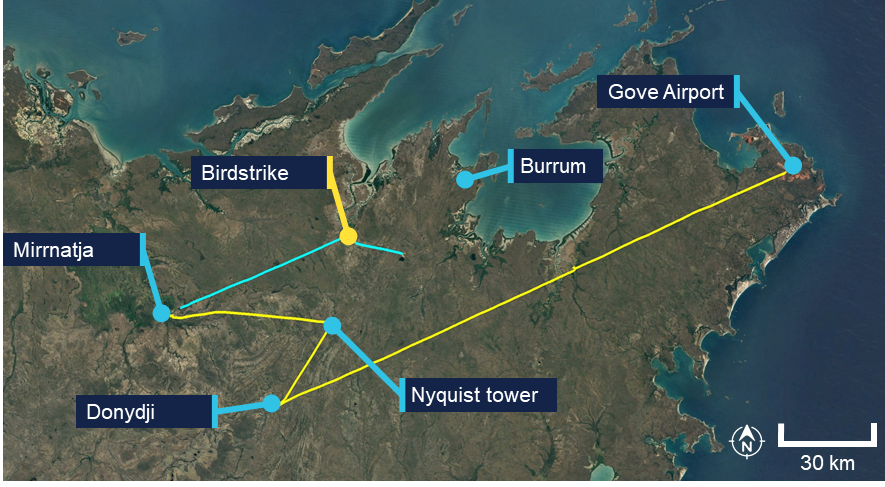
At approximately 0928 local time the helicopter departed Gove Airport for Donydji. The pilot reported that from Donydjii, they flew to ‘Nyquist tower’[1] and then on to Mirrnatja before departing for Burrum, which would be the last stop of the day before returning to Gove (Figure 1).
Figure 1: Flight path overview
Source: Google Earth, annotated by the ATSB
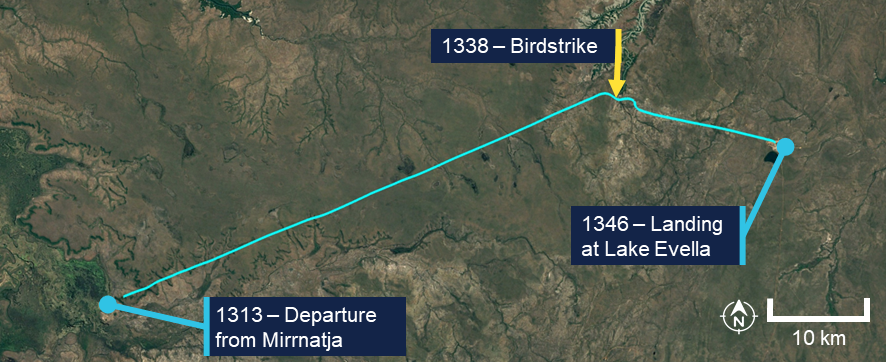
The flight departed for Burrum at 1313 (Figure 2) and the pilot established a cruise altitude of about 900 ft above ground level. The pilot recalled having a conversation with the passenger about a waterway which they were flying near, and was familiar to the passenger. The pilot recalled slightly deviating off track to view the waterway. At approximately 1338, while looking down to the left out of the aircraft, the pilot recalled hearing a loud bang.
The pilot saw a large bird laying between the 2 occupants, and what appeared to be serious injuries to the passenger’s upper body. The pilot reached over to the passenger to check for a pulse, but was unable to feel one. Noting the passenger required immediate attention, the pilot deliberated whether to land nearby and attempt resuscitation, and initially began to descend. However, considering the logistical issues with getting medical attention in a remote location, they decided it would be better for the passenger to receive medical attention at Lake Evella Aerodrome where a police station was next to the airport.
Figure 2: Accident flight overview
Source: Google Earth, annotated by the ATSB
The pilot landed the helicopter at Lake Evella Aerodrome at approximately 1346. They stated they attempted to call emergency services on 000, however the call did not connect. They decided not to attempt the call a second time and ran to the police station for assistance instead.
Police, a local nurse and doctor attended to the passenger, however the passenger had succumbed to injuries. The aircraft sustained minor damage (see Helicopter damage).
Context
Pilot information
The pilot held a valid Class 1 Aviation Medical Certificate and a Commercial Pilot Licence (Helicopter). The pilot had accumulated 2,553 hours of aeronautical experience, of which 1,319 hours was on the Bell 206L.
The pilot had been with the operator since September 2024 and had regularly flown these routes to remote communities as part of their employment.
Passenger information
The passenger was a frequent passenger on the routes operated on the day and had travelled by helicopter regularly to remote communities as part of their employment since 1995.
The pilot reported to having flown this passenger to remote communities on multiple occasions. Familiar with the aviation environment, the pilot reported the passenger would assist with monitoring for birds during flights, as they were aware they presented a hazard in flight.
The post-mortem examination report indicated the passenger was hit between the lower jaw and the upper chest, sustaining fatal injuries to the neck, chin, lower jaw and the right side of the chest.
Helicopter information
General
VH-JMM was a Bell Helicopter Company B206L‑3 Long Ranger, S/N 51400, manufactured in Canada in 1990. It was first registered in Australia in June 2017. The aircraft was registered to the operator in January 2024.
VH-JMM was a helicopter with two‑bladed main rotor and tail rotor systems, powered by a single Rolls-Royce 250‑C30P gas turbine engine.
At the time of the accident, the helicopter had completed 13,250 hours in service and had a current maintenance release.
Helicopter damage
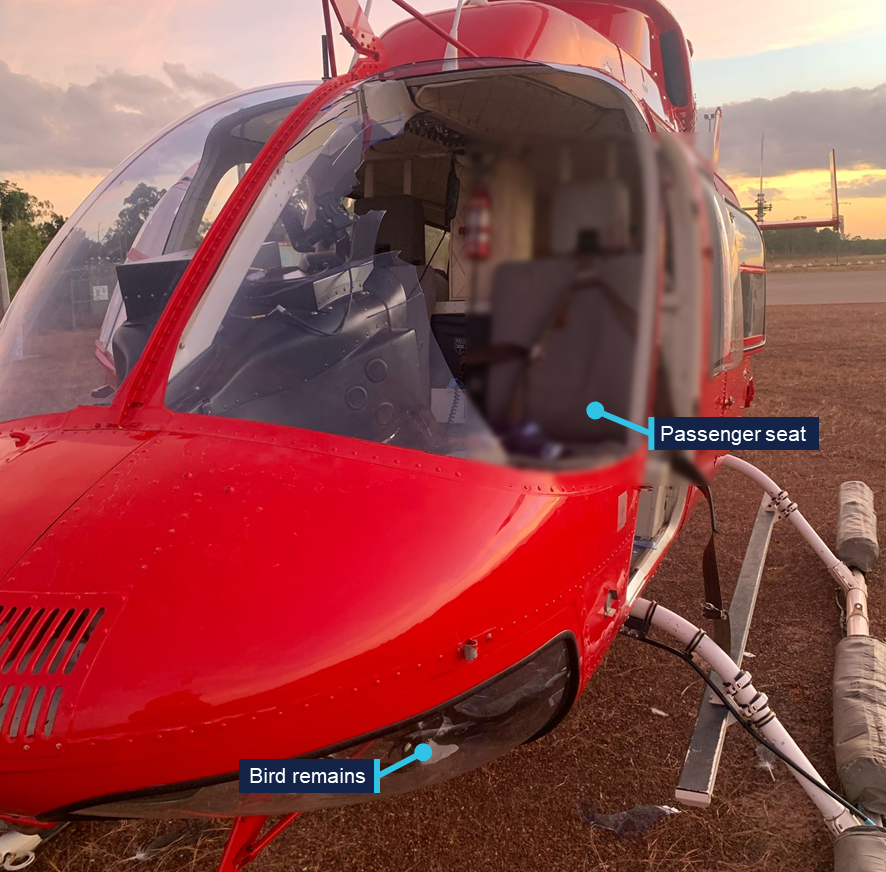
The helicopter sustained damage to the passenger side windshield. There was no other reported damage to the aircraft (Figure 3).
Figure 3: Helicopter damage
Source: Northern Territory Police Force, annotated by the ATSB
Helicopter windshields
VH-JMM was fitted with standard acrylic windshields, which were not rated for impact resistance.
In 2016 Bell Helicopter Company introduced polycarbonate windshields, through a supplemental type certificate (STC) for the Bell 206 series, including the 206L. These were available as an additional option for current owners, offering higher impact resistance compared to traditional acrylic, reducing the risk of breaches from birdstrikes or other impacts. These were rated to United States regulatory requirements of a 2.2 lb (1 kg) bird traveling at VNE (the helicopter’s never-exceed speed).[2]
Despite having a higher impact resistance than acrylic, polycarbonate windshields are more sensitive to scratches, and reportedly susceptible to clouding or hazing due to ultraviolet light exposure, resulting in loss of optical clarity and necessitating more frequent replacements.
Weather information
The terminal aerodrome forecast for the accident region forecasted clear conditions for the flight with scattered cloud above 3,500 ft and visibility greater than 10 km.
At 1530, the weather station at Elcho Island Airport, 48 km north of the accident location, recorded the wind as 4 kt from 110° magnetic. There was scattered cloud at 1,000 ft, visibility was greater than 10 km and the temperature was 23°C.
The pilot reported that the weather varied depending on where they were flying, however it was mostly clear with some areas of cloud. They reported the clouds were above their cruise height.
Recorded data
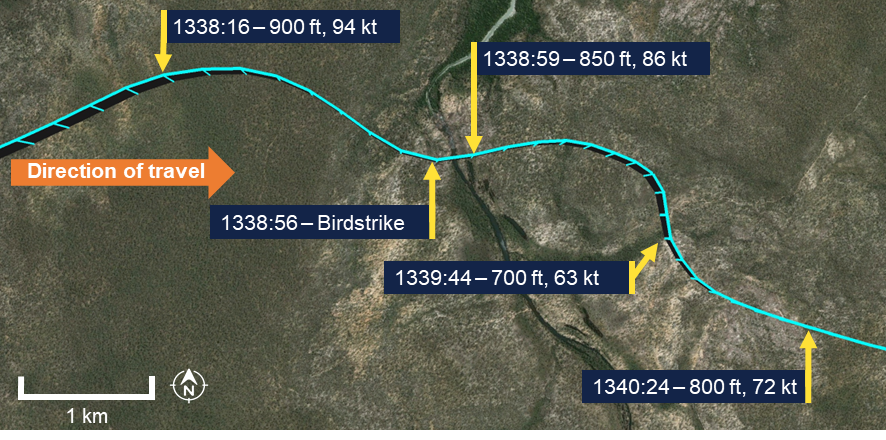
The aircraft was fitted with a Spidertracks flight tracking unit and the pilot used OzRunways electronic flight bag software; both recorded flight data. Flight data indicated that the aircraft was cruising at 900 ft above ground level at a groundspeed of 94 kt at the approximate time the bird was struck. The data showed an initial deceleration to 86 kt groundspeed and a decrease in altitude of 50 ft, followed by a secondary decrease in altitude of approximately 150 ft (likely associated with the pilot’s consideration of whether to land). The track showed that the helicopter then climbed to 800 ft and increased groundspeed to about 70 kt (Figure 4).
Figure 4: Recorded flight track
Source: Google Earth, annotated by the ATSB
Bird information
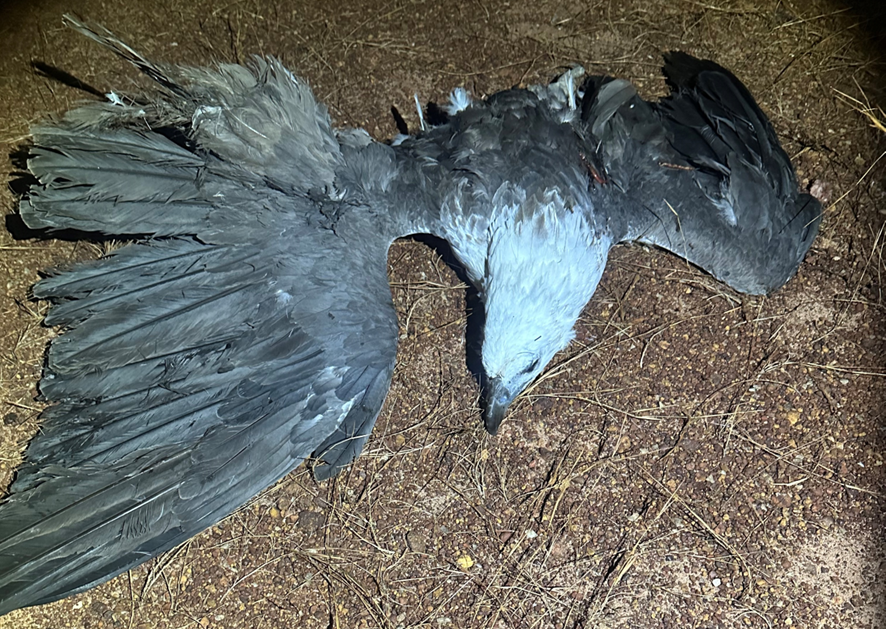
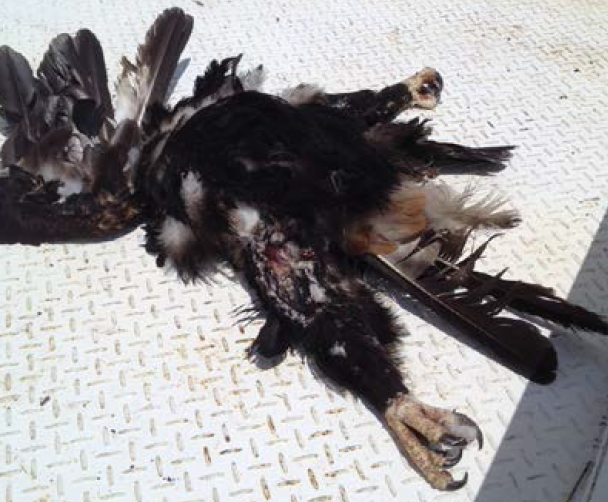
Recovered biological specimens of the bird, including wing feathers and residue from the carcass, were found both inside the helicopter and on the passenger. Through images of the bird, the ATSB determined the species to be a white‑bellied sea eagle.
The white-bellied sea eagle (Haliaeetus leucogaster) (Figure 5) is a large raptor commonly found in coastal regions of Australia, recognised for its distinctive white head, belly, and tail contrasted by dark greyish‑brown wings and back. Adults measure approximately 66–85 cm in length, with a wingspan of 1.8–2.2 m (Debus, 2017). Adult males typically weigh between 1.8–3 kg, while females average 2.5–4.5 kg (Marchant & Higgins, 1993). The weight and sex of the bird in this accident was unknown.
Figure 5: Some of the bird remains retrieved from the helicopter
Source: Northern Territory Police Force
These eagles are often observed soaring over coastlines, estuaries, or inland waterways, preying on fish, seabirds, or carrion, and can reach heights of up to 1,000 m (about 3,300 ft) (Ferguson‑Lees & Christie, 2001). Their activity increases during the June to January period in Australia, which is their breeding season (Debus, 2017).
It is relatively common for large birds, such as eagles, hawks, and gulls, to attack helicopters and drones, often perceiving them as threats or territorial intruders. These birds may display aggressive behaviour during nesting or breeding seasons, diving at or striking the aircraft in an attempt to drive it away (Washburn & others, 2015).
Limitations of see-and-avoid
The human visual system is inherently limited in detecting small objects such as birds at distances. Hobbs (1991) notes that effective visual scanning requires systematic eye movements across the visual field, yet pilots often employ unsystematic techniques, resulting in unsearched areas. Furthermore, the cognitive process of identifying a threat, assessing its collision risk, deciding on evasive action, and executing control inputs requires time that is often unavailable in low‑altitude, high‑speed scenarios.
Birds present unique challenges to the see‑and‑avoid principle due to their relatively small size, unpredictable flight paths, and speed difference compared with aircraft.Unlike aircraft, birds cannot be tracked electronically, meaning pilots must rely solely on visual identification.
Survivability
Restraints
The helicopter was fitted with 4‑point harnesses in the front seats. The pilot reported both they and the passenger had been fastened into the seats by the aircraft’s 4‑point harnesses.
Helmets
The pilot reported wearing a flight helmet[3] and reported wearing a helmet whenever possible, noting that helmets had saved lives in the past. The pilot recalled previously having a discussion with the passenger about helmets and the benefits of them.
The passenger was not wearing a helmet at the time, nor was there an aviation regulatory requirement for them to do so. Nautilus Aviation stated that there was no requirement for passengers to wear a helmet and the decision on their use rested with the passengers themselves or their employers.
Telstra helicopter charters
The passenger was on board the aircraft as part of their work for Telstra, a telecommunications company. Telstra reported that its employees took about 630 helicopter charters on average per year, a mix of passenger charter (transit) and aerial work.
The employer had an operational framework for chartering aircraft that addressed many risks typically associated with helicopter flights, outlining expectations for the aircraft operator. These included the requirement for the aircraft operator to perform a risk assessment ‘prior to the first flight of any new operation by the Charter operator.’
Telstra did not have prescribed or recommended personal protective equipment for employees travelling or working on helicopters. Telstra advised that it relied on the licenced and accredited aviation providers that it engages to advise on safety of flight aspects including the use of personal protective equipment (PPE).
Related occurrences
Global data
Birdstrikes are a recognised hazard in aviation and there are mitigators in place at certified airports, however, there are challenges when operating outside of these areas.
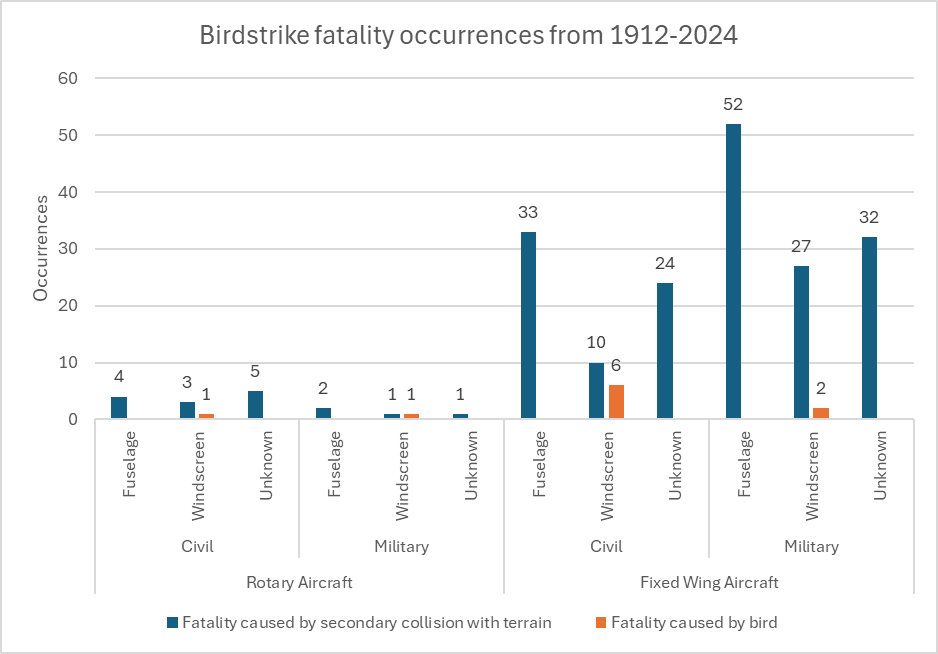
A review of Australian and internation data was conducted using the Avisure serious accident database. Between 1912 and 2024, birdstrikes have resulted in 763[4] reported aviation occurrences worldwide that involved serious or fatal injuries, of which 204 were fatal. Among these fatal cases, 18 involved rotary‑wing aircraft such as helicopters. These 18 accidents comprised 13 civil and 5 military rotary‑wing aircraft (Figure 6).
Figure 6: Global birdstrike data resulting in fatalities
Data does not include this occurrence (AO-2025-039). Source: Avisure
United States data
In the United States, a total of 13,667 bird strike occurrences were reported to the Federal Aviation Administration (FAA) in operations involving aircraft (fixed-wing and rotary-wing) under 5,700 kg maximum take‑off weight from 2014 to 2024. Of these, 60 occurrences resulted in non-fatal injuries, and 11 were fatal.
A subset of 334 occurrences involved birds striking and damaging the aircraft windshield, with 48 of these occurrences (14.4%) resulting in serious injuries and 6 (1.8%) leading to fatal injuries.
Of the total, 3,001 occurrences involved rotary-wing aircraft, which equated to a birdstrike every 285,390 flight hours (Table 1). These included 201 recorded windshield strikes, that resulted in 28 (13.9%) serious injuries and 2 (1.0%) fatalities.
Flight hours per birdstrike to windshield resulting in damage
Australia
412
39,690
8,819
United States
3,001
285,390
19,026
In comparison to the most frequently struck aircraft component, the wings, with 1,171 occurrences, only 6 (0.5%) resulted in injuries including 1 with fatal injuries (0.09%), indicating that the proportion of serious and fatal outcomes from windshield strikes is unexpectedly high relative to other aircraft parts.
Australian data
Birdstrikes in Australia
Between 2014–2024 the ATSB aviation wildlife dashboard indicated there were 17,060 reported birdstrikes reported to the ATSB across all aircraft types (including fixed‑ and rotary-wing). There were 412 reported birdstrikes during helicopter operations (Table 2), which equated to a birdstrike every 39,690 flight hours. The data did not include what component was struck unless the component was damaged, so it was not possible to determine the proportion of windshields struck that were penetrated or damaged. Of the 412 reported birdstrikes to helicopters, 17 had damage to the windshield.
Table 2: Reported helicopter birdstrikes within Australia 2014–2024
Total reported incidents
Injury level
Aircraft damage
Nil
Minor
Fatal
Nil
Minor
Substantial
Destroyed
Unknown
412
411
0
1[1]
352
37
2
2
19
This figure does not include this occurrence
ATSB records indicate there were 2 fatal accidents in civil aircraft in Australia due to birdstrike. Additionally, there was 1 serious accident involving a bird entering through the windshield. These investigations are described in the following subsections.
Birdstrike involving Glasair Sportsman GS‑2, N666GM, near Bathurst, New South Wales, on 24 December 2015 (AO-2016-001)
During take-off the aircraft collided with a wedge‑tailed eagle (Aquila audax), penetrating the windscreen and causing significant damage to the propeller and engine, while also striking the pilot, who sustained serious facial injuries and was temporarily unable to see. The pilot, who was wearing a headset and spectacles (both dislodged and damaged during the impact), managed to land safely.
Birdstrike and in-flight break-up involving a Bell 206L‑1, VH‑ZMF, near Maroota, New South Wales, on 9 July 2022 (AO‑2022‑034)
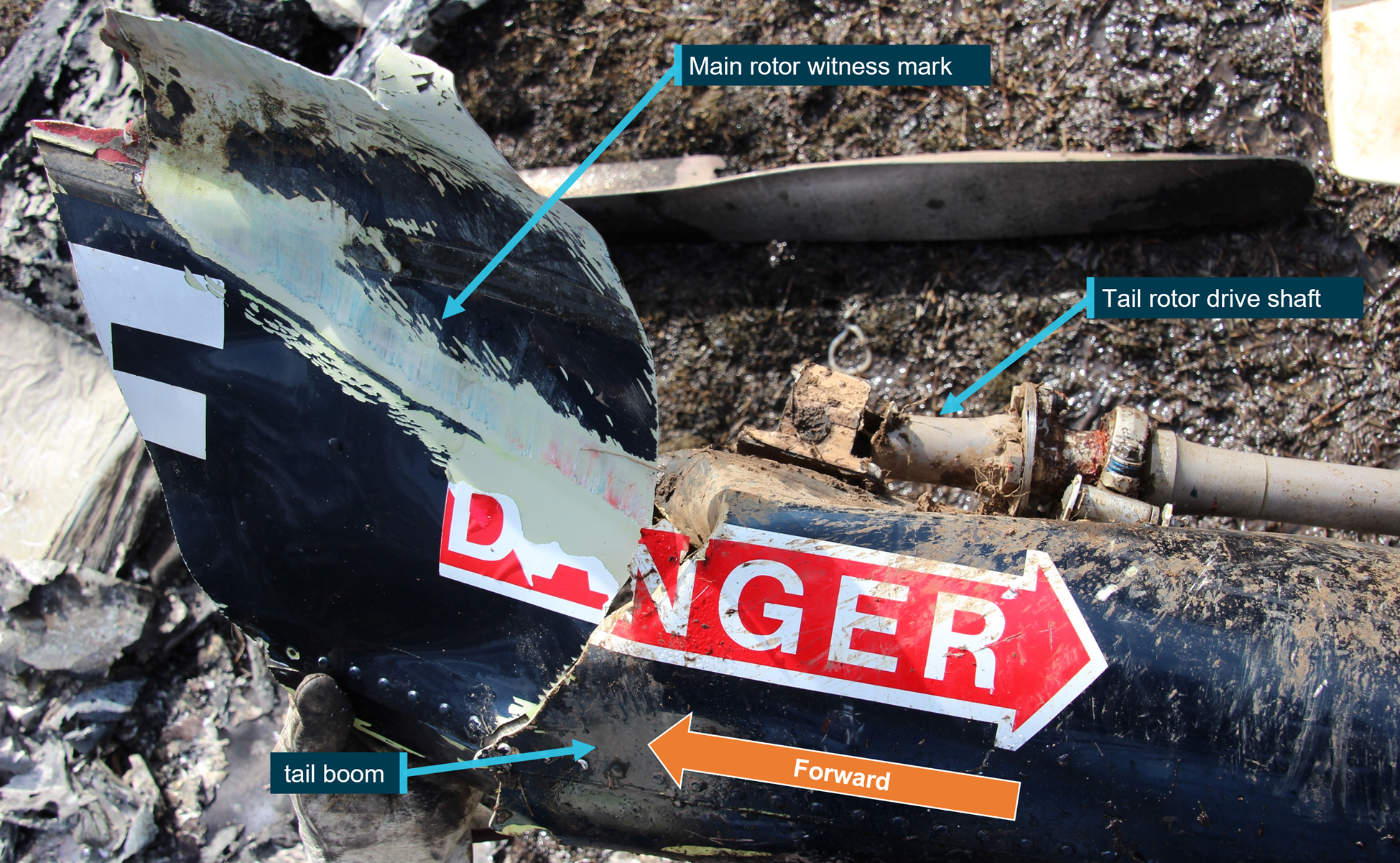
Shortly after departing from a private helipad, the helicopter was struck by a wedge‑tailed eagle (Aquila audax) just below the front left windscreen. The pilot, likely startled by the birdstrike and distracted by sun glare and a required radio frequency change, made abrupt control inputs that caused the main rotor to sever the tail boom, resulting in an in‑flight breakup and collision with terrain. The pilot, who was the sole occupant, was fatally injured.
Birdstrike and collision with terrain involving Air Tractor AT‑502B, VH‑KDR, 32 km east‑north‑east of Chinchilla Airport, Queensland, on 19 September 2022 (AO‑2022‑043)
During low-level aerial spraying at about 8 feet above ground, the aircraft was struck by a large Australian bustard (Ardeotis australis), which shattered the right windshield. The bird entered the cockpit, likely impairing the pilot’s ability to control the aircraft. The aircraft continued for approximately 310 m before colliding with terrain, resulting in the pilot being fatally injured and destruction of the aircraft.
Safety analysis
Birdstrike
Images from the accident site showed that the aircraft collided with a white‑bellied sea eagle (Haliaeetus leucogaster). The pilot had limited opportunity to detect the bird as they were looking down and to the left of the helicopter’s trajectory, so it was probably in their peripheral vision where detection of small objects is very limited. Even if they had been looking ahead at the time, they may not have been able to see the bird in time to avoid it due to the inherent limitations of the see-and-avoid principle. The closure rate to the soaring bird would have been around 94 kt and the difference in speed between them would have also made the relative trajectory almost direct. These factors further reduced the pilot’s ability to see the bird and change the helicopter’s flight path in time, likely rendering the collision unavoidable under the circumstances.
Considerations for aircraft operators and employers
Windshield impact resistance
The analysis of bird strike data highlights the significant safety risks posed to windshields. In windshield impacts in the United States, 14.4% caused serious injuries and 1.8% caused fatalities. Australia’s occurrences included 3 fatal and 3 serious injuries. Comparison of the United States and Australian data indicated that there was a higher chance of both birdstrike and the strike resulting in windshield damage per flight hour in Australia.
There is an elevated risk for helicopter operations due to low‑altitude operations and often less robust windshield designs. This is because if a bird penetrates the windshield, it can directly impact occupants, causing injury or incapacitation of flight crew, which may lead to loss of aircraft control or further operational hazards. While advancements in windshield design, such as laminated materials and reinforced structures, have mitigated many impacts, the data highlights vulnerabilities in extreme cases.
Manufacturers like Robinson and Bell have both released birdstrike‑rated windshields that provide higher impact resistance and significantly decrease the likelihood of objects breaching the windshield upon impact. However, these windshields have been rated to withstand a 1 kg bird strike at the aircraft’s never‑exceed speed, and the occurrence scenario involving a 3 kg bird colliding with the helicopter would likely exceed the windshield’s design limits. Nevertheless, and noting there are some disadvantages of impact‑resistant windshields, operators are encouraged to consider installing impact‑resistant windshields if operating in areas with a high probability of birdstrike.
Helmets
Helicopter pilots often wear helmets as a safety measure due to their frequent exposure to the dynamic conditions of rotary‑wing flight, where turbulence, rapid manoeuvres, and potential accidents pose risks of head injury. In contrast, passengers often do not wear helmets, as the risk is lower for occasional travellers, particularly considering the other safety measures associated with commercial passenger transport operations.
Passengers who travel frequently in helicopters fall between these 2 extremes. They are naturally exposed to a higher risk (over the occasional passenger) simply due to the increased number of flights. While the pilot reported being a helmet advocate and had previously discussed the potential benefits with the passenger, the decision whether to wear a helmet was ultimately left to the passenger’s discretion.
Helmets provide an additional layer of protection against birdstrikes, particularly in aviation scenarios like the Glasair Sportsman GS‑2 incident (AO‑2016‑001). A helmet, often equipped with a sturdy visor, can shield the face and head from small‑object impacts, reducing the risk of injury from a shattered windshield. Additionally, a helmet, especially one designed for aviation, is engineered to absorb and disperse kinetic energy from impacts with larger objects such as a bird potentially mitigating the severity of injuries like those sustained by the pilot of the Glasair, who was not wearing a helmet and suffered serious facial injuries. The helmet’s hard outer shell and padded inner liner work together to reduce the force transmitted to the skull, significantly lowering the risk of traumatic brain injuries, concussions, or skull fractures.
A helmet would not have prevented the passenger’s injuries in this case due to the impact location. Nevertheless, wearing a helmet as standard practice would provide some protection against a range of other potential hazards.
Pilot response
The pilot maintained control of the aircraft despite the sudden disruption and potential aerodynamic effects of the compromised windscreen. They promptly identified the nearest suitable landing site with access to medical facilities and executed a controlled descent and landing.
The pilot’s effective response and adherence to emergency procedures ensured the injured passenger was positioned for immediate medical response, highlighting sound decision‑making under extreme circumstances.
Findings
ATSB investigation report findings focus on safety factors (that is, events and conditions that increase risk). Safety factors include ‘contributing factors’ and ‘other factors that increased risk’ (that is, factors that did not meet the definition of a contributing factor for this occurrence but were still considered important to include in the report for the purpose of increasing awareness and enhancing safety). In addition ‘other findings’ may be included to provide important information about topics other than safety factors.
These findings should not be read as apportioning blame or liability to any particular organisation or individual.
From the evidence available, the following findings are made with respect to the birdstrike involving Bell 206L‑3, VH‑JMM, 16 km west-north-west of Lake Evella Aerodrome, Northern Territory, on 14 July 2025.
Contributing factors
While cruising at about 900 ft above mean sea level, the helicopter struck a white‑bellied sea eagle, which passed through the windscreen and impacted the passenger.
Other factors
Despite the injuries to the passenger and the damage to the aircraft, the pilot demonstrated composure and maintained control of the aircraft, enabling a calm and controlled return to a location where medical assistance could be provided.
Sources and submissions
Sources of information
The sources of information during the investigation included:
the pilot
Nautilus Aviation
Northern Territory Police Service
recorded data from the Spidertracks unit on the helicopter
OzRunways.
References
Australian Transport Safety Bureau (2002). The Hazard Posed to Aircraft by Birds. Canberra: ATSB.
Debus, S. J. S. (2017). Australasian Eagles and Eagle-like Birds. CSIRO Publishing.
Ferguson-Lees, J., & Christie, D. A. (2001). Raptors of the World. Christopher Helm.
Hobbs, A. (1991). Limitations of the See-and-Avoid Principle. Canberra: ATSB.
Marchant, S., & Higgins, P. J. (Eds.). (1993). Handbook of Australian, New Zealand and Antarctic Birds: Volume 2 - Raptors to Lapwings. Oxford University Press.
Washburn, B. E., Begier, M. J., & Wright, S. E. (2015). Wildlife strikes to civil helicopters in the United States, 1990–2011. Wildlife Society Bulletin, 39(1), 115‑120.
Submissions
Under section 26 of the Transport Safety Investigation Act 2003, the ATSB may provide a draft report, on a confidential basis, to any person whom the ATSB considers appropriate. That section allows a person receiving a draft report to make submissions to the ATSB about the draft report.
A draft of this report was provided to the following directly involved parties:
the pilot
Nautilus Aviation
Telstra
Civil Aviation Safety Authority
Northern Territory Police Force
TSB Canada.
Submissions were received from:
Nautilus Aviation
Telstra
The submissions were reviewed and, where considered appropriate, the text of the report was amended accordingly.
Purpose of safety investigations
The objective of a safety investigation is to enhance transport safety. This is done through:
identifying safety issues and facilitating safety action to address those issues
providing information about occurrences and their associated safety factors to facilitate learning within the transport industry.
It is not a function of the ATSB to apportion blame or provide a means for determining liability. At the same time, an investigation report must include factual material of sufficient weight to support the analysis and findings. At all times the ATSB endeavours to balance the use of material that could imply adverse comment with the need to properly explain what happened, and why, in a fair and unbiased manner. The ATSB does not investigate for the purpose of taking administrative, regulatory or criminal action.
Terminology
An explanation of terminology used in ATSB investigation reports is available here. This includes terms such as occurrence, contributing factor, other factor that increased risk, and safety issue.
Publishing information
Released in accordance with section 25 of the Transport Safety Investigation Act 2003
Ownership of intellectual property rights in this publication
Unless otherwise noted, copyright (and any other intellectual property rights, if any) in this report publication is owned by the Commonwealth of Australia.
Creative Commons licence
With the exception of the Commonwealth Coat of Arms, ATSB logo, and photos and graphics in which a third party holds copyright, this report is licensed under a Creative Commons Attribution 4.0 International licence.
The CC BY 4.0 licence enables you to distribute, remix, adapt, and build upon our material in any medium or format, so long as attribution is given to the Australian Transport Safety Bureau.
Copyright in material obtained from other agencies, private individuals or organisations, belongs to those agencies, individuals or organisations. Where you wish to use their material, you will need to contact them directly.
[1]Antenna tower with designation NYQUIST NT 0822.
Occurrence Briefs are concise reports that detail the facts surrounding a transport safety occurrence, as received in the initial notification and any follow-up enquiries. They provide an opportunity to share safety messages in the absence of an investigation. Because occurrence briefs are not investigations under the Transport Safety Investigation Act 2003, the information in them is de-identified.
What happened
At about 0920 local time, an Airbus A320-232 was departing from Newman Airport, Western Australia carrying 93 passengers and 6 crew on a scheduled passenger transport flight to Perth. During take-off, as the aircraft reached rotation speed,[1] the flight crew observed a large flock of galahs at the lower edge of the windshield and subsequently heard multiple impacts on the airframe. The crew observed a pitch change to the engine sound and identified increased vibration on the number 1 engine compared to engine number 2. No alert was presented on the electronic centralised aircraft monitor (ECAM) and the crew continued to climb to 6,000 ft. They then performed the after take‑off checks and noticed a reduction in the high-pitched noise and engine vibration when the reduction to climb thrust was selected. When the aircraft levelled at 6,000 ft the pitch returned to normal.
After discussion and suspecting engine damage from the birdstrike, the crew decided to return to Newman Airport as a precaution. Notification of the intended change in plan was communicated to the passengers, the operator and air traffic control (ATC). The crew conducted a briefing and acknowledged that if the ECAM system displayed any alerts during the approach they would ensure that all actions were completed by 1,000 ft. After discussion with ATC, a decision was made not to declare a PAN or request additional services and the aircraft landed safely.
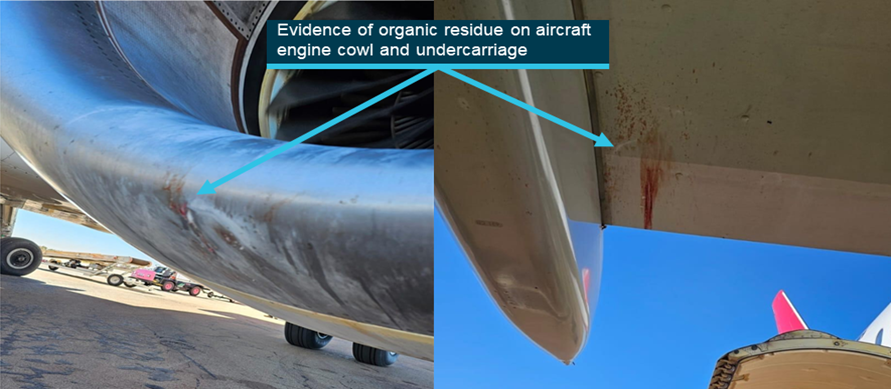
Figure 1: Photographs of aircraft with evidence of a birdstrike
Source: Operator
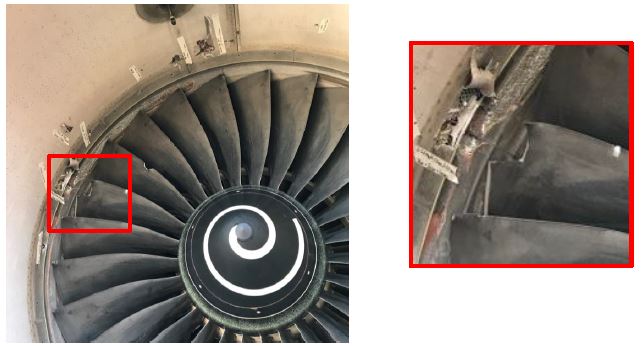
A post-flight inspection of the aircraft found evidence of multiple strikes to the engine cowl and flap (Figure 1) but no damage to the airframe. The operator’s engineer identified that numerous birds had been ingested into both engines and had visibly caused minor damage resulting in the need for a more detailed inspection.
Safety message
Occurrences involving aircraft striking wildlife, particularly birds, continue to be the most common aviation occurrence reported to the ATSB. Birdstrikes are a potential safety risk to aircraft and aerodrome operators.
The ATSB has recently launched a new dedicated aviation wildlife strike occurrence dashboard, which aims to provide valuable information to pilots, aerodrome and aircraft operators, aviation regulators and other industry participants, to assist with understanding and managing the hazards associated with wildlife strikes. Importantly, the dashboard does not include any identifying information about pilots or aircraft.
Birdstrikes typically result in nil to minor damage to aircraft, and nil to minor injuries to occupants, however, severe and fatal accidents as a result of birdstrikes in small aircraft have occurred. Birdstrikes can occur during any phase of flight but are more common during the take-off and landing phases, due partly to the increased numbers of birds at lower heights. Aerodrome operators employ various measures to mitigate these occurrences and to control bird numbers. However, when a birdstrike does happen, pilots are ultimately required to deal with the consequences. By following established procedures and prioritising effective communication, the outcomes associated with birdstrikes can be mitigated by pilots.
About this report
Decisions regarding whether to conduct an investigation, and the scope of an investigation, are based on many factors, including the level of safety benefit likely to be obtained from an investigation. For this occurrence, no investigation has been conducted and the ATSB did not verify the accuracy of the information. A brief description has been written using information supplied in the notification and any follow-up information in order to produce a short summary report and allow for greater industry awareness of potential safety issues and possible safety actions.
[1] Rotation speed: the speed at which the rotation of the aircraft is initiated to take-off attitude.
Occurrence summary
Mode of transport
Aviation
Occurrence ID
AB-2025-019
Occurrence date
14/05/2025
Location
Newman Airport
State
Western Australia
Occurrence class
Incident
Aviation occurrence category
Birdstrike, Diversion/return
Highest injury level
None
Brief release date
16/06/2025
Aircraft details
Manufacturer
Airbus
Model
A320-232
Sector
Jet
Operation type
Part 121 Air transport operations - larger aeroplanes
Occurrence Briefs are concise reports that detail the facts surrounding a transport safety occurrence, as received in the initial notification and any follow-up enquiries. They provide an opportunity to share safety messages in the absence of an investigation. Because occurrence briefs are not investigations under the Transport Safety Investigation Act 2003, the information in them is de-identified.
What happened
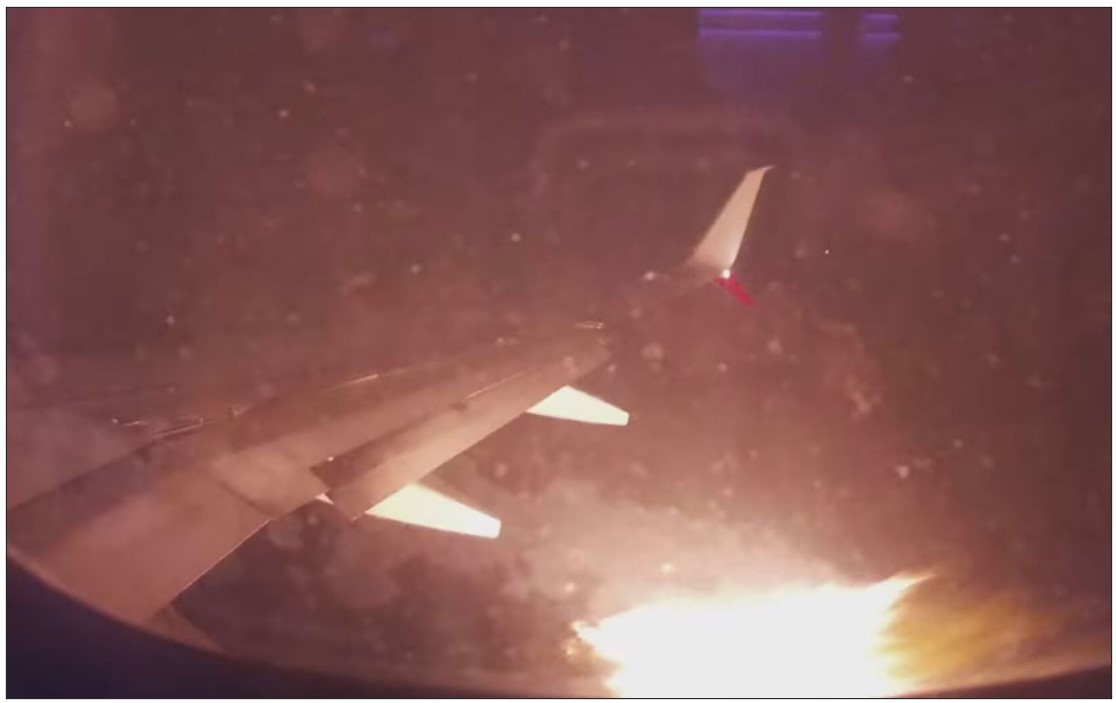
Shortly after departure from Queenstown, New Zealand, at about 1800 local time on 17 June 2024, a Boeing 737-8FE aircraft, carrying 67 passengers and 6 crew, en route to Melbourne, Victoria, was observed with flames emanating from the number 2 engine (Figure 1). The flight crew, responding to instrumentation indicating engine damage, shut down the affected engine and diverted to Invercargill, New Zealand where the aircraft landed safely.
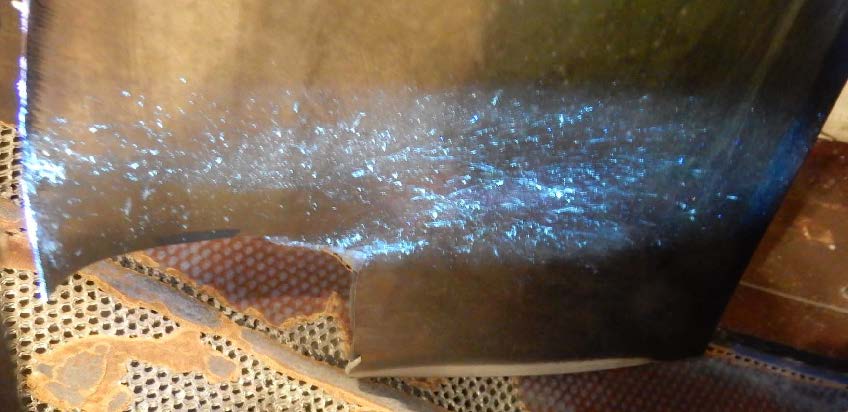
A subsequent maintenance inspection of the aircraft indicated evidence of a birdstrike. It was reported that one bird, believed to be a duck, had been ingested into the number 2 engine and a second duck had struck the aircraft. This caused substantial damage to the fan blade, this damage, coupled with the engine surging, required the engine to be replaced.
Figure 1: Photograph of fire emanating from engine of Boeing 737-8FE aircraft
Source: Channel 9 news.com
Safety message
Occurrences involving aircraft striking wildlife, particularly birds, continue to be the most common aviation occurrence reported to the ATSB. Birdstrikes are a potential safety risk to aircraft and aerodrome operators.
The ATSB has recently launched a new dedicated aviation wildlife strike occurrence dashboard, which aims to provide valuable information to pilots, aerodrome operators, aircraft operators, aviation regulators and other industry participants, to assist with understanding and managing the hazards associated with wildlife strikes. Importantly, the dashboard does not include any identifying information about pilots or aircraft.
Birdstrikes typically result in nil to minor damage to aircraft, and nil to minor injuries to occupants, however, severe and fatal accidents as a result of birdstrikes in small aircraft have occurred. Birdstrikes can occur during any phase of flight but are more common during the take-off and landing phases, due partly to the increased numbers of birds at lower heights. Aerodrome operators employ various measures to mitigate these occurrences and to control bird numbers, however, when a birdstrike does happen, pilots are ultimately required to deal with the consequences. This emphasises the importance of crew training and preparedness for in-flight emergencies to ensure the safety of the aircraft and its occupants. By following established procedures and prioritising effective communication, the outcomes associated with birdstrikes can be mitigated by pilots.
About this report
Decisions regarding whether to conduct an investigation, and the scope of an investigation, are based on many factors, including the level of safety benefit likely to be obtained from an investigation. For this occurrence, no investigation has been conducted and the ATSB did not verify the accuracy of the information. A brief description has been written using information supplied in the notification and any follow-up information to produce a short summary report and allow for greater industry awareness of potential safety issues and possible safety actions.
Occurrence summary
Mode of transport
Aviation
Occurrence ID
AB-2024-031
Occurrence date
17/06/2024
Location
3.7 km east-north-east of Queenstown Airport
State
International
Occurrence class
Serious Incident
Aviation occurrence category
Birdstrike
Highest injury level
None
Brief release date
30/08/2024
Aircraft details
Manufacturer
The Boeing Company
Model
737-8FE
Sector
Jet
Operation type
Part 121 Air transport operations - larger aeroplanes
On the morning of 19 September 2022, the pilot of an Air Tractor AT-502B aircraft, registered VH‑KDR and operated by Smart Air Services, was completing aerial spray operations near Chinchilla, Queensland. After becoming concerned at not being able to contact the pilot, the spray company alerted nearby farmers to assist, and the aircraft was subsequently found in the paddock being sprayed. The pilot was fatally injured and the aircraft was destroyed.
What the ATSB found
The ATSB found that, while the pilot was conducting a spray run parallel to the paddock fence line at about 8 ft above the ground, a large bird (Australian bustard) struck the right Perspex windshield. During the impact, the right windshield was shattered, with the bird carcass found inside the aircraft.
The site examination showed that, after the birdstrike, the aircraft continued flying for a further 310 m, or about 5 seconds. However, without any flight data, it could not be exactly determined what occurred during this time. Despite this, the ATSB established that, it was likely that the birdstrike affected the pilot’s ability to control the aircraft, resulting in a collision with terrain.
Safety message
Birdstrikes are relatively common with over 1,300 occurrences reported to the ATSB in 2022. While these strikes typically result in nil-to-minor damage to an aircraft and nil-to-minor injuries to occupants, there have now been 2 confirmed fatal accidents in Australia. This accident highlights the ongoing hazards of birdstrikes to aircraft, particularly during low-level spraying operations.
Where applicable, there are published recommended practices available from the Australian Aviation Wildlife Hazard Group (2014) to manage risk of wildlife strikes for organisations that may be involved in a wildlife strike occurrence. Practices include considering the likelihood of a wildlife strike and proximity of known wildlife to aircraft manoeuvring areas and flight paths, as well as identifying wildlife characteristics such as their agility, speed, manoeuvrability, and their ability to avoid aircraft. Other considerations include the consequence of a strike, including the effects of the mass of the wildlife species, the velocity of the aircraft involved, the resultant impact force(s) and the damage that could result; and if adequate control of the aircraft can be maintained following a strike event. If a birdstrike does occur, available protections for a pilot include the wearing of flight helmets, 4‑point seatbelts, and the fitment of thicker aircraft windshields, where possible.
The investigation
Decisions regarding the scope of an investigation are based on many factors, including the level of safety benefit likely to be obtained from an investigation and the associated resources required. For this occurrence, a limited-scope investigation was conducted in order to produce a short investigation report, and allow for greater industry awareness of findings that affect safety and potential learning opportunities.
The occurrence
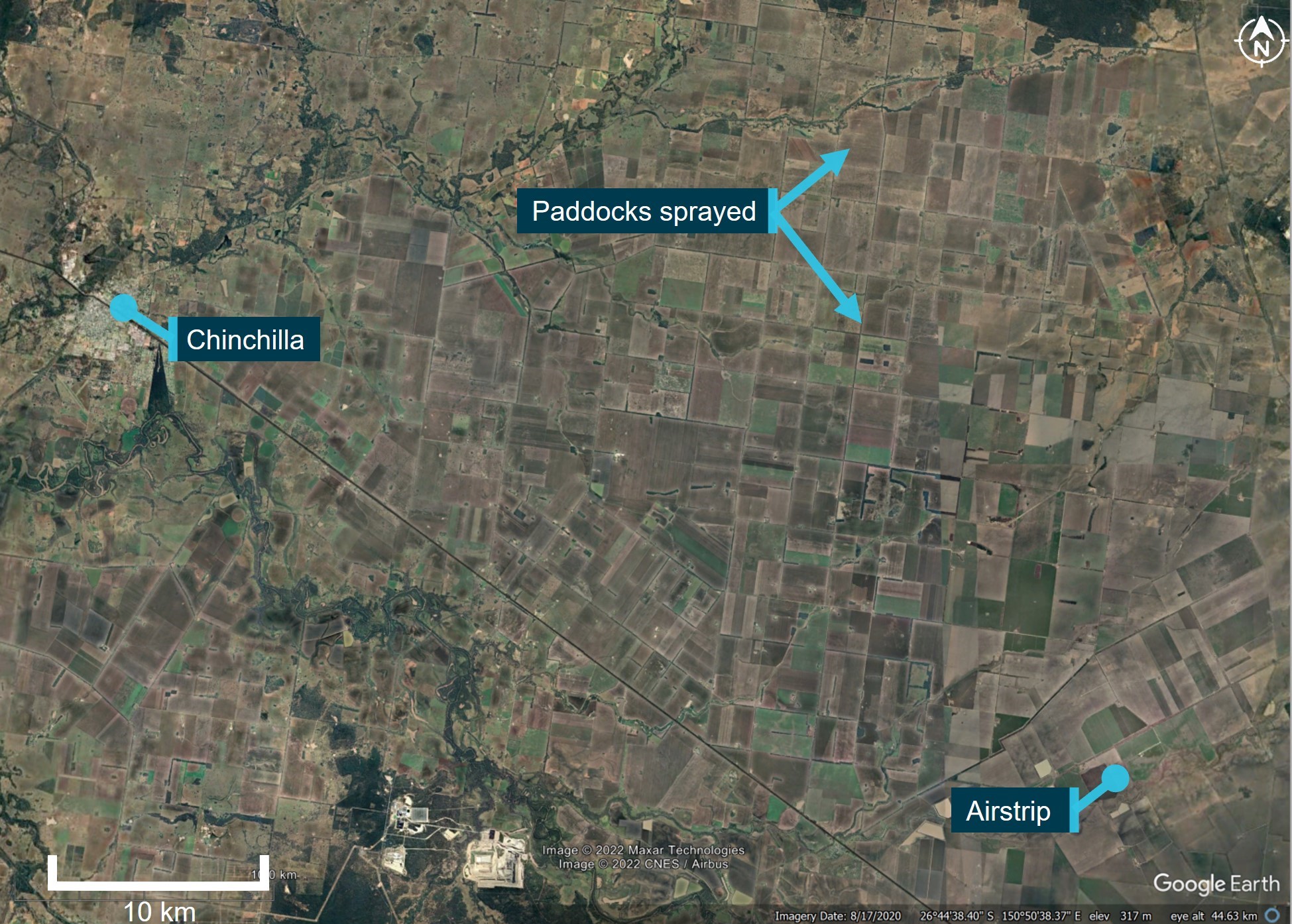
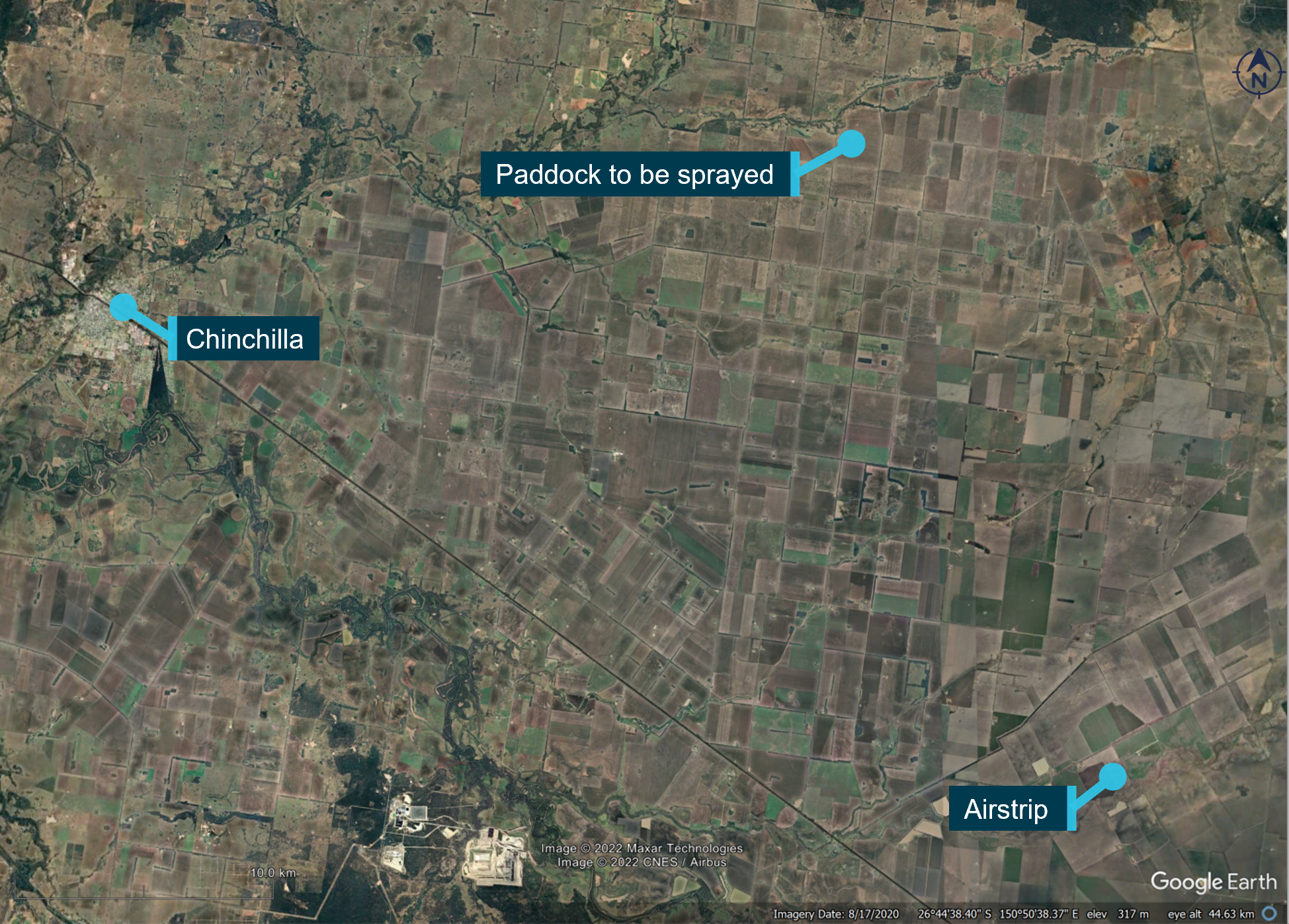
On the morning of 19 September 2022, the pilot of an Air Tractor AT-502B aircraft, registered VH‑KDR and operated by Smart Air Services, was conducting aerial spray operations on a property near Chinchilla, Queensland. The operations base for the day was at a private airstrip south-east of Chinchilla, where the aircraft was to be loaded with fungicide, pesticide, and fuel. The 2 farms to be sprayed were located several kilometres to the north of the airstrip (Figure 1).
Figure 1: Location of the airstrip and area of operations
Source: Google Earth, annotated by the ATSB
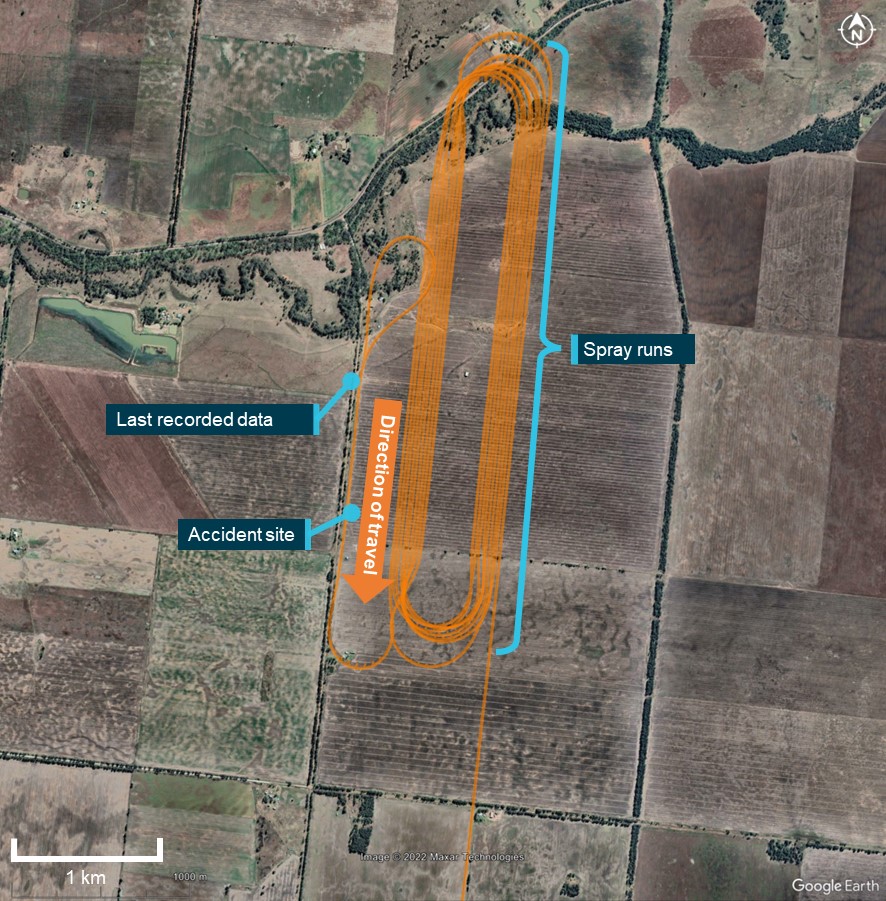
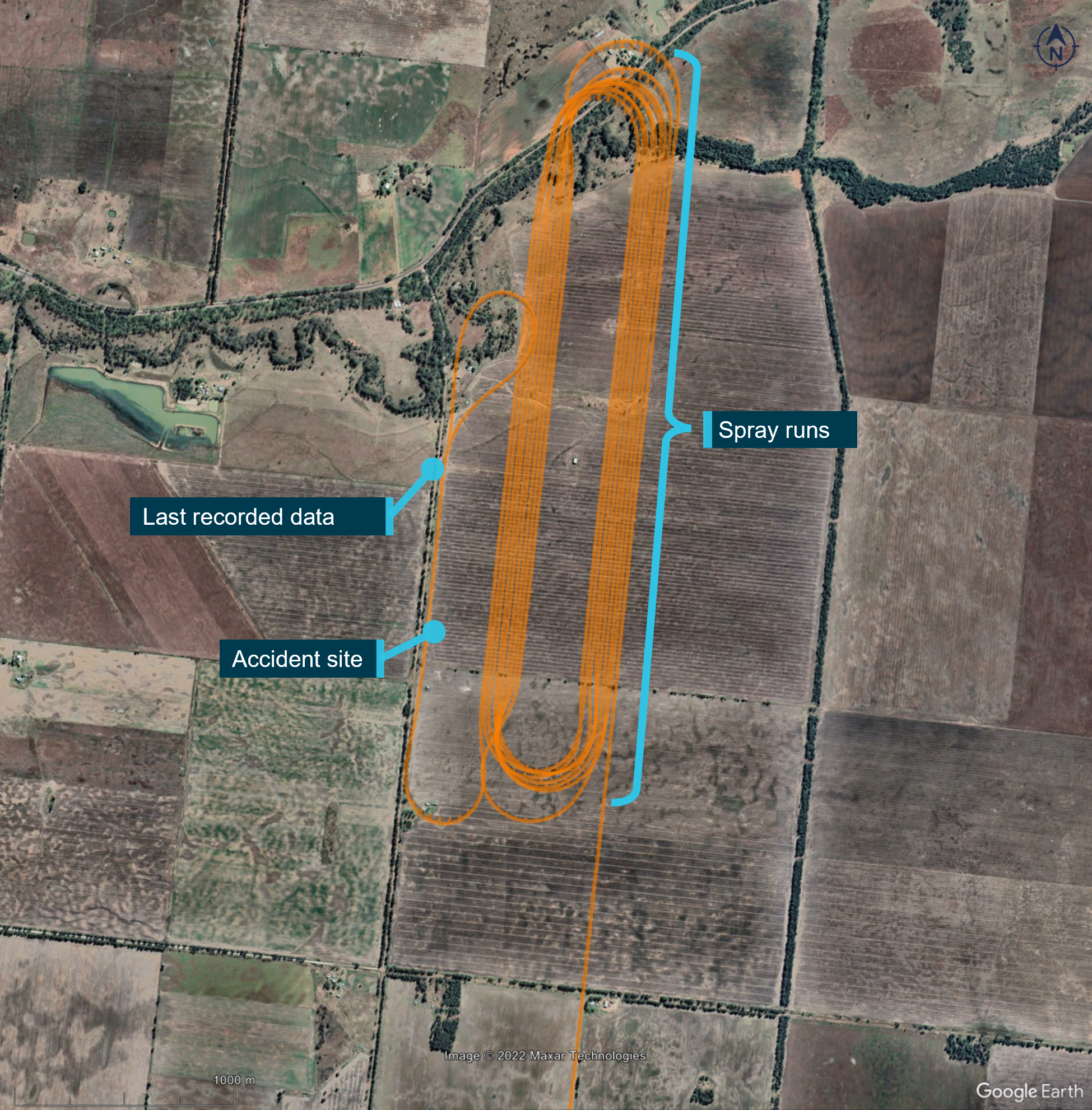
Numerous spray runs were completed on the paddocks during the morning between 0704 and 1012 local time, with the pilot returning to the airstrip on 4 occasions to reload the spray chemicals and to refuel the aircraft. Recorded GPS data from the aircraft’s Satloc[1] system identified that, at 1058, the pilot departed the airstrip to continue herbicide spraying on the northerly paddock. By 1125, the pilot had completed 17 spray runs within the paddock in a racetrack pattern (Figure 2).
At the conclusion of run 17, the aircraft was turned onto a northerly heading, flown parallel to the fence line, before being turned onto a reciprocal heading to spray this area (Figure 2). The final GPS data point recorded by the Satloc system was at 11:25:41, 3 seconds after the pilot had commenced the southerly fence line spray run.
After 1200, the loader at the airstrip attempted to phone the pilot to ask whether more fuel was required, however, no response was received. The loader was concerned at not being able to contact the pilot, and phoned the company operations manager, who then contacted nearby farmers to assist with locating the aircraft. At about 1215, a local farmer found the aircraft wreckage in the paddock where the pilot had been spraying. The pilot was fatally injured and the aircraft was destroyed.
Figure 2: Accident site and spray runs (orange)
Source: SatLoc data provided by the aircraft operator overlaid on Google Earth, annotated by the ATSB
Context
Pilot information
The pilot held a valid Class 1 Aviation Medical Certificate and a Commercial Pilot Licence (Aeroplane). The pilot also held aerial application and low-level ratings, as well as tailwheel and retractable undercarriage, manual propellor pitch control, and turbine engine endorsements.
The pilot had accumulated 3,738 hours of aeronautical experience, of which 2,681 hours was in turbine agricultural aircraft.
Aircraft information
General information
VH-KDR was an Air Tractor Incorporated 502B single-seat low-wing tailwheel aircraft manufactured in the United States in 1996. It had a total wingspan of 15.8 m and was powered by a Pratt & Whitney Canada PT6A‑34AG turboprop engine. It was first registered in Australia on 6 August 2004. It was issued with a Special Certificate of Airworthiness in therestricted category[2] on 10 August 2004. A maintenance release was issued on 9 September 2022.
Windshield information
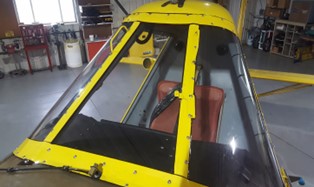
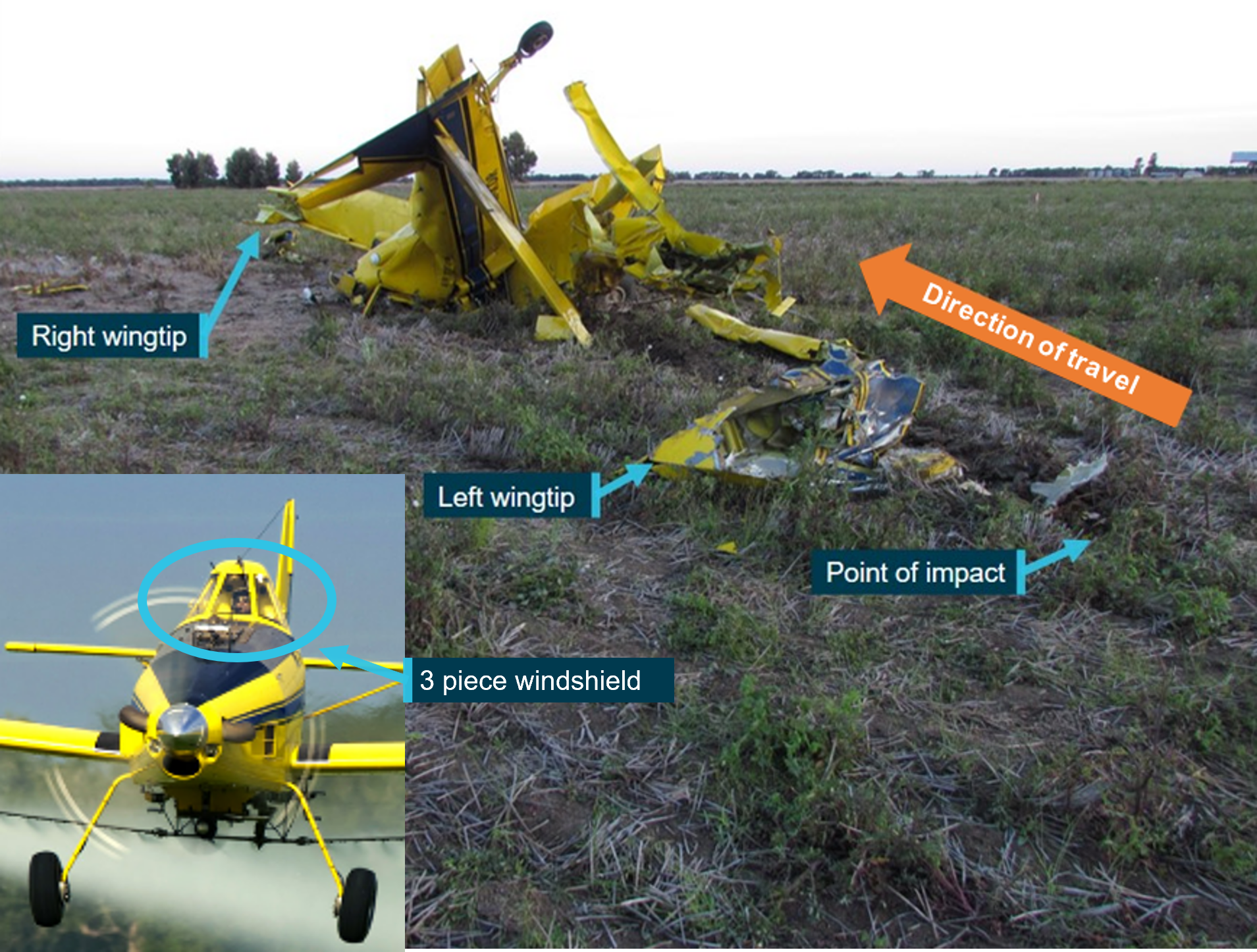
The Air Tractor 502B windshield is constructed of 3 pieces being either glass or Perspex (Figure 3). The centre windshield is manufactured from glass. The thickness of the glass on VH‑KDR was 1/4-inch, which was the standard thickness when the aircraft was manufactured. The 2 side pieces were manufactured from Perspex.
Figure 3: Air Tractor AT-502B windshield
Source: Storm Aeronautics
The ATSB contacted Air Tractor regarding the availability of thicker side windshields and they advised that there had been no consideration for using thicker material. The manufacturer stated that the windshield design on the Air Tractor is standard for the agricultural aviation industry, and in previously reported birdstrikes where the bird had entered the aircraft through either side windscreen, the bird missed the pilot and hit the back wall. Further, they described difficulties in replacing the Perspex windshield with glass due to the curvature of the design, which would increase the likelihood of glare and would add weight.
In 2009, Air Tractor issued a service letter advising that thicker centre windshields were being installed in current production aircraft. The thicker windshields were 3/8-inch thick glass compared to the original 1/4-inch. The letter also advised that the thicker windshields could be installed in existing aircraft, though not mandatory. This letter was issued after operators had reported on birdstrikes that had resulted in the bird carcass entering the cockpit through the centre windshield (refer to section titled Related occurrences).
Meteorological information
Based on information recorded from a private weather station located in the paddock being sprayed, the air temperature around the time of the accident was 26.3 °C, and the average wind speed was about 9 kt from the west-south-west. The calculated crosswind component was about 8 kt.
Wreckage and impact information
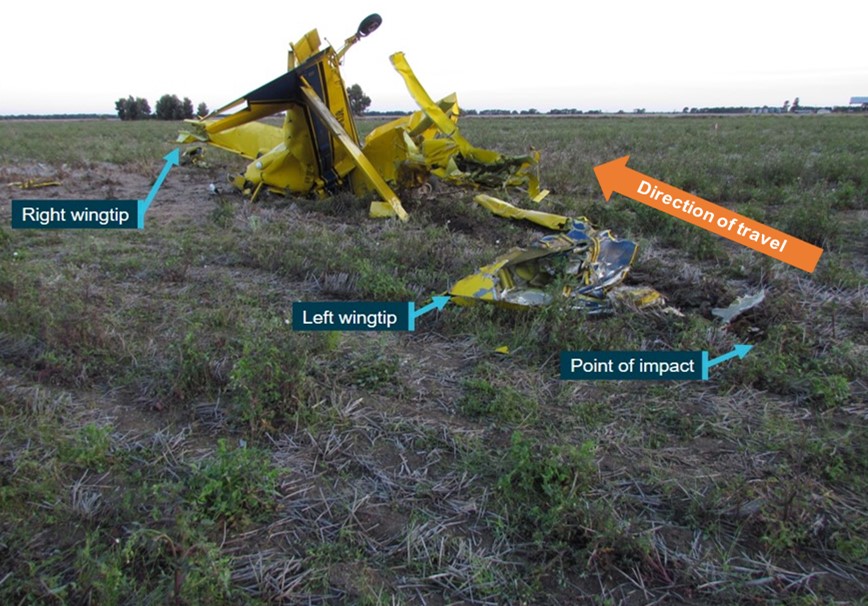
The ATSB’s on-site examination found that the aircraft had impacted the ground, adjacent to the fence line. The aircraft’s orientation was consistent with the direction of travel. The left wing had initially impacted the ground, followed by the fuselage, in a near vertical attitude. The propeller and engine were buried in the soft earth, with the spread of wreckage contained to a small area. Ground scars and damage to the left wing indicated that the wing struck the ground at about 30° to the horizontal (Figure 4). The length of the ground scar from the point of impact to the fuselage was about 12.6 m.
Figure 4: Aircraft wreckage at the accident site
Source: ATSB
Examination of the wreckage identified that:
Inspection of the propeller and engine indicated the engine was delivering power at the time of the impact.
Fuel and chemical product residues were also found at the accident site.
There was no post-impact fire.
Due to the extent of damage to the cockpit in the accident sequence, it was not possible to determine the position of the engine controls prior to the impact. However, where possible, control continuity was established.
It was very likely the aircraft was trimmed ‘nose-up,’[3] which was reported by the operator to be the configuration[4] typically used when conducting low-level aerial spraying.
There were no pre-existing technical failures with the aircraft that would have contributed to the accident.
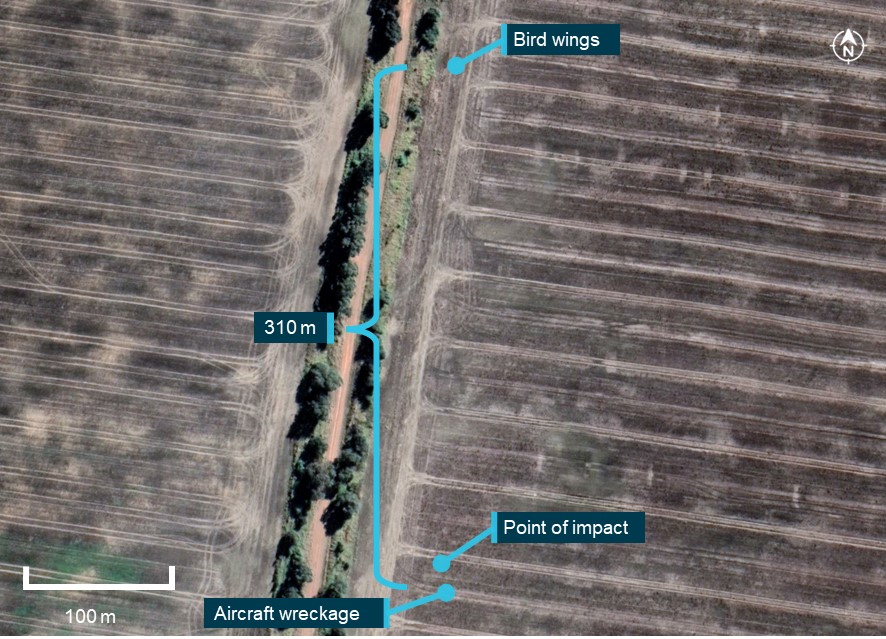
A large bird carcass was found in the cockpit and severed bird wings were located about 310 m north of the wreckage, in-line with the aircraft’s track along the fence line, which indicated the approximate location of the initial birdstrike (Figure 5). Bird feathers were found along flight path in between location of wings and aircraft wreckage. Biological residue from the bird was found outside the right cockpit window and among the pieces of Perspex from that window. Further biological residue was found on the left side of the cockpit behind the pilot’s seat, indicating the bird passed through the right cockpit window in an upward trajectory towards the left side. There was no evidence of the bird striking any other part of the aircraft.
Figure 5: Site map with key locations
Source: Google Earth, annotated by the ATSB
Recorded data
The SatLoc data’s final recorded point was about 800 m north of the wreckage, and 500 m from the location of the severed bird wings (Figure 2). Based on the aircraft's previously recorded ground speed and direction of travel, there were about 5 seconds between the birdstrike occurring and the impact with the ground. The ground speed of the aircraft was about 116 kt (200 km/h), which was a similar speed to other runs, and the height was about 8 ft above ground level,[5] which was a similar height to the previous runs.
Medical and pathological information
The post-mortem report indicated that the pilot did not have any pre-existing medical conditions nor consumed any substances likely to have contributed to the accident. The report indicated that the pilot sustained significant head injuries in the accident. It was also noted that feathers were found on the pilot’s neck and chest, but it could not be determined whether they were the direct result of the birdstrike or from the accident sequence. Therefore, it was unknown whether these injuries sustained were due to the birdstrike or collision with terrain, or both.
Bird identification
Recovered biological specimens of the bird, including wing feathers and residue from the carcass, were analysed by the Australian Centre for Wildlife Genomics at the Australian Museum. The specimens were identified as a Ardeotis australis, commonly known as an Australian bustard (or bush/wild/plains turkey) (Australian Museum 2020).
The Australian bustard is a large bird, 80 to 120 cm in length and a wingspan of up to 230 cm (Ziembicki 2010). An average adult bird weighs 4.5 kg, however, males can weigh up to 8 kg (Bird Fact 2022). Australian bustards are capable of flying but are mostly ground dwelling. They are Australia’s heaviest flying bird. The bird carcass recovered had a wingspan of at least 120 cm and a length of 100 cm; the gender was unknown.
Survival aspects
First responders to the accident site identified that the pilot had been fastened into the seat by the aircraft’s 4‑point restraint harness. A flight helmet was found within the wreckage, which the pilot had been wearing, but it had become dislodged and sustained damage to the right-side shell and left‑side earpiece during the accident sequence. The left-side helmet strap had separated from the earpiece. Yellow paint transfer from the rear of the cockpit was found on the back of the helmet. Bird biological residue was found on the inner surface of the helmet visor.
Severe compression of the forward fuselage and cockpit region had occurred as a result ground impact forces. The accident was not considered survivable.
Related occurrences
Birdstrikes are a recognised hazard in aviation and there are mitigators in place around airports, however, there are challenges when operating outside of these areas. A review of Australian and international data and investigation reports found the following occurrences involving birdstrikes during aerial spraying operations.
Australian data
A review of the ATSB occurrence database from 2000 to 2022 found that 30 birdstrike occurrences were reported during aerial spraying operations. Of those, one resulted in minor injury, 20 resulted in minor damage, and one resulted in substantial damage. For example:
On 4 February 2000, the pilot of an Air Tractor 502B was conducting aerial spraying operations 15 km west of Moree, New South Wales. As the aircraft approached the start of a spray run at approximately 50 ft above ground level, a large bird struck the front windshield. The pilot sustained minor injuries and the aircraft sustained minor damage.
On 9 November 2011, an Air Tractor 802A struck an Australian bustard while conducting aerial spraying operations, 37 km south-east of Emerald Airport, Queensland. The impact damaged the wing, resulting in a loss of control and the aircraft sustained substantial damage. The pilot was uninjured.
In 2022, there were 2 fatal accidents involving birdstrikes, including this accident. The other accident was a private helicopter flight, investigated as AO-2022-034. This was the only fatal birdstrike confirmed in Australia.
United States data
A review of the United States Federal Aviation Administration wildlife strike database identified 2 birdstrikes resulting in damage to the windshield while conducting aerial spraying operations:
On 15 April 2000, the pilot of an Air Tractor 502B reported that a red-tailed hawk struck and damaged the windshield during a spray run near Prescott, Washington, resulting in minor injuries.
On 9 June 2017, the pilot of an Air Tractor 502B reported a birdstrike occurring while conducting spraying operations about 10 miles west of Salt Lake City Airport, Utah. The birdstrike damaged the right front window, which resulted in the door opening. The pilot was uninjured and conducted a precautionary landing. The bird species was unknown.
In addition, Air Tractor reported another 3 instances involving birdstrikes resulting in minor windshield damage and nil injuries:
On 30 October 2015, an Air Tractor AT-402B struck a bird during mosquito control activity.
On 24 August 2020, while returning from a drop during firebombing operations, the windshield of an Air Tractor AT-802A broke due to a birdstrike.
On 24 October 2021, an ibis entered the cockpit through the windshield of an Air Tractor AT‑802.
South African data
On 11 September 2008, the pilot of an Air Tractor 502B was conducting aerial spraying operations on a farm in the Caledon region of South Africa. During a spray run, a witness on the ground, who was approximately 700 m from the aircraft heard an aircraft noise and immediately after, an explosion. The aircraft wreckage was located in a field in an inverted position. The pilot was fatally injured.
Bird remains and feathers were identified inside the aircraft cockpit. A piece of glass windshield was also found within the cockpit that was covered in bird remains. The carcass of a blue crane was found near the wreckage. The investigation was unable to determine if the pilot was incapacitated or fatally injured as a result of the collision with the bird before the impact with the ground.
As a result of the investigation, the South African Civil Aviation Authority (investigation CA 18/2/3/8548) made the following recommendation:
Request the Air Tractor manufacturer to investigate the possibility of replacing the existing windshield with a thicker, stronger windshield to be used by clients operating these aircraft in areas of high bird activity.
The following year, Air Tractor published a service letter with details of a new, thicker windshield available to be fitted (refer to section titled Windshield information).
Safety analysis
Birdstrike and resulting collision with terrain
The location and impact point of the aircraft wreckage was consistent with the previously recorded flight path. Further, the presence of the Australian bustard carcass inside the aircraft wreckage, and the identification of the bird’s wings around 310 m north of the wreckage, indicated that the aircraft had experienced a birdstrike while flying the southbound spraying track at about 8 ft above ground level.
Considering the recorded ground speed of the aircraft on the 17 previous spray runs and up to the last recorded data point, it was likely that the aircraft struck the bird while flying at about 116 kt (200 km/h). This resulted in a collision with sufficient energy to break the right Perspex windshield as evidenced by the biological residue found on the aircraft and broken windshield pieces.
Given the expected track and speed of the aircraft, and the location of the bird wings to the wreckage, the aircraft sustained flight for about 5 seconds following the birdstrike. As the aircraft was operating around 8 ft above ground level, and the wingspan (total of 15.8 m) was longer than this height, it was likely the aircraft entered a short climb to result in a near vertical attitude at impact, indicative of a loss of control. There was also significant damage to the pilot’s helmet as well as a small amount of bird biological residue found in the visor. However, in that time, the ATSB could not determine exactly what occurred as a result of the bird entering the aircraft as no flight data was recorded nor was the extent of the pilot’s injuries from the birdstrike known. That is, whether the pilot sustained a level of incapacitation due to a direct strike from the bird, or whether they experienced a level of startle or distraction following the event.
Therefore, with no other reasonable explanation and having excluded a pre-existing medical condition, it was likely that the birdstrike affected the pilot’s ability to control the aircraft when operating at low-level, resulting in a loss of control and collision with terrain.
Findings
ATSB investigation report findings focus on safety factors (that is, events and conditions that increase risk). Safety factors include ‘contributing factors’ and ‘other factors that increased risk’ (that is, factors that did not meet the definition of a contributing factor for this occurrence but were still considered important to include in the report for the purpose of increasing awareness and enhancing safety). In addition ‘other findings’ may be included to provide important information about topics other than safety factors.
These findings should not be read as apportioning blame or liability to any particular organisation or individual.
From the evidence available, the following findings are made with respect to the birdstrike and collision with terrain involving Air Tractor 502B, VH-KDR, on 19 September 2022.
Contributing factor
During aerial spraying operations at low-level, a large bird (Australian bustard) struck the right windshield of the aircraft and entered the cockpit. This likely affected the pilot’s ability to control the aircraft, resulting in a collision with terrain.
Sources and submissions
Sources of information
Sources of information during the investigation were gathered from:
Ziembicki, M (2010) Australian Bustard. CSIRO Publishing: Collingwood.
Submissions
Under section 26 of the Transport Safety Investigation Act 2003, the ATSB may provide a draft report, on a confidential basis, to any person whom the ATSB considers appropriate. That section allows a person receiving a draft report to make submissions to the ATSB about the draft report.
A draft of this report was provided to the following directly involved parties:
Smart Air Services Pty Ltd
the aircraft loader
Air Tractor Incorporated
Pratt & Whitney Canada
Civil Aviation Safety Authority
Transportation Safety Board of Canada
United States National Transportation Safety Board.
Submissions were received from Air Tractor Incorporated. The submission was reviewed and, where considered appropriate, the text of the report was amended accordingly.
Purpose of safety investigations
The objective of a safety investigation is to enhance transport safety. This is done through:
identifying safety issues and facilitating safety action to address those issues
providing information about occurrences and their associated safety factors to facilitate learning within the transport industry.
It is not a function of the ATSB to apportion blame or provide a means for determining liability. At the same time, an investigation report must include factual material of sufficient weight to support the analysis and findings. At all times the ATSB endeavours to balance the use of material that could imply adverse comment with the need to properly explain what happened, and why, in a fair and unbiased manner. The ATSB does not investigate for the purpose of taking administrative, regulatory or criminal action.
Terminology
An explanation of terminology used in ATSB investigation reports is available here. This includes terms such as occurrence, contributing factor, other factor that increased risk, and safety issue.
Publishing information
Released in accordance with section 25 of the Transport Safety Investigation Act 2003
Ownership of intellectual property rights in this publication
Unless otherwise noted, copyright (and any other intellectual property rights, if any) in this report publication is owned by the Commonwealth of Australia.
Creative Commons licence
With the exception of the Coat of Arms, ATSB logo, and photos and graphics in which a third party holds copyright, this publication is licensed under a Creative Commons Attribution 3.0 Australia licence.
Creative Commons Attribution 3.0 Australia Licence is a standard form licence agreement that allows you to copy, distribute, transmit and adapt this publication provided that you attribute the work.
The ATSB’s preference is that you attribute this publication (and any material sourced from it) using the following wording: Source: Australian Transport Safety Bureau
Copyright in material obtained from other agencies, private individuals or organisations, belongs to those agencies, individuals or organisations. Where you wish to use their material, you will need to contact them directly.
[1] Satloc: an aerial guidance system that provides the pilot with guidance commands to fly accurate spray patterns.
[2] Restricted category aircraft are limited to operate and carry personnel only for specified purpose/s.
[3] The elevator trim control lever was found to be in the ‘nose-up’ position. However, the left elevator trim tab was found to be in the ‘up’ position, which would be consistent with the control lever in the ‘nose-down’ position. This discrepancy likely resulted from compression of the fuselage due to the impact with terrain. This was based on the rod connecting the controls to the trim tab likely sliding towards the rear of the aircraft while the fuselage compressed, moving the trim tab ‘up’ or in the ‘nose-down’. Therefore, it was likely that the aircraft was trimmed nose-up prior to the accident.
[4] If forward pressure was removed from the yoke, the aircraft would climb for safety reasons.
[5] The data was adjusted based on the location of the SatLoc antenna and the spray broom as there was approximately 8 ft between these points.
Preliminary report
Report release date: 16/12/2022
This preliminary report details factual information established in the investigation’s early evidence collection phase and has been prepared to provide timely information to the industry and public. Preliminary reports contain no analysis or findings, which will be detailed in the investigation’s final report. The information contained in this preliminary report is released in accordance with section 25 of the Transport Safety Investigation Act 2003.
The occurrence
On 19 September 2022, the pilot of an Air Tractor AT-502B aircraft, registered VH-KDR and operated by Smart Air Services, was conducting spraying operations on a property near Chinchilla, Queensland.
At about 0704 Eastern Standard Time,[1] the aircraft departed from a private airstrip 24 NM (44 km) south-east of Chinchilla, with the first load of fungicide. Recorded GPS data from the aircraft’s Satloc system showed that, by 0900, the pilot had sprayed 2 loads on that property. The aircraft was then refuelled and the chemical hopper reloaded at the airstrip.
The pilot then sprayed 2 loads of pesticide (the third and fourth loads of the day) on a different paddock, before returning to the airstrip. The aircraft’s hopper was then reloaded before departing with the fifth load to continue spraying the same paddock (Figure 1).
Figure 1: Location of the airstrip and spray paddock
Source: Google Earth, annotated by the ATSB
After completing 17 spray runs on the paddock in a racetrack pattern, at about 1125, the aircraft was turned to track north along the western boundary (Figure 2). The aircraft was then turned at the northern end to commence the 18th spray run to the south. The last GPS data point was recorded 3 seconds after starting this run.
After 1200, the loader attempted to call the pilot to ask whether they needed more fuel but received no response. The loader was concerned having received no response, and phoned the operations manager, who contacted nearby farmers to assist with locating the aircraft. At about 1215, a local farmer found the aircraft in the paddock where the pilot had been spraying. The pilot was fatally injured, and the aircraft was destroyed.
Figure 2: Accident site and spray runs (orange)
Source: Satloc data provided by the aircraft operator overlaid on Google Earth, annotated by the ATSB
Context
Pilot information
The pilot held a valid Class 1 Aviation Medical Certificate and a Commercial Pilot Licence (Aeroplane). The pilot also held aerial application and low-level ratings, as well as tailwheel and retractable undercarriage, manual propellor pitch control, and turbine engine endorsements.
The pilot had 3,738 hours of aeronautical experience, of which 2,681 hours was in turbine agricultural aircraft.
Meteorological information
Based on information from a private weather station located in the paddock being sprayed, around the time of the accident, the air temperature was 26.3 °C, and average wind speed was about 9 kt from the west-south-west.
Operational information
The operator advised that they expected that accident run field would be sprayed at a height of about 2 m (6 ft) above the ground, to be just above the weeds.
The Satloc GPS data indicated the aircraft had a ground speed of 116 kt for the accident spray run.
Site and wreckage information
The ATSB’s site examination found that the aircraft had impacted terrain with the fuselage in a near vertical attitude. The propeller and engine were buried in the soft earth, with the wreckage contained to a small area. Ground scars and damage to the left wing indicated that the wing struck the ground at about 30° to the horizontal (Figure 3).
Figure 3: Aircraft wreckage and exemplar aircraft (inset)
Source: ATSB and Air Tractor (inset), annotated by the ATSB
Examination of the propeller and engine indicated that the engine was delivering power at the time of the impact. Fuel and chemical product residues were also found at the accident site, but there was no post-impact fire.
A large bird carcass was found in the cockpit and the bird’s wings were located about 300 m north of the wreckage, in-line with the aircraft’s track. Biological residue from the bird was found outside the right cockpit window.
Bird identification
Recovered biological specimens of the bird, including the feathers from the wing and residue from the carcass, were analysed by the Australian Centre for Wildlife Genomics at the Australian Museum. The specimens were identified as a Ardeotis australis, commonly known as an Australian bustard or Plains turkey.
The Australian bustard is a large bird, 80 to 120 cm in height, with an average weight for an adult of 4.5 kg, with males weighing up to 8 kg. They are capable of flying but are mostly ground dwelling.
Further investigation
The investigation is continuing and will include further review and examination of:
electronic components recovered from the accident site.
operational documentation.
maintenance records.
research and similar occurrences.
Should a critical safety issue be identified during the course of the investigation, the ATSB will immediately notify relevant parties so appropriate and timely safety action can be taken.
A final report will be released at the conclusion of the investigation.
Acknowledgements
The ATSB acknowledges the support of the local farmers and Queensland Police Service for their assistance during the on-site investigation.
The objective of a safety investigation is to enhance transport safety. This is done through:
identifying safety issues and facilitating safety action to address those issues
providing information about occurrences and their associated safety factors to facilitate learning within the transport industry.
It is not a function of the ATSB to apportion blame or provide a means for determining liability. At the same time, an investigation report must include factual material of sufficient weight to support the analysis and findings. At all times the ATSB endeavours to balance the use of material that could imply adverse comment with the need to properly explain what happened, and why, in a fair and unbiased manner. The ATSB does not investigate for the purpose of taking administrative, regulatory or criminal action.
Terminology
An explanation of terminology used in ATSB investigation reports is available here. This includes terms such as occurrence, contributing factor, other factor that increased risk, and safety issue.
Publishing information
Released in accordance with section 25 of the Transport Safety Investigation Act 2003
Ownership of intellectual property rights in this publication
Unless otherwise noted, copyright (and any other intellectual property rights, if any) in this report publication is owned by the Commonwealth of Australia.
Creative Commons licence
With the exception of the Coat of Arms, ATSB logo, and photos and graphics in which a third party holds copyright, this publication is licensed under a Creative Commons Attribution 3.0 Australia licence.
Creative Commons Attribution 3.0 Australia Licence is a standard form licence agreement that allows you to copy, distribute, transmit and adapt this publication provided that you attribute the work.
The ATSB’s preference is that you attribute this publication (and any material sourced from it) using the following wording: Source: Australian Transport Safety Bureau
Copyright in material obtained from other agencies, private individuals or organisations, belongs to those agencies, individuals or organisations. Where you wish to use their material, you will need to contact them directly.
[1] Eastern Standard Time (EST): Coordinated Universal Time (UTC) + 10 hours.
On the morning of 9 July 2022, a Bell 206 L-1, registered VH-ZMF departed a private helipad at Cattai, NSW for a private flight. About 9 minutes later, the helicopter impacted terrain about 10 km to the north of the departure point. The helicopter was destroyed, and the pilot, who was the sole occupant, was fatally injured.
What the ATSB found
The ATSB found that shortly after crossing Dargle Ridge at about 500 ft above the ground and while approaching the Richmond airspace control boundary, a wedgetail eagle impacted the helicopter just below the front left windscreen. It was unlikely that the pilot saw or had time to avoid the wedgetail eagle due to sun glare and a required radio frequency change.
The pilot was likely startled and initiated abrupt control inputs leading to the main rotor severing the tail boom. This led to an inflight break-up of the airframe and collision with terrain.
Safety message
Birdstrike is sometimes an unavoidable and relatively common hazard for all aviation operations, one which is more prevalent at lower altitudes. Pilots are reminded that sound lookout and visual scanning processes, as well as avoidance of low-level flight and expected areas of large concentrations of birds are key to reducing the likelihood of birdstrike.
Maintaining effective lookout and taking steps to remove, reduce or eliminate reduced visual effectiveness will assist in maintaining better situational awareness in-flight, and also assist in providing better outcomes to see-and-avoid not only birds, but other airspace users.
The investigation
Decisions regarding the scope of an investigation are based on many factors, including the level of safety benefit likely to be obtained from an investigation and the associated resources required. For this occurrence, a limited-scope investigation was conducted in order to produce a short investigation report and allow for greater industry awareness of findings that affect safety and potential learning opportunities.
The occurrence
At about 1139 local time on 9 July 2022, a Bell 206L-1 Long Ranger, registered VH-ZMF, departed a private helipad at Cattai, New South Wales, for a private flight to a property at St Albans (Figure 1). The pilot was the sole occupant on board.
The pilot obtained an airways clearance from air traffic control and recorded data showed the helicopter tracked to the north towards St Albans, climbing to about 700 ft above mean sea level (AMSL).
A witness to the south of Dargle Ridge observed the helicopter moments before the accident. They recalled it flying straight and level towards the north, and that weather conditions were good, with clear skies and light winds.
Figure 1: VH-ZMF departure and track
Source: Google Earth, with OzRunways data, annotated by the ATSB
After crossing the Dargle Ridge lookout the helicopter was at about 500 ft above ground level based on the elevation. Several witnesses described seeing VH-ZMF enter into a rapid banking turn to the right while pitching up. They heard several rotor beats change tone before a final louder noise.
Witnesses then recalled the helicopter pitching and rolling while descending, with one witness describing separation of the main rotor blades from the helicopter at about the height of Dargle Ridge shortly before impact.
A short time later, smoke was observed rising from the area where the helicopter descended. The pilot was fatally injured, and the helicopter was destroyed by a post-impact fire.
A nearby news helicopter, filming local flooding, was the first to arrive on scene and landed nearby to render assistance. Camera crew continued filming the accident scene before it was consumed by the post-impact fire. Biological matter was observed in that recorded video on the outside of the left nose cowl of the helicopter (Figure 2).
Figure 2: Locations of biological matter
Source: Bell, United Services, and ATSB
The landowner, who arrived at the accident scene on the top of the Dargle Ridge lookout, identified a mass of biological tissue, which appeared to be a tail section of a bird (Figure 3), which was still warm. During the on-site phase of the investigation, further biological samples were recovered below the escarpment.
Figure 3: Bird matter found near accident site
Source: NSW Police and ATSB
Context
Pilot information
Licencing
The pilot held both commercial (aeroplane and helicopter) pilot licences and was appropriately licenced to fly the Bell 206 LongRanger. The pilot held a valid class 2 medical certificate which included restrictions requiring the wearing of distance vision correction and additionally, that reading correction must also be available whilst exercising the privileges of the licence. Their most recent single engine helicopter flight review and an operational low level helicopter rating renewal was carried out on 2 June 2022.
Aeronautical experience
The pilot’s electronic logbook record showed a total flying experience of 5,398.3 hours up to the last recorded flight on 19 October 2020, when the pilot ceased using electronic logbook software with a helicopter operator. Of the pilot’s total flying experience, about 4,800 hours was in helicopters. VH-ZMF was used regularly by the pilot as a private aircraft, however due to a lack of recent pilot logbook records, ATSB was unable to determine the pilot’s total flight experience in Bell 206 aircraft.
Recent history
The pilot had spent a number of days at their home in Cattai by themselves after returning from Adelaide to assist with the recent flood recovery efforts in the area and to ensure safety of their own property. While no one spoke to the pilot prior to them departing Cattai that morning, several text messages were exchanged with family and friends.
Post-mortem and toxicology
At the time of release of this report, a post-mortem and toxicology results were not available to the investigation.
Aircraft information
General
VH-ZMF was a Bell Helicopter Company B206L-1 Long Ranger, S/N 45258 manufactured in the US in 1979. It was first registered in Australia in October 2012 as VH-MFF and then changed registration to VH-ZMF in May 2013.
VH-ZMF was a helicopter with two-bladed main rotor and tail rotor systems, powered by a single Rolls Royce 250-C30P gas turbine engine. It had hydraulically assisted flight controls, skid type landing gear and seating for a pilot and 6 passengers. The main and tail rotor blades had been replaced with carbon fibre composite blades under a supplemental type certificate (STC).[1] The helicopter was fitted with an emergency locator transmitter.
At the time of the accident, the helicopter had completed 2,964 hours in service and was certified for day VFR[2] flight only.
Airworthiness and maintenance history
A maintenance release was issued for VH-ZMF on 10 September 2021 at an aircraft time in service of 2,938.34 hours and was valid at the time of the accident.
The aircraft was retrofitted with Van Horn tail rotor blades in December 2015 and Van Horn main rotor blades in May 2021. The Van Horn blades are constructed of carbon fibre composite material which differs to the standard aluminium alloy construction by the original manufacturer. The Van Horn tail and main rotor blades were fitted under STC SR02249LA and STC SR02684LA respectively.
Meteorological conditions
Witnesses near the accident site described the weather conditions that morning to be ‘near perfect flying conditions’ with sunny conditions, light winds, blue skies and little cloud.
Another pilot who had operated through the same area about 7 minutes earlier on the day of the accident described the weather conditions as a good day for flying, with blue skies, sunny, no rain and some cloud around.
About the time of the accident, RAAF Base Richmond, located about 20 km to the south-west of the accident site, recorded wind from the west at about 4 kt and visibility greater than 10 km.
Recent heavy rainfall had swollen rivers, flooded the valleys and cut roads as substantial surface water runoff continued in the local area.
Wreckage information
The main accident site, including the engine, main cabin, and fuselage, was located in relatively flat and open farmland, between 2 ridgelines (Figure 5). The tail rotor assembly, vertical stabiliser and a section of the tail boom were found about 93 m to the north, with no signs of pre-existing component failure or damage. However, the main tail boom and drive shaft (Figure 4) were both severed at roughly the same fuselage station, consistent with a main rotor blade strike.
Figure 4: Tail boom impact
Source: ATSB
The main rotor system, including the transmission cowling, gearbox, and main rotor blades, was located about 68 m to the west in a heavily wooded, sloping escarpment. The teetering main rotor head was still attached to the transmission with multiple severed control rods attached to the transmission mounting structure.
The composite main rotor blades had separated just outboard of the main rotor grips and had impacted heavily with vegetation and delaminated. One of the main rotor blade tips was located about 150 m before the main wreckage on top of the ridgeline.
Figure 5: VH-ZMF accident site
Source: Google Earth with ATSB RPAS picture overlay, annotated by the ATSB
Recorded data
Data collected from radar and aircraft-based sources indicated that VH-ZMF was travelling in a northerly direction at about 100 kt prior to crossing the Dargle Ridge Lookout. The data then showed a track deviation to the right and an increase in 100 ft of altitude coupled with rapid deceleration and an increased vertical descent rate prior to impact with terrain.
Audio from RAAF Richmond air traffic control recorded that at 1143:37 the air traffic controller advised the pilot of VH-ZMF that they were 2 NM (3.7 km) from the airspace boundary and gave the pilot traffic of another media helicopter in the vicinity of Wisemans Ferry.
Figure 6: Richmond radar overlay
Source: Google Earth with Richmond radar overlay, annotated by the ATSB
At 1143:58, the pilot confirmed that the frequency change. Three seconds later static was heard on the radio which lasted for about 2 seconds with no discernible audio. Recorded radar images show VH-ZMF approaching the control boundary before appearing to slow remarkedly and descend at 1144:12 before disappearing from radar at 1144:45.
The aircraft was also fitted with an in-flight camera system; however this was consumed by fire, and it was reported that the pilot did not usually use the camera system.
Bird information
Recovered biological specimens, including the avian carcass and the biological residue found on external helicopter surfaces, were analysed by the Australian Centre for Wildlife Genomics, Airstrike section of the Australian Museum. The carcass and samples taken from the helicopter’s main transmission cowling were identified as Aquila audax, commonly known as a wedge-tailed eagle.
The Australian Museum identifies the wedge-tailed eagle as Australia’s largest bird of prey with a wingspan of up to 2.3 m, with females growing up to 5.3 kg.
Their habitat is defined as:
The Wedge-tailed Eagle is found from sea level to alpine regions in the mountains, but prefers wooded and forested land and open country, generally avoiding rainforest and coastal heaths. Eagles can be seen perched on trees or poles or soaring overhead to altitudes of up to 2000 m. Wedge-tailed Eagles build their nest in a prominent location with a good view of the surrounding countryside. It may be built in either alive or dead tree, but usually the tallest one in the territory.
The landowner and several local witnesses also described the long-term presence of an indigenous pair of wedgetail eagles known to inhabit the Dargle Ridge escarpment for a number of years, raising 1 or 2 chicks per breeding season and often seen soaring and hunting together over the ridges and valleys.
The landowner also reported seeing another large eagle in the vicinity of Dargle Ridge shortly after witnessing the accident.
Birdstrike Statistics
Over the 15 years between 2008 and 2022, 24,106 birdstrikes were reported to ATSB for all modes of aviation.
The ATSB research paper Australian aviation wildlife strike statistics identified that for the 10 years between 2008 and 2017 that there were 28 reported birdstrikes involving wedge-tail eagles for all aircraft, however there was only one of these that resulted in an aircraft being destroyed.
More recently, for the 5 years between 2018-2022, 212 birdstrikes reported to the ATSB involving helicopters. However, this accident was the only one involving a birdstrike on a helicopter.
Limitations of see-and-avoid
During VFR flight, effective lookout and visual scanning by pilots is used to see and avoid airborne hazards, from other aircraft to wildlife or weather events. However, there are significant limitations of the ‘see and avoid principle’.
These include the limitations of the human visual system itself, cockpit demands in operating the aircraft, and physical and/or environmental conditions which when combined, decrease the likelihood of effective see and avoid.
Visual scanning involves moving the eyes in order to bring successive areas of the visual field onto the small area of sharp vision in the centre of the eye. The process is frequently unsystematic and may leave large areas of the field of view unsearched.
Avoidance of any airborne threat first requires identification by direct visual detection, and then must be identified as a collision risk, before the pilot then needs to decide what action to take. The pilot must then make the required control inputs and allow the aircraft to respond to avoid the object. The physiologically inherent limitations of the human visual and information processing system also increase the time taken to respond to a threat.
Tasks requiring pilot attention inside the cockpit also reduce a pilot’s capacity to visually identify and avoid an airborne threat.
Sun position
After the departure of VH-ZMF from the Cattai helipad, the aircraft tracked north at about 005° towards the St Albans property and climbed to about 700 ft AMSL. Calculation of the time of day and sun position relative to the aircraft’s altitude and track direction indicated that VH-ZMF was flying directly into the sun during the last 30 seconds of straight and level flight. Analysis also identified that due to the size and shape of the helicopter windscreen, that the sun was almost directly at the top of centre of the pilot’s field of view.
Direct glare from an unwanted light source can significantly reduce the identification of potential airborne hazards, an ATSB research report (Hobbs, 1991) stated that:
When the glare source is 5 degrees from the line of sight, visual effectiveness is reduced by 84 per cent (Hawkins, 1987). In general, older pilots will be more sensitive to glare.
The use of helmet visors, sunglasses or glare shields may lessen the severity of the impact of glare; however, it is still likely to significantly degrade visual effectiveness.
It was unable to be determined if the pilot was wearing sunglasses or using a sun visor to mitigate the glare from the sun position.
Helicopter rotor aerodynamics
Under normal flight conditions in two bladed, teetering head type helicopter rotor systems, the risk of the main rotor blades flexing to the point of contact with the tail boom is extremely low. However, the consequences of contact between the spinning rotor and the tail boom are potentially catastrophic. This may also lead to main rotor separation from the mast in-flight.
The amplitude of the blade flexing or flapping is increased by one or more of the following factors:
environmental conditions, such as gusts
sudden attitude changes and abrupt cyclic inputs
maximum speed sideways flight
unloading the main rotor disc with low to negative g[3] conditions.
In a low g situation (for an anticlockwise-rotating main rotor system), aerodynamic forces from the tail rotor often produce a right roll, which if countered with left cyclic further reduces the clearance between the main rotor and the tail boom. Under normal positive g in-flight conditions this would produce the desired effect of rolling the aircraft level. In the case of a low-g load flight manoeuvre this increases the risk of the main rotor hub contacting the main rotor mast, commonly referred to as mast bumping. At the point of mast bump, the main rotor blades can flex further, allowing the main rotor blade/s to contact the tail boom.
Mast bumping is described in many helicopter aerodynamic publications, additionally however Wagtendonk (Wagtendonk, 1996) states:
Airplane pilots who have recently transitioned to helicopters are at a higher risk for mast bumping accidents because reactions honed by years of airplane flying are not necessarily conducive to safe helicopter flying. For example, if the pilot must descend suddenly to avoid another object, say, a bird, helicopter technique is to rapidly lower collective. The airplane/helicopter pilot is prone to push the cyclic forward in the same situation. Lowering the nose of the helicopter into a dive, as he would an airplane. Such a push-over is the exact formula for mast bumping.
Safety analysis
This analysis will explore the circumstances pertaining to the in-flight break-up of VH-ZMF, the probability of an airborne birdstrike, its likely effect on the continued operation of the aircraft, and aircraft operation after the collision.
Sun position and visual effectiveness
The track of VH-ZMF on its way to St Albans placed the cockpit directly into the direction of the sun. It is likely that the position of the sun was almost directly at the top centre of the pilot’s field of vision, increasing the risk of glare from the sun and substantially reducing the pilot’s visual effectiveness.
As VH-ZMF approached the control boundary for Richmond airspace, a radio frequency change was required. The pilot needed to shift their vision and attention from outside of the cockpit to inside cockpit to change the frequency on the radio.
This task, combined with the sun glare likely reduced the chance that the pilot was able to visually identify the airborne threat and take appropriate avoiding action.
Birdstrike
Analysis of biological samples found on external surfaces of the helicopter and nearby the accident site, confirmed the airborne contact with a wedge-tailed eagle (Aquila audax). First responder film footage of the cockpit and fuselage impact site, prior to being consumed by fire, indicated a large external impact of biological matter on the front left nose cowl of VH-ZMF, indicating a likely initial impact point of the birdstrike.
It is almost certain that this initial impact location, approximate weight and speed of the bird would not have been of sufficient magnitude to significantly damage the helicopter and lead to a loss of controlled flight.
In-flight break-up
It was likely that the pilot was startled by seeing the large bird close to impacting or/and the actual birdstrike and attempted avoiding action during a period of reduced visual effectiveness. Witness recollection and analysis of recorded data identified that VH-ZMF began a pronounced climb and right roll before pitching forward.
Abrupt cyclic inputs and low to negative g rotor loading are a well-documented and accepted limitation of two-bladed teetering rotor head systems commonly used in light to medium helicopters. Analysis of the impact marks on the tail boom of VH-ZMF and the separation of rotor blade tips, indicate that the tail boom was impacted and severed by contact with its own main rotor blades. This led to further break-up of the aircraft in flight, such as the main rotor system and transmission due to severe rotational forces of a compromised and unbalanced main rotor assembly. Numerous witnesses observed and heard the impact of the main rotor blades on the tail boom and described the uncontrolled nature of the in-flight break-up.
Findings
ATSB investigation report findings focus on safety factors (that is, events and conditions that increase risk). Safety factors include ‘contributing factors’ and ‘other factors that increased risk’ (that is, factors that did not meet the definition of a contributing factor for this occurrence but were still considered important to include in the report for the purpose of increasing awareness and enhancing safety). In addition, ‘other findings’ may be included to provide important information about topics other than safety factors.
These findings should not be read as apportioning blame or liability to any particular organisation or individual.
From the evidence available, the following findings are made with respect to the birdstrike and in-flight break-up involving a Bell 206L1 Long Ranger, registered VH-ZMF, near Maroota, NSW, on 9 July 2022
Contributing factors
Sun position and pilot workload at the control zone boundary likely resulted in the pilot not identifying a potential airborne collision risk.
While cruising at about 700 ft AMSL, the aircraft struck a wedgetail eagle just below the left windscreen.
The pilot was likely startled by the birdstrike resulting in an abrupt control input, which led to the main rotor blades contacting the tail boom and subsequent in-flight break-up.
Sources and submissions
Sources of information
The sources of information during the investigation included the:
aircraft co-owner
chief pilot of a helicopter operator
Civil Aviation Safety Authority
New South Wales Police Force
aircraft manufacturer
maintenance organisation for VH-ZMF
Airservices Australia
accident witnesses
Australian Defence Force
Australian Museum
OzRunways.
References
Hawkins, F. H. (1987). Human Factors in Flight. Gower: Aldershot.
Hobbs, A. (1991, 04 01). Limitations of See-and-Avoid Principle. Canberra: ATSB. Retrieved from www.atsb.gov.au: /sites/default/files/media/4050593/see_and_avoid_report_print.pdf
Wagtendonk, W. J. (1996). Principles of Helicopter Flight. Washington: Aviation Supplies & Academics, Inc.
Submissions
Under section 26 of the Transport Safety Investigation Act 2003, the ATSB may provide a draft report, on a confidential basis, to any person whom the ATSB considers appropriate. That section allows a person receiving a draft report to make submissions to the ATSB about the draft report.
A draft of this report was provided to the following directly involved parties:
Civil Aviation Safety Authority
Bureau de la sécurité des transports du Canada
Australian Defence Force
Bell Helicopter.
Submissions were received from:
Civil Aviation Safety Authority
Bureau de la sécurité des transports du Canada
Bell Helicopter
The submissions were reviewed and, where considered appropriate, the text of the report was amended accordingly.
Purpose of safety investigations
The objective of a safety investigation is to enhance transport safety. This is done through:
identifying safety issues and facilitating safety action to address those issues
providing information about occurrences and their associated safety factors to facilitate learning within the transport industry.
It is not a function of the ATSB to apportion blame or provide a means for determining liability. At the same time, an investigation report must include factual material of sufficient weight to support the analysis and findings. At all times the ATSB endeavours to balance the use of material that could imply adverse comment with the need to properly explain what happened, and why, in a fair and unbiased manner. The ATSB does not investigate for the purpose of taking administrative, regulatory or criminal action.
Terminology
An explanation of terminology used in ATSB investigation reports is available here. This includes terms such as occurrence, contributing factor, other factor that increased risk, and safety issue.
Publishing information
Released in accordance with section 25 of the Transport Safety Investigation Act 2003
Ownership of intellectual property rights in this publication
Unless otherwise noted, copyright (and any other intellectual property rights, if any) in this report publication is owned by the Commonwealth of Australia.
Creative Commons licence
With the exception of the Coat of Arms, ATSB logo, and photos and graphics in which a third party holds copyright, this publication is licensed under a Creative Commons Attribution 3.0 Australia licence.
Creative Commons Attribution 3.0 Australia Licence is a standard form licence agreement that allows you to copy, distribute, transmit and adapt this publication provided that you attribute the work.
The ATSB’s preference is that you attribute this publication (and any material sourced from it) using the following wording: Source: Australian Transport Safety Bureau
Copyright in material obtained from other agencies, private individuals or organisations, belongs to those agencies, individuals or organisations. Where you wish to use their material, you will need to contact them directly.
[1] A Supplemental Type Certificate authorises alteration to an aircraft, engine, or other item operating under an approved Type Certificate for the state of manufacture.
[2] Visual flight rules (VFR): a set of regulations that permit a pilot to operate an aircraft only in weather conditions generally clear enough to allow the pilot to see where the aircraft is going.
[3] G load: the nominal value for acceleration. In flight, g load represents the combined effects of flight manoeuvring loads and turbulence and can have a positive or negative value.
Preliminary report
Report release date: 06/10/2022
This preliminary report details factual information established in the investigation’s early evidence collection phase and has been prepared to provide timely information to the industry and public. Preliminary reports contain no analysis or findings, which will be detailed in the investigation’s final report. The information contained in this preliminary report is released in accordance with section 25 of the Transport Safety Investigation Act 2003.
The occurrence
At about 1135 local time, on 9 July 2022, a Bell 206L1 Long Ranger, registered VH‑ZMF, departed a private helipad at Cattai, New South Wales, for a private flight to a property at St Albans, New South Wales (Figure 1). The pilot was the sole occupant on board.
The pilot departed the private helipad with clearance from air traffic control and tracked to the north towards St Albans, climbing to about 700 ft above mean sea level (AMSL).
A witness to the south of Dargle Ridge observed a helicopter moments before the accident. They recalled it flying straight and level towards the north, and that weather conditions were good, with clear skies and light winds.
Figure 1: VH-ZMF departure and track
Source: Google Earth, with OzRunways data, annotated by the ATSB
After crossing the Dargle Ridge lookout, several witnesses described seeing VH-ZMF enter into a rapid banking turn to the right while pitching up. They heard several rotor beats change tone before a final louder noise.
Witnesses then recalled the helicopter pitching and rolling while descending, with one witness describing separation of the main rotor blades from the helicopter at about the height of Dargle Ridge shortly before impact. A short time later, smoke was observed rising from the area where the helicopter descended. The helicopter was destroyed by a post-impact fire, and the pilot was fatally injured.
Context
Site and wreckage examination
The main accident site, including the engine, main cabin and fuselage, was located in relatively flat and open farmland, between 2 ridgelines (Figure 2). The tail rotor assembly, vertical stabiliser and a section of the tail boom were found about 93 m to the north, also in open farmland. The main rotor system, including the transmission cowling, gearbox and main rotor blades, was located about 68 m to the west in a heavily-wooded, sloping escarpment.
Figure 2: VH-ZMF accident site
Source: Google Earth with ATSB RPAS picture overlay, annotated by the ATSB
The ATSB conducted an examination of the accident site and wreckage, and identified that:
ground impact marks indicated that the main aircraft fuselage had impacted terrain in a nose-down attitude
the vertical stabiliser, aft section of the tail boom, tail rotor and tail rotor gearbox, were severed in flight and found separate to the main wreckage
the main rotor blades, main transmission and cowling had separated in flight and were found separate to the main wreckage
no pre-accident defects were identified with flight controls, aircraft structure or engine
a post-impact fire consumed the cockpit and main wreckage site
the remnants of a quantity of unburnt Jet A1 fuel had sprayed from the fuel tank on impact at the main site and leaked into the soil.
Several items were recovered from the site for further examination, including:
an unidentified avian (bird) carcass
a main rotor blade tip component and section of impacted tail boom
samples of biological residue found on external helicopter surfaces.
Recorded data
Data collected from radar and aircraft-based sources indicated that VH-ZMF was travelling in a northerly direction at about 100 kt prior to crossing the Dargle Ridge Lookout. The data then showed a track deviation to the right and an increase in 100 ft of altitude coupled with rapid deceleration and an increased vertical descent rate prior to impact with terrain.
Other information
Recovered biological specimens, including the avian carcass and the biological residue found on external helicopter surfaces, were analysed by the Australian Centre for Wildlife Genomics, Airstrike section of the Australian Museum. The carcass and samples taken from the helicopter’s main transmission cowling were identified as Aquila audax (commonly known as a wedge-tailed eagle).
Further investigation
To date, the ATSB has finalised its on-site evidence collection, interviewed witnesses and collected aircraft parts and biological specimens from site.
The investigation is continuing and will include:
analysis of recorded flight data
review of aircraft and maintenance documentation
review of pilot qualifications and experience
review of the Australian Museum report on collected biological samples
examination and analysis of the main rotor blade tip and tail boom impact point.
Should a critical safety issue be identified during the course of the investigation, the ATSB will immediately notify relevant parties so appropriate and timely safety action can be taken.
A final report will be released at the conclusion of the investigation.
Acknowledgements
ATSB would like to acknowledge the assistance of the Australian Museum during the on-site and evidence gathering phases of the investigation.
Purpose of safety investigations
The objective of a safety investigation is to enhance transport safety. This is done through:
identifying safety issues and facilitating safety action to address those issues
providing information about occurrences and their associated safety factors to facilitate learning within the transport industry.
It is not a function of the ATSB to apportion blame or provide a means for determining liability. At the same time, an investigation report must include factual material of sufficient weight to support the analysis and findings. At all times the ATSB endeavours to balance the use of material that could imply adverse comment with the need to properly explain what happened, and why, in a fair and unbiased manner. The ATSB does not investigate for the purpose of taking administrative, regulatory or criminal action.
Terminology
An explanation of terminology used in ATSB investigation reports is available here. This includes terms such as occurrence, contributing factor, other factor that increased risk, and safety issue.
Publishing information
Released in accordance with section 25 of the Transport Safety Investigation Act 2003
Ownership of intellectual property rights in this publication
Unless otherwise noted, copyright (and any other intellectual property rights, if any) in this report publication is owned by the Commonwealth of Australia.
Creative Commons licence
With the exception of the Coat of Arms, ATSB logo, and photos and graphics in which a third party holds copyright, this publication is licensed under a Creative Commons Attribution 3.0 Australia licence.
Creative Commons Attribution 3.0 Australia Licence is a standard form licence agreement that allows you to copy, distribute, transmit and adapt this publication provided that you attribute the work.
The ATSB’s preference is that you attribute this publication (and any material sourced from it) using the following wording: Source: Australian Transport Safety Bureau
Copyright in material obtained from other agencies, private individuals or organisations, belongs to those agencies, individuals or organisations. Where you wish to use their material, you will need to contact them directly.
On the night of 3 July 2017, AirAsia X[1] flight D7207, an Airbus 330 aircraft, registered 9M-XXT, taxied at Gold Coast Airport, Queensland for a scheduled passenger transport flight to Kuala Lumpur, Malaysia. On board the aircraft were two flight crew, 12 cabin crew and 345 passengers.
During the taxi to runway 32, all engine indications were normal.
At 2249 Eastern Standard Time, the flight crew commenced the take-off roll. Flight data recorder data shows that Engine 2 vibrations increased as the aircraft approached its take-off rotation speed. After take-off, passing approximately 2,300 ft, the electronic centralised aircraft monitor (ECAM) displayed an ENG 2 STALL alert. At the same time, loud banging noises associated with an engine stall could be heard in the aircraft. The flight crew commenced the ECAM actions for the ENG 2 STALL procedure and made a PAN PAN[2] call to air traffic control.
As the aircraft continued climb to 4,000 ft, the ECAM displayed an ENG 2 FAIL alert. About this time the flight crew received an interphone call from the cabin purser advising of a ‘starboard engine fire’, which was visible from the aircraft cabin and had been reported to the purser by a company pilot, who coincidentally was travelling as a passenger.
In response to the ECAM alert and report from the cabin purser, the flight crew carried out the ENG 2 FAIL procedure with damage actions, including discharging the fire suppression system.
The flight crew upgraded the distress phase to a MAYDAY[3] with air traffic control and requested a diversion and approach to runway 01 at Brisbane Airport for an overweight, single engine landing. The aircraft landed safely at 2310.
After the aircraft vacated the runway, the captain held the aircraft on the taxiway to allow the airport emergency services to inspect the engine before they taxied the aircraft to the arrival gate.
Information from the Gold Coast Airport operator
After the aircraft departed, the Gold Coast Airport operator performed a visual inspection of runway 32. Bird remains and engine debris were recovered on runway 32 around the intersection of taxiway D. This included one complete carcass, as well as additional debris from another bird. Other than the evidence of birds, no foreign objects were found with the potential to have resulted in the damage to the engine.
Video recordings of the runway were reviewed by the airport operator. That review identified flashes of flame emitted from the rear of engine 2 during the take-off ground roll, and the location of these flashes coincided with the area near where the bird remains and engine debris were collected. Tissue samples from the bird remains were sent to the Australian Museum, which identified the bird species as a masked lapwing (commonly known as a plover). A masked lapwing is a common medium-sized, 30–37 cm in length and weighing between 0.23–0.40 kg (see the ATSB Bird information sheet number 3 for more detail).
A post-mortem examination of the complete carcass by a veterinary specialist determined it was unlikely to have been struck by a moving object and its damage was likely the result of wake vortex. Examination of debris from the other bird identified no evidence of burning, which could be expected if the bird had been ingested into an aircraft engine.
Aerodrome bird hazard management
Part 139 of the Australian Civil Aviation Safety Regulations requires that aerodrome operators have procedures to deal with the danger to aircraft operations caused by the presence of birds on or near the aerodrome. This includes arrangements for assessing any bird or animal hazard and the removal of any such hazard. The operator of Gold Coast Airport had a comprehensive wildlife hazard management plan in place.
In 2017, the ATSB published a research report (AR-2016-063) titled Australian aviation wildlife strike statistics. The report provided information to pilots, aerodrome and airline operators, regulators, and other aviation industry participants to assist them with managing the risks associated with bird and animal strikes. For the 10-year period 2006 to 2015, this report stated that 480 birdstrikes (average of 48 per year) were reported to have occurred in the aerodrome confines at Gold Coast Airport. This equated to an average of 5.15 birdstrikes per 10,000 movements[4] at Gold Coast Airport.
Most birdstrikes involving large air transport aircraft do not result in damage (about 95 per cent). About 10 per cent of birdstrikes involving aircraft with turbofan engines result in the bird being ingested into an engine.
Across Australia, the lapwing/plover family of birds has been the third most common bird/bat struck by aircraft across the 10-year period (868 strikes). About 5 per cent of strikes involving lapwing/plover birds have resulted in some aircraft damage, and about 15 per cent involved more than one bird being struck.
The Australian Airports Association published Managing bird strike risk species information sheets focused on managing the strike risk of several bird species at Australian airports. The information sheet for the masked lapwing stated that risk assessments often ranked these birds as moderate to very high risk due to their presence on airfields, particularly in critical aircraft movement areas such as flight strips, and their highly territorial behaviour. The sheet also noted that masked lapwings often loaf at off-airport locations during daylight hours before moving to airports at night to forage. This results in increased numbers flying on and around airports during periods of decreased visibility, thereby increasing the probability of a strike.
Masked lapwings can occur in large flocks in periods just prior to their breeding season. The ATSB Australian aviation wildlife strike statistics report states that birdstrikes involving lapwing/plover birds peak between 1900 and 2100 in the evening and 0700 to 1000 in the morning.
Statistics provided by Gold Coast Airport indicated that over the previous 12 months (July 2016 to June 2017), 237 masked lapwings had been dispersed and 34 culled. The figures for previous years were generally similar, although the figures for the period July 2015 to June 2016 were much higher. It was not unusual for the birds to not require active management for several days at a time, and none had been dispersed or culled in the 4 days prior to the occurrence. Throughout the remainder of July 2017, 35 were dispersed and 45 culled.
Engineering examination of the engine
The aircraft was fitted with two Trent 700 engines, manufactured by Rolls Royce.
After the occurrence, an engineering examination at Brisbane Airport found a single fan blade-tip section, approximately 140 mm x 125 mm, had fractured from one fan blade and the fan rear seal was found broken into pieces and scattered throughout the bypass areas of the engine (Figure 1). There was also evidence of fire within the engine.
Figure 1: Damage to Rolls Royce Trent 700 engine fan blades
Source: Rolls Royce
A sample of visible organic debris was taken from engine 2 in Brisbane and sent for DNA analysis. Testing of this sample was unable to provide a result. The reasons for this could not be determined, but are usually associated with a sample being affected by heat or storage conditions.
The engine was later shipped to Hong Kong for a controlled engine strip and detailed inspection by the engine manufacturer. Some key results of the inspection related to the fan blades included:
The front section of the engine was subjected to an ultraviolet (UV) light inspection to highlight areas of organic debris for swabbing for DNA evidence of bird ingestion. The UV light identified that organic debris was present in a number of locations around the circumference of the fan blade set and in other areas of the engine. DNA analysis identified that this debris was from masked lapwing bird(s).
UV light inspection identified that blade 1 (the blade with the released tip) had organic debris in the area near the blade-tip release (Figure 2), and there was also organic debris on the blade- tip that was recovered at Brisbane Airport. DNA analysis confirmed the debris from the blade and the blade-tip was from a masked lapwing.
Based on the distribution of the debris and engine speed conditions, the engine manufacturer concluded that multiple birds had impacted the fan. However, the damage on or near blade 1 was consistent with impact with a single bird.
Blade 1 exhibited cupping damage consistent with soft body impact close to the point of material release. The radial height of the fracture on the blade was in a leading-edge impact cup at approximately 84 per cent blade-height (Figure 1 and Figure 2).
Laboratory analysis of the fracture surface of blade 1 confirmed the fracture mode as overload. There was no evidence of fatigue or pre-existing material deficiencies that could have contributed to the release of the blade-tip.
There was blade damage on a blade adjacent to blade 1 (see to the right of the red square in Figure 1). This damage to the adjacent blade was consistent with impact from a hard body, and laboratory analysis did not identify that any foreign object had impacted that blade.
Figure 2: Ultraviolet light showing bird remains on damaged fan blade
Source: Rolls Royce
The engine manufacturer conducted a theoretical analysis to determine under what conditions an impact with a bird with a mass of 0.85 lb (0.39 kg), such as a masked lapwing, could have resulted in the discovered condition of the engine fan blade. The analysis used the engine and aircraft speed conditions at the time of the event (88 per cent N1[5] and an aircraft speed of 120–140 kt) and modelled variations of strike position (radial height) and angle of incidence (bird orientation). Only one of the modelled scenarios matched the results of the occurrence event. This was a strike from a bird with the bird’s longitudinal axis aligned with the relative velocity of the blade[6] at a radial height of 83 per cent.
The engine manufacturer concluded that the release of the blade-tip was the result of an impact from a masked plover.
In terms of other aspects of the engine examination, the engine manufacturer advised:
The loss of material from a single blade caused the fan to run out of balance while the engine was at take-off thrust. This out of balance operation generated high levels of N1 vibration, as recorded on the aircraft’s flight data recorder.
It is most likely that the outboard section of the fan rear seal released following contact between the rotating and static members, as a result of high thrust engine operation with the fan out of balance. Fragments of this seal likely entered the core of the engine leading to significant damage to the compressors. This resulted in a series of compressor stalls, which prompted the flight crew to reduce the engine thrust setting to idle in response to the ECAM ENG 2 STALL alert.
At about the time of the ENG 2 STALL alert, the oil quantity on the affected engine diverged from that on engine 1. There was a loss of clamping across the front bearing chamber elastomeric oil seal, as a result of bolt unwinding. This loss of clamping allowed oil to leak from this location, and the oil ignited either by the frictional heat from the rubbing seals or the relative movement between the front bearing housing and the low-pressure roller bearing housing.
The resulting oil fed fire established in the cavity between the front bearing housing and the fan disc. This fire caused failure and melting of aluminium alloy components in this cavity but was not sufficient to affect the structural engine parts made from materials with higher melting points that were in the same region. It is likely that once the bolts had fully unwound, the air pressure and oil feed conditions changed sufficiently so that the fire self-extinguished.
Engine design requirements
The Rolls Royce Trent 700 engine met the engine certification standards for the ingestion of birds. These requirements were outlined in the European Joint Aviation Regulation JAR-E 800. For medium-sized and small birds, these requirements stated that:
It shall be established that when the front of the Engine is struck by a number of medium sized birds… or small birds… there is no unacceptable immediate or ultimate loss of Engine performance, no serious increase of Engine operating temperatures or deterioration of Engine handling characteristics, over the full range of Engine operating conditions, and no dangerous physical damage…
Medium sized birds were considered to have a weight of 0.7 kg (or 1.5 lb) and small birds up to 0.11 kg. The specified test required the impact with a number of birds to be tested over a short duration (not more than 1 second), with the number of birds dependent on the size of the engine and the size of bird.
According to the engine manufacturer, what occurred to the engine during the occurrence flight:
…is not as experienced during the medium bird certification test when 8 birds of at least 1.5lbs [0.68 kg] were fired into the engine at >168 kts with the bird trajectory longitudinally aligned with the engine...
The certification test point is intended to demonstrate a level of capability in a worst-case situation of aircraft above decision speed (V1[7]) but below 1500 ft, where the aircraft is committed to flight but has minimum amount of forward speed and is therefore dependent on engine thrust to climb safely…
The certification birdstrike test is a benchmark test which demonstrates a level of engine capability as required by certifying authorities. The findings of this event do not undermine the capability of the Trent 700 engine with respect to birdstrike and the engine today would be expected to replicate the behaviour demonstrated during the previous test. The Trent 700 has experienced over 430 reported in-service birdstrike events with only five events resulting in fan blade material loss, all except this event were caused by birds greater than 2.5lb [1.14 kg].
It is concluded that in this event a rare combination of 0.85lb bird ingestion at adverse forward speed during the take-off roll (close to V1 but lower than VR[8]) and angle of incidence combined to cause the release of a small section of blade which [led] to the engine producing only idle thrust after approximately 2 minutes and leading to commanded shutdown approximately 4 minutes after the release of fan blade material.
Safety analysis
Based on the available evidence, the engine failure was concluded to be the result of a birdstrike involving a masked lapwing. As the remains of the two birds found on the runway did not show signs of being involved in an engine ingestion, the engine failure was almost certainly a result of an additional bird.
The ATSB reviewed the aircraft’s flight data recorder, cockpit voice recorder and statements from the flight crew. From these data sources the ATSB determined that the flight crew effectively managed the abnormal situation and diversion. The cabin purser relayed to the flight crew relevant information about a possible number 2 engine fire observed from within the cabin. This information assisted the decision-making of the captain.
Although aircraft engines are designed to withstand most types of birdstrikes, including those involving medium-sized birds such as a masked lapwing, this event appeared to involve a rare scenario comprising a combination of aircraft and engine speeds, the height of the fan blade at which the birdstrike occurred, and its angle of incidence. It is extremely unlikely such a scenario would occur on multiple engines simultaneously.
Findings
These findings should not be read as apportioning blame or liability to any particular organisation or individual.
During the take-off the number 2 engine was subjected to a birdstrike, which resulted in the release of a small section of a fan blade.
Following an ECAM ENG 2 FAIL alert, the flight crew shut down number 2 engine, advised air traffic control of the situation and diverted to land as soon as possible at Brisbane Airport.
Safety action
Whether or not the ATSB identifies safety issues in the course of an investigation, relevant organisations may proactively initiate safety action in order to reduce their safety risk. The ATSB has been advised of the following proactive safety action in response to this occurrence.
Rolls Royce
Following this occurrence, the engine manufacturer met with the European Aviation Safety Agency, the certifying authority for the engine, to discuss the event and the manufacturer’s investigation.
The engine manufacturer also advised that its Trent 700 project team will review the design of the fan rear seal and the low-pressure roller bearing bolts to determine if there is a feasible solution to prevent the loss of a small section of fan blade leading imminently to an engine shutdown.
AirAsia X
As a result of this occurrence, AirAsia X advised the ATSB that it had conducted its own internal investigation. The occurrence information will be shared with flight crew in recurrent training programs and used to enhance simulator training exercises.
Safety message
This occurrence highlights the importance of effective crew resource management techniques, including cabin crew passing on pertinent information to flight crew, and robust emergency procedures. Additionally, regular proficiency checks in the simulator, including engine failure scenarios, allow flight crew to respond appropriately in the event of such an occurrence in flight.
About this report
Decisions regarding whether to conduct an investigation, and the scope of an investigation, are based on many factors, including the level of safety benefit likely to be obtained from an investigation. For this occurrence, a limited-scope, fact-gathering investigation was conducted in order to produce a short summary report, and allow for greater industry awareness of potential safety issues and possible safety actions.
Publishing information
Released in accordance with section 25 of the Transport Safety Investigation Act 2003
Ownership of intellectual property rights in this publication
Unless otherwise noted, copyright (and any other intellectual property rights, if any) in this report publication is owned by the Commonwealth of Australia.
Creative Commons licence
With the exception of the Coat of Arms, ATSB logo, and photos and graphics in which a third party holds copyright, this publication is licensed under a Creative Commons Attribution 3.0 Australia licence.
Creative Commons Attribution 3.0 Australia Licence is a standard form licence agreement that allows you to copy, distribute, transmit and adapt this publication provided that you attribute the work.
The ATSB’s preference is that you attribute this publication (and any material sourced from it) using the following wording: Source: Australian Transport Safety Bureau
Copyright in material obtained from other agencies, private individuals or organisations, belongs to those agencies, individuals or organisations. Where you wish to use their material, you will need to contact them directly.
On 24 December 2015, the pilot of a Glasair Sportsman GS-2, registered N666GM, was conducting a private flight from Southport, Queensland, to Moruya, New South Wales (NSW). The pilot was the only person on board.
The pilot landed at Mudgee, NSW, to add fuel, before continuing to Moruya. While en route between Mudgee and Moruya, the aircraft collided with a large bird, believed to be a wedge-tailed eagle. At the time of the birdstrike, the aircraft was cruising at about 5,500 ft above mean sea level,[1] over mountainous terrain, and below a solid layer of cloud. The autopilot was engaged, but not in a mode that would hold a set altitude. The airspeed was about 140 kt.
The bird broke through the windscreen on the left side of the aircraft and struck the pilot. The collision left the pilot with serious facial injuries and they were temporarily unable to see (due to the effects of the impact). The pilot had been wearing a headset and spectacles, which were both dislodged and damaged during the collision.
Following the birdstrike, the aircraft entered an uncommanded and rapid descent. The extreme wind-rush and noise, combined with the effects of their serious injuries, meant that the pilot was not immediately aware that the aircraft was descending.
Despite the extreme circumstances, the pilot recovered sufficiently to manually override the autopilot and control the aircraft sufficiently to prevent a collision with terrain. Although the pilot continued to have difficulty seeing, they were able to apply full power and establish the aircraft in a climb. Following recovery from the initial urgency of the situation, the pilot was able to settle the aircraft in level flight, clear of the surrounding terrain.
The pilot elected to leave the autopilot engaged to assist with aircraft control, because the circumstances made it extremely difficult to continuously monitor airspeed and the flight path of the aircraft. With the autopilot still engaged, the pilot made overriding manual corrections to the flight path as required.
The pilot was able to locate the microphone of the headset by following the headset cord (by hand). The headset itself was substantially damaged and the pilot could only locate the microphone and one broken ear-cup. The pilot transmitted a MAYDAY[2] call using the damaged headset, hopeful that the microphone was functional despite the apparent damage. Air traffic control (ATC) received the MAYDAY call at about 1300 Eastern Daylight-saving Time (EDT) (see later section titled Air traffic control aspects).
Under the circumstances, the pilot was unable to ascertain an accurate position, so just referenced Mudgee and Moruya in the MAYDAY call. Damage to the headset prevented the pilot receiving transmissions, so they were unable to hear any acknowledgement of the MAYDAY call, and consequently were unsure if the transmission was successful. In addition to the MAYDAY call, the pilot attempted to communicate with an associate via a text message, in the hope that their associate may be able to alert relevant authorities.
The pilot succeeded in navigating the aircraft away from the more mountainous terrain. The aircraft was still tracking towards Moruya, but because Moruya was over an hour away, and with high terrain en route, the pilot began considering diversion options. By referencing an iPad mounted in the cockpit, the pilot was able to identify a built-up area, and track towards that area in anticipation of being able to locate an aerodrome. The pilot sent another text message to their associate with updated information, and made another MAYDAY call. Although uncertain at the time, the pilot believed that the built up area was the city of Bathurst, and was broadly aware of the location of Bathurst Airport relative to the city.
The pilot had been flying with the autopilot engaged, holding a high nose attitude, at relatively low airspeed (with the engine at full power) to try to reduce the wind rush and noise. The pilot had also selected half flap, to provide some margin over the aerodynamic stall[3] speed. Although concerned about aircraft controllability and the effect of their injuries, the pilot disconnected the autopilot in order to navigate the aircraft towards the anticipated location of the airport. While handling the aircraft carefully, mindful that the birdstrike may have damaged the wings and/or tail section of the aircraft, the pilot was able to locate and overfly Bathurst Airport.
Although unable to see the windsock, the pilot decided that runway 35 was the preferred runway under the circumstances. The pilot made another emergency (MAYDAY) call and positioned the aircraft for a landing via a wide circuit. Despite continuing problems with the wind-rush and noise, and the effect their injuries, the pilot concentrated on maintaining a safe airspeed during the approach, and landed successfully.
After landing, the Airport Safety Officer met the aircraft and provided the pilot with parking instructions. The pilot shut the aircraft down and medical services were called. Aside from the damage to the windscreen (Figure 1) and some relatively minor marks around the propeller, there appeared to be no other damage to the aircraft. The remains of the bird were retrieved from the cockpit (Figure 2).
Figure 1: Damage to the aircraft windscreen
Source: Bathurst Airport Staff
Figure 2: Some of the bird remains retrieved from the cockpit
Source: Pilot
Pilot comments – use of the autopilot
At the time of the birdstrike, the autopilot was set to hold the heading selected by the pilot, and neutral/zero vertical speed (level flight). This was in anticipation of entering a climb and manoeuvring when a suitable gap appeared in the overlying cloud cover. In this mode, however, the autopilot allowed the aircraft to descend rapidly following the birdstrike. The pilot believed that had the autopilot been set to hold a specific altitude, the aircraft may have maintained that altitude rather than entering an uncommanded descent. Under the circumstances, given the extent to which the pilot was incapacitated (particularly immediately following the birdstrike), altitude hold mode may have been preferable.
Additionally, the pilot believed that continuing to use the autopilot following the birdstrike was a good strategy, given the effect of their injuries and their inability to see clearly. While use of the autopilot reduced the likelihood of a loss of control, the pilot was still able to manually override the autopilot to adjust the flight path of the aircraft as required.
Air traffic control aspects
The pilot’s initial MAYDAY call indicated that the aircraft had been involved in a birdstrike and that the pilot was unable to see. The call also included reference to aircraft control difficulties and mentioned Mudgee and Bathurst. ATC acknowledged the call and initiated a Distress Phase.[4] ATC requested the callsign and location of the aircraft, which were not included or not clear from the MAYDAY call, but there was no response from the pilot. ATC attempted to establish contact with the incident pilot through the pilot of another aircraft who also heard the MAYDAY call, but those attempts were also unsuccessful. ATC also asked the pilots of other aircraft in the area to maintain a listening watch on relevant frequencies.
The pilot of the incident aircraft transmitted another MAYDAY call about a minute after the initial call, indicating that the aircraft was over hills and the windscreen was broken. The pilot added that they had no headset, and repeated that they were unable to see. No further calls or details were received by ATC from the pilot.[5]
Among other activities in response to the situation, ATC contacted the Airport Safety Officer at Bathurst Airport to see if they were aware of any aircraft that was missing or experiencing difficulty. At that point, the Airport Safety Officer was unaware of the situation, and unable to provide any information.
At about 1330, the Airport Safety Officer at Bathurst airport contacted ATC to advise that an aircraft with a broken windscreen was in the process of landing. Several minutes later, they called ATC again, this time to inform them that the aircraft had landed at Bathurst. The Airport Safety Officer was able to provide more relevant information, following which ATC cancelled the DISTRESFA.
ATSB comment
In 2014, the ATSB published a research report (AR-2014-075) titled Australian aviation wildlife strike statistics.The report provides some insights into the nature and characteristics of birdstrikes, and comments that a birdstrike involving a general aviation aircraft is more likely to cause aircraft damage than a birdstrike involving an air transport category or military aircraft.
The August 2010 edition of the Flight Safety Foundation magazine, AeroSafety World, includes an article titled Bird Strike Mitigation Beyond the Airport. The article includes some comments relevant to this occurrence, including:
While general aviation airplanes typically do not have the same engine ingestion concern as transport category jets, their overall design and certification make them much less able to resist damage from bird strikes. Mid-size to large birds can penetrate the windshields and can cause pilot incapacitation or disorientation, resulting in loss of control. The drag caused by the loss of the windshield has also resulted in accidents because enough thrust is not always available to overcome the huge drag increase. Likewise, collision-caused deformation of wing or tail surfaces can increase stall speed considerably and affect handling qualities, especially at slower speeds.
If birds are encountered en route, on climb or descent, the flight crew should pull up — consistent with good piloting technique — to pass over the birds. If birds see the aircraft, they will treat it as an obstacle, but may misjudge the closing speed because the threat is usually beyond their experience.
Birds may turn or dive as avoidance maneuvers, but they rarely climb. So pulling up is the best and fastest avoidance maneuver.
Safety message
Birdstrikes continue to present a serious hazard to aviation, and can cause substantial damage. Such damage has the potential to significantly adversely affect the performance and handling qualities of an aircraft. In this case, despite the damage to the aircraft and their injuries, the pilot effectively managed an extremely challenging situation, resulting in a positive outcome.
This accident highlights to pilots the importance of regular position updates with respect to in-flight diversion options. An ongoing awareness of diversion options may assist pilots in dealing effectively with a stressful and challenging in-flight emergency, particularly where time is critical.
When declaring an emergency, pilots are encouraged to relay as much relevant information as reasonably possible. Although in this event, the damage to the aircraft and injuries to the pilot made all communications very difficult, positional information and information with respect to the intentions of the pilot may be critical to an effective response by emergency services.
Decisions regarding whether to conduct an investigation, and the scope of an investigation, are based on many factors, including the level of safety benefit likely to be obtained from an investigation. For this occurrence, a limited-scope, fact-gathering investigation was conducted in order to produce a short summary report, and allow for greater industry awareness of potential safety issues and possible safety actions.
Publishing information
Released in accordance with section 25 of the Transport Safety Investigation Act 2003
Ownership of intellectual property rights in this publication
Unless otherwise noted, copyright (and any other intellectual property rights, if any) in this report publication is owned by the Commonwealth of Australia.
Creative Commons licence
With the exception of the Coat of Arms, ATSB logo, and photos and graphics in which a third party holds copyright, this publication is licensed under a Creative Commons Attribution 3.0 Australia licence.
Creative Commons Attribution 3.0 Australia Licence is a standard form licence agreement that allows you to copy, distribute, transmit and adapt this publication provided that you attribute the work.
The ATSB’s preference is that you attribute this publication (and any material sourced from it) using the following wording: Source: Australian Transport Safety Bureau
Copyright in material obtained from other agencies, private individuals or organisations, belongs to those agencies, individuals or organisations. Where you wish to use their material, you will need to contact them directly.
The aircraft was in the circuit area when it struck a pelican with the leading edge of the left wing. The approach was continued and the aircraft landed without further incident. Inspection found that there was a 500mm long tear in the wing skin about one metre from the wingtip. The metal had been pushed back to the front wing spar.
The helicopter flew through a flock of birds. The pilot felt and saw a number of birds strike the main rotor and also saw bird remains travel rearwards after this main rotor contact. After a short time of further flight with no apparent problems, the pilot heard a "bang" from the rear of the aircraft. He saw that the rear of the aircraft was vibrating so elected to land immediately. During the landing, the tail rotor contacted the ground.