

Final report
Report release date: 25/09/2025
Investigation summary
What happened
On the morning of 14 July 2025, a Bell 206L-3 helicopter, registered VH-JMM, was being operated on multiple passenger charter flights around the Arnhem region in the Northern Territory. On board was a pilot and one passenger.
During the fourth leg of the day at approximately 1338, while looking down and to the left out of the helicopter, the pilot heard a loud bang. The pilot saw a large bird laying between the 2 occupants, and what appeared to be serious injuries to the passenger’s upper body. The pilot reached over to the passenger to check for a pulse but was unable to feel one. Noting the passenger required immediate attention, they decided it would be better for the passenger to receive medical attention at Lake Evella Aerodrome where a police station was next to the airport.
Police, a local nurse and doctor attended to the passenger, however the passenger had succumbed to injuries. The helicopter sustained minor damage.
What the ATSB found
While cruising at about 900 ft AMSL, the helicopter struck a white bellied sea eagle which passed through the windshield and impacted the passenger.
The pilot had limited opportunity to detect the bird as they were looking down and to the left of the helicopter’s trajectory, reducing the pilot’s ability to see the bird and change the helicopter’s flight path in time, and likely rendering the collision unavoidable under the circumstances.
The passenger was not wearing a helmet at the time, nor was there an aviation regulatory requirement for them to do so. In this case, the location of the bird strike on the passenger was such that wearing a helmet probably would not have reduced the level of injury.
Safety message
Birdstrike is an almost unavoidable and relatively common hazard for all aviation operations. While these strikes typically result in minor or no damage to an aircraft and no injuries to occupants, this is the third fatal birdstrike accident in Australia in recent years.
Pilots are reminded that maintaining effective lookout will assist in maintaining better situational awareness in flight, and also assist in providing better outcomes to see‑and‑avoid not only birds, but other airspace users.
Additionally, pilots should maintain situational awareness, especially when flying over waterways or wetlands. It is relatively common for large birds, such as eagles, hawks, and gulls, to attack helicopters and drones, often perceiving them as threats or territorial intruders. These birds may display aggressive behaviour during nesting or breeding seasons, diving at or striking the aircraft in an attempt to drive it away. Helicopter operators should consider whether available occupant protections, such as the wearing of flight helmets and the fitment of impact-resistant aircraft windshields, are appropriate for their operations.
The investigation
The occurrence
On the morning of 14 July 2025, a Bell 206L-3 helicopter, registered VH‑JMM, was being operated by Nautilus Aviation on multiple air transport (passenger charter) flights around the Arnhem region in the Northern Territory. On board was a pilot and a passenger.
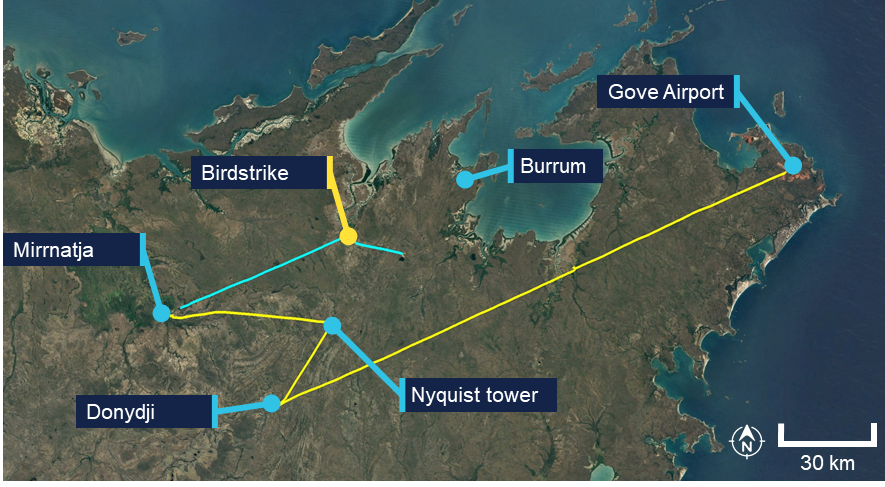
At approximately 0928 local time the helicopter departed Gove Airport for Donydji. The pilot reported that from Donydjii, they flew to ‘Nyquist tower’[1] and then on to Mirrnatja before departing for Burrum, which would be the last stop of the day before returning to Gove (Figure 1).
Figure 1: Flight path overview
Source: Google Earth, annotated by the ATSB
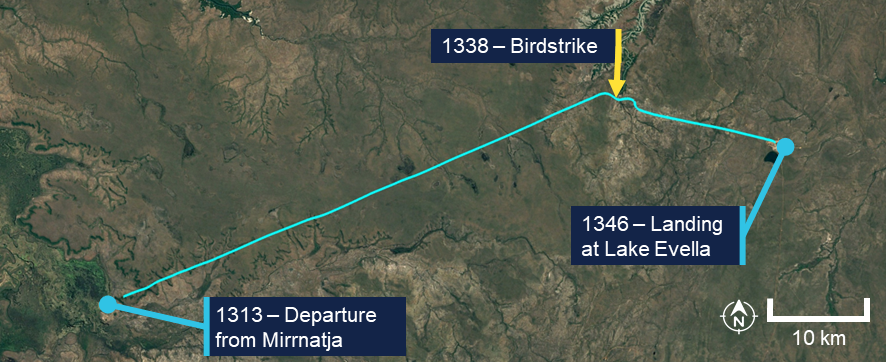
The flight departed for Burrum at 1313 (Figure 2) and the pilot established a cruise altitude of about 900 ft above ground level. The pilot recalled having a conversation with the passenger about a waterway which they were flying near, and was familiar to the passenger. The pilot recalled slightly deviating off track to view the waterway. At approximately 1338, while looking down to the left out of the aircraft, the pilot recalled hearing a loud bang.
The pilot saw a large bird laying between the 2 occupants, and what appeared to be serious injuries to the passenger’s upper body. The pilot reached over to the passenger to check for a pulse, but was unable to feel one. Noting the passenger required immediate attention, the pilot deliberated whether to land nearby and attempt resuscitation, and initially began to descend. However, considering the logistical issues with getting medical attention in a remote location, they decided it would be better for the passenger to receive medical attention at Lake Evella Aerodrome where a police station was next to the airport.
Figure 2: Accident flight overview
Source: Google Earth, annotated by the ATSB
The pilot landed the helicopter at Lake Evella Aerodrome at approximately 1346. They stated they attempted to call emergency services on 000, however the call did not connect. They decided not to attempt the call a second time and ran to the police station for assistance instead.
Police, a local nurse and doctor attended to the passenger, however the passenger had succumbed to injuries. The aircraft sustained minor damage (see Helicopter damage).
Context
Pilot information
The pilot held a valid Class 1 Aviation Medical Certificate and a Commercial Pilot Licence (Helicopter). The pilot had accumulated 2,553 hours of aeronautical experience, of which 1,319 hours was on the Bell 206L.
The pilot had been with the operator since September 2024 and had regularly flown these routes to remote communities as part of their employment.
Passenger information
The passenger was a frequent passenger on the routes operated on the day and had travelled by helicopter regularly to remote communities as part of their employment since 1995.
The pilot reported to having flown this passenger to remote communities on multiple occasions. Familiar with the aviation environment, the pilot reported the passenger would assist with monitoring for birds during flights, as they were aware they presented a hazard in flight.
The post-mortem examination report indicated the passenger was hit between the lower jaw and the upper chest, sustaining fatal injuries to the neck, chin, lower jaw and the right side of the chest.
Helicopter information
General
VH-JMM was a Bell Helicopter Company B206L‑3 Long Ranger, S/N 51400, manufactured in Canada in 1990. It was first registered in Australia in June 2017. The aircraft was registered to the operator in January 2024.
VH-JMM was a helicopter with two‑bladed main rotor and tail rotor systems, powered by a single Rolls-Royce 250‑C30P gas turbine engine.
At the time of the accident, the helicopter had completed 13,250 hours in service and had a current maintenance release.
Helicopter damage
The helicopter sustained damage to the passenger side windshield. There was no other reported damage to the aircraft (Figure 3).
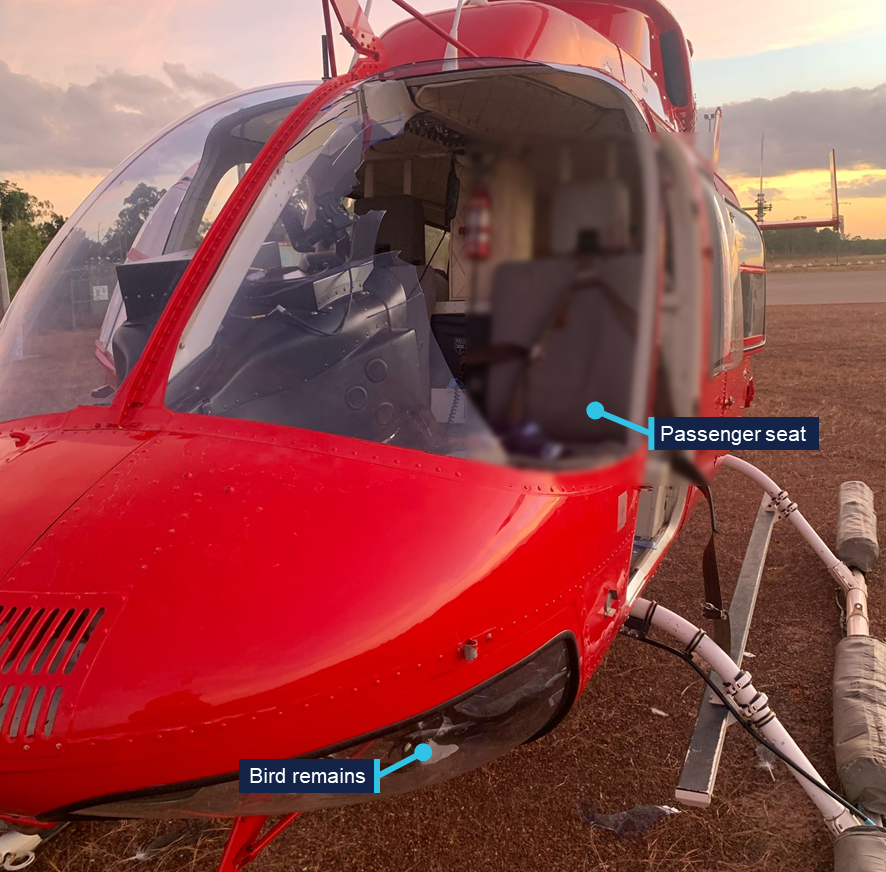
Source: Northern Territory Police Force, annotated by the ATSB
Helicopter windshields
VH-JMM was fitted with standard acrylic windshields, which were not rated for impact resistance.
In 2016 Bell Helicopter Company introduced polycarbonate windshields, through a supplemental type certificate (STC) for the Bell 206 series, including the 206L. These were available as an additional option for current owners, offering higher impact resistance compared to traditional acrylic, reducing the risk of breaches from birdstrikes or other impacts. These were rated to United States regulatory requirements of a 2.2 lb (1 kg) bird traveling at VNE (the helicopter’s never-exceed speed).[2]
Despite having a higher impact resistance than acrylic, polycarbonate windshields are more sensitive to scratches, and reportedly susceptible to clouding or hazing due to ultraviolet light exposure, resulting in loss of optical clarity and necessitating more frequent replacements.
Weather information
The terminal aerodrome forecast for the accident region forecasted clear conditions for the flight with scattered cloud above 3,500 ft and visibility greater than 10 km.
At 1530, the weather station at Elcho Island Airport, 48 km north of the accident location, recorded the wind as 4 kt from 110° magnetic. There was scattered cloud at 1,000 ft, visibility was greater than 10 km and the temperature was 23°C.
The pilot reported that the weather varied depending on where they were flying, however it was mostly clear with some areas of cloud. They reported the clouds were above their cruise height.
Recorded data
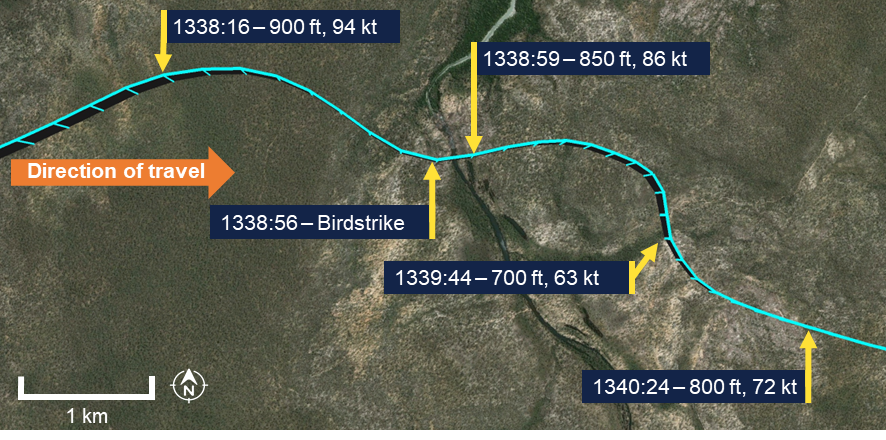
The aircraft was fitted with a Spidertracks flight tracking unit and the pilot used OzRunways electronic flight bag software; both recorded flight data. Flight data indicated that the aircraft was cruising at 900 ft above ground level at a groundspeed of 94 kt at the approximate time the bird was struck. The data showed an initial deceleration to 86 kt groundspeed and a decrease in altitude of 50 ft, followed by a secondary decrease in altitude of approximately 150 ft (likely associated with the pilot’s consideration of whether to land). The track showed that the helicopter then climbed to 800 ft and increased groundspeed to about 70 kt (Figure 4).
Figure 4: Recorded flight track
Source: Google Earth, annotated by the ATSB
Bird information
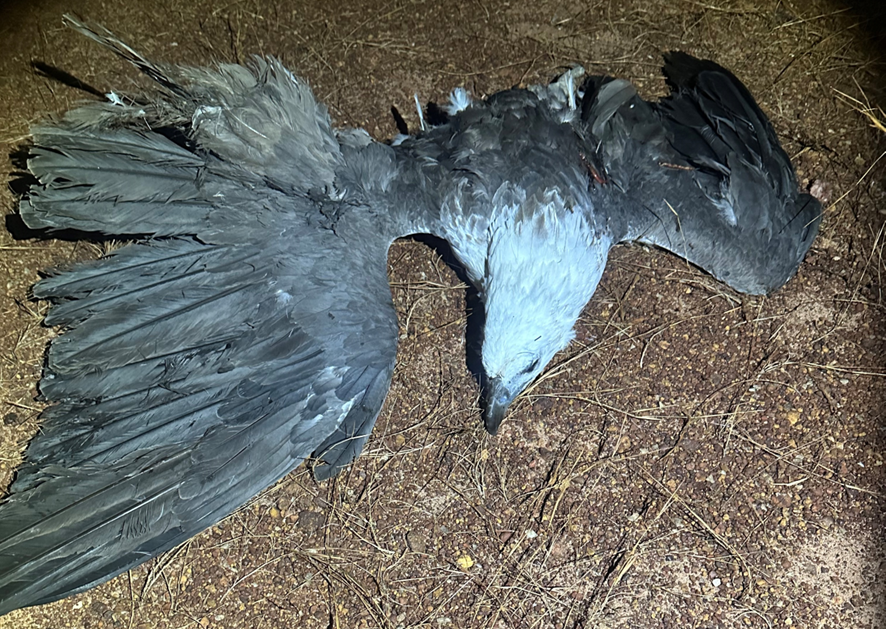
Recovered biological specimens of the bird, including wing feathers and residue from the carcass, were found both inside the helicopter and on the passenger. Through images of the bird, the ATSB determined the species to be a white‑bellied sea eagle.
The white-bellied sea eagle (Haliaeetus leucogaster) (Figure 5) is a large raptor commonly found in coastal regions of Australia, recognised for its distinctive white head, belly, and tail contrasted by dark greyish‑brown wings and back. Adults measure approximately 66–85 cm in length, with a wingspan of 1.8–2.2 m (Debus, 2017). Adult males typically weigh between 1.8–3 kg, while females average 2.5–4.5 kg (Marchant & Higgins, 1993). The weight and sex of the bird in this accident was unknown.
Figure 5: Some of the bird remains retrieved from the helicopter
Source: Northern Territory Police Force
These eagles are often observed soaring over coastlines, estuaries, or inland waterways, preying on fish, seabirds, or carrion, and can reach heights of up to 1,000 m (about 3,300 ft) (Ferguson‑Lees & Christie, 2001). Their activity increases during the June to January period in Australia, which is their breeding season (Debus, 2017).
It is relatively common for large birds, such as eagles, hawks, and gulls, to attack helicopters and drones, often perceiving them as threats or territorial intruders. These birds may display aggressive behaviour during nesting or breeding seasons, diving at or striking the aircraft in an attempt to drive it away (Washburn & others, 2015).
Limitations of see-and-avoid
The human visual system is inherently limited in detecting small objects such as birds at distances. Hobbs (1991) notes that effective visual scanning requires systematic eye movements across the visual field, yet pilots often employ unsystematic techniques, resulting in unsearched areas. Furthermore, the cognitive process of identifying a threat, assessing its collision risk, deciding on evasive action, and executing control inputs requires time that is often unavailable in low‑altitude, high‑speed scenarios.
Birds present unique challenges to the see‑and‑avoid principle due to their relatively small size, unpredictable flight paths, and speed difference compared with aircraft. Unlike aircraft, birds cannot be tracked electronically, meaning pilots must rely solely on visual identification.
Survivability
Restraints
The helicopter was fitted with 4‑point harnesses in the front seats. The pilot reported both they and the passenger had been fastened into the seats by the aircraft’s 4‑point harnesses.
Helmets
The pilot reported wearing a flight helmet[3] and reported wearing a helmet whenever possible, noting that helmets had saved lives in the past. The pilot recalled previously having a discussion with the passenger about helmets and the benefits of them.
The passenger was not wearing a helmet at the time, nor was there an aviation regulatory requirement for them to do so. Nautilus Aviation stated that there was no requirement for passengers to wear a helmet and the decision on their use rested with the passengers themselves or their employers.
Telstra helicopter charters
The passenger was on board the aircraft as part of their work for Telstra, a telecommunications company. Telstra reported that its employees took about 630 helicopter charters on average per year, a mix of passenger charter (transit) and aerial work.
The employer had an operational framework for chartering aircraft that addressed many risks typically associated with helicopter flights, outlining expectations for the aircraft operator. These included the requirement for the aircraft operator to perform a risk assessment ‘prior to the first flight of any new operation by the Charter operator.’
Telstra did not have prescribed or recommended personal protective equipment for employees travelling or working on helicopters. Telstra advised that it relied on the licenced and accredited aviation providers that it engages to advise on safety of flight aspects including the use of personal protective equipment (PPE).
Related occurrences
Global data
Birdstrikes are a recognised hazard in aviation and there are mitigators in place at certified airports, however, there are challenges when operating outside of these areas.
A review of Australian and internation data was conducted using the Avisure serious accident database. Between 1912 and 2024, birdstrikes have resulted in 763[4] reported aviation occurrences worldwide that involved serious or fatal injuries, of which 204 were fatal. Among these fatal cases, 18 involved rotary‑wing aircraft such as helicopters. These 18 accidents comprised 13 civil and 5 military rotary‑wing aircraft (Figure 6).
Figure 6: Global birdstrike data resulting in fatalities
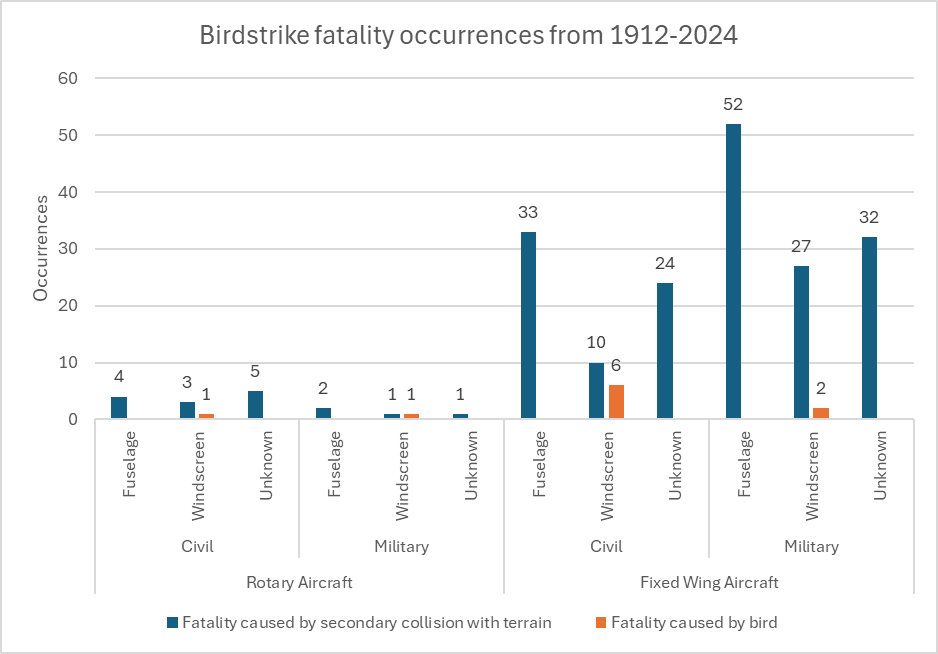
Data does not include this occurrence (AO-2025-039). Source: Avisure
United States data
In the United States, a total of 13,667 bird strike occurrences were reported to the Federal Aviation Administration (FAA) in operations involving aircraft (fixed-wing and rotary-wing) under 5,700 kg maximum take‑off weight from 2014 to 2024. Of these, 60 occurrences resulted in non-fatal injuries, and 11 were fatal.
A subset of 334 occurrences involved birds striking and damaging the aircraft windshield, with 48 of these occurrences (14.4%) resulting in serious injuries and 6 (1.8%) leading to fatal injuries.
Of the total, 3,001 occurrences involved rotary-wing aircraft, which equated to a birdstrike every 285,390 flight hours (Table 1). These included 201 recorded windshield strikes, that resulted in 28 (13.9%) serious injuries and 2 (1.0%) fatalities.
Table 1: Reported helicopter birdstrikes comparison 2014–2024
| Reporting country | Number of occurrences involving helicopters | Flight hours per birdstrike | Flight hours per birdstrike to windshield resulting in damage |
| Australia | 412 | 39,690 | 8,819 |
| United States | 3,001 | 285,390 | 19,026 |
In comparison to the most frequently struck aircraft component, the wings, with 1,171 occurrences, only 6 (0.5%) resulted in injuries including 1 with fatal injuries (0.09%), indicating that the proportion of serious and fatal outcomes from windshield strikes is unexpectedly high relative to other aircraft parts.
Australian data
Birdstrikes in Australia
Between 2014–2024 the ATSB aviation wildlife dashboard indicated there were 17,060 reported birdstrikes reported to the ATSB across all aircraft types (including fixed‑ and rotary-wing). There were 412 reported birdstrikes during helicopter operations (Table 2), which equated to a birdstrike every 39,690 flight hours. The data did not include what component was struck unless the component was damaged, so it was not possible to determine the proportion of windshields struck that were penetrated or damaged. Of the 412 reported birdstrikes to helicopters, 17 had damage to the windshield.
Table 2: Reported helicopter birdstrikes within Australia 2014–2024
| Total reported incidents | Injury level | Aircraft damage | ||||||
Nil | Minor | Fatal | Nil | Minor | Substantial | Destroyed | Unknown | |
| 412 | 411 | 0 | 1[1] | 352 | 37 | 2 | 2 | 19 |
| ||||||||
ATSB records indicate there were 2 fatal accidents in civil aircraft in Australia due to birdstrike. Additionally, there was 1 serious accident involving a bird entering through the windshield. These investigations are described in the following subsections.
Birdstrike involving Glasair Sportsman GS‑2, N666GM, near Bathurst, New South Wales, on 24 December 2015 (AO-2016-001)
During take-off the aircraft collided with a wedge‑tailed eagle (Aquila audax), penetrating the windscreen and causing significant damage to the propeller and engine, while also striking the pilot, who sustained serious facial injuries and was temporarily unable to see. The pilot, who was wearing a headset and spectacles (both dislodged and damaged during the impact), managed to land safely.
Birdstrike and in-flight break-up involving a Bell 206L‑1, VH‑ZMF, near Maroota, New South Wales, on 9 July 2022 (AO‑2022‑034)
Shortly after departing from a private helipad, the helicopter was struck by a wedge‑tailed eagle (Aquila audax) just below the front left windscreen. The pilot, likely startled by the birdstrike and distracted by sun glare and a required radio frequency change, made abrupt control inputs that caused the main rotor to sever the tail boom, resulting in an in‑flight breakup and collision with terrain. The pilot, who was the sole occupant, was fatally injured.
Birdstrike and collision with terrain involving Air Tractor AT‑502B, VH‑KDR, 32 km east‑north‑east of Chinchilla Airport, Queensland, on 19 September 2022 (AO‑2022‑043)
During low-level aerial spraying at about 8 feet above ground, the aircraft was struck by a large Australian bustard (Ardeotis australis), which shattered the right windshield. The bird entered the cockpit, likely impairing the pilot’s ability to control the aircraft. The aircraft continued for approximately 310 m before colliding with terrain, resulting in the pilot being fatally injured and destruction of the aircraft.
Safety analysis
Birdstrike
Images from the accident site showed that the aircraft collided with a white‑bellied sea eagle (Haliaeetus leucogaster). The pilot had limited opportunity to detect the bird as they were looking down and to the left of the helicopter’s trajectory, so it was probably in their peripheral vision where detection of small objects is very limited. Even if they had been looking ahead at the time, they may not have been able to see the bird in time to avoid it due to the inherent limitations of the see-and-avoid principle. The closure rate to the soaring bird would have been around 94 kt and the difference in speed between them would have also made the relative trajectory almost direct. These factors further reduced the pilot’s ability to see the bird and change the helicopter’s flight path in time, likely rendering the collision unavoidable under the circumstances.
Considerations for aircraft operators and employers
Windshield impact resistance
The analysis of bird strike data highlights the significant safety risks posed to windshields. In windshield impacts in the United States, 14.4% caused serious injuries and 1.8% caused fatalities. Australia’s occurrences included 3 fatal and 3 serious injuries. Comparison of the United States and Australian data indicated that there was a higher chance of both birdstrike and the strike resulting in windshield damage per flight hour in Australia.
There is an elevated risk for helicopter operations due to low‑altitude operations and often less robust windshield designs. This is because if a bird penetrates the windshield, it can directly impact occupants, causing injury or incapacitation of flight crew, which may lead to loss of aircraft control or further operational hazards. While advancements in windshield design, such as laminated materials and reinforced structures, have mitigated many impacts, the data highlights vulnerabilities in extreme cases.
Manufacturers like Robinson and Bell have both released birdstrike‑rated windshields that provide higher impact resistance and significantly decrease the likelihood of objects breaching the windshield upon impact. However, these windshields have been rated to withstand a 1 kg bird strike at the aircraft’s never‑exceed speed, and the occurrence scenario involving a 3 kg bird colliding with the helicopter would likely exceed the windshield’s design limits. Nevertheless, and noting there are some disadvantages of impact‑resistant windshields, operators are encouraged to consider installing impact‑resistant windshields if operating in areas with a high probability of birdstrike.
Helmets
Helicopter pilots often wear helmets as a safety measure due to their frequent exposure to the dynamic conditions of rotary‑wing flight, where turbulence, rapid manoeuvres, and potential accidents pose risks of head injury. In contrast, passengers often do not wear helmets, as the risk is lower for occasional travellers, particularly considering the other safety measures associated with commercial passenger transport operations.
Passengers who travel frequently in helicopters fall between these 2 extremes. They are naturally exposed to a higher risk (over the occasional passenger) simply due to the increased number of flights. While the pilot reported being a helmet advocate and had previously discussed the potential benefits with the passenger, the decision whether to wear a helmet was ultimately left to the passenger’s discretion.
Helmets provide an additional layer of protection against birdstrikes, particularly in aviation scenarios like the Glasair Sportsman GS‑2 incident (AO‑2016‑001). A helmet, often equipped with a sturdy visor, can shield the face and head from small‑object impacts, reducing the risk of injury from a shattered windshield. Additionally, a helmet, especially one designed for aviation, is engineered to absorb and disperse kinetic energy from impacts with larger objects such as a bird potentially mitigating the severity of injuries like those sustained by the pilot of the Glasair, who was not wearing a helmet and suffered serious facial injuries. The helmet’s hard outer shell and padded inner liner work together to reduce the force transmitted to the skull, significantly lowering the risk of traumatic brain injuries, concussions, or skull fractures.
A helmet would not have prevented the passenger’s injuries in this case due to the impact location. Nevertheless, wearing a helmet as standard practice would provide some protection against a range of other potential hazards.
Pilot response
The pilot maintained control of the aircraft despite the sudden disruption and potential aerodynamic effects of the compromised windscreen. They promptly identified the nearest suitable landing site with access to medical facilities and executed a controlled descent and landing.
The pilot’s effective response and adherence to emergency procedures ensured the injured passenger was positioned for immediate medical response, highlighting sound decision‑making under extreme circumstances.
Findings
ATSB investigation report findings focus on safety factors (that is, events and conditions that increase risk). Safety factors include ‘contributing factors’ and ‘other factors that increased risk’ (that is, factors that did not meet the definition of a contributing factor for this occurrence but were still considered important to include in the report for the purpose of increasing awareness and enhancing safety). In addition ‘other findings’ may be included to provide important information about topics other than safety factors. These findings should not be read as apportioning blame or liability to any particular organisation or individual. |
From the evidence available, the following findings are made with respect to the birdstrike involving Bell 206L‑3, VH‑JMM, 16 km west-north-west of Lake Evella Aerodrome, Northern Territory, on 14 July 2025.
Contributing factors
- While cruising at about 900 ft above mean sea level, the helicopter struck a white‑bellied sea eagle, which passed through the windscreen and impacted the passenger.
Other factors
- Despite the injuries to the passenger and the damage to the aircraft, the pilot demonstrated composure and maintained control of the aircraft, enabling a calm and controlled return to a location where medical assistance could be provided.
Sources and submissions
Sources of information
The sources of information during the investigation included:
- the pilot
- Nautilus Aviation
- Northern Territory Police Service
- recorded data from the Spidertracks unit on the helicopter
- OzRunways.
References
Australian Transport Safety Bureau (2002). The Hazard Posed to Aircraft by Birds. Canberra: ATSB.
Debus, S. J. S. (2017). Australasian Eagles and Eagle-like Birds. CSIRO Publishing.
Ferguson-Lees, J., & Christie, D. A. (2001). Raptors of the World. Christopher Helm.
Hobbs, A. (1991). Limitations of the See-and-Avoid Principle. Canberra: ATSB.
Marchant, S., & Higgins, P. J. (Eds.). (1993). Handbook of Australian, New Zealand and Antarctic Birds: Volume 2 - Raptors to Lapwings. Oxford University Press.
Washburn, B. E., Begier, M. J., & Wright, S. E. (2015). Wildlife strikes to civil helicopters in the United States, 1990–2011. Wildlife Society Bulletin, 39(1), 115‑120.
Submissions
Under section 26 of the Transport Safety Investigation Act 2003, the ATSB may provide a draft report, on a confidential basis, to any person whom the ATSB considers appropriate. That section allows a person receiving a draft report to make submissions to the ATSB about the draft report.
A draft of this report was provided to the following directly involved parties:
- the pilot
- Nautilus Aviation
- Telstra
- Civil Aviation Safety Authority
- Northern Territory Police Force
- TSB Canada.
Submissions were received from:
- Nautilus Aviation
- Telstra
The submissions were reviewed and, where considered appropriate, the text of the report was amended accordingly.
Purpose of safety investigationsThe objective of a safety investigation is to enhance transport safety. This is done through:
It is not a function of the ATSB to apportion blame or provide a means for determining liability. At the same time, an investigation report must include factual material of sufficient weight to support the analysis and findings. At all times the ATSB endeavours to balance the use of material that could imply adverse comment with the need to properly explain what happened, and why, in a fair and unbiased manner. The ATSB does not investigate for the purpose of taking administrative, regulatory or criminal action. TerminologyAn explanation of terminology used in ATSB investigation reports is available here. This includes terms such as occurrence, contributing factor, other factor that increased risk, and safety issue. Publishing informationReleased in accordance with section 25 of the Transport Safety Investigation Act 2003 Published by: Australian Transport Safety Bureau © Commonwealth of Australia 2025 
Ownership of intellectual property rights in this publication Unless otherwise noted, copyright (and any other intellectual property rights, if any) in this report publication is owned by the Commonwealth of Australia. Creative Commons licence With the exception of the Commonwealth Coat of Arms, ATSB logo, and photos and graphics in which a third party holds copyright, this report is licensed under a Creative Commons Attribution 4.0 International licence. The CC BY 4.0 licence enables you to distribute, remix, adapt, and build upon our material in any medium or format, so long as attribution is given to the Australian Transport Safety Bureau. Copyright in material obtained from other agencies, private individuals or organisations, belongs to those agencies, individuals or organisations. Where you wish to use their material, you will need to contact them directly. |
Occurrence summary
| Investigation number | AO-2025-039 |
|---|---|
| Occurrence date | 14/07/2025 |
| Location | 16 km west-north-west of Lake Evella Aerodrome |
| State | Northern Territory |
| Report release date | 25/09/2025 |
| Report status | Final |
| Investigation level | Short |
| Investigation type | Occurrence Investigation |
| Investigation status | Completed |
| Mode of transport | Aviation |
| Aviation occurrence category | Birdstrike, Forced/precautionary landing |
| Occurrence class | Accident |
| Highest injury level | Fatal |
Aircraft details
| Manufacturer | Bell Helicopter Co |
|---|---|
| Model | 206L-3 |
| Registration | VH-JMM |
| Serial number | 51400 |
| Aircraft operator | Nautilus Aviation Heli Pty Ltd |
| Sector | Helicopter |
| Operation type | Part 133 Air transport operations - rotorcraft |
| Departure point | Mirrnatja, Northern Territory |
| Destination | Burrum, Northern Territory |
| Damage | Minor |