ANSP info/procedural error

Entry to a closed taxiway involving Pilatus PC-12/47E, VH-FXJ, Adelaide Airport, South Australia, on 4 November 2024

Final report

Report release date: 24/06/2025

Investigation summary

What happened

On 4 November 2024, a Pilatus Aircraft PC-12/47E, registered VH-FXJ, and operated by the Royal Flying Doctor Service as Flydoc 543, taxied for departure at Adelaide Airport to conduct a medical transport flight to Pinnaroo Airport, South Australia. On board were a pilot and a flight nurse.

During taxi, after being incorrectly cleared to enter a NOTAMed closed section of taxiway, the pilot did not question the clearance, and the aircraft entered the taxiway and struck an unserviceability light used to identify the closed section. The pilot then continued with the departure.

There was no damage to the aircraft and no injuries as a result of this incident.

What the ATSB found

The ATSB found that, although both the air traffic controller and pilot were aware that the taxiway was closed, the aircraft was cleared and entered the area and consequently struck the light. Additionally, while there were indications via radio transmissions that an unserviceability light had been damaged, the pilot incorrectly assessed that the aircraft had not struck it and continued the flight without an inspection.

The ATSB also found that the lighting used to identify the entrance to the closed taxiway was insufficient to draw the pilot’s attention and the markers, required by the method of working plan, had not been used. In addition, the method of working plan, while stating that the closed area needed to be defined in accordance with the Civil Aviation Safety Regulations (CASR) Part 139 (Aerodromes) Manual of Standards 2019 (MOS), did not specify how many lights were required to denote the closed area.

In addition, the ATSB identified The Civil Aviation Safety Regulations Part 139 (Aerodromes) Manual of Standards 2019 section relating to the temporary closure of a taxiway at night did not:

  • provide a recommendation that when operating on an aerodrome with significant obscuring background lighting, consideration be given to increasing the span of unserviceability lights, similar to the recommendation provided for markers to cross the entire closed area
  • specify that both markers and unserviceability lights were required.

What has been done as a result

CASA is currently writing Advisory Circular (AC) 139.C-15 v1.0 - Safe planning and conduct for aerodrome works and has undertaken to include guidance on the use of both unserviceability cones and lights to designate closed taxiways at night. That guidance will include consideration of the detrimental effect background lighting can have on identifying closed infrastructure.

As a result of this incident, Airservices Australia released a standardised directive to Adelaide Tower air traffic controllers to clarify the occurrence management and reporting requirements following this incident. Operational command authority escalation was added to the Airservices focus area questions for initial and renewal assessments completed in October 2024.

Safety message

This incident highlights the importance of effective communication and potential for expectation bias. If flight crews receive a clearance that contradicts a NOTAM or current ATIS information, they should question the clearance before continuing.

Additionally, although the CASR Part 139 MOS did not specify a minimum number of lights to identify closed ground movement areas, it did state they should be identified as clearly as possible. When considering the adequacy of unserviceability lighting, operators should consider any obscuring background lighting and consider increasing the span of lighting if required. 

Finally, if there is a possibility that an object has been struck by an aircraft, it should be checked for damage before continued flight. 


The occurrence

On 4 November 2024, a Pilatus Aircraft PC-12/47E, registered VH-FXJ and operated by the Royal Flying Doctor Service as Flydoc 543, taxied for departure at Adelaide Airport to conduct a medical transport flight to Pinnaroo Airport, South Australia. On board the aircraft were a pilot and a flight nurse.

At the time of departure there was an active NOTAM[1] for multiple taxiway closures, including an area on taxiway A6 between taxiway K and holding point B2, due to work in progress on the grass beside the taxiway (Figure 1). The same information was broadcast on the Adelaide ATIS.[2] The closed section of taxiway was marked as unserviceable by 3 red lights across the taxiway at multiple entrances to the taxiway. The pilot reported being aware of the taxiway closures.

This was the pilot’s second flight from Adelaide during their duty period that night. On the first flight, the pilot had received the expected taxi clearance from the Adelaide ground air traffic service operator (controller) to taxi via taxiway D1, before entering and backtracking runway 23.[3] This taxi clearance avoided the unserviceable areas of the taxiway.
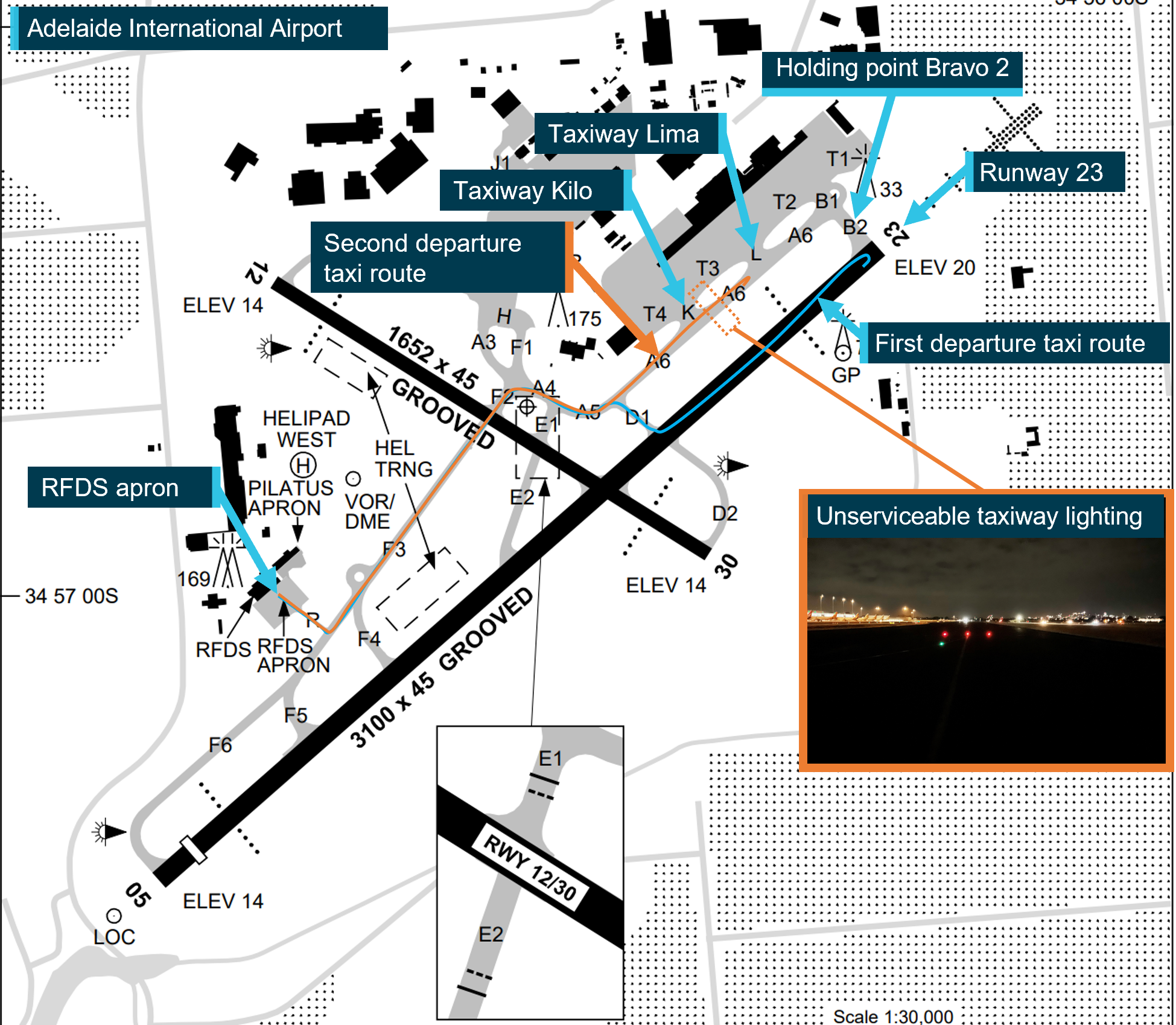
Figure 1: Adelaide Airport

Adelaide Airport diagram annotated by the ATSB to show the aircraft taxi path for both flights. It also shows the position and a picture of the 3 red unserviceability lights.

The image shows both taxi routes taken by Flydoc 543 and the position of the unserviceable taxiway lights. The blue line is the taxi route for the first flight, the orange line is the taxi route for the incident flight. The view of the unserviceable taxiway lights was taken on 14 November 2024. It is an exemplar image of the lights on the night the incident took place. Source: Airservices Australia, Adelaide Airport, and Flightradar24; annotated by the ATSB

At 0309, the pilot taxied for departure on the incident flight. They expected to receive the same taxi clearance for the planned departure on runway 23. However, the clearance received was:

Flydoc 543 on Foxtrot cross runway 12 taxi holding point Bravo 2 runway 23.

This clearance required the aircraft to taxi through the unserviceable area. The pilot did not question the clearance, assuming that the works had ended early.

The pilot later reported that they did not detect the red lights across the taxiway. As they entered the closed section, unknown to the pilot, the aircraft most likely struck the centre unserviceability light. Shortly after, the controller advised the pilot they had entered the closed taxiway and requested they stop and conduct a 180° turn:

…Flydoc 543 that taxiway’s closed, apologies, can you do a 180 there?

A works safety officer, in a nearby aerodrome safety car, offered to remove the red lights on the taxiway before the aircraft taxied back through them. When they entered the taxiway, they detected debris and advised the controller via the ground radio frequency that this would need to be removed:

Adelaide Ground, Works 60, there is debris on taxiway, sorry taxiway Alpha 6 from the red light, I just need a moment to pick that up…

advising a short time later:

Adelaide Ground, Works 60, the debris has been picked up as well as the red lights on Alpha 6.

The controller then asked the pilot if they wished to continue and, after confirming with the flight nurse that they had not felt anything, the pilot advised the controller that they would continue with the departure.

After the operator was advised of the incident the aircraft was grounded, pending an inspection. The post-incident inspection found no damage to the aircraft associated with striking the taxiway light. There were no injuries.

Context

Aircraft information

VH-FXJ was a Pilatus Aircraft PC-12/47E which was manufactured in 2015 and issued serial number 1541. On 10 August 2015, it was registered in Australia with the operator. It was powered by a Pratt & Whitney PT6A-67P turbine engine driving a four-bladed, variable-pitch Hartzell propeller.

Pilot information

The pilot held a commercial pilot licence (aeroplane), an instrument rating and a class 1 aviation medical certificate. They had about 6,375 hours of flight experience at the time of the incident. A total of 1,650 hours had been accrued in PC‑12 aircraft, of which 128 were in the previous 90 days.

The pilot later reported that, at the time of the occurrence, they were fully alert and wide awake. They had been on duty for 5 hours when the incident occurred and awake for approximately 6 hours. In the previous 48 hours, the pilot had received 18 hours of sleep.

They also stated that if they thought they had hit something, they would have returned to the apron to have the aircraft checked by maintenance personnel.

Adelaide Airport

At the time of the incident, NOTAM C0661 was active at Adelaide Airport. It stated, from 3–‍9 November, between 2300 and 0600 local time, taxiway A6 north of taxiway K, taxiway B1, taxiway B2, taxiway L, and holding bay 23 were closed due to work in progress (Figure 2). This meant that an aircraft departing from runway 23, was required to enter the runway at taxiway D1 and backtrack on the runway to the threshold. 

Figure 2: Method of working plan
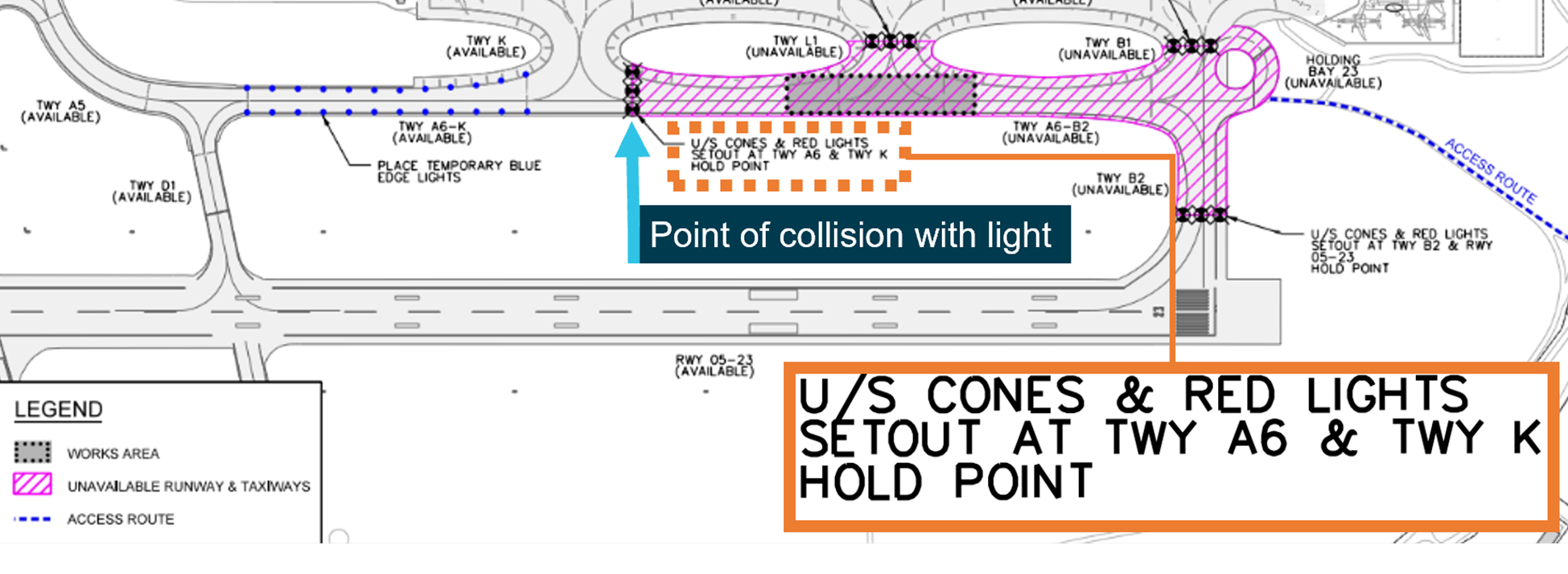
An image of the Adelaide Airport taken from the Method of Working plan. The ATSB has highlighted a section stating: "U/S cones & red lights setout at TWY A6 & TWY K hold point.

Source: Adelaide Airport, annotated by the ATSB

The NOTAM was accompanied by information on the ATIS that was broadcast from 0218 and valid at the time of departure. The ATIS stated that runway 23 was in use and taxiways B1, B2, L, A6 north of K, and the 23 holding bay were not available due to works.

The ATIS also stated the wind was from 200 degrees at 8 kt, visibility was greater than 10 km, temperature 16°C, and cloud cover was few[4] at 4,000 ft.

The method of working plan stated that the closed areas ‘will be defined by works limit markers in accordance with Civil Aviation Safety Authority Part 139 (Aerodromes) Manual of Standards’. The method of working plan required that both cones and lights were used and showed on a diagram where the works limit markers needed to be placed (Figure 2). However, it did not provide guidance regarding how many markers or lights should be used to identify the area.

Parts of the aircraft movement area that are unserviceable as a result of the works being carried out will be defined by unserviceability cones and red lights. These will be positioned as described below:

• Taxiway A6 – on the hold point to Taxiway K…

Adelaide Airport later advised the ATSB that 3 lights placed across the entrance to the taxiway, at 3 m intervals, was its standard practice. Additionally, the ATSB was informed that on the night of the incident the unserviceability cones, required by the method of working plan, had not been put in place, and this was its general practice for night works.  

Taxiway A6 was approximately 35 m in width. The lights used were steady red lights and were designed to break into fragments when struck, minimising damage to aircraft.

Taxiway A also normally had green centreline taxi lights. While not outlined as a safety measure in the method of working plan, at the time of the incident, the green centreline taxi lights were extinguished in the closed section, to assist in identifying this area. 

Air traffic control

The controller

The controller had been employed by Airservices Australia since 2005 and held the required ratings to provide air traffic services at Adelaide Airport. They held operational command authority (OCA), which designated them as the final decision-making authority within the tower when a tower supervisor was not available. They reported having previously completed night shifts as the only controller. In addition, they advised that there was a period of no aircraft movements prior to the pilot requesting taxi clearance, and during this period, they were completing company computer‑based training and felt alert and awake.

The controller also stated that, unless there was an emergency, the use of the runway for aircraft backtracking should be limited. They also stated that the operator required that their aircraft use the full runway length for departures. This meant, under normal circumstances, when runway 23 was in use, a taxi clearance would include taxi on A6 to holding point B2.

Further, the controller advised that there was no actual work being done to the taxiway, it was closed to provide clearance for the workers working on the grass adjacent to the taxiway. They stated that they did not think there would be anything on the taxiway that could damage the aircraft. 

Airservices also advised that the controller had completed the following:

  • assessment of renewal for its Adelaide tower endorsements – completed September 2024
  • examination requirements for renewal of Adelaide tower endorsements – completed October 2024.

Airservices had identified OCA refresher training to be included in the financial year 2024/2025 mandatory training plan. However, at the time of the incident, the controller had not completed this training.

Airport communication facilities

Adelaide Airport’s control tower was operating at the time of the incident and was occupied by a single controller. Due to the low level of activity, the controller was operating as Adelaide Delivery (providing airway clearances), Adelaide Ground (providing surface movement and control), and Adelaide Tower (aerodrome controller). Although the positions operated on different frequencies, while the tower was occupied by a single controller, all communications were re-transmitted across all 3 frequencies. 

Control tower systems

The integrated tower automation suite (INTAS) was in use by controllers at Adelaide Airport. The INTAS was capable of selecting a runway as closed. When activated, the INTAS workstation would highlight this on the status bar for the runway label, which changed the runway designator from grey (normal) to red. Additionally, an alert was also generated based on the runway status. 

In the context of this occurrence, INTAS did not facilitate marking a taxiway as unserviceable or provide an alert if an aircraft was cleared onto an unserviceable taxiway.

The controller reported they were aware of the airport taxiway closures. As they had no available tools to mark a taxiway or region as restricted or closed, they had created a custom text box on their display to help remind them of the closure. The text box did not provide any visual change to the closed taxiway or provide an alert if an aircraft was cleared into the area.

Post-incident procedures

Regarding required action following an occurrence, the NAAM stated:

5.1.1.5 Relief from operational duty

Whenever practicable, relieve the ATSO[5] from operational duty following any potential ATS occurrence for which there may be an ATS attribution.

5.1.1.6 Risk assess continued operation

If the ATSO cannot be relieved from operational duty following a potential ATS occurrence, conduct a risk assessment to determine if the affected ATSO can continue operational duties.

If there is any degree of, or doubt about, ATS attribution and the ATSO will continue duty, record the outcome of the risk assessment in the ATS Risk Assessment and Management Record…

Post-incident actions

After the incident, the controller remained on duty and submitted an internal report and logged the incident in the tower’s physical logbook. The controller advised the ATSB that they were unaware that a risk assessment was required to be completed following an incident or that they were required to contact the Air Traffic Management Director, based in Melbourne. 

At approximately 1030, after their scheduled shift was completed, the controller contacted the on-duty tower supervisor to ensure they were aware of the incident. They were then informed that their air traffic services approval had been temporarily withdrawn.

Airservices Australia later reported that if a risk assessment had been completed as soon as practicable after the incident occurred, the controller would probably have been found suitable to continue operation:

the risk assessment outcome would have likely resulted in the controller involved in the incident being able to remain on console with additional controls until the next scheduled controller arrived at 0530, had it been completed at the time.

The risk assessment controls likely would have focused on the following:

  • welfare checks to ensure fatigue management
  • assessment of the pending scheduled traffic.

Recorded data

Images

Several days after the incident, Adelaide Airport provided photographs of the unserviceability lights on taxiway A6, taken in similar conditions to those at the time of the incident. The images identified that the red unserviceability lights were difficult to see while on the southern end of taxiway A6 due to bright works lights beyond the unserviceable area (Figure 3). However they became more noticeable as the aircraft approached the closed area.

Figure 3: Approaching unserviceability lights
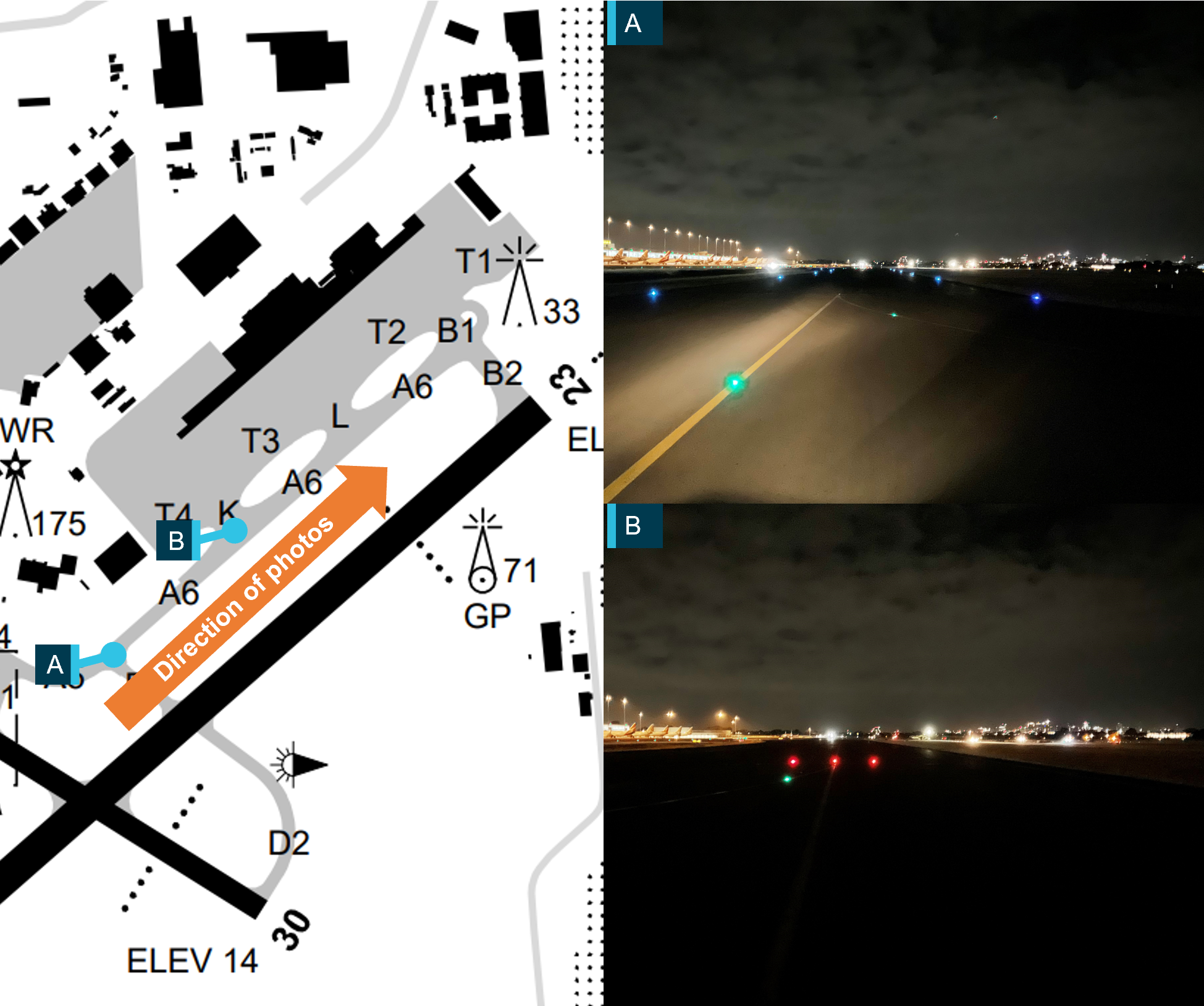
The image shows the 2 locations on the airport approaching A6 north of K. This first image shows the difficulty of spotting the 3 red lights against the works lights from a distance. The second image shows the 3 red lights at short distance

Image shown is an exemplar of the lighting on the night of the incident. The photo shown was taken several days after the incident occurred. Source: Adelaide Airport, annotated by the ATSB

Video imagery

Adelaide Airport also provided the ATSB with video footage of the incident. This showed the unserviceability lighting before and after the aircraft entered the area (Figure 4). It also showed that after completing a 180° turn and coming to a stop facing the 2 remaining red unserviceability lights, the aircraft remained stationary for approximately 4 minutes while ground personnel cleared the remaining lights and debris.

Figure 4: A6 unserviceability lighting before and after the occurrence
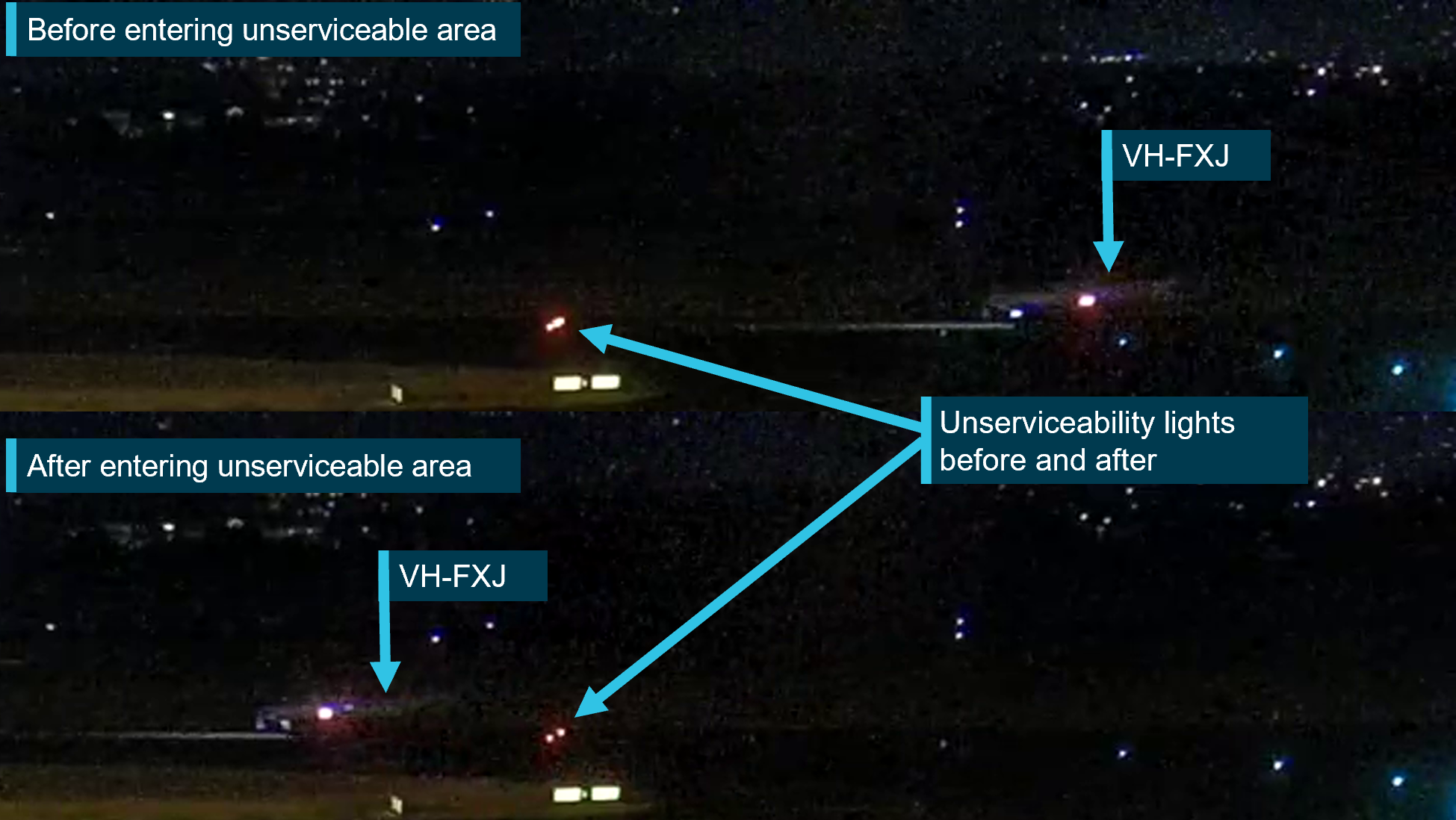
A still taken from a video recording. The video still shows an aircraft entering the unserviceable taxiway and extinguishing the centre light.

Source: Adelaide Airport, annotated by ATSB

Regulatory requirements

Unserviceability lights and markers

The Civil Aviation Safety Regulations (CASR) Part 139 (Aerodromes) Manual of Standards 2019 (MOS) Chapter 8 - Visual aids provided by aerodrome markings, markers, signals, signs, wind direction indicators etc stated:[6]

Division 2 - Markers

8.06 Introduction

(1) A marker must be lightweight and frangible…

8.108 Use of unserviceability markers…

(1) Unserviceability markers must consist of a white standard cone:

(a) with a horizontal red stripe 25 cm wide around its centre halfway up the cone so as to provide 3 bands of colour, namely, white-red-white 

(2) Unserviceability markers must be placed at the entrance to, and across, any part of the movement area of an aerodrome (including a runway) that is not to be used by aircraft.

(3) At least 3 unserviceability markers must be displayed across the centreline of any portion of a taxiway, apron or holding bay that is unserviceable, whether or not it is possible for aircraft to safely taxi past the area that is unserviceable.

Note: CASA recommends that additional unserviceability markers be displayed, 3 m apart, continuously across the entire width of the runway, taxiway, apron or holding bay.

Regarding unserviceability lighting, Chapter 9 - Visual aids provided by aerodrome lighting Division 14 Works and unserviceable area lighting stated:

9.127 Lighting associated with closed and unserviceable areas 

(1) If a runway or taxiway, or a portion of a runway or taxiway, is closed (a closed facility), all aerodrome lighting on the closed facility, and any visual aids leading a pilot into the closed facility, must be extinguished or obscured except the lighting for visual aids used to warn pilots of the closed facility.

(3) For a partial or complete closure of a manoeuvring area for less than 5 days, the aerodrome lights for the closed area must be:

   (a) obscured with an opaque cover ….

   (b) if not so obscured — electrically isolated or disabled to prevent their inadvertent activation.

9.131 Movement area access in the vicinity of unserviceable areas

(1) If a closed runway or taxiway, or a portion of a closed runway or taxiway (the closed area) is intersected by a runway or taxiway which is used at night, unserviceability lights must be placed across the entrance to the closed area at intervals not exceeding 3 m.

9.132 Characteristics of unserviceability lights

Unserviceability lights must:

(a) be steady red lights; and

(b) have:

(i) an intensity that is sufficient to ensure conspicuity considering the intensity of the adjacent lights and the general level of illumination against which they would normally be viewed; and

(ii) an average output of red main beam light not less than 10 cd.

CASA also later advised that markers and lights should be used at night to delineate an unserviceable area:

… the Part 139 MOS does not state that markers are only required during the day, therefore they are required at all times.

CASA also published Advisory Circular 139.C-09v1.0 - Visual Aids, Markings, Signals and Signs, which did not provide any further clarification for how to identify a temporary unserviceable taxiway. This AC advised that ‘Visual aids required for the management of works on the aerodrome are outside the scope of this AC and are addressed in AC 139.C-15 Safe planning and conduct of aerodrome works however, at the time of writing, AC 139.C-15 had not been published.

The International Civil Aviation Organization (ICAO) - Annex 14 Aerodromes section 7.1 Closed runways and taxiways or parts thereof subsection 7.1.1 provided the minimum standard for identifying a temporary closed taxiway, which stated that:

‘a closed marking shall be displayed on a runway or taxiway or portion thereof which is permanently closed to the use of all aircraft.’

 7.1.3 stated that 

‘…on a taxiway a closed marking shall be placed at least at each end of the taxiway or portion thereof closed.’

Note 1. — When an area is temporarily closed, frangible barriers or markings utilizing materials other than paint or other suitable means may be used to identify the closed area.

Annex 14 did not provide a definition of a frangible barrier.

In addition, 7.1.7 stated that:

In addition to closed markings, when the runway or taxiway or portion thereof closed is intercepted by a usable runway or taxiway which is used at night, unserviceability lights shall be placed across the entrance to the closed area at intervals not exceeding 3 m…

In section 7.4 Unserviceable areas subsection 7.4.1 stated 

Unserviceability markers shall be displayed wherever any portion of a taxiway, apron or holding bay is unfit for the movement of aircraft but it is still possible for aircraft to bypass the area safely. On a movement area used at night, unserviceability lights shall be used. 

Note 1.— Unserviceability markers and lights are used for such purposes as warning pilots of a hole in a taxiway or apron pavement or outlining a portion of pavement, such as on an apron, that is under repair. They are not suitable for use when a portion of a runway becomes unserviceable, nor on a taxiway when a major portion of the width becomes unserviceable. In such instances, the runway or taxiway is normally closed.

Safety analysis

Introduction

On the night of the incident, Adelaide Airport had temporary taxiway closures in place. These closures were broadcast on the ATIS and published in the Adelaide Airport NOTAMs. Although, both the pilot and the controller were aware of the temporary closures, the aircraft was cleared to and entered a temporary unserviceable area and collided with an unserviceability light, before proceeding to take-off.

Clearance to enter taxiway

Although, the occurrence time was early in the morning, the controller reported feeling alert. They were experienced in working as the sole controller in the tower and remained active by completing company computer-based training.

As the operator’s aircraft were required to use the full runway length for departure, it is likely that the controller gave the commonly-used taxi clearance, while momentarily forgetting about the taxiway closures. Furthermore, while the controller had created a custom text box on their display to help remind them of the closure, it was ineffective and there was no built-in alerting system if an aircraft was cleared onto the closed taxiway.

Contributing factor

The controller issued a clearance for the aircraft to taxi through a temporarily closed movement area.

Aircraft entered closed taxiway

The pilot was aware of the taxiway closures and planned their taxi route to avoid them. However, as they assumed the clearance indicated the works were no longer active, they did not question the clearance. 

The pilot reported they did not see the red unserviceability lights before entering the closed section of taxiway and the aircraft struck one of the temporary lights. 

Contributing factor

On receipt of a clearance that required taxiing through a known temporarily closed area, the pilot did not question the clearance as they assumed the works had ceased. Additionally, they did not observe the identifying closure lights and, during entry to the closed movement area, the aircraft struck a temporary taxiway light.

Insufficient lighting and markers to denote the closed area

Three lights had been placed across the closed section of taxiway which was 35 m wide. Photographs, taken along the taxiway, showed that with the background lighting, it was difficult to identify the lights, although they were more noticeable close to the closed section. In any event, the lighting in place on the night was insufficient to alert the pilot that the taxiway was still closed. In addition, the markers required to denote the unserviceable area, were not in position.

Contributing factor

The lighting in place on the night was insufficient to draw the pilot's attention and avoid entering the temporary unserviceable area. Additionally, the required markers were not in place.

Continued departure

The pilot was made aware they had entered an unserviceable taxiway, and they waited while the taxiway lights were removed prior to exiting the area. During that time, comments by the works safety officer that they were removing debris from a broken light was rebroadcast on all frequencies, including the one being used by the pilot. 

While the controller did not specifically state that there was debris on the taxiway, they did question the pilot about if they wanted to continue. The pilot, after checking with the flight nurse whether they had felt anything, assessed the aircraft had not struck a light and continued the departure. Regardless of whether the aircraft struck the light, due to the possibility of damage, an inspection should have been completed prior to continued flight.

Other factor that increased risk

Despite indications that an unserviceability light had been damaged by the aircraft, the pilot assessed that the aircraft had not struck it and continued the flight, without getting an inspection.

Method of working plan

While the method of working plan stated that the closed movement areas needed to be marked in accordance with the Civil Aviation Safety Regulations Part 139 (Aerodromes) Manual of Standards 2019 (MOS) and showed where the markers were to be placed, it did not specify a minimum number to be used. As it was Adelaide Airport’s general practice not to use cones to identify night works, this did not contribute to this incident.

In addition, 3 symbols were used to represent the unserviceability markers and red lights. It is likely that this influenced the Adelaide Airport’s general practise to use 3 lights to identify temporary unserviceable areas, as was the case on the night of the occurrence. 

Contributing factor

Despite Adelaide Airport’s method of working plan stating that the markers used to identify the closed areas needed to comply with the Civil Aviation Safety Regulations Part 139 (Aerodromes) Manual of Standards 2019, it did not specify the number of unserviceability markers required. However, these were regularly not being used to denote the closed area at night. The plan also did not specify the number of lights to be used, and it was the general practise to use 3 red lights. This resulted in reduced prominence of unserviceable movement areas.

Clarity of regulations

The Civil Aviation Safety Regulations (CASR) Part 139 (Aerodromes) Manual of Standards 2019 (MOS) stated that a minimum of 3 markers were required to denote a temporary unserviceable movement area and while not mandatory, it recommended that markers cover the entire width of the taxiway at 3 m spacing. 

The requirements in the MOS for identifying a temporary closed taxiway during daylight hours exceeded the Annex 14 – Aerodromes requirements.

For night closures, the regulations stated that unserviceability lights needed to be placed across the entrance at 3 m spacing but did not recommend that the lights should cover the entire width. While CASA had a requirement for lights to have an intensity that was sufficient to ensure conspicuity against the background which they would normally be viewed, as was the case in this occurrence, background lighting at busy airports can make it difficult to detect unserviceability lights.

Increasing the span of unserviceability lights, in circumstances where there is significant obscuring background lighting, would make a closed area much more distinguishable. As done for the markers, a recommendation would encourage operators to consider their circumstances to assess the number of lights required to clearly identify the area. 

In addition, CASA advised that as the MOS did not state that markers were only required during daylight, therefore, they were required at night. Although implied by the MOS, there was no statement that clarified that at night both unserviceability lights and markers were required. This explicit requirement was contained within the wording of Annex 14.

Contributing factor

The Civil Aviation Safety Regulations Part 139 (Aerodromes) Manual of Standards 2019 section relating to the temporary closure of a taxiway at night did not:

  • provide a recommendation that when operating on an aerodrome with significant obscuring background lighting, consideration be given to increasing the span of unserviceability lights, similar to the recommendation provided for markers to cross the entire closed area
  • specify that both markers and unserviceability lights were required.  (Safety issue)
Controller continued duty

After the incident took place, while the Air Traffic Service (ATS) controller entered an internal report and entered the incident into the physical tower logbook, they did not believe the incident required contacting the Air Traffic Management Director (ATMD), located in Melbourne. Although, the Airservices Australia’s records showed the controller had completed their annual renewal for the Adelaide tower endorsements, the controller reported they were unaware that a risk assessment was required for them to continue operating. 

If contact had been made with the ATMD, the risk assessment would likely have found the controller suitable to continue operating, requiring extra welfare checks and an assessment of pending traffic.

As the risk assessment was not completed, the controller continued operations without additional risk controls in place.

Other finding

Following the occurrence, the controller continued operating as the sole tower operator without completing the required risk assessment. If conducted, such an assessment would probably have resulted in the controller completing their duty period with additional risk controls in place.

Findings

ATSB investigation report findings focus on safety factors (that is, events and conditions that increase risk). Safety factors include ‘contributing factors’ and ‘other factors that increased risk’ (that is, factors that did not meet the definition of a contributing factor for this occurrence but were still considered important to include in the report for the purpose of increasing awareness and enhancing safety). In addition ‘other findings’ may be included to provide important information about topics other than safety factors. 

Safety issues are highlighted in bold to emphasise their importance. A safety issue is a safety factor that (a) can reasonably be regarded as having the potential to adversely affect the safety of future operations, and (b) is a characteristic of an organisation or a system, rather than a characteristic of a specific individual, or characteristic of an operating environment at a specific point in time.

These findings should not be read as apportioning blame or liability to any particular organisation or individual.

From the evidence available, the following findings are made with respect to the entry to a closed taxiway involving Pilatus PC-12, VH-FXJ at Adelaide Airport, South Australia on 4 November 2024.

Contributing factors

  • The controller issued a clearance for the aircraft to taxi through a temporarily closed movement area.
  • On receipt of a clearance that required taxiing through a known temporarily closed area, the pilot did not question the clearance as they assumed the works had ceased. Additionally, they did not observe the identifying closure lights and, during entry to the closed movement area, the aircraft struck a temporary taxiway light.
  • The lighting in place on the night was insufficient to draw the pilot's attention and avoid entering the temporary unserviceable area. Additionally, the required cone markers were not in place.
  • Despite Adelaide Airport’s method of working plan stating that the markers used to identify the closed areas needed to comply with the Civil Aviation Safety Regulations Part 139 (Aerodromes) Manual of Standards 2019, it did not specify the number of unserviceability markers required. However, these were regularly not being used to denote the closed area at night. The plan also did not specify the number of lights to be used, and it was the general practise to use 3 red lights. This resulted in reduced prominence of unserviceable movement areas.
  • The Civil Aviation Safety Regulations Part 139 (Aerodromes) Manual of Standards 2019 section relating to the temporary closure of a taxiway at night did not:
    • provide a recommendation that when operating on an aerodrome with significant obscuring background lighting, consideration be given to increasing the span of unserviceability lights, similar to the recommendation provided for markers to cross the entire closed area
    • specify that both markers and unserviceability lights were required. (Safety issue)

Other factors that increased risk

  • Despite indications that an unserviceability light had been damaged by the aircraft, the pilot assessed that the aircraft had not struck it and continued the flight, without getting an inspection.

Other finding

Following the occurrence, the controller continued operating as the sole tower operator without completing the required risk assessment. If conducted, such an assessment would probably have resulted in the controller completing their duty period with additional risk controls in place.

Safety issues and actions

Central to the ATSB’s investigation of transport safety matters is the early identification of safety issues. The ATSB expects relevant organisations will address all safety issues an investigation identifies. 

Depending on the level of risk of a safety issue, the extent of corrective action taken by the relevant organisation(s), or the desirability of directing a broad safety message to the Aviation industry, the ATSB may issue a formal safety recommendation or safety advisory notice as part of the final report.

All of the directly involved parties are invited to provide submissions to this draft report. As part of that process, each organisation is asked to communicate what safety actions, if any, they have carried out or are planning to carry out in relation to each safety issue relevant to their organisation. 

Descriptions of each safety issue, and any associated safety recommendations, are detailed below. Click the link to read the full safety issue description, including the issue status and any safety action/s taken. Safety issues and actions are updated on this website when safety issue owners provide further information concerning the implementation of safety action.

Temporary unserviceability lighting regulations

Safety issue number: AO-2024-061-SI-01

Safety issue description: The Civil Aviation Safety Regulations Part 139 (Aerodromes) Manual of Standards 2019 section relating to the temporary closure of a taxiway at night did not:

  • provide a recommendation that when operating on an aerodrome with significant obscuring background lighting, consideration be given to increasing the span of unserviceability lights, similar to the recommendation provided for markers to cross the entire closed area
  • specify that both markers and unserviceability lights were required.
Additional safety action taken by Airservices Australia

As a result of this incident, Airservices Australia released a standardised directive to Adelaide tower to clarify the occurrence management and reporting requirements following this incident. In addition, operational command authority escalation was added to the Airservices focus area questions for initial and renewal assessments completed in October 2024.

Glossary

ACAdvisory Circular
ATMDAir traffic management director
ATSAir traffic services
ATISAutomatic terminal information service
ATSOAir traffic services officer
CASACivil Aviation Safety Authority
CASRCivil Aviation Safety Regulations
ICAOInternational Civil Aviation Organization
INTASIntegrated tower automation suite
MOSManual of Standards
NAAMNational ATS administration manual
NOTAMNotice to airman
OCAOperational control authority

Sources and submissions

Sources of information

The sources of information during the investigation included:

  • the pilot and operator
  • the controller
  • Civil Aviation Safety Authority
  • International Civil Aviation Organisation
  • Adelaide Airport
  • Airservices Australia
  • ADS-B flight data
  • still and video imagery
  • recorded communications. 

References

  • Civil Aviation Safety Regulations–Part 139 (Aerodromes) Manual of Standards 2019 (MOS)
  • Civil Aviation Safety Regulation–Part 91
  • International Civil Aviation Organization (ICAO) - Annex 14 Aerodromes 

Submissions

Under section 26 of the Transport Safety Investigation Act 2003, the ATSB may provide a draft report, on a confidential basis, to any person whom the ATSB considers appropriate. That section allows a person receiving a draft report to make submissions to the ATSB about the draft report. 

A draft of this report was provided to the following directly involved parties:

  • the pilot and operator
  • the controller
  • Adelaide Airport
  • Airservices Australia
  • Civil Aviation Safety Authority

Submissions were received from:

  • the operator
  • Airservices Australia
  • Civil Aviation Safety Authority

The submissions were reviewed and, where considered appropriate, the text of the report was amended accordingly.

Purpose of safety investigations

The objective of a safety investigation is to enhance transport safety. This is done through: 

  • identifying safety issues and facilitating safety action to address those issues
  • providing information about occurrences and their associated safety factors to facilitate learning within the transport industry.

It is not a function of the ATSB to apportion blame or provide a means for determining liability. At the same time, an investigation report must include factual material of sufficient weight to support the analysis and findings. At all times the ATSB endeavours to balance the use of material that could imply adverse comment with the need to properly explain what happened, and why, in a fair and unbiased manner. The ATSB does not investigate for the purpose of taking administrative, regulatory or criminal action.

Terminology

An explanation of terminology used in ATSB investigation reports is available here. This includes terms such as occurrence, contributing factor, other factor that increased risk, and safety issue.

Publishing information

Released in accordance with section 25 of the Transport Safety Investigation Act 2003

Published by: Australian Transport Safety Bureau

© Commonwealth of Australia 2025

Title: Creative Commons BY - Description: Creative Commons BY

Ownership of intellectual property rights in this publication

Unless otherwise noted, copyright (and any other intellectual property rights, if any) in this report publication is owned by the Commonwealth of Australia.

Creative Commons licence

With the exception of the Commonwealth Coat of Arms, ATSB logo, and photos and graphics in which a third party holds copyright, this report is licensed under a Creative Commons Attribution 4.0 International licence.

The CC BY 4.0 licence enables you to distribute, remix, adapt, and build upon our material in any medium or format, so long as attribution is given to the Australian Transport Safety Bureau. 

Copyright in material obtained from other agencies, private individuals or organisations, belongs to those agencies, individuals or organisations. Where you wish to use their material, you will need to contact them directly.

[1]      Notice to Airmen (NOTAM): a notice distributed by means of telecommunication containing information concerning the establishment, condition or change in any aeronautical facility, service, procedure or hazard, the timely knowledge of which is essential to personnel concerned with flight operations.

[2]      Automatic terminal information service: the provision of current, routine information to arriving and departing aircraft by means of continuous and repetitive broadcasts. ATIS information is prefixed with a unique letter identifier and is updated either routinely or when there is a significant change to weather and/or operations.

[3]      Runway number: the number represents the magnetic heading of the runway.

[4]      Cloud cover: in aviation, cloud cover is reported using words that denote the extent of the cover – ‘few’ indicates that up to a quarter of the sky is covered.

[5]      Air Traffic Services Officer

[6]      Closed taxiway markings: A yellow cross that is 9 m across, generally painted on the surface of the taxiway.

Occurrence summary

Investigation number AO-2024-061
Occurrence date 04/11/2024
Location Adelaide Airport
State South Australia
Report release date 24/06/2025
Report status Final
Investigation level Defined
Investigation type Occurrence Investigation
Investigation status Completed
Mode of transport Aviation
Aviation occurrence category ANSP info/procedural error, Taxiing collision/near collision
Occurrence class Incident
Highest injury level None

Aircraft details

Manufacturer Pilatus Aircraft Ltd
Model PC-12/47E
Registration VH-FXJ
Serial number 1541
Aircraft operator Royal Flying Doctor Service of Australia Central Operations
Sector Turboprop
Operation type Part 135 Air transport operations - smaller aeroplanes
Departure point Adelaide Airport, South Australia
Destination Pinnaroo Aircraft Landing Area, South Australia
Damage Nil

ANSP information/procedural error involving Airbus A380-841, 9V-SKQ and Boeing 737-8SA, VH-IWQ, at Sydney Airport, New South Wales, on 14 November 2022

Discontinuation notice

Report release date: 30/01/2025

Section 21 (2) of the Transport Safety Investigation Act 2003 (TSI Act) empowers the ATSB to discontinue an investigation into a transport safety matter at any time. Section 21 (3) of the TSI Act requires the ATSB to publish a statement setting out the reasons for discontinuing an investigation. The statement is published as a report in accordance with section 25 of the TSI Act, capturing information from the investigation up to the time of discontinuance.

Overview of the investigation

The occurrence

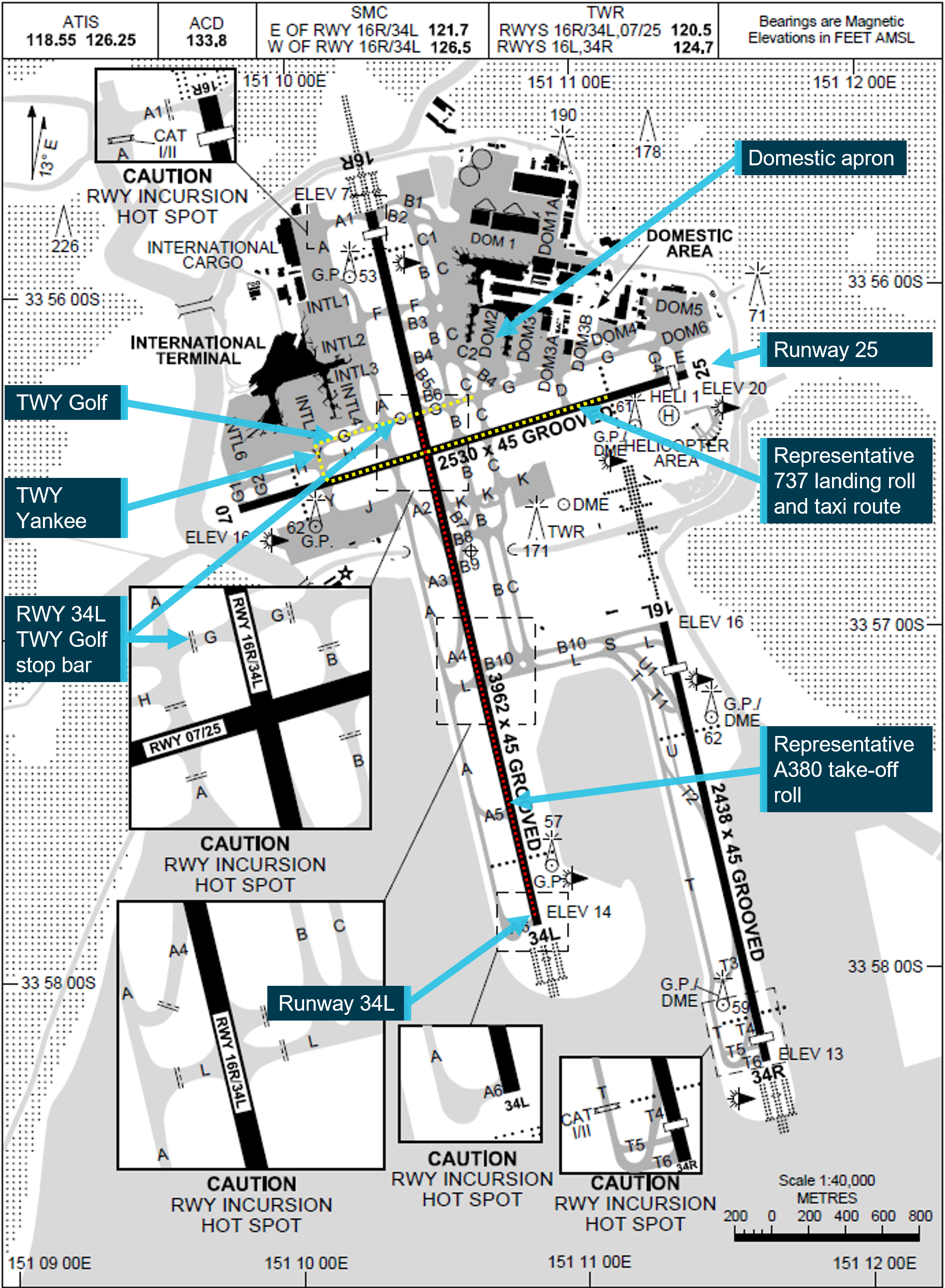
On the afternoon of 14 November 2022, a Boeing 737-800 aircraft (B737), registered VH-IWQ was being operated by Virgin Australia on a passenger air transport flight between Melbourne, Victoria and Sydney, New South Wales. The flight from Melbourne had been uneventful and the flight crew of the B737 were given a clearance by the aerodrome controller (ADC)[1] to land on runway 25 at Sydney and vacate the runway at taxiway Yankee. After vacating the runway, the flight crew contacted the surface movement controller east (SMCE)[2] and were issued a clearance to taxi to their assigned parking bay on the domestic apron via taxiway Golf, and to cross runway 34 left (34L). The SMCE deactivated the taxiway stop bar[3] for the B737 to cross the runway.

At the time the clearance was issued for the B737 to cross the runway, an Airbus A380-841 (A380) aircraft, registered 9V‑SKQ and operated by Singapore Airlines, had just commenced its take-off on runway 34L and was accelerating through a groundspeed of about 40 kt. The B737 was on taxiway Golf and about 300 m from runway 34L when its flight crew saw the A380 on initial climb. They remarked to each other that this was unusual and thought they had been instructed to cross runway 34L ahead. They contacted the SMCE and received confirmation they were clear to cross the runway and taxied to their parking bay. The B737 did not infringe on the 34L runway strip and there was no runway incursion.

Figure 1 depicts the relative locations between runways 25 and 34L, representative ground tracks for the B737 and A380 together with the location of taxiways Yankee and Golf.

Figure 1: Extract from Sydney Airport aerodrome chart with runway (RWY) orientation and taxiway (TWY) layout

Figure 1: Extract from Sydney Airport aerodrome chart with runway (RWY) orientation and taxiway (TWY) layout

Source: Airservices Australia, annotated by the ATSB

Runway and taxiing operations

Strong westerly winds prevailed during the afternoon, with runway 25 being used as the duty runway for both arriving and departing aircraft. For aircraft requiring the use of a longer runway, 34L was available on request but was deactivated when not operationally required.

With runway 25 being used for arrivals, flight crews of landing domestic jet aircraft were typically required to vacate via taxiway Yankee or if operationally required, taxiway Alpha. The flight crew were then to contact the SMCE, who would issue the taxi clearance to the domestic apron, including the clearance to cross runway 34L.

Similarly, the surface movement controller west (SMCW) was responsible for coordinating taxi clearances for aircraft using the international apron. The SMCW had provided approval for the flight crew of the A380 to push back from their parking bay and issued the clearance to taxi to the runway threshold for 34L.

Activation of runway 34L and take-off of the A380

The ADC had activated runway 34L using the tower control and monitoring system. Soon after, the flight crew of the taxiing A380 had called ready for take-off. With the activation of the runway, the responsibility for separating aircraft and vehicles using that runway transferred to the ADC, including approving requests to cross or enter the active runway.

The SMCE and SMCW were alerted to the runway activation by notification chimes at their controller positions, which required their acknowledgement and insertion of a ‘34L ACTIVE’ strip in their flight progress strip board.[4] The SMCW and SMCE in turn used their hotline to the ADC to acknowledge the changed status of the runway and provide relevant details for aircraft or vehicles operating on that part of the aerodrome’s movement area. When the SMCE acknowledged the runway activation and placed the relevant status strip into their flight progress strip board, they requested (and were issued) clearance from the ADC, for an aircraft under tow to cross runway 34L.

After activating the runway, the ADC instructed the flight crew of the A380 to line-up and hold position. Soon after, the B737 flight crew were transferred to the tower frequency and established contact with the ADC. About a minute later, the ADC issued the B737 flight crew a landing clearance and passed information about the A380, which was lining-up on the crossing runway to hold position. The ADC issued the A380 flight crew their clearance to take-off as the B737 passed through 34L during its landing roll.

After landing and vacating the runway, the B737 flight crew transferred to the SMCE frequency. The SMCE subsequently issued the B737 flight crew their taxiing instructions and clearance to cross runway 34L, without coordinating the crossing of the active runway with the ADC.

Sighting limitations

The B737 operator required its flight crews to scan the runway approach path and runway environment prior to entering any runway, to identify potential traffic that could conflict with their safe crossing. Flight crew and airside vehicle drivers crossing runway 34L in the vicinity of taxiway Golf had several sighting limitations along the runway to the south, principally due to reprofiling of terrain that had occurred with the construction of General Holmes Drive (which passes under the airport south of taxiway Golf).

The ATSB examined any sighting limitations based on the time a B737 flight crew would have been scanning the runway environment as they approached the taxiway hold position and the performance of the A380 on its take-off roll. The ATSB found that the lower fuselage, wings and landing lights of an A380 would be shielded by terrain during the first part of the take-off roll and not visible to flight crew or vehicle operators approaching runway 34L along taxiway Golf. In addition, the oblique viewing angle of an A380 upper fuselage and tail at the maximum sighting range made it harder to identify aircraft during the early stages of the take-off roll.

Stop bar lighting and procedures

Operating the stop bars and runway guard lighting

The airport’s ground-based infrastructure included runways, taxiways and the associated airfield lighting systems, which were maintained by Sydney Airport Corporation Limited. The intersections of taxiways with runways were equipped with stop bar lighting, runway guard lighting[5] and movement area guidance signs. Those systems were intended to help reduce the incidence of runway incursions.[6]

Local procedures at Sydney required taxiway stop bars to be illuminated at all runway crossing points, irrespective of runway status.[7] Consequently, an air traffic controller was required to deactivate the taxiway’s stop bar for every clearance issued for a runway crossing or entry by taxiing aircraft or authorised vehicles. The responsible controller selected and deselected the taxiway’s stop bar using the airfield ground lighting (AGL) panel.[8] The location of the stop bar at the intersection of taxiway Golf with runway 34L is depicted in Figure 1.

As noted previously, when runway 34L was active, the ADC was responsible for separating aircraft and vehicles, and for operating the stop bars. When runway 34L was inactive and the runway had been released by the ADC, the SMCE in this case was responsible for both deactivating the stop bars and issuing the runway crossing clearance to flight crews of aircraft taxiing to the domestic terminal.

Advanced surface movement guidance and control system

Sydney Airport was equipped with an advanced surface movement guidance and control system (A-SMGCS) that provided tower controllers a surveillance picture of the airport’s surface movement areas. The A‑SMGCS interfaced with several related systems, including the airport surveillance radar, flight data system and AGL systems.

Data was shown on the A-SMGCS controller’s working position display, which included a map of the airport environment (runways, taxiways and apron/ramp), together with the position/identification of aircraft/vehicles and information about the status of the various related systems. The system also had several safety logic functions that included closing/opening a runway, airport configuration, operator role (including control over runways) and runway alerts and warnings. The safety logic detection parameters would activate an alert or warning when detecting a conflict between tracks on the runway. In this instance, a safety alert was not generated due to the B737 not entering the runway strip while the A380 was on its take-off roll.

Manual of Air Traffic Services procedures

The Manual of Air Traffic Services (MATS) procedures required that all runways in use were controlled by the relevant ADC and activation of all stop bars at the holding positions associated with that runway (where installed). The ADC controlling the runway was responsible for issuing clearances to cross or enter the runway and temporarily deactivating the stop bar at that relevant holding position to indicate the traffic may proceed. Stop bars were installed on the runways at Brisbane, Canberra, Melbourne, Perth and Sydney airports.

At Canberra, Melbourne and Brisbane, the stop bars were only activated when the runway was in use. When runways at those airports were not in use, the stop bars were deactivated and the inactive runway did not need to be released to the SMC.[9] This was consistent with the guidance provided in MATS.

For Sydney and Perth airports, stop bars were continuously active irrespective of the runway status. When a runway was not in use, the ADC released the runway to the SMC who was then responsible for authorising flight crews or vehicle drivers to cross/enter the runway and also operated the stop bar lighting system.[10] While this was inconsistent with MATS, Airservices Australia, the airport operators and local users had implemented local procedures to facilitate the activation of stop bars on all runways, irrespective if they were in use and under the control of an ADC.

Operational standards review

Airservices Australia’s Sydney tower unit had been subject to a routine national check and standardisation supervisor review in June 2022, covering the period from completion of the last review in May 2019. The purpose of review was to ensure that the unit was meeting required documentation and operational standards, together with consideration of any local unit procedures that could be considered for national implementation.

The review identified that Sydney tower operated stop bars differently to other airports, including their use when the runway was not being used, when stop bar activation was not required. That finding was not identified to be safety critical but recommended that the process for stop bar operation should be standardised. The actions identified to address the finding included a clarification to MATS that the controller with control of the runway was to have sole ownership of the associated stop bars and that the stop bar procedures for Sydney were to be aligned to the national standardised practice.

The revised procedures were subsequently implemented in March 2024. In addition, in July 2024, the AGL system was updated, enabling the jurisdictional transfer of stop bar operation to the ADC at times the runway was in use and at those times, the stop bars could not be deactivated by the SMC.

Surface movement controller east information

The controller performing SMCE duties at the time of the incident had more than 30 years’ experience and had worked in Sydney Tower for most of that period. The controller was rated for all positions in Sydney Tower and previously held ratings for training, checking and supervising tower operations. They had successfully completed 2 days of their regular scenario based tower simulator training about 10 days prior to the incident and their 6-month proficiency check in August 2022.

The SMCE had signed on for duty at 1320 and felt they were adequately rested and fit for their duty. The controller had occupied 2 other positions (with 30-minute breaks between each position) prior to commencing the SMCE duties. At the time of the incident, the controller had been performing SMCE for about 1 hour 15 minutes and recalled feeling 4-a little tired, less than fresh.[11] The ATSB reviewed the controller’s roster for a 6-week period, however, there was insufficient evidence to suggest that the controller’s performance was affected by fatigue.

The incident flight was the first activation of runway 34L for a departing or arriving aircraft while the controller was in the SMCE position. Prior to this, the SMCE had cleared the flight crew of about 18 landed jet aircraft to taxi to the domestic terminal. These all included a clearance to cross the inactive runway 34L and deselection of the stop bars. This was in addition to the SMCE’s other workload, which included coordinating ground movements for arriving turboprop aircraft, departing aircraft (including approving pushbacks from the parking bay), and other vehicles operating on the airport.

ATSB observations

The ATSB made the following observations regarding the incident:

  • When the flight crew of the B737 landed and contacted the SMCE for taxiing instructions and a clearance to their parking bay, the SMCE did not correctly recall the changed status of runway 34L. Subsequently, they deactivated the stop bar and issued a clearance for the B737 to cross the active runway. However, as the runway was active, those actions were the responsibility of the ADC.
  • Although the SMCE was using the runway 34L active strip in the flight progress strip board, clearing landed jet aircraft to the domestic apron, deselecting the stop bar lighting in the AGL panel and crossing them through the inactive runway 34L was a repetitive task and familiar in nature. This increased the likelihood that if a change to the runway status was overlooked, it would result in the deactivation of the stop bar lighting and the issuing of an incorrect clearance.
  • The design of the AGL panel at the time of the incident enabled the SMCE to deactivate a stop bar of an active runway, for which they did not have responsibility for.
  • At the time of publication for this notice, only 5 Australian airports were fitted with stop bars. The procedures for using stop bars on inactive runways varied between these airports.
  • The routine use of stop bars on an inactive runway was inconsistent with the procedures indicated in MATS. This influenced the SMCE deactivating the stop bars and issuing the clearance for the B737 flight crew to cross the runway while it was being used for take-off by the A380. Alternately, if the stop bars were only used when the runway was in use, the stop bars would have been activated by the ADC when resuming control for the runway. Even if the SMCE had incorrectly assessed the status of the runway and issued a clearance to cross (what they thought was an inactive runway), the stop bars would have remained illuminated, indicating to the flight crew they could not cross.

Safety action

Procedural changes to the stop bar operation at Sydney Airport and implemented since this incident are as follows:

  • If runway 34L is inactive and the ADC has not released the runway to the SMC, the ADC retains stop bar ownership and is required to approve all runway crossings of the inactive runway. The SMC is unable to operate the stop bar lighting controls in the AGL panel.
  • If runway 34L is inactive and the ADC has released the runway to the SMC, access for the SMC to operate the stop bars is enabled in the AGL panel when the ADC selects the relevant runway mode. The SMC is responsible for issuing runway crossing clearances and operates the stop bars without requiring coordination with the ADC.
  • When runway 34L has been released to the SMC and the ADC takes ownership back, the ADC amends the operating mode in the AGL panel and the SMC is then unable to operate the stop bar lighting controls in the AGL panel. The SMC coordinates runway crossings with the ADC, who operates the stop bars.
  • When runway 34L is active, the ADC retains stop bar jurisdiction and the SMC is unable to operate the stop bar controls in the AGL panel. The SMC requests clearances for runway crossings from the ADC, and when the ADC approves the crossing and deselects the stop bar, the SMC issues the clearance for the aircraft or authorised vehicle to cross the runway.

Safety message

Although stop bars were principally introduced to help reduce runway incursions by taxiing aircraft and authorised airside vehicles during periods of low visibility, they are also used effectively at other times to help reduce the risk of an incursion on an active runway. The ATSB also notes that, at Australian airports where stop bar lighting is only activated at times the runway is active, the associated procedure introduces an additional risk control by removing the coupling between an SMC’s deactivation of stop bars and their issuing of clearances to cross the inactive runway. This reduces the potential for an SMC to deactivate stop bars and issue an incorrect clearance to cross an active runway, with taxiing flight crew and vehicle drivers required to stop at all illuminated stop bars.

Reasons for the discontinuation

Based on a review of the available evidence and the implementation of safety action by Airservices Australia and Sydney Airport Corporation Limited, the ATSB considered it was unlikely that further investigation would identify any systemic safety issues or important safety lessons.

The ATSB strives to use its limited resources for maximum safety benefit, and considers that in this case, the change to stop bar procedures at Sydney Airport and the change to the airfield ground lighting system has likely reduced the risk of a similar incident occurring. Consequently, the ATSB discontinued the investigation.

[1]     The function of aerodrome control for the purpose of aircraft taking-off, landing and transiting the airspace associated with the control zone was provided by air traffic controllers located in the airport’s control tower. At Sydney Airport, there was provision for several aerodrome control positions, depending on the number of runways in use and any additional coordination that was required for arriving and departing aircraft.

[2]     The function of airport surface movement control was provided by an air traffic controller located in the airport’s control tower. At Sydney Airport, there were 2 surface movement control positions (east and west). The surface movement controller coordinated the ground movement of aircraft and vehicles.

[3]     When activated, the stop bars comprise a row of red lights inset into the surface of the taxiway, at an angle of 90° to the taxiway centreline. The inset lighting was augmented with a red above ground light either side of the taxiway, abeam the stop bar position. Aircraft or authorised vehicles must not cross the stop bars without both an air traffic control clearance and the red stop bar lights being extinguished.

[4]     The flight progress strip board formed part of the controller’s scan when issuing clearances to cross inactive runways.

[5]     Runway guard lighting comprised pairs of above ground flashing amber lights on each side of the taxiway, which continuously flashed to indicate a runway was ahead. Each amber light in the pair flashed alternately so that one light in each pair was always illuminated. Runway guard lighting installations are also known as ‘wig wags’.

[6]     Stop bar and runway guard lighting was initially designed to reduce the risk of runway incursions during periods of low visibility. Those lighting systems are also used more generally to help mitigate the risk of runway incursions that could occur at other times.

[7]     When not being used operationally, a runway could be inactivated and responsibility for aircraft and vehicles using that part of the movement area transferred to the surface movement controllers.

[8]     The airfield ground lighting system was part of the airport’s operating infrastructure, which was provided/maintained by Sydney Airport Corporation Limited.

[9]     At Canberra airport, stop bars were activated when runways were closed by NOTAM. In addition, when the tower was closed overnight, the stop bars were deactivated and flight crews were responsible for their operations at the uncontrolled aerodrome.

[10]    At Perth and Sydney airports, stop bars were also activated when runways were closed by NOTAM.

[11]    The score is based on the Samn-Perelli 7-point fatigue scale, where 1 indicates fully alert and 7 indicates completely exhausted.

Occurrence summary

Investigation number AO-2022-062
Occurrence date 14/11/2022
Location Sydney Airport
State New South Wales
Report release date 30/01/2025
Report status Discontinued
Investigation level Short
Investigation type Occurrence Investigation
Investigation status Discontinued
Mode of transport Aviation
Aviation occurrence category ANSP info/procedural error
Occurrence class Incident
Highest injury level None

Aircraft details

Manufacturer The Boeing Company
Model 737-8SA
Registration VH-IWQ
Serial number 44225
Aircraft operator Virgin Australia Airlines
Sector Jet
Operation type Part 121 Air transport operations - larger aeroplanes
Departure point Melbourne Airport, Victoria
Destination Sydney Airport, New South Wales
Damage Nil

Aircraft details

Manufacturer Airbus
Model A380-841
Registration 9V-SKQ
Serial number 79
Aircraft operator Singapore Airlines
Sector Jet
Operation type Part 129 Foreign air transport operators
Departure point Sydney Airport, New South Wales
Destination Singapore Changi Airport, Singapore
Damage Nil

Air traffic control procedural errors, Perth Airport, Western Australia, on 9 May 2018

Final report

What happened

On the morning of 9 May 2018, there were five controllers on duty in the Air Traffic Control (ATC) tower operated by Airservices Australia (Airservices) at Perth Airport, Western Australia (WA). One controller was acting as the surface movement controller (SMC)[1]. One controller, who was being trained in air traffic control, was acting as the aerodrome controller (ADC)[2] under the supervision of another controller. The other controllers on duty were in airways clearance delivery and tower supervisor roles.

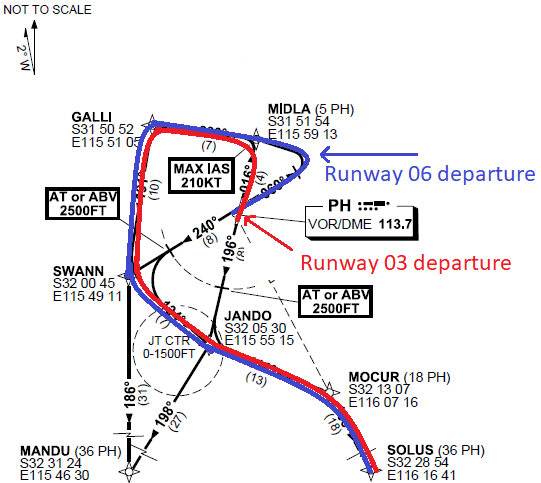
At 0841 local time, the crew of a Regional Express SAAB 340 aircraft operating a passenger service, call-sign RXA2113, were at their departure bay. The crew contacted the airways clearance delivery controller who issued an airways clearance for the planned flight from Perth to Albany, WA. This clearance authorised the crew to track to Albany via SOLUS and flight-planned route. The crew was cleared to depart Perth in accordance with the SOLUS THREE standard instrument departure (SID) and climb to 5,000 ft. Figure 1 shows SOLUS THREE SIDs from runway 03 and runway 06.

Figure 1: Perth Airport SOLUS THREE SIDs from runway 03 (red highlight) and runway 06 (blue highlight)

Figure 1: Perth Airport SOLUS THREE SIDs from runway 03 (red highlight) and runway 06 (blue highlight). Source: Adapted from Airservices Australia

Source: Adapted from Airservices Australia

The Automated Terminal Information Service (ATIS) that was available to pilots between 0852 and 0908 included the following information:

Runway 03 for all arrivals and for departures via [various waypoints including] SOLUS. Runway 06 for all other departures.

Based on the airways clearance and ATIS, the RXA2113 crew programmed the aircraft flight management system (FMS) for a departure from runway 03 direct to MIDLA followed by a left turn to track as specified by the SID to SOLUS, followed by the flight-planned route (Figure 1: red highlight).

The controller acting as SMC took control of this position at 0830. Between 0847 and 0901, the SMC had managed the taxi transit of five aircraft that all departed from runway 06.

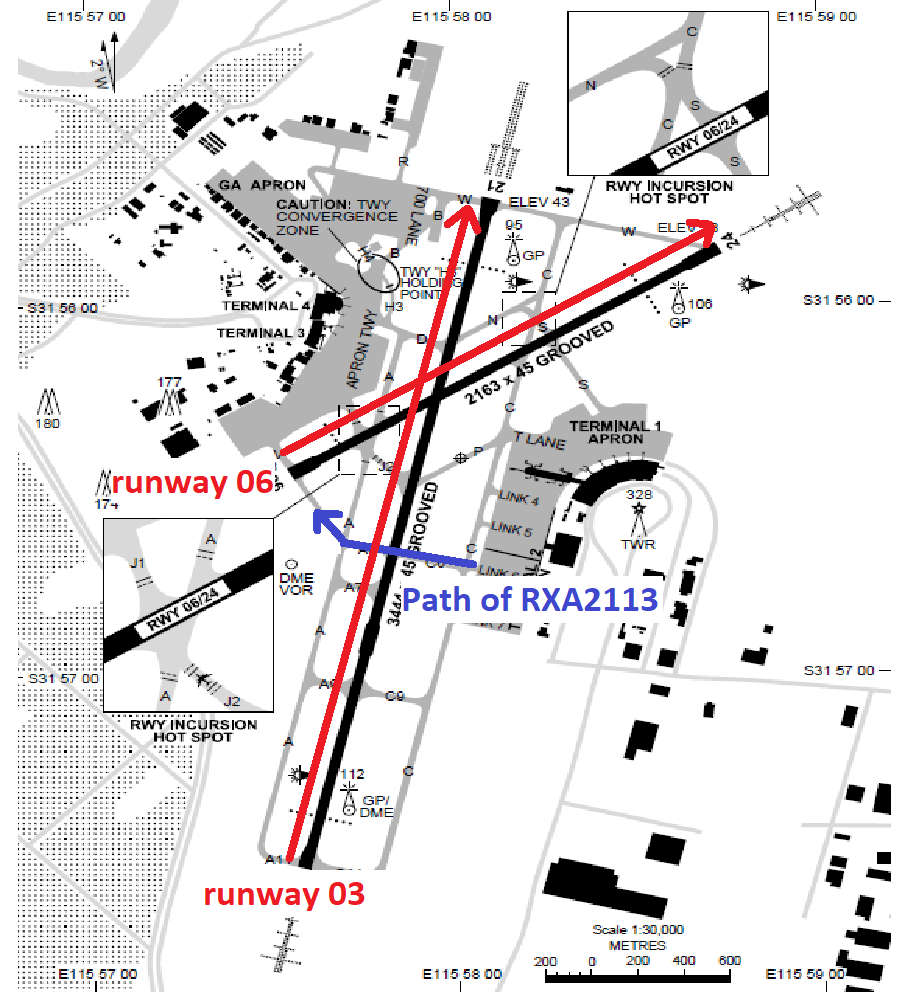
At 0905, the RXA2113 crew contacted the SMC to request taxi clearance. The SMC recalled that he referred to the flight data record on his display and perceived that the aircraft was departing off runway 06. Accordingly, the SMC issued instructions for RXA2113 to taxi via taxiway ‘Charlie Six’ (C6) and hold short of runway 03 (Figure 2). At the same time, the SMC selected the intermediate hold point as the clearance limit on the ATS graphical display.

Figure 2: Perth Airport taxiway map with RXA2113 route highlighted in blue

Figure 2: Perth Airport taxiway map with RXA2113 route highlighted in blue. Source: Adapted from Airservices Australia, annotated by ATSB.

Source: Adapted from Airservices Australia, annotated by ATSB

As required to ensure there was no conflicting traffic, the SMC coordinated a runway crossing for RXA2113 with the ADC. The SMC then issued onwards clearance for RXA2113 to ‘cross runway 03, taxi hold point Victor (V), runway 06’ and selected the hold point on the graphical display. Once the SMC was satisfied that the crew was complying with the instruction, he transferred the flight data record to the ADC screen as per standard procedure.

By now it was apparent to the RXA2113 crew that ATC intended for them to depart from runway 06 rather than runway 03 as nominated on the ATIS for SOLUS departures. At the time, the captain considered this and determined that they would still be compliant with the airways clearance as the runway was not part of the clearance and the SID was applicable to both runways. Given that key aspect and crew member experience of similar departures, the crew did not query ATC about the variation to the expected departure runway.

At hold point V the RXA2113 crew reprogrammed the FMS for the SOLUS THREE SID for runway 06. The captain recalled that this process did not present any problems to the crew and they were not aware of any safety implications.

In the tower, the trainee ADC was in the controlling position and the supervising ADC was seated behind and adjacent to the trainee. The trainee had full vision and control of the monitors and controls. The supervising ADC reported that although his view of the display was incomplete he remained vigilant of arriving and departing aircraft.

When the opportunity arose, the supervisor was asking the trainee questions about ATS policy and procedure as an ad hoc training activity. This was taking place while the RXA2113 crew prepared for take-off at the hold point. Although the flight data record for RXA2113 was displayed on the ADC display after the SMC had transferred it, there was no requirement for the ADC to pay attention to RXA2113 until the crew was ready for take-off.

At 0910, the RXA2113 crew contacted the ADC to advise they were ready to depart.

The supervising ADC recalled that the trainee ADC followed standard procedure to ensure that the runways and initial departure track were free of conflicting traffic. The supervisor did not have a clear view of the flight data record on the ATS display and it was unclear if the trainee ADC referred to it. Departures[3] were being conducted in accordance with auto-release procedures so no coordination was required with the departures controller.

The supervising ADC related that during departures, the focus of both his and the trainee ADC’s attention was on monitoring for incoming and outgoing traffic, and checking that the runways were clear. At Perth Airport, the ADC controls arrivals and departures off all runways. This means that when an ADC issues a take-off clearance from one runway, he or she will also be aware of any aircraft arriving or departing from other runways.

The presence of the aircraft at hold point V indicated to the ADC that RXA2113 was scheduled to depart from runway 06, and the ADC issued a take-off clearance from that runway. The trainee ADC instructed the RXA2113 crew to line up, then at 0911 cleared the crew to take-off from runway 06 with instructions to contact ‘departures’ when airborne.

From the perspective of the crew and controllers in the tower, the take-off and departure was uneventful. However, the departures controller was expecting the aircraft to be on a northward track to MIDLA rather than tracking initially to the north-east before turning left to MIDLA (runway 03 departure, Figure 1). The aircraft was soon on the flight planned track and there was no reported loss of separation with any other aircraft.

The controllers in the tower were unaware of the discrepancy between the clearances issued to the crew of RXA2113 and the flight data record until advised by the departure controller.

Contextual information

The controllers described the traffic situation as quiet by 0840 because the number of aircraft movements had decreased from the earlier morning period. The weather at Perth Airport was not operationally significant, the visibility was good, and the wind was light and variable.

Personnel information

Surface movement controller

The controller who was performing the role of SMC held ATC certification and had about three years’ experience with Airservices. Prior to that, the controller had been trained by, and operated for, another ATC agency.

Prior to the day of the occurrence, the controller had three rostered days off. He reported having slept well the night before. Although the controller was concerned about the health of a close family member, he did not consider that his performance would be affected. There was no evidence to indicate that stress affected the actions of the SMC on the day of the occurrence.

Aerodrome controllers

The trainee controller who was performing the role of ADC under supervision had previous experience with another ATC agency. It was reported that the trainee controller had demonstrated competence at the console but needed further familiarity with Airservices’ policy and procedures.

On the day of the occurrence, both controllers in the ADC position started work at 0530, and had been working for approximately three and a half hours. They were in the second shift of their rotation, having come off rostered days off the day prior to the occurrence. It is not known what sleep either controller had prior to the occurrence.

Consideration of controller rostering and fatigue

The ATSB reviewed the actual hours worked and known sleep history of the SMC and ADCs for indications of fatigue on the day of the occurrence. Based on the available evidence, there is no indication that fatigue contributed to this occurrence.

ATC systems

Flight Data Record

The air traffic system automatically generated the departure runway for RXA2113 into the flight data record. This displayed the departure runway as 03 in the fourth column of the top row (Figure 3). The ATC system allowed the controllers to change the departure runway recorded for each flight. The system would notify other users that this change had occurred.

Figure 3: The Flight Data Record for RXA2113

Figure 3: The Flight Data Record for RXA2113. Source: Adapted from Airservices Australia

Source: Adapted from Airservices Australia

Hold point selection panel

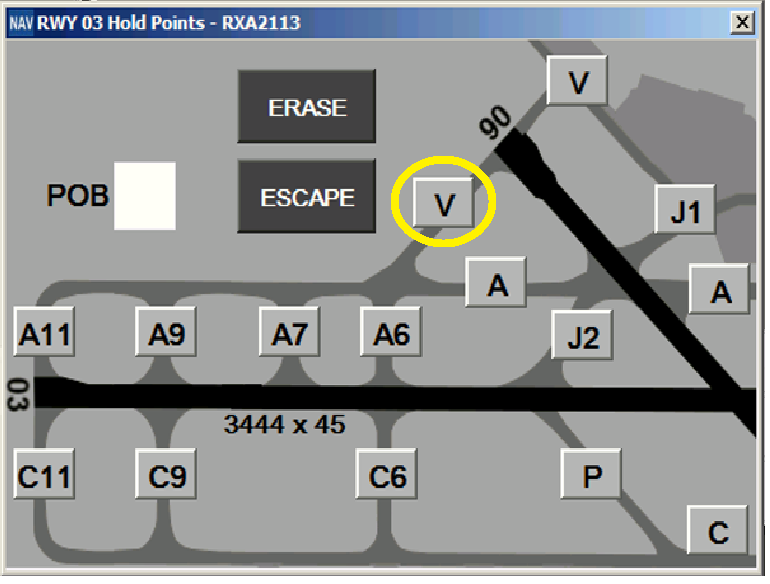
Immediately after the SMC instructed the RXA2113 crew to taxi to hold point V, he recorded that hold point in the ATC system. The SMC called up the ‘RWY03 Hold Points’ selection panel within the ATC system. The SMC used this panel to record the taxi clearance for RXA2113 to hold point V (Figure 4).

This panel presented all valid hold points for runway 03 departures. Although the hold point options on the graphical display were delimited to those associated with the system-assigned runway, hold point V was available to facilitate traffic flow from terminals 3 and 4.

Figure 4: Hold point selection panel in ATC system for runway 03 departures (Hold point V highlighted by ATSB)

Figure 4: Hold point selection panel in ATC system for runway 03 departures (Hold point V highlighted by ATSB). Source: Adapted from Airservices Australia, annotated by ATSB

Source: Adapted from Airservices Australia, annotated by ATSB

The ATSB noted that the ATS system did not provide any specific inhibitions to prevent or alert the controllers to the taxi of aircraft to non-conforming hold-points.

Safety analysis

Taxi clearance RXA2113

The surface movement controller issued taxi instructions to the crew of RXA2113 which directed them to runway 06. This was contrary to the departure runway (runway 03) recorded by the air traffic system and shown on the ATC flight data record.

When an aircraft crew requests a taxi clearance, the SMC would normally provide instructions based on the flight data record.

The ATSB considered the factors that might have adversely influenced the SMC’s attention and perception at the time. Based on the available information, there were no indications that fatigue, workload, expectancy, or stress from personal circumstances were contributory.

The ATSB also considered the presentation of the departure runway information on the flight data record. That information was presented clearly and saliently and there was a high level of contrast between the text and the background. No one reported that the flight data record was difficult to read or interpret. Therefore the runway information was readily accessible.

Therefore, as the SMC issued taxi instructions that were inconsistent with the flight data record, it is likely that he did not attend to the flight data record.

After the SMC issued the taxi instructions to hold point V, runway 06, there were no prompts for a reassessment of those instructions. Although they were not required to, if the crew of RXA2113 had requested confirmation that the departure runway was different to that expected, this would have prompted the SMC to check the flight data record. In this occurrence, the flight crew had identified the instructions were inconsistent with the information provided by the ATIS, as such this was a missed opportunity to identify and resolve this inconsistency. Although the ATC system limited the taxiway selections to those associated with the assigned departure runway, hold point V was necessarily available for use in conjunction with both runways 03 and 06.

Although the SMC instructed the crew of RXA2113 to taxi to a runway contrary to the flight data record, the ATSB did not identify any broader risk to safety posed by this action. There is no evidence that the taxi instructions issued to the crew reduced the safety of the aircraft or other traffic while it was taxiing and holding. The arrival of the aircraft at the hold point of runway 06 did have an effect on the ADC function.

Take-off clearance RXA2113

The trainee ADC issued a take-off clearance to the crew of RXA2113, which cleared them to depart from runway 06. Like the taxi clearance, this was also contrary to the departure runway recorded by the air traffic system and displayed on the flight data record.

The ATSB considered whether the training activity the ADCs were engaged in prior to issuing the take-off clearance affected their attention to and perception of the departure runway on the flight data record. The ADC supervisor related that the focus of attention of both ADCs during the take-off clearance was on monitoring incoming and outgoing traffic, and checking that the runway was clear and that in these circumstances the ADC would not normally focus on the flight strip of a taxiing or departing aircraft.

The ATSB also identified that the position of RXA2113, at hold point V, was a strong indicator to the ADC that aircraft was scheduled to depart from runway 06. Given the position of the aircraft at the hold point to runway 06 and crew report that RXA2113 was ready at that position, it is likely that both controllers engaged in the ADC function had an expectation that RXA2113 should depart from runway 06.

In this context it is unlikely that the training activity affected the likelihood of the ADC detecting the departure. The focus of the ADCs on traffic, and the expectation associated with the presence of the aircraft at runway 06, meant that the controller was unlikely to detect that the aircraft had been taxied to the incorrect runway, whether they were engaged in training or not. This expectation likely resulted in the two ADCs either not attending to the flight data record or misperceiving the runway information on the record.

Safety considerations

The departure of RXA2113 from runway 06 meant that the initial track of the aircraft was different to that expected by the departures controller. The departures controller used the air traffic system to identify which runway aircraft would depart from, in order to predict their track after departure.

Based on the information current in the air traffic system, the departures controller had expected RXA2113 to depart from runway 03 and commence on a northward track to MIDLA. Because RXA2113 departed from runway 06 and initially tracked to the north-east, this may have affected the departures controller’s understanding and awareness of the position of the aircraft.

The departure of RXA2113 from runway 06 was primarily the result of the taxi instructions provided by the SMC. After the SMC had issued these instructions, there were limited opportunities to identify the deviation in departure runway, or to update this information within the air traffic system.

The ATC system contains limited defences to prevent or identify deviations from the operational detail of the departure runway. The departure runway is recorded on the flight data record, and the system primarily relies on each controller attending to that record to ensure departures accord with the planned runway. In addition, aircraft separation relies on both controller and flight crew, and there is a role for flight crew to identify any perceived inconsistencies or errors to ATC.

The ATC system has comprehensive defences to ensure the separation of aircraft while taxiing, and during and after take-off. The ATSB did not identify any evidence that separation was affected at any stage during this occurrence.

Findings

These findings should not be read as apportioning blame or liability to any particular organisation or individual.

  • The Perth SMC issued taxi instructions to the flight crew of a departing aircraft that directed them to the holding point of runway 06 rather than runway 03, which was assigned by the air traffic system and shown in the flight strip details.
  • The aerodrome controllers cleared the crew of the departing aircraft to take-off from runway 06, which was contrary to the runway assigned by the air traffic system and shown in the flight strip details. As a result, the initial track of the aircraft was different to that expected by the departures controller.
  • There was no broader safety risk identified as a result of either the taxi or take-off clearances. The taxi clearance provided to the crew of the departing aircraft did not reduce the safety of the aircraft while it was taxiing and holding. The take-off clearance did not reduce the separation of the aircraft during take-off or departure from the airport.

Safety action

Airservices reported that as a result of this incident, they have conducted a check assessment with the SMC. Airservices have developed a training and performance improvement plan for the SMC, to address several performance issues identified in their review.

Safety message

This occurrence highlights how deviations from flight details, as presented in the air traffic system, affect the ability of controllers and flight crews to understand and predict the behaviour of aircraft. Furthermore, limited defences exist to identify when instructions have deviated from the information recorded in the system. Although in this occasion the ATSB has not identified any significant risk to the safety of taxiing or departing aircraft, controllers are reminded that they play an important role in remaining vigilant to the content of displayed data, and updating the system when deviations do occur.

Purpose of safety investigations

The objective of a safety investigation is to enhance transport safety. This is done through:

  • identifying safety issues and facilitating safety action to address those issues
  • providing information about occurrences and their associated safety factors to facilitate learning within the transport industry.

It is not a function of the ATSB to apportion blame or provide a means for determining liability. At the same time, an investigation report must include factual material of sufficient weight to support the analysis and findings. At all times the ATSB endeavours to balance the use of material that could imply adverse comment with the need to properly explain what happened, and why, in a fair and unbiased manner. The ATSB does not investigate for the purpose of taking administrative, regulatory or criminal action.

Terminology

An explanation of terminology used in ATSB investigation reports is available here. This includes terms such as occurrence, contributing factor, other factor that increased risk, and safety issue.

Publishing information 

Released in accordance with section 25 of the Transport Safety Investigation Act 2003

Published by: Australian Transport Safety Bureau

© Commonwealth of Australia 2019

image_5.png

Ownership of intellectual property rights in this publication

Unless otherwise noted, copyright (and any other intellectual property rights, if any) in this report publication is owned by the Commonwealth of Australia.

Creative Commons licence

With the exception of the Coat of Arms, ATSB logo, and photos and graphics in which a third party holds copyright, this publication is licensed under a Creative Commons Attribution 3.0 Australia licence.

Creative Commons Attribution 3.0 Australia Licence is a standard form licence agreement that allows you to copy, distribute, transmit and adapt this publication provided that you attribute the work.

The ATSB’s preference is that you attribute this publication (and any material sourced from it) using the following wording: Source: Australian Transport Safety Bureau

Copyright in material obtained from other agencies, private individuals or organisations, belongs to those agencies, individuals or organisations. Where you wish to use their material, you will need to contact them directly.

__________

  1. The surface movement controller (SMC) is responsible for controlling the movement of aircraft around the Aerodrome movement area. The SMC issues taxi instructions to aircraft to route them across the aerodrome surface.
  2. The aerodrome controller (ADC) issues line up and take off clearances to the crew of departing aircraft, and landing clearances to the crew of arriving aircraft. The purpose of these instructions is to ensure that aircraft depart from and arrive on runways clear of obstructions, and that prescribed separation standards exist once aircraft take off.
  3. The departures controller works in a separate location to the control tower at Perth airport.

Occurrence summary

Investigation number AO-2018-037
Occurrence date 09/05/2018
Location Perth Airport
State Western Australia
Report release date 12/03/2019
Report status Final
Investigation level Short
Investigation type Occurrence Investigation
Investigation status Completed
Mode of transport Aviation
Aviation occurrence category ANSP info/procedural error
Occurrence class Incident
Highest injury level None

Runway lighting event involving Beech B200, VH-FDL, Cairns Airport, Queensland, on 11 March 2018

Final report

What happened

On 11 March 2018, at about 0040 Eastern Standard Time,[1] a Beech B200 aircraft, registered VH‑FDL (FDL) operated by the Royal Flying Doctors Service (RFDS) Queensland Section and based at Cairns, took off from Cairns Airport on runway 15 without the runway lights activated.

At about 0024, an emergency services helicopter departed Cairns with the crew using night vision goggles. The Cairns duty air traffic controller did not activate the runway lights for this departure as it may have interfered with the crew’s night vision goggles. Eight minutes later, at 0032, the pilot of FDL requested clearance from the controller to conduct flight FD493, a medivac flight from Cairns to Townsville. The aircraft had five persons on board; the pilot, two medical crew members, a patient and a passenger (a relative of the patient). The controller granted the clearance and the pilot then requested permission to taxi and backtrack runway 15 to abeam taxiway A2 for departure. In response, the controller issued the instruction to taxi to holding point A3 (Figure 1).

Figure 1: Cairns Airport runway, taxiway and terminal map

Figure 1: Cairns Airport runway, taxiway and terminal map. Source: Airservices Australia, annotated by the ATSB

Source: Airservices Australia, annotated by the ATSB

During taxi, at about 0035, the medical crew informed the pilot that the cabin was not yet secure for take-off. Subsequently the pilot elected to request an extended backtrack to abeam taxiway B2, which was granted by the controller. After issuing this instruction, the controller moved the flight progress strip[2] for FD493 from the taxiway to the runway on the INTAS system.[3]

At 0036, while the aircraft was backtracking runway 15, the controller issued the pilot with a clearance to take-off when ready. On reaching abeam taxiway B2, the pilot turned the aircraft around and immediately commenced the take‑off run on runway 15.

At 0040, the controller instructed the pilot to contact the approach controller. The pilot acknowledged the request and then asked if the runway lights had gone out as the aircraft became airborne. The controller subsequently checked his INTAS display and reported that the lights had not been activated. The flight proceeded to Townsville without further incident.

Cairns Airport

Cairns Airport is a single runway airport with general aviation, domestic and international operations. The airport had a permanently manned air traffic control tower and is active 24 hours per day.

Runway 15 was the active runway on the night of the occurrence. Runway 15 was equipped with both medium and high intensity runway lights (MIRL and HIRL), which were activated by air traffic control. The MIRL are a diffuse light, which can be seen from all directions when in use. The HIRL use a reflector and lens arrangement to control the direction of their light, and can only be seen within approximately 45 degrees of the runway centreline.

In addition to runway lights, Cairns Airport also has taxiway, apron and substantial ambient lighting (predominantly from the two passenger terminals). At the time of the occurrence, the taxiway, apron and terminal lights were on.

The pilot and controller reported that the weather present at Cairns at the time of the occurrence was fine with no obstruction to visibility. The ATIS[4] published at 0031 indicated an air temperature of 25° C, greater than 10 km visibility, ‘FEW’[5] clouds at 1,500 ft and ‘SCT’[6] clouds at 3,000 ft.

Air traffic control

The runway lights were managed by air traffic control (ATC) via the INTAS system control panel. Confirmation of the system state (on/off and intensity) was presented on the INTAS aerodrome layout display and field lighting popup (shown together in Figure 2). The controller could also check the status of the runway lights by looking outside the tower, although HIRL can only be seen by looking towards the southern threshold due to the directionality of their light emission.

The Manual of Air Traffic Services (MATS) section 12.11.1: Operation of lighting procedures, required that runway lighting be in operation ‘prior to aircraft entering the runway’ for departures. Section 12.11.1.6.1 further clarified that runway lighting was required to be activated for all departures, except during daylight hours where visibility was greater than 5,000 m. MATS did not specifically address the operation of runway lighting when aircraft crews are using night vision goggles.

The controller on duty had 20 years’ experience as a tower controller including 17 years at Cairns Tower. The controller had commenced his shift at 2200 on the previous evening and described his alertness at the time of the occurrence as being higher than normal, as there was more traffic than normal at that time of night. The controller was the sole operator in the tower for the occurrence shift, which was standard procedure for that time of night at Cairns Airport.

Airservices Australia and the controller reported that activation of runway lights was a routine task. Checking their status would normally occur during issuing of clearance to enter the runway. Therefore, the task would be performed as part of a sequence that involved several actions including communication, data updating and visual scanning.

The controller reported that he used the ‘LIGHTS’ annunciation on the INTAS flight progress strip display as a memory prompt to aid him to perform the task (Figure 3). He reported that he continuously displayed the ‘LIGHTS’ memory prompt during night-time hours and that this display was independent of the status of the runway lights (on or off).

Figure 2: INTAS aerodrome layout display with field lighting popup

Figure 2: INTAS aerodrome layout display with field lighting popup. A part of the INTAS display, showing airfield lighting system status at time of the incident flight in the field lighting pop-up (bottom right). When activated, the selected light intensity level would have been displayed in green, for example, taxiway (TWY) light level 1 is active.
Source: Airservices Australia

A part of the INTAS display, showing airfield lighting system status at time of the incident flight in the field lighting pop-up (bottom right). When activated, the selected light intensity level would have been displayed in green, for example, taxiway (TWY) light level 1 is active.

Source: Airservices Australia

Figure 3: INTAS flight progress strip display

Figure 3: INTAS flight progress strip display. A part of the INTAS display, showing LIGHTS prompt in the right-hand column placed above the runway (RWY) panel.
Source: Airservices Australia

A part of the INTAS display, showing LIGHTS prompt in the right-hand column placed above the runway (RWY) panel.

Source: Airservices Australia

Pilot and aircraft

The pilot in command’s responsibility for ensuring the adequacy of aerodrome lighting was published in the Aeronautical Information Publication (AIP), section 11.9.1: Suitability of aerodromes – General. The pilot’s responsibility included the following conditions:

11.9.1 - b. unless otherwise approved an aircraft must not take off or land at an aerodrome at night unless the following lighting is operating:

(1) for a PVT, AWK or CHTR aircraft: runway edge lighting, threshold lighting, illuminated wind direction indicator, obstacle lighting (when specified in local procedures).

Thus, while not having direct control of the operation of the runway lights, the pilot in command of FDL had a responsibility to ensure that the runway lights were operating before commencing take‑off.

The pilot had approximately 10 years’ experience flying Beech B200 aircraft for the RFDS and had been operating from Cairns Airport for the past 2 and a half years. Due to the nature of RFDS work, night‑time operations were common and the pilot estimated that 40 per cent of his take-off and landings occurred at night.

The pilot started his shift at 1800 the previous evening and received a notification at about 2100 that a medivac flight to Townsville would be required. The pilot submitted a flight plan for the incident flight and conducted a short flight to burn fuel in order to reduce the weight of the aircraft. After completing the circuits, he was informed that the medivac flight would need to be delayed due to a delay with the patient.

The pilot indicated that these types of delays were normal for RFDS operations and that, while broken activity schedules could increase fatigue, he was aware of the hazard and monitored his fatigue accordingly. The pilot reported that, at the time of the incident flight, his personal fatigue level was acceptable for the work required.

The flight was operated with a single pilot, in line with RFDS practice. As such, the pilot in command conducted all communication, aircraft preparation and surface navigation tasks before and during taxi. The nature of the service provided by the RFDS frequently required operation into temporary or makeshift aircraft landing areas that had poor or no lighting. In response, the RFDS had equipped their fleet of B200 aircraft, including FDL, with upgraded LED landing and taxi lights that provide a significant increase in illumination (Figure 4).

Figure 4: RFDS Beech B200 landing and taxi lights

Figure 4: RFDS Beech B200 landing and taxi lights. The nose gear of a RFDS Beech B200 fitted with LED lights for landing (outer) and taxi (centre). Source: Royal Flying Doctors Service

The nose gear of a RFDS Beech B200 fitted with LED lights for landing (outer) and taxi (centre). Source: Royal Flying Doctors Service

The pilot advised that he was satisfied with the light available to him during taxi and take-off. The operator’s line-up checklist included a check that the aircraft landing lights were on immediately prior to entering the runway, but did not include a check that the runway lights were on.

Previous occurrences

A review of previous ATSB investigations found the following similar occurrences where an aircraft took-off without runway lighting activated:

  • On 12 March 2008, an Airbus A320-200 departed from Launceston Airport runway 32L without the runway lights activated (ATSB investigation AO-2008-020). The investigation found that the flight crew did not activate the pilot activated lighting at Launceston prior to departure and did not detect that airport lighting was not on during the taxi and take-off. The report also identified seven other occurrences that were not investigated, between 1988 and 2008, where an aircraft had taken off at night without the runway lights being activated.
  • On 30 November 2011, an Emirates Airlines Boeing 777-31H/ER, departed from Melbourne Airport runway 16 without the runway lights activated (ATSB investigation AO-2011-161). The investigation found that the aerodrome controller did not activate runway 16 lighting in response to a requested change in runway from the flight crew. In addition, the report identified that the illumination provided by the aircraft lights was sufficient to be mistaken as low intensity runway lighting.
  • On 16 and 17 May 2012, three aircraft departed from Gladstone Airport without the runway lights being activated (ATSB investigation AO-2012-069). The investigation found that the crews had not activated the pilot activated lighting prior to departure. The report identified that all pilots commented that the aircraft lights provided a substantial amount of illumination during the taxi and take-off roll and that the flashing warning lights (on the primary windsock) were hard to see due to other environmental lighting.
  • On 19 and 28 August 2016, a JetGo Australia Embraer EMB-135LR, departed from Tamworth Airport without the runway lights activated (ATSB investigation AO-2016-108). The investigation found that the flight crew did not activate the pilot activated lighting on runway 30R at Tamworth before beginning take-off. In addition, the report identified that available lighting from the aircraft taxi and landing lights, a lack of crew expectation, a short taxi with high workload, and no assigned role or procedure to check for runway lighting resulted in the crew not detecting the lack of runway lights.

Safety analysis

Air traffic control

The controller described his use of the ‘LIGHTS’ memory prompt in INTAS as a passive risk control measure. The memory prompt was left on screen for the entire period from last light to first light, independent of the status of the runway lights (on or off). In addition, the workflow in INTAS for a departing aircraft did not require the controller to pass the flight progress strip of this flight through the ‘LIGHTS’ prompt when it was moved from the taxiway to the runway.

Continuously displayed prompts, which do not require action or provide a barrier to other actions, may lead to user de-sensitisation. Over time, this may have resulted in the controller not processing the ‘LIGHTS’ prompt in his workflow.

In addition to the ‘LIGHTS’ prompt, the controller indicated that it was his normal practice to conduct a visual scan of the INTAS display and airfield before clearing an aircraft to enter the runway. The controller recalled completing the scan on this occasion, but did not notice that the runway lights were not on and subsequently did not take action to activate the lights. The controller also stated his expectation that the pilot would notify them of any issue with the runway lights.

Pilot

The period of taxi is a time of high workload for a pilot, particularly in a single pilot cockpit, where they are required to divide their attention in order to perform several tasks. During this time, the pilot of FDL received notification from the cabin medical crew indicating the cabin was not yet secure for take-off. This led to the pilot’s request to ATC for an extended backtrack on runway 15. The pilot’s additional communications with the medical crew and ATC, while taxiing the aircraft, placed further demands on his attentional resources, resulting in an increased workload while in the runway environment.

The pilot’s view from the cockpit of FDL, once aligned on the runway for backtrack and then take‑off, would have included light from the strong aircraft landing lights reflected in the inactive HIRL. The presence of this reflected light along with that of several other light sources from a generally well-lit aerodrome would have resulted in significant light being presented to the pilot when conducting his visual scan.

This reflected and environmental light, along with the absence of a specific check for runway lights resulted in the pilot not realising that the runway lights were not active prior to commencing his take-off. When FDL rotated[7] for take-off the aircraft lighting was directed away from the runway lighting, and the loss of the reflection provided an illusion to the pilot that the runway lighting extinguished as soon as the aircraft became airborne.

A review of the sequence and timing of clearances requested and given to the pilot showed that the aircraft was not required to stop at any point before take-off. The pilot noted that not stopping at the holding point before entering the runway removed an opportunity to visually check the runway without the landing lights shining on it. He recounted that the increased workload involved in securing the aircraft for take-off should have prompted him to pause and re-assess his environment before initiating take-off. However, while certainly good practice, an additional pause when lined up would likely have been ineffective due to the combined expectation that the lights would be on and the presence of the light reflected in the HIRL.

Findings

These findings should not be read as apportioning blame or liability to any particular organisation or individual.

  • The air traffic controller inadvertently did not activate the runway lighting controls prior to VH‑FDL entering runway 15 for take-off. Subsequently, the aircraft took-off without the lights active.
  • The increased cockpit workload combined with the reflected and environmental lighting resulted in the pilot of VH-FDL being unaware that runway lights were not on before commencing take-off.

Safety message

Runway lighting serves many important functions for a departing aircraft. For example, it provides:

  • directional guidance during the take-off roll
  • an indication of the location of the end of the runway
  • necessary guidance for approach and landing if required due to an emergency shortly after take-off.

This event demonstrates the importance of implementing robust processes to ensure that routine tasks are always carried out. In particular, it highlights the hazards of skill based human error and expectation bias when performing routine tasks such as activation and checking of runway lighting.

Purpose of safety investigations

The objective of a safety investigation is to enhance transport safety. This is done through:

  • identifying safety issues and facilitating safety action to address those issues
  • providing information about occurrences and their associated safety factors to facilitate learning within the transport industry.

It is not a function of the ATSB to apportion blame or provide a means for determining liability. At the same time, an investigation report must include factual material of sufficient weight to support the analysis and findings. At all times the ATSB endeavours to balance the use of material that could imply adverse comment with the need to properly explain what happened, and why, in a fair and unbiased manner. The ATSB does not investigate for the purpose of taking administrative, regulatory or criminal action.

Terminology

An explanation of terminology used in ATSB investigation reports is available here. This includes terms such as occurrence, contributing factor, other factor that increased risk, and safety issue.

Publishing information 

Released in accordance with section 25 of the Transport Safety Investigation Act 2003

Published by: Australian Transport Safety Bureau

© Commonwealth of Australia 2018

image_5.png

Ownership of intellectual property rights in this publication

Unless otherwise noted, copyright (and any other intellectual property rights, if any) in this report publication is owned by the Commonwealth of Australia.

Creative Commons licence

With the exception of the Coat of Arms, ATSB logo, and photos and graphics in which a third party holds copyright, this publication is licensed under a Creative Commons Attribution 3.0 Australia licence.

Creative Commons Attribution 3.0 Australia Licence is a standard form licence agreement that allows you to copy, distribute, transmit and adapt this publication provided that you attribute the work.

The ATSB’s preference is that you attribute this publication (and any material sourced from it) using the following wording: Source: Australian Transport Safety Bureau

Copyright in material obtained from other agencies, private individuals or organisations, belongs to those agencies, individuals or organisations. Where you wish to use their material, you will need to contact them directly.

__________

  1. Eastern Standard Time (EST): Coordinated Universal Time (UTC) + 10 hours.
  2. Electronic flight progress strip: contains abbreviated aircraft details, current location and control instructions as an awareness tool for the controller
  3. Integrated Tower Automation Suite (INTAS): an electronic system provided by Airservices Australia for use by air traffic controllers to coordinate and monitor aircraft movement and airfield functions.
  4. Automatic Terminal Information Service (ATIS): The provision of current, routine information, including weather, to arriving and departing aircraft by means of continuous and repetitive broadcast.
  5. FEW: Abbreviated reporting unit of cloud amount in visible sky area indicating cloud is covering one to two eighths of total area visible to celestial horizon. This may also be reported as 1-2 OKTA.
  6. SCT: Abbreviated reporting unit of cloud amount in visible sky area indicating cloud is covering three to four eighths of total area visible to celestial horizon. This may also be reported as 3-4 OKTA.
  7. Rotation: the positive, nose-up, movement of an aircraft about the lateral (pitch) axis immediately before becoming airborne.

Occurrence summary

Investigation number AO-2018-024
Occurrence date 11/03/2018
Location Cairns Airport
State Queensland
Report release date 16/10/2018
Report status Final
Investigation level Short
Investigation type Occurrence Investigation
Investigation status Completed
Mode of transport Aviation
Aviation occurrence category ANSP info/procedural error
Occurrence class Incident
Highest injury level None

Aircraft details

Manufacturer Beech Aircraft Corp
Model B200
Registration VH-FDL
Serial number BB-2021
Aircraft operator Royal Flying Doctor Services of Australia (Queensland Section)
Sector Turboprop
Operation type Medical Transport
Departure point Cairns, Qld
Destination Townsville, Qld
Damage Nil

Runway operations with hookcable raised involving Cessna 310, VH-COQ, Tindal Airport, Northern Territory, on 28 April 2017

Final report

What happened

On 28 April 2017, at about 0936 Central Standard Time (CST), a Cessna 310R aircraft, registered VH‑COQ (COQ), was on approach to land at Tindal Airport, Northern Territory.

Tindal Airport has bi-directional hookcables, used to stop military jets in an emergency, positioned at both ends of the runway (Figure 1). The air traffic control tower had opened for a scheduled military jet departure and was therefore active when COQ made its approach to land. During the tower opening checklist procedure, the tower controller annotated the ‘cables’ check was completed. About 21 minutes after the tower opened, COQ requested a clearance to land from the base leg position for runway 14. The tower controller scanned the control console, noted that both hookcable pushbutton lights were green, and cleared COQ to land on runway 14.

Figure 1: Tindal airport runway hookcables

Figure 1: Tindal airport runway hookcables

Source: Airservices Australia, annotated by ATSB

When COQ was on short final approach to land on runway 14, the pilot noticed the approach end hookcable was raised.[1] They[2] adjusted their aim point beyond the hookcable and landed without incident. The pilot of COQ reported the position of the hookcable to the tower controller, who then rectified the situation.

Hookcable status checks

During the air traffic control tower opening procedure, equipment failure resulted in the approach controller working downstairs and the adoption of procedural coordination between the positions of tower controller and approach controller. The tower controller noted that while traffic levels were low at the time of the incident, they were distracted by phone calls and attempts to restore the functioning of the failed equipment. Both the UP and DOWN hookcable positions have green indicator status lights (see Aircraft arrestor system).

Aircraft arrestor system

The Tindal Airport aircraft arrestor system (AAS) is used to stop military jets that have a malfunction, which may otherwise result in a runway excursion. The jet will lower a hook at the rear of the aircraft to catch the cable. The AAS includes two cables, one positioned at either end of the runway and displaced from the respective threshold as displayed in Figure 1.

The AAS may be controlled by air traffic control from the air traffic control tower using the cable control console pushbutton selection/indicator lights (Figure 2). There are four pushbutton selection/indicator lights for each hookcable. Two separate green UP and green DOWN pushbuttons are used to select, and then indicate, the desired position for each hookcable.

Figure 2: Tower control console hookcable pushbuttons

Figure 2: Tower control console hookcable pushbuttons

Source: Tindal Airport

Enroute Supplement Australia

The Enroute Supplement Australia entry for Tindal Airport includes the following information:

Physical characteristics: Recessed bi-directional hookcables installed. When arrestable aircraft are operating – departure end up, approach end down. In the event of power failure, cables will rise to a height of 10 cm until restored. Recommended that aircraft not approved to trample hookcables confine their operations to between cables outside air traffic control hours.

Enroute Supplement Australia introduction paragraph 22.2 (b) states:

Pilots should refer to the Pilot Operating Handbook or Flight Manual for specific restrictions for each aircraft. In the absence of any reference to trampling in either the handbook or manual, trampling is not authorised.

Previous incident

On 9 August 2016, an aircraft struck the runway 14 hookcable at Tindal Airport during take-off a few minutes after the air traffic control tower closed. Further information is available from ATSB report AO-2016-098.

Safety analysis

The distractions during the opening procedure resulted in the tower controller inadvertently leaving both hookcables in the UP position after they tested the operation of the system. When they received the request to land from COQ, the tower controller subsequently checked the status of the hookcable but they misidentified the two green UP status lights as DOWN indicators, which are also green.

Finding

  • When the air traffic tower was opened, the hookcables were inadvertently left in the UP position. When the tower controller subsequently checked the status of the hookcable before clearing COQ to land, they incorrectly identified the green UP light as the green DOWN light and cleared COQ to land.
  • The pilot detected the raised cable and adjusted their aim point to ensure they landed past the raised cable.

Safety action

Whether or not the ATSB identifies safety issues in the course of an investigation, relevant organisations may proactively initiate safety action in order to reduce their safety risk. The ATSB has been advised of the following proactive safety action in response to this occurrence.

Air traffic service provider

As a result of this occurrence, the air traffic service provider has advised the ATSB that they are taking the following safety action:

The possibility of changing the colour of the UP lights will be investigated through an engineering process to better differentiate between the UP and DOWN positions (this will be for all our sites that have arrestor systems). Furthermore, due to the relative low number of civilian aircraft operating at Tindal Airport, Tindal air traffic control will be advising the position of the cable with every landing and take-off clearance given to civilian aircraft. This will help force the controller to verify the position of the cable in addition to the conduct of the instrument scan.

Safety message

This incident highlights the risks of expectation bias. The tower controller observed two green lights on the control console, but did not recognise they were the UP indicators. However, the design of the indicators, where green lights can have two different meanings, removes the usefulness of the colour of the lights in determining whether the hookcable is up or down.

The pilot detected the problem in time to avoid trampling the hookcable during the landing. However, pilots should take note that the hookcables will automatically raise in the event of a power failure.

Aviation Short Investigations Bulletin - Issue 62

Purpose of safety investigations

The objective of a safety investigation is to enhance transport safety. This is done through:

  • identifying safety issues and facilitating safety action to address those issues
  • providing information about occurrences and their associated safety factors to facilitate learning within the transport industry.

It is not a function of the ATSB to apportion blame or provide a means for determining liability. At the same time, an investigation report must include factual material of sufficient weight to support the analysis and findings. At all times the ATSB endeavours to balance the use of material that could imply adverse comment with the need to properly explain what happened, and why, in a fair and unbiased manner. The ATSB does not investigate for the purpose of taking administrative, regulatory or criminal action.

Terminology

An explanation of terminology used in ATSB investigation reports is available here. This includes terms such as occurrence, contributing factor, other factor that increased risk, and safety issue.

Publishing information 

Released in accordance with section 25 of the Transport Safety Investigation Act 2003

Published by: Australian Transport Safety Bureau

© Commonwealth of Australia 2017

image_5.png

Ownership of intellectual property rights in this publication

Unless otherwise noted, copyright (and any other intellectual property rights, if any) in this report publication is owned by the Commonwealth of Australia.

Creative Commons licence

With the exception of the Coat of Arms, ATSB logo, and photos and graphics in which a third party holds copyright, this publication is licensed under a Creative Commons Attribution 3.0 Australia licence.

Creative Commons Attribution 3.0 Australia Licence is a standard form licence agreement that allows you to copy, distribute, transmit and adapt this publication provided that you attribute the work.

The ATSB’s preference is that you attribute this publication (and any material sourced from it) using the following wording: Source: Australian Transport Safety Bureau

Copyright in material obtained from other agencies, private individuals or organisations, belongs to those agencies, individuals or organisations. Where you wish to use their material, you will need to contact them directly.

__________

  1. Hookcables are marked by dayglo orange disks.
  2. Gender-free plural pronouns: may be used throughout the report to refer to an individual (i.e. they, them and their).

Occurrence summary

Investigation number AO-2017-049
Occurrence date 28/04/2017
Location Tindal Airport
State Northern Territory
Report release date 05/09/2017
Report status Final
Investigation level Short
Investigation type Occurrence Investigation
Investigation status Completed
Mode of transport Aviation
Aviation occurrence category ANSP info/procedural error
Occurrence class Incident
Highest injury level None

Aircraft details

Manufacturer Cessna Aircraft Company
Model 310R
Registration VH-COQ
Serial number 310R1643
Sector Piston
Operation type Charter
Departure point Darwin, NT
Destination Tindal, NT
Damage Nil

ANSP info/procedural error involving a Boeing 737-377, VH-CZH, 55 km north-east of Ayers Rock (Yulara), Northern Territory, on 20 November 1993

Summary

On taxiing and after departure, the crew completed the required radio transmissions. They were advised to call Melbourne Control for an airways clearance prior to entering controlled airspace but were not advised of any conflicting traffic. When the crew requested clearance, Melbourne Control asked them if they were aware of an opposite direction aircraft that was leaving controlled airspace on descent to Ayers Rock. When the crew replied they were unaware of the traffic, Control gave details of the other aircraft.

The descending Boeing 737 was sighted ahead, and a left turn was commenced. The crew of the climbing aircraft estimated that the descending aircraft passed overhead with a vertical separation of about 1,000 ft. The climbing aircraft was then cleared to enter controlled airspace.

Safety Action

As a result of several occurrences involving opposite direction traffic conflictions, a NOTAM was issued that prescribed a new air route and specified a `racetrack' route pattern between Alice Springs and Ayers Rock. This route system will be made permanent during the review process being conducted by the Civil Aviation Authority.

Occurrence summary

Investigation number 199303957
Occurrence date 20/11/1993
Location 55 km north-east of Ayers Rock (Yulara)
State Northern Territory
Report release date 28/03/1994
Report status Final
Investigation type Occurrence Investigation
Investigation status Completed
Mode of transport Aviation
Aviation occurrence category ANSP info/procedural error
Occurrence class Incident

Aircraft details

Manufacturer The Boeing Company
Model 737-377
Registration VH-CZH
Sector Jet
Operation type Air Transport High Capacity
Departure point Ayers Rock NT
Destination Alice Springs NT
Damage Nil

ANSP info/procedural error involving a Boeing 747-400, N117KG, 1310 km north of Perth, Western Australia, on 26 October 1993

Summary

The Air Traffic Service (ATS) Officer issued a clearance for the aircraft to climb from FL330 to FL370. The crew did not receive the clearance. The ATS Officer did not realise he had not received an acknowledgement to the clearance and assumed the aircraft had climbed to the assigned level. He later misunderstood a further request from the crew for information about the climb clearance to be a statement that the aircraft was cruising at the new level.

Consequently, the aircraft transited between two reporting points at the incorrect flight level. The error was discovered when the aircraft reported its level at the next reporting point. No traffic confliction resulted.

Occurrence summary

Investigation number 199303462
Occurrence date 26/10/1993
Location 1310 km north of Perth
State Western Australia
Report release date 24/03/1994
Report status Final
Investigation type Occurrence Investigation
Investigation status Completed
Mode of transport Aviation
Aviation occurrence category ANSP info/procedural error
Occurrence class Incident

Aircraft details

Manufacturer The Boeing Company
Model 747-400
Registration N117KG
Sector Jet
Operation type Air Transport High Capacity
Departure point Changi Singapore
Destination Melbourne VIC
Damage Nil

ANSP info/procedural error involving a Boeing 747-438, VH-OJG, 8 km west of Townsville, Queensland, on 3 September 1993

Summary

Both aircraft were in communication with Townsville Arrivals and being tracked to the west of Townsville on approximately reciprocal tracks. The northbound aircraft at FL390 (39,000ft) and the southbound aircraft at FL370 (37,000ft). The Arrivals Controller had some six aircraft under his jurisdiction and was moderately busy. When the two aircraft were within a few minutes of passing each other, a co-ordination message was received from the Cairns Arrivals Controller with descent instructions for the northbound aircraft.

The instructions specified a higher than normal descent speed and involved delaying the time of descent. The controller was aware that the crew of the aircraft needed the information as soon as possible to allow the reprogramming of the flight management computer. If there is no conflicting traffic, descent instructions are normally passed to the aircraft together with a clearance to descend. The controller passed the information to the aircraft and also gave a clearance to descend to FL230 despite the lower opposing traffic.

The crews of both aircraft realised that the controller had made a mistake and commented as they passed and saw each other. It was then that the controller realised that he had made an error. The higher aircraft did not descend until six minutes later, at its designated descent point. There was no breakdown in separation. Later, the controller could not explain his mistake, commenting that it was probably force of habit that he passed the clearance at the same time as the descent instructions.

Occurrence summary

Investigation number 199302772
Occurrence date 03/09/1993
Location 8 km west of Townsville
State Queensland
Report release date 30/10/1993
Report status Final
Investigation type Occurrence Investigation
Investigation status Completed
Mode of transport Aviation
Aviation occurrence category ANSP info/procedural error
Occurrence class Incident

Aircraft details

Manufacturer The Boeing Company
Model 747-438
Registration VH-OJG
Sector Jet
Operation type Air Transport High Capacity
Departure point Sydney NSW
Destination Cairns QLD
Damage Nil

ANSP info/procedural error involving an Israel Aircraft 1124, VH-LLX, 160 km north-east of Brisbane, Queensland, on 24 August 1993

Summary

The pilot requested, from Sydney Flight Service International, the NOTAM status of R674. The Flight Service Officer (FSO) checked the status using the FISOR system and advised that the area was not active. R674 is a military restricted area and is active on a 24-hour basis, any change to this status is advised by NOTAM. When the FSO checked the system, he received a message which indicated that there were no current NOTAMs for R674.

The correct interpretation of this message is that the area would still be active. Apparently the FSO, who was not familiar with the normal status of the restricted area, assumed that if no NOTAMs were current for the area, then it was not active. He should have advised the pilot that there were no current NOTAMs for R674. Significant factors 1. The Flight Service Officer made an incorrect interpretation of the message on the FISOR system.

Occurrence summary

Investigation number 199302720
Occurrence date 24/08/1993
Location 160 km north-east of Brisbane
State Queensland
Report release date 19/06/1994
Report status Final
Investigation type Occurrence Investigation
Investigation status Completed
Mode of transport Aviation
Aviation occurrence category ANSP info/procedural error
Occurrence class Incident

Aircraft details

Manufacturer Israel Aircraft Industries Ltd
Model 1124
Registration VH-LLX
Sector Jet
Departure point Rockhampton QLD
Destination Brisbane QLD
Damage Nil

ANSP info/procedural error involving a de Havilland Canada DHC-8-102, VH-XFT and Cessna 208, VH-PSQ, near Lockhart River, Queensland, on 24 June 1993

Summary

The Dash 8 aircraft was tracking to the south after departure from Lockhart River. The aircraft had transmitted a taxiing call prior to departure. The call was acknowledged by the Flight Service operator, but no traffic was given to the aircraft. As the aircraft was climbing through 4,500 ft the crew monitored a Lockhart River position report from a northbound aircraft, VH-PSQ. VH-PSQ was cruising at 4,000 ft. Both aircraft were in cloud and did not sight each other.

The Flight Service operator reported that he had not recognised that the aircraft were conflicting traffic and as a result had neglected to pass the required information to each aircraft. At the time the operator had a high workload with other aircraft on his frequency, which was further increased by an aircraft that was out of communications.

Occurrence summary

Investigation number 199301890
Occurrence date 24/06/1993
Location near Lockhart River
State Queensland
Report release date 19/06/1994
Report status Final
Investigation type Occurrence Investigation
Investigation status Completed
Mode of transport Aviation
Aviation occurrence category ANSP info/procedural error
Occurrence class Incident

Aircraft details

Manufacturer Cessna Aircraft Company
Model 208
Registration VH-PSQ
Sector Turboprop
Departure point Cairns
Destination Horn Island
Damage Nil

Aircraft details

Manufacturer De Havilland Canada/De Havilland Aircraft of Canada
Model DHC-8-102
Registration VH-XFT
Sector Turboprop
Operation type Air Transport Low Capacity
Departure point Lockhart River
Destination Cairns
Damage Nil