

| Occurrence Briefs are concise reports that detail the facts surrounding a transport safety occurrence, as received in the initial notification and any follow-up enquiries. They provide an opportunity to share safety messages in the absence of an investigation. Because occurrence briefs are not investigations under the Transport Safety Investigation Act 2003, the information in them is de-identified. |
What happened
On the early morning of 15 February 2026, a Kavanagh Balloons E240 hot air balloon with a pilot and 10 passengers aboard was conducting a scenic flight over the inner eastern suburbs of Melbourne, Victoria. After launching from Mayer Park, Thornbury, the balloon followed a predominantly southerly track, and after around 40 minutes of flight, was approaching a landing at Fawkner Park, South Yarra. Describing the approach as stable at 100 ft on a track of 195 degrees towards the targeted landing point at the northern end of the park, the pilot reported noting that several other balloons had already landed in that area, so elected to extend towards the park’s south-west.
On final approach, the balloon encountered an abrupt wind direction change, with the track shifting right to 214 degrees. Judging that a landing was still possible ahead of the new direction of travel, the pilot transitioned to a landing, however there was insufficient space available to accommodate the balloon’s envelope, which contacted and became entangled with a tree as it deflated upon landing (Figure 1).
Neither pilot nor passengers were injured during the landing, however the envelope sustained substantial damage from the tree contact, with several fabric panels punctured and torn around the equatorial region.[1]
Figure 1: Entangled balloon envelope after landing
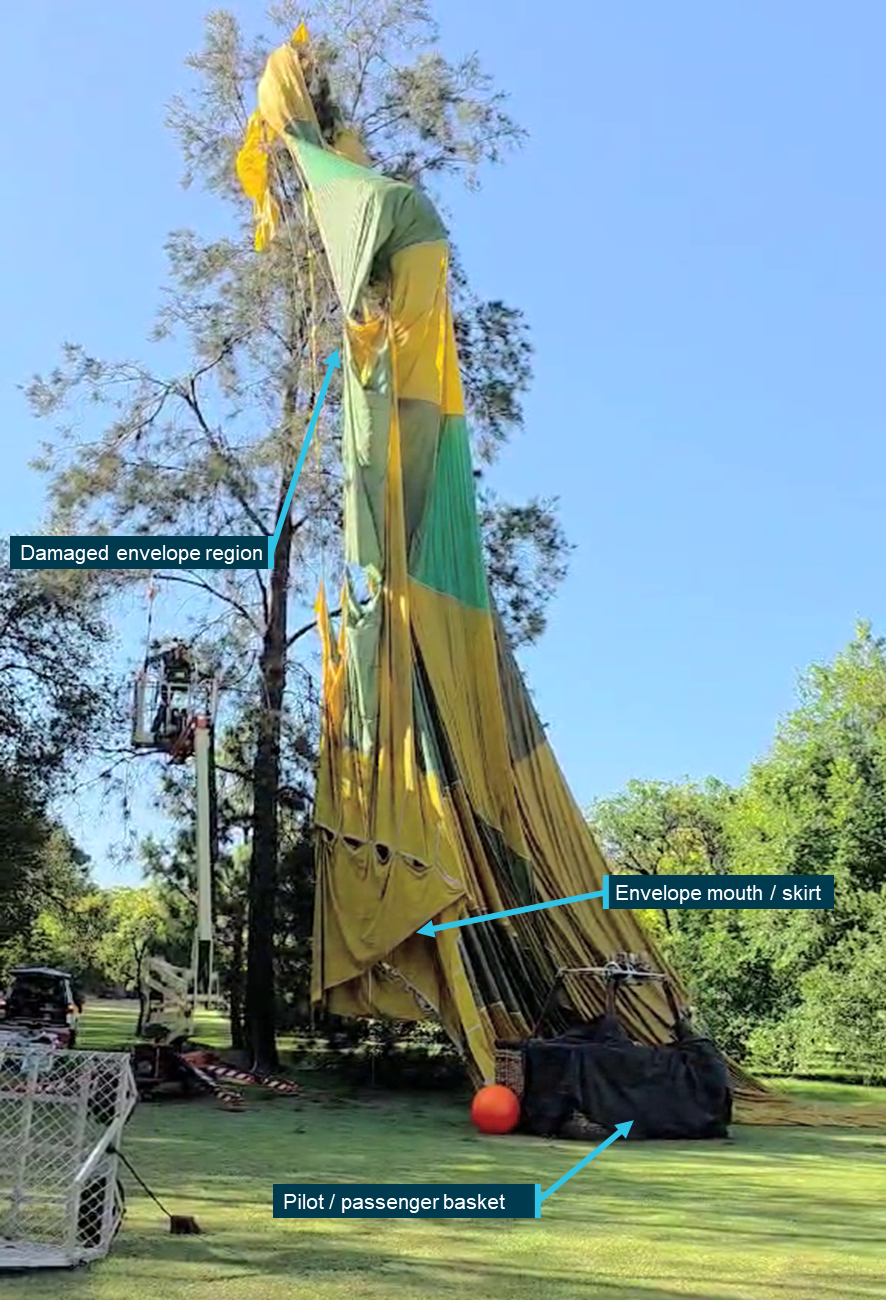
Source: Witness, annotated by the ATSB
Safety message

The ATSB SafetyWatch highlights the broad safety concerns that come out of our investigation findings and from the occurrence data reported to us by industry. One of the safety concerns is Reducing passenger injuries in commercial ballooning operations.
Commercial ballooning operations was added to SafetyWatch after the ATSB identified a trend toward a heightened exposure to risk in the sector, as compared to other forms of charter aviation.
This occurrence reinforces the need for all hot air balloon pilots to be prepared to discontinue a landing approach if changing conditions result in an increased risk of contact with ground obstacles and hazards in the direction of flight.
The risks associated with landing profiles can change markedly with varying wind conditions. Pilots must plan onboard fuel loads and projected downwind tracks to ensure options remain open and viable for continued safe flight and subsequent landing/s, should an initial landing be rejected for any reason.
About this report
Decisions regarding whether to conduct an investigation, and the scope of an investigation, are based on many factors, including the level of safety benefit likely to be obtained from an investigation. For this occurrence, no investigation has been conducted and the ATSB did not verify the accuracy of the information. A brief description has been written using information supplied in the notification and any follow-up information in order to produce a short summary report, and allow for greater industry awareness of potential safety issues and possible safety actions.
[1] Balloon envelope equatorial region: the band of fabric panels extending around the circumference of the balloon envelope at its widest point.
Occurrence summary
| Mode of transport | Aviation |
|---|---|
| Occurrence ID | AB-2026-014 |
| Occurrence date | 15/02/2026 |
| Location | Fawkner Park, South Yarra |
| State | Victoria |
| Occurrence class | Accident |
| Aviation occurrence category | Controlled flight into terrain (CFIT) |
| Highest injury level | None |
| Brief release date | 18/03/2026 |
Aircraft details
| Manufacturer | Kavanagh Balloons |
|---|---|
| Model | E240 |
| Sector | Balloon |
| Operation type | Part 131 Balloons and hot air airships |
| Departure point | Mayer Park, Thornbury, Victoria |
| Destination | Fawkner Park, South Yarra, Victoria |
| Damage | Substantial |