

Report release date: 11/05/2026
| Occurrence Briefs are concise reports that detail the facts surrounding a transport safety occurrence, as received in the initial notification and any follow-up enquiries. They provide an opportunity to share safety messages in the absence of an investigation. Because occurrence briefs are not investigations under the Transport Safety Investigation Act 2003, the information in them is de-identified. |
What happened
On the afternoon of 5 March 2026, a Gippsland Aeronautics GA8 Airvan, with a pilot and 4 passengers on board, prepared to depart Atauro Island airstrip, Timor-Leste, for a medical transport flight to Dili, Timor-Leste. At 1214 local time, the aircraft departed runway 01 into a 5 kt headwind. Soon after taking off, the aircraft encountered turbulence and the pilot turned right, away from the nearby terrain that was likely creating the turbulence.
As the aircraft climbed to about 600 ft above mean sea level (AMSL) with climb power selected, the aircraft encountered severe turbulence with an associated downdraft. Control of the aircraft was briefly lost and a dash mat lifted off the glareshield, striking the pilot in the face, with dust from the dash mat temporarily impairing the pilot’s vision.
The aircraft descended toward the ocean surface and the pilot increased engine power to full, in an attempt to arrest the rate of descent. Despite this, the aircraft continued descending toward the water and the terrain awareness and warning system generated a ‘pull up’ alert.
The descent continued until the aircraft was about 150 ft AMSL, when the pilot was able to arrest the descent and reestablish a climb. As the aircraft climbed above 1,000 ft AMSL, the pilot observed that the flight instrumentation indicated a north westerly wind of 45 kt. The flight then continued to Dili and landed without further incident. There were no reported injuries and the aircraft was not damaged.
Turbulence
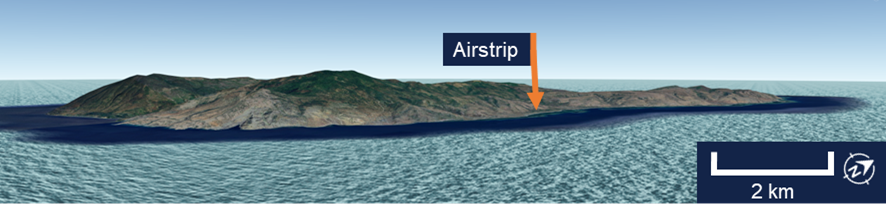
Mountainous terrain lies to the north and west of the Atauro Island airstrip (Figure 1).
Figure 1: Atauro Island
Source: Google Earth, annotated by the ATSB
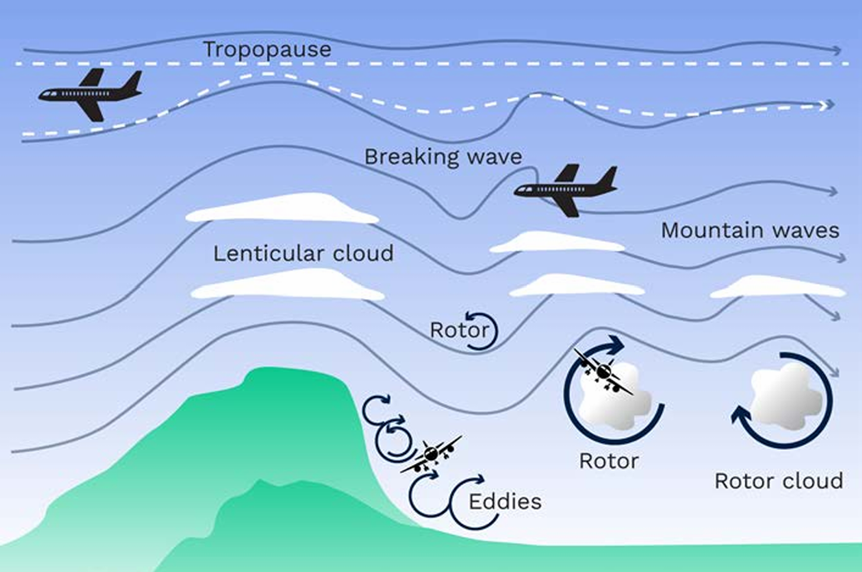
The Australian Civil Aviation Safety Authority Avsafety card, Turbulencedescribes turbulence types associated with mountainous terrain (Figure 2):
- Mechanical turbulence occurs when air flow is forced to diverge around or converge through gaps in natural barriers like hills, or obstructions like buildings.
- Orographic turbulence is caused by the large-scale displacement of airflow by natural structures such as mountains and islands. Mountain waves are likely to form when the following atmospheric conditions are present:
- the wind flow at around ridge height is nearly perpendicular to the ridge line and at least 25kts
- the wind speed increases with height
- there is a stable layer at around ridge height.
As the air is forced over the mountain it will descend in the lee and then oscillate in a series of waves, sometimes for long distances. Mountain wave severe forecasts indicate a downdraft of 600fpm or more.
Figure 2: Mechanical turbulence and mountain waves
Source: Bureau of Meteorology
Safety action
Following the incident, the operator conducted a review of operational wind limitations for operations at Atauro Island airstrip. The airstrip notes were also updated to include seasonal hazards associated with the surrounding terrain, including turbulence and potential windshear.
The operator also inspected all aircraft to ensure that no unapproved dash mats were fitted and that approved dash mats were secure and free of debris. In addition, a review was being conducted of the maintenance schedule to determine if a specific dash mat inspection was required. Lastly, the paint scheme specification was being updated to add a specific dashboard paint and location for the dash mat velcro loops.
Safety message
To avoid unexpected encounters with severe turbulence, the Flight Safety Australia article Mountain flying: unconsidered factors encourages pilots to visualise the flow of air around and above terrain, especially when the winds are strong and when the air is stable.
About this report
Decisions regarding whether to conduct an investigation, and the scope of an investigation, are based on many factors, including the level of safety benefit likely to be obtained from an investigation. For this occurrence, no investigation has been conducted and the ATSB did not verify the accuracy of the information. A brief description has been written using information supplied in the notification and any follow-up information in order to produce a short summary report, and allow for greater industry awareness of potential safety issues and possible safety actions.
Occurrence summary
| Mode of transport | Aviation |
|---|---|
| Occurrence ID | AB-2026-017 |
| Occurrence date | 05/03/2026 |
| Location | Near Atauro Island airstrip, Timor-Leste |
| State | International |
| Occurrence class | Serious Incident |
| Aviation occurrence category | E/GPWS warning, Loss of control, Unrestrained occupants/objects |
| Highest injury level | None |
| Brief release date | 11/05/2026 |
Aircraft details
| Manufacturer | Gippsland Aeronautics Pty Ltd |
|---|---|
| Model | GA8-TC 320 |
| Sector | Piston |
| Operation type | Part 135 Air transport operations - smaller aeroplanes |
| Departure point | Atauro Island airstrip, Timor-Leste |
| Destination | Dili Airport, Timor-Leste |
| Injuries | None |
| Damage | Nil |