

Appendices
Appendix A.
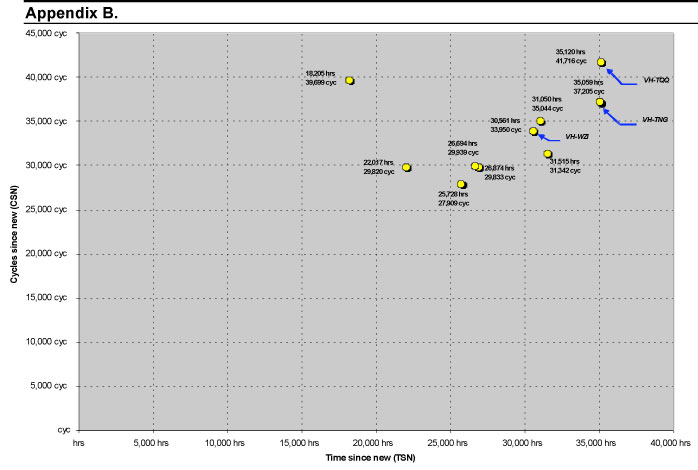
| Failure Date | Model DHC-8 | Aircraft SN | Aircraft TTIS | Aircraft TCIS | Actuator PN A44700- | Actuator SN | Actuator TSN | Actuator CSN | Failure Mode | Actuator Position | Hydraulic System |
|---|---|---|---|---|---|---|---|---|---|---|---|
| 2000 | 0799 | 22,668 hrs | |||||||||
| 2000 | 0989 | 25,019 hrs | |||||||||
| 2000 | 1860 | 15,217 hrs | |||||||||
| 4/02/2000 | 102 | 24745 | 009 | Burst | Left Outboard | 2 | |||||
| 27/10/2000 | 007 | 22,017 hrs | 29,820 cyc | Cracked | |||||||
| 05/2002 | 1690 | ||||||||||
| 23/07/2002 | 102 | 308 | 26874 | 29833 | 009 | 1148 | 26,874 hrs | 29,833 cyc | Cracked | Right Inboard | 1 |
| 2/08/2002 | 102 | 289 | 26694 | 29939 | 009 | 1154 | 26,694 hrs | 29,939 cyc | Cracked | Right Inboard | 1 |
| 01/2003 | 0837 | ||||||||||
| 02/2003 | 0906 | 31,050 hrs | 35,044 cyc | ||||||||
| 18/05/2003[2] | 102 | 14 | 009 | 0963 | 30,561 hrs | 33,950 cyc | Cracked | Left Outboard | 2 | ||
| 6/09/2003[1] | 41 | 009 | 0163 | 35,059 hrs | 37,205 cyc | Burst | Left Outboard | 2 | |||
| 07/2003 | 1673 | 18,205 hrs | 39,699 cyc | ||||||||
| 08/2003 | 1764 | 25,728 hrs | 27,909 cyc | ||||||||
| 23/10/2003 | 102 | 009 | 31,515 hrs | 31,342 cyc | Cracked | Left Outboard | 2 | ||||
| 7/9/2004[3] | 102 | 204 | 009 | 0954 | 35,120 hrs | 41,716 cyc | Burst | Right Outboard | 2 |
Notes:
SN - serial number
PN - part number
TTIS - total time in service
TCIS - total flight cycles in service
TSN - time since new
CSN - flight cycles since new
[1] - VH-TNG, subject occurrence
[2] - VH-WZI occurrence
[3] - VH-TQQ occurrence
Absence of information indicates data not available for the relevant occurrence.
Findings and Safety Action
FINDINGS
The investigation identified the following contributing safety factors.
- The part number A44700-009 roll spoiler actuator, as fitted to TNG, was susceptible to fatigue cracking as a result of deficiencies within the design of the actuator cylinder base
- The actuator ruptured as a result of fatigue cracking initiated due to the design deficiency and the accumulation of a sufficient number of flight cycles
- Rupture of the actuator allowed the loss of fluid contents from the number 2 hydraulic system, and the subsequent failure of that system.
SAFETY ACTION
Aircraft manufacturer
On 18 August 2004, the manufacturer issued In-Service Activity Report (ISAR) 2004-07-2760 advising that it considered the overall risks associated with the failure of the actuator as low, and to raise operator awareness of the actuator failure mechanism.
Transport Canada
Transport Canada, being the certification authority for the Dash 8 series of aircraft, conducted its own investigation of the issues associated with actuator failure. In communication with the ATSB, Transport Canada concurred with the aircraft manufacturer's risk management position and agreed that on the basis of current failure rates, no additional action was warranted.
Australian Transport Safety Bureau
The ATSB reviewed the responses and positions of the aircraft manufacturer, Transport Canada and the aircraft operator in relation to the potential for roll spoiler actuator failure to affect operational safety of the Dash 8. While it supports the risk management approach adopted by the manufacturer and Transport Canada, the ATSB believes that the issue of landing performance limitations imposed by a hydraulic system failure is not adequately addressed by this approach. Therefore, the ATSB issues the following safety advisory notice.
Safety Advisory Notice SAN20050012
The Australian Transport Safety Bureau notifies operators of Dash 8 aircraft fitted with part number A44700-007 and/or A44700-009 roll spoiler actuator components, of the increased risk of the cracking and/or rupture failure of the actuator cylinder section as the actuators accumulate service cycles. Failures have been sustained by actuators with service lives ranging from 27,909 to 41,716 cycles. Cracking or rupture of an actuator cylinder results in the loss of contents and subsequent failure of the associated aircraft hydraulic system. Given that the loss of an aircraft hydraulic system will result in extended landing distance requirements, operators are advised to consider the safety implications of operating affected aircraft to regions where the increased landing distance requirements may not be easily accommodated by available primary or alternate aerodromes.
Analysis
ANALYSIS
Actuator failure
The investigation determined that the roll spoiler actuator from TNG had failed as a result of the growth of fatigue cracking from within the actuator cylinder. Originating from the internal threads at the end of the cylinder, the cracking propagated under service pressure cycles to a point where it compromised the cylinder wall and subsequently caused the rupture of the housing.
ATSB research found records of 16 actuator failures within the world fleet, of the type and nature sustained by TNG. All such failures had occurred in part number A44700-007 or -009 actuators and all had occurred in units that had accumulated over 27,000 flight cycles. There was no record of failures of the newer part number 1556000-1 actuators.
On the basis of the investigation findings, it was apparent that the design of the A44700-007 and -009 actuators renders the units susceptible to fatigue cracking and failure under service conditions. The nature of design influenced fatigue failures is such that they typically present a range of cycles-to-failure that is characterised by a lower threshold value and an increasing number of failures as cumulative cycles increase. The distribution of known actuator failures reflects these features and as such, it is a reasonable expectation that the number of future failures will increase with the age of the Dash 8 fleet equipped with the A44700 series actuators.
Operational implications
Following the TNG actuator failure and increasing awareness of the actuator deficiencies, the aircraft manufacturer reviewed the issues from a risk management perspective and elected not to pursue any direct course of safety action, on the basis that the probability and risks presented by the events were low. From the information available, it was not apparent whether the aircraft manufacturer, in its decision not to implement any direct safety action, had considered the likelihood of an increasing frequency of actuator failure as the number of component flight cycles build across the fleet. Nor is it known if the manufacturer had considered the performance implications of actuator failure and hydraulic system loss where the aircraft was being operated into areas with limited runway distance availability.
Summary
Shortly after reaching a cruising altitude of 12,000 ft (FL120), the flight crew of a de Havilland Canada DHC-8-102 (Dash 8), registered VH-TNG, that was operating a scheduled passenger service from Brisbane to Roma (Queensland), were alerted to the failure and rapid loss of contents from the number-2 hydraulic system. Electing to return the aircraft to Brisbane, the flight crew carried out the relevant quick-reference handbook (QRH) checks, and after some initial difficulty, manually extended the landing gear.
Occurrence summary
| Investigation number | 200303861 |
|---|---|
| Occurrence date | 06/09/2003 |
| Location | Brisbane, Aero. |
| State | Queensland |
| Report release date | 01/02/2006 |
| Report status | Final |
| Investigation type | Occurrence Investigation |
| Investigation status | Completed |
| Mode of transport | Aviation |
| Aviation occurrence category | Hydraulic |
| Occurrence class | Incident |
| Highest injury level | None |
Aircraft details
| Manufacturer | De Havilland Canada/De Havilland Aircraft of Canada |
|---|---|
| Model | DHC-8 |
| Registration | VH-TNG |
| Serial number | 041 |
| Sector | Turboprop |
| Operation type | Air Transport High Capacity |
| Departure point | Brisbane, QLD |
| Destination | Roma, QLD |
| Damage | Nil |