

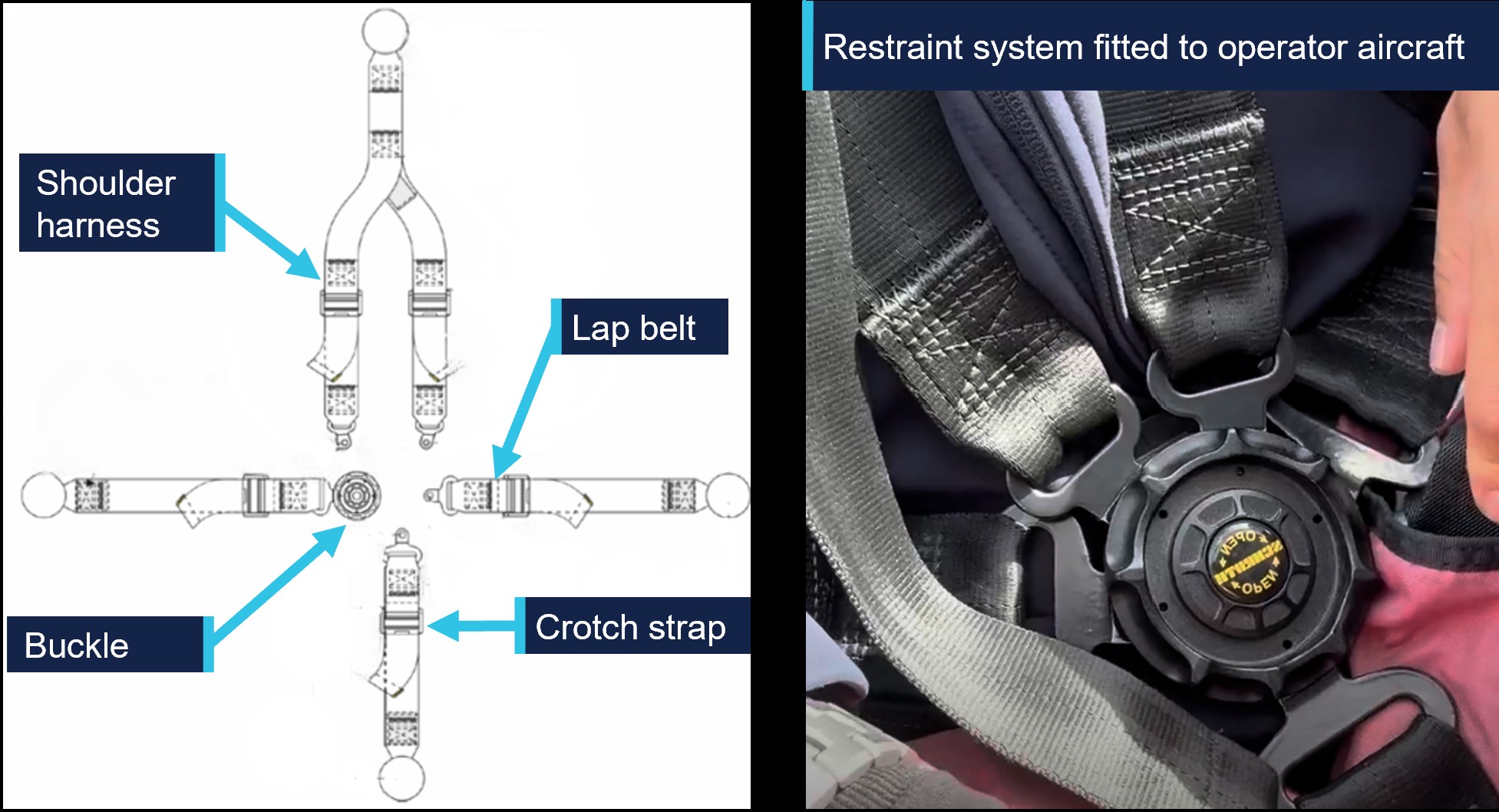
Worn latch and internal sub-parts led to the disconnection of part of a pilot’s five-point restraint during an aerobatic manoeuvre, resulting in minor injuries and a loss of control, an ATSB investigation report details.
The incident occurred on 4 February 2026 when an instructor and student pilot were conducting an upset prevention and recovery training flight in a CAP 10B aerobatic aircraft, operated by Flight Training Adelaide.
About half an hour after taking off from Adelaide’s Parafield Airport, at an altitude of about 7,000 ft, the instructor commenced the demonstration of a split S manoeuvre by rolling the aircraft inverted, at which point the crotch strap of their 5-point restraint system suddenly released.
“As a result of the strap disconnection, the instructor fell out of their seat, impacting the overhead canopy and briefly releasing pressure on the flight control stick,” explained ATSB Director of Transport Safety Kerri Hughes.
“With the aircraft in a nosedive with airspeed increasing, the instructor reported they completed a pitch roll to the left, and gently pulled out to ease out of the dive, recovering to normal flight.”
Air traffic control secondary surveillance data showed the aircraft recovered at about 3,000 ft, and the aircraft was then returned to Parafield without further incident. As a result of impacting the canopy, which sustained minor damage, the instructor received a minor head injury.
The investigation report notes that the instructor conducted pilot harness security checks both prior to the flight and before commencing aerobatic manoeuvres, and did not identify any issues.
“But examination of the buckle’s internal sub-parts and latches found evidence of wear that was present prior to the incident,” Ms Hughes said.
The investigation found that the manufacturer’s inspection method for the restraint system did not assure that deterioration within the buckle would be detected, and the restraint’s prescribed five-year service life did not account for the extent of use in some aerobatic training operations.
“This increased the likelihood of a restraint system with excessive wear remaining in service, as occurred here.”
Schroth, the manufacturer of the restraint, plans to amend the prescribed service life for the restraint system, when used during aerobatic flight, to include a time in service hour limit, layered with the existing calendar life limit.
Separately, Flight Training Adelaide has limited the use of the harness to three years, or 1,000 hours.
Ms Hughes noted the incident was highly relevant to the ATSB’s ongoing SafetyWatch priority, reducing the severity of injuries and accidents involving small aircraft.
“Restraints are a crucial part of reducing injury outcomes in light aircraft accidents and incidents, but it can be difficult to ensure serviceability if worn restraint system components are not readily visible,” she said.
“By conducting analysis of their products, and rectifying unexpected problems as they arise, restraint system manufacturers play a pivotal role in ensuring the continued airworthiness of aircraft components.”
Read the final report: Restraint release and loss of control involving Avions Mudry & Cie CAP 10B, VH-YAO, 29 km north-north-west of Edinburgh Airport, South Australia, on 4 February 2026